Article

A High-Speed Optical Vector Signal Time-Domain Analysis System Based on Linear Optical Sampling

School of Electronic Engineering, Beijing University of Posts and Telecommunications (BUPT), Beijing 100876, China
*
Author to whom correspondence should be addressed.
These authors contributed equally to this work.
Electronics 2026, 15(12), 2584; https://doi.org/10.3390/electronics15122584
Submission received: 15 April 2026 / Revised: 8 June 2026 / Accepted: 9 June 2026 / Published: 11 June 2026
(This article belongs to the Section Optoelectronics)

Abstract

As the modulation rate in high-speed optical communication systems continues to increase and modulation formats become increasingly complex, conventional electrical-domain sampling techniques, limited by the “electronic bottleneck,” are unable to meet the time-domain analysis requirements of optical vector signals with bandwidths exceeding 100 GHz. In this paper, a system based on linear optical sampling (LOS) is implemented for time-domain analysis of high-speed polarization-division-multiplexed (PDM) optical vector signals. An unbalanced input method is proposed to ensure the integrity of the sampling clock when the power of the signal under test is zero; a resampling method combined with soft integration is proposed to replace the conventional peak detection method, improving the accuracy of sampling point position and amplitude information extraction; and an adaptive frequency offset estimation algorithm is proposed to compensate for the continuously varying frequency offset caused by the use of low-repetition-rate sampling pulses. We constructed a signal acquisition system for optical vector signal measurement based on LOS. Using the above methods, the eye diagrams and constellation diagrams of 50 Gbaud PDM-QPSK (quadrature phase-shift keying), PDM-16QAM (quadrature amplitude modulation), and PDM-32QAM signals are successfully measured, and related parameters, including error vector magnitude (EVM) and signal-to-noise ratio (SNR), are calculated. The experimental results show that the proposed system achieves quasi-real-time measurement of 500 Gbps optical vector signals, and the measured performance parameters are on the same order of magnitude as those obtained from a commercial high-speed oscilloscope.

1. Introduction

With the rapid growth of emerging data services such as cloud computing, big data, and the computational demands of AI-driven large language models, significant challenges have been imposed on network traffic capacity. The current 400 Gbps Ethernet deployed in hyperscale data centers is no longer sufficient to meet traffic requirements [1], making network upgrades an urgent priority. Submarine optical fiber communication cables (SCCs) carry 98% of international Internet traffic [2]. To increase the capacity of fiber-optic transmission systems, various modulation formats and multiplexing techniques have been developed. The bandwidth of commercially available electro-optic modulators has already exceeded 120 GHz [3], and, by using high-order modulation formats together with polarization multiplexing, the net data rate of a single carrier is expected to reach 1.6 Tbps [4]. In long-haul communications, by combining probabilistic shaping with optical-domain power equalization, a C+L band DWDM transmission system carrying 96 wavelengths at 800 Gbps carried by a single wavelength over a distance of 1000 km can be achieved [5]. In short-reach interconnects between or within hyperscale data centers, by using multi-dimensional multiplexing techniques in multi-core few-mode fibers, a transmission system with a capacity exceeding 100 Tbps over a distance of 10 to 50 km can be realized [6]. With increasing modulation rates, complexity of modulation formats, and diversity of multiplexing schemes, data acquisition has become increasingly difficult for time-domain measurement equipment [7]. Currently, time-domain signal measurement is performed by an oscilloscope in the electrical domain. When signal bandwidths exceed 100 GHz, the response speeds of electrical sampling gates and analog-to-digital conversion circuits require more than 200 GHz. As communication rates continue to increase, the implementation of even faster digital circuits will become out of reach due to the fundamental limitation known as the “electronic bottleneck” [8]. Current high-speed optical communication systems employ high-order modulation formats and polarization multiplexing schemes, such as PDM-QPSK and PDM-MQAM [9]. The received signals are optical vector signals, the reception complexity of which is far higher than that of OOK signals. Generally, coherent detection is needed to separate the in-phase and quadrature components, with balanced photodetectors (BPDs) performing the optical-to-electrical conversion. The bandwidth of BPDs is currently evolving from the mainstream 50 GHz toward more than 100 GHz, and achieving higher bandwidth is jointly constrained by the physical limitations of photodiodes and the bottleneck of broadband low-noise amplifier circuits [10], so a breakthrough in this area still requires considerable time. Polarization demultiplexing, frequency offset and phase offset estimation, as well as channel crosstalk introduced by wavelength division multiplexing and mode division multiplexing, all require support from complex digital signal processing algorithms. Therefore, a broadband optical vector signal analysis system that supports polarization multiplexing and is capable of performing time-domain analysis at the current 100 GHz bandwidth and remains applicable after future bandwidth upgrades is of great urgency.
For time-domain analysis of high-speed optical signals, the bandwidth limitation of the sampling gate must first be addressed. Through dispersive Fourier transformation, high-speed time-domain optical signals can be converted to the frequency domain in real time, and, after frequency-domain sampling, the time-domain signal can be recovered by inverse Fourier transformation in the digital domain, enabling real-time measurement of high-speed optical signals. However, this approach requires simultaneous acquisition of both the amplitude and phase of the signal under test, needs high-speed interleaving to split the signal, and relies on complex digital signal processing algorithms. Moreover, without an optical buffer, the complete waveform of the signal cannot be obtained [11,12]. Since optical-domain sampling can overcome the bandwidth limitation encountered in electrical-domain sampling, optical sampling has attracted increasing attention in the time-domain analysis of high-speed optical signals. Ref. [13] reported the use of four-wave mixing in highly nonlinear fibers to perform optical sampling on line signals with QPSK and QAM modulation formats. An all-optical sampling gate based on a nonlinear optical loop mirror utilizing the cross-phase modulation effect of a semiconductor optical amplifier (SOA) that achieves sampling of periodic signals at 500 MHz was proposed in Ref. [14]. However, sampling gates based on four-wave mixing require strict phase matching, and the carrier recovery time of SOAs limits the response speed of the SOA-based sampling gate, which is also accompanied by the adverse effects of cross-gain modulation.
Since optical vector signals are used in high-speed optical communication systems, linear optical sampling (LOS) technology based on the principle of coherent mixing has attracted considerable attention. Ref. [15] described a linear optical sampling system using waveguide-based optical mixing, which achieved eye diagram and constellation diagram measurements of PSK signals at 40 Gbps. Ref. [16] proposed a quasi-real-time coherent optical sampling method that combines high-speed signal acquisition with DSP algorithms, achieving measurement of PDM-QPSK signals at 107 Gbaud and demonstrating that the measurable signal bandwidth of optical sampling is much greater than electrical sampling. Ref. [17] proposed a method to overcome the limitation caused by the non-ideal response of balanced photodetectors in LOS-based coherent detection, enabling accurate measurement of 32 Gbaud PDM-QPSK signals.
The bandwidth of photodetectors and analog-to-digital converters (ADCs) is another limiting factor in the time-domain analysis of high-speed optical signals. By using low-repetition-rate optical pulses to perform down-sampling of high-speed optical signals in the optical domain, the bandwidth requirements of photodetectors and ADCs can be reduced. Although the complete signal waveform cannot be obtained in this way, the eye diagram of a random signal can be reconstructed through digital-domain algorithms. Ref. [18] proposed a software-synchronized all-optical sampling system that is capable of reconstructing the signal eye diagram and calculating its Q-factor without requiring clock recovery. Ref. [19] proposed a software synchronization algorithm based on the chirp-z transform, which achieves accurate clock synchronization with low computational complexity. Ref. [20] proposed a synchronization algorithm that calculates the offset frequency between the data bit rate and the sampling rate, enabling reconstruction of the signal eye diagram.
From a theoretical perspective, the eye diagrams and constellation diagrams of a signal can be reconstructed through LOS. However, the integrity of the sampling clock, the method used to extract sampling information, and the digital signal processing algorithms employed in coherent detection directly determine the success of the measurement and the accuracy of the measurement results. The sampling frequency in the optical domain is determined by the repetition rate of the mode-locked laser. The sampling pulse serves as the local oscillator (LO) light in LOS, and, when the power of the signal under test is low or zero, the BPD cannot output the sampling pulse, making it impossible to extract the sampling clock in subsequent data processing and thus preventing the determination of the correct position of each sampling point. The accuracy of sampling information extraction directly determines the quality of the eye diagram. The sampling information includes the position and amplitude of each sampling point, and the conventional extraction method is the peak detection method. Since the time-domain width of the sampling pulse is very small, only a limited number of values can be obtained after the ADC, making it difficult to accurately determine the position and amplitude. Inaccurate position information leads to large timing jitter in the eye diagram, while inaccurate amplitude information reduces the vertical eye opening and degrades the signal-to-noise ratio. Since low-repetition-rate sampling pulses are used to sample high-speed optical signals, the phase difference between adjacent sampling points caused by frequency offset is large, and the frequency offset also drifts as the amount of data grows. The choice of an appropriate frequency offset estimation algorithm directly affects the quality of the eye diagram and constellation diagram. In this paper, an unbalanced input method is proposed to solve the problem of sampling clock loss when the signal under test is zero, a resampling method combined with soft integration is proposed to accurately extract sampling point information, and an adaptive frequency offset estimation algorithm is proposed for accurate frequency offset tracking and fine compensation. Using the above methods, the algorithm verification was completed with 32 Gbaud signals, and, based on the constructed LOS measurement system, the eye diagrams and constellation diagrams of 50 Gbaud PDM-QPSK, PDM-16QAM, and PDM-32QAM signals were successfully measured, and related parameters, including EVM and SNR, were calculated. The measured performance parameters are on the same order of magnitude as those obtained from a commercial high-speed oscilloscope.

2. Principles and Methods

The LOS system used in this paper is designed for time-domain analysis of optical vector signals, where the signals are modulated with IQ modulation and transmitted using polarization-division multiplexing. The overall system architecture, as illustrated in Figure 1, consists of three main components: the signal generation module, the linear optical sampling module, and the digital signal processing (DSP) module.
In the signal generation module, a continuous-wave (CW) laser with a wavelength of 1550 nm, a linewidth of 100 kHz, and an output power of 13 dBm is first split into X- and Y-polarized components using a polarization beam splitter (PBS). These two polarization components are then injected into an IQ electro-optic modulator. A random sequence generated by an arbitrary waveform generator is processed through serial-to-parallel conversion, pulse shaping, and digital-to-analog conversion, and, after passing through a driver amplifier, the resulting signal is loaded onto the radio-frequency port of the modulator to modulate the continuous-wave light, generating X-polarization and Y-polarization optical vector signals, which are then combined by a polarization beam combiner to complete polarization multiplexing.
In the linear optical sampling module, the sampling pulses are generated by a mode-locked laser with a repetition rate around 100 MHz, which is tunable with a resolution of 0.01 MHz. The temporal width of the optical pulses is approximately 1 ps. These sampling pulses serve as the local oscillator (LO) reference and are combined with the signal under test through a polarization beam splitter. The two optical fields interfere in an optical hybrid, enabling down-converted optical sampling and separation of the in-phase (I) and quadrature (Q) components. The balanced photodetectors are then used to cancel the common-mode components and complete the optical-to-electrical conversion, and the resulting signals are digitized by an ADC with a sampling rate of 2.5 GSa/s. In the digital signal processing part, the eye diagram and constellation diagram of the signal are reconstructed after sequentially performing IQ orthogonalization, polarization demultiplexing, sampling point information extraction, frequency offset compensation, and clock synchronization.

2.1. Unbalanced Input Method for Sampling Clock Preservation

In the linear sampling part, the sampling pulse serves as the local reference signal and enters the 90° optical hybrid together with the signal under test. The electric field amplitudes of the signal light and the reference light can be expressed as
E s = s ( t ) · exp j ( ω s t + ϕ s ( t ) ) E L O = g ( t k T ) · exp j ( ω L O t + ϕ L O )
where s ( t ) denotes the amplitude function of the signal light under test, ω s denotes the center frequency of the signal light, and ϕ s denotes the modulation phase information and random phase noise of the signal light. g ( t k T ) denotes the pulse waveform function of the sampling pulse, k denotes the k-th sampling pulse, T denotes the time interval of the periodic sampling pulses, ω L O denotes the center frequency of the sampling pulse, and ϕ L O denotes the phase of the sampling pulse. In this work, a 4 × 4 optical hybrid is used, and, taking the X polarization as an example, the four outputs of the X polarization are:
E I + = 1 2 ( E s + E L O ) E I = 1 2 ( E s E L O ) E Q + = 1 2 ( E s + j E L O ) E Q = 1 2 ( E s j E L O )
The four output ports of the X polarization from the optical hybrid are typically connected to two pairs of photodetectors. Taking the I channel as an example, the resulting photocurrent is
i I + = R 2 ( A s 2 + A L O 2 + 2 A s A L O cos ( ϕ s ϕ L O ) ) i I = R 2 ( A s 2 + A L O 2 2 A s A L O cos ( ϕ s ϕ L O ) )
where R is the responsivity of the photodetector, A s 2 = | E s | 2 , A L O 2 = | E L O | 2 , and the output of the balanced photodetector is:
i I = 2 R A s A L O cos ( ϕ s ϕ L O ) i Q = 2 R A s A L O sin ( ϕ s ϕ L O )
It can be seen from Equation (4) that, when the power of the signal under test is low or zero, the sampling clock at the output of the balanced photodetector disappears, making it impossible to determine the correct position of each sampling point. To address the clock vanishing problem, we propose attenuating the power of one branch in the I and Q paths (for example, I + or Q + ) by an attenuation factor n ( n < 1 ). The choice of the attenuation factor n entails a trade-off between the signal-to-noise ratio of the sampling clock and the detection amplitude of the signal under test. As shown in Equation (5) below, the coefficient of the signal term is proportional to ( n + 1 ) . Compared with the coefficient of 2 in the ideal balanced detection case ( n = 1 ), the relative loss in signal amplitude is 1 ( n + 1 ) / 2 . As n decreases, the magnitude of the residual DC term | n 1 | increases, making the sampling clock more intact, but the signal detection amplitude decreases accordingly. The output of the balanced photodetector becomes:
i I = R 2 ( n 1 ) ( A s 2 + A L O 2 ) + A s A L O R ( n + 1 ) cos ( ϕ s ϕ L O ) i Q = R 2 ( n 1 ) ( A s 2 + A L O 2 ) + A s A L O R ( n + 1 ) sin ( ϕ s ϕ L O )
It can be seen from Equation (5) that, when the power of the signal under test is zero, the output sampling pulse current is R 2 ( n 1 ) A L O 2 . Compared with Equation (4), the current of the signal under test is proportional to A s A L O R ( n + 1 ) , and, at the cost of a limited reduction in detection amplitude ( R ( n + 1 ) < 2 R ), the complete sampling clock and the signal under test are both preserved.
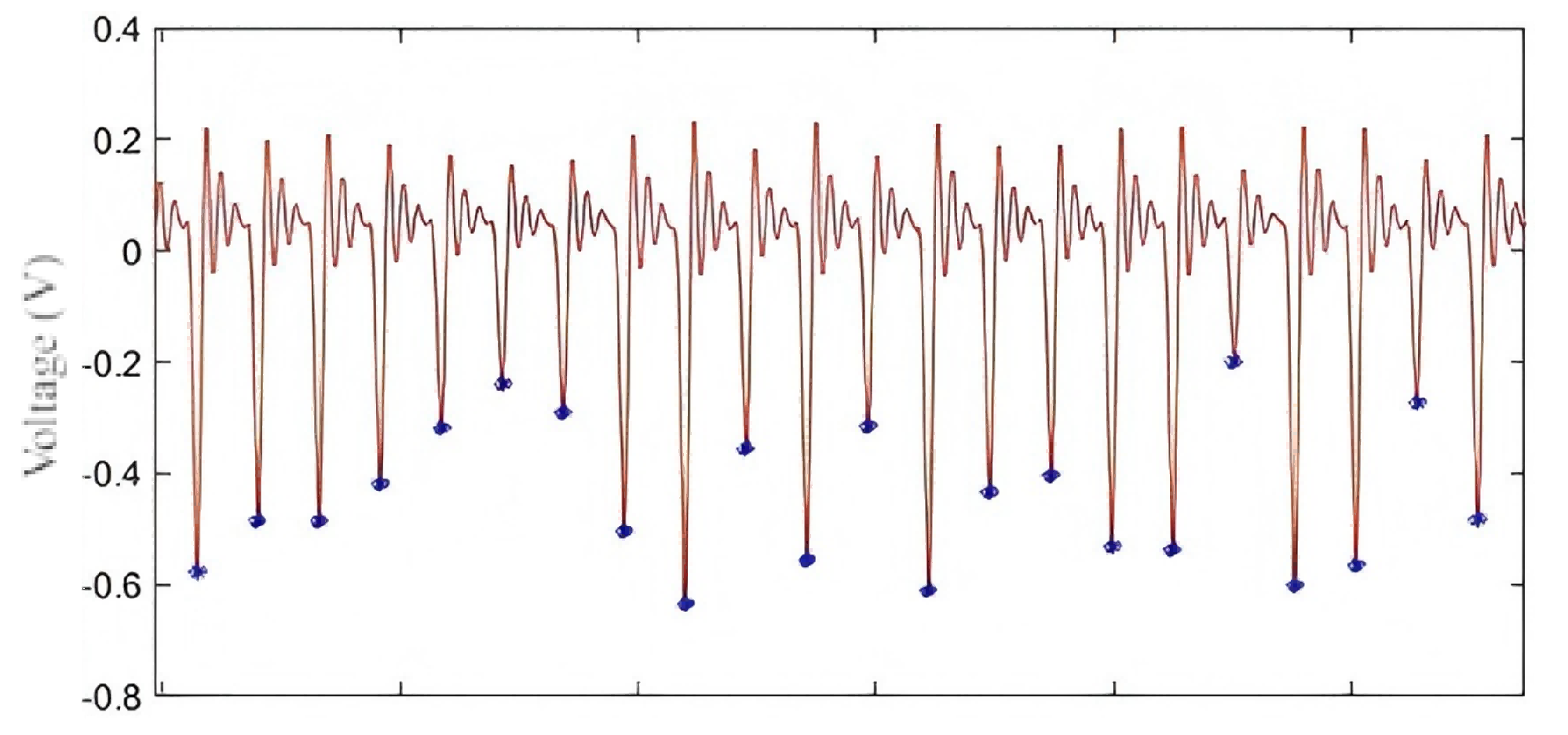
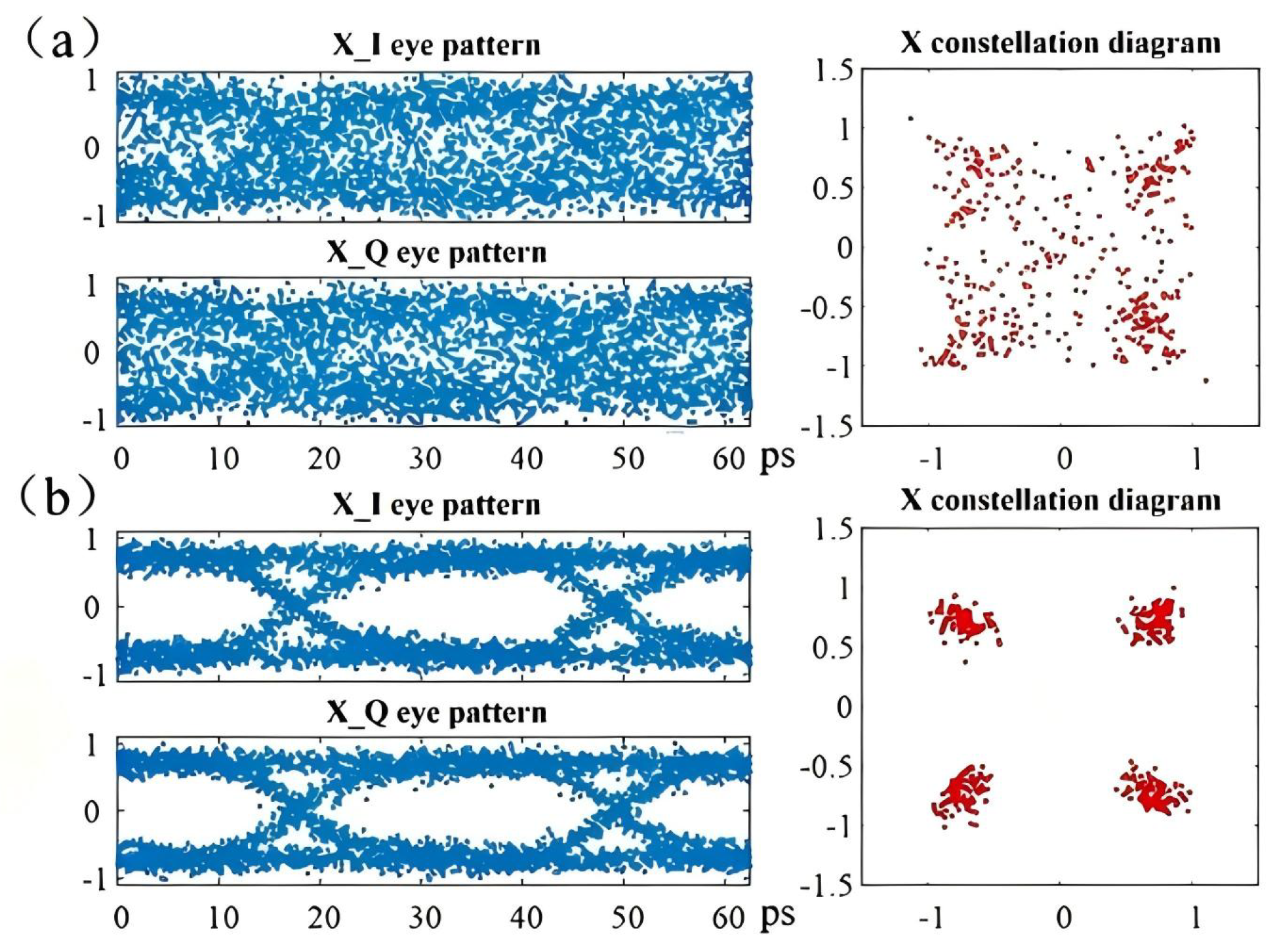
To verify the scheme of using the unbalanced input method to solve the sampling clock missing problem, we constructed an experimental system according to the principle shown in Figure 1. The signal under test was a 32 GBaud QPSK random signal generated by a Keysight M8195A arbitrary waveform generator, and the signal was captured by a Keysight UXR0594AP oscilloscope. Figure 2 shows the I-channel signal of the X polarization at the output of the BPD measured by the oscilloscope, which contains a uniform sampling clock. Figure 3 shows the reconstruction results of the eye diagrams and constellation diagrams of the X and Y polarization signals when the signal is a QPSK random signal with 32 GBaud. Figure 3a shows the case without attenuation, where the eye diagram and constellation diagram cannot be correctly recovered due to incomplete synchronization clock information. Figure 3b shows the case with attenuation introduced, where the eye diagram and constellation diagram of the QPSK signal can be correctly reconstructed after signal processing. In the experiment, we chose n 0.8 , which results in a relative loss in signal amplitude of approximately 10%. The impact on the measurement signal-to-noise ratio is negligible, while the sampling clock can be reliably extracted, ensuring the correctness of subsequent clock synchronization and sampling information extraction.

2.2. Resampling Combined with Soft Integration

Accurate extraction of position and amplitude information is a key step in reconstructing correct eye diagrams and constellation diagrams. The conventional information extraction method is the peak detection method, in which a fast Fourier transform is first applied to a block of data to extract the repetition period of the sampling clock. A maximum value is then searched from the first few tens of data as the initial peak, and the positions and amplitudes of the remaining sampling points are identified in sequence by counting the number of ADC conversions within one sampling clock period.
The use of the peak detection method for extracting position and amplitude information introduces significant errors. The time-domain width of the sampling pulse at the output of the BPD is typically around 1 ns, and, with an ADC sampling rate of 2.5 GSa/s, only 4 conversion data points are obtained within one sampling pulse. Since the sampling pulses and the ADC clock are not synchronized, the maximum value among these 4 conversion data points does not represent the actual peak value or the position of the sampling pulse.
In this paper, we propose a method combining resampling and soft integration to replace the conventional peak detection method for sampling information extraction. A maximum value is first searched from the first few tens of data points, and 10 data points are taken on each side of this maximum value as a sampling point group. Cubic spline interpolation is then applied to reconstruct a sampling pulse, with an interpolation factor of 100, i.e., 99 new data points are uniformly inserted between adjacent ADC samples, improving the time resolution from 400 ps to 4 ps and thereby enabling a more precise determination of the peak position of the sampling pulse. The peak position of this reconstructed pulse is used as the starting position of the sampling clock. The positions of the remaining sampling points are then determined by counting the number of ADC conversions within one sampling clock period, and the other sampling point groups are identified in sequence, with the corresponding sampling pulses reconstructed accordingly.
Since the sampling pulse used as the LO has high energy, with an average power of 6 mW and a more than 30 nm bandwidth at 3 dB, the pigtails of the optical hybrid and the BPDs introduce nonlinearity and dispersion, causing changes in the pulse shape and temporal broadening. In addition, since a low-bandwidth BPD is used, the resulting pulse in the electrical domain is further broadened. Therefore, the peak value of the sampling pulse reconstructed from the ADC data cannot represent the accurate information of the sampling point.
Since the time-domain width of the sampling optical pulse is only on the order of picoseconds, after passing through the LOS system, it approximates an impulse function that samples the signal under test. Taking the I channel signal as an example, the amplitude related to the signal under test can be expressed as
A I ( t ) = g ( k T ) s ( k T ) ( n + 1 ) cos ( ϕ s ϕ L O )
where A I represents the amplitude information of the sampling point at t = k T . During transmission, although the linear and nonlinear phase changes in the pulse fiber link alter the pulse shape, the energy of the pulse remains unchanged. Considering that the pulse width is much smaller than the pulse period, Δ t is the half-window width of integration, taken to be several times the temporal width of the sampling pulse to ensure that the entire energy of the sampling pulse is included while also satisfying Δ t < T / 2 to avoid energy leakage from adjacent sampling pulses. In this system, the 3 dB bandwidth of the balanced photodetector is 1 GHz, and the electrical pulse broadened by the BPD has a width of approximately 1 ns. The half-window width Δ t is set to 2.5 ns, approximately 2.5 times the broadened electrical pulse width, to ensure that the full energy of the sampling pulse is captured. Since the sampling pulse period T 10 ns (corresponding to a repetition rate of approximately 100 MHz), Δ t = 2.5 ns < T / 2 = 5 ns, which satisfies the condition of avoiding energy leakage from adjacent sampling pulses. Within the time range centered at the k-th sampling point k T with a half-window width of Δ t , the following condition is satisfied:
A I ( k T ) k T Δ t k T + Δ t A I ( t ) d t
The impulse response function of the BPD can be expressed as the product of its responsivity and a low-pass system response h ( t ) . The BPD used in this system has a 3 dB bandwidth of 1 GHz, and its impulse response h ( t ) can be approximated by that of a first-order low-pass system, i.e., h ( t ) = 1 τ exp ( t / τ ) · u ( t ) , where τ = 1 / ( 2 π f 3 dB ) 159 ps and u ( t ) is the unit step function. Under this approximation, a picosecond optical sampling pulse is broadened to an electrical pulse of approximately 1 ns after passing through the BPD, which is consistent with experimental observations. After passing through the BPD,
i I ( t ) = R A I ( t ) h ( t )
Since low-repetition-rate sampling pulses at around 100 MHz are used and the bandwidth of the BPD is about 1 GHz, the BPD receives 10 harmonics, and it can be considered that i I ( t ) contains the total energy of A I ( t ) . The peak value of the interpolated i I ( t ) waveform cannot represent the energy of A I ( t ) , and the energy of i I ( t ) is the integral of its amplitude over time, so:
A I ( k T ) k T Δ t k T + Δ t i I ( t ) d t
The proportionality symbol (∝) rather than an equality sign is used in Equations (7) and (9) because the two sides differ by a fixed proportionality constant determined by system parameters such as the sampling pulse energy and the detector responsivity. Since all integrated values are scaled by a uniform factor in subsequent processing, this constant is cancelled out and does not affect the final measurement results.
The performance of the resampling combined with soft integration method is affected by the ADC sampling rate, the sampling pulse width, and system noise. A higher ADC sampling rate provides more raw data points within each sampling pulse window, leading to higher interpolation accuracy and more accurate soft integration results. This system uses an ADC with a sampling rate of 2.5 GSa/s, and there are approximately 20 data points within each sampling pulse window. After 100-fold interpolation, sufficient time resolution can be obtained. The sampling pulse width determines the choice of the integration window Δ t : the narrower the pulse, the smaller the required Δ t . However, because the limited bandwidth of the balanced photodetector broadens the pulse, the actual integration window is determined by the width of the broadened electrical pulse. In terms of noise, the soft integration process has an averaging effect on the noise within the integration window, offering better noise immunity compared with single-point peak extraction. It should be noted that, since the unbalanced input method is adopted in this system, the output of the balanced photodetector contains a DC residual term, as shown in Equation (5). Before performing the soft integration, this DC baseline is first removed: the average DC offset is estimated from the signal-free intervals between adjacent sampling pulses, and this offset value is subtracted from the integration result within each sampling pulse window, thereby eliminating the influence of the DC component introduced by the unbalanced detection on the integration result.
Regarding the extraction of amplitude information, since the energy of each sampling pulse generated by the mode-locked laser is identical, the integration result for each sampling point in Equation (9) is linearly proportional to the optical-field amplitude A I ( k T ) of the signal under test. Therefore, the integrated values can be directly used as the amplitude information of each sampling point without any nonlinear energy-to-amplitude conversion. In practice, the integrated values of all sampling points are scaled by a uniform factor for subsequent eye diagram reconstruction and constellation diagram plotting.
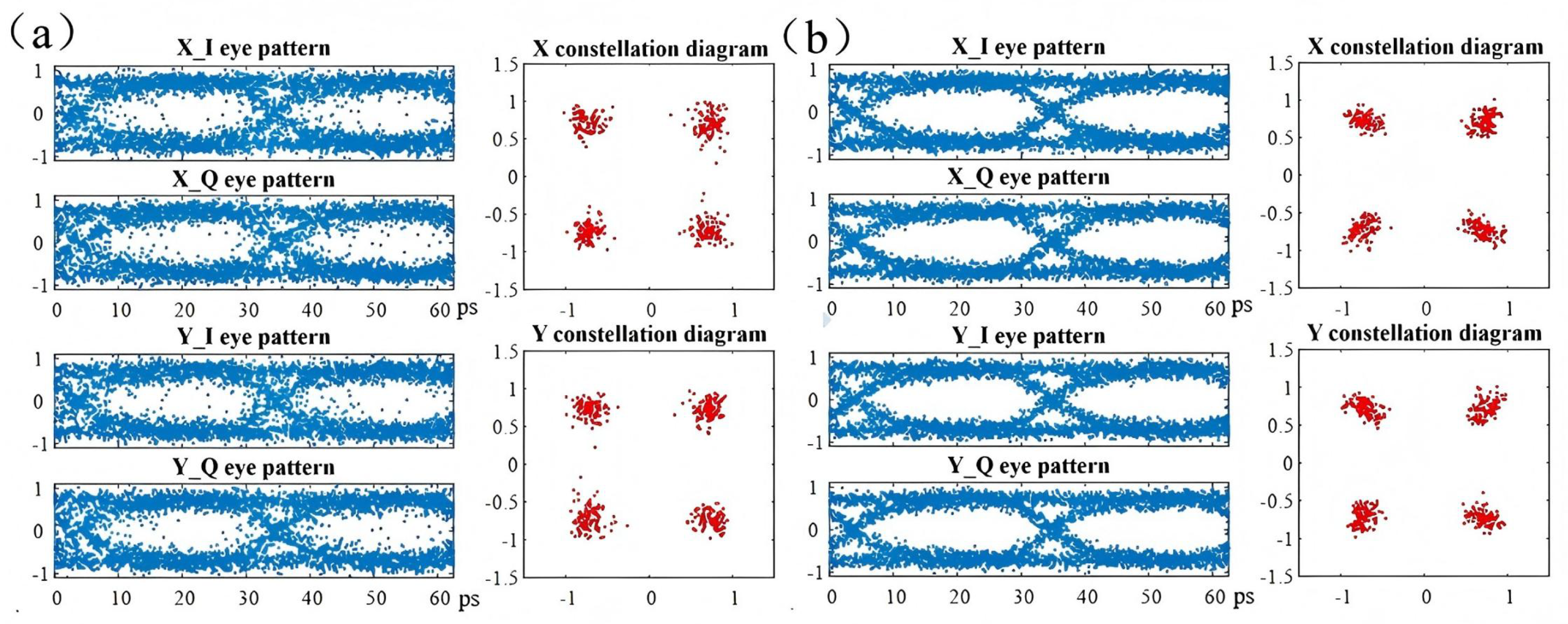
The effectiveness of the sampling information extraction method combining resampling and soft integration is also verified experimentally. The signal under test is a QPSK random signal with 32 Gbaud, which is captured by an oscilloscope and processed offline. The results are shown in Figure 4, where Figure 4a and Figure 4b show the constellation diagrams and eye diagrams obtained by the peak detection method after resampling and the method combining resampling and soft integration, respectively. It can be seen that the eye diagram in Figure 4b shows smaller rising edge jitter, indicating that the extracted position information is more accurate. The upper and lower edges of the eye diagram are clearer with a larger eye opening, indicating that the extracted amplitude information is more accurate. From the comparison of the constellation diagrams, the EVM is improved from 15% to 7% with the proposed method.

2.3. Adaptive Frequency Offset Estimation

Frequency offset compensation is a critical step in ensuring the accurate reconstruction of eye diagrams and constellation diagrams. When sampling high-speed optical signals with low-repetition-rate sampling pulses, the frequency offset can cause large phase differences between adjacent sampling points; moreover, as the length of the transmitted data increases, the laser frequency offset may also drift continuously. For high-order MQAM modulation formats such as 16QAM, the conventional FFT-based frequency offset estimation algorithm is affected by these factors, resulting in relatively large estimation errors and limited compensation performance. To address this, this paper proposes a block-based adaptive frequency offset estimation and compensation method. First, the M-th power operation is applied to the long data sequence to strip off the modulation phase information, and a coarse frequency offset estimate is obtained via FFT, completing an initial coarse compensation of the entire data sequence. Then, the global data is uniformly divided into N sub-blocks so that the residual frequency offset within each sub-block can be considered approximately constant, and fine residual frequency offset compensation is performed block by block. Finally, the sub-block data are recombined to reconstruct the signal, achieving high-precision dynamic frequency offset compensation under time-varying frequency offset drift conditions.
In the M-th power operation, M = 4 is uniformly adopted for all three modulation formats considered in this paper. For QPSK signals, the 4th-power operation maps all four equally spaced phase states (0°, 90°, 180°, and 270°) to the same phase, thereby strictly eliminating the modulation phase information and retaining only the frequency offset component. For multi-level modulation formats such as 16QAM and 32QAM, the constellation points have non-uniform amplitudes and phases, and the 4th-power operation cannot strictly eliminate the modulation phase information of each individual sampling point. However, since the modulation data is random and all constellation points appear with equal probability, when the data length is sufficiently large, the modulation phase information after the 4th-power operation is spread across the spectrum as a low noise floor, while the frequency offset component is concentrated into a prominent spectral peak. The coarse frequency offset estimate can therefore be obtained by detecting the peak position and dividing by 4. As the modulation order increases, the noise floor rises accordingly, and the accuracy of the coarse estimate decreases. However, since this coarse estimate is used only for initial compensation and the residual frequency offset is subsequently eliminated by the block-based fine compensation algorithm, the uniform choice of M = 4 is applicable to all three modulation formats.
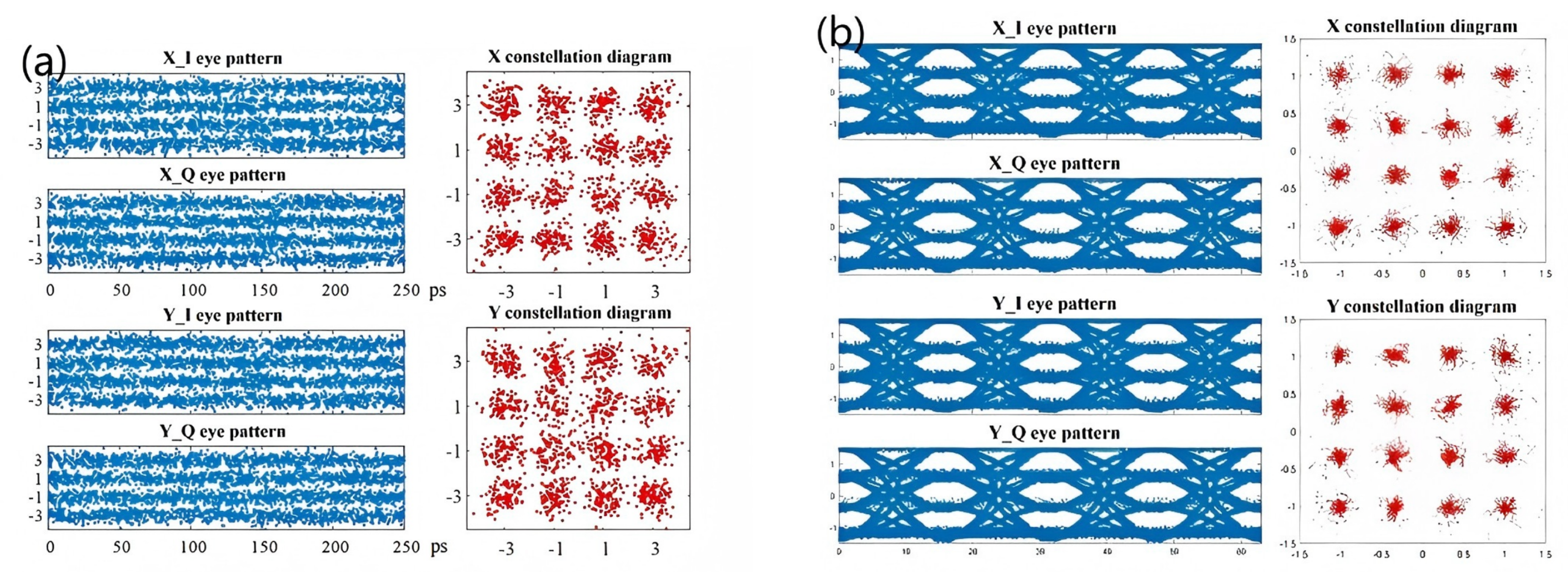
The performance of the proposed algorithm was verified by constructing an experimental platform. A 32-GBaud 16QAM random modulated signal was used in the experiment, which was captured by an oscilloscope and processed via offline digital signal processing. In adaptive frequency offset estimation, the choice of the number of segments N involves a trade-off between the tracking accuracy of the frequency offset and the estimation accuracy within each individual segment. When N is small, each segment has a relatively long data length, and the frequency offset drift within a segment cannot be neglected, degrading the compensation accuracy of the residual offset. When N is too large, the number of sampling points in each segment becomes insufficient, reducing the statistical accuracy of frequency offset estimation. In the experiment, we tested the EVM of the 32-GBaud PDM-16QAM signal at different values of N. For N = 1 (i.e., without segmentation), the EVM was approximately 17%, consistent with the result of conventional FFT-based frequency offset estimation. As N increased, the EVM gradually improved, reaching an optimum of about 9% when N was in the range of 15 to 25. When N further increased beyond 50, the frequency offset estimation accuracy deteriorated due to insufficient sampling points per segment, and the EVM began to rise. Taking all these factors into consideration, N = 20 was chosen for this system. The experimental results are shown in Figure 5, where Figure 5a and Figure 5b present the eye diagrams and constellation diagrams obtained by the conventional FFT-based frequency offset estimation and the proposed adaptive block-based frequency offset compensation, respectively. It can be seen from the comparison that the eye diagram opening reconstructed by the proposed algorithm is significantly better than that of the conventional algorithm, and the EVM of the constellation diagram is improved from 17% to 9%, which effectively verifies the feasibility and superiority of the block-based adaptive frequency offset compensation method.

3. Experimental Setup and Results

Combined with the unbalanced input method, the resampling combined with soft integration method, the adaptive frequency offset estimation method, and other signal processing methods proposed in this paper, we designed a quasi-real-time time-domain analysis system for high-speed optical vector signals. The system controller is an NI PXIe-8861, equipped with an Intel® Xeon® Processor E3-1515M and a bus throughput of up to 32 GB/s; the data acquisition card is an NI PXIe-5160, featuring four 2.5 GSa/s data channels corresponding to the I and Q signals of the X and Y polarizations, respectively; the optical hybrid is a COH28-X from Kylia (Gradignan, France), which realizes dual-polarization demodulation using two single-polarization hybrids, providing the I and Q signals for X-Pol and Y-Pol; the balanced photodetectors are PDB428 from Thorlabs (Newton, NJ, USA), with a bandwidth of 1 GHz. The XI, XQ, YI, and YQ signals output by the balanced photodetectors are acquired and converted into digital signals. The resampling combined with soft integration method constitutes the sampling point position and amplitude information extraction module, and the adaptive frequency offset estimation method is incorporated into the frequency offset estimation module. Together with the orthogonal normalization, polarization demultiplexing, software synchronization, and other digital signal processing modules, all processing is executed on the system controller. The eye diagrams and constellation diagrams of the signal under test are constructed from the processed data, and the measurement results are compared with those from the Keysight UXR0594AP oscilloscope.
It should be noted that the algorithm verification in Section 2 was performed using 32 Gbaud signals. The three proposed methods, the unbalanced input method, the resampling combined with soft integration method, and the adaptive frequency offset estimation method, are all independent of the baud rate of the signal under test, and their core processing steps are unrelated to the modulation rate of the signal under test. When the baud rate is increased from 32 Gbaud to 50 Gbaud, it is only necessary to adjust the interpolation factor and the integration window parameters according to the actual sampling clock repetition frequency and the ADC sampling rate; the algorithm flow itself requires no modification. Based on this, measurement verification has been carried out on 50 Gbaud signals with this system.
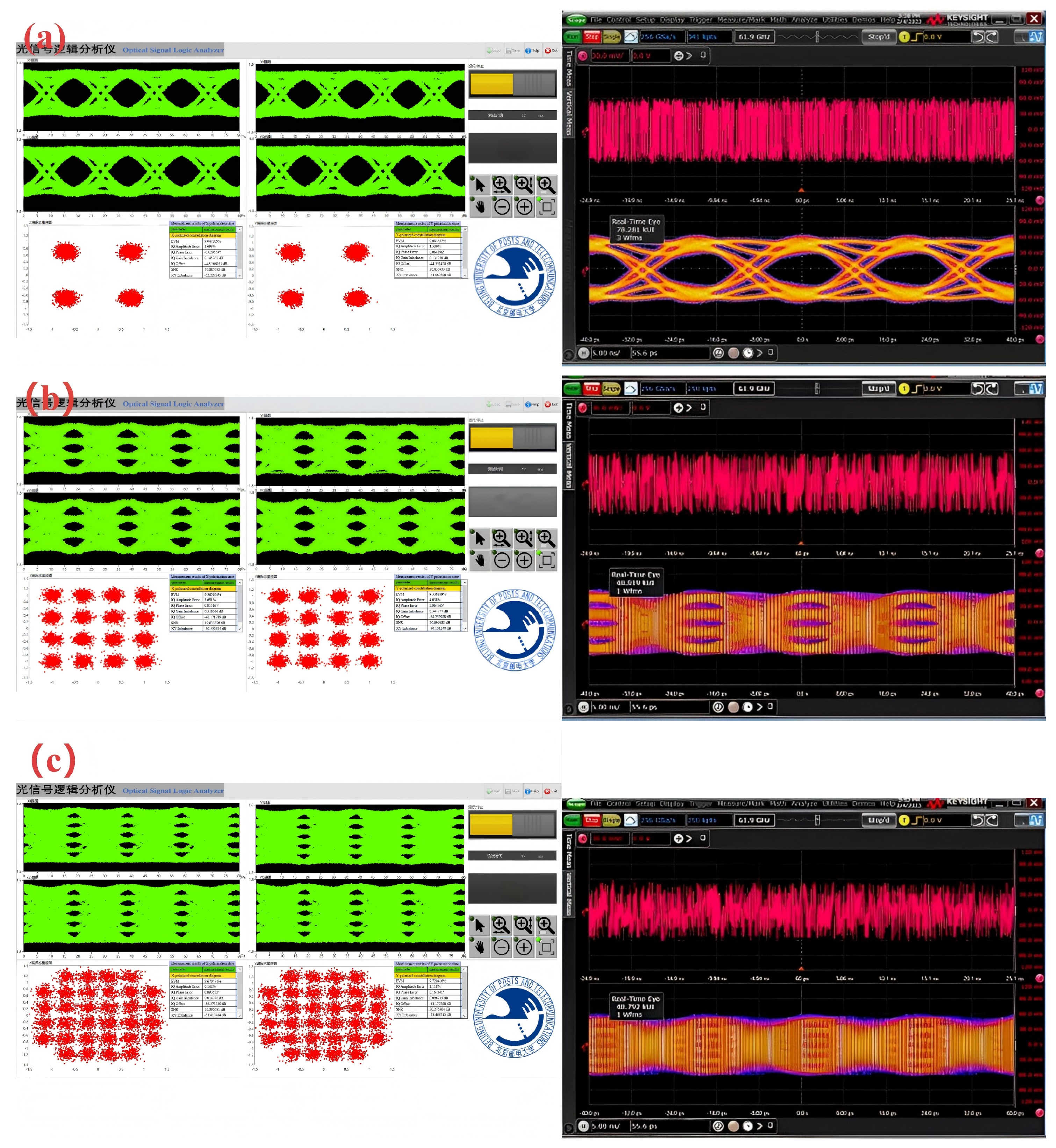
The input signals are PDM-QPSK, PDM-16QAM, and PDM-32QAM random signals with 50 Gbaud, with a maximum data rate of 500 Gbps for the PDM-32QAM signal. The measured eye diagrams and constellation diagrams are shown in Figure 6. By comparing with the results of the UXR0594AP oscilloscope, the correctness of the reconstructed eye diagrams is confirmed, and the eye diagrams show large eye opening, small jitter, and low crosstalk. Since the UXR0594AP oscilloscope cannot directly output constellation diagrams or EVM measurement results, direct comparisons between the two systems were performed using SNR, IQ gain imbalance, and XY polarization imbalance.
SNR is calculated by
SNR = 10 lg P s P n
where P s and P n represent signal power and noise power, respectively.
IQ gain imbalance ( ε ) is a measure of the amplitude unevenness between the I-branch signal and the Q-branch signal. It is calculated by
ε = 10 lg P Q P I
where P I and P Q represent the average power of the I-branch signal and the Q-branch signal, respectively.
The XY imbalance value is used to measure the degree of imbalance between the signals in the X and Y polarization directions, calculated by
X Y i m b = 10 lg P X P Y 1
where P X and P Y represent the signal powers of the two polarization signals, respectively. For EVM, we utilized the mathematical relationship between EVM and SNR (for an AWGN channel, EVM 1 / SNR ) to indirectly estimate the corresponding EVM values from the oscilloscope’s SNR measurements. It should be noted that these oscilloscope-side EVM values are estimated under the AWGN assumption rather than directly measured by the oscilloscope. These estimated values were then compared with the directly measured EVM values from the OVSAS system; these results are also listed in Table 1. From the data in the table, it can be seen that the measured values of SNR, IQ gain imbalance, XY polarization imbalance, and EVM obtained by the OVSAS system are all on the same order of magnitude as those of the UXR0594AP, indicating relatively high measurement accuracy.
Regarding the real-time capability of the system, the optical-domain sampling process is performed continuously in real time: the mode-locked laser generates sampling pulses at a repetition rate of 100 MHz, and the ADC digitizes the output of the balanced photodetector in real time at a rate of 2.5 GSa/s. It should be noted that the algorithm verification in Section 2 was performed in an offline manner, where the data were captured by a Keysight UXR0594AP oscilloscope and subsequently post-processed on a computer to facilitate algorithm debugging and optimization. In contrast, the experimental system presented in this section is based on the NI PXIe platform. All digital signal processing steps after data acquisition, including IQ orthogonalization, polarization demultiplexing, sampling point information extraction, frequency offset compensation, and clock synchronization, are performed online by the NI PXIe-8861 system controller, achieving a quasi-real-time measurement workflow. The data length of a single acquisition is approximately 50 μ s, containing about 5000 optical sampling points, and the processing time of the system controller is approximately 200 ms, enabling the reconstruction and display of eye diagrams and constellation diagrams within half a second.
In terms of system scalability, the maximum measurable signal baud rate of this system is mainly constrained by three factors. First, the sampling pulse width determines the time resolution of optical-domain sampling. The picosecond pulses used in this system have a 3 dB bandwidth exceeding 30 nm, which can support optical-domain sampling of signals with bandwidths of several hundred GHz. Second, the bandwidth of the balanced photodetector determines the degree of broadening of the electrical pulse. Although the 1 GHz bandwidth balanced photodetector employed in this system broadens the electrical pulse, the detector bandwidth does not constitute a bottleneck for the optical-domain sampling bandwidth because the soft integration method extracts the pulse energy rather than the peak value. Third, the ADC sampling rate must be sufficient to adequately sample the broadened electrical pulse. This system uses an ADC with a sampling rate of 2.5 GSa/s, which can acquire a sufficient number of sampling points under the current 1 GHz detector bandwidth. If it is necessary to measure signals with higher baud rates in the future, e.g., above 100 Gbaud, the present system is equally applicable. This is because the optical-domain sampling has already down-converted the high-speed signal into a sampling pulse sequence with a repetition rate of 100 MHz. Regardless of the baud rate of the signal under test, the bandwidth of the electrical signal after the balanced photodetector remains the same. The 1 GHz bandwidth balanced photodetector can receive up to 10 harmonics of the 100 MHz signal, which is sufficient to preserve the complete pulse energy information, and the bandwidth requirement of the ADC does not increase with the baud rate of the signal under test. Therefore, higher-speed signal measurement can be achieved without hardware replacement as the picosecond pulses used in the optical-domain sampling part already possess sufficient time resolution.

4. Conclusions

In this paper, LOS is used to achieve sampling of high-speed PDM-QPSK, PDM-16QAM, and PDM-32QAM signals. An unbalanced input method is proposed to ensure the integrity of the sampling clock, a resampling method combined with soft integration is proposed to ensure the accuracy of the position and amplitude information of the sampling points, and an adaptive frequency offset estimation method is proposed for accurate frequency offset compensation. The experimental results demonstrate that, by using the methods proposed in this paper, quasi-real-time measurement of 500 Gbps optical vector signals can be achieved, and the measured performance parameters are on the same order of magnitude as those of commercial instruments.

Author Contributions

Conceptualization, K.Z., Z.L., X.Z. and L.D.; methodology, K.Z., Z.L., X.Z. and L.D.; software, K.Z.; validation, K.Z., Z.L., X.Z. and L.D.; investigation, D.L. and H.L.; writing—original draft preparation, K.Z.; writing—review and editing, L.Y. and Y.W.; supervision, L.Y. and Y.W.; funding acquisition, Y.W. All authors have read and agreed to the published version of the manuscript.

Funding

This work was supported by the National College Student Innovation and Entrepreneurship Training Program (Grant No. 202502026 and Grant No. 202502013) and the National Key Research and Development Program of China (Grant No. 2021YFB2900703).

Data Availability Statement

The data that support the findings of this study are available from the corresponding author upon reasonable request.

Conflicts of Interest

The authors declare no conflicts of interest.

References

  1. Wei, J.; Cheng, Q.; Penty, R.V.; White, I.H.; Cunningham, D.G. 400 gigabit Ethernet using advanced modulation formats: Performance, complexity, and power dissipation. IEEE Commun. Mag. 2015, 53, 182–189. [Google Scholar] [CrossRef]
  2. Franken, J.; Reinhold, T.; Reichert, L.; Reuter, C. The digital divide in state vulnerability to submarine communications cable failure. Int. J. Crit. Infrastruct. Prot. 2022, 36, 100522. [Google Scholar] [CrossRef]
  3. Yang, F.; Fang, X.; Chen, X.; Zhu, L.; Zhang, F.; Chen, Z.; Li, Y. Monolithic thin film lithium niobate electro-optic modulator with over 110 GHz bandwidth. Chin. Opt. Lett. 2022, 20, 022502. [Google Scholar] [CrossRef]
  4. Wang, X.; Shang, C.; Pan, A.; Cheng, X.; Gui, T.; Yuan, S.; Gui, C.; Zheng, K.; Zhang, P.; Song, X.; et al. Thin-film lithium niobate based dual-polarization IQ modulator for single-carrier 1.6 Tb/s transmission. In Proceedings of the Integrated Optics: Devices, Materials, and Technologies XXVI (SPIE OPTO), San Francisco, CA, USA, 22–27 January 2022; p. 120040E. [Google Scholar] [CrossRef]
  5. Liu, Y.; Zhang, A.; Feng, L.; Lv, K.; Liu, H.; Sheng, X. Real-time C+L band 96×800-Gbit/s DP-PCS-64-QAM WDM transmission over 1000-km G.654.E fiber. In Proceedings of the 2024 IEEE Opto-Electronics and Communications Conference (OECC), Melbourne, Australia, 30 June–4 July 2024; pp. 1–3. [Google Scholar] [CrossRef]
  6. Rademacher, G.; Luís, R.S.; Puttnam, B.J.; Fontaine, N.K.; Mazur, M.; Chen, H.; Ryf, R.; Neilson, D.T.; Dahl, D.; Carpenter, J.; et al. 1.53 peta-bit/s C-band transmission in a 55-mode fiber. In Proceedings of the 2022 European Conference on Optical Communication (ECOC), Basel, Switzerland, 18–22 September 2022; pp. 1–4. [Google Scholar]
  7. Li, L.; Liu, S.; Gong, Y.; Zhang, C.; Zhang, X. Progress of large-bandwidth optical signal measurement technology (invited). Acta Opt. Sin. 2024, 44, 1300001. [Google Scholar]
  8. Drenski, T.; Rasmussen, J.C. ADC & DAC—Technology trends and steps to overcome current limitations. In Proceedings of the Optical Fiber Communication Conference (OFC), San Diego, CA, USA, 11–15 March 2018; Paper M2C.1; Optica Publishing Group: Washington, DC, USA, 2018. [Google Scholar]
  9. Roudas, I. Coherent optical communication systems. In WDM Systems and Networks: Modeling, Simulation, Design and Engineering; Springer: New York, NY, USA, 2012. [Google Scholar] [CrossRef]
  10. Teng, X.; She, H.; Liang, Y. Design and implementation of high-speed balanced homodyne detector. Opt. Instrum. 2022, 44, 32–38. [Google Scholar]
  11. Goda, K.; Jalali, B. Dispersive Fourier transformation for fast continuous single-shot measurement. Nat. Photonics 2013, 7, 102–112. [Google Scholar] [CrossRef]
  12. Li, L.; Zhang, C.; Xiao, X.; Cai, Y.; Wong, K.K.-Y.; Zhang, H.; Zhang, X. Real-time Fourier-domain optical vector oscilloscope. Sci. Adv. 2023, 9, eadg2538. [Google Scholar] [CrossRef] [PubMed]
  13. Sköld, M.; Westlund, M.; Sunnerud, H.; Andrekson, P.A. All-optical waveform sampling in high-speed optical communication systems using advanced modulation formats. J. Lightw. Technol. 2009, 27, 3662–3670. [Google Scholar] [CrossRef]
  14. Li, P.; Jiang, L.; Zhang, J.G.; Zhang, J.Z.; Wang, Y.C. Low-complexity TOAD-based all-optical sampling gate with ultralow switching energy and high linearity. IEEE Photonics J. 2015, 7, 7801108. [Google Scholar] [CrossRef]
  15. Sunnerud, H.; Sköld, M.; Westlund, M.; Rosenfeldt, H.; Andrekson, P.A. Characterization of complex optical modulation formats at 100 Gb/s and beyond by coherent optical sampling. J. Lightw. Technol. 2012, 30, 3747–3759. [Google Scholar] [CrossRef]
  16. Skold, M.; Raybon, G.; Adamiecki, A.L. Quasi-real-time optical sampling scheme for high-speed signal acquisition and processing. IEEE Photonics Technol. Lett. 2013, 25, 504–507. [Google Scholar] [CrossRef]
  17. Yu, Z.; Fu, S.; He, H.; Wu, Z.; Huang, T.; Tang, M.; Liu, D. Biased balance detection for fiber optical frequency comb based linear optical sampling. J. Lightw. Technol. 2021, 39, 3458–3465. [Google Scholar] [CrossRef]
  18. Westlund, M.; Sunnerud, H.; Karlsson, M.; Andrekson, P.A. Software-synchronized all-optical sampling for fiber communication systems. J. Lightw. Technol. 2005, 23, 1088–1099. [Google Scholar] [CrossRef]
  19. Yang, A.; Lai, J.; Sun, Y. A chirp-z-transform-based software synchronization method for optical performance monitoring. IEEE Photonics Technol. Lett. 2011, 23, 1739–1741. [Google Scholar] [CrossRef]
  20. Tian, Q.; Zhang, S.; Wang, F.; Li, Z.; Gao, R.; Tian, F.; Yang, L.; Zhang, Q.; Wang, Y.; Xin, X. Data rate measurement method with selectable range in linear optical sampling. Opt. Express 2023, 31, 9362. [Google Scholar] [CrossRef] [PubMed]
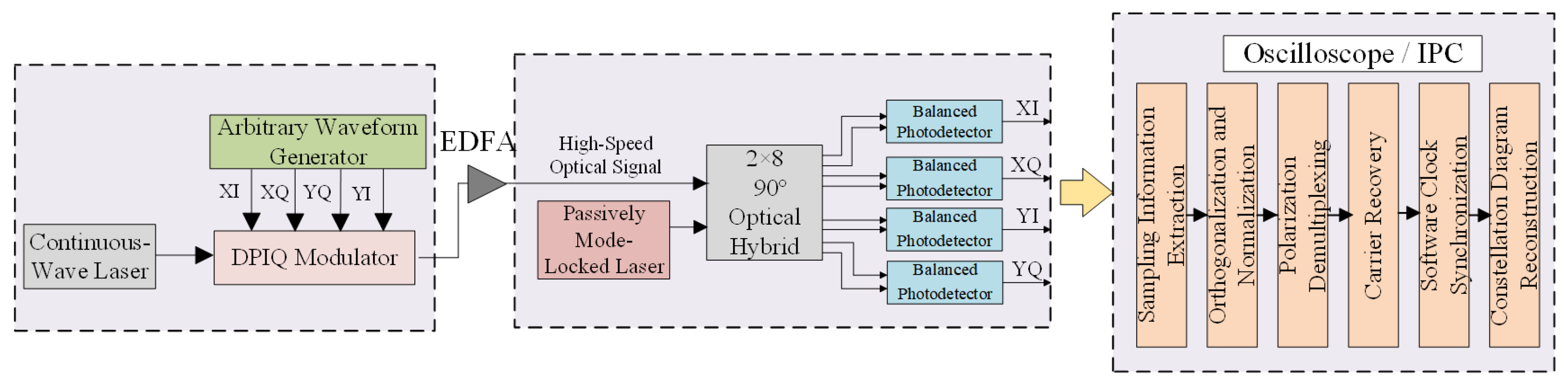
Figure 1. The structure of the LOS system.
Electronics 15 02584 g001
Figure 2. Sampling signal with uniform sampling clock.
Electronics 15 02584 g002
Figure 3. Reconstruction results for QPSK signal: (a) with incomplete clock and (b) with introduction of attenuation.
Electronics 15 02584 g003
Figure 4. Reconstruction results for QPSK signal: (a) with peak value extraction and (b) with combining resampling and soft integration.
Electronics 15 02584 g004
Figure 5. Reconstruction results for 16QAM signal: (a) with FFT frequency offset estimation and (b) with adaptive frequency offset estimation.
Electronics 15 02584 g005
Figure 6. Measured results from OVSAS and UXR0594AP: (a) PDM-QPSK, (b) PDM-16QAM, and (c) PDM-32QAM.
Electronics 15 02584 g006
Table 1. Comparison of measured parameters between OVSAS and UXR0594AP.
Modulation FormatSystemSNR (dB)IQ Imb. (dB)XY Imb. (dB)EVM (%)
PDM-QPSKOVSAS20.880.145−52.229.04
UXR0594AP20.730.154−49.639.19
PDM-16QAMOVSAS20.090.318−30.559.57
UXR0594AP20.110.347−30.109.87
PDM-32QAMOVSAS20.310.083−33.819.67
UXR0594AP20.270.096−33.469.70
Disclaimer/Publisher’s Note: The statements, opinions and data contained in all publications are solely those of the individual author(s) and contributor(s) and not of MDPI and/or the editor(s). MDPI and/or the editor(s) disclaim responsibility for any injury to people or property resulting from any ideas, methods, instructions or products referred to in the content.