1. Introduction
Airbag electrical connectors are used to transmit electrical energy and signals in the airbag initiator circuit. If a contact failure occurs, the airbag initiator circuit may fail to conduct properly during a collision, preventing the airbag from deploying in time and thereby endangering occupant safety. Airbag electrical connectors are long-life, high-reliability, safety-critical components. Under conventional test conditions, it is difficult to obtain sufficient failure data, which limits reliability assessment. Degradation data, therefore, need to be used to analyze the deterioration of their contact performance and to provide a basis for reliability evaluation.
The effective use of degradation data depends on constructing a degradation model that can reasonably describe the underlying failure physics. The degradation of electrical connector contact performance is affected by interface film accumulation, fretting wear, and related factors, and the growth of contact resistance usually exhibits nonlinear behavior. At the same time, differences in manufacturing processes, initial contact states, and microstructures lead to different overall degradation rates among samples. Even for the same sample, the degradation trajectory may show local fluctuations because of the random distribution of contact spots and oxidation corrosion products. A stochastic degradation model that can simultaneously and hierarchically characterize nonlinear growth, sample-to-sample variability, and within-sample fluctuations is therefore a basis for accurate reliability assessment and remains a key issue in reliability modeling.
During long-term service in privately used passenger cars, automotive airbag electrical connectors are subjected to thermal stress during static parking and to combined temperature-vibration stress during dynamic driving, leading to different characteristics in the contact resistance growth process. In addition, the connector investigated in this study consists of stainless-steel pins, beryllium-bronze sockets, and Ni/Au composite coatings, which determine a failure mechanism different from that of common tin-plated or gold-plated copper-alloy connectors. Studying the contact performance degradation of this specific structure under thermal stress and combined temperature-vibration stress is, therefore, of considerable engineering significance.
In stochastic degradation modeling, the Wiener process has become a widely used basis for degradation models because of its continuous sample paths, independent increments, and analytical tractability. Zhang et al. [
1] provided a systematic review of Wiener-process-based methods and clarified their role in performance degradation modeling and remaining useful life prediction. Within this framework, subsequent studies have mainly developed in two directions: improving adaptability to complex operating conditions and characterizing multiple sources of randomness.
In terms of model adaptability, existing studies have sought to extend the Wiener process to engineering settings with more complex degradation behavior. Li et al. [
2] proposed a generalized Wiener process model to address the limitations of conventional models in representing sample heterogeneity, temporal correlation, and measurement error. Yang et al. [
3] introduced a nonlinear time-scale function, which transforms a nonlinear degradation process into a linear Wiener-process framework and provides a standard way to handle nonlinear trends. Wang, Kang and co-workers [
4] established the theoretical relationship between Wiener model parameters and stress conditions based on the constant acceleration factor principle, providing a basis for assessing the consistency of degradation mechanisms. More recent work has further increased model flexibility. Sun et al. [
5] combined a nonlinear Wiener process with a time-varying Copula to address competing failures caused by multiple degradation processes and random shocks. Zhang et al. [
6,
7] considered the effects of dynamic environments and random loads by proposing, respectively, a model with random dynamic covariates and a model incorporating both measurable and unobservable external factors. Taken together, the introduction of nonlinear time scales, acceleration-stress links, and dynamic covariates has made the Wiener process a relatively mature framework for modeling complex nonlinear, time-varying, and multi-factor-coupled degradation.
In characterizing multi-source randomness, research has focused on describing differences among the various sources of randomness in degradation data. Zhai, Ye and co-workers [
8] used Brownian motion to describe adaptive drift, allowing the degradation rate itself to vary randomly over time. Wang et al. [
9] studied exact statistical inference for Wiener process models with random drift rates under small-sample conditions, confirming the effectiveness of random drift rates in representing degradation-rate differences among samples. For multi-performance degradation, Xu et al. [
10], Dong et al. [
11], and Yan et al. [
12] constructed multivariate Wiener process models based on bivariate processes, two-stage correlation structures, and shared environmental functions, respectively, to capture correlations among performance characteristics. Fang et al. [
13] proposed a hierarchical multivariate Wiener process model in which layered random effects describe sample heterogeneity, performance dependence, and the relationship between initial states and degradation rates. The stochastic structure of these models was later further extended. Zhai et al. [
14] extended random effects from the diffusion term to the drift term, so as to characterize individual heterogeneity in both drift rate and diffusion intensity. Ma et al. [
15] also treated the drift and diffusion coefficients at different stages as random variables in a multi-phase degradation model. Liu, Wang and co-workers [
16] combined the Wiener process with evidence theory to address parameter inference under small-sample conditions. These studies indicate that Wiener-process-based models, through random drift rates, hierarchical random effects, correlation structures, and more general random effects, can describe multiple sources of randomness across several levels, from sample-to-sample differences in degradation rates and random fluctuations in degradation trajectories to multivariate correlations.
Taken together, existing Wiener-process-based models have developed a relatively complete extension framework and can provide a theoretical basis for hierarchical modeling of nonlinear growth, sample-to-sample variability, and random fluctuations in degradation trajectories. Their application to specific engineering objects, however, still needs to be developed in connection with failure mechanisms and degradation data characteristics.
For electrical connector contact degradation, existing studies have mainly examined environmental effects and contact-interface damage. Bunting et al. [
17] studied the performance degradation of copper-alloy contact elements in automotive electrical connectors under thermal, mechanical, and coupled loads, showing that long-term thermo-mechanical loading may induce contact-force relaxation by affecting the Young’s modulus of the material. Kehong et al. [
18] reported that temperature stress and thermal shock can markedly affect contact performance and may induce random intermittent faults. Krüger et al. [
19,
20] investigated the effects of thermal-stress parameters and vibration test modes on the failure rate of automotive electrical connectors, indicating that temperature and vibration loads are key external stresses affecting connector reliability. Mawidi et al. [
21] further showed that temperature variation changes the relative motion at the contact point and affects the evolution of contact resistance. Li et al. [
22] analyzed contact terminal failure in automotive high-voltage connectors under combined temperature-vibration stress and found that fretting wear induces coating delamination, substrate exposure, and the propagation of oxidation corrosion, eventually leading to an increase in contact resistance. For contact-interface damage, Dong et al. [
23] used experiments and finite element modeling to analyze the effects of abrasive wear, coating removal, and oxide-film formation on electrical contact resistance. Lei et al. [
24] examined electrical contact failure in high-speed connectors under fretting wear and identified contact-structure degradation and surface-coating loss as major causes of contact failure. Wang, Xu and co-workers [
25] considered the coupled effects of atmospheric corrosion and wear, establishing a corrosion model for gold-plated components and a contact-resistance degradation model based on a multi-spot contact mechanism. Song et al. [
26] proposed a state analysis and lifetime prediction method based on failure mechanisms in automotive electrical connectors, including fretting corrosion, oxidation, stress relaxation, and plastic deformation. These studies show that thermal stress, vibration stress, and their coupling affect connector contact performance through mechanisms such as fretting wear, oxidation corrosion, and coating damage, providing a basis for studying contact resistance growth.
In contact performance modeling and lifetime prediction for electrical connectors, reliability assessment has been conducted using contact resistance, intermittent-fault features, surface-damage characteristics, and accelerated degradation data. Cheng et al. [
27] extracted a health indicator for electrical connectors with intermittent faults under vibration environments and used an extreme learning machine optimized by a genetic algorithm for remaining useful life prediction. Cheng et al. [
28] further applied an Attention-LSTM model to connector remaining useful life prediction and found that intermittent-fault precursors appear earlier than the marked increase in contact resistance, which helps improve prediction accuracy. Shukla, Song, and co-workers [
29] performed lifetime prediction based on short-term contact resistance data and found a strong correlation between early contact resistance evolution and the number of failures at later stages. Qian et al. [
30] addressed the contact reliability of wire spring-hole connectors under long-term storage, established a reliability design model, and verified it using accelerated test data. Li Z. et al. [
31] used contact resistance as the key performance parameter and combined HAST testing, a Wiener-process degradation model, and the Peck acceleration model to assess the reliability of electrical connectors in new-energy vehicle electronic control systems. Hong, Qian, and co-workers [
32] developed a nonlinear Wiener process model for electrical connector contact pairs, in which both the drift and diffusion coefficients are stress-dependent, and used it for accelerated degradation test planning; however, degradation-rate differences among connectors were not considered. These studies indicate that reliability assessment for electrical connectors has evolved from failure analysis alone toward lifetime prediction and stochastic-process modeling based on degradation data. Existing modeling work, however, remains mainly focused on degradation-index extraction, data-driven prediction, acceleration models, and test-plan optimization, while hierarchical stochastic descriptions of nonlinear growth, sample-to-sample variability, and within-sample local fluctuations in contact-resistance degradation trajectories remain insufficient.
Taken together, existing studies on electrical connectors have clarified how thermal stress, vibration stress, fretting wear, oxidation corrosion, coating damage, and contact-force variation affect contact performance degradation. Some work has also used contact resistance and intermittent-fault features for lifetime prediction or reliability assessment. However, the connection between failure-mechanism analysis and the parameters of stochastic process models still requires further development. At the same time, existing studies have mainly used Wiener process models for contact performance degradation modeling or reliability assessment and have not yet sufficiently linked the random drift rate, nonlinear time scale, and diffusion term to sample-to-sample variability, nonlinear growth, and local random fluctuations in contact-interface degradation, respectively. For automotive airbag electrical connectors with stainless-steel pins, beryllium-bronze sockets, and Ni/Au composite coatings, there is still a lack of research that systematically applies a random-drift nonlinear Wiener process to contact performance degradation modeling based on the contact-interface degradation mechanisms under thermal stress and combined temperature-vibration stress.
Therefore, this study takes automotive airbag electrical connectors as the research object and uses the contact resistance increment to characterize contact performance degradation. Based on an analysis of the failure mechanisms responsible for contact resistance growth under thermal stress and combined temperature-vibration stress, a nonlinear time scale in the form of tα is introduced, and a random-drift nonlinear Wiener process model is developed. The model is used to describe the nonlinear trend of contact resistance growth, the local random fluctuations within the degradation trajectory of the same sample, and the differences in growth rates among different samples. Accelerated degradation tests are then carried out for the 160 °C thermal-stress group and the 160 °C temperature-vibration group. The obtained degradation data are used for parameter estimation, time-scale model comparison, and model validation. Finally, EDS and XPS analyses of the socket surface are used to provide supplementary evidence for the proposed degradation mechanism from the perspectives of surface elemental composition and surface chemical state.
2. Structure and Failure Mechanism of the Airbag Electrical Connector
2.1. Structural Composition and Functional Requirements
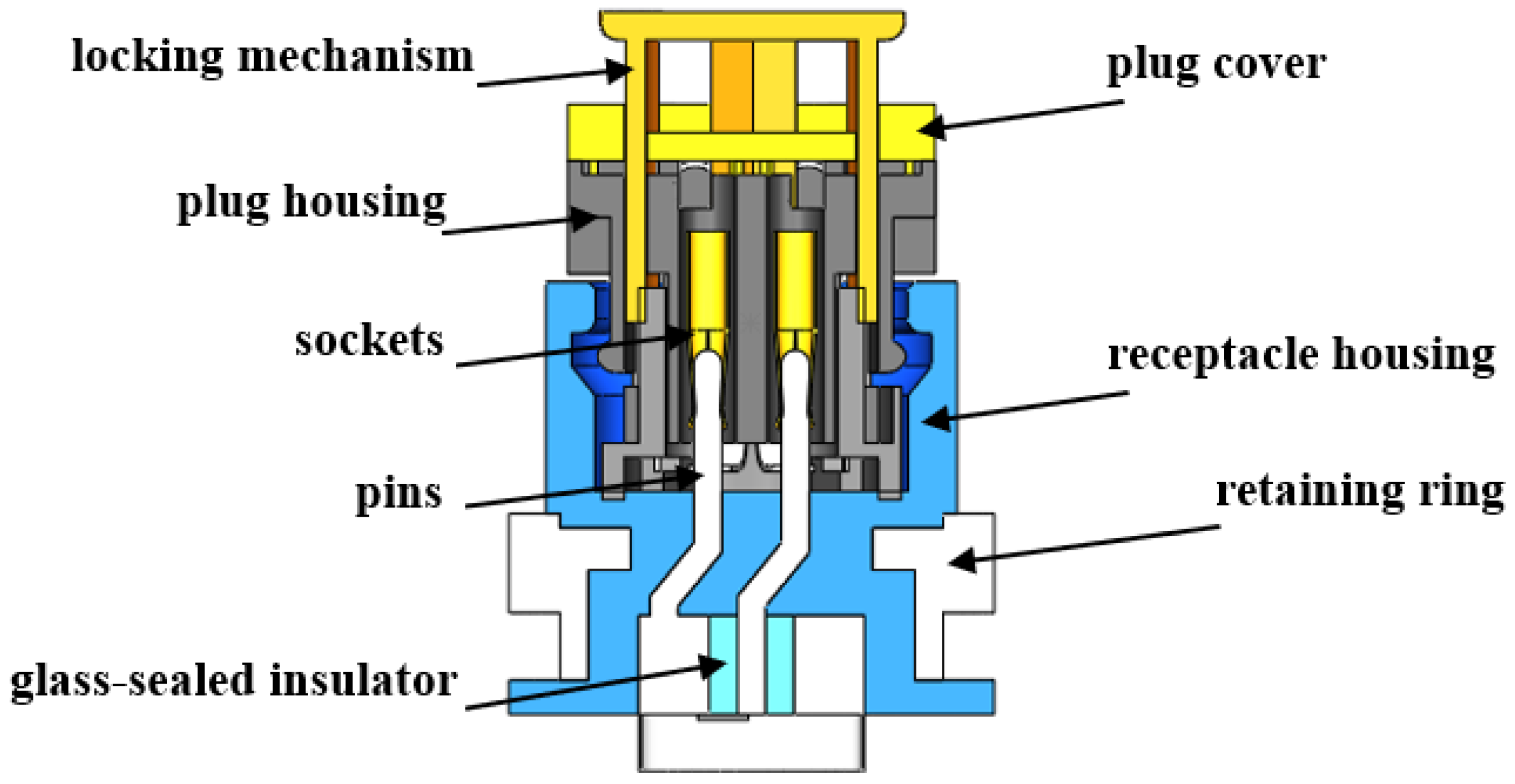
The airbag electrical connector consists of a cover, a plug housing, sockets, and a locking mechanism on the plug side, as well as pins, a receptacle housing, a glass-sintered insulator, and a retaining ring on the receptacle side, as shown in
Figure 1. The receptacle is mounted at the top of the airbag initiator and is fixed together with the initiator shell. When a vehicle collision occurs and the deceleration reaches the triggering condition, the control unit sends an ignition command, causing the bridgewire circuit to conduct. The increased current rapidly heats the bridgewire and ignites the pyrotechnic charge. As the temperature and pressure inside the pyrotechnic cartridge rise sharply, the receptacle must withstand high temperature and high pressure. For this reason, a glass-sintered insulator is used in the receptacle. During the glass-sealing process, the pins must maintain good structural stability. The pin substrate is therefore made of 06Cr19Ni10 stainless steel, which has favorable high-temperature strength, thermal stability, and a coefficient of thermal expansion close to that of glass. Iron is the main constituent, accounting for 67–71.5%. The pin surface is first plated with a 3 μm nickel layer and then with a 0.7 μm gold layer.
The socket contact element is made of QBe2.0 beryllium bronze, which provides high electrical conductivity and good elastic properties. A 3 μm nickel undercoat is applied, followed by a 0.7 μm gold surface layer. The socket is processed into an elastic spring-lamella structure, which provides continuous and stable contact pressure and helps maintain good electrical conduction under vibration and impact conditions.
The locking mechanism is made of PBT-GF15, while the plug cover, plug housing, receptacle housing, and retaining ring are made of PBT-GF10. Polybutylene terephthalate (PBT) has good electrical insulation, heat resistance, dimensional stability, and molding processability. PBT-GF15, namely PBT reinforced with 15% glass fiber. The addition of GF15 improves the structural stiffness of the locking mechanism and its ability to maintain shape under long-term loading, thereby preventing accidental release. GF10 provides sufficient strength while maintaining better toughness, flowability, and lower warpage, which is beneficial for manufacturing housings with complex geometries.
2.2. Mission Profile and Environmental Effects
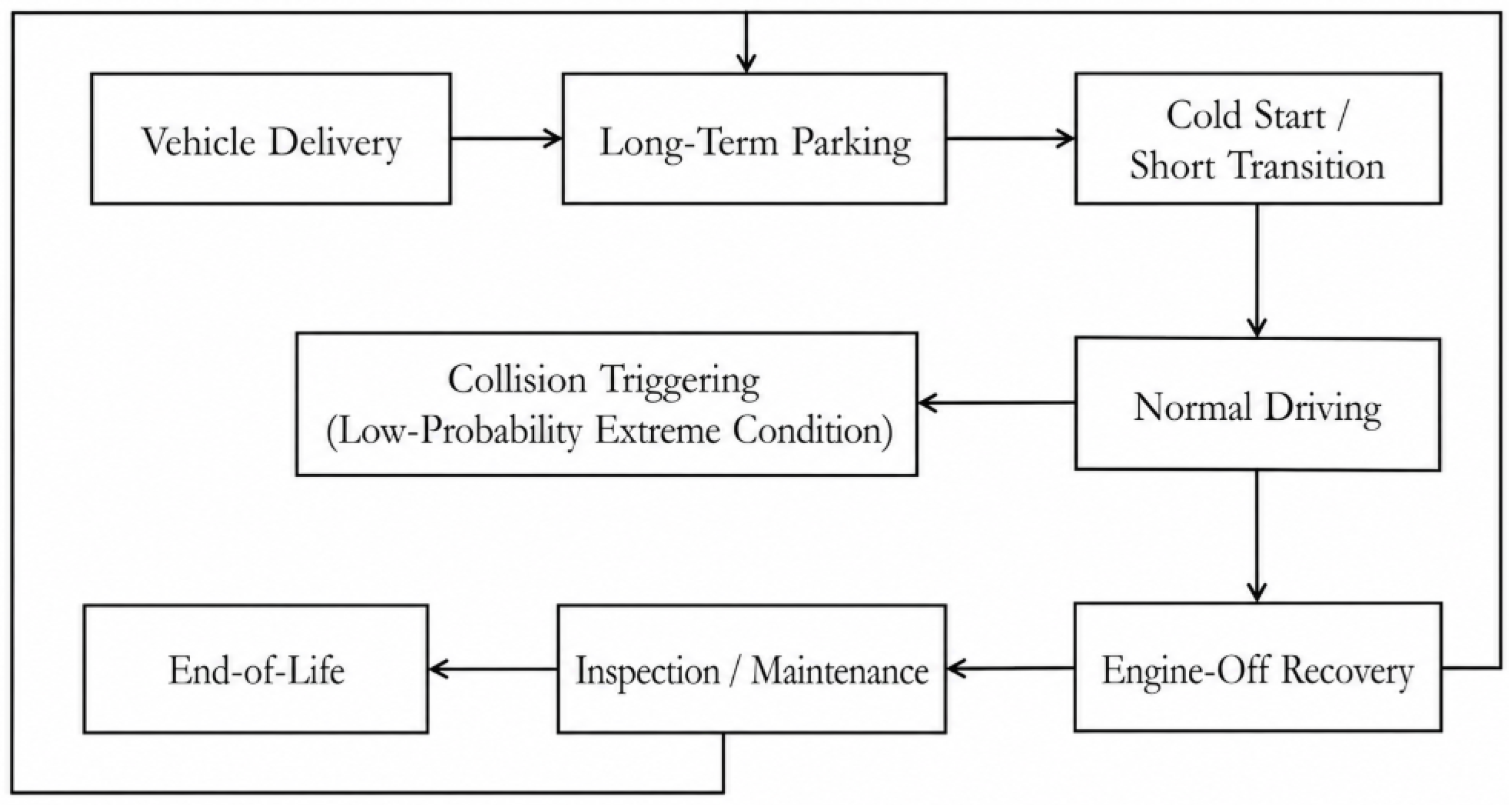
Taking privately used passenger cars as the application scenario, the airbag electrical connector experiences the full operation and maintenance process of the vehicle from delivery to end-of-life retirement. Over its service life, the mission profile repeatedly follows a cyclic pattern of long-term parking, cold start or short transient operation, normal driving, engine-off recovery, and subsequent parking. Inspection and maintenance stages occur intermittently, while collision triggering represents a low-probability extreme event, as shown in
Figure 2.
During long-term parking, thermal stress is the dominant factor. It promotes the formation of oxidation corrosion products and the gradual growth of the interfacial film layer, which reduces the effective conductive area at the contact interface and increases contact resistance, thereby inducing contact degradation. Humidity participates in the degradation process mainly by accelerating oxidation corrosion at the contact interface and promoting insulation deterioration.
During normal driving, the connector is continuously exposed to vibration caused by vehicle operation and road excitation. This may induce fretting wear between mating contact elements, damage the local oxide film and coating layer, and further promote the formation of subsequent oxidation corrosion products. The engine-off recovery stage strengthens thermal-mechanical cycling effects, while the inspection and maintenance stage introduces additional mechanical operation loads. The collision-triggering stage represents a low-probability but safety-critical event requiring instantaneous electrical conduction.
Therefore, long-term thermal stress and short-term vibration jointly constitute the dominant factors affecting the contact reliability of airbag electrical connectors.
2.3. Contact Conduction Principle of Electrical Connectors
The transmission of electrical energy and signals in an electrical connector relies on intimate contact between the pin and the socket under contact pressure, through which a stable conductive path is established at the contact interface. At the microscopic scale, the interface is not an ideal planar contact because of surface roughness. When the pin and socket are mated, asperities on the rough contact surfaces penetrate the surface oxide layer and other contaminant films, forming local metal-to-metal conductive paths. As the contact pressure increases, the oxide film is further fractured, and metal is extruded through these ruptured regions, increasing both the number and area of small metallic contact spots. These metallic conductive spots are slightly cold-welded together and constitute the actual conductive paths. The real contact area is therefore much smaller than the apparent contact area.
When current converges from the macroscopic conductor into these small conductive spots, the current streamlines are strongly constricted. This local geometric restriction increases the current density and is electrically equivalent to an additional resistance in the circuit, known as constriction resistance. The contact surface is also not an ideally clean metal surface. Oxide films, adsorbed films, and other interfacial layers with relatively high resistivity are commonly present. When electrons pass through these films, they encounter an additional barrier equivalent to a thin-film resistance, which gives rise to film resistance. Physically, the current can be regarded as passing successively through two serial processes: convergence through the interfacial film and constricted conduction through the contact spots. The total contact resistance can therefore be expressed as the sum of these two components. The macroscopic conductive state of the contact interface depends not only on the number, size, and distribution of real contact spots, which determine the constriction resistance, but also on the properties and thickness of the interfacial film, which determine the film resistance.
To quantitatively describe the total contact resistance
Rk, classical electrical contact theory simplifies the above complex three-dimensional current field. The conductive spot is treated as a circular clean-metal contact with radius
a, while the interfacial film is regarded as a uniform thin layer covering the contact surface, with thickness and resistivity. The constriction resistance
Rc is determined by the spot radius
a and the substrate-metal resistivity and represents the resistance caused by current constriction through the geometric bottleneck of the contact spot in an ideal conductor. The film resistance
Rf is governed by the film resistivity and the spot area π
a2, and characterizes the resistance encountered by electrons when passing through the thin film above the spot. For a sufficiently thin film, electron transport is mainly controlled by quantum tunneling, and
Rf can be expressed in a form inversely proportional to the contact-spot area. Based on these simplifications, the total contact resistance is
where
Rk is the contact resistance,
Rc is the constriction resistance, and
Rf is the film resistance.
When the contact interface remains stable, the conductive spots are sufficient in number and relatively uniform in distribution, and the interfacial film is thin. Under this condition, the contact resistance Rk remains at a low and stable level. Once corrosive media such as oxygen and moisture enter the contact region, they may react chemically or electrochemically with exposed metal or protective coatings, such as the Ni coating, producing a thicker corrosion-product film with higher resistivity. This directly increases the film resistance Rf. Corrosion not only thickens the interfacial film, but also its loose products may block conductive spots. Under vibration stress, wear and delamination of the surface coating can further damage the coating layer, reducing the number of conductive spots and decreasing the effective contact radius a, thereby increasing the constriction resistance Rc.
Under long-term service conditions, oxidation corrosion is a continuous and progressive chemical process, and the thickening of its products directly contributes to the film resistance in the contact circuit. For the airbag electrical connector considered here, the outer stainless-steel sleeve of the socket helps maintain stable contact pressure while limiting the micro-deformation amplitude of the spring lamellae. In the early stage, vibration-induced degradation at the contact interface mainly appears as slight wear of the coating and oxide film. It is therefore difficult for short-term vibration to cause large-area coating delamination or plastic deformation sufficient to markedly worsen the constriction resistance. A pronounced increase in constriction resistance generally requires extremely long-term wear accumulation or unusually severe vibration impact. For the analysis of the contact resistance growth trend in this work, the film resistance is therefore treated as the dominant contributor to the increase in contact resistance.
2.4. Failure Mechanism Analysis
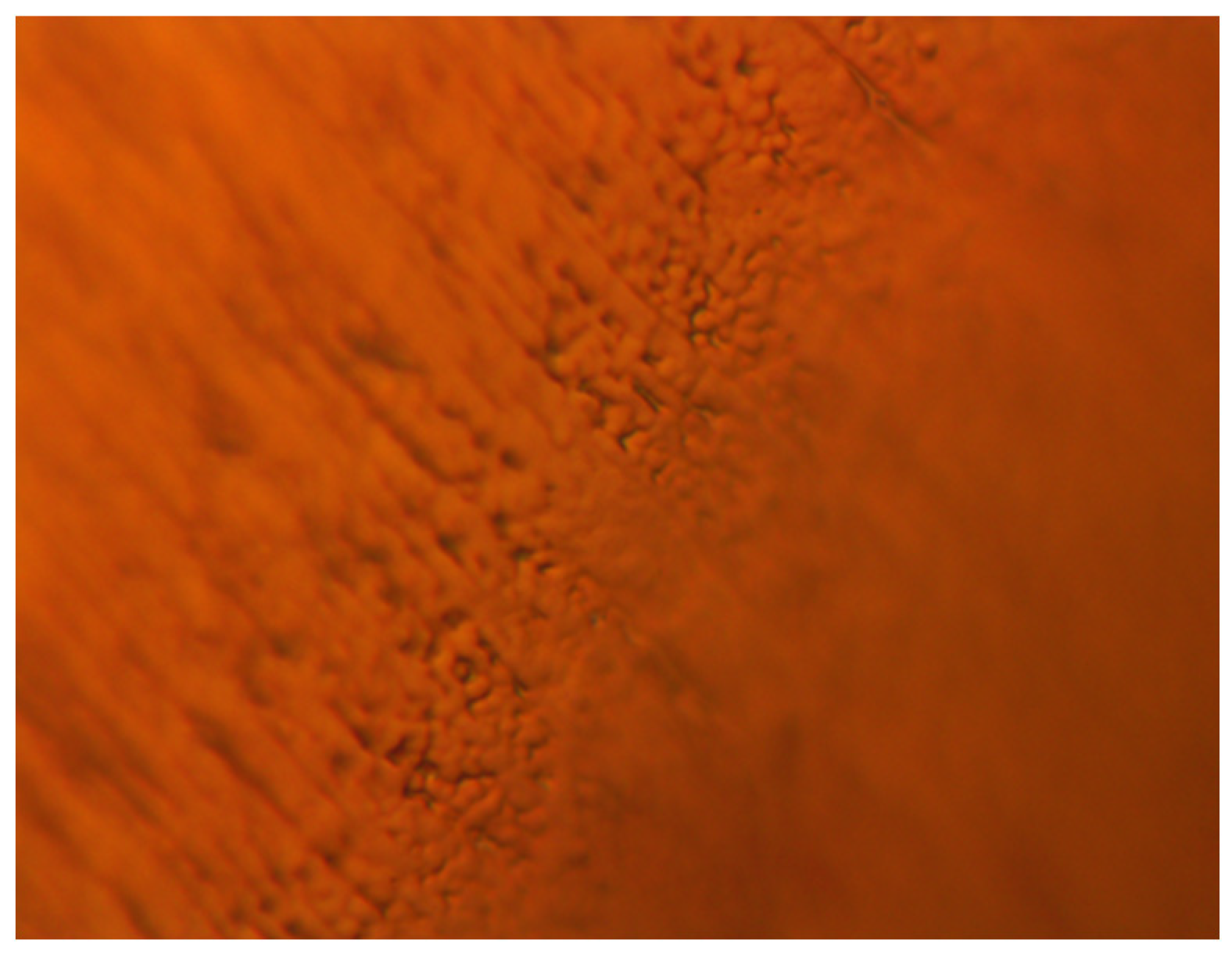
To reduce the risk of contact degradation caused by oxidation corrosion of the contact pair, the contact elements of the airbag electrical connector use a Ni/Au composite coating to improve the corrosion resistance and electrical conductivity of the contact interface. Owing to limitations in the plating process and coating thickness, however, micropores, cracks, and local discontinuities may still exist in the Au and Ni coating layers, as shown in
Figure 3. Under long-term thermal exposure, these micropores and cracks provide local pathways for environmental media to penetrate the interface, creating conditions for oxidation-corrosion reactions at the interface between the coating and the substrate material.
At the same time, the electrode potential difference between different metals further promotes local corrosion reactions. For the pin contact element, the electrode potentials of Ni and Fe are lower than that of Au. As a result, oxidation corrosion occurs in local microcells, producing corresponding corrosion products. For the socket contact element, the substrate is beryllium bronze. The electrode potential of the intermediate Ni coating is lower than that of the Cu-based substrate, which provides cathodic protection for the substrate Cu to some extent, while an Au–Ni microchemical cell is formed. As oxidation corrosion products accumulate at the contact interface, a corrosion-product film gradually forms, increasing the contact resistance and eventually causing contact failure.
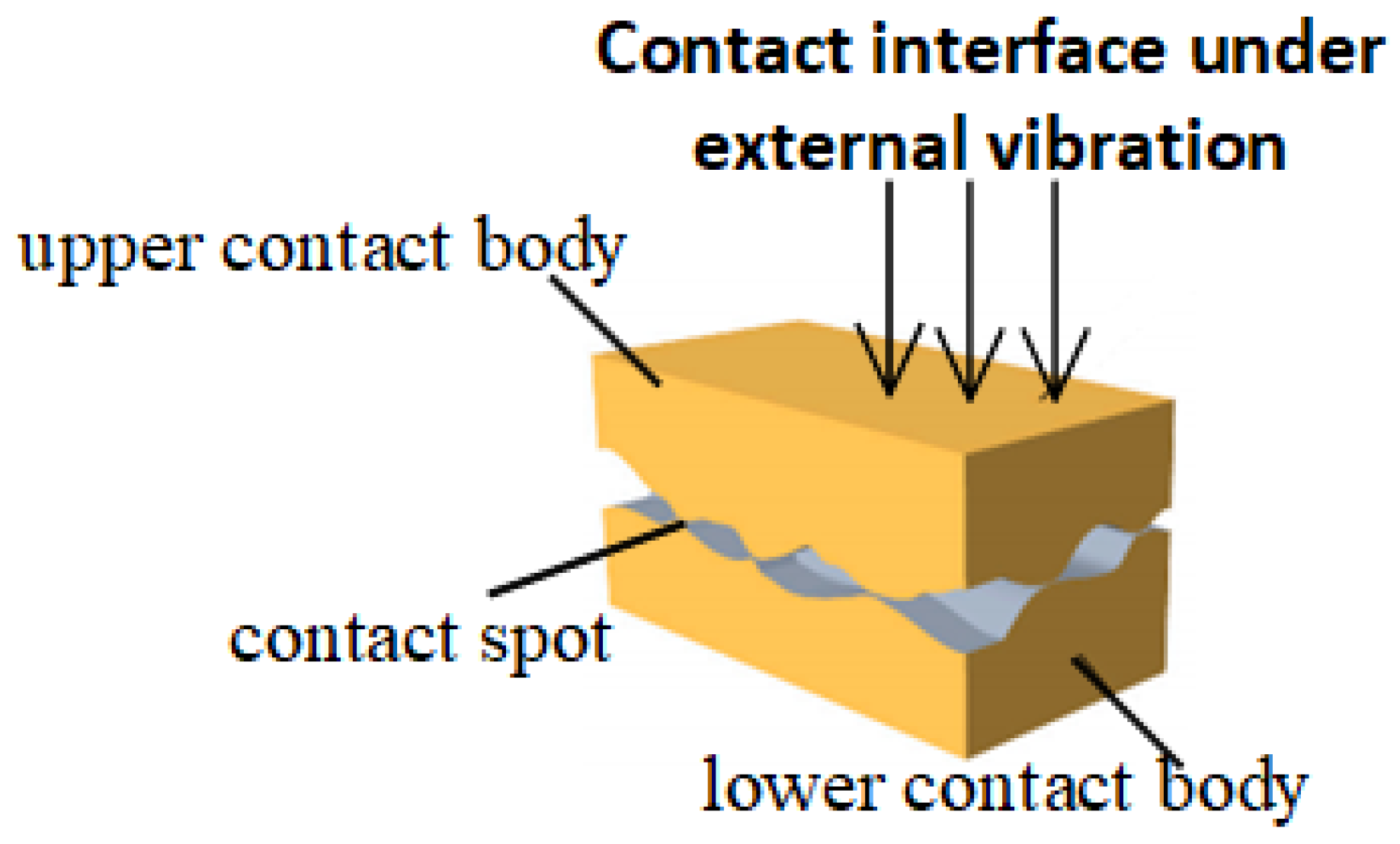
Under driving conditions, the contact interface of an automotive airbag electrical connector is exposed simultaneously to thermal stress and mechanical vibration. In the mated pin–socket pair, the axial direction is rigidly constrained by the locking mechanism, although assembly clearance remains. In the radial direction, the normal deformation of the socket spring lamellae provides the main elastic contact pressure, while the outer stainless-steel sleeve limits the maximum overall deformation of the lamellae and helps maintain a stable normal contact force. After random vibration generated during vehicle operation is transmitted to the connector, it can be resolved into axial and radial inertial components. The axial inertial component tends to produce slight relative displacement of the contact pair along the mating direction; the assembly clearance allows this displacement to be released as reciprocating axial play. The radial inertial component disturbs the original normal elastic clamping state, promotes a lateral motion tendency of the pin, and induces local micro-separation at the interface.
Under the combined effect of axial play and radial separation tendency, the actual motion trajectory of the socket relative to the pin becomes a complex spatial curve, constrained by the stainless-steel sleeve that limits the overall deformation of the spring lamellae. The tangential component of this three-dimensional micro-displacement trajectory appears at and around the contact spots as reciprocating, small-amplitude tangential microslip. This microslip imposes continuous, low-amplitude, cyclic mechanical shear on the contact surface, causing local transfer or removal of the oxide film and coating layer, and thereby producing fretting wear, as shown in
Figure 4.
Under combined temperature-vibration stress, the oxide film at the contact interface is repeatedly reconstructed through a rupture–regeneration cycle, which makes its thickness distribution more nonuniform and weakens its continuity. At the same time, the protective capability of the surface coating gradually deteriorates under repeated shear, exposing more active metal to oxidation reactions. As a result, the effective area of the contact spots decreases, and their spatial distribution becomes less stable, increasing the obstruction to interfacial current transport. Electrically, this process is mainly reflected in the continuous increase in film resistance, which gradually becomes the dominant contributor to the growth of total contact resistance. Because film damage and regeneration occur locally and randomly, the contact resistance growth process is often accompanied by evident time-varying fluctuations.
Compared with thermal stress alone, contact degradation under combined temperature-vibration stress therefore exhibits two main characteristics: a higher contact resistance growth rate and stronger fluctuations in the degradation trajectory. These characteristics provide the failure-mechanism basis for establishing the subsequent contact resistance growth behavior.
3. Contact Resistance Growth Behavior Based on Failure Mechanisms
3.1. Growth Behavior of Oxidation Corrosion Products Under Thermal Stress
Under thermal stress, local microcells driven by electrode-potential differences are formed at the contact interface. The cathodic potential of the Au layer is higher than that of the substrate anode, causing positively charged metal cations to migrate directionally toward the cathode under the electric field. At the same time, anodic dissolution increases the local concentration of metal ions near the anode, whereas metal ions are consumed near the Au-plated cathodic surface during the formation of corrosion products, leaving a lower ion concentration in that region. An ion concentration gradient is therefore established between the anode and cathode. According to Fick’s diffusion law, ions spontaneously diffuse from the high-concentration anodic region toward the low-concentration cathodic region. Since micropores and cracks in the coating are the only electrolyte pathways, the ion flux dominated by electromigration is forced to converge under geometric confinement.
At the outlet of the electrolyte channel and on the adjacent Au-plated surface, the local electrochemical current density at the cathodic reaction interface is relatively high. Metal ions and oxygen also converge in this region, increasing the local electrochemical reaction rate. Corrosion products therefore preferentially undergo electrochemical nucleation and deposition at the solid–liquid interface on the Au-plated surface. The initially deposited products are chemically and crystallographically compatible with newly formed corrosion products, so subsequent oxide corrosion products tend to grow around the initial deposition sites, spreading laterally along the surface and increasing in thickness.
The cathodic reaction consumes oxygen and produces hydroxide ions. Driven by the concentration gradient, oxygen diffuses from the external environment toward the cathodic interface, while part of the hydroxide ions diffuses into the electrolyte channel. Meanwhile, metal ions generated by anodic dissolution migrate outward along the channel under the combined action of the concentration gradient and electric field. The diffusing hydroxide ions encounter the transported metal ions on the inner wall of the channel and react with them, forming solid corrosion products that deposit locally. As deposition continues, together with the thickening of surface corrosion products, the effective flow cross-section of the channel gradually decreases, and the diffusion path becomes longer, which markedly increases the migration resistance of subsequent ions.
The growth of oxide corrosion products under thermal stress is therefore characterized by rapid microcell-driven deposition in the early stage and transport-limited growth in the later stage, as ion migration becomes increasingly hindered by the accumulated corrosion products. To quantify this process, the following assumptions are introduced. First, under the equivalent-film assumption, the irregularly deposited corrosion-product layer is represented by a one-dimensional uniform film with thickness δ(t). Second, under the quasi-steady-state assumption, because ion diffusion is much faster than film growth, the concentration field inside the film satisfies a quasi-steady distribution on the local time scale. Third, under the diffusion-controlled growth assumption, the subsequent growth rate is governed by the diffusion flux of reactants through the equivalent film.
According to Fick’s first law, when the corrosion-product layer thickness is
δ, the diffusion flux per unit area of metal ions, oxygen, and related reactants through the corrosion layer toward the reaction region can be expressed as
where
J is the diffusion flux per unit area, mol/(m
2·s);
Deff is the effective diffusion coefficient in the corrosion-product layer, m
2/s; Δ
C is the effective concentration difference between the two sides of the corrosion layer, mol/m
3; and
δ is the equivalent thickness of the oxidation corrosion products, m.
As corrosion products continue to deposit, the effective transport area of the channel decreases. To describe this effect, an effective transport coefficient
η(
δ), which is inversely proportional to the film thickness
δ, is introduced:
where
η(
δ) is the dimensionless effective transport coefficient, and
δc is the characteristic length scale of the defect channel, m.
Therefore, the effective flux that actually participates in corrosion growth at the interface is
where
Jeff is the effective flux, mol/(m
2·s).
According to mass conservation, the mass of deposited material per unit area and per unit time can be written as
where M is the molar mass, which converts the amount of substance from mol to kg.
Using the density
ρ, the deposited mass can be converted into the volume of the solid product:
For deposition over a unit area of 1 m
2, the numerical increase in volume is equal to the increase in film thickness. Thus,
The growth rate of the oxide corrosion product layer,
dδ/
dt, is therefore proportional to the effective flux
Jeff
where
ρ is the density of the oxide layer, kg/m
3, and
M is the molar mass of the corrosion product, kg/mol.
When the oxide-layer density and molar mass are constants or vary slowly, the growth rate of the oxidation corrosion product layer is proportional to the effective flux. Substituting Equation (4) into Equation (8) and combining the constant terms gives
where
k′ = (
M/
ρ)
δcΔ
C is the combined proportionality coefficient, m; and
t is time, s.
Under a given thermal-stress condition, the temperature
T is constant, and the effective diffusion coefficient
Deff is strongly affected by temperature. According to the Arrhenius law,
where
D0 is the diffusion pre-exponential factor, m
2/s;
Ea is the activation energy, J;
k is the Boltzmann constant, J/K; and
T is the absolute temperature, K.
Substituting Equation (10) into Equation (9), the growth rate of the equivalent thickness of oxidation corrosion products under thermal stress can be written as
Let the initial equivalent thickness of oxidation corrosion products at the interface be
δ0. With the initial condition
δ =
δ0 at
t = 0, integration gives
and thus
where
is the growth coefficient of oxidation corrosion products under thermal stress, m
3/s.
3.2. Growth Behavior of Oxidation Corrosion Products Under Combined Temperature-Vibration Stress
Under combined temperature-vibration stress, the growth of oxide corrosion products at the contact interface is no longer a continuous process. Vibration induces tangential fretting at the interface. When the local shear stress generated near the contact spots exceeds the bonding strength of the oxide film and the Au coating layer, the previously formed oxide film and the local Au coating may rupture and delaminate.
The occurrence of film delamination events depends on random factors such as the instantaneous stress state, local bonding strength, and fretting phase. These events can therefore be treated as a sequence of randomly occurring discrete events. To quantify this randomness, the following assumptions are made for the film delamination events: (1) independence, meaning that different delamination events do not affect each other in a macroscopic statistical sense; (2) stationarity, meaning that under a fixed operating condition, the average number of delamination events per unit time remains approximately constant; and (3) instantaneity, meaning that the duration of a single delamination event is much shorter than the time scale of oxide growth and can be regarded as instantaneous. Since these characteristics satisfy the basic definition of a Poisson process, the total number of film delamination events occurring within the time interval [0, t], denoted by N(t), can be described as a Poisson process with intensity νV.
Between two successive delamination events, the newly exposed surface re-enters the oxidation growth stage. Its growth behavior is still governed by the diffusion-controlled process under thermal stress, namely,
If the equivalent-thickness loss caused by the
i-th wear event is denoted by
Yi, the cumulative wear loss can be written as
where
WV(
t) is the cumulative equivalent thinning caused by random wear before time
t, m.
The random growth process of the equivalent thickness of oxidation corrosion products is then given by
Taking expectations on both sides of the Equation (16), the mean evolution equation of the equivalent thickness of oxidation corrosion products becomes
where
E[
Yi] is the expected wear loss of a single event.
Since the function
δ−2 is convex for
δ > 0, Jensen’s inequality gives
Fretting wear locally reduces δ(t) and increases its spatial and temporal dispersion. Since the growth term contains 1/δ2(t), such dispersion increases the expected growth contribution through Jensen’s inequality.
When a certain thickness of oxidation corrosion products has accumulated at the interface, the fluctuation in the equivalent thickness caused by random wear is small relative to the mean thickness. Under this condition,
and thus
where
is the equivalent growth coefficient of oxidation corrosion products under combined temperature-vibration stress. For macroscopic modeling over the test time scale, the amplification factor is treated as an equivalent average factor, and
KTV is regarded as an equivalent constant growth coefficient.
Here,
is the amplification factor. Therefore,
When δ(t) does not fluctuate due to fretting wear, KTV = KT. When wear-induced dispersion exists in δ(t), KTV > KT, indicating that vibration-induced wear accelerates the mean growth of the oxidation corrosion product layer.
Define the macroscopically averaged equivalent thickness of the oxide corrosion products under combined temperature-vibration stress as
δTV(
t). Under the initial condition
E[
δ(0)] =
δ0, integration yields:
3.3. Contact Resistance Growth Behavior Based on the Growth of Oxidation Corrosion Products
The total contact resistance at the contact interface of the electrical connector,
Rk, consists of the constriction resistance
Rc and the film resistance
Rf [
33],
Rk =
Rc +
Rf. Where the film resistance
Rf originates from the resistance to current transport caused by the oxide corrosion products, and other interfacial film layers at the contact interface. As oxidation corrosion products continue to form and accumulate at the interface, the low-conductivity interfacial product layer gradually thickens, leading to an increase in film resistance.
Based on the growth behavior of oxidation corrosion products under thermal stress and combined temperature-vibration stress, the macroscopic equivalent thickness of oxidation corrosion products under stress condition
s, denoted by
δs(
t), satisfies
where
δs(
t) is the equivalent thickness of oxidation corrosion products at the contact interface under stress condition
s, m;
Ks is the corresponding growth coefficient of oxidation corrosion products under stress condition
s, m
3/s. When
s =
T,
Ks =
KT; when
s =
TV,
Ks =
KTV.
The actual increase in the equivalent thickness of oxidation corrosion products relative to the initial state is therefore
The contact resistance can then be expressed in incremental form relative to the initial state as
where Δ
Rk(
t) =
Rk(
t) −
Rk(0) is the contact resistance increment, Ω; Δ
Rc(
t) =
Rc(
t) −
Rc(0) is the constriction resistance increment, Ω; and Δ
Rf(
t) =
Rf(
t) −
Rf(0) is the film resistance increment, Ω.
The film resistance can be expressed as [
34]
where
ρf is the equivalent resistivity of the interfacial film layer, Ω·m, and
Ac(
t) is the effective conductive area at time
t, m
2.
For the effective conductive area,
where
Ac0 is the initial effective conductive area, m
2, and Δ
Ac(
t) is the change in the effective conductive area at time
t relative to the initial state, m
2.
Therefore, the increment in film resistance is
If the change in the effective conductive area
Ac(
t) during time
t is relatively small, or if its contribution to Δ
Rf is much smaller than that of the growth of the film thickness
δs(
t),
Ac(
t) can be treated as an approximately constant value. Thus,
Therefore,
where
βR,s =
ρf/
Ac0 is the equivalent resistance coefficient, Ω/m.
In the present degradation scenario under thermal stress and combined temperature-vibration stress, the continuous growth of the oxidation corrosion product layer is assumed to dominate the change in contact resistance, while the change in constriction resistance is treated as a secondary factor [
35]. The total contact resistance increment can therefore be approximated by the increment in film resistance, namely,
Thus, under a given stress condition
s, the contact resistance increment can be expressed as
When the composition of the oxidation corrosion products remains consistent, the equivalent resistance coefficient
βR,s can be regarded as a constant. The effective time-scale exponent of the contact resistance increment with respect to time is then defined as
Differentiating Equation (32) with respect to time gives
Substituting Equations (32) and (34) into Equation (33) yields
Using the difference-of-cubes identity,
Substituting Equation (36) into Equation (35) and simplifying gives
where the time-scale exponent
αs(
t) of the contact resistance increment is related to the initial equivalent film-layer thickness
δ0 and the growth coefficient
Ks of the oxidation corrosion products.
Equation (37) shows that the logarithmic slope of the contact resistance increment is affected by the initial equivalent film-layer thickness
δ0, the growth coefficient
Ks, and the degradation time ttt. Therefore, the slope obtained from the mechanism-based expression is not strictly constant over the entire degradation process. In the following stochastic degradation model,
αs is introduced as an effective time-scale exponent within the experimental observation window, rather than as a fixed physical constant directly calculated from
δ0 and
Ks. This effective exponent characterizes the average nonlinear growth tendency of the contact resistance increment under a given stress condition:
The contact resistance increment relative to the initial state is defined as
Therefore, under a given stress condition
s, the time-scale function of the contact resistance increment under the mechanism constraint can be written as
where
T denotes the thermal-stress condition,
TV denotes the combined temperature-vibration stress condition, and
αs > 0 is the effective time-scale exponent, which is estimated from the degradation data over the test period and represents the observed temporal scaling of contact resistance growth within this period.
4. Nonlinear Wiener Process Model with Random Drift Rate
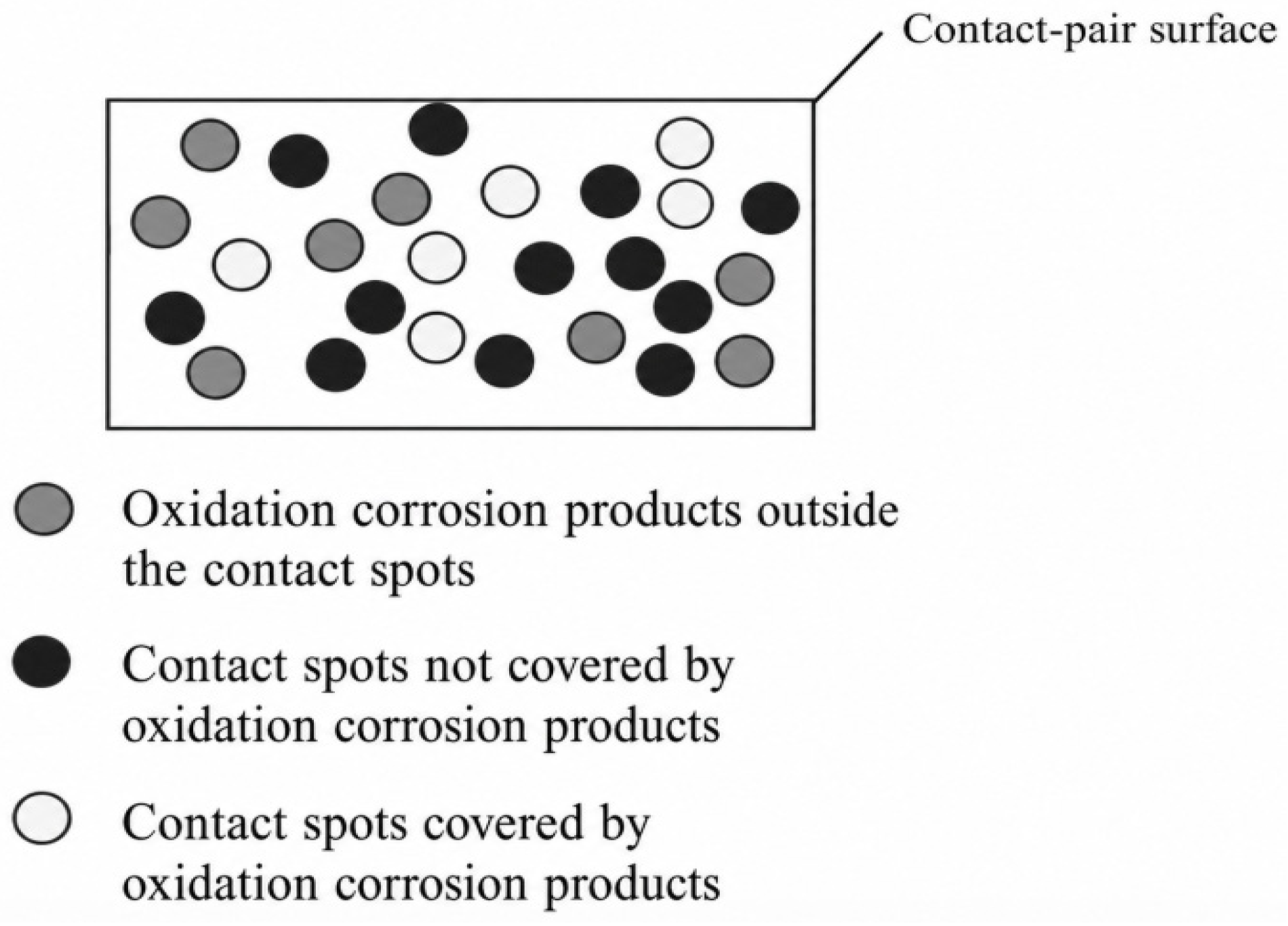
On the actual contact interface, oxidation corrosion products and contact spots are spatially randomly distributed on the contact-pair surface, rather than uniformly and continuously covering the entire conductive path, as shown in
Figure 5. Therefore, in addition to the mean growth trend, the film resistance increment also exhibits local random fluctuations caused by the random coverage of contact spots by corrosion products [
32].
To describe this randomness, the contact-pair surface is equivalently divided into contact-spot regions and non-contact-spot regions. Let
p denote the area fraction of contact-spot regions on the contact surface, namely,
where
As is the total area of contact-spot regions, m
2, and
Ab is the contact surface area, m
2.
Under a given load and stress condition, if the overall conductive mode of the contact interface does not undergo an abrupt change, that is, if no sudden reconstruction of the conductive paths occurs,
p can be regarded as a fixed geometric probability. Whether a small oxidation corrosion product unit covers a contact-spot region can then be treated as a random event. Let
λi denote the coverage event of the
i-th corrosion product unit, defined as
Then
λi follows a Bernoulli distribution with parameter
p, satisfying
Let the equivalent volume of each small corrosion product unit be
v, m
3. To separate the average growth component from the random fluctuation component,
λi is centered and defined as
Let
Sn denote the total equivalent volume of the first
n corrosion product units that cover contact-spot regions. Then,
The corresponding centered component is denoted by
From Equations (44) and (47), it follows that
Therefore, the total volume of corrosion products covering contact-spot regions can be decomposed into the mean coverage volume npv, determined by the coverage probability p, and the random deviation around this mean level. The former corresponds to the average growth component of contact performance degradation, while the latter corresponds to random fluctuations around the mean trend within the degradation trajectory.
When the corrosion products can be regarded as being composed of a large number of small units, {
} can be approximated as a sequence of independent and identically distributed random variables. Let
where Equation (49) gives the variance of a single centered random contribution.
To describe the evolution of the random coverage deviation in the cumulative sense, the normalized partial-sum sequence is first defined as
On the interval [0, 1], a piecewise linear stochastic process is constructed using the points
, and is denoted by
. When
,
, define
where
denotes the continuous stochastic process obtained by linear interpolation of the centered partial-sum sequence {
}. According to the functional central limit theorem, as
n → ∞,
converges in distribution to a standard Wiener process
W(
τ), namely,
From Equation (47), the mean and variance of the cumulative random deviation term
are
Equation (53) indicates that the variance of
increases linearly with the cumulative number of coverage events. For a standard Wiener process
B(
n), its mean and variance are
Since Equations (53) and (54) are consistent, the random deviation term
can be approximated on the macroscopic continuous scale as
Because the volume of corrosion products is proportional to the film-thickness increment, Equation (30) gives the local fluctuation in the contact resistance increment caused by the random coverage of contact spots by oxidation corrosion products:
where
, and
is the proportionality coefficient between the corrosion-product volume and the film-thickness increment.
For the
i-th sample under stress condition
s, let
Ni,s(
t) denote the cumulative number of micro-coverage events up to time
t. Then the local fluctuation in the contact resistance increment at time
t is equal to the value of the event-scale process at
n =
Ni,s(
t), namely,
From Equation (39), the contact resistance increment of the
i-th sample under stress condition
s is
Without considering random fluctuations, the mean growth path of the contact resistance increment can be written as
where
vi,s is the mean growth coefficient of the contact resistance increment for the
i-th sample under stress condition
s.
Since a larger cumulative number of random coverage events
Ni,s(
t) corresponds to a larger average volume of corrosion products covering the contact-spot regions, and since the corrosion-product volume is proportional to the film-thickness increment, the mean contact resistance increment also increases. Therefore,
where
as > 0 is the proportionality coefficient under stress condition
s.
According to the time-change property of a standard Wiener process,
Substituting Equations (60) and (61) into Equation (57) gives
where the diffusion coefficient is
.
By adding the mean growth path in Equation (59) and the local random fluctuation term in Equation (62), the contact resistance increment process of the
i-th sample under stress condition
s can be written as
Substituting Equation (40) into Equation (63) gives
where the mean growth coefficient
vi,s of the contact resistance increment is the drift rate.
Differences in the number, size, location, and connection degree of coating defects among samples, together with differences in the initial interfacial film state and local micro-morphology of the contact interface, affect the formation location, intensity, and accumulation path of local microcells, as well as the coverage of oxidation corrosion products on the actual conductive paths. These differences are ultimately reflected in the variation in the average contact resistance growth rate among samples.
According to Equation (32), the average degradation path of different samples may vary because of differences in δ0, Ks, and βR,s, leading to different contact resistance growth rates. Therefore, under the nonlinear time-scale approximation, the sample-specific mean growth coefficient vi,s can be used to characterize the difference in average degradation rates caused by coating defects, initial interfacial states, and local micro-morphology among samples.
Since the drift rate
vi,s is a positive sample-level random variable, it is assumed to follow an inverse Gaussian distribution to describe sample-to-sample variability:
where
mv,s is the mean parameter of the random drift rate, and
cv,s is the shape parameter. According to the properties of the inverse Gaussian distribution,
Given
vi,s, the conditional mean and variance of Z
i,s(
t) are
For two adjacent observation times
ti,j−1 and
tij, the interval increment of contact resistance is defined as
According to the independent-increment property of the Wiener process,
where
.
Thus, the local fluctuation in contact resistance caused by the random spatial distribution of oxidation corrosion products and contact spots is represented by the diffusion term of the nonlinear Wiener process. The difference in contact resistance growth rates caused by coating defect distribution, initial interfacial film state, and local micro-morphology is represented by the drift term of the nonlinear Wiener process.
5. Test Data and Statistical Analysis
5.1. Accelerated Degradation Test Design and Data Acquisition
The plug cover, the plug housing, the retainer and the receptacle housing are made of PBT-GF10. Their melting point is approximately 220–230 °C, and the maximum service temperature is in the range of 120–160 °C. Therefore, 160 °C was selected as the temperature acceleration stress to shorten the test duration.
Since the airbag electrical connector is installed in the passenger compartment, the random vibration spectrum specified in Test IV of GB/T 28046.3-2011 [
36] for components mounted on the vehicle body was selected to simulate the vibration environment encountered during vehicle operation. The root-mean-square acceleration was doubled from 27.8 m/s
2, giving a vibration acceleration stress of 55.6 m/s
2, as shown in
Table 1.
The selected temperature and vibration levels were used as accelerated degradation conditions rather than exact reproductions of the complete in-vehicle service profile. The 160 °C condition was used to accelerate contact-interface oxidation near the upper service-temperature range of the housing material while avoiding macroscopic thermal damage to the connector housing. The doubled RMS acceleration was used to accelerate fretting-related interfacial degradation while retaining the vehicle-body vibration spectrum specified in GB/T 28046.3-2011 [
36]. Thus, the results are used for degradation comparison and model estimation under the tested stress classes, rather than for direct service-life extrapolation under actual vehicle mission profiles.
Ten samples were assigned to the combined temperature-vibration accelerated test group (160 °C, 55.6 m/s
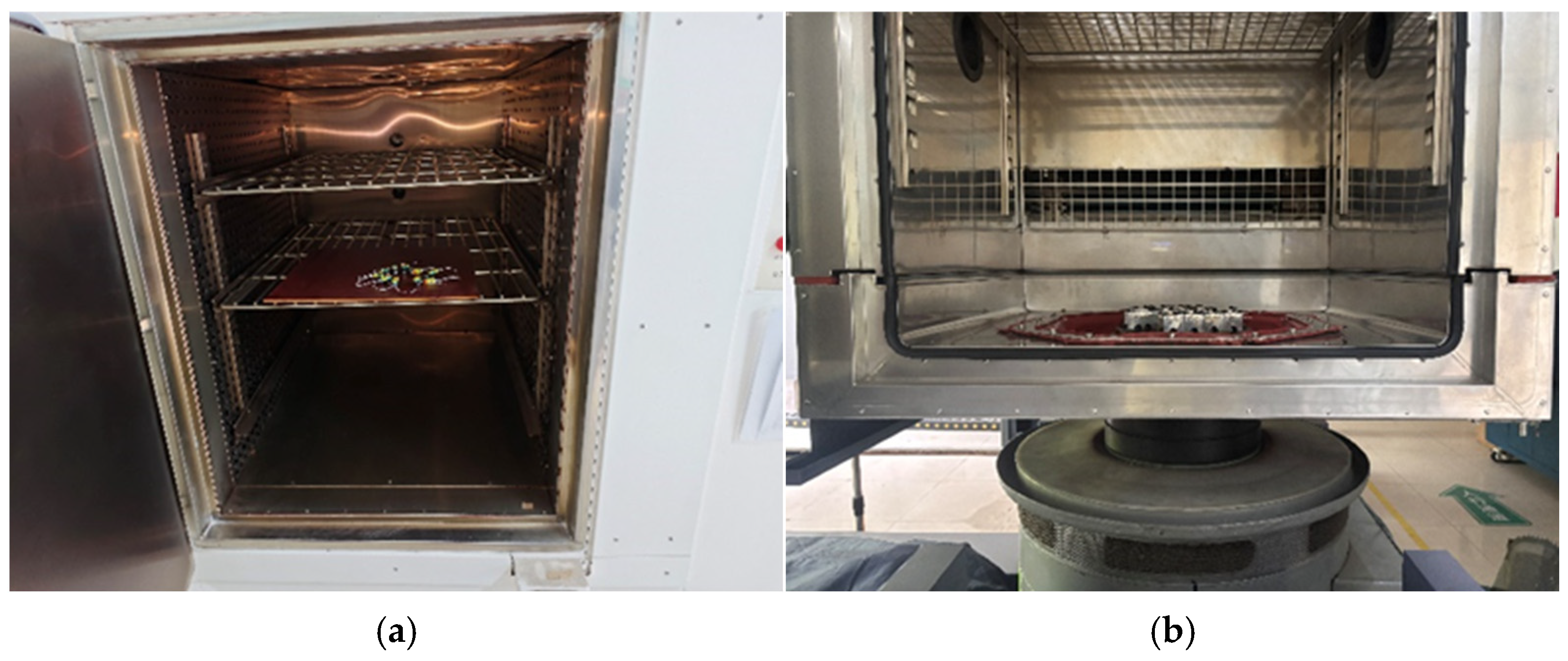
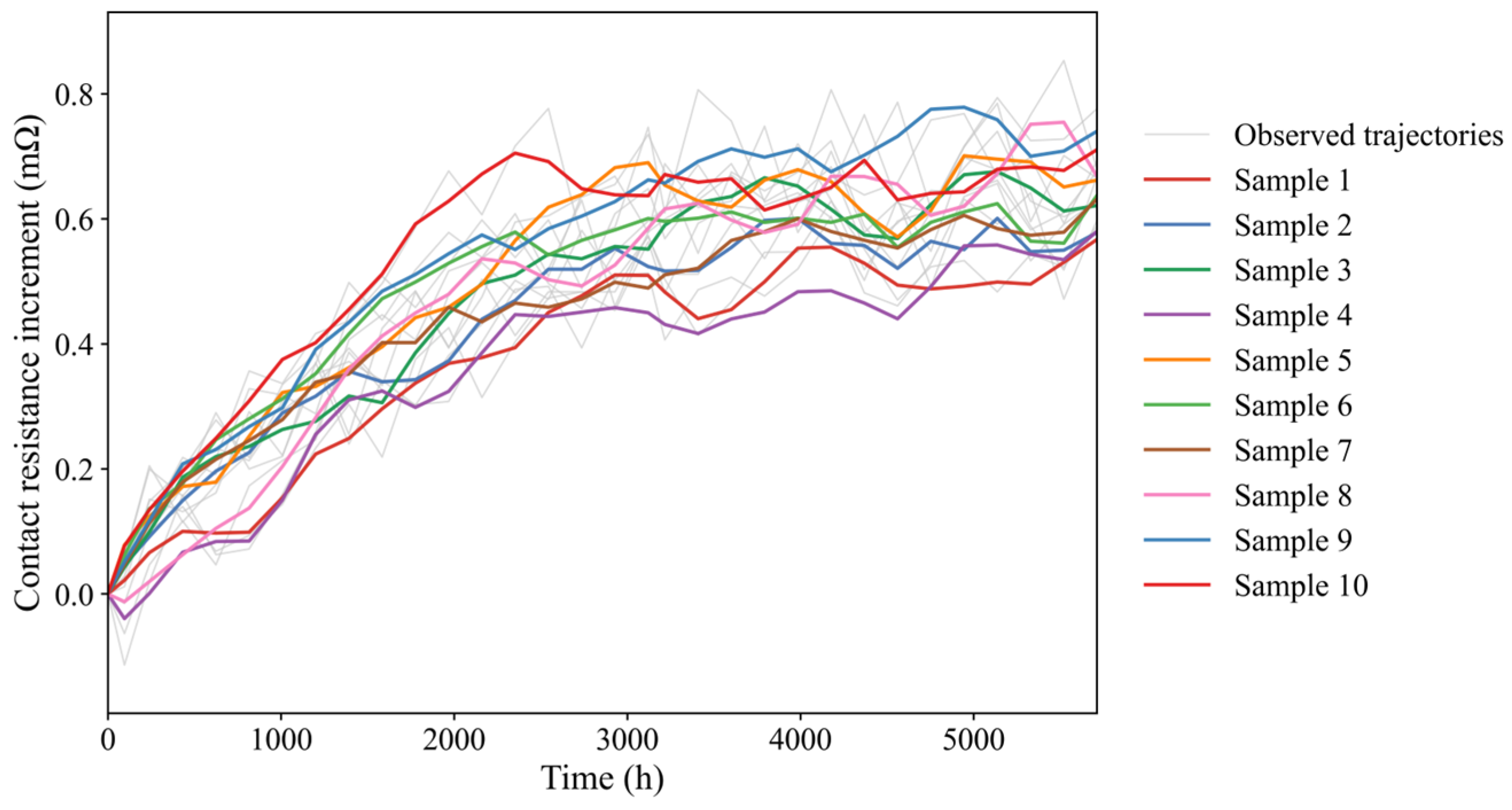
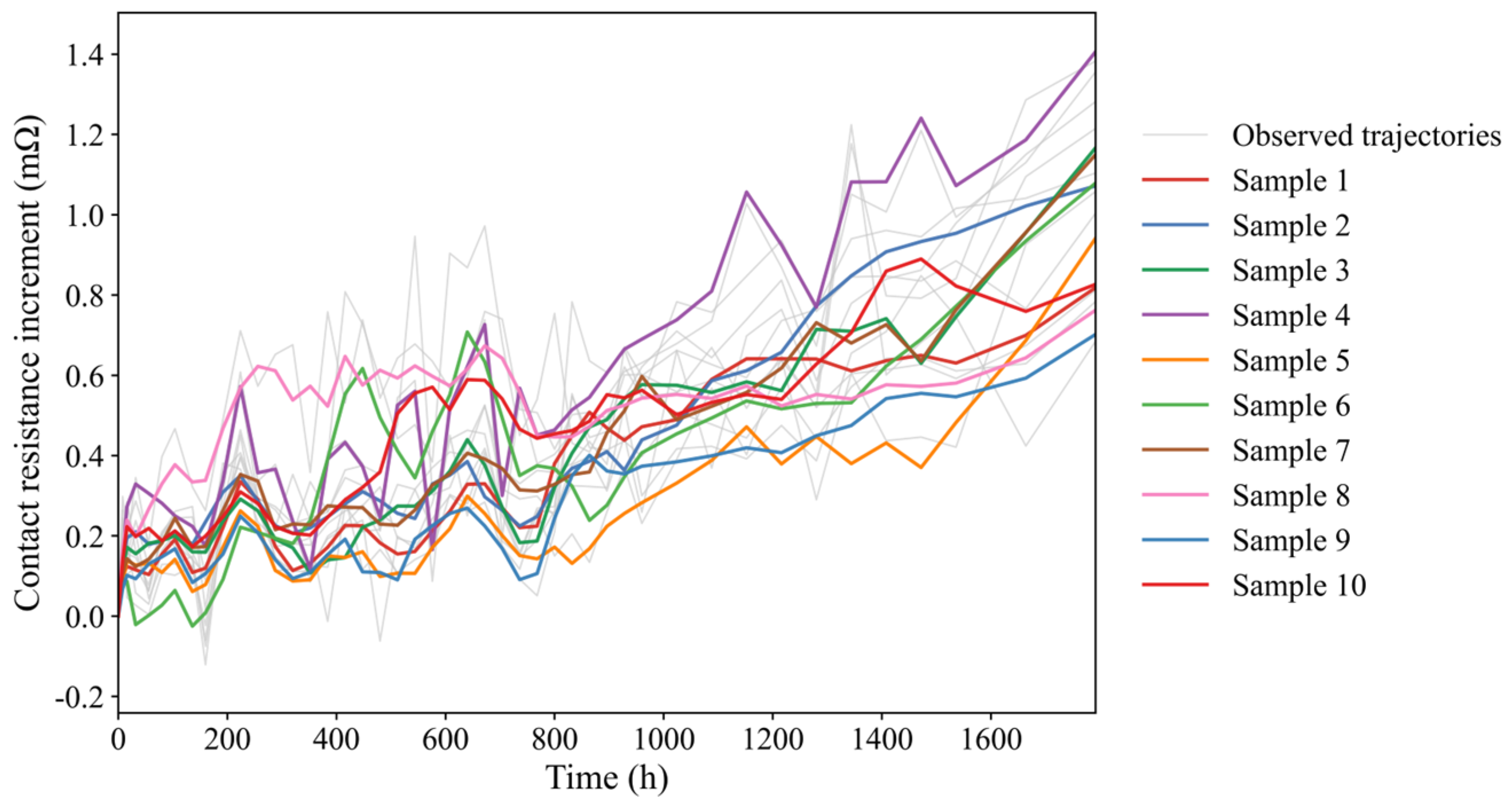
2), and ten samples were assigned to the high-temperature accelerated test group (160 °C). The two groups were used to obtain contact performance degradation data under different stress conditions. The high-temperature accelerated test lasted 5712 h, while the combined temperature-vibration accelerated test lasted 1792 h, as shown in
Figure 6.
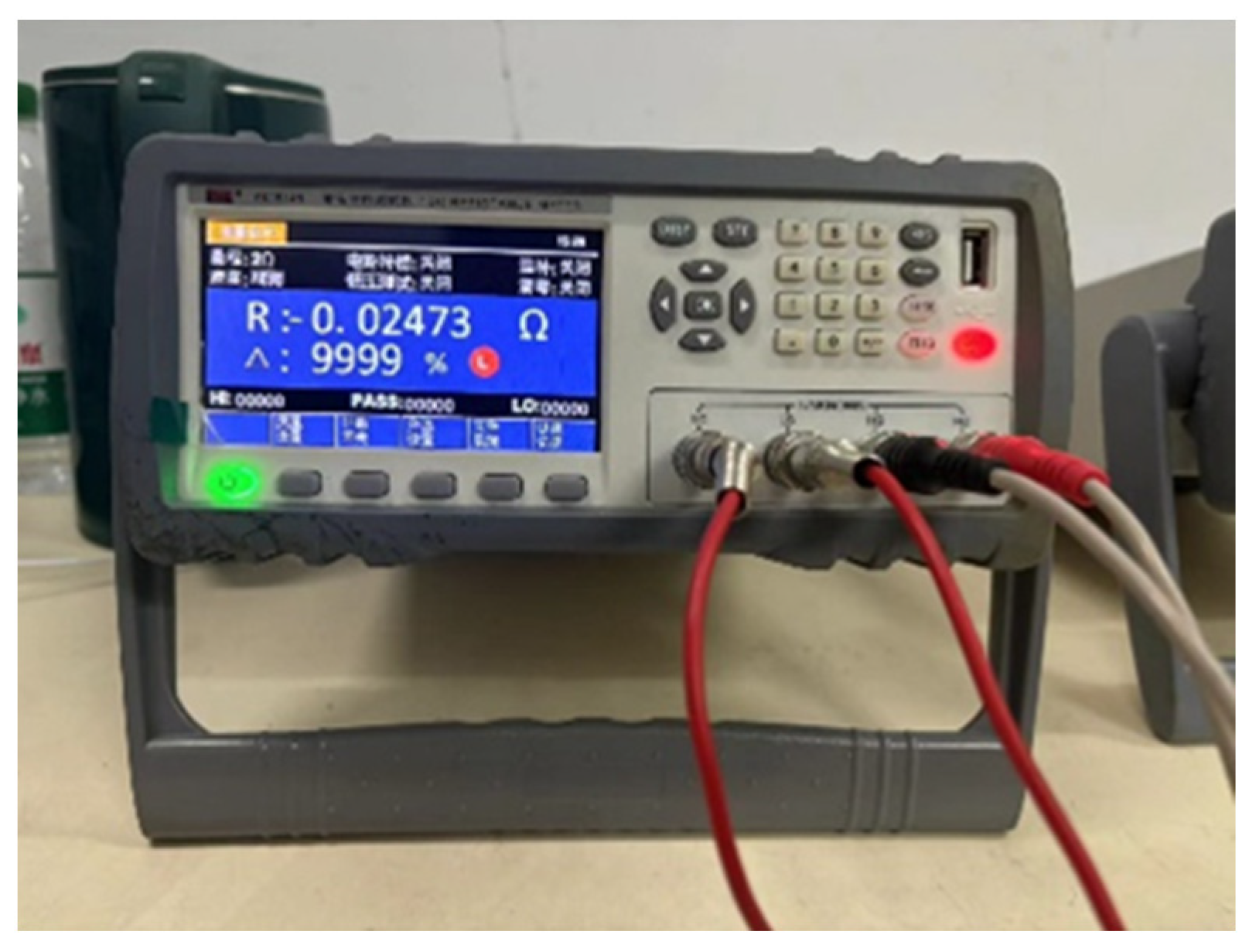
Contact resistance was measured using the four-wire method to eliminate the influence of lead resistance and improve measurement accuracy for low-resistance values. The measurement procedure was as follows:
- (1)
Two current probes were connected to the rear lead sections of the receptacle, and a test current of 100 mA was applied.
- (2)
Two voltage probes were connected to both ends of the contact element.
- (3)
The contact resistance was read using an RK2514N precision resistance tester, as shown in
Figure 7.
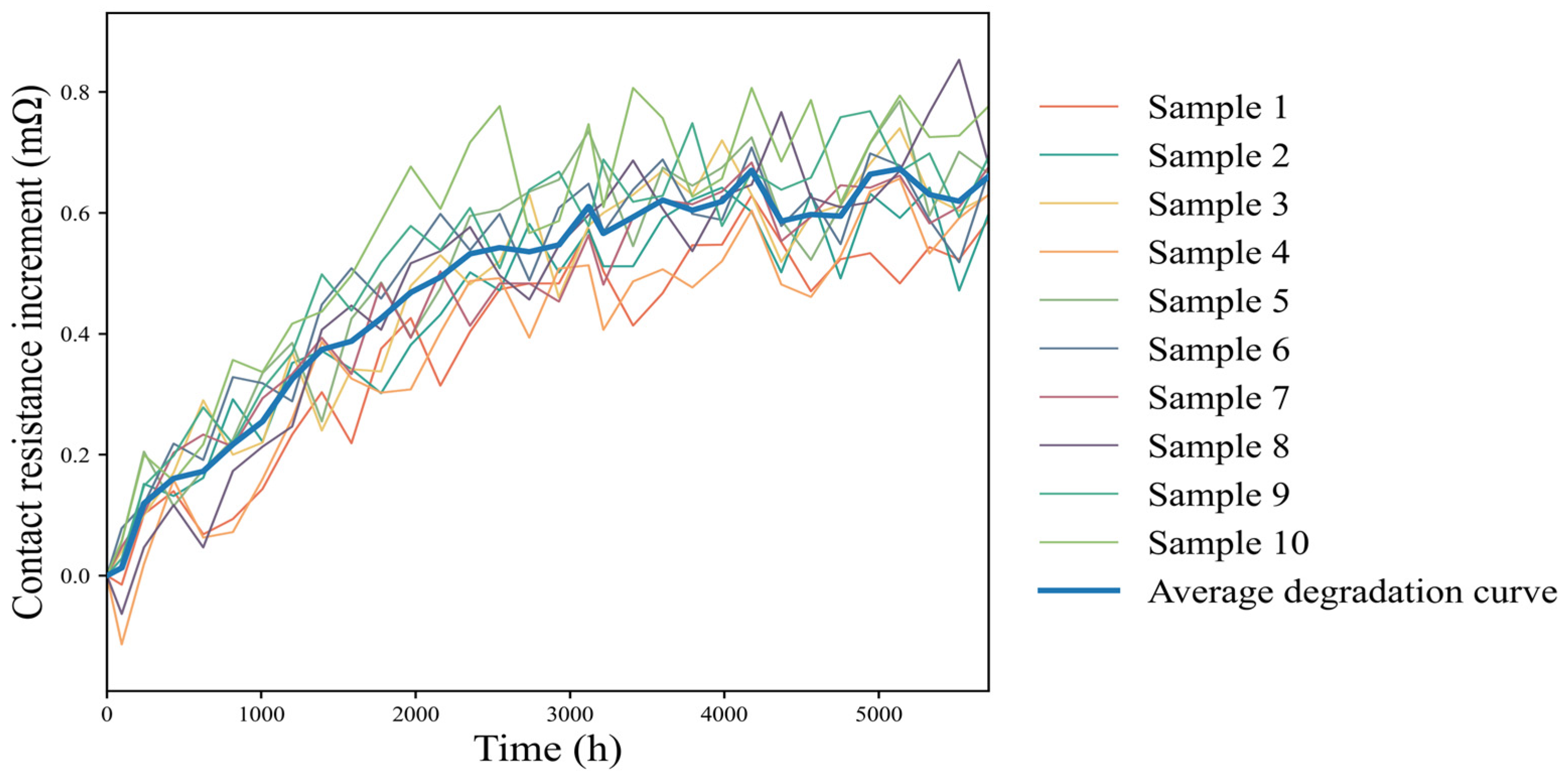
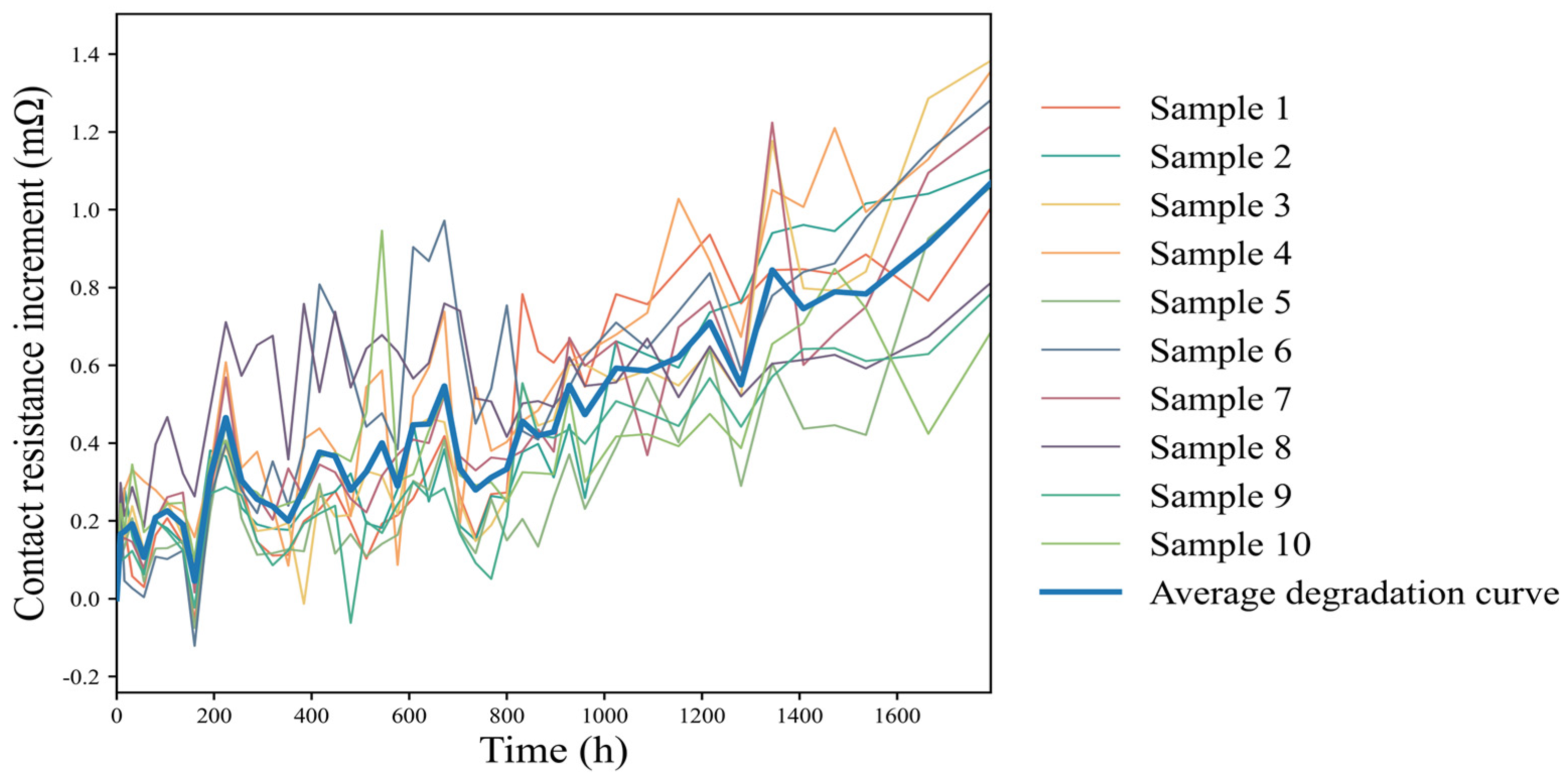
The contact resistance increment of the combined temperature-vibration test group was generally higher than that of the high-temperature test group, and its average degradation curve increased more rapidly. This indicates a higher degradation level and larger sample-to-sample fluctuation under combined temperature-vibration stress, as shown in
Figure 8 and
Figure 9.
5.2. Time-Scale Models and Parameter Estimation
The degradation data from the high-temperature test reflect the accumulation process of oxidation corrosion products under thermal stress, whereas the data from the combined temperature–vibration test are influenced by thermo-oxidation, fretting wear, and re-oxidation processes simultaneously. If both datasets are forced to share a single time-scale exponent, the effect of temperature–vibration coupling on the degradation behavior may be obscured. Therefore, two types of time-scale models are constructed for comparison.
The first is a classified time-scale model, where the two datasets are allowed to evolve on different time scales. The high-temperature data are described by an exponent
αT, while the combined temperature–vibration data are characterized by
αTV, i.e.,
The second is a shared time-scale model, which assumes a common temporal scaling for both conditions. In this case, a single exponent
αC is used for all data,
These two formulations provide a basis for assessing whether separating the time scales is necessary to represent the additional degradation mechanisms introduced by vibration. It should be noted that αT, αTV, and αC are effective exponents estimated within the present test period. They are used to represent the overall temporal scaling of the observed degradation trajectories under the corresponding stress conditions, rather than fixed physical constants directly determined by a single material or kinetic parameter.
For parameter estimation, Equations (64) and (65) show that, once the time-scale exponent
α is specified, the parameters to be estimated are the mean parameter of the random drift rate
mv,s, the shape parameter
cv,s, and the proportional diffusion parameter
κs. Since the sample drift rate
vi,s is an unobservable latent variable, the EM algorithm is used for parameter estimation. Let
Ji,s denote the number of observation intervals for the
i-th sample under stress condition
s, and define
where Δ
Zij and Δ
Λij are given by Equations (69) and (70), respectively. At the rrr-th iteration, the current parameter estimates are denoted by
In the E-step, the posterior distribution of the latent variable
vi,s is calculated using the current parameter estimates. Combining the inverse Gaussian prior in Equation (65) with the conditional normal increment distribution in Equation (70), the posterior distribution of
vi,s is a generalized inverse Gaussian distribution [
14]:
where
Using the moment properties of the generalized inverse Gaussian distribution, the two conditional moments required in the E-step are computed as
In the M-step, the model parameters are updated using the conditional moments in Equation (79). The update for the mean parameter of the random drift rate is
The shape parameter is updated as
and the proportional diffusion parameter satisfies
where
is the total number of degradation observation intervals used for parameter estimation under stress condition
s. From Equation (82),
The E-step and M-step are repeated until the maximum relative change in mv,s, cv,s, and κs between two adjacent iterations is smaller than the prescribed threshold, at which point the parameter estimates are regarded as converged.
Thus, the parameter estimation procedure consists of an outer search for the time-scale exponent α and an inner EM estimation of the model parameters. In the outer layer, α was searched over 0.05–1.20 using 80 grid points, followed by bounded continuous optimization with a convergence tolerance of 10−5 for α and a maximum of 150 optimization iterations. In the inner EM estimation, the initial sample drift rates were obtained by least-squares fitting on the transformed time scale tα. The initial mv,s, cv,s, and κs were then determined from the mean, between-sample variance, and residual variance of these preliminary estimates, respectively. The EM iteration was stopped when the maximum relative change in mv,s, cv,s, and κs was smaller than 10−8, or when the number of iterations reached 5000.
The marginal log-likelihood, AIC, and BIC are then calculated for different candidate time-scale models to compare the classified time-scale model with the shared time-scale model.
For any candidate time-scale model
M, let its estimated parameter vector be
ηM. Since the sample-specific drift rate
vi,s is an unobservable latent variable, it is integrated out to obtain the marginal likelihood of the observed degradation data. The marginal likelihood of all degradation data under candidate model
M can be written as
where
Z is the complete set of degradation data from all stress groups;
Zi,s is the degradation sequence of the
i-th sample in the
s-th stress group; and
q denotes the data category, with
q =
T for the high-temperature data and
q =
TV for the combined temperature–vibration data. Here,
is the inverse Gaussian density of the sample drift rate, and
is the conditional normal density of the degradation increments given the sample drift rate. The corresponding marginal log-likelihood is defined as
The value of logLik in Equation (85) measures how well candidate model M, with its optimized parameter estimates, explains the observed degradation data. A larger logLik indicates a better statistical fit. Since logLik tends to increase with the number of model parameters, model comparison also requires a penalty for model complexity through AIC and BIC.
For candidate model
M, AIC is defined as
and BIC is defined as
where
kM is the number of estimated parameters in the candidate model, and
N is the total number of degradation observation intervals involved in the likelihood calculation.
The classified time-scale model and the shared time-scale model are compared using the AIC and BIC criteria. The results are listed in
Table 2.
From
Table 2, the estimated time-scale exponent is
αT = 0.958431 for the high-temperature group and
αTV = 0.784673 for the combined temperature–vibration group. Neither estimate reaches the boundary of the search range, and the parameter estimation procedure converges in both cases. The lower value of
αTV suggests a different nonlinear time-scale characteristic when thermal stress and vibration act together.
The classified time-scale model gives a marginal log-likelihood of 801.19, which is higher than 797.73 for the shared time-scale model. Its AIC is also lower, −1586.37 compared with −1581.46, indicating better support under the AIC criterion. However, the BIC values of the two models are nearly identical, with the shared model being only slightly favored. Considering the possible difference in contact-interface degradation mechanisms under thermal stress and combined temperature–vibration stress, the classified time-scale model is adopted for subsequent parameter estimation and model validation based on the combined consideration of statistical fit and physical interpretation.
After determining the classified time-scale model, the parameters of the nonlinear Wiener process with an inverse Gaussian random drift rate are further estimated. The results are shown in
Table 3.
As shown in
Table 3, the estimated
mv is 0.002991 for the combined temperature-vibration group and 0.000180 for the high-temperature group. Because the two groups have different time-scale exponents,
mv should be interpreted as the mean drift parameter with respect to the transformed time scale, rather than as an ordinary degradation rate per unit physical time. Therefore, the larger
mv value in the combined temperature-vibration group indicates a larger drift level on its corresponding nonlinear time scale.
To compare the degradation levels under the same physical time, the expected contact resistance increment can be calculated as . At the common observation time of 1792 h, the predicted mean contact resistance increment is approximately 0.236 mΩ for the high-temperature group and 1.071 mΩ for the combined temperature-vibration group. This comparison under the same physical time indicates that the introduction of vibration stress leads to a higher contact resistance increment within the test period.
It should be noted that the number of independent specimens is limited by the time and cost of long-duration accelerated testing. Although each stress group contains ten specimens, each specimen provides repeated degradation measurements over the test period, and these time-series increments are jointly used in the likelihood estimation. Therefore, the estimated parameters are interpreted as model-based estimates under the tested stress classes.
Based on the parameter estimates, model degradation trajectories are plotted. The observed curves are used to reflect the actual evolution of the contact resistance increment for each sample.
Figure 10 and
Figure 11 compare the observed contact resistance increment trajectories with the fitted trajectories from the stochastic process model. Under the high-temperature accelerated test condition, the contact resistance increment of each sample shows a gradual upward trend, with relatively weak local fluctuations. The fitted trajectories capture the main growth trend and local variations in the observed data. In contrast, under combined temperature-vibration accelerated stress, the trajectories are more dispersed and exhibit stronger local fluctuations, indicating that the introduction of vibration stress increases the instability of the contact-interface degradation process.
5.3. Model Validation and Analysis
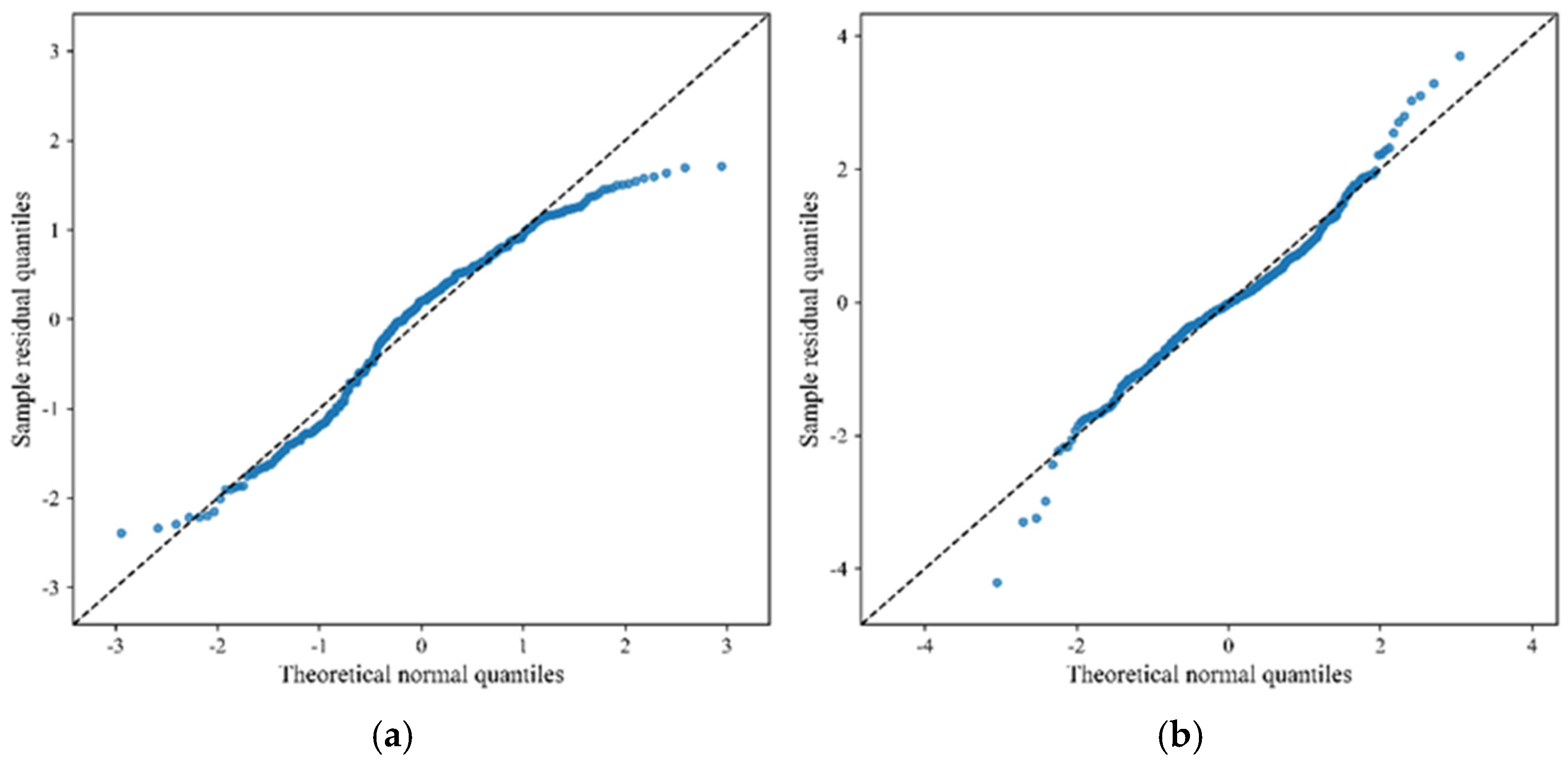
After the classified time-scale model is selected and the model parameters are estimated by the EM algorithm, the standardized increment residuals are examined to evaluate the ability of the random-drift nonlinear Wiener process model to describe the growth of contact resistance. If the conditional mean and diffusion terms are specified appropriately, the standardized increment residuals should have a mean close to 0, a standard deviation close to 1, skewness close to 0, and ordinary kurtosis close to 3, and the main region of the Q-Q plot should also agree well with the standard normal reference line. The descriptive statistics of the standardized increment residuals are listed in
Table 4.
As shown in
Table 4, the mean values of the standardized residuals are −0.009356 for the high-temperature group and −0.008164 for the temperature-vibration group, both close to 0. This indicates no obvious systematic bias in the modeled mean growth trend of the contact resistance increment. The standard deviations are 0.964751 and 0.987668, respectively, both close to 1, suggesting that the diffusion term captures the main scale of random fluctuation in the contact resistance increment.
The skewness values are −0.465285 for the high-temperature group and 0.078629 for the temperature-vibration group, indicating no pronounced one-sided skewness and an approximately symmetric main residual distribution. The ordinary kurtosis is 2.345638 for the high-temperature group and 4.821778 for the temperature-vibration group.
The higher kurtosis in the temperature–vibration group indicates more evident tail fluctuations, which is consistent with stronger local film rupture and re-oxidation induced by fretting wear under combined temperature-vibration stress. These tail deviations may be associated with local oxide-film rupture, re-oxidation of newly exposed metal, and sudden changes in effective contact spots. Therefore, while the current Wiener process model captures the main degradation trend and fluctuation scale, its ability to describe occasional abrupt local interface reconstruction remains limited.
The Q-Q plots of the standardized increment residuals are shown in
Figure 12.
As shown in
Figure 12, the standardized residuals of both groups generally follow the standard normal reference line in the central region. This indicates that the proposed model can describe the main distributional characteristics of the contact resistance increment. Deviations appear in the tails for both groups, suggesting that a small number of extreme local fluctuations remain in the actual contact resistance growth process.
To further examine the suitability of the assumed random drift-rate distribution, three candidate distributions are considered under the classified time-scale model: inverse Gaussian, lognormal, and Gamma. For each candidate distribution, the corresponding distribution parameters and diffusion coefficient are estimated, and the marginal log-likelihood, AIC, and BIC are then calculated.
Let the candidate drift-rate distribution model be denoted by Md, where d ∈ {IG, Lognormal, Gamma}. According to Equations (85)–(87), logLik(Md), BIC(Md) and AIC(Md) are calculated for each candidate model. A larger marginal log-likelihood indicates stronger explanatory ability for the observed degradation data, while smaller AIC and BIC values indicate a better fit after accounting for model complexity.
As shown in
Table 5, all models converge, indicating that the inverse Gaussian, lognormal, and Gamma distributions are all feasible for the present data. The inverse Gaussian model gives a marginal log-likelihood of 507.398053, which is higher than 507.388877 for the lognormal model and 507.379734 for the Gamma model. Their AIC and BIC are −1002.796106 and −975.075666, respectively, both the smallest among the three candidate models. Thus, under the classified time-scale model, the inverse Gaussian distribution provides a feasible and slightly better-fitting description of the random drift rate for the present dataset. However, because the differences among the three candidate distributions are small, this result should not be interpreted as evidence that the inverse Gaussian distribution is uniquely optimal.
The fitted degradation model can further provide a basis for threshold-based engineering evaluation, including first passage time (FPT) and remaining useful life (RUL) assessment. Let
D denote the allowable contact resistance increment threshold under a specified stress condition
s. For a given sample drift rate
vs, the conditional degradation process is
By defining the transformed time
Equation (88) can be written as
Zs(
u) =
u +
κsB(
u). Therefore, the first passage time in the transformed time scale is
For the Wiener process with unit drift and diffusion coefficient
κs,
τD follows an inverse Gaussian first-passage distribution, with density
For a connector observed at time
t0 with degradation state
Zs(
t0) =
z0 <
D, the remaining useful life can be similarly evaluated by replacing
D with the remaining threshold
D−z0 and updating the drift-rate distribution using the observed degradation history. The conditional RUL can be expressed as
These expressions show how the estimated drift-rate and diffusion parameters can be used for threshold-based reliability evaluation. In the present work, numerical FPT or RUL results are not reported because the contact resistance threshold D and the mapping from accelerated stress conditions to actual service conditions depend on product specifications and application scenarios. Thus, the proposed model provides a degradation-modeling basis for future FPT and RUL assessment rather than a direct service-life extrapolation.
5.4. Surface Composition Analysis and Degradation-Mechanism Support
To provide surface-composition evidence for the failure-mechanism analysis, EDS analysis was performed on the socket surfaces of the untested sample, the high-temperature-degraded sample, and the combined temperature–vibration degraded sample using a field-emission scanning electron microscope equipped with an EDS system (GeminiSEM 500, Carl Zeiss Microscopy GmbH, Oberkochen, Germany). The main elemental contents are listed in
Table 6.
Here, at% denotes atomic percentage, i.e., the proportion of a given element relative to the total number of detected atoms.
As shown in
Table 6, the socket surface of the untested sample is dominated by Au, with an Au content of 78.65 at%. The Ni content is only 0.08 at%, close to the detection limit, indicating that the Au coating on the untested socket surface remains relatively intact and that the underlying Ni layer is only weakly exposed.
After high-temperature degradation, the O content increases from 21.27 at% to 29.74 at%, while the Au content decreases from 78.65 at% to 65.67 at%. The Ni content also increases to 4.59 at%. These changes indicate evident oxidation corrosion and coating-state variation on the socket surface under thermal stress, with possible local reduction in Au coating coverage or exposure of the underlying Ni layer. This result is consistent with the analysis that oxidation corrosion product accumulation and the growth of low-conductivity film layers under thermal stress increase the contact resistance.
The surface composition changes are more pronounced for the combined temperature-vibration-degraded sample. The O content further increases to 35.56 at%, the Au content decreases to 56.18 at%, and the Ni content rises to 8.26 at%. Compared with the high-temperature-degraded sample, the combined temperature-vibration sample shows higher O and Ni contents and lower Au content.
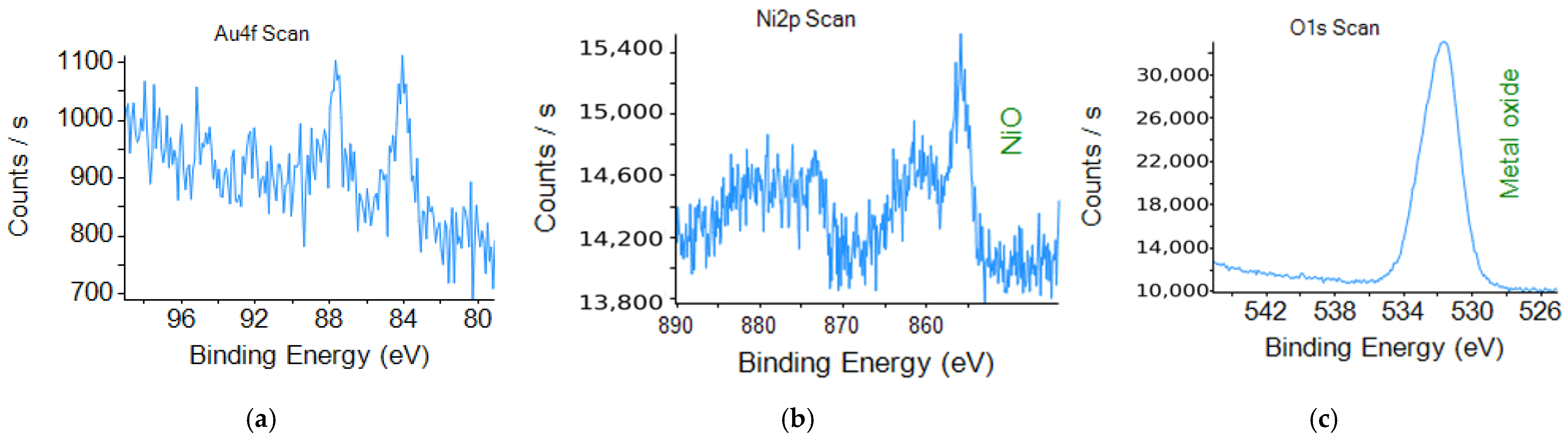
To obtain more surface-sensitive information from the outermost surface, X-ray photoelectron spectroscopy (XPS) was further performed on the combined temperature–vibration-degraded sample using a K-Alpha X-ray photoelectron spectrometer (Thermo Fisher Scientific, Waltham, MA, USA). The representative Au 4f, Ni 2p, and O 1s spectra are shown in
Figure 13.
As shown in
Figure 13a, the Au 4f signal is still detectable on the degraded surface, indicating that Au-containing regions remain present after degradation. The Ni 2p spectrum in
Figure 13b exhibits a characteristic peak associated with NiO, while the O 1s spectrum in
Figure 13c contains a dominant metal-oxide component. These results provide surface-sensitive evidence that oxidation products are present on the outermost surface after combined temperature-vibration degradation.
The EDS and XPS results provide complementary information on the degraded contact surface. EDS reflects elemental composition changes within a relatively larger information depth, whereas XPS is sensitive to the outermost surface and provides chemical-state information. The EDS results indicate significant changes in the relative contents of O, Ni, and Au after degradation, while the XPS results further confirm the presence of oxidation-related species on the outermost surface of the combined temperature–vibration-degraded sample. Together, these observations support the proposed degradation mechanism involving oxidation-product accumulation and surface-state evolution at the contact interface.