1. Introduction
The increasing penetration of residential photovoltaic (PV) systems is a key component of the transition toward decentralized and low-carbon energy systems [
1,
2,
3]. In recent years, declining investment costs of PV technologies, together with supportive regulatory frameworks, have led to a rapid growth of small-scale installations in the household sector.
Despite this progress, a fundamental mismatch persists between the temporal profiles of electricity generation and consumption. Household demand is typically concentrated in the morning and evening hours, whereas PV generation peaks around midday. As a result, a significant share of locally generated electricity is exported to the distribution grid under less favourable conditions compared to the retail electricity price, which limits the economic benefits for consumers [
4,
5,
6].
Increasing the level of on-site self-consumption has therefore become one of the main objectives in the design and operation of residential PV systems. The most commonly investigated approaches include battery storage systems, Demand Side Management (DSM) strategies, and various forms of sector coupling, such as linking electricity generation with thermal systems [
7,
8,
9,
10].
From a cost-effectiveness perspective, DSM represents an attractive alternative, as it enables the adjustment of the operating schedule of selected loads to match available PV generation without the need for additional installation of electrical energy storage systems [
11,
12,
13].
In residential settings, electric water heaters (boilers) represent a particularly suitable controllable load [
14,
15]. Due to their inherent thermal storage capacity, they enable time-flexible heating of domestic hot water without significantly affecting user comfort.
Various types of flexible loads can be used to increase PV self-consumption in residential buildings, including heat pumps, electric vehicle charging and smart appliance scheduling. These options offer different flexibility characteristics and may provide substantial benefits when properly integrated. In the present study, however, the focus is placed on an electric storage water heater as the sole flexible load. This choice reflects the characteristics of the analyzed case study, where an electric storage water heater is already installed, no battery storage or electric vehicle charger is present, and t such heaters are widely deployed, relatively inexpensive and technically simple to control. As a result, they represent a readily accessible flexibility option for many existing PV-equipped households. Extending the analysis to combinations of multiple flexible loads, such as water heaters, heat pumps and EV charging, is identified as an important direction for future work but lies beyond the scope of this paper.
Several studies have shown that redirecting surplus PV generation to water heating can substantially increase the self-consumption rate and improve the economic performance of small-scale PV installations. Electrified domestic hot water systems are therefore considered an important DSM tool for optimizing the operation of residential PV systems. [
12,
16,
17,
18].
Existing studies address a wide range of control approaches for electric water heaters, ranging from simple threshold-based on/off strategies to advanced optimization models [
15] based on mathematical programming or heuristic algorithms. Some contributions consider the water heater as the only flexible load, while others combine its control with battery storage systems or additional appliances, thereby increasing both system complexity and investment requirements. [
18,
19,
20,
21,
22,
23,
24,
25].
Simulation tools such as PV*SOL [
26] are commonly used for the energy and economic evaluation of these strategies, as they enable detailed modelling of generation, consumption, and energy flows within a household.
Despite growing interest in DSM strategies in combination with residential PV systems, most studies primarily focus on comparing an uncontrolled baseline with a single selected strategy or on contrasting simple threshold-based control with a complex optimization model. Only a limited number of studies systematically analyze how control granularity—i.e., the number of discrete steps in which the power of an electric water heater can be adjusted—affects energy indicators such as the self-consumption ratio and self-sufficiency rate, as well as the economic performance of the system. This aspect is crucial for practical implementation, as a higher number of control steps typically requires more sophisticated control components and may increase costs without delivering proportional benefits.
Another identified gap in the literature is the limited attention given to simple system configurations without battery storage, which more accurately reflect the real conditions of a large share of households equipped with small-scale PV systems and electric water heaters. Many recent studies assume the simultaneous deployment of battery storage or complex control of multiple flexible loads. While this approach can achieve higher levels of optimization, it also increases the investment cost of the solution. Consequently, detailed analyses are lacking that quantify the extent to which energy self-sufficiency can be improved and costs reduced solely through appropriately designed control of an electric water heater in battery-free systems.
The aim of this study is to evaluate the impact of different control strategies for electric water heating on the energy and economic performance of a residential photovoltaic system under conditions without battery storage. The analysis is based on a simulation model of a household equipped with a PV installation, in which several control modes with different levels of granularity—from a reference case without control to continuous power modulation—are applied to the operation of the electric water heater. The main contribution of the study lies in the comparative assessment of these control modes in terms of key indicators, such as the self-consumption ratio, self-sufficiency rate, energy flows, and total electricity costs, as well as in identifying a potential saturation effect, where further refinement of control yields only marginal additional benefits. The results provide practical recommendations for the design of DSM in residential PV systems and contribute to a more efficient integration of distributed renewable energy sources into the power grid.
2. System Configuration and Methodology
The aim of this study is to quantify the impact of different demand-side control strategies on the energy and economic performance of a residential photovoltaic (PV) system. For this purpose, a simulation-based approach was employed, enabling a detailed analysis of electricity flows and their effects on household operation [
27].
The simulations were carried out using the PV*SOL Premium environment [
26] with a simulation time step set to 1 h. The results represent a prediction of electricity generation and consumption based on historical climate data, site-specific characteristics, and technical system parameters. Climate data were obtained from the Meteonorm 8.2 [
28] database for the period 2001–2020.
The analyzed location is situated in Dunajská Streda, with an annual global solar irradiation of 1207 kWh/m2. The household consumption profile was adopted from the PV*SOL database, which is based on a representative high-resolution residential load profile developed by HTW Berlin.
The simulation tracks electricity flows between the PV system, the household, and the distribution grid, with a focus on the balance between instantaneous self-consumption and surplus energy export.
2.1. Characteristics of the Modelled Photovoltaic System
The parameters of the analyzed PV system are summarized in
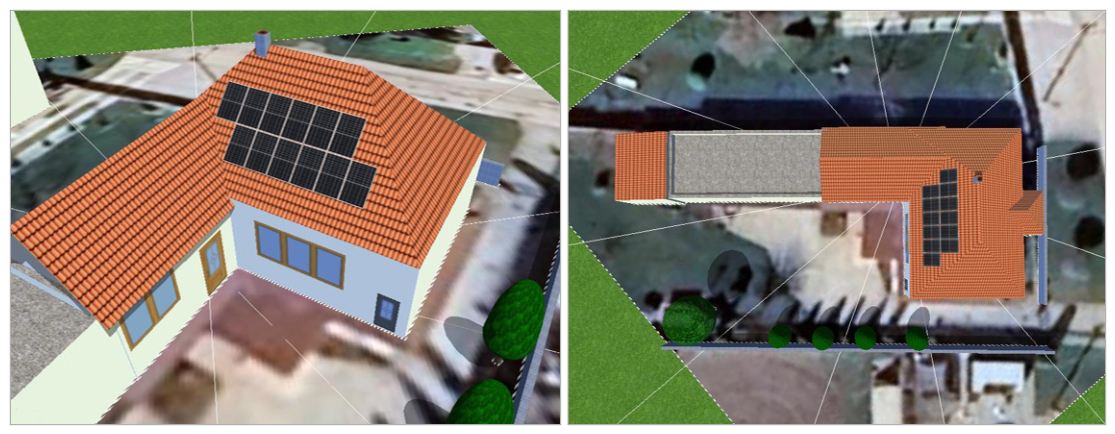
Table 1. The system has an installed capacity of 5.4 kWp, with an annual electricity production of 5452 kWh. The analyzed photovoltaic system is based on a real residential installation. The PV array is installed at a tilt angle of 45°, corresponding to the roof inclination, and occupies a total area of 24 m
2. The system configuration reflects a typical small-scale residential setup, ensuring realistic operating conditions and practical relevance of the obtained results (
Figure 1). The simulations were carried out in PV*SOL Premium using an hourly time step. This choice was made as a compromise between temporal resolution and computational effort, since the main focus of this study is on annual energy balances and tariff-based cost indicators rather than short-term dynamics. We acknowledge that an hourly resolution averages out sub-hourly fluctuations in irradiance, PV output and load, which may affect detailed control behaviour, especially for the more granular Modes 3–5. Consequently, the saturation of self-consumption observed for these modes should be interpreted in the context of this temporal resolution, and a higher-resolution (e.g., 5 min) analysis is identified as a topic for future work.
The simulations were performed using a 1 h time step, which is the default temporal resolution available in the adopted modelling approach. A shorter time step (e.g., 15 min or 1 min) would capture short-term fluctuations in photovoltaic generation and household demand more accurately and could affect the absolute values of self-consumption and self-sufficiency. However, since all analyzed control modes were evaluated under identical conditions, the relative comparison between modes and the observed saturation trend is expected to remain largely unchanged.
The total annual electricity consumption of 7034 kWh/year results from the baseline household demand and the assumed 2000 kWh/year consumption of the electric storage water heater. The control modes mainly affect the share of this demand supplied by PV versus the grid, rather than the total annual energy consumption.
2.2. Parameters of the Electric Water Heater
The electric water heater represents a controlled thermal load. Its technical parameters are summarized in
Table 2, while its operational parameters are provided in
Table 3. The annual electricity consumption of the water heater is assumed to be 2000 kWh, and its operation is controlled according to the availability of surplus PV generation.
In addition to the technical characteristics, further inputs are defined to describe the operational behaviour and energy consumption of the water heater (
Table 3):
The electric water heater represents a controllable thermal load with inherent energy storage capability. With a nominal power of 2–2.2 kW and a storage volume of 122 L, the system enables temporal shifting of electricity consumption by storing energy as heat. This characteristic makes the water heater particularly suitable for demand-side management applications in residential PV systems.
Domestic hot water (DHW) demand was modelled using a standard residential DHW load profile representative of a Central European single-family house with 3–4 occupants. The profile leads to an annual electric water heater consumption of approximately 2000 kWh/year. It exhibits higher hot water draws in the morning and evening, lower consumption during daytime, and negligible demand at night. This DHW profile is based on the typical-use templates for residential buildings provided in the simulation software and reflects usage patterns reported for similar households in Central Europe. The resulting hourly DHW load is used as input to the storage tank model and is kept identical for all control modes.
The electric storage water heater is modelled as a stratified hot water tank with a nominal volume of 112 L. The tank is discretized into several vertical layers, enabling temperature stratification to be represented instead of assuming a single perfectly mixed volume. Standby heat losses are described by a constant heat-loss coefficient corresponding to the manufacturer’s data for a 112 L electric storage tank, resulting in a specific heat loss of approximately 1.68 kWh per 24 h. During domestic hot water draws, cold make-up water enters at the bottom of the tank and mixing between layers is computed according to the internal stratified tank formulation of the simulation software. These storage model assumptions are applied identically to all control modes, so that differences between Modes 1–5 arise solely from the control logic and not from changes in the physical tank model.
The minimum storage temperature during normal operation was set to 40 °C, with a weekly thermal disinfection cycle at 70 °C to limit the risk of legionella growth. Legionella bacteria are known to proliferate mainly between approximately 20 °C and 45 °C and are effectively inactivated at temperatures of 60 °C and above when maintained for a sufficient duration. Periodic elevation of the storage temperature above 60 °C is widely recommended in Legionella control guidance as a ‘pasteurisation’ measure for domestic hot water systems. A more detailed microbiological risk assessment is beyond the scope of this study; here, the temperature regime is chosen to remain compatible with common hygiene practices while enabling an assessment of the energy and economic impacts of different control granularities.
2.3. Control Strategy and PLC Implementation
The proposed demand-side control strategy is based on real-time control of the electric water heater using a programmable logic controller (PLC). The aim of the control system is to maximize the utilization of locally generated electricity from the photovoltaic system by dynamically adjusting the power input of the water heater according to the available surplus power.
2.3.1. Input Variables
The control algorithm is based on instantaneous power values within the system. The following variables are considered:
: instantaneous power output of the photovoltaic system;
: instantaneous household load demand;
: available surplus power.
2.3.2. Surplus Power Calculation
Positive surplus values represent available electricity suitable for domestic hot water heating, whereas negative values indicate the need to import electricity from the distribution grid (Equation (1)).
2.3.3. Control Logic
The power input of the electric water heater is controlled according to the available surplus power using the following rule (Equation (2)):
where
represents the rated power of the electric water heater. Here
denotes the actual water temperature in the storage tank and
is the maximum allowable water temperature. The boiler is activated only when surplus photovoltaic power is available, and the water temperature remains below this predefined upper temperature limit.
2.3.4. Control Granularity
A key parameter of the proposed control strategy is control granularity, defined as the number of available power levels at which the input power of the controlled load can be adjusted. Increasing granularity enables more accurate matching of electricity consumption to the current PV generation, thereby increasing the self-consumption ratio.
2.4. PLC Implementation
The control algorithm is implemented in a PLC environment, where instantaneous power values in the system are processed in discrete time steps. Based on the calculated surplus power, the control system adjusts the operation of the electric water heater either by switching between discrete power levels or by continuous power modulation, depending on the selected control mode.
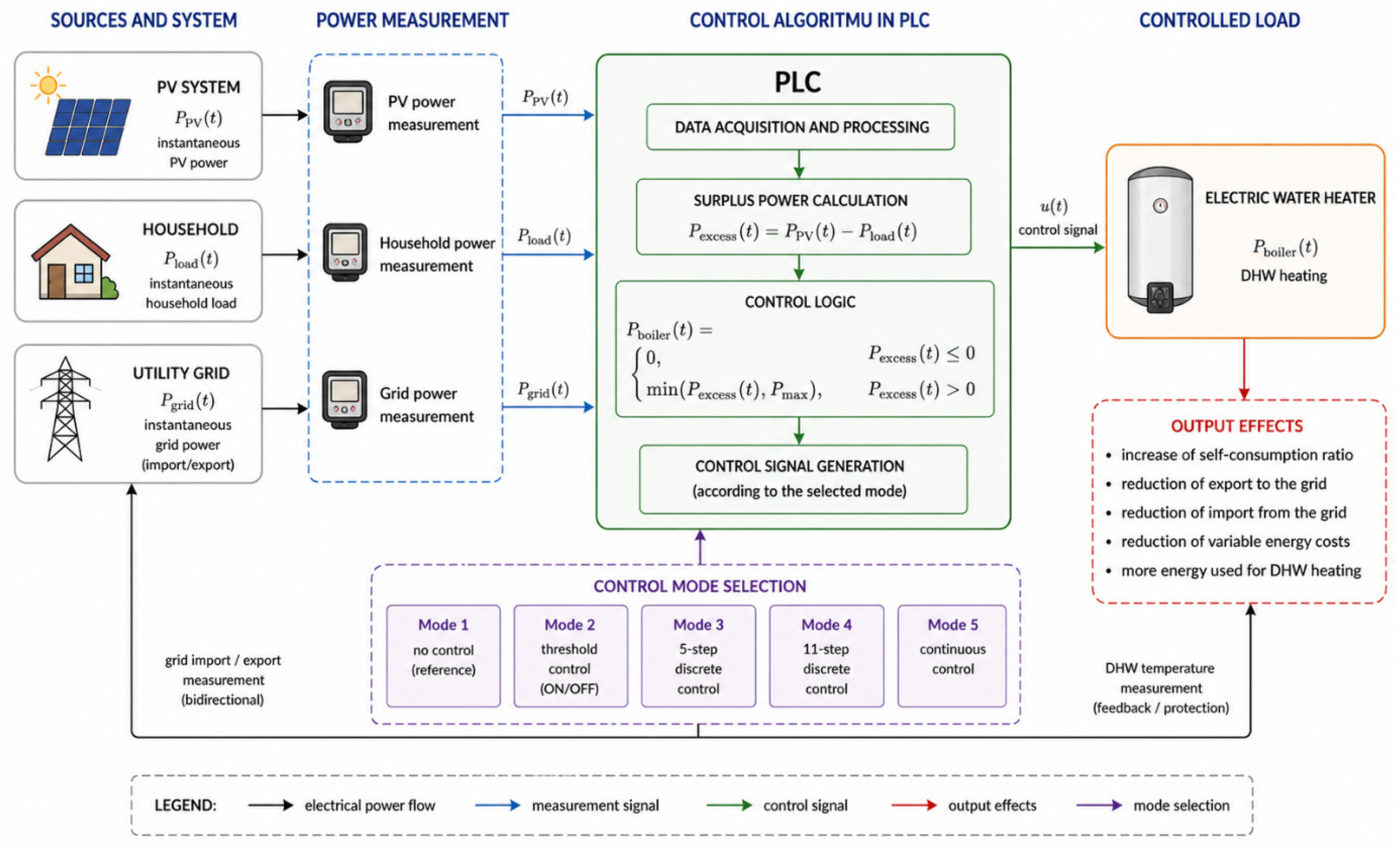
The block diagram of the proposed control system is shown in
Figure 2.
The diagram illustrates the flow of electrical power and information between the main system components, namely the photovoltaic source, household load, distribution grid, measurement devices, PLC-based control algorithm, and controlled load.
The instantaneous values of photovoltaic power output , household load demand , and grid power are measured and processed in discrete time steps within the PLC environment. Based on these data, the surplus power is calculated as , representing the available energy suitable for on-site utilization.
The control algorithm subsequently generates a control signal , which adjusts the power input of the electric water heater to the current surplus power according to the selected control mode, ranging from the reference case without control to continuous power modulation.
The objective of the proposed control strategy is to increase the self-consumption ratio, reduce the amount of electricity exported to the distribution grid, limit electricity import from the grid, and decrease variable electricity costs. At the same time, the system enables more efficient use of surplus PV energy for domestic hot water heating.
The control system uses feedback from the measurement of grid energy flows and domestic hot water temperature, ensuring reliable and efficient system operation (
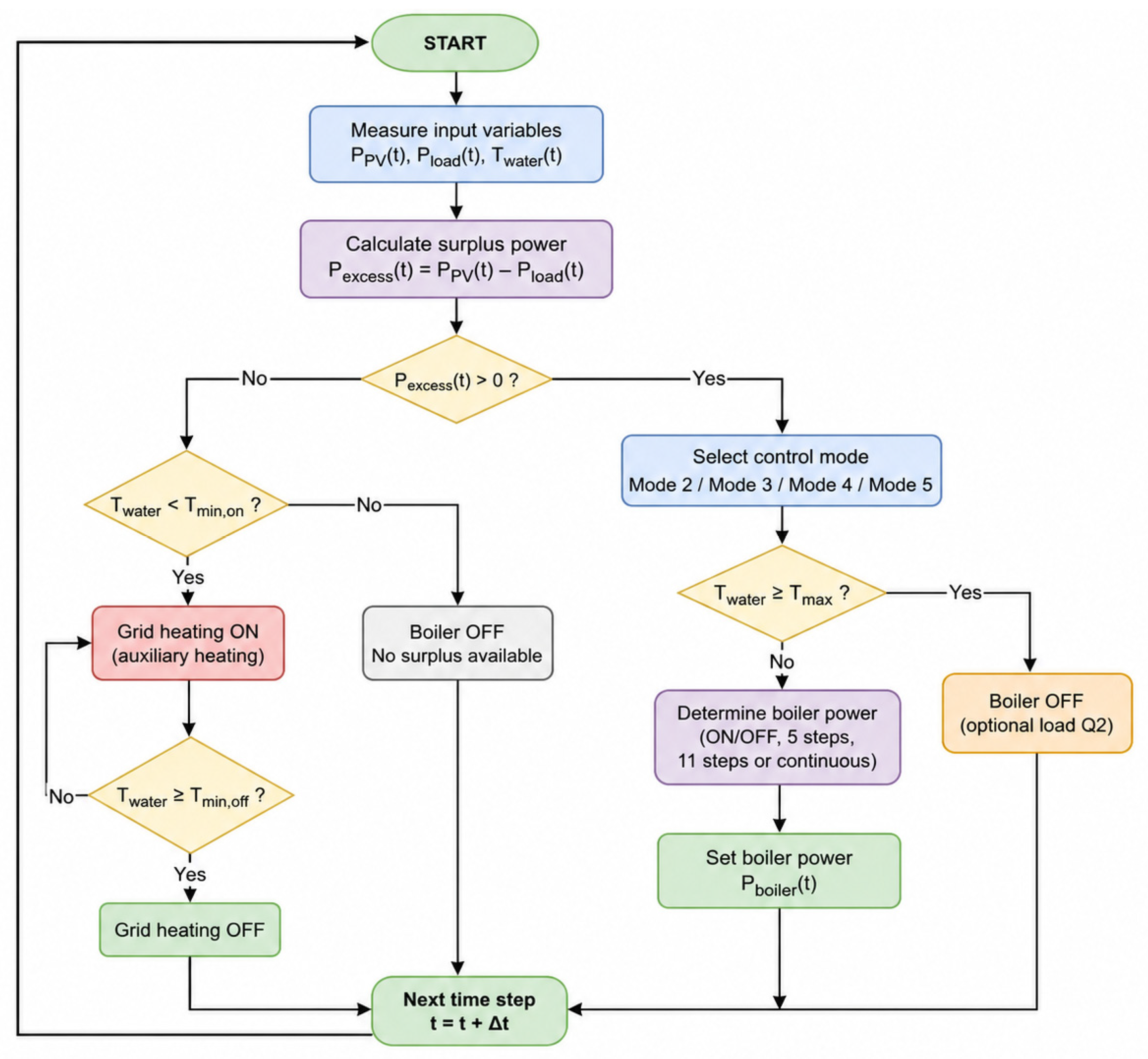
Figure 3).
In each discrete time step, the measured values of the photovoltaic system output , household load demand , and water temperature are processed. Based on these variables, the surplus power is calculated as .
If no surplus power is available, the water heater remains switched off. However, when the water temperature drops below the minimum required value, grid-powered heating is activated to maintain user comfort. If surplus power is available, the control mode is selected, and the water heater power is adjusted to the current surplus using threshold-based, multi-step, or continuous control.
To avoid frequent switching of the grid-powered heating around the minimum temperature threshold, a hysteresis band is implemented in the control logic. The auxiliary grid heating is activated only when the water temperature drops below and remains active until the temperature reaches , where . This prevents short-cycling and ensures stable operation of the electric water heater.
The algorithm also includes a temperature constraint to prevent overheating of the water. Once the maximum temperature is reached, the water heater is switched off, or the surplus energy is redirected to an alternative load. The control cycle is repeated in each time step, ensuring dynamic adjustment of electricity consumption to the current photovoltaic generation. The objective of the control is to increase the self-consumption ratio, reduce electricity export and import, and minimize electricity costs.
2.5. Control Modes
Within the study, five electricity demand control strategies were analyzed. These strategies differ in the level of control granularity applied to the power regulation of the electric water heater as a flexible thermal load. The individual modes represent a progressively increasing level of system adaptability to the instantaneous surplus electricity generated by the photovoltaic system.
The control approach is based on the utilization of surplus electricity, defined as the difference between current PV generation and instantaneous household consumption. Depending on the value of this surplus, the power input to the water heater is adjusted with the objective of maximizing on-site consumption of generated electricity and minimizing its export to the distribution grid.
The control modes (Modes 1–5) were implemented directly within the PV*SOL Premium simulation environment by defining different operating characteristics of the controllable electric water heater load. The analyzed modes represent increasing levels of control complexity, ranging from thermostat-controlled operation without active surplus utilization (Mode 1) to threshold-based switching and discrete multi-step power control (Modes 2–4), up to continuous power modulation according to the available photovoltaic surplus (Mode 5).
The control logic was modelled as a PLC-type algorithm within the simulation environment. Therefore, the block diagram and flowchart presented in
Figure 2 and
Figure 3 should be understood as a conceptual representation of the control strategy used in the simulations rather than as a fully deployed physical PLC installation. These figures describe the decision-making process applied to the simulated electric storage water heater and illustrate the control principles intended for practical implementation in future work. All simulations were performed entirely within the PV*SOL environment. No external optimization routines, custom post-processing algorithms, or additional control software were used to generate the reported energy, self-consumption, self-sufficiency, or economic indicators.
The individual control modes are defined as follows:
Mode 1 (reference)—no active demand control; the operation of the water heater is governed solely by the built-in thermostat with a lower temperature limit of 40 °C, without considering the instantaneous PV generation or surplus electricity.
Mode 1 represents a reference operation with thermostat-only control and no dedicated PV-surplus utilization. Nevertheless, the electric storage water heater can still consume photovoltaic electricity whenever thermostat-driven operation happens to coincide with periods of photovoltaic generation. Therefore, Mode 1 does not represent a zero-PV baseline for water heating but rather a realistic reference case without active load control.
Mode 2—single-threshold control; the water heater is activated once a predefined surplus power level (2.2 kW) is reached and operates at full power until the target temperature is achieved.
Mode 3—multi-level discrete control with five power levels; the input power of the water heater is adjusted according to predefined surplus power intervals, enabling improved matching between generation and consumption.
Mode 4—refined multi-level control with eleven power levels; this mode allows more precise adjustment of consumption to smaller fluctuations in surplus electricity.
Mode 5—continuous power control; the input power of the water heater is continuously modulated based on the instantaneous surplus power, theoretically achieving the maximum utilization of locally generated energy.
In all control modes, a minimum level of domestic hot water comfort is ensured. If the water temperature drops below 40 °C and surplus electricity is insufficient, the water heater is supplied from the distribution grid. This mechanism guarantees operational reliability and enables an objective comparison of the individual control strategies.
The objective of the comparison is to analyze the impact of demand-side control on electricity flows within a residential PV system, with a focus on the relationship between instantaneous self-consumption and surplus energy export to the distribution grid.
2.6. Evaluated Energy Parameters and Performance Indicators
The following energy parameters are monitored in the analysis:
: total electricity generation of the photovoltaic system;
: instantaneous on-site electricity consumption;
: amount of electricity exported to the distribution grid and subsequently re-imported;
: total household electricity consumption, defined as the sum of the electric water heater consumption and the consumption of other appliances according to the selected load profile.
2.6.1. Performance Indicators
The evaluated indicators include the self-consumption ratio (SCR), defined as (Equation (3)):
where
represents the instantaneous on-site electricity consumption and
the total PV electricity generation. The SCR represents the share of generated electricity that is directly consumed on-site without being exported to the distribution grid. A higher SCR indicates more efficient utilization of locally generated electricity.
In addition to the standard self-consumption ratio (SCR) and self-sufficiency ratio (SSR), we introduce the surplus consumption ratio (MSP), which quantifies the fraction of surplus PV generation absorbed by the electric water heater. While SCR and SSR describe the overall matching between PV generation and total household demand, MSP focuses specifically on the utilization of surplus PV energy by the controllable heater. In the following, SCR and SSR are used as the main performance indicators, and MSP is reported as a complementary metric. The surplus consumption ratio (MSP) is defined as (Equation (4)):
where
denotes the amount of electricity exported to the grid and later re-imported, and
is the total household electricity consumption. The MSP reflects the share of electricity that was not consumed immediately on-site and required interaction with the grid. A higher MSP indicates lower instantaneous consumption and greater dependence on the distribution grid.
The self-sufficiency ratio (SSR) is defined as (Equation (5)):
where
represents the instantaneous on-site electricity consumption and
the total household electricity consumption. The SSR expresses the share of total demand covered by locally generated electricity. A higher SSR indicates a higher level of energy independence from the distribution grid.
2.6.2. Total Electricity Consumption
The total household electricity consumption is defined as (Equation (6)):
where
represents the electricity consumption of the water heater and
the consumption of other household appliances according to the selected load profile.
The required annual electricity consumption of the water heater is assumed to be constant in the simulation; however, its actual consumption may vary slightly due to operational losses associated with the water-heating process. The applied control strategy primarily affects the share of electricity used for water heating that is supplied by the photovoltaic system versus the distribution grid.
2.6.3. Economic Evaluation
In addition to the energy assessment, the analysis includes an economic evaluation of the individual control modes. The input economic parameters are based on a real electricity billing invoice (year 2022, tariff DD2), with only the variable components of the electricity price included in the calculations (
Table 4).
Table 4 presents the variable components of the electricity price used in the economic evaluation. Fixed charges are not included in the analysis, as they are not affected by the applied demand-side control strategy.
From an economic perspective, the objective of demand-side control is to maximize the instantaneous consumption of electricity generated by the photovoltaic system, thereby reducing the volume of electricity imported from the distribution grid. Given the structure of electricity pricing, this primarily reduces the cost of electricity as a commodity, while distribution-related charges remain largely unchanged.
For the purpose of economic evaluation, total electricity consumption is divided into three components:
Instantaneous consumption ()—electricity generated by the PV system and consumed directly on-site; this component does not incur commodity electricity costs.
Surplus energy ()—electricity exported to the distribution grid and subsequently re-imported; this component incurs distribution-related charges, while commodity costs are not considered.
Grid import ()—electricity directly imported from the distribution grid; this component includes full costs, i.e., both the electricity commodity price and distribution charges.
This decomposition forms the basis of the economic model and enables quantification of the impact of demand-side control on individual cost components.
The total variable cost of electricity is defined as (Equation (7)):
where
is the total variable electricity cost for a given control mode;
is the unit price of electricity as a commodity [€/kWh];
is the unit price of distribution charges [€/kWh];
is the electricity imported from the distribution grid [kWh];
is the electricity exported to the grid and subsequently re-imported [kWh].
All tariff parameters in Equation (7) are taken from the official DD2 price lists for residential customers in the year 2022 and are applied consistently across all control modes so that differences in annual cost arise solely from changes in the energy flows. Additionally, we consider a sensitivity case where the unit energy prices are replaced by the average DD2 prices over 2022–2025.
The distribution charges
are defined as the sum of individual variable components (Equation (8)):
where
is the variable component of the distribution tariff;
represents distribution loss charges;
is the nuclear fund levy;
denotes system service charges;
represents system operation costs.
The proposed model reflects the structure of the tariff system, in which commodity electricity costs are associated with direct grid import, while distribution charges apply to the total volume of electricity drawn from the grid, regardless of its origin. This approach enables a consistent comparison of the economic efficiency of the individual control strategies.
2.6.4. Model Validation and Input Data
The case study is based on a real 5.4 kWp residential rooftop PV installation with an electric storage water heater located in Slovakia. However, no dedicated long-term measurement campaign was conducted to validate the simulation model for this particular household. Instead, PV generation and load profiles were derived from the PV*SOL database and typical residential usage patterns provided by the software and literature sources. This approach is common in PV energy yield simulations when detailed on-site measurements are not available. Consequently, the absolute values reported in this paper (e.g., annual electricity cost of €725.53 and a baseline self-consumption of 38.73%) should be regarded as indicative for a representative household under the assumed conditions rather than as precise predictions for a specific customer.
3. Performance Evaluation of Demand-Side Control Strategies
The simulations were performed in the PV*SOL Premium 2023 environment (Valentin Software GmbH, Berlin, Germany) with a time step of 1 h. Energy and economic parameters were evaluated for five operating modes differing in the control strategy of the electric water heater, ranging from a reference case without control to continuous power modulation. For each scenario, annual energy flows, the self-consumption ratio (SCR), the surplus consumption ratio (MSP), the self-sufficiency ratio (SSR), and total variable electricity costs were quantified.
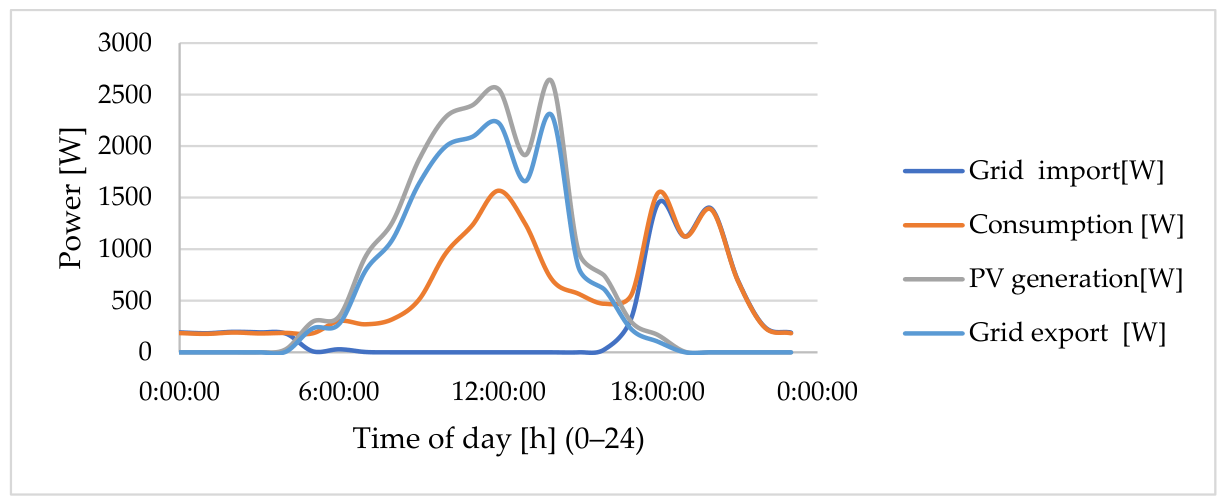
To illustrate the mismatch between photovoltaic generation and household demand, the daily power profiles are shown in
Figure 4.
Figure 4 clearly shows a significant temporal mismatch between electricity generation and consumption. While PV generation peaks around midday, household demand is distributed throughout the day, with higher values typically occurring in the morning and evening hours. This mismatch leads to surplus electricity being exported to the grid during daytime and to the need for electricity import during periods of low or zero PV generation.
3.1. Mode 1—Reference (No Demand Control)
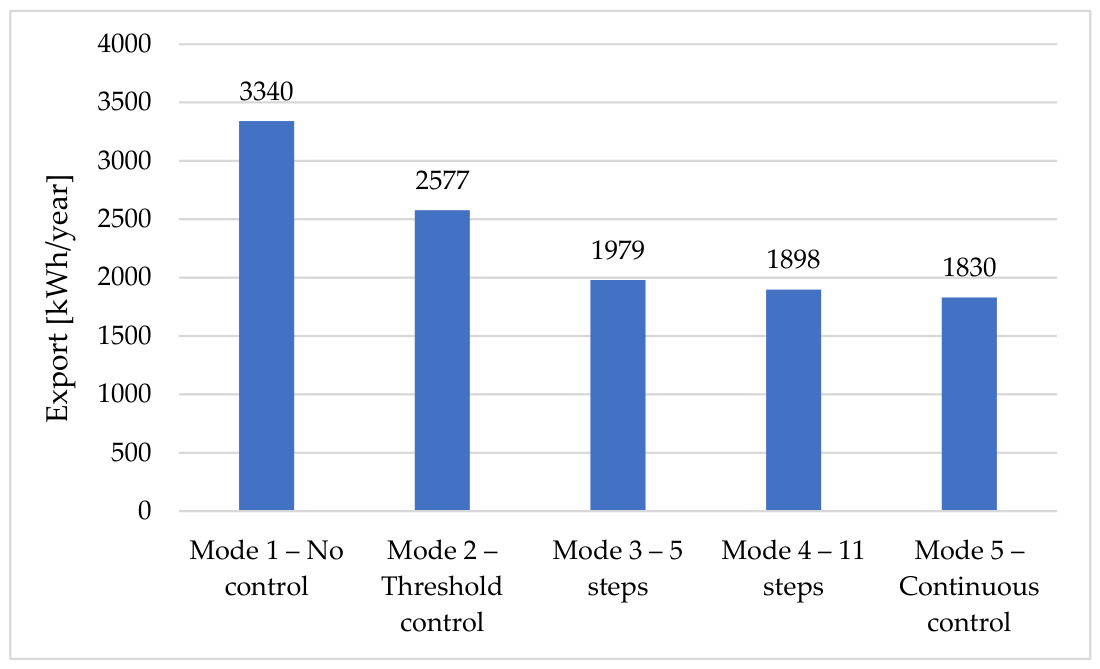
The direct consumption of generated electricity reaches 2112 kWh/year, corresponding to a self-consumption ratio of 38.73% out of the total annual generation of 5452 kWh. The remaining 3340 kWh/year is exported to the distribution grid. The share of re-imported surplus electricity represents 47.48% of total grid consumption.
The self-sufficiency ratio reaches 30.03%, indicating a significant dependence on the distribution grid. The total variable electricity cost amounts to €725.53, which is the highest among all analyzed modes.
It should be noted that the baseline Mode 1 already includes some incidental PV contribution to water heating due to coincidental timing between photovoltaic generation and thermostat-driven boiler operation. Consequently, the improvements observed in Modes 2–5 are measured relative to a realistic baseline that already benefits from a limited degree of naturally occurring photovoltaic self-consumption.
3.2. Mode 2—Single-Step (Threshold) Control
In Mode 2, a simple threshold-based control strategy is applied, where the water heater is activated when sufficient surplus PV generation is available. This results in a partial shift in consumption to periods of higher generation.
Direct consumption increases to 2876 kWh/year, corresponding to an SCR of 52.73%. At the same time, electricity export decreases to 2577 kWh/year. The MSP is reduced to 36.43%, indicating more efficient utilization of locally generated electricity.
The SSR increases to 40.65%, representing a substantial improvement compared to the reference mode. From an economic perspective, the implementation of this simple strategy reduces the total variable electricity cost to €608.04 per year.
These results demonstrate that even a basic control approach can significantly reduce surplus electricity export and improve both the energy and economic performance of the system.
3.3. Mode 3—Five-Step Discrete Control
Mode 3 applies a multi-level discrete control strategy with five power levels, allowing better adaptation of the water heater power input to the available PV surplus.
Direct consumption increases to 3474 kWh/year, corresponding to an SCR of 63.70%. Electricity export decreases to 1979 kWh/year, while the MSP is reduced to 27.82%.
The SSR reaches 48.83%, showing a further improvement compared to Mode 2. The total variable electricity cost decreases to €517.11 per year.
Compared to single-threshold control, multi-step control provides a substantial increase in self-consumption and a further reduction in electricity export, confirming the importance of finer control granularity for improved system performance.
3.4. Mode 4—Eleven-Step Discrete Control
Mode 4 introduces a finer multi-level control strategy with eleven power levels, enabling more precise matching of consumption to smaller fluctuations in PV surplus.
Direct consumption reaches 3555 kWh/year (SCR = 65.21%), representing an increase of approximately 1.5 percentage points compared to Mode 3. Electricity export decreases to 1898 kWh/year, and MSP is reduced to 26.66%.
The SSR reaches 49.93%, representing only a marginal improvement over Mode 3. The total variable electricity cost decreases slightly to €504.73 per year.
A more detailed analysis shows that although finer control enables better utilization of smaller surplus energy portions, its overall annual impact is relatively limited. Most significant improvements were already achieved when transitioning from Mode 1 to Mode 3, while further increases in control granularity result only in incremental optimization.
These findings indicate a diminishing marginal benefit with increasing control complexity. Despite improved technical precision, the differences compared to the five-step control remain limited from both energy and economic perspectives. This represents a clear indication of a saturation effect, which becomes more evident in the next mode.
3.5. Mode 5—Continuous Control
Mode 5 applies continuous power control, where the water heater input is dynamically adjusted to the instantaneous surplus PV generation. This represents the highest level of control among the analyzed scenarios.
Direct consumption reaches 3622 kWh/year, corresponding to an SCR of 66.43%, which is only a modest increase of approximately 1.2 percentage points compared to Mode 4. Electricity export decreases to 1830 kWh/year, while MSP reaches 25.69%.
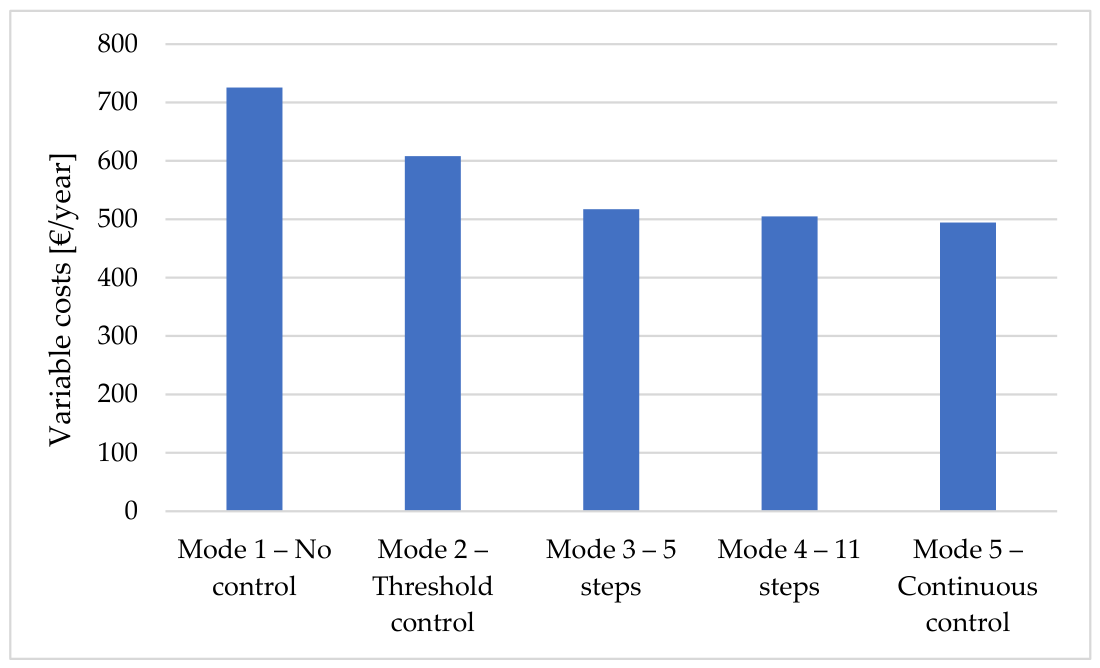
The SSR attains 50.85%, the highest among all modes, although the improvement compared to Mode 4 is minimal. The total variable electricity cost is reduced to €494.44 per year, representing an overall cost reduction of 31.86% compared to the reference mode.
Although continuous control provides the best results across all evaluated indicators, its incremental benefit compared to multi-step control (Modes 3 and 4) is limited. The differences in SCR, SSR, and costs are relatively small and do not indicate a substantial improvement in overall system performance.
These results clearly confirm the presence of a saturation effect, where increasing control complexity does not lead to proportional gains in energy or economic performance. While continuous control represents a theoretically optimal approach, its practical benefits may not justify the increased implementation complexity.
3.6. Comparison and Trend Analysis
A summary of the energy and economic indicators for all analyzed control modes is presented in
Table 5. The results clearly demonstrate the significant impact of demand-side control on both the energy and economic performance of the photovoltaic system.
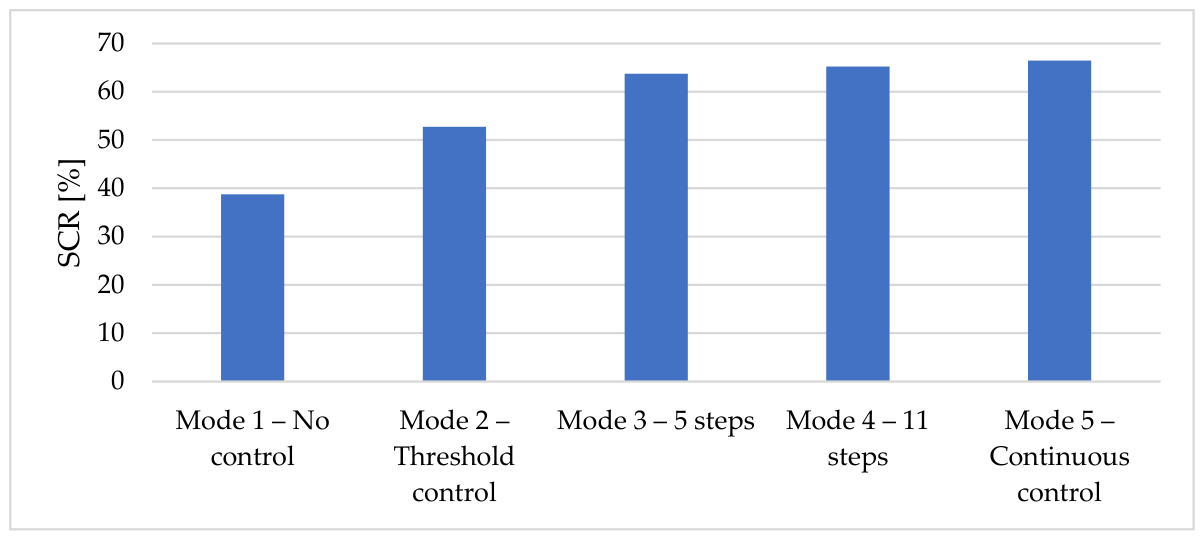
The most substantial improvement is observed when transitioning from the reference mode (Mode 1) to multi-level control (Mode 3). The self-consumption ratio increases from 38.73% to 63.70%, while electricity export to the distribution grid decreases from 3340 kWh/year to 1979 kWh/year. At the same time, total variable electricity costs decrease significantly from €725.53 to €517.11, representing a major improvement in the economic performance of the system.
Further increases in control complexity (Modes 4 and 5) result only in marginal improvements. The SCR increases slightly to 66.43%, while the self-sufficiency ratio) reaches a maximum of 50.85%. The reduction in variable costs is limited, with the difference between Modes 3 and 5 amounting to approximately €22 per year.
This trend clearly indicates the presence of a saturation effect, where further increases in the number of control steps do not lead to proportional improvements in energy or economic performance. Most of the benefits of demand-side control are already achieved with simple or moderately complex strategies.
From a practical perspective, this suggests that the optimal trade-off between control complexity and achieved savings is represented by multi-level control at the level of Mode 3. Further refinement of control leads only to minor performance improvements with diminishing returns.
Compared to the reference mode, continuous control (Mode 5) achieves an overall reduction in variable electricity costs of 31.86%, confirming the importance of demand-side control as an effective tool for improving the economic efficiency of photovoltaic systems.
A significant increase is observed when transitioning from the reference mode (Mode 1) to multi-level control (Mode 3), where SCR rises from 38.73% to 63.70%. Further increases in control granularity (Modes 4 and 5) result only in minor improvements, with a maximum SCR of 66.43%. This trend illustrates (
Figure 5) the saturation effect, where additional control refinement does not lead to proportional gains.
The introduction of control leads to a substantial reduction in exported electricity, with the most significant decrease observed between Mode 1 and Mode 3 (from 3340 to 1979 kWh/year). Further reductions in Modes 4 and 5 are only marginal, confirming the saturation effect (
Figure 6).
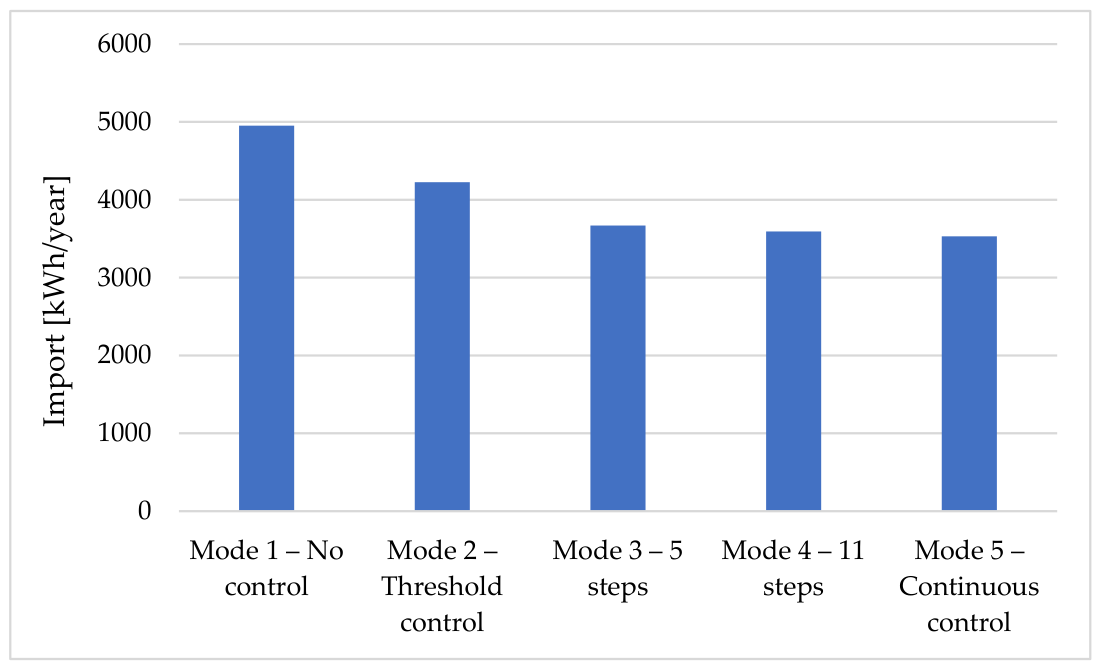
The implementation of control reduces grid import progressively, with the most pronounced decrease occurring between Mode 1 and Mode 3 (from 4951 to 3669 kWh/year). Additional improvements in Modes 4 and 5 are limited, indicating diminishing returns and reduced dependence on the grid (
Figure 7).
The values were derived from PV*SOL Premium simulations based on annual energy balance calculations.
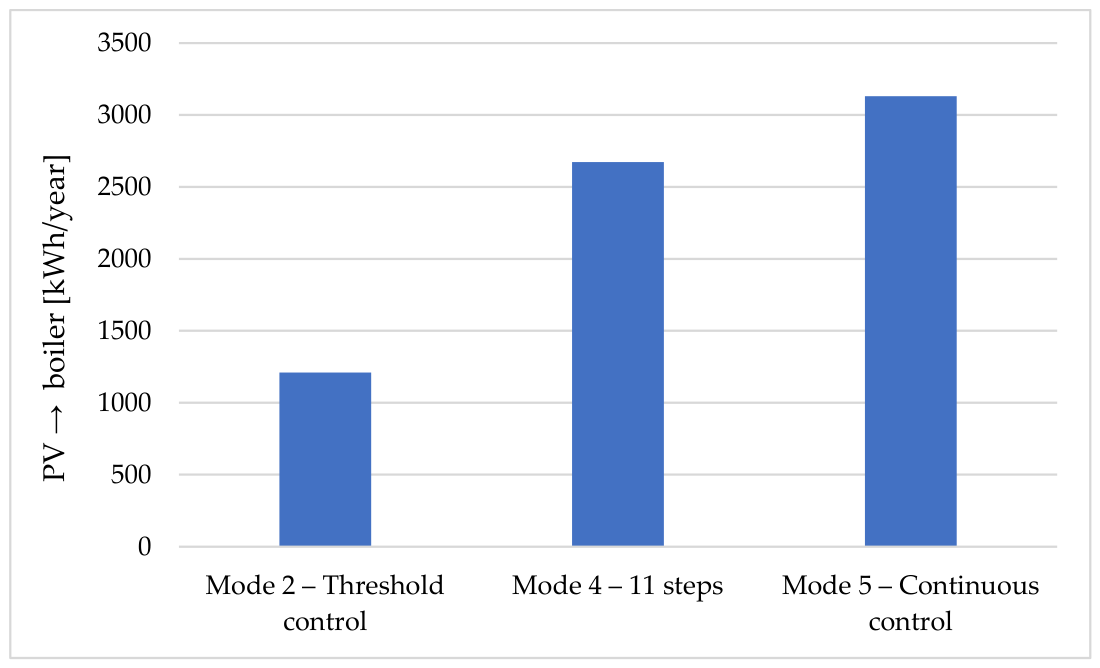
Figure 8 illustrates the influence of control strategy on the utilization of surplus photovoltaic generation, showing a significant increase in the amount of energy redirected to the electric water heater when dynamic power control is applied compared to constant-power operation.
To provide additional insight into the utilization of photovoltaic self-consumption,
Table 6 summarizes the annual amount of surplus PV energy redirected to domestic hot water preparation. The presented values were obtained directly from the annual energy-balance results generated by the PV*SOL Premium simulation environment.
The results indicate that the applied control strategy has a significant influence on the utilization of photovoltaic surplus energy by the electric water heater. In Mode 2, corresponding to constant-power operation, 1210 kWh/year of surplus PV energy was directed to domestic hot water preparation. More advanced control strategies further increased this value to 2673 kWh/year in Mode 4 and 3130 kWh/year in Mode 5.
These results demonstrate that increasing the flexibility of boiler power control enables more effective utilization of surplus photovoltaic generation and contributes directly to the observed increase in overall self-consumption. The findings confirm that a substantial portion of the self-consumption improvement achieved by advanced control strategies originates from the enhanced use of photovoltaic surplus energy for domestic hot water preparation.
The values shown represent the annual quantity reported by PV*SOL as “energy supplied to the boiler from PV surplus”. This parameter was used as an indicator of the extent to which surplus photovoltaic generation was utilized by the controlled water-heating system. Since the internal calculation methodology of this indicator differs from the definition of the annual domestic hot water demand used as an input parameter in the simulation model, the reported values should not be interpreted as the net annual thermal energy demand for domestic hot water. Values for Modes 1 and 3 were not available directly from the PVSOL output parameters used for this analysis.
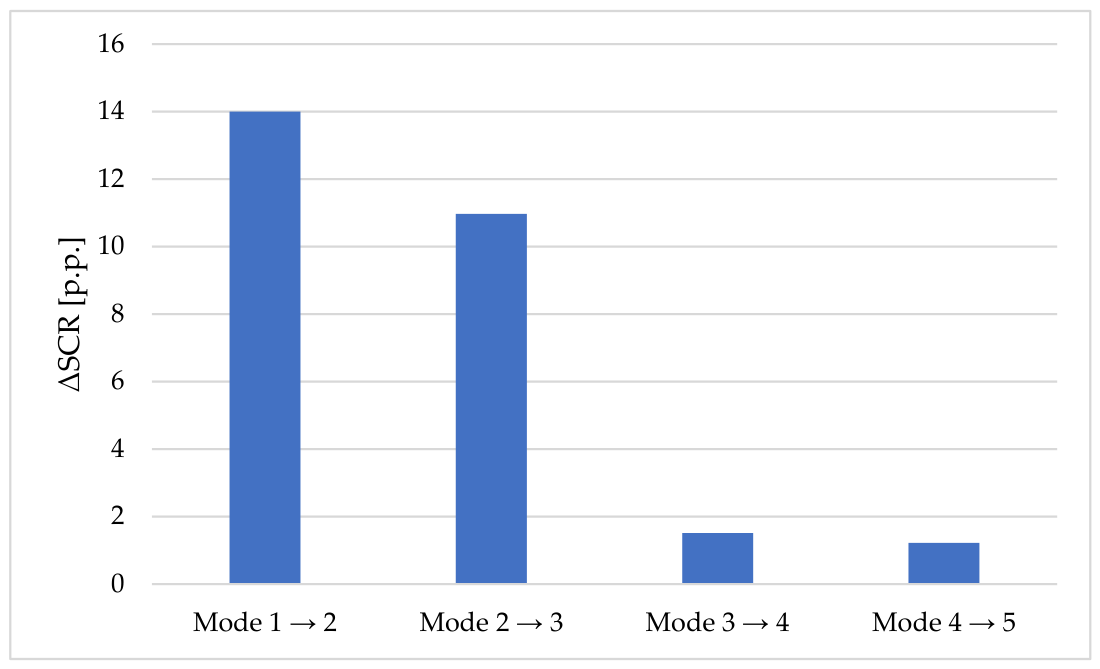
The largest improvement is observed between Mode 1 and Mode 2 (
Figure 9), with an increase of approximately 14 percentage points. As control complexity increases, marginal gains decrease significantly, with ΔSCR reaching only about 1–2 percentage points between the most advanced modes. This confirms the saturation effect and highlights that most benefits are achieved with simpler or moderately complex strategies.
A significant cost reduction is observed when transitioning from the reference mode (Mode 1) to controlled modes, particularly up to Mode 3 (from €725.53 to €517.11). Further increases in control complexity result in only minor cost reductions, with a minimum value of €494.44 achieved in Mode 5. Overall, continuous control reduces variable costs by 31.86% compared to the reference mode, confirming the effectiveness of demand-side control in reducing household electricity expenses (
Figure 10).
4. Discussion
The simulation results confirm that demand-side control has a significant impact on both the energy and economic efficiency of residential photovoltaic systems. The implementation of electric water heater control leads to a substantial increase in the self-consumption ratio, a reduction in electricity export to the distribution grid, and a notable decrease in variable electricity costs.
The largest relative benefit is observed when transitioning from the reference mode without control to the multi-level control strategy represented by Mode 3. This result indicates that even a relatively simple discrete control strategy can effectively shift a portion of consumption to periods of higher PV generation and significantly reduce the amount of surplus energy exported to the grid. The key mechanism behind this improvement is the substitution of grid electricity with locally generated energy and the reduction in energy volumes subject to distribution-related charges.
In contrast, further increases in control complexity in Modes 4 and 5 provide only limited additional benefits. The improvements in SCR and SSR are relatively small, and the reduction in variable costs compared to Mode 3 is marginal, despite the increased technical complexity of implementation. This phenomenon is linked to the inherent characteristics of daily PV generation and household demand profiles. Once a certain level of alignment between generation and consumption is achieved, the availability of additional surplus energy that could be effectively utilized through finer control becomes limited.
The observed saturation effect represents a key finding of this study. It suggests the existence of an optimal level of control granularity at which the best trade-off between achieved benefits and technical and investment complexity is reached.
For the analyzed 5.4 kWp residential PV system with a 112 L electric storage water heater under the Slovak DD2 tariff, Mode 3 appears to offer the most practical compromise between control complexity, hardware requirements and performance. The observed saturation of benefits at Mode 3 should be interpreted as case-specific; for different PV system sizes, storage tank volumes, DHW demand patterns or tariff structures, the saturation point may shift, and another control mode might provide a more suitable trade-off.
From a practical perspective, these findings have important implications for the design of demand-side control in households equipped with PV systems. The implementation of simpler discrete control strategies can represent a cost-effective solution that does not require complex communication infrastructure or sophisticated control systems, while still achieving most of the potential savings. Compared to more capital-intensive solutions, such as battery storage systems, thermal load control appears to be an attractive and economically accessible alternative for increasing the utilization of locally generated PV electricity.
At the same time, the results indicate that further substantial improvements in system performance will likely require the integration of multiple flexible loads or additional demand-side management elements. The control of a single electric water heater has a limited potential, and its benefits tend to saturate beyond a certain level, highlighting the need for a more comprehensive, system-level DSM approach in residential applications.
The study also has several limitations that should be considered when interpreting the results. The simulations were conducted for a single location, a specific PV system configuration, and a defined household load profile; therefore, the generalizability of the results to other climatic conditions or household types may be limited. In addition, only one type of flexible load—the electric water heater—was analyzed, without considering interactions with other controllable appliances or energy storage systems.
Despite these limitations, the results provide valuable insight into the effectiveness of demand-side control in residential PV systems without battery storage. They also highlight the importance of optimizing, rather than maximizing, control complexity and of establishing a basis for future research.
From a practical implementation perspective, increasing control granularity requires progressively more advanced switching, measurement, and control hardware. While simple threshold-based control can be implemented using low-cost relays and basic PLC logic, finer multi-level and continuous control strategies require more sophisticated power regulation and higher-resolution measurement systems.
To reduce the dependency of the economic assessment on a single tariff year, we also considered an alternative case in which the unit prices in Equation (7) were replaced by the average DD2 energy prices over the period 2022–2025. Using this multi-year average attenuates the influence of short-term price spikes or temporary relief measures while preserving the relative differences between control modes. As expected, the absolute annual electricity cost shifts to an intermediate level between the individual yearly scenarios; however, the relative reduction in variable electricity cost between the reference operation and the most granular control mode remains in the range of approximately 31–33%. This confirms that the key conclusion of the study—namely, that increasing control granularity can yield a substantial reduction in annual electricity costs—is robust with respect to moderate year-to-year variations in electricity prices and to the use of multi-year average tariffs instead of a single-year price snapshot.
It should be noted that the assumed value of 2000 kWh/year represents the reference annual domestic hot water (DHW) demand used as an input parameter of the simulation model. The value of 3130 kWh/year reported by PV*SOL does not represent the reference DHW demand itself, but the annual amount of photovoltaic surplus energy allocated to the controlled water-heating process according to the simulation results.
Within the PV*SOL model, this value is reported as “energy supplied to the boiler from PV surplus” and reflects the utilization of available photovoltaic excess energy under the applied control strategy. Therefore, this quantity should not be interpreted as the net annual DHW energy demand, but rather as a simulation output parameter describing the utilization of photovoltaic surplus energy within the controlled heating process. For this reason, direct comparison between the reference DHW demand and the reported PV surplus utilization is not appropriate.
4.1. Comparison with Previous Studies
Table 7 compares the proposed work with selected recent studies addressing the integration of residential PV systems and domestic hot water preparation. While previous contributions often combine electric water heating with electrical battery storage or apply advanced optimization frameworks, they typically assess only a single “smart” control strategy against an uncontrolled baseline. In contrast, the present study focuses on a battery-free configuration representative of common Central European households and systematically evaluates five control modes with increasing power-control granularity. This approach demonstrates that a relatively simple multi-level control strategy already achieves most of the possible improvements in self-consumption, self-sufficiency and variable electricity costs, thereby revealing a clear saturation effect and providing practical guidance for the design of cost-effective demand-side management solutions.
Clift and Suehrcke (2021) [
25] demonstrated that advanced control of PV-powered electric storage and heat pump water heaters can reduce purchased grid electricity for water heating by more than 80% without the use of conventional batteries, highlighting the potential of domestic hot water tanks as low-cost thermal storage. In contrast, the present study focuses on a specific 5.4 kWp residential PV installation in Slovakia operating under the DD2 tariff and net-billing scheme and provides a detailed economic assessment of different control granularities. Rather than optimizing a single control strategy, we systematically vary the control resolution from a thermostat-only reference to multi-step and quasi-continuous control (Modes 1–5) and show how this granularity affects self-consumption, self-sufficiency and annual electricity costs, revealing a practical saturation effect where moderately complex multi-level control captures most of the attainable benefits.
4.2. Practical Implementation Consideration
The analyzed control modes differ substantially in terms of control principle, implementation complexity and hardware requirements, which directly affects their economic feasibility and practical suitability for residential DSM applications (
Table 8). Mode 1 represents a thermostat-only reference operation with negligible implementation effort and cost, as it relies solely on the built-in thermostat of a standard electric water heater. Mode 2 introduces a simple single-threshold ON/OFF control strategy that uses a PLC, an SSR and basic power measurement, while maintaining low implementation cost and good suitability for residential applications.
Mode 3 extends this concept to a five-step discrete control strategy employing a PLC, multi-step SSR and dedicated power measurement. Although this configuration increases implementation complexity to a moderate level, it provides a substantially better adaptation of heater power to the available PV surplus and represents a favourable compromise between performance and hardware requirements.
In contrast, Mode 4 with eleven discrete control levels further increases the demands on the control system, including more advanced PLC hardware, multiple SSR stages and higher-resolution power measurement. However, the additional energy and economic benefits compared with the five-step strategy remain limited.
Mode 5, based on continuous power modulation, achieves the most accurate matching between PV generation and the thermal load but also requires the highest level of control sophistication. Such a strategy typically relies on analogue PLC outputs, phase-angle controllers or inverter-based modulation together with fast measurement and regulation hardware, resulting in the highest implementation cost. Although continuous control provides the technically optimal solution in terms of PV self-consumption, the improvements over intermediate granularities are relatively small, confirming that moderately complex multi-level control strategies already capture the majority of achievable performance benefits in typical residential applications.
4.3. Future Work
Future work should extend the presented analysis by incorporating additional flexible loads, such as heat pumps, electric vehicle charging, and other thermal storage systems. The coordinated control of multiple loads could enable more effective matching between electricity generation and consumption and further reduce grid export.
From a system architecture perspective, an important research direction is the integration of energy storage systems, particularly battery storage and advanced thermal storage, and their coordination with thermal load control. Such an approach would allow for the evaluation of trade-offs between investment costs and additional energy and economic benefits compared to demand-side control alone.
Another promising area is the implementation of advanced control algorithms and predictive strategies based on short-term forecasts of PV generation and household demand. The application of such approaches, combined with smart metering and communication technologies, could enhance the robustness of control under uncertain weather conditions and variable consumption patterns.
4.4. Limitation
The primary contribution of this study lies in the comparative evaluation of different control granularities under identical modelling assumptions rather than in the precise prediction of absolute economic outcomes for a specific household. Modelling and input-data uncertainties are expected to affect all control modes in a similar manner; therefore, the reported relative improvements in self-consumption, self-sufficiency, and annual electricity costs are considered more robust than the corresponding absolute values.
A limitation of the present study is the use of a 1 h simulation time step. Sub-hourly simulations (e.g., 15 min or 1 min resolution) would provide a more detailed representation of short-duration photovoltaic surplus events and household load fluctuations and could therefore slightly modify the calculated values of the self-consumption ratio (SCR), self-sufficiency ratio (SSR), and exported energy. The saturation point observed between the higher-complexity control strategies may also shift to some extent. Nevertheless, the principal finding that moderately granular control captures most of the achievable benefit is expected to remain valid. Verification of this assumption using higher-resolution simulations represents an important direction for future research.
Another limitation is that the available PV*SOL outputs do not provide a complete separation of electric water heater consumption into PV-supplied and grid-supplied components for all analyzed control modes. Consequently, the evaluation focuses on system-level indicators such as SCR, SSR, grid import, and grid export, which directly reflect the impact of the applied control strategies on overall system performance.
A further limitation concerns the economic evaluation. The electricity prices and tariff parameters used in Equation (7) correspond to the DD2 tariff applicable in 2022. To assess the sensitivity of the economic results to changes in electricity prices, an alternative calculation was performed using the average DD2 energy prices over the period 2022–2025 while preserving the same annual energy flows obtained from the simulations. Using a multi-year average reduces the influence of short-term price fluctuations and temporary regulatory measures while maintaining the underlying tariff structure. As expected, the absolute annual electricity costs differ under alternative price assumptions. However, the relative economic performance of the analyzed control modes remains largely unchanged because the cost differences are primarily driven by changes in self-consumption, grid imports, and grid exports. This indicates that the main conclusion of the study—that increasing control granularity can substantially reduce annual electricity costs in the analyzed residential photovoltaic system—is robust with respect to moderate variations in electricity prices and tariff parameters.
5. Conclusions
This study analyzes the impact of different demand-side control strategies on the energy and economic performance of a residential photovoltaic system, with a focus on controlling an electric water heater as a flexible thermal load. The results confirm that demand-side control represents an effective tool for increasing the utilization of locally generated electricity and reducing household variable electricity costs.
The implementation of advanced control strategies significantly improves photovoltaic self-consumption and reduces annual electricity costs. Compared with the reference operation, the most advanced control mode achieved annual cost savings of 31.86%, demonstrating the potential of domestic hot water storage as a flexible load for increasing photovoltaic self-consumption.
For the analyzed case study, Mode 3 achieved the most favourable balance between implementation complexity and performance improvement. Nevertheless, the optimal control strategy may differ under other operating conditions, system configurations, or tariff structures and, therefore, the results should be interpreted as case-specific rather than universally applicable.
From a practical perspective, the results suggest that moderately complex multi-level control of the electric water heater represents an appropriate compromise between technical complexity and achieved benefits. Thermal load control thus emerges as a simple and cost-effective solution for increasing the energy self-sufficiency of households with photovoltaic systems, without the need for additional investment in battery storage.
These findings provide a basis for further research focused on the coordinated control of multiple flexible loads, the integration of energy storage systems, and the extension of the analysis to different household types and system configurations.