1. Introduction
GNSSs have become indispensable for modern navigation applications. Despite their ubiquity, GNSS signals are inherently weak at the receiver level and remain highly vulnerable to intentional radio frequency interference, including jamming and spoofing [
1,
2]. Such interference can rapidly degrade positioning accuracy or even deny service entirely [
3]. Correction products and auxiliary navigation systems can temporarily bridge performance gaps under degraded conditions [
4,
5]. However, these solutions generally rely on GNSS initialization and suffer from long-term drift, leaving system integrity ultimately dependent on GNSS signal reception. Thus, the development of robust anti-jamming and anti-spoofing technologies remains a critical research priority. CRPAs have emerged as the cornerstone of advanced interference mitigation. By employing multiple-element antenna arrays with adaptive beamforming algorithms, CRPAs exploit spatial filtering and direction of arrival (DOA) estimation to preserve satellite signals while placing nulls in the direction of interference [
6]. Algorithms such as minimum-variance distortionless response (MVDR), minimum mean square error (MMSE), maximum signal to interference plus noise ratio (MSINR), and power inversion (PI) have been developed to compute optimal weight vectors for adaptive array processing [
7]. Among these, MVDR remains the most widely implemented in real-time CRPA receivers due to its balance between interference suppression and computational efficiency [
8,
9]. MVDR minimizes output power while maintaining unity gain toward the desired signal, thus preserving signal fidelity under jamming. However, its effectiveness is limited by the accuracy of interference covariance estimation and its lack of temporal processing capability, which reduces robustness under spoofing scenarios. To address these shortcomings, STAP has been introduced, extending adaptive beamforming into the temporal domain to jointly exploit spatial and temporal diversity. STAP algorithms can provide superior interference rejection and spoofing resilience compared to conventional time-frequency domain techniques [
10]. A growing body of research has refined STAP algorithms for GNSS. Wang et al. [
11] proposed a robust STAP algorithm that broadens interference nulls and mitigates steering vector mismatches, while Meng and Shen [
12] extended STAP to coherent multipath environments. More recently, Wang [
13] demonstrated that conventional STAP can introduce carrier phase biases and proposed a distortionless carrier phase tracking approach to eliminate such effects. Real-time implementations have also been investigated. Chen et al. [
14] demonstrated a software-defined CRPA receiver using STAP, while Dai et al. [
15] introduced a distortionless STAP algorithm that preserves code and carrier phase linearity. While these studies have advanced STAP and CRPA techniques, their scope has remained confined to theoretical analyses or controlled laboratory conditions. A critical gap persists in the form of experimental evaluations of interference mitigation strategies under realistic jamming and spoofing. Time-frequency domain methods, such as adaptive notch filtering and pulse blanking, and advanced space-time approaches are not sufficiently tested under real-world conditions.
The present study addresses this gap by providing a comparative field-based evaluation of two CRPA-based GNSS interference mitigation configurations under identical SDR-generated jamming and spoofing conditions. Unlike studies that focus primarily on a single receiver architecture, laboratory simulations, or isolated interference metrics, this work enables a direct system-level comparison between conventional time/frequency domain suppression based on adaptive notch filtering and pulse blanking, and a space-time adaptive processing (STAP)-based CRPA configuration. The main contribution of the study is the controlled side-by-side assessment of these two mitigation approaches on a vehicle-mounted dynamic test platform using both navigation-level and signal-level indicators, including HDOP, satellite visibility, RSSI variation, jammer level, and coordinate offsets. This experimental design provides practical insight into the performance limits of conventional mitigation methods and the system-level stability of STAP-based processing under sustained jamming and spoofing conditions.
2. Materials and Methods
2.1. GNSS Model
The distance between the satellite and the receiver is calculated using carrier phase and code signals transmitted by GNSSs. This distance is then used to determine the receiver’s position using GNSS observation equations through least squares estimation. The receiver’s position is calculated using signals transmitted by GPS, GLONASS, Galileo, and BeiDou global satellite constellations. Equations (1) and (2) show the code (
) and phase (
) signals transmitted by the satellite constellations [
16,
17].
In Equations (1) and (2), and denote the functional models of the code and carrier phase measurements, respectively. In these models, represents the geometric distance between the satellite and the receiver, denotes the speed of light, and and correspond to the receiver and satellite clock errors, respectively. The term counts for relativistic effects. and represent the ionospheric and tropospheric delays, respectively. The ionospheric delay appears with opposite signs in the code and carrier phase observations due to the dispersive nature of the ionosphere. The terms enote receiver- and satellite-related code hardware biases, whereas denote receiver- and satellite-related carrier phase hardware biases. and represent multipath effects in the code and carrier phase measurements, respectively. In the carrier phase equation, denotes the carrier wavelength multiplied by the integer ambiguity. Finally, and represent the remaining measurement noise and unmodeled residual errors affecting the code and carrier phase observations.
Since the receiver operates on only one frequency (), it is impossible to calculate ionospheric corrections using dual-frequency combinations. Similarly, no tropospheric delay models or external meteorological data are employed. These atmospheric effects are implicitly included in the total error, , which reduces the achievable accuracy compared to techniques like PPP or RTK.
In GNSS positioning, code and carrier phase signals differ in precision and susceptibility to interference. Code signals, also known as pseudo-range measurements, generally provide positioning accuracy within several meters. This makes them suitable for general navigation purposes. In contrast, carrier phase signals allow for centimeter-level precision by measuring the phase of the carrier wave, which oscillates at a much higher frequency [
18]. However, this enhanced accuracy comes at a cost; carrier phase signals are more vulnerable to jamming and spoofing interference. Jamming disrupts GNSS signals, potentially leading to a complete loss of positioning capabilities, while spoofing involves transmitting false signals to mislead the receiver into calculating an incorrect position [
19].
Advanced technologies such as CRPA and MVDR algorithms can address these vulnerabilities. CRPAs enhance resilience against jamming and spoofing by forming nulls in specific directions, effectively suppressing unwanted interference while maintaining reception of legitimate GNSS signals. MVDR algorithms further optimize signal processing by minimizing interference’s impact while preserving the integrity of desired signals. Consequently, the combination of CRPA technology and MVDR algorithms provides a robust solution for enhancing the reliability of GNSS positioning and ensuring accurate and secure navigation, even in challenging environments [
18].
2.2. CRPA-Based Interference Mitigation Algorithms
Interference signals remain a critical challenge for GNSS receivers, as they can severely degrade positioning accuracy and, in some cases, deny service altogether. Ideally, interference sources should be detected, located, and eliminated to ensure reliable GNSS operations; however, many signals exhibit only local effects and are difficult to identify without a dense monitoring infrastructure. A sparse distribution of monitoring stations reduces the probability of intercept, whereas excessive deployment increases installation, calibration, and maintenance costs, highlighting the limitations of network-based interference monitoring approaches [
20].
CRPAs leverage spatial diversity by taking advantage of the fact that authentic satellite signals and interference sources generally arrive from different directions. Instead of utilizing a solitary antenna element, CRPAs implement an array configuration, thereby facilitating the establishment of spatial filters. This configuration serves to enhance gain in the direction of satellite signals while concurrently suppressing or nulling signals emanating from jammer directions. Antenna array-based processing has been the subject of extensive investigation as a countermeasure against GNSS interference, and it has consistently demonstrated superior performance relative to single-element antenna techniques. The fundamental challenge for such systems is to suppress interference signals without compromising the gain of authentic GNSS signals.
In practical implementations, CRPA architectures are often combined with finite impulse response (FIR) filtering applied to each antenna element. The implementation of multiple filter taps enables the generation of frequency notches that attenuate continuous-wave jammers, while adaptive beamforming techniques direct maximum array gain toward the direction of arrival of desired signals. Conversely, null steering involves the adjustment of antenna weights to minimize or cancel signals associated with interference, thereby enhancing the signal-to-noise and signal-to-interference ratios.
Recent engineering guidelines emphasize the necessity of validating the performance of CRPA systems under realistic conditions that extend beyond algorithmic simulations. A comprehensive evaluation generally involves testing. The assessment of performance is contingent upon critical metrics, including null depth, angular resolution, adaptive response time, and phase alignment across antenna elements. Ensuring robustness across these parameters is essential for maintaining satellite visibility, preserving favorable dilution of precision, and reducing signal tracking losses under complex interference environments.
Mitigation strategies such as adaptive notch filtering and pulse blanking are frequently employed in conjunction with CRPA arrays to suppress narrowband and pulsed interference sources. These foundational methods have been built upon by the development of more advanced adaptive beamforming algorithms. One such algorithm, MVDR, has been shown to minimize array output power while preserving unity gain toward satellites, resulting in a stronger balance between interference suppression and signal fidelity. In contrast, STAP extends this principle by simultaneously exploiting both spatial and temporal signal dimensions, thereby offering enhanced resilience against multiple-source interference scenarios.
2.3. MVDR and STAP
In adaptive beamforming algorithms such as MVDR, the design of the weight vector is critical for achieving effective interference suppression while maintaining the desired signal. The weight vector is instrumental in determining the extent to which each antenna element’s signal is amplified or suppressed, thereby effectively shaping the beam pattern of the antenna array [
21]. The objective of the MVDR algorithm is to select the weights in a manner that ensures the response in the direction of the desired signal remains undistorted, while the total output power, including interference and noise, is minimized. This objective gives rise to a constrained optimization problem, wherein the distortionless constraint is imposed on the direction of the desired signal. The optimal weight vector for MVDR beamforming is given by Equation (3).
In the context of signal processing, the term is defined as the covariance matrix of the received signals. The term is defined as the steering vector corresponding to the direction of the desired signal. The term is defined as the Hermitian transpose. In commercial CRPA receivers, covariance matrix estimation and inversion are generally performed within proprietary firmware or FPGA-based processing units, and the exact implementation details are not disclosed by the manufacturers. Since MVDR requires covariance matrix storage and inversion, its computational burden increases with the number of antenna elements. In STAP, the processing load further increases because the data dimension is extended from the spatial domain to the joint space-time domain by including temporal samples or taps, which increases both memory usage and processing latency in real-time embedded applications. This solution guarantees that the beamformer maintains unity gain in the desired direction while minimizing the array output power. Consequently, it optimally suppresses interference and noise under the MVDR algorithm.
While MVDR primarily focuses on spatial filtering, modern interference environments often necessitate a more comprehensive strategy. This issue is addressed through the implementation of STAP, which extends the MVDR principle by jointly leveraging the spatial diversity of the antenna array and the temporal diversity of the received signal snapshots. In STAP, the received data vector is constructed not only across the array elements but also across successive time samples, resulting in a space-time covariance matrix. In this context, cooperative data processing refers to the joint use of multi-element antenna observations and consecutive temporal samples, allowing the receiver to exploit both the spatial directionality and temporal evolution of interference within a unified space-time processing structure. This capability enables the adaptive processor to effectively suppress interference that exhibits both spatial and temporal correlation, including wideband jammers, chirp signals, and multipath effects [
22]. Formally, the STAP weight vector can be expressed by Equation (4).
In the context of signal processing, the term is defined as the space-time covariance matrix of the received signals. The term is defined as the space-time steering vector corresponding to the direction of the desired signal. The STAP has been expanded to incorporate temporal domain considerations, thereby enabling the system to effectively mitigate frequency-selective interference and jamming that are not fully addressed by spatial beamforming.
2.4. Adaptive Notch Filter
A notch filter, also referred to as a band stop filter, is a signal processing structure designed to attenuate a narrow frequency band centered around a specific frequency
, while allowing the remaining spectrum to pass with minimal distortion. The effectiveness of notch filters in suppressing narrowband interference sources, such as continuous wave jammers, is attributable to their selective filtering capability, which minimally affects the desired signal components [
23].
Among jamming mitigation strategies, adaptive notch filtering is one of the most widely recognized techniques due to its low computational complexity [
24]. This approach combines a fixed notch filter, characterized by a pass band frequency response that rejects a narrow spectral region corresponding to the interference, with an adaptive block that tracks instantaneous jamming frequencies in real time [
25]. Spectral estimation techniques, such as the Fast Fourier Transform (FFT), are frequently employed to detect dominant interference peaks, thereby enabling the filter to reconfigure its response. Nevertheless, a limitation of this frequency domain countermeasure is that interference excision may induce non-negligible distortion of the useful GNSS signal, particularly under high power or rapidly varying interference. The transfer function of a second-order notch filter in the Laplace domain is given by Equation (5).
where
is the Laplace transform variable,
is the angular frequency of the notch, and
is the quality factor controlling the sharpness of the attenuation. At
, the filter provides maximum attenuation, while signals outside the rejection band pass largely unaffected.
Adaptive notch filters are widely implemented in GNSS receivers as a lightweight and computationally efficient defense against narrowband interference. By tuning the notch frequency to track continuous wave jammers, they improve the effective signal-to-noise ratio while maintaining compatibility with real-time hardware platforms such as FPGAs. However, their suppression capability is inherently limited to narrowband interference signals. In more complex environments involving multi-source, wideband, or time-varying interference, the effectiveness of notch filtering alone is often insufficient.
Consequently, notch filters are typically integrated with complementary mitigation techniques, such as pulse blanking in the time domain or CRPA-based beamforming (e.g., MVDR and STAP) in the spatial domain, to form multi-layered anti-jamming. Adaptive notch filtering acts as an initial frequency domain interference suppression stage, while higher-level spatial processing provides enhanced robustness against complex interference.
2.5. Pulse Blanking
Pulse blanking is a widely adopted signal conditioning technique employed to suppress transient interference or high-power pulses that could otherwise corrupt received data. The method operates by momentarily disabling the receiver or nullifying the output during intervals identified as containing interference, thereby preventing distortion of authentic signals. Conceptually, pulse blanking can be regarded as a time domain gating process, in which samples exceeding a predefined amplitude threshold are suppressed or replaced by zeros [
25].
In systems where high-amplitude pulses are transmitted and followed by weak reflections or responses (e.g., radar), the receiver is at risk of overload or false detection immediately after transmission. Pulse blanking introduces a time window during which the receiver output is either muted or ignored, based on a control signal synchronized with the transmission event. Consider a received signal expressed by Equation (6)
where
is the desired signal,
is additive noise (typically modeled as Gaussian white noise), and
represents interference, such as high-power transmit leakage or external transient disturbances. Pulse blanking applies a time-varying mask b(t), defined by Equation (7).
Then, the blanked signal is obtained by using Equation (8):
This operation effectively nullifies the received signal during known periods of high interference.
In radar and sonar applications, the transmitter emits high-power pulses that can saturate the receiver front-end. A blanking interval synchronized with the transmission event prevents overload but inevitably removes data within that window. This introduces a trade-off—while blanking suppresses interference, it may also reduce the energy of desired signals, lowering detection probability if echoes arrive during the blanking interval.
In GNSS receivers, pulse blanking is particularly effective against pulsed interference sources such as Distance Measuring Equipment (DME), Tactical Air Navigation (TACAN), or intentional pulse jammers. These sources emit short-duration, high-power bursts that can disrupt both code and carrier tracking processes. By blanking only the contaminated intervals, the receiver preserves the integrity of authentic GNSS signals while minimizing the impact of transient interference. A simple pulse blanking strategy applies an amplitude threshold
.
More advanced implementations adaptively adjust the blanking threshold and duration in real time, based on the characteristics of the interference. However, pulse blanking is subject to inherent limitations. Excessive blanking reduces the effective carrier-to-noise density ratio , and continuous or wideband interference cannot be mitigated by this technique alone. Consequently, pulse blanking is typically employed as a primary time domain mitigation stage, often in conjunction with frequency domain techniques such as adaptive notch filtering and spatial domain approaches including CRPA-based beamforming (e.g., MVDR or STAP). Such multi-layered architectures provide more robust protection against diverse interference scenarios.
2.6. SDR-Based Interference Modeling and Signal Generation for GNSS
Software-defined radio (SDR) represents a paradigm shift in radio system design, where conventional hardware-based components such as modulators, demodulators, filters, and mixers are implemented in software. This architecture enables rapid reconfiguration, supports multiple communication standards, and facilitates the prototyping of advanced signal processing techniques. These capabilities are particularly important in GNSS research, where controlled and repeatable interference environments are required for performance evaluation [
26,
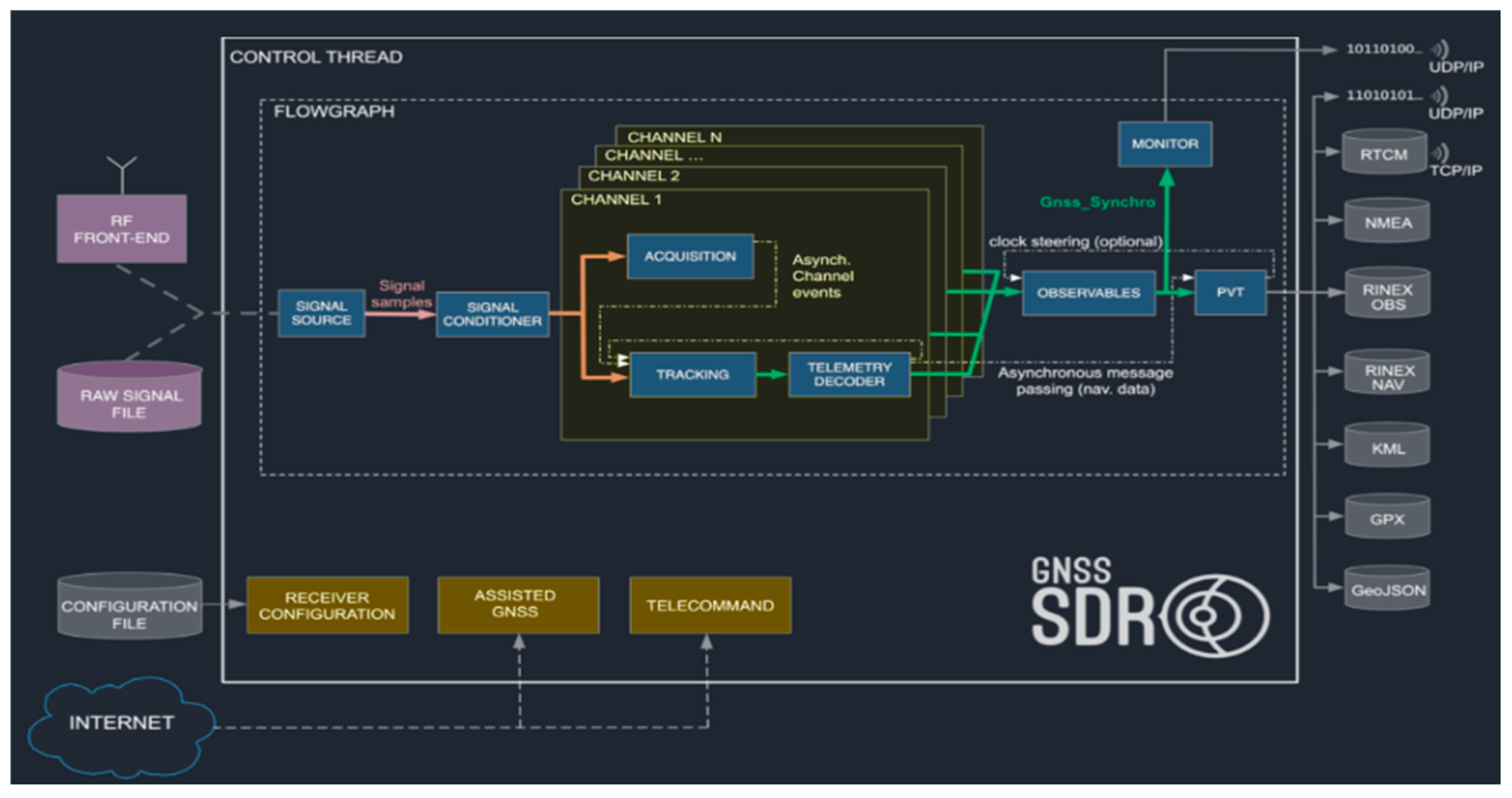
27]. An SDR system typically consists of an RF front-end, analog-to-digital and digital-to-analog converters, digital processing (FPGA), and a host computer running software frameworks such as GNSS-SDR, GNU Radio, and Python 3.14.5-based modules. As illustrated in
Figure 1, this modular architecture enables flexible signal generation and processing while supporting detailed investigation of interference effects and signal distortions within a unified [
27].
In this study, a commercially available SDR platform was used as a flexible interface to generate controlled GNSS interference scenarios. Signal processing and waveform generation were implemented using GNU Radio integrated with GNSS-SDR, enabling real-time control of interference parameters. Narrowband jamming signals were incrementally increased up to 50 dB-Hz, while spoofing signals were generated up to 32 dB-Hz, with waveform and timing parameters managed within the GNSS-SDR processing chain to ensure repeatability [
26,
27]. The reported dB-Hz values refer to experiment-level interference indicators generated and monitored within the SDR/GNSS-SDR processing chain, rather than calibrated equivalent isotopically radiated power or absolute RF output power. Therefore, they are used only to describe the relative severity of the applied interference conditions. The spoofing signal was generated in a controlled GNSS-SDR environment using GPS L1 signal parameters and was introduced to evaluate receiver degradation under a repeatable spoofing-like condition. However, it was not used as a fully time-synchronized over-the-air counterfeit navigation signal intended to replace the live GNSS constellation. This SDR-based setup, shown in
Figure 1, establishes a controlled and repeatable interference generation framework for evaluating GNSS receiver performance under baseline, jamming, and spoofing conditions. The methodology is designed to assess the observable receiver response to controlled interference rather than to provide calibrated RF emission characterization.
3. Experiment
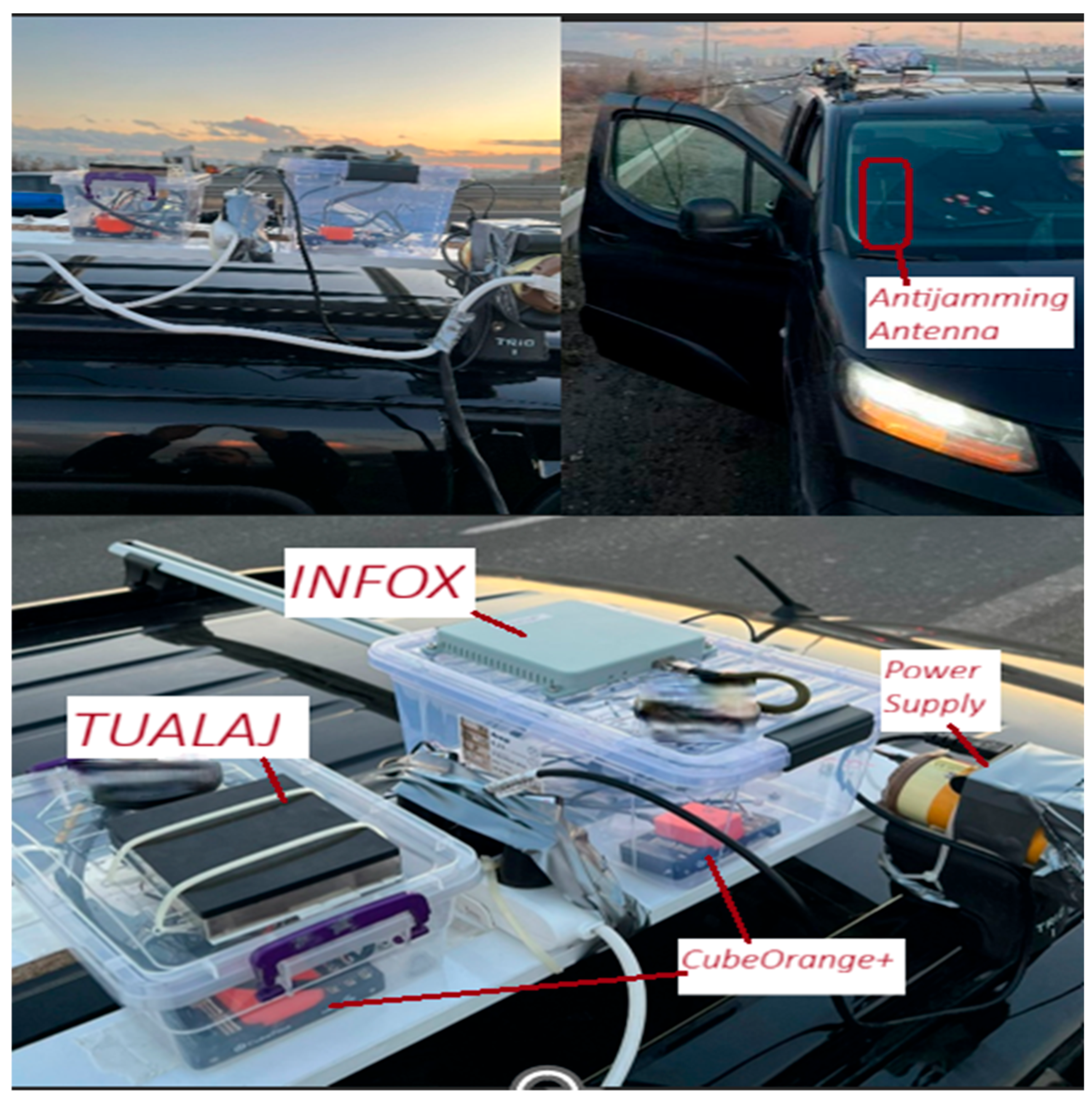
In this study, two CRPA-based GNSS receiver configurations, each employing different interference mitigation strategies, were mounted on a vehicle platform and evaluated under controlled conditions. To assess their performance in GNSS-denied or GNSS-degraded environments, controlled jamming and spoofing were introduced during the experimental campaigns. Both systems were integrated with a CubeOrange+ autopilot running the ArduPilot open-source flight control software, enabling synchronized data acquisition and real-time navigation output logging. In degraded GNSS conditions, INS-aided state estimation through an extended Kalman filter can also provide complementary support for navigation continuity and state monitoring when GNSS measurements become unreliable [
28].
The evaluated systems represent two distinct approaches to GNSS interference mitigation. The first configuration employs conventional time-frequency domain techniques, including adaptive notch filtering and pulse blanking, which are widely used for suppressing narrowband and transient interference. The second configuration incorporates a more advanced interference mitigation framework based on space-time adaptive processing, combined with adaptive suppression mechanisms. These two approaches reflect fundamentally different design philosophies, namely frequency domain excision versus joint spatial–temporal filtering, allowing for a comparison of their performance under identical experimental conditions. Therefore, the first configuration is treated as the time/frequency domain CRPA configuration, while the second configuration is treated as the STAP-based CRPA configuration; internal receiver-level algorithm parameters were not separately available, and the comparison was conducted at the complete system-configuration level.
It should be noted that the comparison presented in this study represents a system-level evaluation of two commercial CRPA-based GNSS configurations rather than an isolated algorithm-only benchmark. The measured performance differences may therefore reflect the combined influence of antenna array geometry, receiver front-end characteristics, firmware implementation, tracking loop behavior, baseline sensitivity, and interference mitigation processing. Since the evaluated systems are commercial products, some receiver-level parameters and internal processing details are proprietary and cannot be fully disclosed. Therefore, the interpretation of the results is limited to the observable navigation performance of the complete configurations. To ensure experimental consistency, both configurations were evaluated on the same vehicle platform, along the same test route, under the same SDR-generated jamming and spoofing sequence, and by using the same performance indicators, including HDOP, satellite visibility, RSSI variation, and coordinate offsets.
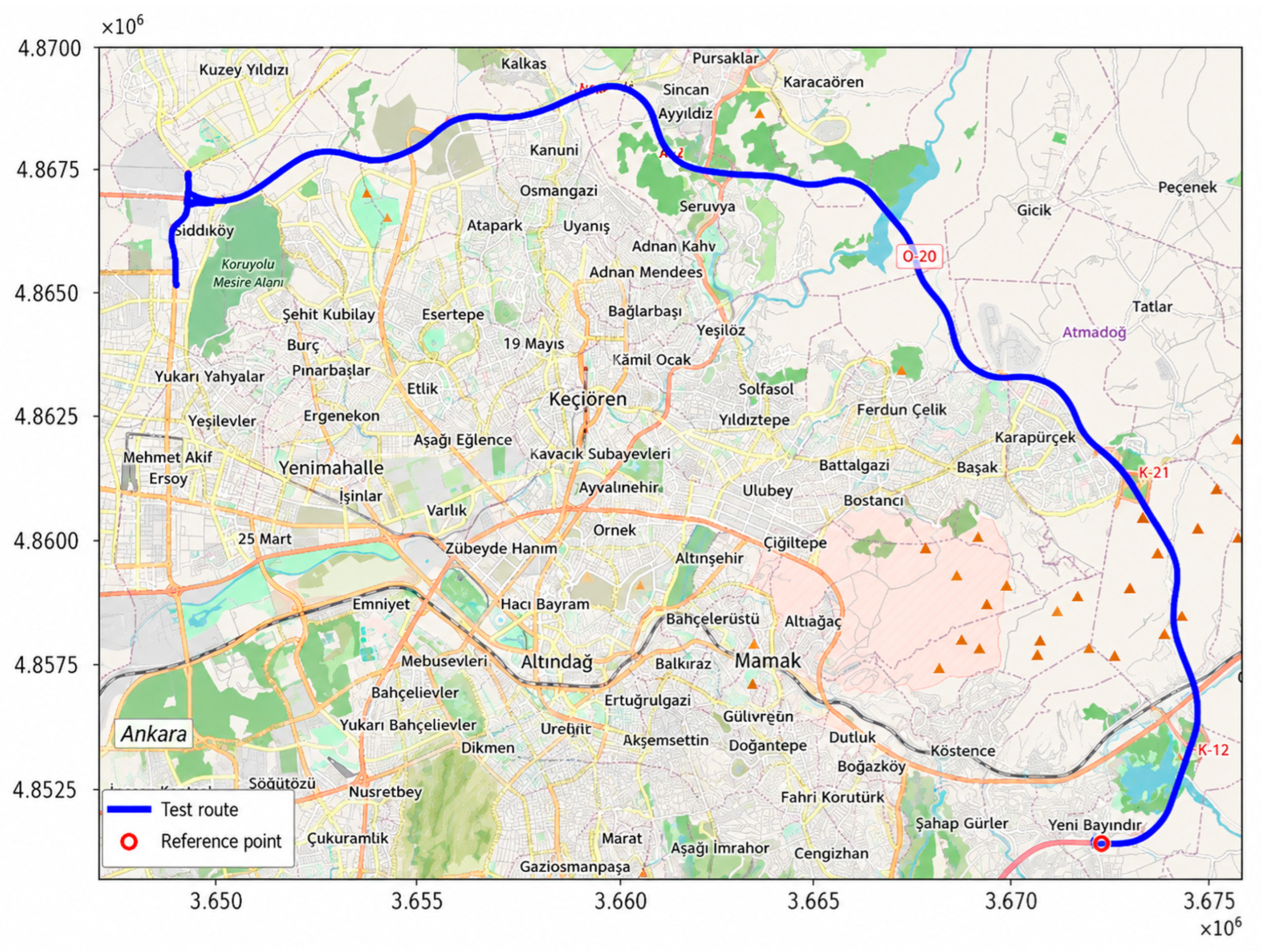
A series of experiments were conducted under both static and kinematic conditions using a vehicle-mounted platform, as shown in
Figure 2, while the corresponding trajectory is presented in
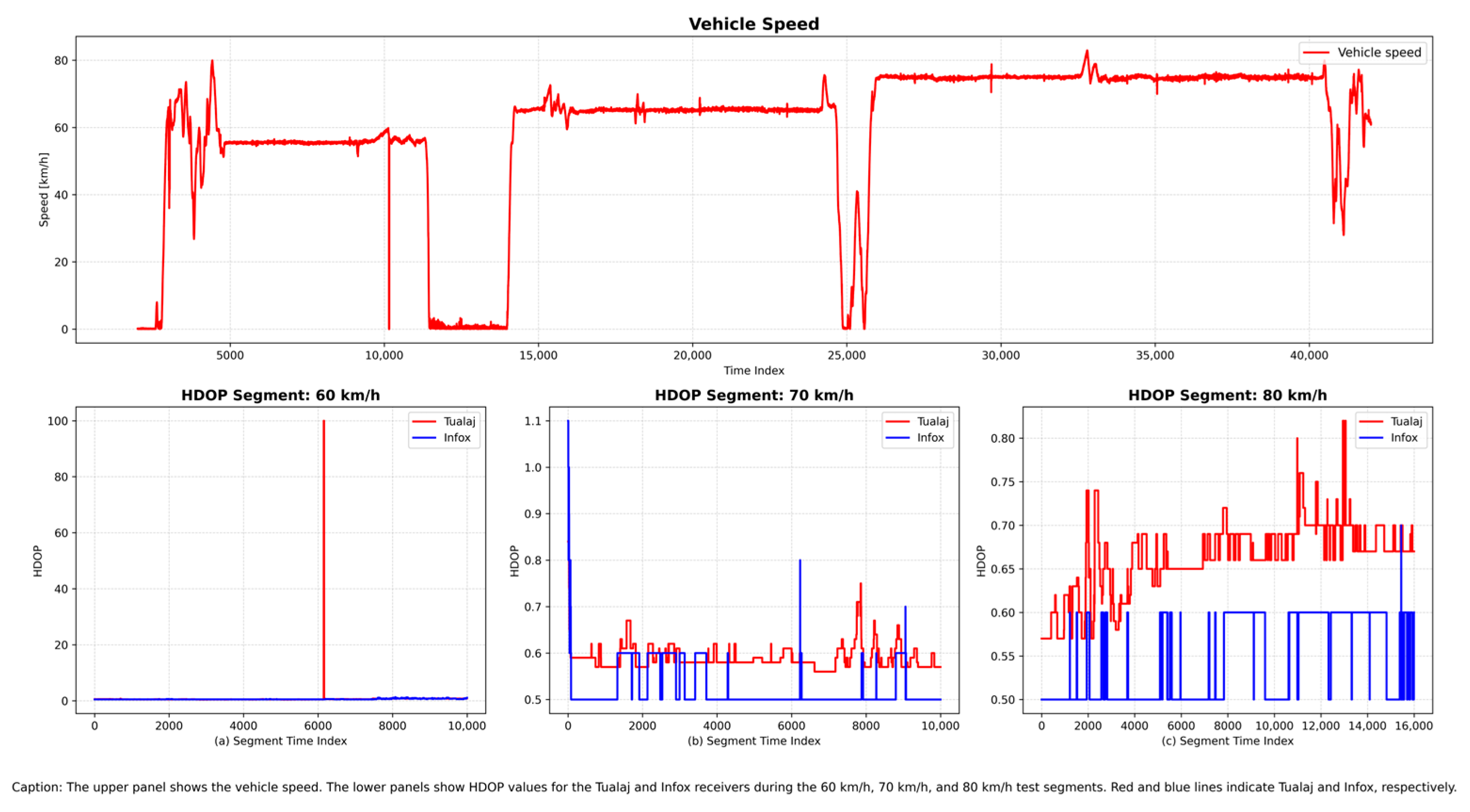
Figure 3. The vehicle was operated at controlled speeds of approximately 60 km/h, 70 km/h, and 80 km/h during successive test segments. Under baseline conditions, both configurations produced consistent positioning solutions, with minor deviations in latitude and longitude. However, under sustained spoofing, the configuration based on time-frequency domain techniques exhibited a gradual degradation in positional consistency, reflected by increased divergence in latitude and longitude estimates. In contrast, the configuration employing STAP-based processing maintained stable positioning performance, demonstrating improved robustness against prolonged interference.
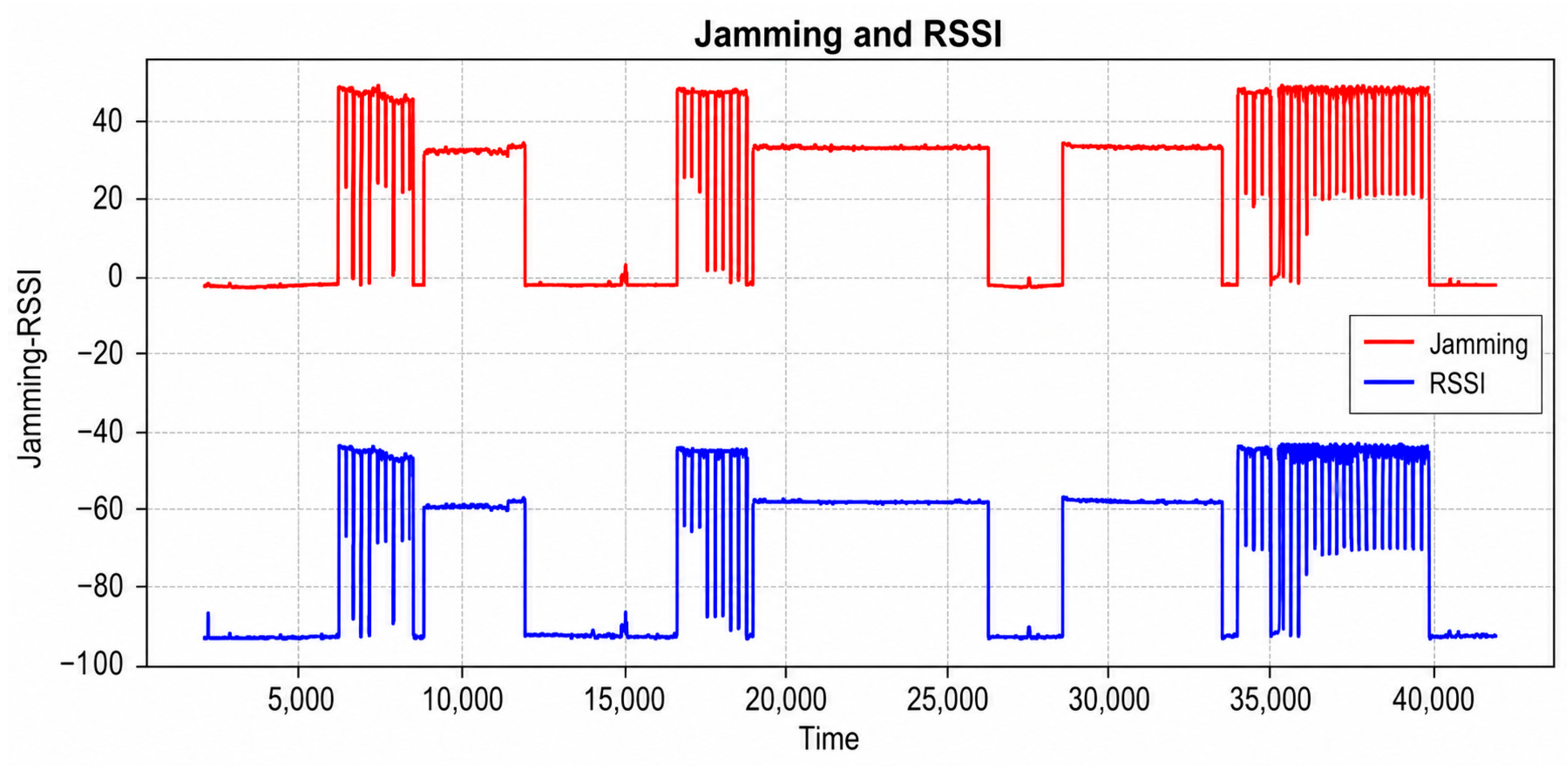
As illustrated in
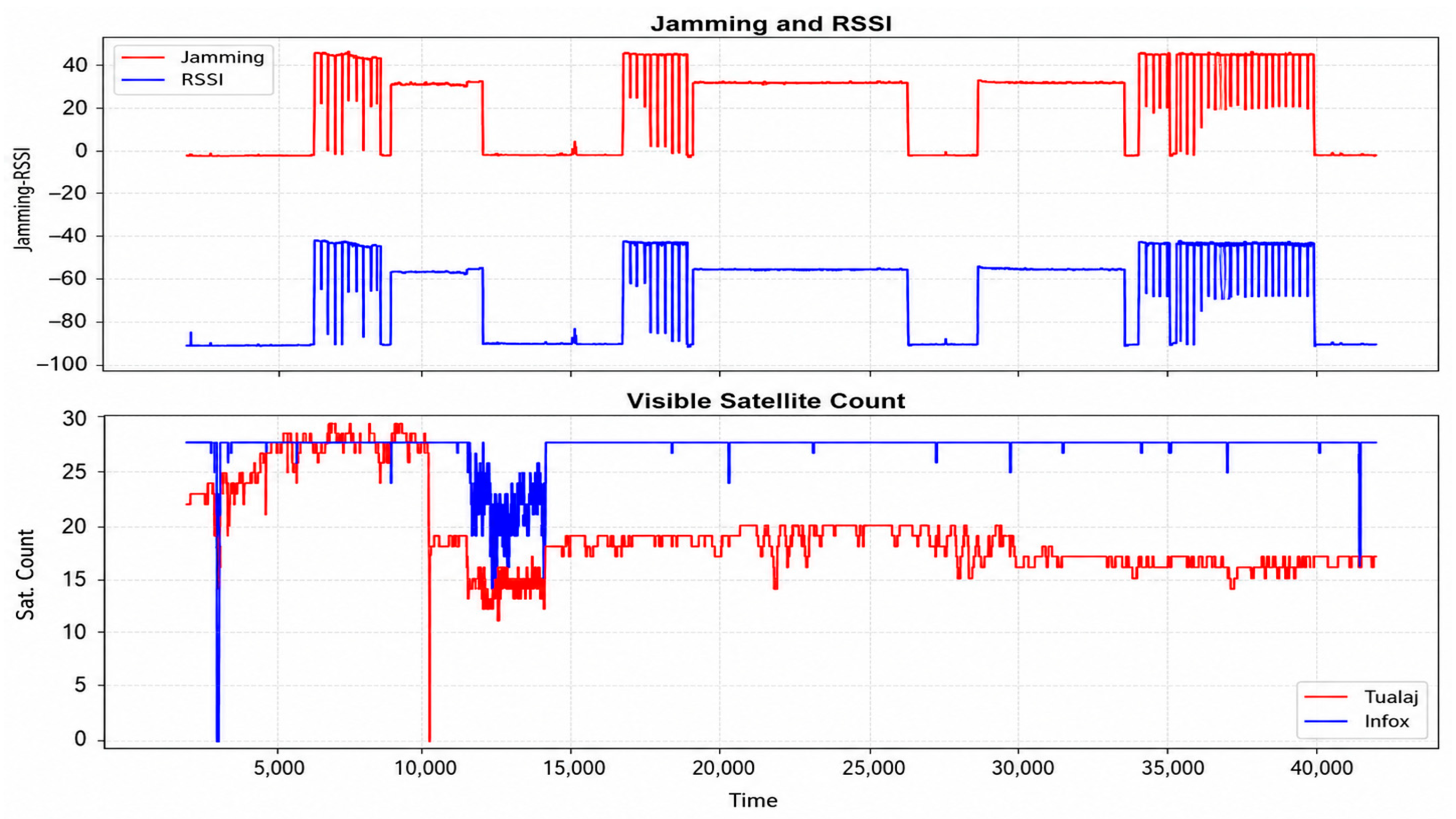
Figure 4, each trial lasted 15 min and was divided into three sequential phases: (i) a five-minute baseline under nominal conditions, (ii) a five-minute jamming phase, and (iii) a five-minute spoofing phase. During the jamming phase, the interference power was gradually increased, reaching peak levels of approximately 50 dB-Hz, while spoofing signals were subsequently introduced at levels up to 32 dB-Hz. During the experiments, the jammer/spoofing antenna was positioned at less than 1 m from the GNSS receivers under controlled conditions, and
Figure 4 presents the detected jammer level together with the corresponding RSSI variations throughout the full test duration. The interference waveforms were generated using a software-defined radio operating at the GPS L1 center frequency of 1575.42 MHz.
Under baseline conditions, the background interference remained close to 2 dB-Hz, and the received signal strength indicator (RSSI) exhibited a stable level of approximately −90 dB. Following the activation of interference, the RSSI showed pronounced fluctuations, varying between −60 dB and −90 dB, closely reflecting the temporal structure of the applied jamming and spoofing signals. This strong correlation between the injected interference and the observed RSSI variations confirms the reproducibility of the interference and demonstrates the effectiveness of RSSI as a real-time indicator of signal degradation.
The comparative evaluation revealed significant differences in the robustness of the two CRPA-based GNSS configurations. As illustrated in
Figure 5a, at 60 km/h, the configuration based on time-frequency domain interference mitigation exhibited a substantial degradation in positioning integrity under prolonged spoofing, with HDOP abruptly increasing to values exceeding 100 and complete loss of satellite tracking. In contrast, the configuration employing STAP maintained uninterrupted satellite visibility, with stable HDOP values around 0.5.
In the subsequent interval shown in
Figure 5b (70 km/h), the STAP-based configuration continued to demonstrate stable performance, with HDOP consistently near 0.5, whereas the time-frequency -based configuration exhibited moderate fluctuations between 0.55 and 0.65, indicating reduced robustness under interference conditions. Finally, in
Figure 5c (80 km/h), the STAP-based system maintained stable HDOP values close to 0.55, while the time-frequency-based configuration showed gradual degradation, with HDOP increasing toward 0.75 in the presence of combined jamming and spoofing.
As illustrated in
Figure 6, the temporal variation in interference power and RSSI closely correlates with the degradation of satellite tracking performance. The STAP-based configuration consistently maintained visibility of approximately 27–28 satellites throughout all interference phases, with negligible degradation. In contrast, the time-frequency-based configuration, which initially tracked approximately 23 satellites, exhibited increased sensitivity to interference, with satellite counts dropping below 20 during jamming and spoofing intervals, occasionally resulting in complete loss of visibility. These results highlight the improved resilience of space-time adaptive processing in maintaining navigation performance and positional integrity under contested conditions, compared to conventional time-frequency domain mitigation techniques.
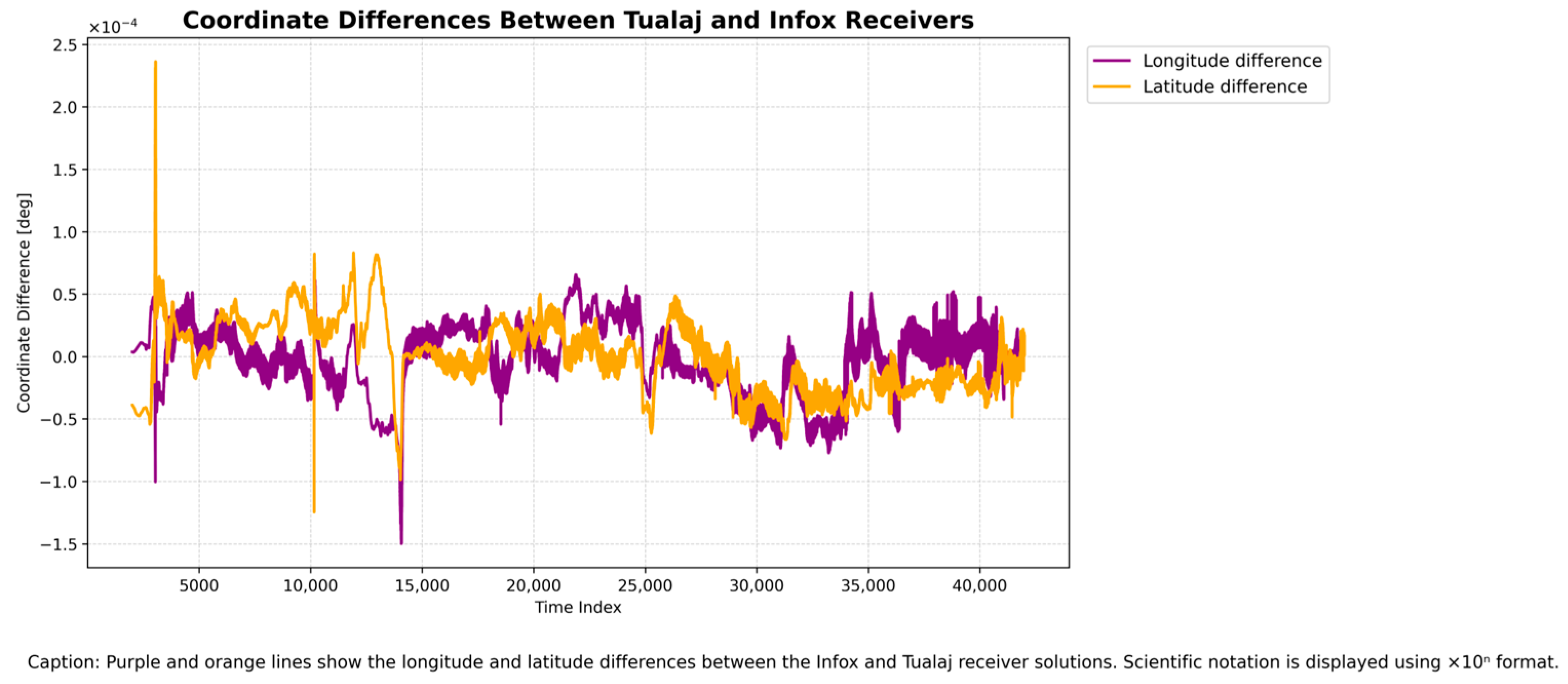
As illustrated in
Figure 7, the coordinate discrepancies between the two CRPA-based GNSS configurations provide an indication of how interference and vehicle speed affect relative positioning stability. Under nominal baseline conditions, longitude and latitude offsets remained within ±0.00005° (approximately 4–6 m), indicating close agreement between the two configurations. However, with the introduction of jamming and spoofing (see
Figure 4), these offsets increased, reaching values of up to 0.0002° (approximately 17–22 m). It should be noted that the coordinate offsets shown in
Figure 7 represent relative differences between the two evaluated CRPA-based GNSS configurations, rather than positioning errors with respect to an independent ground-truth trajectory. Therefore, these results should be interpreted as indicators of relative coordinate stability and inter-system divergence under controlled interference conditions, not as absolute positioning accuracy. Since an independent RTK/PPK or high-precision INS reference trajectory was not available during the experiment, absolute trajectory validation is considered a limitation of this study.
A speed-dependent effect was also observed. During the 60 km/h interval (
Figure 5a), prolonged spoofing caused the configuration based on time-frequency domain techniques to diverge sharply, resulting in sudden spikes in coordinate differences due to loss of satellite tracking. In contrast, the configuration employing space-time adaptive processing (STAP) maintained stable alignment. During the 70 km/h phase (
Figure 5b), coordinate offsets showed moderate fluctuations; however, the instability of the time-frequency-based configuration persisted, with variations exceeding those observed in the STAP-based configuration. At 80 km/h (
Figure 5c), the impact of interference became more pronounced, as indicated by the increased magnitude and persistence of coordinate differences. This effect was particularly evident in the time-frequency-based configuration, which exhibited noticeable drift, whereas the STAP-based configuration maintained near-constant alignment.
When considered together with the satellite visibility results shown in
Figure 6, these findings indicate that the STAP-based configuration consistently maintained low coordinate offsets, stable satellite tracking, and strong resilience against spoofing-induced drift. In contrast, the time-frequency-based configuration exhibited increased sensitivity to interference, with coordinate accuracy degrading as vehicle speed increased and interference intensity rose, highlighting its susceptibility to contested signal environments.
To support the visual interpretation of the results, summary statistics were calculated from the logged GNSS, jammer, and RSSI messages. The detected jammer levels were obtained from the eight CRPA channels, while RSSI variations were monitored throughout the experiment. The calculated statistics include mean/max–min HDOP, visible satellite count, tracking availability, jammer level range, and RSSI range. These metrics provide a quantitative basis for comparing the two CRPA configurations under the tested interference conditions, and the results are summarized in
Table 1. During the initial acquisition stage and during short periods in which the receivers were temporarily affected by jamming or spoofing before stable tracking was fully re-established, both CRPA configurations occasionally transmitted high HDOP values to the autopilot. In the logged data, the time/frequency domain CRPA configuration reported transient HDOP values up to 99.99, while the STAP-based CRPA configuration reported transient HDOP values up to 168.60. These values were internally generated receiver outputs during acquisition or interference-affected tracking periods and do not necessarily represent the stable HDOP behavior observed after receiver convergence. Therefore, HDOP minimum and maximum values were added to
Table 1 to distinguish transient receiver-reported HDOP spikes from the stable operating behavior of the evaluated configurations.
The summary statistics in
Table 1 support the visual trends observed in
Figure 5,
Figure 6 and
Figure 7 and indicate the higher system-level stability of the STAP-based configuration under the tested interference conditions.