An Open Hardware ML-KEM Polynomial Ring Accelerator on Chipyard RISC-V SoC: System-Level Integration and Evaluation


Abstract
1. Introduction
- Open-IP-based ML-KEM polynomial ring accelerator for matrix–vector polynomial computations;
- Integration of the accelerator into a Chipyard-based RISC-V SoC through an MMIO interface;
- FPGA-based system-level implementation and performance evaluation;
- Demonstration of a reproducible open hardware framework for PQC accelerator research.
2. Background and Related Works
2.1. ML-KEM and NTT-Based Polynomial Arithmetic
2.2. ML-KEM Hardware Accelerators Survey
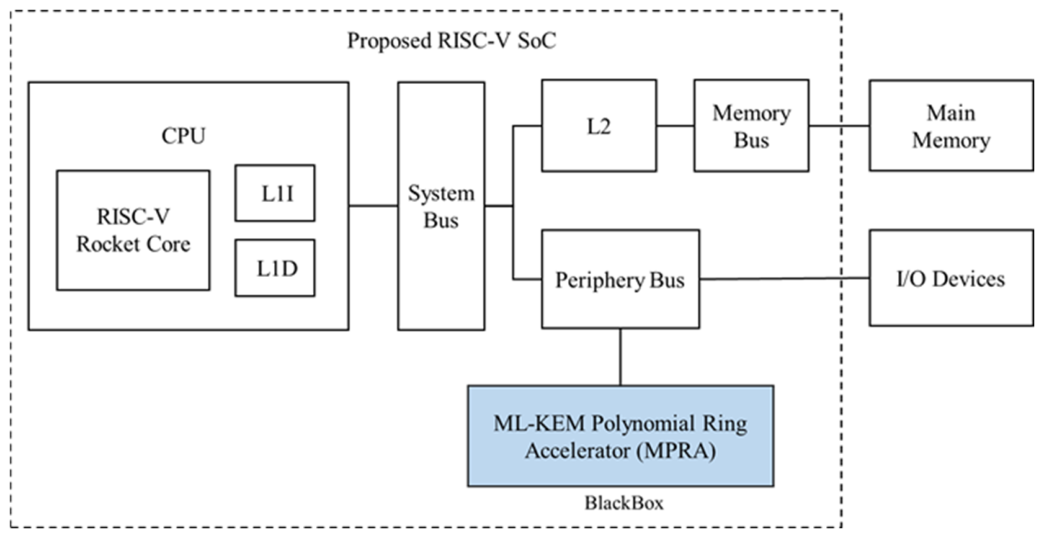
2.3. Open Hardware and RISC-V SoC Platforms
3. Polynomial Ring Multiplication Accelerator for ML-KEM in RISC-V SoC
3.1. System Architecture of the RISC-V SoC
3.2. Design of the ML-KEM Polynomial Ring Accelerator
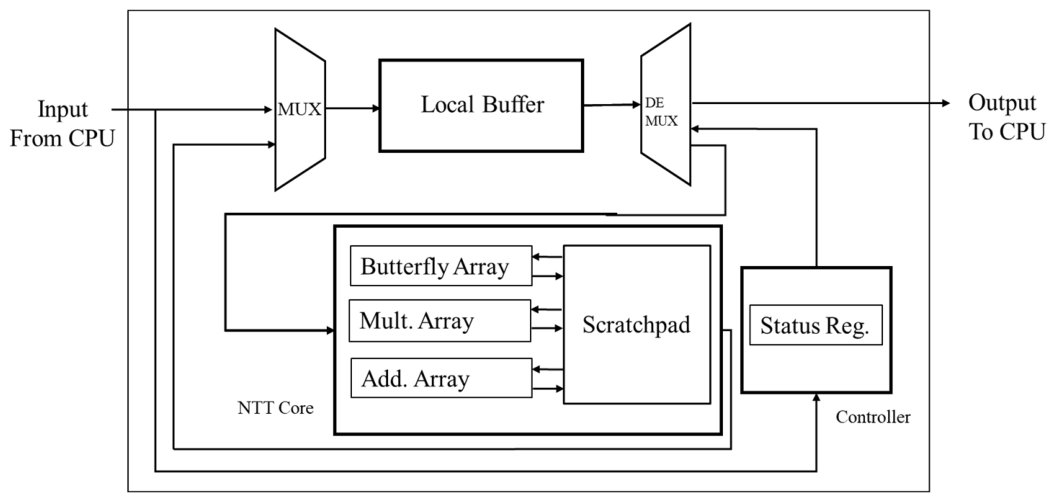
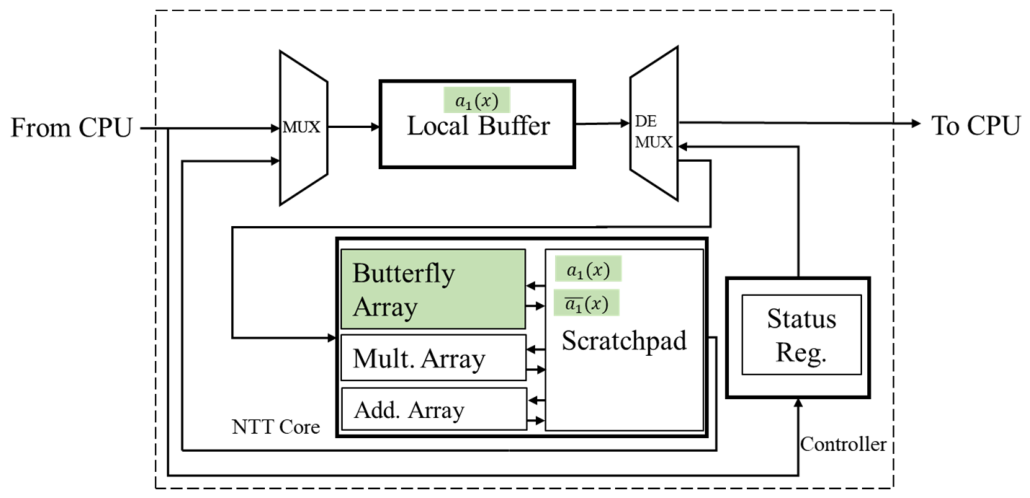
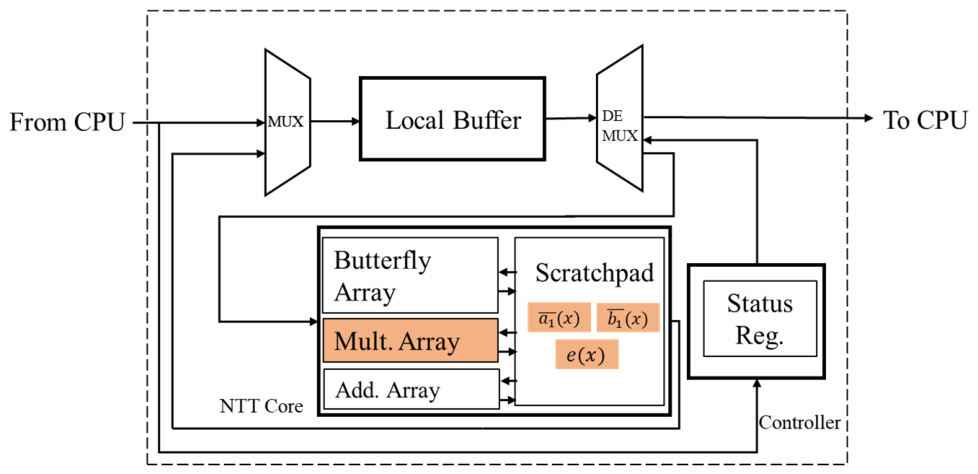
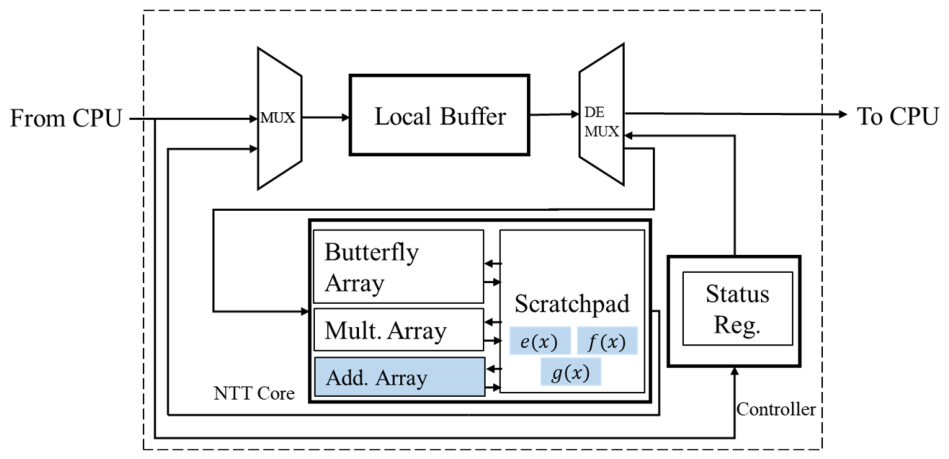
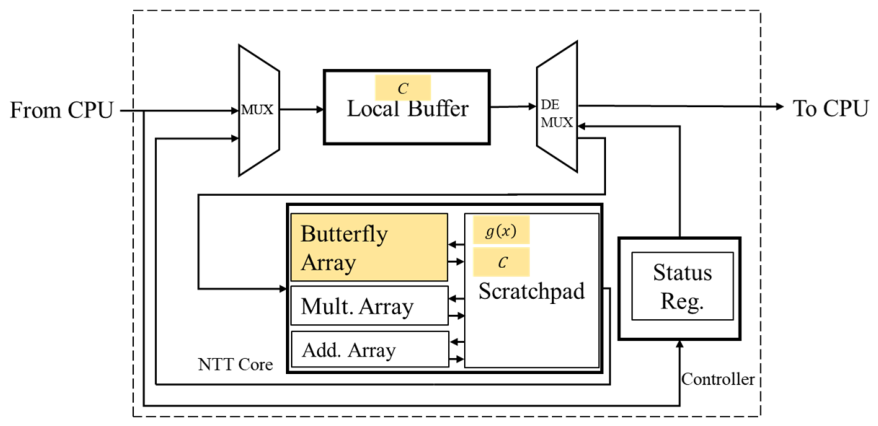
- Local BufferThe local buffer serves as an intermediate buffer between the CPU interface and the computation core. It temporarily stores polynomial coefficients received from the processor and supports staged data loading and processing. This design reduces the dependency on frequent external memory access during computation.
- Butterfly ArrayThe butterfly array performs NTT and INTT operations. It employs a parallel butterfly structure to execute modular multiplication and addition over finite fields, enabling efficient transformation between the time domain and the frequency domain.
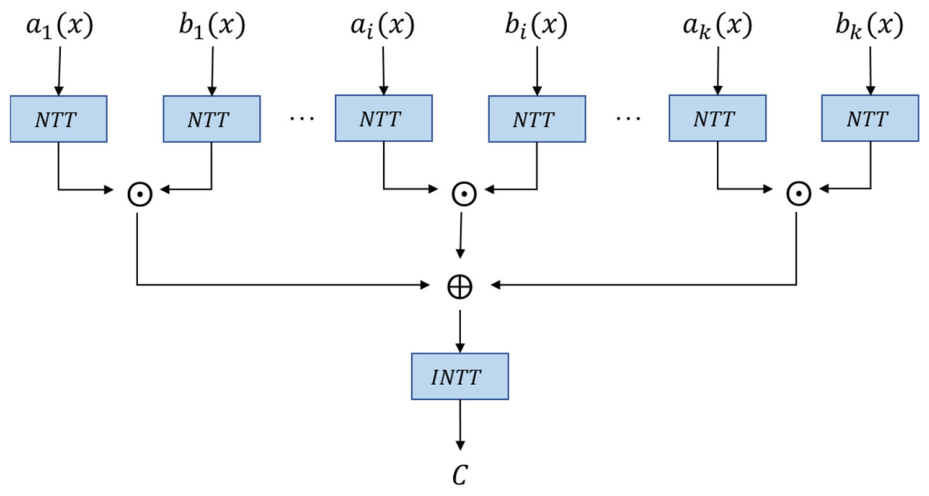
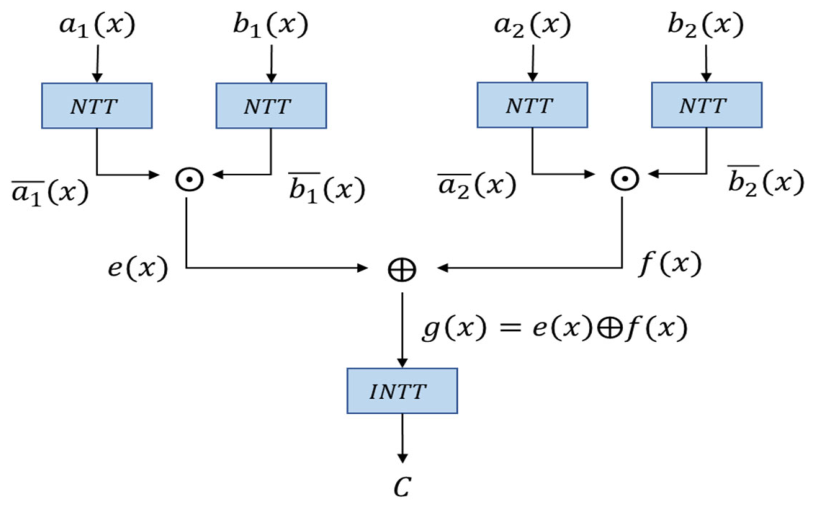
- Multiplier ArrayThe multiplier array supports pointwise multiplication in the NTT domain. It performs modular multiplication on corresponding polynomial coefficients and serves as the core computational unit for polynomial ring multiplication.
- Adder ArrayThe adder array performs modular addition of polynomial coefficients. It is primarily used for accumulation in matrix–vector multiplication, where intermediate results are combined across multiple polynomial products.
- Scratchpad MemoryThe scratchpad memory stores intermediate results generated during NTT, pointwise multiplication, and modular addition stages. By keeping intermediate data within the accelerator, the design enables continuous computation without repeatedly transferring data across the system bus, thereby significantly reducing main memory access overhead.
- ControllerThe controller manages the overall execution flow and scheduling of operations. It coordinates data movement and computation among the modules and interacts with the processor through a status register. This mechanism enables synchronization and provides a programmable interface for controlling the accelerator.
3.3. Matrix–Vector Multiplication over Polynomial Rings for ML-KEM
4. Implementation Results and Discussion
4.1. Hardware Resource Utilization
4.2. Performance Analysis of Polynomial Ring Computation
- Data load time requires 2967 cycles;
- NTT computation requires 280 cycles;
- Pointwise multiplication requires 122 cycles;
- INTT computation requires 150 cycles;
- Data store time requires 1964 cycles.
4.3. SoC-Level Performance Evaluation of ML-KEM
5. Conclusions
Author Contributions
Funding
Institutional Review Board Statement
Informed Consent Statement
Data Availability Statement
Acknowledgments
Conflicts of Interest
Abbreviations
| BRAM | Block RAM |
| CPU | Central Processing Unit |
| DDR | Double Data Rate |
| DSP | Digital Signal Processing |
| FF | Flip-Flop |
| FIPS | Federal Information Processing Standards |
| FPGA | Field-Programmable Gate Array |
| GCC | GNU Compiler Collection |
| INTT | Inverse Number Theoretic Transform |
| IP | Intellectual Property Core |
| ISA | Instruction Set Architecture |
| KAT | known answer test |
| LUT | Look-Up Table |
| ML-DSA | Module-Lattice-Based Digital Signature Algorithm |
| ML-KEM | Module-Lattice-Based Key Encapsulation Mechanism |
| MMIO | Memory-Mapped I/O |
| MPRA | ML-KEM Polynomial Ring Accelerator |
| NTT | Number Theoretic Transform |
| OS | Operating System |
| OTBN | OpenTitan Big Number |
| PQC | Post-Quantum Cryptography |
| RISC-V | Open-standard RISC instruction set architecture |
| RSA | Rivest–Shamir–Adleman |
| RTL | Register-Transfer Level |
| RV64GC | RISC-V 64-bit General-purpose ISA with Compressed extension |
| SHAKE | Secure Hash Algorithm Keccak |
| SoC | System on Chip |
| TL-UL | TileLink-Uncached Lightweight |
| XOF | Extendable Output Function |
Appendix A

| Symbol | Description |
|---|---|
| Polynomial ring defined as | |
| Modulus used in ML-KEM; in the proposed work, | |
| Polynomial degree parameter; in ML-KEM, | |
| Security-level-dependent dimension parameter in ML-KEM. | |
| Input polynomials in | |
| Polynomial vector or matrix operand in matrix–vector multiplication. | |
| Polynomial vector operand in matrix–vector multiplication. | |
| Output polynomial or matrix–vector multiplication result. | |
| Example input polynomials from vector in the ML-KEM-512 case. | |
| Example input polynomials from vector in the ML-KEM-512 case. | |
| NTT-domain representation of i.e., | |
| NTT-domain representation of i.e., | |
| Intermediate result of the first pointwise multiplication in the NTT domain. | |
| Intermediate result of the second pointwise multiplication in the NTT domain. | |
| Accumulated intermediate result in the NTT domain before INTT. | |
| Number Theoretic Transform. | |
| Inverse Number Theoretic Transform. | |
| Polynomial multiplication over | |
| Pointwise multiplication in the NTT domain. | |
| Modular addition over |
Appendix B
| Resource | Version | Purpose | License | Repository |
|---|---|---|---|---|
| Chipyard Framework | v1.8.1 | Open-source RISC-V SoC framework. | BSD-3-Clause/ Apache-2.0 | https://github.com/ucb-bar/chipyard/tree/1.8.1 (accessed on 6 May 2026) |
| Vivado-RISC-V | v3.8.0 | FPGA deployment and software execution environment for Chipyard. | MIT | https://github.com/eugene-tarassov/vivado-risc-v (accessed on 6 May 2026) |
| Kyber Polynomial Multiplier Hardware | N/A | Open-source polynomial multiplier IP. | CC0-1.0 | https://github.com/acmert/kyber-polmul-hw (accessed on 6 May 2026) |
| CRYSTALS-Kyber Reference Implementation | v3.0 | Functional verification and NIST KAT. | CC0-1.0/ Apache-2.0 | https://github.com/pq-crystals/kyber (accessed on 6 May 2026) |
References
- Shor, P.W. Algorithms for quantum computation: Discrete logarithms and factoring. In Proceedings of the 35th Annual Symposium on Foundations of Computer Science (FOCS), Santa Fe, NM, USA, 20–22 November 1994; IEEE: New York, NY, USA, 1994; pp. 124–134. [Google Scholar]
- National Institute of Standards and Technology (NIST). Migration to Post-Quantum Cryptography; NIST Interagency Report (IR) 8547 (Initial Public Draft); NIST: Gaithersburg, MD, USA, 2024. [Google Scholar] [CrossRef]
- National Institute of Standards and Technology (NIST). Module-Lattice-Based Key-Encapsulation Mechanism (ML-KEM); FIPS 203; NIST: Gaithersburg, MD, USA, 2024. [Google Scholar] [CrossRef]
- Tan, W.; Lao, Y.; Parhi, K.K. KyberMat: Efficient accelerator for matrix–vector polynomial multiplication in CRYSTALS-Kyber. In Proceedings of the IEEE/ACM International Conference on Computer-Aided Design (ICCAD), San Francisco, CA, USA, 29 October–2 November 2023. [Google Scholar] [CrossRef]
- Bos, J.W.; Ducas, L.; Kiltz, E.; Lepoint, T.; Lyubashevsky, V.; Schanck, J.M.; Schwabe, P.; Seiler, G.; Stehlé, D. CRYSTALS-Kyber: A CCA-secure module-lattice-based KEM. In Proceedings of the IEEE European Symposium on Security and Privacy (EuroS&P), London, UK, 24–26 April 2018; IEEE: New York, NY, USA, 2018; pp. 353–367. [Google Scholar] [CrossRef]
- Waris, A.; Aziz, A.; Khan, B.M. Area-time efficient pipelined number theoretic transform for CRYSTALS-Kyber. PLoS ONE 2025, 20, e0323224. [Google Scholar] [CrossRef] [PubMed]
- Yaman, F.; Mert, A.C.; Öztürk, E.; Savaş, E. A hardware accelerator for polynomial multiplication operation of CRYSTALS-Kyber PQC scheme. In Proceedings of the Design, Automation and Test in Europe Conference (DATE), Grenoble, France, 1–5 February 2021. [Google Scholar] [CrossRef]
- Wang, T.; Zhang, C.; Zhang, X.; Gu, D.; Cao, P. Hardware–software co-design for Kyber and Dilithium on RISC-V SoC FPGA. IACR Trans. Cryptogr. Hardw. Embed. Syst. 2024, 3, 99–135. [Google Scholar] [CrossRef]
- Amid, A.; Biancolin, D.; Gonzalez, A.; Grubb, D.; Karandikar, S.; Liew, H.; Magyar, A.; Mao, H.; Ou, A.; Pemberton, N.; et al. Chipyard: Integrated Design, Simulation, and Implementation Framework for Custom SoCs. IEEE Micro 2020, 40, 10–21. [Google Scholar] [CrossRef]
- Karabulut, E.; Aysu, A. RANTT: A RISC-V architecture extension for the number theoretic transform. In Proceedings of the International Conference on Field-Programmable Logic and Applications (FPL), Gothenburg, Sweden, 31 August–4 September 2020; IEEE: New York, NY, USA, 2020; pp. 26–32. [Google Scholar] [CrossRef]
- Huang, Y.; Huang, M.; Lei, Z.; Wu, J. A Pure Hardware Implementation of CRYSTALS-KYBER PQC Algorithm through Resource Reuse. IEICE Electron. Express 2020, 17, 20200234. [Google Scholar] [CrossRef]
- Bisheh-Niasar, M.; Azarderakhsh, R.; Mozaffari Kermani, M. High-Speed NTT-Based Polynomial Multiplication Accelerator for Post-Quantum Cryptography. In Proceedings of the 28th IEEE Symposium on Computer Arithmetic (ARITH), Virtual Conference, 14–16 June 2021; IEEE: New York, NY, USA, 2021; pp. 94–101. [Google Scholar] [CrossRef]
- Zhang, X.; Liu, D.; Chen, Z.; Jing, J. Towards Efficient Hardware Implementation of NTT for Kyber on FPGAs. In Proceedings of the IEEE International Symposium on Circuits and Systems (ISCAS), Daegu, Republic of Korea, 22–28 May 2021; IEEE: New York, NY, USA, 2021; pp. 1–5. [Google Scholar] [CrossRef]
- Liu, S.-H.; Kuo, C.-Y.; Mo, Y.-N.; Su, T. An area-efficient, conflict-free, and configurable architecture for accelerating NTT/INTT. IEEE Trans. Very Large Scale Integr. (VLSI) Syst. 2024, 32, 519–529. [Google Scholar] [CrossRef]
- Chen, Z.; Ma, Y.; Chen, T.; Lin, J.; Jing, J. Towards efficient Kyber on FPGAs: A processor for vector of polynomials. In Proceedings of the Asia and South Pacific Design Automation Conference (ASP-DAC), Beijing, China, 13–16 January 2020; IEEE: New York, NY, USA, 2020; pp. 247–252. [Google Scholar]
- Xing, Y.; Li, Y. A Compact Hardware Implementation of CCA-Secure Key Exchange Mechanism CRYSTALS-KYBER on FPGA. IACR Trans. Cryptogr. Hardw. Embed. Syst. 2021, 2021, 328–356. [Google Scholar] [CrossRef]
- Kim, H.; Jung, H.; Satriawan, A.; Lee, H. A configurable ML-KEM/Kyber hardware accelerator. IEEE Trans. Circuits Syst. II 2024, 71, 4678–4682. [Google Scholar] [CrossRef]
- Ni, Z.; Khalid, A.; Liu, W.; O’Neill, M. A highly hardware-efficient ML-KEM accelerator. ACM Trans. Embed. Comput. Syst. 2025, 24, 1–24. [Google Scholar] [CrossRef]
- Di Matteo, S.; Sarno, I.; Valea, E.; Saponara, S. KEM-22: An Efficient Post-Quantum ML-KEM Hardware Accelerator on 22-nm ASIC. IEEE Internet Things J. 2026, 13, 4715–4726. [Google Scholar] [CrossRef]
- Cui, Y.; Chen, J.; Ni, Z.; Zhang, Z.; Wang, C.; Liu, W. Instruction-based hardware controller of CRYSTALS-Kyber. IEEE Trans. Circuits Syst. I 2025, 72, 2394–2407. [Google Scholar]
- Dolmeta, A.; Valpreda, E.; Martina, M.; Masera, G. Integration of NTT/INTT accelerator on RISC-V. In Proceedings of the ACM Computing Frontiers Conference (CF), Ischia, Italy, 7–9 May 2024; IEEE: New York, NY, USA, 2024; pp. 59–62. [Google Scholar] [CrossRef]
- Dam, D.-T.; Nguyen, T.-H.; Kieu-Do-Nguyen, B.; Hoang, T.T.; Pham, C.K. RISC-V SoC with NTT-Blackbox for CRYSTALS-Kyber Post-Quantum Cryptography. In Proceedings of the ICDV 2024; IEEE: New York, NY, USA, 2024; pp. 49–54. [Google Scholar] [CrossRef]
- Dam, D.-T.; Nguyen, K.-D.; Le, D.-H.; Pham, C.-K. High-efficiency NTT for ML-KEM on RISC-V. Electronics 2026, 15, 100. [Google Scholar] [CrossRef]
- Abdulrahman, A.; Oberhansl, F.; Pham, H.N.; Philipoom, J.; Schwabe, P.; Stelzer, T.; Zankl, A. Towards ML-KEM and ML-DSA on OpenTitan. In Proceedings of the IEEE Symposium on Security and Privacy, San Francisco, CA, USA, 16 June 2025. [Google Scholar] [CrossRef]
- Celik, A.; Yilmaz, F.; Korkmaz, M.A.; Ors, B. Implementation of CRYSTALS-Kyber post-quantum algorithm using RISC-V processor. In Proceedings of the IEEE International Conference on Electronics, Circuits and Systems (ICECS), Istanbul, Turkey, 4–7 December 2023. [Google Scholar] [CrossRef]
- lowRISC. Ibex: An Embedded 32 Bit RISC-V CPU Core. Available online: https://ibex-core.readthedocs.io/en/latest/index.html (accessed on 2 April 2026).
- OpenTitan Project. OpenTitan: Open Source Silicon Root of Trust. Available online: https://opentitan.org (accessed on 2 April 2026).
- OpenHW Group. CORE-V CV32E40P RISC-V Processor Core User Manual. Available online: https://docs.openhwgroup.org/projects/cv32e40p-user-manual (accessed on 2 April 2026).
- Rumelili Köksal, C.I.; Örs Yalçın, S.B. Efficient modeling and usage of scratchpad memory. Electronics 2025, 14, 1032. [Google Scholar] [CrossRef]
- Pq-Crystals. CRYSTALS-Kyber Official Reference Implementation. Available online: https://github.com/pq-crystals/kyber (accessed on 2 April 2026).

| Work | Year | Algorithm | Architecture | Integration | Impl. | Open IP |
|---|---|---|---|---|---|---|
| Chen et al. [15] | 2020 | Kyber | Polynomial vector processor | Standalone accelerator | FPGA | No |
| Huang et al. [11] | 2020 | Kyber | NTT-based polynomial multiplication | Standalone full accelerator | FPGA | No |
| Karabulut et al. [10] | 2020 | NTT | RISC-V ISA extension for NTT | CPU-integrated (ISA extension) | ASIC | No |
| Xing et al. [16] | 2021 | Kyber | Full Kyber accelerator | Standalone full accelerator | FPGA | Partial |
| Yaman et al. [7] | 2021 | Kyber | Polynomial multiplication accelerator | Standalone accelerator | FPGA | Yes |
| Bisheh-Niasar et al. [12] | 2021 | Kyber | NTT-based polynomial multiplier | Standalone accelerator | FPGA | No |
| Zhang et al. [13] | 2021 | Kyber | Efficient NTT architecture | Standalone accelerator | FPGA | No |
| Celik et al. [25] | 2023 | Kyber | Keccak hardware acceleration | RISC-V CPU (Ibex, MMIO/interrupt-based) | FPGA | No |
| Liu et al. [14] | 2024 | NTT/INTT | Configurable NTT/INTT accelerator | Standalone accelerator | ASIC | No |
| Kim et al. [17] | 2024 | ML-KEM | Configurable full KEM accelerator | Standalone full accelerator | ASIC | No |
| Wang et al. [8] | 2024 | Kyber / Dilithium | HW/SW co-design with polynomial accelerators | RISC-V SoC (HW/SW co-design) | FPGA | No |
| Dolmeta et al. [21] | 2024 | Kyber | Memory-mapped NTT/INTT accelerator | RISC-V SoC (MMIO-based) | FPGA | No |
| Dam et al. (ICDV) [22] | 2024 | Kyber | NTT black-box accelerator | Chipyard RISC-V SoC (MMIO/peripheral) | FPGA/ASIC | Partial |
| Waris et al. [6] | 2025 | Kyber | NTT/INTT-based polynomial multiplier | Standalone accelerator | FPGA | No |
| Ni et al. [18] | 2025 | ML-KEM | Full ML-KEM accelerator | Standalone full accelerator | ASIC | No |
| Cui et al. [20] | 2025 | Kyber | Instruction-based hardware controller | CPU–accelerator (instruction-based) | ASIC | No |
| Abdulrahman et al. [24] | 2025 | ML-KEM / ML-DSA | OpenTitan OTBN extension | OpenTitan SoC (OTBN-based) | ASIC | Partial |
| Di Matteo et al. [19] | 2026 | ML-KEM | Full ML-KEM accelerator | Standalone full accelerator | ASIC | No |
| Dam et al. (Electronics) [23] | 2026 | ML-KEM | Tightly integrated NTT accelerator with custom instructions | Chipyard RISC-V SoC (RoCC tightly coupled) | ASIC | Partial |
| Proposed Work | 2026 | ML-KEM | ML-KEM Polynomial ring accelerator | Chipyard RISC-V SoC (MMIO/peripheral) | FPGA | Yes |
| Work | Algorithm | NTT Accelerator | Full ML-KEM | RISC-V SoC | Open Hardware |
|---|---|---|---|---|---|
| Wang et al. (TCHES) [8] | Kyber | ✓ | Partial | ✓ | ✗ |
| Dolmeta et al. [21] | Kyber | ✓ | ✗ | ✓ | ✗ |
| Abdulrahman et al. [24] | ML-KEM | ✓ | Partial | ✓ | Partial |
| Dam et al. (ICDV) [22] | Kyber | ✓ | ✗ | ✓ | Partial |
| Dam et al. (Electronics) [23] | ML-KEM | ✓ | Partial | ✓ | Partial |
| Proposed Work | ML-KEM | ✓ (Integrated NTT datapath) | ✓ (HW/SW co-designed ML-KEM) | ✓ (Chipyard SoC + OS support) | ✓ (Open IP + reproducible) |
| Implementation | LUT | FF | BRAM | DSP |
|---|---|---|---|---|
| Proposed SoC without MPRA | 67,356/203,800 (33.05%) | 42,918/407,600 (10.53%) | 143/445 (32.13%) | 15/840 (1.79%) |
| Proposed SoC with MPRA | 78,514/203,800 (38.52%) | 52,613/407,600 (12.91%) | 177/445 (39.77%) | 31/840 (3.69%) |
| Work | Target Operation | NTT Accelerator | Polynomial Multiplication | Modular Addition | Matrix–Vector Multiplication | Hash Accelerator | SoC-Level Evaluation |
|---|---|---|---|---|---|---|---|
| Yaman et al. [7] | Polynomial Multiplication | ✓ | ✓ | ✗ | ✗ | ✗ | Partial |
| Karabulut et al. [10] | Polynomial Multiplication | ✓ | ✓ | ✗ | ✗ | ✗ | Partial |
| Dam et al. [22] | Polynomial Multiplication | ✓ | ✓ | ✗ | ✗ | ✗ | Partial |
| Celik et al. [25] | Keccak Acceleration | ✗ | ✗ | ✗ | ✗ | ✓ | Full |
| Proposed Work | Matrix–Vector Multiplication over Polynomial Rings | ✓ | ✓ | ✓ | ✓ | ✗ | Full |
| Implementations | Steps | Clocks | Total Clocks | Latency (μs) | |
|---|---|---|---|---|---|
| Proposed work | NTT (2 NTTs) | Data Load Time | 2967 | 5483 | 54.83 |
| NTT Core for NTT | 280 | ||||
| Pairwise Multiplication | 122 | ||||
| INTT (1 INTT) | NTT Core for INTT | 150 | |||
| Data Store Time | 1964 | ||||
| Karabulut et al. [10] | NTT (1 NTT) | Data Load Time | 43,756 | 43,756 | ✗ |
| NTT Core for NTT | |||||
| Data Store Time | |||||
| Dam et al. [22] | NTT (1 NTT) | Data Load Time | 2084 | 9842 | ✗ |
| NTT Core for NTT | 5682 | ||||
| Data Store Time | 2076 | ||||
| Kyber C code [30] | NTT | 66,394 | 143,196 | 1431.96 | |
| Pairwise Multiplication | 18,686 | ||||
| INTT | 56,098 | ||||
| Implementations | Clocks | Latency (μs) | Speed Up |
|---|---|---|---|
| Kyber C code [30] | 296,485 | 2964.85 | 1 |
| Proposed HW Accelerator with Pointwise Multiplication Only | 12,037 | 120.37 | 24.6 |
| Proposed HW Accelerator with Pointwise Multiplication and Modular Addition Support | 7372 | 73.72 | 40.2 |
| Parameter Set | KeyGen | Encaps | Decaps |
|---|---|---|---|
| ML-KEM 512 | Pass | Pass | Pass |
| ML-KEM 768 | Pass | Pass | Pass |
| ML-KEM 1024 | Pass | Pass | Pass |
| Algorithm | Operation | Kyber C Code [30] | Proposed Work | Speed-Up |
|---|---|---|---|---|
| ML-KEM 512 | KeyGen | 802,174 | 513,555 | 1.56 |
| Encaps | 929,391 | 554,479 | 1.67 | |
| Decaps | 1,037,658 | 492,533 | 2.10 | |
| ML-KEM 768 | KeyGen | 1,270,151 | 829,646 | 1.53 |
| Encaps | 1,447,649 | 877,912 | 1.64 | |
| Decaps | 1,604,701 | 788,022 | 2.03 | |
| ML-KEM 1024 | KeyGen | 1,827,053 | 1,219,147 | 1.50 |
| Encaps | 2,120,848 | 1,295,500 | 1.63 | |
| Decaps | 2,317,043 | 1,193,890 | 1.94 |
| Work | CPU | ISA | Clock Rate | Execution Time | Encaps (SW) | Encaps (SW/HW) | Decaps (SW) | Decaps (SW/HW) |
|---|---|---|---|---|---|---|---|---|
| Celik et al. [25] | Ibex Core | RV32IMC | 50 MHz | Cycles | 5,886,277 | 3,115,537 | 6,222,787 | 3,957,289 |
| Latency (μs) | 117,725.54 | 62,310.74 | 124,455.74 | 79,145.78 | ||||
| Proposed Work | Rocket Core | RV64GC | 100 MHz | Cycles | 1,447,649 | 877,912 | 1,604,701 | 788,022 |
| Latency (μs) | 14,476.49 | 8779.12 | 16,047.01 | 7880.22 |
Disclaimer/Publisher’s Note: The statements, opinions and data contained in all publications are solely those of the individual author(s) and contributor(s) and not of MDPI and/or the editor(s). MDPI and/or the editor(s) disclaim responsibility for any injury to people or property resulting from any ideas, methods, instructions or products referred to in the content. |
© 2026 by the authors. Licensee MDPI, Basel, Switzerland. This article is an open access article distributed under the terms and conditions of the Creative Commons Attribution (CC BY) license.
Share and Cite
Tsai, Y.-C.; Lin, Y.-H.; Hwang, W.-J. An Open Hardware ML-KEM Polynomial Ring Accelerator on Chipyard RISC-V SoC: System-Level Integration and Evaluation. Electronics 2026, 15, 2511. https://doi.org/10.3390/electronics15122511
Tsai Y-C, Lin Y-H, Hwang W-J. An Open Hardware ML-KEM Polynomial Ring Accelerator on Chipyard RISC-V SoC: System-Level Integration and Evaluation. Electronics. 2026; 15(12):2511. https://doi.org/10.3390/electronics15122511
Chicago/Turabian StyleTsai, Yi-Chang, Yu-Han Lin, and Wen-Jyi Hwang. 2026. "An Open Hardware ML-KEM Polynomial Ring Accelerator on Chipyard RISC-V SoC: System-Level Integration and Evaluation" Electronics 15, no. 12: 2511. https://doi.org/10.3390/electronics15122511
APA StyleTsai, Y.-C., Lin, Y.-H., & Hwang, W.-J. (2026). An Open Hardware ML-KEM Polynomial Ring Accelerator on Chipyard RISC-V SoC: System-Level Integration and Evaluation. Electronics, 15(12), 2511. https://doi.org/10.3390/electronics15122511