Risk Management of Microgrids in Power System for Enhanced Energy Security and National Resilience

 , , ,
, , , 
 ,
, 
Abstract
1. Introduction
2. State of Art
- planning the transition to green energy;
- reducing dependence on fossil fuels;
- integrating microgrids into existing energy systems;
- increasing the resilience of the energy system to economic and climate changes.
2.1. PESTEL Analysis
- A.
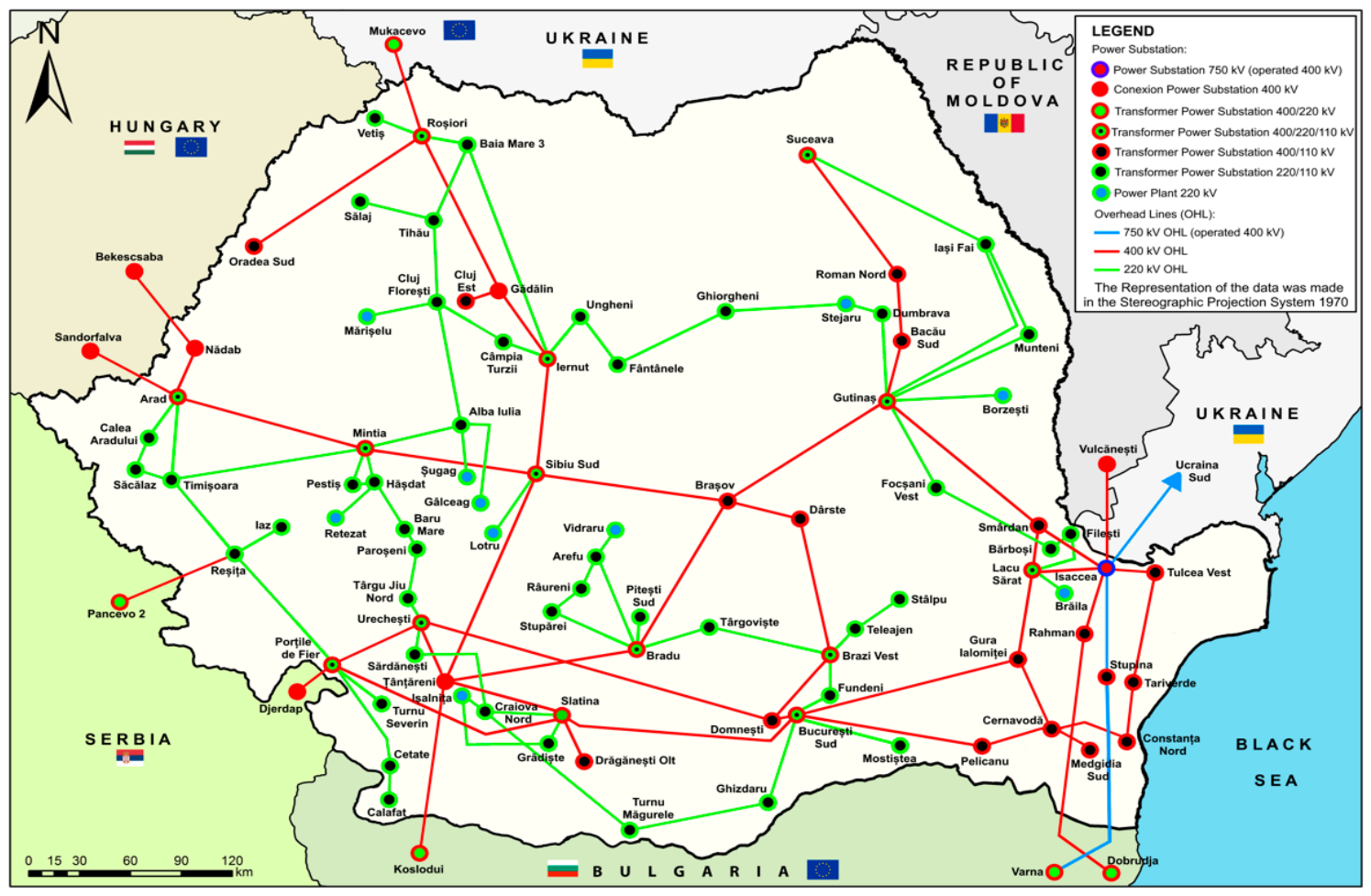
- Political (factors): The energy sector in Romania is strongly influenced by national and European political decisions, playing a strategic role in the country’s energy security;
- B.
- Economic (factors): The energy sector is of major importance to Romania’s economy, as energy is an essential resource for industrial operation and economic development;
- C.
- Social (factors): Energy directly affects the population’s standard of living, as access to affordable and reliable energy is essential for social welfare;
- D.
- Technological (factors): Modernization of energy infrastructure is essential for developing the national power system, which includes all electricity production, transport, distribution, and consumption facilities in Romania;
- E.
- Environmental (factors): The energy sector has a significant environmental impact, being responsible for a large portion of greenhouse gas emissions;
- F.
- Legal (factors): The energy sector is regulated by a complex legislative framework, consisting of both national laws and European Union regulations.
2.2. SWOT Analysis
- A.
- Strengths: Diversified Energy Portfolio; Strategic Geographic Position; European Union; Integration and Financial Support; Developed Transmission and Distribution Infrastructure;
- B.
- Weaknesses: Aging Infrastructure; Dependence on Fossil Fuels; Insufficient Energy Storage Capacity; Regulatory Complexity;
- C.
- Opportunities: Expansion of Renewable Energy; Grid Modernization and Smart Technologies; Regional Energy Trading; Decarbonization and EU Climate Targets;
- D.
- Threats: Energy security challenges; Price instability; Regulatory and Political Uncertainty; Climate-related Risks.
3. Microgrids—Elements of Ensuring Energy Security and Resilience
3.1. Definitions & Core Concepts
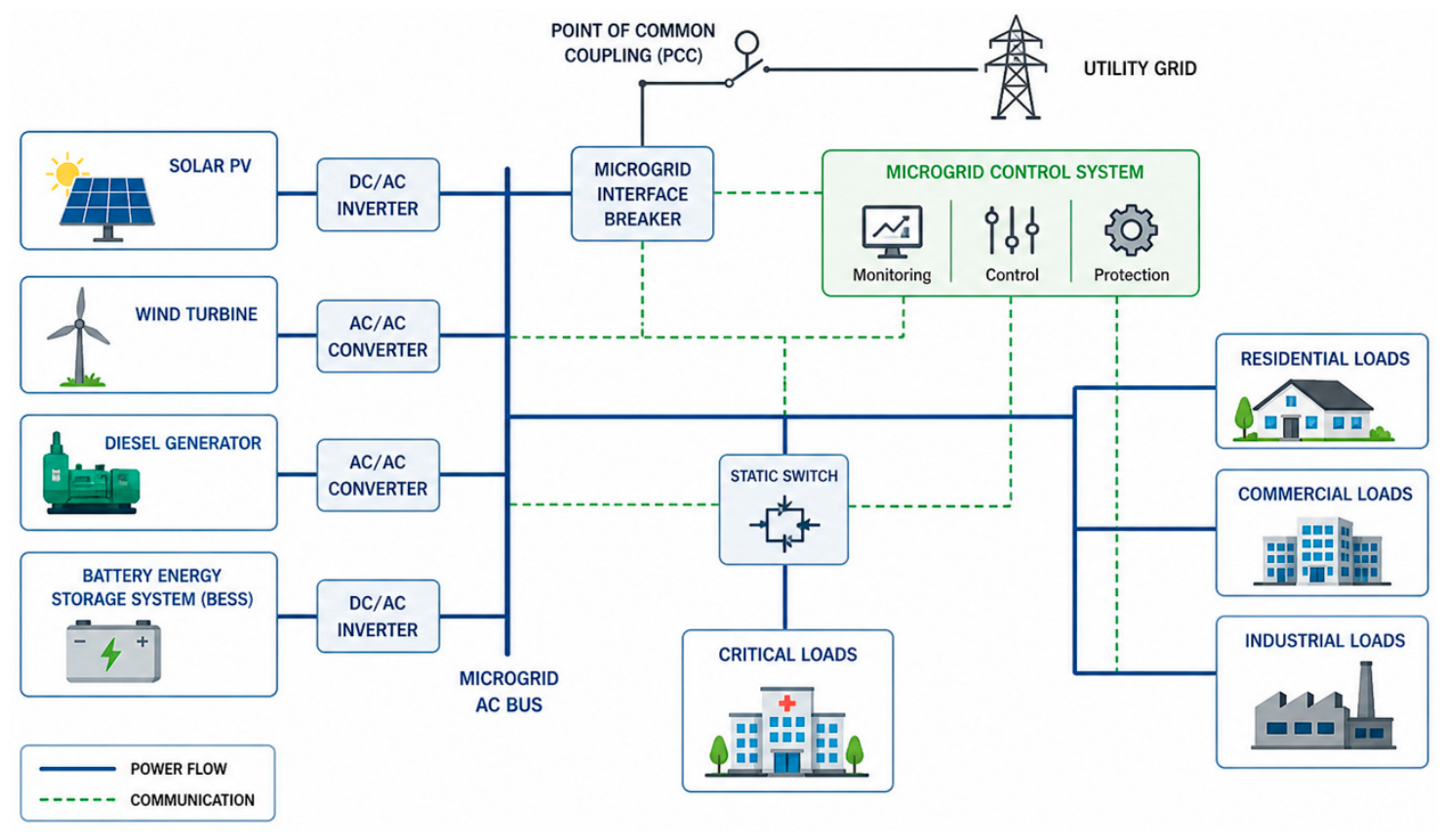
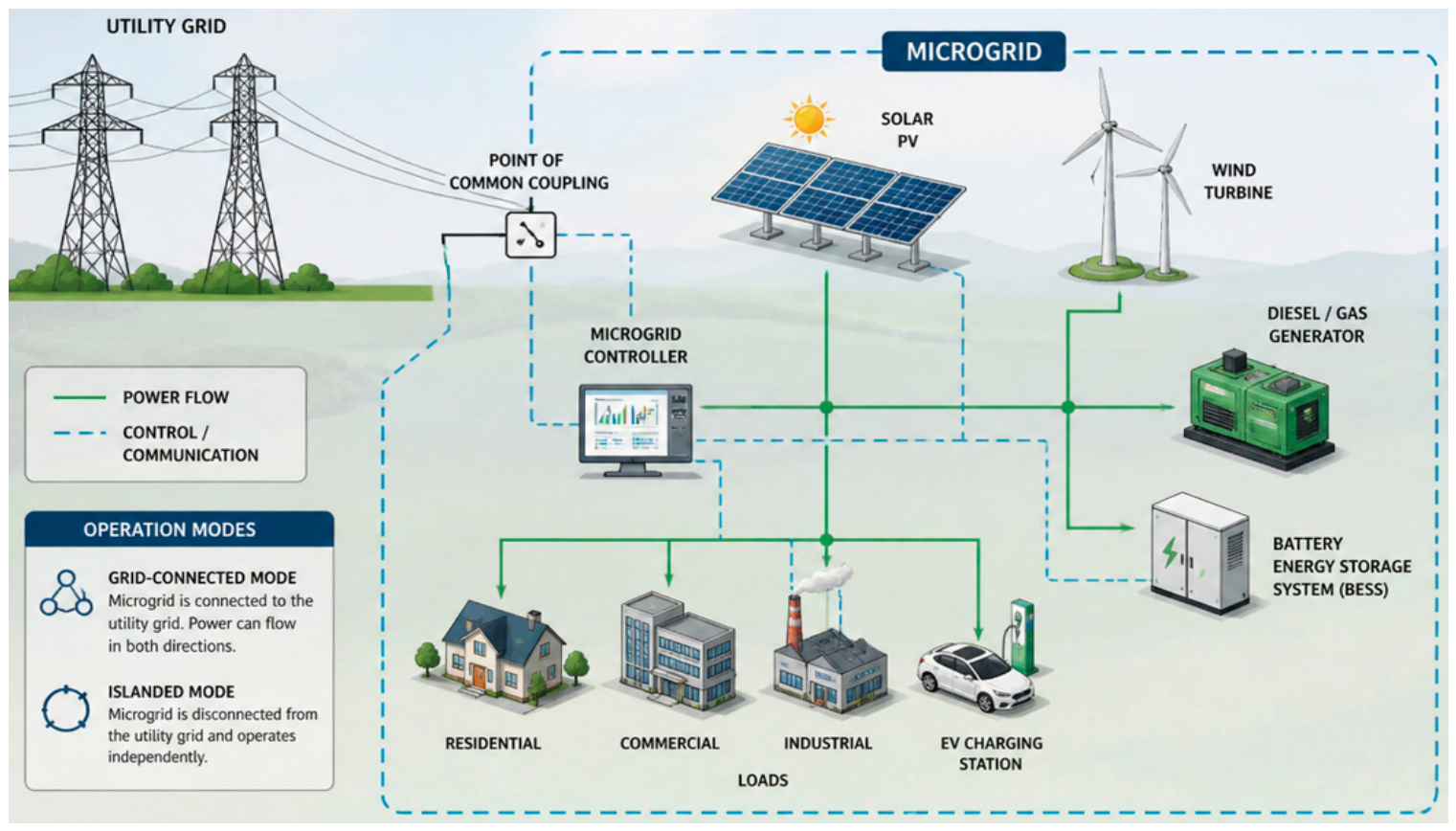
3.2. Key Structural Elements of Microgrids
- Distributed Generation: Renewable (solar, wind, biomass) and conventional sources;
- Energy Storage Systems (ESS): Batteries, hydrogen, flywheels for load balancing and islanding support;
- Power Electronics and Converters: Enable flexible AC/DC interfaces and control;
- Control and Communication Systems: Microgrid controllers, EMS, real-time sensors;
- Load Management: Critical vs. non critical loads for prioritization during disruptions.
- Centralized/Decentralized/Hybrid Controls tailor adaptability and fault tolerance;
- Energy Management Systems (EMS) optimize energy dispatch, storage use, and islanding transitions.
3.3. Mechanisms Ensuring Energy Security & Resilience
- Islanded Operation—Microgrids dynamically disconnect from the main grid during faults or disasters, ensuring continuous power to critical loads and reducing reliance on central grids;
- Distributed Resource Diversity—Using multiple energy sources and storage increases redundancy and reduces vulnerability to single point failures;
- Advanced Control and Forecasting—Adaptive control algorithms (e.g., predictive, AI based) and demand forecasting improve system anticipation and rapid response;
- Networked and Multi-Microgrid Strategies—Interconnected or clustered microgrids share energy and support broader geographic resilience, enhancing stability and recovery;
- Cyber–Physical Protection—Cybersecurity and robust communication protocols are critical, as digitalization increases exposure to cyber risks that can compromise resilience.
3.4. Benefits for Energy Security and Resilience
- Operational Advantages:
- ➢
- Reliable, uninterrupted supply even during grid outages;
- ➢
- Energy autonomy for critical infrastructure (hospitals, military, industrial facilities);
- ➢
- Greater flexibility in energy management and rapid adaptation to variable conditions.
- Sustainability and Decarbonization: Integration of renewables reduces dependence on fossil fuels and lowers carbon emissions while improving local energy reliability;
- Economic and Social Gains—Optimized local production and storage can stabilize energy prices and reduce operational costs. Community microgrids also promote energy access equity and localized control.
3.5. Challenges and Research Directions
- Technical and Operational Challenges:
- ➢
- High initial cost for energy storage, control systems, and communications;
- ➢
- Complexity in control transitions between grid-connected and islanded modes;
- ➢
- Standardization and interoperability issues for multi-vendor systems.
- Cybersecurity Risks—Digital interfaces and communication networks introduce vulnerabilities requiring adaptive security frameworks.
- Future Research Directions:
- ➢
- AI/Machine Learning for predictive resilience and EMS optimization;
- ➢
- Standardized resilience metrics and real world performance validation;
- ➢
- Policy and regulatory frameworks that enable adaptable microgrid integration and energy markets.
3.6. Conclusion
4. Energy Security Assessment—Risk Management
4.1. Risk Scenario: 400 kV Power Substation Sequence of Technical Incidents—NPS (Blackout)
- (a)
- Probability
| Level | Probability Definition | Period | |
| 1. Very low | It has a very low probability of occurring. Normal measures are required to monitor the evolution of the event. | over 13 years | |
| 2. Low | The event has a low probability of occurring. Efforts shall be made to reduce the likelihood and/or mitigation of the impact produced. | 10–12 years | |
| X | 3. Average | The event has a significant probability of occurring. Significant efforts are required to reduce the likelihood and/or mitigate the impact produced. | 7–9 years |
| 4. High | The event is likely to occur. Priority efforts are required to reduce the likelihood and mitigate the impact produced. | 4–6 years | |
| 5. Very high | The event is considered imminent. Immediate and extreme measures are required to protect the target and evacuate to a safe location if the impact requires it. | 1–3 years | |
- (b)
- Gravity (severity)/Impact

| Impacts | Level | |
|---|---|---|
| Significant damage resulting from the absence of electricity | 1. Very low | temporary |
| 2. Low | medium damage | |
| 3. Average | main damage | |
| 4. High | big damage | |
| 5. Very high | very big damage | |
| Significant damage resulting from the interdependence of other systems | 1. Very low | 0–10% |
| 2. Low | 11–20% | |
| 3. Average | 21–30% | |
| 4. High | 31–40% din | |
| 5. Very high | over 41% | |
| Potential environmental damage | 1. Very low | 0–20% |
| 2. Low | 21–40% | |
| 3. Average | 41–60% | |
| 4. High | 61–80% | |
| 5. Very high | over 81% | |
| Strong social impacts | 1. Very low | 0–10% trust |
| 2. Low | 11–20% trust | |
| 3. Average | 21–30% trust | |
| 4. High | 31–40% trust | |
| 5. Very high | over 41% trust |
| Level | Gravity (Severity) Consequences | |
| 1. Very low | The event produces a minor disturbance in the activity, without any material damage. | |
| 2. Low | The event causes minor material damage and limited disruption of the activity | |
| 3. Average | Injuries to personnel, and/or certain loss of equipment, utilities, and delays in providing the service | |
| 4. High | Serious personnel injury, significant loss of equipment and facilities, delays, and/or interruption of service provision | |
| X | 5. Very high | The consequences are catastrophic resulting in death and serious injury to personnel, major losses of equipment, facilities and facilities, and cessation of service provision |
- (c)
- Level risk
| P R O B A B I L I T Y | Very high 5 | |||||||
| High 4 | ||||||||
| Average 3 | Risk Scenario | |||||||
| Low 2 | ||||||||
| Very low 1 | ||||||||
| 0 | Very low 1 | Low 2 | Average 3 | High 4 | Very high 5 | |||
| G R A V I T Y/C O N S E Q U E N C E S | ||||||||
| Note: The risk is given by the product between the probability of a hazard/threat and the gravity (severity) | ||||||||
| Risk: 15 (probability 3 × gravity 5) HIGH RISK | LEVEL RISK CALCULATE | |
| LEVEL | SCORE | |
| Very low | 1–3 | |
| Low | 4–6 | |
| Average | 7–12 | |
| High | 13–16 | |
| Very high | 17–25 | |
- (d)
- Risk treatment
- (e)
- Gravity (Severity)/Impact recalculation
| Level | Gravity (Severity) Consequences | |
| 1. Very low | The event produces a minor disturbance in the activity, without any material damage | |
| 2. Low | The event causes minor material damage and limited disruption of the activity | |
| X | 3. Average | Injuries to personnel, and/or certain loss of equipment, utilities, and delays in providing the service. |
| 4. High | Serious personnel injury, significant loss of equipment and facilities, delays, and/or interruption of service provision. | |
| 5. Very high | The consequences are catastrophic resulting in death and serious injury to personnel, major losses of equipment, facilities and facilities, and cessation of service provision | |
- (f)
- Level risk after applying the mesures
| P R O B A B I L I T Y | Very high 5 | |||||
| High 4 | ||||||
| Average 3 | Risk Scenario | |||||
| Low 2 | ||||||
| Very low 1 | ||||||
| 0 | Very low 1 | Low 2 | Average 3 | High 4 | Very high 5 | |
| G R A V I T Y/C O N S E Q U E N C E S | ||||||
| Note: The risk is given by the product between the probability of a hazard/threat and the gravity (severity) | ||||||
| Risk: 9 (probability 3 × gravity 3) AVERAGE RISK | LEVEL RISK CALCULATE | |
| LEVEL | SCORE | |
| Very low | 1–3 | |
| Low | 4–6 | |
| Average | 7–12 | |
| High | 13–16 | |
| Very high | 17–25 | |
4.2. Risk Scenario: Natural Disaster of National Power System—NPS → Blackout
- (a)
- Probability
| Level | Probability Definition | Period | |
| 1. Very low | It has a very low probability of occurring. Normal measures are required to monitor the evolution of the event. | over 13 years | |
| X | 2. Low | The event has a low probability of occurring. Efforts shall be made to reduce the likelihood and/or mitigation of the impact produced. | 10–12 years |
| 3. Average | The event has a significant probability of occurring. Significant efforts are required to reduce the likelihood and/or mitigate the impact produced. | 7–9 years | |
| 4. High | The event is likely to occur. Priority efforts are required to reduce likelihood and mitigate the impact produced. | 4–6 years | |
| 5. Very high | The event is considered imminent. Immediate and extreme measures are required to protect the target, evacuate to a safe location if the impact requires it. | 1–3 years | |
- (b)
- Gravity (severity)/Impact
| Impacts | Level | |
|---|---|---|
| Significant impacts arising from power outages. | 1. Very low | temporary |
| 2. Low | medium damage | |
| 3. Average | main damage | |
| 4. High | big damage | |
| 5. Very high | very big damage | |
| Significant damage resulting from the interdependence among other systems. | 1. Very low | 0–10% |
| 2. Low | 11–20% | |
| 3. Average | 21–30% | |
| 4. High | 31–40% | |
| 5. Very high | over 41% | |
| Potential environmental damage | 1. Very low | 0–20% |
| 2. Low | 21–40% | |
| 3. Average | 41–60% | |
| 4. High | 61–80% | |
| 5. Very high | over 81% | |
| Strong social impacts | 1. Very low | 0–10% trust |
| 2. Low | 11–20% trust | |
| 3. Average | 21–30% trust | |
| 4. High | 31–40% trust | |
| 5. Very high | over 41% trust |
| Level | Gravity (Severity) Consequences | |
| 1. Very low | The event produces a minor disturbance in the activity, without any material damage | |
| 2. Low | The event causes minor material damage and limited disruption of the activity | |
| 3. Average | Injuries to personnel, and/or certain loss of equipment, utilities, and delays in providing the service | |
| 4. High | Serious personnel injury, significant loss of equipment and facilities, delays, and/or interruption of service provision | |
| X | 5. Very high | The consequences are catastrophic, resulting in death and serious injury to personnel, major losses of equipment, facilities and facilities, and cessation of service provision |
- (c)
- Level risk
| P R O B A B I L I T Y | Very high 5 | |||||
| High 4 | ||||||
| Average 3 | ||||||
| Low 2 | Risk Scenario | |||||
| Very low 1 | ||||||
| 0 | Very low 1 | Low 2 | Average 3 | High 4 | Very high 5 | |
| G R A V I T Y/C O N S E Q U E N C E S | ||||||
| Note: The risk is given by the product between the probability of a hazard/threat and the gravity (severity) | ||||||
| Risk: 10 (probability 2 × gravity 5) AVERAGE RISK | LEVEL RISK CALCULATE | |
| LEVEL | SCORE | |
| Very low | 1–3 | |
| Low | 4–6 | |
| Average | 7–12 | |
| High | 13–16 | |
| Very high | 17–25 | |
- (d)
- Risk treatment
- (e)
- Gravity (Severity)/Impact recalculation
| Level | Gravity (Severity) Consequences | |
| 1. Very low | The event produces a minor disturbance in the activity, without any material damage | |
| 2. Low | The event causes minor material damage and limited disruption of the activity | |
| X | 3. Average | Injuries to personnel, and/or certain loss of equipment, utilities, and delays in providing the service. |
| 4. High | Serious personnel injury, significant loss of equipment and facilities, delays, and/or interruption of service provision. | |
| 5. Very high | The consequences are catastrophic resulting in death and serious injury to personnel, major losses of equipment, facilities and facilities, and cessation of service provision | |
- (f)
- Level risk after applying the mesures
| P R O B A B I L I T Y | Very high 5 | |||||
| High 4 | ||||||
| Average 3 | ||||||
| Low 2 | Risk Scenario | |||||
| Very low 1 | ||||||
| 0 | Very low 1 | Low 2 | Average 3 | High 4 | Very high 5 | |
| G R A V I T Y/C O N S E Q U E N C E S | ||||||
| Note: The risk is given by the product between the probability of a hazard/threat and the gravity (severity) | ||||||
| Risk: 6 (probability 2 × gravity 3) LOW RISK | LEVEL RISK CALCULATE | |
| LEVEL | SCORE | |
| Very low | 1–3 | |
| Low | 4–6 | |
| Average | 7–12 | |
| High | 13–16 | |
| Very high | 17–25 | |
4.3. Risk Scenario: 400 kV Power Substation Terrorist Attack → Blackout
- (a)
- Probability
| Level | Probability Definition | Period | |
| 1. Very low | It has a very low probability of occurring. Normal measures are required to monitor the evolution of the event. | over 13 years | |
| 2. Low | The event has a low probability of occurring. Efforts shall be made to reduce the likelihood and/or mitigation of the impact produced. | 10–12 years | |
| X | 3. Average | The event has a significant probability of occurring. Significant efforts are required to reduce the likelihood and/or mitigate the impact produced. | 7–9 years |
| 4. High | The event is likely to occur. Priority efforts are required to reduce likelihood and mitigate the impact produced. | 4–6 years | |
| 5. Very high | The event is considered imminent. Immediate and extreme measures are required to protect the target, evacuate to a safe location if the impact requires it. | 1–3 years | |
- (b)
- Gravity (severity)/Impact
| Impacts | Level | |
|---|---|---|
| Extensive impacts caused by power outages | 1. Very low | temporary |
| 2. Low | medium damage | |
| 3. Average | main damage | |
| 4. High | big damage | |
| 5. Very high | very big damage | |
| Significant damage resulting from the interdependence of other systems | 1. Very low | 0–10% |
| 2. Low | 11–20% | |
| 3. Average | 21–30% | |
| 4. High | 31–40% | |
| 5. Very high | over 41% | |
| Potential environmental damage | 1. Very low | 0–20% |
| 2. Low | 21–40% | |
| 3. Average | 41–60% | |
| 4. High | 61–80% | |
| 5. Very high | over 81% | |
| Strong social impacts | 1. Very low | 0–10% trust |
| 2. Low | 11–20% trust | |
| 3. Average | 21–30% trust | |
| 4. High | 31–40% trust | |
| 5. Very high | over 41% trust |
| Level | Gravity (Severity) Consequences | |
| 1. Very low | The event produces a minor disturbance in the activity, without any material damage. | |
| 2. Low | The event causes minor material damage and limited disruption of the activity | |
| 3. Average | Injuries to personnel, and/or certain loss of equipment, utilities, and delays in providing the service | |
| 4. High | Serious personnel injury, significant loss of equipment and facilities, delays, and/or interruption of service provision | |
| X | 5. Very high | The consequences are catastrophic resulting in death and serious injury to personnel, major losses of equipment, facilities and facilities, and cessation of service provision |
- (c)
- Level risk
| P R O B A B I L I T Y | Very high 5 | |||||
| High 4 | ||||||
| Average 3 | Risk Scenario | |||||
| Low 2 | ||||||
| Very low 1 | ||||||
| 0 | Very low 1 | Low 2 | Average 3 | High 4 | Very high 5 | |
| G R A V I T Y/C O N S E Q U E N C E S | ||||||
| Note: The risk is given by the product between the probability of a hazard/threat and the gravity (severity) | ||||||
| Risk: 15 (probability 3 × gravity 5) HIGH RISK | LEVEL RISK CALCULATE | |
| LEVEL | SCORE | |
| Very low | 1–3 | |
| Low | 4–6 | |
| Average | 7–12 | |
| High | 13–16 | |
| Very high | 17–25 | |
- (d)
- Risk treatment
- (e)
- Gravity (Severity)/Impact recalculation
| Level | Gravity (Severity) Consequences | |
| 1. Very low | The event produces a minor disturbance in the activity, without any material damage. | |
| 2. Low | The event causes minor material damage and limited disruption of the activity | |
| X | 3. Average | Injuries to personnel, and/or certain loss of equipment, utilities, and delays in providing the service |
| 4. High | Serious personnel injury, significant loss of equipment and facilities, delays, and/or interruption of service provision | |
| 5. Very high | The consequences are catastrophic resulting in death and serious injury to personnel, major losses of equipment, facilities and facilities, and cessation of service provision | |
- (f)
- Level risk after applying the mesures
| P R O B A B I L I T Y | Very high 5 | |||||
| High 4 | ||||||
| Average 3 | Risk Scenario | |||||
| Low 2 | ||||||
| Very low 1 | ||||||
| 0 | Very low 1 | Low 2 | Average 3 | High 4 | Very high 5 | |
| G R A V I T Y/C O N S E Q U E N C E S | ||||||
| Note: The risk is given by the product between the probability of a hazard/threat and the gravity (severity) | ||||||
| Risk: 9 (probability 3 × gravity 3) AVERAGE RISK | LEVEL RISK CALCULATE | |
| LEVEL | SCORE | |
| Very low | 1–3 | |
| Low | 4–6 | |
| Average | 7–12 | |
| High | 13–16 | |
| Very high | 17–25 | |
4.4. Risk Scenario: 400 kV Power Substation Sabotaje → Blackout
- (a)
- Probability
| Level | Probability Definition | Period | |
| 1. Very low | It has a very low probability of occurring. Normal measures are required to monitor the evolution of the event. | over 13 years | |
| 2. Low | The event has a low probability of occurring. Efforts shall be made to reduce the likelihood and/or mitigation of the impact produced. | 10–12 years | |
| X | 3. Average | The event has a significant probability of occurring. Significant efforts are required to reduce the likelihood and/or mitigate the impact produced. | 7–9 years |
| 4. High | The event is likely to occur. Priority efforts are required to reduce the likelihood and mitigate the impact produced. | 4–6 years | |
| 5. Very high | The event is considered imminent. Immediate and extreme measures are required to protect the target, evacuate to a safe location if the impact requires it. | 1–3 years | |
- (b)
- Gravity (severity)/Impact
| Impacts | Level | Impact |
|---|---|---|
| Severe damage resulting from power supply interruptions. | 1. Very low | temporary |
| 2. Low | medium damage | |
| 3. Average | main damage | |
| 4. High | big damage | |
| 5. Very high | very big damage | |
| Significant damage arises from the interdependence among other systems. | 1. Very low | 0–10% |
| 2. Low | 11–20% | |
| 3. Average | 21–30% | |
| 4. High | 31–40% | |
| 5. Very high | over 41% | |
| Risk of environmental damage. | 1. Very low | 0–20% |
| 2. Low | 21–40% | |
| 3. Average | 41–60% | |
| 4. High | 61–80% | |
| 5. Very high | over 81% | |
| Strong social impacts. | 1. Very low | 0–10% trust |
| 2. Low | 11–20% trust | |
| 3. Average | 21–30% trust | |
| 4. High | 31–40% trust | |
| 5. Very high | over 41% trust |
| Level | Gravity (Severity) Consequences | |
| 1. Very low | The event produces a minor disturbance in the activity, without any material damage. | |
| 2. Low | The event causes minor material damage and limited disruption of the activity | |
| 3. Average | Injuries to personnel, and/or certain loss of equipment, utilities, and delays in providing the service. | |
| 4. High | Serious personnel injury, significant loss of equipment and facilities, delays, and/or interruption of service provision. | |
| X | 5. Very high | The consequences are catastrophic resulting in death and serious injury to personnel, major losses of equipment, facilities and facilities, and cessation of service provision |
- (c)
- Level risk
| P R O B A B I L I T Y | Very high 5 | |||||
| High 4 | ||||||
| Average 3 | Risk Scenario | |||||
| Low 2 | ||||||
| Very low 1 | ||||||
| 0 | Very low 1 | Low 2 | Average 3 | High 4 | Very high 5 | |
| G R A V I T Y/C O N S E Q U E N C E S | ||||||
| Note: The risk is given by the product between the probability of a hazard/threat and the gravity (severity) | ||||||
| Risk: 15 (probability 3 × gravity 5) HIGH RISK | LEVEL RISK CALCULATE | |
| LEVEL | SCORE | |
| Very low | 1–3 | |
| Low | 4–6 | |
| Average | 7–12 | |
| High | 13–16 | |
| Very high | 17–25 | |
- (d)
- Risk treatment
- (e)
- Gravity (Severity)/Impact recalculation
| Level | Gravity (Severity) Consequences | |
| 1. Very low | The event produces a minor disturbance in the activity, without any material damage. | |
| 2. Low | The event causes minor material damage and limited disruption of the activity | |
| X | 3. Average | Injuries to personnel, and/or certain loss of equipment, utilities, and delays in providing the service. |
| 4. High | Serious personnel injury, significant loss of equipment and facilities, delays, and/or interruption of service provision. | |
| 5. Very high | The consequences are catastrophic resulting in death and serious injury to personnel, major losses of equipment, facilities and facilities, and cessation of service provision | |
- (f)
- Level risk after applying the mesures
| P R O B A B I L I T Y | Very high 5 | |||||
| High 4 | ||||||
| Average 3 | Risk Scenario | |||||
| Low 2 | ||||||
| Very low 1 | ||||||
| 0 | Very low 1 | Low 2 | Average 3 | High 4 | Very high 5 | |
| G R A V I T Y/C O N S E Q U E N C E S | ||||||
| Note: The risk is given by the product between the probability of a hazard/threat and the gravity (severity) | ||||||
| Risk: 9 (probability 3 × gravity 3) AVERAGE RISK | LEVEL RISK CALCULATE | |
| LEVEL | SCORE | |
| Very low | 1–3 | |
| Low | 4–6 | |
| Average | 7–12 | |
| High | 13–16 | |
| Very high | 17–25 | |
4.5. Simplified Illustrative Probabilistic Risk Analysis (PRA) for a Blackout in the Romanian Power System
| Consequence Variable | Value |
|---|---|
| Unserved load | 3000 MW |
| Duration | 4 h |
| Energy not supplied | 12,000 MWh |
| Value of lost load | €8000/MWh |
4.6. Representative Microgrid Model
- 1.
- Power-flow study
- 2.
- Peak-load/low renewable case
- 3.
- Frequency stability/islanding analysis
4.7. Key Findings:
4.8. Large-Scale Risk-Based Simulation Scenarios for Microgrid Resilience Assessment
| Scenario | Risk event | Simulation Purpose | Key Variables | Main Metrics |
| 1. Long-duration blackout | Transmission/distribution outage for 24 h, 72 h, 7 days, 14 days | Test energy security under prolonged grid loss | BESS SOC, diesel fuel, renewable forecast error, load priority | Critical load served, unserved energy, autonomy hours, restoration time |
| 2. Extreme weather disaster | Storm/flood/heatwave damages feeder lines and DER assets | Evaluate resilience to natural hazards | Line failure rate, PV derating, wind cut-out, repair delay | Energy not served, resilience index, load recovery curve |
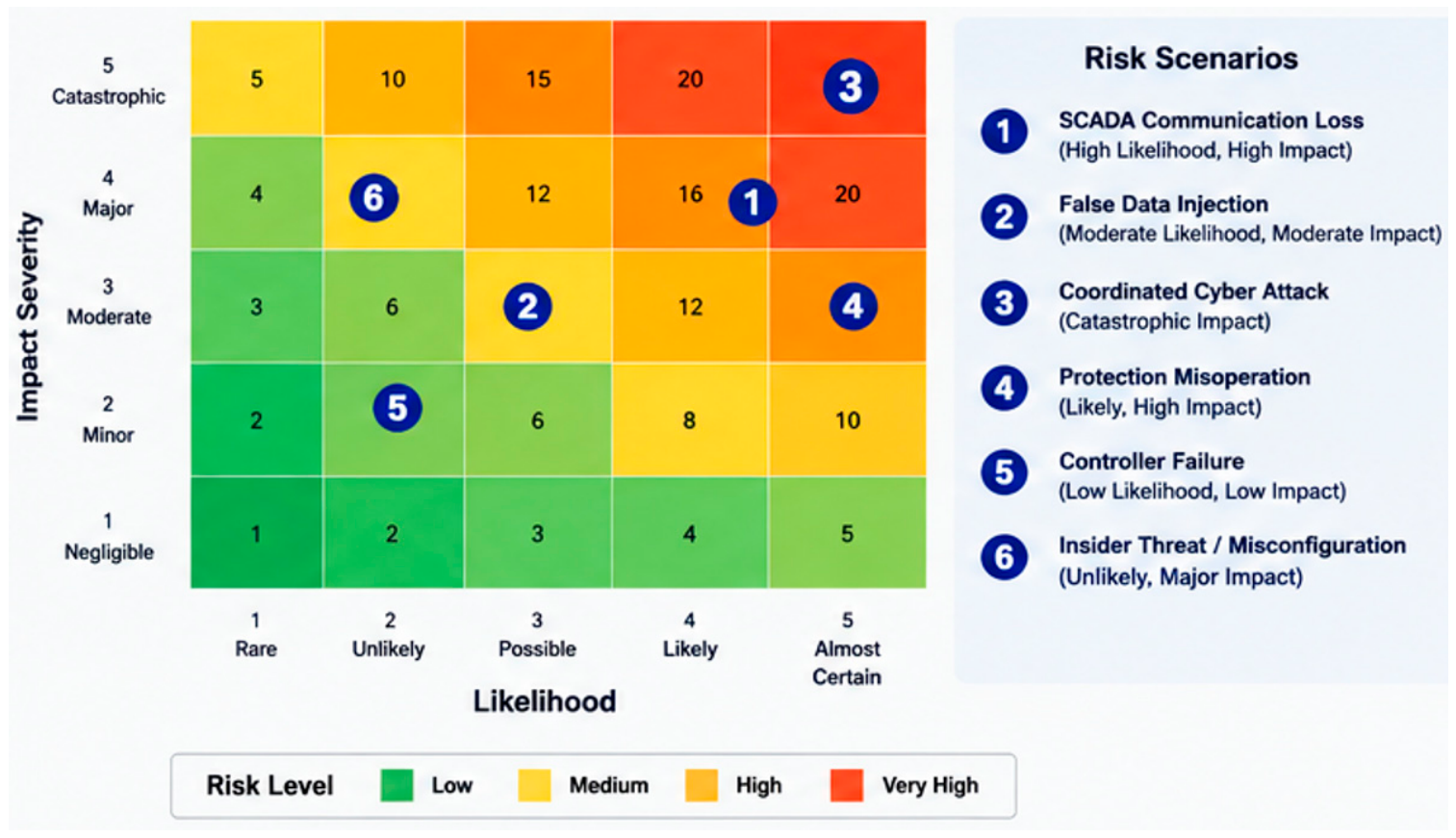
| 3. Coordinated cyberattack | False data injection, SCADA outage, inverter-control manipulation | Test cyber–physical risk management | Communication delay, compromised sensors, control fallback | Frequency/voltage violations, detection time, critical-load loss |
| 4. Fuel supply disruption | Diesel/gas delivery unavailable for 3–10 days | Assess dependence on fossil backup | Fuel stock, generator efficiency, renewable penetration | Fuel autonomy, renewable contribution, blackout probability |
| 5. Renewable intermittency + forecast error | Sudden cloud cover, wind ramp-down, forecasting error | Test operational flexibility | PV/wind forecast error ±10–40%, BESS size, reserve margin | Reliability, curtailment, reserve shortfall |
| 6. Peak-load national emergency | Heatwave or cold wave increases demand by 20–50% | Study stress during national-level demand surge | HVAC load, EV charging, demand response participation | Peak shaving, critical service continuity, cost of load shedding |
| 7. Cascading distribution failure | Upstream feeder trip plus local line overloads | Examine microgrid’s role in preventing cascading outages | Protection settings, islanding time, relay coordination | Successful islanding rate, voltage stability, recovery time |
| 8. Military or government facility resilience | Attack or emergency isolates a defense/administrative base | Link microgrids to national resilience | Mission-critical load, secure communications, RMF-compliant control | Mission-load survivability, cyber compliance, autonomy |
| 9. Hospital/community shelter operation | Regional outage during disaster; hospital and shelters must operate | Test public-safety resilience | Medical load, refrigeration, water pumps, communications | Life-safety load served, outage duration avoided |
| 10. Networked microgrids after disaster | Several microgrids share energy while main grid is unavailable | Compare isolated vs. networked resilience | Tie-line capacity, energy-sharing rules, local surplus | Total unserved energy, equity of supply, system-wide resilience |
| 11. Island/remote community cable failure | Mainland cable or overhead connection is lost | Model national resilience for isolated regions | Local DER capacity, BESS, demand flexibility | Days of autonomy, import dependence reduction |
| 12. Compound event | Cyberattack occurs during storm-related outage | Most realistic high-impact stress case | Weather damage + communication failure + DER uncertainty | Worst-case resilience, risk score, recovery cost |
- Baseline normal operation;
- Long-duration blackout with islanding;
- Extreme weather + renewable uncertainty;
- Compound cyber–physical disaster scenario.
- Energy security: critical load served, autonomy duration, fuel dependence, renewable utilization;
- Resilience: outage survival time, recovery time, resilience triangle area, unserved energy;
- Risk: probability of failure, expected energy not served, cyber-risk score, asset vulnerability;
- Economic: operating cost, value of lost load, cost of resilience investment;
- National resilience: continuity of hospitals, communications, water pumping, defense, emergency shelters.
4.9. Comparison with Recent Resilience Assessment and Microgrid Risk Management Studies
| Study | Main focus | Key limitation | Advantage of the proposed method |
| Mishra et al. | Holistic microgrid resilience framework based on threats, vulnerabilities, and mitigation strategies | Mainly conceptual and design-oriented | Adds scenario-based quantitative risk scoring and post-treatment recalculation |
| Ahmadisourenabadi et al. | Bayesian-network-based microgrid resilience considering EVs | Focused on optimization under selected risk assumptions | Covers multiple security threats: technical incidents, natural disasters, terrorism, and sabotage |
| Yuan et al. | Sensor-network-based resilience enhancement under natural disasters | Focuses mainly on information uncertainty and disaster response | Integrates probability, severity, vulnerability, impact, and treatment measures |
| Sapkota et al. | Monte Carlo-based multiphase resilience assessment with DERs | Strong simulation focus, less emphasis on national security risks | Links microgrid resilience to national power-system security |
| Tuan et al. | Review of grid resilience metrics and real-time control strategies | Provides review-level guidance rather than an applied case framework | Provides an operational assessment method applied to Romania’s Power System |
5. Energy Security Strategy for Enhancing the Resilience of the Romanian Power System
- High dependence on hydro generation variability (hydrological risk exposure);
- Aging thermal capacity still partially relied upon for balancing;
- Increasing penetration of intermittent renewables;
- Strategic importance of cross-border electricity trade within the EU internal energy market.
5.1. Technical Solutions (Grid Modernization & Operational Resilience)
- A.
- Smart Grid and Digitalization:
- Deployment of advanced SCADA/EMS systems for real-time monitoring and control;
- Expansion of digital substations
- Integration of AI based predictive maintenance for transformers, lines, and switchgear;
- Implementation of wide-area monitoring systems (WAMS) using PMUs (phasor measurement units);
- B.
- Grid Flexibility and Stability Enhancement:
- Large-scale deployment of battery energy storage systems (BESS) for frequency regulation and peak shaving;
- Expansion of pumped hydro storage (critical for Romania’s hydro-dominant system);
- Use of grid-forming inverters for renewable plants to provide synthetic inertia;
- Deployment of FACTS devices (STATCOM, SVC, HVDC links) for voltage stability and congestion management.
- C.
- Transmission and Distribution Reinforcement:
- Upgrade of 400 kV backbone transmission network;
- Strengthening cross-border interconnections (Hungary, Bulgaria, Serbia, Moldova, Ukraine);
- Modernization of aging distribution networks (reducing technical losses and outages);
- Implementation of self-healing grid architectures in distribution systems Romania already benefits from ENSTO-E integration, which is critical for regional balancing and resilience.
- D.
- Renewable Integration and System Balancing:
- Advanced forecasting systems for wind and solar generation;
- Dynamic curtailment systems for congestion management;
- Mandatory grid-support functions (voltage, frequency ride-through) for renewables;
- Development of regional balancing markets.
5.2. Cybersecurity Solutions (Critical Infrastructure Protection)
- A.
- Defense-in-Depth Cybersecurity Architecture:
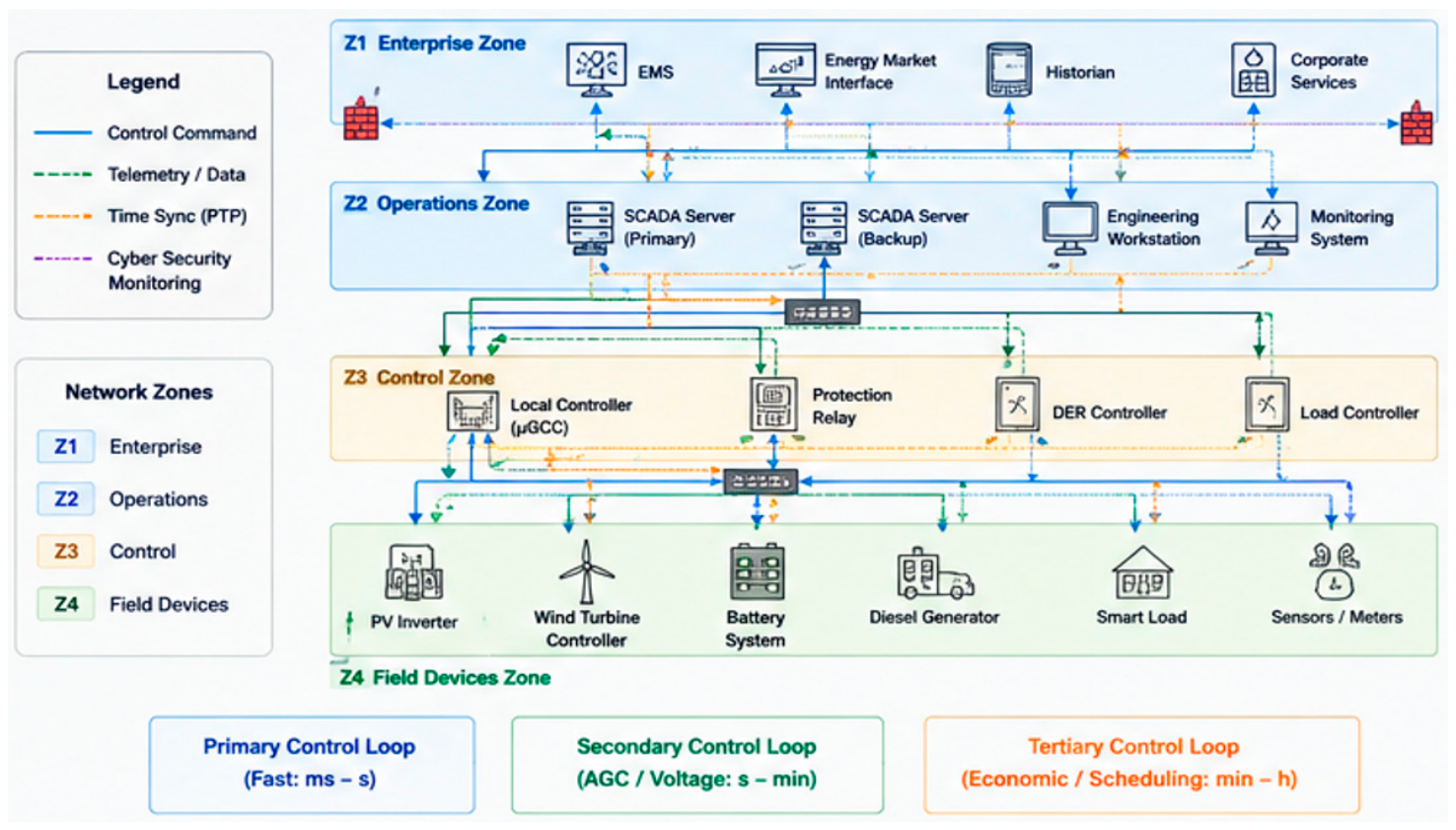
- Segmentation of IT and OT networks (strict separation of control systems);
- Multi-layer firewalls and intrusion detection systems (IDS/IPS);
- Continuous vulnerability scanning for SCADA and substation systems;
- Cyberattacks on power systems are a recognized systemic risk requiring layered defenses.
- B.
- OT/SCADA Security Hardening:
- Secure-by-design architecture for all grid digital systems;
- Encryption of all SCADA communications (TLS, VPN tunneling);
- Strict authentication (multi-factor + hardware tokens);
- Whitelisting of authorized commands in control systems.
- C.
- Smart Grid and DER Cyber Protection:
- Mandatory cybersecurity certification for distributed energy resources (DERs);
- DNSC-defined standards for PV and small generators;
- Secure firmware update mechanisms for inverter-based resources: Romania is already moving toward stricter cybersecurity rules for PV and cogeneration systems.
- D.
- National Energy Cyber Coordination:
- Real-time threat intelligence sharing between: transmission operators (TSO), distribution operators (DSO), National Cyber Security Directorate (DNSC);
- National Energy Cybersecurity SOC (Security Operations Center);
- EU-level coordination via ENTSO-E cyber frameworks.
5.3. Physical Security and Critical Infrastructure Protection
- A.
- Protection of Critical Assets:
- Physical hardening of: nuclear facilities (e.g., Cernavodă), major substations, gas-electric coupling infrastructure;
- Anti-intrusion systems (perimeter detection, drones, thermal imaging).
- B.
- Resilience Against Extreme Events:
- Flood protection systems for substations and hydro plants;
- Wildfire-resistant grid corridors;
- Storm-hardened transmission towers;
- Underground cabling in high-risk urban areas;
- Climate-driven extreme weather is a major resilience threat for European grids.
- C.
- Emergency Restoration Capability:
- Mobile substations and black-start units;
- Rapid deployment repair teams;
- Strategic spare equipment reserves (transformers, breakers).
5.4. System Operation and Control Resilience
- A.
- Advanced Grid Operation Tools:
- Real-time dynamic security assessment (DSA) tools;
- AI based contingency analysis (N-1, N-2 security);
- Adaptive protection schemes that adjust to grid conditions.
- B.
- Blackout Prevention and Recovery:
- Automated load shedding schemes (UFLS/UVLS);
- Fast frequency response (FFR) from batteries and renewables;
- Black-start coordination between hydro and gas plants;
- Regional restoration protocols with ENTSO-E neighbors.
5.5. Market and Structural Resilience Solutions
- A.
- Energy Market Integration:
- Strengthening coupling with EU electricity markets (OPCOM integration);
- Cross-border balancing mechanisms;
- Real-time pricing signals for demand response.
- B.
- Demand-Side Flexibility:
- Industrial demand response programs;
- Smart metering rollout (AMI systems);
- Dynamic tariffs to reduce peak stress.
- C.
- Diversification of Energy Sources:
- Expansion of nuclear capacity (Cernavodă Units 3 & 4);
- Gas diversification (domestic + LNG imports);
- Accelerated renewables deployment (wind, solar, biomass) Romania’s strategy emphasizes diversification and interconnection as core security pillars.
5.6. Regional and EU Integration Solutions
- A.
- Cross-Border Interconnections:
- New 400 kV interconnectors (Romania–Moldova, Romania–Serbia upgrades);
- Increased import/export capacity for balancing emergencies;
- Synchronization reinforcement within ENTSO-E Continental Europe grid.
- B.
- Regional Crisis Coordination:
- Joint emergency response protocols with neighboring TSOs;
- Shared reserve capacity agreements;
- Regional adequacy assessments (capacity planning cooperation).
5.7. Governance, Policy, and Institutional Solutions
- A.
- Regulatory Strengthening:
- Mandatory resilience standards for grid operators;
- Cybersecurity compliance audits (EU NIS2 directive alignment);
- Risk-based asset classification for critical infrastructure.
- B.
- National Energy Resilience Framework:
- Centralized Energy Security Coordination Unit;
- Regular stress-testing of grid scenarios (blackouts, cyberattacks, fuel shortages);
- Annual resilience reporting aligned with EU requirements.
5.8. Modeling and Analysis of Cyber–Physical Coupling Mechanisms in Microgrids
5.8.1. Problem Context
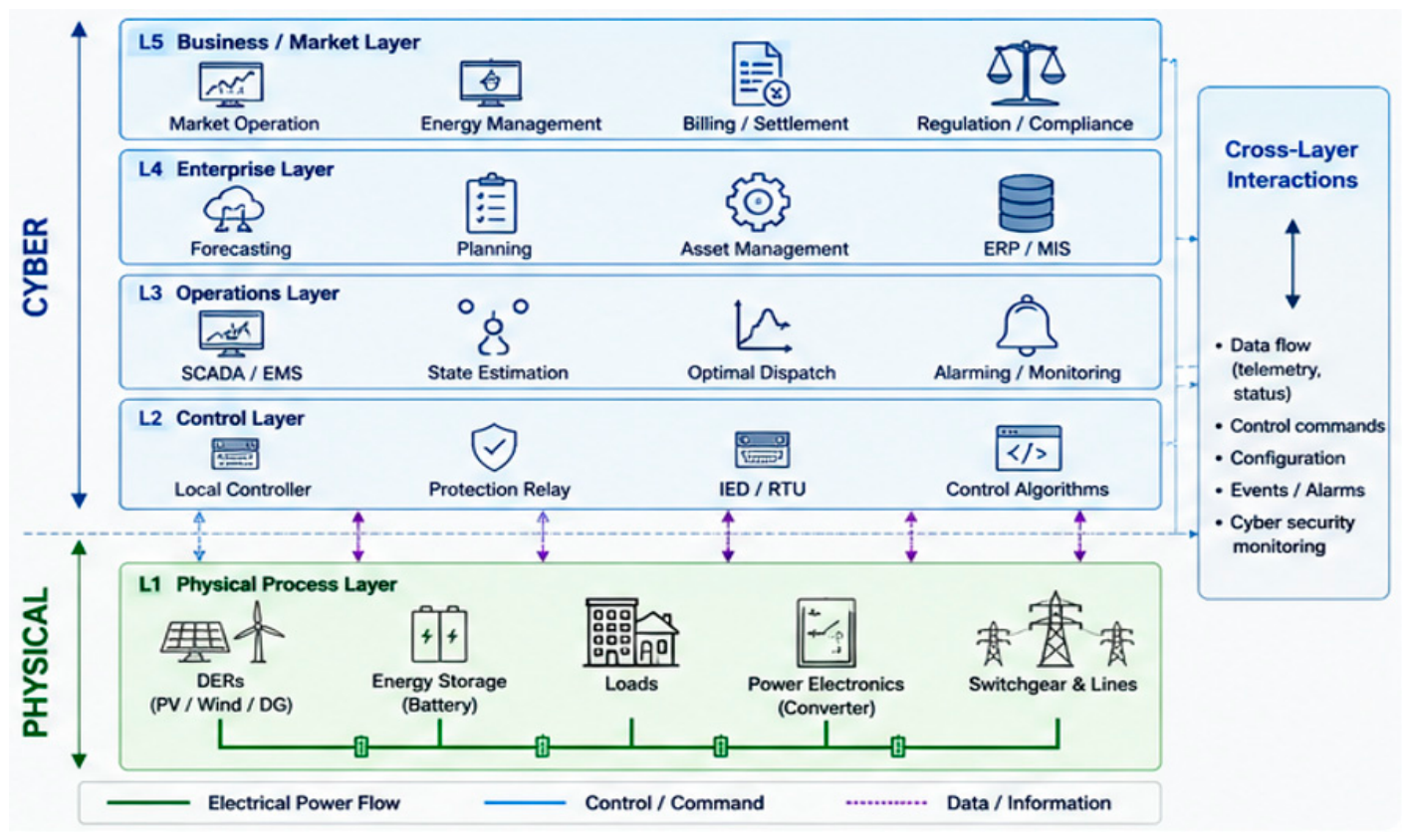
- the physical layer contains DERs, batteries, converters, loads, transformers, and protection devices;
- the cyber layer contains EMS, SCADA, sensors, PMUs, controllers, communication links, IoT gateways, and cloud services;
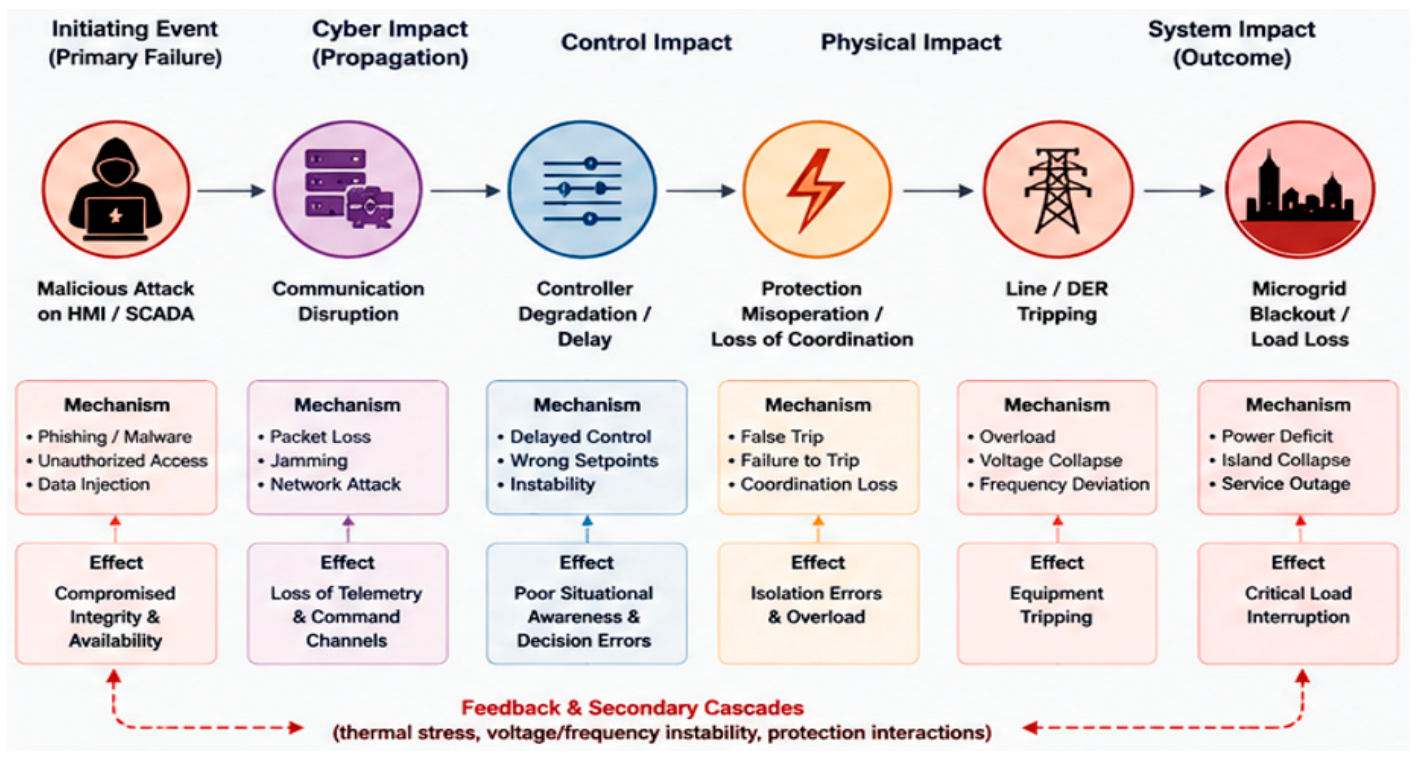
- Because both layers are interdependent, disturbances propagate bidirectionally:
- cyber failures affect voltage/frequency stability;
- physical disturbances overload communication/control systems.
5.8.2. Proposed Realistic Microgrid Architecture
- 500 kW photovoltaic farm;
- 250 kW wind turbine;
- 1 MWh battery energy storage system (BESS);
- diesel backup generator;
- critical hospital loads;
- EV charging station;
- PCC connection to utility grid.
- SCADA server;
- Energy Management System (EMS);
- PMUs and smart meters;
- IEC 61850 communication network;
- wireless controller links;
- distributed secondary frequency controllers.
5.8.3. Cyber–Physical Coupling Model
- Vp—buses, DERs, loads;
- Ep—transmission/distribution lines.
- VC—controllers, RTUs, PMUs, EMS nodes;
- EC—communication channels.
- controllers depend on electrical power,
- physical devices depend on communication/control signals.
5.8.4. Dynamic State-Space Model
| Variable | Meaning |
| xp | Physical states (voltage, frequency, SOC) |
| xc | Cyber states (latency, packet loss, controller states) |
| Fcp | Cyber influence on physical system |
| Fpc | Physical influence on cyber system |
5.8.5. Real Coupling Mechanisms
- A.
- Frequency Control Coupling
- oscillations,
- synchronization loss,
- unstable islanded operation.
- B.
- False Data Injection (FDI)
- incorrect EMS optimization;
- overcharging BESS;
- load shedding errors;
- frequency instability.
- C.
- Denial-of-Service (DoS)
- controller isolation,
- delayed dispatch,
- DER desynchronization.
5.8.6. Cascading Failure Analysis
- cyberattack disables EMS node,
- inverter dispatch becomes incorrect,
- line overload occurs,
- protection relay trips feeder,
- hospital load enters emergency mode.
5.8.7. Quantitative Risk Assessment
| Parameter | Meaning |
| Pf | Failure probability |
| If | Operational impact |
| Cd | Cyber dependency factor |
- Example Table below
| Threat | Physical Impact | Cyber Dependency |
| FDI attack | Voltage instability | High |
| DoS attack | Loss of EMS control | Medium |
| PMU spoofing | Incorrect state estimation | High |
| Line outage | Islanding transition | Low |
- normal grid-connected mode;
- cyberattack on EMS at t = 5 s;
- packet delay rises to 400 ms;
- frequency deviation exceeds 0.7 Hz;
- microgrid islands;
- distributed controller restores stability.
| Metric | Description |
| Frequency deviation | Dynamic resilience |
| Voltage recovery time | Restoration capability |
| Packet loss | Cuber degradation |
| ENS | Energy Not Supplied |
| SAIDI/SAIFI | Reliability |
| Cyber Risk Index | Security exposure |
5.8.8. National Resilience Perspective
- hospitals,
- military bases,
- telecom infrastructure,
- water treatment plants,
- emergency shelters.
- maintain critical loads during grid collapse,
- isolate from cascading blackouts,
- provide autonomous restoration capability.
5.9. Conclusion
6. Conclusions
Author Contributions
Funding
Data Availability Statement
Conflicts of Interest
References
- Petrilean, D.C.; Fîță, N.D.; Vasilescu, G.D.; Ilieva-Obretenova, M.; Tataru, D.; Cruceru, E.A.; Mateiu, C.I.; Nicola, A.; Darabont, D.-C.; Cazac, A.-M.; et al. Sustainability Management Through the Assessment of Instability and Insecurity Risk Scenarios in Romania’s Energy Critical Infrastructures. Sustainability 2025, 17, 2932. [Google Scholar] [CrossRef]
- Muresan-Grecu, F.; Fita, N.D.; Babut, G.B.; Obretenova, M.I.; Pasculescu, D.; Lazar, T.; Uțu, I.; Rada, C.; Schiopu, A.M.; Nicola, A.; et al. Analysis and Assessment of Energy Security in the Context of Ensuring Economic Sustainability and Crisis Prevention. Sustainability 2026, 18, 3183. [Google Scholar] [CrossRef]
- National Power Grid Transelectrica—Romania. Available online: www.transelectrica.ro (accessed on 19 May 2026).
- ENTSO-E (European Network of Transmission System Operators for Electricity)—European Union. Available online: www.entsoe.eu (accessed on 19 May 2026).
- Kundur, P. Power System Stability and Control; McGraw-Hill: New York, NY, USA, 1994. [Google Scholar]
- Wood, A.J.; Wollenberg, B.F.; Sheblé, G.C. Power Generation, Operation, and Control, 2nd ed.; Wiley-Interscience: New York, NY, USA, 1996. [Google Scholar]
- Esparza, A.; Blondin, M.; Trovão, J.P.F. A Review of Optimization Strategies for Energy Management in Microgrids. Energies 2025, 18, 3245. [Google Scholar] [CrossRef]
- Aslam, M.U.; Miah, M.S.; Amin, B.M.R.; Shah, R.; Amjady, N. Application of Energy Storage Systems to Enhance Power System Resilience: A Critical Review. Energies 2025, 18, 3883. [Google Scholar] [CrossRef]
- Bevrani, H. Robust Power System Frequency Control; Springer: New York, NY, USA, 2009. [Google Scholar] [CrossRef]
- Machowski, J.; Bialek, J.W.; Bumby, J.R. Power System Dynamics: Stability and Control, 3rd ed.; Wiley: West Sussex, UK, 2020; Available online: https://www.wiley.com/en-gb/shop/general-introductory-electrical-electronics-engineering/power-system-dynamics-stability-and-control-3rd-edition-p-9781119526360 (accessed on 19 May 2026).
- Awerbuch, S.; Berger, M. Applying Portfolio Theory to EU Electricity Planning and Policy-Making; IEA Report No. EET/2003/03; International Energy Agency: Paris, France, 2003. [Google Scholar]
- Andersson, G.; Donalek, P.; Farmer, R.; Hatziargyriou, N.; Kamwa, I.; Kundur, P.; Martins, N.; Paserba, J.; Pourbeik, P.; Sanchez-Gasca, J.; et al. Causes of the 2003 Major Grid Blackouts in North America and Europe, and Recommended Means to Improve System Dynamic Performance. IEEE Trans. Power Syst. 2005, 20, 1922–1928. [Google Scholar] [CrossRef]
- Final Report. System Disturbance on 4 November 2006. Available online: https://eepublicdownloads.entsoe.eu/clean-documents/pre2015/publications/ce/otherreports/Final-Report-20070130.pdf (accessed on 19 February 2023).
- Lin, W.; Tang, Y.; Sun, H.; Guo, Q.; Zhao, H.; Zeng, B. Blackout in Brazil Power Grid on February 4, 2011 and Inspirations for Stable Operation of Power Grid. Autom. Electr. Power Syst. 2011, 35, 1–5. [Google Scholar]
- Velay, M.; Vinyals, M.; Besanger, Y.; Retière, N. An Analysis of Large-Scale Transmission Power Blackouts from 2005 to 2016. Available online: https://hal.science/hal-02330748v1/document (accessed on 19 February 2023).
- Raza, M.A.; Khatri, K.L.; Hussain, A.; Khan, M.H.A.; Shah, A.; Taj, H. Analysis and Proposed Remedies for Power System Blackouts around the Globe. Eng. Proc. 2022, 20, 5. [Google Scholar]
- Haes Alhelou, H.; Hamedani-Golshan, M.E.; Njenda, T.C.; Siano, P. A Survey on Power System Blackout and Cascading Events: Research Motivations and Challenges. Energies 2019, 12, 682. [Google Scholar] [CrossRef]
- Overland, I.; Juraev, J.; Vakulchuk, R. Are renewable energy sources more evenly distributed than fossil fuels? Renew. Energy 2022, 200, 379–386. [Google Scholar]
- Bahgat, G. Europe’s Energy Security: Challenges and Opportunities. Int. Aff. 2006, 82, 961–975. [Google Scholar] [CrossRef]
- Zakeri, B.; Paulavets, K.; Barreto-Gomez, L.; Echeverri, L.G.; Pachauri, S.; Boza-Kiss, B.; Zimm, C.; Rogelj, J.; Creutzig, F.; Ürge-Vorsatz, D.; et al. Pandemic, War, and Global Energy Transitions. Energies 2022, 15, 6114. [Google Scholar] [CrossRef]
- Hu, G.; Yang, J.; Li, J. The Dynamic Evolution of Global Energy Security and Geopolitical Games: 1995~2019. Int. J. Environ. Res. Public Health 2022, 19, 14584. [Google Scholar] [CrossRef] [PubMed]
- Gitelman, L.; Magaril, E.; Kozhevnikov, M. Energy Security: New Threats and Solutions. Energies 2023, 16, 2869. [Google Scholar] [CrossRef]
- Toke, D.; Vezirgiannidou, S.-E. The relationship between climate change and energy security: Key issues and conclusions. Environ. Politics 2013, 22, 537–552. [Google Scholar] [CrossRef]
- Cherp, A.; Jewell, J. The three perspectives on energy security: Intellectual history, disciplinary roots and the potential for integration. Curr. Opin. Environ. Sustain. 2011, 3, 202–212. [Google Scholar] [CrossRef]
- Winzer, C. Conceptualizing Energy Security. Energy Policy 2012, 46, 36–48. [Google Scholar] [CrossRef]
- Månsson, A.; Johansson, B.; Nilsson, L.J. Assessing energy security: An overview of commonly used methodologies. Energy 2014, 73, 1–14. [Google Scholar] [CrossRef]
- Climate Risk and Adaptation in the Electric Power Sector. Asian Development Bank. 2012. Available online: https://www.adb.org/sites/default/files/publication/29889/climate-risks-adaptation-power-sector.pdf (accessed on 19 February 2023).
- Gitelman, L.D.; Dobrodey, V.V.; Kozhevnikov, M.V. Tools for Sustainable Development of Regional Energy Systems. Econ. Reg. 2020, 16, 1208–1223. [Google Scholar] [CrossRef]
- Gitelman, L.D.; Gitelman, L.M.; Kozhevnikov, M.V. Managers for sustainable electric power industry of tomorrow. Int. J. Sustain. Dev. Plan. 2018, 13, 307–315. [Google Scholar] [CrossRef]
- Gitelman, L.D. Management education for a sustainable electric power industry in the 21st century. WIT Trans. Ecol. Environ. 2014, 190, 1197–1203. [Google Scholar]
- Matsui, E.A.; Kryukova, E.V. Energy security is an important component of national security. SHS Web Conf. 2021, 110, 01049. [Google Scholar] [CrossRef]
- Ayoo, C. Towards Energy Security for the Twenty-First Century. In Energy Policy; IntechOpen: London, UK, 2020; Available online: https://www.intechopen.com/chapters/71825 (accessed on 19 February 2023).
- Podbregar, I.; Šimić, G.; Radovanović, M.; Filipović, S.; Maletič, D.; Šprajc, P. The International Energy Security Risk Index in Sustainable Energy and Economy Transition Decision Making—A Reliability Analysis. Energies 2020, 13, 3691. [Google Scholar] [CrossRef]
- Fita, N.D.; Utu, I.; Marcu, M.D.; Pasculescu, D.; Mila, I.O.; Popescu, F.G.; Lazar, T.; Schiopu, A.M.; Muresan-Grecu, F.; Cruceru, E.A. Global Energy Crisis and the Risk of Blackout: Interdisciplinary Analysis and Perspectives on Energy Infrastructure and Security. Energies 2025, 18, 4244. [Google Scholar] [CrossRef]
- Billanes, J.D.; Jørgensen, B.N.; Ma, Z. A Framework for Resilient Community Microgrids: Review and Future Directions. Energies 2025, 18, 405. [Google Scholar] [CrossRef]
- He, J.-H.; Lin, J.-H. Review of Microgrids to Enhance Power System Resilience. Eng. Proc. 2025, 92, 82. [Google Scholar]
- Tuan, L.A.; Bouloumpasis, I.; Steen, D. Resilience-Driven Planning and Real-Time Control Strategies. Curr. Sustain. Energy Rep. 2025, 12, 1–10. [Google Scholar]
- Sapkota, A.; Karki, R. Multi-phase microgrid resiliency assessment framework against extreme weather events. Energy Convers. Econ. 2025, 6, 111–125. [Google Scholar] [CrossRef]
- Nazari, M.H.; Varmazyari, H.; Biswas, A.K.; Cali, Ü.; Belnap, H.; Parvania, M. A review of community-centric power system resilience: Strategies, data-driven methods, and techno-legal perspectives. Electr. Power Syst. Res. 2025, 260, 113285. [Google Scholar] [CrossRef]
- Huang, Y.; Rong, X.; Bie, Z.; Li, J.; Huang, B.; Zhao, T.; Li, G. Artificial Intelligence for Resilient Power System: Motivations, Challenges, and Opportunities. Smart Power Energy Secur. 2025, 1, 65–75. [Google Scholar] [CrossRef]
- Hadi, M.; Elbouchikhi, E.; Zhou, Z.; Saim, A.; Shafie-Khah, M.; Siano, P.; Rahbarimagham, H.; Colom, P.M. Artificial Intelligence for Microgrids Design, Control, and Maintenance. Energy Convers. Manag. X 2025, 27, 101056. [Google Scholar] [CrossRef]
- Razmi, D.; Razmi, P.; Babayomi, O.; Zhang, Z. Toward Intelligent and Resilient Microgrids: A Survey of Machine Learning Approaches. Appl. Energy 2026, 415, 127929. [Google Scholar] [CrossRef]
- Li, Y.; Zhang, S.; Li, Y. AI-Enhanced Resilience in Power Systems: Adversarial Deep Learning for Robust Short-Term Voltage Stability Assessment under Cyber-Attacks. arXiv 2025, arXiv:2504.02859. [Google Scholar] [CrossRef]
- Pasculescu, D.; Riurean, S.; Ilieva-Obretenova, M.; Lazar, T.; Tatar, A.M.; Fita, N.D. Intelligent Modeling of PV–BESS Microgrids for Enhanced Resilience. Energies 2025, 19, 148. [Google Scholar] [CrossRef]
- Hristov, E.; Nakov, P. Metrics-Driven Cyber-Resilience Evaluation for Renewable Energy Infrastructures. Available online: https://unitech-selectedpapers.tugab.bg/archive/unitech-2025/thematic-sessions/electrical-engineering?view=article&id=263:metrics-driven-cyber-resilience-evaluation-for-renewable-energy-infrastructures&catid=29:papers-2025 (accessed on 19 May 2026).
- Rouhani, S.H.; Su, C.-L.; Mobayen, S.; Razmjooy, N.; Elsisi, M. Cyber Resilience in Renewable Microgrids: A Review of Standards, Challenges, and Solutions. Energy 2024, 309, 133081. [Google Scholar] [CrossRef]
- Afrin, S.; Al Muttaki, R.; Anil, A.I.A.; Hasan, S. AI-Powered Cybersecurity for Smart Grid Communication. Energy Convers. Manag. X 2025, 29, 101416. [Google Scholar] [CrossRef]
- Zhao, T.; Tu, H.; Jin, R.; Xia, Y.; Wang, F. Improving resilience of cyber–physical power systems against cyber attacks through strategic energy storage deployment. Reliab. Eng. Syst. Saf. 2024, 252, 110438. [Google Scholar] [CrossRef]
- World Bank. Resilience Metrics and Standards for Transmission Systems; World Bank: Washington, DC, USA, 2025. [Google Scholar]
- Saleheen, M.Z.; Wagner, M.; Razzaghi, R.; Wang, H. Reliability as a Design Principle: A Systematic Review and Integrated Framework for Renewable-Based Microgrids. Energy Convers. Manag. X 2026, 30, 101878. [Google Scholar] [CrossRef]
- Castañeda-Arias, N.; Díaz-Aldana, N.L.; Hernandez, A.L.; Jutinico, A.L. Energy Management in Microgrid Systems. Electricity 2025, 6, 73. [Google Scholar] [CrossRef]
- Mishra, S.; Anderson, K.; Miller, B.; Boyer, K.; Warren, A. Microgrid Resilience: A Holistic Approach for Assessing Threats, Identifying Vulnerabilities, and Designing Corresponding Mitigation Strategies. Appl. Energy 2020, 264, 114726. [Google Scholar] [CrossRef]
- Lasseter, R.H. Microgrids. In IEEE PES Winter Meeting. Foundational Work Introducing the Modern Microgrid Concept; IEEE: Washington, DC, USA, 2002. [Google Scholar]



| Vulnerability and Capability | LEVEL |
|---|---|
| 1. Failure to complete the 400 kV transmission ring in Romania. | Very low |
| Low | |
| Average | |
| High | |
| Very high | |
| 2. Level of staff specialization and the regularity of training provided to personnel responsible for power supply restoration tasks. | Very low |
| Low | |
| Average | |
| High | |
| Very high |
| Vulnerability and/or Capability | Proposed Measures |
|---|---|
| 1. Failure to complete the 400 kV transmission ring in Romania. |
|
| 2. Level of staff specialization and the regularity of training provided to personnel responsible for power supply restoration tasks. |
|
| Vulnerability | Identified | After Applying the Measures |
|---|---|---|
| 1. Failure to complete the 400 kV transmission ring in Romania. 2. Level of staff specialization and the regularity of training provided to personnel responsible for power supply restoration tasks. | 1. Very low | 1. Very low |
| 2. Low | 2. Low | |
| 3. Average | 3. Average | |
| 4. High | 4. High | |
| 5. Very high | 5. Very high |
| Vulnerability and Capability | LEVEL |
|---|---|
| 1. Inadequate or improperly designed power substations and overhead transmission lines from a seismic resilience perspective; 2. The potential occurrence of a tsunami triggered by seismic events; 3. Insufficient staffing levels or inadequately trained personnel for crisis response, natural disaster management, and risk mitigation activities. | Very low |
| Low | |
| Average | |
| High | |
| Very high |
| Vulnerability and/or Capability | Proposed Measures |
|---|---|
| 1. Inadequate or improperly designed power substations and overhead transmission lines from a seismic resilience perspective; 2. The potential occurrence of a tsunami triggered by seismic events; 3. Insufficient staffing levels or inadequately trained personnel for crisis response, natural disaster management, and risk mitigation activities. |
|
| Vulnerability | Identificated | After Applying the Measures |
|---|---|---|
| 1. Inadequate or improperly designed power substations and overhead transmission lines from a seismic resilience perspective; 2. The potential occurrence of a tsunami triggered by seismic events; 3. Insufficient staffing levels or inadequately trained personnel for crisis response, natural disaster management, and risk mitigation activities. | 1. Very low | 1. Very low |
| 2. Low | 2. Low | |
| 3. Average | 3. Average | |
| 4. High | 4. High | |
| 5. Very high | 5. Very high |
| Vulnerability and Capability | LEVEL |
|---|---|
| 1. Non-compliance with fire safety regulations and physical security standards; 2. Insufficient training of personnel responsible for critical infrastructure protection management; 3. Inadequate staffing and/or insufficiently trained cybersecurity personnel, coupled with vulnerabilities in hardware and software systems, insecure communication channels, and underinvestment in cybersecurity measures. | Very low |
| Low | |
| Average | |
| High | |
| Very high |
| Vulnerability and/or Capability | Proposed Measures |
|---|---|
| 1. Non-compliance with fire safety regulations and physical security standards; 2. Insufficient training of personnel responsible for critical infrastructure protection management; 3. Inadequate staffing and/or insufficiently trained cybersecurity personnel, coupled with vulnerabilities in hardware and software systems, insecure communication channels, and underinvestment in cybersecurity measures. |
|
| Vulnerability | Identified | After Applying the Measures |
|---|---|---|
| 1. Non-compliance with fire safety regulations and physical security standards; 2. Insufficient training of personnel responsible for critical infrastructure protection management; 3. Inadequate staffing and/or insufficiently trained cybersecurity personnel, coupled with vulnerabilities in hardware and software systems, insecure communication channels, and underinvestment in cybersecurity measures. | 1. Very low | 1. Very low |
| 2. Low | 2. Low | |
| 3. Average | 3. Average | |
| 4. High | 4. High | |
| 5. Very high | 5. Very high |
| Vulnerability and Capability | LEVEL |
|---|---|
Human risk factors:
| Very low |
| Low | |
| Average | |
| High | |
| Very high |
| Vulnerability and/or Capability | Proposed Measures |
|---|---|
Human risk factors:
|
|
| Vulnerability | Identificated | After Applying the Measures |
|---|---|---|
Human risk factors:
| 1. Very low | 1. Very low |
| 2. Low | 2. Low | |
| 3. Average | 3. Average | |
| 4. High | 4. High | |
| 5. Very high | 5. Very high |
| Step | Event | Probability |
|---|---|---|
| A | Severe winter peak stress occurs | 0.08/year |
| B | Major 400 kV line or substation outage during stress | 0.12 |
| C | N-1 criterion not maintained after outage | 0.25 |
| D | Protection/cascading trips propagate | 0.15 |
| E | Under-frequency load shedding fails or is insufficient | 0.20 |
| Event | Before | After |
|---|---|---|
| Cascading propagation | 0.15 | 0.07 |
| Load shedding failure | 0.20 | 0.10 |
| Bus | Component | P [MW] | Q [MVar] |
|---|---|---|---|
| 1 | Grid/slack | Balance | Balance |
| 2 | Commercial load | 1.00 | 0.35 |
| 3 | Residential load + PV | 0.15 net | 0.25 |
| 4 | Industrial load + diesel | 0.30 net | 0.40 |
| 5 | EV load + battery | 0.20 net | 0.15 |
| Line | R [Ω] | X [Ω] |
|---|---|---|
| 1–2 | 0.30 | 0.40 |
| 2–3 | 0.20 | 0.30 |
| 2–4 | 0.25 | 0.35 |
| 4–5 | 0.15 | 0.25 |
| Source | Rating | Operating Point |
|---|---|---|
| PV | 0.60 MW | unity PF |
| Diesel generator | 0.90 MW | voltage/frequency support |
| Battery | 0.50 MW/1 MWh | 0.40 MW discharge |
| Bus | Voltage | Angle Deg |
|---|---|---|
| 1 | 1.0000 | 0.000 |
| 2 | 0.9950 | −0.095 |
| 3 | 0.9944 | −0.094 |
| 4 | 0.9933 | −0.107 |
| 5 | 0.9929 | −0.115 |
| Bus | Voltage |
|---|---|
| 1 | 1.0000 |
| 2 | 0.9933 |
| 3 | 0.9922 |
| 4 | 0.9911 |
| 5 | 0.9905 |
| Parameter | Value |
|---|---|
| Nominal frequency | 50 Hz |
| Aggregate inertia constant | 1.5 s |
| Available islanded generation | 2.0 MW |
| Load damping | 0.8 MW/Hz |
| Droop response | 0.8 MW/Hz |
| Disturbance | sudden 0.6 MW generation loss |
Disclaimer/Publisher’s Note: The statements, opinions and data contained in all publications are solely those of the individual author(s) and contributor(s) and not of MDPI and/or the editor(s). MDPI and/or the editor(s) disclaim responsibility for any injury to people or property resulting from any ideas, methods, instructions or products referred to in the content. |
© 2026 by the authors. Licensee MDPI, Basel, Switzerland. This article is an open access article distributed under the terms and conditions of the Creative Commons Attribution (CC BY) license.
Share and Cite
Fita, N.D.; Obretenova, M.I.; Marcu, M.D.; Olteanu, C.R.; Popescu, F.G.; Manafu, M.G.; Muresan-Grecu, F.; Schiopu, A.M.; Diodiu, I.L.; Nicola, A.; et al. Risk Management of Microgrids in Power System for Enhanced Energy Security and National Resilience. Electronics 2026, 15, 2397. https://doi.org/10.3390/electronics15112397
Fita ND, Obretenova MI, Marcu MD, Olteanu CR, Popescu FG, Manafu MG, Muresan-Grecu F, Schiopu AM, Diodiu IL, Nicola A, et al. Risk Management of Microgrids in Power System for Enhanced Energy Security and National Resilience. Electronics. 2026; 15(11):2397. https://doi.org/10.3390/electronics15112397
Chicago/Turabian StyleFita, Nicolae Daniel, Mila Ilieva Obretenova, Marius Daniel Marcu, Constantin Razvan Olteanu, Florin Gabriel Popescu, Marius Gheorghe Manafu, Florin Muresan-Grecu, Adrian Mihai Schiopu, Ioan Lucian Diodiu, Aurelian Nicola, and et al. 2026. "Risk Management of Microgrids in Power System for Enhanced Energy Security and National Resilience" Electronics 15, no. 11: 2397. https://doi.org/10.3390/electronics15112397
APA StyleFita, N. D., Obretenova, M. I., Marcu, M. D., Olteanu, C. R., Popescu, F. G., Manafu, M. G., Muresan-Grecu, F., Schiopu, A. M., Diodiu, I. L., Nicola, A., Popescu, G., & Radu, A. A. (2026). Risk Management of Microgrids in Power System for Enhanced Energy Security and National Resilience. Electronics, 15(11), 2397. https://doi.org/10.3390/electronics15112397