1. Introduction
As a revolutionary innovation in fluid power transmission technology, EHA represents a high-end application of the mechatronics-hydraulics integrated architecture. Essentially, EHA is a highly integrated hydrostatic transmission system that achieves an ideal combination of electric drive and hydraulic transmission by integrating a servo motor, hydraulic pump, actuator and control unit into a compact module. This actuator not only inherits the advantages of hydraulic systems such as high power density and strong anti-interference capability, but also features precise control and high-efficiency energy conversion of electronic control systems, enabling it to gradually replace conventional hydraulic systems in high-precision control fields including aerospace and industrial automation.
The sources of torque ripple in EHA can be primarily categorized into three distinct groups: First, from the perspective of the motor itself, manufacturing imperfections—including asymmetric magnetic circuits, rotor-stator misalignment, and magnetic saturation—give rise to interactions between the permanent-magnet magnetic field and armature slots, thereby generating cogging torque ripple [
1,
2,
3,
4,
5,
6,
7]. Second, regarding current harmonics, factors such as inverter dead time and the on-state voltage drop of power switching devices introduce substantially high-order current harmonic components into the speed control loop [
8,
9,
10,
11,
12,
13,
14]. Third, in the context of measurement errors, DC offsets in current sensor readings and quadrature or bias errors in resolver measurements degrade the precision of motor current and torque computation, leading to measurement-induced torque ripple [
15,
16,
17,
18,
19,
20].
In recent years, research on torque ripple suppression by scholars worldwide has mainly focused on two directions. One is to eliminate torque ripple by improving the motor structure, and the other is to suppress torque fluctuation to a certain extent by optimizing motor control algorithms. Improving the motor structure features a long design cycle, is difficult to popularize, and incurs relatively high economic costs. In contrast, optimizing motor control algorithms offers greater advantages in practicality and operability.
For sensor detection errors, the primary strategies focus on enhancing measurement precision and compensating for measurement deviations through indirect control frameworks. Zhang C [
21] developed a feature model integrating measurement noise, grounded in feature modeling theory to address motor measurement noise. A robust tracking filtering algorithm was constructed by employing a recursive least-squares approach with a forgetting factor for feature parameter identification, alongside a golden-section control law with integration for system regulation. By tracking measurement noise, this approach resolved the slow convergence issue of characteristic parameters induced by measurement noise and effectively attenuated its impact on the system. He M [
22] investigated resolver calibration techniques and devised an angle error correction system to mitigate angle inaccuracies present in resolver output data. Cai Z [
23] put forward a piecewise integral compensation scheme for the d-axis current, where an error term is derived via integration of the d-axis current and subsequently injected into the measured current for compensation. Hwang [
24] introduced a compensation algorithm to mitigate position inaccuracies stemming from two non-ideal output signals of the resolver in a vector-controlled PMSM. This algorithm accounts for the bandwidth impact of the closed-loop current control loop and precisely estimates the error signal based on rotor speed variations, rendering it applicable to both steady-state and transient operating conditions.
For cogging torque suppression, the core strategy relies on optimizing manufacturing processes. Islam [
25] explored the variations in torque ripple and cogging torque within surface-mounted PMSMs equipped with skewed rotors, and analyzed how slot-pole configurations and magnet geometries affect the amplitude and harmonic spectrum of torque waveforms in PMSM drive systems. Qiu H [
26] employed finite element analysis to investigate the impacts of two distinct magnetic pole eccentricities on magnetic field distribution and back electromotive force (EMF), establishing quantitative correlations among pole shape, magnetic field characteristics, and back-EMF performance. Guo S [
27] delved into the mechanism of cogging torque reduction in PMSM through fractional-slot windings, elaborating on the fundamental principles for winding selection and deriving the calculation method for winding factors. The finite element method was utilized to simulate and compute the cogging torque of open-slot motors with fractional-slot windings under diverse pole-slot layouts, and the optimal configuration was determined via comparative evaluation.
For torque ripple induced by current harmonics, Li F [
28] developed an adaptive fuzzy control scheme incorporating segmented harmonic current injection. This approach partitions the conduction interval of each phase into n segments, then injects nth-order harmonic currents into the phase reference current. Leveraging torque error feedback, a fuzzy logic strategy is deployed to dynamically tune the harmonic current coefficients for each segment. This tailored current waveform generates a compensating torque component, effectively mitigating the ripple originating from square-wave reference currents. Xiao F [
29] proposed a stator current active control strategy to dampen rotational-frequency oscillations within AC drive systems. Employing the magnetomotive force and permeance method, the work examined how mechanical faults influence the stator current of PMSM and elucidated the underlying mechanism of this oscillation suppression technique. Chen Z [
30] derived an electromagnetic torque model for PMSM featuring non-sinusoidal back-EMF and current waveforms. Based on this mathematical framework, the study examined how the order, amplitude, and initial phase angle of current harmonics impact the average torque and torque ripple magnitude. Through parametric analysis, optimal harmonic settings were identified to minimize torque fluctuations to the greatest extent.
Excessive torque ripple elevates hysteresis and eddy-current losses, intensifies the electrical stress imposed on the EHA, and consequently reduces the operational lifespan of the system. Hence, the smoothness of the output torque serves as a critical metric for assessing both the dynamic and steady-state performance of the EHA. The torque ripple suppression methodologies explored in this work will effectively enhance the overall operational performance of the equipment.
Nonlinear characteristics of the inverter, including dead-time effects and device voltage drops, introduce distortions in the inverter output voltage, which in turn generate harmonic currents. This leads to elevated motor losses, amplified torque ripple, and degraded system control performance. For harmonic current mitigation, prevailing control strategies encompass multi-rotational PI control, proportional-resonant (PR) control, complex vector PI (CVPI) control, repetitive control (RC), and active disturbance rejection control (ADRC). In this work, multi-rotational PI control is selected as the harmonic current suppression scheme. This approach constructs an independent synchronous rotating coordinate system for each harmonic order, transforming the corresponding harmonic component into a DC quantity, and then utilizes a PI regulator to achieve zero steady-state error tracking and harmonic elimination. The scheme exhibits insensitivity to frequency variations and eliminates the need for resonant frequency retuning under speed fluctuations. Each harmonic component is regulated within its dedicated rotating coordinate frame, avoiding cross-coupling between the fundamental and harmonic channels. The PI parameters for each harmonic can be tuned independently, enabling straightforward debugging logic. It delivers stable suppression performance against harmonics stemming from inverter dead time, cogging effect, and back-EMF distortion, while demonstrating rapid dynamic response and high robustness. Overall, this scheme boasts simple implementation, high flexibility, and wide applicability, holding significant practical engineering value.
The remainder of this paper is structured as follows.
Section 2 outlines the fundamental operating principle of the EHA.
Section 3 delivers an in-depth examination of current harmonics within the system.
Section 4 elaborates on the proposed torque ripple suppression methodology.
Section 5 presents simulation validation and a comprehensive discussion of the suppression performance. Finally,
Section 6 concludes the work with a concise summary of key findings.
2. Basic Principle of EHA
The EHA regulates the position and pressure of the hydraulic cylinder by modulating the output flow rate of the hydraulic pump. The flow relationship is expressed as follows:
where
qL denotes the volumetric flow rate of the fixed-displacement pump (m
3/s);
qp represents the volumetric displacement of the pump (m
3/rad); and
np signifies the angular rotational speed of the fixed-displacement pump (rad/s).
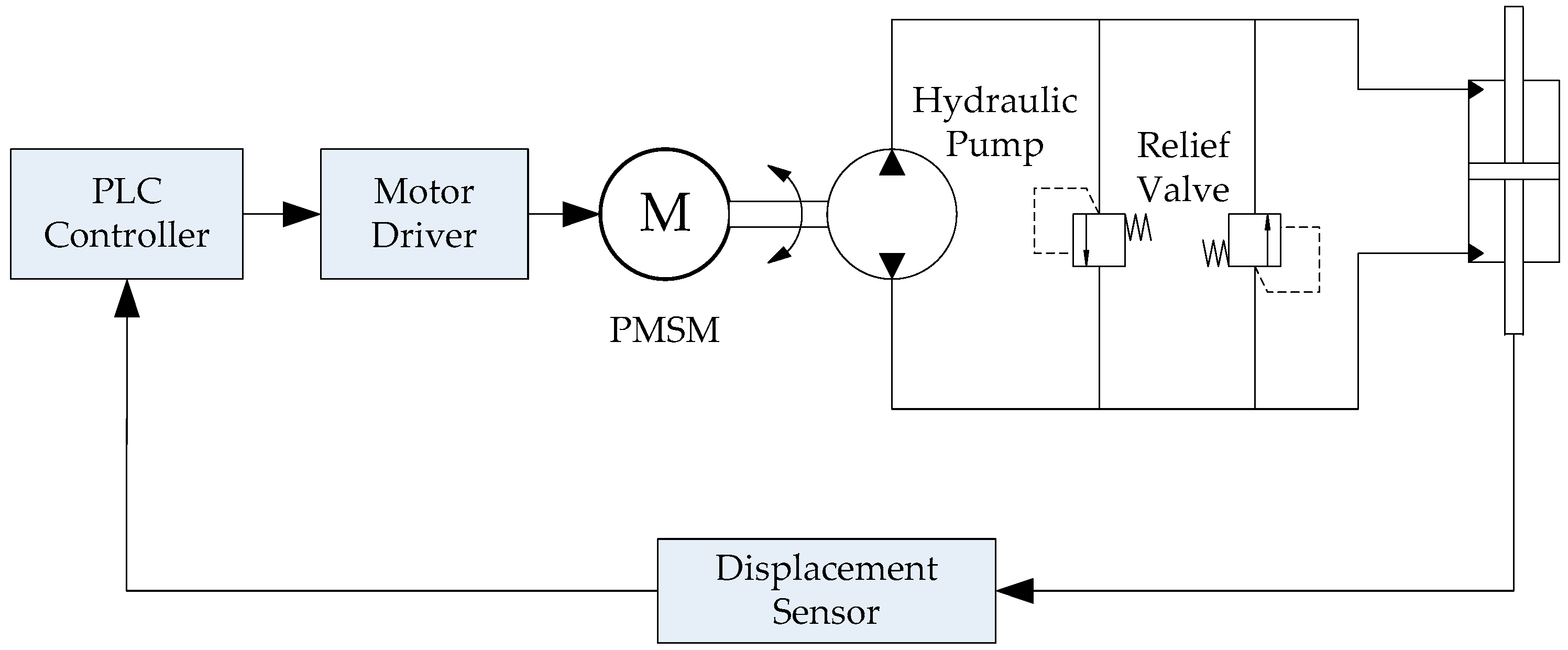
EHA represents a representative closed-loop actuation system. It primarily comprises an AC PMSM, a bidirectional fixed-displacement pump, a pilot-operated check valve, a hydraulic cylinder, and auxiliary components. Its operating principle is that the servo motor actuates the fixed-displacement pump, which delivers pressurized oil at a constant flow rate to drive the hydraulic cylinder. The system’s flow rate can be regulated by adjusting the motor speed; its load-bearing capacity can be governed by modulating the motor torque; and its motion direction can be controlled by altering the motor’s rotational direction [
31]. The fundamental operating principle of the EHA is illustrated in
Figure 1.
EHA represents a representative servo actuation system, which typically employs a PMSM as its prime mover. Consequently, modeling and analyzing the PMSM is of paramount significance. Without compromising the core functionalities of the motor, complex nonlinear factors within the motor that exert negligible influence on the system are neglected. The detailed procedure for deriving the motor’s mathematical model is presented below.
Stator flux linkage equations:
Stator voltage equations:
Electromagnetic torque equation:
Motion equation:
where
ψd,
ψq denote the
d-
q axis stator flux linkage components (Wb);
Ld,
Lq represent the equivalent
d-
q axis stator inductances (H);
id,
iq signify the
d-
q axis stator current components (A);
ψf is the permanent magnet flux linkage (Wb);
Ud,
Uq stand for the
d-
q axis stator voltage components (V);
Rs is the stator resistance (Ω);
ωe is the rotor electrical angular velocity (rad/s);
Te is the internal electromagnetic torque (N·m);
pn is the number of pole pairs;
TL is the load torque (N·m);
JL is the total moment of inertia referred to the motor shaft (kg·m
2);
ωm is the mechanical angular velocity of the motor (rad/s);
D is the motor damping coefficient.
3. Current Harmonic Analysis
Nonlinear factors within the EHA are the primary contributors to motor torque ripple. Owing to limitations in motor manufacturing processes—such as stator slotting, core saturation, and other fabrication imperfections—the magnetic fields generated by stator windings and permanent magnets deviate from an ideal sinusoidal spatial distribution, which manifests primarily as the 5th and 7th harmonics. Regarding the drive stage, the inverter dead-time effect and voltage drop across power switches introduce numerous high-order harmonic components into the stator current, resulting in a non-sinusoidal waveform.
When dead time is taken into account, the inverter’s output voltage deviation is correlated with the polarity of the phase current, as expressed in [
32]:
In this equation, Δ
ua, Δ
ub and Δ
uc denote the three-phase voltage error signals;
ia,
ib and
ic represent the three-phase currents; and
Udead signifies the average error voltage induced by dead time
Td within a single PWM switching cycle
Tpwm.
where
Ton and
Toff denote the turn-on and turn-off durations of the power semiconductor devices, respectively, and
Udc represents the DC-link voltage. The Fourier decomposition in the
αβ coordinate frame is presented as follows:
In this equation, ω signifies the fundamental electrical angular frequency; γ denotes the phase angle between the current vector and the q-axis. The error voltage manifests as voltage harmonics of order 6k ± 1 (where k is a positive integer) in both the αβ and d-q reference frames.
Likewise, the voltage drop across power semiconductor devices also introduces voltage harmonics of order 6k ± 1. Both the motor’s back-EMF harmonics and the voltage harmonics generated by the inverter exhibit amplitudes that decay as the harmonic order increases. Accordingly, only the 5th and 7th harmonics are primarily considered, while higher-order harmonics are disregarded.
Constrained by motor topology and manufacturing processes—including non-sinusoidal stator winding distribution and structural imperfections in rotor permanent magnets—the rotor flux linkage tends to deviate from a sinusoidal waveform. Excessively high motor current under such conditions exacerbates magnetic circuit saturation, introducing harmonic components into the flux density waveform, which are notably reflected in the permanent magnet flux linkage. In the three-phase stationary reference frame, the three-phase voltages can be formulated as follows:
In this equation, u1, u5 and u7 denote the voltage amplitudes of the fundamental component, 5th harmonic, and 7th harmonic, respectively; θ1, θ2 and θ3 represent the initial phase angles of the corresponding fundamental, 5th-harmonic, and 7th-harmonic voltage components.
Via the Clark and Park transformations, the expression for the three-phase voltage in the
d-
q reference frame is derived as follows:
Here, ud1 and uq1 signify the d-axis and q-axis components of the fundamental voltage in the fundamental d-q synchronous rotating reference frame, respectively. The 5th and 7th harmonic components in the three-phase stationary frame manifest as the 6th harmonic in the fundamental d-q synchronous rotating reference frame.
Accounting for the presence of 5th and 7th harmonics in both the back-EMF and current, the motor torque under
id = 0 control can be formulated as follows:
In this equation, ea, eb and ec denote the three-phase back-EMF signals; E1, E5 and E7 represent the amplitudes of the fundamental, 5th, and 7th harmonic components of the back-EMF, respectively; I1, I5 and I7 signify the amplitudes of the fundamental, 5th, and 7th harmonic components of the phase current, respectively.
Under non-sinusoidal current and back-EMF conditions, the electromagnetic torque comprises not only a constant component but also 6th-order and 12th-order ripple components. The 6th-order torque ripple arises from the interaction between the fundamental current and the 5th/7th harmonic back-EMF, as well as between the fundamental back-EMF and the 5th/7th harmonic current. The 12th-order torque ripple stems from the interaction between the 5th/7th harmonic back-EMF and harmonic current. Accordingly, eliminating the 5th and 7th harmonic currents can mitigate torque ripple and enhance the system’s control performance.
4. Torque Ripple Suppression Method
During EHA operation, abundant harmonic components are inherently present. These harmonic currents constitute a key contributor to torque ripple; hence, current harmonic control represents an effective approach for mitigating EHA torque ripple.
The harmonic current suppression strategy employed in this work is multi-rotational PI control, which enables precise attenuation of multiple harmonics, achieves zero steady-state error tracking, and offers fast dynamic response, strong robustness, and straightforward engineering implementation. Existing alternative control strategies include proportional resonant (PR) control, complex vector PI (CVPI) control, repetitive control (RC), and active disturbance rejection control (ADRC). Among these, the PR controller features a fixed resonant frequency. When motor speed fluctuates or grid frequency drifts, the actual harmonic frequency deviates from the resonant point, leading to a substantial reduction in resonant gain and notable degradation in harmonic suppression performance. Under dynamically varying operating conditions, harmonic frequencies change in real time, and fixed-parameter PR control cannot adaptively track such frequency variations, rendering it unsuitable for wide-speed operating ranges. To simultaneously suppress multiple harmonics, multiple sets of PR controllers must be connected in parallel, resulting in a large number of parameters, cumbersome tuning, difficult debugging, and unavoidable cross-coupling between different control channels. The CVPI controller suffers from incomplete decoupling after discretization, high parameter sensitivity, weak suppression capability for low-frequency harmonics, complex implementation, and poor stability at low speeds. At low speeds (<10% rated speed), back-EMF harmonics account for a high proportion. Restricted by the bandwidth of the CVPI controller, it cannot effectively suppress cogging harmonics and dead-time harmonics. RC employs periodic signals as its internal model and is only effective for periodic disturbances, while it fails to suppress aperiodic disturbances. It also exhibits slow dynamic response and severe compensation lag under abrupt changes in operating conditions. ADRC estimates all lumped disturbances via an extended state observer and compensates for them through a nonlinear PID mechanism. Nevertheless, ADRC involves a large number of control parameters that are difficult to tune, making it challenging to achieve satisfactory control performance. Therefore, the multi-rotational PI control adopted in this work can realize effective suppression of harmonic currents and holds great practical engineering significance.
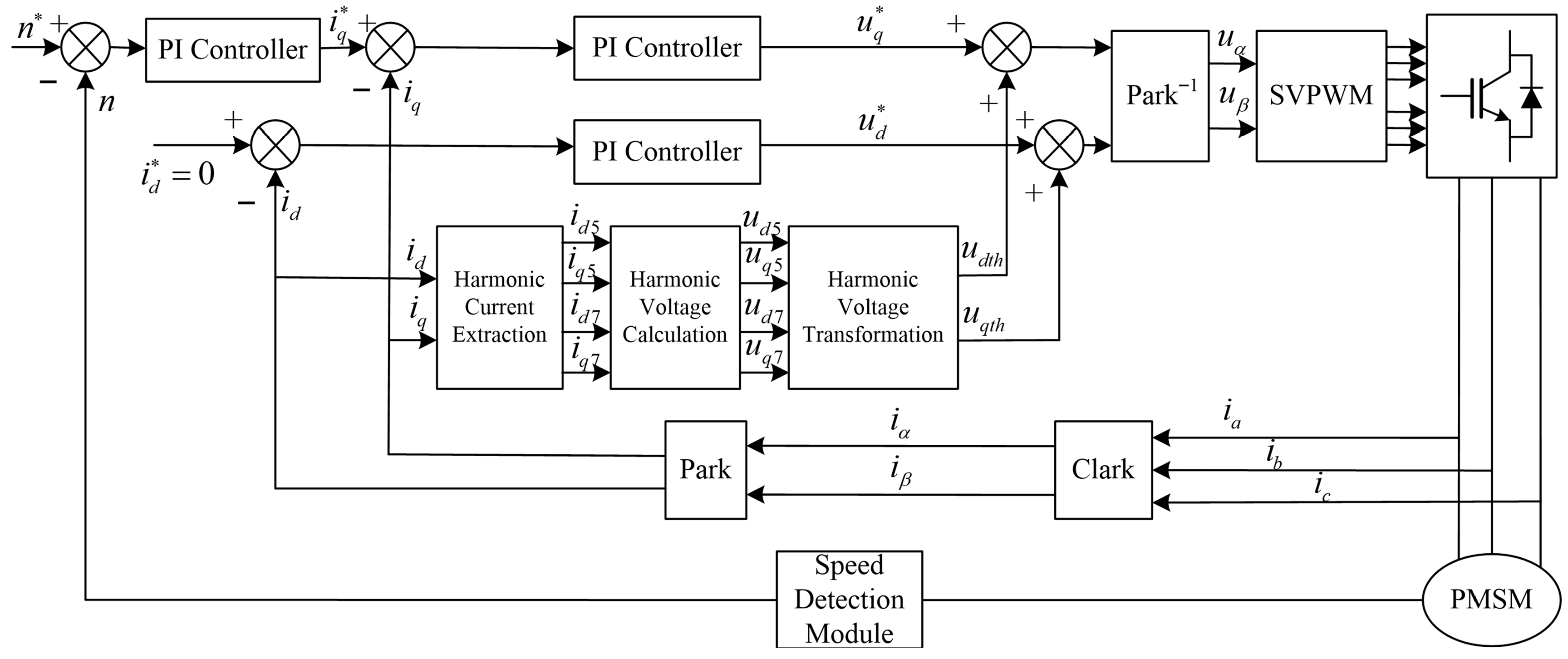
In this work, harmonic injection is employed to counteract inherent harmonics, thereby attenuating harmonic components in the motor phase current. This harmonic injection is realized via voltage compensation. The control framework comprises three core modules: harmonic current extraction, harmonic current suppression (i.e., harmonic voltage compensation), and harmonic voltage injection.
The block diagram of the harmonic-injection-based control system is illustrated in
Figure 2. Building upon conventional vector control, this algorithm incorporates three additional modules: harmonic current extraction, harmonic voltage calculation, and harmonic voltage transformation. The computed compensation voltages
udth and
uqth are superimposed onto the reference voltages
ud* and
uq* to eliminate harmonic components in the reference voltage signals.
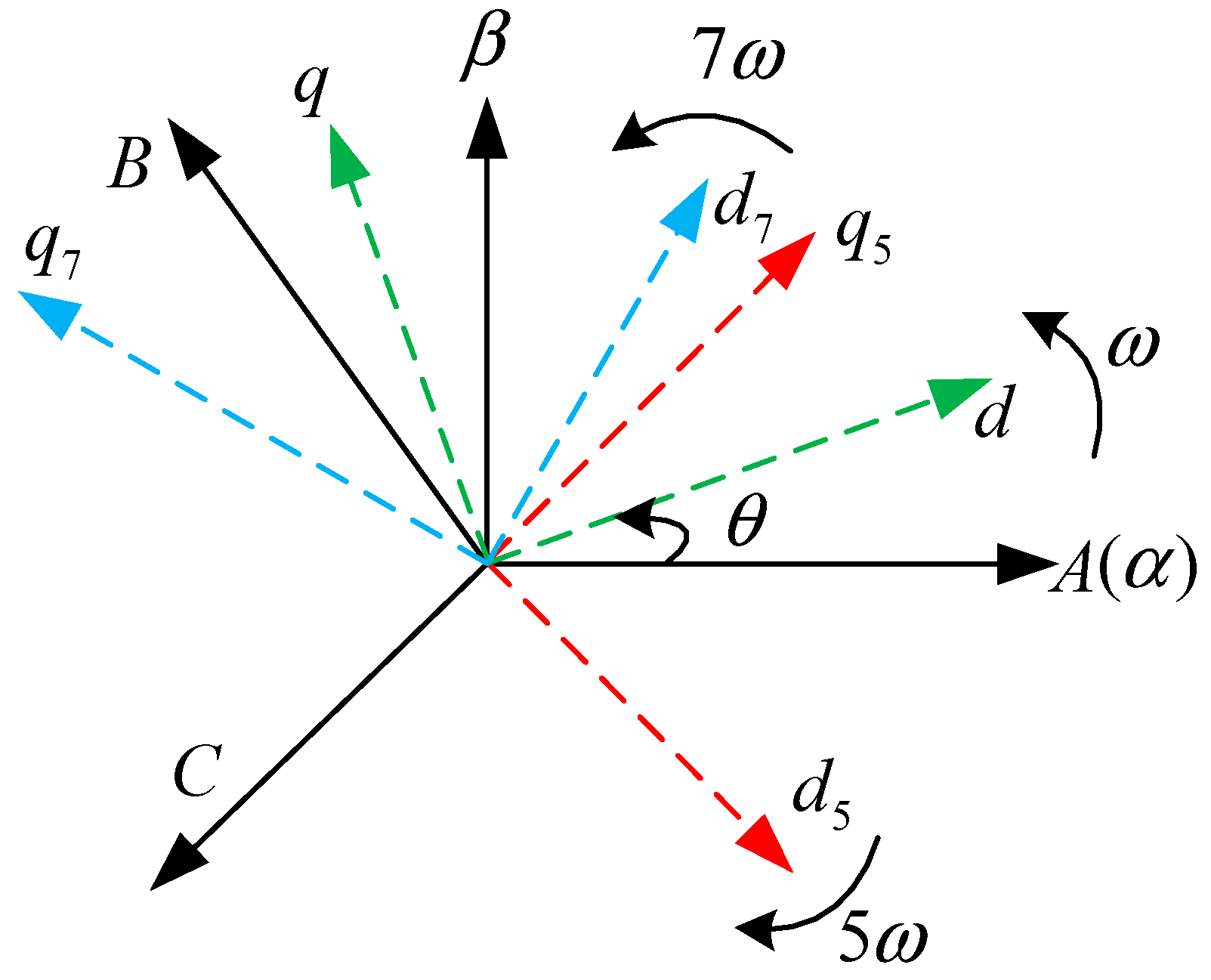
To realize independent regulation of the d-axis and q-axis currents corresponding to the 5th and 7th harmonics, respectively,
d-
q synchronous rotating reference frames associated with the 5th and 7th harmonics are constructed [
33], as illustrated in
Figure 3.
The sinusoidal component corresponding to the longest oscillation period in the motor phase current waveform is defined as the fundamental component. As illustrated in
Figure 3, the electrical angular velocities of the fundamental component, the 5th-order negative-sequence harmonic, and the 7th-order positive-sequence harmonic are
ω, 5
ω and 7
ω, respectively. Accounting for the 5th and 7th harmonics in the phase current, the expression for the three-phase current in the three-phase stationary ABC frame is given as follows [
34]:
In this equation, i1, i5 and i7 denote the amplitudes of the fundamental, 5th-harmonic, and 7th-harmonic components, respectively; θ1, θ5 and θ7 represent the initial phase angles of the corresponding fundamental, 5th-harmonic, and 7th-harmonic components, respectively.
Since the amplitudes of the 5th and 7th harmonics are not directly measurable, a coordinate transformation is employed to simplify their analysis.
The transformation matrix from the ABC stationary frame to the
d-
q synchronous rotating frame is expressed as follows:
By transforming the three-phase current from the ABC stationary frame to the
d-
q synchronous rotating frame, the currents in the 5th and 7th harmonic
d-
q reference frames are obtained as follows:
The motor’s d-axis and q-axis currents are transformed into the 5th and 7th harmonic d-q reference frames via high-order coordinate transformation to extract the 5th and 7th harmonic currents. In this work, the d- and q-axis components of the 5th and 7th harmonics refer to the d-q components id5 and iq5 of the 5th harmonic in the 5th-harmonic d-q reference frame, and the d-q components id7 and iq7 of the 7th harmonic in the 7th-harmonic d-q reference frame, respectively.
In the harmonic voltage calculation module, a PI controller is employed. The steady-state voltage equation for the 5th harmonic in the 5th-harmonic
d-
q reference frame is formulated as follows:
The steady-state voltage equation for the 7th harmonic in the 7th-harmonic
d-
q reference frame is formulated as follows:
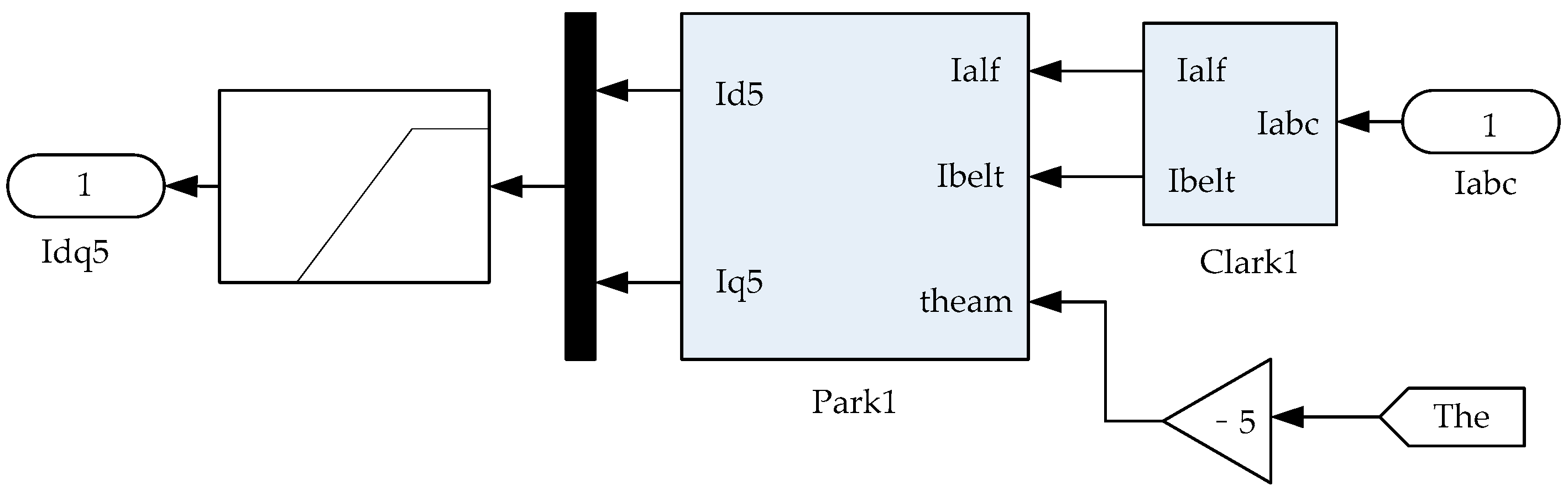
In motor speed control systems, corresponding harmonic components are superimposed onto the three-phase PWM reference voltage waveforms to counteract harmonic contents in the motor current. Based on the foregoing analysis, modules for extracting the 5th and 7th harmonic currents from the actual three-phase currents of a PMSM are developed. The simulation model of the 5th harmonic current extraction module is illustrated in
Figure 4, and the 7th harmonic current extraction module shares an identical structure.
Since the 5th and 7th harmonic current components in the motor’s three-phase currents appear as DC components in their respective d-q synchronous rotating reference frames, while other frequency components remain AC, extraction of the 5th and 7th harmonic currents can be achieved via low-pass filtering, yielding the d-axis and q-axis components id5, iq5, id7, and iq7 of the 5th and 7th harmonic currents in the corresponding synchronous rotating reference frames. This work employs a second-order Butterworth filter with a cutoff frequency of 100 Hz.
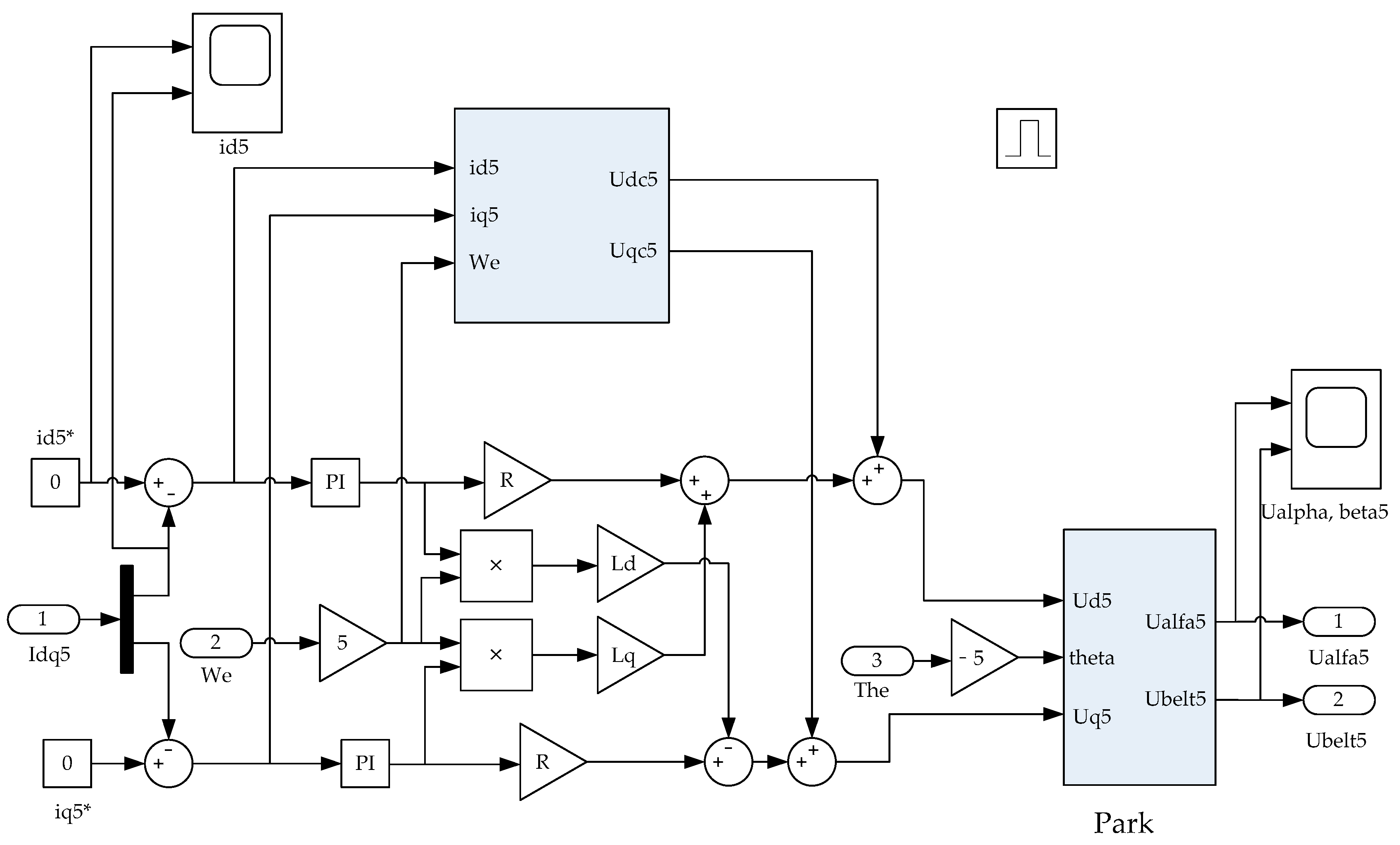
The simulation model of the 5th harmonic injection module is depicted in
Figure 5, and the 7th harmonic injection module exhibits an identical structure. The ode23tb solver is utilized with a variable-step configuration, and the relative tolerance is set to 10
−4. The PI controller parameters are configured as
Kp = 2 and
Ki = 130. The sampling time is set to 2 μs, and the carrier period for SVPWM modulation is 100 μs.
5. Experimental Results and Analysis
To validate the efficacy of the proposed harmonic suppression algorithm, a comparative analysis is conducted within the simulation environment. Regarding motor structure, manufacturing deviations, cogging effects, and structural imperfections in rotor permanent magnets give rise to distortion of the motor air-gap magnetic field, which generates 6
k ± 1 order harmonics. From the motor drive perspective, the inverter exhibits nonlinear characteristics under the influence of dead time and device voltage drop, which also induces 6
k ± 1 order harmonics. For both harmonics stemming from air-gap magnetic field distortion and those introduced by inverter nonlinearity, the harmonic amplitude decays with increasing harmonic order. Accordingly, only the 5th and 7th harmonics are primarily considered, while higher-order harmonics can be disregarded. Although the simulation model constructed in this work omits harmonic currents originating from air-gap magnetic field distortion, it can still introduce 5th and 7th harmonic currents by configuring the driver’s device voltage drop and dead time. Therefore, the model simplification exerts a negligible impact on the validity of simulation results, and the proposed method remains applicable under actual magnetic field operating conditions. The PMSM parameters are listed in
Table 1, and the inverter parameters are provided in
Table 2.
Two typical operating scenarios are selected for validation:
Condition 1: Rated speed of 3000 rpm, load torque of 60 N·m, and dead time of 5 μs;
Condition 2: Rated speed of 2000 rpm, load torque of 30 N·m, and dead time of 2 μs.
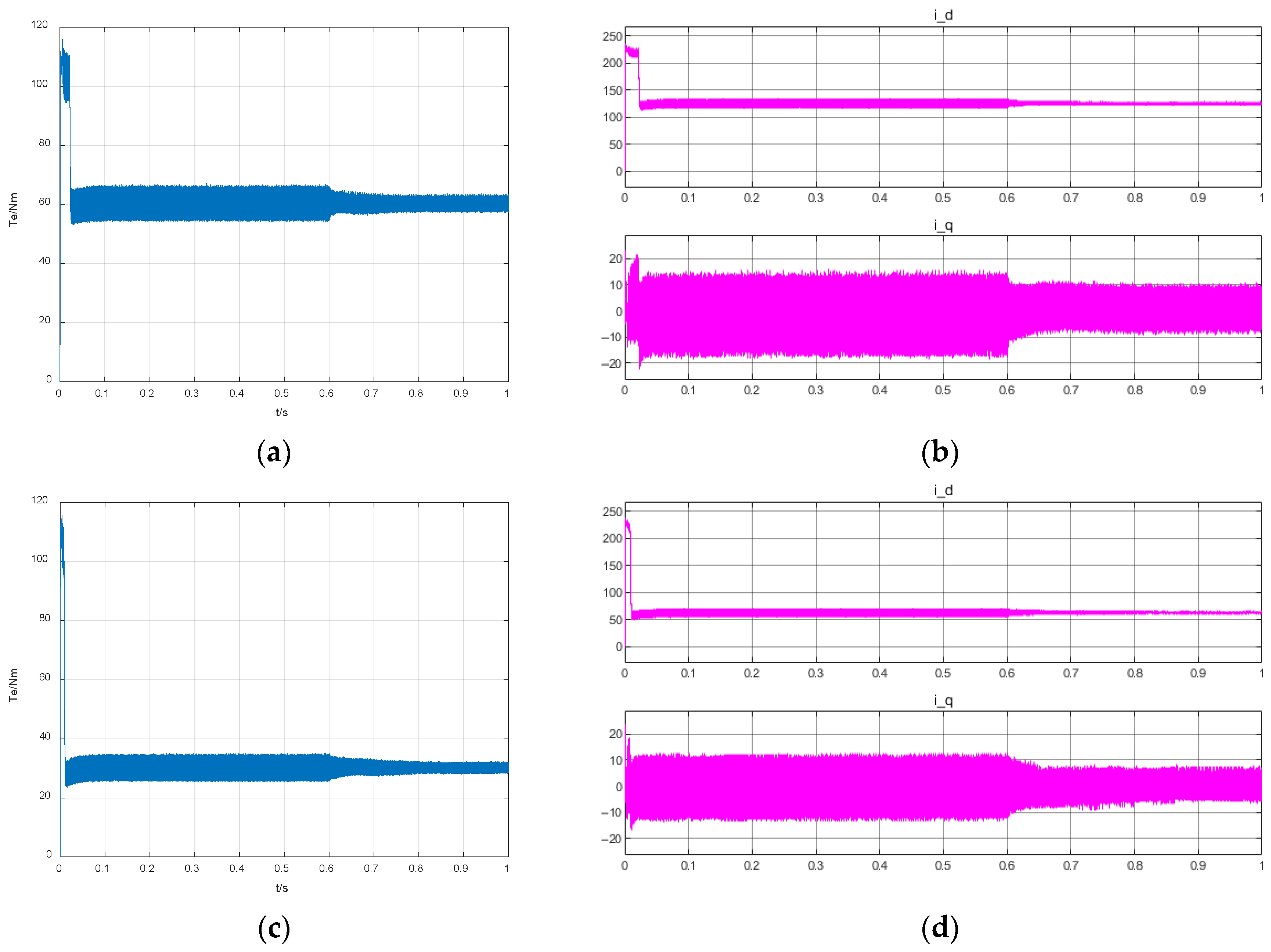
The simulation duration is set to 1 s. The torque curves before and after harmonic injection under Condition 1 are presented in
Figure 6a. Following the activation of the harmonic injection algorithm at 0.6 s, a significant reduction in torque ripple is observed. The
d-
q axis current curves before and after harmonic injection under Condition 1 are depicted in
Figure 6b, which reveals a notable decrease in current fluctuations after the algorithm is applied. The torque and d-q axis current curves under Condition 2 are illustrated in
Figure 6c and
Figure 6d, respectively. Simulation results confirm that the proposed torque ripple suppression algorithm remains effective across diverse operating conditions.
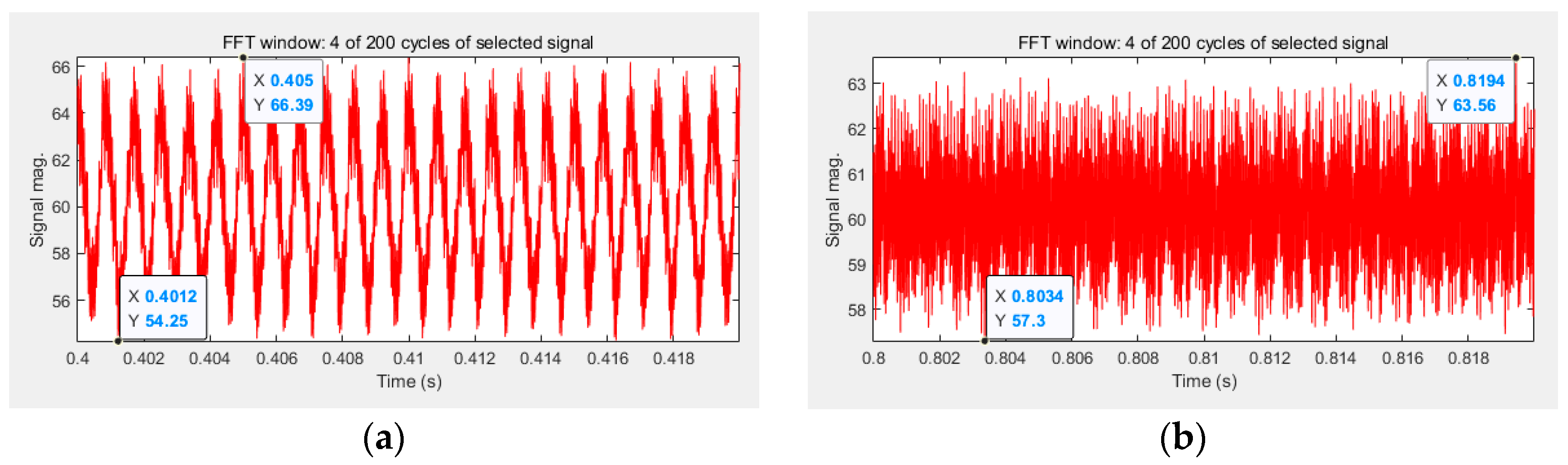
A detailed analysis of Condition 1 is provided below. The torque curve from 0.4 s to 0.42 s is shown in
Figure 7a, indicating a maximum torque fluctuation of 6.39 Nm prior to algorithm activation. The torque curve from 0.8 s to 0.82 s is presented in
Figure 7b, showing that the maximum torque fluctuation is reduced to 3.56 Nm after algorithm activation, effectively mitigating system torque fluctuations. Relative to the rated torque of 60 Nm, the torque ripple is decreased from 10.65% to 5.93%.
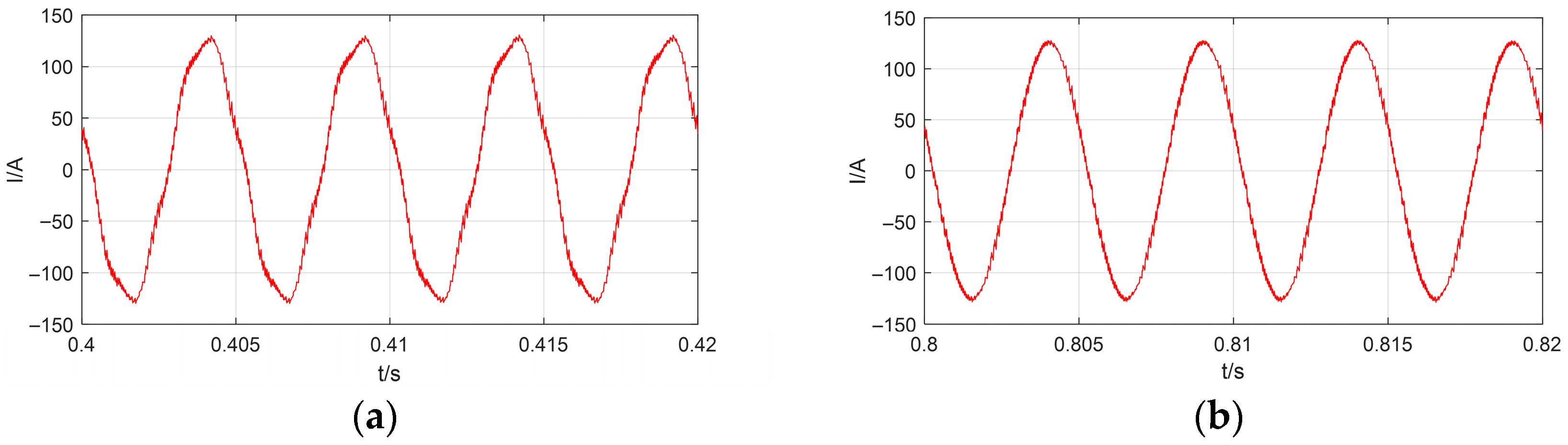
The phase-A current curve before harmonic injection is depicted in
Figure 8a, and the curve after harmonic injection is presented in
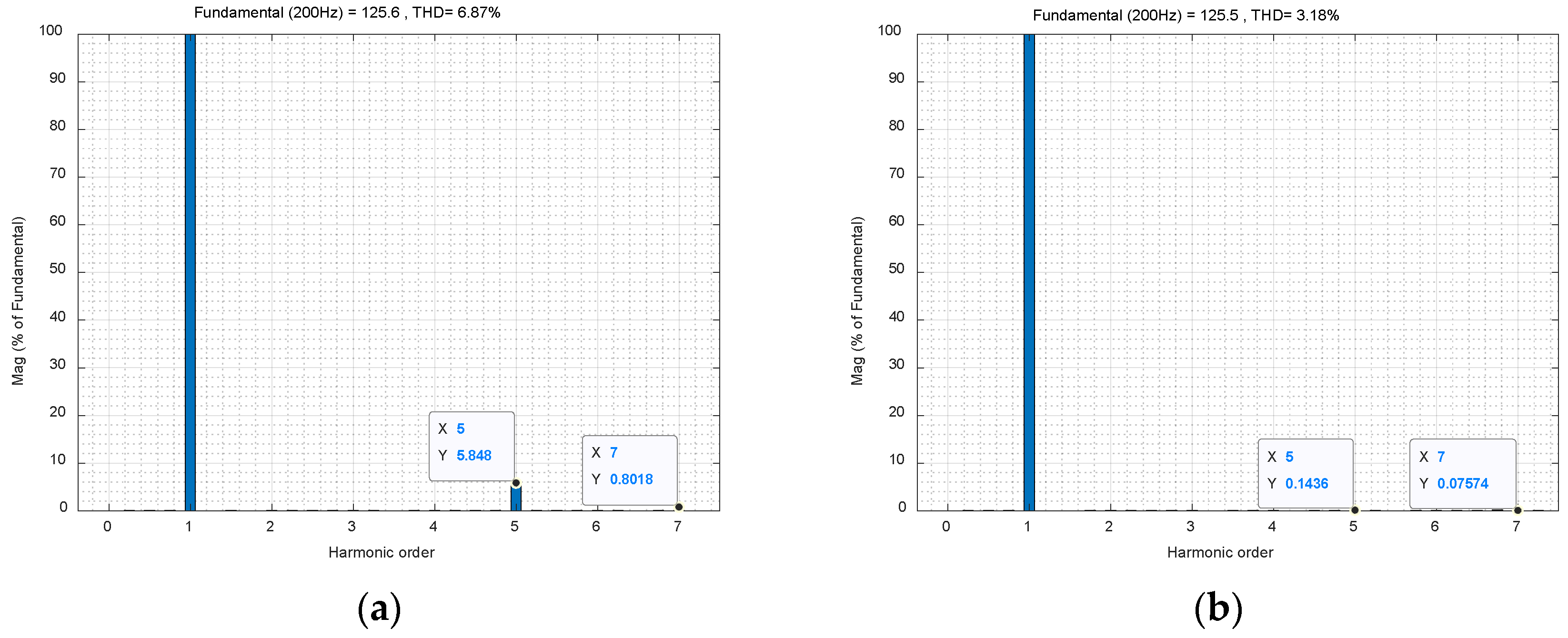
Figure 8b. Prior to algorithm implementation, the current curve exhibits severe distortion due to high harmonic content. Following algorithm activation, the harmonic content is reduced, rendering the current curve nearly sinusoidal with negligible visible distortion. The FFT analysis results of the phase-A current before and after harmonic injection are illustrated in
Figure 9a and
Figure 9b, respectively. The fundamental frequency of the current is determined to be 200 Hz. The 5th and 7th harmonic components in the current decrease from 5.848% and 0.8018% to 0.1436% and 0.07574%, respectively. The Total Harmonic Distortion (THD) is reduced from 6.87% to 3.18%. These results confirm that the 5th and 7th harmonic currents are effectively suppressed after the harmonic suppression algorithm is applied.
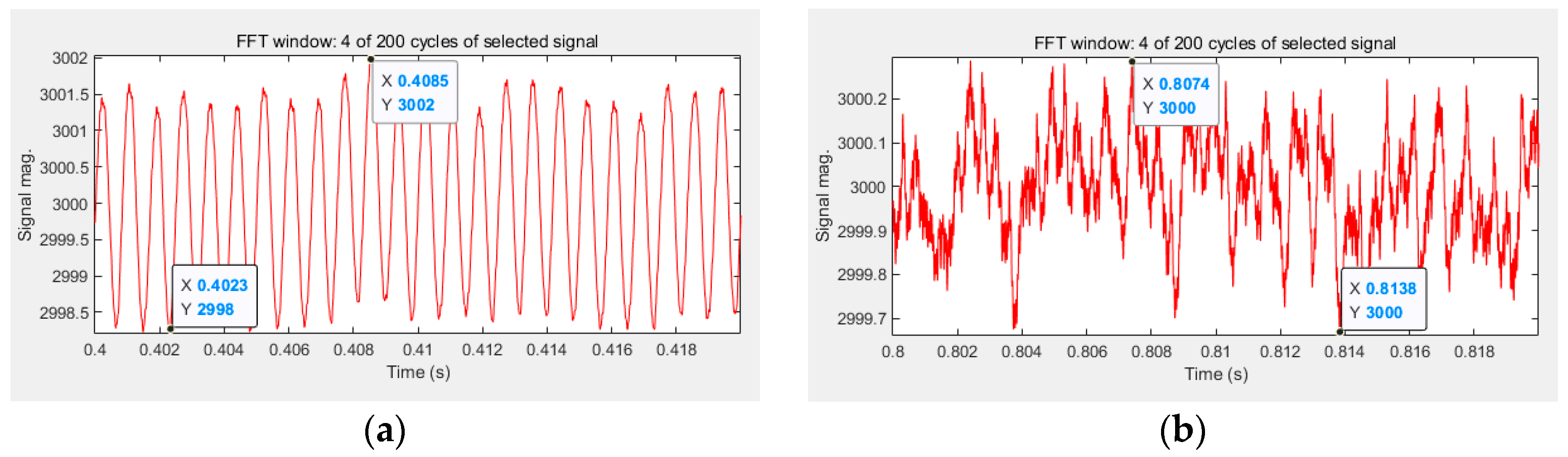
The speed curves before and after harmonic injection are presented in
Figure 10a and
Figure 10b, respectively. Prior to algorithm activation, the minimum speed reaches 2998 rpm at 0.4023 s, while the maximum speed reaches 3002 rpm at 0.4085 s. Relative to the rated speed of 3000 rpm, the speed fluctuation is ±2 rpm. After algorithm implementation, the maximum speed is approximately 3000.3 rpm at 0.8074 s (the cursor displays 3000 due to display precision; the exact value is available from the left coordinate axis), and the minimum speed is 2999.7 rpm at 0.8138 s (the cursor displays 3000 due to display precision; the exact value is obtainable from the left coordinate axis). Relative to the rated speed of 3000 rpm, the speed fluctuation is reduced to ±0.3 rpm. These results demonstrate that the speed ripple decreases from ±2 rpm to ±0.3 rpm, indicating effective suppression of speed ripple.
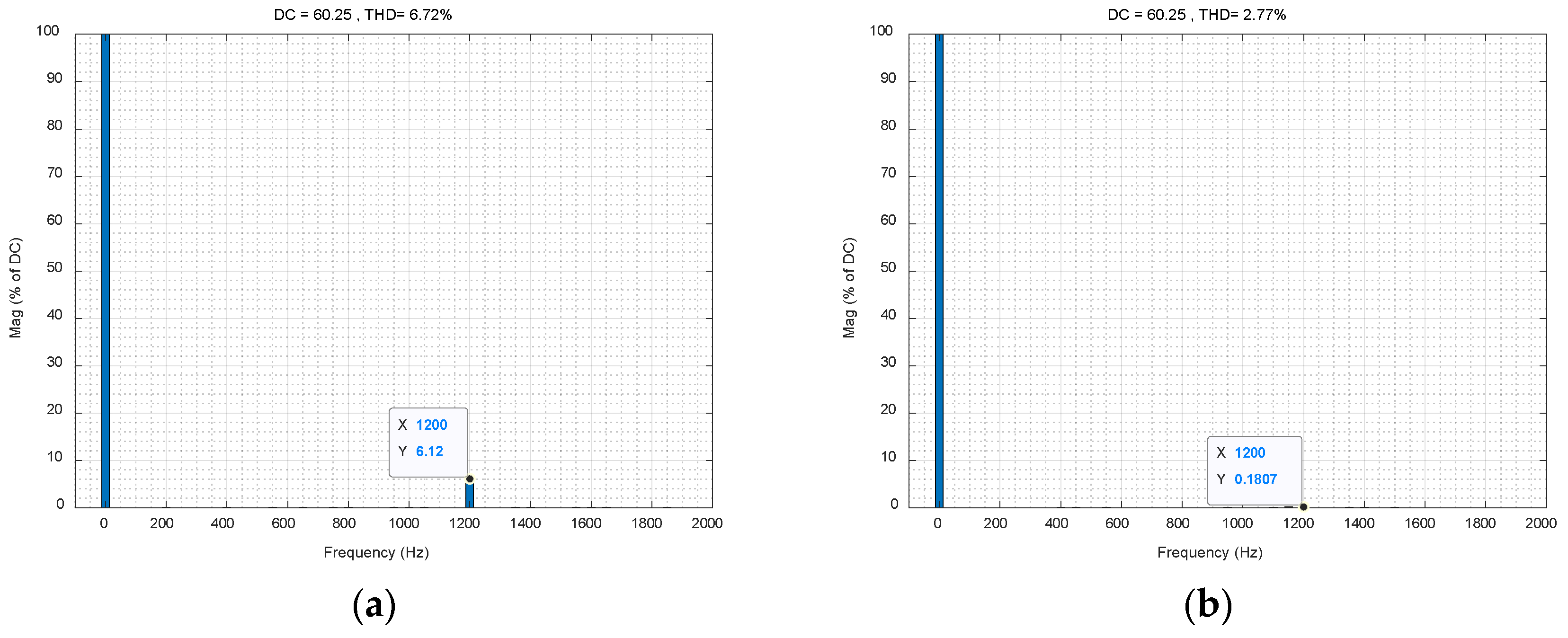
The 5th and 7th harmonic currents give rise to the 6th-order torque ripple in the motor. The FFT analysis results of the torque curves are illustrated in
Figure 11a,b. Since the fundamental frequency of the current is 200 Hz, the corresponding frequency of the 6th-order torque ripple is 1200 Hz. The ripple amplitude at this frequency decreases from 6.12% to 0.1807%, and the THD is reduced from 6.72% to 2.77%. The 6th-order torque ripple is significantly suppressed.
6. Conclusions
Torque ripple suppression represents a critical research area in the field of EHA. This work presents a harmonic-injection-based suppression algorithm to tackle the torque ripple mitigation challenge in EHA systems. Simulation results demonstrate that the algorithm delivers excellent torque ripple suppression performance and effectively suppresses the 5th and 7th current harmonics. The amplitude of the 6th-order torque ripple is reduced from 6.12% to 0.1807%, while the THD decreases from 6.72% to 2.77%. The notable suppression efficacy validates this approach as an effective solution for torque ripple mitigation in EHA applications.
The torque ripple in EHA systems stems from motor and drive sources, ultimately impacting EHA vibration and noise, which manifests as prominent vibration line spectra at six times the motor fundamental frequency. Torque ripple has negligible influence on EHA pressure ripple, flow ripple, and cylinder displacement ripple—these are primarily generated by hydraulic pump ripple. Accordingly, this work focuses on the simulation and analysis of motor torque ripple, providing technical support for subsequent engineering applications. In future work, vibration and noise experiments will be conducted on physical EHA prototypes to validate torque ripple suppression performance.