Article

From Ontology to Application: A Semantic Architecture for Music Education in Low-Code Environments


by
Ioannis Kakaras
,
Vasilios Zoumboulidis
,
Ioannis Paliokas
and
Stavros Valsamidis
*
Department of Accounting and Finance, Campus of Kavala, Democritus University of Thrace, 65404 Kavala, Greece
*
Author to whom correspondence should be addressed.
Electronics 2026, 15(10), 2071; https://doi.org/10.3390/electronics15102071
Submission received: 6 April 2026 / Revised: 30 April 2026 / Accepted: 6 May 2026 / Published: 13 May 2026
(This article belongs to the Section Computer Science & Engineering)

Abstract

This study investigates the design, development, and practical exploitation of an educational ontology for classical guitar instruction, within a semantically driven and application-oriented framework. The proposed approach aims to bridge the gap between formal knowledge representation and its functional use in real educational contexts. The ontology is developed using OWL in the Protégé environment and systematically models core pedagogical elements, including learning objectives, technical skills, instructional practices, and assessment processes, in alignment with the official curriculum. The semantic model is stored and managed as an RDF graph within a GraphDB repository, where it supports consistency checking and semantic querying through SPARQL. For application development, the ontological model is subsequently translated into a structured tabular schema suitable for the AppSheet low-code environment. Thus, GraphDB functions as a semantic validation and knowledge management layer, whereas the educational application operates on an application-oriented representation derived from the ontology rather than on a live RDF backend. The proposed three-tier architecture (Ontology–GraphDB–Application) demonstrates how Semantic Web technologies can support the transformation of abstract knowledge models into functional educational systems. The results highlight the capacity of ontology-driven approaches to enhance the organization, reusability, and pedagogical coherence of instructional knowledge, while enabling scalable and accessible application development through low-code technologies. The study contributes to the field of educational technology by providing a practical framework for integrating semantic knowledge representation into music education and laying a semantic foundation for future extensions toward adaptive and intelligent learning environments.

1. Introduction

The rapid development of Semantic Web technologies and knowledge representation systems has substantially influenced the way instructional information is organized, managed, and utilized in contemporary learning environments. Particularly within the field of educational technology, the need for structured, reusable, and conceptually consistent knowledge representation has led to the systematic adoption of ontologies as fundamental tools for modeling educational domains [1,2]. At the level of educational technology, the use of ontologies is therefore approached not only as a theoretical means of representation, but also as a practical foundation for organizing the educational process and supporting educational applications with clearly defined functional requirements.
Ontologies are commonly defined as formal and explicit specifications of the concepts and relationships that characterize a particular knowledge domain, enabling a shared, unambiguous, and consistent understanding of knowledge by both humans and computational systems [1]. Within educational contexts, ontologies have been extensively employed to model learning objectives, instructional activities, learning objects, and assessment mechanisms, thereby facilitating the development of flexible, adaptive, and semantically enriched learning environments [3,4]. In this work, the proposed educational ontology is organized around a set of core pedagogical concepts, including learning objectives, technical skills, exercises, repertoire, and assessment criteria, allowing instructional knowledge to be represented in a coherent, systematic, and extensible manner.
In the field of music education, and more specifically in the teaching of classical guitar, educational knowledge is characterized by a high degree of complexity, as it integrates technical skills, theoretical knowledge, interpretative practices, and aesthetic criteria. This multi-layered nature of knowledge makes the clear mapping of student progress challenging, since technical requirements, exercises, and expected learning outcomes are not always linked in a formal and transparent manner. Traditional instructional approaches rely primarily on experiential knowledge transmission and the instructor’s empirical guidance, which hinders the systematic documentation and reuse of knowledge within formal educational contexts [5,6]. The need for an organized representation of instructional knowledge becomes particularly critical in institutional educational settings, where teaching must align with official curricula and predefined learning outcomes.
The literature indicates that ontologies can function as a powerful conceptual foundation for modeling musical concepts, performance techniques, and educational processes. Indicatively, the music ontology and related ontological models have been employed to interlink musical works, creators, performances, and associated metadata, thereby enhancing interoperability and the semantic analysis of musical data [7,8]. Although these models successfully document musical entities and metadata, they do not adequately address the pedagogical dimension of learning a musical instrument, such as the systematic linkage of technical skills with instructional activities and assessment processes.
A closely related contribution is the Guitar Rendition Ontology, which focuses on the semantic representation of guitar performance and rendition knowledge for teaching and learning support [9]. The present work differs from this approach in both scope and implementation. While the Guitar Rendition Ontology is primarily concerned with representing performance- and rendition-related knowledge, the ontology proposed in this study is curriculum-derived and pedagogically organized around learning objectives, instructional practices, exercises, assessment criteria, and learning-progress support. In addition, the present study extends beyond ontology modeling by examining how the semantic structure can be transformed into an application-oriented tabular representation and operationalized within a low-code educational application. In this respect, the proposed model complements previous guitar-related ontological work by emphasizing curriculum alignment, pedagogical organization, and ontology-to-application transformation. At the same time, the proposed architecture supports structured retrieval and pedagogically meaningful organization of instructional content and may serve as a semantic foundation for future extensions toward adaptive learning pathways, although such adaptive functionality is not implemented in the current prototype [10,11].
However, despite advances in the theoretical development of educational ontologies, their adoption in functional educational applications that can be directly used by teachers and students remains limited. The gap between semantic modeling and practical implementation has long been recognized as a persistent challenge in educational technology and ontology-based system design [12,13].
This issue is addressed in the present study through the proposal of a functional model for exploiting an ontology within a realistic application context, in which the semantic structure is transformed into navigable and usable information for both teachers and learners. At the same time, the emergence of low-code platforms provides new opportunities for the development of educational applications without requiring specialized programming skills, thereby making the dissemination of semantic knowledge across broader educational environments feasible.
Within this context, the relationship between ontological modeling and educational application is examined by considering classical guitar instruction as a case study. Specifically, the study presents the development of an educational ontology based on the official curriculum, its storage and management in an RDF-based semantic repository (GraphDB), and its utilization within an educational application implemented using the AppSheet platform.
Through the proposed architecture (Ontology–GraphDB–AppSheet), the manner in which semantic technologies can function as a bridge between theoretical knowledge representation and practical educational application is highlighted, supporting the functional utilization of instructional knowledge in the field of music education. At the same time, the proposed architecture supports the structured retrieval and organization of instructional content and may serve as a semantic foundation for future extensions toward adaptive learning pathways within educational practice.

2. Theoretical Framework

2.1. Ontologies and Semantic Representation of Educational Knowledge

Ontologies constitute formalized and semantically enriched representations of knowledge that capture the core concepts of knowledge domain, their attributes, and the relationships among them within an explicitly defined conceptualization. According to the classical definition proposed by Gruber [1], an ontology is an “explicit specification of a conceptualization,” providing a shared conceptual foundation for the systematic organization and exchange of knowledge. Within the context of the Semantic Web, ontologies are implemented using languages such as OWL (Web Ontology Language), which are grounded in description logics and enable the formal specification of concepts, hierarchies, and logical constraints, as well as automated reasoning and inference [2].
There has been growing interest in the use of ontologies within educational technology, reflecting the need for structured, scalable, and reusable representations of learning knowledge within digital learning environments. Educational ontologies support the modeling of learning objectives, concepts, and instructional activities, functioning as a semantic foundation for pedagogical design and the coherent organization of knowledge across heterogeneous educational settings [14]. Recent work on ontology and Semantic Web technologies in distance and e-learning environments also emphasizes their role in structuring domain knowledge, supporting content organization, and enabling more flexible learning experiences [15].
The ontological approach facilitates the explicit representation of relationships between instructional goals and educational practices, reducing conceptual ambiguity and supporting semantic interoperability among educational systems.
Considerable emphasis has been placed on the role of ontologies in personalized and adaptive learning. Recent studies indicate that approaches based on the Semantic Web and ontological models enable the systematic representation of learners’ profiles, progress, and prerequisite knowledge, thereby supporting the dynamic adaptation of learning content and activities to individual needs [16]. At the same time, the integration of semantically organized data into learning analytics and artificial intelligence systems has been shown to enhance the effectiveness of personalized learning experiences, allowing for the automatic selection and sequencing of educational resources based on the learner’s level and progress [17]. Through explicitly defined semantic relationships, such as skill attainment or prerequisite requirements, evidence-based and adaptive support of the learning process becomes feasible.
Moreover, the capability for logical inference (reasoning) is recognized as a critical advantage of ontological models. The use of reasoning mechanisms based on description logics enables the verification of conceptual consistency, the detection of modeling errors, and the derivation of implicit knowledge, constituting a fundamental component of ontological systems [18]. Within the field of educational technology, contemporary applications of educational ontologies exploit these mechanisms to validate the correctness of pedagogical models and to provide semantically grounded support for the learning process [14]. In this way, the ontology does not function merely as a passive structure for storing terms, but as an active knowledge substrate that supports semantic analysis and the reliable utilization of educational information.
Overall, contemporary literature recognizes ontologies as a robust foundation for representing and managing educational knowledge in complex domains. In such contexts, they support the formal organization of learning objectives, skills, instructional practices, and assessment processes, while providing the basis for semantically driven educational applications such as the one examined in this study.

2.2. Ontologies in Educational Technology and Music Education

Within educational technology, ontologies provide a formal framework for organizing pedagogical knowledge, including learning objectives, skills, instructional activities, and assessment processes. This supports clearer instructional design and greater interoperability across systems that employ Semantic Web technologies [14].
The use of ontologies within the field of educational technology is closely associated with the support of personalized and adaptive learning experiences. Through the semantic modeling of parameters such as learners’ profiles, progress, and prerequisite knowledge, it becomes possible to dynamically adapt learning content and instructional flow according to the current learning state of each learner. Contemporary studies in the areas of the Semantic Web, intelligent tutoring systems, and learning analytics demonstrate that ontologies function as a semantic foundation for the automated selection, sequencing, and adaptation of educational resources, enhancing both the effectiveness of personalized learning and the overall coherence of the learning experience [16,17].
The application of the approaches discussed above is of particular importance in the field of music education and instrumental pedagogy, where theoretical knowledge, practical skills, aesthetic judgment, and performance experience coexist. Musical learning constitutes a complex process that integrates multiple levels of knowledge and practice, making the coherent and multi-layered organization of instructional knowledge necessary, as also highlighted in the relevant literature on music pedagogy [19]. Ontological approaches enable the semantic integration of musical concepts, performance techniques, repertoire, and learning objectives within a unified reference framework, supporting both pedagogical design and the systematic monitoring of learning progress. When combined with logical reasoning mechanisms, ontologies create the conditions for the development of intelligent learning environments in music education and form the theoretical foundation for applications in the instruction of specific musical instruments, such as the classical guitar.

2.3. Semantic Management of Educational Knowledge Using Graph Databases

The semantic infrastructure for managing educational knowledge is implemented through graph databases and knowledge graphs, which enable the systematic storage, organization, and utilization of semantically structured educational data. Within the context of the Semantic Web, this management is based on the use of RDF graphs and triplestores, where knowledge is represented through triples (subject–predicate–object) that form directed graphs and explicitly capture the conceptual relationships among entities. This graph-based representation facilitates the interconnection of heterogeneous knowledge sources, model scalability, and the preservation of conceptual coherence, features that are critical for modeling complex educational domains [2,18].
Graph databases and RDF triplestores thus play a central role in the management and exploitation of ontologies, as they directly support the structure of semantic graphs and enable efficient navigation and knowledge retrieval. In contrast to traditional relational databases, graph databases facilitate the execution of complex semantic queries that are based on conceptual relationships rather than static data structures. Through query languages such as SPARQL, it becomes possible to retrieve knowledge according to criteria such as learning objectives, prerequisite skills, and conceptual dependencies, thereby enhancing the functionality of ontology-based educational applications and supporting the development of dynamic and adaptive learning environments [20,21].

2.4. From Ontology to a Functional Educational Application

The transition from semantic modeling to a functional educational application is achieved through ontology-driven educational systems, in which the ontology serves as the central mechanism for structuring and exploiting educational knowledge, rather than merely as a static representation of concepts. Within such systems, core instructional elements—such as learning objectives, skills, instructional activities, and assessment processes—are explicitly represented at the semantic level and systematically linked to the functional behavior of the application. This linkage enables informed navigation, content selection, and the support of coherent learning pathways. The importance of this approach has been widely acknowledged in the literature as a key factor in the development of intelligent, knowledge-based educational systems grounded in semantic mechanisms [10,11].
Within this framework, the educational application emerges as a functional extension of the previously established semantic infrastructure, translating ontological models into software systems that support interaction, adaptation, and personalization. The integration of the ontology with the presentation and control layers of the application ensures alignment between the conceptual model and the system’s functional behavior, while simultaneously enabling scalability and the reuse of knowledge. As emphasized in the relevant literature, ontology-driven educational systems provide a robust theoretical and technical foundation for bridging semantic knowledge representation and the functional implementation of educational applications, particularly within complex learning environments [22]. This approach lays the groundwork for the detailed presentation of the implementation that follows.

3. Methodology and Implementation

3.1. Methodological Approach and Design Framework

The present study adopts a design-and-development methodological approach for educational systems, aiming at the creation and utilization of a functional educational system based on ontological knowledge representation. This approach is particularly appropriate for studies that seek to bridge theoretical models of knowledge representation with practical applications in authentic educational settings, as highlighted in the literature on educational technology and intelligent tutoring systems [23,24].
The methodology comprises three distinct yet interrelated stages: (1) the design and development of an educational ontology grounded in the official curriculum and instructional practice; (2) the semantic storage and management of the ontology within an RDF repository; and (3) the implementation of a low-code educational application that exploits ontological data to support instruction and learning progress monitoring. Classical guitar instruction is employed as a case study, as it constitutes a knowledge domain characterized by increased conceptual and procedural complexity, thereby providing a suitable context for evaluating ontology-based educational systems in real educational environments [22,25].

3.2. Design and Development of Educational Ontology

The design and development of the educational ontology were carried out in the Protégé environment and were based on a combination of institutional and experiential sources of knowledge, with the aim of achieving a systematic and pedagogically grounded representation of instructional knowledge in classical guitar education. Table 1 provides a structured overview of representative ontology components, including class groups, object-property groups, data properties, and representative individuals. The primary source was the official curriculum of the Greek Ministry of Education for the first level of classical guitar instruction, which specifies learning objectives, expected skills, and assessment criteria. In parallel, domain-specific instructional practice was considered to capture conceptual relationships and instructional dependencies that are not explicitly described in institutional documents but constitute essential elements of the educational process.
Table 1 summarizes the main ontology components developed and organized in Protégé. By presenting representative class groups, object-property groups, data properties, and individuals, the table provides a concise overview of the ontology’s semantic organization. These components illustrate how the ontology integrates pedagogical entities, assessment structures, guitar-related knowledge, body- and posture-related concepts, repertoire, and concrete teaching practices within a unified semantic model.
The content of the curriculum was conceptually analyzed and organized into three fundamental axes: (i) learning objectives, (ii) instructional practices, and (iii) assessment processes. This distinction formed the core structural foundation of the ontology and enabled the transformation of the pedagogical logic of the curriculum into a formal semantic model. The learning objectives of the first level focus on the acquisition of fundamental technical and cognitive skills, such as correct body and instrument posture, basic right- and left-hand techniques, pitch recognition, and the performance of simple scales, arpeggios, and chords. These objectives were semantically associated with corresponding instructional practices and assessment criteria, ensuring a coherent representation of learning progression.
The modeling process followed established principles of ontology engineering, with particular emphasis on conceptual clarity, consistent hierarchical organization, and the potential for future extension of the model [23,24]. Initially, a conceptual analysis of the domain was conducted to identify the core entities involved in classical guitar instruction. Subsequently, these concepts were organized into class hierarchies, and object properties were defined to capture the relationships among learning objectives, skills, exercises, repertoire, and assessment, along with data properties used to describe specific attributes of these entities.
In its current version, the ontology comprises 68 classes, 38 object properties, 5 data properties, 5 annotation properties, and 179 individuals. The annotation properties used in the ontology are prefLabel, rdfs:label, rdfs:comment, dc:creator, and owl:versionInfo. These properties are used primarily for descriptive and metadata-related purposes, supporting documentation, readability, and semantic interpretation of the modeled entities. The five data properties—angle, hasDuration, hasResource, hasTempoRange, and levelNumber—capture literal-valued attributes related to posture, duration, external educational resources, tempo, and study level. In total, the ontology contains 1905 axioms, including 792 logical axioms and 292 declaration axioms. These figures reflect the scope and formal complexity of the proposed semantic model. From a Description Logic perspective, the ontology remains within OWL DL; more specifically, its expressivity is SHIQ(D), as it employs transitive roles, role hierarchies, inverse properties, qualified cardinality restrictions, and datatype properties.
The core classes of the ontology include, indicatively, concepts related to the human body and performance posture, the parts of the guitar, technical skills, exercises, repertoire, and assessment criteria. These concepts are interconnected through semantic relationships that reflect the pedagogical logic of the domain, such as the acquisition of specific skills through targeted exercises or the alignment of educational material with learning objectives and levels of study. In addition, appropriate logical constraints, such as cardinality restrictions and value type constraints, were defined to ensure the conceptual validity of the associations and to prevent incompatible or ambiguous combinations.
The ontology was implemented using the OWL language and developed within the Protégé environment, which supports incremental development, consistency checking, and logical reasoning over ontological models [24,25]. Figure 1 provides a simplified conceptual overview of the core pedagogical classes and their main semantic relationships.
To verify the correctness and consistency of the model, reasoning mechanisms were employed to detect inconsistent classes, logical contradictions, and erroneous hierarchical relationships. This process also enabled the automatic classification of classes and the derivation of implicit knowledge, thereby enhancing the reliability of the ontology as a semantic foundation for the subsequent storage, retrieval, and exploitation of educational knowledge within a functional application.

3.3. Semantic Infrastructure and Management of Ontological Knowledge

The semantic infrastructure and management of ontological knowledge are based on the transformation of the ontological model into an RDF graph representation, enabling the storage, organization, and utilization of educational knowledge in a form suitable for computational processing and retrieval. Within the context of the Semantic Web, OWL ontological models can be represented as RDF graphs, in which knowledge is expressed through triples (subject–predicate–object), forming a set of explicit statements that describe concepts and their interrelationships [2]. The transition from the OWL conceptual model to RDF ensures the interoperability of the ontology with knowledge storage and retrieval infrastructures, as well as its exploitation by heterogeneous educational systems and applications [18].
For the storage and management of RDF data, a graph repository (GraphDB) was employed, which supports the systematic storage, indexing, and navigation of structured knowledge data. Graph databases differ from traditional relational databases in that they are designed for the direct representation and processing of conceptual relationships, a feature that is particularly important for applications based on ontologies and knowledge graphs [21]. In the context of educational applications, the use of triplestores and graph databases enables the consistent management of ontological data and their functional integration into educational systems, while preserving coherence between the conceptual model and the stored knowledge [2].
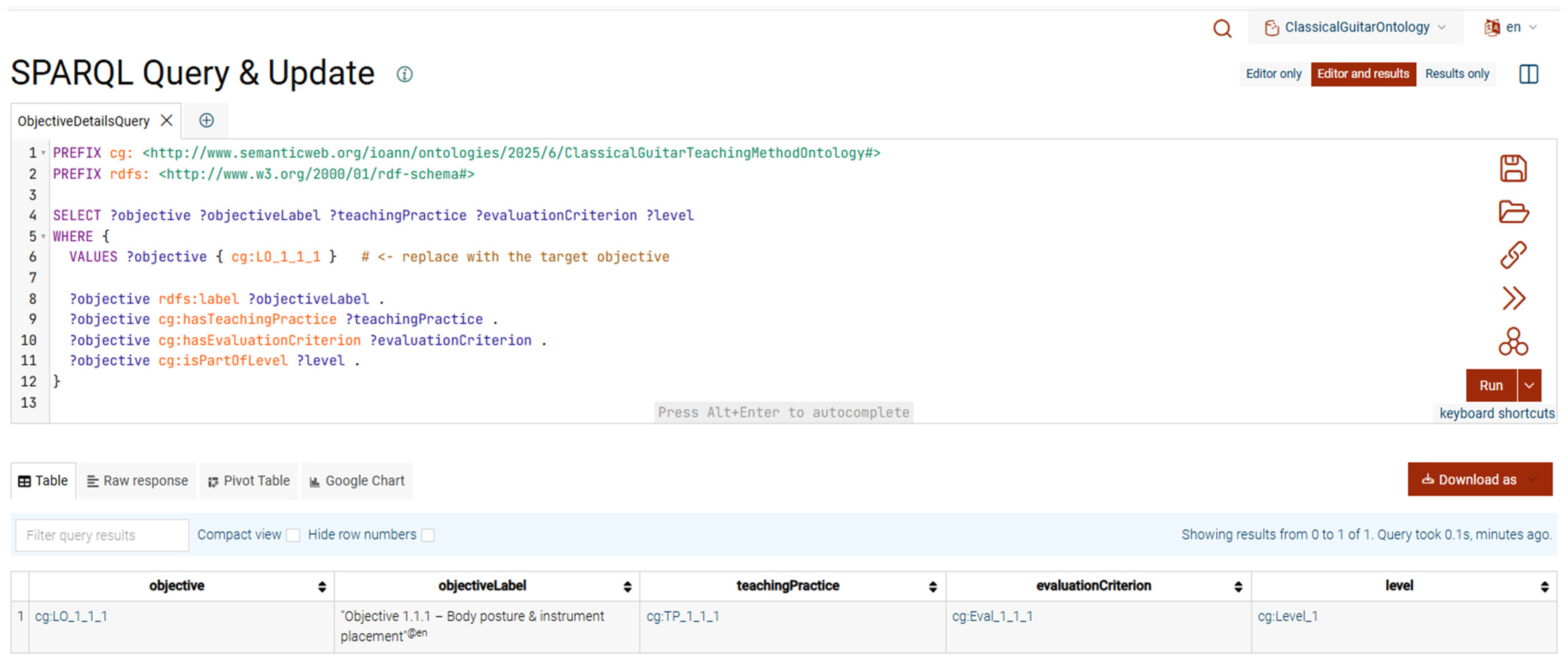
In practice, SPARQL queries were used within the GraphDB (ver. 11.2.0) environment to inspect, validate, and retrieve semantically structured knowledge from the ontology, including learning objectives, instructional activities, exercises, and assessment criteria. These queries served the purposes of semantic verification and knowledge exploration at the repository level. In the present implementation, however, the application layer does not directly execute SPARQL queries against GraphDB; instead, the validated ontological content is conceptually transformed into a structured tabular representation for use within the AppSheet platform. Figure 2 presents a representative SPARQL query retrieving a learning objective together with its label, associated teaching practice, evaluation criterion, and study level. In addition to this example, further SPARQL queries were used to retrieve teaching practices, learning objectives by level, and other semantically linked pedagogical entities, thereby illustrating the broader querying capabilities of the repository [20].
Through SPARQL, the semantic repository supports the retrieval and organization of learning objectives, instructional activities, exercises, and assessment criteria, as well as their underlying conceptual dependencies, thereby confirming its role as an intermediate semantic layer between ontological modeling and the final educational application and preparing the transition to the subsequent presentation and interaction layer.

3.4. Knowledge Flow and Functional Architecture

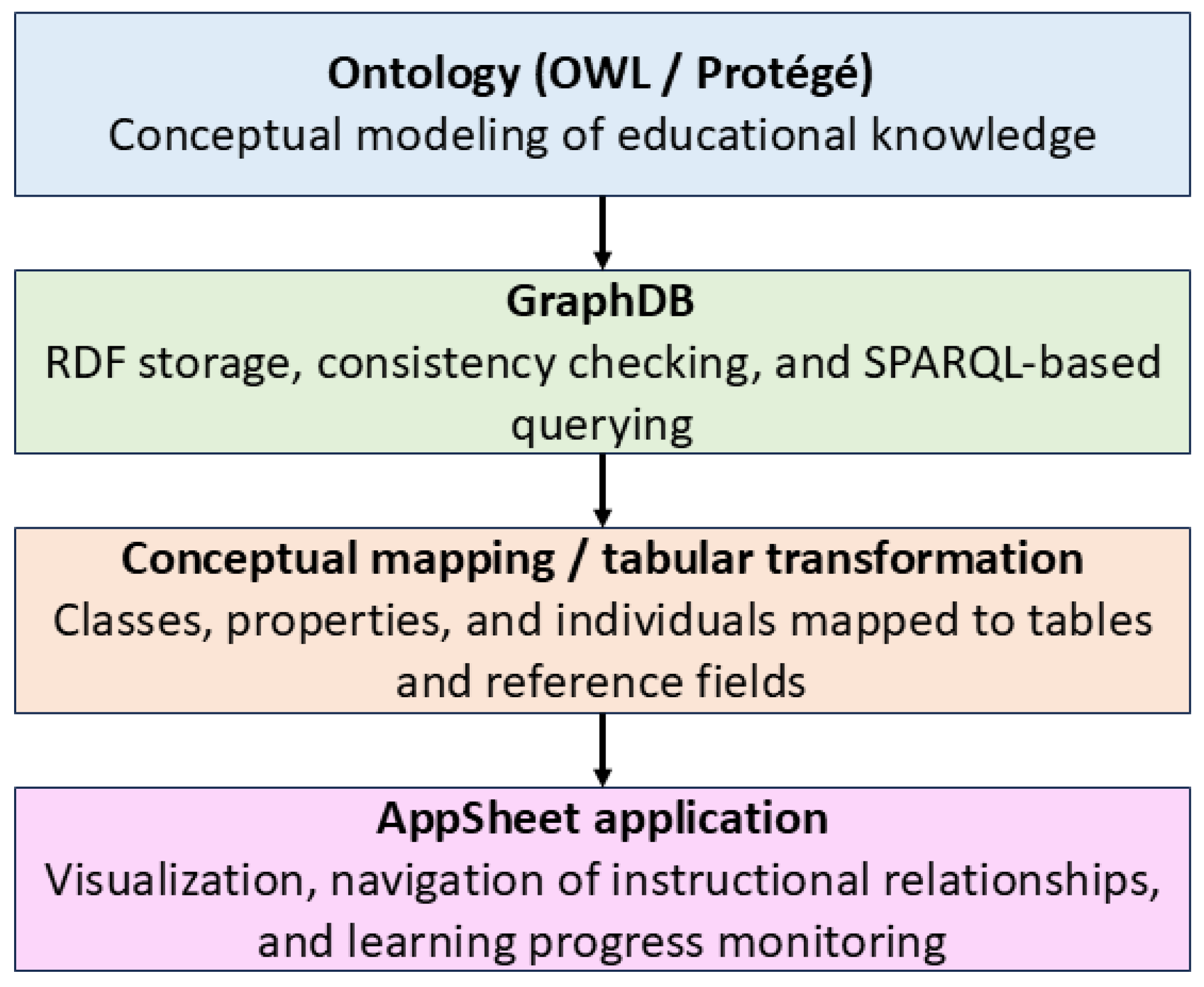
The functional architecture of the proposed solution is based on a staged organization of ontology modeling, semantic data storage and management, conceptual mapping into tabular structures, and application-level utilization (Figure 3). As illustrated in Figure 3, the proposed framework does not rely on a live GraphDB-to-AppSheet pipeline; instead, ontological knowledge is first stored and validated semantically and is then transformed into application-oriented tabular structures for use in the AppSheet environment.
This distinction is aligned with established multi-tier architectural approaches in Semantic Web systems, where conceptual modeling, data storage, and application-level consumption are functionally separated while maintaining a clear flow of knowledge among them [2]. The flow of semantically structured knowledge follows a directed process that begins with the ontology and culminates in the functional educational application, with the aim of preserving conceptual coherence across all stages.
At the first layer, educational knowledge is modeled in the form of an OWL ontology, in which the core concepts of the domain, their interrelationships, and the constraints governing them are represented in a formal and explicit manner. The ontology functions as a conceptual “source of truth,” in accordance with ontology design and development principles that advocate a clear distinction between concepts, relationships, and axioms, aiming at clarity, consistency, and knowledge reuse [22,24]. The knowledge is expressed in the form of an RDF graph, enabling semantically rich representation and serving as the starting point of the knowledge flow toward the subsequent layers of the architecture.
At the second layer, the RDF graph of the ontology is stored in GraphDB, which functions as a semantic repository for storage, consistency checking, and SPARQL-based querying. However, GraphDB does not serve as the live operational backend of the AppSheet application. Instead, the transition to the application layer is achieved through an intermediate conceptual mapping step, during which classes, properties, and individuals are translated into a tabular schema compatible with the low-code environment. Accordingly, the knowledge flow should be understood not as direct runtime interoperability between GraphDB and AppSheet, but as a staged transformation from semantic representation to application-oriented data structures.
At the third layer, knowledge is transformed into a structured tabular data format suitable for exploitation by the low-code AppSheet platform. This transition is implemented through a process of conceptual mapping, during which ontological classes, relationships, and individuals are mapped to application-level data structures. This approach is consistent with effective modeling principles in RDFS/OWL, according to which semantic structures can be transferred to application-oriented representations without loss of conceptual organization, provided that a clear correspondence between the conceptual and functional layers is maintained [26]. Moreover, the selection of a low-code platform for application-level knowledge exploitation is aligned with contemporary studies that highlight the contribution of low-code technologies to rapid development, flexibility, and the sustainability of educational and information systems [27,28].
Overall, the flow of knowledge from ontology to the application can be described as a process of gradual knowledge transformation: from a conceptual and semantically rich representation to a structured and functionally exploitable form. This architecture ensures the independence of the ontological model from the application’s implementation technology and allows for the future extension or replacement of the application layer without redesigning the semantic foundation, an aspect that is directly related to the sustainability and long-term reuse of knowledge [25].

3.5. Implementation of the Educational Application

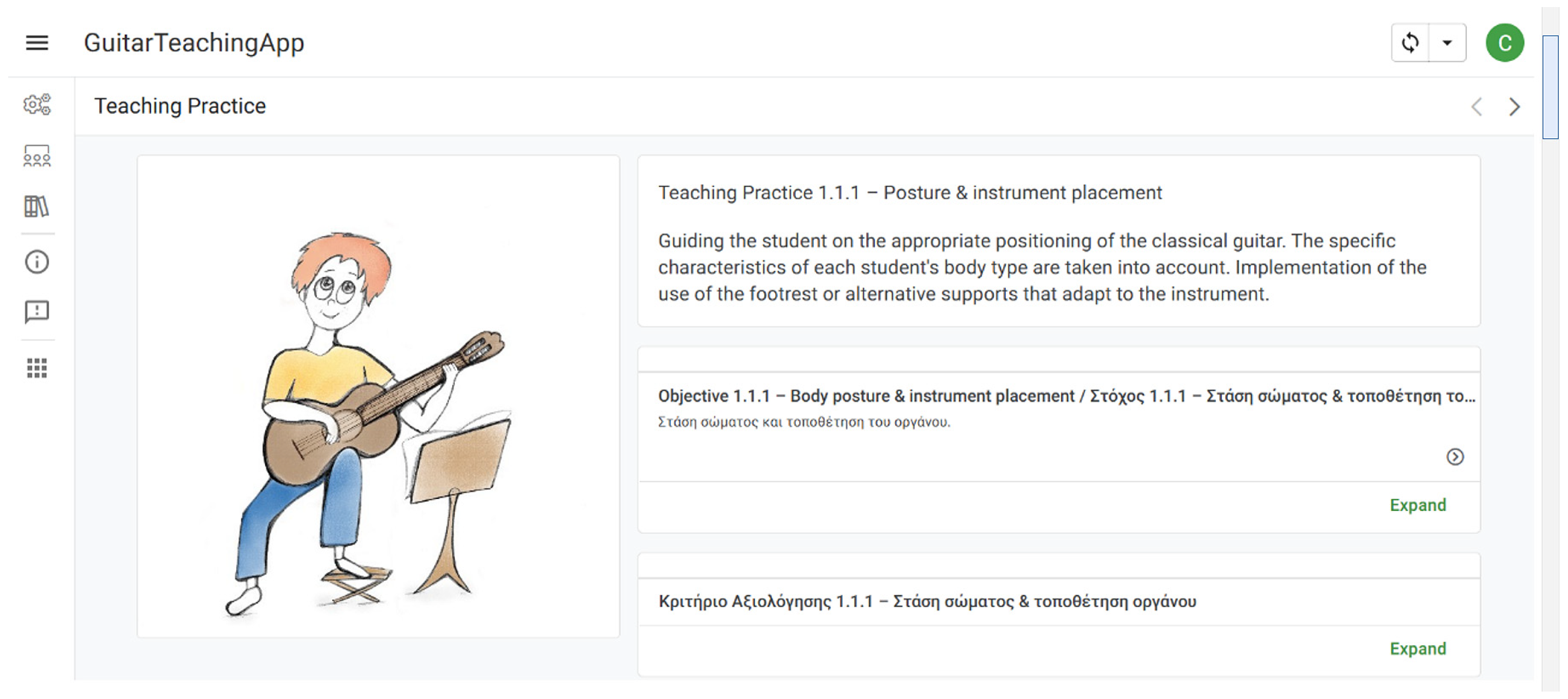
The implementation of the educational application (Figure 4) aims to transform ontologically structured instructional knowledge into a functional digital tool capable of supporting the everyday teaching practice of classical guitar. The semantic organization of the domain through an OWL ontology enables the formal representation of concepts and relationships within the Semantic Web framework, while the development of the ontology follows established design and documentation principles to ensure clarity, consistency, and reusability [2,22,24]. At the same time, for the functional exploitation of the ontological model in educational practice, a low-code application development approach was adopted, allowing for the rapid creation and adaptation of applications based on structured data without the need for extensive programming. This approach is considered particularly suitable in environments that require flexibility, rapid development, and the integration of data from heterogeneous sources [27,29].
In educational contexts, no-code platforms have also been used to lower technical barriers and support hands-on learning activities for users without extensive programming experience [30].
Within the scope of the present study, the Google AppSheet platform was selected, as it supports the development of data-driven applications and enables the direct use of tabular data as the primary structure for organizing information. This choice is further supported by recent literature, in which AppSheet is employed for the development of functional information systems with an emphasis on data management without traditional programming [29]. The operational logic of the platform aligns with the ontological foundation, as the application is organized around entities and relationships, thereby enabling the mapping of the conceptual schema to an application-level data model.
The connection between the application and the semantic data of the ontology is not achieved through direct manipulation of RDF/OWL, but through a process of conceptual mapping in which ontological entities are transformed into structured data tables. Core classes (e.g., learning objectives, instructional practices, assessment criteria) are mapped to data tables, while individuals are represented as records. Data properties are converted into fields, and object properties are implemented as reference (Ref) relationships between tables, so as to preserve the connectivity structure implied by the ontological model. This practice is consistent with principles of effective modeling in RDFS/OWL, according to which semantic structures can be transferred to application-level representations without loss of conceptual organization [26].
Therefore, the AppSheet application consumes a tabular data structure derived from the ontology, rather than directly accessing RDF triples or executing live SPARQL queries against the GraphDB repository. At the application level, AppSheet supports the operational use of explicitly modeled ontological entities and direct relations through tables, reference fields, and linking structures, thereby preserving navigational access among learning objectives, teaching practices, exercises, and assessment criteria.
Accordingly, the current application should be understood as a structured, ontology-derived tool for content organization, navigational access, and learning-progress support rather than as an adaptive tutoring system. It does not implement personalized recommendation, adaptive sequencing, or automated pedagogical decision-making.
Ontology-derived information is visualized through table, deck, and detail views, where core entities are presented as records in linked tables and their semantic relations are rendered through reference-based navigation between views. With respect to syntactic and grammatical correctness, no major problems were observed in the user-facing presentation. Nevertheless, labels and descriptive texts were reviewed and lightly normalized, where necessary, to improve readability in the application interface. These adjustments concerned only the presentation layer and did not alter the underlying semantic structure of the ontology.
At the same time, while the pedagogical core of the application is ontology-derived, the application is not limited to ontology-stored content alone. It also includes operational and interface-level elements, such as learning-progress records, user roles, access control, filters, and views, which support practical use without belonging to the ontology itself.
Nevertheless, the transformation from OWL/RDF to a tabular schema entails a reduction in semantic expressiveness. Inverse properties are not preserved as inferred logical relations but are instead represented through reverse references generated from explicit links. Likewise, transitive relations are not resolved automatically within the AppSheet environment and therefore require prior semantic processing or explicit tabular materialization. These trade-offs confirm that the application layer does not preserve the full semantic expressiveness of the ontology.
The annotation properties used in the ontology are prefLabel, rdfs:label, rdfs:comment, dc:creator, and owl:versionInfo, and they serve primarily descriptive and metadata-related functions. In the current implementation, the application visualization relies mainly on ontology-derived entities and relations rather than on annotation properties as a separate presentation layer. The posture- and instrument-related images shown in Figure 4 are additional application-level visual assets and are not part of the ontology itself.
The core functionalities of the application were designed to support the instructional process at the first level of classical guitar studies. Teachers are provided with the ability to navigate learning objectives and to view the corresponding instructional practices and activities through predefined reference relationships embedded in the application’s tabular schema. The application also supports the recording of learning progress and its association with specific assessment criteria, while user-role differentiation, access control mechanisms, data filters, and views enable adaptation to different instructional scenarios and user needs.
Overall, implementation through low-code technologies highlights the applied nature of the proposed ontological approach. The ontology functions as the conceptual foundation for organizing instructional knowledge, while the low-code application serves as the functional layer for disseminating and exploiting this knowledge in real teaching contexts, thereby enhancing the transferability and sustainability of the pro-posed solution [27,28].

4. Conceptual, Technical, and Architectural Evaluation of the Proposed Framework

4.1. Conceptual Evaluation of the Ontology

The conceptual evaluation of the educational ontology aims to investigate its quality and suitability as a means of formally and semantically consistent representation of instructional knowledge in classical guitar education. According to the literature on ontology engineering, ontology evaluation is not limited to the verification of logical consistency, but also encompasses a set of qualitative criteria, such as alignment with domain requirements, conceptual clarity, structural quality, and the potential for extension and reuse [22,31].
A central criterion of the evaluation concerns the alignment of ontology with the educational requirements of the domain. Because the model was developed based on the official curriculum and instructional practice of classical guitar education, its conceptual scope is closely linked to real pedagogical needs. The explicit distinction among learning objectives, instructional practices, and assessment processes further supports conceptually meaningful queries and contributes to the ontology’s domain adequacy [31].
At a technical level, the ontology was evaluated using the HermiT reasoner within the Protégé environment. Reasoning was used to verify class satisfiability, validate hierarchical relations, check the logical coherence of property restrictions and datatype assignments, and support automatic classification. During development, this process revealed two concrete modeling issues, a datatype inconsistency involving the relation between hasResource and hasTempoRange, and unintended class equivalences caused by inappropriate domain and range assertions on owl:topObjectProperty. After revising the property hierarchy and removing the problematic top-level constraints, the ontology was reclassified and no logical inconsistency remained in the final version. This reasoning-based check constitutes the main concrete technical validation step performed on the final OWL model.
Beyond reasoning-based validation, the evaluation also considered modeling quality and structural adequacy. In line with established ontology-evaluation and ontology-engineering criteria [22,31], emphasis was placed on clear naming, well-defined hierarchies, appropriate use of properties, avoidance of unnecessary complexity, alignment with the curriculum, and support for meaningful knowledge retrieval. These criteria were used as qualitative indicators of semantic validity and application relevance [22,32].
In this context, semantic relatedness among ontological concepts is also relevant, since the degree to which concepts are meaningfully connected can contribute to the assessment of coherence and relevance within an ontology structure [33].
Overall, the ontology appears well aligned with domain requirements, logically consistent, and sufficiently robust to support future extension and reuse, thereby providing a reliable semantic foundation for ontology-driven educational applications in music education.

4.2. Functional Evaluation of the Educational Application

The functional evaluation of the educational application focuses on its ability to effectively exploit ontologically structured knowledge and to transform it into functionally usable information that supports the instructional process. In contrast to applications based on static data or predefined information flows, the present application adopts the logic of ontology-driven systems, in which the structure, relationships, and semantics of the data are determined by the underlying conceptual model [18,22].
A key criterion of the functional evaluation is the extent to which the application preserves the ontology’s conceptual structure at the application layer. In the present implementation, navigation among learning objectives, instructional practices, and assessment criteria directly reflects the corresponding ontological relationships, while the application also supports core educational use cases such as the retrieval and presentation of interconnected pedagogical entities. In this sense, the application functions as a coherent operational layer built upon the ontology rather than as an isolated information interface [32,34].
The use of a low-code platform further strengthens the practical accessibility of the proposed solution, since it enables the operational exploitation of ontology-derived knowledge without requiring educators to engage with the technical complexity of the semantic infrastructure. At the same time, the application presents information in a conceptually organized manner that avoids fragmented views and supports coherent instructional navigation. Overall, these characteristics indicate that the application fulfills its intended role as an intermediate layer between ontological knowledge representation and practical instructional use.

4.3. Evaluation of the Architecture and Knowledge Flow

The evaluation of the architecture and knowledge flow focuses on the coherence, clarity, and functional sustainability of the multi-tier framework adopted for the exploitation of ontological knowledge within the educational system. The proposed solution is based on distinct yet interrelated layers, the ontological knowledge representation layer, the semantic data management and storage layer, and the application-level utilization layer, an approach that is aligned with established principles of architectural design in the Semantic Web [2,22].
A central strength of the proposed architecture lies in the clear separation of concerns across its layers, which helps preserve the independence of conceptual knowledge from application-specific implementation choices. In the present framework, the ontology functions as an autonomous conceptual core, while the semantic repository supports storage, validation, and structured retrieval, and the application layer consumes a transformed, application-oriented representation of that knowledge. This layered organization contributes to maintainability and long-term extensibility [2,22].
The architecture is also supported by a controlled flow of semantically structured knowledge from ontology to repository and from repository to application-oriented data structures. This staged organization helps preserve semantic coherence across the system, while the existence of a distinct ontological layer enables reasoning-based validation before knowledge is propagated to the application layer. In addition, the use of standardized Semantic Web technologies such as OWL and RDF strengthens interoperability and facilitates future integration with other knowledge repositories or educational systems [2,18,22,32,35].
Overall, the proposed framework demonstrates satisfactory architectural coherence and functional adequacy as an infrastructure for ontology-driven educational applications. At the same time, this assessment remains limited to conceptual, functional, and architectural evaluation conducted by the authors, without user studies or comparative testing. The findings should therefore be interpreted as evidence of feasibility and internal coherence rather than as direct evidence of pedagogical effectiveness in authentic classroom settings. Future work should include pilot use, usability-oriented evaluation, and task-based studies with end users.

5. Conclusions and Potential Extensions

The present study investigated the design, development, and exploitation of an educational ontology for the teaching of classical guitar, as well as its integration into a functional educational application based on ontology-driven approaches. The central objective of the study was the systematic representation of instructional knowledge in a formal and semantically consistent manner, so as to enable its reuse, extensibility, and application-level exploitation within educational contexts, in accordance with the principles of ontology engineering and the Semantic Web [1,2,22].
At the level of conceptual modeling, the educational ontology was developed in accordance with established ontology design practices and aligned with the official curriculum and instructional practice of classical guitar education. The conceptual evaluation demonstrated that the model exhibits logical consistency, a clear hierarchical structure, and adequate coverage of the domain within the scope of the first level of studies, features that are regarded as critical for the quality and sustainability of educational ontologies [22,31].
At the functional level, the evaluation of the educational application showed that the semantically structured knowledge of the ontology can be transformed into functionally usable information to support the instructional process. The support of core educational use-case scenarios, conceptually consistent navigation, and the use of low-code technologies together constitute a functionally viable framework capable of bridging the complex semantic infrastructure with everyday educational practice. This approach is consistent with findings in the literature that emphasize the importance of Semantic Web technologies for the organization and reuse of educational knowledge in formal education [34].
These conclusions should be interpreted in light of the present study’s scope, which was limited to conceptual, functional, and architectural evaluation and did not include empirical validation with teachers or students in authentic educational settings.
At the same time, the architectural evaluation indicated that the proposed multi-tier model exhibits a satisfactory to high degree of coherence, along with a clear separation of concerns across its layers. The independence of conceptual knowledge from application-specific implementation choices, the controlled flow of semantically structured knowledge, and the possibility of centrally validating logical consistency through reasoning mechanisms collectively demonstrate that the architecture can function as a stable and extensible infrastructure for ontology-driven educational applications [18,35].
With regard to future extensions of the present work, several complementary directions can be identified. One indicative extension concerns the enrichment of the ontology with additional domain content, such as multiple levels of study, repertoire from different historical periods, or specialized performance techniques. Furthermore, the same conceptual structure could be adapted and extended to support the instruction of other musical instruments, by leveraging shared pedagogical concepts (e.g., learning objectives, techniques, assessment) and specializing them according to the characteristics of each instrument. This approach is consistent with the literature that advocates the reuse and specialization of ontologies across related knowledge domains [22].
A contemporary direction for future work concerns the integration of ontology with knowledge-based intelligent systems and Artificial Intelligence techniques. The availability of formally structured and semantically rich knowledge can serve as a reliable conceptual foundation for recommender systems and adaptive learning support, in which the selection and organization of educational content are guided by semantic relationships [36,37].
Finally, future research could focus on the empirical evaluation of the proposed approach in authentic educational settings, examining the usability of the application, its acceptance by educators, and the contribution of semantic organization to instructional practice. In parallel, linking ontology with external knowledge repositories or other educational ontologies could contribute to the development of broader ecosystems of semantically supported music education.
In summary, this study argues that the exploitation of ontologies and Semantic Web technologies can provide a coherent and sustainable foundation for the teaching of classical guitar and, more broadly, for the development of semantically supported educational systems in the field of music education, combining conceptual rigor, functional applicability, and architectural flexibility.

Author Contributions

Conceptualization, I.K. and S.V.; methodology, I.K., S.V. and V.Z.; software, I.K.; validation, I.P. and S.V.; resources, I.K.; writing—original draft preparation, I.K.; writing—review and editing, S.V., I.P. and V.Z.; supervision, S.V. All authors have read and agreed to the published version of the manuscript.

Funding

This research received no external research funding.

Data Availability Statement

The ontology developed in this study is publicly available at https://github.com/ioanniskakaras/classical-guitar-teaching-ontology/releases/tag/v1.0.0 (accessed on 29 April 2026) under a CC BY 4.0 license. The repository includes the OWL ontology file, descriptive documentation, licensing information, and citation metadata. The version associated with the present manuscript is v1.0.0. In the present implementation, GraphDB was used as an intermediate semantic repository for storage, validation, and SPARQL-based inspection rather than as a separately deployed public service. The AppSheet prototype is documented through representative screenshots included in the manuscript.

Conflicts of Interest

The authors declare no conflict of interest.

References

  1. Gruber, T.R. A translation approach to portable ontology specifications. Knowl. Acquis. 1993, 5, 199–220. [Google Scholar] [CrossRef]
  2. Antoniou, G.; van Harmelen, F. A Semantic Web Primer, 2nd ed.; MIT Press: Cambridge, MA, USA, 2008. [Google Scholar]
  3. Aroyo, L.; Dicheva, D. The new challenges for e-learning: The educational semantic web. Educ. Technol. Soc. 2004, 7, 59–69. [Google Scholar]
  4. Mizoguchi, R.; Bourdeau, J. Using ontological engineering to overcome common AI-ED problems. Int. J. Artif. Intell. Educ. 2000, 11, 107–121. [Google Scholar]
  5. Wade, G. A Concise History of the Classic Guitar; Mel Bay Publications: Pacific, MO, USA, 2010. [Google Scholar]
  6. Tanenbaum, D. Perspectives on the classical guitar in the twentieth century. In The Cambridge Companion to the Guitar; Coelho, V.A., Ed.; Cambridge University Press: Cambridge, UK, 2003; pp. 182–206. [Google Scholar]
  7. Raimond, Y.; Sutton, C.; Sandler, M.B. Interlinking music-related data on the web. IEEE Multimed. 2009, 16, 52–63. [Google Scholar] [CrossRef]
  8. Raimond, Y.; Sandler, M. Evaluation of the Music Ontology Framework. In The Semantic Web: Research and Applications; Simperl, E., Cimiano, P., Polleres, A., Corcho, O., Presutti, V., Eds.; Springer: Berlin/Heidelberg, Germany, 2012; pp. 255–269. [Google Scholar]
  9. Iino, N.; Nishimura, S.; Nishimura, T.; Fukuda, K.; Takeda, H. The guitar rendition ontology for teaching and learning support. In Proceedings of the 2019 IEEE 13th International Conference on Semantic Computing (ICSC), Newport Beach, CA, USA, 30 January–1 February 2019; pp. 404–411. [Google Scholar]
  10. Brusilovsky, P.; Millán, E. User models for adaptive hypermedia and adaptive educational systems. In The Adaptive Web: Methods and Strategies of Web Personalization; Brusilovsky, P., Kobsa, A., Nejdl, W., Eds.; Springer: Berlin/Heidelberg, Germany, 2007; pp. 3–53. [Google Scholar]
  11. Dolog, P.; Nejdl, W. Semantic web technologies for the adaptive web. In The Adaptive Web: Methods and Strategies of Web Personalization; Brusilovsky, P., Kobsa, A., Nejdl, W., Eds.; Springer: Berlin/Heidelberg, Germany, 2007; pp. 697–719. [Google Scholar]
  12. Iino, N.; Takeda, H.; Nishimura, T. An ontology-based development of activity knowledge and system design. In Semantic Technology; Springer International Publishing: Cham, Switzerland, 2020; pp. 369–384. [Google Scholar]
  13. Knight, C.; Gašević, D.; Richards, G. An ontology-based framework for bridging learning design and learning content. Educ. Technol. Soc. 2006, 9, 23–37. [Google Scholar]
  14. Allard, D.; Mizoguchi, R. Dr. Mosaik: A holistic framework for understanding the English tense–aspect system based on ontology engineering. Res. Pract. Technol. Enhanc. Learn. 2021, 16, 23. [Google Scholar] [CrossRef]
  15. Alseny, C.; Ilham, D.; El Khatir, H. Revolutionizing distance learning: The impact of ontology and the Semantic Web. Comput. Sci. Math. Forum 2025, 10, 16. [Google Scholar] [CrossRef]
  16. Iqbal, M.; Sarwar, S.; Safyan, M.; Nasralla, M. Personalized and adaptive e-learning systems for semantic Web: A systematic review and roadmap. Int. J. Web Inf. Syst. 2025, 21, 327–352. [Google Scholar] [CrossRef]
  17. Alifah, N.; Hidayat, A.R. Effectiveness of artificial intelligence-based learning analytics tool in supporting personalized learning in higher education. J. Pendidik. Progresif 2025, 15, 74–84. [Google Scholar] [CrossRef]
  18. Hitzler, P.; Krötzsch, M.; Rudolph, S. Foundations of Semantic Web Technologies; Chapman and Hall/CRC: Boca Raton, FL, USA, 2009. [Google Scholar]
  19. Webster, P.R. Towards pedagogies of revision: Guiding a student’s music composition. In Musical Creativity: Insights from Music Education Research; Odena, O., Ed.; Routledge: London, UK, 2016; pp. 115–134. [Google Scholar]
  20. Seaborne, A.; Prud’hommeaux, E. SPARQL Query Language for RDF. W3C Recommendation, 15 January 2008.
  21. Angles, R.; Gutierrez, C. Survey of graph database models. ACM Comput. Surv. 2008, 40, 1–39. [Google Scholar] [CrossRef]
  22. Staab, S.; Studer, R. Handbook on Ontologies, 2nd ed.; Springer: Berlin/Heidelberg, Germany, 2010. [Google Scholar]
  23. Uschold, M.; Gruninger, M. Ontologies: Principles, methods and applications. Knowl. Eng. Rev. 1996, 11, 93–136. [Google Scholar] [CrossRef]
  24. Noy, N.F.; McGuinness, D.L. Ontology Development 101: A Guide to Creating Your First Ontology; Stanford Knowledge Systems Laboratory Technical Report KSL-01-05; Stanford Medical Informatics Technical Report SMI-2001-0880; Stanford University: Stanford, CA, USA, 2001. [Google Scholar]
  25. Staab, S.; Studer, R. (Eds.) Handbook on Ontologies; Springer Science & Business Media: Berlin/Heidelberg, Germany, 2013. [Google Scholar]
  26. Héder, M. Semantic Web for the Working Ontologist, second edition: Effective modeling in RDFS and OWL by Dean Allemang and James Hendler, Morgan Kaufmann, 384 pp., $55, ISBN 0-123-85965-4. Knowl. Eng. Rev. 2014, 29, 404–405. [Google Scholar] [CrossRef]
  27. Rokis, K.; Kirikova, M. Challenges of low-code/no-code software development: A literature review. In Perspectives in Business Informatics Research; Springer: Cham, Switzerland, 2022; pp. 3–17. [Google Scholar]
  28. Rokis, K.; Kirikova, M. Exploring low-code development: A comprehensive literature review. Complex Syst. Inform. Model. Q. 2023, 36, 68–86. [Google Scholar] [CrossRef]
  29. Mubarokan, B.; Nisa’i, Z.H. Application of the AppSheet application to develop an inventory system for goods at MSME Parabot Barokah. Rec. Manag. Syst. J. 2025, 4, 35–41. [Google Scholar]
  30. Lagogiannis, G.; Chatzopoulos, A.A. A no-code educational platform for introducing Internet of Things and its application to agricultural education. IoT 2025, 6, 42. [Google Scholar] [CrossRef]
  31. Brank, J.; Grobelnik, M.; Mladenić, D. A survey of ontology evaluation techniques. In Proceedings of the Conference on Data Mining and Data Warehouses (SiKDD 2005), Ljubljana, Slovenia, 17 October 2005; pp. 166–170. [Google Scholar]
  32. Motik, B.; Sattler, U.; Studer, R. Query answering for OWL-DL with rules. J. Web Semant. 2005, 3, 41–60. [Google Scholar] [CrossRef]
  33. Elfaki, A.O.; Alfaifi, Y.H. Systematic approach for measuring semantic relatedness between ontologies. Electronics 2023, 12, 1394. [Google Scholar] [CrossRef]
  34. Jensen, J. A systematic literature review of the use of Semantic Web technologies in formal education. Br. J. Educ. Technol. 2019, 50, 505–517. [Google Scholar] [CrossRef]
  35. Horrocks, I.; Patel-Schneider, P.F.; van Harmelen, F. From SHIQ and RDF to OWL: The making of a web ontology language. J. Web Semant. 2003, 1, 7–26. [Google Scholar] [CrossRef]
  36. De Gemmis, M.; Lops, P.; Musto, C.; Narducci, F.; Semeraro, G. Semantics-aware content-based recommender systems. In Recommender Systems Handbook; Ricci, F., Rokach, L., Shapira, B., Eds.; Springer: New York, NY, USA, 2015; pp. 119–159. [Google Scholar]
  37. Kejriwal, M.; Knoblock, C.A.; Szekely, P. Knowledge Graphs: Fundamentals, Techniques, and Applications; MIT Press: Cambridge, MA, USA, 2021. [Google Scholar]
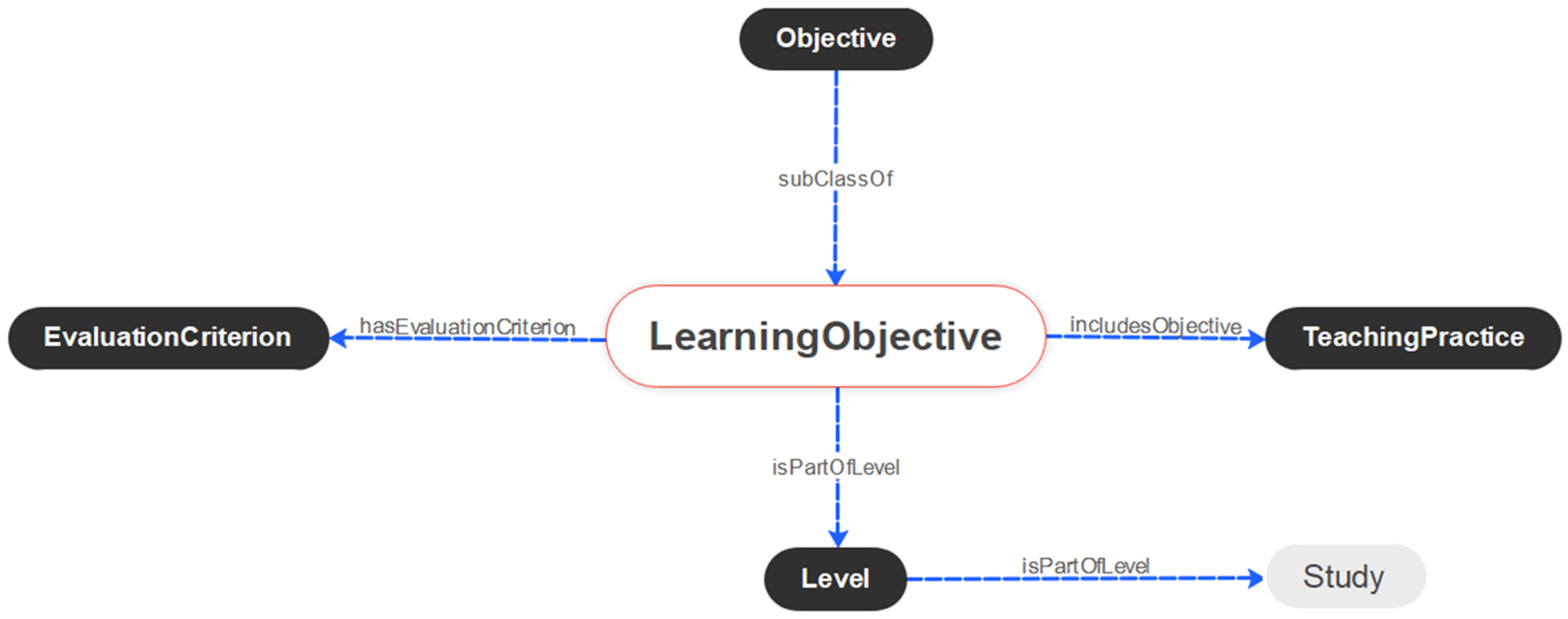
Figure 1. Simplified conceptual overview of the educational ontology, highlighting the core pedagogical classes and their main semantic relationships.
Electronics 15 02071 g001
Figure 2. Representative SPARQL query for retrieving a learning objective together with its label, associated teaching practice, evaluation criterion, and study level.
Electronics 15 02071 g002
Figure 3. Architecture of the proposed framework.
Electronics 15 02071 g003
Figure 4. Indicative screen of the ontology-based educational application developed in AppShee loaded with a teaching practice related to body posture and instrument placement in classical guitar instruction, together with its associated learning objective and evaluation criterion: (left) The visual element provides additional instructional support, (right) the linked records demonstrate how the semantic relationships defined in the ontology are translated into a functional and navigable application interface.
Electronics 15 02071 g004
Table 1. Overview of representative ontology components.
Ontology ComponentRepresentative ElementsRole in the Ontology
Pedagogical core classesLearningObjective, TeachingPractice, EvaluationCriterion, Study, Level, ObjectiveRepresent the central pedagogical structure of the ontology, linking curriculum-derived learning objectives with teaching practices, assessment criteria, study material, and levels of instruction.
Learning-objective classesLearningObjectiveCategory, TechniqueObjectiveCategory, InterpretationObjectiveCategory, SightReadingObjectiveCategory, CreativityObjectiveCategory, HistoryAndAestheticsObjectiveCategoryOrganize learning objectives into pedagogical domains corresponding to technique, interpretation, sight-reading, creativity, and historical/aesthetic knowledge.
Guitar-related classesGuitarParts, Body, Bridge, Fretboard, Frets, Head, Neck, Nut, Rosette, Saddle, SoundHole, Soundboard, Strings, TuningPegsModel the physical structure of the classical guitar and support teaching activities related to instrument knowledge.
Body- and posture-related classesHumanBodyPart, BodyPosture, GuitarPosition, Finger, HandOfBodySide, HandOfNeckSide, Leg, Torso, Thumb, IndexFinger, MiddleFinger, RingFinger, LittleFingerRepresent body parts, posture, hand use, and fingering concepts involved in classical guitar technique.
Musical-content classesExercise, Repertoire, SheetMusic, MusicalActivity, Skill, Topic, Subtopic, HistoricalPeriod, InstrumentRepresent exercises, repertoire, sheet music, musical activities, skills, topics, historical periods, and instruments.
Pedagogical object propertieshasTeachingPractice, includesObjective, hasStudy, includesRepertoire, belongsToCategory, isSubObjectiveOf, hasLevel, isPartOfLevelConnect learning objectives with teaching practices, study material, repertoire, categories, and curriculum levels.
Assessment object propertieshasEvaluationCriterion, evaluatesObjective, evaluatedBy, hasPerformance, participatesInLink learning objectives, evaluation criteria, performance, and assessment-related processes.
Technique-related object propertiesachievesSkill, requiresSkill, hasExercise, hasPreferredFinger, targetsFinger, requiresFinger, usesFinger, usesHandRepresent skill acquisition, technical requirements, exercise-based practice, fingering, and hand use.
Instrument and structural object propertiesincludesPart, isPartOfCombination, includesInstrument, includesTopic, hasSubtopic, includesPeriod, supportsPosture, placesRepresent part–whole relations, topic organization, historical period inclusion, instrument-related knowledge, and posture support.
Data propertiesangle, hasDuration, hasResource, hasTempoRange, levelNumberCapture literal-valued attributes related to posture angle, duration, external resources, tempo range, and level numbering.
Learning-objective individualsObjective 1.1.1—Body posture & instrument placement, Objective 1.1.2—Open-string exercises, Objective 1.1.8—Scales, arpeggios & chords, Objective 1.4—Prima vista reading, Objective 1.6—Melody composition & song accompanimentInstantiate curriculum derived learning objectives for first-level classical guitar instruction.
Teaching-practice individualsTeaching Practice 1.1.1—Posture & instrument placement, Teaching Practice 1.1.2—Open-strings, Teaching Practice 1.1.8.1—Major/minor scales, Teaching Practice 1.1.8.2—Arpeggios, Teaching Practice 1.4.3—Melodic prima vista, Teaching Practice 1.6.2—Song selection & accompanimentRepresent concrete instructional practices associated with learning objectives and classroom activities.
Evaluation-criterion individualsEvaluation Criterion 1.1.1—Body posture & instrument placement, Evaluation Criterion 1.1.8—Scales, arpeggios and chords, Evaluation Criterion 1.2.1—Repertoire, Evaluation Criterion 1.4—Prima vista, Evaluation Criterion—Minimum requirements (Level 1)Instantiate assessment criteria used to evaluate the achievement of specific learning objectives.
Repertoire and study individualsD. Aguado—Study No. 9, D. Aguado—Study No. 16, M. Giuliani—Op. 100 No. 1, J. Sagreras—Book 1, Exercise 7, E. Pujol—Exercise No. 20, Anonymous—Greensleeves, Traditional—KumbayaRepresent repertoire, studies, and exercises used as educational material within the Level 1 curriculum.
Instrument and accessory individualsClassical Guitar, Electric Guitar, Flamenco Guitar, Folk Guitar, Twelve-string Guitar, Footstool, Metronome, Music Stand, Tuner, CapoRepresent instruments and supporting accessories relevant to classical guitar instruction and practice.
Historical-period individualsMedieval Period, Renaissance Period, Baroque Period, Classical Period, Romantic Period, Modern PeriodRepresent historical periods used in the organization of music-history and aesthetics-related knowledge.
Disclaimer/Publisher’s Note: The statements, opinions and data contained in all publications are solely those of the individual author(s) and contributor(s) and not of MDPI and/or the editor(s). MDPI and/or the editor(s) disclaim responsibility for any injury to people or property resulting from any ideas, methods, instructions or products referred to in the content.