1. Introduction
Robots are becoming central actors in modern mining operations, performing tasks such as excavation, inspection, surveying, and safety monitoring. Unlike structured industrial settings, mining environments, both open-pit and underground, are highly dynamic, partially observable, and continuously altered by blasting, excavation, and material transport. For robots to operate efficiently and safely under such conditions, autonomy alone is insufficient; they should work within persistent digital environments that maintain continuity between physical processes, machine actions, and human oversight [
1]. Such digital environments, often described through concepts such as digital twins or digital representations, serve not as static models, but as living operational spaces. Robot localization, hazard reasoning, coordination with each other, and interaction with human supervisors are all done within digital realms like these. Recent work in mining robotics and heavy machinery has demonstrated that digital twins can support real-time decision-making by tightly coupling physical machines with virtual counterparts that evolve alongside the environment [
2]. In this view, digital twins are not auxiliary tools for automation, but the substrate in which robotic systems perceive, plan, and act. However, the viability of such fully robotized mining systems is mostly constrained by sensing. Mining environments are among the harshest industrial settings. In practice, they do not comply with the assumptions underlying conventional perception pipelines: illumination varies abruptly, dust and debris obscure visibility, structural geometry changes after each operation, and high-energy events introduce rapid transients. Frame-based sensing architectures struggle to provide the temporal fidelity and robustness required for maintaining a consistent digital state under such conditions [
3]. As a result, digital representations built on these pipelines often degrade precisely, when robots most need to bank on reliable situational awareness. This limitation becomes especially acute for robots operating in close proximity to humans or heavy machinery. Safe robotic behavior in mining depends on the timely perception of motion, deformation, and unexpected events, rather than a detailed semantic reconstruction. Studies in field robotics and safety-critical systems increasingly emphasize that latency and responsiveness, rather than visual completeness, are decisive factors for robust operation in unstructured environments [
4]. These observations motivate architectures leaning toward change detection and temporal precision, rather than appearance. Event-based sensing provides a natural foundation for this. By reporting asynchronous changes in the visual field with microsecond-level latency and high dynamic range, event-based sensors align more closely with the physical dynamics encountered in difficult environments, such as the mining ones [
5]. Instead of reconstructing scenes frame by frame, robotic systems can directly respond to motion, vibration, and transient phenomena that signal risk or opportunity.
Moreover, when integrated with complementary modalities such as LiDAR, inertial sensing, or positioning cues, event-based perception supports robust situational awareness under conditions where conventional cameras fail [
6]. Crucially, event-based sensing is not merely an alternative sensor modality; it reshapes how digital twins are maintained. Persistent digital environments depend on continuous updates that reflect real physical change. Asynchronous sensing enables these updates to occur at the temporal scale of the environment itself, reducing the mismatch between physical events and their digital counterparts. For robots operating in mines, this means that the digital environment remains actionable even during blasting, material flow, or rapid vehicle motion, periods traditionally treated as sensing blind spots [
7]. From a robotics perspective, such sensing capabilities shift the emphasis toward competent robotic agents embedded within evolving digital environments. The digital twin provides a form of operational grounding, allowing the robotic agent to evaluate and select actions based on optimised scenario sets executed within the twin, and to deploy the most appropriate decision in the physical world. This process, however, is only feasible if robots can maintain fast, real-time perception of the physical environment with which they interact. Human operators, in turn, engage with these same digital environments, enabling supervision, intervention, and coordination without the need for continuous direct control. Such human–robot coexistence is increasingly recognised as essential for the deployment of robotics in safety-critical industrial domains [
8].
The implication for mining robotics is clear. Progress will not come from incremental improvements to isolated perception or planning modules, but from designing sensing and representation architectures that treat temporal dynamics, uncertainty, and partial observability as first-class constraints. Event-based sensing offers a foundational capability in this direction, enabling digital environments that remain coherent under extreme conditions and allow robotic systems to operate with the responsiveness required by real mining operations. In this sense, the future of robotic mining lies not in replacing human labor through automation, but in creating shared digital environments where robots, humans, and machines coexist, coordinate, and adapt. Event-based sensing does not solve mining autonomy on its own, but without it the digital worlds required for truly capable mining robots cannot be sustained.
Contributions:
This work proposes a unified conceptual framework that integrates event-driven perception with digital twin modeling for autonomous robotic mining systems:
We propose a conceptual reference architecture that integrates event-based vision with digital twin technologies, specifically tailored to the challenges of dynamic and low-visibility mining environments.
We introduce a multi-layer perception framework that combines event-based cameras with complementary sensing modalities, including LiDAR, IMUs, and RGB cameras, designed to support robust perception under challenging conditions.
We formalize the system-level information flow across sensing, event-driven perception, digital twin synchronization, and decision-making, outlining a conceptual unified pipeline for event-driven robotic systems.
We identify and discuss representative mining scenarios (e.g., tunnel inspection, autonomous navigation, hazard detection, and digital twin updating) in which event-based perception is expected to provide system-level advantages compared to conventional frame-based pipelines, subject to future experimental validation.
We articulate a system-level integration perspective of event-driven perception and digital twin technologies, and outline key implementation considerations and future evaluation directions for mining robotics.
This work presents a conceptual framework for the integration of event-driven sensing within robotic mining systems, explicitly positioned as a viewpoint and reference-architecture contribution. The paper focuses on system-level design rather than the experimental evaluation of individual algorithms. The proposed approach structures the interaction between sensing, perception, and decision-making layers to support real-time operation in dynamic and safety-critical environments. While significant progress has been made in event-based vision and digital twin technologies, existing research has largely developed these domains independently. Event-driven perception has primarily focused on algorithmic advances such as SLAM and motion estimation, whereas digital twin frameworks have mainly been applied in structured industrial settings. As a result, the integration of asynchronous perception, multi-sensor fusion, and real-time digital twin synchronization remains underexplored, particularly in unstructured environments such as mining. To address this gap, the present work proposes a unified conceptual architecture that tightly couples event-based perception with digital twin modeling, aiming to support responsive and adaptive robotic operation. Rather than claiming full-system validation, this viewpoint organizes the design space, highlights key integration challenges, and outlines implementation considerations and evaluation directions for future mining robotics systems.
2. Background and State of the Art
Event-based vision has emerged as a promising paradigm in computer vision and robotics, offering an alternative sensing approach to conventional frame-based imaging systems. Traditional cameras capture full image frames at fixed temporal intervals, typically ranging from 30 to several hundred frames per second. While this sensing approach has proven effective for a wide range of applications, it introduces inherent limitations such as motion blur, high data redundancy, and latency in highly dynamic environments. Event-based cameras, also referred to as neuromorphic cameras or Dynamic Vision Sensors (DVS), operate under a fundamentally different sensing principle [
5]. Instead of periodically sampling the full image plane, each pixel independently detects changes in log-intensity and asynchronously emits events when the local brightness change exceeds a predefined threshold [
9]. Each event encodes the pixel location, timestamp, and polarity of the brightness change, resulting in a sparse stream of spatio-temporal events rather than dense image frames.
This sensing mechanism provides several advantages over conventional frame-based cameras. Event cameras offer extremely high temporal resolution, often in the order of microseconds, enabling the capture of very fast motions without motion blur. Additionally, event cameras exhibit a significantly higher dynamic range, typically exceeding 120 dB, which allows for them to operate reliably under challenging illumination conditions such as high contrast scenes or rapid lighting changes [
10]. Furthermore, since events are generated only when changes occur in the visual field, the resulting data stream is inherently sparse, reducing bandwidth requirements and enabling low-latency perception pipelines [
11]. Inspired by the biological retina, neuromorphic vision sensors represent a shift from frame-driven perception to event-driven sensing. In biological vision systems, retinal ganglion cells respond primarily to changes in visual stimuli rather than absolute intensity values. Event cameras emulate this principle by detecting temporal contrast changes at each pixel independently, resulting in asynchronous and efficient sensory processing [
12]. This biologically inspired sensing paradigm has attracted significant attention in fields such as robotics, autonomous navigation, industrial inspection, and high-speed motion analysis.
Over the past decade, event-based vision has evolved from a niche research topic into an active field of computer vision and neuromorphic engineering. Advances in sensor hardware, algorithmic frameworks, and machine learning techniques have enabled the development of event-based approaches for tasks including optical flow estimation, visual odometry, object detection, and simultaneous localization and mapping (SLAM) [
9]. In particular, event-based perception has demonstrated strong potential for applications requiring ultra-low latency and high-speed sensing, such as drone navigation and agile robotic systems. Despite these advantages, event-based vision also introduces new computational challenges. The asynchronous nature of event streams requires novel data representations and processing algorithms that differ fundamentally from conventional image processing pipelines [
13]. Recent research has therefore focused on developing specialized event representations, including time surfaces, event frames, and voxel grids, which enable compatibility with both classical computer vision techniques and modern deep learning architectures [
14]. As research in this area continues to expand, event-based sensing is increasingly being integrated with complementary sensing modalities such as standard RGB cameras, LiDAR, and inertial measurement units (IMUs). These hybrid perception systems leverage the strengths of both frame-based and event-based sensing, enabling robust perception across a wide range of operating conditions.
2.1. Event-Based Vision: Principles and Sensor Evolution
Event-based cameras are designed to emulate key principles of biological vision by operating asynchronously and responding only to changes in brightness. Each pixel in the sensor continuously monitors the logarithmic intensity of incoming light and generates an event whenever the change in brightness exceeds a predefined contrast threshold [
9]. This event is represented as a tuple
, where
denotes the pixel location,
t represents the timestamp with microsecond precision, and
p indicates the polarity of the brightness change. The first widely adopted event-based sensor was the Dynamic Vision Sensor (DVS), which demonstrated the feasibility of asynchronous visual sensing in silicon retinas. Early DVS designs achieved temporal resolutions on the order of microseconds while maintaining extremely low power consumption and high dynamic range [
12]. These characteristics made event cameras particularly suitable for high-speed robotics and low-latency perception tasks. Subsequent developments introduced hybrid sensors that combine event-based sensing with traditional frame-based imaging. One notable example is the Dynamic and Active Pixel Vision Sensor (DAVIS), which integrates a conventional active pixel sensor (APS) alongside the event-based DVS array [
15]. This hybrid architecture enables simultaneous acquisition of intensity images and asynchronous event streams, facilitating the integration of event-based data with conventional computer vision algorithms.
Recent generations of event cameras have significantly improved spatial resolution, sensitivity, and noise performance. Modern commercial sensors developed by companies such as Prophesee, iniVation, and Samsung now provide higher pixel densities, improved contrast sensitivity, and mature software ecosystems supporting real-time processing pipelines. These advances have accelerated the adoption of event-based vision in applications including autonomous driving, robotics, augmented reality, and industrial monitoring [
10]. Alongside hardware improvements, the algorithmic ecosystem for event-based vision has also expanded considerably. Research efforts have developed novel approaches for event-based feature detection, motion estimation, visual odometry, and deep learning-based perception. In particular, event-driven SLAM systems and event-based neural networks have demonstrated promising performance in dynamic and high-speed environments where traditional vision systems struggle [
9]. Overall, the continued evolution of neuromorphic vision sensors and processing algorithms suggests that event-based perception will play an increasingly important role in next-generation robotic and autonomous systems.
2.2. Event-Driven Perception and State Estimation
Event-driven perception has become an important research direction in robotics and autonomous systems due to the unique sensing properties of event-based cameras. Unlike conventional frame-based perception pipelines, event-driven systems process asynchronous streams of brightness changes that encode scene dynamics with microsecond temporal resolution. This sensing paradigm enables low-latency perception and efficient processing in highly dynamic environments, making event cameras particularly suitable for robotic navigation, high-speed motion analysis, and agile autonomous systems [
9]. One of the main research challenges in event-based perception is the estimation of the state of a dynamic system from asynchronous event streams. In robotics, state estimation typically refers to the process of estimating variables such as position, velocity, orientation, or environmental structure based on sensor observations. Traditional visual state estimation approaches rely on frame-based images and employ feature detection, tracking, and geometric optimization techniques. However, the asynchronous nature of event data requires the development of new representations and estimation methods specifically designed for event streams [
16]. Several event-based perception algorithms have been proposed to address tasks such as optical flow estimation, visual odometry, and simultaneous localization and mapping (SLAM). Optical flow estimation from event streams exploits the temporal structure of events to estimate local motion patterns with extremely high temporal resolution [
13]. Early approaches relied on local plane fitting in the spatio-temporal event space, allowing for the estimation of motion vectors from clusters of events generated by moving edges [
17,
18].
Event-based visual odometry methods extend these concepts to estimate the motion of a camera over time. In such systems, the motion of the sensor is inferred from the geometric relationships between events generated by scene structures. Approaches based on contrast maximization and probabilistic filtering have demonstrated promising results in estimating camera trajectories in highly dynamic scenes [
9,
19]. Another important research direction concerns event-based simultaneous localization and mapping (SLAM). Event-driven SLAM systems aim to reconstruct the structure of the environment while simultaneously estimating the pose of the sensor. Several approaches integrate event-based feature tracking with probabilistic state estimation frameworks such as extended Kalman filters or factor graph optimization [
20]. These systems have demonstrated the ability to operate reliably in challenging conditions including high-speed motion, low illumination, and scenes with large dynamic range. More recently, deep learning approaches have been introduced to process event streams and perform perception tasks such as object detection, motion segmentation, and state estimation. Neural network architectures designed for event-based data often rely on spatio-temporal representations such as voxel grids, time surfaces, or event frames that allow for event streams to be processed using convolutional neural networks. These methods have shown promising results in bridging the gap between event-based sensing and modern machine learning frameworks [
18]. Overall, event-driven perception and state estimation continue to be active research areas. The combination of high temporal resolution, low latency sensing, and sparse data representation makes event-based vision particularly attractive for next-generation robotic perception systems operating in dynamic and challenging environments.
2.3. Event-Based Sensing in Dynamic and Safety-Critical Environments
Event-based sensing has attracted significant attention in recent years for applications operating in highly dynamic and safety-critical environments. Traditional frame-based cameras often struggle in such scenarios due to limitations including motion blur, latency, and limited dynamic range. In contrast, event-based cameras asynchronously detect brightness changes at the pixel level and generate events with microsecond temporal resolution, enabling perception systems to react rapidly to fast-changing visual stimuli [
5,
12]. These properties make event-driven sensing particularly suitable for environments where rapid response and robust perception are essential. For example, in autonomous navigation and robotics, event-based cameras have demonstrated strong performance in high-speed scenarios where conventional cameras produce blurred or unreliable images. The ability to detect motion with extremely low latency allows for robotic platforms to estimate motion, track objects, and avoid obstacles more effectively in dynamic environments [
16,
20]. Safety-critical applications such as autonomous vehicles, aerial drones, and industrial monitoring systems also benefit from the high dynamic range of event cameras. Conventional sensors often fail in scenes with extreme illumination contrasts, such as tunnels, night driving, or environments with strong shadows and glare. Event-based sensors, however, typically achieve dynamic ranges exceeding 120 dB, enabling reliable perception under challenging lighting conditions [
15,
21]. In addition to robotics and autonomous driving, event-based sensing has shown promise in high-speed tracking and surveillance applications. Because events encode precise temporal information, event cameras can detect rapid object motion and enable real-time tracking even in scenarios where traditional frame rates are insufficient. This capability is particularly important in safety-critical monitoring systems where early detection of anomalies or hazardous events is required [
5,
17].
Recent research has also explored the integration of event-based sensing with complementary perception modalities such as inertial sensors, LiDAR, and conventional cameras. Multi-sensor fusion approaches allow for event cameras to contribute high-frequency motion information while other sensors provide structural or geometric context. Such hybrid perception frameworks have demonstrated improved robustness and reliability in challenging operating conditions, particularly in robotics and autonomous navigation tasks [
19]. Overall, the unique characteristics of event-based sensing, including high temporal resolution, low latency, sparse data representation, and high dynamic range, make it a promising technology for perception systems operating in dynamic and safety-critical environments. As sensor technology and processing algorithms continue to mature, event-driven vision is expected to play an increasingly important role in next-generation autonomous and safety-aware systems.
2.4. Robotics and Digital Twin Technologies in Mining
The increasing automation of mining operations has led to growing interest in robotic systems capable of performing inspection, monitoring, and navigation tasks in hazardous environments. Autonomous and semi-autonomous robotic platforms have been investigated for underground exploration, mapping, and infrastructure inspection in mining sites, aiming to reduce human exposure to dangerous conditions while improving operational efficiency and situational awareness [
22,
23]. Recent advances in robotics and sensing technologies have enabled the development of intelligent mining systems equipped with multi-modal sensing capabilities, including LiDAR, cameras, and inertial measurement units [
24,
25]. These sensing modalities support localization, mapping, and environment perception in challenging underground conditions characterized by dust, low illumination, and complex geometries [
22].
In parallel, the concept of digital twins has emerged as an important paradigm for monitoring and managing industrial systems. A digital twin represents a continuously updated virtual model of a physical environment that integrates sensor observations, system states, and operational data. Such systems enable real-time monitoring, predictive maintenance, and improved decision-making in industrial environments [
26,
27,
28]. Despite these advances, maintaining accurate and up-to-date digital representations of highly dynamic mining environments remains a significant challenge. Conventional frame-based perception systems may struggle to capture rapid environmental changes caused by machinery operation, structural shifts, or environmental disturbances. These limitations highlight the need for sensing technologies capable of capturing high-frequency environmental dynamics. Event-based vision sensors provide a promising alternative sensing paradigm due to their asynchronous operation, high temporal resolution, and high dynamic range [
5]. When integrated with robotic perception pipelines and digital twin environments, event-driven sensing technologies can significantly enhance the responsiveness and robustness of autonomous robotic systems operating in complex mining environments.
2.5. Limitations and Research Gap
Despite the rapid progress in event-based vision over the past decade, several limitations remain that hinder the widespread adoption of event-driven sensing in real-world applications. Although event cameras offer significant advantages such as microsecond temporal resolution, low latency, and high dynamic range, their asynchronous output introduces new challenges for perception algorithms and system integration [
5,
12]. One major limitation concerns the representation and processing of event streams. Unlike conventional image frames, event data are sparse and asynchronous, which makes them incompatible with many traditional computer vision algorithms. As a result, specialized representations such as event frames, time surfaces, and voxel grids are often required to convert event streams into formats suitable for processing by conventional vision pipelines or deep learning architectures [
9]. However, these transformations may partially reduce the inherent advantages of event-driven sensing by introducing artificial discretization or additional computational overhead. Another challenge lies in the relatively low spatial resolution of current event cameras compared to modern frame-based imaging sensors. Although recent generations of neuromorphic sensors have improved pixel density and sensitivity, event cameras still typically operate at lower spatial resolutions than conventional RGB cameras, which can limit their effectiveness in applications requiring detailed scene understanding or high-precision feature extraction [
15,
21].
Furthermore, the development of robust event-based perception algorithms remains an active research area. Tasks such as object detection, scene reconstruction, and semantic understanding are significantly more complex when relying solely on event streams. Many existing approaches therefore rely on hybrid perception systems that combine event cameras with additional sensors such as inertial measurement units (IMUs), LiDAR, or conventional frame-based cameras [
16,
20]. While these multi-sensor systems improve robustness, they also introduce additional complexity in sensor calibration, synchronization, and data fusion. Another important limitation concerns the availability of standardized datasets and benchmarking frameworks for event-based vision. Compared to traditional computer vision, where large-scale datasets have enabled rapid algorithmic progress, event-based perception has historically suffered from limited datasets and evaluation benchmarks. Although recent datasets have addressed some of these limitations, further work is required to establish widely accepted evaluation protocols and reproducible benchmarking environments [
16]. These challenges highlight an important research gap in the development of robust, scalable, and computationally efficient event-driven perception systems. In particular, there is a need for perception frameworks capable of fully exploiting the temporal precision and sparse nature of event streams while maintaining compatibility with modern machine learning and robotics pipelines. Addressing these limitations will be essential for enabling the reliable deployment of event-based sensing technologies in real-world dynamic and safety-critical environments [
19]. Despite significant progress in event-based vision and robotic perception, existing studies primarily focus on algorithmic development or isolated robotic perception tasks. Similarly, research on digital twins in industrial systems has largely concentrated on manufacturing environments rather than dynamic field robotics applications. To the best of our knowledge, a unified system-level framework that integrates event-driven perception, multi-sensor fusion, and digital twin synchronization for autonomous robotic mining operations has not yet been systematically investigated. This gap motivates the conceptual architecture proposed in this work.
Unlike existing approaches that focus either on robotic perception or digital twin modeling, the proposed framework provides a unified architecture that explicitly links event-based sensing with dynamic environment representation and control. This integration is particularly relevant for mining environments, where rapid environmental changes and uncertainty require continuous and adaptive perception.
2.6. What Is Novel in the Proposed Framework
While prior work has extensively explored event-based perception and digital twin technologies as separate research directions, the contribution of this study lies in their explicit system-level integration within the context of autonomous mining robotics. Existing research in event-based vision has primarily focused on algorithmic developments such as visual odometry, SLAM, and motion estimation, whereas digital twin technologies have largely evolved within structured industrial environments, particularly in manufacturing and smart production systems. As a result, the coupling between asynchronous perception, multi-sensor fusion, and real-time digital twin synchronization remains insufficiently explored, especially in unstructured, dynamic, and communication-constrained environments such as mining.
The novelty of the proposed framework does not reside in the introduction of a new sensing modality or a novel digital twin model, but rather in the definition of a unified architectural paradigm that explicitly links perception, representation, and decision-making through an event-driven perspective. In particular, the framework introduces an asynchronous integration mechanism between the Event-Driven Perception layer and the Digital Twin layer, enabling event-triggered updates that reduce latency between physical environmental changes and their virtual representation. This contrasts with conventional approaches that rely on frame-based sensing and periodic synchronization, which may introduce delays and reduce responsiveness under highly dynamic conditions.
Furthermore, the proposed architecture establishes a closed-loop interaction between multi-sensor perception, digital twin modeling, and decision-making processes, allowing robotic agents to operate within continuously evolving digital environments. By structuring the system into layered components operating at different temporal scales, the framework supports both high-frequency local perception and lower-frequency global coordination, addressing key challenges related to scalability, modularity, and communication constraints. This system-level integration perspective, tailored to the specific characteristics of mining environments, represents a conceptual advancement beyond existing approaches that treat perception and digital representation as loosely coupled components. Accordingly, the proposed novelty should be understood as an architectural and integration-level contribution, rather than as a new sensing device, perception algorithm, or experimentally validated mining robot.
3. Conceptual Framework for Event-Based Robotic Mining
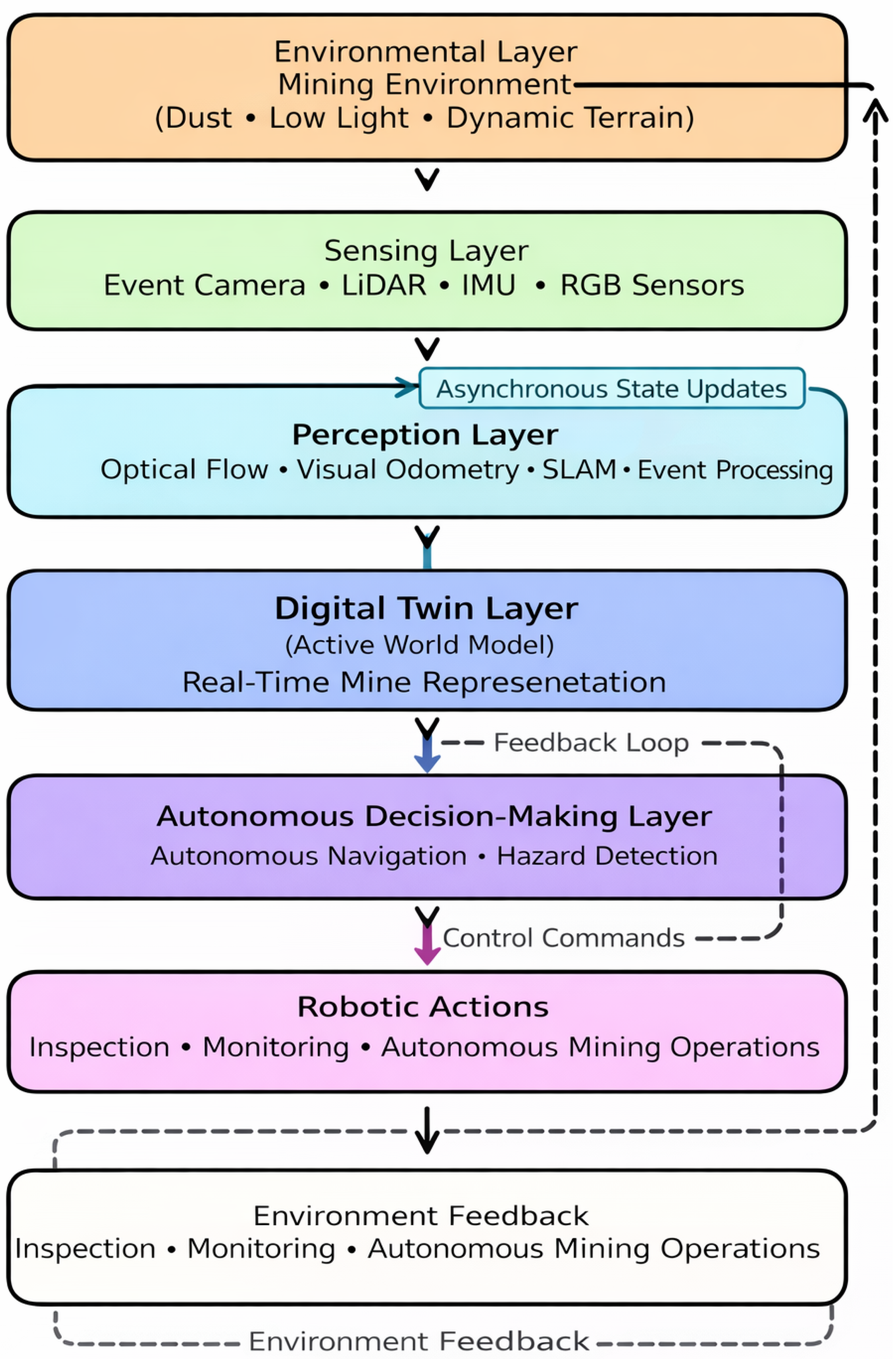
Building upon the limitations identified in existing approaches, the proposed framework is designed to address three key challenges: (i) high-temporal-resolution perception, (ii) continuous environment representation through digital twins, and (iii) adaptive decision-making under uncertainty. To this end, a layered architecture is adopted, enabling a structured integration of sensing, perception, modeling, and control components. So, this section presents the proposed conceptual framework for integrating event-based sensing technologies into robotic mining systems. The framework is structured into multiple functional layers describing the flow of information from environmental sensing to autonomous robotic decision-making. As illustrated in
Figure 1, the architecture begins with environmental perception and progresses through sensing, event-driven perception, digital twin integration, and decision-making layers that ultimately drive robotic actions in mining operations.
3.1. Design Rationale of the Layered Architecture
The proposed architecture is structured into distinct layers to separate sensing, perception, representation, and decision-making processes according to their functional roles and temporal requirements.
The Hardware and Sensing layers operate at high frequency, capturing raw environmental data and ensuring synchronization across heterogeneous modalities. The Event-Driven Perception layer processes asynchronous data streams, focusing on extracting motion and environmental changes with minimal latency.
Figure 1.
Conceptual representation of the proposed architecture for autonomous mining robotics. The framework highlights the asynchronous bridge between the Event-Based Perception Layer and the Digital Twin, which functions as an Active World Model. Unlike static representations, this integration is intended to support low-latency, event-triggered state updates, providing the Decision-Making Layer with high-fidelity environmental context for robust navigation in dynamic and poorly lit mining sites.The architecture emphasizes the decoupling of temporal processing scales across layers, enabling real-time responsiveness under dynamic conditions.
Figure 1.
Conceptual representation of the proposed architecture for autonomous mining robotics. The framework highlights the asynchronous bridge between the Event-Based Perception Layer and the Digital Twin, which functions as an Active World Model. Unlike static representations, this integration is intended to support low-latency, event-triggered state updates, providing the Decision-Making Layer with high-fidelity environmental context for robust navigation in dynamic and poorly lit mining sites.The architecture emphasizes the decoupling of temporal processing scales across layers, enabling real-time responsiveness under dynamic conditions.
The Digital Twin layer operates as a persistent world model, integrating perception outputs into a continuously updated representation of the environment. This layer abstracts raw sensor data into a structured form that supports reasoning, prediction, and planning.
Finally, the Decision-Making layer operates at a higher level of abstraction, using the digital twin as a basis for selecting actions and generating control commands.
This layered separation reflects both computational constraints and system design principles, allowing for each layer to operate at different temporal scales while maintaining a coherent perception–action loop. Alternative architectural designs, such as fully centralized or monolithic perception–decision pipelines, were not adopted due to their limited scalability and reduced robustness under communication constraints. The proposed layered structure enables modularity, distributed processing, and adaptability, which are critical for operation in dynamic and resource-constrained mining environments.
3.2. Layer 0: Hardware Layer
The foundation of the proposed framework is the hardware layer, which provides the physical sensing, computation, and actuation infrastructure required for autonomous robotic operation in mining environments. This layer includes the robotic platforms, sensing devices, onboard computing units, and communication interfaces that enable the acquisition and processing of environmental information.
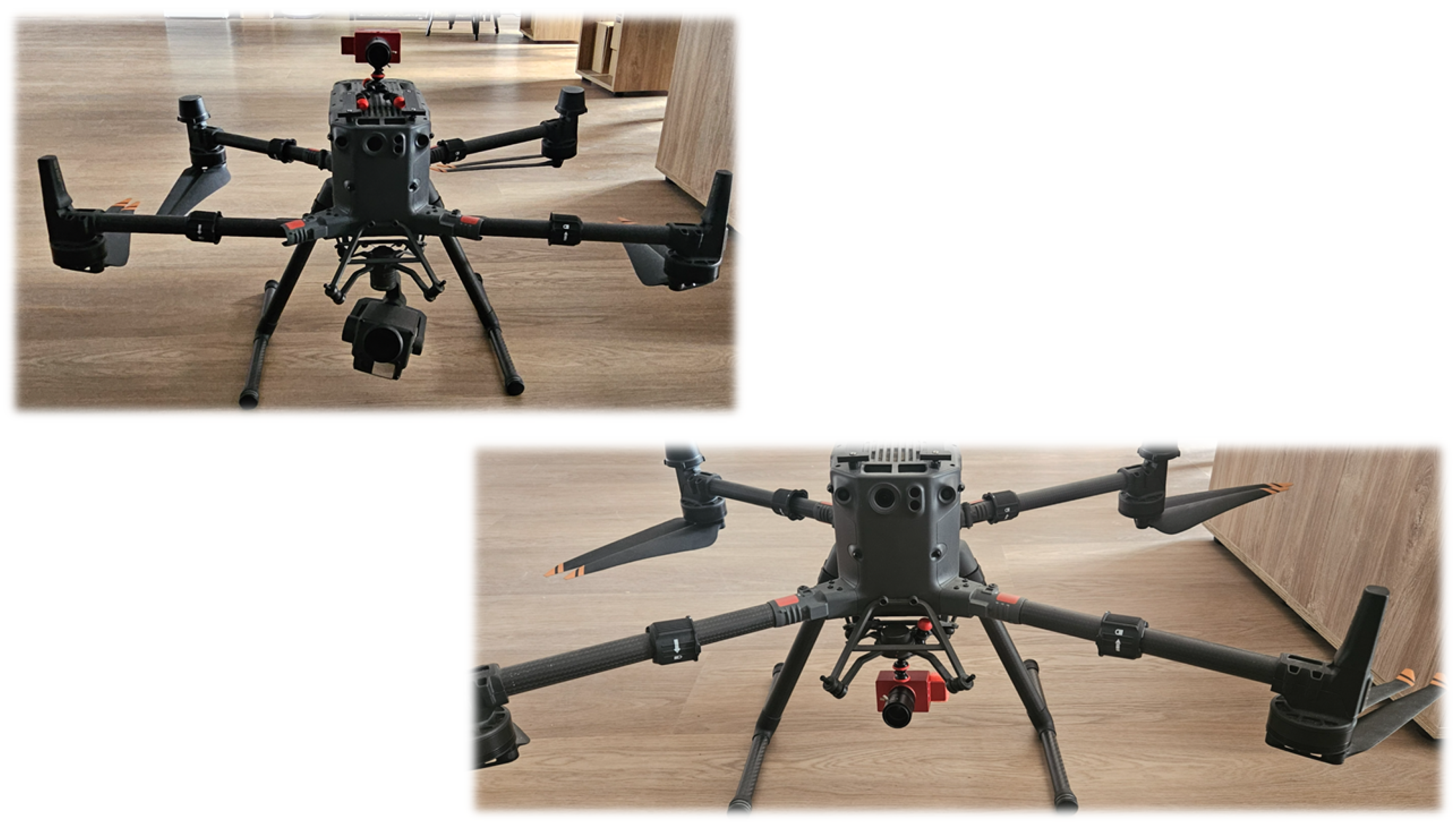
The robotic platforms considered in the proposed framework include both unmanned ground vehicles (UGVs) and unmanned aerial vehicles (UAVs). UGV platforms are typically designed to operate in harsh ground conditions commonly encountered in mining environments, such as uneven terrain, loose rocks, dust, and confined underground tunnels. These systems are equipped with ruggedized chassis, high-torque motors, and suspension mechanisms that enable reliable navigation and inspection tasks within underground galleries and open-pit mining areas. In addition to providing mobility, the UGV platform serves as a stable mounting structure for perception sensors and onboard computing hardware.
Complementing ground-based systems, UAV platforms provide aerial mobility and rapid environmental observation capabilities. UAVs are particularly useful for inspection and monitoring tasks in areas that are difficult or unsafe to access with ground robots, such as high tunnel ceilings, steep open-pit walls, or areas affected by rockfalls and structural instability. By offering an elevated perspective of the mining environment, UAVs enable rapid data acquisition for mapping, inspection, and situational awareness. The main hardware components of the proposed robotic mining platforms, including both ground and aerial systems, are summarized in
Table 1.
The sensing hardware integrated into these platforms includes event-based cameras, LiDAR sensors, inertial measurement units (IMUs), and conventional RGB cameras. Event cameras serve as the primary perception modality for capturing asynchronous brightness changes with microsecond temporal resolution, enabling robust perception in dynamic or low-light mining environments. LiDAR sensors provide dense three-dimensional measurements of the surrounding environment, supporting geometric reconstruction of tunnels and mining galleries as well as obstacle detection. IMUs provide measurements of angular velocity and linear acceleration that support motion estimation and stabilization of both aerial and ground robotic platforms. RGB cameras complement the perception pipeline by providing texture and color information useful for scene interpretation and object recognition.
The hardware layer also incorporates onboard computing units responsible for processing high-frequency sensor streams and executing perception and control algorithms. These computing systems typically consist of embedded GPUs or edge AI accelerators capable of handling event stream processing, multi-sensor fusion, and real-time decision-making. Efficient processing is particularly important for event-based sensing systems, which may generate millions of asynchronous events per second.
Finally, communication interfaces are included in this layer to enable data exchange between the robotic platforms and external monitoring systems. Wireless communication technologies such as Wi-Fi, 5G, or specialized underground communication networks allow the for transmission of perception data, operational status, and sensor measurements to remote control stations or digital twin platforms for monitoring and decision support.
Overall, the hardware layer provides the physical infrastructure that enables the higher-level sensing, perception, and decision-making components of the proposed framework. By integrating robust robotic platforms with advanced sensing technologies and edge computing capabilities, this layer forms the foundation for reliable robotic operation in complex and safety-critical mining environments. Example robotic platforms equipped with event-based vision sensor and others are shown in
Figure 2.
The devices listed in
Table 1 are indicative examples and do not define a fixed hardware configuration. The proposed architecture assumes that the sensing modalities can operate either on a single integrated robotic platform or across coordinated heterogeneous platforms, depending on payload, power, and synchronization constraints.
3.3. Environmental Layer: Mining Operational Context
Mining environments are highly dynamic and uncertain, characterized by evolving terrain geometry, moving machinery, airborne dust, and extreme illumination variations. From a system perspective, the environment at time
t can be described as:
where
represents the geometric structure,
the dynamic objects (e.g., vehicles, robots, workers), and
environmental disturbances such as dust, vibration, and illumination variability. These characteristics make mining environments particularly challenging for conventional perception systems, highlighting the need for sensing approaches capable of operating under high dynamics and uncertainty. The ability to capture rapid changes in the environment is therefore critical for ensuring both operational efficiency and safety.
3.4. Sensing Layer: Event-Based Multi-Sensor Perception
The sensing layer integrates event-based cameras with complementary sensing modalities including LiDAR, inertial measurement units (IMUs), and RGB cameras. Event cameras provide asynchronous measurements of brightness changes with high temporal resolution, while LiDAR, IMUs, and RGB cameras contribute geometric, motion, and semantic information, respectively. The combined multi-modal perception input can be expressed as
where
denotes event data,
LiDAR measurements,
image frames, and
inertial observations. This multi-sensor configuration improves robustness by compensating for the limitations of individual sensing modalities. In particular, event-based sensing provides resilience to illumination changes and motion blur, which are common in underground mining conditions. In mining environments characterized by low visibility and rapid illumination changes, event-based cameras offer significant advantages over frame-based sensors, including reduced latency, high dynamic range, and robustness to motion blur. Multi-sensor fusion in the proposed framework follows a complementary strategy. Event cameras provide high-temporal-resolution motion cues, LiDAR provides geometric structure, IMU provides high-frequency motion estimation, and RGB cameras provide semantic and texture information. Fusion is performed using a hybrid approach combining tightly-coupled state estimation (for motion and pose) and loosely-coupled fusion (for semantic and environmental interpretation), with confidence-weighted integration under degraded sensing conditions.
3.5. Event-Driven Perception Layer
The event-driven perception layer processes asynchronous event streams and extracts information about scene dynamics. Instead of relying on frame-based representations, this layer focuses on spatio-temporal analysis of events to support tasks such as motion estimation, visual odometry, and SLAM. By leveraging the asynchronous nature of event data, this layer enables continuous perception without the latency associated with frame-based systems. This is particularly important in mining environments where rapid changes and dynamic obstacles require immediate response. The event-driven paradigm allows for the system to focus computational resources on relevant changes in the scene.
3.6. Digital Twin Layer
The Digital Twin layer maintains a continuously updated virtual representation of the mining environment by integrating perception outputs and system state information. At a conceptual level, the evolution of the digital twin can be expressed as
where
represents the current digital twin state and
the incoming multi-sensor perception data. The digital twin representation
consists of a hybrid spatial model combining geometric, semantic, and temporal information. Specifically, it may be implemented as a multi-layer representation including voxel grids or point clouds for geometry, semantic labels for object-level understanding, and temporal event streams for capturing dynamic changes.
A key innovation of this framework lies in the “bridge” between asynchronous sensing and the virtual model. Unlike traditional digital twins that rely on periodic, frame-based updates, introducing inherent latency and motion blur, the proposed architecture leverages the sparse and asynchronous nature of event-based data () to perform incremental state updates. The update function operates in an event-driven manner, where only relevant changes in the scene (e.g., moving obstacles or structural shifts) trigger local refinements in the digital twin. his enables the potential for microsecond-level synchronization between the physical environment and its virtual counterpart, aiming to maintain an accurate and up-to-date representation even during high-speed robotic maneuvers or under rapidly changing environmental conditions.
Furthermore, within this framework, the Digital Twin is envisioned not merely as a passive visualization tool for remote monitoring, but as an Active World Model for the autonomous agent. By maintaining a high-fidelity, hallucination-free representation of the surroundings, the Digital Twin layer provides the necessary environmental context to the Decision-Making layer. This enables the robot to perform real-time simulations and predictive assessments, such as evaluating path safety or anticipating potential hazards, before executing actions in the physical space.
Depending on the application requirements, the digital twin may also incorporate neural implicit representations (e.g., neural fields) to enable continuous and high-fidelity modeling of complex mining structures, further enhancing the system’s ability to operate in unstructured and evolving environments. From an implementation perspective, the digital twin can be deployed as a hybrid architecture combining edge and centralized components. Local updates are performed on-board the robotic platform using event-driven perception outputs, while global consistency and long-term storage are maintained through periodic synchronization with external systems. The update mechanism follows an event-triggered paradigm, where only significant changes in the environment lead to local modifications of the twin state. This approach minimizes bandwidth usage and computational load, making it suitable for resource-constrained and communication-limited mining environments. Furthermore, consistency between the physical environment and its digital representation aims to ensure through sensor synchronization and time-aligned fusion strategies, addressing potential latency and drift issues.
3.7. Digital Twin Synchronization Under Communication Constraints
Real-world mining environments impose severe communication limitations, including low bandwidth, high latency, and intermittent connectivity, particularly in underground settings. These constraints directly affect the synchronization between the physical system and its digital twin representation. To address these challenges, the proposed framework adopts a hierarchical and bandwidth-aware synchronization strategy.
Edge-Local Digital Twin Maintenance: A key design principle of the framework is that a local instance of the digital twin is maintained on-board each robotic platform. This local twin is continuously updated using high-frequency perception outputs (e.g., event streams, LiDAR, IMU), enabling real-time situational awareness and decision-making without reliance on external connectivity. This edge-centric approach ensures that critical operations such as navigation and hazard avoidance remain functional even under communication loss.
Event-Driven and Delta-Based Updates: Instead of transmitting full environment representations, the system communicates incremental updates (deltas) to the global digital twin. These updates are triggered by significant changes in the environment, such as the detection of new obstacles, structural modifications, or dynamic hazards. By transmitting only relevant changes, the framework significantly reduces communication overhead while preserving essential information.
Priority-Based Data Transmission: To further optimize bandwidth usage, transmitted information is prioritized based on operational importance. Critical events, such as hazard detections or safety-related alerts, are assigned the highest priority and transmitted immediately. Lower-priority data, such as minor map refinements or non-critical semantic updates, can be delayed or aggregated before transmission.
Multi-Rate Synchronization Strategy: The proposed framework employs a multi-rate synchronization scheme:
A high-frequency local loop operates on-board the robot, continuously updating the local digital twin using sensor data.
A lower-frequency global synchronization loop updates the remote or centralized digital twin, ensuring consistency across multiple agents and long-term storage.
This separation allows for the system to maintain responsiveness at the edge while accommodating communication limitations at the system level.
Store-and-Forward Mechanisms: In cases of intermittent connectivity, the system temporarily stores outgoing updates and transmits them when communication becomes available. This ensures eventual consistency between local and global digital twin states without requiring continuous connectivity.
Consistency and Conflict Resolution: When multiple agents contribute updates to a shared digital twin, inconsistencies may arise due to delays or partial observations. The framework assumes the use of time-stamped updates and confidence-weighted fusion strategies to resolve conflicts. More recent or higher-confidence observations are prioritized during integration into the global model. For multi-agent operation, local observations from each robotic platform are transformed into a shared global map frame before integration into the common digital twin. This can be achieved through SLAM-based map alignment, known calibration parameters, or reference landmarks when available. Each update should therefore include not only timestamped perception data, but also the corresponding robot pose and coordinate-frame transformation.
Graceful Degradation under Network Failure: When communication is severely degraded or unavailable, the system transitions to a fully local operational mode. In this mode, the robot relies exclusively on its local perception and digital twin instance, while suspending non-critical data transmission. Once connectivity is restored, synchronization is resumed using buffered updates.
Overall, this communication-aware synchronization strategy enables the digital twin to remain functional, consistent, and responsive under the challenging network conditions typical of mining environments. It also provides a scalable foundation for multi-agent robotic systems operating in distributed and communication-constrained settings.
3.8. Decision and Control Layer
The final layer of the framework focuses on intelligent decision-making and adaptive robotic control, leveraging recent advances in learning-based planning, foundation models, and digital twin integration. The digital twin operates as a dynamic, continuously updated representation of the environment, enabling predictive analytics, simulation-based optimization, and closed-loop decision support.
Instead of relying solely on classical path planning approaches (e.g., A*, D*, RRT), the framework incorporates learning-based and hybrid planning strategies. In particular, sampling-based planners are enhanced through neural guidance (e.g., Neural RRT*, MPNet) [
29,
30], while trajectory optimization methods such as Model Predictive Control (MPC) are employed for smooth and dynamically feasible motion generation [
31]. Obstacle avoidance and environment representation move beyond traditional occupancy grids to semantic and probabilistic world models. These include learned occupancy fields and neural implicit representations (e.g., Neural Radiance Fields—NeRF) [
32], allowing for the continuous and high-fidelity modelling of complex mining environments:
The control policy is formulated within a reinforcement learning framework:
where
represents the learned world model or digital twin state. Policies are trained using deep reinforcement learning methods such as PPO [
33] and SAC [
34]. To ground the proposed decision-making framework in a realistic mining scenario, consider the case of autonomous navigation in a partially collapsed underground tunnel. In such environments, the robot must continuously adapt its trajectory based on unstable terrain, falling debris, and limited visibility. The robot state
includes its pose, velocity, proximity to obstacles, and local environmental features extracted from the digital twin, while the action
corresponds to motion commands such as velocity and steering adjustments. The digital twin
provides a shared and continuously updated representation of the environment, incorporating both historical and real-time perception data. This allows for the policy
to evaluate potential future states and select actions that minimize risk while ensuring efficient navigation. This closed-loop interaction between perception, digital twin, and control supports the development of robust, adaptive, and context-aware autonomy in highly dynamic mining environments. To further enhance autonomy, the framework explores the integration of Vision-Language-Action (VLA) models and Spatial LLMs [
35], enabling high-level reasoning over spatial data and natural language task specification. By combining neural planning, world models, reinforcement learning, and digital twin feedback, the proposed layer enables robust, adaptive, and context-aware autonomy.
The proposed framework is conceptual and aims to provide a system-level architecture. Experimental validation and implementation are considered as future work.
The overall event-driven perception pipeline, including the flow of data, processing stages, and output information across the system layers, is summarized in
Table 2.
3.9. Interfaces and Inter-Layer Data Exchange
To support reproducibility and clarify the system-level integration, this subsection outlines the conceptual interfaces, data formats, and communication mechanisms between the layers of the proposed architecture.
Sensor Data Interfaces: Each sensing modality provides time-stamped data streams:
Event camera: Asynchronous event stream of the form , where denotes pixel location, t the timestamp, and p the polarity of brightness change.
LiDAR: Time-stamped point clouds representing 3D spatial measurements.
IMU: High-frequency inertial measurements including linear acceleration and angular velocity.
RGB cameras: Image frames with associated timestamps.
Time Synchronization: A shared temporal reference is required to enable consistent multi-sensor fusion. This can be achieved through hardware timestamps or software-based synchronization mechanisms (e.g., ROS 2 clock or Precision Time Protocol—PTP). Time alignment ensures that heterogeneous sensor data can be fused consistently across perception and digital twin layers. In addition to temporal alignment, spatial alignment between sensors and robotic platforms is required. This includes sensor extrinsic calibration and transformation of all measurements into a common robot or map coordinate frame before fusion and digital twin updating.
Middleware and Communication: The interaction between system components can be implemented using middleware frameworks such as ROS 2, leveraging DDS (Data Distribution Service) for real-time communication. This allows for modular data exchange between sensing, perception, and control modules, supporting distributed and scalable deployments.
Inter-Layer Data Flow: The information exchange between layers follows a structured pipeline:
The sensing layer provides synchronized multi-modal data streams.
The event-driven perception layer processes asynchronous events and fused sensor data to estimate motion, extract features, and generate environment representations.
The digital twin layer receives processed perception outputs and updates the virtual representation of the environment.
The decision-making layer consumes the digital twin state to generate control commands for robotic actions.
Digital Twin Update Interface: The communication between perception and digital twin layers is based on incremental updates, including:
Local map updates or geometric changes;
Detected hazards or dynamic events;
Robot pose and state information;
Semantic annotations when available.
Synchronization Strategy: The proposed framework follows a hybrid synchronization scheme:
Event-triggered local updates are performed on-board the robotic platform, allowing for high-frequency adaptation to environmental changes.
Periodic global synchronization ensures consistency between local and remote digital twin instances, particularly in multi-agent scenarios.
This interface definition does not prescribe a specific implementation but provides a reproducible conceptual model that can guide future system development and experimental validation. To further illustrate the practical realization of the proposed framework,
Table 3 presents an indicative implementation stack.
3.10. End-to-End System Operation
To clarify the overall system behavior, the proposed framework operates as follows:
Raw data are acquired from event cameras, LiDAR, IMU, and RGB sensors.
Sensor data are time-aligned and synchronized in the sensing layer.
The event-driven perception layer processes asynchronous events to estimate motion, detect changes, and extract environment features.
Fused perception outputs are used to update the digital twin through incremental, event-triggered updates.
The digital twin maintains a consistent and continuously evolving representation of the environment.
The decision-making layer utilizes the digital twin state to generate control actions.
Control commands are executed by the robotic platform, completing the perception–action loop.
4. Proposed Application Scenarios in Mining Environments
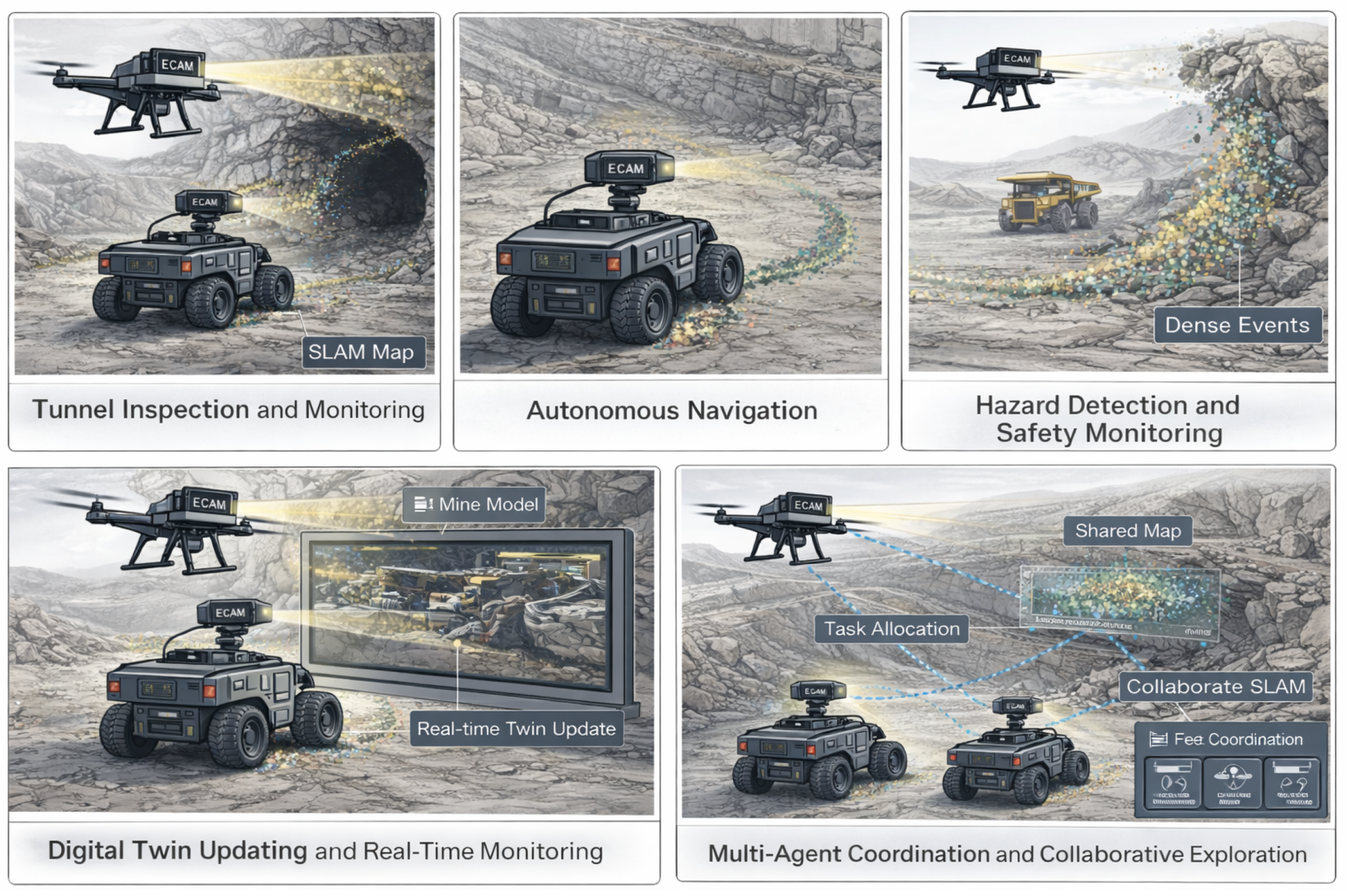
To demonstrate the practical relevance of the proposed framework, this section presents key application scenarios in mining environments. Each application highlights how the different layers of the framework interact to support real-world robotic tasks. As illustrated in
Figure 3, event-based perception can enable several robotic mining applications, including tunnel inspection, autonomous navigation, hazard detection, digital twin updating, and multi-agent coordination.
4.1. Tunnel Inspection and Monitoring
Tunnel inspection is a critical operation in underground mining, requiring reliable perception in environments characterized by low visibility, uneven terrain, and airborne particles. Event-based sensing can enable robust perception under such conditions due to its high dynamic range, low latency, and resilience to motion blur. This can support continuous monitoring of tunnel structures, detection of deformations, and identification of potential hazards in real time. Beyond conventional inspection, event-based perception can support advanced structural assessment by enabling fine-grained temporal analysis of micro-movements and vibrations in tunnel walls. When combined with digital twin models, this enables predictive maintenance strategies, where early signs of structural degradation can be detected and analyzed before critical failures occur. The integration of AI-based anomaly detection methods further enhances the ability to identify subtle changes in the environment that may not be visible through traditional sensing approaches.
4.2. Autonomous Navigation
Autonomous navigation in mining environments is particularly challenging due to dynamic obstacles, poor lighting, and complex geometries. Event-based perception provides low-latency sensing and efficient detection of motion changes, enabling faster and more reliable obstacle avoidance and path planning. This is especially important for both UGVs and UAVs operating in confined underground spaces. In addition to classical navigation pipelines, event-driven data can be integrated with learning-based planning and control methods, enabling adaptive navigation in highly dynamic and partially unknown environments. By leveraging digital twin feedback and predictive models, robotic systems can anticipate environmental changes and adjust their trajectories proactively. This supports more robust operation under uncertainty and enables continuous navigation even in GNSS-denied conditions commonly encountered in underground mines.
4.3. Hazard Detection and Safety Monitoring
Safety is a primary concern in mining operations, where hazards such as falling rocks, moving equipment, and environmental instabilities are common. Event-driven perception allows for the rapid detection of sudden changes in the environment, with the potential to improve the responsiveness of robotic systems. This capability enhances early warning mechanisms and supports safer interaction between humans and machines. Moreover, the combination of event-based sensing with AI-driven classification and risk assessment models enables automated hazard recognition and prioritization. By continuously analysing spatio-temporal patterns, the system can distinguish between normal operational changes and critical safety threats. Integration with digital twin platforms further allows simulation of hazard scenarios and evaluation of mitigation strategies, contributing to improved safety planning and decision support.
4.4. Digital Twin Updating and Real-Time Monitoring
The integration of event-based sensing with digital twin technologies enables continuous and efficient updating of virtual representations of the mining environment. Due to the asynchronous nature of event data, only relevant changes are captured and transmitted, reducing computational load and communication requirements. This facilitates real-time monitoring and supports predictive analysis for improved operational decision-making. In this context, digital twins evolve from static representations to dynamic, learning-enabled systems that incorporate real-time sensor feedback, historical data, and predictive models. This enables continuous synchronization between the physical and virtual environments, supporting advanced functionalities such as scenario simulation, anomaly detection, and optimization of mining operations. The integration of neural scene representations and world models further enhances the fidelity and adaptability of the digital twin.
From a system perspective, multi-agent coordination requires both temporal and spatial consistency. Each agent maintains a local reference frame and time-stamped observations, which are aligned to a shared global coordinate system through pose estimation and map registration. Synchronization across agents is achieved through time-aligned updates and confidence-weighted fusion, allowing the system to resolve inconsistencies caused by communication delays or partial observations. This ensures that the shared digital twin remains consistent despite distributed sensing and asynchronous updates.
4.5. Multi-Agent Coordination and Collaborative Exploration
Modern mining operations increasingly rely on the coordinated deployment of multiple robotic agents, including Unmanned Ground Vehicles (UGVs) and Unmanned Aerial Vehicles (UAVs), to improve coverage, efficiency, and operational safety. In this context, event-based sensing provides a significant advantage by enabling low-latency information sharing and efficient detection of dynamic changes across agents. Multi-agent coordination allows robots to collaboratively explore unknown environments, distribute sensing tasks, and share situational awareness through a common digital twin. For instance, UAVs can rapidly map large or hard-to-reach areas from above, while UGVs perform detailed inspection and in-situ measurements. Event-driven perception enables fast detection of environmental changes, which can be propagated across the robotic team to update shared maps and adapt mission plans in real time.
Coordination strategies may be implemented using decentralized or semi-centralized approaches, leveraging graph-based communication models and multi-agent reinforcement learning techniques. These methods allow agents to learn cooperative behaviours such as task allocation, collision avoidance, and adaptive path planning under uncertainty. The integration of multi-agent systems with digital twin technology further enhances operational intelligence, enabling simulation of coordinated missions, prediction of system-level performance, and optimization of resource allocation. This collaborative paradigm significantly extends the capabilities of individual robotic platforms, supporting scalable and resilient mining operations. From a system perspective, multi-agent coordination can be formulated as a decentralized decision-making process, where each agent operates based on its local state and a shared digital twin representation of the environment. The shared digital twin enables agents to exchange information, coordinate actions, and adapt their behavior in real time. Communication is typically achieved through graph-based networks, allowing for efficient information sharing even under constrained connectivity conditions.
5. Discussion
Firstly, it is important to clarify that the proposed framework should be interpreted as a conceptual and architectural contribution. While the discussion highlights expected system-level properties such as robustness, responsiveness, and improved synchronization between the physical and digital domains, these aspects have not been experimentally validated within the scope of this work. Instead, they represent design hypotheses and anticipated benefits that motivate future research. Systematic experimental, simulation-based, or prototype-level validation remains an important direction for future work.
In general, the increasing automation of mining operations necessitates perception systems capable of maintaining reliable performance under highly dynamic, uncertain, and visually degraded conditions. Conventional frame-based perception pipelines, although effective in structured environments, exhibit inherent limitations in mining contexts due to motion blur, latency, and restricted dynamic range, particularly under conditions of abrupt illumination changes, airborne dust, and rapid mechanical activity. These limitations directly affect the ability of robotic systems to maintain accurate situational awareness and, consequently, to operate safely and efficiently.
Within this context, event-based sensing provides a fundamentally different perception paradigm, enabling asynchronous detection of brightness changes with microsecond temporal resolution. As discussed in earlier sections, this capability allows for robotic systems to capture high-speed environmental dynamics with minimal latency and reduced data redundancy. However, the contribution of this work extends beyond the use of event-based sensing alone, emphasizing its integration within a broader multi-sensor and system-level framework. By combining event cameras with LiDAR, IMU, and RGB sensors, the proposed architecture leverages complementary sensing characteristics, where event-based data provide high-frequency motion information, LiDAR contributes geometric structure, IMUs support motion estimation, and RGB sensors provide semantic context. This multi-modal approach enhances robustness, particularly in conditions where individual sensing modalities may degrade. A central aspect of the proposed framework is the role of the digital twin as an active and continuously evolving representation of the mining environment, rather than a passive visualization tool. The integration of event-driven perception with digital twin updating enables near real-time synchronization between the physical environment and its virtual counterpart, allowing robotic agents to operate within a consistent and up-to-date world model. This capability is particularly important in mining environments, where rapid changes in terrain, moving machinery, and environmental disturbances require continuous adaptation. The introduction of event-triggered updates further reduces unnecessary data transmission and computational overhead, supporting efficient operation under constrained resources.
Despite these advantages, several practical challenges must be considered for real-world deployment. Environmental factors such as dust, airborne particles, and varying illumination conditions may introduce noise or saturation effects in event-based sensors, while long-term operation may lead to sensor drift or degradation. Additionally, mining environments often impose strict communication constraints, including limited bandwidth, high latency, and intermittent connectivity, particularly in underground settings. The proposed framework addresses these challenges through a combination of multi-sensor fusion, edge-based processing, and hierarchical synchronization strategies, allowing for the system to maintain local operational autonomy while ensuring eventual consistency at the global level. Energy constraints and computational limitations also necessitate efficient processing pipelines, further motivating the use of event-driven and sparse data representations. From a research perspective, the proposed framework highlights several directions for future work. These include the development of event-based perception algorithms specifically tailored to mining environments, the design of robust multi-sensor fusion strategies capable of operating under degraded sensing conditions, and the creation of domain-specific datasets for benchmarking and evaluation. Furthermore, the integration of event-driven perception with learning-based decision-making methods and digital twin environments opens new opportunities for predictive analytics, hazard detection, and adaptive control in safety-critical scenarios. Finally, it is important to emphasize that the present work is intentionally positioned as a conceptual and system-level contribution, aiming to organize the design space and identify key integration challenges rather than provide a fully validated implementation. By formalizing the interaction between sensing, perception, digital representation, and decision-making, the proposed framework establishes a foundation for future experimental validation and practical deployment in autonomous mining robotics.
5.1. Research Implications
The conceptual framework presented in this study highlights several important research directions for the development of next-generation robotic mining systems. In particular, future research should focus on the development of event-based perception algorithms specifically designed for mining environments, where conditions such as dust, low illumination, and dynamic terrain significantly affect sensor performance. Another important research direction concerns the integration of event-driven perception with simultaneous localization and mapping (SLAM) systems capable of operating reliably in underground and open-pit mining sites. Event-based SLAM approaches could provide improved robustness to motion blur and lighting variations compared to conventional frame-based visual SLAM systems.
Furthermore, the integration of event-based sensing with digital twin environments opens new opportunities for real-time synchronization between physical mining operations and their virtual representations. Such capabilities could support predictive hazard detection, operational monitoring, and decision support systems for autonomous mining operations. Finally, the development of domain-specific datasets and benchmarking frameworks for event-based perception in mining environments remains an important challenge. The availability of such datasets would significantly facilitate the evaluation and comparison of event-driven perception algorithms in realistic industrial scenarios.
5.2. Practical Deployment Constraints and Mitigation Strategies
The deployment of robotic systems in real mining environments introduces a range of practical challenges that go beyond controlled laboratory conditions. These constraints affect sensing reliability, perception accuracy, communication, and overall system robustness. This subsection outlines the key challenges and corresponding mitigation strategies within the context of the proposed framework.
Dust and Airborne Particles: Mining environments are characterized by high concentrations of dust and particulate matter, which can introduce noise, event saturation, or occlusions in vision-based sensors, including event cameras. To mitigate these effects, protective enclosures and optical shielding can be employed to reduce direct exposure. In addition, event-based denoising techniques, such as refractory filtering and spatio-temporal consistency filtering, can be applied to suppress noise-induced events. Fusion with LiDAR data further provides geometric robustness in low-visibility conditions.
Sensor Noise and Degradation: Long-term operation in harsh environments may lead to sensor degradation, calibration drift, and reduced measurement accuracy. Periodic recalibration procedures and self-diagnostic routines can be integrated into the system. Cross-validation between sensing modalities (e.g., event camera and IMU or LiDAR) allows for the detection of inconsistencies and improves reliability.
Temperature Variations: Underground and open-pit mining environments may exhibit significant temperature variations, affecting sensor performance and timing stability. Temperature-aware calibration models and adaptive parameter tuning can be used to compensate for such effects, ensuring consistent perception performance over time.
Limited Visibility and Illumination Variability: Rapid illumination changes and low-light conditions are common in mining sites. While event cameras inherently provide high dynamic range, extreme conditions may still affect data quality. Confidence estimation mechanisms can be incorporated to assess the reliability of perception outputs. When confidence drops below a threshold, the system can adapt its behavior, for example by reducing speed or switching to more conservative navigation strategies.
Communication Constraints: Underground environments often suffer from limited bandwidth, high latency, and intermittent connectivity. To address these challenges, the proposed framework adopts an edge-centric processing approach, where critical perception and decision-making tasks are executed locally on the robotic platform. Data transmission is limited to compressed or event-triggered updates, prioritizing essential information such as hazards, pose updates, and structural changes. Store-and-forward mechanisms can be used to handle temporary communication losses.
Energy and Computational Constraints: Robotic platforms operating in mining environments are subject to strict energy and computational limitations. Efficient processing of event streams and selective activation of sensing modalities can reduce power consumption. Adaptive processing strategies, where computational resources are allocated based on environmental complexity or task requirements, further improve system efficiency.
Fallback and Degradation Modes: To ensure safe operation under degraded sensing or communication conditions, the system should incorporate fallback strategies. These include switching to lower-rate but more robust perception pipelines, relying more heavily on inertial or LiDAR sensing, or entering safe navigation modes with reduced speed and conservative planning policies.
Overall, these mitigation strategies highlight that the proposed framework is not only conceptually motivated but also aligned with the practical constraints of real-world mining deployments. They provide a foundation for future implementation and validation efforts under realistic operational conditions.
5.3. Evaluation Roadmap and Performance Metrics
Although the proposed framework is conceptual, it enables the definition of a structured evaluation strategy for future implementation and validation. This subsection outlines representative scenarios, performance metrics, and testable hypotheses that can be used to assess the effectiveness of the proposed architecture.
Representative Evaluation Scenarios: The framework can be evaluated across key mining-related operational scenarios:
Tunnel inspection under low visibility and dust conditions;
Autonomous navigation in dynamic environments with moving machinery;
Hazard detection and early warning under rapid environmental changes;
Multi-agent coordination with shared digital twin updates under communication constraints.
Performance Metrics. The following quantitative indicators are proposed to evaluate system performance:
Perception latency: Time delay between physical event occurrence and system detection.
Digital twin update rate: Frequency of updates in the virtual environment.
Synchronization error: Temporal misalignment between physical and digital states.
Communication load: Bandwidth required for data transmission.
Pose estimation accuracy: Error in robot localization and mapping.
Hazard detection rate: Accuracy and responsiveness in detecting critical events.
Robustness under degradation: System performance under dust, noise, or low-light conditions.
Energy consumption: Computational and sensing energy requirements.
To further clarify the evaluation criteria, indicative definitions of the above metrics are provided. Perception latency can be measured as the elapsed time between the occurrence of a physical event and its detection by the perception module. Digital twin synchronization error can be quantified as the temporal or spatial deviation between the physical environment state and its corresponding virtual representation. Communication load can be expressed as the volume of transmitted data per unit time. Finally, robustness under degraded conditions can be assessed by comparing perception and localization performance under controlled scenarios involving dust, low-light conditions, or sensor noise.
Baseline Comparisons: Future evaluations may compare the proposed event-driven framework with conventional frame-based perception pipelines, particularly in terms of latency, robustness, and communication efficiency.
Testable Hypotheses: The proposed architecture leads to several testable hypotheses:
Event-driven perception reduces perception latency compared to frame-based approaches.
Event-triggered updates reduce communication load in digital twin synchronization.
Multi-modal fusion improves robustness under adverse environmental conditions.
Edge-based digital twin maintenance improves responsiveness under limited connectivity.
Evaluation Perspective: This evaluation roadmap does not provide experimental results but defines a structured validation pathway for future work, aligning the conceptual framework with measurable system-level performance criteria.
6. Conclusions
This paper presented a conceptual framework for integrating event-based sensing technologies into robotic mining systems in order to address the perception challenges encountered in dynamic and safety-critical mining environments. The proposed framework aims to serve as a reference architecture for future research on event-driven robotic systems in mining environments. Hence, the proposed architecture combines event-driven vision with complementary sensing modalities including LiDAR, inertial sensors, and RGB cameras, with the aim of supporting more robust multi-sensor perception under conditions where traditional frame-based systems often face limitations. The framework introduces a layered architecture that connects environmental sensing, event-driven perception, sensor fusion and artificial intelligence processing, digital twin integration, and autonomous robotic decision-making. Through this architecture, robotic systems can maintain a continuously updated representation of the mining environment and respond rapidly to dynamic changes such as moving machinery, structural shifts, or hazardous events.
The analysis suggests that event-based sensing has the potential to enhance situational awareness, responsiveness, and operational safety in mining robotics, provided that the proposed architecture is validated through future experimental or simulation-based studies. Although several challenges remain related to algorithm development, sensor integration, and benchmarking datasets, the continued evolution of neuromorphic sensors and event-based perception methods indicates strong potential for future industrial deployment. Overall, event-driven perception represents an important step toward the development of intelligent robotic systems capable of operating reliably in complex industrial environments such as mines. By enabling low-latency sensing and continuous environmental monitoring, event-based vision can contribute to the realization of safer, more efficient, and more autonomous mining operations.