Article

Parameter Analysis and Optimization of Virtual Impedance for Grid-Forming MMC Based on GWO Algorithm


by
Yulong Yan
and
Bo Guan
*
School of Electrical Engineering, Chongqing University, Chongqing 400044, China
*
Author to whom correspondence should be addressed.
Electronics 2026, 15(10), 1972; https://doi.org/10.3390/electronics15101972
Submission received: 8 April 2026 / Revised: 2 May 2026 / Accepted: 2 May 2026 / Published: 7 May 2026
(This article belongs to the Special Issue Advanced Intelligent Methodologies for Power Electronic Converters)

Abstract

Modular multilevel converters (MMCs) are widely used in high-voltage direct current transmission, renewable energy integration, and rail transit. However, most existing MMCs adopt grid-following control, which performs well in strong power grids but easily induces broadband oscillation when interacting with weak power grids, threatening system stability. To address the voltage support and stability issues of weak power grids caused by high-proportion renewable energy integration, grid-forming MMCs are increasingly being adopted, but their stability analysis remains insufficient. To fill this gap, this paper establishes the impedance model of grid-forming MMCs using a multi-harmonic linearization method and analyzes system stability based on the Nyquist stability criterion. To suppress broadband oscillation, a virtual impedance control strategy is introduced, where the parameter selection of virtual impedance directly determines the control performance. Therefore, the grey wolf optimization algorithm is employed to optimize the virtual impedance parameters, achieving effective oscillation suppression and stable system operation.

1. Introduction

With the promotion of the “double carbon” goal and the deepening construction of new power systems, the modular multilevel converter (MMC), as a core power electronic equipment, has been widely used in key fields such as high-voltage direct current (HVDC) transmission, renewable energy integration, and rail transit [1], and has become the mainstream topology of flexible AC/DC transmission systems [2]. It plays an irreplaceable role in ensuring the safe and stable operation of power grids [3,4,5] and promoting the efficient grid connection of renewable energy [6,7,8,9,10].
At present, most MMCs in practical applications adopt grid-following control, which relies on phase-locked loops (PLLs) to track the grid voltage phase [11]. This control mode is suitable for strong power grids with a high short-circuit ratio and strong voltage support capability, featuring stable operation characteristics and mature technology [12]. However, grid-following MMCs cannot independently establish voltage amplitude and frequency, relying entirely on the grid for voltage support [13].
In recent years, the large-scale grid connection of wind power, photovoltaic (PV), and other renewable energy sources has led to a significant reduction in the equivalent inertia and short-circuit ratio of power grids, resulting in typical “weak power grid” characteristics [14]. The interaction between traditional grid-following MMCs and weak power grids easily triggers broadband oscillation, causing voltage distortion and power fluctuations [15], and even equipment damage or system disconnection in severe cases, which has become a key bottleneck restricting the integration of high-proportion renewable energy [11]. In contrast, grid-forming MMCs can simulate the inertial characteristics of synchronous generators, independently maintain voltage and frequency stability, and provide effective voltage support for weak power grids [16], making it an inevitable choice to solve the stability issues of weak power grids and improve voltage quality, thereby promoting the high-quality development of new power systems.
Stability analysis is critical for the reliable operation of grid-forming MMCs. Small-signal stability analysis is carried out using impedance modeling in this paper. Common methods include dq-axis impedance modeling, sequence impedance modeling, and state-space modeling [17]. The dq-axis impedance model is complex in derivation and sensitive to operating points. The state-space model has a high order and heavy computation for MMC systems, with poor physical interpretability. In comparison, sequence impedance modeling has clear physical meaning, simple derivation, and good adaptability to unbalanced grids [18]. Thus, sequence impedance modeling is adopted in this paper [19].
However, existing research mainly focuses on the impedance modeling and stability analysis of grid-following MMCs, while studies on grid-forming MMCs are extremely limited [20]. The existing impedance models of grid-forming MMCs cannot fully match their typical control schemes such as virtual synchronous generator (VSG) control and droop control, and their dynamic characteristics are significantly different from those of grid-following MMCs. Therefore, it is urgent to establish a dedicated impedance model for grid-forming MMCs to achieve accurate stability analysis. Some scholars have conducted impedance modeling for grid-forming two-level converters and MMCs under V/F control. Grid-forming MMCs under V/F control cannot independently regulate reactive power, which limits their flexibility to adapt to complex grid operating conditions. In contrast, VSG control enables MMCs to mimic the inertia and damping characteristics of synchronous generators, thereby enhancing the grid-friendly operation capability of converters. However, existing research on the impedance characteristics of MMCs under VSG control is still insufficient, especially regarding the sequence impedance modeling and broadband stability analysis considering frequency coupling effects. This paper addresses this research gap by establishing a sequence impedance model of MMCs under VSG control with frequency coupling considered, which is of great significance for improving the impedance analysis system of grid-forming MMCs [16].
Against this background, this paper proposes a multi-harmonic linearization method to establish the impedance model of grid-forming MMCs. The system stability margin is directly derived from the impedance characteristic Bode plots, providing a theoretical basis for the design of oscillation suppression strategies [17,18,19].
To suppress broadband oscillation, this paper introduces virtual impedance control, which reshapes the system damping characteristics to suppress oscillation [21]. However, the parameter selection of virtual impedance is critical: an excessively small value leads to insufficient damping, while an excessively large value degrades the dynamic response and steady-state accuracy. Therefore, an efficient optimization algorithm is required to determine the optimal parameters. At present, there are many optimization algorithms applied in the field of power electronic control parameter optimization, among which particle swarm optimization (PSO) and genetic algorithm (GA) are the most commonly used ones [22].
However, PSO is prone to falling into local optimum, and GA has the problems of slow convergence and complex parameter setting. In contrast, the grey wolf optimization (GWO) algorithm has the advantages of fast convergence, strong optimization ability, good robustness, and simple implementation for small-parameter optimization scenarios. Thus, this paper uses the GWO algorithm to optimize the virtual impedance parameters, ensuring effective broadband oscillation suppression and stable system operation.
In summary, facing the challenge of grid weakening caused by high-proportion renewable energy integration, this paper establishes the impedance model of grid-forming MMCs based on multi-harmonic linearization, conducts stability analysis using the Nyquist criterion combined with Bode plots, and optimizes virtual impedance parameters via GWO to propose a complete broadband oscillation suppression strategy. This research provides theoretical support and technical reference for the stable application of grid-forming MMCs in weak power grids [16,21,22].
The rest of this paper is organized as follows. Section 2 establishes the sequence impedance model of the grid-forming MMC with VSG control based on multi-harmonic linearization, taking frequency coupling effects into account, and verifies the model accuracy by frequency sweep simulation. Section 3 analyzes the influence of virtual impedance parameters on system impedance and identifies the dominant factors affecting oscillation characteristics. Section 4 designs the virtual impedance optimization strategy using the GWO algorithm, aiming to maximize the system phase margin. Section 5 verifies the effectiveness of the proposed method through detailed simulation cases, including impedance analysis and waveform comparison. Finally, Section 6 concludes the whole paper and summarizes the main contributions of this work.

2. Sequence Impedance Model of Grid-Forming MMC

The establishment of an accurate impedance model is the foundation for stability analysis and subsequent research of grid-forming MMCs. This chapter focuses on the impedance modeling of grid-forming MMCs, laying a theoretical foundation for follow-up work.

2.1. Topology and Control of Grid-Forming MMC

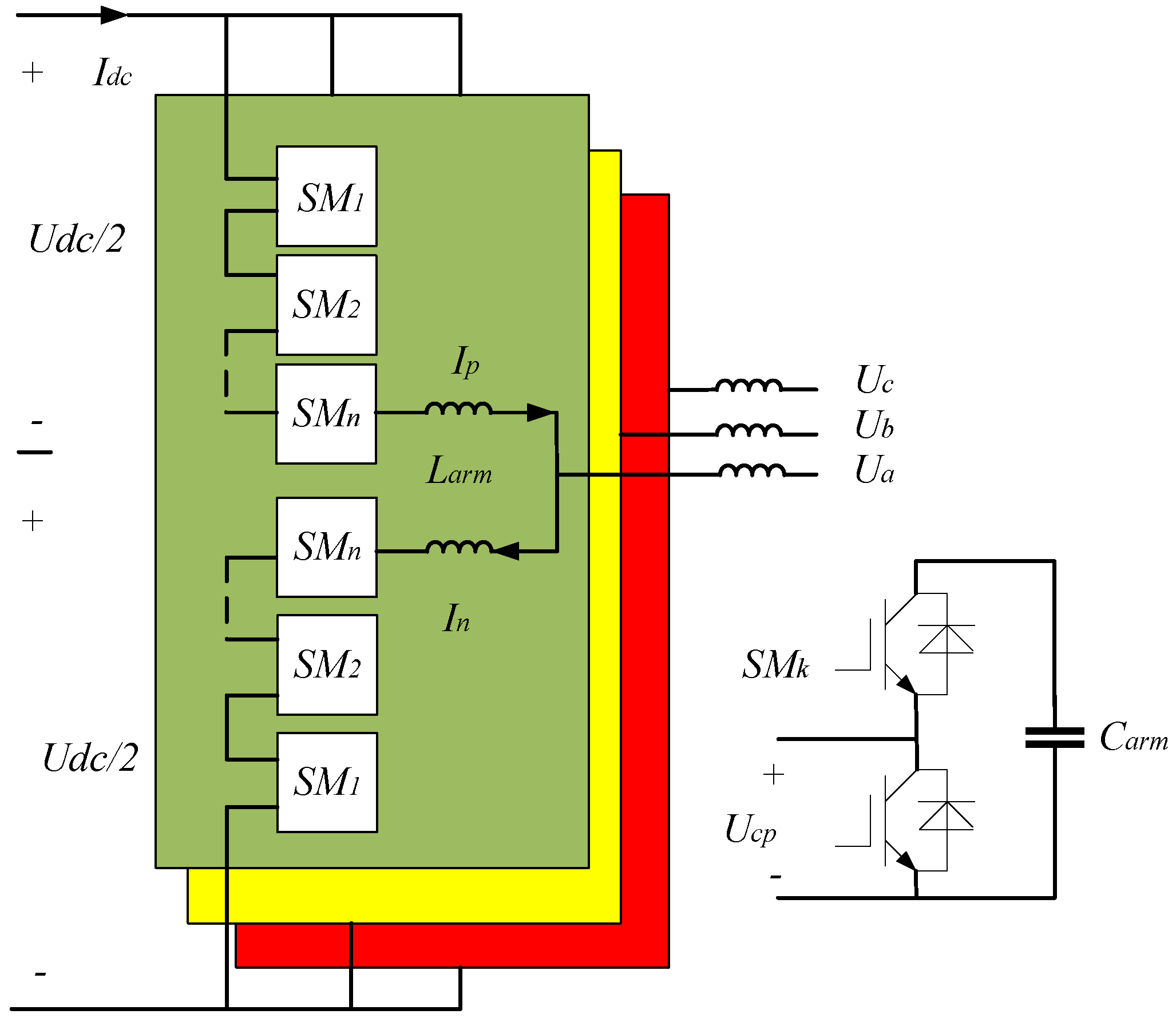
The complete control flow diagram of the MMC is presented in Figure 1, while its equivalent circuit is illustrated in Figure 2. Where U d c is the DC voltage source, PCC is the point of common coupling, Z g is the grid inductance, U k and I c i r are the AC voltage and DC circulating current of the MMC, respectively, and I p , I n , U p , U n are the currents and voltages of the upper and lower bridge arms, respectively.
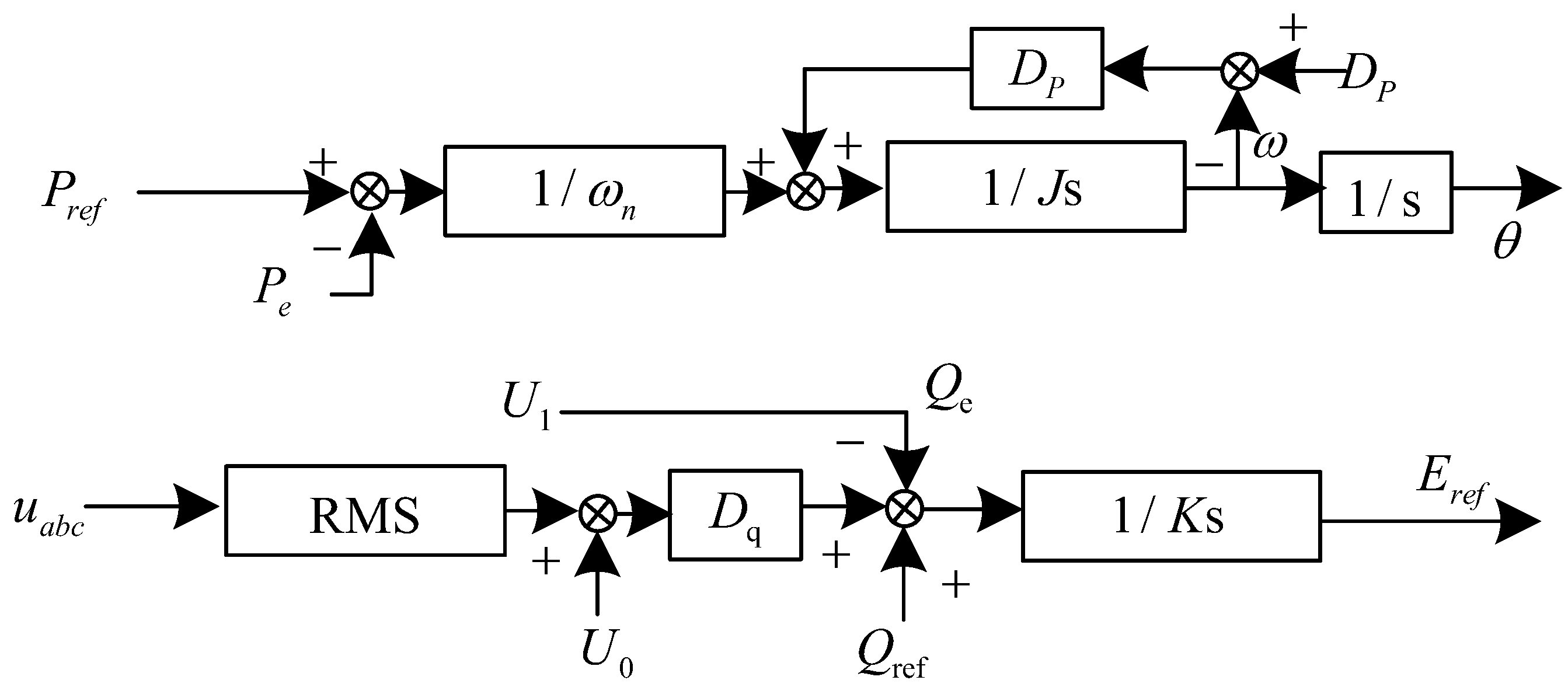
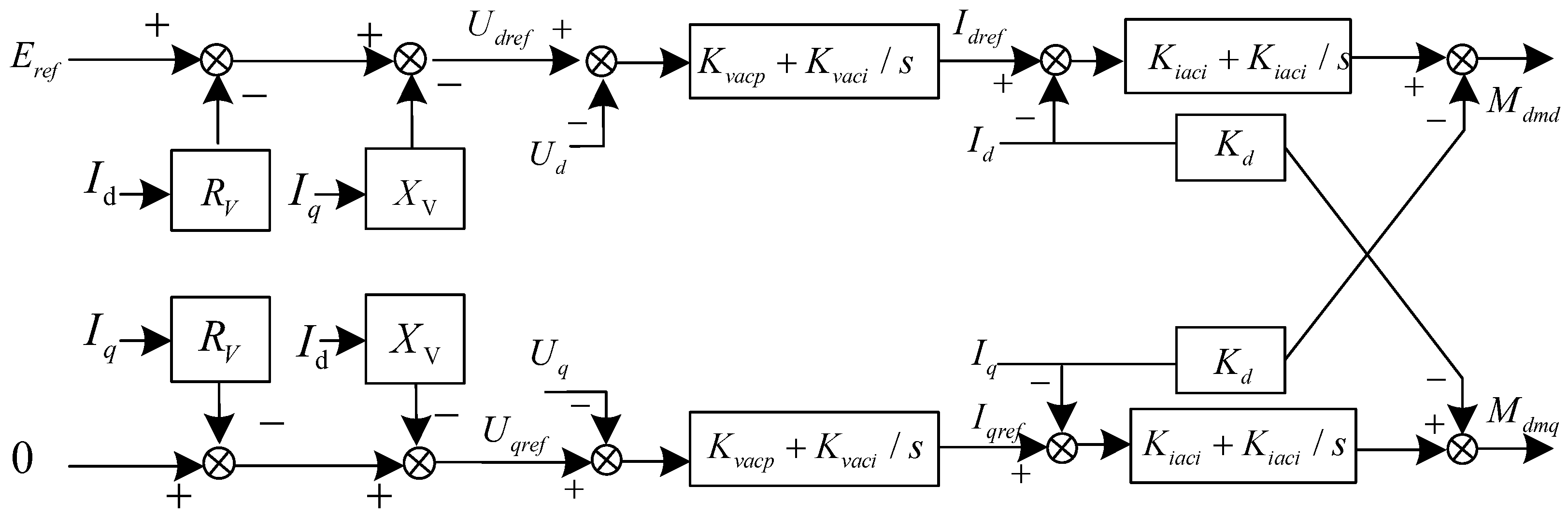
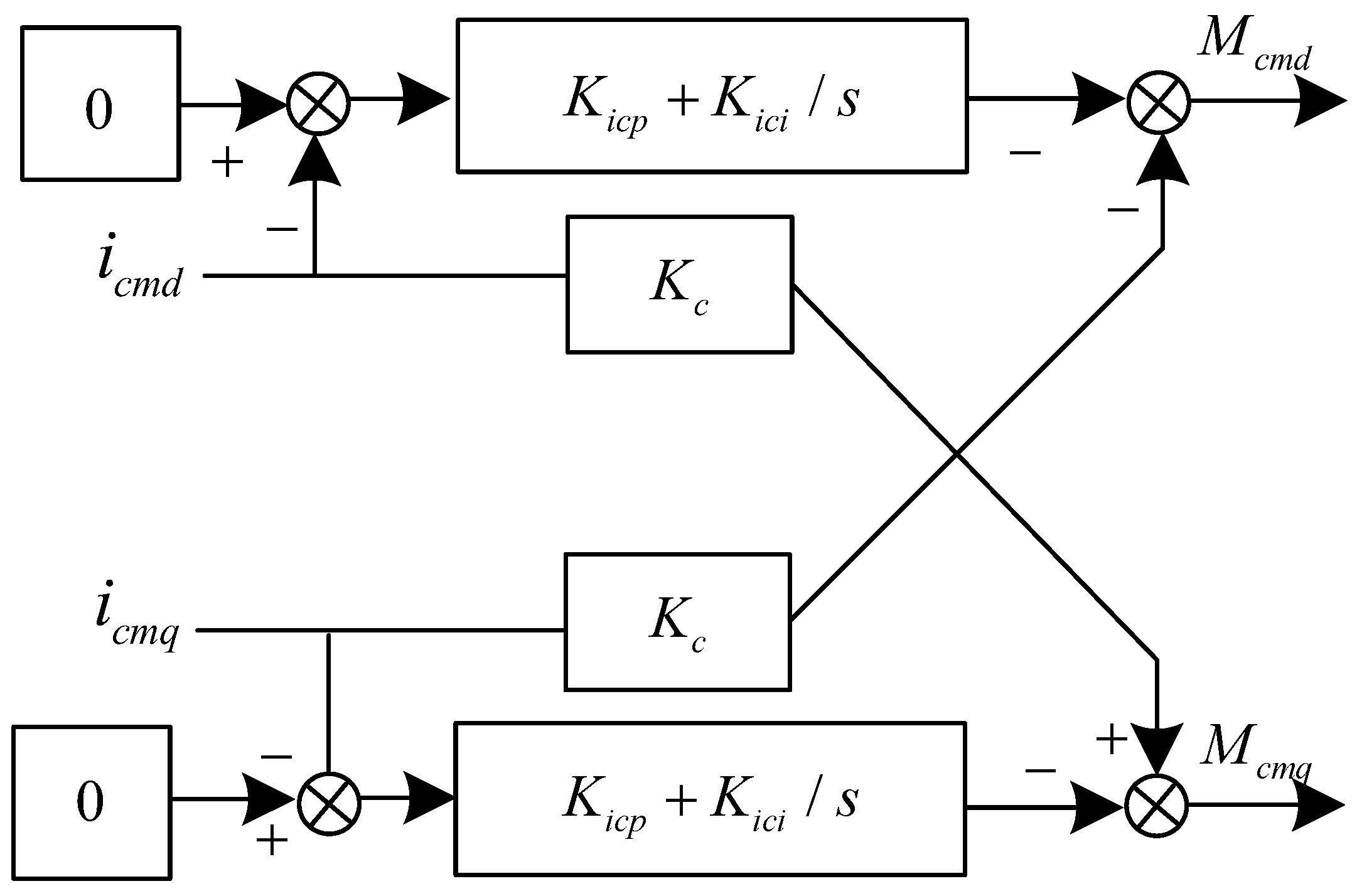
In a grid-forming MMC with VSG control, the control loop mainly consists of the active/reactive power control loop, the voltage–current double closed-loop, and the virtual impedance control stage. The power control structure adopts VSG control, as shown in Figure 3. The active loop provides inertia and damping characteristics, and the reactive loop simulates the voltage regulation process. Virtual impedance can be added at the output of the VSG, as shown in Figure 4, where the virtual impedance is disabled when X V = 0 . The voltage–current double closed-loop control structure is shown in Figure 5.
In Figure 3, P n , P e and Q n , Q e are the reference and instantaneous values of active and reactive power, respectively. ω , ω n , J, K, D p , D q represent the output angular frequency, rated angular frequency, virtual inertia, reactive inertia coefficient, active droop coefficient, and reactive droop coefficient, respectively.
In Figure 4, X V and R V are the virtual inductance and resistance, respectively. U d , U q , I d , I q are the dq-axis components of grid-connected voltage and current. In Figure 4, K v a c p , K v a c i , K i a c p , K i a c i are the PI parameters of the voltage and current loops, and K d is the decoupling coefficient. In Figure 5, K i c p , K i c i , are the PI parameters of circulating current suppression loop, and K c is the decoupling coefficient.

2.2. Modeling of MMC Sequence Impedance Considering Frequency Coupling

T ref and T e are reference torque and electromagnetic torque respectively, and the mathematical model is:
T ref + ( ω n ω ) D p T e = J s ω 1 T e = P e ω P e ω n T ref = P ref ω P ref ω n ω = s θ Q ref + ( U 0 U 1 ) D q Q e = K s E ref
where ω n is the rated angular frequency; ω and ω 1 are actual angular frequencies; D p and D q are active and reactive damping coefficients; J and K are virtual inertia and virtual excitation coefficients; P ref , P e are reference and actual active power; Q ref , Q e are reference and actual reactive power; U 0 is rated voltage, U 1 is PCC voltage; θ is electrical angle; s is Laplace operator; E ref is internal potential reference.
A positive sequence disturbance voltage is introduced at the PCC, and its frequency is set as f p . Under the system coupling effect, a new frequency component 2 f 1 f p is generated, which is known as the frequency coupling effect, where f 1 denotes the fundamental frequency. Z p ( s ) and Z n ( s ) represent the positive-sequence impedance and negative-sequence impedance, respectively. For clarity, f p + f 1 is defined as the positive sequence component and f p f 1 as the negative sequence component.
The grid-connected system adopts VSG control. Based on the system model, the small-signal expressions of instantaneous active power p e and reactive power q e are given as:
{ p e = u a i a + u b i b + u c i c q e = ( u a i c + u b i a + u c i b u a i b u b i c u c i a ) / 3
where u a , u b , u c are three-phase voltages and i a , i b , i c are three-phase currents.
Linearizing Equation (2) yields:
P ^ e Q ^ e = P 11 P 21 · I ^ a + P 12 P 22 · U ^ a
where P ^ e and Q ^ e are small-signal power perturbations; I ^ a and U ^ a are small-signal vectors of phase current and voltage; and P 11 ,   P 12 ,   P 21 ,   P 22 are linearized power coefficients.
According to the active controller of the voltage-controlled VSG:
θ ^ ( s ) = H vsgp ( s ) · ( p ^ ref ( s ) p ^ e ( s ) ) ,   H vsgp ( s ) = 1 ω n ( K J p s 2 + K D p s )
where H vsgp ( s ) is the active loop transfer function; K J p and K D p are inertia and damping coefficients of the active control loop.
Combining Equations (3) and (4), the small-signal phase angle from the active loop is derived as:
θ ^ = G 11 · I ^ a + G 12 · U ^ a
From the reactive power controller of the voltage-controlled VSG:
E ^ m = G 21 · I ^ a + G 22 · U ^ a
where G 11 ,   G 12 ,   G 21 ,   G 22 are transfer matrices of the coupled control loops; E ^ m is the small-signal internal potential.
According to the MMC topology:
u d c 2 = u c m a + R a r m i c m a + L a r m i c m a t u a + u o = u d m a + R a r m 2 i a + L a r m 2 + L f i a t
where u d c is DC voltage; R a r m and L a r m are arm resistance and inductance; L f is filter inductance; u c m a and u d m a are upper and lower arm capacitor voltages; and i c m a is the circulating current.
In the frequency range of 10 Hz–2 kHz, the MMC average-value model is adopted:
u C n a N = u C n a ( 1 ) = u C n a ( 2 ) = = u C n a ( N ) u C p a N = u C p a ( 1 ) = u C p a ( 2 ) = = u C p a ( N )
where N is the number of submodules per arm; u C n a and u C p a are average capacitor voltages of lower and upper arms.
The steady-state modeling of upper and lower arms is expressed as:
I a = I p a I n a = I p a A · I p a = ( E 2 h + 1 A ) · I p a = 2 · A d · I p a A d = 1 2 ( E 2 h + 1 A ) = 1 2 diag 1 ( 1 ) k | k = h h
where A d is the transformation matrix between phase current and arm current; E 2 h + 1 is identity matrix; A is sequence coupling matrix.
The interphase relationships are:
I p b = D · I p a ,   U C p b = D · U C p a ,   M p b = D · M p a I n b = D · A · I p a ,   U C n b = D · A · U C p a ,   M n b = D · A · M p a I p c = D · I p a ,   U C p c = D · U C p a ,   M p c = D · M p a I n c = D · A · I p a ,   U C n c = D · A · U C p a ,   M n c = D · A · M p a D = diag e j 2 k π / 3 | k = h h ,   D = conj ( D )
where D and D are interphase transformation matrices and their conjugate forms.
The small-signal model of the main circuit is:
U ^ C p a = Z C a r m · M p a I ^ p a + I p a M ^ p a I ^ p a = Y R L a r m L f · M p a U ^ C p a + U C p a M ^ p a + U ^ a + U ^ o
where Z C a r m and Y R L a r m L f are arm impedance and admittance; ⊗ denotes convolution operation.
The coordinate transformation of three-phase voltage, current and circulating current is:
U ^ a = E 2 h + 1 · U ^ a U ^ b = D p · U ^ a U ^ c = D p · U ^ a ,   I ^ a = 2 · A p d · I ^ p a I ^ b = 2 · A p d · D p · I ^ p a I ^ c = 2 · A p d · D p · I ^ p a ,   I ^ c m a = A p c · I ^ p a I ^ c m b = A p c · D p · I ^ p a I ^ c m c = A p c · D p · I ^ p a
where D p and D p are sequence transformation matrices; A p c is circulating current transformation matrix.
According to the voltage and current control loops, the impedance model is:
I ^ d r = H u a c · U ^ d I ^ q r = H u a c · U ^ q ,   H u a c = diag H u a c ( j 2 π ( f p + k f 1 ) ) | k = h h
where H u a c is the voltage loop transfer function matrix; I ^ d r , I ^ q r are dq-axis current references.
The modulation signal M d m d q from closed-loop control is:
M ^ d m d = H i a c · I ^ d r I ^ d K d · I ^ q M ^ d m q = H i a c · I ^ q r I ^ q + K d · I ^ d
where H i a c is current loop transfer function matrix; K d is decoupling coefficient.
Similarly, M c m d q can be obtained, and the modulation signal of phase-a upper arm is:
M ^ p a = K m 2 M ^ c m d M ^ d m d = E 11 · I ^ p a + E 12 · U ^ a
where K m is modulation coefficient; E 11 ,   E 12 are control coupling matrices.
Finally, the grid-connected admittance matrix is derived as:
Y g c c = I ^ a U ^ a = 2 · A p d · I ^ p a U ^ a = 2 · A p d · X 12 X 11
where X 11 , X 12 are main circuit and control coupling coefficient matrices.
The positive–negative sequence admittance and impedance matrices are:
Y P N = Y p p Y p n Y n p Y n n = Y G C C ( h + 1 , h + 1 ) Y G C C ( h + 1 , h 1 ) Y G C C ( h 1 , h + 1 ) Y G C C ( h 1 , h 1 ) Z P N = Z p p Z p n Z n p Z n n = Y P N 1
The impedance matrix is further converted into SISO positive- and negative-sequence impedances:
Z p = Z p p Z p n Z n p / ( Z g n + Z n n ) Z n = Z n n Z n p Z p n / ( Z g p + Z p p )
where Z g p and Z g n are positive- and negative-sequence grid impedance.
Z o p = Z p + Z v p Z o n = Z n + Z v n
where Z op and Z on denote the overall positive-sequence and negative-sequence impedances integrated with virtual impedance. Based on the virtual impedance characteristics, the impedance model of grid-forming MMC with virtual impedance is established.

2.3. Frequency Sweep Verification of the MMC Impedance Model

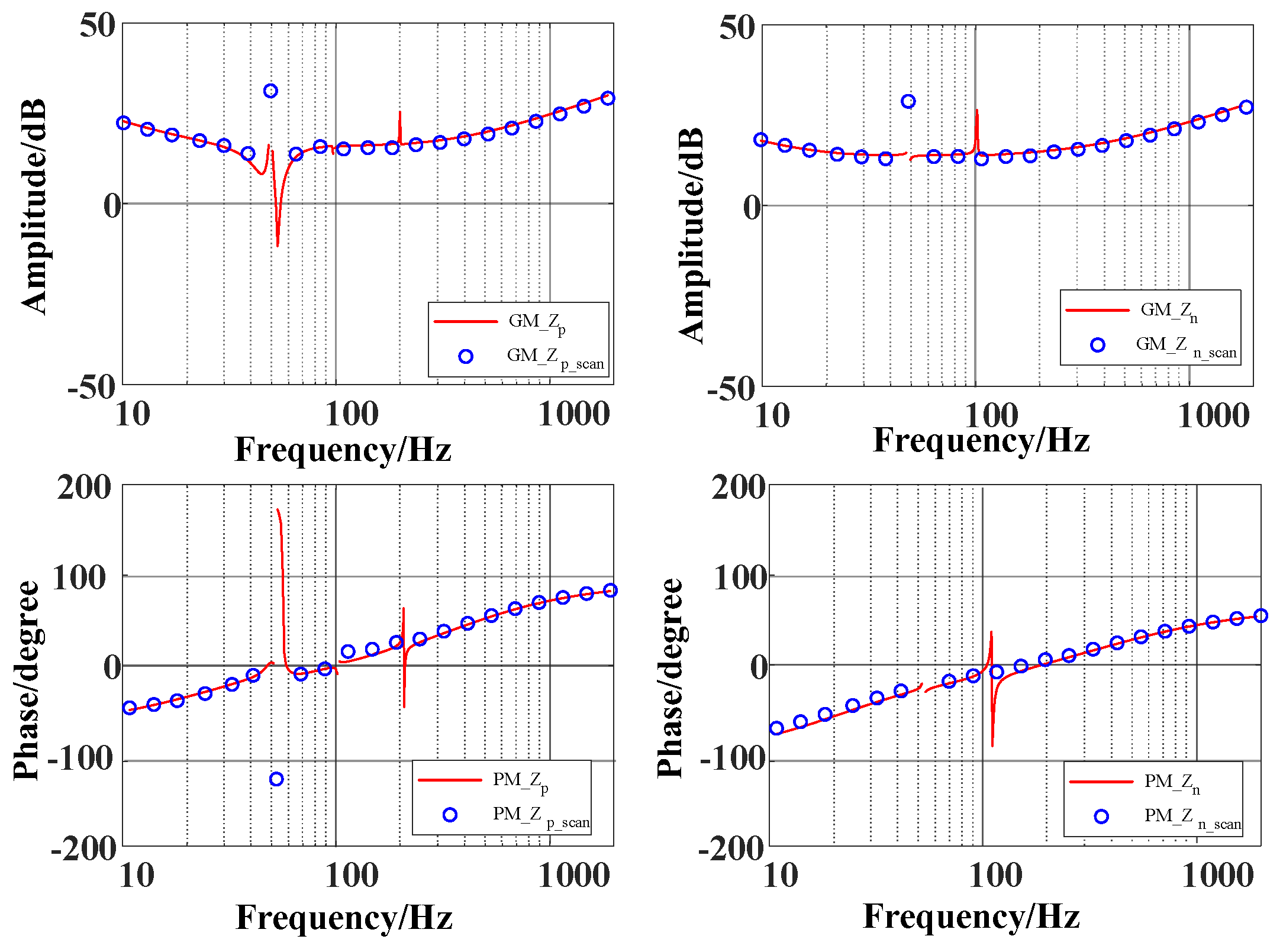
The sequence impedance model is verified via frequency sweep simulation in MATLAB/Simulink R2024a. The operating conditions for simulation are presented in Table 1. As shown in Figure 6, the theoretical impedance curves fit well with the measured sweep results, verifying the accuracy of the model.
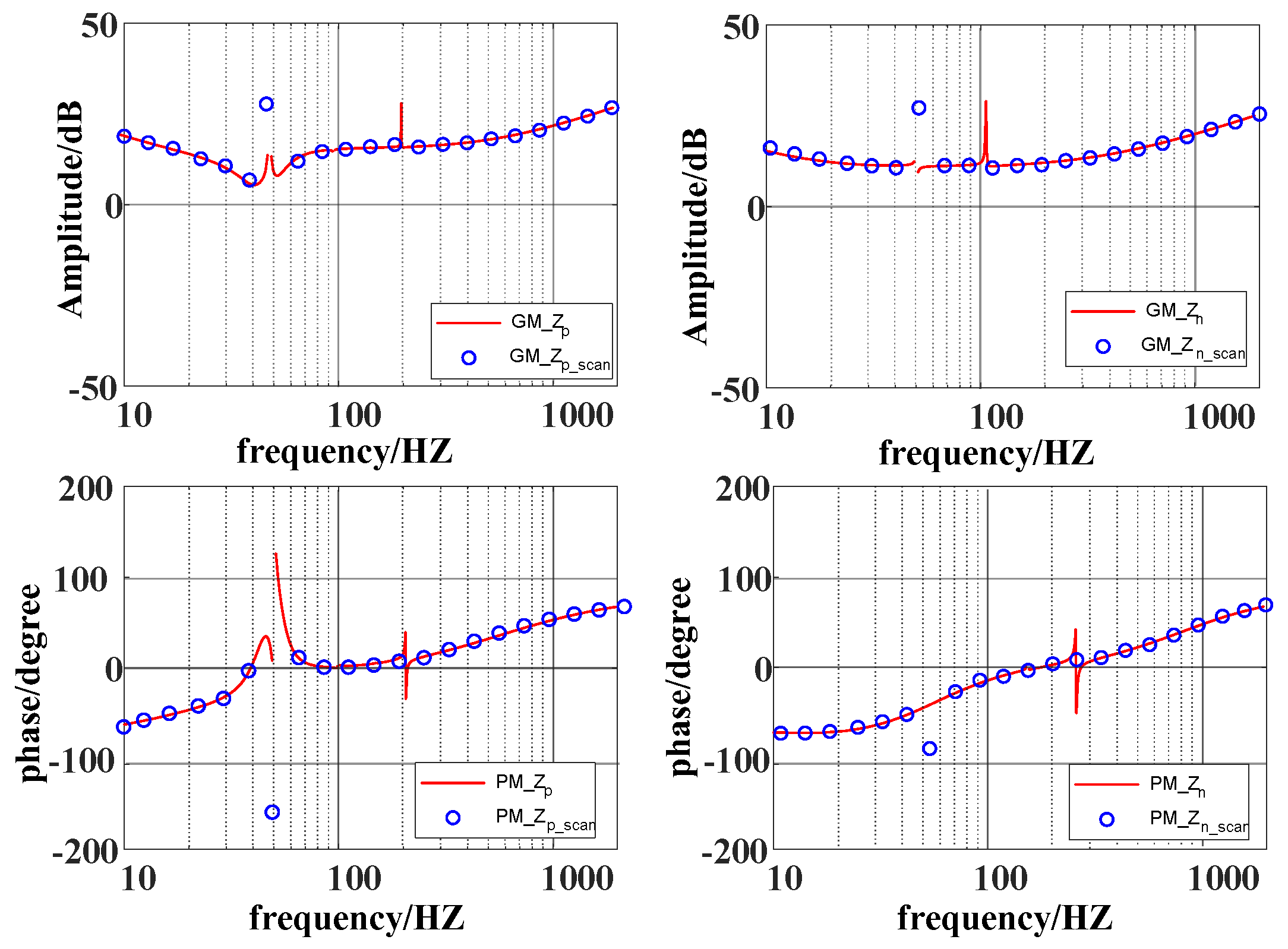
The initial values are X V = 0.157   Ω and R V = 0.01   Ω . Figure 7 shows the impedance characteristics with virtual impedance. The consistency between theoretical and measured results further verifies the model.

3. Influence of Virtual Impedance on MMC Stability

Relationship Between Virtual Impedance and Stability

Based on the impedance analysis, instability mainly occurs in the low-frequency band. Therefore, a virtual impedance with a band-pass filter is introduced to optimize the low-frequency characteristics while maintaining the original high-frequency performance. The initial values are X V = 0.157   Ω and R V = 0.01   Ω .
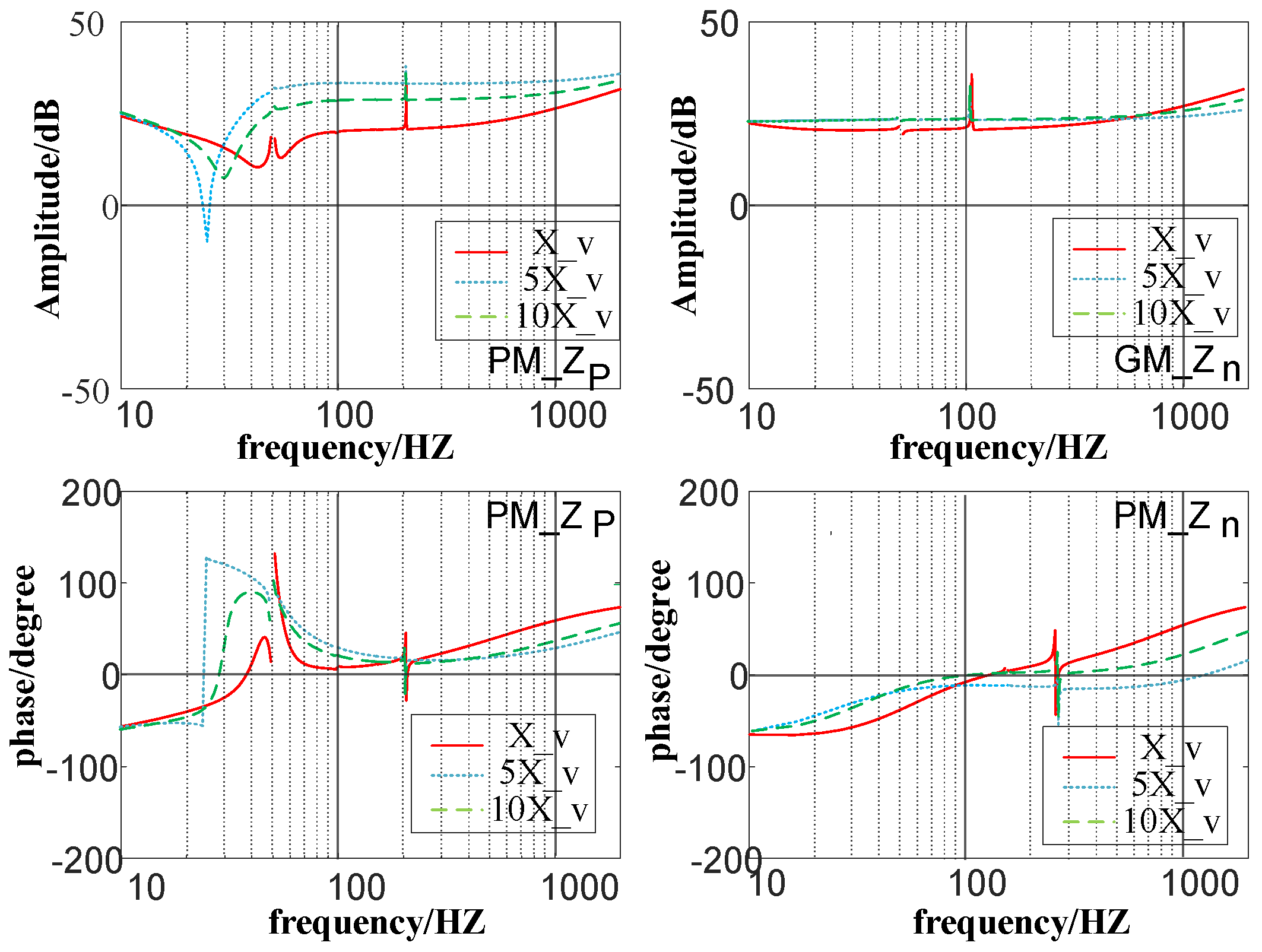
The virtual impedance includes resistance and inductance; changing the inductance-resistance ratio has little effect on the phase characteristics, as shown in Figure 8. The product of the magnitudes of X V and R V is maintained constant, while only their ratio is adjusted to observe the effect on the overall impedance. Taking the initial ratio as C, the impedance comparison at ratios of C, 5 C , and 10 C is shown in the Figure 8. Therefore, the amplitude of virtual impedance is the dominant factor affecting stability.
It can be seen from Figure 9 that the positive-sequence impedance changes more significantly at low frequencies, so it is taken as the key research object.

4. Virtual Impedance Optimization Based on Grey Wolf Algorithm

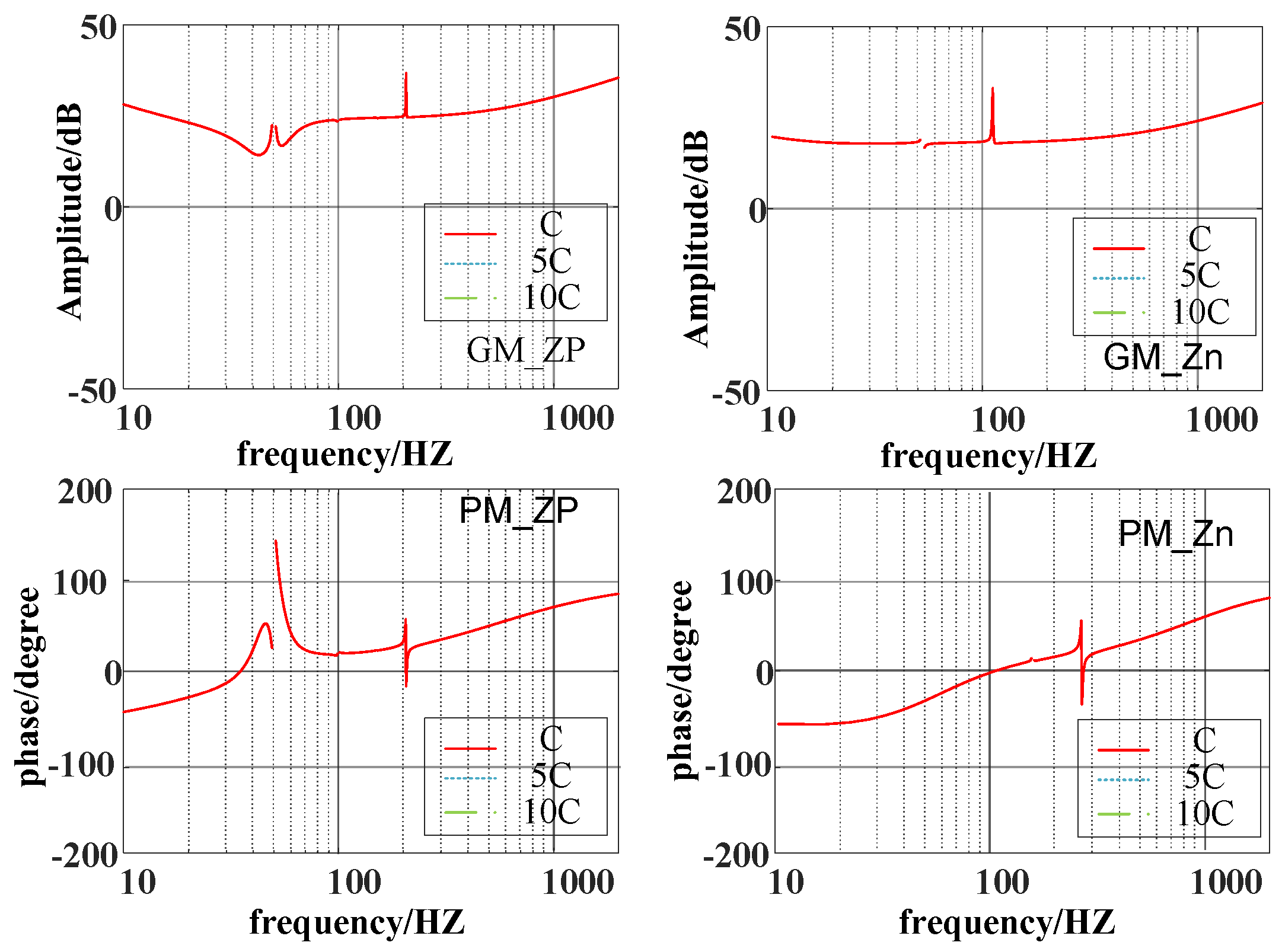
The system stability is judged by the Bode plots of the grid impedance Z g ( s ) and MMC impedance Z M M C ( s ) . The phase margin (PM) is defined as:
P M = φ ( ω c p ) + 180 °
φ ( ω c p ) represents the phase difference between the impedance of the MMC and that of the power system. When P M < 0 ° , the system oscillates.
The amplitude margin (GM) is:
G M = 1 | Z g / Z M M C | ( Z g / Z M M C ) = 180 °
In the low-frequency oscillation band, only PM is used to evaluate stability. To avoid complex manual parameter tuning, the GWO algorithm is used to optimize the virtual impedance parameters with the optimization goal of maximizing the minimum phase margin.
The fitness function is defined as:
fitness = 1000 , if   P M min < 30 °   or   G M min < 6   dB 1 / P M min , otherwise
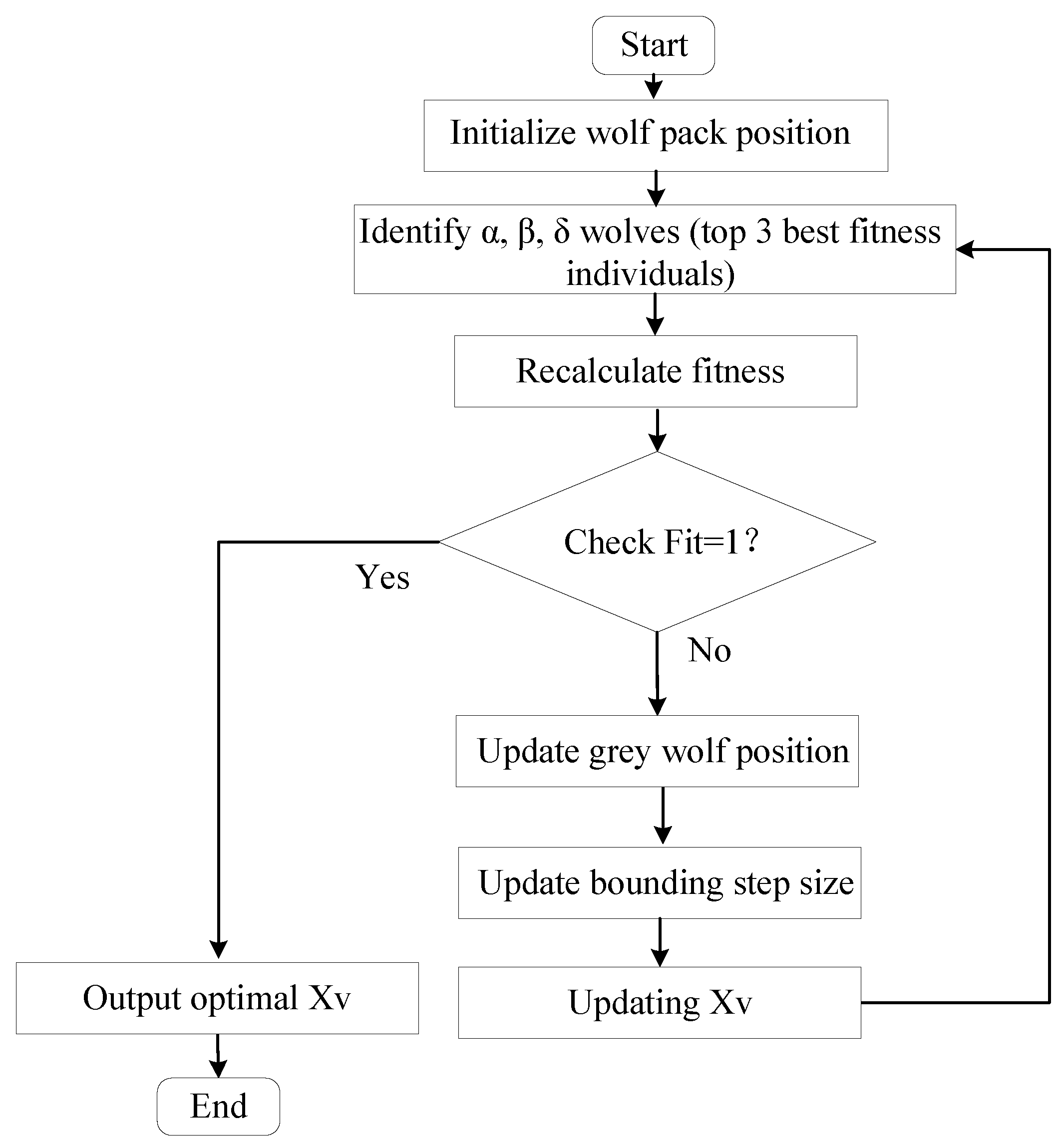
The fitness function is designed to prioritize system stability and maximize stability margins during the optimization of virtual impedance parameters. To ensure only stable solutions are considered, a large penalty value of 1000 is assigned when the system fails to meet the minimum stability margin requirements, P M min < 30 ° or G M min < 6   dB , which forces the algorithm to discard unstable parameter combinations and avoid searching in invalid spaces. For all solutions satisfying these stability constraints, the fitness is defined as 1 / P M min ; since the Grey Wolf Optimization algorithm (Figure 10) minimizes the fitness value, this formulation is equivalent to maximizing the minimum phase margin P M min , thereby finding optimal parameters that not only stabilize the system but also maximize its robustness against broadband oscillations.
Here, P M 30 ° and G M 6   dB are the classic stability margin requirements. Herein, determine X V as the optimization parameter, and set its optimization bounds as [ X l , X h ] , where X l is 0.1 times the initial value and X h is 10 times the initial value. The optimization terminates when the maximum iteration is reached or the fitness remains unchanged for 5 consecutive generations, which can be expressed as
Fit = 1 , Iter = MaxIter   or   fitness   unchanged   for   5   generations 0 , otherwise
The termination condition is reaching the maximum iterations or the fitness remaining unchanged for 5 consecutive generations. The GWO algorithm searches for the optimal virtual impedance parameters within the preset range to maximize the system stability margin.

5. Simulation Verification

The main parameters of the grid-forming MMC simulation model are shown in Table 1.
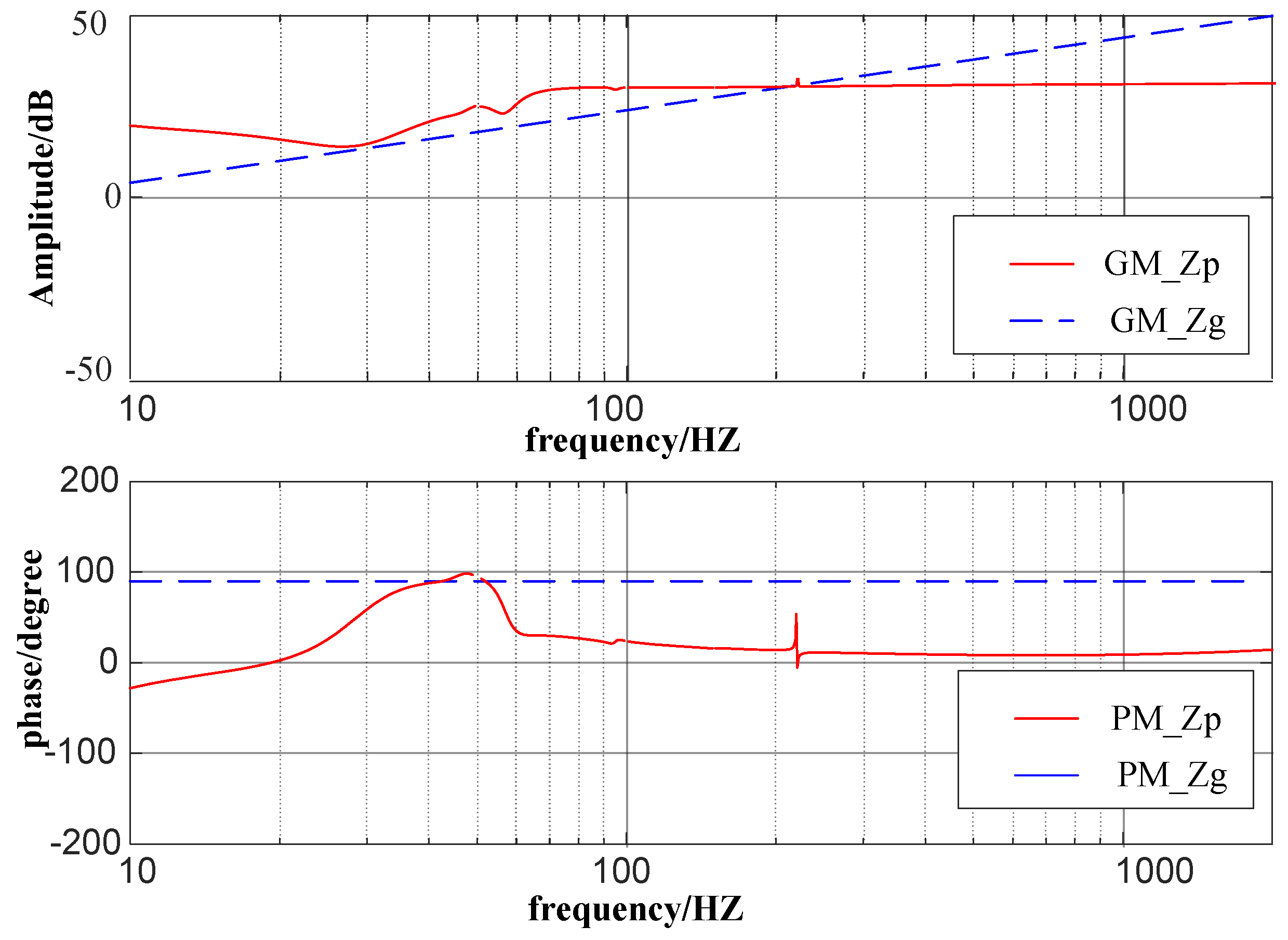
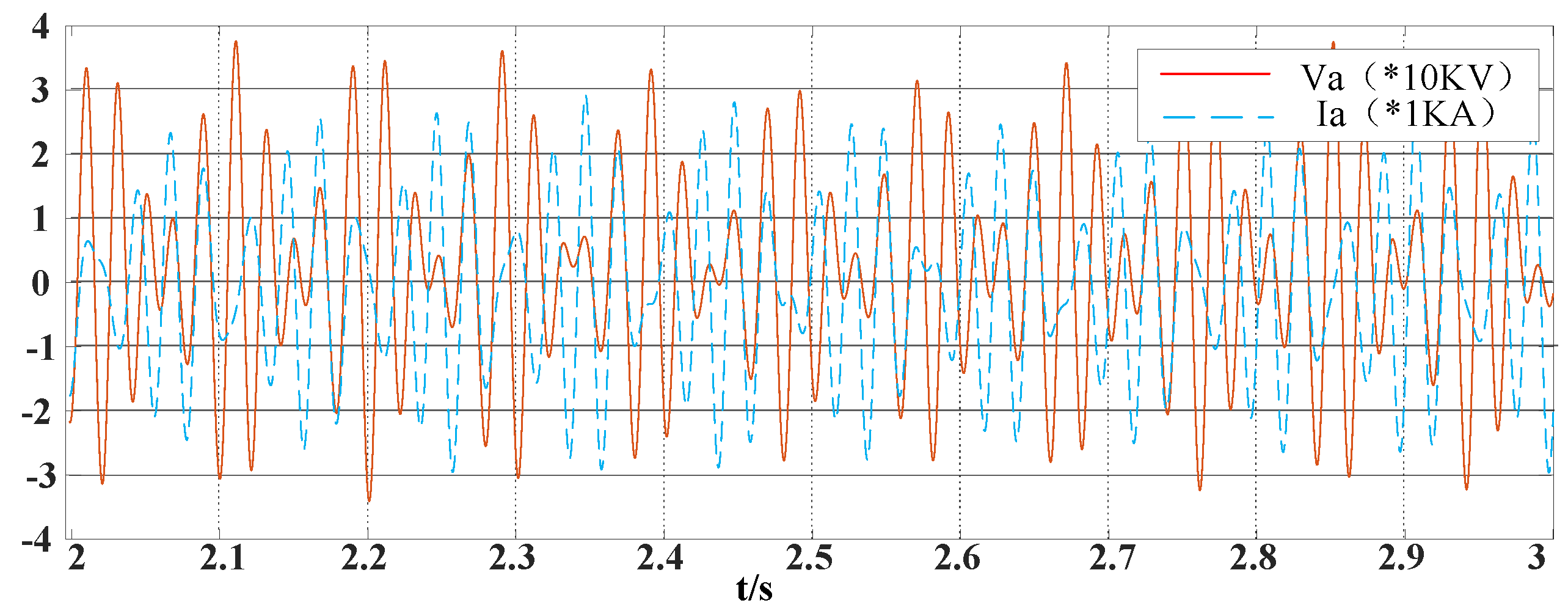
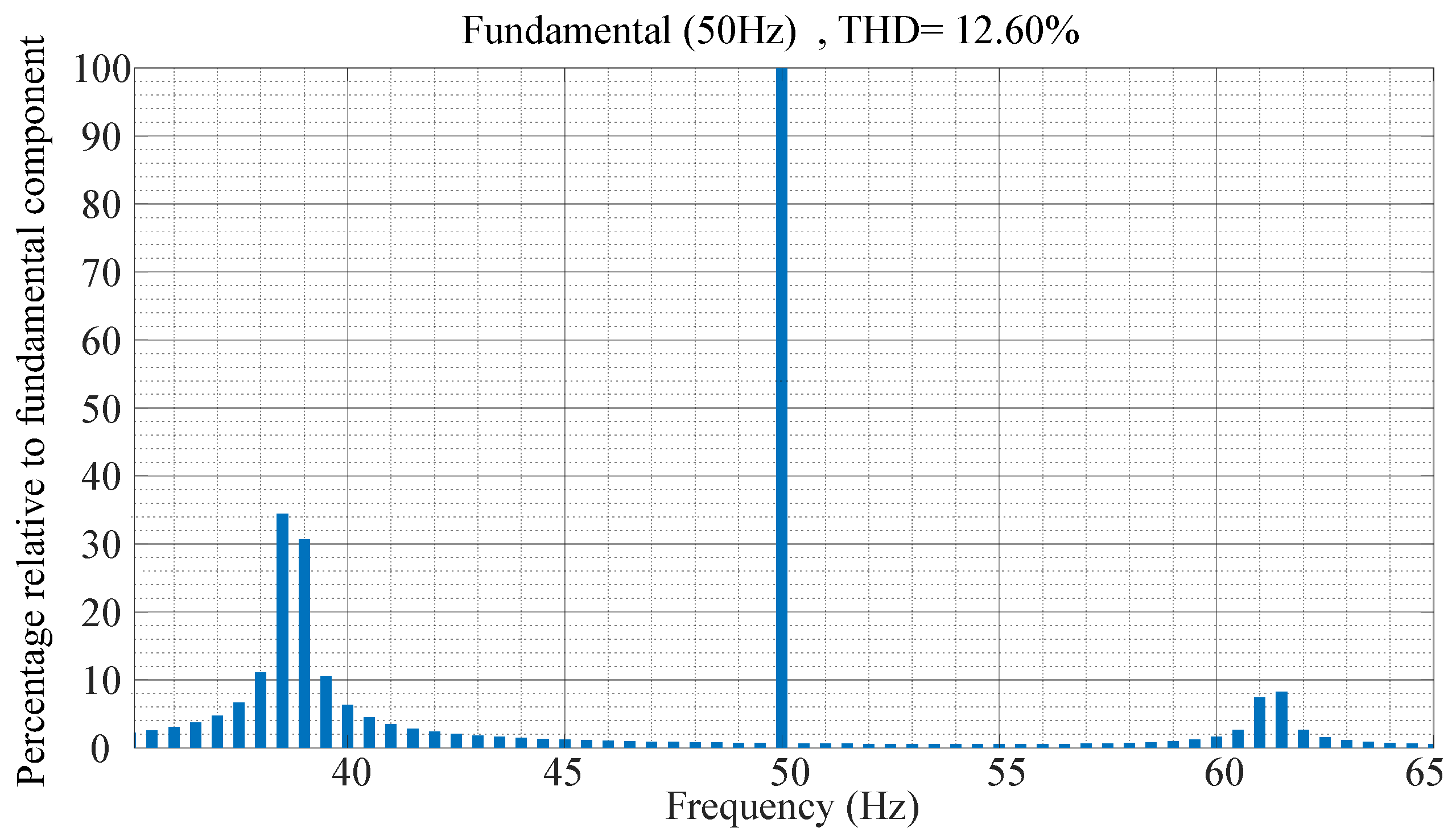
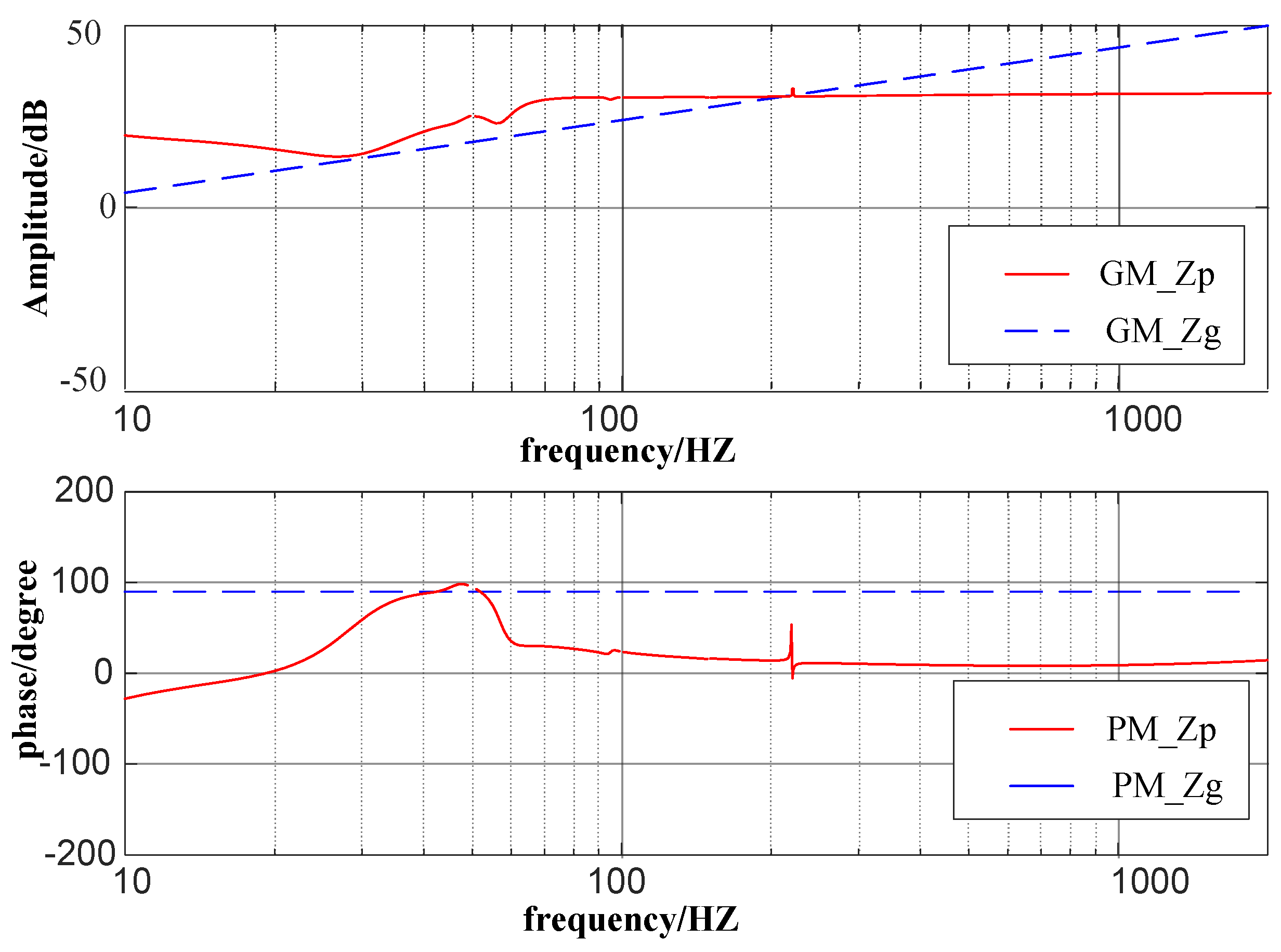
Without virtual impedance, the impedance Bode diagram (Figure 11) shows that the amplitude curves intersect at 61 Hz with P M = 63 ° , indicating instability. The grid-connected voltage and current waveforms (Figure 12) and FFT results (Figure 13) verify the 61 Hz oscillation, which is consistent with the theoretical analysis. Correspondingly, a resonance at 37 Hz is also observed, which matches the theoretical analysis of the aforementioned frequency coupling effect.
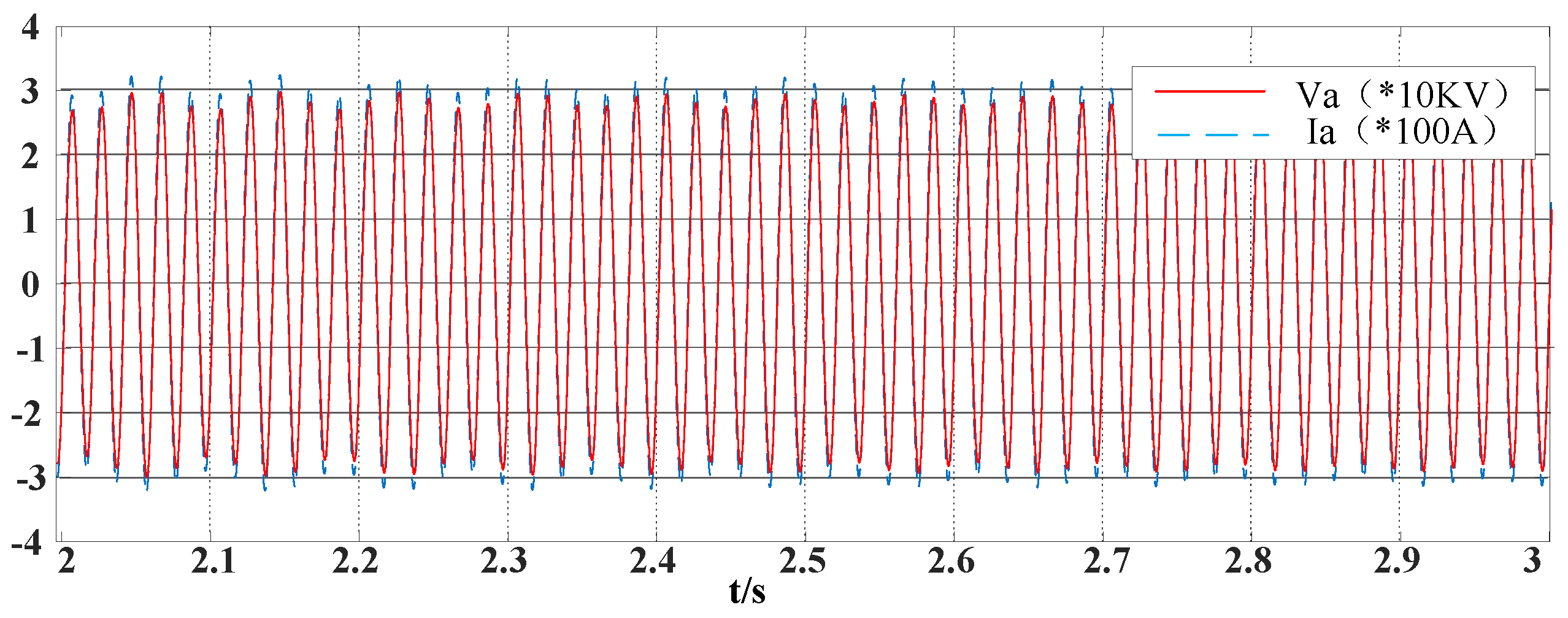
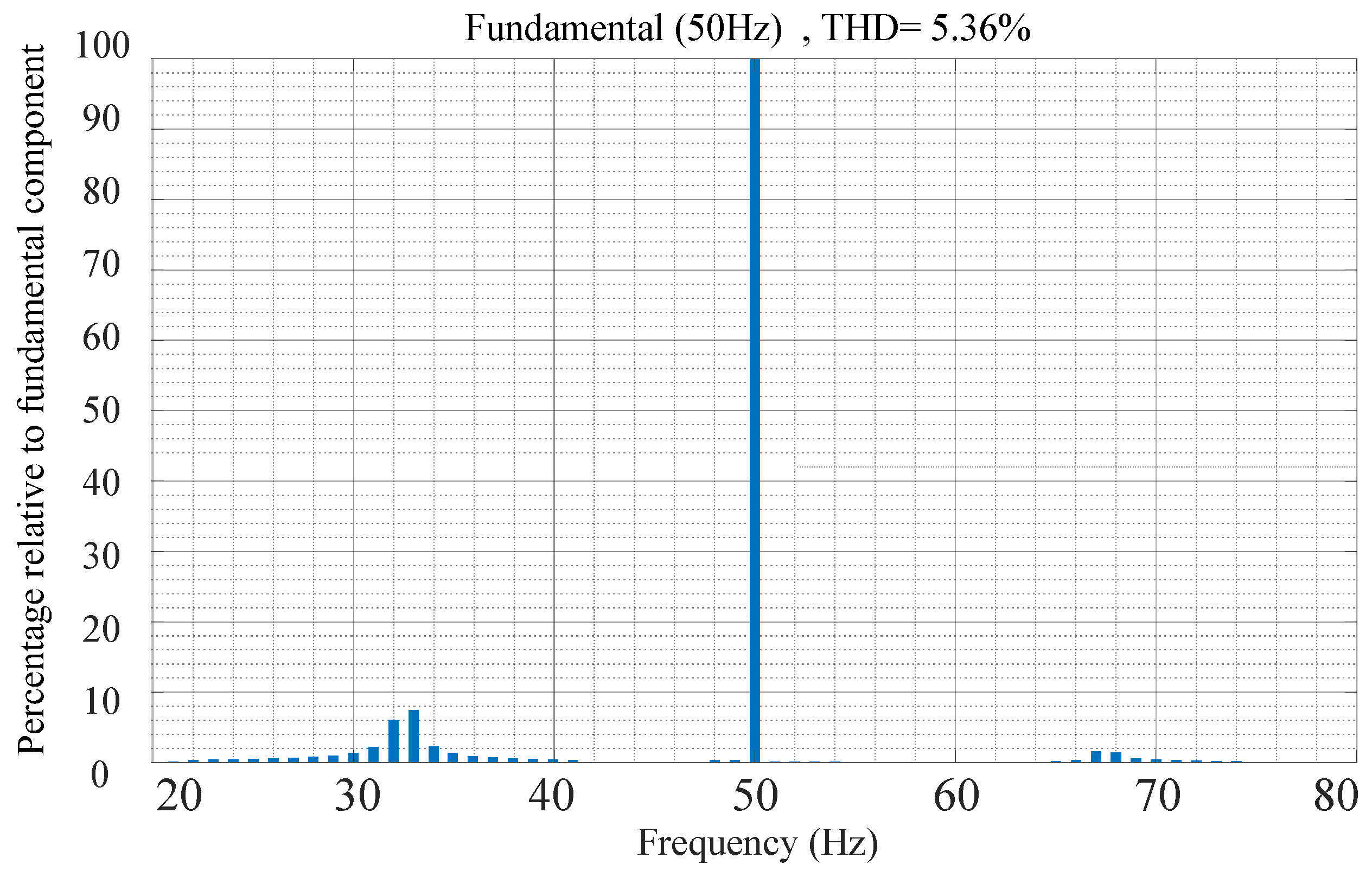
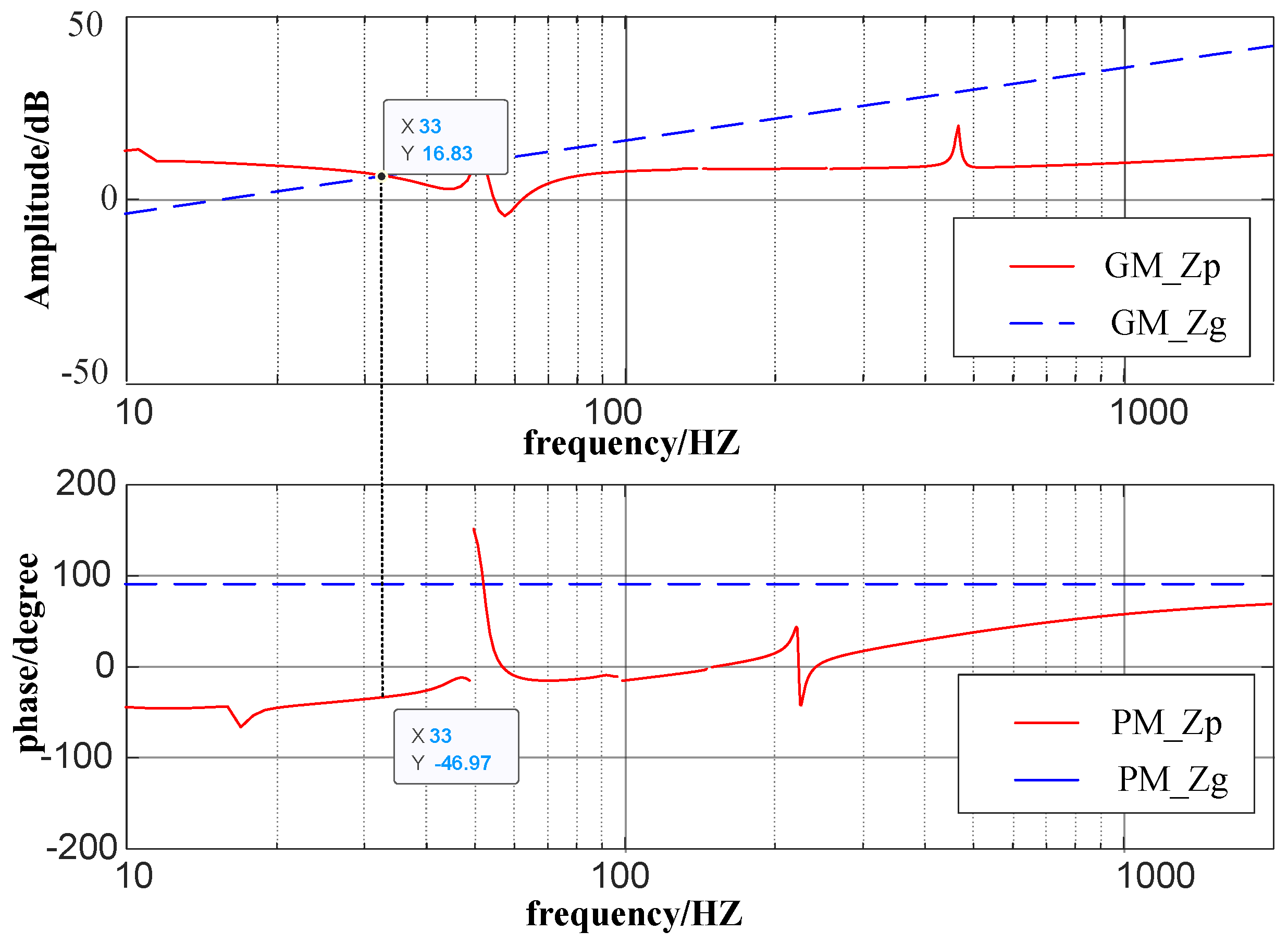
With a randomly selected virtual impedance ( X V = 0.628   Ω , R V = 0.01   Ω ), the system is in a critical stable state due to the extremely low phase margin (Figure 14 and Figure 15) and FFT results (Figure 16) verify the 33 Hz oscillation, which is consistent with the theoretical analysis. Correspondingly, a resonance at 67 Hz is also observed, which matches the theoretical analysis of the aforementioned frequency coupling effect.
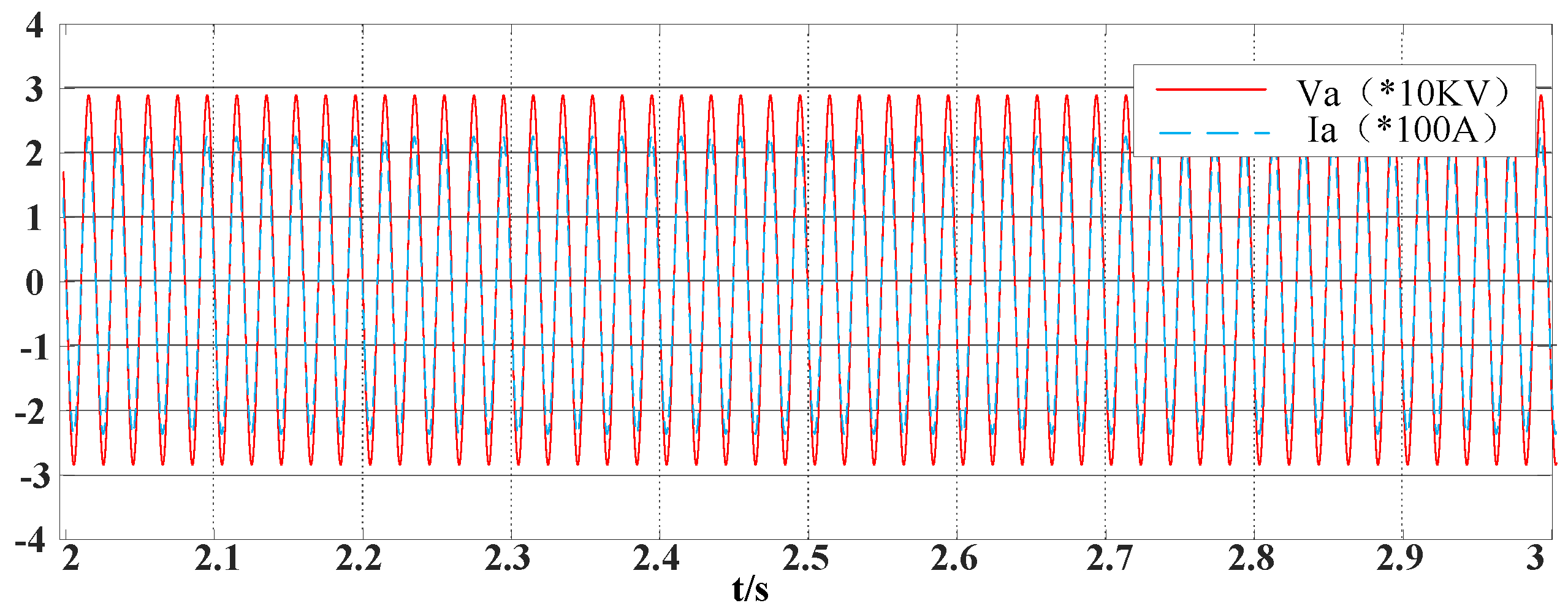
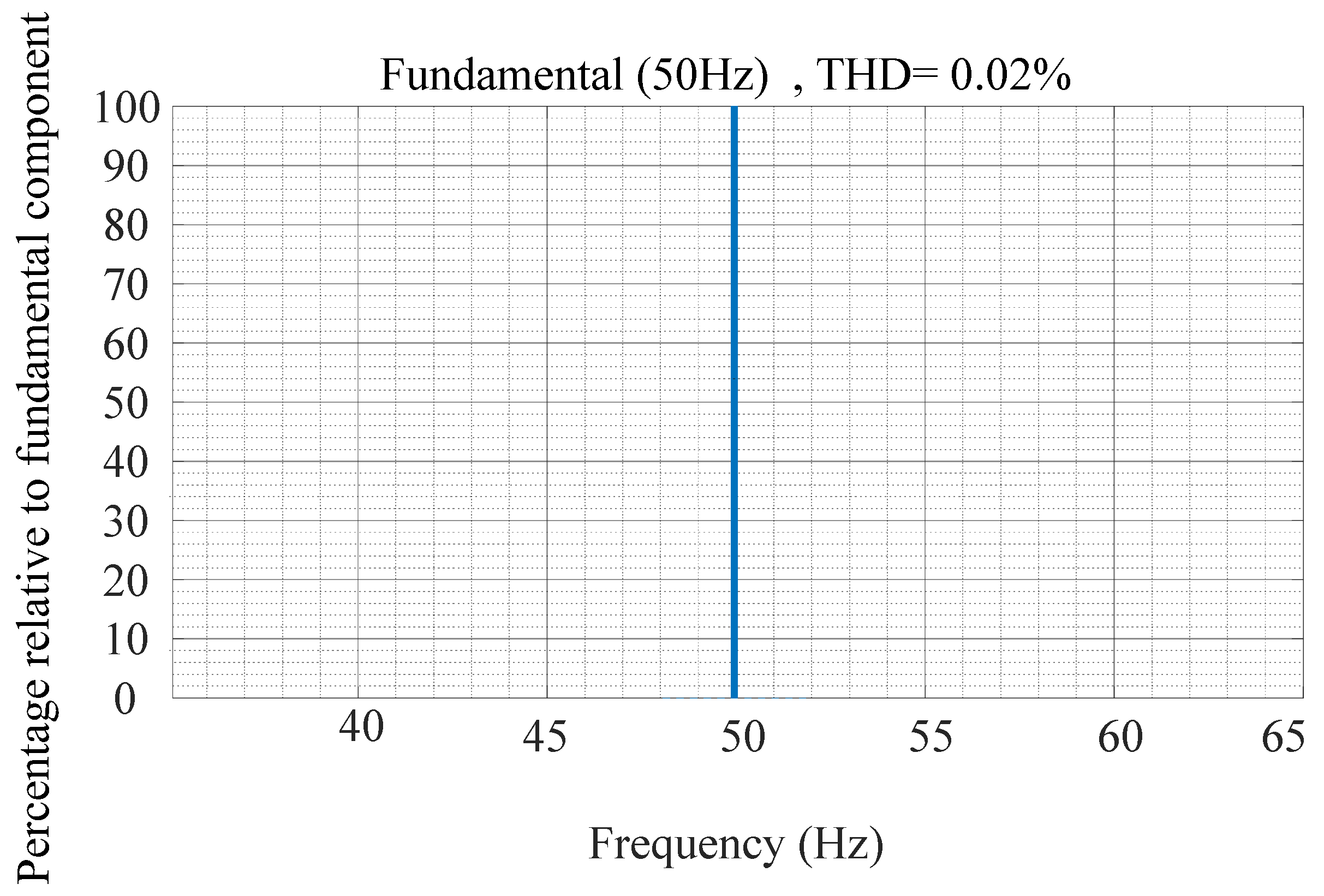
After GWO optimization, the optimal parameters are X V = 1.381   Ω , R V = 0.01   Ω . As shown in Figure 17, the system phase margin is higher than 50°, and the grid-connected waveforms are stable (Figure 18), verifying the effectiveness of the proposed method.The FFT result of the voltage at the PCC is shown in Figure 19.
Without virtual impedance adoption, the THD of voltage and current at the PCC is 12.6%. When a random small virtual impedance is introduced, the THD decreases to 5.36%. By contrast, adopting the virtual impedance optimized by the GWO algorithm reduces the THD to only 0.02%. The comparative analysis of THD values verifies the effectiveness and superiority of the proposed strategy.

6. Conclusions

Aiming at the stability issues of grid-forming MMCs in weak power grids, this paper proposes a GWO-based virtual impedance optimization strategy. First, the sequence impedance model of grid-forming MMCs considering frequency coupling is established using multi-harmonic linearization, and the system stability is analyzed based on the Nyquist criterion and Bode plots. Then, a virtual impedance control method with a band-pass filter is introduced to suppress broadband oscillation, and the GWO algorithm is used to optimize the virtual impedance parameters with the goal of maximizing the system phase margin. Finally, the effectiveness of the proposed method is verified via detailed simulation. The results show that the optimized virtual impedance can significantly improve the phase margin of the system, effectively suppress broadband oscillation in weak power grids, and enhance the stability and dynamic performance of grid-forming MMCs. The proposed method provides a practical solution for oscillation suppression and stable operation of grid-forming MMCs in high-proportion renewable energy systems.

Author Contributions

Conceptualization, Y.Y. and B.G.; methodology, Y.Y. and B.G.; software, Y.Y.; investigation, Y.Y.; writing—original draft preparation, Y.Y.; writing—review and editing, Y.Y.; project administration, B.G.; funding acquisition, B.G. All authors have read and agreed to the published version of the manuscript.

Funding

This work was supported by the National Natural Science Foundation of China under Grant No. 52477176.

Data Availability Statement

All data generated or analyzed during this study are included in this paper. Further inquiries can be directed to the corresponding author.

Conflicts of Interest

The authors declare no conflicts of interest.

References

  1. Simiyu, P.; Davidson, I.E. MVDC Railway Traction Power Systems: State-of-the-Art, Opportunities, and Challenges. Energies 2021, 14, 4156. [Google Scholar] [CrossRef]
  2. Perez, M.A.; Bernet, S.; Rodriguez, J.; Kouro, S.; Lizana, R. Circuit Topologies, Modeling, Control Schemes, and Applications of Modular Multilevel Converters. IEEE Trans. Power Electron. 2015, 30, 4–17. [Google Scholar] [CrossRef]
  3. Xiang, W.; Li, X.; Zhang, G.; Wen, J. DC Fault Study of a Point-to-Point HVDC System Integrating Offshore Wind Farm Using High-Temperature Superconductor DC Cables. IEEE Trans. Energy Convers. 2022, 37, 377–388. [Google Scholar] [CrossRef]
  4. Liu, K.; Li, B.H.; Jiang, Q.; Zhang, Y.M.; Liu, T.Q. Fault Ride-Through Strategy for Hybrid Cascaded HVDC Systems Based on Controllable LCC. IEEE Trans. Circuits Syst. II Express Briefs 2026, 73, 88–92. [Google Scholar] [CrossRef]
  5. Lü, J. Instability Mechanism and Stabilization Methods of MMC-Based HVDC for Wind Farm Integration. Ph.D. Dissertation, Shanghai Jiao Tong University, Shanghai, China, 2016. (In Chinese) [Google Scholar]
  6. Xie, L.; Zhang, Y.; Liu, J.; Wang, Z. Coordinate Control Strategy for Hybrid HVDC System Based on DR-MMC with Offshore Wind Farm Integration. In Proceedings of the 18th IET International Conference on AC and DC Power Transmission, Birmingham, UK, 2–3 July 2022; pp. 617–622. [Google Scholar]
  7. Wu, Y.; Li, L.; Zhang, Y.; Zhou, Z.; Hu, X.; Zhao, Q.; Zhuang, K. A Hybrid HVDC Converter Based on MMC and Diode Rectifier for Offshore Wind Farm Integration. In Proceedings of the 2021 IEEE International Conference on Power System Technology, Haikou, China, 8–9 December 2021; pp. 1476–1480. [Google Scholar]
  8. Zu, Y.; Chen, Z.; Han, M.; Li, Y. Black-Start Strategy of the HVDC System Based on Series-Connected Hybrid Converter for Offshore Wind Farms. In Proceedings of the 18th IET International Conference on AC and DC Power Transmission, Birmingham, UK, 2–3 July 2022; pp. 1153–1157. [Google Scholar]
  9. Miao, S.; Lu, Y.; Zhu, J.; Zhao, C. Control of Series-Connected Diode Rectifier and MMC for Three-Wire-Bipolar-Structure Based HVDC. In Proceedings of the 18th IET International Conference on AC and DC Power Transmission, Birmingham, UK, 2–3 July 2022; pp. 270–277. [Google Scholar]
  10. Ji, K.; Tang, G.; Pang, H.; Yang, J. Impedance Modeling and Analysis of MMC-HVDC for Offshore Wind Farm Integration. IEEE Trans. Power Deliv. 2020, 35, 1488–1501. [Google Scholar] [CrossRef]
  11. Liu, Y.; Zhu, L.; Xu, X.; Li, D.; Liang, Z.; Ye, N. Transient Synchronization Stability in Grid-Following Converters: Mechanistic Insights and Technological Prospects—A Review. Energies 2025, 18, 1975. [Google Scholar] [CrossRef]
  12. Huang, M.; Shu, S.R.; Li, X.L.; Fu, X.K.; Zha, X.M. A Review of Synchronization-Stability-Oriented Analysis and Control of Power Electronic Grid-Connected Converters. Trans. China Electrotech. Soc. 2024, 39, 5978–5994. [Google Scholar]
  13. Li, L.; Xu, L. A Unidirectional Hybrid HVDC Transmission System Based on Diode Rectifier and Full-Bridge MMC. IEEE J. Emerg. Sel. Top. Power Electron. 2021, 9, 6974–6984. [Google Scholar] [CrossRef]
  14. Wu, W. Research on Wideband Oscillation Mechanism and Suppression Methods of New Energy Power Generation Connected to Weak Power Grid. Ph.D. Dissertation, Hunan University, Changsha, China, 2019. (In Chinese) [Google Scholar]
  15. Amin, M.; Molinas, M. Understanding the Origin of Oscillatory Phenomena Observed Between Wind Farms and HVDC Systems. IEEE J. Emerg. Sel. Top. Power Electron. 2017, 5, 378–392. [Google Scholar] [CrossRef]
  16. Li, T.; Lu, Q.H.; Sun, P.L.; Wang, Y.; Zhang, C. Damping Control Strategy for Weak Synchronous Support Flexible DC System Based on VSG. Power Electron. 2025, 59, 83–88. (In Chinese) [Google Scholar]
  17. Chen, X.; Wang, Y.C.; Gong, C.Y.; Sun, J.; He, G.Q.; Li, G.H.; Wang, H.J. Overview of Stability Research for Grid-Connected Inverters Based on Impedance Analysis Method. Proc. CSEE 2018, 38, 5347–5362. (In Chinese) [Google Scholar]
  18. Fang, Q.; Xing, F.; Jiang, Z.; Zhao, Y.; Wu, C. Equivalence Analysis of Different Sequence Impedance Modeling Methods. In Proceedings of the 2023 IEEE 6th International Electrical and Energy Conference, Hefei, China, 12–14 May 2023; pp. 3800–3805. [Google Scholar]
  19. Shah, S.; Koralewicz, P.; Gevorgian, V.; Wallen, R. Sequence Impedance Measurement of Utility-Scale Wind Turbines and Inverters—Reference Frame, Frequency Coupling, and MIMO/SISO Forms. IEEE Trans. Energy Convers. 2022, 37, 75–86. [Google Scholar] [CrossRef]
  20. Liu, J.; Zhang, X.; Cai, X.; Molinas, M. Harmonic State-Space Based Small-Signal Impedance Modeling of a Modular Multilevel Converter with Consideration of Internal Harmonic Dynamics. IEEE Trans. Power Electron. 2019, 34, 2134–2148. [Google Scholar] [CrossRef]
  21. Yang, D.; Ruan, X.; Wu, H. Impedance Shaping of the Grid-Connected Inverter with LCL Filter to Improve its Adaptability to the Weak Grid Condition. IEEE Trans. Power Electron. 2014, 29, 5795–5805. [Google Scholar] [CrossRef]
  22. Valedsaravi, S.; El Aroudi, A.; Barrado-Rodrigo, J.A.; Issa, W.; Martínez-Salamero, L. Control Design and Parameter Tuning for Islanded Microgrids by Combining Different Optimization Algorithms. Energies 2022, 15, 3756. [Google Scholar] [CrossRef]
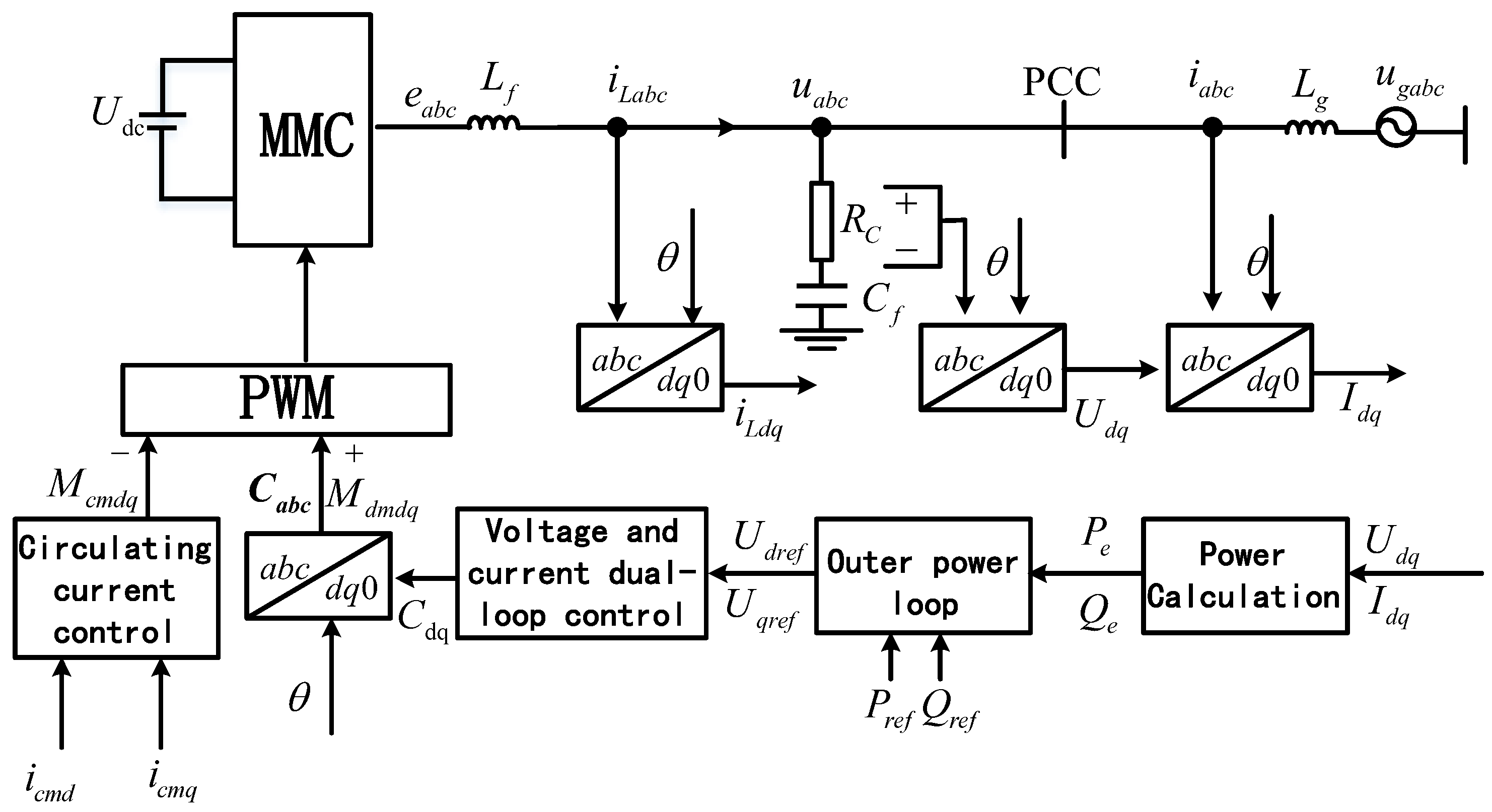
Figure 1. Control Block Diagram of MMC.
Electronics 15 01972 g001
Figure 2. Topology Diagram of MMC.
Electronics 15 01972 g002
Figure 3. Topology of the Power Control Loop.
Electronics 15 01972 g003
Figure 4. Block Diagram of Voltage–Current Double-Loop Control.
Electronics 15 01972 g004
Figure 5. Block Diagram of Voltage–Current Double-Loop Control.
Electronics 15 01972 g005
Figure 6. Impedance Sweep Results of MMC Without Virtual Impedance.
Electronics 15 01972 g006
Figure 7. Sequence Impedance Characteristics of MMC With Virtual Impedance.
Electronics 15 01972 g007
Figure 8. MMC Impedance With Varying Virtual Impedance Phase.
Electronics 15 01972 g008
Figure 9. MMC Impedance Characteristics With Different Virtual Impedances.
Electronics 15 01972 g009
Figure 10. Flowchart of Grey Wolf Optimization.
Electronics 15 01972 g010
Figure 11. Bode Plots of MMC and Grid Impedance Without Virtual Impedance.
Electronics 15 01972 g011
Figure 12. Grid-Connected Voltage and Current Without Virtual Impedance.
Electronics 15 01972 g012
Figure 13. FFT Result of PCC Voltage.
Electronics 15 01972 g013
Figure 14. Impedance Bode Plots With Random Virtual Impedance.
Electronics 15 01972 g014
Figure 15. Grid-Connected Voltage and Current With Random Virtual Impedance.
Electronics 15 01972 g015
Figure 16. FFT Result of PCC Voltage.
Electronics 15 01972 g016
Figure 17. Impedance Bode Plots With GWO-Optimized Virtual Impedance.
Electronics 15 01972 g017
Figure 18. Grid-Connected Voltage and Current With Optimized Virtual Impedance.
Electronics 15 01972 g018
Figure 19. FFT Result of PCC Voltage.
Electronics 15 01972 g019
Table 1. Detailed Parameters of the Grid-Forming MMC.
DescriptionSymbolValue
DC voltage U d c (kV)70
Phase AC voltage U 0 (kV)35/1.732
Fundamental frequency f 0 (Hz)50
Rated active power P r e f (MW)10
Rated reactive power Q r e f (kvar)0
Active droop coefficient D p 5.6
Reactive droop coefficient D q 88
Virtual inertiaJ (kg·m2)0.9
Submodule capacitance C a r m (mF)0.14
Bridge arm inductance L a r m (mH)2
Short-circuit ratio S C R 2
Voltage loop P coefficient K v p 0.01
Voltage loop I coefficient K v i 10
Current loop P coefficient K i p 7.5
Current loop I coefficient K i i 15
Circulating suppression P coefficient K c p 50
Circulating suppression I coefficient K c i 2
Disclaimer/Publisher’s Note: The statements, opinions and data contained in all publications are solely those of the individual author(s) and contributor(s) and not of MDPI and/or the editor(s). MDPI and/or the editor(s) disclaim responsibility for any injury to people or property resulting from any ideas, methods, instructions or products referred to in the content.