


Abstract
Wind power systems often introduce interfering DC components that distort power measurements and threaten grid stability. To address these issues, this paper proposes a novel delayed sampling-based grid parameter estimation method that explicitly accounts for DC disturbances. By transforming the estimation problem into a linear regression form via nonlinear algebraic transformation, an adaptive recursive identification algorithm is developed to estimate grid frequency, amplitude, phase, and DC component simultaneously. Rigorous stability analysis is provided to guarantee convergence and robustness of the estimator in the presence of DC components. Experimental results demonstrate fast transient response and zero steady-state error, validating the effectiveness of the proposed method for real-time grid parameter estimation.
1. Introduction
Large-scale wind power bases are increasingly integrated into weak regional power grids via grid-forming converters. However, the intermittency of renewable energy output and the characteristics of power electronic devices have exacerbated the risk of grid frequency fluctuations [1,2,3]. More importantly, converter control errors or grid disturbances easily result in DC components. If these DC components are not accurately estimated and compensated, it will lead to distortion in the calculation of converter output power, thereby affecting its critical capability for active frequency and voltage support, and even inducing grid oscillations [4,5].
At present, various methods have been developed for power grid frequency and signal parameter estimation, which can generally be classified into phase-locked loop (PLL)-based methods, adaptive filtering methods, and time–frequency transformation techniques. PLL [6,7,8] and its improved variants, such as the synchronous reference frame phase-locked loop (SRF-PLL) [9,10] and the second-order generalized integrator phase-locked loop (SOGI-PLL) [11,12], are widely adopted due to their simple structure and ease of engineering implementation. However, these methods typically rely on front-end filters for signal preprocessing, introducing noticeable phase delays and failing to effectively suppress DC components. The inherent limitation lies in that the mathematical models of traditional PLL techniques are established under the assumption of ideal sinusoidal signals, making them difficult to adapt to actual grid conditions with DC components.
SOGI-PLL employs an orthogonal signal generator (OSG) to construct synchronous reference signals. However, the core second-order generalized integrator is highly sensitive to DC components of the input signal [13,14,15]. When DC components exist in the input signal, the orthogonal signals output by the OSG introduce low-frequency deviations correlated with the DC amplitude, which in turn induces steady-state errors in frequency and phase estimation. These estimation errors will be further amplified in dynamic operating conditions, even triggering oscillation instability, which poses significant risks to the reliable voltage and frequency support functions of grid-forming converters [16,17]. To enhance robustness against DC component disturbances, ref. [18] introduces an integral term into the SOGI structure and proposes an improved third-order generalized integrator (TOGI) method, which can suppress DC components to a certain extent. However, its dynamic response speed is still constrained by the design of integrator parameters. In particular, under conditions involving sudden frequency changes, the error convergence rate is relatively slow, making it difficult to meet the requirements of high accuracy and real-time performance in engineering applications.
Adaptive filtering-based methods [19,20,21], such as estimators utilizing the recursive least squares algorithm [22] and adaptive frequency-locked loops [23,24], achieve online estimation of frequency and phase by constructing time-recursive models, demonstrating certain adaptive capabilities. However, most algorithms only focus on the frequency components of signals without modeling the interference caused by DC components, leading to potential estimation jitter or even divergence under dynamic disturbances such as frequency jumps or sudden load changes. In addition, some researchers have introduced time–frequency analysis tools, including the Fourier Transform, Wavelet Transform, and Hilbert Transform, to enhance the processing capability for non-stationary signals [25,26,27,28]. Nevertheless, these methods generally suffer from issues such as high computational complexity, poor real-time performance, and sensitivity to sampling accuracy, making it difficult to achieve high-frequency updates in embedded environments.
Notably, most existing methods focus on independent estimation of signal parameters such as frequency, phase, or amplitude, rarely considering the impact of estimation errors on the accuracy of subsequent active and reactive power calculations. In many studies, power calculation still relies on idealized models that assume the input signals are pure sinusoids without DC components [29,30]. Practical frequency drift, DC disturbances, or phase deviations cause orthogonal component deviations, introducing errors [31]. Moreover, dynamic phasor algorithms typically ignore DC content, while DC-centric methods neglect dynamic behavior. Under transient or dynamic disturbances, these modeling mismatches amplify estimation errors and degrade functions such as disturbance localization and oscillation detection [32,33,34].
To address the limitations of existing methods in suppressing DC components and achieving accurate parameters and power estimation, this paper proposes a delayed sampling-based nonlinear algebraic transformation method and a multi-parameter estimation method for grid signals with DC component disturbances. The core contributions are as follows: A delayed sampling-based nonlinear algebraic transformation method is developed to establish the power grid multi-parameter model, which converts the parameter estimation problem under DC component disturbances into a linear regression identification problem. This transformation enables explicit decoupling of the DC component from the fundamental signal parameters while eliminating the need for front-end filters and featuring a simplified structure. An adaptive recursive method is further designed to perform real-time, high-precision joint estimation of the fundamental frequency, DC component, and power. Rigorous Lyapunov analysis proves the global asymptotic stability of the proposed method, ensuring its reliable performance under disturbance conditions. The experimental results demonstrate that the proposed method not only effectively eliminates the impact of DC components on parameter estimation, but also significantly improves the accuracy of frequency, amplitude, and phase estimation. All symbols involved in this paper are listed in Table 1.
Table 1.
Nomenclature.
2. Proposed Delayed Sampling-Based Power Grid Parameter Modeling and Estimation
In this section, a nonlinear algebraic transformation method based on delayed sampling is proposed for grid signals affected by DC component disturbances. This method transforms the complex parameter estimation problem, which includes DC components, into a linear regression identification problem. Through this mathematical transformation, efficient iterative computation can be applied to estimate the unknown parameters, such as frequency, amplitude, phase, and DC components.
The expression for the grid voltage with a DC component disturbance is given by the following:
where V, , , and are the amplitude, frequency, phase angle, and DC component.
By discretizing the grid voltage with a sampling time of , the resulting discretized expression is written as follows:
where .
By sampling the signal with different time delays, the following relation is derived:
the delay factor m is chosen such that .
To simplify the analysis, we define the following:
With these definitions established, the relationship is expressed in the form of a linear regression model as follows:
Based on the linear regression in (7), an adaptive method is proposed to estimate the parameter vector :
where and denote the estimated values of and , and the calculation methods of related variables are as follows:
where the forgetting factor satisfies , typically chosen as . To clearly present the minimum procedure for obtaining in (9), the specific calculation steps of the proposed method are detailed in the following Table 2.
Table 2.
Calculation flow for , , and in the proposed method.
Based on the relationship between and in (4), the frequency estimation and the DC component estimation are calculated as follows:
The actual orthogonal signals for is calculated as follows:
Based on trigonometric relationship, the following is obtained:
so the estimation of the orthogonal signal is calculated by
Similarly, when the DC component is removed, the corresponding magnitude and phase angle of should be the following:
Thus, the amplitude estimation and phase angle estimation can be obtained as follows:
Therefore, the proposed method achieves joint estimation of grid frequency, amplitude, phase, and DC component, addressing the coupling problem between DC component and AC parameters.
3. Stability Analysis
This section presents a rigorous stability analysis of the proposed estimation method, establishing sufficient conditions for parameter convergence. The analysis examines the evolution of the estimation error dynamics and verifies asymptotic convergence to the true parameter values. First, the parameter estimation error is defined as follows:
The error dynamics are derived from the adaptive update law:
This derivation reveals how the estimation error evolves with the adaptive update law, laying the foundation for subsequent stability verification.
To formally establish the stability of the proposed estimation method, a Lyapunov function, which is an essential tool for analyzing the convergence and stability of dynamic systems, is constructed as follows:
Application of the Sherman–Morrison formula provides the following:
This formula simplifies the inverse of the updated information matrix , enabling tractable recursion of the Lyapunov function.
Substituting the error dynamics (14) into the Lyapunov function (15) yields the following:
Then, applying (16) to (17), the following is obtained:
To simplify the expansion of the complex expression and the verification of the Lyapunov function’s monotonicity, (18) is split into terms A and B as follows:
Expanding term A results in the following:
using the relations
where . Combining all subterms of A results in the following:
Expanding term B results in the following:
Combining terms A (19) and B (20) yields the following:
Hence, the following inequality holds:
since , the proposed estimation method is stable according to the Lyapunov theroy. Proceeding with the convergence analysis, the information matrix update from (16) yields the following:
Considering only the most recent L terms provides a lower bound:
Since when , there is the following:
Under the persistent excitation condition, there exist constants and such that for all k, the following is calculated:
therefore
Defining , the following inequality holds:
This establishes the parameter error bound, calculated as follows:
so that
and the parameter error converges exponentially to zero.
In summary, the proposed method can achieves a joint estimation of the frequency, amplitude, phase, and DC component accurately.
4. Application of Delayed Sampling-Based Estimation Method in Power Calculation
This section introduces a method for calculating the positive and negative power of the grid with DC components while integrating the proposed delayed sampling-based estimation approach to ensure accurate power computation.
The discretized voltage and current, including DC components, are expressed as follows:
where I, , and are the current amplitude, phase difference between the current and the voltage, and DC component of the current.
Based on the definitions of the positive and negative power, incorporating the DC component, the calculations are as follows:
By applying the proposed method to the voltage and current, the orthogonal signals , and DC components , can be extracted. Substituting these estimated quantities into the power expression framework of (26). The estimated positive and negative power can be calculated as follows:
5. Experimental Results
In this section, the effectiveness and performance of the proposed method are further evaluated through experiments. The proposed method is implemented on the YXSPACE-SP2000 processing platform, operating at a frequency of 20 kHz. The parameters of the proposed method are selected as follows: The forgetting factor is set to 0.99, and the delay sampling is configured as one-quarter of the nominal period. The experimental conditions are summarized in Table 3. The results are presented in two main sections: Grid Parameter Estimation Verification and Power Estimation Verification.
Table 3.
Experimental conditions.
5.1. Grid Parameter Estimation Verification
In this section, experiments are performed to estimate the DC component, orthogonal signal, frequency, amplitude, and phase. To illustrate the superiority of the proposed method, a comparative analysis is performed with TOGI [18] and SOGI.
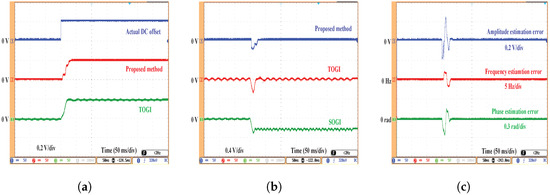
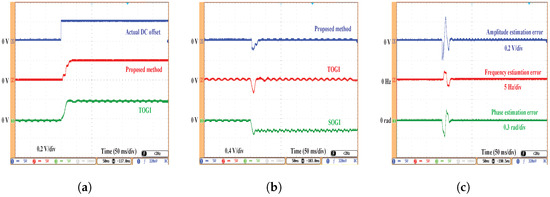
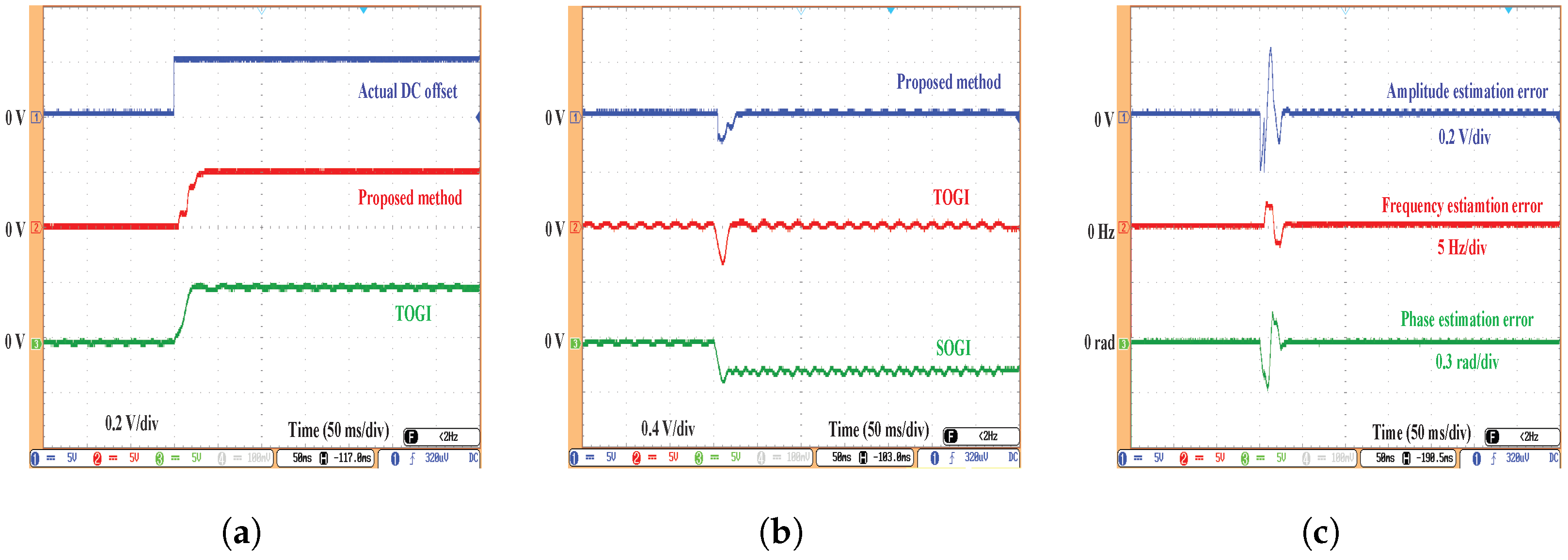
Case A: At s, a 0.2 p.u. DC component is injected. Figure 1a compares the DC component estimation results: the proposed method achieves an accurate estimation within approximately 30 ms with no overshoot, and its steady-state accuracy is superior to TOGI, which exhibits oscillations. Figure 1b shows orthogonal signal estimation: SOGI degrades in the presence of a DC component, while the proposed method performs slightly better than TOGI. Figure 1c shows the performance of the proposed method in multi-parameter estimation, showing fast dynamics and low overshoot. These results confirm the proposed method’s effectiveness in suppressing DC-induced estimation errors.
Figure 1.
Experimental results under Case A: (a) estimation of the DC component; (b) estimation of orthogonal signals; (c) estimation of grid parameters.
Case B: At s, a 0.2 p.u. DC component is injected, and the frequency jumps from 50 Hz to 55 Hz. Figure 2a shows DC component estimation: the proposed method stabilizes faster without obvious overshoot, in contrast to TOGI, which exhibits notable transient fluctuations under combined DC and frequency jump disturbances. Figure 2b shows the proposed method effectively suppresses the influence of the DC component, with smaller overshoot in estimated orthogonal components compared to SOGI and TOGI, and no steady-state oscillations, closely tracking the ideal waveform. Figure 2c shows the performance of the proposed method in multi-parameter estimation. Even under the injection of the DC component and frequency jump, the proposed method still exhibits excellent dynamic performance, converging within 30 ms.
Figure 2.
Experimental results under Case B: (a) estimation of the DC component; (b) estimation of orthogonal signals; (c) estimation of grid parameters.
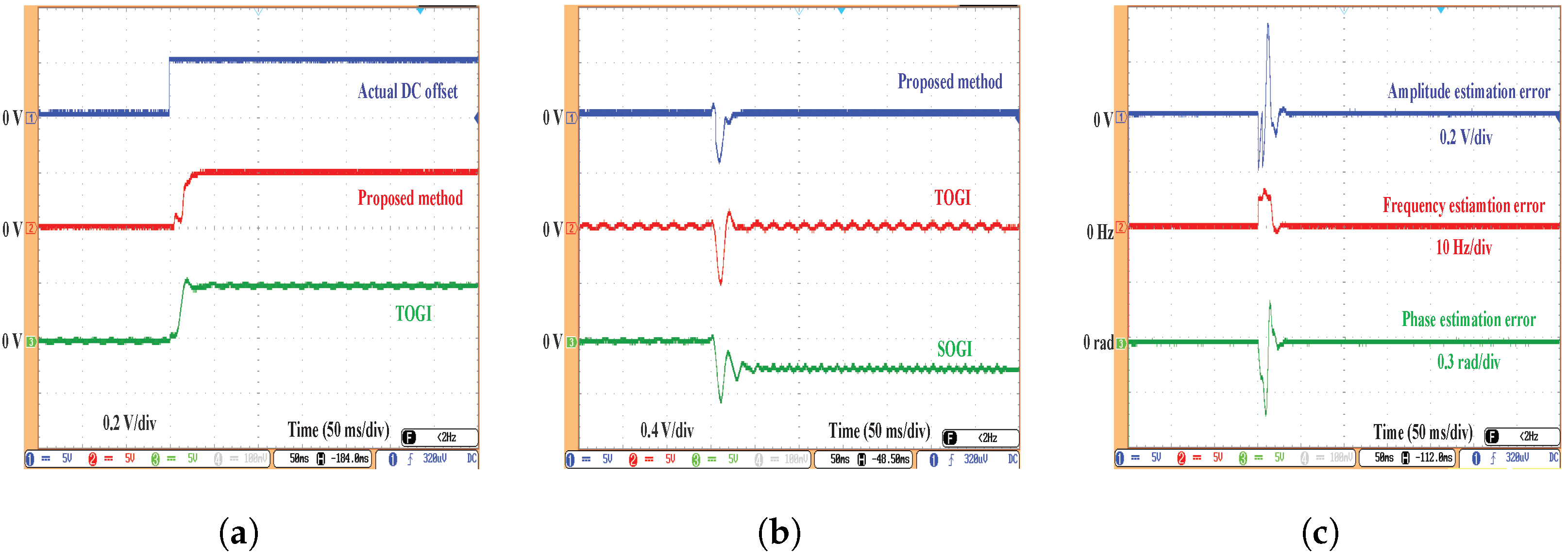
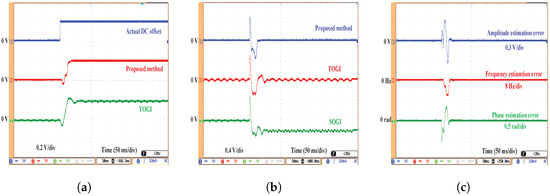
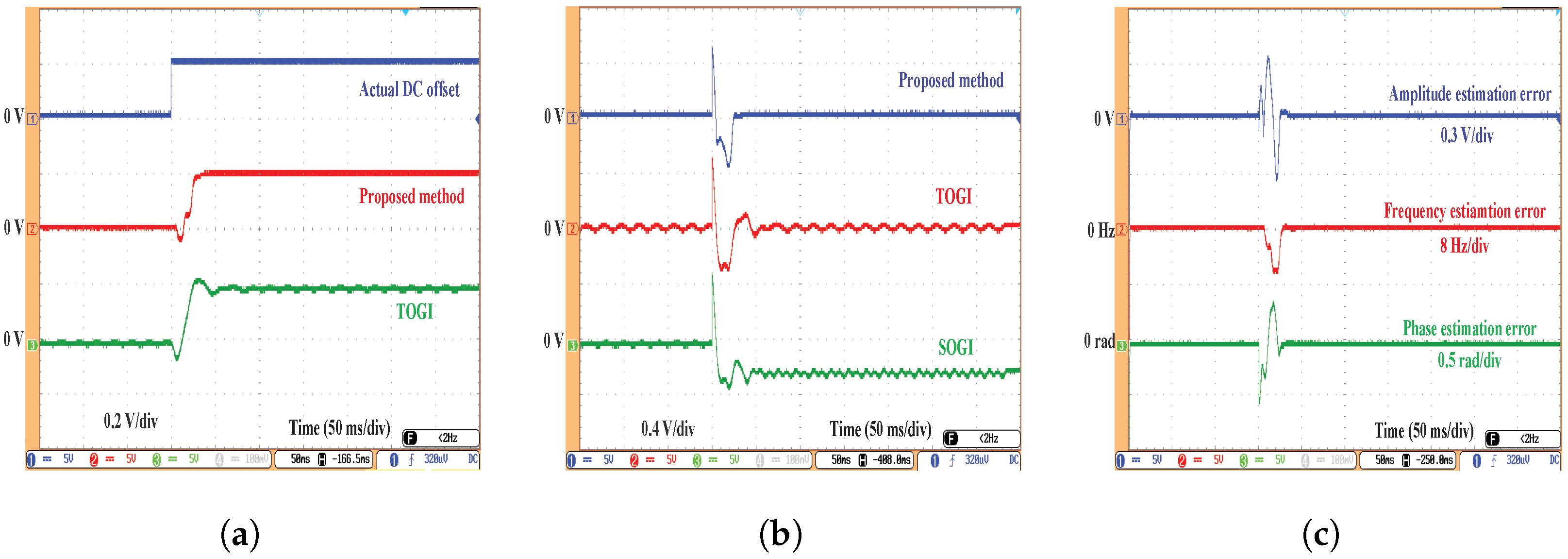
Case C: At s, a 0.2 p.u. DC component is injected, and the frequency changes at a rate of 10 Hz/s. Figure 3a shows DC component estimation: the proposed method maintains high tracking accuracy with a faster dynamic response, unaffected by the ramping frequency. Figure 3b shows orthogonal signals, where the proposed method outperforms TOGI in both stability and tracking smoothness under time-varying frequency conditions. Figure 3c illustrates the performance of the proposed method in multi-parameter estimation. Although the proposed method experiences small oscillations, it successfully tracks the amplitude, frequency, and phase of the power grid. These results verify the method’s adaptability to DC disturbance combined with dynamic frequency variation.
Figure 3.
Experimental results under Case C: (a) estimation of the DC component; (b) estimation of orthogonal signals; (c) estimation of grid parameters.
Case D: At s, a 0.2 p.u. DC component is injected and phase jumps . Figure 4a shows the DC component estimation: the proposed method achieves a more accurate and stable estimation of the DC component with minimal overshoot, outperforming the TOGI method, which exhibits significant fluctuations. Figure 4b shows the orthogonal signals: the proposed method outperforms TOGI with improved stability and tracking accuracy. Figure 4c illustrates the performance of the proposed method in multi-parameter estimation, where it converges within 30 ms. These results demonstrate the method’s robustness against DC component and phase jump disturbances.
Figure 4.
Experimental results under Case D: (a) estimation of the DC component; (b) estimation of orthogonal signals; (c) estimation of grid parameters.
To quantitatively evaluate the performance of the proposed method and TOGI in DC component estimation, Table 4 compares three key indicators: dynamic responsiveness, steady-state accuracy, and overshoot. The comparison covers the four experimental cases defined in Table 3. Specific numerical results intuitively reflect the proposed method’s advantages. It balances rapid convergence, estimation precision, and stability in complex grid scenarios.
Table 4.
Performance comparison of the proposed method and TOGI.
5.2. Power Estimation Verification
To further validate the power estimation performance of the proposed method, experiments are conducted under typical working conditions as shown in Table 5. The voltage and current frequency were set at 50 Hz, with a voltage amplitude of 1 V and a current amplitude of 0.1 A, with a phase difference of between the voltage and current.
Table 5.
Experimental conditions for Power Estimation.
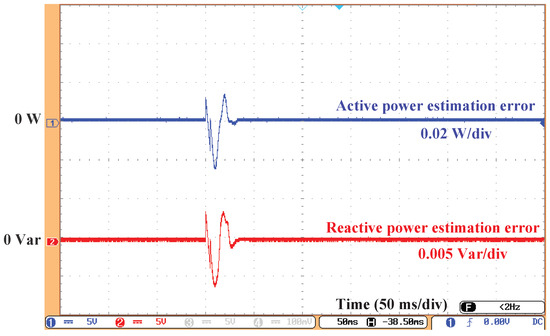
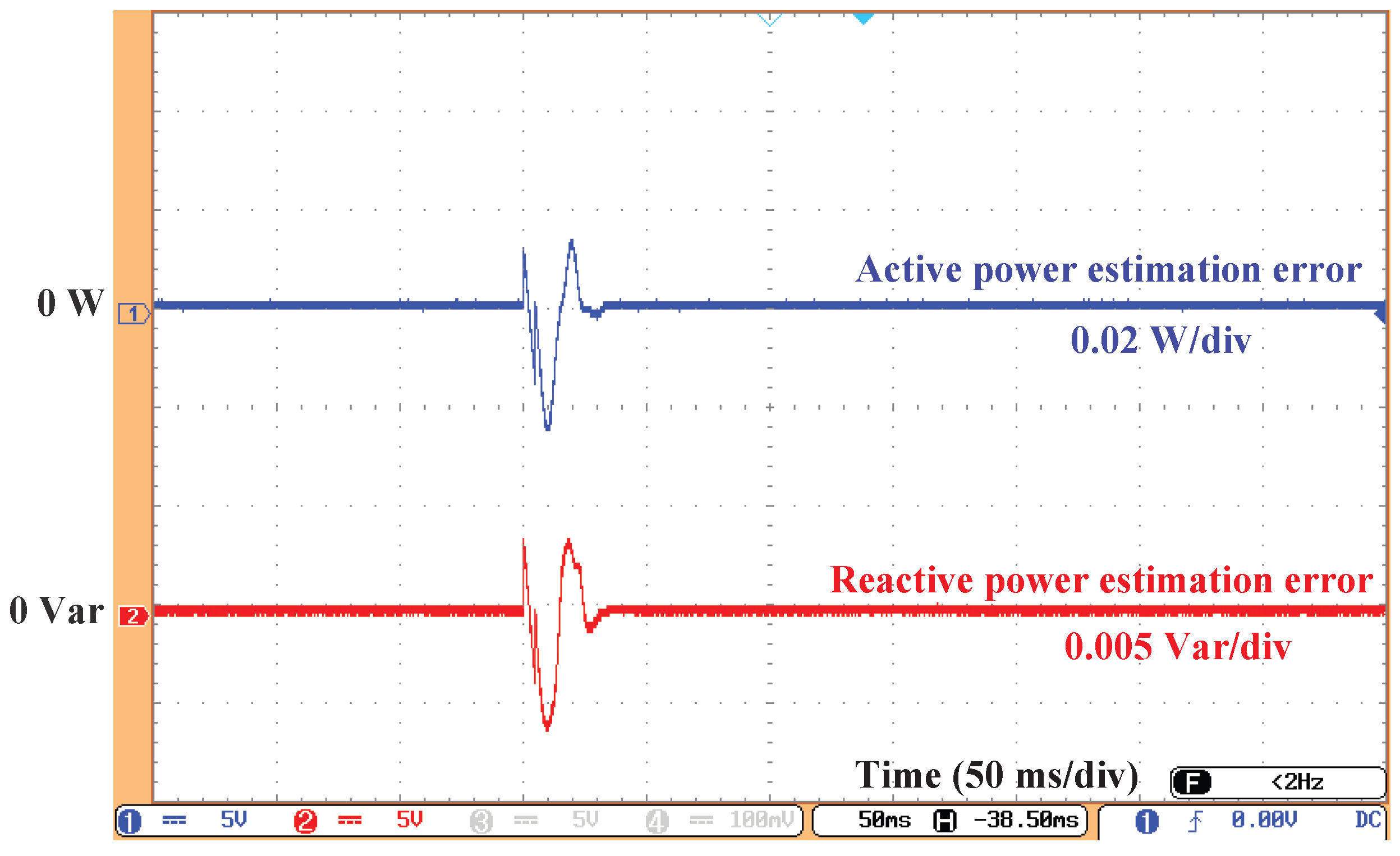
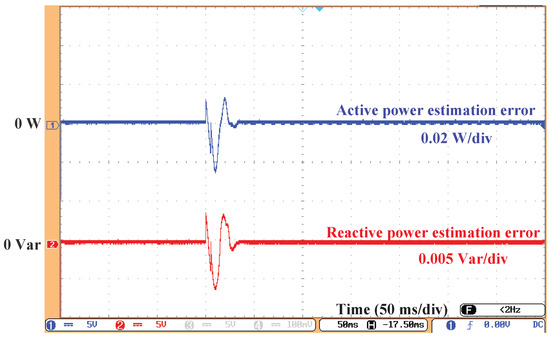
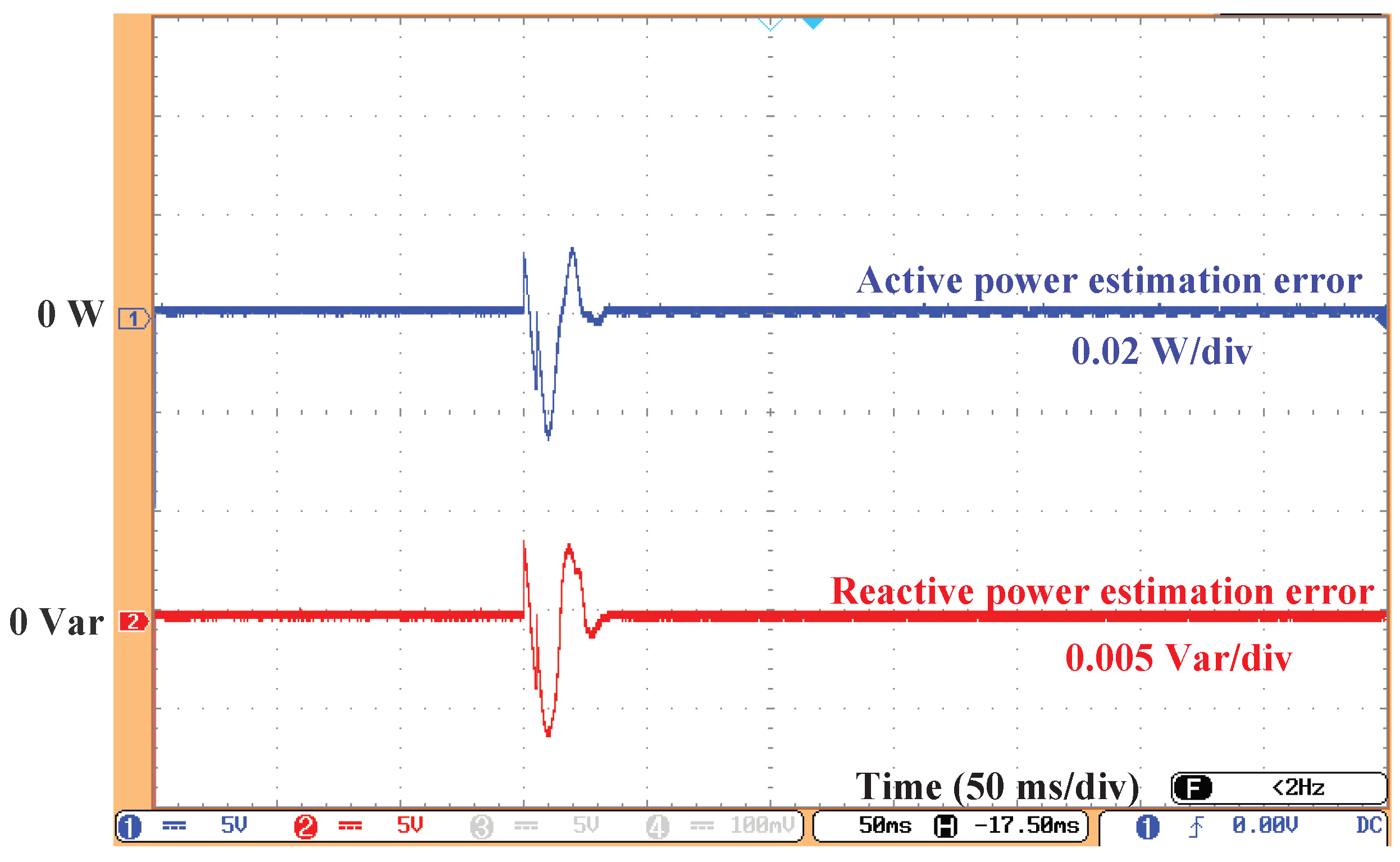
Figure 5 shows the estimation errors of active and reactive power under Case A. As shown in Figure 5, after the DC component is injected, the active power estimation error exhibits a transient disturbance with a peak value of approximately 0.02 W, which quickly decays and stabilizes, eventually maintaining a zero-error state. Similarly, the reactive power estimation error shows initial fluctuations, with a maximum value below 0.007 Var, and also converges quickly to a zero-steady-state level. This illustrates that the proposed method ensures accurate estimation of both active and reactive power, exhibiting excellent dynamic performance and steady-state precision under DC component conditions.
Figure 5.
Dynamic error of power estimation under Case A.
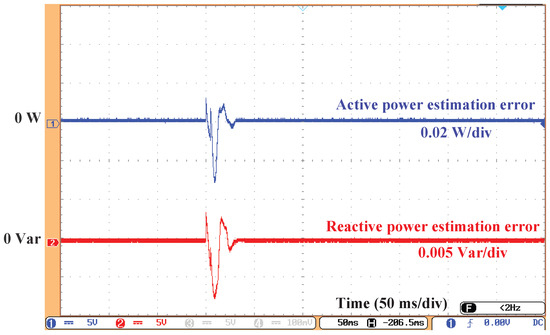
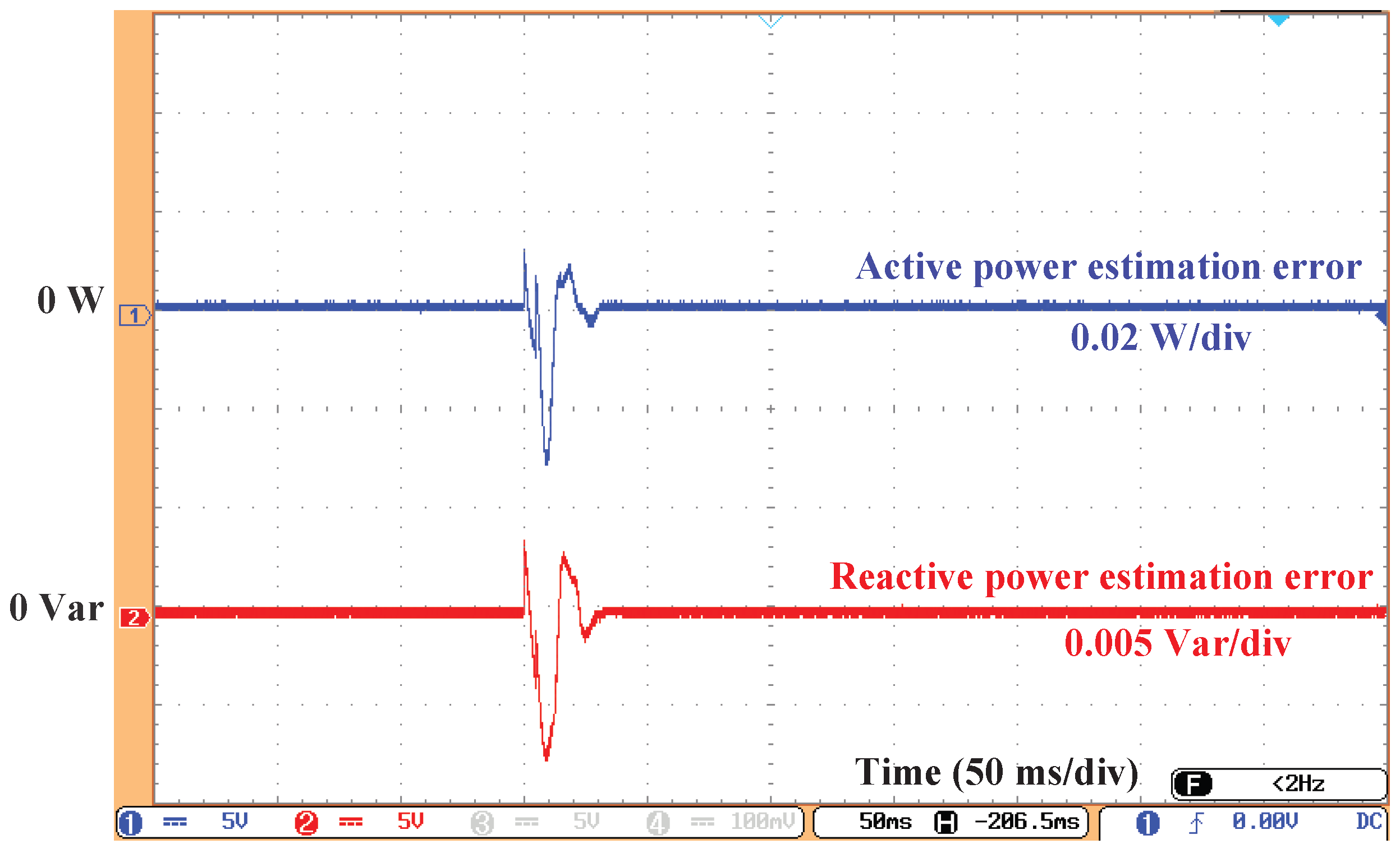
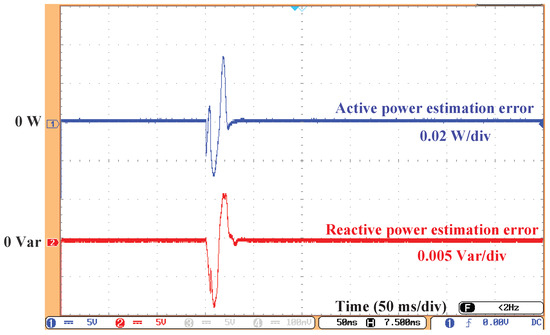
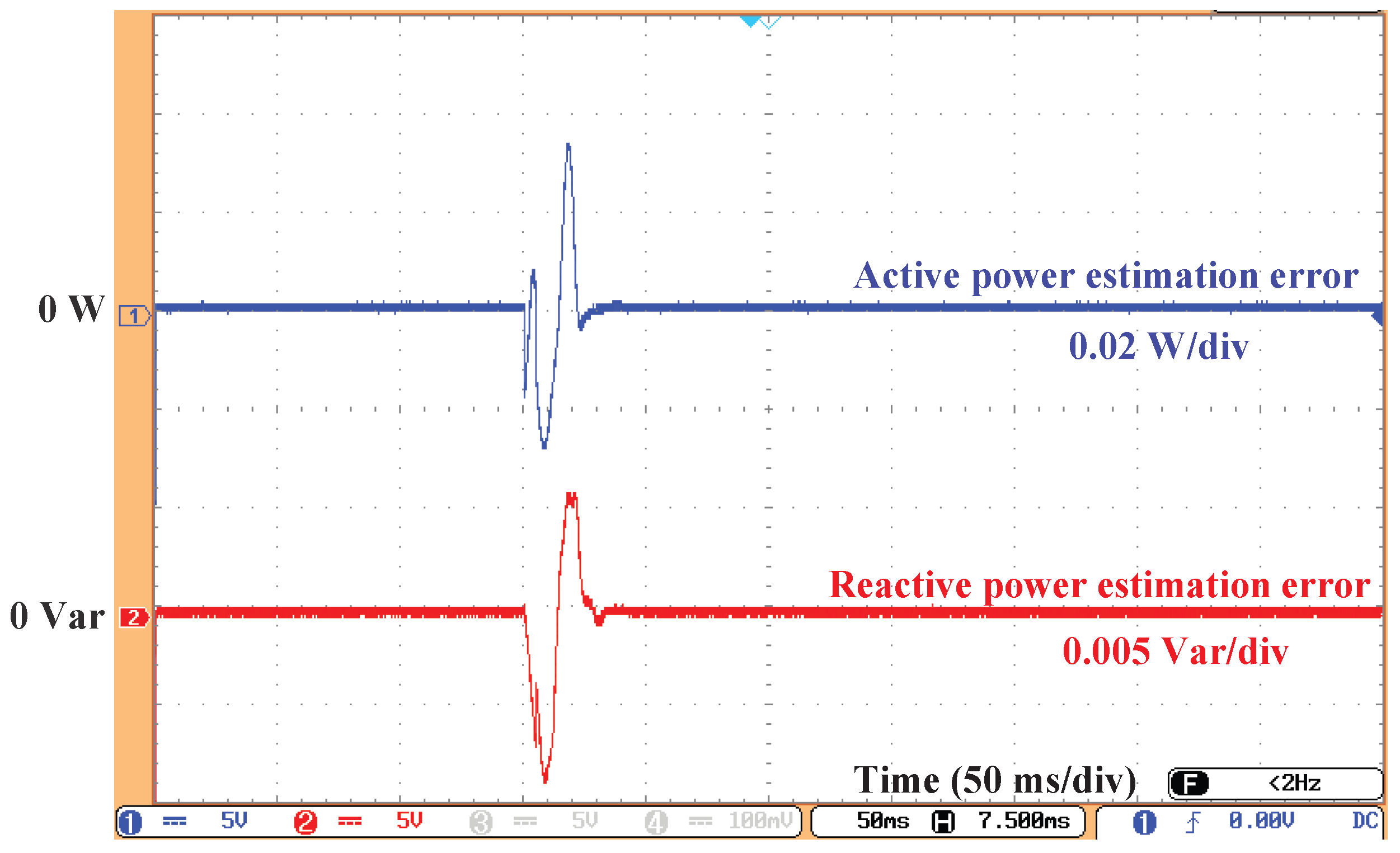
Figure 6 illustrates the estimation errors under Case B. As seen in Figure 6, the active power error converges rapidly, returning to a steady state within about 30 ms, which demonstrates an excellent dynamic response and strong disturbance rejection. Although the reactive power error exhibits initial fluctuations, it also stabilizes and converges to zero. These results confirm the method’s effectiveness in accurately estimating both active and reactive power despite the concurrent presence of a DC component and a frequency jump.
Figure 6.
Dynamic error of power estimation under Case B.
Figure 7 shows the estimation errors under Case C. As seen in Figure 7, after the combined disturbance, the errors show noticeable transient fluctuations but gradually stabilize within 30 ms, remaining within a narrow error range. This demonstrates that the method’s adaptability to power estimation under complex scenarios involving frequency ramps and DC components, with rapid stabilization and consistent accuracy in dynamic scenarios.
Figure 7.
Dynamic error of power estimation under Case C.
Figure 8 illustrates the estimation errors under Case D. Compared with the previous three cases, the proposed method exhibits more noticeable overshoot under phase jump conditions, but the error converges rapidly to near zero. This indicates that, despite initially large estimation errors caused by phase jumps, the proposed method rapidly converges to the true active and reactive power values. This effectively demonstrates the effectiveness of the proposed method in complex scenarios.
Figure 8.
Dynamic error of power estimation under Case D.
The experimental results under a variety of operating conditions demonstrate the superiority of the proposed method. It achieves faster convergence and more accurate estimation of DC components and orthogonal signal components compared with SOGI and TOGI, while exhibiting only minimal overshoot during dynamic transients. Moreover, power estimation errors converge to zero rapidly, confirming the method’s robustness against DC disturbances during both parameter identification and power calculation.
6. Conclusions
This paper proposes a power grid multi-parameter model and an adaptive recursive parameter estimation method. By explicitly including DC components, the method enables joint estimation of frequency, amplitude, phase, and DC component. The recursive estimator is shown to be stable and convergent by Lyapunov analysis, yielding fast transient response and asymptotically zero estimation error. Experimental results verify the effectiveness of the proposed approach, demonstrating fast dynamics and zero steady-state error in both the voltage parameter and power estimation. However, practical disturbances such as high-order harmonic injection and extremely weak-grid conditions can degrade its performance. Future work will focus on these scenarios to further enhance the method’s adaptability.
Author Contributions
Conceptualization, Y.Z. (Youfeng Zhou), G.L., Z.D. and Y.L.; methodology, G.L., Y.Z. (Yihua Zhu) and Y.L.; writing—original draft preparation, Y.Z. (Youfeng Zhou), X.L. and Y.L.; writing—review and editing, G.L. and C.L.; visualization, C.L. and Y.Z. (Yihua Zhu); project administration, G.L. and Y.Z. (Yihua Zhu); funding acquisition, G.L. and C.L. All authors have read and agreed to the published version of the manuscript.
Funding
This work was supported by the National Key Research and Development Program of China under grant 2023YFB4203200.
Data Availability Statement
The original contributions presented in this study are included in the article. Further inquiries can be directed at the corresponding authors.
Conflicts of Interest
Author Yuyan Liu, Yihua Zhu, and Chao Luo were employed by the Company State Key Laboratory of HVDC, Electric Power Research Institute, China Southern Power Grid, Guangzhou 510663, China. The authors declare that the research was conducted in the absence of any commercial or financial relationships that could be construed as a potential conflict of interest.
Abbreviations
The following abbreviations are used in this manuscript:
| DC | direct current |
| PLL | phase-locked loop |
| SRF-PLL | synchronous reference frame phase-locked loop |
| SOGI-PLL | second-order generalized integrator PLL |
| OSG | orthogonal signal generator |
| TOGI | third-order generalized integrator |
References
- Khan, S.A.; Wang, M.; Su, W.; Liu, G.L.; Chaturvedi, S. Grid-Forming Converters for Stability Issues in Future Power Grids. Energies 2022, 15, 4937. [Google Scholar] [CrossRef] [Scilit]
- Rodríguez-Amenedo, J.L.; Gómez, S.A. Damping Low-Frequency Oscillations in Power Systems Using Grid-Forming Converters. IEEE Access 2021, 9, 158984–158997. [Google Scholar] [CrossRef] [Scilit]
- Revathi, V.M.; Sasikala, D.R.; Geetha, B.; Al-Attabi, K.; Aggarwal, S.; Sherje, D.N.P. Grid-Forming Converters: Stability and Control in Islanded Power Systems. E3S Web Conf. 2024, 540, 8. [Google Scholar] [CrossRef] [Scilit]
- Kong, X.; Zhang, J.; Zhou, J.; Zang, J.; Wang, J.; Shi, G.; Cai, X. Power and Voltage Control Based on DC Offset Injection for Bipolar Low-voltage DC Distribution System. J. Mod. Power Syst. Clean Energy 2023, 11, 1529–1539. [Google Scholar] [CrossRef] [Scilit]
- Lee, J.S.; Hwang, S.H. DC Offset Error Compensation Algorithm for PR Current Control of a Single-Phase Grid-Tied Inverter. Energies 2018, 11, 2308. [Google Scholar] [CrossRef] [Scilit]
- Golestan, S.; Guerrero, J.M.; Vasquez, J.C. Single-Phase PLLs: A Review of Recent Advances. IEEE Trans. Power Electron. 2017, 32, 9013–9030. [Google Scholar] [CrossRef] [Scilit]
- Dutta, D.; Pranshu Tumukunta, S.; Sivaraaj, N.R.; Abdul Majeed, K.K. Exploring the Landscape of Phase-Locked Loop Architectures: A Comprehensive Review. IEEE Access 2024, 12, 125523–125543. [Google Scholar] [CrossRef] [Scilit]
- Xu, J.; Qian, H.; Bian, S.; Hu, Y.; Xie, S. Comparative Study of Single-phase Phase-locked Loops for Grid-connected Inverters Under Non-ideal Grid Conditions. Csee J. Power Energy Syst. 2022, 8, 155–164. [Google Scholar]
- Dai, Z.; Li, G.; Fan, M.; Huang, J.; Yang, Y.; Hang, W. Global Stability Analysis for Synchronous Reference Frame Phase-Locked Loops. IEEE Trans. Ind. Electron. 2022, 69, 10182–10191. [Google Scholar] [CrossRef] [Scilit]
- Li, X.; Lin, H. A Design Method of Phase-Locked Loop for Grid-Connected Converters Considering the Influence of Current Loops in Weak Grid. IEEE J. Emerg. Sel. Top. Power Electron. 2020, 8, 2420–2429. [Google Scholar]
- Xin, Z.; Wang, X.; Qin, Z.; Lu, M.; Loh, P.C.; Blaabjerg, F. An Improved Second-Order Generalized Integrator Based Quadrature Signal Generator. IEEE Trans. Power Electron. 2016, 31, 8068–8073. [Google Scholar] [CrossRef] [Scilit]
- Sahoo, A.; Ravishankar, J.; Jones, C. Phase-Locked Loop Independent Second-Order Generalized Integrator for Single-Phase Grid Synchronization. IEEE Trans. Instrum. Meas. 2021, 70, 9004409. [Google Scholar]
- Golestan, S.; Guerrero, J.M.; Gharehpetian, G.B. Five Approaches to Deal with Problem of DC Offset in Phase-Locked Loop Algorithms: Design Considerations and Performance Evaluations. IEEE Trans. Power Electron. 2016, 31, 648–661. [Google Scholar] [CrossRef] [Scilit]
- Dash, A.; Bagarty, D.P.; Hota, P.K.; Behera, R.K.; Muduli, U.R.; Al Hosani, K. DC-Offset Compensation for Three-Phase Grid-Tied SPV-DSTATCOM Under Partial Shading Condition with Improved PR Controller. IEEE Access 2021, 9, 132215–132224. [Google Scholar] [CrossRef] [Scilit]
- Mnider, A.; Dahidah, M.; Kadandani, N.B. Advancements in DC Offset Rejection Techniques: A Comparative Analysis of SOGI-PLL Schemes. In Proceedings of the 2024 7th International Conference on Electric Power and Energy Conversion Systems (EPECS), Sharjah, United Arab Emirates, 12–14 November 2024; pp. 129–134. [Google Scholar]
- Prakash, S.; Singh, J.K.; Behera, R.K.; Mondal, A. Comprehensive Analysis of SOGI-PLL Based Algorithms for Single-Phase System. In Proceedings of the 2019 National Power Electronics Conference (NPEC), Tiruchirappalli, India, 13–15 December 2019; pp. 1–6. [Google Scholar]
- Xu, J.; Qian, H.; Hu, Y.; Bian, S.; Xie, S. Overview of SOGI-Based Single-Phase Phase-Locked Loops for Grid Synchronization Under Complex Grid Conditions. IEEE Access 2021, 9, 39275–39291. [Google Scholar]
- Karimi-Ghartemani, M.; Khajehoddin, S.A.; Jain, P.K.; Bakhshai, A.; Mojiri, M. Addressing DC Component in PLL and Notch Filter Algorithms. IEEE Trans. Power Electron. 2012, 27, 78–86. [Google Scholar]
- Pan, H.; Li, Z.; Wei, T. A Novel Phase-Locked Loop with Improved-Dual Adaptive Notch Filter and Multi-Variable Filter. IEEE Access 2019, 7, 176578–176586. [Google Scholar]
- Bacon, V.D.; Oliveira da Silva, S.A.; Garcia Campanhol, L.B.; Angélico, B.A. Stability analysis and performance evaluation of a single-phase phase-locked loop algorithm using a non-autonomous adaptive filter. IET Power Electron. 2014, 7, 2081–2092. [Google Scholar] [CrossRef] [Scilit]
- Quan, X.; Dou, X.; Wu, Z.; Hu, M.; Chen, F. A Concise Discrete Adaptive Filter for Frequency Estimation Under Distorted Three-Phase Voltage. IEEE Trans. Power Electron. 2017, 32, 9400–9412. [Google Scholar] [CrossRef] [Scilit]
- Lian, C.; Xiao, F.; Liu, J.; Gao, S. A novel filtering algorithm for the resolver position signal based on recursive least squares and phase-locked loop. IET Power Electron. 2021, 14, 2535–2544. [Google Scholar]
- Dai, Z.; Zhang, Z.; Yang, Y.; Blaabjerg, F.; Huangfu, Y.; Zhang, J. A Fixed-Length Transfer Delay Based Adaptive Frequency-Locked Loop for Single-Phase Systems. IEEE Trans. Power Electron. 2019, 34, 4000–4004. [Google Scholar] [CrossRef] [Scilit]
- Lyu, S.; Zheng, L.; Song, J. A Second-Order Generalized Integrator Frequency Locked Loop with Damping Ratio Adaptation. IEEE Trans. Power Electron. 2022, 37, 2694–2704. [Google Scholar] [CrossRef] [Scilit]
- Lee, J.; Cha, H. A new DSC-PLL using recursive discrete fourier transform for robustness to frequency variation. In Proceedings of the 2016 IEEE Applied Power Electronics Conference and Exposition (APEC), Long Beach, CA, USA, 20–24 March 2016; pp. 3598–3602. [Google Scholar]
- Liu, H.; Sun, Y.; Hu, H.; Xing, Y. A new single-phase PLL based on discrete fourier transform. In Proceedings of the 2015 IEEE Applied Power Electronics Conference and Exposition (APEC), Charlotte, NC, USA, 15–19 March 2015; pp. 521–526. [Google Scholar]
- Wang, S.; Yuan, Z.; Ma, J.; Liu, T.; Wu, Z.; Wang, R. Accurate LTP Model and Stability Analysis of the Second-Order Generalized Integrator-Based Single-Phase Phase-Locked Loop. IEEE Trans. Ind. Electron. 2022, 69, 6225–6235. [Google Scholar] [CrossRef] [Scilit]
- Velamarthi, S.; Paidimarry, C.S. A Novel Design of Hilbert Huang Based All Digital Phase Locked Loop Using FPGA. Int. J. Electr. Electron. Eng. Telecommun. 2023, 12, 235–244. [Google Scholar]
- Song, J.; Mingotti, A.; Zhang, J.; Peretto, L.; Wen, H. Fast Iterative-Interpolated DFT Phasor Estimator Considering Out-of-Band Interference. IEEE Trans. Instrum. Meas. 2022, 71, 9005814. [Google Scholar] [CrossRef] [Scilit]
- Borkowski, J.; Mroczka, J.; Matusiak, A.; Kania, D. Frequency Estimation in Interpolated Discrete Fourier Transform with Generalized Maximum Sidelobe Decay Windows for the Control of Power. IEEE Trans. Ind. Inform. 2021, 17, 1614–1624. [Google Scholar] [CrossRef] [Scilit]
- Li, M.; Matas, J.; El Mariachet, J.; Branco, C.G.C.; Guerrero, J.M. A Fast Power Calculation Algorithm for Three-Phase Droop-Controlled-Inverters Using Combined SOGI Filters and Considering Nonlinear Loads. Energies 2022, 15, 7360. [Google Scholar] [CrossRef] [Scilit]
- Ma, X.; Liao, Z.; Wang, Y.; Zhao, J. Fast Dynamic Phasor Estimation Algorithm Considering DC Offset for PMU Applications. IEEE Trans. Power Deliv. 2023, 38, 3582–3593. [Google Scholar] [CrossRef] [Scilit]
- Zhao, J.; Tan, J.; Wu, L.; Zhan, L.; Yao, W.; Liu, Y. Impact of the Measurement Errors on Synchrophasor-Based WAMS Applications. IEEE Access 2019, 7, 143960–143972. [Google Scholar] [CrossRef] [Scilit]
- Guo, Y.; Xu, H.; Chi, A. Broadband Dynamic Phasor Measurement Method for Harmonic Detection. Electronics 2022, 11, 1667. [Google Scholar] [CrossRef] [Scilit]

Disclaimer/Publisher’s Note: The statements, opinions and data contained in all publications are solely those of the individual author(s) and contributor(s) and not of MDPI and/or the editor(s). MDPI and/or the editor(s) disclaim responsibility for any injury to people or property resulting from any ideas, methods, instructions or products referred to in the content. |
© 2025 by the authors. Licensee MDPI, Basel, Switzerland. This article is an open access article distributed under the terms and conditions of the Creative Commons Attribution (CC BY) license.