Article

High-Speed Thin-Film Lithium Niobate Modulator Based on Novel Dual-Capacitor Electrode Design

1
The 34th Research Institute of China Electronics Technology Group Corporation, Guilin 541004, China
2
School of Optoelectronics Engineering, Guilin University of Electronic Technology, Guilin 541004, China
*
Author to whom correspondence should be addressed.
Electronics 2026, 15(1), 89; https://doi.org/10.3390/electronics15010089
Submission received: 16 October 2025 / Revised: 14 December 2025 / Accepted: 18 December 2025 / Published: 24 December 2025
(This article belongs to the Special Issue Trends and Challenges in Integrated Photonics)

Abstract

This work introduces a dual-capacitance upper and lower T-electrode structure for high-performance silicon-based thin-film lithium niobate electro-optic modulators. Employing this structure reduces the distributed capacitance per unit length, suppresses the slow light effect, and lowers the microwave refractive index, consequently achieving group velocity matching between optical and microwave waves. For a 1 cm long device, this design simulates a half-wave voltage of 1.18 V, an electro-optic bandwidth exceeding 70 GHz, and an optical loss of 0.1 dB/cm. Furthermore, the proposed modulator demonstrates compatibility with standard photonic integrated circuit fabrication processes, indicating strong potential for large-scale manufacturing.

1. Introduction

In recent years, thin-film lithium niobate (TFLN) has attracted considerable research interest owing to its high integration density, broad optical transparency window, and stable physicochemical properties [1]. The intrinsic properties of lithium niobate (LiNbO3) make it exceptionally suited to achieving ultrafast modulation, low-voltage operation, and low optical loss [2]. TFLN modulators exhibit superior performance over their conventional bulk counterparts, including compact footprint, broad bandwidth, and low power consumption. This performance superiority positions TFLN modulators as a leading platform for high-speed optical communication systems [3]. The application scope of lithium niobate (LN) modulators has expanded beyond optical communications to encompass diverse fields such as optical sensing [2], microwave photonics [4], integrated photonic computing [5], frequency metrology [6,7], and quantum information processing [8]. Specifically, the TFLN modulator plays a crucial role in integrated optical gyroscope systems by enabling precise bias control, phase modulation, and noise suppression. It provides a key enabling technology for realizing high-performance, highly stable, miniaturized inertial navigation systems [9,10]. The TFLN modulator enables on-chip continuous terahertz wave generation through the optical rectification effect. Based on the difference frequency generation (DFG) mechanism, the modulator facilitates efficient bidirectional conversion between optical and terahertz domains, enabling continuous wave generation at frequencies up to 500 GHz. The device exhibits a conversion efficiency more than an order of magnitude greater than that of conventional platforms [11]. Integrated TFLN-based optical oscillators have generated low phase-noise microwave signals in the Ka-band (e.g., 30 GHz). This achievement represents a breakthrough in simultaneously attaining high frequency and high performance within a compact form factor [12].
However, conventional coplanar waveguide electrode designs exhibit fundamental limitations. These designs face a fundamental trade-off between drive voltage and bandwidth, while also exhibiting substantial microwave losses. Moreover, velocity mismatch between propagating microwave and optical signals presents a significant challenge [13].
According to Reference [14], the modulation bandwidth at higher frequencies is primarily limited by phase velocity mismatch, with additional constraints from electrode microwave loss and characteristic impedance. Consequently, achieving effective phase matching between microwave and optical waves represents a central challenge in developing cost-effective, highly reliable thin-film lithium niobate modulators on silicon platforms.
To overcome these limitations, researchers commonly utilize microstructured or segmented electrodes to reduce the radio frequency (RF) phase velocity, thus achieving velocity matching between RF and optical waves. For example, Kharel et al. (2021) [15] demonstrated a periodically loaded T-shaped electrode configuration. Due to challenges in achieving effective velocity matching on silicon substrates, their implementation utilized a quartz substrate. This design reduced microwave losses through increased electrode spacing while improving velocity matching via capacitive loading techniques. Although excellent velocity matching can be achieved on quartz substrates, their inherent incompatibility with silicon photonic platforms limits potential for scalable, cost-effective optoelectronic integration. In 2022, Valdez et al. reported an inductively loaded slot-type slow-wave electrode structure. This design employed periodic U-shaped slots to increase the microwave effective refractive index, enabling phase velocity matching with hybrid silicon/lithium niobate optical modes [16]. Nevertheless, heterogeneous integration approaches face challenges in process complexity and manufacturing cost. In 2023, Xu et al. reported a U-channel electrode configuration that enables velocity matching through precise control of microwave dispersion and group velocity characteristics [17]. Nevertheless, substantial microwave losses in such designs limit achievable bandwidth. In the same year, Chen et al. demonstrated a novel waveguide architecture incorporating optically isolated grooves [18]. The implementation of deep grooves on both sides of the thin-film lithium niobate waveguide significantly improved optical mode confinement and reduced propagation losses. This design achieved a half-wave voltage-length product of 1.2 V·cm with an electro-optic bandwidth exceeding 40 GHz. However, the fabrication of this structure demands challenging high-aspect-ratio etching processes with stringent dimensional control. In 2024, Hu et al. designed a periodic dual-capacitance structure electrode [19]. This design incorporates an additional T-shaped electrode layer above the conventional one, creating a dual-capacitor coupling that synergistically enhances the microwave transmission properties. Theoretically, this structure achieves a high modulation efficiency and bandwidth, with a simulated half-wave voltage-length product of 1.7 V·cm and a 3 dB electro-optic bandwidth exceeding 190 GHz. In the same year, Yu et al. reported a design using low-inductance thick-metal traveling-wave electrodes. The fabrication of several-micrometer-thick metal electrodes on a silicon substrate substantially reduced microwave transmission line inductance, consequently lowering both the microwave effective refractive index and propagation loss. This approach produced devices with a half-wave voltage below 2 V and a 3 dB electro-optic bandwidth exceeding 120 GHz [20]. Le et al. proposed a double-layer capacitively loaded electrode, where a top T-shaped rail electrode was introduced to enhance the microwave electric field confinement in the optical waveguide region [21]. However, this double-layer configuration substantially increases electrode capacitance, which reduces characteristic impedance and increases microwave loss. Consequently, this design compromises velocity matching to achieve impedance matching. Wang et al. implemented an alternating configuration of fast- and slow-wave propagation electrodes to achieve equivalent group velocity matching through proportional scaling [22]. This approach offers design flexibility and process compatibility, but requires careful attention to impedance matching and microwave reflection mitigation [22]. In 2025, Li et al. introduced a hybrid-load T-U traveling-wave electrode structure (TU-TWEs) [23]. Its key innovation is an inductive compensation mechanism that lowers the microwave refractive index and mitigates the slow-light effect [23]. In the same year, Wang et al. reported a dual-slow-wave structure incorporating T-stubs and square serrations on coplanar waveguide electrodes for synergistic loading [24]. Precise dimensional control of both structures enables tailored adjustment of the effective microwave refractive index while maintaining excellent impedance matching. However, this configuration suffers from substantial microwave propagation loss.
Current research on velocity matching in silicon-based platforms can be classified into some primary strategies:
1. This approach increases the junction width between the microstructure and main electrodes, which introduces substantial microwave loss and does not achieve optimal impedance matching.
2. Although increasing the silica buffer layer thickness addresses group velocity mismatch between microwave and optical signals [25,26], this method imposes stringent substrate specifications that require customized wafers, thereby increasing manufacturing complexity and cost. Furthermore, this approach introduces performance trade-offs in other modulator characteristics, including mode leakage and coupling loss [26].
3. The replacement of silicon substrates with low-dielectric-constant alternatives (e.g., quartz) faces challenges that limit their applicability in large-scale integration [6]. Although quartz substrates exhibit superior microwave properties, their high cost, thermal instability, mechanical fragility, and incompatibility with standard fabrication processes present major barriers to implementation.
4. Silicon substrate etching enables velocity matching by compensating the slow-wave effect through undercut etching [27,28] or back-side cavity etching [29]. This approach addresses the fundamental challenge of optical mode confinement in submicron waveguides coexisting with substrate-propagating microwave modes. However, these techniques require complex micro/nanofabrication with tight tolerances, introducing mechanical stress and waveguide distortion that compromise device yield.
5. Optical delay tuning employs two primary strategies: (1) waveguide design with path delay structures in cross-waveguide phase modulators [30], and (2) utilization of the slow-light effect in thin-film lithium niobate platforms through coupled Bragg resonator configurations [31]. This approach enables velocity matching by tuning the optical effective refractive index to align with its microwave counterpart. Although this method eliminates substrate etching, it demands stringent control of optical path differences, involves complex designs, and typically increases insertion loss.
6. Electrode innovation and optimization includes cascaded slow-wave electrodes, dual-layer capacitive load electrodes, U-groove electrodes, microstructured electrodes, square serrated and T-shaped truncated dual-slow-wave structures, low-inductance thick-metal traveling-wave electrodes, etc.
7. Alternatively, replacing the cladding layer with UV15 polymer enables velocity matching between copropagating RF and optical modes. This hybrid heterogeneous integration approach increases the RF modal index [32] while maintaining phase synchronization [33].
In summary, multiple strategies have been developed to address group velocity mismatch in silicon-based photonic platforms. These approaches encompass electrode optimization, dielectric layer engineering, substrate modification, optical path design, and integration of novel functional materials. Although these methods improve microwave–optical velocity matching to varying extents, they face challenges including considerable process complexity, high cost, compromised reliability, and additional losses. These limitations hinder their implementation in large-scale, high-performance integrated photonic systems. Consequently, an urgent need remains for velocity-matching solutions that simultaneously offer high performance, robust process tolerance, CMOS compatibility, and integration simplicity.
To overcome these limitations, we present a thin-film lithium niobate electro-optic modulator on silicon featuring a dual capacitively loaded traveling-wave electrode design. It has been established that capacitively loaded traveling-wave electrodes can overcome the voltage–bandwidth trade-off [15,34]. Based on the perforated waveguide geometry and dual-capacitance electrode design reported in prior work [35], our simulation results show excellent agreement with experimental measurements. This agreement validates the efficacy of the proposed approach. In these structures, capacitance arises primarily from the T-rails, while inductance is governed by the width of the central signal electrode and the inter-electrode spacing [34]. The periodic capacitive loading confines current distribution within the electrode region, minimizing leakage into adjacent gaps. This configuration increases the effective conductor area, reduces ohmic losses, and consequently lowers microwave attenuation; however, it also significantly elevates the microwave refractive index. To leverage these benefits while mitigating the drawbacks, our design employs dual capacitive loading with upper and lower T-electrodes. This structure reduces the slow-light effect per unit length and decreases the microwave refractive index. Through optimization of the main electrode and T-electrode parameters, group velocity matching between optical and microwave signals is achieved on the silicon substrate, enabling broad electro-optic bandwidth. The scope of this study is limited by the availability of key micro- and nanofabrication tools, including those for electron-beam lithography and reactive ion etching. Consequently, the present work relies primarily on simulation analysis. Simulations demonstrate that a 1 cm long device achieves a half-wave voltage of 1.18 V. The device exhibits an electro-optic bandwidth exceeding 70 GHz and an optical loss of 0.1 dB/cm. The design is compatible with standard photonic integrated circuit fabrication processes, making it amenable to mass production.

2. Theoretical Analysis

The Mach–Zehnder interferometer modulator consists of an input waveguide, a 3 dB splitter, two phase-modulation arms, a combiner, and an output waveguide. An input optical signal is equally divided by the 3 dB splitter into two beams propagating through the phase-modulation arms. Reverse-polarity electric fields applied to the two arms induce opposite phase shifts via the electro-optic effect. The resulting phase difference at the combiner produces constructive or destructive interference, which converts the phase modulation into optical intensity modulation at the output.
We employ X-cut TFLN wafers, where the anomalous refractive index variation induced by an electric field Δ n e is expressed by the formula
Δ n e = 1 2 n e 3 r 33 E z x , z
n e indicates the anomalous optical refractive index of lithium niobate, and E z x , z is the electric field along the z-axis direction. According to the principles of electromagnetism, the change in the refractive index of LN under the influence of voltage can be expressed as [36]
Δ n e f f = 1 2 n e 4 r 33 n e f f V g a p Γ m o
In the equation, V denotes the applied voltage, gap represents the distance between electrodes, and neff is the difference in effective refractive index of the TE0 mode in the optical waveguide. Γ m o is the normalized overlap integral between the applied electric field and the TE0 mode of the optical waveguide. To achieve the highest modulation efficiency by utilizing the maximum γ33 component of the electro-optic coefficient, the electric field direction is aligned with the z-axis of the lithium niobate crystal, yielding the following expression:
Γ m o = g a p V E o x , z 2 E z x , z d x d z E o x , z 2 d x d z
Among these, E o x , z represents the electric field strength in TE mode.
In the equal-arm MZI, the phase difference between the two modulated arms is primarily caused by the electro-optic effect, which alters the waveguide’s refractive index due to an applied electric field. Δ φ B Δ φ A can be expressed as optical phase difference Δφ:
Δ φ = n e 4 r 33 π V L n e f f λ 0 g a p Γ m o
In the equation, L represents the modulation zone length.
For the push–pull structure of an MZ-modulated modulator, its half-wave voltage is half that of the phase modulator. We can derive the expression for the product of half-wave voltage durations:
V π L = 1 2 n e f f λ 0 g a p n e 4 r 33 Γ m o
When the effective refractive index neff equals the refractive index ne, and Γmo is performed over the entire cross-sectional domain rather than being confined to the LN ridge, the formula simplifies to the conventional expression [13,37].
The bandwidth of an electro-optic modulator is primarily limited by three factors:
(1)
First is impedance matching between the modulator’s transmission line and the 50 Ω driving electronics. Although the electrode is typically designed for a 50 Ω characteristic impedance (Z0), practical constraints often result in imperfect matching (frequently with Z0 < 50 Ω), leading to RF power reflection and bandwidth reduction [38]. The relationship between S-parameters and microwave transmission characteristics is modeled using an ABCD matrix, as given by [39]
A = 1 + S 11 1 S 22 + S 12 S 21 2 S 21 B = Z 0 1 + S 11 1 S 22 S 12 S 21 2 S 21 C = 1 Z 0 1 S 11 1 S 22 S 12 S 21 2 S 21 D = 1 S 11 1 + S 22 + S 12 S 21 2 S 21 .
The coefficient represents the corresponding values of current and voltage in the ABCD matrix:
V = V 2 c o s h γ d + Z c I 2 s i n h γ d I = V 2 s i n h γ d Z c + I 2 c o s h γ d A = c o s h γ d B = Z c s i n h γ d
By combining the formula to determine the characteristic impedance Zc and the propagation constant γ, we obtain
γ = a c o s h A d Z c = B A 2 1
(2)
Transmission line loss constitutes a primary limitation for the high-frequency performance of LNOI modulators. This attenuation, governed by conductor loss, dielectric loss, and scattering from surface roughness, increases with frequency and directly limits the achievable bandwidth [40].
(3)
The phase velocity of the microwave must match the group velocity of the optical wave to ensure velocity synchronism [41,42]. The weak electro-optic interaction in LN platforms results in a low microwave effective index, which simplifies the design of the transmission line for velocity matching. The microwave index can be effectively tuned via the thickness of the cladding or buried oxide layer, combined with the geometry of the metallic electrodes, to achieve precise phase velocity matching while maintaining low propagation loss.

3. Design and Simulations

3.1. Device Structure

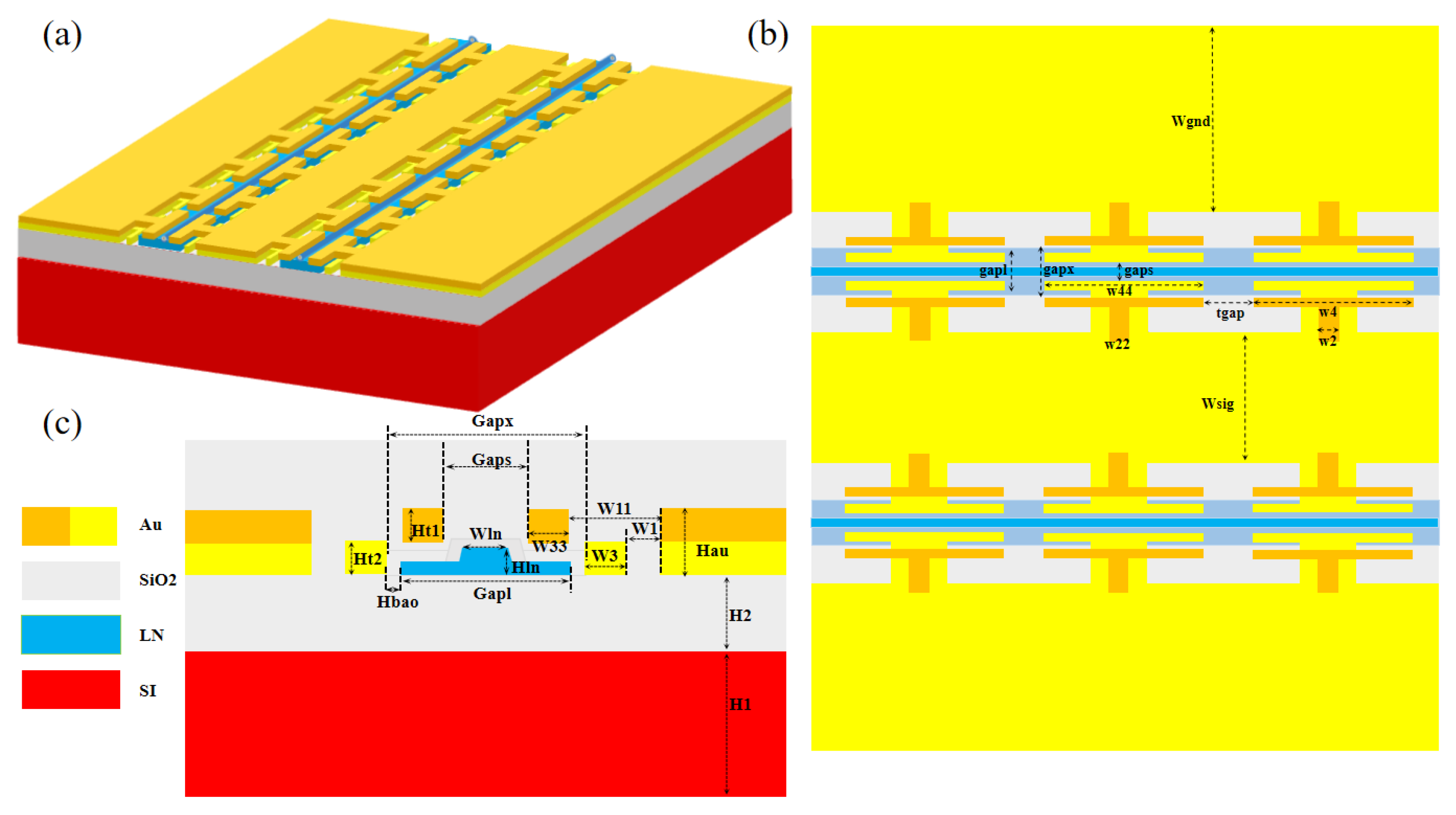
Figure 1a presents a three-dimensional schematic of the thin-film lithium niobate photomodulator. The device employs a conventional Mach–Zehnder traveling-wave configuration fabricated on an x-cut lithium-niobate-on-insulator (LNOI) wafer consisting of a 400 nm lithium niobate layer, 4.7 μm silicon dioxide buried oxide, and 525 μm undoped silicon handle substrate. The ridge waveguide structure provides three key advantages over traditional strip waveguides in the modulation region: a lower effective refractive index, a significantly smaller device footprint, and enhanced optical mode confinement [43]. The ridge waveguide features a height of 200 nm and width of 1.2 μm. A silicon dioxide capping layer on the thin-film lithium niobate serves dual functions as a protective cladding and for performance enhancement, reducing optical propagation loss while improving modulation efficiency [34]. Complete etching of the thin-film lithium niobate waveguide defines the optical waveguide region while removing surrounding material. This fabrication process significantly improves electro-optic modulation efficiency. Figure 1c depicts the traveling-wave electrode configuration, while Figure 1b shows the modulator’s three-dimensional structure, where the metal electrodes consist of three key components: a rectangular coplanar waveguide (CPW) main electrode with upper and lower T-shaped electrode structures. The upper and lower T-electrodes collectively form a dual-layer capacitively loaded electrode structure.
Based on transmission line theory and the RLCG equivalent circuit model, a preliminary analysis is performed on the dual-capacitance traveling-wave electrode design with segmented upper and lower T-shaped electrodes. The equivalent capacitance is primarily attributed to the parasitic capacitance formed between the main electrode and the upper and lower T-shaped electrodes. Although the displacement current through this parasitic capacitance does not participate in effective charge storage and release at high frequencies, it introduces considerable coupling loss. This represents an inherent performance trade-off dictated by the velocity-matching design strategy.

3.2. Simulation Analysis of VπL

The electro-optic conversion efficiency is governed by the waveguide’s effective refractive index and the electro-optic overlap factor (Γ). This overlap factor depends critically on geometric parameters including electrode spacing and positioning. In traveling-wave electrode configurations, increasing the modulator length enhances the accumulated optical phase shift, thereby reducing the half-wave voltage (Vπ). However, longer device lengths exacerbate velocity mismatch between microwave and optical signals and increase microwave attenuation. These effects degrade the electro-optic bandwidth, establishing a fundamental trade-off between drive voltage and bandwidth [44]. Reducing the electrode spacing decreases the half-wave voltage-length product (VπL), thereby improving electro-optic efficiency. However, closer electrode spacing also increases optical attenuation due to stronger field interaction. This creates a critical design trade-off between modulation efficiency and optical loss that requires careful optimization. Based on the theoretical foundation of the VπL formulation, we performed finite element analysis to simulate the optical mode profiles and electrostatic field distributions in the modulator structure.
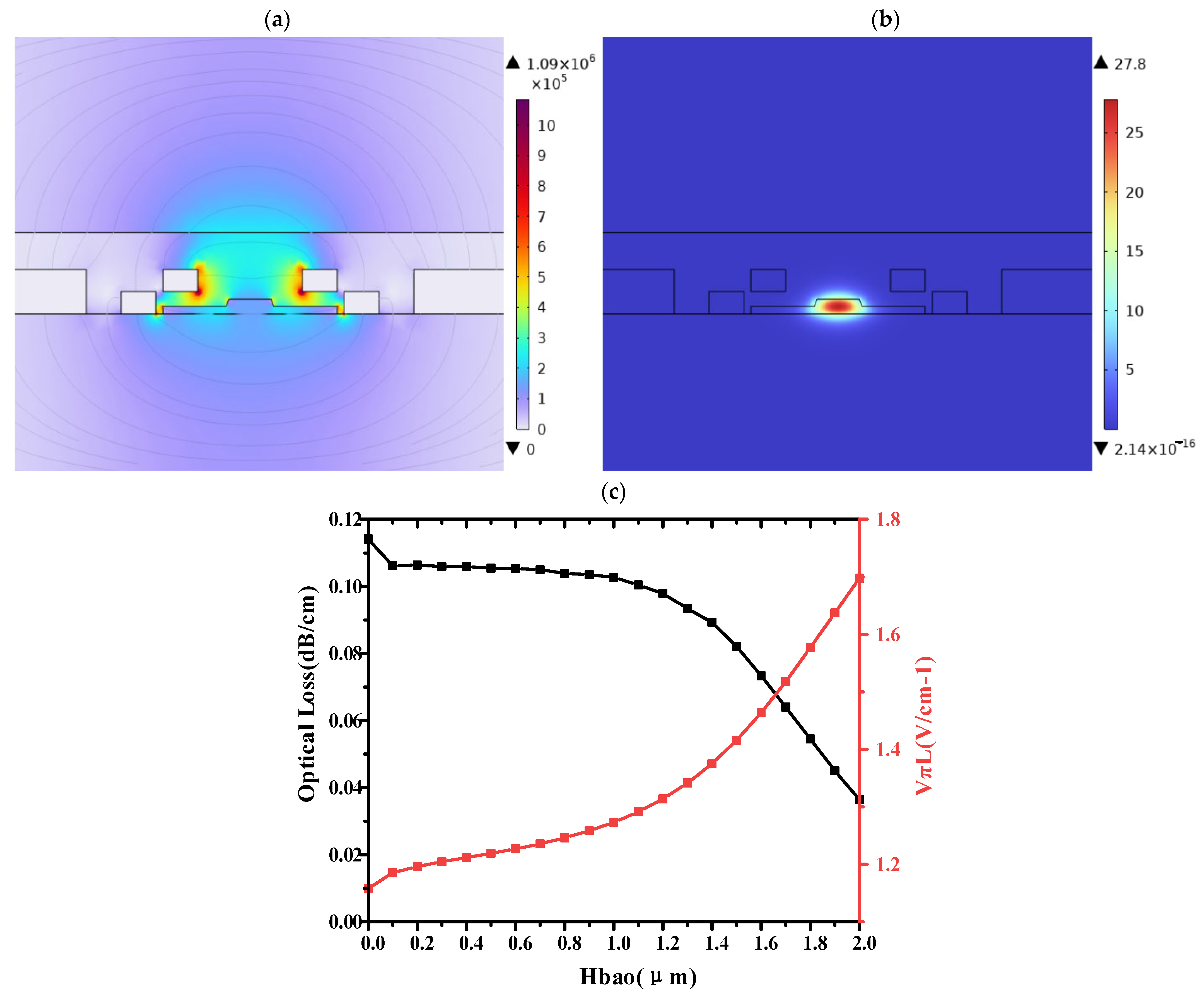
Figure 2a shows the static electric field distribution, and Figure 2b depicts the optical mode field distribution. The electric field concentrates transversely at the waveguide center, and the negligible imaginary component of the effective refractive index indicates minimal propagation loss. This field pattern corresponds to the fundamental TE0 waveguide mode. COMSOL 6.2 simulations and electric field analysis demonstrate that reduced electrode spacing intensifies and confines the electric field within the waveguide. This configuration enhances the electro-optic overlap integral, thus improving modulation efficiency.
A silicon dioxide capping layer is deposited over the waveguide. The dual-layer capacitively loaded electrodes are fabricated using a two-step metal deposition process. The deposition process positions electrode segments above the waveguide (top capacitor) and on the lithium niobate substrate (bottom capacitor). These dual capacitors significantly enhance the electric field density and electro-optic overlap integral. This design enables a more compact electrode layout. The structure leverages field concentration at electrode edges while ensuring uniform field distribution across the waveguide. This optimization maximizes the electro-optic overlap, significantly improving modulation efficiency [45].
A silica buffer layer serves to tightly confine the optical mode and reduce propagation loss, while simultaneously enhancing the radio-frequency electric field strength in the LiNbO3 ridge waveguide by over 40% [34]. Figure 2c shows the simulated characteristics with fixed electrode dimensions (main electrode thickness = 1.2 μm, GAPs = 3 μm, lower electrode spacing = 6 μm, upper electrode thickness = 0.6 μm) and constant inter-electrode spacing, while varying the SiO2 capping layer thickness (Hbao). As Hbao increases, the lithium niobate waveguide width decreases accordingly, reducing optical propagation loss. However, this reduction in waveguide width simultaneously increases the half-wave voltage-length product (VπL), revealing a critical trade-off between optical loss and modulation efficiency.
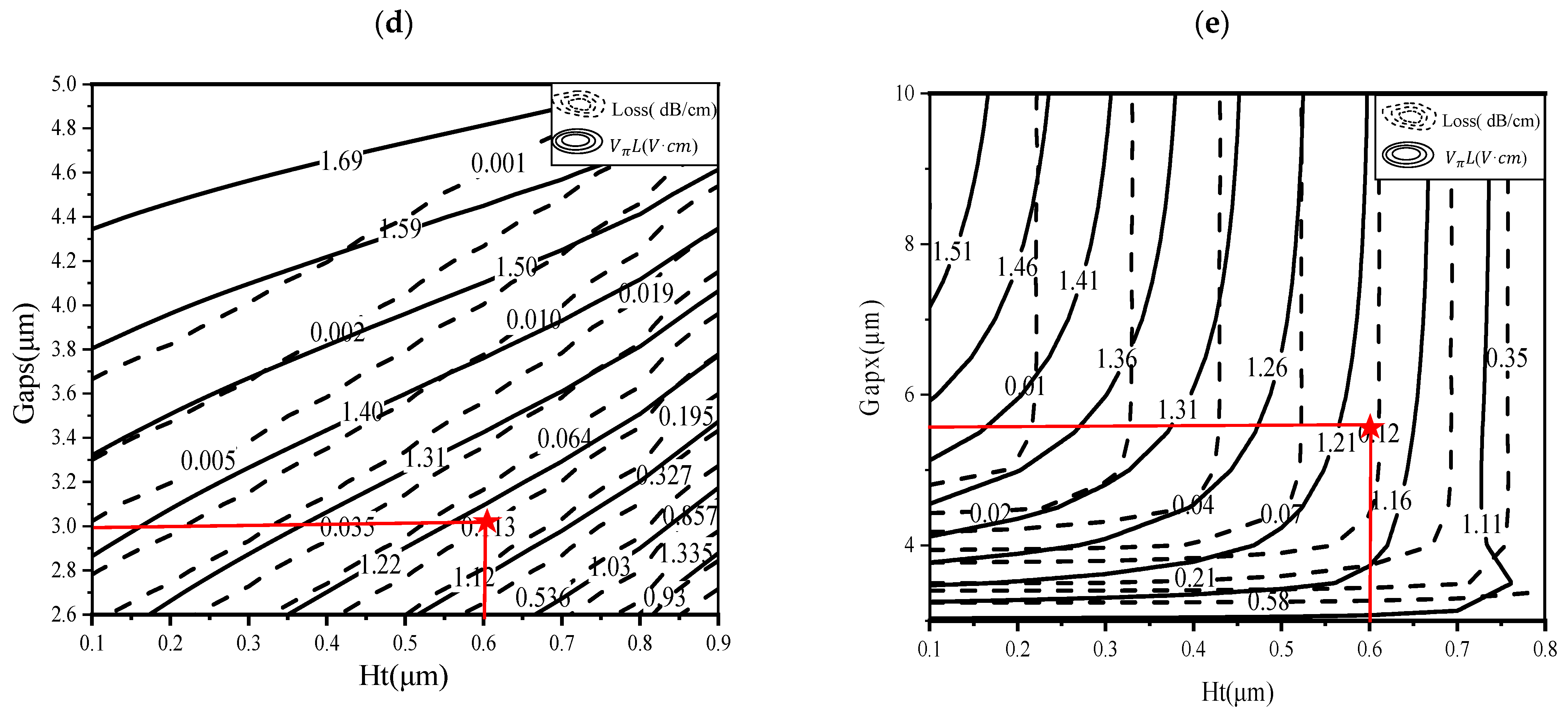
The contour maps illustrate the correlations between optical loss and the half-wave voltage-length product (VπL) with respect to upper electrode gap (Gaps), lower electrode gap (Gapx), and upper electrode thickness (Ht1). Figure 2d shows how VπL varies with upper electrode gap (Gaps) while maintaining fixed lower electrode gap (5 μm), LN waveguide width, and main electrode thickness (1.2 μm). Figure 2e shows the dependence on lower electrode gap (Gapx) with fixed upper electrode gap (3 μm), main electrode thickness (1.2 μm), and LN planar width. With upper electrode gap fixed at 3 μm and SiO2 cap layer unchanged, varying the lower electrode gap (Gapx) simultaneously modifies the LN planar layer width (Gapl). The separation between upper and lower T-electrodes critically influences modulation efficiency. Reducing this separation enhances the electric field strength at constant voltage, particularly as upper electrode thickness (Ht1) increases. Additionally, increased Ht1 reduces the electrode-to-waveguide distance, improving the optical–electrical overlap factor. These combined effects reduce VπL, thereby enhancing modulation efficiency. However, metal-induced optical absorption becomes significant at close proximity, introducing substantial propagation loss. Comparison of both figures reveals that Gaps has a more substantial impact on modulation efficiency than Gapx.
As shown in Figure 2d, scanning Gaps from 2.6 to 5 μm increases VπL monotonically from 1.07 to 1.7 V·cm. Figure 2e shows that with Ht1 = 0.6 μm, increasing Gapx from 3 to 10 μm causes minimal VπL variation (1.1 to 1.2 V·cm). Within this parameter range, metal-induced optical loss remains negligible. Gapx is geometrically constrained by W1 and W3, necessitating careful optimization to balance optical loss against modulation efficiency. After optimization with Ht1 = 0.6 μm, Gaps = 3 μm, and Gapx = 6 μm, the device achieves VπL = 1.18 V·cm and optical loss of 0.1 dB/cm.

3.3. Simulation Analysis of Modulation Region

The RF mode distribution exhibits frequency dispersion, so we analyze its characteristics at the target frequency of 60 GHz. To maintain a high cutoff frequency in this periodic electrode configuration [46], the T-electrode period is set to 50 μm.
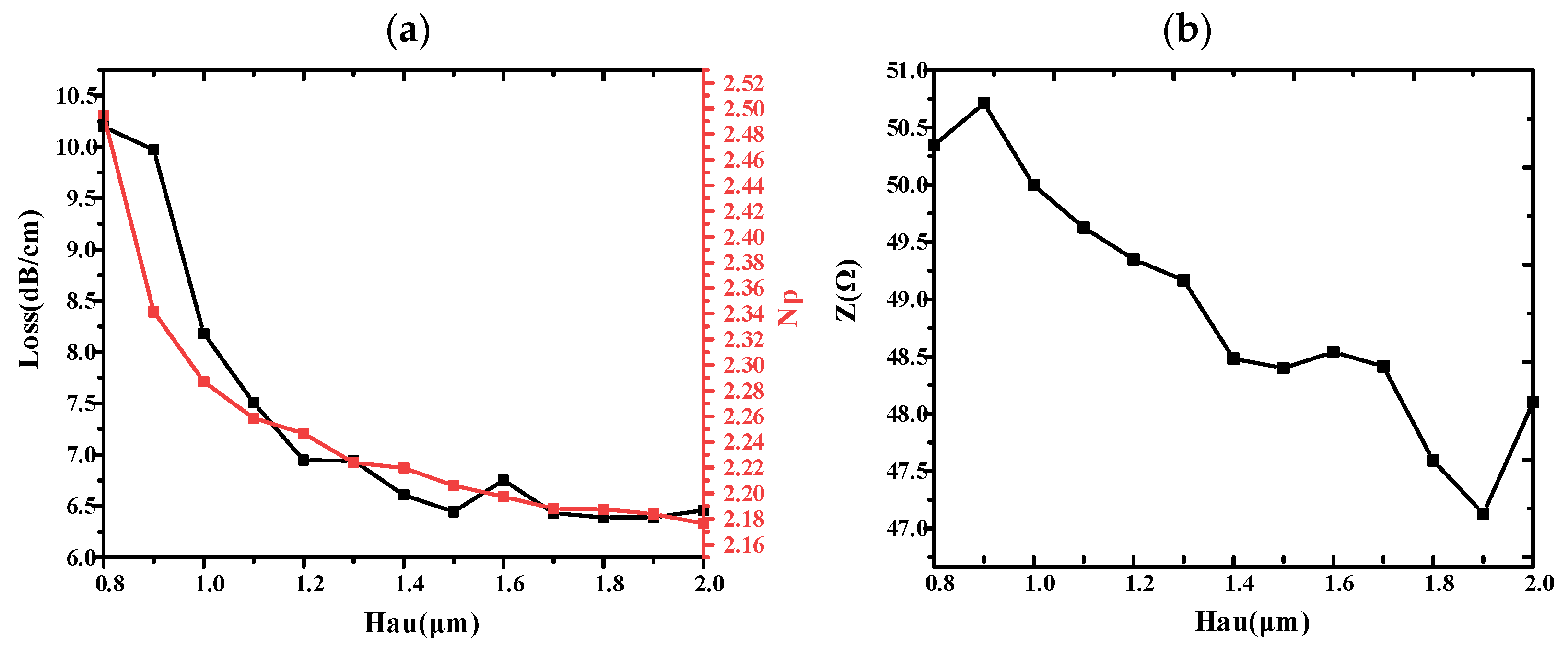
We systematically analyzed the impact of electrode thickness by maintaining equal upper and lower electrode dimensions while varying the total thickness, as shown in Figure 3. Owing to the skin effect [47], microwave loss, effective microwave refractive index, and characteristic impedance all decrease with increasing electrode thickness and eventually saturate. However, merely increasing electrode thickness to reduce the microwave refractive index is counterproductive, as it increases the half-wave voltage. Although this approach may increase bandwidth, it compromises modulation efficiency. To achieve higher modulation efficiency, the electro-optic overlap integral must be maximized. After comprehensive consideration of these trade-offs, we optimized the electrode thickness to 1.2 μm.
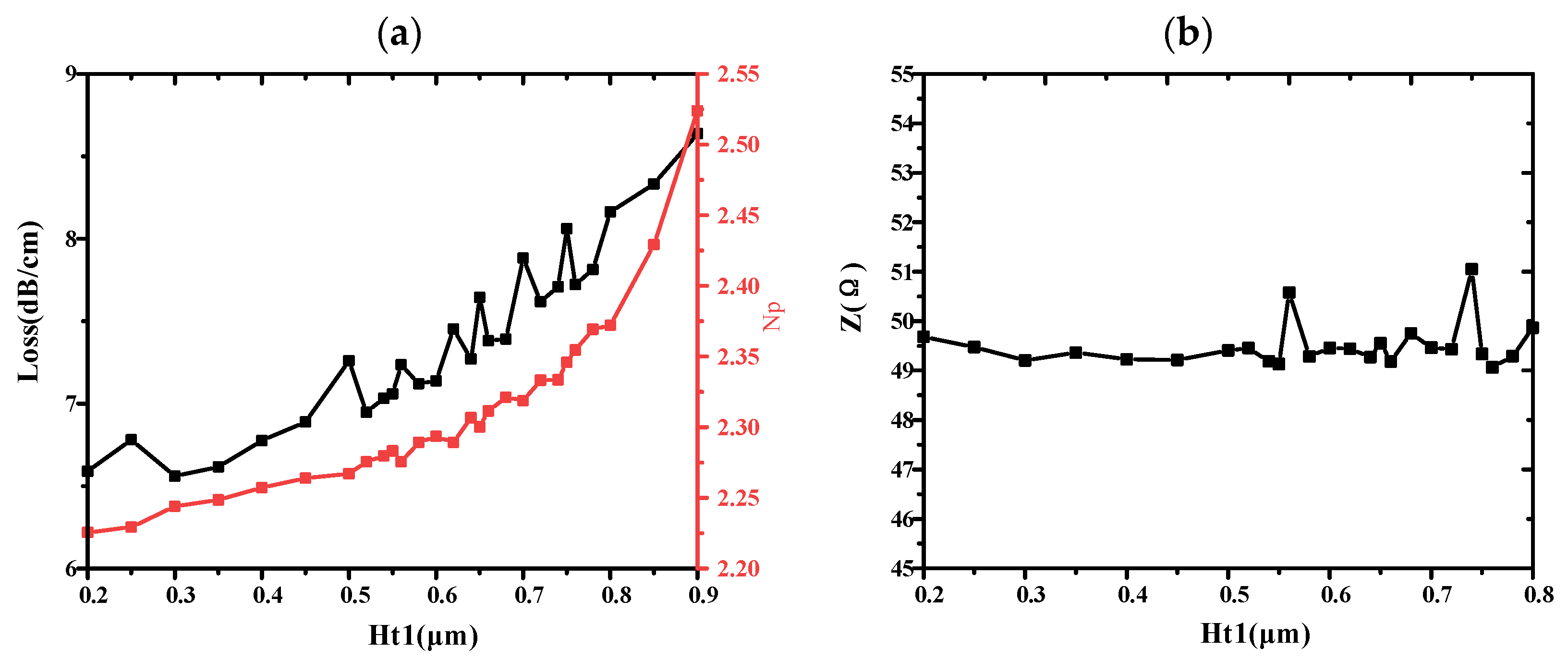
With the total electrode thickness fixed at 1.2 μm, we conducted a parametric analysis of the upper electrode thickness while adjusting the lower electrode thickness accordingly to maintain this total, as shown in Figure 4. Increasing the upper electrode thickness raises both the microwave transmission loss and effective microwave refractive index, whereas the characteristic impedance remains relatively constant. Concurrently, increasing the upper electrode thickness reduces the half-wave voltage (Vπ). Considering the systematic trade-off between microwave characteristics and modulation efficiency, we set both upper and lower electrode thicknesses to 0.6 μm (Ht1 = 1.2 μm/2).
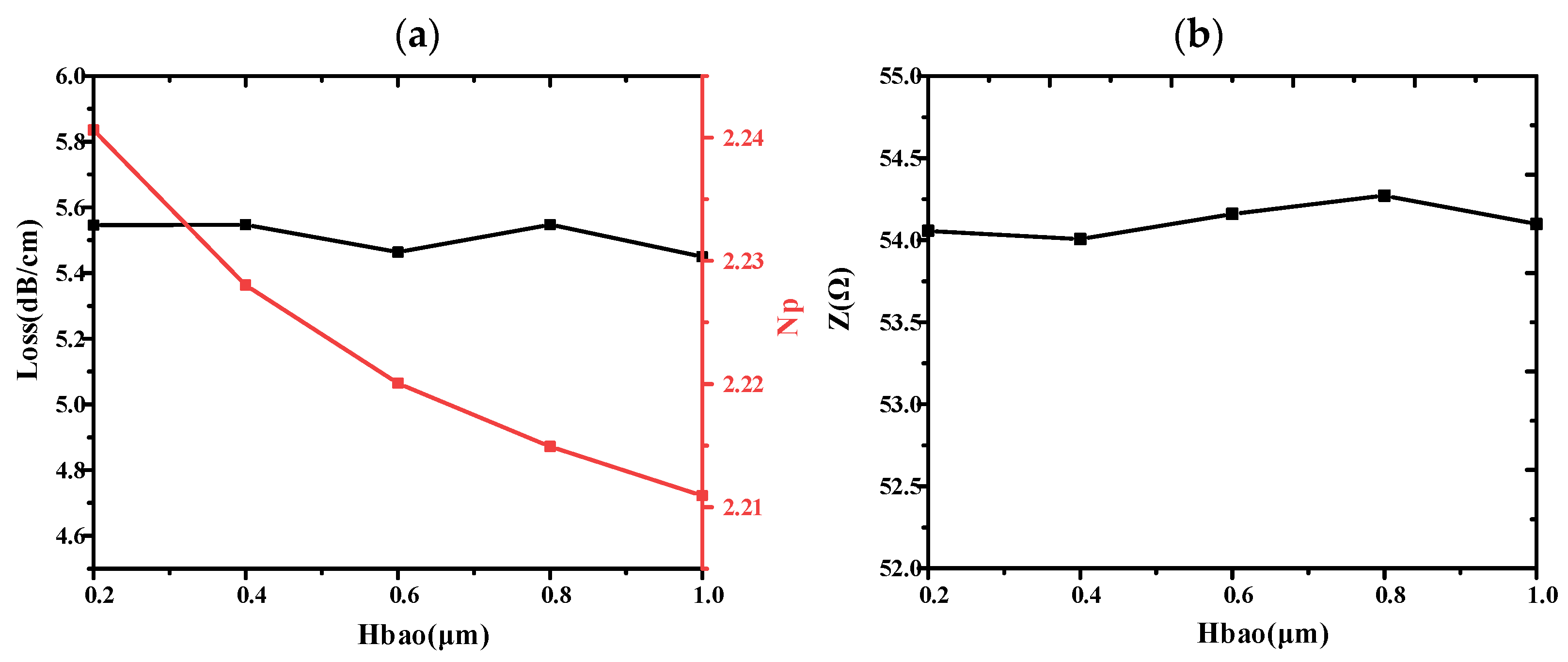
We investigated how variations in the silica cladding thickness between the metal layer and the thin-film lithium niobate waveguide affect the lithium niobate planar waveguide width. With fixed upper and lower electrode spacings, both microwave transmission loss and characteristic impedance remain largely unchanged with increasing silica cladding thickness. As shown in Figure 5, each 0.8 μm increment in cladding thickness reduces the effective microwave refractive index by approximately 0.03. However, this reduction in refractive index increases the half-wave voltage (Vπ), thereby reducing modulation efficiency. To balance microwave properties with modulation efficiency, we selected a final silica cladding thickness of 0.2 μm.
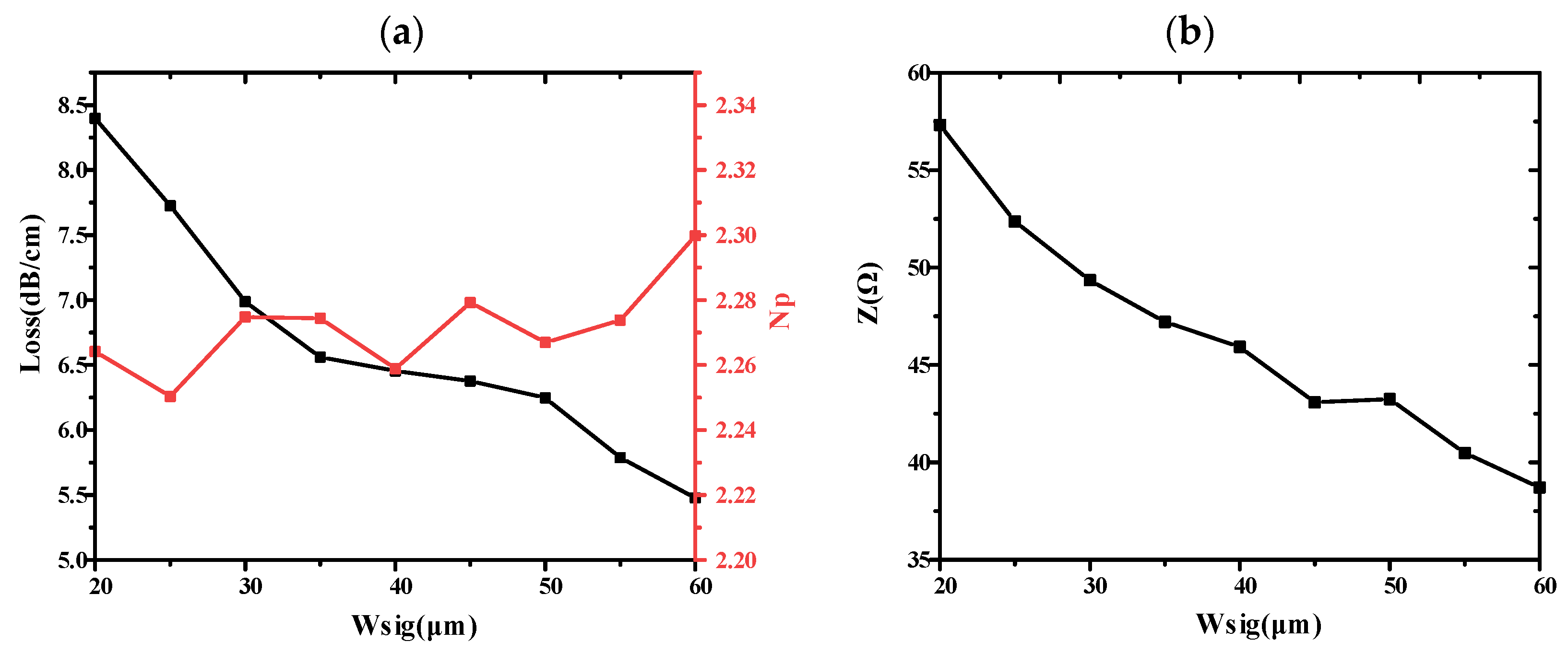
Simulation results in Figure 6 demonstrate that electrode width predominantly affects microwave loss and impedance characteristics. As the width Wsig of the signal electrode increases, the resistance R decreases due to the enlarged metal surface area, thereby reducing microwave loss and characteristic impedance. After determining other parameters, fine-tuning the electrode width enables bandwidth optimization.
We now analyze how T-electrode geometry affects microwave propagation loss, phase velocity, and impedance matching.
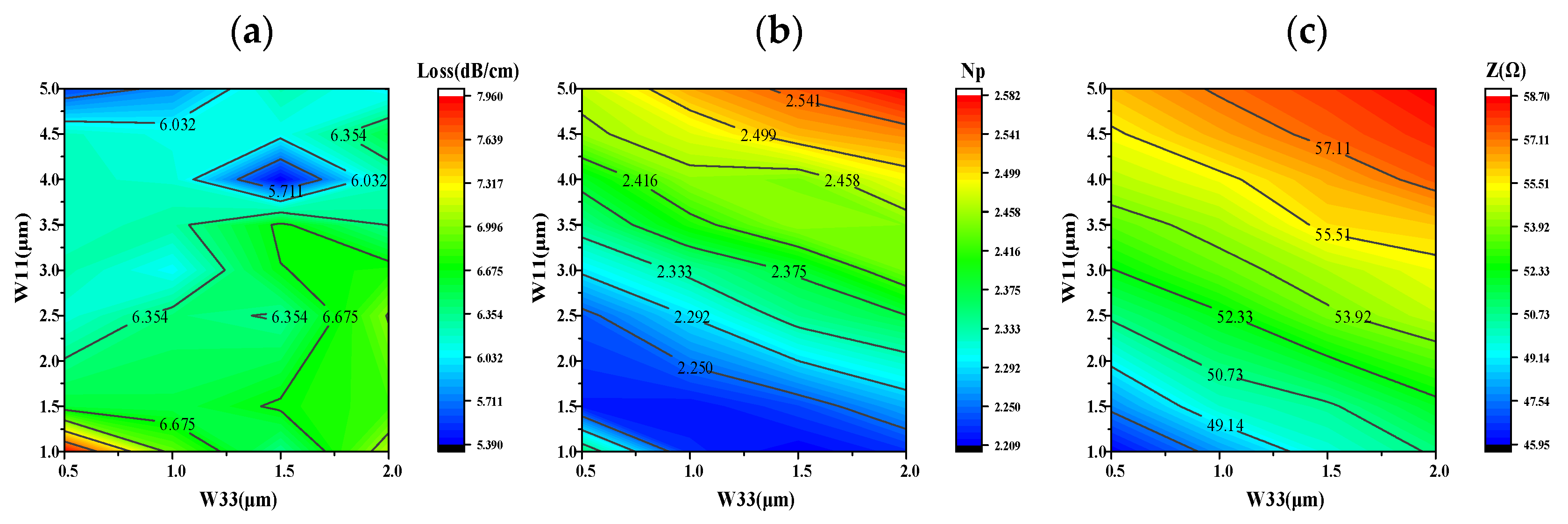
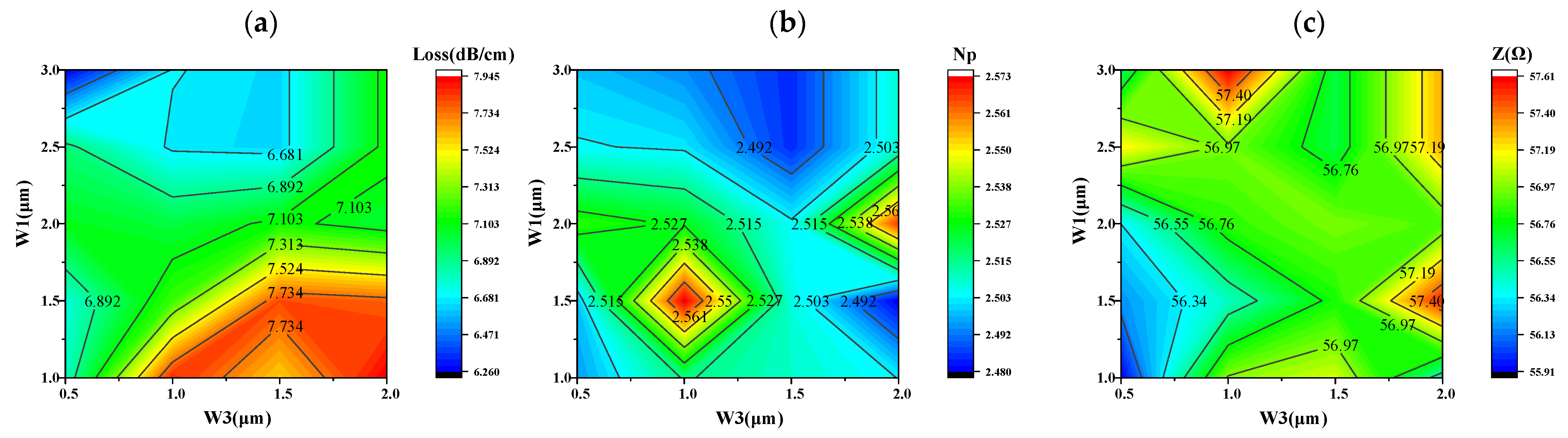
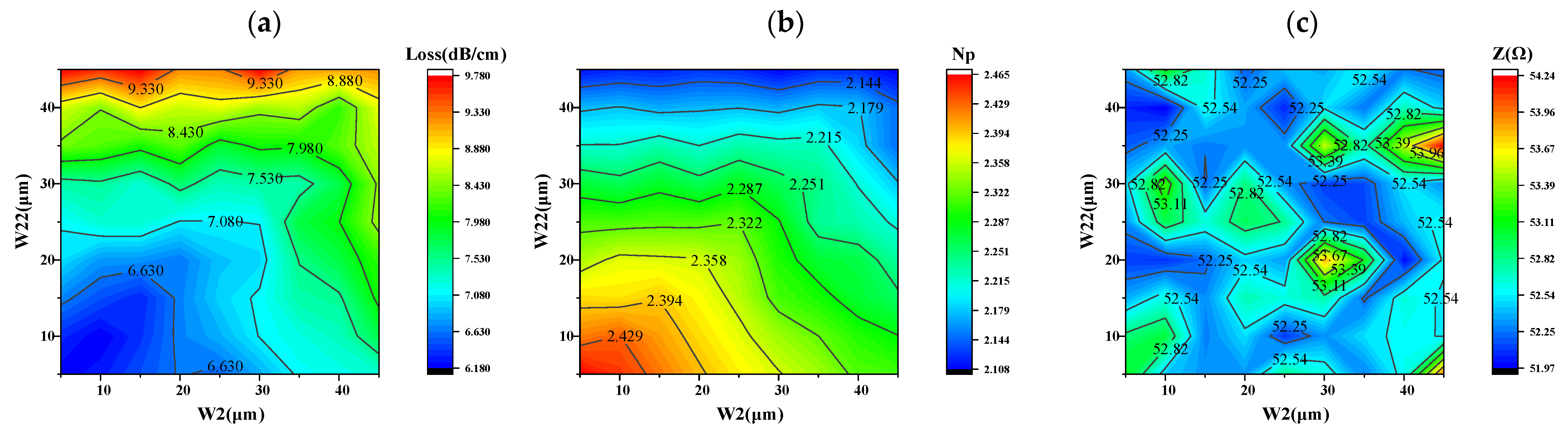
Figure 7 demonstrates a significant influence on microwave velocity and impedance characteristics. Increased resistance and variations in inductance are detrimental to high-speed transmission lines, as they introduce higher microwave losses alongside uncontrollable microwave impedance and RF index. Conversely, structures that reduce T-track current decrease total resistance and improve both microwave loss and microwave refractive index. The smaller the values of W11 and W33, the smaller Np becomes, and the overall trend of microwave loss decreases. Therefore, both are set to 1 μm. The results in Figure 8 indicate that variations in the dimensions of W1 and W3 do not exert any significant or systematic influence on the key performance parameters. This is because the lower electrode is situated far from the core region of the optical waveguide, thereby exerting a lesser influence. As shown in Figure 9, W22 adjustment provides nanometer-scale tuning over a wide range while preserving excellent velocity matching. Increasing W2 or W22 reduces the microwave effective index but at the cost of higher microwave loss. This trend arises because widening these parameters transitions the structure toward a U-groove configuration, which reduces inductance and weakens the slow-wave effect. Moreover, impedance variation remains within ~2 Ω when tuning W2 and W22, confirming their minimal impact on impedance characteristics.
The narrow signal–ground gap causes current concentration due to the proximity effect, increasing RF loss [48]. However, increasing this gap via the T-electrode design promotes uniform current distribution, alleviates crowding, and significantly reduces microwave loss without sacrificing modulation efficiency.
Among the geometric parameters of the T-shaped electrode, W2 and W22 exhibit the dominant influence on the microwave effective refractive index. These parameters define the junction widths between the microstructure and main electrodes.

4. EO Bandwidth Simulation

According to microwave transmission theory, the photoelectric transfer function can be expressed as
M f = 20 log 10 1 Z 0 Z in Z 0 + Z in 2 e α L 2 sinh 2 α L 2 + sin 2 bL 2 α L 2 2 + bL 2 2 1 2
Among these, transmission loss α, the deviation between the speed of light and microwave velocity b, the total length L of the modulator, the input impedance (typically set to 50 Ω), the characteristic impedance Z0 of the transmission line, and the velocity matching term b = 2πf/c(nm-ng) are the key parameters determining the modulator’s performance.
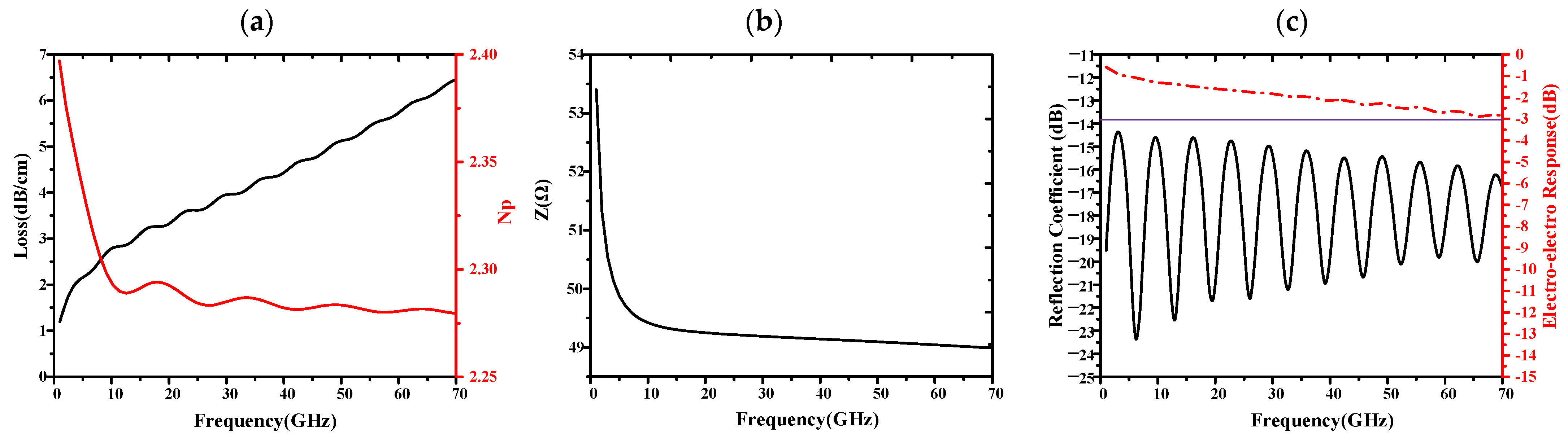
Equation (9) provides a unified formulation for evaluating the combined effects of impedance matching, velocity matching, and microwave loss on electro-optic efficiency. We performed finite element analysis to characterize key parameters including characteristic impedance, microwave loss, and phase velocity. The modulator length is set to 1 cm, yielding a half-wave voltage of 1.18 V. Simulations span 1–70 GHz, with the resulting microwave loss and refractive index shown in Figure 10a. Across this bandwidth, microwave loss remains below 6.4 dB/cm while the refractive index converges to 2.28 at higher frequencies. S-parameters were calculated to extract the ABCD matrix and derive the characteristic impedance, shown in Figure 10b. The characteristic impedance fluctuates near 50 Ω throughout the operating band. Substituting the frequency-dependent microwave loss, refractive index, and characteristic impedance into Equation (9) yields the electro-optic response in Figure 10c. The electro-optic response shows −2.8 dB attenuation at 70 GHz with reflection coefficients below −10 dB across the operating bandwidth. This work demonstrates a thin-film lithium niobate modulator achieving 1.18 V half-wave voltage and >70 GHz electro-optic bandwidth, confirming its excellent high-frequency performance.
As presented in Table 1, the comparative reveals that the proposed configuration retains a low VπL value while demonstrating a modulation bandwidth surpassing 100 GHz. The innovative electrode architecture achieves optimal equilibrium between modulation efficiency and high-frequency response properties.

5. Roadmap for Future Fabrication and Testing

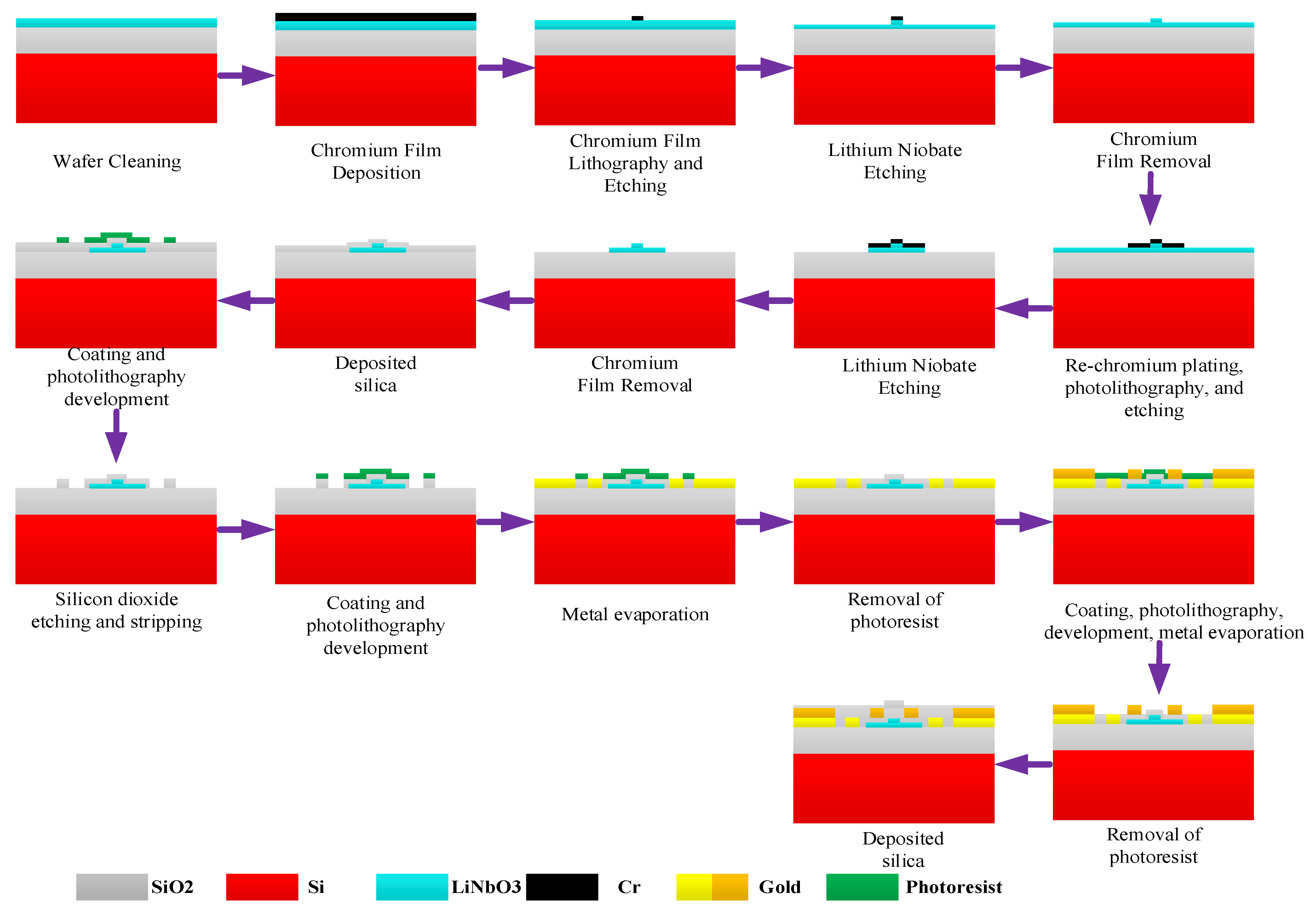
As shown in Figure 11, the manufacturing process flow is as follows: The wafer sequentially undergoes cleaning with acetone, ethanol, and deionized water to remove surface contaminants. A 120 nm layer of metallic chromium (Cr) is evaporated onto the LN wafer using an electron beam evaporator (EBE) to serve as a mask for etching lithium. The etching pattern is defined using a 2 μm SPR photoresist. The photoresist pattern is transferred onto the Cr mask via inductively coupled plasma (ICP) etching, and the etched pattern is processed during the etching step. After photoresist removal, the LN layer was etched using the Cr mask. This step was repeated twice to complete waveguide fabrication. Metal electrode contact windows were defined on the lithium niobate via photolithography patterning. The first layer of traveling-wave electrodes is fabricated via photolithography followed by physical vapor deposition (PVD), then evaporated and lifted-off. The second metallization layer is deposited using the same sputtering process with alignment, followed by thermal annealing to enhance interlayer adhesion and conductivity. Finally, an 800 nm thick SiO2 layer is deposited on the wafer to form a protective layer preventing device oxidation.

6. Conclusions

We evaluated the performance of the periodic dual-capacitance electrode structure through multi-physics simulations using FDTD 2020R2, COMSOL 6.2, and HFSS 2024R1. Despite limitations in microfabrication capability, the strong agreement between our simulation results and established experimental data provides a robust foundation for future device fabrication. The structure incorporates vertically stacked dual-capacitive T-electrodes, where it reduces the slow-light effect per unit length and lowers the microwave refractive index, enabling broad electro-optic bandwidth. The optimized design achieves a microwave refractive index of 2.28 and characteristic impedance of 49 Ω, satisfying both velocity and impedance matching conditions on silicon while significantly enhancing electro-optic bandwidth. A 1 cm long device demonstrates a voltage-length product of 1.18 V·cm, electro-optic bandwidth exceeding 70 GHz, and TE0 mode optical loss of 0.1 dB/cm. The fabricated devices are compatible with standard CMOS processes, facilitating mass production and accelerating the commercialization of high-performance modulators.

Author Contributions

Conceptualization, M.Y.; data curation, M.Y.; formal analysis, M.Y.; funding acquisition, Y.Y.; investigation, M.Y.; methodology, M.Y.; project administration, Y.Y. and T.J.; resources, Y.Y. and T.J.; software, M.Y.; supervision, W.Y., Y.L. and H.L.; validation, M.Y.; visualization, W.Y.; writing—original draft preparation, M.Y.; writing—review and editing, Y.Y., T.J. and M.Y. All authors have read and agreed to the published version of the manuscript.

Funding

This research was funded by the National Natural Science Foundation of China (No. 62174041); the Guangxi Science and Technology Plan Project (AD24010060); and the Guangxi Science and Technology Base and Talent Special Project (Guike AD24010060).

Data Availability Statement

The data presented in this study are available upon request from the corresponding author.

Acknowledgments

We thank the National Natural Science Foundation of China, the Guangxi Natural Science Foundation, and the GUET Graduate Education Innovation Project for partial funding and the National Key R&D Program of China.

Conflicts of Interest

Authors Yihui Yin, Wanli Yang, Yue Li, and Hanyu Li were employed by The 34th Research Institute of China Electronics Technology Group Corporation. The remaining authors declare that the research was conducted in the absence of any commercial or financial relationships that could be construed as a potential conflict of interest.

Correction Statement

This article has been republished with a minor correction to the existing affiliation information. This change does not affect the scientific content of the article.

References

  1. Xu, M.; Cai, X. Advances in integrated ultra-wideband electro-optic modulators. Opt. Express 2022, 30, 7253–7274. [Google Scholar] [CrossRef] [PubMed]
  2. Wang, C.; Zhang, M.; Chen, X.; Bertrand, M.; Shams-Ansari, A.; Chandrasekhar, S.; Winzer, P.; Lončar, M. Integrated lithium niobate electro-optic modulators operating at CMOS-compatible voltages. Nature 2018, 562, 101–104. [Google Scholar] [CrossRef]
  3. Chen, G.; Liu, L. High-performance thin-film lithium niobate electro-optic modulator (Invited). Acta Opt. Sin. 2024, 44, 9–29. [Google Scholar]
  4. Duvillaret, L.; Rialland, S.; Coutaz, J.L. Electro-optic sensors for electric field measurements. I. Theoretical comparison among different modulation techniques. J. Opt. Soc. Am. B 2002, 19, 2692–2703. [Google Scholar] [CrossRef]
  5. Marpaung, D.; Yao, J.; Capmany, J. Integrated microwave photonics. Nat. Photonics 2019, 13, 80–90. [Google Scholar] [CrossRef]
  6. Boes, A.; Chang, L.; Langrock, C.; Yu, M.; Zhang, M.; Lin, Q.; Loncar, M.; Fejer, M.; Bowers, J.; Mitchell, A. Lithium niobate photonics: Unlocking the electromagnetic spectrum. Science 2023, 379, eabj4396. [Google Scholar] [CrossRef]
  7. Saravi, S.; Pertsch, T.; Setzpfandt, F. Lithium niobate on insulator: An emerging platform for integrated quantum photonics. Adv. Opt. Mater. 2021, 9, 2100789. [Google Scholar] [CrossRef]
  8. Li, M.; Chang, L.; Wu, L.; Staffa, J.; Ling, J.; Javid, U.A.; Xue, S.; He, Y.; Lopez-Rios, R.; Morin, T.J.; et al. Integrated pockels laser. Nat. Commun. 2022, 13, 5344. [Google Scholar] [CrossRef]
  9. Shen, H.; Zhang, L.; Li, M.; Huang, F.; She, X.; Chen, K.; Bi, R.; Wang, L.; Shu, X. Multi-function integrated optic chip for miniaturized resonant fiber optic gyroscope. Opt. Commun. 2025, 583, 131774. [Google Scholar] [CrossRef]
  10. Li, X.; Pei, W.; Lu, Y.; Li, W.; Huang, A.; Feng, D. Multifunction Thin-Film Lithium Niobate Chip for an Interference Optical Gyroscope. IEEE Sens. J. 2025, 25, 35853–35862. [Google Scholar] [CrossRef]
  11. Zhang, Y.; Yang, J.; Zeng, Y.; Chen, Z.; Feng, H.; Zhu, S.; Shum, K.M.; Chan, C.H.; Wang, C. Monolithic lithium niobate photonic chip for efficient terahertz-optic modulation and terahertz generation. Nat. Commun. 2025, 16, 10330. [Google Scholar] [CrossRef]
  12. Ma, R.; Huang, Z.; Gao, S.; Wang, J.; Wang, X.; Zhang, X.; Hao, P.; Yao, X.S.; Cai, X.L. Ka-band thin film lithium niobate photonic integrated optoelectronic oscillator. Photonics Res. 2024, 12, 1283–1293. [Google Scholar] [CrossRef]
  13. Liu, Y.; Li, H.; Liu, J.; Tan, S.; Lu, Q.; Guo, W. Low Vπ thin-film lithium niobate modulator fabricated with photolithography. Opt. Express 2021, 29, 6320–6329. [Google Scholar] [CrossRef] [PubMed]
  14. Fan, J.; Li, W.; Luo, Q.; Yu, X.; Bo, F.; Zhang, G.; Xu, J. Research progress of thin-film lithium niobate electro-optic modulators. Sci. China Phys. Mech. Astron. 2024, 54, 19–37. [Google Scholar]
  15. Kharel, P.; Reimer, C.; Luke, K.; He, L.; Zhang, M. Breaking voltage–bandwidth limits in integrated lithium niobate modulators using micro-structured electrodes. Optica 2021, 8, 357–363. [Google Scholar] [CrossRef]
  16. Valdez, F.; Mere, V.; Wang, X.; Boynton, N.; Friedmann, T.A.; Arterburn, S.; Dallo, C.; Pomerene, A.T.; Starbuck, A.L.; Trotter, D.C.; et al. 110 GHz, 110 mW hybrid silicon-lithium niobate Mach-Zehnder modulator. Sci. Rep. 2022, 12, 18611. [Google Scholar] [CrossRef]
  17. Xu, G.; Ma, X.; Sheng, C.; Liu, H. Slow-light lithium niobate electro-optic modulator using an artificial spoof surface plasmon polariton electrode. Acta Opt. Sin. 2023, 43, 272–278. [Google Scholar]
  18. Chen, N.; Yu, Y.; Lou, K.; Mi, Q.; Chu, T. High-efficiency thin-film lithium niobate modulator with highly confined optical modes. Opt. Lett. 2023, 48, 1602–1605. [Google Scholar] [CrossRef]
  19. Hu, S.; Zhou, X.; Qi, B.; Sun, C. Large Bandwidth Thin Film Lithium Niobate Electro-Optic Modulator with Periodic Dual-Capacitance Structured Electrodes. In Proceedings of the 22nd International Conference on Optical Communications and Networks (ICOCN), Harbin, China, 26–29 July 2024; IEEE: Piscataway, NJ, USA, 2024; pp. 1–3. [Google Scholar]
  20. Yu, Z.; Tu, D.; Yan, W.; Guan, H.; Jiang, L.; Sun, X.; Li, Z. 120 ghz sub-2 v thin-film lithium niobate modulators on silicon substrate using thick capacitively loaded slow wave electrodes. IEEE Photonics J. 2024, 16, 1–5. [Google Scholar] [CrossRef]
  21. Yue, G.; Yang, H.; Zhang, Z.; Hao, T.; Xiao, L.; Li, Y. Dual-layer capacitance-loaded thin-film lithium niobate electro-optic modulator with high modulation efficiency. Opt. Express 2024, 32, 23161–23170. [Google Scholar] [CrossRef]
  22. Wang, S.; Liu, H.; Wang, M.; Chen, H.; Ma, Z.; Pan, B.C.; Huang, Y.S.; Shi, Y.Q.; Li, C.L.; Gao, H.; et al. A quasi-matching scheme for arbitrary group velocity match in electro-optic modulation. APL Photonics 2024, 9, 086112. [Google Scholar] [CrossRef]
  23. Liu, Y.; Li, H.; Li, Y.; Li, H.; Hao, Y.; Qin, L.; Yang, J. High-speed electro-optic modulator with group velocity matching on silicon substrate. Front. Bioeng. Biotechnol. 2025, 13, 1626017. [Google Scholar] [CrossRef]
  24. Wang, P.; Li, D.; Zhang, T.; Tao, J.; Wang, X.; Liu, J.; Li, J. A Broadband Thin-Film Lithium Niobate Modulator Using an Electrode with Dual Slow-Wave Structures. Photonics 2025, 12, 452. [Google Scholar] [CrossRef]
  25. Xue, X.; Xu, Y.; Ding, W.; Ye, R.; Qiu, J.; Li, G.; Liu, S.; Li, H.; Yuan, L.; Wang, B.; et al. High-performance thin-film lithium niobate Mach-Zehnder modulator on thick silica buffering layer. arXiv 2024, arXiv:2412.12556. [Google Scholar]
  26. Ruan, Z.; Hu, J.; Xue, Y.; Liu, J.; Chen, B.; Wang, J.; Chen, K.; Chen, P.; Liu, L. Metal based grating coupler on a thin-film lithium niobate waveguide. Opt. Express 2020, 28, 35615–35621. [Google Scholar] [CrossRef]
  27. Wang, Z.; Chen, G.; Ruan, Z.; Gan, R.; Huang, P.; Zheng, Z.; Lu, L.; Li, J.; Guo, C.; Chen, K.; et al. High performance thin-film lithium niobate modulator on a silicon substrate using periodic capacitively loaded traveling-wave electrode. APL Photonics 2022, 7, 026103. [Google Scholar]
  28. Wang, Z.; Huang, P.; Lu, C.; Lau, A.; Dai, D.; Guo, C. Silicon–lithium niobate hybrid intensity and coherent modulators using a periodic capacitively loaded traveling-wave electrode. ACS Photonics 2022, 9, 2668–2675. [Google Scholar] [CrossRef]
  29. Wang, M.; Qi, L.; Wang, H.; Ruan, Z.; Chen, G.; Chen, B.; Gong, S.; Chen, K.; Liu, L. Robust thin-film lithium niobate modulator on a silicon substrate with backside holes. Chin. Opt. Lett. 2024, 22, 050601. [Google Scholar] [CrossRef]
  30. Du, Y.; Zou, X.; Zou, F.; Pan, W.; Yan, L.; Zhao, Q.; Liu, N. Novel Folded Structure TFLN Recycling Phase Modulator Enabling Large Low-Vπ Bandwidth and Efficient Microwave–Optical Velocity Matching. Laser Photonics Rev. 2024, 18, 2400787. [Google Scholar] [CrossRef]
  31. Chen, G.; Wang, H.; Chen, B.; Ruan, Z.; Guo, C.; Chen, K.; Liu, L. Compact slow-light waveguide and modulator on thin-film lithium niobate platform. Nanophotonics 2023, 12, 3603–3611. [Google Scholar] [CrossRef] [PubMed]
  32. Mercante, A.J.; Shi, S.; Yao, P.; Xie, L.; Weikle, R.M.; Prather, D.W. Thin film lithium niobate electro-optic modulator with terahertz operating bandwidth. Opt. Express 2018, 26, 14810–14816. [Google Scholar] [CrossRef]
  33. Cao, L.; Aboketaf, A.; Wang, Z.; Preble, S. Hybrid amorphous silicon (a-Si: H)–LiNbO3 electro-optic modulator. Opt. Commun. 2014, 330, 40–44. [Google Scholar] [CrossRef]
  34. Liu, X.; Xiong, B.; Sun, C.; Wang, J.; Hao, Z.; Wang, L.; Han, Y.; Li, H.; Yu, J.; Luo, Y. Wideband thin-film lithium niobate modulator with low half-wave-voltage length product. Chin. Opt. Lett. 2021, 19, 060016. [Google Scholar] [CrossRef]
  35. Song, S.; Li, H.; Yang, J.; Yin, Y.; Yang, W.; Li, Y.; Cen, M. High-Performance Thin Film Lithium Niobate Electro-optic Modulator By Embedding Structure. IEEE Photonics Technol. Lett. 2025, 62, 1858–1864. [Google Scholar] [CrossRef]
  36. Yariv, A.; Yeh, P.; Yariv, A. Photonics: Optical Electronics in Modern Communications; Oxford University Press: New York, NY, USA, 2007. [Google Scholar]
  37. Li, Y.; Lan, T.; Yang, D.; Bao, J.; Xiang, M.; Yang, F.; Wang, Z. High-performance Mach–Zehnder modulator based on thin-film lithium niobate with low voltage-length product. ACS Omega 2023, 8, 9644–9651. [Google Scholar] [CrossRef] [PubMed]
  38. Zhu, D.; Shao, L.; Yu, M.; Cheng, R.; Desiatov, B.; Xin, C.J.; Hu, Y.; Holzgrafe, J.; Ghosh, S.; Shams-Ansari, A.; et al. Integrated photonics on thin-film lithium niobate. Adv. Opt. Photonics 2021, 13, 242–352. [Google Scholar] [CrossRef]
  39. Weigel, P.O. High-Speed Hybrid Silicon-Lithium Niobate Electro-Optic Modulators & Related Technologies. Ph.D. Thesis, University of California, San Diego, CA, USA, 2018. [Google Scholar]
  40. Pozar, D.M. Microwave Engineering; Wiley: Hoboken, NJ, USA, 2005. [Google Scholar]
  41. Aoki, K.; Kondou, J.; Mitomi, O.; Minakata, M. Velocity-matching conditions for ultrahigh-speed optical LiNbO3 modulators with traveling-wave electrode. Jpn. J. Appl. Phys. 2006, 45, 8696–8698. [Google Scholar] [CrossRef]
  42. Rigrod, W.W.; Kaminow, I.P. Wide-band microwave light modulation. Proc. IEEE 2005, 51, 137–140. [Google Scholar] [CrossRef]
  43. Rao, A.; Fathpour, S. Compact lithium niobate electrooptic modulators. IEEE J. Sel. Top. Quantum Electron. 2018, 24, 1–14. [Google Scholar] [CrossRef]
  44. Wooten, E.L.; Kissa, K.M.; Yi-Yan, A.; Murphy, E.J.; Lafaw, D.A.; Hallemeier, P.F.; Maack, D.; Attanasio, D.V.; Fritz, D.J.; McBrien, G.J.; et al. A review of lithium niobate modulators for fiber-optic communications systems. IEEE J. Sel. Top. Quantum Electron. 2000, 6, 69–82. [Google Scholar] [CrossRef]
  45. Li, H.; Song, S.; Yin, Y.; Xie, S.; Yang, W.; Li, Y.; Yang, J.; Xiong, B. Design of a high-modulation-efficiency thin-film lithium niobate electro-optic modulator. Opt. Commun. Technol. 2024, 22, 090003. [Google Scholar]
  46. Noguchi, K.; Miyazawa, H.; Mitomi, O. Frequency-dependent propagation characteristics of coplanar electrode on 100GHz Ti:LiNbO3 optical modulator. Electron. Lett. 2002, 34, 661. [Google Scholar] [CrossRef]
  47. Gu, J.; Wu, B. Analysis on the microwave attenuation coefficient of traveling-wave electrodes with complicated cross-sections in Ti: LiNbO3 optical modulators. Acta Electron. Sin. 1998, 26, 58–61. [Google Scholar]
  48. Capelli, F.; Riba, J.R. Analysis of formulas to calculate the AC inductance of different configurations of nonmagnetic circular conductors. Electr. Eng. 2017, 99, 827–837. [Google Scholar] [CrossRef]
Figure 1. (a) Three-dimensional schematic of the thin-film lithium niobate electro-optic modulator; (b) top view: Gapx = 6 μm, Gaps = 3 μm, Ht1 = Ht2 = 0.6 μm, Hau = 1.2 μm, Gapl = 5.6 μm, Wln = 1.2 μm, Hln = 0.4 μm, Hbao = 0.2 μm, H1 = 525 μm, H2 = 4.7 μm, W1 = 1 μm, W11 = 2.5 μm, W3 = 1 μm, W33 = 1 μm. (c) Cross-sectional view of the modulator segmented electrodes: Wgnd = 200 μm, Wsig = 25 μm, tgap = 5 μm, W2 = 30 μm, W22 = 5 μm, W4 = 45 μm, W44 = 45 μm. Design parameters have been labeled.
Electronics 15 00089 g001
Figure 2. (a) Electric field distribution in the waveguide region. (b) Optical modes. (c) Trends in modulation efficiency and optical loss with silica thin-film coating thickness. (d) Two-dimensional contour plots of VπL and optical loss versus different upper electrode Gaps and upper electrode thickness Ht1. (e) Two-dimensional contour plots of VπL and optical loss versus different lower electrode Gapx and upper electrode thickness Ht1.The parameters marked with red asterisks in the figure are those selected for this study.
Electronics 15 00089 g002aElectronics 15 00089 g002b
Figure 3. (a) Trend of RF loss and microwave refractive index with respect to electrode thickness (Hau). (b) Trend of characteristic impedance with respect to electrode thickness (Hau).
Electronics 15 00089 g003
Figure 4. (a) Trend of RF loss and microwave permittivity with upper electrode thickness Ht1. (b) Trend of characteristic impedance with respect to electrode thickness Ht1.
Electronics 15 00089 g004
Figure 5. (a) Trend of RF loss and microwave permittivity with respect to the thickness Hbao of the silica thin cap layer. (b) Trend of characteristic impedance with respect to electrode thickness Hbao of the silica thin cap layer.
Electronics 15 00089 g005
Figure 6. (a) Trend of RF loss and microwave refractive index with respect to signal electrode width Wsig. (b) Trend of characteristic impedance with respect to signal electrode width Wsig.
Electronics 15 00089 g006
Figure 7. Contour plots of (a) microwave loss, (b) effective microwave refractive index and (c) characteristic impedance as functions of W11 and W33 dimensions.
Electronics 15 00089 g007
Figure 8. Contour plots of (a) microwave loss, (b) effective microwave refractive index, and (c) characteristic impedance as functions of W1 and W3 dimensions.
Electronics 15 00089 g008
Figure 9. Contour plots of (a) microwave loss, (b) effective microwave refractive index, and (c) characteristic impedance as functions of W2 and W22 dimensions.
Electronics 15 00089 g009
Figure 10. Electro-optic performance under a 1 cm LNOI modulator: (a) microwave loss and microwave permittivity obtained for the designed structure below 70 GHz bandwidth; (b) characteristic impedance obtained for the designed structure below 70 GHz bandwidth; (c) bandwidth and S21 obtained for the designed structure below 70 GHz bandwidth. The frequency range corresponding to the −3 dB half-power point marked by the purple line.
Electronics 15 00089 g010
Figure 11. Fabrication process of TFLN modulator.
Electronics 15 00089 g011
Table 1. Performance comparison of TFLN modulators.
ReferenceSubstrateInnovative Structure (Waveguide
/Electrode)
V π · L
(V·cm)
Length
(mm)
Optical Loss
(dB/cm)
EO Bandwidth
(GHz)
[15]Quartzsegmented2.310<1>100
[16] *SiliconSWE3.150.8>110
[18]Siliconoptical isolation trenches1.240.25>40
[19]Siliconperiodic dual-capacitance structured electrodes1.750.1190
[20]Siliconlow-inductance thick-metal traveling-wave electrode2.512.5-120
[21]Quartztwo capacitively loaded layers of T-rail-shaped electrodes1.65-67
[22]Siliconcascaded TWE3.656-50
[23] *SiliconTU-TWEs1.3510->110
[24]SiliconCPW-SWS3.368->130
This work *Silicondual-capacitance interdigitated T-shaped electrode1.18100.1>70
*: simulated.
Disclaimer/Publisher’s Note: The statements, opinions and data contained in all publications are solely those of the individual author(s) and contributor(s) and not of MDPI and/or the editor(s). MDPI and/or the editor(s) disclaim responsibility for any injury to people or property resulting from any ideas, methods, instructions or products referred to in the content.