Article

Assessing Urban Activity and Accessibility in the 20 min City Concept

1
Computer Science Department, School of Information and Communication Technology, Mongolian University of Science and Technology, Ulaanbaatar 13341, Mongolia
2
Department of Human Intelligence and Robot Engineering, Sangmyung University, Cheonan 31066, Republic of Korea
*
Author to whom correspondence should be addressed.
Electronics 2025, 14(8), 1693; https://doi.org/10.3390/electronics14081693

Submission received: 16 March 2025 / Revised: 14 April 2025 / Accepted: 18 April 2025 / Published: 21 April 2025
(This article belongs to the Special Issue Machine/Deep Learning Applications and Intelligent Systems)

Abstract

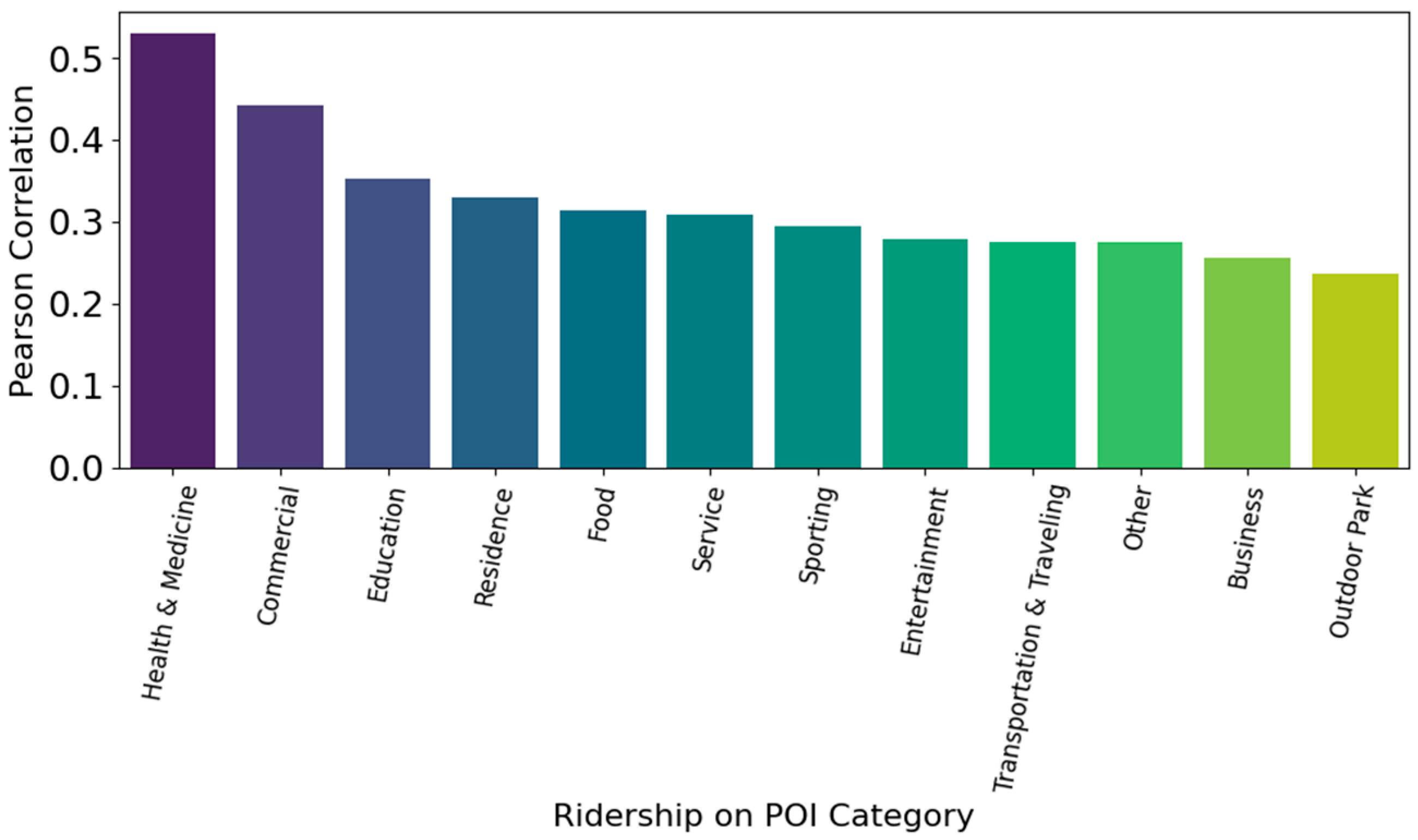
The 20 min city concept ensures that essential services—such as work, education, healthcare, and recreation—are accessible within a 20 min walk or transit ride. This study evaluates urban accessibility in Ulaanbaatar by analyzing Points of Interest (POIs) and public bus transit networks using spatial analytics and deep learning techniques. Our finding highlights that geographical area characterization is a good proxy for predicting ridership in transit networks. For instance, healthcare and medical areas show a strong correlation with similar ridership behaviors. However, some areas lack nearby bus stations, leading to poorly placed transit stops with low walking scores. To address this, we propose the use of a Quad-Bus approach to identify optimal bus station locations in urban and suburban areas, considering amenity density and deep learning ridership models to diagnose and remedy accessibility gaps. This approach is evaluated using walking and transit scores for distances ranging from 5 to 20 min in the case of Ulaanbaatar city. Results show a moderate overall link between amenity density and ridership (r = 0.44), rising to 0.53 around healthcare clusters. However, >500 high-activity partitions contain no bus stop, and 40% of the city scores below 50 on a 0–100 walking index. Half of urban areas lack a stop within 300 m, leaving 60% of residents beyond a 10 min walk. Quad-Bus reallocations close many of these gaps, boosting walk and transit scores simultaneously. This research offers valuable insights for enhancing mobility, reducing car dependency, and optimizing urban planning to create equitable and sustainable 20 min city models.
Keywords: deep learning; feature extraction; transportation; spatiotemporal phenomena; ridership behaviors deep learning; feature extraction; transportation; spatiotemporal phenomena; ridership behaviors