1. Introduction
Load forecasting is a key aspect of power system operation and planning, aiming at modeling and analyzing the data of historical loads and related external factors to infer the power demand in future periods [
1]. The accuracy of its forecasting directly affects system supply–demand balance, dispatch plan formulation, and the assessment of operating costs and security margins [
2,
3,
4]. Under ultra-short-term scales, the load sequence presents significant stochastic fluctuations and non-stationarity, which makes the forecasting error further amplified in the spare capacity allocation, power market clearing, and demand-side response. Meanwhile, with the diversification of demand-side electricity consumption behaviors, the load series is often superimposed with stochastic, seasonal, and cyclical components, and subject to the combined influence of external factors such as meteorological conditions [
5]. Therefore, achieving stable and high-precision load forecasting under complex disturbances and multidimensional coupling conditions has become a core scientific problem and engineering challenge in power system optimal operation and planning [
6].
Existing load forecasting technology systems can be classified into three categories: physical mechanism, statistical, and artificial intelligence. Early load forecasting mainly relies on physical mechanism models, which are usually based on physical and engineering principles and are constructed by combining equipment energy consumption feature portrayal and user behavior patterns [
7,
8]. This type of approach is theoretically highly interpretable, but its applicability in short-term grid scenarios is limited by its cumbersome parameter calibration, high sensitivity to user group heterogeneity, and external environmental perturbations [
9]. As a result, research is gradually shifting towards data-driven approaches.
With the expansion of power system data scale, statistical modeling methods have gradually become the mainstream of research, and typical methods include autoregressive moving average (ARIMA) [
10] and seasonal autoregressive (SARIMA) [
11]. Although statistical models have a clear mathematical foundation and strong interpretability, they can effectively portray the trend and periodicity characteristics in smooth or weakly nonlinear load series [
12]. However, electricity load data usually exhibit non-stationarity and random fluctuations, and the prediction accuracy of statistical models significantly decreases when disturbed by extreme weather or holidays [
13].
To cope with the limitations of statistical models in representing non-smooth and nonlinear load data, researchers have introduced machine learning methods, including support vector machine (SVM) and random forest (RF). Dong et al. firstly used K-means clustering algorithm to classify weekday and holiday patterns of electricity load data, and then constructed a prediction model by using SVM. The accuracy of short-term forecasting of electricity load was effectively improved [
14]. Jiang et al. combined stochastic method, grey box model, and random forest method to forecast flexible loads of split air conditioners, which effectively characterized the energy performance of split air conditioners at both individual and aggregate levels [
15]. The above methods enhance the modeling capability through nonlinear mapping and integration strategies and achieve better performance than statistical models in some tasks. However, the machine learning methods mainly rely on feature extraction and windowing modeling when representing long sequences and have limited ability to portray multi-scale dynamic features and long-range dependencies [
16,
17].
With the development of deep learning, neural network models are widely used for load forecasting. Recurrent Neural Networks (RNN), Long Short-Term Memory Networks (LSTM), and Gated Recurrent Units (GRUs) perform well in capturing time-dependent and nonlinear features [
18,
19]. Wen et al. proposed an improved recurrent neural network based on recurrent neural network to predict the day-ahead wholesale tariff, photovoltaic (PV) power output, and power load, which achieved better performance [
20]. Wan et al. proposed a new method for short-term power load forecasting combining convolutional neural network (CNN), LSTM, and attention mechanism, which solves the problem of information loss due to the excessive length of input time series data [
21]. Fan et al. proposed a two-layer GRU network optimized by the Improved Multi-Objective Evolutionary Algorithm (MOEA/D), which was tested in two load forecasting sets, and the proposed model demonstrated good accuracy and generalization [
22]. However, although the above models overcome to some extent the limitation of insufficient capture of artificial feature dependencies and long-distance dependencies in terms of long sequence modeling and prediction accuracy, they still face the gradient decay problem when representing long sequences and lack an explicit modeling mechanism for cross-variate dependencies [
23].
In this context, the transformer architecture was introduced for time series forecasting due to its parallel modeling capabilities based on the self-attention mechanism [
24]. The transformer architecture demonstrates the advantages of parallel modeling and long-range dependency representation in time series forecasting, however, its lack of inductive bias on local time series patterns and limited ability to model cross-feature dependencies in multivariate scenarios constrains its performance in complex load forecasting tasks. Researchers have proposed a variety of improved models in the literature. Zhou et al., proposed the informer model, which reduces complexity and improves prediction efficiency through sparse attention with a hierarchical distillation mechanism [
25]. Wu et al., proposed the autoformer model, which embedded decomposition operators into the network structure and introduced autocorrelation mechanisms to enhance the cyclic modeling capability [
26]. Zhou et al., proposed the FEDformer model to achieve more efficient multi-scale feature extraction in the framework of frequency and time domain decomposition [
27]. These works promoted the development of transformer in time series forecasting from the perspectives of efficiency optimization, cycle-dependent modeling, and multiscale decomposition, respectively, but their common limitation is that they are mainly oriented to long time scale tasks, and they do not sufficiently portray high frequency fluctuations and cross-variate correlations in short-term forecasting [
28].
To address the limitations, iTransformer takes variables rather than time-steps as the basic unit of modeling, thus realizing the inverted dimensionality design of variables as tokens [
29]. This structure can explicitly portray the interactions between different variables, which significantly enhances the ability to model the dependence on multiple input features, such as the decomposed IMF components, residuals, and meteorological exogenous variables [
30]. This method makes up for the shortcomings of the traditional transformer in multivariate time series forecasting, but still fails to adequately capture the local time-series patterns and nonlinear dynamic features. The LSTM network has a natural advantage in modeling short-term dependence and nonlinear dynamics, and its gating mechanism can effectively alleviate the gradient vanishing problem, which makes it suitable for extracting local features of loaded sequences. However, LSTM lacks effective exploitation of cross-feature interactions in multivariate scenarios. Therefore, combining LSTM with iTransformer, where the former is used to capture local nonlinear and short-term dynamic features, and the latter is used to portray cross-feature dependencies and global relationships, can complement each other’s strengths, and provide a more robust modeling framework for predicting complex load sequences.
The combination of LSTM-iTransformer improves the model’s ability to comprehensively model local and global features, but the iTransformer still relies on the standard self-attention mechanism internally, which is prone to the problem of unstable attention distribution in high-dimensional scenarios and the risk of under-utilization of information. For this reason, this paper introduces a hybrid cosine attention mechanism into the framework. This mechanism borrows the idea of cosine kernel from CosFormer, which retains the basis of Softmax, weakens the paradigm difference through cosine normalization, and combines with non-negative constraints to improve the stability and focusing of the attention distribution, to enhance the ability to capture the dependency relationships across time scales and feature dimensions [
31].
Short-term load series usually show strong volatility and complex non-stationary features, which will reduce the prediction accuracy if directly used for modeling, so it is necessary to pre-process the data by empirical mode decomposition-like methods [
32]. Currently, commonly decomposition methods include ensemble empirical mode decomposition (EEMD), complete ensemble empirical mode decomposition with adaptive noise (CEEMDAN), and variational mode decomposition (VMD), among others [
33,
34,
35]. These methods can alleviate the complexity of non-stationary signals to a certain extent, but there are still problems such as mode mixing, inaccurate estimation of instantaneous frequency or insufficient portrayal of local characteristics, which may lead to pseudo-modal decompositions or omission of key information in the decomposition results. In contrast, the improved complete ensemble empirical mode decomposition with adaptive noise (ICEEMDAN) effectively overcomes the shortcomings of the traditional method by introducing adaptive noise in the iterative process and adopting the ensemble averaging strategy. ICEEMDAN effectively overcomes the shortcomings of traditional methods by introducing adaptive noise in the iterative process and adopting an ensemble averaging strategy and can obtain more robust and physically clearer intrinsic mode function components [
36]. In this paper, ICEEMDAN is used as a preprocessing tool to decompose the load sequence at multiple scales and construct the input feature set by combining the meteorological variables, to provide a clearer and hierarchical feature support for the LSTM—iTransformer model.
Short-term load series exhibit pronounced volatility and strong non-stationarity, while existing decomposition–transformer hybrid models still suffer from notable limitations in utilizing multi-scale components and modeling cross-variable dependencies. First, the decomposed IMF components are typically treated as static inputs, lacking explicit characterization of their internal local dynamics and fast fluctuations. Second, the decomposition results and deep models are often combined in a simple cascaded manner, without establishing a coherent mechanism that integrates multi-scale components, local temporal structures, and global cross-variable dependencies. Third, the standard scaled dot-product attention is sensitive to magnitude and unit discrepancies, which easily induces attention bias in multivariate settings and thereby weakens the representation of complex coupled relationships. Therefore, this study proposes a hybrid forecasting framework based on ICEEMDAN–LSTM–iTransformer-hybrid cosine attention forecasting model to enhance the accuracy and robustness of short-term load forecasting. The main contributions of this work are as follows:
The Improved Complete Ensemble Empirical Modal Decomposition (ICEEMDAN) was introduced to solve the problems of modal aliasing and instantaneous frequency estimation bias that are commonly found in traditional decomposition methods. By decomposing the original load sequence into intrinsic modal functions (IMFs) and residuals with different scale characteristics and fusing them with exogenous variables such as meteorology, a clearer and more hierarchical input feature set is constructed, which provides a solid feature base for the subsequent deep model.
The LSTM and iTransformer architectures were combined. The former can effectively capture short-term dependencies and nonlinear dynamics to alleviate the problem of gradient vanishing; the latter adopts a variable-as-token representation for multi-source inputs, explicitly capturing cross-variable dependencies and global relationships. The two models complement each other and overcome the inadequacy of a single model in modeling local dynamics or global interactions.
The hybrid cosine attention mechanism was incorporated based on iTransformer and draw on the idea of CosFormer to introduce cosine reweighting and non-negative constraints, improve the numerical stability of the distribution of the attention, enhance the focusing of the weights, and reduce the computational complexity in high-dimensional scenarios. The mechanism enables the model to portray the dynamic dependence of loads more effectively on different time scales and capture the interaction between multi-source features.
The rest of this paper is structured as follows:
Section 2 introduces the overall framework of the proposed method and describes the principle and implementation of ICEEMDAN decomposition, LSTM feature extraction, iTransformer global modeling and hybrid cosine attention mechanism.
Section 3 gives the construction process of the complete model and details of the algorithms.
Section 4 describes the source of the experimental data, the pre-processing method and the evaluation index.
Section 5 verifies and analyses the effectiveness of the proposed method through comparative experiments and ablation experiments.
Section 6 concludes the whole paper and discusses future research.
2. Model Construction
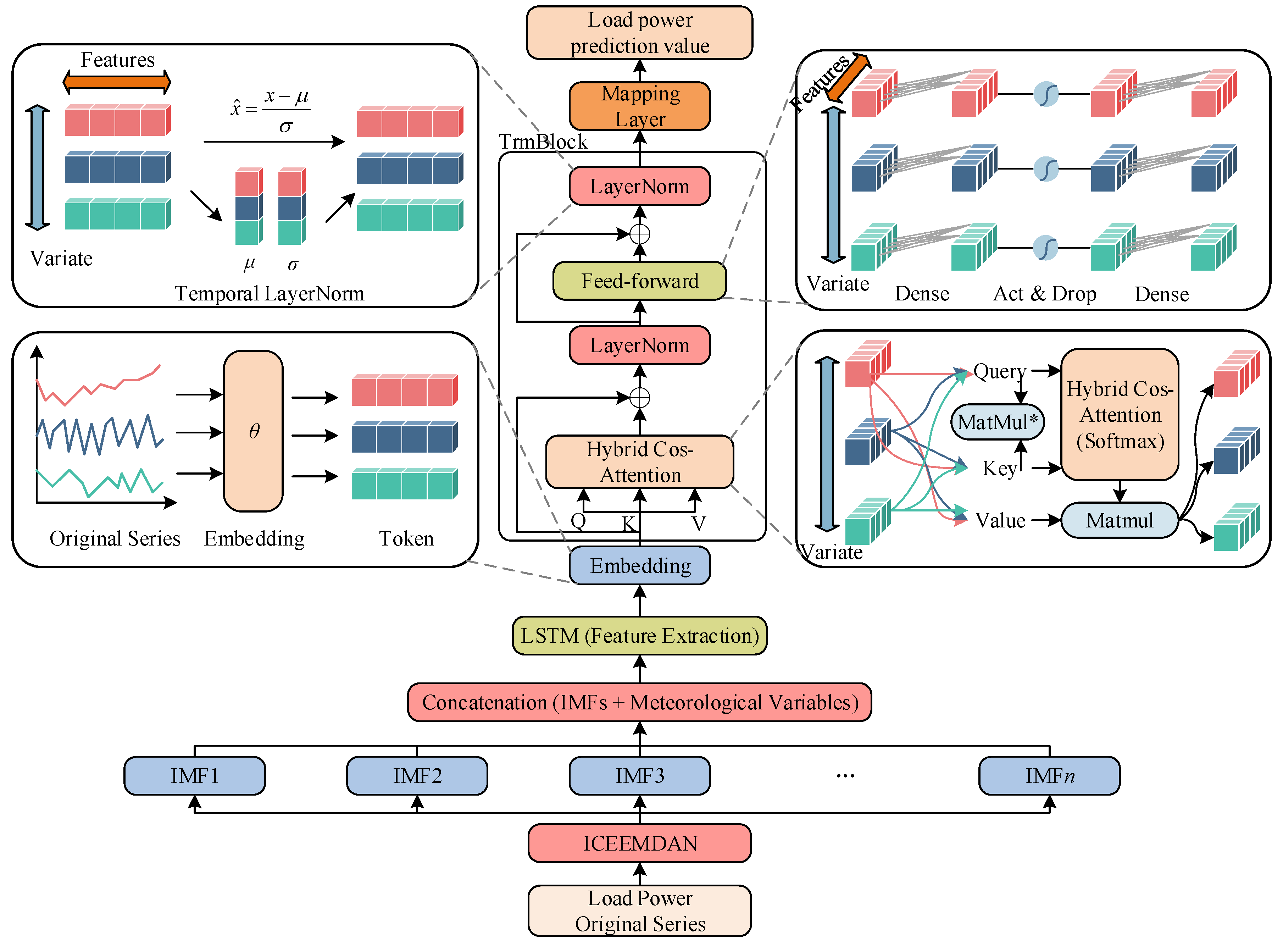
The ICEEMDAN–LSTM–iTransformer-hybrid cosine attention forecasting framework proposed in this study is illustrated in
Figure 1. It introduces a structural advancement over existing approaches. ICEEMDAN employs adaptive-noise decomposition to obtain multi-scale IMFs, enabling an explicit separation between high-frequency fluctuations and low-frequency trends. LSTM further encodes the local dynamics and short-term perturbations within each IMF, providing the short-window memory structure required for ultra-short-term forecasting. The iTransformer models cross-variable dependencies in a variable-as-token manner, addressing the limitations of conventional transformers in representing variable interactions. Moreover, the hybrid cosine attention mechanism mitigates the norm sensitivity of standard scaled dot-product attention by applying directional normalization and gated reweighting, thereby stabilizing the attention distribution under noisy and highly volatile conditions. Through clear functional division and tight cooperation among these components, the proposed framework is capable of simultaneously handling non-stationarity, multi-scale characteristics, high-frequency disturbances, and cross-variable coupling—key challenges intrinsic to ultra-short-term load forecasting.
- (1)
ICEEMDAN decomposition and feature construction
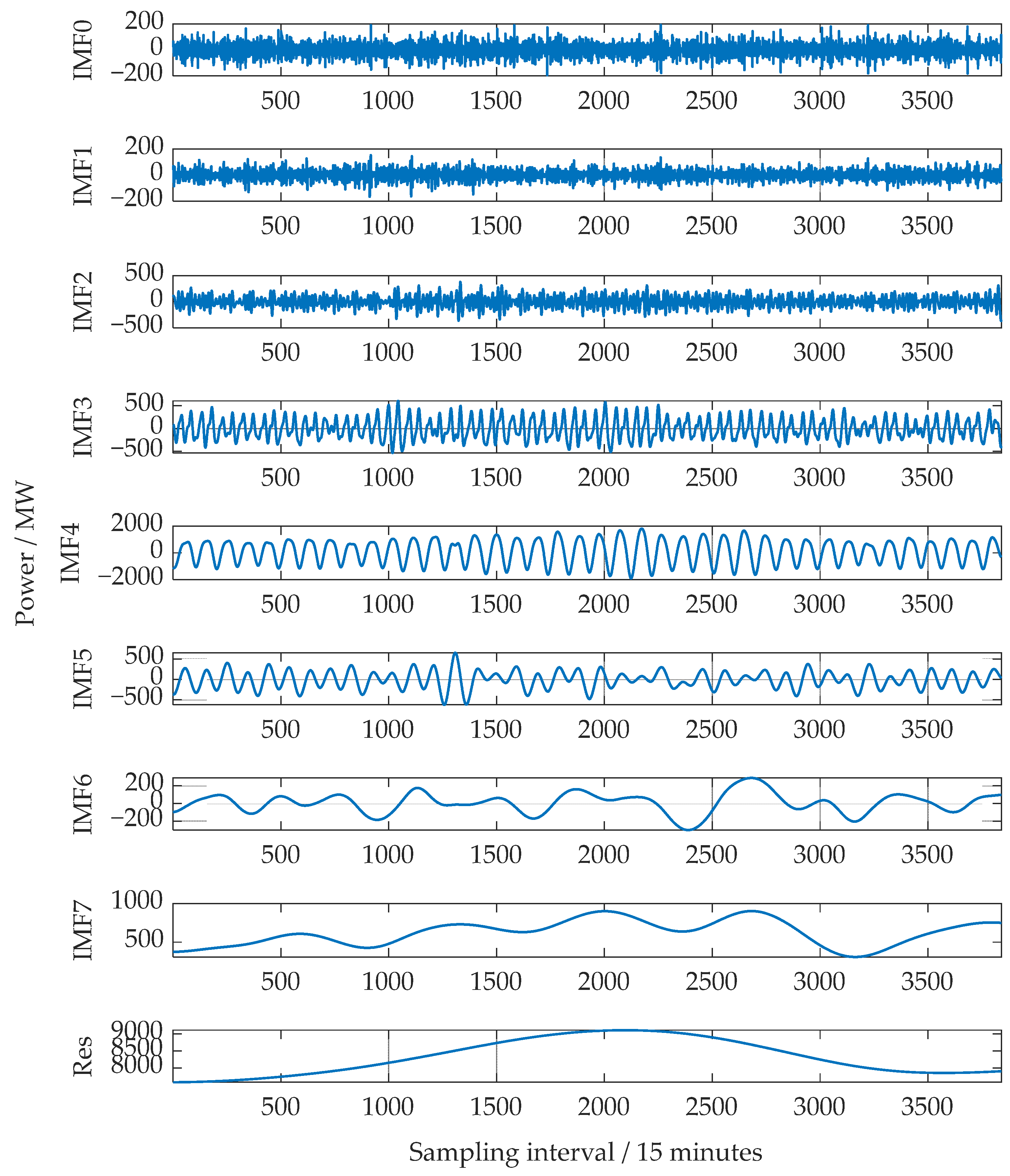
The raw load series was first decomposed by ICEEMDAN into multiple IMF components together with a residual component (Res). All components were temporally aligned with meteorological variables and concatenated column-wise to form the feature matrix (X_raw) with a structure of [T, C]. To ensure consistent feature scales, the model applied normalization to X_raw using statistics computed from the training segment, producing X_norm. A sliding window of length L was then constructed along the temporal axis, where X_norm[t − L + 1:t] was extracted as the input window (X_win) with dimension [L, C], and the corresponding load value was used as the prediction target (y_target). All samples were partitioned into training, validation, and test sets in chronological order, generating a unified sequential-learning data flow that provided format-consistent inputs for all subsequent model modules.
- (2)
LSTM feature extraction
The mini-batch input X_batch has an initial shape of [B, L, C]. The model first transposed this tensor to [B, C, L] so that each variable formed an individual time series of length L within the window. The batch and variable dimensions were then flattened to construct X_seq with shape [B*C, L, 1], where each sequence was encoded by a shared-parameter LSTM. The LSTM recursively propagated its internal states along the temporal dimension and output the final hidden state (h_last) for each sequence, resulting in a representation of size [B*C, d_model]. These states were reshaped back along the variable axis to form the variable-level representation Z with shape [B, C, d_model]. Each vector in Z corresponded to the temporal embedding of one variable within the current window and served as the input unit for cross-variable modeling in the iTransformer.
- (3)
iTransformer global dependency modeling
The variable-level representation Z was then fed into the iTransformer encoder to construct global dependency structures along the variable dimension. Each encoder layer first applied layer normalization to the input, followed by linear projections that generated the query Q, key K, and value V matrices, which were rearranged into a multi-head format of shape [B, num_heads, C, head_dim]. The attention operation was performed over the variable dimension so that each variable token updated its representation based on the dynamic embeddings of all other variables. The concatenated multi-head output was linearly projected back to [B, C, d_model], passed through a residual connection and a feed-forward network, and formed the layer output H_block. After stacking multiple layers, the encoder produced H_glob, which remained in shape [B, C, d_model] but encoded global interactions and cross-variable dependencies among all variables.
- (4)
Hybrid cosine attention mechanism
Within the attention computation, the model applied directional normalization to Q and K along their last dimension, producing Q_norm and K_norm, so that similarity was dominated by vector direction. The normalized similarity was then scaled by a temperature parameter τ to obtain a controllable similarity response. Meanwhile, K was passed through a linear transformation to generate gate_raw, which was converted to a positive value (gate_pos) via a Softplus operation and further transformed into gate_bias through a logarithmic mapping. This bias term was added to the cosine similarity to modulate variable-wise attention weights, enabling the model to dynamically adjust each variable’s relative contribution based on its characteristics. The final attention matrix (attn) was obtained by Softmax normalization and was used to compute the weighted sum with V, producing the output of each head. All attention heads were concatenated along the head_dim dimension and linearly projected back to the d_model space, completing the mixed cosine-attention representation.
- (5)
Predicted output
The global representation (H_glob) produced by the encoder was compressed along the variable dimension through average pooling to obtain h_pool, which has the structure [B, d_model]. This vector integrated both the local temporal features within the window and the cross-variable dependency patterns. The pooled representation (h_pool) was then linearly projected to the prediction dimension, yielding the output y_hat with shape [B, horizon]. During training, the model minimized the mean squared error between the predictions and targets in the normalized space. During inference, y_hat was denormalized and used to compute MAE, RMSE, MAPE, and R2 to evaluate predictive performance in the physical scale. This output design ensured that the model leveraged a unified high-dimensional representation to support accurate ultra-short-term load forecasting.
The pseudocode of the algorithm is as follows (Algorithm 1):
| Algorithm 1. ICEEMDAN–LSTM–iTransformer with hybrid cosine attention. |
Input: multivariate series X ∈ ^{T × C} (IMFs + Res + meteorology), window length L, horizon H, model parameters Θ, epochs E, batch size B
Output: trained parameters Θ*, predictions ŷ |
1: Split X into train/val/test in time order; fit Min–Max scalers on train
2: For t = L, …, T − H form samples (x_t, y_t) with x_t = X[t − L + 1:t, :], y_t = X[t + H, target]
3: For epoch = 1, …, E do
4: For each mini batch {x, y} of size B do
5: Permute x to [B, C, L] and reshape to [B·C, L, 1]
6: Pass each variable sequence through LSTM and keep final hidden state
7: h ∈ ^{B·C × D}; reshape to variable tokens Z ∈^{B × C × D}.
8: For ℓ = 1, …, N_layers do ▷ variable-wise iTransformer block
9: Project Z → (Q, K, V) and normalize along D to obtain , .
10: Compute cosine scores S = (T)/τ + log G(K) ▷ G(K) ≥ 0 is key gate
11: A = Softmax(S) over the key dimension; Z ← Z + FFN(A V) with residual and LN
12: Aggregate variable tokens by mean pooling = mean_C(Z)
13: Predict = W + b ∈ ^{B × H}
14: Compute loss L = MSE(, y); back-propagate ∇ΘL and update Θ with AdamW
15: Select Θ* with minimum validation loss
16: On test set, generate , inverse-transform to original scale, and compute MAE, RMSE, MAPE, R2 |
3. Algorithmic Principles
3.1. ICEEMDAN
ICEEMDAN is an optimization method based on the empirical modal decomposition (EMD) and its improved algorithm, CEEMDAN, which can decompose complex signals into a series of intrinsic modal functions (IMFs) and residuals but is prone to modal aliasing in the presence of noise and end-point effects. CEEMDAN alleviates this problem by introducing noise assistance and ensemble averaging, but its reconstruction accuracy and noise control are still insufficient. reconstruction accuracy and noise control are still insufficient. The core improvement of ICEEMDAN lies in the following: firstly, EMD decomposition of the white noise sequence is carried out, and its IMF component is selected as the perturbation signal, which is then introduced into the process of the signal to be decomposed. This method not only avoids the excessive interference that may be caused by direct noise addition, but also ensures the stability and accuracy of the extracted IMF in each round of decomposition, thus achieving a complete decomposition of the signal with higher time-frequency localization capability. The basic steps of the ICEEMDAN algorithm are as follows:
- (1)
First, the original signal is defined as the initial residual:
where
denotes the original time series data to be decomposed; at the same time, I sets of Gaussian white noise
are generated, and a sequence of noise amplitudes
is set for the subsequent iterations of each layer. During the decomposition process, the noise amplitude is dynamically adjusted according to the overall scale of the current residual signal to ensure that the perturbations at different levels maintain a reasonable match with the signal.
- (2)
Signal first IMF extraction
In the first layer of decomposition, the perturbation is obtained by introducing the first IMF of the noise into the signal first:
where
denotes the first IMF extracted for white noise
and
is the noise amplitude of the first layer.
Then, the local mean is obtained for the perturbed signals and the ensemble average is taken over all the perturbed sequences:
where
is the local mean operator (upper and lower envelope averaging) and
denotes the ensemble average.
According to the definition of residual difference, the first IMF of the signal can be written as the following:
The first IMF of the signal corresponds to the highest frequency component of the signal.
- (3)
k layer iteration
In the subsequent levels, the algorithm maintains the same structure. The residual is first summed with the
th IMF of the noise:
where
is the previous layer of residuals and
is the
th IMF extracted for the white noise such that the make noise matches the band of residuals in that layer.
Take local means and do ensemble averaging on the perturbed series:
In turn, the IMF is defined by the residual difference:
In this way, the IMF is extracted layer by layer, and each intrinsic modal function of the signal is obtained sequentially from high frequency to low frequency.
- (4)
Terminat
When the residual
can no longer be decomposed further efficiently, the iteration is stopped, and the signal can be expressed as the sum of IMF and residual:
Ultimately, the raw signal is decomposed into a series of IMFs (from high to low frequencies) and a smoothed trend term.
3.2. LSTM
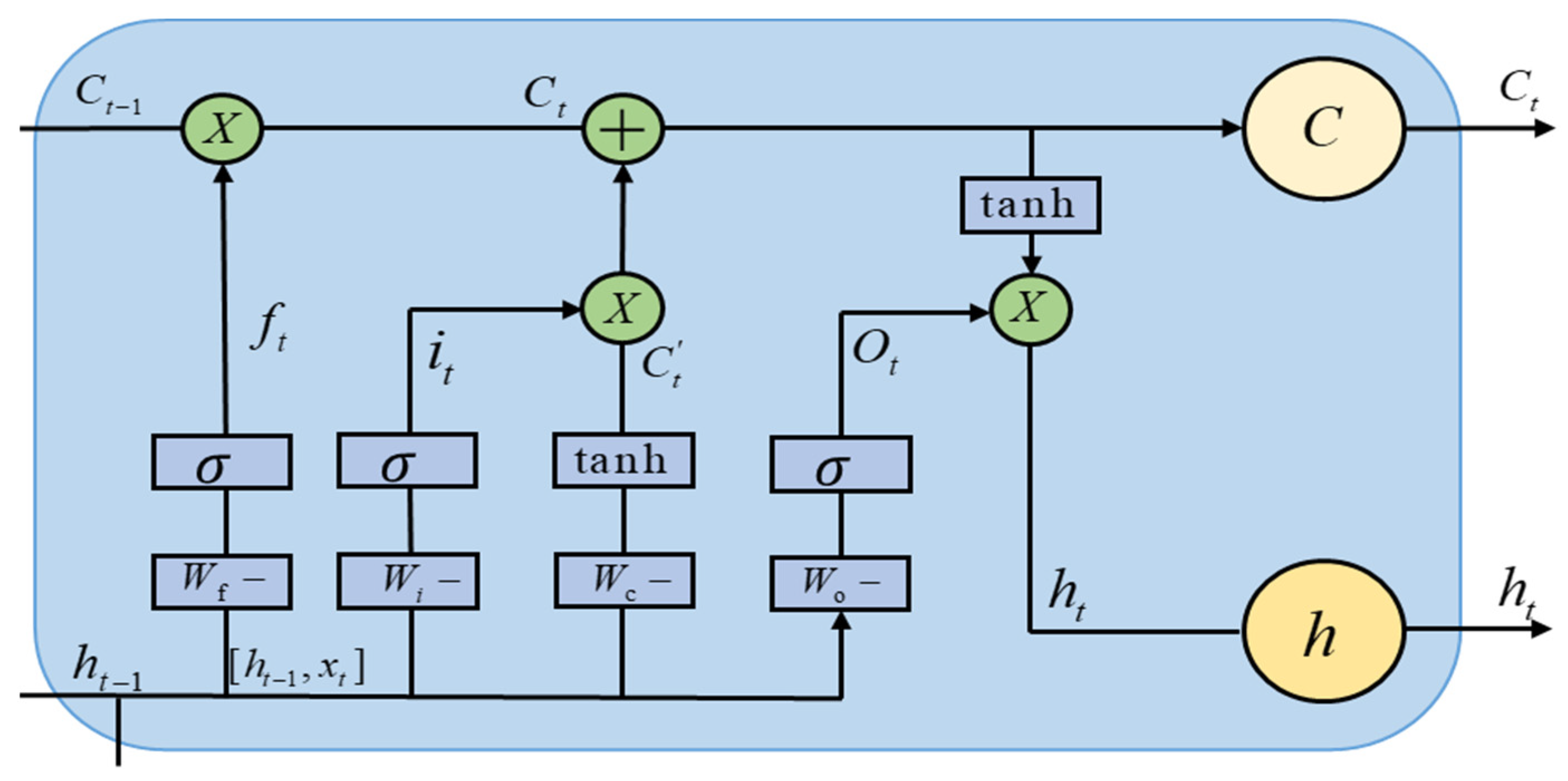
LSTM is a special recurrent neural network structure designed to solve the problem of gradient vanishing and gradient explosion prevalent in traditional RNNs when dealing with long sequential data. The core idea is to selectively control the transmission of information in the time dimension by introducing multiple gating mechanisms. The forgetting gate
is used to regulate the degree of decay of the historical memory, the input gate
determines the contribution of external inputs to the updating of the current memory, and the output gate
constrains the strength of the mapping of the internal state to the external hidden state. Under this framework, the memory cells can stably preserve valid information over a long-time span while avoiding the accumulation of redundancy or noise. This mechanism enables the LSTM to consider the short-term local dynamic features while possessing a strong long-term dependence modeling capability, thus providing a more accurate and efficient representation for time series forecasting tasks. At time step
, its computational process is as follows (
Figure 2):
where
is the last moment hidden state and
is the current input;
and
are the weight matrix and bias, respectively; and
is the Sigmoid activation function.
- (2)
Input Gate and Candidate Memory
where
is the candidate memory state;
and
are the corresponding weights and biases; and
is the hyperbolic tangent function.
- (3)
Memory unit update and output
where
is the current memory cell;
is the current hidden state, which is used to predict or pass to the next moment;
and
are the weight and bias parameters.
LSTM can extract deep features with dynamic memory properties during gated modeling of time series, which are passed as inputs to iTransformer in the framework of this paper to further complete the modeling of global dependencies and feature fusion.
3.3. iTransformer
In multivariate time series prediction tasks, transformer, as one of the most important deep learning architectures in recent years, is widely used in load forecasting, energy scheduling, traffic flow modeling, etc., as it can model dependencies globally by means of the Self-Attention mechanism. All variables are spliced into a token input:
where
is the number of time steps,
is the number of variables, and
denotes the observed value of the
ith variable at time
.
This approach can work better when the sequence length is short, but in complex multivariate prediction tasks the following problems are encountered:
- (1)
Variable interactions are implicitly realized. The attention weighting matrix is as the following:
where
is the query matrix,
is the key matrix, the dimensions of both are
is the dimension of the query and key vectors;
is the square root of the dimension of the key vector, used as a scaling factor.
denotes the Softmax function.
represents the correlation between different time steps, while the relationship between variables only exists implicitly within the same token, which is difficult to manifest explicitly, resulting in insufficient ability to model the coupling of multi-source input features.
- (2)
Time–variable overlap: Time-step tokens contain multiple variables, which lead to the model facing both time and variable dimensions when learning dependencies, and the information is overlapped, making it difficult for the model to distinguish between time relevance and variable relevance’, thus affecting the generalization performance. The generalization performance is affected.
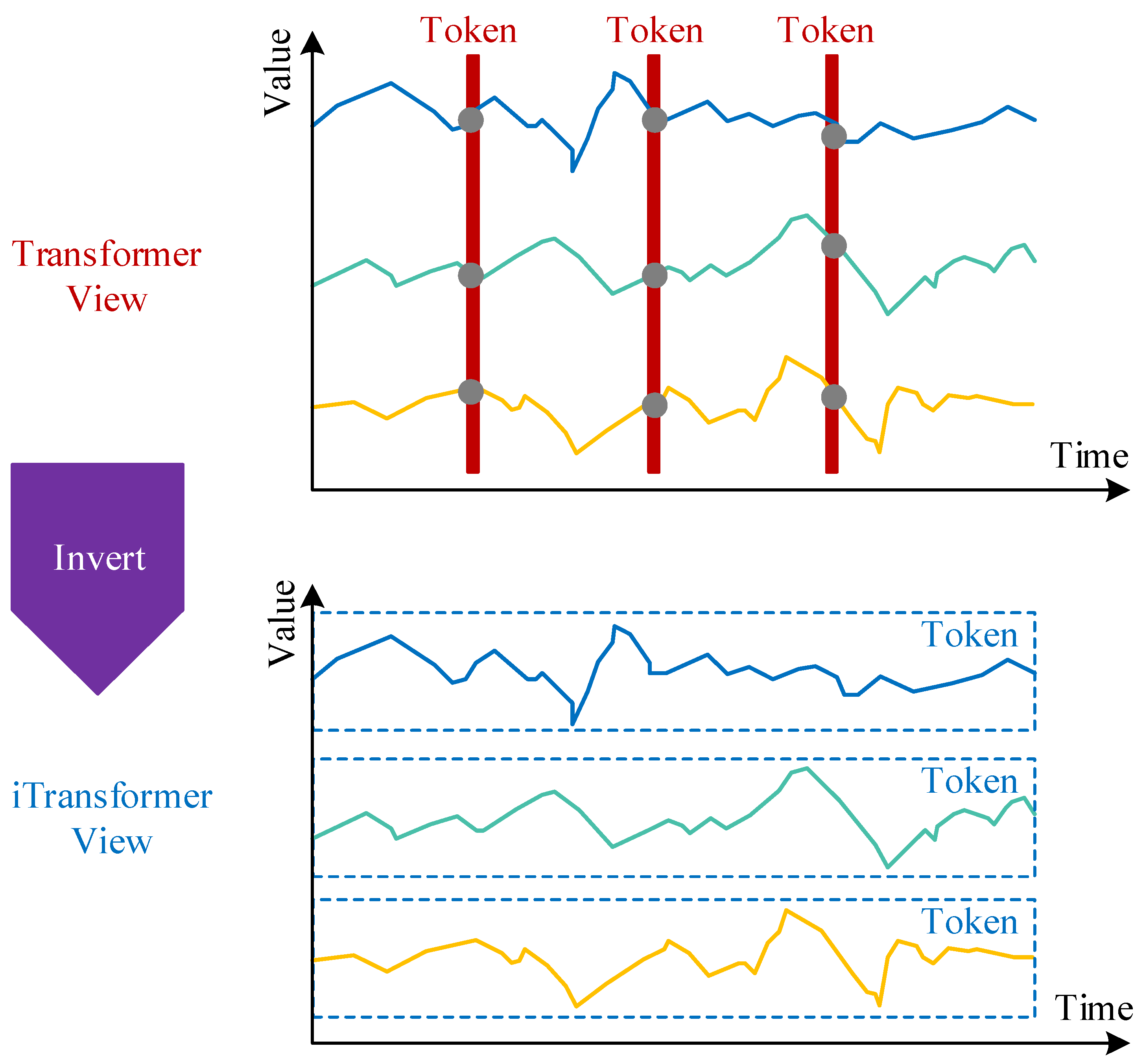
To cope with the above problem, iTransformer (inverted transformer) employs an inversion modeling paradigm. Variables rather than time steps are defined as tokens, and the complete history sequence of each variable is embedded as an independent representation. As a result, the domain of the self-attention mechanism is shifted from the time dimension to the variable dimension. This structural adjustment allows the model to explicitly portray cross-variate dependencies at the representational level and effectively mitigate the complexity of the long-series condition at the computational level.
- (1)
Modeling
The overall structure of iTransformer follows the encoder framework of transformer, including the input embedding layer, the stacked transformer blocks, and the prediction projection layer, but it is significantly different from the traditional transformer in terms of token definition and the dimension of the role of the attention. Its core process can be represented as the following:
where
denotes the initial representation vector of the
th input and
denotes the
th input sample;
denotes the matrix consisting of all the initial representations, and
denotes the hidden representation matrix of the
th layer;
denotes the predicted output corresponding to the
th input, and
denotes the
th layer at which this input becomes the representation vector.
is used to embed the time series of each variable as a vector;
includes self-attention, feedforward networks, residual connectivity, and normalization;
is used for the output prediction layer. The difference with the traditional structure is that the number of input tokens is equal to the number of variables
, instead of time steps
T. The idea is shown in
Figure 3.
- (2)
Input embedding and hierarchical characterization
Let the multivariate time series be
The iTransformer projects each
into a token:
where
and
D is the embedding dimension. This process compresses dynamic patterns (e.g., periodicity, trend) in the time dimension into token representations, allowing the subsequent attention mechanism to focus only on the interactions between variables.
This hierarchical representation idea has two advantages: on one hand, temporal dependence is modeled in the embedding stage, avoiding variable dependence being masked within temporal tokens; on the other hand, different variables are projected into the same representation space, reducing the impact of differences in measurement units and statistical distributions, and laying a unified feature base for subsequent attention operations.
- (3)
Self-attention mechanism for variable dimensions
In the
th layer transformer block, the input is
. It is obtained by linear mapping:
where
, denote the projection parameter matrices of queries, keys, and values, respectively.
The attention weight matrix is as the following:
The output is as the following:
Unlike traditional transformers, explicitly represents the strength of dependence between the th variable and the th variable, thus enabling direct modeling of cross-variable interactions. In contrast, standard attention matrices can only portray correlations between moments, and variable interactions are implied within tokens, which lacks transparency.
- (4)
Feedforward and residual structure
Attentional output was further mapped via a Feed-Forward Network (FFN):
where
is a two-layer fully connected and nonlinear activation function. Residual connectivity with Layer Normalization (LN) ensures training stability when deep stacking and uniform distribution in variable dimensions to enhance comparability of cross-variate features.
In summary, the main difference in iTransformer is the redesign of the way tokens are defined: from a timestep-centric representation to a variable-centric representation. This structural adjustment theoretically provides a new modeling perspective for the portrayal of multivariate dependencies:
- (1)
Time-variant hierarchical decoupling
iTransformer models temporal features in the embedding phase and variable features in the attention phase, which avoids conflation between the two and helps to improve the generalization of the model in non-smooth, multi-source input environments.
- (2)
Multi-source feature fusion
Variables from different sources (e.g., weather, load, and renewable power) are unified into the attention mechanism at the token level, and the model can naturally capture cross-modal and cross-physical coupling relationships.
3.4. Hybrid Cosine Attention Mechanism
In the standard self-attention mechanism, the correlation between the query and the key is computed by scaling the dot product and normalized by the Softmax function to generate the attention weights. However, in multivariate time-series prediction tasks, the score function of this form not only relies on the directional relationship between the vectors but is also directly affected by the vector paradigms .
This dependence may lead to systematic biases in the distribution of attention weights for different magnitude variables and exacerbate numerical stability problems under high-dimensional input conditions.
To alleviate the challenges, this paper proposes a hybrid cosine attention mechanism. The core idea of this mechanism is to normalize the query and key vectors to portray their relevance with cosine similarity. Therefore, temperature scaling and sparse gating are introduced before Softmax normalization to improve the numerical stability of the attention distribution and enhance the suppression of noise features. Its mathematical form is as the following:
where
are the normalized query and key matrices, respectively;
is a temperature parameter to regulate the sharpness of the Softmax distribution;
is the key-side non-negative gating,
is a stability constant, and
is used to suppress the invalidated or noisy features;
is the masking matrix to prevent the future information leakage and padding position nullification;
is the value matrix and the output is
.
The hybrid cosine attention mechanism is more suitable for complex multivariate time series prediction tasks because it retains the characteristics of Softmax focusing and normalization, as well as numerical stability, controllability of distribution, and noise immunity.
5. Analysis of Experimental Results
5.1. Intermediate Representations and Visualization of Key Model Components
To provide a clearer understanding of how the proposed model extracts hierarchical features and captures cross-variable dependencies, this subsection visualizes the intermediate representations of its key modules, including the LSTM-based temporal feature mapping, the multi-head hybrid cosine-attention patterns, and the latent representations produced by the iTransformer encoder.
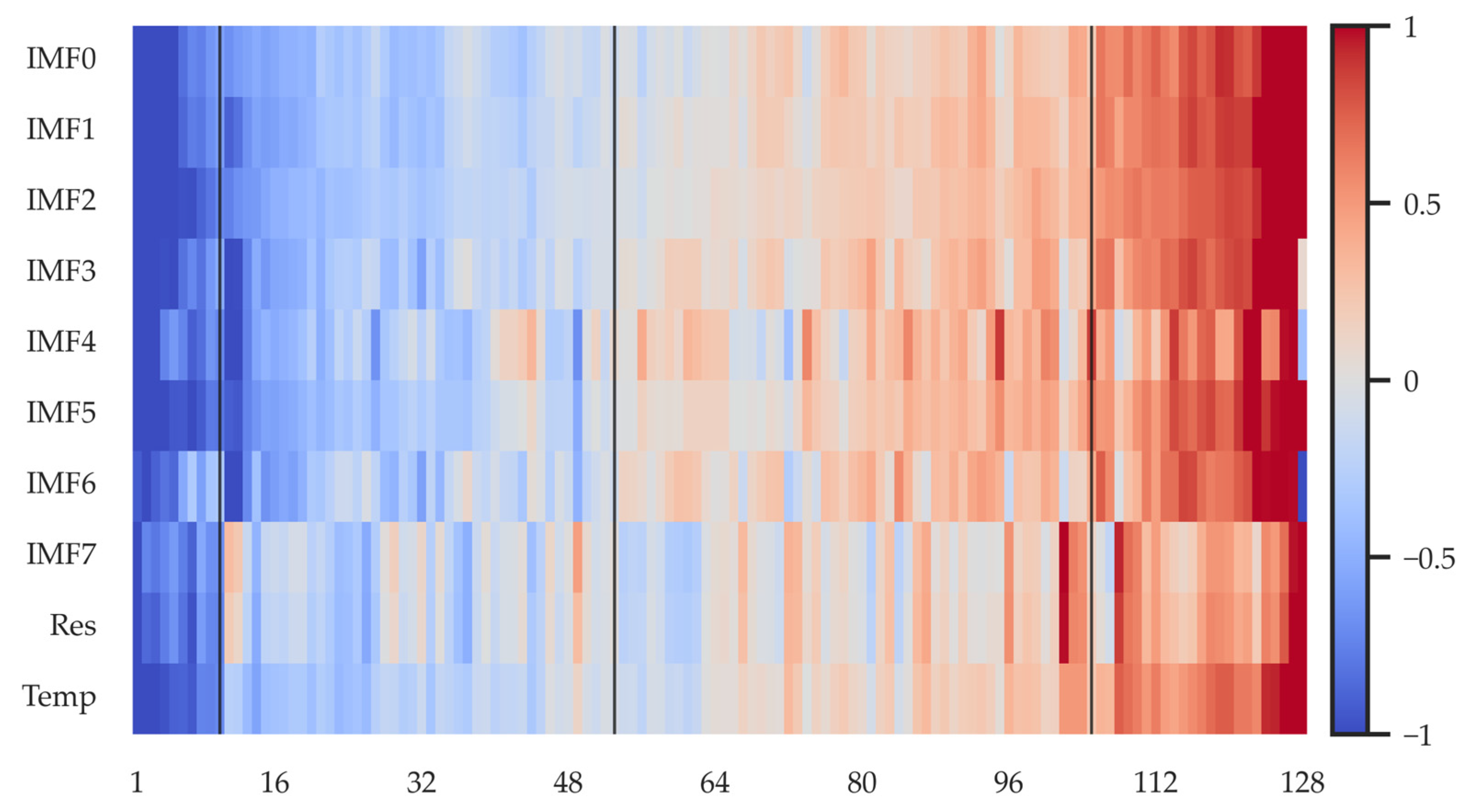
Figure 5 presents the hidden-state activations generated by the LSTM for the multi-scale IMF components, the residual term, and the meteorological variable. The horizontal axis denotes the time steps, the vertical axis corresponds to the input-variable dimension, and the color intensity indicates the activation magnitude. High-frequency IMFs exhibit rapidly fluctuating activation patterns, reflecting their pronounced influence on short-term load perturbations. In contrast, medium- and low-frequency IMFs form smoother, gradually evolving structures, corresponding to trend-related and cyclical behaviors. The residual term and temperature variable show distinct activation peaks at specific time positions, suggesting that the LSTM effectively captures the impact of exogenous drivers and non-decomposable components. Overall, the activations display a progressive temporal strengthening effect, demonstrating the LSTM’s ability to extract discriminative short-term dynamics from highly non-stationary load sequences and provide temporally structured features for the subsequent attention module.
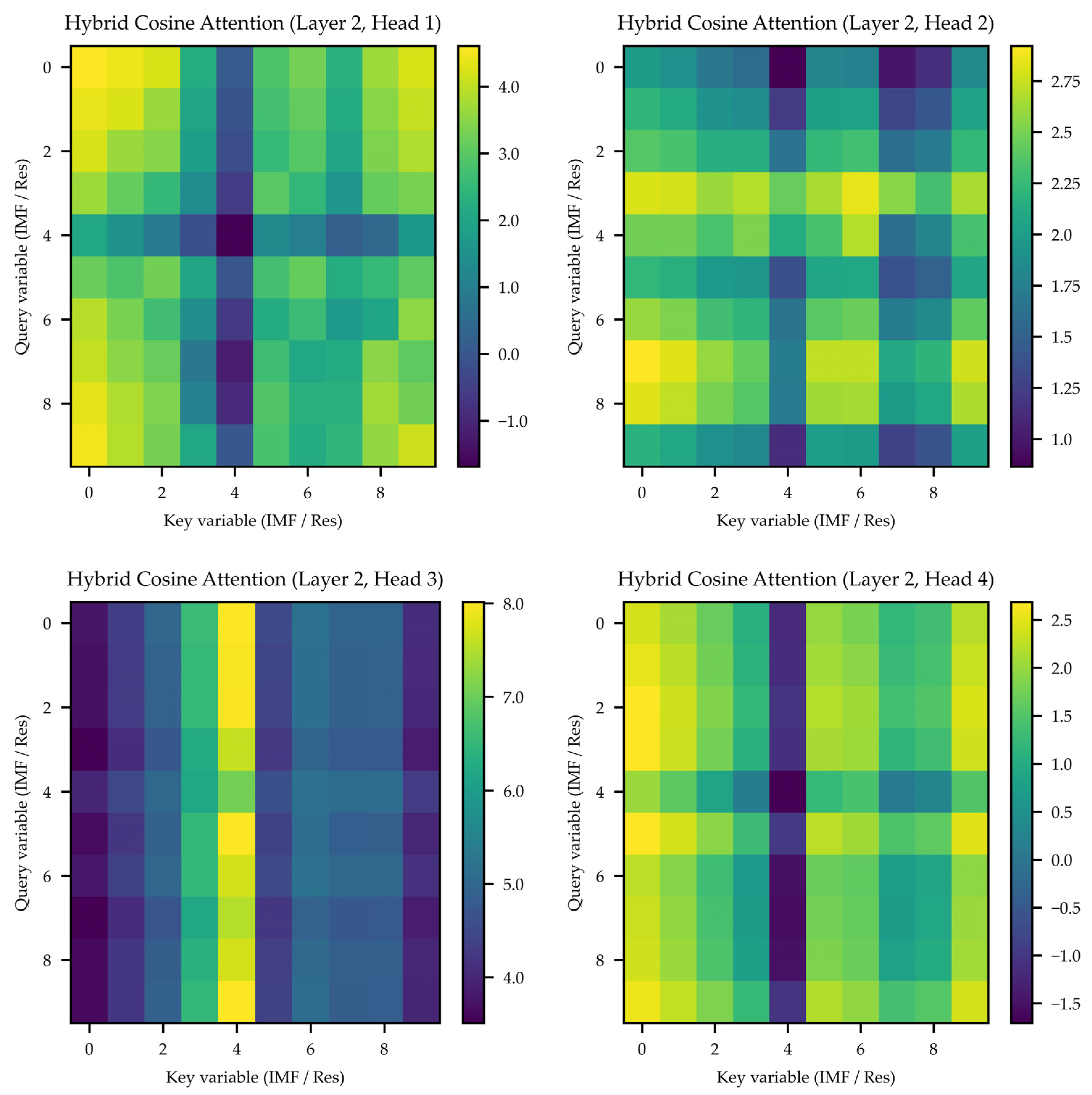
Figure 6 illustrates the hybrid cosine-attention weights of the four heads in the second attention layer, revealing the direction-normalized similarity structure among variables. The four heads exhibit clearly differentiated attention patterns: Heads 1 and 4 emphasize global coupling relationships, Head 2 focuses on interactions among medium-frequency components, and Head 3 concentrates on single-variable patterns. Such diversity indicates the inherent division of labor within the multi-head structure when modeling variable dependencies. Cosine normalization mitigates the norm bias caused by scale differences across IMFs, yielding more stable attention distributions that are not dominated by components with larger energy. The temperature-scaling factor further maintains a balanced trade-off between attention sharpness and dispersion, enabling more robust multi-scale dependency modeling.
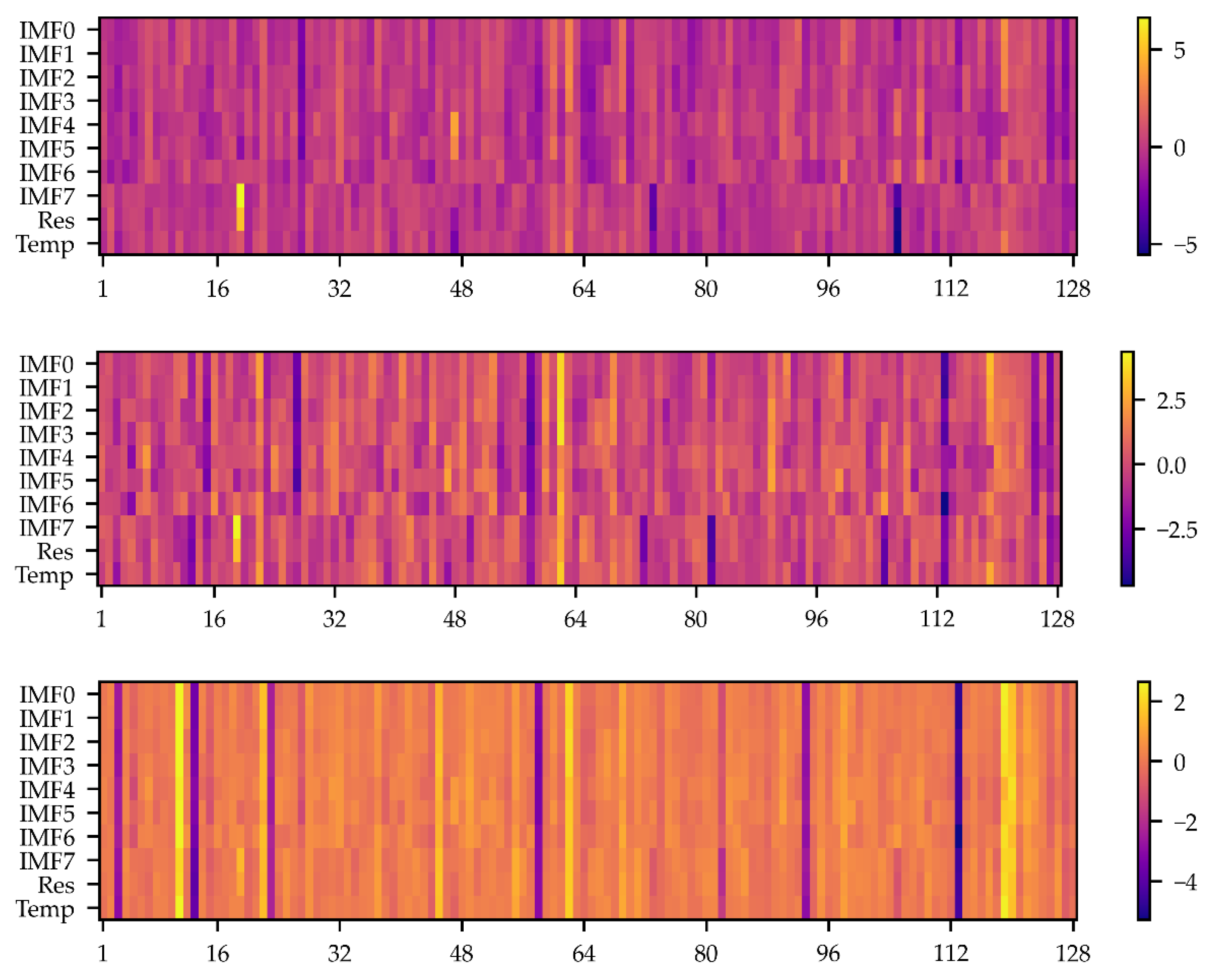
Figure 7 shows the latent representations produced by the iTransformer encoder, where color indicates activation intensity in the high-dimensional embedding space. Compared with the localized temporal features extracted by the LSTM, these latent representations are smoother and more compact, suggesting that redundancy among IMF components is significantly reduced after attention-based aggregation. Local activation peaks appear at several time steps, indicating the encoder’s ability to identify and encode key variations in the load curve into a unified variable space. The overall representation is both balanced and concentrated, confirming that the iTransformer effectively establishes global variable-wise dependencies.
5.2. Comparison Analysis with Traditional Models
To verify the effectiveness of the proposed method in the load forecasting task, four types of typical benchmark models are selected for comparison, namely RNN, LSTM, transformer, and iTransformer. All models are trained and tested with the same dataset and parameter settings, and the evaluation metrics are shown in
Section 4.3. The experimental results of each model are shown in
Table 1.
From the results in
Table 1, the traditional neural network model can fit the load data better overall, but there are still obvious differences in the prediction task of complex non-stationary sequences. The performance of RNN is the most limited, with an R
2 of 0.9395, and the MAE and RMSE of 206.48 and 253.20, respectively, which indicates that the model is not capable of capturing the dependence of the long sequences and the nonlinear fluctuations. The LSTM model introduces a gating mechanism in its structure, which can alleviate the problem of gradient disappearance, and thus outperforms the RNN in all the indexes, in which the R
2 is improved to 0.9485, and the MAE and RMSE are reduced to 193.25 and 233.57, respectively, with improved prediction accuracy.
Further comparison of the transformer series of models based on the attention mechanism reveals that it exhibits stronger modeling capabilities in load forecasting. iTransformer has an R2 of 0.9521, an MAE of 187.63, and an RMSE of 225.32, and performs better in portraying the long-time dependencies and capturing the global features compared to LSTM. iTransformer has improved in modeling multivariate interactions but is not as good as transformer in extracting serial dependencies in the time dimension, and thus performs slightly worse than transformer.
From
Table 1, the proposed method is better than the comparison model in all the indicators. Its R
2 is 0.9857, MAE and RMSE are reduced to 96.55 and 124.93, which are about 48.6% and 44.6% lower than that of the second-best transformer, and MAPE is reduced to 1.13%, which is almost half of that of RNN. The data show that the proposed method has higher accuracy and stability in portraying both short-term fluctuations and long-term trends.
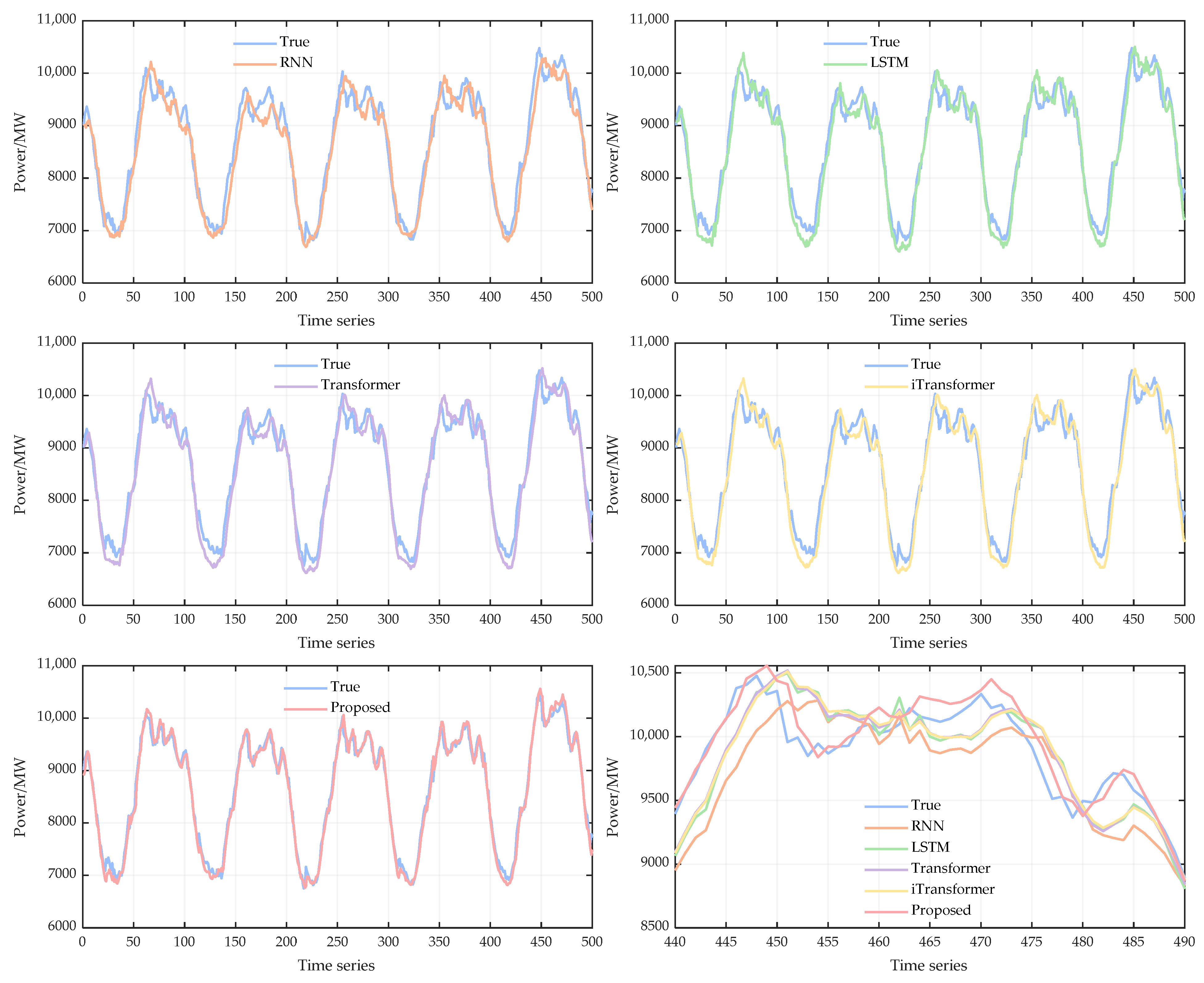
To demonstrate the accuracy of the proposed method in this paper more intuitively, the prediction results of the last 500 moments are selected for visualization and comparison, as shown in
Figure 8. Overall, all models can portray the cyclical fluctuation characteristics of the load sequence, but there is an obvious difference in the fitting accuracy between the peak and valley intervals, as shown in
Figure 8.
Firstly, the prediction curves of RNN and LSTM are closer to the real curves in the overall trend but show a certain degree of lag and deviation in the zones of rapid load changes. Especially in the peak interval, the prediction results show underestimation phenomenon, which indicates that the cyclic class models are still deficient in capturing the long-time dependence and non-stationary fluctuations. Secondly, the prediction curves of transformer and iTransformer are overall more closely matched to the real values and can better reflect the peaks and valleys characteristics of the loads, which verifies the effectiveness of the attention mechanism in modeling long time span dependencies. However, iTransformer does not show any significant advantage over the standard transformer, and there is a slight bias in some of the valley intervals, which is related to its structural characteristic of emphasizing multivariate interaction modeling. In contrast, the prediction results of the proposed method in this paper are highly consistent with the real curve in all time periods, especially in the extreme value interval, which almost coincides with the real curve, and significantly reduces the prediction lag and bias. The results show that the proposed joint decomposition-local-global-stability modeling framework can effectively reduce the non-stationarity of the original load series and improve the characterization of multi-scale features, thus achieving better prediction performance at both the overall trend and local detail levels. The proposed decomposition-local-global-stability joint modeling framework can effectively reduce the non-stationarity of the original load series and improve the characterization of multi-scale features, thus obtaining better prediction performance in both the overall trend and local details.
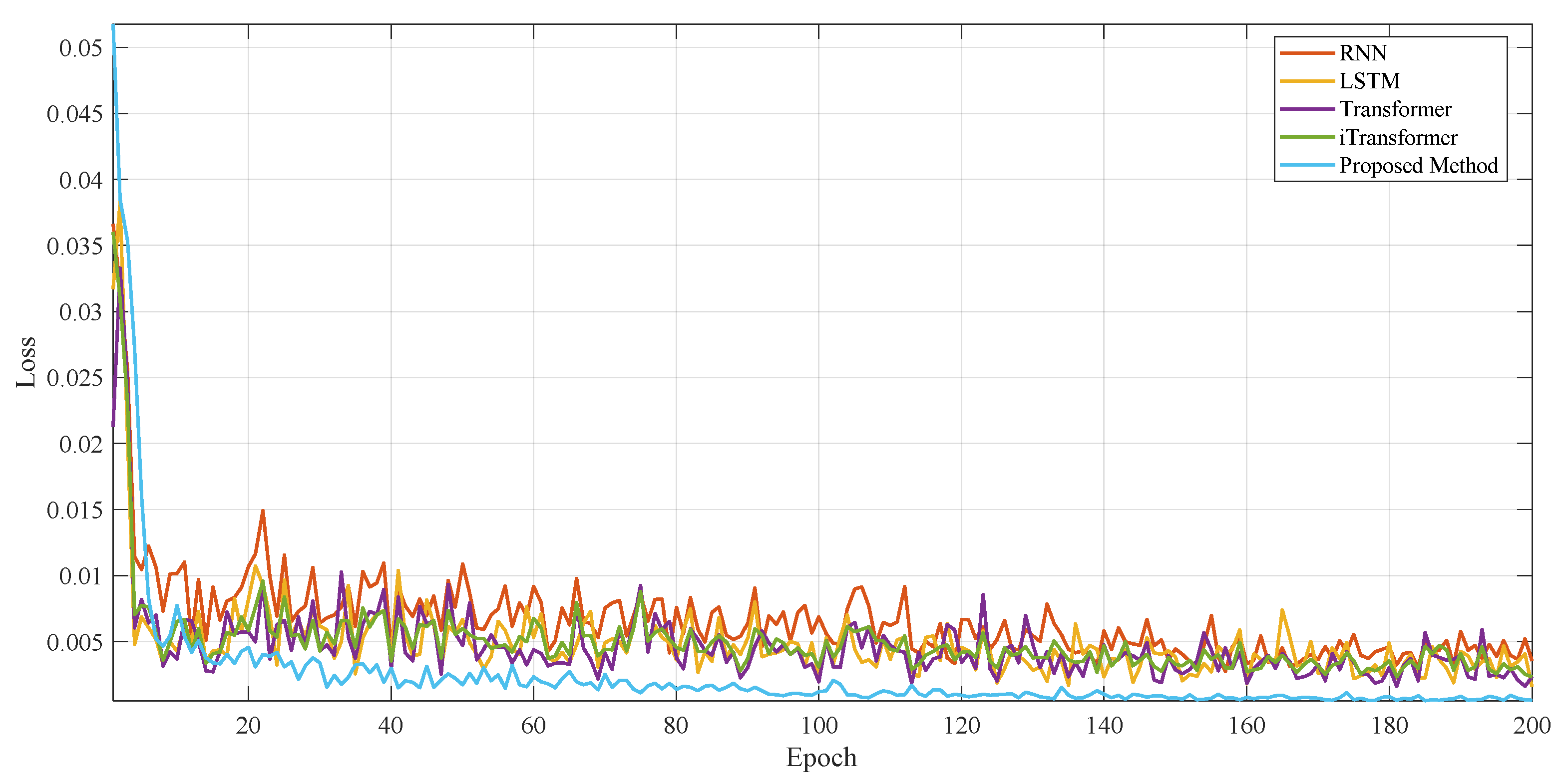
Each model can converge faster during the training process (
Figure 9), but the method proposed in this paper maintains the lowest loss level and the smallest fluctuation in the whole process, which indicates that it has a more significant advantage in optimization stability and generalization performance.
5.3. Ablation Experiments
To further explore the contribution of each functional module in the proposed method to the overall performance, this section designs ablation experiments to gradually remove or replace key components of the model and construct different variants for comparison. The specific experimental setup includes the following:
iTransformer: Only the base iTransformer structure is used.
LSTM–iTrans–cosA: Adds an LSTM feature extraction layer before the iTransformer and introduces hybrid cosine attention.
ICEEMDAN–iTrans–cosA: Adopts ICEEMDAN decomposition as preprocessing but does not include the LSTM layer.
ICEEMDAN–LSTM–iTrans: Includes ICEEMDAN and LSTM but does not use hybrid cosine attention.
Proposed Method: Complete framework, i.e., ICEEMDAN + LSTM + iTransformer + hybrid cosine attention.
The experimental results are shown in
Table 2.
From the results, it can be observed that the standalone iTransformer exhibits certain limitations in forecasting accuracy, achieving an R2 of only 0.9503, while its MAE and RMSE remain relatively high at 190.53 and 229.57, respectively. This indicates that when dealing with non-stationary load series, relying solely on global dependency modeling is insufficient to adequately capture local dynamic patterns. With the introduction of LSTM and the hybrid cosine attention mechanism, the model performance improves significantly: R2 increases to 0.9656, while MAE and RMSE are reduced by 15.6% and 15.5%, respectively. This demonstrates the effectiveness of local temporal dependency extraction and stabilized attention distribution in controlling prediction errors. After incorporating ICEEMDAN decomposition, the error metrics further decrease, suggesting that weakening the non-stationarity of the series enhances the specificity and effectiveness of subsequent feature learning. When ICEEMDAN and LSTM are retained but the hybrid cosine attention mechanism is removed, the model still achieves a high level of fitting performance, with R2 rising to 0.9793, indicating that the combination of decomposition and local modeling provides a fundamental contribution to overall performance improvement. Finally, the proposed model achieves the best results across all four-evaluation metrics, with an MAE of 96.55, an RMSE of 124.93, and an R2 of 0.9857, validating its synergistic advantages in multi-scale feature representation and cross-level modeling.
When ICEEMDAN and LSTM are retained without introducing the hybrid cosine attention mechanism, the model still exhibits a high degree of goodness-of-fit, showing that the combination of decomposition and local modeling plays a fundamental role in the overall performance improvement. Ultimately, the proposed model achieves optimal results in all four metrics, which verifies the synergistic advantages of the proposed method in multi-scale feature characterization and cross-level modeling.
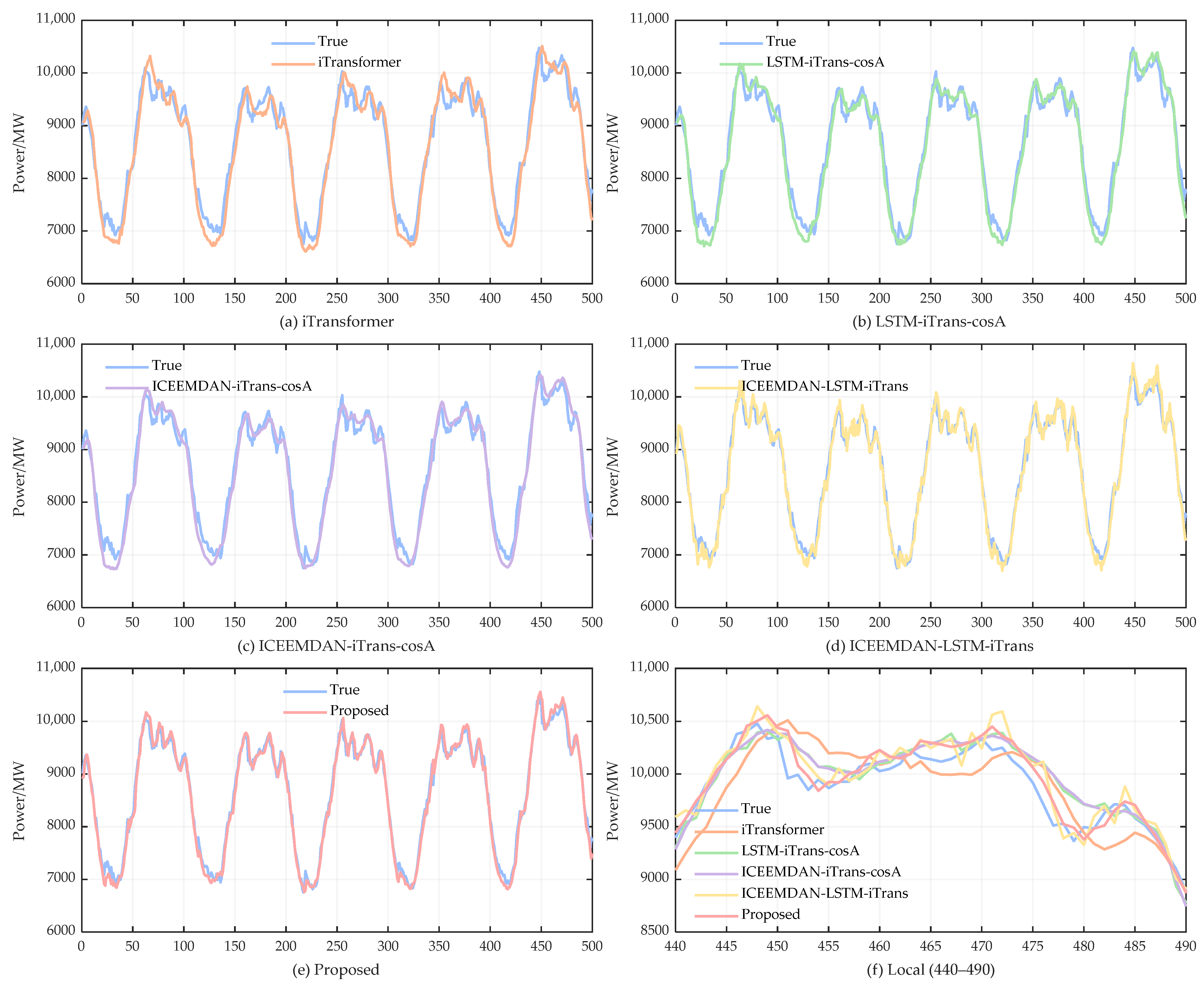
Figure 10 illustrates the comparison of different ablation models with the real load profile. The iTransformer alone can reproduce the general trend but shows significant deviations in the peak and trough intervals, indicating that it does not sufficiently characterize the local dynamics. After the introduction of LSTM and hybrid cosine attention mechanism, the response ability of the model is enhanced in the fast-varying region, and the temporal consistency of the prediction curves is improved. After combining the ICEEMDAN decomposition, the error is further narrowed in the extreme range, indicating that the decomposition plays a role in alleviating the non-stationarity. The overall fit is further improved when the joint structure of ICEEMDAN and LSTM is used. The predicted curves of the proposed model are highly consistent with the true curves and show excellent fits in both the overall shape and local details, as shown in
Figure 10. The results are consistent with the quantitative indexes in
Table 2, verifying the effectiveness and necessity of multi-module collaborative modeling.
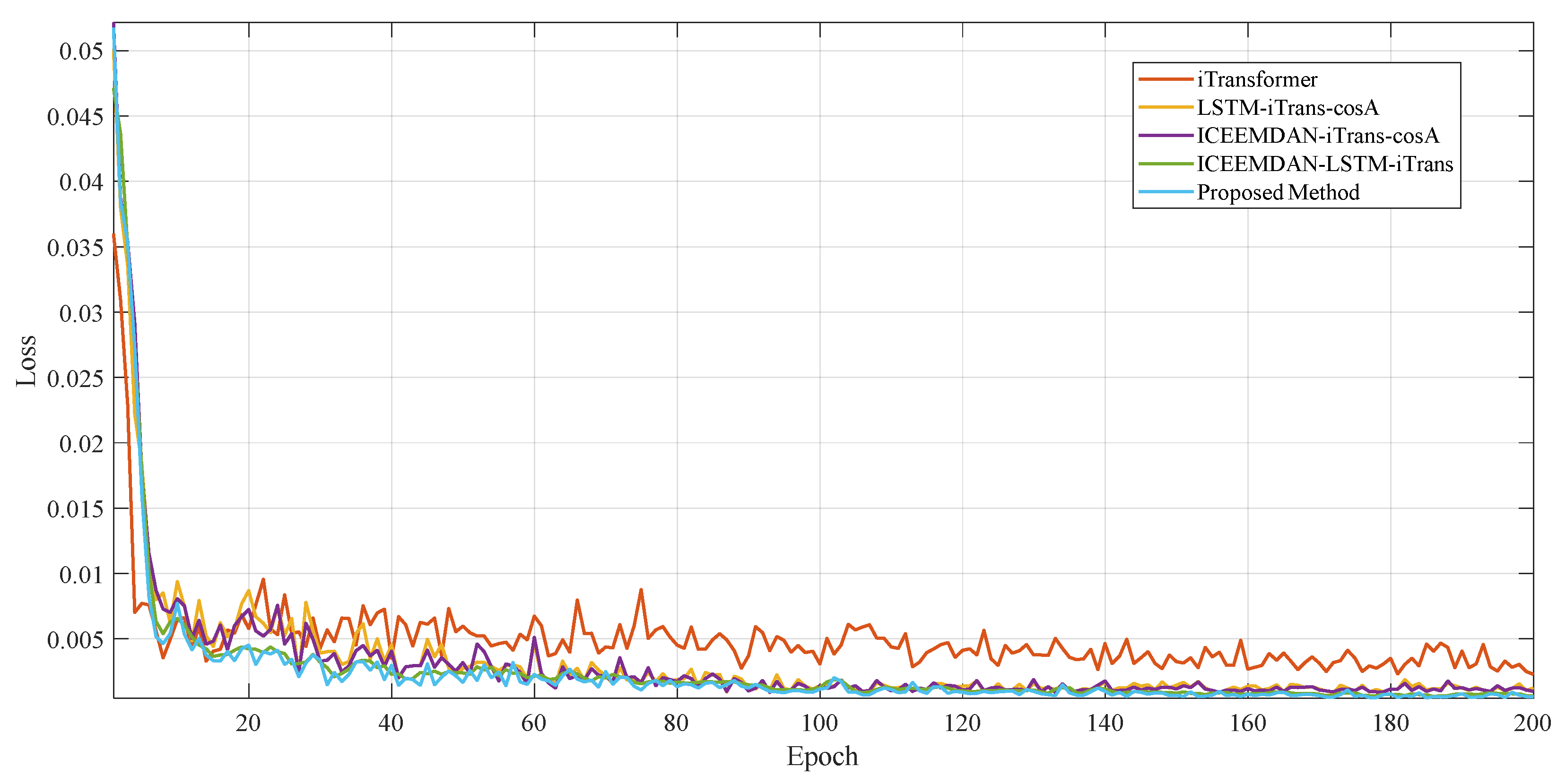
As can be seen from
Figure 11, all models converge faster, but the complete ICEEMDAN–LSTM–iTransformer-hybrid cosine attention framework maintains the lowest loss level almost throughout, reflecting stronger training stability and generalization ability.
5.4. Statistical Significance Testing and Sensitivity Analysis
As shown in
Table 3, the proposed method achieves extremely small
p-values in both paired
t-tests and Wilcoxon signed-rank tests when compared with all seven baseline models. Specifically, the
t-test
p-values range from 5.18793 × 10
−53 to 7.91437 × 10
−12, while the Wilcoxon
p-values range from 4.25252 × 10
−45 to 2.20031 × 10
−10. All values are far below the significance threshold of 0.05, demonstrating that the performance improvements of the proposed framework are statistically significant at the 95% confidence level. These results confirm that the superiority of the proposed model is systematic rather than arising from random fluctuations in the dataset.
The sensitivity analysis is performed around the final configuration, where the historical input window length is set to
look_back = 96, the batch size is 128, the learning rate is 5 × 10
−3, the embedding/representation dimension is
d_model = 128, the number of attention heads is
n_heads = 4, the number of encoder layers is
n_layers = 3, the feed-forward network width is
dim_ffn = 4 ×
d_model, the dropout rate is 0.1, and the
τ = 0.1. We perturb one hyperparameter at a time and keep the others fixed to observe how the prediction accuracy reacts to controlled structural changes.
Table 4 reports the evaluation metrics under different hyperparameter settings.
Although the evaluation metrics deteriorate when deviating from the optimal configuration, the degradation shows no abnormal jumps and remains within a small and stable range. This indicates that the model exhibits neither instability nor sensitivity explosion, and its overall performance remains stable under hyperparameter perturbations, demonstrating strong robustness.
5.5. Evaluation of Model Performance on External Datasets
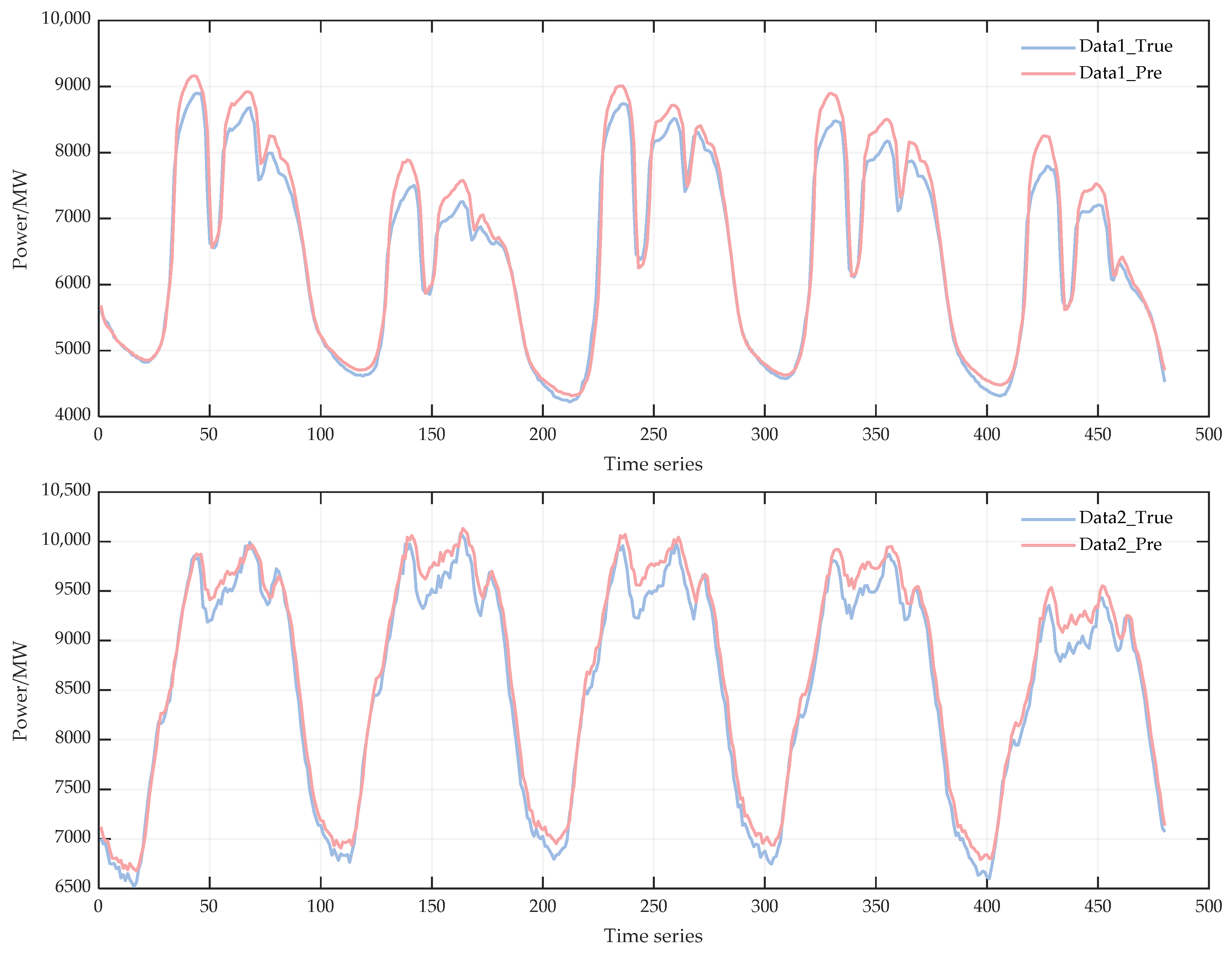
To further evaluate the generalization capability of the proposed model, we conduct additional experiments on two external datasets. As summarized in
Table 5, the model maintains consistently high prediction accuracy across both datasets. Specifically, it achieves MAE values of 195.94 and 146.38, RMSE values of 262.40 and 173.12, MAPE values of 2.82% and 1.73%, and R
2 scores of 0.9648 and 0.9744 on Data 1 and Data 2, respectively. These results demonstrate that the model delivers stable and robust performance on datasets with different temporal patterns, confirming its strong applicability beyond the primary training set.
Figure 12 illustrates the model’s prediction performance on two additional datasets (Data 1 and Data 2). In both cases, the predicted curves closely follow the ground-truth values, demonstrating the model’s strong generalization capability across datasets.
6. Conclusions
In this paper, a hierarchical forecasting framework integrating ICEEMDAN–LSTM–iTransformer with hybrid attention mechanism is proposed to address the problems of strong non-stationarity, complex multi-scale features, and insufficient modeling of cross-variate dependence that are commonly found in short-term electricity load forecasting. The method uses ICEEMDAN decomposition to reduce the non-stationarity of the sequence and extract the multi-timescale information at the input stage, combines with LSTM module to enhance the characterization of local nonlinear dynamics and short-term dependence, and then realizes the explicit modeling of cross-variable interactions and global dependence through the iTransformer architecture, and at the same time, introduces the cosine normalization improvement in the attention mechanism to enhance the numerical stability and cross-scale information aggregation.
In the arithmetic example based on real load data, the comparison experiment proves the effectiveness of the constructed framework, while the ablation experiment further reveals the independent contributions of the modules in different dimensions and their synergistic effects. The experimental results verify the advantages of the proposed method in terms of forecasting accuracy and stability, demonstrating that the obtained short-term load predictions can directly support practical power system operations. More accurate short-term load forecasts help improve the quality of rolling schedules in real-time dispatch, reduce uncertainty in reserve allocation, and provide more reliable prior load information for renewable energy accommodation, thereby enhancing operational flexibility and security margins under highly volatile conditions.
Future work could be carried out in the following areas: First, graph neural networks can be used to better characterize the spatial coupling properties of the power system and to realize spatial and temporal integrated prediction. Second, external perturbations such as extreme weather and demand-side response are considered to enhance the robustness of the model in abnormal situations. Third, the lightweight and online update mechanism of the model is explored to meet the real-time and deployable requirements of the actual grid operation. Building on this foundation, a more comprehensive research route may be further developed, including multi-regional forecasting, probabilistic prediction, and risk-aware scheduling, as well as integrated prediction–control frameworks, to facilitate the deployment of data-driven forecasting models in future renewable-dominated power systems.