Article

Assessing ChatGPT Adoption in Higher Education: An Empirical Analysis

by
Iuliana Dorobăț
and
Alexandra Maria Ioana Corbea (Florea)
*
Faculty of Cybernetics, Statistics and Economic Informatics, Bucharest University of Economic Studies, Romana Square 6, 010374 Bucharest, Romania
*
Author to whom correspondence should be addressed.
Electronics 2025, 14(23), 4739; https://doi.org/10.3390/electronics14234739
Submission received: 28 October 2025 / Revised: 20 November 2025 / Accepted: 27 November 2025 / Published: 2 December 2025

Abstract

Artificial intelligence (AI) has transformed the educational landscape and reshaped learning experiences. Its adoption in higher education is increasing due to the recent plethora of AI tools (AITs) and their associated benefits. Romanian universities face the challenge of integrating AITs in the learning process. Thus, the students’ attitudes and behavioral intentions concerning the use of AITs are meaningful. Technology acceptance models have been widely used to investigate factors that affect the intention to use a technology. ChatGPT (Chat Generative Pre-Trained Transformer) is a popular AIT among students. Therefore, this study presents a conceptual model for successfully adopting ChatGPT in a Romanian Higher Education Institution (HEI). A case study was conducted at the Faculty of Cybernetics, Statistics, and Economic Informatics at the Bucharest University of Economic Studies to test this model. Structural equation modeling (SEM) was used to validate and inspect the model’s network of determinants. The findings indicate that perceived ease of use (PEOU) and perceived usefulness (PU) are key predictors of student satisfaction (S) and trust (T), which in turn promote loyalty (L) to the AIT. The paper provides a novel perspective by distinguishing between forms of social presence, and their impact on students’ satisfaction and trust, thereby enhancing the understanding of student behavior toward AIT adoption.

1. Introduction

As we entered the digital age, the academic landscape has undergone a profound evolution and transformation, with technology becoming an intrinsic part of the educational process [1]. The integration of new digital technologies has been a strategic priority for higher education institutions [2]. Over the last decade, they have frequently integrated tools such as learning management systems (LMS), digital assessment platforms, and chatbots to support teaching, learning, and assessment processes [3]. A turning point in the digitalization of education was the emergence and rapid popularization of large language models (LLMs), particularly generative LLMs [4].
LLMs are sophisticated artificial intelligence systems built on deep learning architectures and trained on extensive datasets, originally developed to perform text-related tasks [5]. Generative LLMs represent an innovative subset of these models, designed for analysis and classification as well as creating new content across multiple formats [6].
A variety of generative LLMs from global organizations are now available, serving not just as chatbots but as educational and research assistants. Tools like Google Gemini and Microsoft 365 Copilot support interactive learning, productivity, and academic tasks, while Claude focuses on promoting critical thinking, aiding programming education, and reducing programming anxiety [7,8,9].
Among this variety of AITs, ChatGPT (GPT-4o) stands out as a popular generative LLM. Launched by OpenAI in November 2022, it represents a significant achievement in natural language processing. ChatGPT generates human-like responses, assists in problem-solving, and facilitates personalized learning experiences. Its adoption has been unprecedented; within just a week of its launch, it has attracted over a million users [10], marking the beginning of one of the fastest growth trajectories in technology’s history.
In higher education, LLMs, particularly ChatGPT, are perceived as both innovative and challenging tools. On one hand, these enhance efficiency, foster creativity, and improve accessibility by supporting academic writing, providing personalized explanations [11], assisting with debugging code [12], and reducing the time required to complete administrative or documentation tasks [13]. In contrast, there are major concerns regarding the accuracy of the information provided, the risk of “hallucinations” (generating erroneous answers presented as truthful) [14], as well as the potential for students to become overly dependent on the tool, which may impair their critical thinking skills [15]. Moreover, the use of such tools in higher education institutions raises significant ethical concerns and challenges related to academic integrity [16].
Despite existing challenges, there is growing interest in understanding how students interact with and utilize ChatGPT, as usage statistics alone do not provide a comprehensive picture of its adoption and acceptance within higher education institutions. Students’ perceptions and their willingness to integrate ChatGPT into their academic practices are crucial factors influencing its successful adoption. Moreover, beyond the ethical concerns surrounding issues like plagiarism and the authenticity of student work, a more fundamental question arises: How do students themselves view this technology? Addressing this question is essential, as the acceptance of new technologies is not solely driven by rational evaluations of their objective benefits, but also by subjective and experiential factors. Subjective perceptions of users, such as how easy they find ChatGPT to use, the level of enjoyment or playfulness they experience, and the sense of social presence or connection they feel during interaction, significantly influence whether they choose to adopt or reject the AIT [17,18]. These personal experiences shape users’ attitudes and ultimately impact their willingness to integrate ChatGPT into their academic or professional routine. Therefore, it is relevant to develop a deeper understanding of the factors determining students’ attitudes toward adopting ChatGPT and how these factors influence their intentions to continue using this tool in their academic endeavors.
Within Romanian HEIs, the integration of ChatGPT into the learning process is in its early stages, but efforts are being made to encourage its adoption [19]. The current study aligns with these efforts and employs a quantitative research method to inspect factors influencing ChatGPT adoption in a Romanian HEI. The empirical study data were collected from a large sample of students from the Faculty of Cybernetics, Statistics, and Economic Informatics at the Bucharest University of Economic Studies via a questionnaire. Data collection targeted a diverse sample, and the preliminary tests confirmed the reliability of the instrument. The collected data were used for statistical analysis and the description, explanation, and testing of hypotheses using Structural Equation Modeling (SEM) to propose a comprehensive model for the successful adoption of ChatGPT. The proposed model incorporates concepts from the TAM (Technology Acceptance Model), UTAUT (Unified Theory of Acceptance and Use of Technology), and ECM (Expectation-Confirmation Model). Although studies on ChatGPT adoption in Romanian HEIs have begun to emerge [19,20], this paper is among the first to integrate multiple theoretical models. It contributes to the existing body of knowledge by examining several ChatGPT adoption outcomes—students’ satisfaction, trust and loyalty—and by introducing two distinct dimensions of social presence and investigating their effects on these outcomes.
The structure of the paper is as follows: Section 2 provides an overview of ChatGPT, its current uses in higher education, and a review of previous studies focusing on the key features of established, empirically tested technology adoption frameworks. Section 3 describes the research methodology, including the research model and hypotheses, followed by an explanation of the data analysis process—this encompasses the evaluation of the measurement model, assessment of model fit, path analysis, and interpretation of results. Lastly, Section 4 concludes the paper by summarizing the theoretical and practical implications and offering recommendations for future research.

2. Literature Review

2.1. ChatGPT Short Overview

ChatGPT is part of a broader category of GPT-type LLM models [21]. It was built on the GPT-3.5 architecture, a benchmark in the evolution of GPT models for its ability to answer complex questions and simulate natural conversation. Thus, ChatGPT was an optimized iteration of GPT-3.5 designed specifically for conversational interactions [22]. Its emphasis on clarity and accessibility enabled it to generate coherent, human-like text on a wide range of topics and in multiple languages [23]. This approach represented a remarkable leap in natural language processing (NLP), enabling not only fluent conversations but also problem-solving, content writing, and adaptation to diverse user needs [24].
The launch of ChatGPT attracted worldwide attention and is likely to be remembered as a significant milestone in the evolution of technology. The 100 million user threshold was exceeded in 2 months from launch [25,26], making ChatGPT “the fastest-growing app of all time” [25,27]. Its popularity has only grown over time [28], making it a well-known and widely used generative LLM in multiple countries [29].
ChatGPT has undergone rapid evolution, with 3 new iterations being released in less than 3 years. March 2023 brought the GPT-4 version, with significant improvements in reasoning, factual accuracy, and context understanding, and a little over 1 year later, in May 2024, GPT-4o was released, which introduced multimodal functionalities (the model processes and generates text but also works with images and audio) opening up new possibilities for interactive learning, accessibility, and human–AI collaboration [30]. The latest version was launched in August 2025. GPT-5 is promoted as faster, more secure, and with a lower hallucination rate than previous versions. Among the areas where it excels, we should mention medical imaging and advanced mathematical research. GPT-5 achieves up to 90.7% accuracy, exceeding the estimated passing threshold for human experts in certain classic medical examinations [31], and solved an open problem in convex optimization, contributing to the formulation of new quantitative and qualitative results [32].
These developments illustrate the rapid advancement of generative AITs toward becoming everyday digital utilities. Many experts view this phase as a crucial moment in the democratization of AI, where high-performance models, once exclusive to academia and research institutions, are now accessible to the public [33].

2.2. ChatGPT in Education

The emergence of ChatGPT has significantly impacted higher education [34], generating both excitement and apprehension. Its capacity to produce coherent, contextually appropriate text positions it as a valuable educational resource [35]. ChatGPT opens up new opportunities for personalized learning and improved access to complex information [27,36,37]. However, it is also a source of disruption for traditional teaching and assessment practices [38], and “educational bodies and institutions need to remain vigilant and proactive in observing and governing the use of such tools” [39].
Students use ChatGPT as a tutor-like assistant [40], capable of providing basic educational materials, explanations, summaries, and feedback [41]. They can request clarification on complex concepts, summaries of dense academic materials, or explanations tailored to their level of understanding [25]. Various studies [42,43,44] suggest that students perceive ChatGPT as a valuable support and are increasingly using it for academic tasks, from brainstorming and essay writing to coding and data analysis. Therefore, ChatGPT proves to be a versatile tool, useful in a variety of fields, from the humanities to computer science and mathematics.
Faculty members also experiment with ChatGPT. For them, it offers opportunities to rethink courses, pedagogical strategies, and explore innovative pedagogical approaches [45,46]. The AIT can support the design of course materials, the creation of formative assessments, and the provision of feedback on assignments while saving considerable time by automating administrative tasks [47,48]. Moreover, universities are experimenting with integrating generative AI into LMS platforms, academic writing support tools, and research assistance, reflecting a broader trend of digital transformation [49].
Despite the many benefits that the adoption of ChatGPT in higher education can bring, it also poses major challenges regarding academic integrity, plagiarism, and the potential erosion of critical thinking skills [50,51,52]. The specialized literature warns that students’ excessive reliance on AI-generated content may diminish their analytical capabilities and independent reasoning skills [53]. This is a significant risk because these competencies are vital in distinguishing reliable from unreliable information. Another major concern is the questionable reliability and precision of ChatGPT-generated information [54]. While it can offer answers to a wide variety of questions, those responses may be inaccurate or incomplete because, despite its fluency, ChatGPT is prone to hallucinations [24,55]. Professors are also expressing reservations about the correct assessment of students in the ChatGPT era, and universities are advised to formulate clear policies regarding its use [56].
A recent survey by the Digital Education Council [57] revealed that approximately 66% of students worldwide reported using ChatGPT for academic purposes. Yet, despite its widespread adoption, 58% admitted to lacking sufficient AI literacy, 48% felt unprepared for an AI-enabled workforce, and 80% considered their university’s integration of AI tools to be below expectations. This indicates that assessing ChatGPT’s success in higher education requires more than measuring usage rates: it also involves exploring the factors that determine effective adoption and integration.
Therefore, ChatGPT’s presence in academia highlights a dual reality: it is simultaneously a powerful enabler of innovation in teaching and learning and a disruptive force that challenges traditional educational practices. In Romania, where these discussions are only beginning to emerge, empirical studies conducted within local universities become essential for understanding how this technology can be effectively integrated while addressing its inherent challenges.

2.3. Technology Acceptance Models for AI Adoption

TAM, introduced by Fred Davis in 1989, is one of the most widely utilized and empirically supported frameworks for understanding the factors influencing technology adoption across both organizational and individual levels. The model centers on two core constructs: perceived usefulness and perceived ease of use, which influence users’ attitudes toward a technology and affect their behavioral intention and actual usage [58].
Besides TAM, there are other well-established theoretical frameworks for analyzing the factors that determine the adoption and use of technologies. Among the most widely used are the UTAUT and ECM, which extend and complement the perspectives offered by TAM.
UTAUT was developed by Venkatesh (2003) and integrates elements from eight previous theoretical models, which it synthesizes to finally propose four major constructs that explain the intention to use and actual behavior: performance expectancy, effort expectancy, social influence, and facilitating conditions [59].
UTAUT2, proposed 9 years after the initial version, extends the original model by considering the contexts of individual use [60]. In this version, constructs such as hedonic motivation, price value, and habit are added as adjacent factors influencing adoption. This extension is particularly relevant for a better understanding of the adoption of AI tools in education, where intrinsic motivations and pleasant user experiences can play a crucial role in accepting new technology.
Another significant framework is the ECM proposed by Bhattacherjee, which emphasizes continued usage rather than initial acceptance of technology [61]. The model identifies two key factors influencing user satisfaction and the intention to continue using a technology: expectation confirmation and perceived usefulness. When users’ experiences align with or surpass their initial expectations, satisfaction increases, thereby enhancing the likelihood of continued use. This model is particularly applicable in educational settings, where both the initial adoption and sustained integration of AI tools into the learning process are crucial.
AITs and LLMs in particular can be considered a distinct category of information systems. Consequently, many academic studies examining the success of AITs in educational contexts rely on technology acceptance and continuance models, such as those previously discussed. The literature shows that TAM and ECM are well-suited for assessing the effectiveness of AITs from the student perspective [62,63,64,65]. In the case of generative LLMs like ChatGPT, however, researchers often apply extended versions of these models, incorporating additional constructs such as perceived usefulness, perceived ease of use, hedonic motivation, perceived social presence (both AI-driven and human-like), satisfaction, trust, and loyalty [5,66,67].
The perceived usefulness construct refers to the extent to which students believe that using ChatGPT enhances their performance [68]. Key aspects of ChatGPT’s perceived usefulness are efficiency and timeliness [26,64,69,70,71]. ChatGPT’s capacity for personalization adds to its perceived value by delivering tailored content and learning experiences [69]. Table 1 presents a list of perceived usefulness metrics and their references.
ChatGPT is perceived by students as easy to use [34,54,62]. Users find the system simple to understand and operate, requiring minimal time or effort to become skillful in its use for academic purposes [34,67]. Also, the quality of interaction is highly rated [64,76]. Table 2 presents a list of perceived ease of use metrics and their corresponding references.
Hedonic motivation (HM) is defined as the enjoyment and pleasure derived from using a technology, measured by whether the experience is perceived as fun or entertaining [54,60,71,75]. This construct includes positive subjective experiences that foster enthusiasm for continued use [78]. Table 3 presents a list of hedonic motivation metrics and their corresponding references.
The perceived social presence construct describes the extent to which users experience ChatGPT as a socially present, human-like partner rather than a purely technical tool. This perception plays a key role in shaping emotional trust, attachment, and willingness to engage with the system [80]. In addition, perceived AI interaction, characterized by the ability to act as an intelligent agent, enhances user satisfaction and supports intentions to adopt the technology for learning [26,65]. Table 4 presents a list of perceived social presence metrics and their corresponding references.
Overall satisfaction is generally reported as favorable [81] and significantly predicts user loyalty and continuous usage intentions [70,77]. However, content sufficiency receives mixed reviews, frequently praised for quality and relevance, but facing significant user dissatisfaction regarding precision [82]. Responsiveness in combination with personalized interaction contributes to satisfaction [79]. Certain student populations [82] still question the overall ChatGPT education adequacy. Table 5 presents a list of satisfaction metrics and their corresponding references.
Trust functions as a key factor for the acceptance, adoption, and continuous usage of generative AI, being defined as the belief that the AI’s responses and recommendations are reliable, dependable, and credible [65,69,81,83]. Therefore, trust is strongly built through the quality of information. However, user trust remains highly vulnerable to inaccurate or misleading information, affective responses like discomfort or “creepiness” associated with overly human-like interactions, and raises concerns regarding security and privacy [54,69,70,74]. The degree of user security and comfort relying on the AIT is driven by anthropomorphism and serves as an affective component of trust [26]. Table 6 presents a list of trust metrics and their corresponding references.
Habit formation is identified as the most prominent predictor of continuance intention to use ChatGPT [26,67,75]. Continuance intention and recommendation of ChatGPT are also significantly driven by user trust and high satisfaction, where trust serves as a critical antecedent to commitment, and high satisfaction is linked to greater user dependence [26,64,69,70,80,83]. Table 7 presents a list of loyalty metrics and their corresponding references.

3. Research Methodology

3.1. Research Model and Hypotheses

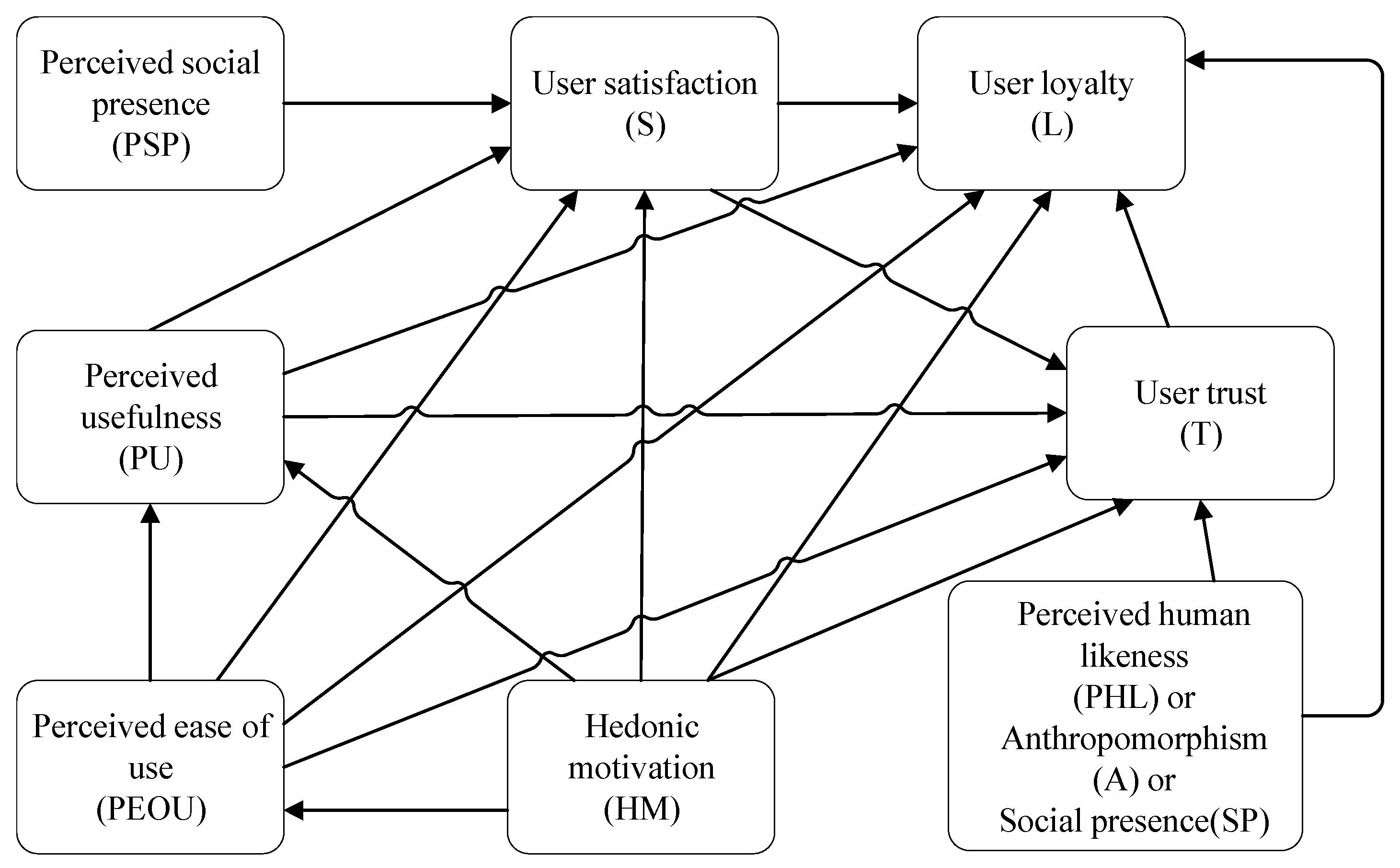
Previous empirical studies on ChatGPT adoption have incorporated the dimensions illustrated in Figure 1. The current study’s initial step involves identifying the limitations of these earlier models by integrating their constructs and examining the relationships among them. As summarized in Table 8, prior studies offer empirical support for the relationships illustrated in Figure 1.
Two main determinants of students’ ChatGPT adoption in learning [84] were extracted from the TAM framework: PU and PEOU [58]. The ECM asserts that user satisfaction is linked to the perceived usefulness of the technology [61]. Therefore, the current model added the student satisfaction construct to explore its impact on ChatGPT adoption in an educational context.
Hedonic motivation has its roots in the motivational model and refers to affective reactions (intrinsic motivation) like joy or enjoyment associated with technology use as implemented in UTAUT [59].
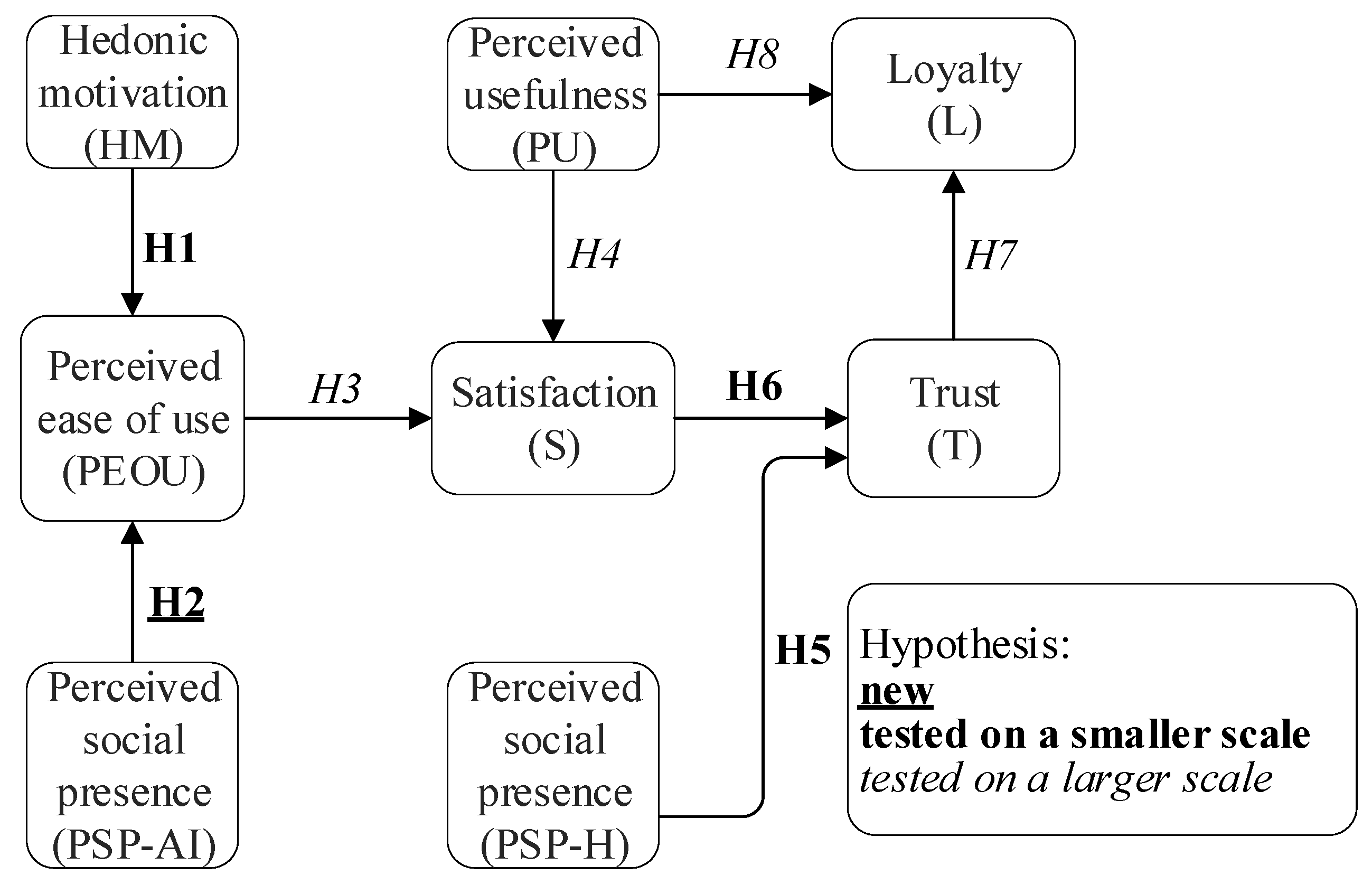
Perceived social presence appears to be a critical element in technology-mediated interactions [71,85,86,87]. Table 8 shows studies that analyzed PSP, anthropomorphism, SP, and PHL in relation to student satisfaction, trust, or loyalty [26,71,80,88]. The proposed model introduces two constructs, PSP-H and PSP-AI. PSP-H represents the degree to which students perceive ChatGPT as facilitating human-to-human interaction. PSP-AI captures the extent to which the students feel they are engaging with an artificial intelligence entity. The bivalent nature of PSP originates from a study [87] that posits perceptions of intelligence (PI) and anthropomorphism (PA) as antecedent variables influencing behavioral beliefs.
Table 8. Summary of hypotheses tested in previous academic research.
HypothesisReferencesDirect Effect Magnitude
HM → PEOU[73]Medium
HM → PU[73]Small
HM → T[69]Not Supported
HM → S[71]Large
HM → L[73,89,90]Large, Medium, Not supported
PEOU → PU[73,76]Medium, Not supported
PEOU → S[26,71,81,84,89]Medium, Not supported, Small, Medium, Medium
PEOU → T[81]Small
PEOU → L[73,76,89] Medium, Small, Not supported
PU → S[26,70,71,84,89]Large, Medium, Large, Small, Medium
PU → T[81]Large
PU → L[73,76,77,83,89,90]Medium, Large, Medium, Small, Large, Medium
PSP → S[71]Medium
A → T; SP → T[80,88]Medium; Large
PHL → L; SP → L[26,90]Medium indirect effect, Not supported
S → T[81]Medium
S → L[26,70,71,84,89]Medium, Medium, Medium, Large, Large
T → L[69,80,83]Medium, Large, Medium
Evaluating the potential impact of students’ trust on their loyalty to ChatGPT is worth examining [81]. This construct is a critical factor that influences the intention to use a technology [83]. Consequently, the proposed model is extended with this dimension to provide a more flexible and comprehensive understanding of ChatGPT adoption among students at a Romanian HEI.
The final dimension of the proposed model is user loyalty to ChatGPT. User loyalty is an enhanced version of the behavioral intentions construct from the UTAUT model [59,73]. If student trust is considered an antecedent of commitment, then student loyalty manifests as a form of high commitment toward ChatGPT [80].
This study explores how perceived usefulness (PU), perceived ease of use (PEOU), and student satisfaction determine student trust and loyalty to ChatGPT. This approach aims to develop a comprehensive framework for assessing student ChatGPT adoption behavior.
This research addresses a gap because no previous studies (as shown in Table 8) investigated the relationship between PSP-AI, HM, and student trust in ChatGPT, while emphasizing the pivotal role of student satisfaction and trust in bridging student perceived benefits and loyalty to ChatGPT for educational purposes. The definitions of the dimensions outlined above are provided in Table 9.
The proposed model was used to show the dimensions that determine the user’s loyalty toward ChatGPT. The first step is to set the hypotheses that led to the model presented in Figure 2. The proposed conceptual model will test the following hypotheses: H1–HM positively affects PEOU; H2–PSP-AI positively affects PEOU; H3–PEOU positively affects S; H4–PU positively affects S; H5–PSP-H positively affects T; H6–S positively affects T; H7–T positively affects L, and H8–PU positively affects L.

3.2. Data Collection

The research method used to measure the dimensions and test the proposed model was a survey conducted during two consecutive academic years starting 2024. The questionnaire was distributed via institutional email to all 1217 students in the faculty with an IT background, and 512 responses were received. Although the response rate of 42.07% is moderate, the collected data still provide valuable insights into the studied population. Students were briefed on the purpose of the study, participation was voluntary, and they were clearly informed that their responses would be anonymous. They were also assured that their involvement would have no impact on their grades, ensuring that their answers were given without coercions.
The students were asked to provide demographic information and then respond to questions for each construct of the model (a total of 32 questions), as shown in the Appendix A. This research instrument used a Likert scale ranging from 1 to 5 (1—Strongly Disagree, 2—Disagree, 3—Neutral, 4—Agree, and 5—Strongly Agree).
After data collection, the dataset was prepared for analysis. Incomplete responses were removed to maintain the integrity of the dataset by ensuring that the analysis is conducted on complete and reliable answers. Despite its potential to reduce the sample size, listwise deletion was selected as an appropriate method due to the minimal level of missing data (4.88%). In consequence, 487 valid answers formed the basis of this study.

3.3. Population and Sample

The majority of students (97.9%) affirmed that they used ChatGPT. As a result, only 477 answers were considered for this study. A total of 83.2% of respondents used ChatGPT between 0–5 h/week, 12.4% used it between 5–10 h/week, and 4.4% used the AIT more than 10 h/week. Students responded that they use ChatGPT to study (70%), for personal purposes (17.6%), and 12.4% for professional purposes. Also, the students answered that, while using ChatGPT, they experienced a feeling of anxiety (4.6%); timidity (1%); indifference (31.2%); control (32.7%); relaxation (30.4%).
Descriptive statistics indicate that 97.9% of respondents were of Romanian nationality, 58.9% were female, and 41.1% were male respondents. A total of 46.4% of students were 20–23 years, 43.3% were 17–20 years, and 10.3% were 23–26 years. The majority of students are enrolled in a bachelor’s program (76.4%), while the other 23.6% are in a master’s program.

4. Results

4.1. Measurement Model Assessment

SEM was used to analyze the collected data, and according to the academic literature [70,91,92,93], this means implementing a two-step approach. In the first phase of the Confirmatory Factor Analysis (CFA), the measurement model was tested for reliability, validity, and fitness. In the second phase of the CFA, the structural model was examined for fitness and causal relationships between its constructs. The CFA analysis was performed using IBM SPSS AMOS v24 and IBM SPSS Statistics v20 (IBM Corp., Armonk, NY, USA) software packages.
Table 10 details the results of the first phase of the study regarding convergent validity, discriminant validity, and construct reliability. This table shows the following values for each construct of the proposed model: Composite Reliability (CR), Average Variance Extracted (AVE), Maximum Shared Variance (MSV), Maximum reliability, Cronbach’s alpha, inter-construct correlations, and the square root of AVE values.
Convergent validity is achieved if for each construct the AVE value is greater than 0.5 [80,94,95,96]. Convergent validity indicates that the items properly reflect their corresponding constructs [93]. For the proposed model, all the CR values exceed 0.7, proving good internal consistency, and all the AVE values are greater than 0.5, meaning “that the constructs explain more than half of the variance of their indicators” [97]. Therefore, the items represent their constructs [71,92].
A model shows discriminant validity (any two factors of the model are different from each other) if two conditions are met [94,97,98]: (1) for each construct, the MSV value is less than the AVE value, and (2) the square roots of AVEs are greater than the inter-construct correlations. Table 10 reflects that the first condition is met for all the constructs. To verify if the second condition is met, the “Inter-construct correlations and the square root of AVE” section from Table 10 must be inspected in the following way: the bold diagonal results are all greater than the off-diagonal results. According to this rule, the second condition is also met. In consequence, the measurement model exhibits discriminant validity.
To test a model for construct reliability, CR and Cronbach’s alpha values for each construct must be computed. These two values show if the items are free of random error and provide consistent results [93,97]. Both values must exceed the threshold of 0.7 for each construct for the model’s construct reliability to be ensured [94,99]. Table 10 shows results (the CR and CA columns) that exceed the imposed thresholds for each construct on both measures; therefore, the measurement model shows construct reliability.
All the latent variables of this study fulfilled the requirements concerning convergent validity, discriminant validity, and construct reliability.

4.2. Measurement of the Model Fitness

To assess the model’s overall fit, values for parsimonious, absolute, and incremental fit indices were calculated. For evaluating parsimonious fit, the normed Chi-Square (χ2/df) was used. Absolute model fit was assessed using the Root Mean Square Error of Approximation (RMSEA), the Goodness-of-Fit Index (GFI), the Adjusted Goodness-of-Fit Index (AGFI), and the Standardized Root Mean Square Residual (S-RMR).
To demonstrate incremental model fit, the following indices were computed: Normed-Fit Index (NFI), Incremental Fit Index (IFI), Tucker–Lewis Index (TLI), and Comparative Fit Index (CFI). According to researchers [92,93,100,101,102,103,104,105], the cutoff criteria for excellent model fit indices are as shown in Table 11.
All the values of the computed fit indices shown in Table 11 respect the imposed threshold. The first phase of the CFA is completed, and according to the calculated values, the measurement model is valid, reliable, and fit.
The second phase of the CFA starts by inspecting the structural model’s fitness. Table 12 presents the calculated values for all the above-mentioned fit indices. Considering the thresholds for an excellent fit, the structural model also shows a good fit.

4.3. Path Analysis

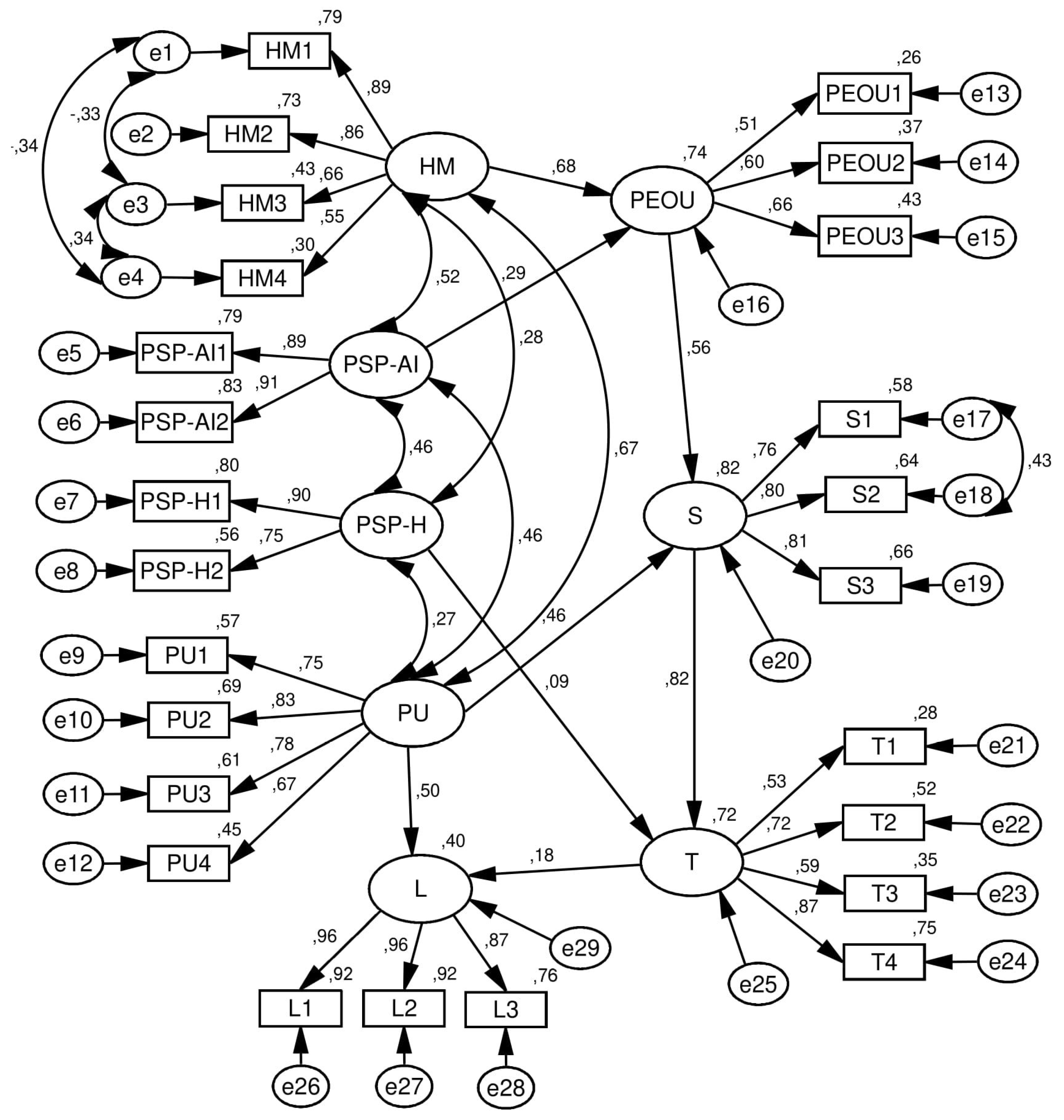
Figure 3 shows the causal paths and the standardized path coefficients (β-values) and Squared Multiple Correlations (SMC).
Further investigation of the structural model reveals the direct, indirect, and total effects (DE, IE, TE) between the model’s dimensions (Table 13).
The employed bootstrap analysis [71,84,106] estimates the significance of path coefficients.
HM and PSP-AI show direct and significant effects on PEOU. HM reflects a large effect (β = 0.675, p < 0.01), while PSP-AI reflects a medium effect (β = 0.290, p < 0.01).
PU (β = 0.458, p < 0.01) and PEOU (β = 0.558, p < 0.01) manifest large, direct, and significant effects on S, while PSP-AI and HM express indirect and significant effects. The indirect effect of PSP-AI on S is moderate (β = 0.162, p < 0.01), but the HM effect is large (β = 0.377, p < 0.01).
The largest direct and significant effect of the structural model manifests between S and T (β = 0.816, p < 0.01). Also, the path analysis reveals a direct and statistically significant effect between PSP-H and T. This effect has the smallest magnitude in the current model (β = 0.092, p < 0.05). PEOU, PU, HM, and PSP-AI show indirect, and statistically significant effects on T. PEOU (β = 0.456, p < 0.01) and PU (β = 0.374, p < 0.01) express a large effect on T. HM (β = 0.308, p < 0.01) has a medium effect on T while PSP-AI (β = 0.132, p < 0.01) expresses a small effect on T.
The findings indicate that direct and significant effects on L come from the PU and T constructs. PU (β = 0.502, p < 0.01) has a greater impact on L than T (β = 0.178, p < 0.05). The current path analysis demonstrates small, indirect, and significant effects of the following constructs on L: PSP-H (β = 0.016, p < 0.05), PSP-AI (β = 0.023, p < 0.05), HM (β = 0.055, p < 0.05), and S (β = 0.145, p < 0.05). The summary of the path analysis is presented in Table 14.

5. Discussion

User satisfaction is defined as “evaluation that a product or service has met or exceeded expectations… and is associated with a positive emotional state that arises from a favorable comparison between expectations and the actual performance of the product” [77]. This empirical investigation proposes two main factors that impact student satisfaction, perceived usefulness, and perceived ease of use of ChatGPT.
The academic literature states that perceived usefulness is a crucial factor in the adoption and use of ChatGPT for educational purposes [74] and has a positive impact on ChatGPT user satisfaction [26,70,77,84]. The results of this empirical study reveal that this construct has a strong influence on student satisfaction (H4 is supported). In addition, perceived usefulness determines user trust in ChatGPT [81]. The results of this study indicate that the perceived usefulness of ChatGPT has a large indirect effect on student trust (β = 0.374, p < 0.01).
The second factor inspected in relation to student satisfaction is the perceived ease of using ChatGPT. This construct was defined as “the degree to which the user expects the use of the system to be free of effort” [87] or “the degree of ease associated with the use of a system” [76]. Enhanced PEOU of ChatGPT is essential for increasing user satisfaction, which in turn boosts user trust in ChatGPT [81]. By using ChatGPT, students can easily obtain an adequate solution to their academic inquiries. In this manner, while learning, students can create a positive state of mind that drives satisfaction. The respondents of this survey were students familiar with technology and may find this AIT easier to use or helpful. The hypothesis of the current study, H3, was that ChatGPT’s PEOU impacts student satisfaction [26,84]. The magnitude and significance of the effect (β = 0.558, p < 0.01) demonstrate this affirmation. An interesting aspect that emerged from this model analysis is the relationship between PEOU and student trust in ChatGPT. The effect of PEOU ChatGPT on student trust is the strongest indirect association in the model (β = 0.456, p < 0.01).
In previous research, hedonic motivation “specifies the extent to which a person derives fun from using a technology” [107]. “Educational activities that make the learning process fun and drive student curiosity and intrinsic motivation are essential for efficient education” [73]. Hedonic motivation is important in developing a positive attitude toward using technology for educational purposes [71,97,107]. A similar study provided empirical support for an association between hedonic motivation and PEOU ChatGPT [73]. Hypothesis H1 stipulates that if students find using ChatGPT interesting and enjoyable, it can significantly reduce learning anxiety and, in turn, will directly impact the PEOU of ChatGPT. The findings of this study reveal that hypothesis H1 is supported, and hedonic motivation exhibits a high impact on the PEOU of ChatGPT. Although H1 confirmation was an expected result, this study also reveals a relationship between hedonic motivation and student satisfaction. The magnitude of this indirect effect is large (β = 0.377, p < 0.01). Interestingly, this association was previously studied [89] as a direct effect, and the hypothesis was not supported. A previous study provided empirical evidence for an association between hedonic motivation and user loyalty [73]. The current study results do not indicate a relationship between HM and loyalty but reveal evidence of a medium indirect effect of hedonic motivation on user trust in ChatGPT (β = 0.308, p < 0.01).
Social presence was defined in the academic literature as “the sense of being with another and is dependent on the ease with which one perceives to have access to the intelligence, intentions, and sensory impressions of another” [108]. Social presence is also “measured as perceived warmth, expressing a feeling of human sociability, sensitivity, and contact embodied in an instrument” [109]. The gold standard for social presence is face-to-face interaction [108].
Perceived anthropomorphism was established as “the degree to which users perceive the intelligent agent to be human-like” [87]. A previous study investigated the impact of human-like traits and characteristics in computer-mediated communication and revealed that when users assign human-like characteristics to an AIT, they perceive social and emotional cues that help build an interpersonal interaction [86,87]. This type of interaction enhances user trust.
“ChatGPT is made to simulate human-like dialogue and answer naturally and interestingly, which can be perceived as having a human touch” [79]. Engagement with ChatGPT is desired to be just like that in human-to-human communications. By incorporating emotional intelligence and empathy, ChatGPT will help students feel a stronger emotional attachment and gain trust, which in turn will motivate them to reuse the AIT [26,110].
The PSP-H factor reflects the student’s perception of interacting with an empathic being while using ChatGPT. The purpose of this study was to demonstrate that PSP-H has an impact on student trust. The findings of this study reveal that hypothesis H5 is confirmed, and ChatGPT PSP-H’s impact on student trust is very low.
To continue, the objective of the current study was to verify that the PSP-AI construct (which embodies the feeling of communicating or being accompanied by an intelligent agent) is prominently associated with the PEOU of ChatGPT. The current findings suggest that PSP-AI enhances PEOU (H2 is supported with a medium effect). Since both H1 and H2 are supported, ChatGPT PEOU, the second factor that fosters student satisfaction, is positively associated with HM and PSP-AI. The respondents perceive their interaction with ChatGPT as a fun human-to-computer communication and understand that an AI’s creativity is derived from a computational process. This indirectly enhances their satisfaction and trust in ChatGPT, since both HM and PSP-AI manifest a significant indirect effect on student satisfaction (HM large scale; PSP-AI medium scale) and student trust (HM medium scale; PSP-AI small scale).
A previous study [26] suggested that ChatGPT’s human likeness and interaction quality lead to stronger emotional attachment and enhance user loyalty. This empirical study reveals that students are currently harnessing the analytical and computational capabilities of ChatGPT to improve their academic performance. If they build/perceive a special human bond with ChatGPT or anthropomorphize the AIT, it does not show greater influence on student trust or loyalty to ChatGPT. The proven indirect effect of PSP-H on trust is small (β = 0.092, p < 0.05), and PSP-H to loyalty is even lower. The respondents have a set of skills (IT students) that help them understand the true capabilities and limitations of AI, and do not have unrealistic expectations regarding the interaction with ChatGPT.
To completely assess students’ interaction with ChatGPT, it is essential to include the trust construct, which “signifies the user’s confidence in the reliability and efficacy of the technology” [81]. ChatGPT’s ability to perform tasks accurately and provide useful information contributes significantly to enhancing user trust [81]. But when students overestimate this ability, they become dissatisfied and lose trust in the AIT. This dynamic sets content reliability as an additional metric for testing student trust. The current study shows that student satisfaction impacts student trust in ChatGPT. This agrees with previous empirical work [81] that stated that “higher user satisfaction levels with ChatGPT corresponded with higher trust in the AI system”. H6 is supported and indicates the highest effect magnitude (β = 0.816 at p < 0.01) of the current model. Also, other constructs show an indirect effect on student trust in ChatGPT, and the magnitudes are large (PU and PEOU), medium (HM), and small (PSP-AI).
User loyalty is defined as “a measure of the likelihood that a person will continue using a technology or a system” [111]. The academic literature [83,90] enumerates among the elements that predicted user loyalty, perceived usefulness, and trust in ChatGPT. The emphasis is on student trust: “users’ trust in ChatGPT is significantly impacting loyalty and subsequent adoption intentions” [69,80]. This study indicates that H7 is supported, and student trust impacts student loyalty in ChatGPT. This effect is moderate. In addition, perceived usefulness enhances student loyalty [73,90] or has a positive impact on user satisfaction [70,89], which in turn influences user loyalty toward ChatGPT. The findings of this empirical study indicate that PU has a strong path coefficient with student loyalty (H8 is supported at β = 0.568, p < 0.01), reinforcing the circulated idea [73] that students appreciate the contribution of ChatGPT to their academic performance and therefore will likely continue to use it [77].

6. Conclusions

Previous attempts [26,70,73] have been made to update well-established models for technology success and to demonstrate ChatGPT’s successful adoption in an educational context. This study empirically investigates to confirm factors and establish a model to assess the adoption of ChatGPT in a Romanian HEI. The findings confirm the model and its following constructs: hedonic motivation, perceived social presence (PSP-AI and PSP-H), perceived usefulness, perceived ease of using ChatGPT, student satisfaction, student trust, and student loyalty. The model exhibits strong empirical support for the proposed hypotheses (six hypotheses from a total of eight show large and significant effects).
This investigation reveals that student trust and perceived usefulness reflect student loyalty to ChatGPT. Student satisfaction has a high prediction rate in explaining student trust, while the main determinants of student satisfaction are perceived usefulness and perceived ease of using ChatGPT. The direct effect of PSP-H on student trust is very low. The perceived ease of using ChatGPT is mainly associated with hedonic motivation. Meanwhile, perceived social presence (PSP-AI) has a moderate effect on perceived ease of use (direct effect) and student satisfaction (indirect effect) constructs.
Therefore, when students find ChatGPT enjoyable, user-friendly, and valuable for completing academic tasks, they are more likely to experience satisfaction. In turn, satisfaction fosters greater trust in this AI technology. Hedonic motivation, perceived usefulness, and student trust play crucial roles in fostering ChatGPT loyalty.
Technology companies may be advised to intensify their efforts to reduce potentially incorrect or misleading information in AITs’ responses. Currently, Romanian IT students are benefiting from ChatGPT’s analytical and computational capabilities to improve their academic performance, and what they need is accurate and reliable responses to their inquiries. They understand that ChatGPT simulates human-to-human interaction; therefore, the degree to which interaction feels human-like reflects no real impact on forming student trust or ChatGPT dependence.
The study was conducted at a university with no formal guidelines in place, meaning that students use ChatGPT entirely on their own initiative. Although the “policy compliance perception” metric was dropped from the model and it is not reflected in the quantitative results, it still carries practical importance. Uncertainty about proper and ethical use may hinder adoption. Consequently, universities should provide training to enhance students’ comfort and skills with ChatGPT, while also managing expectations about its accuracy. At the same time, establishing clear policies and ethical guidelines can legitimize ChatGPT use, reduce student anxieties, and support responsible adoption.
Although this paper reflects a careful and systematic effort, the proposed model has limitations. First, the focus is on ChatGPT, and students may use other AITs in their academic endeavors. Second, the respondents of this study were mainly students enrolled in a public Romanian HEI with an IT background. Although they have realistic performance expectations regarding ChatGPT, they have embraced this technology to improve their learning. Future research could be expanded in the following ways: including other AI technologies; testing the model by gathering input from students without an IT background to enhance the practical applicability of the proposed model; extending the analysis of model’s minor effects; expanding the current model with a students’ ethical perceptions or belief constructs; analyzing the emotional versus cognitive trust and their impact on student loyalty; analyzing the shift to full integration of AITs in HEIs.

Author Contributions

Conceptualization, all authors; introduction, A.M.I.C., literature review A.M.I.C., methodology, I.D., software, I.D.; validation all authors.; formal analysis, I.D.; data curation, all authors; writing—original draft preparation, all authors; writing—review and editing, all authors. All authors have read and agreed to the published version of the manuscript.

Funding

This research received no external funding.

Data Availability Statement

The data presented in this study are openly available in the Zenodo repository https://doi.org/10.5281/zenodo.17472244.

Conflicts of Interest

The authors declare no conflicts of interest.

Appendix A. Data Collection Tool

Item CodeMetricItem
PU1Perceived efficiencyUsing ChatGPT enables me to accomplish my academic tasks more quickly.
PU2Perceived learning effectivenessUsing ChatGPT enhanced my learning effectiveness.
PU3Academic performance impactUsing ChatGPT helps me improve my academic performance.
PU4Academic perceived usefulnessI find ChatGPT useful for answering academic inquiries.
PU5 (dropped)Self-efficacyWhen I use ChatGPT, I feel more self-confident.
PEOU1Perceived ease of useChatGPT is easy for me to use.
PEOU2Ease of learningLearning how to use ChatGPT is easy for me.
PEOU3Cognitive effortUsing ChatGPT requires minimal mental effort.
PSP-AI1Impersonal interactionMy interaction with ChatGPT is impersonal and lacking in human sensitivity.
PSP-AI2Perceived AI identityWhile using ChatGPT, I had the feeling of communicating with an AI agent.
PSP-AI3 (dropped)Perceived AI co-presenceWhile using ChatGPT, I felt accompanied by an AI agent.
PSP-AI4 (dropped)Perceived AI social presenceWhile using ChatGPT, I felt that the AI was socially attentive and responsive to me.
PSP-H1Perceived human-likenessWhile using ChatGPT, I had the feeling of talking to an actual person.
PSP-H2Perceived agreeablenessWhile using ChatGPT, I had the feeling of talking to an agreeable person.
PSP-H3 (dropped)Perceived sensitivityWhile using ChatGPT, I had the feeling of interacting with a sensitive person.
PSP-H4 (dropped)Perceived empathyWhile using ChatGPT, I had the feeling of interacting with an empathic person.
HM1Perceived interestI find using ChatGPT interesting.
HM2User enthusiasmI used ChatGPT enthusiastically.
HM3Perceived enjoymentI find using ChatGPT enjoyable.
HM4Perceived funI had fun using ChatGPT.
S1Satisfaction with efficiencyI am satisfied with the efficiency of ChatGPT.
S2Satisfaction with effectivenessI am satisfied with the effectiveness of ChatGPT
S3Overall satisfactionOverall, I am satisfied with ChatGPT.
T1Perceived securityChatGPT is secure.
T2Perceived information reliabilityThe information provided by ChatGPT is reliable.
T3ReputationChatGPT has a good reputation.
T4Overall trustOverall, I trust ChatGPT.
T5 (dropped)Policy compliance perceptionUsing ChatGPT is not a violation of academic policies.
L1Short-term continuance intentionIn the next weeks, I plan to use ChatGPT to address my academic inquiries.
L2Long-term continuance intentionI intend to continue using ChatGPT to address my academic inquiries in the future.
L3User dependenceI depend upon ChatGPT.
L4 (dropped)Recommendation intentionI will recommend ChatGPT to other students.

References

  1. Singh, S. The Impact of Technology in Learning and Teaching: A Critical Review. J. Inf. Syst. Eng. Manag. 2025, 10, 777–795. [Google Scholar] [CrossRef]
  2. Carmo, J.E.S.; Lacerda, D.P.; Klingenberg, C.O.; Piran, F.A.S. Digital Transformation in the Management of Higher Education Institutions. Sustain. Futures 2025, 9, 100692. [Google Scholar] [CrossRef]
  3. Qolamani, K.I.B.; Mohammed, M.M. The Digital Revolution in Higher Education: Transforming Teaching and Learning. QALAMUNA J. Pendidik. Sos. Dan Agama 2023, 15, 837–846. [Google Scholar] [CrossRef]
  4. Wong, W.K.O. The Sudden Disruptive Rise of Generative Artificial Intelligence? An Evaluation of Their Impact on Higher Education and the Global Workplace. J. Open Innov. Technol. Mark. Complex. 2024, 10, 100278. [Google Scholar] [CrossRef]
  5. Dahri, N.A.; Yahaya, N.; Al-Rahmi, W.M.; Aldraiweesh, A.; Alturki, U.; Almutairy, S.; Shutaleva, A.; Soomro, R.B. Extended TAM Based Acceptance of AI-Powered ChatGPT for Supporting Metacognitive Self-Regulated Learning in Education: A Mixed-Methods Study. Heliyon 2024, 10, e29317. [Google Scholar] [CrossRef]
  6. Chiarello, F.; Giordano, V.; Spada, I.; Barandoni, S.; Fantoni, G. Future Applications of Generative Large Language Models: A Data-Driven Case Study on ChatGPT. Technovation 2024, 133, 103002. [Google Scholar] [CrossRef]
  7. Imran, M.; Almusharraf, N. Google Gemini as a next Generation AI Educational Tool: A Review of Emerging Educational Technology. Smart Learn. Environ. 2024, 11, 22. [Google Scholar] [CrossRef]
  8. Nikolic, S.; Sandison, C.; Haque, R.; Daniel, S.; Grundy, S.; Belkina, M.; Lyden, S.; Hassan, G.M.; Neal, P. ChatGPT, Copilot, Gemini, SciSpace and Wolfram versus Higher Education Assessments: An Updated Multi-Institutional Study of the Academic Integrity Impacts of Generative Artificial Intelligence (GenAI) on Assessment, Teaching and Learning in Engineering. Australas. J. Eng. Educ. 2024, 29, 126–153. [Google Scholar] [CrossRef]
  9. Fan, G.; Liu, D.; Zhang, R.; Pan, L. The Impact of AI-Assisted Pair Programming on Student Motivation, Programming Anxiety, Collaborative Learning, and Programming Performance: A Comparative Study with Traditional Pair Programming and Individual Approaches. Int. J. STEM Educ. 2025, 12, 16. [Google Scholar] [CrossRef]
  10. Dempere, J.; Modugu, K.; Hesham, A.; Ramasamy, L.K. The Impact of ChatGPT on Higher Education. Front. Educ. 2023, 8, 1206936. [Google Scholar] [CrossRef]
  11. Miah, A.S.M.; Tusher, M.M.R.; Hossain, M.M.; Hossain, M.M.; Rahim, M.A.; Hamid, M.E.; Islam, M.S.; Shin, J. ChatGPT in Research and Education: A SWOT Analysis of Its Academic Impact. CMES-Comput. Model. Eng. Sci. 2025, 143, 2573–2614. [Google Scholar] [CrossRef]
  12. Park, A.; Kim, T. Code Suggestions and Explanations in Programming Learning: Use of ChatGPT and Performance. Int. J. Manag. Educ. 2025, 23, 101119. [Google Scholar] [CrossRef]
  13. Pawar, M.r.S.D. ChatGPT: Revolutionizing Education Administration-A Case Study Analysis. Int. J. Res. Appl. Sci. Eng. Technol. 2023, 11, 4447–4454. [Google Scholar] [CrossRef]
  14. Holzmann, U.; Anand, S.; Payumo, A.Y. The ChatGPT Fact-Check: Exploiting the Limitations of Generative AI to Develop Evidence-Based Reasoning Skills in College Science Courses. Adv. Physiol. Educ. 2025, 49, 191–196. [Google Scholar] [CrossRef] [PubMed]
  15. Gerlich, M. AI Tools in Society: Impacts on Cognitive Offloading and the Future of Critical Thinking. Societies 2025, 15, 6. [Google Scholar] [CrossRef]
  16. Fajt, B.; Schiller, E. ChatGPT in Academia: University Students’ Attitudes Towards the Use of ChatGPT and Plagiarism. J. Acad. Ethics 2025, 23, 1363–1382. [Google Scholar] [CrossRef]
  17. Hasan, M.R.; Chowdhury, N.I.; Rahman, M.H.; Syed, M.A.B.; Ryu, J. Analysis of the User Perception of Chatbots in Education Using A Partial Least Squares Structural Equation Modeling Approach. arXiv 2023, arXiv:2311.03636. [Google Scholar] [CrossRef]
  18. Al-kfairy, M. Factors Impacting the Adoption and Acceptance of ChatGPT in Educational Settings: A Narrative Review of Empirical Studies. Appl. Syst. Innov. 2024, 7, 110. [Google Scholar] [CrossRef]
  19. Popovici, D.-M. ChatGPT in the Classroom. Exploring Its Potential and Limitations in a Functional Programming Course. Int. J. Hum.–Comput. Interact. 2024, 40, 7743–7754. [Google Scholar] [CrossRef]
  20. Sova, R.; Tudor, C.; Tartavulea, C.V.; Dieaconescu, R.I. Artificial Intelligence Tool Adoption in Higher Education: A Structural Equation Modeling Approach to Understanding Impact Factors among Economics Students. Electronics 2024, 13, 3632. [Google Scholar] [CrossRef]
  21. Xames, M.D.; Shefa, J. ChatGPT for Research and Publication: Opportunities and Challenges. J. Appl. Learn. Teach. 2023, 6, 390–395. [Google Scholar] [CrossRef]
  22. Ye, J.; Chen, X.; Xu, N.; Zu, C.; Shao, Z.; Liu, S.; Cui, Y.; Zhou, Z.; Gong, C.; Shen, Y.; et al. A Comprehensive Capability Analysis of GPT-3 and GPT-3.5 Series Models. arXiv 2023, arXiv:2303.10420. [Google Scholar] [CrossRef]
  23. Lai, V.D.; Ngo, N.T.; Ben Veyseh, A.P.; Man, H.; Dernoncourt, F.; Bui, T.; Nguyen, T.H. ChatGPT Beyond English: Towards a Comprehensive Evaluation of Large Language Models in Multilingual Learning. In Findings of the Association for Computational Linguistics: EMNLP 2023; Association for Computational Linguistics: Singapore, 2023; pp. 13171–13189. [Google Scholar]
  24. Bang, Y.; Cahyawijaya, S.; Lee, N.; Dai, W.; Su, D.; Wilie, B.; Lovenia, H.; Ji, Z.; Yu, T.; Chung, W.; et al. A Multitask, Multilingual, Multimodal Evaluation of ChatGPT on Reasoning, Hallucination, and Interactivity. In Proceedings of the 13th International Joint Conference on Natural Language Processing and the 3rd Conference of the Asia-Pacific Chapter of the Association for Computational Linguistics (Volume 1: Long Papers), Bali, Indonesia, 1–4 November 2023; Association for Computational Linguistics: Stroudsburg, PA, USA, 2023; Volume 1, pp. 675–718. [Google Scholar]
  25. Dwivedi, Y.K.; Kshetri, N.; Hughes, L.; Slade, E.L.; Jeyaraj, A.; Kar, A.K.; Baabdullah, A.M.; Koohang, A.; Raghavan, V.; Ahuja, M.; et al. “So What If ChatGPT Wrote It?” Multidisciplinary Perspectives on Opportunities, Challenges and Implications of Generative Conversational AI for Research, Practice and Policy. Int. J. Inf. Manag. 2023, 71, 102642. [Google Scholar] [CrossRef]
  26. Liu, Y.; Wang, H.; Park, Y. Behavioral Analysis of ChatGPT Users Based on the ABC Model: Focusing on a Socio-Technical Approach. Eur. Manag. J. 2025. [Google Scholar] [CrossRef]
  27. Rudolph, J.; Tan, S.; Tan, S. War of the Chatbots: Bard, Bing Chat, ChatGPT, Ernie and beyond. The New AI Gold Rush and Its Impact on Higher Education. J. Appl. Learn. Teach. 2023, 6, 364–389. [Google Scholar] [CrossRef]
  28. Liang, W.; Zhang, Y.; Wu, Z.; Lepp, H.; Ji, W.; Zhao, X.; Cao, H.; Liu, S.; He, S.; Huang, Z.; et al. Mapping the Increasing Use of LLMs in Scientific Papers. arXiv 2024, arXiv:2404.01268. [Google Scholar] [CrossRef]
  29. Khan, N.; Khan, Z.; Koubaa, A.; Khan, M.K.; Salleh, R. Global Insights and the Impact of Generative AI-ChatGPT on Multidisciplinary: A Systematic Review and Bibliometric Analysis. Connect. Sci. 2024, 36, 2353630. [Google Scholar] [CrossRef]
  30. Shahriar, S.; Lund, B.D.; Mannuru, N.R.; Arshad, M.A.; Hayawi, K.; Bevara, R.V.K.; Mannuru, A.; Batool, L. Putting GPT-4o to the Sword: A Comprehensive Evaluation of Language, Vision, Speech, and Multimodal Proficiency. Appl. Sci. 2024, 14, 7782. [Google Scholar] [CrossRef]
  31. Hu, M.; Eidex, Z.; Wang, S.; Safari, M.; Li, Q.; Yang, X. Benchmarking GPT-5 for Zero-Shot Multimodal Medical Reasoning in Radiology and Radiation Oncology. arXiv 2025, arXiv:2508.13192. [Google Scholar] [CrossRef]
  32. Diez, C.-P.; da Maia, L.; Nourdin, I. Mathematical Research with GPT-5: A Malliavin-Stein Experiment. arXiv 2025, arXiv:2509.03065. [Google Scholar] [CrossRef]
  33. Costa, C.J.; Aparicio, M.; Aparicio, S.; Aparicio, J.T. The Democratization of Artificial Intelligence: Theoretical Framework. Appl. Sci. 2024, 14, 8236. [Google Scholar] [CrossRef]
  34. Alghazo, R.; Fatima, G.; Malik, M.; Abdelhamid, S.E.; Jahanzaib, M.; Nayab, D.E.; Raza, A. Exploring ChatGPT’s Role in Higher Education: Perspectives from Pakistani University Students on Academic Integrity and Ethical Challenges. Educ. Sci. 2025, 15, 158. [Google Scholar] [CrossRef]
  35. McDonald, N.; Johri, A.; Ali, A.; Collier, A.H. Generative Artificial Intelligence in Higher Education: Evidence from an Analysis of Institutional Policies and Guidelines. Comput. Hum. Behav. Artif. Hum. 2025, 3, 100121. [Google Scholar] [CrossRef]
  36. Qadir, J. Engineering Education in the Era of ChatGPT: Promise and Pitfalls of Generative AI for Education. In Proceedings of the IEEE Global Engineering Education Conference, EDUCON, Salmiya, Kuwait, 1–4 May 2023; IEEE Computer Society: Washington, DC, USA, 2023. [Google Scholar]
  37. Naznin, K.; Al Mahmud, A.; Nguyen, M.T.; Chua, C. ChatGPT Integration in Higher Education for Personalized Learning, Academic Writing, and Coding Tasks: A Systematic Review. Computers 2025, 14, 53. [Google Scholar] [CrossRef]
  38. Mogavi, R.H.; Deng, C.; Juho Kim, J.; Zhou, P.; D Kwon, Y.; Hosny Saleh Metwally, A.; Tlili, A.; Bassanelli, S.; Bucchiarone, A.; Gujar, S.; et al. ChatGPT in Education: A Blessing or a Curse? A Qualitative Study Exploring Early Adopters’ Utilization and Perceptions. Comput. Hum. Behav. Artif. Hum. 2024, 2, 100027. [Google Scholar] [CrossRef]
  39. Lim, W.M.; Gunasekara, A.; Pallant, J.L.; Pallant, J.I.; Pechenkina, E. Generative AI and the Future of Education: Ragnarök or Reformation? A Paradoxical Perspective from Management Educators. Int. J. Manag. Educ. 2023, 21, 100790. [Google Scholar] [CrossRef]
  40. Zare, J.; Al-Issa, A.; Madiseh, F.R. Interacting with ChatGPT in Essay Writing: A Study of L2 Learners’ Task Motivation. ReCALL 2025, 37, 385–402. [Google Scholar] [CrossRef]
  41. Zhang, Z.; Dong, Z.; Shi, Y.; Price, T.; Matsuda, N.; Xu, D. Students’ Perceptions and Preferences of Generative Artificial Intelligence Feedback for Programming. Proc. AAAI Conf. Artif. Intell. 2024, 38, 23250–23258. [Google Scholar] [CrossRef]
  42. Baidoo-Anu, D.; Owusuansah, L. Education in the Era of Generative Artificial Intelligence (AI): Understanding the Potential Benefits of ChatGPT in Promoting Teaching and Learning. J. AI 2023, 7, 52–62. [Google Scholar] [CrossRef]
  43. Kim, J.; Lee, S.S.; Detrick, R.; Wang, J.; Li, N. Students-Generative AI Interaction Patterns and Its Impact on Academic Writing. J. Comput. High Educ. 2025, 1–22. [Google Scholar] [CrossRef]
  44. Lepp, M.; Kaimre, J. Does Generative AI Help in Learning Programming: Students’ Perceptions, Reported Use and Relation to Performance. Comput. Hum. Behav. Rep. 2025, 18, 100642. [Google Scholar] [CrossRef]
  45. Phokoye, S.P.; Dlamini, S.; Mthalane, P.P.; Luthuli, M.; Moyane, S.P. A Comprehensive Review of ChatGPT in Teaching and Learning Within Higher Education. Informatics 2025, 12, 74. [Google Scholar] [CrossRef]
  46. Schmidt, D.A.; Alboloushi, B.; Thomas, A.; Magalhaes, R. Integrating Artificial Intelligence in Higher Education: Perceptions, Challenges, and Strategies for Academic Innovation. Comput. Educ. Open 2025, 9, 100274. [Google Scholar] [CrossRef]
  47. Sa-ad, M.M.; Osafo-Apeanti, W.; Owusu-Boateng, O.; Seidu, S.A.; Majeed, M.; Bright-Benuwa, B. Automated Administrative Tasks in Education. In Deep Science Publishing; Deep Science Publishing: San Francisco, CA, USA, 2025; pp. 31–45. [Google Scholar]
  48. Alkaabi, A.; Abdallah, A.; Alblooshi, S.; Alomari, F.; Alneaimi, S. ChatGPT in Higher Education: Opportunities, Challenges, and Required Competencies in the Absence of Guiding Policies. J. Educ. Elearn Res. 2025, 12, 153–164. [Google Scholar] [CrossRef]
  49. Symeou, L.; Louca, L.; Kavadella, A.; Mackay, J.; Danidou, Y.; Raffay, V. Development of Evidence-Based Guidelines for the Integration of Generative AI in University Education Through a Multidisciplinary, Consensus-Based Approach. Eur. J. Dent. Educ. 2025, 29, 285–303. [Google Scholar] [CrossRef]
  50. Cotton, D.R.E.; Cotton, P.A.; Shipway, J.R. Chatting and Cheating: Ensuring Academic Integrity in the Era of ChatGPT. Innov. Educ. Teach. Int. 2024, 61, 228–239. [Google Scholar] [CrossRef]
  51. Munaye, Y.Y.; Admass, W.; Belayneh, Y.; Molla, A.; Asmare, M. ChatGPT in Education: A Systematic Review on Opportunities, Challenges, and Future Directions. Algorithms 2025, 18, 352. [Google Scholar] [CrossRef]
  52. Nematov, D. Progress, Challenges, Threats and Prospects of ChatGPT in Science and Education: How Will AI Impact the Academic Environment? J. Adv. Artif. Intell. 2025, 3, 187–205. [Google Scholar] [CrossRef]
  53. Zhai, C.; Wibowo, S.; Li, L.D. The Effects of Over-Reliance on AI Dialogue Systems on Students’ Cognitive Abilities: A Systematic Review. Smart Learn. Environ. 2024, 11, 28. [Google Scholar] [CrossRef]
  54. Foroughi, B.; Senali, M.G.; Iranmanesh, M.; Khanfar, A.; Ghobakhloo, M.; Annamalai, N.; Naghmeh-Abbaspour, B. Determinants of Intention to Use ChatGPT for Educational Purposes: Findings from PLS-SEM and FsQCA. Int. J. Hum. Comput. Interact. 2024, 40, 4501–4520. [Google Scholar] [CrossRef]
  55. Cao, Y.; Li, S.; Liu, Y.; Yan, Z.; Dai, Y.; Yu, P.S.; Sun, L. A Comprehensive Survey of AI-Generated Content (AIGC): A History of Generative AI from GAN to ChatGPT. arXiv 2023, arXiv:2303.04226. [Google Scholar] [CrossRef]
  56. Khalil, M.; Er, E. Will ChatGPT Get You Caught? Rethinking of Plagiarism Detection. In International Conference on Human-Computer Interaction; Springer Nature: Cham, Switzerland, 2023; pp. 475–487. [Google Scholar]
  57. Digital Education Council AI or Not AI: What Students Want—Global AI Student Survey 2024. 2024. Available online: https://www.digitaleducationcouncil.com/post/digital-education-council-global-ai-student-survey-2024 (accessed on 31 January 2025).
  58. Davis, F.D. Perceived Usefulness, Perceived Ease of Use, and User Acceptance of Information Technology. MIS Q. 1989, 13, 319. [Google Scholar] [CrossRef]
  59. Venkatesh, V.; Morris, M.G.; Davis, G.B.; Davis, F.D. User Acceptance of Information Technology: Toward a Unified View. MIS Q. 2003, 27, 425. [Google Scholar] [CrossRef]
  60. Venkatesh, V.; Thong, J.Y.; Xu, X. Consumer Acceptance and Use of Information Technology: Extending the Unified Theory of Acceptance and Use of Technology. MIS Q. 2012, 36, 157. [Google Scholar] [CrossRef]
  61. Bhattacherjee, A. Understanding Information Systems Continuance: An Expectation-Confirmation Model. MIS Q. 2001, 25, 351. [Google Scholar] [CrossRef]
  62. Almulla, M.A. Investigating Influencing Factors of Learning Satisfaction in AI ChatGPT for Research: University Students Perspective. Heliyon 2024, 10, e32220. [Google Scholar] [CrossRef]
  63. García-Alonso, E.M.; León-Mejía, A.C.; Sánchez-Cabrero, R.; Guzmán-Ordaz, R. Training and Technology Acceptance of ChatGPT in University Students of Social Sciences: A Netcoincidental Analysis. Behav. Sci. 2024, 14, 612. [Google Scholar] [CrossRef]
  64. Yu, C.; Yan, J.; Cai, N. ChatGPT in Higher Education: Factors Influencing ChatGPT User Satisfaction and Continued Use Intention. Front. Educ. 2024, 9, 1354929. [Google Scholar] [CrossRef]
  65. Shahzad, M.F.; Xu, S.; Javed, I. ChatGPT Awareness, Acceptance, and Adoption in Higher Education: The Role of Trust as a Cornerstone. Int. J. Educ. Technol. High. Educ. 2024, 21, 46. [Google Scholar] [CrossRef]
  66. Acosta-Enriquez, B.G.; Arbulú Ballesteros, M.A.; Huamaní Jordan, O.; López Roca, C.; Saavedra Tirado, K. Analysis of College Students’ Attitudes toward the Use of ChatGPT in Their Academic Activities: Effect of Intent to Use, Verification of Information and Responsible Use. BMC Psychol. 2024, 12, 255. [Google Scholar] [CrossRef]
  67. Strzelecki, A. Students’ Acceptance of ChatGPT in Higher Education: An Extended Unified Theory of Acceptance and Use of Technology. Innov. High. Educ. 2024, 49, 223–245. [Google Scholar] [CrossRef]
  68. Mehrvarz, M.; Salimi, G.; Abdoli, S.; McLaren, B.M. How Does Students’ Perception of ChatGPT Shape Online Learning Engagement and Performance? Comput. Educ. Artif. Intell. 2025, 9, 100459. [Google Scholar] [CrossRef]
  69. Baek, T.H.; Kim, M. Is ChatGPT Scary Good? How User Motivations Affect Creepiness and Trust in Generative Artificial Intelligence. Telemat. Inform. 2023, 83, 102030. [Google Scholar] [CrossRef]
  70. Niu, B.; Mvondo, G.F.N. I Am ChatGPT, the Ultimate AI Chatbot! Investigating the Determinants of Users’ Loyalty and Ethical Usage Concerns of ChatGPT. J. Retail. Consum. Serv. 2024, 76, 103562. [Google Scholar] [CrossRef]
  71. Tiwari, C.K.; Bhat, M.A.; Khan, S.T.; Subramaniam, R.; Khan, M.A.I. What Drives Students toward ChatGPT? An Investigation of the Factors Influencing Adoption and Usage of ChatGPT. Interact. Technol. Smart Educ. 2024, 21, 333–355. [Google Scholar] [CrossRef]
  72. Farhi, F.; Jeljeli, R.; Aburezeq, I.; Dweikat, F.F.; Al-shami, S.A.; Slamene, R. Analyzing the Students’ Views, Concerns, and Perceived Ethics about Chat GPT Usage. Comput. Educ. Artif. Intell. 2023, 5, 100180. [Google Scholar] [CrossRef]
  73. Lai, C.Y.; Cheung, K.Y.; Chan, C.S. Exploring the Role of Intrinsic Motivation in ChatGPT Adoption to Support Active Learning: An Extension of the Technology Acceptance Model. Comput. Educ. Artif. Intell. 2023, 5, 100178. [Google Scholar] [CrossRef]
  74. Sallam, M.; Salim, N.A.; Barakat, M.; Al-Mahzoum, K.; Al-Tammemi, A.B.; Malaeb, D.; Hallit, R.; Hallit, S. Assessing Health Students’ Attitudes and Usage of ChatGPT in Jordan: Validation Study. JMIR Med. Educ. 2023, 9, e482542023. [Google Scholar] [CrossRef]
  75. Biloš, A.; Budimir, B. Understanding the Adoption Dynamics of ChatGPT among Generation Z: Insights from a Modified UTAUT2 Model. J. Theor. Appl. Electron. Commer. Res. 2024, 19, 863–879. [Google Scholar] [CrossRef]
  76. Camilleri, M.A. Factors Affecting Performance Expectancy and Intentions to Use ChatGPT: Using SmartPLS to Advance an Information Technology Acceptance Framework. Technol. Forecast. Soc. Change 2024, 201, 123247. [Google Scholar] [CrossRef]
  77. Ngo, T.T.A.; Tran, T.T.; An, G.K.; Nguyen, P.T. ChatGPT for Educational Purposes: Investigating the Impact of Knowledge Management Factors on Student Satisfaction and Continuous Usage. IEEE Trans. Learn. Technol. 2024, 17, 1367–1378. [Google Scholar] [CrossRef]
  78. Sallam, M.; Elsayed, W.; Al-Shorbagy, M.; Barakat, M.; El Khatib, S.; Ghach, W.; Alwan, N.; Hallit, S.; Malaeb, D. ChatGPT Usage and Attitudes Are Driven by Perceptions of Usefulness, Ease of Use, Risks, and Psycho-Social Impact: A Study among University Students in the UAE. Front. Educ. 2024, 9, 1414758. [Google Scholar] [CrossRef]
  79. Menon, D.; Shilpa, K. “Chatting with ChatGPT”: Analyzing the Factors Influencing Users’ Intention to Use the Open AI’s ChatGPT Using the UTAUT Model. Heliyon 2023, 9, e20962. [Google Scholar] [CrossRef] [PubMed]
  80. Li, Y.; Lee, S.O. Navigating the Generative AI Travel Landscape: The Influence of ChatGPT on the Evolution from New Users to Loyal Adopters. Int. J. Contemp. Hosp. Manag. 2025, 37, 1421–1447. [Google Scholar] [CrossRef]
  81. Choudhury, A.; Shamszare, H. The Impact of Performance Expectancy, Workload, Risk, and Satisfaction on Trust in ChatGPT: Cross-Sectional Survey Analysis. JMIR Hum. Factors 2024, 11, e55399. [Google Scholar] [CrossRef]
  82. García Sánchez, O.V. Uso y Percepción de ChatGPT En La Educación Superior. Rev. Investig. Tecnol. Inf. 2023, 11, 98–107. [Google Scholar] [CrossRef]
  83. Mun, I.B.; Hwang, K.H. Understanding ChatGPT Continuous Usage Intention: The Role of Information Quality, Information Usefulness, and Source Trust. Inf. Dev. 2025, 41, 675–691. [Google Scholar] [CrossRef]
  84. Alshammari, S.H.; Babu, E. The Mediating Role of Satisfaction in the Relationship between Perceived Usefulness, Perceived Ease of Use and Students’ Behavioural Intention to Use ChatGPT. Sci. Rep. 2025, 15, 7169. [Google Scholar] [CrossRef]
  85. Gefen, D.; Straub, D.W. Consumer Trust in B2C E-Commerce and the Importance of Social Presence: Experiments in e-Products and e-Services. Omega 2004, 32, 407–424. [Google Scholar] [CrossRef]
  86. Moussawi, S.; Koufaris, M. Perceived Intelligence and Perceived Anthropomorphism of Personal Intelligent Agents: Scale Development and Validation. In Proceedings of the 52nd Hawaii International Conference on System Sciences, Maui, HI, USA, 8–11 January 2019; ISBN 9780998133126. [Google Scholar]
  87. Moussawi, S.; Koufaris, M.; Benbunan-Fich, R. How Perceptions of Intelligence and Anthropomorphism Affect Adoption of Personal Intelligent Agents. Electron. Mark. 2021, 31, 343–364. [Google Scholar] [CrossRef]
  88. Munnukka, J.; Talvitie-Lamberg, K.; Maity, D. Anthropomorphism and Social Presence in Human–Virtual Service Assistant Interactions: The Role of Dialog Length and Attitudes. Comput. Hum. Behav. 2022, 135, 107343. [Google Scholar] [CrossRef]
  89. Ashfaq, M.; Yun, J.; Yu, S.; Loureiro, S.M.C. I, Chatbot: Modeling the Determinants of Users’ Satisfaction and Continuance Intention of AI-Powered Service Agents. Telemat. Inform. 2020, 54, 101473. [Google Scholar] [CrossRef]
  90. Grassini, S.; Aasen, M.L.; Møgelvang, A. Understanding University Students’ Acceptance of ChatGPT: Insights from the UTAUT2 Model. Appl. Artif. Intell. 2024, 38, 2371168. [Google Scholar] [CrossRef]
  91. Lin, W.S.; Wang, C.H. Antecedences to Continued Intentions of Adopting E-Learning System in Blended Learning Instruction: A Contingency Framework Based on Models of Information System Success and Task-Technology Fit. Comput. Educ. 2012, 58, 88–99. [Google Scholar] [CrossRef]
  92. Cheng, Y.M. Extending the Expectation-Confirmation Model with Quality and Flow to Explore Nurses’ Continued Blended e-Learning Intention. Inf. Technol. People 2014, 27, 230–258. [Google Scholar] [CrossRef]
  93. Mohammadi, H. Investigating Users’ Perspectives on e-Learning: An Integration of TAM and IS Success Model. Comput. Hum. Behav. 2015, 45, 359–374. [Google Scholar] [CrossRef]
  94. Hair, J.; Black, W.; Anderson, R. Multivariate Data Analysis, 7th ed.; Prentice-Hall: Saddle River, NJ, USA, 2010. [Google Scholar]
  95. Aparicio, M.; Bacao, F.; Oliveira, T. Grit in the Path to E-Learning Success. Comput. Hum. Behav. 2017, 66, 388–399. [Google Scholar] [CrossRef]
  96. Shrestha, N. Factor Analysis as a Tool for Survey Analysis. Am. J. Appl. Math. Stat. 2021, 9, 4–11. [Google Scholar] [CrossRef]
  97. Sasongko, A.T.; Ekhsan, M.; Fatchan, M. Dataset on Technology Acceptance in E-Learning: A PLS-SEM Analysis Using Extended TAM among Undergraduate Students in Indonesia. Telemat. Inform. Rep. 2025, 18, 100192. [Google Scholar] [CrossRef]
  98. Fornell, C.; Larcker, D.F. Evaluating Structural Equation Models with Unobservable Variables and Measurements Error. J. Mark. Res. 1981, 18, 39–50. [Google Scholar] [CrossRef]
  99. Huang, C.-C.; Wang, Y.-M.; Wu, T.-W.; Wang, P.-A. An Empirical Analysis of the Antecedents and Performance Consequences of Using the Moodle Platform. Int. J. Inf. Educ. Technol. 2013, 3, 217–221. [Google Scholar] [CrossRef]
  100. Hu, L.T.; Bentler, P.M. Cutoff Criteria for Fit Indexes in Covariance Structure Analysis: Conventional Criteria versus New Alternatives. Struct. Equ. Model. 1999, 6, 1–55. [Google Scholar] [CrossRef]
  101. Schreiber, J.B.; Stage, F.K.; King, J.; Nora, A.; Barlow, E.A. Reporting Structural Equation Modeling and Confirmatory Factor Analysis Results: A Review. J. Educ. Res. 2006, 99, 323–338. [Google Scholar] [CrossRef]
  102. Alsabawy, A.Y.; Cater-Steel, A.; Soar, J. IT Infrastructure Services as a Requirement for E-Learning System Success. Comput. Educ. 2013, 69, 431–451. [Google Scholar] [CrossRef]
  103. Schermelleh-Engel, K.; Moosbrugger, H.; Müller, H. Evaluating the Fit of Structural Equation Models: Tests of Significance and Descriptive Goodness-of-Fit Measures. Methods Psychol. Res. Online 2003, 8, 23–74. [Google Scholar]
  104. Daʇhan, G.; Akkoyunlu, B. Modeling the Continuance Usage Intention of Online Learning Environments. Comput. Hum. Behav. 2016, 60, 198–211. [Google Scholar] [CrossRef]
  105. Gaskin, J.; Lim, J. Master Validity Tool, AMOS Plugin. Available online: http://statwiki.kolobkreations.com/index.php?title=Main_Page (accessed on 31 January 2025).
  106. Wu, J.H.; Tennyson, R.D.; Hsia, T.L. A Study of Student Satisfaction in a Blended E-Learning System Environment. Comput. Educ. 2010, 55, 155–164. [Google Scholar] [CrossRef]
  107. Shen, S.; Xu, K.; Sotiriadis, M.; Wang, Y. Exploring the Factors Influencing the Adoption and Usage of Augmented Reality and Virtual Reality Applications in Tourism Education within the Context of COVID-19 Pandemic. J. Hosp. Leis. Sport Tour. Educ. 2022, 30, 100373. [Google Scholar] [CrossRef]
  108. Oh, C.S.; Bailenson, J.N.; Welch, G.F. A Systematic Review of Social Presence: Definition, Antecedents, and Implications. Front. Robot. AI 2018, 5, 114. [Google Scholar] [CrossRef]
  109. Wang, H.; Lee, K. Getting in the Flow Together: The Role of Social Presence, Perceived Enjoyment and Concentration on Sustainable Use Intention of Mobile Social Network Game. Sustainability 2020, 12, 6853. [Google Scholar] [CrossRef]
  110. Rane, N.L. Multidisciplinary Collaboration: Key Players in Successful Implementation of ChatGPT and Similar Generative Artificial Intelligence in Manufacturing, Finance, Retail, Transportation, and Construction Industry 2023. Available online: https://osf.io/preprints/osf/npm3d_v1 (accessed on 31 January 2025).
  111. Cho, V.; Cheng, T.C.E.; Lai, W.M.J. The Role of Perceived User-Interface Design in Continued Usage Intention of Self-Paced e-Learning Tools. Comput. Educ. 2009, 53, 216–227. [Google Scholar] [CrossRef]
Figure 1. Hypotheses tested in previous academic research.
Electronics 14 04739 g001
Figure 2. The proposed model and the hypotheses.
Electronics 14 04739 g002
Figure 3. Standard path coefficients.
Electronics 14 04739 g003
Table 1. Perceived Usefulness metrics.
MetricsQuestion SampleReferences
Usefulness
Useful in education
I find ChatGPT useful for answering academic inquiries. ChatGPT is useful for studying. ChatGPT helps students to compose essays and write articles. I find ChatGPT useful in my learning.[34,54,64,67,70,71,72,73,74,75,76,77,78]
TimelinessUsing ChatGPT addresses my academic inquiries more quickly. ChatGPT helps me save time when searching for information. ChatGPT responds to my questions in real time. ChatGPT saves me time in searching for materials.[26,54,67,70,71,73,74,76,78,79,80]
Increased performance
Goal achievement
I think that using ChatGPT has helped to improve my overall academic performance. Using ChatGPT increases your chances of achieving important things in your studies. Using ChatGPT would improve my learning performance. Using ChatGPT increases my knowledge and helps me to be successful in my studies.[54,67,73,74,76,78,79]
Learning effectiveness
Quality of learning
Using ChatGPT to address my academic inquiries would enhance my learning effectiveness. ChatGPT adds value to my learning process. I perceive ChatGPT as a beneficial tool for my educational development. ChatGPT is a very effective educational tool and helps me to improve my learning process.[5,54,64,65,69,71,72,73]
EfficiencyI appreciate the convenience and efficiency that ChatGPT provides for my university assignments and duties. Using ChatGPT helps you get tasks and projects done faster in your studies. ChatGPT enhances the efficiency of my research tasks. Using ChatGPT allows me to accomplish learning tasks more quickly.[26,34,54,62,64,67,69,74,75,78,79,81]
Self-confidenceChatGPT instills confidence in me when making decisions through interaction.[26]
Table 2. Perceived Ease of Use metrics.
MetricsQuestion SampleReferences
Ease of learning how to useLearning how to use ChatGPT is easy for me. Had no difficulty understanding how to get around it. It does not take a long time to learn how to use ChatGPT.[26,54,67,73,74,75,78]
Easy to use
Easy to master
I find ChatGPT easy to address academic inquiries. I find it easy for me to become skillful at asking ChatGPT to address my academic inquiries. I find it simple to navigate and use AI ChatGPT in my research activities. Learning to use AI ChatGPT for research is simple. I find ChatGPT easy to use for my learning.[34,54,62,65,67,71,73,74,75,76,78,79]
Less mental effortWithout much mental effort. Uncomplicated and less mental effort.[26,71]
Interaction easeI find it easy to get ChatGPT to do what I want it to do. Interacting with AI ChatGPT for research purposes is easy for me.
ChatGPT interacts with me in a clear and understandable manner. My interaction with ChatGPT is clear and simple.
[54,62,64,67,71,75,76]
Table 3. Hedonic Motivation metrics.
MetricsQuestion SampleReferences
JoyChatGPT provides a seamless and enjoyable user experience in my research activities. I enjoy using ChatGPT for metacognitive self-regulated learning. Interacting with ChatGPT makes my learning experience more enjoyable. Using ChatGPT in my studies is enjoyable.[5,26,54,62,67,69,71,73,75]
PleasureThe actual process of using ChatGPT was pleasant. The interactions with AI ChatGPT are pleasant and user-friendly. I derive pleasure from utilizing ChatGPT in my learning activities.[5,62,73]
FunI had fun using ChatGPT. Conversations with ChatGPT can be fun. Using ChatGPT is fun. I use ChatGPT because it is fun for me. Using ChatGPT in my studies is fun.[26,54,67,69,71,73,74,75,78]
InterestUsing ChatGPT to address my academic inquiries is interesting.[73]
EnthusiasmI am enthusiastic about using technology such as ChatGPT for learning and research.[74,78]
Table 4. Perceived Social Presence metrics.
MetricsQuestion SampleReferences
Anthropomorphism
Perceived human likeliness
Perceived emotional touch
ChatGPT conveyed a sense of empathy or understanding similar to humans. Act like a human being. Has its own emotions. Seems very considerate. ChatGPT has a human touch. Sense of human sensitivity. Seems to have a self.[26,65,71,79,80]
Perceived human interactionThe interaction with ChatGPT created an emotional connection similar to that with a human. The conversations with ChatGPT evoked a sense of familiarity similar to interacting with a human. Competence of ChatGPT to interact like human beings. Feeling accompanied by an intelligent being.[26,71,79,80]
Perceived AI interaction
Perceived intelligence
ChatGPT is quite intelligent. A feeling of communicating with an intelligent agent. I believe ChatGPT demonstrates a high level of intelligence in assisting with my learning. I believe ChatGPT is intelligent, like a teacher in the classroom.[5,71,79]
Table 5. User Satisfaction metrics.
MetricsQuestion SampleReferences
Overall satisfactionI am satisfied with ChatGPT. My experience of using ChatGPT was very satisfying. I am satisfied with my experiences with ChatGPT. I am satisfied with ChatGPT’s performance.[26,64,70,77,81]
Content SufficiencySatisfied with the quality and quantity of responses. I am satisfied with the accuracy of the responses provided by ChatGPT.[79,82]
ResponsivenessSatisfaction with the response time.[79]
Personalized interactionSatisfied with the personalized interactions from ChatGPT.[79]
Education adequacyChatGPT satisfies my educational needs.[64]
Table 6. Trust metrics.
MetricsQuestion SampleReferences
Information reliability Source trust
Trustworthy
ChatGPT provides accurate and reliable information. The information provided by ChatGPT is trustworthy. For me, ChatGPT is a reliable source of accurate information. I trust ChatGPT to provide reliable and accurate information for my learning. I believe ChatGPT is a trustworthy tool for enhancing my learning experiences.[5,54,69,70,71,74,76,78,79,80,81,83]
Emotional attachmentChatGPT makes me feel like family.[26]
Security and privacyChatGPT is secure. I trust that all activities I do on ChatGPT will be confidential and secure.
I feel that ChatGPT would maintain the privacy of my private data. ChatGPT is secure and protects my privacy and confidential information.
[65,70,71,74,78,79,81]
Academic ethical policiesI am concerned that using ChatGPT would get me accused of plagiarism. I am afraid that the use of ChatGPT would be a violation of academic and university policies. It is unethical for students to depend on the ChatGPT tool to write their assignments. I refrain from writing the text for assignments to avoid ethical dilemmas. Developing ethical guidelines for using ChatGPT is the institution’s liability.[72,74,78]
Table 7. Loyalty metrics.
MetricsQuestion SampleReferences
Habit formationI consistently use AI ChatGPT in various aspects of my research. AI ChatGPT is a significant factor in my research efforts. I utilize AI ChatGPT as a primary tool for conducting research. The use of ChatGPT has become a habit for me. Using ChatGPT has become natural for me.[26,62,67,75]
DependenceSeeking information on ChatGPT is one of my main daily activities. I am addicted to using ChatGPT. I am worried about the dependency on ChatGPT for educational purposes. I have a high dependence on the use of ChatGPT for my academic activities. I am a regular user of ChatGPT.[67,70,71,72,75,82]
Continuance intentionI plan to continue to use ChatGPT to address my academic inquiries frequently. In the next weeks, I intend to use ChatGPT to address my academic inquiries. My intention is to regularly use ChatGPT as a valuable learning tool. I intend to use ChatGPT in my studies in the future. I plan to use ChatGPT in my studies in the future.[5,26,54,64,65,67,69,70,71,73,75,76,77,83]
RecommendationI will strongly recommend others to use ChatGPT. I recommend ChatGPT to my colleagues to facilitate their academic duties. I intend to recommend ChatGPT to my friends. I recommend the use of ChatGPT to other students for their academic activities.[64,70,74,78,80,82,83]
CommitmentI will always try to use ChatGPT in my studies. I am determined to incorporate ChatGPT into my learning routines.[5,67]
Table 9. The definitions of the dimensions.
HypothesisDirect Effect Magnitude
PUCaptures the degree to which a student believes that using ChatGPT will help him improve his academic performance.
PSP-HMeasures the student’s perception that ChatGPT provides personal and sensitive human contact.
PSP-AIMeasures the student’s perception that ChatGPT provides impersonal contact.
HMMeasures the student’s perception of the enjoyment derived from using ChatGPT.
SCaptures the student’s evaluative effect when interacting with ChatGPT.
TMeasures the student’s perception of engaging with a trustworthy, secure, and confidential AI tool.
LMeasures the strength of the student’s commitment to using ChatGPT in the future.
Table 10. Measurement model validity and reliability measures.
Const.ItemStand. LoadingCRAVEMSVMaxR(H)CA **Inter-Construct Correlations and the Square Root of AVE
HMPUPSP
AIH
HMHM10.8980.8420.5780.4340.8880.8120.760
HM20.839
HM30.683
HM40.576
PUPU10.7430.8470.5830.4340.8580.8440.659 *0.763
PU20.838
PU30.786
PU40.677
PSP-AIPSP10.8720.8930.8060.2650.8990.8920.514 *0.468 *0.898
PSP20.923
PSP-HPSP30.8950.8080.6790.2120.8410.7980.270 *0.273 *0.461 *0.824
PSP40.747
Note: * Significance of correlations: p < 0.001; ** Cronbach’s alpha.
Table 11. Fit indices values for the measurement model.
ModelAbsolute Fit IndicesIncremental Fit Indices
The threshold for excellent fit *2/dfRMSEAPCloseGFIAGFIS-RMRNFIIFITLICFI
1 < ꭓ2/df < 3<0.06>0.05>0.9>0.8<0.08>0.9>0.9>0.9>0.95
Computed value21930.0500.4760.9670.9430.0400.9660.9810.9720.981
Note: * According to [100,105]
Table 12. Fit indices values for the structural model.
ModelAbsolute Fit IndicesIncremental Fit Indices
The threshold for excellent fit *2/dfRMSEAPCloseGFIAGFIS-RMRNFIIFITLICFI
1 < ꭓ2/df < 3<0.06>0.05>0.9>0.8<0.08>0.9>0.9>0.9>0.95
Computed value2.2090.0500.4440.9120.8890.0450.9250.9570.9500.957
Note: * According to [100,105]
Table 13. Standardized direct, indirect, and total effects between constructs.
Construct
/Effect
Perceived Ease of Use (PEOU)Satisfaction
(S)
Trust
(T)
Loyalty
(L)
DEIETEDEIETEDEIETEDEIETE
PSP-H0.0000.0000.0000.0000.0000.0000.0920.0000.0920.0000.0160.016
PSP-AI0.2900.0000.2900.0000.1620.1620.0000.1320.1320.0000.0230.023
PU0.0000.0000.0000.4580.0000.4580.0000.3740.3740.5020.0660.568
HM0.6750.0000.6750.0000.3770.3770.0000.3080.3080.0000.0550.055
PEOU0.0000.0000.0000.5580.0000.5580.0000.4560.4560.0000.0810.081
S0.0000.0000.0000.0000.0000.0000.8160.0000.8160.0000.1450.145
T0.0000.0000.0000.0000.0000.0000.0000.0000.0000.1780.0000.178
L0.0000.0000.0000.0000.0000.0000.0000.0000.0000.0000.0000.000
Table 14. Summary of hypothesis testing.
HypothesisPathSignificanceStatus
H1HM→PEOU***Supported with a large effect
H2PSP-AI→PEOU***Supported with a medium effect
H3PEOU→S***Supported with a large effect
H4PU→S***Supported with a large effect
H5PSP-H→T**Supported with a small effect
H6S→T***Supported with a large effect
H7T→L**Supported with a medium effect
H8PU→L***Supported with a large effect
Note: Significance [95]: NS-not significant; * significant at p < 0.10; ** significant at p < 0.05; *** significant at p < 0.01. Effect magnitude: >0.350 large effect; >0.150 and <0.350 medium effect; <0.15 small effect.
Disclaimer/Publisher’s Note: The statements, opinions and data contained in all publications are solely those of the individual author(s) and contributor(s) and not of MDPI and/or the editor(s). MDPI and/or the editor(s) disclaim responsibility for any injury to people or property resulting from any ideas, methods, instructions or products referred to in the content.