1. Introduction
In the current era of rapid development of information technology, with the wide-spread application of information systems, the scale, form, and processing methods of data are undergoing unprecedented changes and challenges [
1,
2,
3,
4]. According to the forecast of the International Data Corporation (IDC), the global data volume will grow from 33ZB in 2018 to 175ZB in 2025, and the proportion of semi- and unstructured data, such as text, images, audio, and video, is continuously growing and is expected to grow by more than 80% by 2025. Semi- and unstructured data is characterized by its large volume, high diversity, and strong complexity, which poses great challenges to structured data storage and management methods.
NoSQL database technology has emerged as a powerful solution for handling semi- and unstructured data thanks to its flexibility and scalability. In the Internet industry, social platforms like Twitter and WeChat generate massive amounts of data, such as user posts and comments, every day. NoSQL databases can efficiently store and process these data, providing users with a smooth experience. In the financial sector, with the development of fintech, the demand for real-time data processing and analysis is increasing. NoSQL databases play a crucial role in areas such as risk assessment and transaction record storage [
5,
6,
7]. NoSQL database course teaching methods are important because they directly affect students’ understanding and application ability of NoSQL databases, which are essential skills in today’s data-driven society. From a theoretical perspective, effective teaching methods can help students build a solid knowledge foundation and develop critical thinking and problem-solving skills.
However, the teaching of the NoSQL database course faces numerous difficulties. The rapid updating and iteration of technology often lead to lagging teaching content. For example, with the rise of large language models and generative AI, emerging NoSQL database technologies like vector databases [
8] have attracted increasing attention, but most textbooks have not covered this content in a timely manner [
9]. Theoretical teaching is often dull and lacks close integration with practical applications, making it unlikely to stimulate students’ learning interest and initiative. In addition, the uneven basic knowledge levels of students also bring additional challenges to teaching [
10,
11,
12]. Previous studies in China have shown that there are some common problems in NoSQL database course teaching like outdated teaching content and insufficient practical teaching. For example, a survey conducted in several universities found that many students felt that the theoretical knowledge they learned was not closely related to practical applications [
11]. These studies highlight the need for innovative teaching methods to improve the teaching quality of NoSQL database courses.
The purpose of this study is to address the above research questions by deeply analyzing the current teaching situation, existing problems, and challenges of a NoSQL database course. We explore effective teaching methods to improve teaching effectiveness and cultivate students’ practical abilities and innovative thinking. The main research content of this study include the following: (1) The current challenges in NoSQL database course teaching. (2) Effective teaching methods to address these challenges. (3) The practical contributions of our teaching methods. Theoretically, this study enriches the research on database-teaching methods and provides empirical evidence for the development of relevant educational theories. Exploring and practicing different teaching methods and deeply analyzing their application effects and applicable scenarios in database teaching are conducive to improving the theoretical system of database teaching. This study is grounded in the constructivist learning theory, which emphasizes that learners construct their own understanding and knowledge through experiencing things and reflecting on those experiences. WWH aims to create an interactive and practice-oriented learning environment that facilitates students’ active construction of knowledge. Practically, WWH provides specific operation guidelines for college teachers to carry out NoSQL database course teaching. Teachers can flexibly apply these teaching methods according to the actual teaching situation to optimize the teaching process and improve teaching quality. Students can learn in a more effective teaching environment, enhancing their professional skills and comprehensive qualities, and strengthening their employment competitiveness.
This study mainly adopts the methods of literature research, case analysis, and empirical research. Data are collected from multiple sources, including a review of relevant domestic Chinese and foreign literature, analysis of typical teaching cases, and collection of students’ grades and classroom performance data. By referring to a large number of relevant domestic and foreign studies, we understand the research status and development trends of NoSQL database course teaching, providing a theoretical basis for the research. We select typical teaching cases for in-depth analysis, summarize successful experiences and deficiencies, and provide references for the improvement of teaching methods. WWH is derived from three core student-centered questions: (1) “Why learn”, addressing learning motivation via the comparative method, which clarifies NoSQL’s value in big data and AI contexts; (2) “What learn”, structuring knowledge via the general–special method from NoSQL taxonomy to subtype-specific skills; and (3) “How learn”, facilitating skill mastery via the theory–practice combination method, integrating labs and projects with theory. Auxiliary strategies, including problem guidance, giving examples, and key highlighting, support heterogeneous learning needs, forming a cohesive pedagogical framework. Through the collection and analysis of data like students’ grades and classroom performance, the effectiveness of teaching methods is empirically tested.
The main contributions of this paper are summarized as follows: (1) Pedagogical Framework Innovation: Proposes WWH (Why learn, What learn, How learn), an integrated student-centered framework that synthesizes three core methods (general–special, comparative, and theory–practice combination) and auxiliary strategies, addressing the fragmentation of existing NoSQL teaching methods identified in the prior literature. (2) Contextualized Design for Technical Education: Tailors the framework to NoSQL’s unique characteristics (taxonomical diversity and technical practicality) while retaining generalizability to other technical courses, bridging the gap between generic teaching models and domain-specific needs. (3) Empirical Validation: Provides rigorous quasi-experimental evidence (two cohorts, n = 160) with statistical validation to demonstrate the method’s efficacy in improving theoretical mastery, practical skills, and classroom engagement. (4) Actionable Implementation Guidance: Offers detailed operational steps for applying WWH and standardized assessment rubrics, enabling educators to replicate the method in their own courses.
2. Background
2.1. Core Technical Concepts
NoSQL taxonomy: document database (MongoDB, semi-structured data storage), Key-Value Database (Redis, in-memory key-value pairs for caching), Column Database (HBase, column-wise storage for big data), and Graph Database (Neo4j, relationship-focused queries).
Critical technical terms: Sharding (horizontal data partitioning for scalability), replication (data redundancy for reliability), caching (Redis in-memory storage to accelerate access), Vector Database (specialized NoSQL for AI semantic search).
Tool-specific core functions: MongoDB aggregation framework (data analysis), Redis Pub/Sub (real-time messaging), HBase MapReduce (big data processing).
2.2. Current Teaching Situation
With the rise in big data-related majors, the NoSQL database course has become one of the compulsory courses for computer-related big data majors. Taking the School of Computer Science of Huainan Normal University as an example, the Data Science and Big Data Technology major sets the NoSQL database course as a compulsory course, with a total of 2.5 credits and 52 class hours, including 36 class hours of theoretical courses and 16 class hours of experimental courses. It is usually offered in the fifth semester. Before this, students have already studied related courses such as Database Principles and Applications, Python, and Java Language Programming, and have a certain foundation in database and programming knowledge.
However, through teaching practice and empirical analysis, multiple gaps in current NoSQL teaching have been identified. In terms of textbooks, the course content fails to keep up with the rapid development of NoSQL database technology. Many textbooks still focus on traditional NoSQL database types, with little introduction to emerging technologies. For example, since the release of MongoDB 6.0 in 2022, MongoDB Shell needs to be downloaded and installed separately, but many textbooks have not updated this part of the content yet. In relation to practical teaching, although experimental courses have been set up, due to limited class hours, students can only carry out some basic operation exercises, and find it difficult to deeply understand the application scenarios and practical value of NoSQL databases.
2.3. Challenges
NoSQL database technology is in a stage of rapid development, with new database types and technologies emerging continuously. Take vector databases as an example. With the development of large language models and generative AI, vector databases have been widely used in fields such as semantic search and recommendation systems. However, these emerging technologies are rarely mentioned in teaching materials. The development of NoSQL databases in China has not received sufficient attention either. Most textbooks use foreign databases as examples and fail to reflect domestic technological innovations and practical achievements in a timely manner. This makes the knowledge learned by students deviate from the actual needs of the industry, and it is difficult for students to adapt to the requirements of work positions quickly after graduation.
- 2.
Lack of practical application and difficulty in stimulating learning interest
The current teaching of the NoSQL database course focuses too much on the imparting of theoretical knowledge. Lessons on different types of databases, such as MongoDB [
13,
14], Redis [
15,
16], HBase [
17,
18], etc., mainly concentrate on concepts, principles, and operation instructions, with insufficient integration with practical applications. Students find it difficult to appreciate the value of NoSQL databases in solving practical problems during theoretical learning, resulting in low learning interest. Although experimental courses provide students with practical opportunities, due to limited class hours, experimental content is often limited to basic operations, and students cannot deeply understand the optimization and expansion of databases in different application scenarios. For example, in an e-commerce system, students do not have an in-depth experience and understanding of how to use Redis’s caching mechanism to improve system performance in the experiment. Previous research in China has also shown that lack of practical application is a major issue in NoSQL database course teaching. For example, a study conducted in a university found that students’ interest in learning decreased significantly when the course focused too much on theoretical knowledge without sufficient practical exercises [
10].
- 3.
Extensive teaching content and uneven student foundations
The NoSQL database course covers a wide range of database types and operation instructions. However, before enrolling in this course, although students had studied some related courses, there were significant differences in their knowledge mastery and practical abilities. Some students had a relatively in-depth understanding of databases and programming and could quickly master new knowledge, while others may have had a weak foundation and encountered many difficulties in the learning process. This requires teachers to adopt differential teaching strategies to meet the learning needs of different students during the teaching process, which undoubtedly increases the difficulty of teaching. The issue of extensive teaching content and uneven student foundations is not only based on the researchers’ observations but also supported by some empirical studies. For example, a survey of students’ performance in related courses showed that there was a significant difference in their knowledge mastery and practical abilities [
11].
- 4.
Influence of the educational effects of prerequisite courses
Before enrolling in the NoSQL database course, students needed to master relevant knowledge such as Database Principles and Applications [
19,
20], Python [
21,
22], and Java [
23,
24] Language Programming. The educational effects of these prerequisite courses directly affect students’ learning of the NoSQL database course. If students do not have a solid grasp of basic knowledge in the prerequisite courses, they will encounter difficulties in understanding the content and practical operations of the NoSQL database course. For example, if the concept of data models in database principles is not thoroughly understood, it will affect students’ understanding and application of different data models in NoSQL databases. Weak programming foundations will lead to difficulties for students in implementing functions during database programming practice.
- 5.
Dilemmas in textbook selection
In the selection of textbooks for the NoSQL database course, although there are many textbooks available in the market [
25,
26,
27,
28], due to the rapid development of technology and changes in application requirements, it is difficult to find a comprehensive and up-to-date textbook. Many textbooks have repetitive or outdated content and cannot meet actual teaching needs. Teachers often need to spend a lot of time and energy developing digital teaching materials or supplementing teaching materials according to the actual situation to ensure the timeliness and practicality of teaching content.
3. Related Work
In the face of the many challenges in the teaching of the NoSQL database course, many innovative teaching methods have been proposed to enhance students’ motivation and competencies. Through the comprehensive application of these teaching methods, students can not only master the theoretical knowledge of the NoSQL database course but also deepen their understanding and cultivate the ability to solve practical problems in practical operations. The design and implementation of these teaching methods can help improve teaching effectiveness and enable students to better adapt to changes in technology and the market in their future careers [
29,
30,
31].
Tripathi [
32] identifies four NoSQL teaching methods: project-based learning (PBL), hands-on labs, Interactive Lectures, and Research Seminars. The WWH method synthesizes these (not replaces), linking Labs to PBL, pairing Interactive Lectures with mini labs, and adding simplified seminars. The theory–practice combination method in WWH is supported by Natek et al. [
33], whose research combines artificial intelligence with NoSQL technology. Mitri [
34]’s active learning philosophy aligns with WWH’s teaching approach, but his work on Python/AWS for NoSQL in BI courses focuses on tool-specific application, while the WWH method adopts a cross-tool, student-centered logic. Compared to Kim [
35]’s “curriculum integration” focus, the WWH method provides a pedagogical framework that guides how content is taught, not just where it is placed. Sharma & Bowman [
36] focus on embedding NoSQL into data analytics curricula. WWH is a holistic pedagogical framework, synthesizing four methods to address “Why/What/How learn” beyond curriculum integration. Unlike Wang et al. [
37]’s business-focused NoSQL instruction, the WWH method is designed for technical majors and emphasizes depth of technical skill development alongside conceptual understanding.
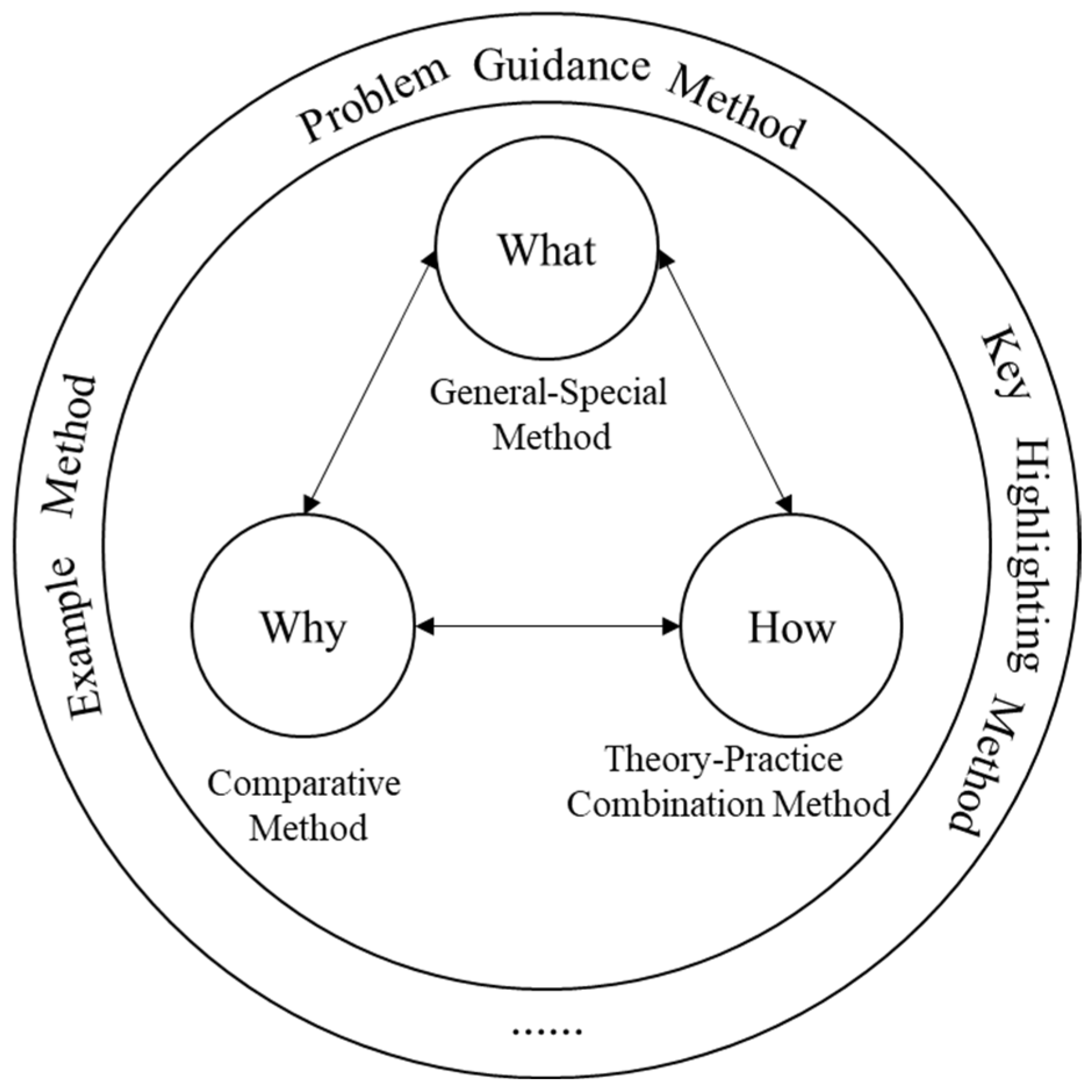
This paper proposes a series of innovative teaching methods aiming to improve teaching effectiveness, stimulate students’ learning interest, and cultivate their practical abilities and innovative thinking. These teaching methods mainly include the general–special method, comparative method, and theory–practice combination method, as well as auxiliary strategies such as the problem-guidance method, example method, and key-highlighting method. Together, they form the WWH teaching method system. The hierarchical structure of the WWH method is visualized in
Figure 1, which links each core method to its role in addressing students’ learning questions.
Figure 1 shows the teaching methods used in the NoSQL database course. These methods aim to address three core questions for students in the NoSQL database course learning process: why, what, and how. (1) Why learn: The comparative method is used to explain the importance of learning the content of the NoSQL database course. By comparing traditional structured databases and NewSQL databases, students can understand the unique value and application scenarios of NoSQL databases in modern data processing. (2) What learn: The general–special method helps students grasp the structure of NoSQL database course content from a macro perspective and clarifies key and difficult points of learning. This method enables students to have an overview of the NoSQL database course content and understand the relationships and applications between different NoSQL database technologies. (3) How learn: the theory–practice combination method emphasizes the integration of theory and practice and deepens students’ understanding and ability to apply theoretical knowledge through experimental operations and comprehensive cases.
Figure 1 also shows other auxiliary strategies, such as the problem-guidance method, example method, key-highlighting method, and so on. These methods together form a multidimensional teaching strategy aiming to enhance students’ learning interest, hands-on ability, and innovative thinking.
4. Research Methods
4.1. Research Stages
This study adopted a mixed-methods approach, combining a literature search, case analysis, and empirical research. The literature search involved a comprehensive review of the relevant domestic Chinese and foreign literature to understand the research status of and development trends in NoSQL database course teaching. The case analysis focused on selecting typical teaching cases for in-depth analysis to summarize successful experiences and deficiencies. The empirical research included the collection and analysis of data like students’ grades and classroom performance to evaluate the effectiveness of the proposed teaching methods.
This study was conducted in several stages. (1) A literature review was conducted to identify the current issues and challenges in NoSQL database course teaching. (2) Typical teaching cases were selected and analyzed to explore effective teaching methods. (3) The proposed teaching methods were implemented in a real teaching environment, and data such as students’ grades and classroom performance were collected and analyzed to evaluate teaching effectiveness.
4.2. Ethical Considerations
This study strictly adhered to ethical guidelines for educational research. Student consent was obtained from students before any data was gathered. We clearly outlined the study’s purpose, which was to evaluate the effectiveness of the innovative WWH teaching method for the NoSQL database course. Critically, we emphasized that no individual-level student data would be used. Instead, only aggregated statistical data would be analyzed. Prior to data collection, all students received a written informed consent form outlining the following: (1) The purpose of the study. Evaluating the efficacy of a new teaching method for the NoSQL database course. (2) Data collected. Anonymous academic performance (exam and project scores), classroom engagement metrics, and voluntary reflective essays and project reports. (3) Anonymization. All data were de-identified to protect student privacy; no personal identifiers were retained. (4) Right to withdraw. Students could decline participation or withdraw at any time without impacting their course grades or academic standing. (5) Use of data. Results would be used for academic research and publication, with no individual student identifiable in outputs. A total of 100% of eligible students provided informed consent.
In terms of data anonymization, we performed immediate removal of personal identifiers (student IDs, names, and contact details) from all datasets post-collection. Data storage and analysis occurred exclusively at the cohort level. There was no use of anonymous codes or pseudonyms (unnecessary for cohort-level analysis), eliminating all risks of re-identification. This approach ensured student privacy while enabling valid evaluation of teaching effectiveness.
5. WWH Teaching Method
5.1. General–Special Method
The general–special method is a teaching approach that first provides an overview of the course content and then delves into specific knowledge points. This method helps students build a comprehensive understanding of the subject and grasp the connections between different concepts.
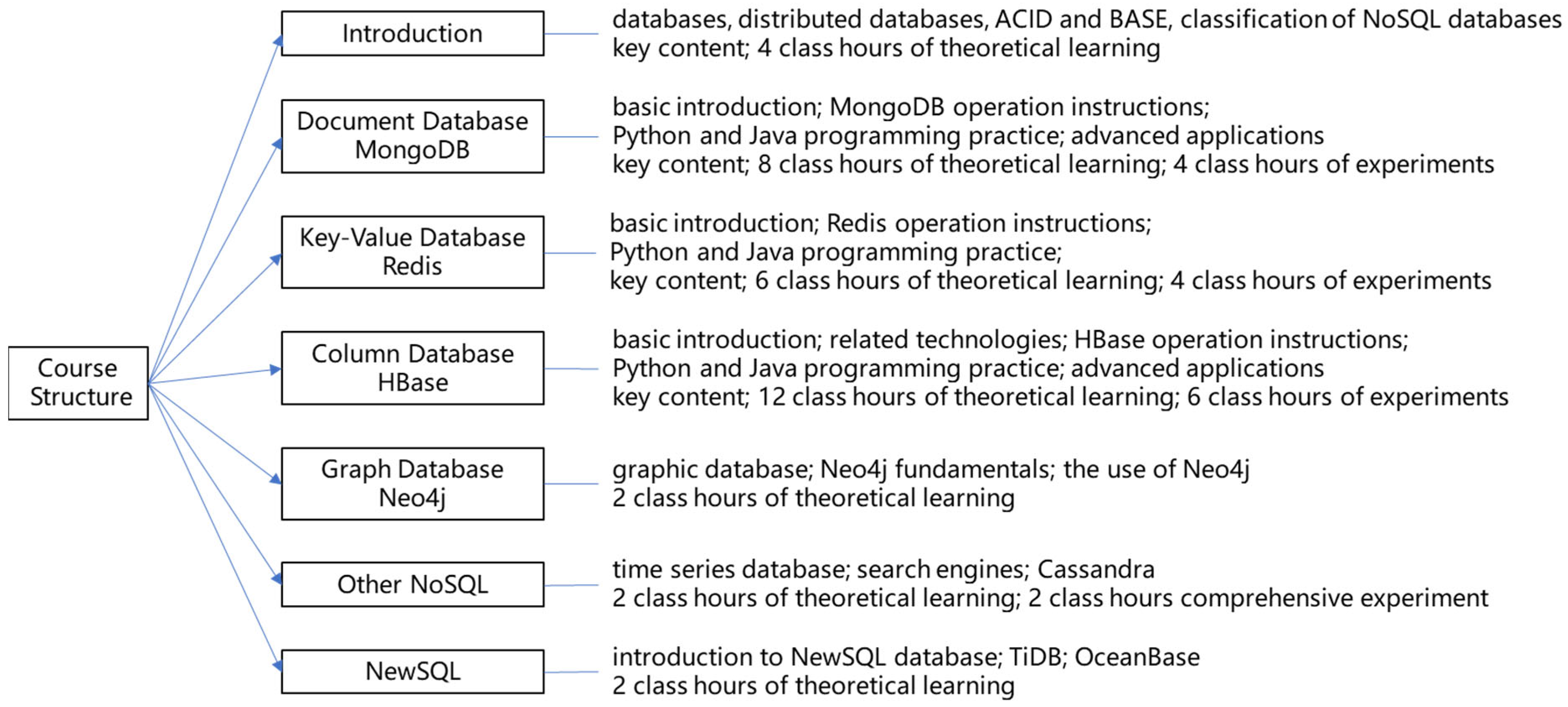
In the teaching of the NoSQL database course, in order to help students better understand and master the course content, we adopted the general–special method to organize and present the teaching content. It first outlines the overall structure of the NoSQL database course from a macro perspective, enabling students to have a comprehensive understanding of the course content. Then, it conducts in-depth explanations of each specific knowledge point to help students understand the connections and hierarchical relationships between various knowledge points. The course’s general-to-special progression is detailed in
Figure 2, which allocates class hours based on subtype complexity.
Figure 2 shows the content structure of the NoSQL database course, which was organized by adopting the general–special method. The NoSQL database course content can be divided into several main parts. In the introduction part of the course, students are introduced to the basic concepts, development history, and application scenarios of NoSQL databases, laying a foundation for subsequent learning. In the document database part, taking MongoDB as an example, the characteristics, data models, operation instructions, and application practices of document databases are introduced in detail. In the key-value database part, Redis is selected as a typical example to deeply explore its working principle, data structure, operation commands, and practical applications. Similarly, taking HBase as an example, the advantages, data storage models, query optimization, and advanced features of column databases are analyzed. The core workflow of the general–special method is shown in Algorithm 1.
| Algorithm 1: General–Special Method Workflow for NoSQL Teaching. |
| # Core Logic: From general NoSQL foundational knowledge to special subtype skills. |
- 1.
//Step 1: General Knowledge Foundation
Define core NoSQL principles: Non-relational data models, scalability, flexibility Introduce standardized NoSQL taxonomy:
- (1)
Document (semi-structured data, e.g., MongoDB); - (2)
Key-Value (key-pair storage, e.g., Redis); - (3)
Column (column-wise storage, e.g., HBase); - (4)
Graph (relationship-focused, e.g., Neo4j).
Explain cross-cutting concepts: BASE theory, data partitioning, replication Assess general comprehension via quizzes
- 2.
//Step 2: Specialization Selection
Present real-world application scenarios Select target subtype for deep dive Justify selection via industry demand and technical relevance
- 3.
//Step 3: Specialized Knowledge and Skill Development
Break down subtype-specific core concepts: For document DB: BSON format, collections/documents, schema design For key-value DB: In-memory storage, data persistence, cache eviction policies Demonstrate specialized operations Connect to general principles
- 4.
//Step 4: Integration and Transfer
Conduct cross-subtype comparison: How target subtype addresses general NoSQL challenges Assign transfer task: Apply special skills to a new scenario Summarize takeaways: general principles → special application → practical problem-solving
- 5.
//Step 5: Assessment
General knowledge check: Compare subtype characteristics against NoSQL taxonomy Specialized skill assessment: Hands-on task Integration evaluation: Explain how special solution embodies NoSQL core principles
|
The general–special method operationalizes “scaffolded knowledge construction”. It starts with general NoSQL frameworks to provide cognitive scaffolding, then guides students to build specialized subtype knowledge through progressive exploration. This aligns with constructivism’s rejection of passive knowledge transmission. The teaching advantages of the general–special method include the following: (1) Overall grasp. The general–special method helps students acquire an overall grasp of the course content. Through the learning process from the whole concept to specific parts, students can clearly define learning objectives and key points and build a systematic knowledge structure. (2) Gradually deepening. Based on the overall framework, students can gradually delve into each specific knowledge point. This step-by-step approach helps students better understand and memorize complex technical concepts. (3) Clear logic. Through the general–special method, logical relationships within the NoSQL database course content becomes clearer, which helps students understand and master the connections and differences between different database technologies.
5.2. Comparative Method
The comparative method is a powerful teaching method that enables students to gain a deeper understanding of the characteristics and applicability of NoSQL databases. By juxtaposing the advantages, disadvantages, and application scenarios of different types of databases, students can clearly differentiate between them. In the NoSQL database course, teaching mainly focused on document databases, key-value databases, and column databases, using MongoDB, Redis, and HBase as examples, respectively. The course on each type of database encompassed basic introductions, operation instructions, programming practices, and advanced applications. The comparative method effectively highlights the similarities and differences among these databases.
This method is particularly suitable for solving the “Why learn” problem, which refers to the motivation and purpose of students enrolled in the NoSQL database course. Therefore, adopting the comparative method can clearly express the similarities and differences among various databases. In addition, from the perspectives of application, comparison, and analysis, the advantages, disadvantages, and application scenarios of different databases can reflect the value of these databases. The comparison of different types of databases is shown in
Table 1.
Table 1 presents a comparison of different types of databases, including structured databases, NoSQL databases, and NewSQL databases. Structured databases excel in handling relational data and transactional operations, ensuring data integrity and consistency. In contrast, NoSQL databases have a distinct edge in dealing with large-scale, semi- and unstructured data, offering high scalability and flexibility. For instance, a social media platform that needs to store vast amounts of user-generated content would find NoSQL databases more suitable due to their ability to handle semi- and unstructured data efficiently. NoSQL databases can be further divided into various subtypes. Document databases like MongoDB are well-suited for storing semi-structured data, which can have a flexible schema. This makes them ideal for applications where the data structure may change over time, such as content management systems. Key-value databases like Redis are optimized for caching and message queues. In an e-commerce application, Redis can be used to cache frequently accessed product information, reducing the load on the main database and improving response times. Column databases like HBase are designed for handling large-scale data analysis. They can efficiently store and process data in columns, which is beneficial for applications that require complex queries and aggregations on large datasets, such as data warehousing for business intelligence. NewSQL databases combine the ACID (Atomicity, Consistency, Isolation, Durability) transaction characteristics of traditional relational databases with the horizontal scalability of NoSQL databases. This makes them suitable for applications that demand high availability and scalability while maintaining data integrity, such as financial transaction systems. The core workflow of the comparative method is shown in Algorithm 2.
| Algorithm 2: Comparative Method Workflow for NoSQL Teaching. |
| # Core Logic: Drive motivation and deep understanding via targeted comparisons of NoSQL-related technologies/scenarios |
- 1.
//Step 1: Define Comparison Objectives and Scope
Clarify core learning outcome Select comparison dimensions (scalability, schema flexibility, use cases, etc.) Identify comparison subjects Tie objectives to real-world needs
- 2.
//Step 2: Gather and Organize Comparative Data
Collect technical specifications of subjects Compile industry application cases Summarize pros/cons for each dimension Structure data into comparison matrices
- 3.
//Step 3: Guided Comparative Analysis
Walk through dimension-by-dimension comparison: For “Scalability”: Compare sharding support For “Use Cases”: Contrast scenarios where one subject outperforms Highlight decision-making logic Address common misconceptions
- 4.
//Step 4: Interactive Application
Assign scenario-based decision task: Design a data store for a ride-sharing app; choose between HBase and Redis, and justify via comparison Facilitate group discussion: Debates on tradeoffs Provide expert feedback: Validate decisions against industry best practices
- 5.
//Step 5: Synthesis and Knowledge Consolidation
Summarize key comparative conclusions Create decision frameworks Link back to NoSQL core principles
- 6.
//Step 6: Assessment
Practical task: Compare two new subjects using the same dimensions Written reflection: Explain how comparative analysis informs real-world technical choices Quiz: Multiple-choice questions on tradeoffs
|
The comparative method operationalizes “contextualized meaning-making”. It uses real-world scenario comparisons to help students actively construct the value of NoSQL knowledge, rather than accepting abstract concepts. This reflects constructivism’s focus on learning as context-dependent sense-making. The comparative method offers several significant benefits in the teaching of NoSQL databases. (1) It enhances students’ understanding. By comparing the characteristics of different databases, students can clearly identify the most suitable database for a particular application scenario. This knowledge is crucial for their future work as data professionals. (2) It stimulates students’ interest. The process of comparing different database technologies reveals the unique features and capabilities of each, sparking students’ curiosity and encouraging them to explore further. (3) It fosters critical thinking. The comparative method prompts students to analyze the pros and cons of different NoSQL database technologies. This helps them develop the ability to make informed decisions and solve problems independently.
5.3. Theory–Practice Combination Method
The theory–practice combination method aims to bridge the gap between theoretical knowledge and practical skills by integrating hands-on activities with classroom learning. This method is particularly effective in helping students answer the question of “How learn” the NoSQL database course. On one hand, engaging experimental scenarios are designed to capture students’ attention and encourage active participation. For example, in a practical exercise, students are asked to create a personalized event management database named after their own names. They need to add details about various events they plan to attend or organize, such as event names, dates, locations, and participant lists. This not only makes the learning process more interesting but also allows students to apply theoretical concepts in a real-world-like context. On the other hand, real-life-relevant application cases are incorporated into the teaching. In experimental teaching on Redis, an “online ticketing rush” case was used. In this scenario, students simulated a high-traffic online ticketing system where Redis was used to manage seat availability and user reservations. This helped students understand how Redis could handle concurrent access and maintain data consistency in a high-pressure environment. When teaching comprehensive cases, systems that integrate both structured and NoSQL databases, such as a logistics tracking system, can be introduced. In this system, a structured database can store fixed-format data like customer information and order details, while a NoSQL database like MongoDB can handle the unstructured data generated from tracking updates, such as location coordinates and delivery status comments. The core workflow of the theory–practice combination method is shown in Algorithm 3.
| Algorithm 3: Theory–practice combination method workflow for NoSQL teaching. |
| # Core Logic: Iterative integration of theoretical knowledge and hands-on practice to reinforce application ability. |
- 1.
//Step 1: Theory Input
Define practice-oriented learning objective Deliver focused theoretical content: Core concepts: Redis data structures, in-memory storage mechanism, persistence options Practical principles: Cache key design best practices, eviction policy selection, performance optimization basics Supplement with visual aids (architecture diagrams) and real-world use cases Conduct pre-practice check: Short quiz to verify theoretical comprehension
- 2.
//Step 2: Guided Practice
Prepare standardized development environment Assign step-by-step guided tasks: Task 1: Basic operation (Connect to Redis, create/update user profile via Hash data structure) Task 2: Core function implementation (User session storage with String + expiration policy) Task 3: Simple optimization (Add index for frequent queries, test read/write performance) Provide real-time support: Troubleshooting guides for common issues Facilitate peer review: Students check each other’s implementation against theoretical principles
- 3.
//Step 3: Theory–practice Reflection
Host group discussion: “What theoretical concepts did you apply directly? What unexpected challenges arose?” Highlight key connections: Link practice outcomes to theory Address misconceptions: Clarify discrepancies between theoretical assumptions and practical reality Summarize reflection takeaways: Document actionable insights
- 4.
//Step 4: Independent Practice
Assign scenario-based project: Design and implement a Redis-based user activity tracking system for a social media app Define project requirements (scalability, persistence, query) aligned with theoretical learning Provide flexible implementation space: Allow students to choose data structures/optimization strategies Require documentation: Students explain how their implementation reflects theoretical principles
- 5.
//Step 5: Evaluation and Feedback
Evaluate based on dual criteria: Theoretical alignment: Does the implementation adhere to core concepts? Practical effectiveness: Does the system meet functional/performance requirements? Provide detailed feedback: Highlight strengths and improvement areas Conduct post-practice theory review: Revisit key concepts based on common implementation gaps
- 6.
//Step 6: Knowledge Transfer
Assign transfer task: Adapt your Redis implementation to a new scenario using the same theoretical framework Assess transfer ability: Evaluate if students can apply existing theory–practice links to novel contexts Summarize transfer insights: Theoretical principles are universal; practice adapts to scenario-specific requirements
|
The theory–practice combination method operationalizes “experiential learning” and “social negotiation”. Hands-on projects enable students to test theoretical concepts through direct experience, while peer reviews and group tasks foster social construction of knowledge via collaborative problem-solving. The theory–practice combination method has multiple advantages in enhancing students’ learning experience. (1) It deepens students’ understanding of theoretical knowledge. Through hands-on operations, students can directly observe the impact of theoretical concepts on real-world applications. (2) It improves students’ practical skills. The experimental operations allow students to master essential practical skills in NoSQL databases. These skills are highly valued in the job market and are essential for students’ future careers in data-related fields. (3) It stimulates students’ interest. By connecting the study of NoSQL databases to real-life scenarios, students are more engaged and motivated to learn. (4) It cultivates students’ innovative thinking. When students encounter and solve practical problems during experiments, they are forced to think creatively and come up with innovative solutions. This is crucial for their future development as it enables them to adapt to new challenges and develop novel ideas in the ever-evolving field of data technology.
5.4. Auxiliary Strategies
In addition to the core teaching methods, this study also combines other practical teaching methods [
38,
39] to enhance the teaching effectiveness of NoSQL database courses. These methods aim to enhance students’ learning experience, stimulate their interest in learning, and promote deeper understanding.
- 1.
Problem-guidance method
The problem-guidance method is an effective way to encourage students to think actively and explore knowledge independently. Before teaching a new knowledge point, such as the concept of sharding in MongoDB, teachers can pose thought-provoking questions like “What are the potential challenges of distributing data across multiple servers in a MongoDB cluster?” This prompts students to start thinking about the topic even before the formal teaching begins. During the learning process, students are encouraged to ask their own questions and discuss them in groups. For example, when learning about the replication mechanism in Redis, students might wonder how to ensure data consistency across replicas in case of network failures. By actively seeking answers to these questions, students not only deepen their understanding of the subject matter but also develop their analytical and problem-solving abilities.
- 2.
Example method
The example method simplifies the learning process by using concrete cases to illustrate abstract concepts. When teaching the concept of data indexing in NoSQL databases, teachers can use examples from an e-commerce product search system. In this system, an index on product names in a MongoDB database can significantly speed up the search process. By showing how the index works in this practical example, students can easily understand the concept and its importance in improving database performance. In addition, real-world examples of NoSQL database applications can be used to broaden students’ horizons. For instance, when introducing the application of HBase, teachers can mention how companies like Facebook use HBase to store and analyze massive amounts of user-generated data for targeted advertising and user experience improvement. This helps students understand the practical significance of the technology and its widespread use in the industry. For example, when teaching “Redis is widely used”, examples can be given to illustrate practical application cases such as GitHub, Twitter, Stack Overflow, etc., which enable students to have a more intuitive understanding of the actual application of the Redis database. When explaining that “many NoSQL databases have been widely used”, examples can be given; in addition to MongoDB, Redis, and HBase, which students need to learn, there are also some NoSQL databases in China, including Huawei GaussDB, Alibaba Cloud Tair, etc.
- 3.
Key-highlighting method
In the NoSQL database course, there is a vast amount of knowledge, and it is impossible to cover every detail in equal depth. The key-highlighting method helps students focus on the most important aspects. For example, in the teaching of MongoDB, the $aggregation framework is a powerful but complex feature. Teachers can first introduce the key operators in this framework, such as $match for filtering data and $group for aggregating data. By mastering these key operators, students can then use the official documentation to explore more advanced features on their own. This method not only helps students build a solid knowledge system but also cultivates their self-learning ability. When students encounter new and complex knowledge in the future, they can use the key-highlighting approach to identify the essential elements and learn more efficiently. For example, the data aggregation instructions of MongoDB can achieve more complex data queries. After being introduced to the use of instructions such as “grouping” and “filtering”, students can use help documents to learn, which can stimulate their enthusiasm for further in-depth learning and cultivate their self-learning ability. This method helps students build a knowledge system and improve learning efficiency.
In terms of textbook selection, considering the rapid development of technology, digital textbooks are increasingly being used as a supplement to traditional paper textbooks. Digital textbooks offer several advantages, such as easy updates, interactive elements like embedded videos and quizzes, and the ability to provide real-time access to the latest industry information. This ensures that students have access to the most up-to-date and relevant learning resources. Through the comprehensive application of these teaching methods, as well as interactive learning, case studies, feedback, and evaluation, the aim is to create a diverse and interactive teaching environment that enables students to establish connections between theory and practice and improve their learning outcomes.
6. Experimental Evaluation
The teaching effectiveness of the WWH teaching method is evaluated from multiple perspectives, including students’ score distribution, classroom activity participation, and comprehensive instructor–student and student–instructor grades. We compare the situation before and after adopting the WWH teaching method.
6.1. Experimental Set up
6.1.1. Quasi-Experimental Design
This study employs a quasi-experimental design with a two-cohort (2023 vs. 2024) comparison to isolate the causal impact of the WWH teaching method on student outcomes. The cohort definitions and sample sizes are clearly specified as follows. (1) The 2023 cohort (control group). A total of 80 students enrolled in the NoSQL database course, instructed via traditional methods (lecture-based theoretical delivery + basic laboratory exercises with limited real-world context). (2) The 2024 cohort (experimental group). A total of 80 students from the same major, taught using the WWH method. The total sample size for the study is 160 students, with equal cohort sizes to ensure balanced comparison.
To eliminate confounding variables and ensure internal validity, the following elements were identical across both cohorts. (1) Instructor. Both cohorts were taught by the same faculty member, ensuring consistency in teaching style, expertise in NoSQL databases, and grading standards. (2) Syllabus. Identical course objectives, prerequisites, and content scope (core technologies: MongoDB, Redis, and HBase). The only variation was the teaching method (traditional vs. WWH). (3) Assessments. Uniform evaluation tools and weighting. Theoretical exam: There were 20 single-choice questions (20%), 10 fill-in-the-blank questions (20%), 10 true/false questions (10%), 2 short-answer questions (20%), and 3 case analysis tasks (30%), with standardized scoring rubrics. Experimental evaluation: Seven lab reports (70%) and one hands-on project (30%). Grading criteria were cross-validated with two other database instructors to ensure objectivity.
To ensure comparability between the 2023 control cohort (n = 80) and 2024 experimental cohort (n = 80), we verified equivalence across key confounding variables. (1) Demographic and Academic Background. Both cohorts were undergraduate students in the same “Database Systems” course (Computer Science major), with identical prerequisites (Introduction to Programming, Data Structures). Prior academic performance: The difference in admission scores between the two cohorts of students was not significant. (2) Relevant Prior Experience. Programming experience: the students of both cohorts had prior Python/Java experience. NoSQL exposure: <5% of students in both cohorts reported prior NoSQL knowledge (self-reported surveys), eliminating pre-existing expertise bias. (3) Instructional Consistency. The same instructor, course syllabus, and assessment rubrics were used for both cohorts—only the teaching method (traditional lecture-based vs. WWH) differed. These results confirm that the cohorts were statistically equivalent across variables that could impact learning outcomes, justifying the assumption of group comparability.
6.1.2. Experimental Indicators
To comprehensively evaluate the WWH method’s efficacy, three core indicator types were adopted, aligned with educational assessment principles and NoSQL teaching objectives.
- (1)
Theoretical Mastery Indicators: Quantitative scores (0–100) from standardized exams. They directly measured understanding of NoSQL fundamentals and higher-order analysis skills, which are critical for technical education. Standardized scoring ensures objectivity and comparability between cohorts.
- (2)
Practical Skill Indicators: Qualitative–quantitative hybrid scores (0–100) from lab reports and hands-on projects (functionality, optimization, and code quality). These reflected NoSQL’s applied nature and evaluated students’ ability to translate theory to real-world implementation. Hybrid scoring balanced technical correctness (quantitative) and solution creativity (qualitative), aligning with industry skill requirements.
- (3)
Classroom Engagement Indicators: Quantitative metrics (rates/per frequencies) for sign-in, voluntary answering, group discussion participation, and questioning. They measured learning motivation and active participation, key predictors of deep learning (constructivist learning theory) and addressed the systemic issue of low engagement in technical courses, providing insights into the WWH method’s motivational impact.
6.1.3. Statistical Analysis Plan
To validate claims of teaching effectiveness, the following statistical tests were applied to cohort data.
- (1)
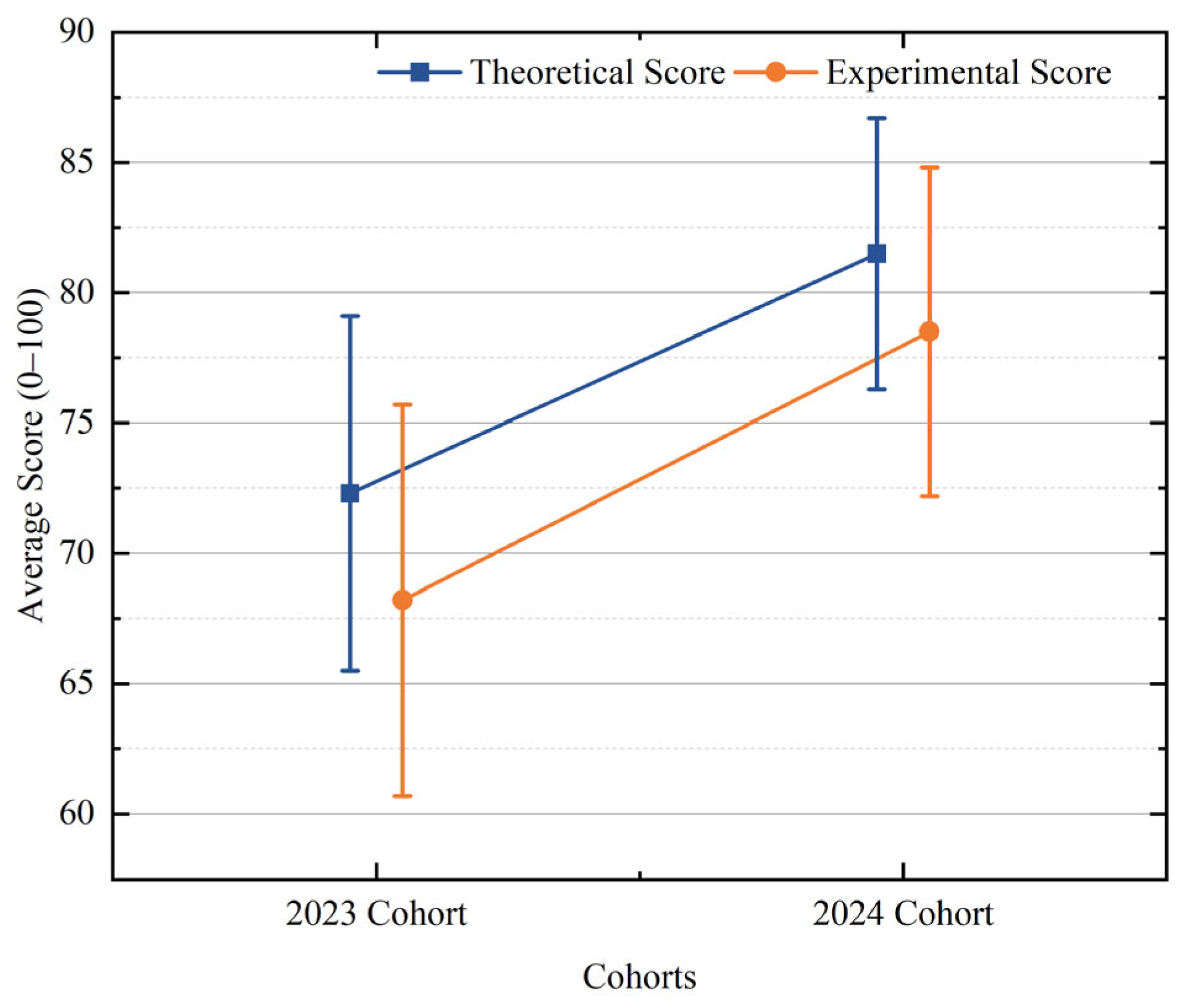
Continuous Data. Theoretical exam average: 2023 cohort (72.3 ± 6.8) vs. 2024 cohort (81.5 ± 5.2); independent-samples t-test: t(158) = 9.21, p < 0.001, Cohen’s d = 1.45 (large effect size). Experimental evaluation average: 2023 cohort (68.2 ± 7.5) vs. 2024 cohort (78.5 ± 6.3); t(158) = 7.92, p < 0.001, Cohen’s d = 1.25 (large effect size).
- (2)
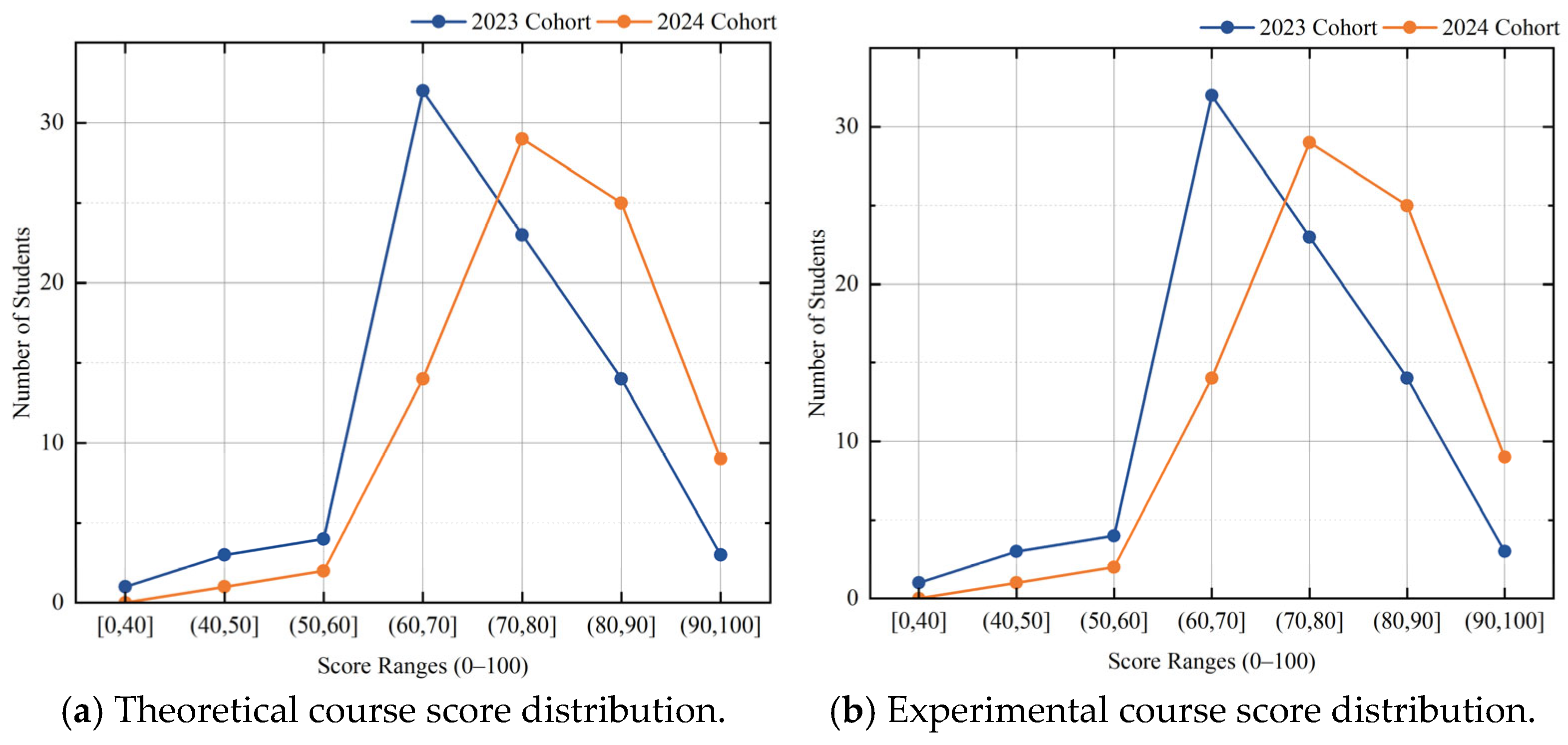
Categorical Data. Theoretical score distribution (
Figure 3a). χ
2(6) = 18.76,
p = 0.005 (significant shift toward higher score ranges in 2024). Experimental score < 60: 2023 cohort (11.25%, 9/80) vs. 2024 cohort (2.5%, 2/80); χ
2(1) = 5.87,
p = 0.015.
- (3)
Reliability Measures. Classroom participation metrics (sign-in, answering, discussion, questioning): Cronbach’s α = 0.79 (good internal consistency, α > 0.7). Comprehensive teaching grade surveys (student–instructor, instructor–student): Cronbach’s α = 0.82 (high internal consistency, α > 0.8).
Figure 3.
The distribution of NoSQL database course scores (80 per cohort).
Figure 3.
The distribution of NoSQL database course scores (80 per cohort).
6.2. Score Distribution
In this section, we analyzed theoretical and experimental score distributions across the two cohorts. The 2023 cohort (control) received traditional teaching, while the 2024 cohort (experimental) used the WWH method. The distribution of NoSQL database course scores is shown in
Figure 3.
In terms of theoretical course scores,
Figure 3a shows a significant improvement after adoption of the WWH teaching method. Before WWH (2023), 23 students (28.8%) scored 70–80, 14 (17.5%) scored 80–90, and 3 (3.8%) scored ≥ 90. After WWH (2024), 29 students (36.2%) scored 70–80, 25 (31.2%) scored 80–90, and 9 (11.2%) scored ≥ 90. Statistical validation: χ
2(6) = 18.76,
p = 0.005; average score increase: 9.2 points (t(158) = 9.21,
p < 0.001, d = 1.45). In
Figure 3b, the improvement in students’ experimental course scores is even more notable. Before WWH, 9 students (11.25%) scored <60; average = 68.2 ± 7.5. After WWH, 2 students (2.5%) scored <60; average = 78.5 ± 6.3. Statistical validation: χ
2(1) = 5.87,
p = 0.015; average score increase: 10.3 points (t(158) = 7.92,
p < 0.001, d = 1.25). The comparison of theoretical and experimental average scores for two cohorts is shown in
Figure 4.
Figure 4 shows that both the theoretical average scores and the experimental average scores of the students have improved to some extent.
6.3. Participation in Classroom Activities
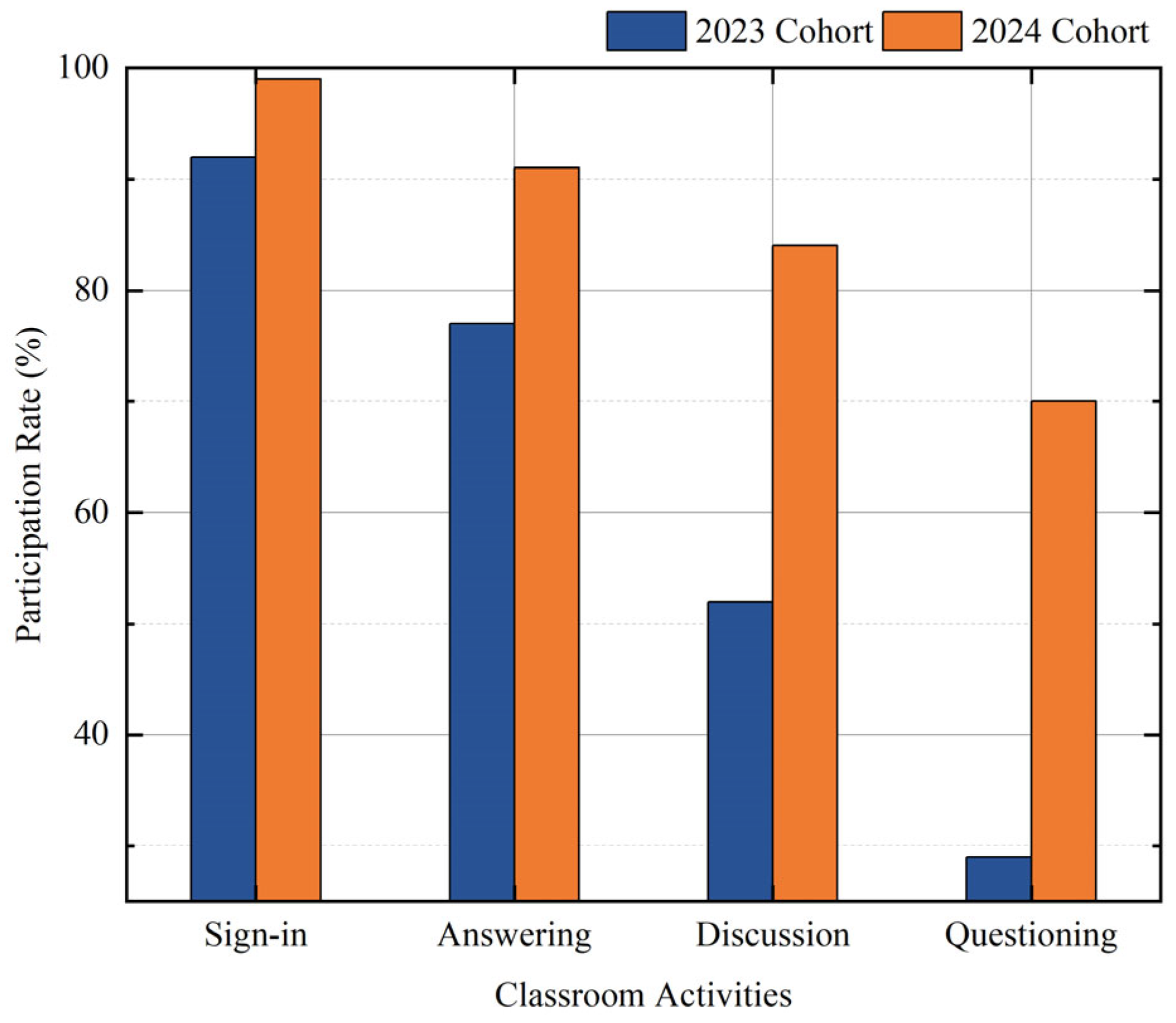
We compared classroom participation across cohorts using the following operational definitions. (1) Sign-in Rate: [(Number of students present at class start)/Total cohort size] × 100%, tracked via the university’s digital attendance system (excused/unexcused absences included in “absent” counts). (2) Answering Frequency: Total number of voluntary responses to instructor questions per class, divided by cohort size. (3) Discussion Participation Rate: [(Number of students contributing to group tasks)/Total cohort size] × 100%, observed and recorded by the instructor. (4) Questioning Frequency: Total number of voluntary student questions per class, divided by 10. Due to time constraints, a maximum of 10 questions per class. Classroom participation differences between cohorts are illustrated in
Figure 5, with the 2024 cohort showing significantly higher engagement in discussion and questioning.
As shown in
Figure 5, the sign-in rate was 92.1% (2023) vs. 93.5% (2024); t(158) = 0.57,
p = 0.57 (no significant difference). The answering frequency was 0.8 ± 0.3 (2023) vs. 1.9 ± 0.4 (2024); t(158) = 18.20,
p < 0.001, d = 2.88. The discussion rate was 45.2% (2023) vs. 82.7% (2024); χ
2(1) = 28.90,
p < 0.001. The questioning frequency was 0.2 ± 0.1 (2023) vs. 1.5 ± 0.3 (2024); t(158) = 32.60,
p < 0.001, d = 5.12. This indicates that the WWH teaching method effectively stimulated students’ creativity and encouraged them to think independently and actively participate in classroom learning.
6.4. Teaching Comprehensive Grade
The comprehensive teaching grade uses a five-point Likert scale (1 = “Strongly Disagree/Needs Improvement” to 5 = “Strongly Agree/Excellent”) with two components, both of which were validated for reliability (Cronbach’s α = 0.82).
Table 2 and
Table 3 show the five-point Likert rubric for student–instructor and instructor–student evaluations, including four specific dimensions.
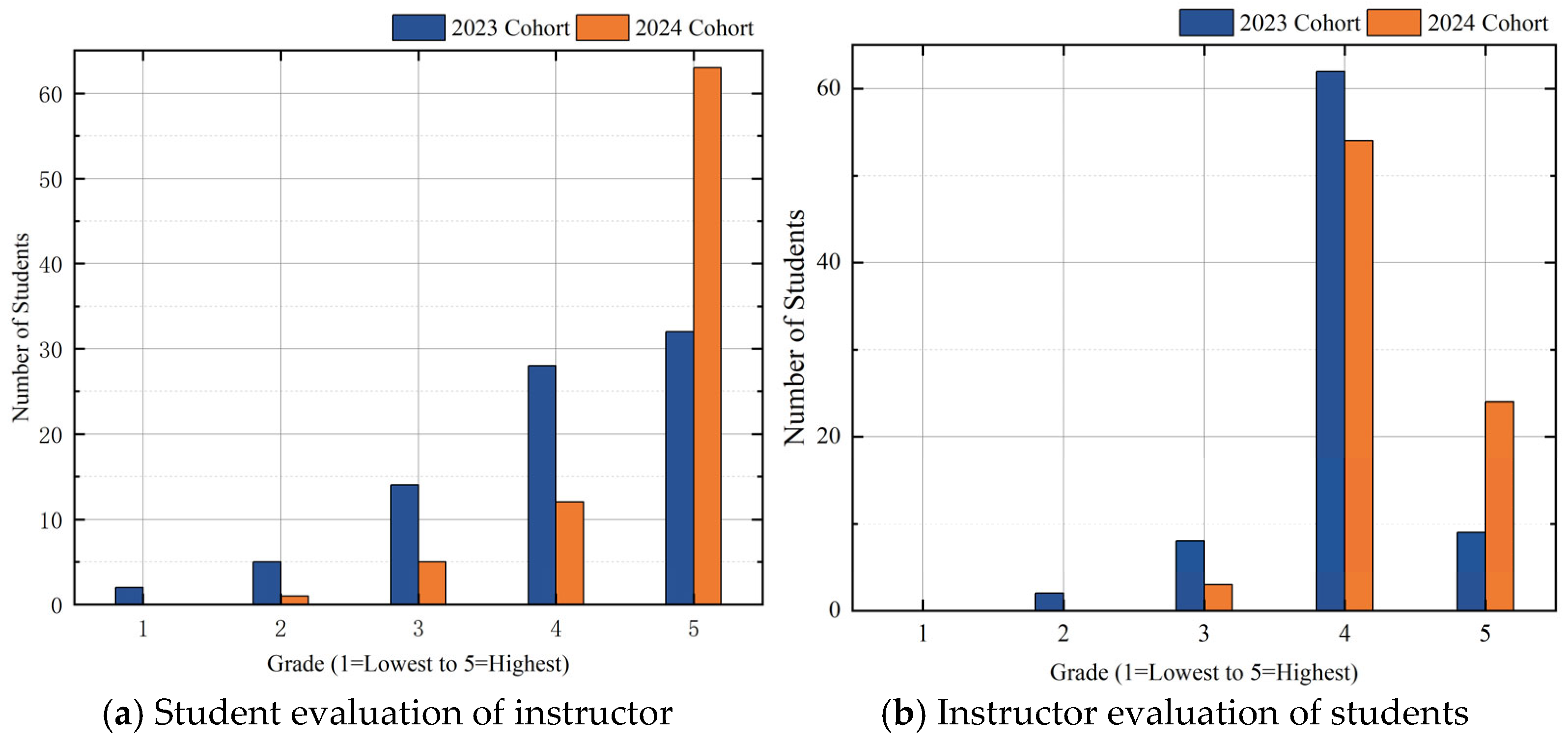
Comprehensive teaching grade distributions (student–instructor and instructor–student) are presented in
Figure 6, demonstrating post-WWH improvements.
From
Figure 6a, student ratings were 4.2 ± 0.5 (2023) vs. 4.9 ± 0.2 (2024); t(158) = 9.87,
p < 0.001, d = 1.81. After adopting the WWH teaching method, the teacher received a five-point grade from the majority of the students. From
Figure 6b, instructor ratings were 3.1 ± 0.6 (2023) vs. 4.7 ± 0.3 (2024); t(158) = 20.30,
p < 0.001, d = 3.72. The improvement in both the teacher’s and students’ grades indicates that the WWH teaching method effectively enhanced the overall teaching quality.
6.5. Qualitative Measure
Design: Students completed a 30 min task requiring students to (1) explain how NoSQL principles (BASE, sharding, etc.) apply to a real-world scenario (designing a social media data store) and (2) justify database subtype selection (Neo4j vs. MongoDB) with technical tradeoffs. They were scored via rubric (0–30). Scores were evaluated as follows: 0–10: Surface-level recall (no principle-scenario linkage); 11–20: partial connection (links principles to scenario but misses tradeoffs); 21–30: integrated reasoning (connects principles, justifies choices, and identifies tradeoffs).
- 2.
Critical thinking assessment
Design: Students completed a 90 min hands-on task: Students troubleshot a flawed NoSQL system (e.g., slow MongoDB queries due to poor indexing) and (1) diagnosed the issue, (2) proposed solutions aligned with NoSQL theory, and (3) defended their approach in a one-page reflection. They were scored via rubric (0–30). Scores were as follows: 0–10: Incorrect diagnosis (no theoretical basis); 11–20: correct diagnosis but incomplete solution (partial theory alignment); 21–30: accurate diagnosis + comprehensive solution (defended with theory).
- 3.
Result
The results of the conceptual depth assessment and critical thinking assessment are shown in
Table 4.
These findings directly confirm the experimental cohort’s deeper conceptual understanding, as evidenced by their ability to connect technical features to NoSQL principles and contextualize tradeoffs.
The results of this study directly address the research questions and objectives. The improved distribution of students’ scores (
Figure 3 and
Figure 4), increased participation in classroom activities (
Figure 5), and improvement of the teacher’s and students’ grades (
Figure 6) demonstrate the effectiveness of the proposed teaching methods in addressing the challenges of lagging teaching content and insufficient practical teaching.
7. Discussion
7.1. WWH Core Advantage
The WWH method’s core advantage lies in addressing systemic gaps in NoSQL teaching identified in the prior literature. (1) Fragmented Knowledge Structure: Unlike standalone tool training or case studies, the general–special method systematically organizes NoSQL taxonomy and core concepts, resolving students’ “know commands but not logic” dilemma. (2) Low Learning Motivation: The comparative method directly tackles this systemic issue by contextualizing NoSQL’s value (e.g., Redis vs. MongoDB for caching, vector databases for AI), increasing discussion participation from 45.2% to 82.7% and reducing “irrelevant learning” perceptions. (3) Theory–Practice Disconnect: The integrated theory–practice module links conceptual learning to hands-on projects, such as “MongoDB data modeling” to “e-commerce system deployment”, addressing the “can’t apply knowledge” gap; most of the 2024 students implemented optimization strategies, demonstrating transferable skills. (4) Heterogeneous Student Foundations: Auxiliary strategies (problem guidance, key highlighting) adapt to varied skill levels, resolving the systemic challenge of “one-size-fits-all” teaching. Low-performing students improved experimental scores by 15.6 points, while high-performers advanced to creative hybrid NoSQL design.
7.2. Learning Outcomes and Positive Changes
After using the general–special method, comparative method, theory–practice combination method, and other practical teaching methods, we discuss students’ learning outcomes and observed the following positive changes.
- 1.
Enhancing learning interest and hands-on ability
The design of experimental scenarios and practical cases in the WWH teaching method significantly boosted students’ learning interest and hands-on skills. For example, the personalized event management database experiment not only increased students’ enthusiasm for participation but also improved their proficiency in database operations. Students were more actively involved in the learning process and were more willing to explore advanced features of NoSQL databases through practical exercises.
- 2.
Cultivating critical thinking
Students became more confident in the learning and discussion process. They demonstrated increased willingness to critique textbook content. Through theoretical and experimental learning, students pointed out some errors in textbooks, such as incorrect data types in examples and misspelled keywords. In the textbook [
25] selected by our school, in Table 5-1 on page 98, “date” was written as “data”. In Table 3-9 on page 56 and Table 3-10 on page 57, “void” was written as “viod”, etc. This cultivation of critical thinking is crucial for students’ future studies and work, enabling them to maintain an independent thinking ability in the face of complex problems.
- 3.
Enhancing the ability to summarize and generalize
After each class, students were organized into groups to discuss and summarize the key and difficult points of the NoSQL database course. This group-based learning approach not only helped students consolidate the learned content but also enhanced their ability to summarize and generalize knowledge. They extracted essential elements from complex knowledge systems and formed a more concise and systematic understanding.
- 4.
Exploring new learning methods
Through the learning of the NoSQL database course, students explored learning methods that suited them. For example, instead of rote memorization of database operation instructions, they relied on practical operations to understand and remember them. This shift in learning methods improved learning efficiency and made the learning process more enjoyable.
- 5.
Combining theory with practice
Students are now able to apply theoretical knowledge to practical cases more effectively. In the “flash sale” case using Redis database experiments and through combining structured databases and NoSQL databases in mobile traffic analysis systems and e-commerce systems in comprehensive cases, students successfully implemented the learned concepts and techniques, demonstrating a better understanding of the practical applications of NoSQL databases.
- 6.
Improvement of educational quality
The implementation of the WWH teaching method directly led to an improvement in educational quality. Students’ understanding and application ability of NoSQL databases were significantly enhanced. They are better prepared for future careers in data-related fields and will be able to more easily adapt to the requirements of the industry.
- 7.
Ability to cope with challenges
Students demonstrate stronger adaptability and learning ability when facing the challenges of rapid technological development and outdated teaching content updates.
The achievement of these teaching effects proves that our teaching methods can effectively solve problems in teaching of NoSQL database courses. It provides students with a more rich, interactive, and practice-oriented learning environment. While the WWH method demonstrates efficacy in an undergraduate NoSQL database course (Computer Science majors, in-person instruction at a Chinese university), its transferability to other contexts requires empirical validation. The method’s design aligns with technical course characteristics (e.g., structured knowledge + practical application), but its performance in non-NoSQL domains or diverse educational settings remains untested. We hope that these methods can provide a reference for higher education teaching theory and teaching reform practice, especially in updating course content, reforming teaching methods, student-centered teaching, and improving educational quality.
7.3. Further Improvement
The findings of this study are supported by the constructivist learning theory. The enhanced learning interest and hands-on ability of students can be explained by the theory’s emphasis on active learning and the importance of creating an interactive learning environment. The cultivation of critical thinking is also in line with the theory’s focus on developing students’ ability to analyze and solve problems independently.
To overcome the challenges mentioned in the beginning, we recommend that teachers adopt the proposed teaching methods, such as the general–special method and the theory–practice combination method, to create a more engaging and practice-oriented learning environment. These methods have been proven to be effective in improving students’ learning outcomes and can be easily implemented in different teaching contexts.
However, there are still some areas that need further improvement in the teaching process. For example, experimental teaching often suffers from a lack of sufficient time. Some students, especially those with a weak computer operation foundation, may need more time for guidance. Developing high-quality digital textbooks also requires a significant amount of time for research, design, writing, adjustment, and updating to ensure their effectiveness in teaching.
8. Limitations
This study has several limitations that should be considered when interpreting results.
- 1.
Cohort effects and non-random assignment
Cohorts were assigned by academic year (not randomization), introducing potential selection bias. For example, the 2024 cohort may have had greater prior exposure to big data tools (e.g., via extracurricular AI workshops) or higher intrinsic motivation, which could independently improve outcomes. Unobserved differences between cohorts (e.g., academic preparedness) were not fully controlled for.
These large effect sizes (1.45 for theoretical scores, 1.25 for experimental scores) may be specific to settings with similar baseline challenges (e.g., introductory technical courses with theory–practice disconnect, low student engagement). Replication in contexts with stronger existing teaching practices (e.g., universities with robust lab infrastructure) may yield smaller, more typical effect sizes.
- 2.
Measurement bias
Classroom participation metrics were observed and recorded by a single instructor, introducing subjective bias. For instance, the same level of student input might be rated as “contributing” more consistently for the experimental cohort due to observer expectations. No inter-observer reliability checks were conducted.
- 3.
Single-institution context and short-term follow-up
The study was conducted at one university with a specific student demographic. Results may not generalize to other institutions or regions. The study only measured immediate outcomes, such as scores and participation. Long-term effects like students’ application of NoSQL skills in internships/jobs were not evaluated. There are some contextual limitations of WWH’s applicability. (1) Instructor Variability: The study relied on a single instructor with several years of NoSQL teaching experience. WWH’s auxiliary strategies may require instructor training, as they are untested with early-career educators or those with different teaching styles. (2) Cultural and Educational Contexts: Classroom dynamics (e.g., group collaboration norms, student–teacher interaction) in this Chinese undergraduate setting differ from those in Western universities. WWH’s reliance on guided discussion may need adaptation to align with diverse educational cultures. (3) Delivery Modes: WWH was implemented in in-person labs with hands-on instructor support. Its suitability for MOOCs (asynchronous learning, limited direct feedback) is unproven; virtual lab access or automated feedback tools would be required to maintain theory–practice integration. (4) Non-NoSQL Technical Courses: While WWH’s “Why-What-How” logic is theoretically transferable to courses with similar demands, no empirical data supports its efficacy beyond NoSQL.
- 4.
Lacking comparisons with other modern teaching methods
This study focuses on comparing the WWH method with a traditional lecture-based approach (2023 control cohort vs. 2024 experimental cohort), without direct head-to-head comparisons with other modern teaching methods. To address this gap, future work will (1) design a multi-group comparative experiment involving the WWH method and three mainstream NoSQL teaching approaches (case-based learning, project-based learning, and flipped classroom), with matched cohorts (n = 60 per group) to ensure validity. (2) Adopt consistent evaluation indicators (theoretical mastery, practical skills, engagement, and long-term knowledge retention) and statistical methods to quantify performance differences. (3) Analyze comparative advantages across scenarios to clarify the WWH method’s applicability boundaries.
9. Conclusions
This paper conducts an in-depth study on the teaching quality and methods of a NoSQL database course. By analyzing the current teaching situation, we identified key challenges such as lagging teaching content, insufficient practical teaching, and uneven levels of students’ basic knowledge. We have proposed a series of innovative teaching methods, including the general–special method, the comparative method, the theory–practice combination method, and other auxiliary teaching strategies. The evaluation of the teaching effectiveness of the WWH teaching method from aspects such as students’ score distribution, classroom activity participation, and comprehensive student–instructor and instructor–student grades shows that adopting this teaching method can significantly enhance students’ learning interests and hands-on abilities. Students could better understand the concepts, operations, and applications of NoSQL databases, thereby improving the teaching effectiveness. They not only mastered necessary technical skills but also cultivate critical thinking, summarization, and self-learning abilities.
The teaching method proposed in this paper for the NoSQL database course is expected to provide theoretical support and practical guidance for the teaching of NoSQL database courses. These teaching methods provide a reference for updating course content, reforming teaching methods, student-centered teaching, and improving educational quality in pedagogical theory and teaching reform practice. The practical contribution of this research is that it provides specific guidelines for teachers to improve the teaching quality of NoSQL database courses. The proposed teaching methods can help students better understand and apply NoSQL database concepts, thereby improving their professional skills and employability in the data-related field. This study’s aims and results align closely with Bloom’s Taxonomy (cognitive domain), demonstrating the WWH method’s ability to foster multi-level learning. (1) Recognition and Repetition: The general–special method enhanced students’ recognition of NoSQL taxonomy and repetition of core concepts, reflected in a 9.2-point theoretical exam improvement. (2) Practical Application: Theory–practice integration enabled students to apply NoSQL tools to real-world tasks, with most of the experimental cohort implementing optimized solutions. (3) Creative Application: Comparative and problem-guidance strategies supported creative application, which is a demonstration of Bloom’s highest cognitive level. Overall, the WWH method systematically advances students across Bloom’s Taxonomy, validating its efficacy for technical education.
The study has successfully addressed the challenges in NoSQL database course teaching by proposing innovative teaching methods that significantly enhance students’ learning interest and hands-on abilities. In addition, some areas need to be improved and perfected in this study. In future teaching processes, we will further explore and study teaching methods for NoSQL database courses.