Article

KG-PLPPM: A Knowledge Graph-Based Personal Learning Path Planning Method Used in Online Learning

1
School of Computer Science and Technology, Xidian University, Xi’an 710000, China
2
Xi’an Institute of High-Tech, Xi’an 710025, China
3
School of Automation, Northwestern Polytechnical University, Xi’an 710072, China
4
Guangzhou Research Institute, Xidian University, Guangzhou 510530, China
*
Author to whom correspondence should be addressed.
Electronics 2025, 14(2), 255; https://doi.org/10.3390/electronics14020255

Submission received: 18 November 2024 / Revised: 1 January 2025 / Accepted: 7 January 2025 / Published: 9 January 2025
(This article belongs to the Special Issue Future Trends of Artificial Intelligence (AI) and Big Data)

Abstract

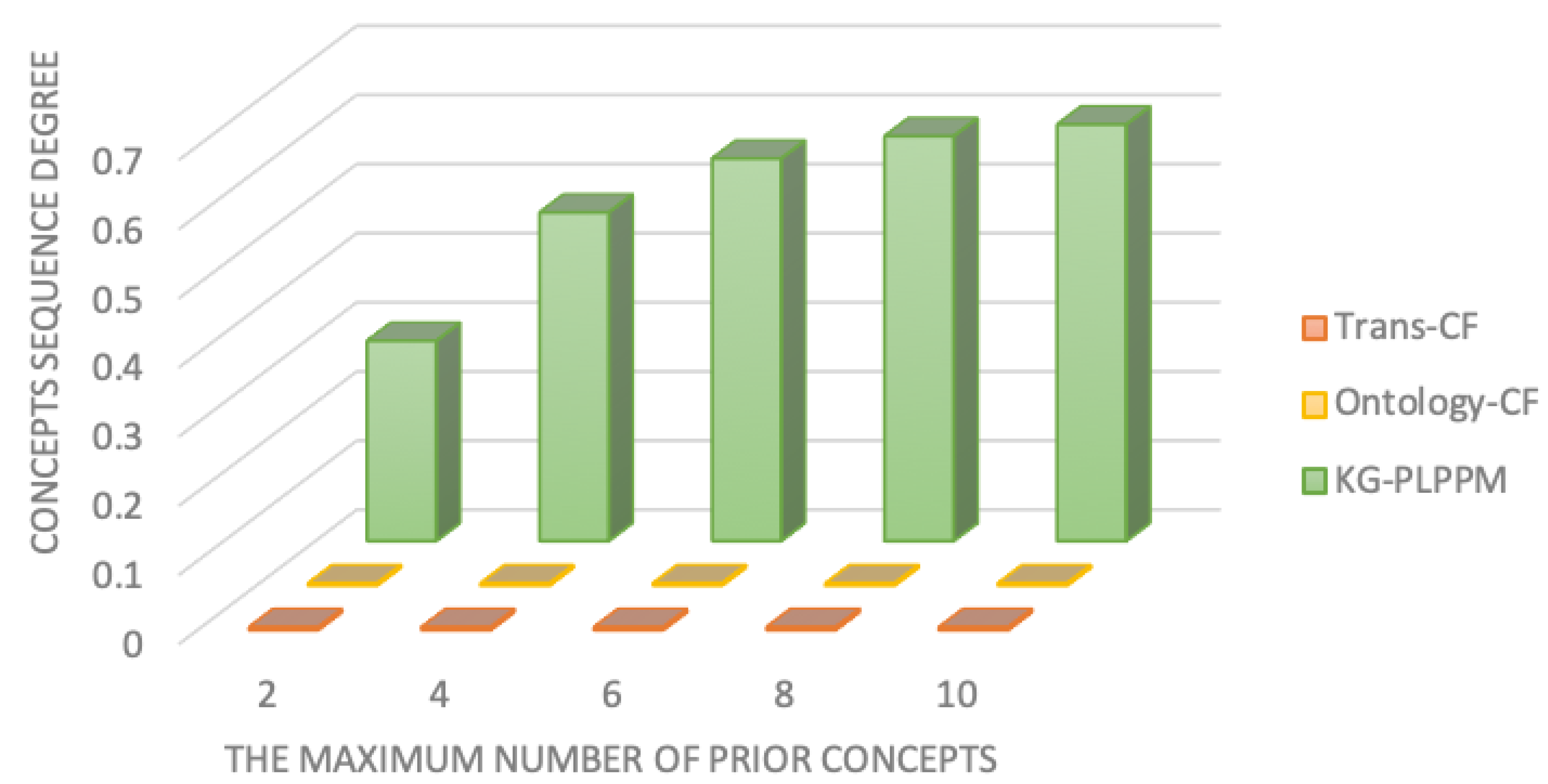
In the realm of online learning, where resources are abundant, it is essential to customize recommendations and plans to meet individual learning needs. This involves not only identifying and addressing areas of weakness but also aligning the learning journey with each learner’s cognitive preferences. However, existing methods for suggesting and structuring learning paths have notable limitations. To address these challenges, this paper introduces a knowledge graph-based personalized learning path planning method (KG-PLPPM). By leveraging a knowledge graph and refining cognitive diagnosis models, the proposed method tailors learning paths to individual needs. It evaluates knowledge concept similarity and learner mastery, and employs an algorithm for path planning. In the experiments, two metrics—the concept sequence degree and learning efficiency—are used to assess our work. Experimental results demonstrate that the method presented enhances the coherence and relevance of recommended learning paths, and achieves a higher concept sequence degree, indicating that knowledge concepts are arranged in a manner consistent with the learning sequence, which aligns more closely with learners’ cognitive preferences. Moreover, across various learning progresses and path lengths, it effectively addresses weak knowledge areas, significantly enhancing learning efficiency.
Keywords: learning path plan; knowledge graph; cognitive diagnosis; data science applications in education; online learning learning path plan; knowledge graph; cognitive diagnosis; data science applications in education; online learning