3.2.2. Constraints for Helicopter Dispatching in Power System Emergencies
- 1.
Basic path constraints
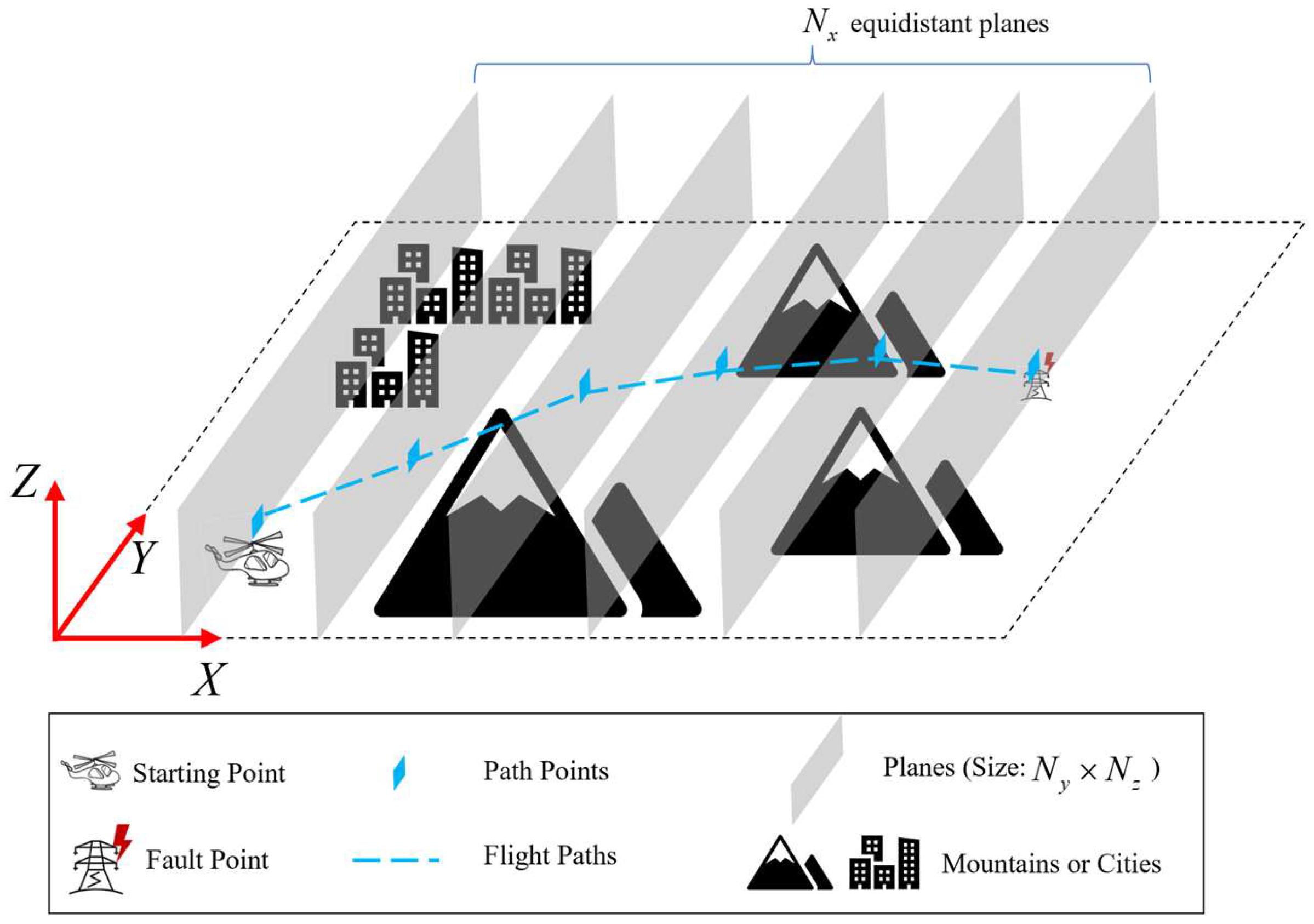
In the process of the helicopter emergency response, once a helicopter is dispatched, it is assumed to follow a planned route that starts from a site, proceeds to several fault points in an orderly manner, and, finally, returns to the site. Therefore, the following basic route constraints are considered:
In the formulae, and are, respectively, the take-off point and landing point of helicopter ; and are, respectively, the sets of take-off points and landing points of helicopters. Formulae (18) and (19), respectively, indicate that all dispatched helicopters need to depart from the site to the fault points and return from the fault points to the site for landing; Formula (20) means that, after a helicopter arrives at fault point, it must leave from the fault point, ensuring flow conservation; Formula (21) indicates that a helicopter is not allowed to return to any point once it has arrived there; and Formula (22) represents special paths that are not allowed, including the direct path between the starting point and the ending point, the path from a fault point to the starting point, and the path from the ending point to a fault point.
- 2.
Task assignment constraints
During the restoration process, to avoid the waste of maintenance resources and flight mileage, it is necessary to ensure that each fault point is reached and handled by exactly one helicopter:
In the formulae, is a binary variable indicating whether fault point is repaired by helicopter .
Formula (23) indicates that all fault points passed through in the helicopter’s route planning will be responsible for repair by the corresponding helicopter; Formula (24) means that each fault point will be repaired only once; and Formula (25) shows that the operation mode can be selected only when the helicopter arrives at the corresponding fault point.
- 3.
Resource limitation constraints
In the process of the helicopter emergency response, this paper considers the limitations on maintenance resources carried by each helicopter and the restrictions on flight mileage for a single mission, and lists the following constraints:
In the formulae, represents the maintenance resources required for fault point ; is the upper limit of resources that helicopter can carry in a single mission; is the flight distance between fault points ; is the coefficient of equivalent flight mileage when the helicopter is in the state of hovering for on-site maintenance; and is the maximum flight mileage of helicopter in a single mission.
- 4.
Maintenance time and line state update constraints
In this paper, the starting time is set as the moment when the helicopter departs from the starting point. The repair time of the faulty line is calculated based on the time to reach the fault point according to the route plan and the required maintenance time, and the line status is updated according to the repair time:
In the formulae, denotes the time when helicopter arrives at node ; and is a binary variable indicating whether fault point has been repaired at the -th time period.
Formula (28) indicates that the time when the helicopter departs from the starting point is recorded as 0. Considering that no operation is required at the starting point and the return point, the operation mode of the two points is equivalent to hovering, but there is no consumption of resources or time; Formula (29) represents the logic for calculating the time taken by helicopter to travel from point to point —that is, the arrival time at point equals to the arrival time at point plus the operation time at point and the traffic time between points; Formula (30) means that the arrival times of fault points other than those on the planned route of helicopter are all recorded as 0; Formula (31) is used to calculate the maintenance completion time of fault point , which is the arrival time of the corresponding helicopter plus the maintenance operation time; and Formula (32) ensures that the maintenance completion time of each fault point is unique during the restoration process. Among them, Formula (31) contains a nonlinear part where two binary variables are multiplied. An auxiliary variable and linearization constraints can be introduced to describe the product of binary variables, which will not be elaborated here.
After calculating the repair time of the fault point, the operating status of the faulty line can be updated accordingly:
In the formulae, is a line with the starting node and the ending node ; is the set of system lines; and is a binary variable representing the operating status of line at the -th time period, where 1 indicates that the line is closed and 0 indicates that it is open.
The above two formulae indicate that non-faulty lines are always in normal operating status, while faulty lines can only operate normally and allow active power flow after being repaired.
- 5.
Power system and power flow security constraints
In the formulae, is the upper limit of active power allowed to flow through line ; is the active power flowing through line during time period ; is the voltage phase angle of node at time period ; is the reactance of line ; denotes the slack bus of the system; and are, respectively, the upper and lower limits of the output of traditional generator unit ; represents the output of generator unit during time period; is the set of generator units; is the active load demand of node at time period ; and is the active load curtailment of node at time period .
Formula (35) represents the linearized DC power flow constraint; and Formulae (36)–(39) impose constraints on the line transmission power, generator output, and load curtailment.
The principal advantage of the DC power-flow constraints lies in their ability to reduce model complexity and dramatically improve computational efficiency, making them particularly well-suited to large-scale systems and time-critical decision environments. By retaining only the linear relationship between active-power injections and phase-angle differences, while explicitly neglecting reactive-power balances and voltage-magnitude constraints, the original non-linear programming formulation is transformed into a mixed-integer linear program (MILP), thereby drastically decreasing the solution difficulty. Given that post-disaster emergency operation demands a high computational speed while tolerating moderate accuracy, this paper adopts DC power-flow constraints in the proposed restoration model.
- 6.
New energy output constraints
New energy units represented by wind power generation and photovoltaic power generation have random output, and the use of deterministic models may be too conservative or risky. This model adopts a simple chance constraint to convert the uncertainty of new energy output into a probabilistic constraint condition. The following formula defines that the actual output of new energy does not exceed the predicted value and the upper bound of the output confidence interval.
In the formula, and are, respectively, the predicted output and the standard deviation of the prediction error of the new energy unit at the node during time period ; denotes the inverse cumulative distribution function of the standard normal distribution; is the allowable overload probability of the new energy unit output; and is the set of nodes with new energy configurations.
The variability and randomness of renewable energy output are among the key factors influencing the power and energy balance in power systems. Different types of renewable energy generation also exhibit distinct output patterns. Taking wind power as an example, since wind speed approximately follows a Weibull distribution, constraint (40) can be expressed as follows:
Here, and represent the shape and scale parameters of the Weibull distribution, respectively; , , , and denote the rated power, rated wind speed, cut-in wind speed, and cut-out wind speed of the wind turbine generator; refers to the inverse cumulative distribution function (i.e., quantile function) of the Weibull distribution; is the allowed probability threshold; and represents the mapping function between the wind turbine output and wind speed, which is typically a piecewise function.
- 7.
Energy storage constraints
This paper adopts a simple charging and discharging model for energy storage, using a binary variable
to indicate whether the energy storage is in a charging or discharging state at time
.
In the formulae, is the maximum charge–discharge efficiency of energy storage ; and are, respectively, the output and state of charge of the energy storage system at node at time ; is the set of bus nodes with energy storage configurations; is the capacity of the energy storage system at node; and are, respectively, the safe upper and lower limits of energy storage, which are used to prevent damage to battery life caused by overcharging/over-discharging.
- 8.
Power balance constraints
In this study, load curtailment is reflected in the form of node injection power. Based on the power injection relationship between lines and units and nodes, the following constraint formulae are derived: