Article

Model for Post-Disaster Restoration of Power Systems Considering Helicopter Scheduling and Its Cost–Benefit Analysis

1
Electric Power Research Institute of State Grid Liaoning Electric Power Supply Co., Ltd., Shenyang 110004, China
2
State Grid Liaoning Electric Power Supply Co., Ltd., Shenyang 110004, China
3
State Key Laboratory of Electrical Insulation and Power Equipment, Xi’an Jiaotong University, Xi’an 710049, China
*
Author to whom correspondence should be addressed.
Electronics 2025, 14(19), 3903; https://doi.org/10.3390/electronics14193903
Submission received: 19 August 2025 / Revised: 25 September 2025 / Accepted: 28 September 2025 / Published: 30 September 2025

Abstract

In recent years, helicopters have shown stronger advantages than ground transportation in post-disaster emergency response due to their strengths of rapid response and cross-domain maneuverability. Especially against the backdrop of the increasing frequency of extreme weather and natural disasters, the issues of power supply guarantee and power grid security caused by extreme events have become increasingly severe. Making full use of helicopter resources can better meet the needs of repairing inaccessible faulty facilities in power systems after disasters and quickly restoring power supply. This paper studies the behavioral mechanism and application basis of helicopters participating in the post-disaster emergency response of power systems. It obtains route planning that reflects the maneuvering characteristics of helicopters by constructing a spatial route-planning model, and proposes a post-disaster restoration method for power systems with the joint action of helicopters and energy storage to verify its feasibility and superiority. Finally, the restoration model is supplemented from the perspectives of a cost consumption and benefit analysis of helicopter application, and verified in the improved IEEE 30-bus system. The results show that helicopters greatly reduce the loss of emergency load curtailment after disasters and have good economic benefits in the applied scenarios. The proposed analysis method can help balance the improvement in resilience and economic feasibility in helicopter deployment.

1. Introduction

A safe and stable power supply system is essential for the stable operation of modern society. With the continuous advancement of the construction of new power systems, the structure and operation mode of power systems have undergone tremendous changes. At the same time, not only does the system itself face the risks of a reduced anti-disturbance capability and increased vulnerability, but the power system also interacts highly with the external environment. The issues of power supply guarantee and power grid security caused by extreme events have become increasingly severe, posing a huge threat to social economy and residents’ lives. Considering the situation that, in recent years, extreme events such as typhoons, ice disasters, earthquakes, heavy rains, and high temperatures, which occur more frequently, have seriously threatened the safe and reliable operation of power systems [1,2,3,4,5,6], the factors by which extreme events threaten security are more multidimensional and complex, bringing new challenges to the safe production and stable control of power systems [7].
In the context of extreme scenarios, enhancing the power system’s emergency response capability and rapid restoration ability against extreme events has become the key to breaking the deadlock. However, due to the “low-probability and high-loss” characteristics of extreme events, they often lie in the tail of the probability distribution, so the planning and operation of power systems tend to downplay or even ignore such “low probabilities”. On the one hand, no one can be certain that a low-probability event will definitely occur; on the other hand, improving the emergency response and restoration capabilities during disasters requires substantial investment. Nevertheless, against the backdrop of the increasing vulnerability of power systems and the more pronounced meteorological-driven characteristics, ignoring tail risks is no longer reasonable, and even the harm caused by such behavior has become increasingly unacceptable. In 2021, a power outage induced by extreme cold weather occurred in Texas, USA. Over 4.5 million residents were affected by power outages, and some residents even suffered continuous power outages for up to 4 days in the extreme cold. According to statistics from the Federal Reserve Bank of Dallas, the direct and indirect economic losses caused by this power outage in Texas reached 80 to 130 billion US dollars [8,9]. As a result, a resilience-based cost–benefit analysis from the “low-probability” perspective is necessary in order to support the evaluation of the power system’s emergency and restoration capabilities. Conducting research on the cost-effectiveness analysis of the post-disaster restoration and resilience resources of power systems, as well as advancing the resilience construction of power systems, is of great significance, as it contributes to the power system’s balance between economy and restoration capability.
The rapid restoration ability of power systems against extreme events constitutes a crucial component in power system resilience research [2], which requires the system to withstand disaster impacts, recover rapidly, and make improvements after the disaster to enhance its future risk resistance capability. Measures for improving the rapid restoration capability can be roughly categorized into two types: hardening measures and smart/operational measures [10]. The former emphasizes strengthening the construction of the power system infrastructure to enhance the inherent resilience of power systems, while the latter focuses on operation and control in actual disaster scenarios, with a priority on rapid power restoration for critical loads. By deploying flexible resources such as mobile power generation units and distributed energy storage systems, a limited power supply network can be constructed within a limited time to maintain the normal power consumption of critical facilities, thereby pursuing operational resilience for optimal post-disaster restoration. Such measures boast favorable economic benefits.
In resilience research, it is evident that distribution networks are smaller in scale and rich in resilience resources. Scholars have conducted extensive studies on how to coordinate various resilience resources to maximize the power supply to loads after a disaster. References [11,12,13,14] mainly focus on the coordinated control technology for the black start of power systems after disasters, proposing a resilience-based power supply paradigm based on network topology reconstruction, and dynamically constructing self-consistent power supply islands through multi-source collaborative optimization algorithms. The deployment of maintenance team resources is also an important part of post-disaster restoration. Reference [15], considering both the traffic conditions of the system and the post-disaster restoration process, proposes a pre-scheduling and post-disaster dispatch method for maintenance teams that takes into account the uncertainty of component failure locations. This method plays an important role in the post-disaster restoration of distribution networks. However, transmission networks cover wide geographical areas, have large power demands, involve complex terrains, and have limited resilience resources. Post-disaster recovery in such networks emphasizes the physical restoration of faults, as it is difficult to compensate for power supply capabilities with other resilience resources. Therefore, optimizing the crew scheduling and dispatch methods is essential for improving infrastructure recovery. A novel helicopter-based emergency scheduling method is proposed for power transmission systems that lack adequate elastic resources. Compared to ground transportation, helicopters are faster and can cover large transmission networks. Moreover, helicopter path planning is not constrained by ground transportation networks and can be widely selected in three-dimensional space, offering greater flexibility and responsiveness.
Aerospace emergency rescue, leveraging the advantages of rapid response, three-dimensional delivery, and cross-domain maneuverability, can serve as the “first responder” in sudden disasters and become an important piece of equipment for the post-disaster emergency response. In July 2022, a 500 kV Line in Sichuan suffered a broken strand due to a lightning strike and required emergency repair. The helicopter took less than 5 h from the start of the operation to the completion of the repair, which was nearly 7 h earlier than the conventional method, greatly improving the repair efficiency. How to break through the constraints of terrain, weather, time, and space to complete tasks such as material delivery and maintenance personnel transfer within the shortest time, and reduce disaster losses, has become a potential area to explore in enhancing power system resilience. While both black-start strategies and helicopter scheduling are applied in extreme disaster contexts, their applicable conditions and optimization focuses differ significantly. Compared with traditional black-start restoration methods, black-start studies generally assume intact transmission corridors and do not consider terrain-related accessibility challenges. Their optimization variables are primarily internal to the power system, such as the voltage, frequency, phase angle, power flow, and startup sequences. In contrast, helicopter scheduling is designed for situations where the transmission infrastructure is physically damaged and requires on-site repair. Its problem nature is closer to a three-dimensional routing problem rather than an electrical sequence optimization.
To this end, relevant scientific research institutions in the industry have carried out studies from aspects such as key equipment technology, site and route planning, emergency optimization scheduling, and market mechanism design [16,17,18,19,20,21]. Existing research provides a practical context for the use of helicopters in power system emergencies and this study focuses specifically on the optimized emergency scheduling of helicopters, including path planning, scheduling modeling, and cost–benefit analysis. Reference [22] establishes a model for selecting helicopter take-off and landing points and a model for the low-altitude operating environment of helicopters. With particular emphasis on performance constraints and differences among helicopters to improve coordinated emergency strategies, it proposes a method for selecting helicopter take-off and landing points considering the impacts of terrain, meteorology, and radar detection blind zones, and constructs an air–ground coordinated emergency scheduling model, which significantly reduces the rescue costs and time while improving rescue efficiency. The 3D route planning approach introduced is highly relevant. However, the rescue scenario discussed is rather general, involving personnel and material transport between airports and supply points. Reference [23] develops helicopter power inspection models based on single and multiple alternate landing points. Based on the optimal inspection time and regional factors of the line, and combined with the analysis of time and space dimensions, it considers the optimal inspection time and region for helicopters. This represents an application of helicopters in power systems, though the inspection task does not involve the operational state of the power system itself. Reference [24] puts forward the concept of helicopter collaborative rescue from multiple rescue points to multiple resource demand points. With the objectives of minimizing the helicopter configuration time, maximizing utility, and maximizing demand satisfaction, it constructs an optimal scheduling model for helicopter collaborative rescue, and converts the multi-objective function into a single-objective function for a solution through coefficient weighting. Both the optimization model and the multi-objective weighting method have inspired our work. The above references provide valuable insights into 3D path planning and helicopter emergency scheduling modeling, but they do not fully consider power system emergency scenarios. Building on these studies, our work incorporates the operational state of the power system and focuses specifically on post-disaster fault scenarios, conducting modeling and a cost–benefit analysis to evaluate effectiveness.
In response to the issue that the response speed of transportation resources needs to be further improved when large-scale failures occur in power systems located in complex terrains, this paper proposes a collaborative rapid restoration method based on helicopter optimal scheduling and energy storage power support for new power systems with a high proportion of new energy penetration. This paper conducts an analysis of the cost elements regarding load loss, helicopter scheduling, and the cost per kilowatt-hour of energy storage, as well as a benefit analysis concerning the improvement in restoration capability. It constructs a model for helicopter route planning in three-dimensional space and an operation model for the joint participation of helicopters and energy storage in power system restoration after disasters. Through case studies, it presents the emergency repair task decisions, restoration processes, and cost–benefit analysis of two types of resilience resources, namely, helicopters and energy storage, in the restoration process, highlighting the effectiveness of the proposed model and assisting power system decision-makers in striking a balance between efficiency and economy.
The innovation of this paper lies in the following aspects: compared with the traditional crew scheduling problem, this paper expands the scope of path planning from a two-dimensional transportation network to a three-dimensional spatial route design; in terms of resilient resource research, by introducing the full-life-cycle cost of energy storage and the scheduling cost of helicopters, this paper minimizes the load loss while taking into account the economical scheduling of emergency resources, providing decision-makers with a trade-off basis between recovery efficiency and economic cost; in addition, the indicator of ‘Application Improvement Index’ is proposed to quantify the impact of different resource allocation strategies on recovery effects, which helps to judge the benefits of investment and construction and provide references for the benefit critical point.

2. Three-Dimensional Route Planning Spatial Modeling for Helicopters

2.1. Terrain Environment and No-Fly Airspace Modeling

One of the significant advantages demonstrated by helicopters in the post-disaster emergency response is their three-dimensional maneuverability in space. The route planning model proposed in this paper focuses on the optimal path planning for helicopter movement between different locations based on the basic topographical environment (such as hills, mountains, etc.) where the main network is situated.
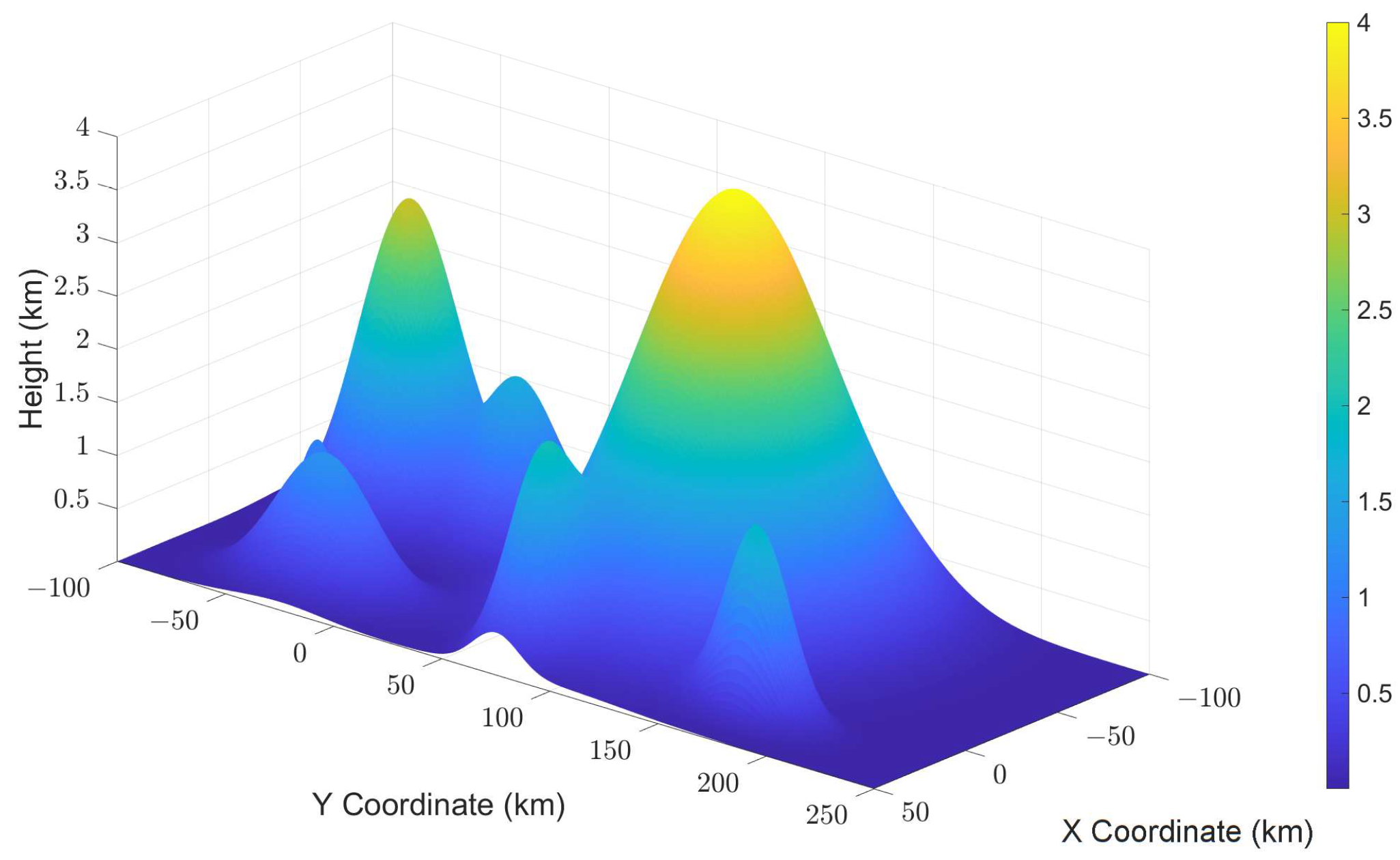
Firstly, it is necessary to model the basic terrain. This paper adopts the classic digital elevation model to simulate the real environment through simulation functions. Here, a commonly used mountain simulation function in the industry is introduced from reference [25], and its mathematical description is as follows:
H ( x , y ) = k = 1 n h k exp x x k x k a t t 2 y y k y k a t t 2
In the formula, n represents the total number of peaks; h k denotes the height of the k -th peak; ( x k , y k ) stands for the central coordinates of the k -th peak; x k a t t and y k a t t , respectively, indicate the attenuation amounts of the k -th peak along the x axis and y axis, which mainly control the steepness of the corresponding peak.
Meanwhile, considering the existence of restricted airspace settings in actual route planning, this paper presents the mathematical descriptions of two common geometric-shape-based restricted airspace models, namely, the cylindrical model and the semi-ellipsoidal model:
L i ( x , y , z ) = ( x x i ) 2 + ( y y i ) 2 = R L i 2 z [ 0 , h i ]
W j ( x , y , z ) = ( x x j ) 2 a j 2 + ( y y j ) 2 b j 2 + ( z z j ) 2 c j 2 = 1 z 0
In the formulae, L i ( x , y , z ) represents the restricted airspace i in the shape of a cylinder, ( x i , y i ) represents the center coordinates of the cylinder, R L i and h i are its radius and height; and W j ( x , y , z ) represents the restricted airspace j in the shape of a semi-ellipsoid, ( x j , y j , z j ) represents the center coordinates of the semi-ellipsoid, and ( a j , b j , c j ) represents the radii along the x , y , and z axes.

2.2. Three-Dimensional Route Planning Model

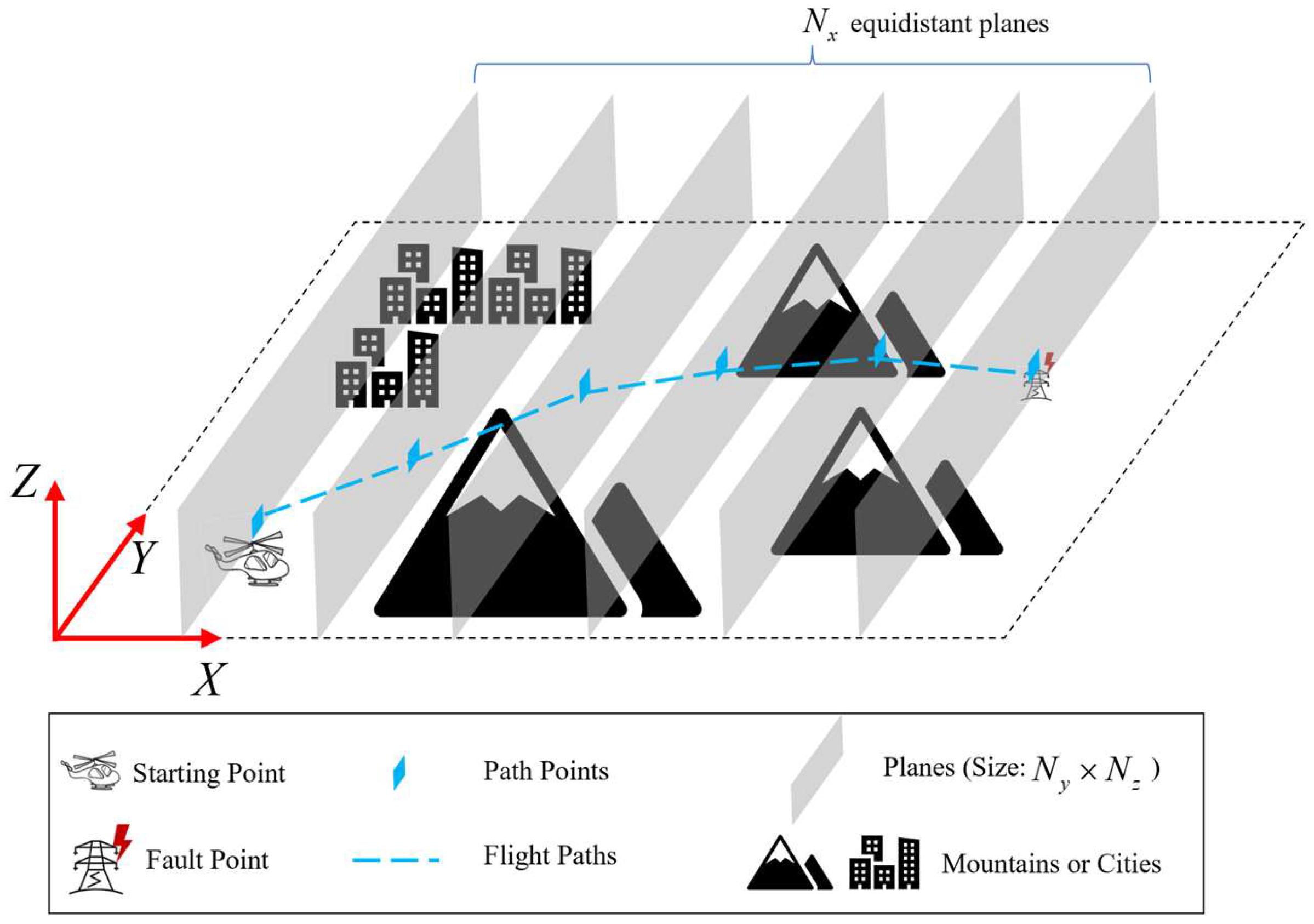
Based on the aforementioned space, a series of ordered and discrete coordinate points are used to represent the three-dimensional route of the helicopter. Several planes are set along any coordinate axis direction to map the position of the helicopter’s route onto that axis. Taking the x axis as an example as shown in Figure 1, equally spaced planes are set along the axis from the starting point to the end point. Each plane is then divided into N y N z discrete points, and a path point is selected on each plane. Finally, an ordered set of N x points is obtained to represent the helicopter’s route trajectory. It is ideally assumed that the helicopter travels in a straight line between adjacent planes. The accuracy and scale of solving the route planning problem increase with the increase in the value of N x N y N z .

2.2.1. Objective Function of Path Planning

In the process of helicopters participating in emergency restoration, the shortest voyage distance should be considered in the spatial dimension to enable helicopters to quickly transport between multiple locations. The calculation formula for the total length of a helicopter’s flight path in three-dimensional space is the sum of the distances between each path point, and its mathematical description is as follows:
p = 1 N 1 ( x p + 1 x p ) 2 + ( y p + 1 y p ) 2 + ( z p + 1 z p ) 2
To facilitate a better solution, the above formula is adjusted, and the minimum sum of squared distances is adopted as the objective function of the three-dimensional route planning model.
min p = 1 N 1 ( x p + 1 x p ) 2 + ( y p + 1 y p ) 2 + ( z p + 1 z p ) 2

2.2.2. Constraints of Path Planning

  • Basic path constraints
j k F i , j , k = 1 , i
( x 1 , y 1 , z 1 ) = ( x start , y start , z start ) ( x N x , y N x , z N x ) = ( x end , y end , z end )
x p = x start + ( p 1 ) N x 1 ( x end x start ) y p = j k F p , j , k Y j , k z p = j k F p , j , k Z j , k , p 2 , N x 1
In the above formulae, F i , j , k is a binary variable with a scale of N x N y N z , representing whether the coordinate point on the i -th plane is selected as the path point on that plane. If it is 1, it is a path point; if it is not 1, it means it is not a path point. ( x p , y p , z p ) is the coordinate of the path point; ( x start , y start , z start ) and ( x start , y start , z start ) represent the coordinates of the starting point and the ending point of the route, respectively; and Y j , k and Z j , k are the y -axis and z -axis coordinates of the point represented by F i , j , k , respectively. Formula (6) indicates that only one coordinate point on each y z plane can be a point passed by the route; Formulae (7) and (8) are the representation methods for all path points.
For the route planning model, a large-scale power system implies the need to handle a broader range of 3D space, which poses challenges to the scale design of the binary variable F . If the designed scale is too small, the routes will be excessively constrained, making it impossible to ensure that the routes between plans do not pass through mountains, high-rise buildings, or no-fly zones. Conversely, if the designed scale is too large, it will lead to an increase in the computational cost caused by the high resolution. Therefore, dispatchers need to select an appropriate path planning calculation accuracy based on actual conditions.
2.
Spatial restriction constraints
During the helicopter’s flight, to avoid collision due to ground contact, its flying altitude should always be higher than the terrain height while ensuring an adequate reserved safety distance, that is,
z p H x p , y p + h safe , p 2 , N x 1
In the formula, H x p , y p represents the terrain height at position x p , y p ; h safe denotes the vertical safety distance reserved from the basic terrain.
During the flight, the helicopter’s route must not conflict with restricted airspace. Therefore, the helicopter’s flying altitude should always be higher than the minimum height corresponding to each point within the restricted airspace, with an adequate safety distance reserved.
z p L x p , y p + h safe , p 2 , N x 1
z p W x p , y p + h safe , p 2 , N x 1
In the formulae, L x p , y p and W x p , y p , respectively, represent the height of the cylindrical restricted airspace and the height of the semi-ellipsoidal restricted airspace at position x p , y p ; h safe denotes the safety height reserved between the helicopter and the restricted airspace.
3.
Flight characteristic constraints
During the high-speed flight of a helicopter, to ensure the stability of its flight attitude and the airworthiness of the route, it is necessary to limit the maximum turning and pitching distances between path points.
Δ y max y p + 1 y p Δ y max Δ z max z p + 1 z p Δ z max , p [ 1 , N x 1 ]
In the process of the rapid post-disaster restoration of power systems, the helicopter’s three-dimensional route planning model, which takes into account environmental constraints and flight characteristics, can provide three-dimensional routes and actual flight distances between every two points among heliport sites and power system fault points. This model offers more realistic and reliable route data for the subsequent rapid post-disaster restoration models of power systems.

3. Dispatch and Restoration Model Considering Two Emergency Resources: Helicopters and Energy Storage

3.1. Cost Calculation of Post-Disaster Dispatch in Power Systems

3.1.1. Helicopter Dispatch Cost

In the emergency response process, the cost of helicopter scheduling mainly includes the basic cost of dispatching the helicopter and the fuel consumption cost incurred during the helicopter’s flight and hovering. The calculation formula is as follows:
C H = C base v V E v + C t r a n s i V j P T i , j , v travel X i , j , v + β i V j F T i , v repair , stay M i , v
In the formula, V denotes the set of all available helicopters; P represents the set of all nodes, including fault points and helicopter starting/ending points; F stands for the set of all fault points; C b a s e is the basic dispatching cost of a helicopter, i.e., the basic fee per helicopter, with the unit being ten thousand yuan per helicopter; C t r a n s is the helicopter’s flight cost, in ten thousand yuan per hour; β is the conversion coefficient for converting helicopter hovering time into flight time; E v is a binary variable indicating whether a helicopter is dispatched for emergency restoration; T i , j , v travel represents the flight time of helicopter v from node i to node j ; X i , j , v is a binary variable indicating whether the operation route of helicopter v includes the direction from i to j ; and M i , v is a binary variable set to describe different operation modes of the helicopter after arriving at fault point i . This paper designs two operation methods for the helicopter after reaching a fault point: one is hovering at the fault site for on-site operations (the variable M i , v takes a value of 1), and the other is that, after transporting maintenance personnel and materials to a fault point, they immediately proceed to the next fault point (the variable value is 0); T i , v repair , stay represents the repair time required for the fault point when helicopter is in the hovering operation mode.

3.1.2. Energy Storage Dispatch Cost

When considering energy storage resources participating in the post-disaster restoration scheduling of power systems, given the complexity of the energy storage configuration and the diverse application scenarios they face, it is unreasonable to allocate all costs of energy storage to emergency restoration under extreme conditions. Based on the full-life-cycle cost of energy storage, this paper calculates the cost per unit of electricity of the energy storage in specific scenarios, and the mathematical expression of the cost per kilowatt-hour of energy storage is as follows:
C L C O S = C E + C P d + C E + C P d t = 1 L C O & M ( t ) ( 1 + r ) t + P C η t = 1 L C n ( t ) ( 1 + r ) t η t = 1 L C n ( t ) ( 1 + r ) t
In the formula, d represents the discharge duration of energy storage at its rated power; P c is the purchase price during charging; η denotes the cycle efficiency of the energy storage station; L C stands for the service life of the energy storage system; n ( t ) is the annual cycle count; r is the discount rate; O & M ( t ) is the ratio of the operation and maintenance costs to the installation cost in the t -th year; C E is the installation cost varying with capacity, with the unit being yuan/kWh; and C P is the installation cost varying with power, with the unit being yuan/kWh.
During the post-disaster restoration process of the power system, the energy storage scheduling cost is as follows:
C E S = C L C O S t T i E S P i , t ES Δ t
In the formula, T is the set of time periods, and E S is the set of energy storage nodes; P i , t ES represents the output of the energy storage node i in the time period t .

3.1.3. Calculation of Load Loss Compensation Cost

During the restoration process, due to the damage to the system caused by extreme events and the need for the stable operation of the post-disaster system, it is often impossible to ensure a power supply to all loads in a short period of time, resulting in losses from local power outages. In this regard, this paper introduces a compensation mechanism to compensate for load outages based on load value:
C c p s = C P o w e r t T i N P i , t LS Δ t
In the formula, N is the set of bus nodes; and P i , t LS represents the load curtailment at the node i during the time period t .

3.2. Rapid Post-Disaster Restoration Model for Power Systems

3.2.1. Objective Function for Helicopter Dispatching in Power System Emergencies

After a power system failure, the primary goal is to minimize load curtailment and reduce power outage losses. When considering helicopters and energy storage resources participating in post-disaster restoration together, since their usage costs are higher than those of traditional means, it is also necessary to optimize the scheduling methods of these flexible resources and reflect their corresponding costs in the objective function. Therefore, the objective function of the restoration model is as follows:
min s S ( C s c p s + ω ( C s E S + C s H ) )
In the formula, S represents the set of post-disaster fault scenarios of extreme events in the power system; ω is a weight coefficient to adjust the ratio of the orders of magnitude between the two objective functions, so as to ensure that the former objective function of minimizing load curtailment always occupies a dominant position when solving the optimization problem.

3.2.2. Constraints for Helicopter Dispatching in Power System Emergencies

1.
Basic path constraints
In the process of the helicopter emergency response, once a helicopter is dispatched, it is assumed to follow a planned route that starts from a site, proceeds to several fault points in an orderly manner, and, finally, returns to the site. Therefore, the following basic route constraints are considered:
j F X start , j , v = E v , v V , start v D start
i F X i , end , v = E v , v V , end v D end
i F X i , j , v = i F X j , i , v , j F , v V
X i , j , v = 0 , i = j P , v V
X s t a r t , e n d , v = X e n d , s t a r t , v = 0 i = 1 n f X e n d , i , v = 0 j = 1 n f X j , s t a r t , v = 0 , v V
In the formulae, s t a r t v and e n d v are, respectively, the take-off point and landing point of helicopter v ; D s t a r t and D e n d are, respectively, the sets of take-off points and landing points of helicopters. Formulae (18) and (19), respectively, indicate that all dispatched helicopters need to depart from the site to the fault points and return from the fault points to the site for landing; Formula (20) means that, after a helicopter arrives at fault point, it must leave from the fault point, ensuring flow conservation; Formula (21) indicates that a helicopter is not allowed to return to any point once it has arrived there; and Formula (22) represents special paths that are not allowed, including the direct path between the starting point and the ending point, the path from a fault point to the starting point, and the path from the ending point to a fault point.
2.
Task assignment constraints
During the restoration process, to avoid the waste of maintenance resources and flight mileage, it is necessary to ensure that each fault point is reached and handled by exactly one helicopter:
Y j , v = i F D s t a r t X i , j , v , j F , v V
v V Y j , v = 1 , j F
M j , v Y j , v , j F , v V
In the formulae, Y j , v is a binary variable indicating whether fault point j is repaired by helicopter v .
Formula (23) indicates that all fault points passed through in the helicopter’s route planning will be responsible for repair by the corresponding helicopter; Formula (24) means that each fault point will be repaired only once; and Formula (25) shows that the operation mode can be selected only when the helicopter arrives at the corresponding fault point.
3.
Resource limitation constraints
In the process of the helicopter emergency response, this paper considers the limitations on maintenance resources carried by each helicopter and the restrictions on flight mileage for a single mission, and lists the following constraints:
j F Y j , v D j S C v , v V
i , j P X i , j , v W i , j + α i F M i , v T i , v repair ,   stay W v max , v V
In the formulae, D j represents the maintenance resources required for fault point j ; S C v is the upper limit of resources that helicopter v can carry in a single mission; W i , j is the flight distance between fault points i , j ; α is the coefficient of equivalent flight mileage when the helicopter is in the state of hovering for on-site maintenance; and W v max is the maximum flight mileage of helicopter v in a single mission.
4.
Maintenance time and line state update constraints
In this paper, the starting time is set as the moment when the helicopter departs from the starting point. The repair time of the faulty line is calculated based on the time to reach the fault point according to the route plan and the required maintenance time, and the line status is updated according to the repair time:
T start , v = 0 M start , v = 0 M e n d , v = 0 , start v D start , e n d v D e n d , v V
X i , j , v = 1 T j , v = T i , v + M i , v T i , v repair ,   stay + T i , j , v travel , v V , i F D start , j F D end
Y j , v = 0 T j , v = 0 , j F , v V
v V T n , v + Y n , v T n , v repair ,   stay + Y n , v ( 1 M n , v ) T n leave ,   extra Δ t t T t φ n , t v V T n , v + Y n , v T n , v repair ,   stay + Y n , v ( 1 M n , v ) T n leave ,   extra Δ t + 1 ε , n F
t T φ n , t = 1 , n F
In the formulae, T j , v denotes the time when helicopter v arrives at node j ; and φ n , t is a binary variable indicating whether fault point n has been repaired at the t -th time period.
Formula (28) indicates that the time T start , v when the helicopter departs from the starting point is recorded as 0. Considering that no operation is required at the starting point and the return point, the operation mode of the two points is equivalent to hovering, but there is no consumption of resources or time; Formula (29) represents the logic for calculating the time taken by helicopter v to travel from point i to point j —that is, the arrival time at point j equals to the arrival time at point i plus the operation time at point i and the traffic time between i , j points; Formula (30) means that the arrival times of fault points other than those on the planned route of helicopter v are all recorded as 0; Formula (31) is used to calculate the maintenance completion time of fault point n , which is the arrival time of the corresponding helicopter plus the maintenance operation time; and Formula (32) ensures that the maintenance completion time of each fault point is unique during the restoration process. Among them, Formula (31) contains a nonlinear part where two binary variables are multiplied. An auxiliary variable and linearization constraints can be introduced to describe the product of binary variables, which will not be elaborated here.
After calculating the repair time of the fault point, the operating status of the faulty line can be updated accordingly:
Z i j , t τ = 1 t φ n , τ , n = ( i , j ) F , t T
Z i j , t = 1 , ( i , j ) L / F , t T
In the formulae, ( i , j ) is a line with the starting node i and the ending node j ; L is the set of system lines; and Z i j , t is a binary variable representing the operating status of line ( i , j ) at the t -th time period, where 1 indicates that the line is closed and 0 indicates that it is open.
The above two formulae indicate that non-faulty lines are always in normal operating status, while faulty lines can only operate normally and allow active power flow after being repaired.
5.
Power system and power flow security constraints
P i j max ( 1 Z i j , t ) P i j , t θ i , t θ j , t x i j P i j max ( Z i j , t 1 ) P i j , t θ i , t θ j , t x i j θ r e f , t = 0 , ( i , j ) L , t T
Z i j , t P i j max P i j , t Z i j , t P i j max , ( i , j ) L , t T  
P i G   min P i , t G P i G   max , i N G , t T  
0 P i , t LS P i , t L , i N , t T  
P i , t G = 0 , i N / N G , t T  
In the formulae, P i j max is the upper limit of active power allowed to flow through line ( i , j ) ; P i j , t is the active power flowing through line ( i , j ) during time period t ; θ i , t is the voltage phase angle of node at time period t ; x i j is the reactance of line ( i , j ) ; r e f denotes the slack bus of the system; P i G   max and P i G   min are, respectively, the upper and lower limits of the output of traditional generator unit i ; P i j , t represents the output of generator unit during time period; N G is the set of generator units; P i , t L is the active load demand of node i at time period t ; and P i , t L S is the active load curtailment of node i at time period t .
Formula (35) represents the linearized DC power flow constraint; and Formulae (36)–(39) impose constraints on the line transmission power, generator output, and load curtailment.
The principal advantage of the DC power-flow constraints lies in their ability to reduce model complexity and dramatically improve computational efficiency, making them particularly well-suited to large-scale systems and time-critical decision environments. By retaining only the linear relationship between active-power injections and phase-angle differences, while explicitly neglecting reactive-power balances and voltage-magnitude constraints, the original non-linear programming formulation is transformed into a mixed-integer linear program (MILP), thereby drastically decreasing the solution difficulty. Given that post-disaster emergency operation demands a high computational speed while tolerating moderate accuracy, this paper adopts DC power-flow constraints in the proposed restoration model.
6.
New energy output constraints
New energy units represented by wind power generation and photovoltaic power generation have random output, and the use of deterministic models may be too conservative or risky. This model adopts a simple chance constraint to convert the uncertainty of new energy output into a probabilistic constraint condition. The following formula defines that the actual output of new energy does not exceed the predicted value and the upper bound of the output confidence interval.
P i , t G P ^ i , t R + Φ 1 ( 1 ϵ R / 2 ) σ i , t R , i N R e n e w , t
In the formula, P ^ i , t R and σ i , t R are, respectively, the predicted output and the standard deviation of the prediction error of the new energy unit at the node during time period t ; Φ 1 denotes the inverse cumulative distribution function of the standard normal distribution; ϵ R is the allowable overload probability of the new energy unit output; and N R e n e w is the set of nodes with new energy configurations.
The variability and randomness of renewable energy output are among the key factors influencing the power and energy balance in power systems. Different types of renewable energy generation also exhibit distinct output patterns. Taking wind power as an example, since wind speed approximately follows a Weibull distribution, constraint (40) can be expressed as follows:
P i , t G P W F Weibull 1 ( 1 ε ; k , λ ) , P r a t e , v r a t e d , v i n , v o u t , i N R e n e w , t
Here, k and λ represent the shape and scale parameters of the Weibull distribution, respectively; P r a t e , v r a t e , v i n , and v o u t denote the rated power, rated wind speed, cut-in wind speed, and cut-out wind speed of the wind turbine generator; F W e i b u l l 1 refers to the inverse cumulative distribution function (i.e., quantile function) of the Weibull distribution; ε is the allowed probability threshold; and P W represents the mapping function between the wind turbine output and wind speed, which is typically a piecewise function.
7.
Energy storage constraints
This paper adopts a simple charging and discharging model for energy storage, using a binary variable u i , t E S to indicate whether the energy storage is in a charging or discharging state at time t .
P E S , i max ( 1 u i , t E S ) P i , t E S P E S , i max u i , t E S , i N E S , t
S O C i , t = S O C i , t 1 + P i , t E S Δ t E i , max , i N E S , t 2
S O C i min S O C i , t S O C i max , i N E S
P i , t E S = 0 , i N / N E S , t
In the formulae, P E S , i max is the maximum charge–discharge efficiency of energy storage i ; P i , t E S and S O C i , t are, respectively, the output and state of charge of the energy storage system at node i at time t ; N E S is the set of bus nodes with energy storage configurations; E i , max is the capacity of the energy storage system at node; and S O C i min , S O C i max are, respectively, the safe upper and lower limits of energy storage, which are used to prevent damage to battery life caused by overcharging/over-discharging.
8.
Power balance constraints
In this study, load curtailment is reflected in the form of node injection power. Based on the power injection relationship between lines and units and nodes, the following constraint formulae are derived:

P i , t G + P i , t E S = j : ( i , j ) L P i j , t j : ( j , i ) L P j i , t + P i , t L + P i , t L S , i N , t T

3.2.3. Scalability Analysis

Considering practical power systems, the route adopted in this study is modeled as an MILP problem, into which the linearized DC power flow and the characteristics of the Vehicle Routing Problem with Resource Constraints (VRPRC) are embedded. Its structural features provide a solid foundation for good scalability. A large number of mature commercial solvers are equipped with efficient solution algorithms (such as branch-and-bound and cutting-plane methods) for this type of problem, and can effectively handle the optimization of power systems with hundreds to thousands of nodes and lines. Therefore, the collaborative recovery model established in this study has the potential to handle larger-scale problems in terms of the theoretical architecture.
Admittedly, it must be acknowledged that a significant expansion of the network scale will lead to a combinatorial increase in computational complexity. With the rapid growth in the number of power grid nodes and faulty lines, the number of decision variables and constraints will increase combinatorially, which will directly pose challenges to computational resources. To meet the needs of large-scale practical applications in the future, further research will focus on developing high-performance solution strategies, such as adopting hierarchical optimization and decomposition algorithms, or designing specialized heuristic rules, so as to obtain feasible and efficient recovery schemes within a reasonable time frame.

4. Study Case

4.1. Basic Data

In this paper, improvements are made to the traditional IEEE 30-bus system from [26]. Conventional generators at nodes 2, 5, 11, and 13 have been replaced by renewable energy generators. These can be regarded as negative fluctuating loads, simulating the system response under the high penetration of renewable energy in a modern power system while maintaining power and energy balance. Considering the volatility of new energy, a safer, more stable, and more sufficient power system is required. Therefore, the line capacity of the original system is increased by 1.2 times, and the unit capacity is also increased by 1.2 times. Meanwhile, in consideration of the uncertainty of new energy output, the overload probability is set to 0.05, and the predicted value and standard deviation of the predicted output are 0.9 and 0.1 times the rated capacity, respectively. In addition, lithium-ion battery and sodium-ion battery energy storage stations with a capacity of 30 MWh and a discharge capability of 0.5C are configured at buses 7 and 18 to provide power support for the system. The calculation of the electricity cost of energy storage refers to Table 1, and the electricity costs of the two types of energy storage participating in post-disaster restoration scheduling are 0.30 yuan/kWh and 0.54 yuan/kWh, respectively.
In the study case, the following idealized postulates are introduced to foreground the quintessential issues of resilience:
  • The power system is endowed with the capability of faulted-circuit localization that is both expeditious and error-free.
  • Upon completion of the flight-path planning, helicopters execute their maneuvers in strict accordance with the prescribed trajectories and timetable.
  • The manpower and temporal resources requisite for each corrective maintenance task are treated as deterministic constants.
These three premises serve to circumscribe unambiguously the feasible region of the helicopter-based emergency-scheduling problem. Their epistemic justification resides in the systematic exclusion of stochastic and subjective perturbations—such as the mis-localization of faults, enroute deviations induced by sudden meteorological or air-traffic events, heterogeneity in operator proficiency, progressive tool wear, and component incompatibility—that would otherwise confound the causal interpretation of scheduling outcomes.
Information such as the corresponding relationship between the system network topology and the location of the constructed terrain environment, helicopter parameters, and the location of faulty lines is based on references [27] and sorted out in Table 2, Table 3, Table 4, Table 5 and Table 6. The geographical environment where the power system in the study case is located is shown in Figure 2.
Table 1. Energy storage technology cost calculation [28].
UnitDescriptionLithium-IonSodium-Ion
HourContinuous discharge duration at rated power44
Yuan * 1,2/kWhGrid purchase price for charging energy00
%Storage system efficiency from AC input to AC output9090
YearEconomic/technical service life1616
Cycles/yearEquivalent full cycles per year350350
%Nominal discount rate for cost–benefit analysis77
%Annual operation and maintenance cost as a percentage of initial investment33
Yuan/kWhInitial investment per unit of energy capacity64120
Yuan/kWInitial investment per unit of power capacity2424
Yuan/kWhLife-cycle unit cost of discharged electricity0.300.54
* 1 All cost data presented in this study are denominated in Chinese Yuan (CNY). * 2 To aid international interpretation, the average 2024 annual exchange rates (1 CNY = 0.14042 USD; 1 CNY = 0.12945 EUR) are provided as a reference. Readers can use these rates to approximate the scale of costs in either US Dollars or Euros.
Table 2. Terrain and environment data.
Number of Mountains ( x k , y k ) /km h k /km ( x k a t t , y k a t t ) /km
1(−50, 100)4.00(50, 50)
2(−50, 0)1.50(20, 20)
3(−50, −50)3.00(25, 25)
4(0, −50)1.00(10, 10)
5(25, 175)1.80(10, 20)
6(25, 75)1.65(20, 15)
7(25, −25)1.30(15, 30)
Table 3. Restricted airspace data.
Restricted AirspaceCentral Coordinates/km Radius/km Height/km
cylinder 1(−25, 25)10.001.50
cylinder 2(−80, 30)10.001.20
semi-ellipsoid 1(−50, 200, 0)(5.00, 5.00, 1.50)/
Table 4. Helicopter data.
ParametersIndexValue
/Helicopter’s typeBELL 407
n h e l i c o p t e r The number of the helicopter can be dispatched2
n d e p o t The number of the helicopter depot1
( x d e p o t , y d e p o t , z d e p o t )The location of the helicopter depot(0, 0, 0.1)
v The speed of the helicopter 222 (km/h)
W max Maximum range of a single flight690 (km)
α Flight mileage conversion factor 50 (km/h)
β Conversion factor for converting hovering time to flight time0.2252
C b a s e Basic dispatching cost (in thousand yuan)20
C t r a n s Helicopter’s flight cost (in thousand yuan)5.785 (h−1)
S C v Upper limit of resources carried in a single voyage4
Table 5. Faulty line parameters.
Number of the Fault PointLine in Power SystemLocationDemand for Repair ResourceTime Cost of RepairingExtra Time Cost for Aerial Work
14(−82, 6, 0.2)122
27(−89, −66, 0.2)141
313(5, −87, 0.0)122
436(46, −22, 0.2)122
529(25, 130, 0.3)141
630(35, 224, 0.0)122
76(−3, 67, 1.2)122
89(−48, −43, 2.8)122
919(−46, 128, 2.9)141
1024(−14, 219, 0.0)122
Table 6. Fault scenario information.
Number of the Fault ScenarioOccurrence ProbabilityFault Points Included
10.201, 2, 3, 4, 5, 6
20.153, 4, 5, 6, 7, 8
30.155, 6, 7, 8, 9, 10
40.11, 2, 3, 4, 5
50.13, 4, 5, 6, 7
60.15, 6, 7, 8, 9
70.051, 2, 3, 4
80.053, 4, 5, 6
90.055, 6, 7, 8

4.2. Route Planning Results

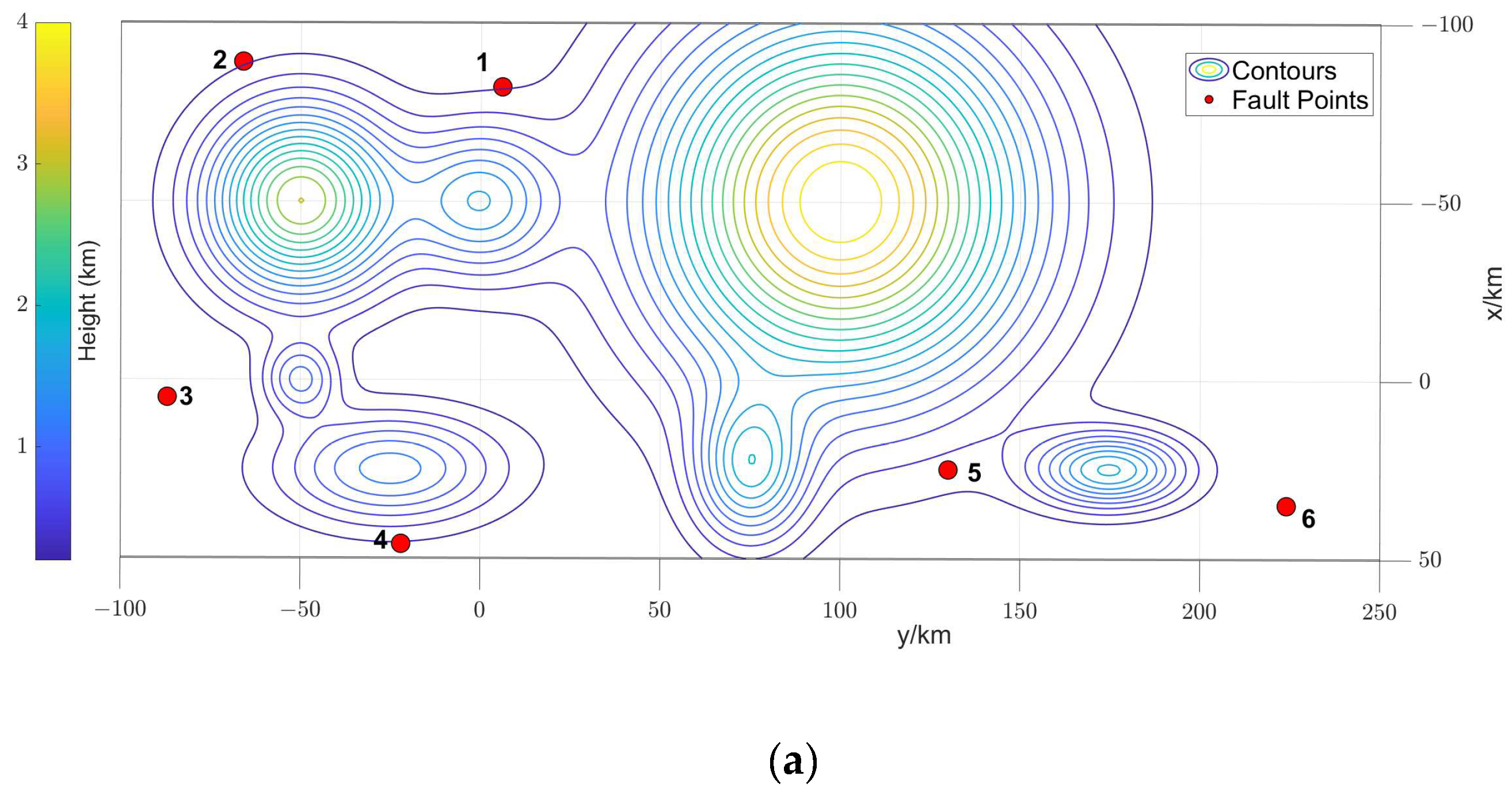
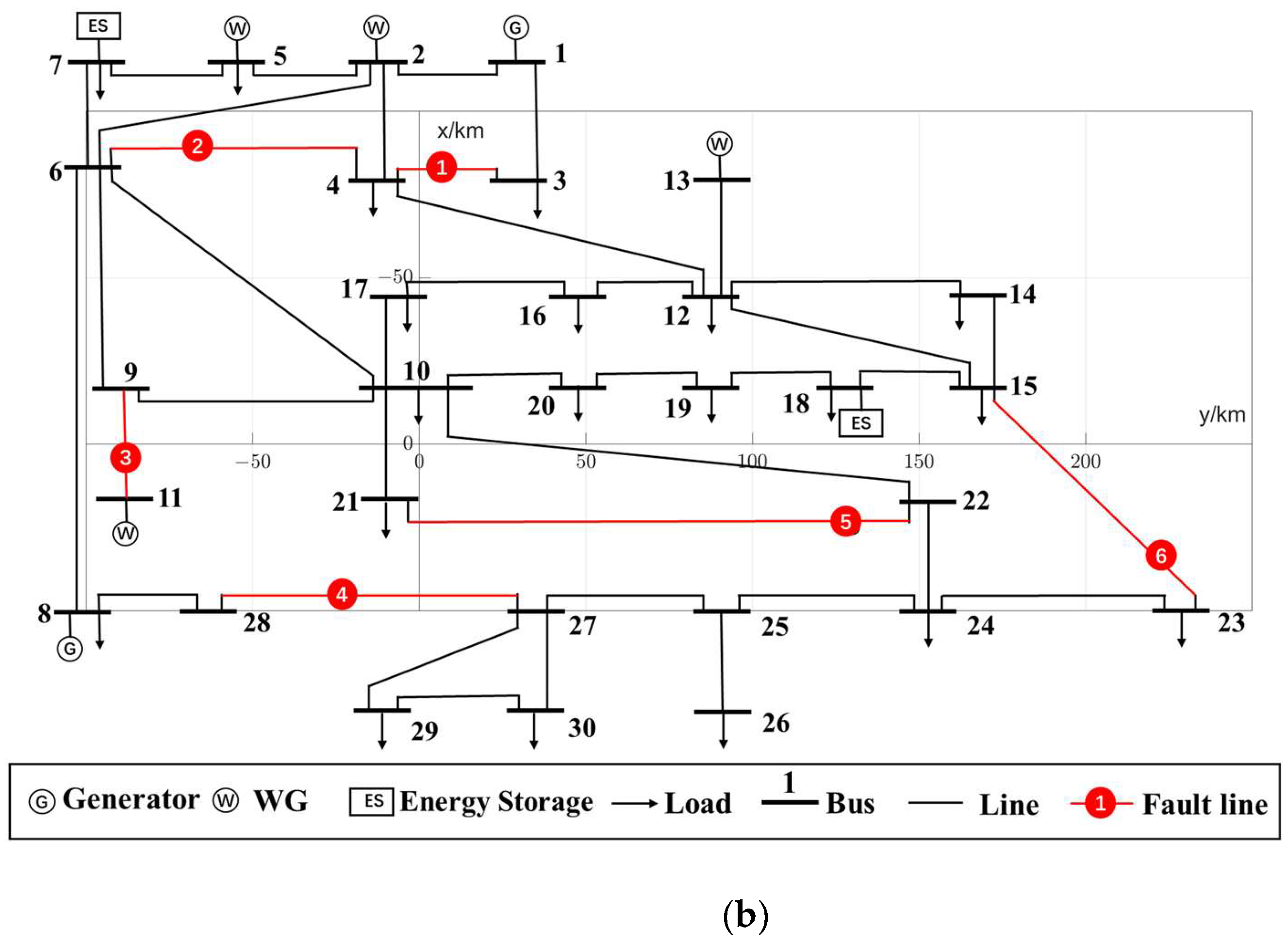
In the model constructed for this case, each voyage planning divides the space into eight planes along the x axis, i.e., N x is set to 8; the spatial accuracies of the y axis and z axis are 1 km and 0.1 km, respectively; and h s a f e is set to 0.1 km, while Δ y max and Δ z max are set to 50 km and 1 km, respectively. The three-dimensional helicopter route planning is solved in the environment shown in Figure 3a and the topological network in Figure 3b. Taking the nodes involved in Scenario 1 as an example, where the faulty nodes are marked with red dots and line segments, the calculated route distances are shown in Table 7.

4.3. Restoration Process Simulation

Helicopters feature rapid response and cross-domain maneuverability in the context of post-disaster faults in power systems. Taking disaster scenario 1 as an example, this paper simulates the improvement level of system restoration efficiency brought by helicopters participating in the emergency response under this scenario. Meanwhile, it calculates the loss expectation under the condition that an average of ten large-scale disasters occur every year.

4.3.1. Improvement of System Restoration Capability

In this study, the ground vehicles are used as a comparative case to highlight the advantages of helicopters in the emergency restoration of power systems through simulation. In the actual restoration process, the primary goal of post-disaster restoration is to minimize load curtailment. Therefore, the weight coefficient ω for helicopter dispatch costs and energy storage scheduling costs is set to 0.1 to emphasize the importance of load restoration.
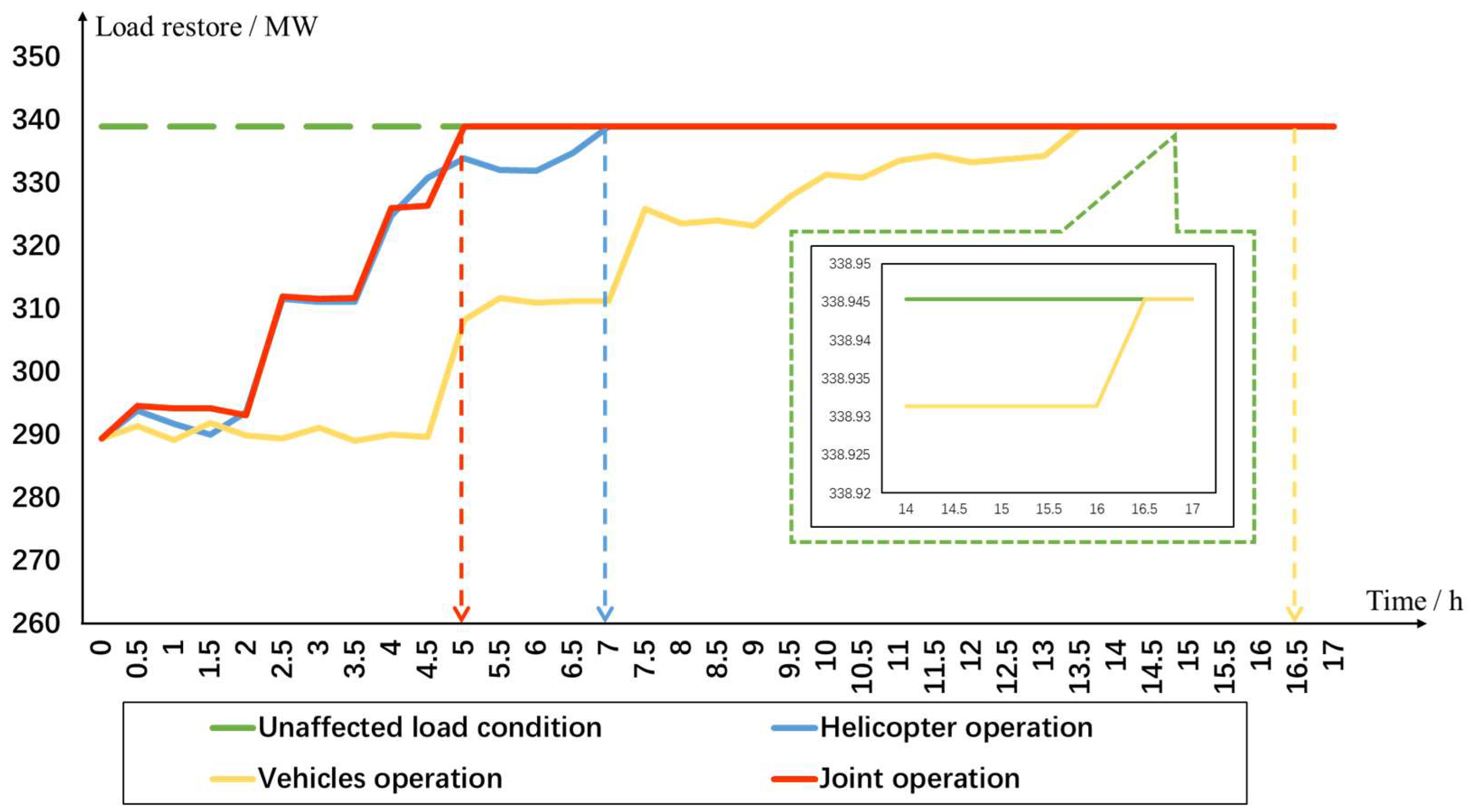
In the comparative case, we consider employing two vehicles to participate in the emergency repair and restoration of the power system. The vehicle’s travel distance is set to 1.5 times that of the helicopter’s voyage, with an average driving speed of 80 km/h. For the on-site maintenance time, considering that the time for climbing the tower is 1 h more than that for helicopter hovering maintenance, the dispatch cost is set to 0, and the driving cost is 0.16 thousand yuan per hour. The maximum single driving distance, resource capacity, and initial position of the vehicles are consistent with those of the helicopters. In Scenario 1, the restoration curves obtained by the three transportation modes are shown in Figure 4.
The superiority of helicopters as rescue and maintenance transportation vehicles is reflected in the earlier rise of the load restore curve and the smaller area enclosed with the original load curve in the coordinate graph. This indicates that emergency repairs using helicopters can complete the post-disaster restoration of the power system better and faster than ground transportation, thereby reducing the load curtailment. This study also simulates the third case where both helicopters and vehicles participate in post-disaster restoration. Undoubtedly, the best restoration effect can be achieved in this case. The task allocation, cost consumption, and load restoration status of the three methods are listed in the following Table 8. By comparing Case 1 and Case 2, it can be seen that, although dispatching helicopters incurs high transportation costs, in Disaster Scenario 1, the load restoration time and load loss when using helicopters for emergency response are less than half of those when using the same number of vehicles. Case 3, on the other hand, illustrates the advantages of sufficient flexible resources. Case 3 demonstrates the advantages of ample flexible resources in post-disaster emergency dispatch, even though this may require more investment.
It should be emphasized that the improvement is based on the idealized assumptions presented in Section 4.1. Although these assumptions avoid the impact of random factors on the results, they also limit the realism and adaptability of the model. This is because such factors do exert actual influences in the practical scheduling process. Assumption 1 ignores the flight time and additional fuel consumption caused by fault location errors, which will lead to emergency delays and a reduction in emergency response levels, thereby affecting the system recovery efficiency; and Assumptions 2 and 3 eliminate all possible random factors and deviations in the subjective capabilities of operators, making it impossible to perfectly replicate them in real-world scenarios. For instance, extreme disasters may damage communication facilities, resulting in the delayed transmission of fault information; secondary disasters triggered by extreme events might lead to route changes and disrupt maintenance progress; furthermore, the different disaster patterns and varying operational skills of maintenance personnel can also affect the status of fault points. A variety of factors collectively contribute to the uncertainties in the emergency response process.
These uncertainties, while beyond the scope of this study, are important considerations for real-world applications. Future research will focus on the introduction of uncertainty models, integrating historical data and the probability distributions of relevant parameters to address uncertain factors such as fault location errors and fluctuations in maintenance time. Meanwhile, to ensure the highest possible accuracy, active consideration will be given to integrating line patrol processes and real-time communication technologies to achieve dynamic updates of fault information and the real-time optimization of scheduling strategies. We have explicitly discussed their potential impacts on the results and highlighted the directions for future work to incorporate stochastic and dynamic elements.

4.3.2. Efficiency Improvement Factors and Cost–Benefit Analysis

In economic activities, benefits are usually measured by comparing the effectiveness achieved by a certain function with the costs incurred. In this section, an analysis is conducted on some factors related to restoration capabilities concerning two flexible resources: helicopters and energy storage. Meanwhile, this study evaluates the cost-effectiveness of these factors based on their application improvement indices. The application improvement index I is defined as follows:
I = P o w e r   o u t a g e   l o s s e s   f r o m   a p p l y i n g   e x i s t i n g   r e s o u r c e s I n v e s t m e n t   c o s t + P o w e r   o u t a g e   l o s s e s   a f t e r   r e s o u r c e   a l l o c a t i o n
When the defined application improvement index is greater than 1, we consider such an investment to be meaningful, and, the larger the value, the more beneficial the corresponding behavior is deemed to be.
9.
The number of the helicopter can be dispatched
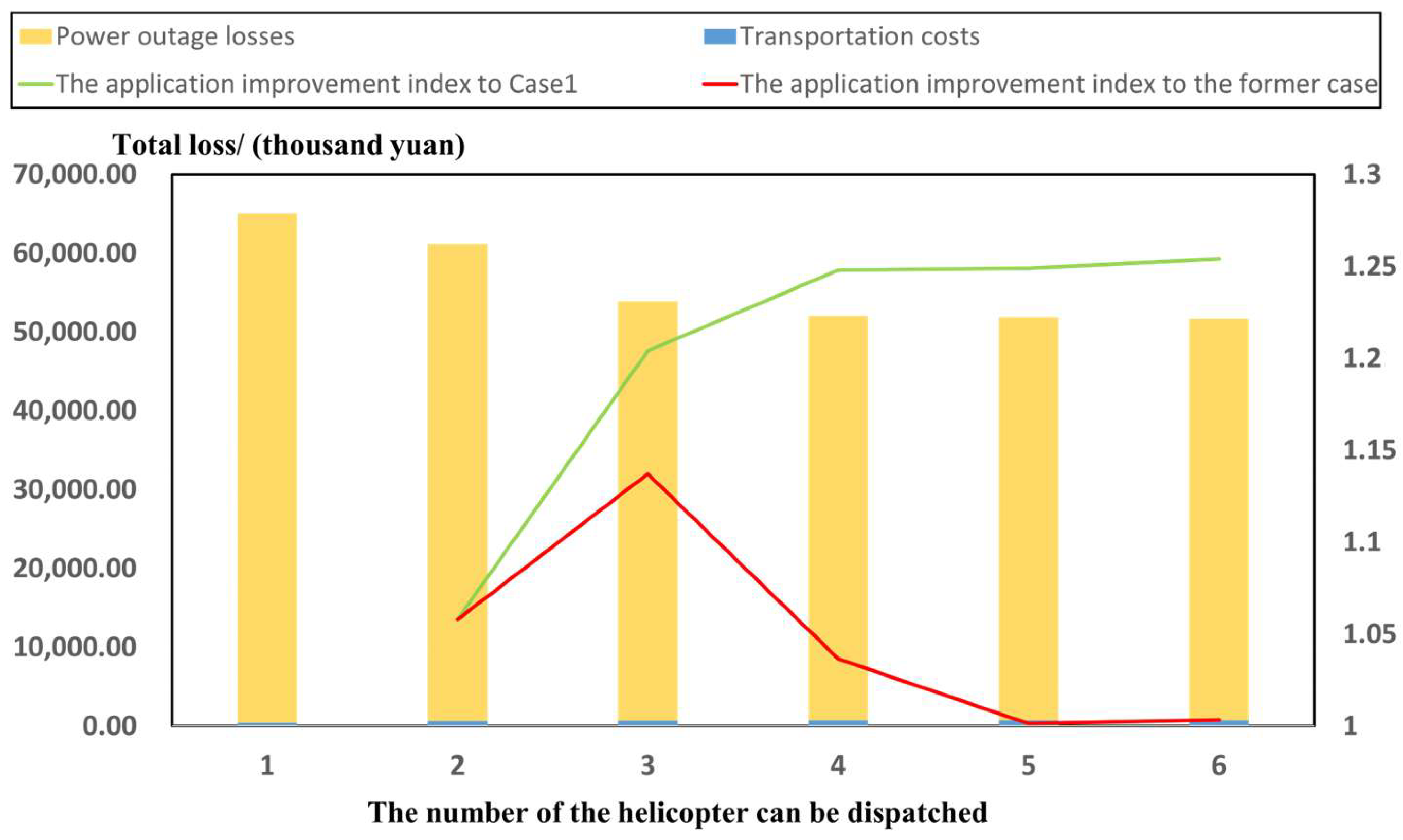
An increase in the number of helicopters can improve the maintenance efficiency of faulty equipment in the power system, which is the most direct and intuitive way to enhance the restoration level. Table 9 lists the expected cost losses in a given operating scenario and the cost losses in the most severe scenario as the number of available helicopters increases. Let us take one helicopter as the existing resource condition and conduct a cost–benefit analysis on the factor of the number of helicopters:
As can be seen from Table 9 and Figure 5, as the number of available helicopters increases from 1 to 6, the losses caused by power outages gradually decrease. Meanwhile, we also notice that, when the number of available helicopters is within 4, a relatively considerable application improvement index can be achieved; however, when the number of deployed helicopters reaches more than 5, the improvement in benefits is not significant. In fact, in most scenarios of the example test, due to the objective function of economic dispatch, Case 7 and Case 8 often do not put all available helicopters into emergency restoration. This indicates that the cost consumed by helicopters has exceeded the cost of load outage losses. In such cases, increasing the number of helicopters will instead lead to resource saturation and fail to achieve good benefits.
10.
Number and distribution of heliport depots
The distribution of stations is an important part of system planning. Since the model proposed in this study is mainly oriented toward operating scenarios, in the analysis of this factor, it is simply assumed that the annualized cost of each helicopter station is 500 thousand yuan. The analysis is carried out by comparing the changes in the number of stations under the condition that two and three helicopters can be deployed, respectively.
According to common sense, the decentralization of helicopter stations is conducive to better repairing widely distributed fault points. However, the application improvement index obtained in Table 10 is not optimistic, and even drops below 1 when considering the construction cost of the stations. The reason for this in the current example may be that the benefits generated by the small number of stations are limited. In addition, the locations of scattered fault points dilute the distribution advantages of multi-location stations. In short, this gives planners the inspiration that they need to consider more reasonable station site selection and more comprehensive fault scenarios.
11.
The effect of energy storage
Energy storage plays a vital role in the new power system. When extreme disasters damage the power system topology and cut off the original power transmission channels, energy storage can provide emergency power support. This study evaluates the benefits of energy storage systems participating in the post-disaster emergency response based on their cost per kilowatt-hour. The simulation results are presented Table 11.
As can be seen from the above table, energy storage has achieved good benefits in post-disaster emergency response and is a very important flexible resource in modern power systems.
This study places greater emphasis on the effectiveness of energy storage and the concepts of cost and efficacy behind the full-life-cycle costs embodied in the levelized cost of electricity. Therefore, the characterization of different energy storage technologies mainly focuses on their varying levelized costs of electricity. However, there is significant scope for exploring the roles that energy storage can play in emergency situations and the differences between various energy storage technologies.
Taking the energy storage technologies included in our levelized cost calculation as examples, lithium-ion battery storage and sodium-ion battery storage differ not only in their levelized costs of electricity but also in their temperature tolerance capabilities. For instance, sodium-ion batteries exhibit better low-temperature tolerance, which means their performance will differ when facing different extreme disasters, especially those related to temperature. In terms of power and energy density, lithium-ion batteries typically have a higher power density and can provide active power support more quickly, while sodium-ion batteries have advantages in low-temperature performance and safety. These characteristics influence their different performances in addressing short-term power deficits and providing longer-duration voltage support after disasters. Regarding safe operating windows, lithium-ion batteries should adhere to stricter charge–discharge rate (C-rate) constraints to simulate operational limitations that may exist for safety reasons, whereas the corresponding constraints for sodium-ion batteries are relatively relaxed. The selection of energy storage technology is not merely a matter of cost but a strategic decision deeply coupled with recovery strategies, system risk tolerance, and long-term asset planning.

4.3.3. Selection of Weight Coefficients

In the proposed solution model, the optimization objective is measured in economic dimensions. However, the post-disaster situation of power systems cannot be generally reduced to economic losses. As an important part of social public services, a reliable power supply in post-disaster emergency situations has many values that cannot be economically quantified. Therefore, post-disaster restoration often takes minimizing load curtailment as the main goal. In this regard, we conduct a sensitivity analysis on the weight coefficient ω in the objective function to explore its impact on load restoration during the post-disaster restoration process. In the following cases, the number of available helicopters is set to 5.
The four weight coefficients selected in Table 12, in descending order, emphasize different priorities in the post-disaster emergency response. When the weight coefficient of secondary costs is set to a very high value, such as in Case 14, specific effects can often be achieved: for example, reducing the power support pressure of energy storage or the fuel consumption required by helicopters. However, such coefficients would be considered putting the cart before the horse in post-disaster emergency situations. If secondary costs are ignored and the most conservative restoration strategy is adopted, such as in Case 16, the power loss incurred will be minimized, but the value of the reduced power loss may be far less than the consumption in secondary costs. When the weight coefficient is set to 1, the finally calculated cost is closest to the actual cost, so the minimum comprehensive cost is likely to be obtained. The weight coefficient used in this paper is 0.1, which highlights the main objective while taking into account the consumption of secondary costs, thus having a certain degree of rationality. In actual operation and scheduling, it can be flexibly selected according to needs.

5. Conclusions

This paper studies the behavioral advantages (including rapid response and cross-domain maneuverability) exhibited by helicopters in the post-disaster emergency response and the cost–benefit analysis of their dispatch. A route planning model based on a three-dimensional spatial environment is constructed. Further, considering the characteristics of the high proportion of new energy and wide application of energy storage systems in the new power system, a method for the rapid post-disaster restoration of power systems with the synergy of helicopters and energy storage resources is proposed, which includes several links such as helicopter task allocation, the stable operation of power systems, and response coupling. The model constructed in this paper verifies the above advantages of helicopters in the case study, and the results show that, from the perspective of decomposing the economic dispatch cost of the post-disaster emergency response, helicopters have greatly reduced the economic losses of post-disaster emergency work. At the same time, a cost–benefit analysis is carried out on various factors such as the number of helicopters, station distribution, and energy storage synergy under the dimension of economy, and an application improvement index is proposed in order to evaluate the related factors in the process. Finally, considering the relationship between the economic dispatch of post-disaster power system operation and the load restoration target, a sensitivity analysis of the weight coefficient is conducted, aiming to provide a reference for actual post-disaster emergency dispatch and help build a resilient power system.
Future research will incorporate the helicopter operation and dispatch model into the planning level, link various flexible resources including pre-disaster deployment, in-disaster support, and post-disaster restoration, and jointly build a resilient-oriented, cost-effective, and complete power system–helicopter emergency system.

Author Contributions

Conceptualization, S.H. and J.X.; methodology, S.H., X.H. and M.Z.; software, J.X. and C.L.; validation, C.L.; formal analysis, S.H.; investigation, M.Z.; data curation, S.H. and X.H.; writing—original draft preparation, S.H. and X.H.; writing—review and editing, G.L. and Y.B.; supervision, G.L. and Y.B. All authors have read and agreed to the published version of the manuscript.

Funding

This work is supported by the Research Project of State Grid Corporation of China (Project No. 2024YF-44).

Data Availability Statement

The original contributions presented in this study are included in the article. Further inquiries can be directed to the corresponding author.

Conflicts of Interest

Author Dr. Shubo Hu was employed by the company Electric Power Research Institute of State Grid Liaoning Electric Power Supply Co. Ltd. Author Ms. Jing Xu, Ms. Meishan Zhangwas and Mr. Chengcheng Li was employed by the company State Grid Liaoning Electric Power Supply Co. Ltd. The remaining authors declare that the research was conducted in the absence of any commercial or financial relationships that could be construed as a potential conflict of interest.

References

  1. Bie, Z.; Lin, C.; Li, G.; Qiu, A. Development and prospect of resilient power system in the context of energy transition. Proc. CSEE 2020, 40, 2735–2744. [Google Scholar] [CrossRef]
  2. Bie, Z.; Wang, Z.; Xiao, Y.; Li, G. Outlook on the development of new power system under dual-carbon target. New Type Power Syst. 2023, 1, 116–131. [Google Scholar] [CrossRef]
  3. Huang, G.; Li, G.; Xiao, Y.; Bie, Z.; Sun, S. Optimal placement for integrated electricity and gas energy system considering natural disasters and man-made attacks. Power Syst. Technol. 2021, 45, 959–969. [Google Scholar] [CrossRef]
  4. Rong, J.; Zhou, M.; Yuan, B.; Li, H.; Wu, Z. Resilience assessment method on power systems under typhoon disaster considering failure evolution process. Power Syst. Technol. 2024, 48, 1114–1131. [Google Scholar]
  5. He, J.; Liu, Y.; Zhu, Y.; Yang, Y.; Lu, Q.; Hu, Z. Physics-informed TPA-LSTM network applied to multi-step wind speed prediction of offshore wind farms under typhoon conditions. Power Syst. Technol. 2023, 47, 4152–4161. [Google Scholar] [CrossRef]
  6. Liang, Z.; Yan, J.; Li, J.; Wang, X. Risk assessment of urban distribution network under extreme rainstorm disasters. Power Syst. Technol. 2023, 47, 4180–4190. [Google Scholar] [CrossRef]
  7. Zhang, Z.; Kang, C. Challenges and Prospects for Constructing the New-type Power System Towards a Carbon Neutrality Future. Proc. CSEE 2022, 42, 2806–2819. [Google Scholar] [CrossRef]
  8. Magness, B. Review of February 2021 Extreme Cold Weather Event: ERCOT Presentation; ERCOT: Austin, TX, USA, 2021. [Google Scholar]
  9. FERC-NERC-Regional Entities. The February 2021 Cold Weather Outages in Texas and the South Central United States; FERC: Washington, DC, USA, 2021. [Google Scholar]
  10. Panteli, M.; Trakas, D.N.; Mancarella, P.; Hatziargyriou, N.D. Power systems resilience assessment: Hardening and smart operational enhancement strategies. Proc. IEEE 2017, 105, 1202–1213. [Google Scholar] [CrossRef]
  11. Chen, C.; Wang, J.; Qiu, F.; Zhao, D. Resilient distribution system by microgrids formation after natural disasters. IEEE Trans. Smart Grid 2016, 7, 958–966. [Google Scholar] [CrossRef]
  12. Wang, Z.; Wang, J. Self-healing resilient distribution systems based on sectionalization into microgrids. IEEE Trans. Power Syst. 2015, 30, 3139–3149. [Google Scholar] [CrossRef]
  13. Gao, H.; Chen, Y.; Xu, Y.; Liu, C. Resilience-oriented critical load restoration using microgrids in distribution systems. IEEE Trans. Smart Grid 2016, 7, 2837–2848. [Google Scholar] [CrossRef]
  14. Chen, B.; Ye, Z.; Chen, C.; Wang, J. Toward a MILP modeling framework for distribution system restoration. IEEE Trans. Power Syst. 2019, 34, 1749–1760. [Google Scholar] [CrossRef]
  15. Zhu, H.; Fu, W.; Xie, H.; Gao, J.; Bie, Z. Repair crew pre-scheduling and post-disaster dispatch method considering uncertainty of component fault location. Electr. Power Autom. Equip. 2024, 44, 161–168. [Google Scholar] [CrossRef]
  16. Yu, D.; Chen, F.; Guo, X.; Zhao, X.; Zhang, J.; Wang, L. Application of Helicopter Laser Scanning 3D Imaging Technology in Transmission Lines. High Volt. Eng. 2011, 37, 711–717. [Google Scholar] [CrossRef]
  17. Peng, X.; Chen, C.; Rao, Z.; Yang, B.; Mai, X.; Wang, K. Safety inspection and intelligent diagnosis of transmission line based on unmanned helicopter of multi sensor data acquisition. High Volt. Eng. 2015, 41, 159–166. [Google Scholar] [CrossRef]
  18. Deng, Z. Research on Application of High Voltage Transmission Line Patrol with Unmanned Aerial Vehicles. Master’s Thesis, North China Electric Power University, Beijing, China, 2015. [Google Scholar]
  19. Li, X. The Application of Helicopters Patrol Inspection on the 500 kV Transmission Line of Western Inner Mongolian Power Grid. Master’s Thesis, North China Electric Power University, Beijing, China, 2017. [Google Scholar]
  20. Li, Y.; Li, J. Status quo, technical difficulties and development tendency of helicopter live-line maintenance. Central China Electric Power 2011, 24, 18–22. [Google Scholar]
  21. Zhang, Z. Research on the Marketing Strategy of SGGA; North China Electric Power University: Beijing, China, 2018. [Google Scholar]
  22. Wu, H. Research on the Location of Take-Off and Landing Points and Emergency Dispatch Under Low-Altitude Rescue. Master’s Thesis, Nanjing University of Aeronautics and Astronautics, Nanjing, China, 2020. [Google Scholar]
  23. Tan, Z. Research on the Path Optimization Method of Helicopter Power Operation. Master’s Thesis, Civil Aviation University of China, Tianjin, China, 2020. [Google Scholar]
  24. Zhang, Q.; Jin, Y.; Qin, S. Research on helicopter cooperative rescue scheduling optimization. China Saf. Sci. J. 2019, 29, 180–186. [Google Scholar] [CrossRef]
  25. Xue, Q.; Cheng, P.; Cheng, N. Offline Path Planning and Online Replanning of UAVs in Complex Terrain. In Proceedings of the 2014 IEEE Chinese Guidance, Navigation and Control Conference, Yantai, China, 8–10 August 2014; pp. 2287–2292. [Google Scholar] [CrossRef]
  26. Alsac, O.; Stott, B. Optimal load flow with steady-state security. IEEE Trans. Power Appar. Syst. 1974; PAS-93, 745–751. [Google Scholar]
  27. Fan, K.; Li, G.; Sun, S.; Bie, Z. Fast post-disaster recovery model of power system based on helicopter optimal dispatching. Power Syst. Technol. 2024, 48, 4021–4034. [Google Scholar] [CrossRef]
  28. Ling, G. Analysis of the cost of electricity per kilowatt-hour of various energy storage technologies. China Ind. Inf. Technol. 2022, 12, 29–34. [Google Scholar] [CrossRef]
Figure 1. Schematic diagram of 3D helicopter route planning.
Electronics 14 03903 g001
Figure 2. Geographical environment in the study case.
Electronics 14 03903 g002
Figure 3. Corresponding relationship between the fault point and geographical environment. (a) Terrain environment model under grid-based modeling.; (b) Topological post-disaster fault location model of power systems under grid-based modeling.
Electronics 14 03903 g003aElectronics 14 03903 g003b
Figure 4. Restore curves of different transportation vehicles under Scenario 1.
Electronics 14 03903 g004
Figure 5. Application improvement index for varying numbers of helicopters.
Electronics 14 03903 g005
Table 7. The route length (km) for helicopter transfers between different nodes in Scenario 1.
Fault Line 1Fault Line 2Fault Line 3Fault Line 4Fault Line 5Fault Line 6Depot
Fault line 1072.34127.4565131.6011163.883699.918382.3169
Fault line 272.34096.3541145.2484226.7939315.4559111.1072
Fault line 3127.456596.3541076.9013217.9682312.481687.2281
Fault line 4131.6011145.248476.90130153.4580246.275651.0813
Fault line 5248.1041226.7939217.9682153.4580094.6492132.4745
Fault line 699.9183315.4559312.4816246.275694.64920226.7452
Depot82.3169111.107287.228151.0813132.4745226.74520
Table 8. Results of different transportation vehicles under Scenario 1.
Transportation MeansTask ArrangementRestoration Time Cost (h)Load Loss (MW)Transportation Costs (Thousand Yuan)
Case 1:
Helicopter operation
Helicopter10 *→1→5→6→17 h157.33475.1
Helicopter20→3→4→2→0
Case 2:
Vehicle operation
Vehicle10→3→2→1→4→016.5 h336.622.8
Vehicle20→5→6→0
Case 3:
Joint operation
Helicopter10→3→05 h142.8561.0
Helicopter20→1→2→0
Vehicle10→4→0
Vehicle20→6→5→0
* 0 represents the depot and 1–6 represent the fault points.
Table 9. The change in restoration capability and benefits with the increase in the number of dispatchable helicopters.
Load Loss (MW)Load Loss Cost (Thousand Yuan)Helicopter Cost (Thousand Yuan)Total Cost (Thousand Yuan)I
Case   4 :   n h e l i c o p t e r = 1652.1664,616.3414.465,892.5/
Case   1 :   n h e l i c o p t e r = 2611.4560,582.2626.262,251.31.058
Case   5 :   n h e l i c o p t e r = 3537.1853,223.7703.054,739.11.204
Case   6 :   n h e l i c o p t e r = 4517.2251,246.6749.952,810.61.248
Case   7 :   n h e l i c o p t e r = 5515.8551,110.8749.952,737.21.249
Case   8 :   n h e l i c o p t e r = 6514.2550,952.0749.952,565.11.254
Table 10. The change in restoration capability and benefits with the change in number and distribution of heliport depots.
Load Loss (MW)Load Loss Cost (Thousand Yuan)Helicopter Cost (Thousand Yuan)Total Cost Including DepotI
Case   1 :   n d e p o t   =   1 ,   n h e l i c o p t e r = 2611.4560,582.2626.2500 + 65,892.5/
Case   9 :   n d e p o t   =   2 ,   n h e l i c o p t e r = 2592.9358,747.6610.31000 + 60,372.91.082
Case   10 :   n d e p o t   =   2 ,   n h e l i c o p t e r = 3536.9953,204.8703.0500 + 54,732.6/
Case   11 :   n d e p o t   =   2 ,   n h e l i c o p t e r = 3534.4952,957.4667.51000 + 54,544.00.994
Case   12 :   n d e p o t   =   3 ,   n h e l i c o p t e r = 3527.6052,274.6669.71500 + 53,834.90.998
Table 11. The change in restoration capability and benefits whether the energy storage system (ESS) is allocated.
Load Loss (MW)Load Loss Cost (Thousand Yuan)ESS Cost (Thousand Yuan)Total Cost (Thousand Yuan)I
Case 1: ESS allocated611.4560,582.21042.962,251.31.160
Case 13: No ESS 722.4571,580.4/72,202.7/
Table 12. The change in restoration capability with different weight coefficients.
Load Loss (MW)Main Cost for Load Loss (Thousand Yuan)Secondary Cost for Dispatch (Thousand Yuan)Total Cost (Thousand Yuan)
Case 14: ω = 1000864.3385,638.0553.786,191.8
Case 7: ω = 1516.0451,128.91593.252,722.1
Case 15: ω = 0.1515.8551,110.81626.452,737.2
Case 16: ω = 0514.2550,952.04385.455,337.4
Disclaimer/Publisher’s Note: The statements, opinions and data contained in all publications are solely those of the individual author(s) and contributor(s) and not of MDPI and/or the editor(s). MDPI and/or the editor(s) disclaim responsibility for any injury to people or property resulting from any ideas, methods, instructions or products referred to in the content.