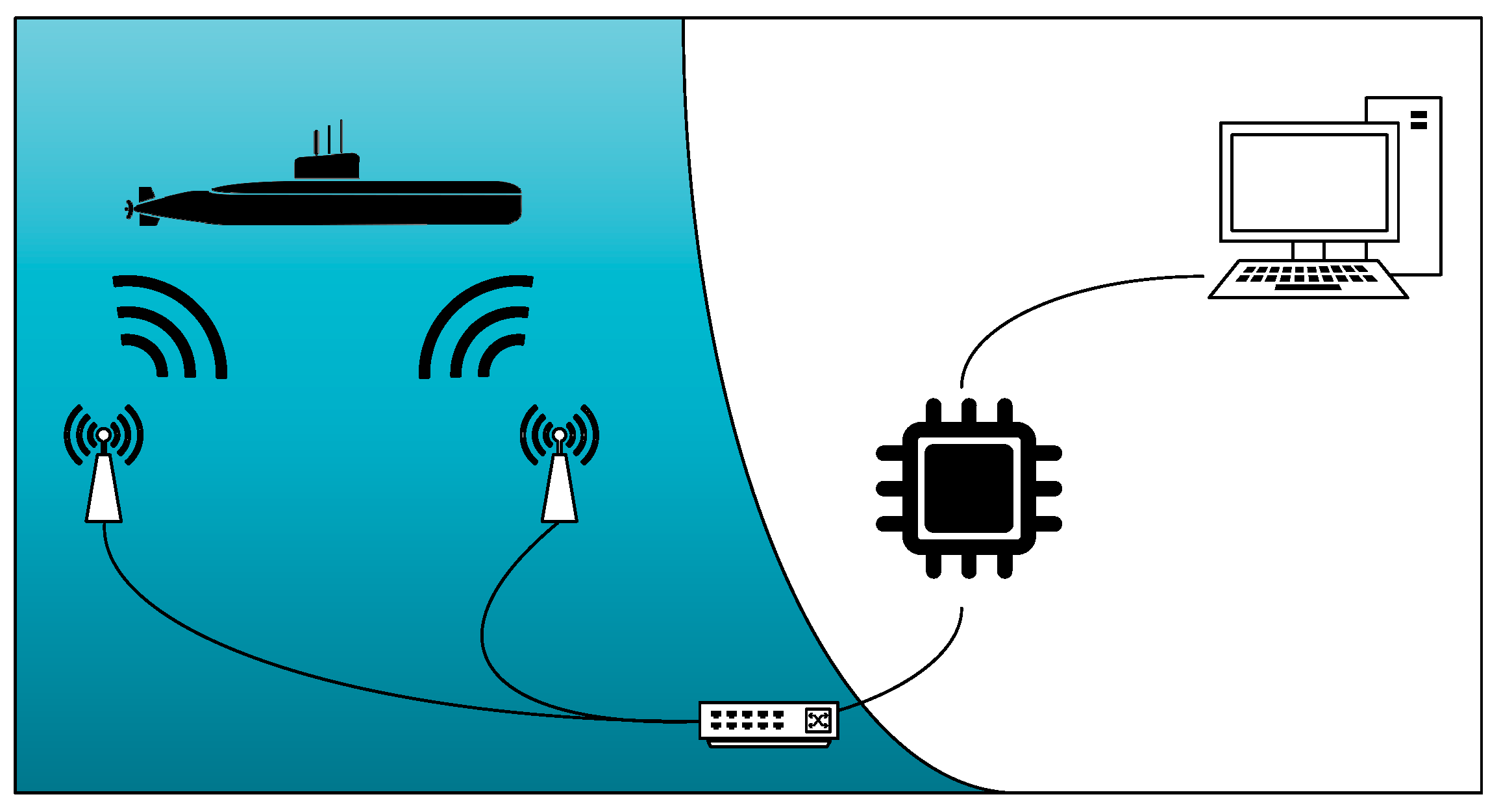
Design and Research of High-Energy-Efficiency Underwater Acoustic Target Recognition System



Abstract
1. Introduction
- (1)
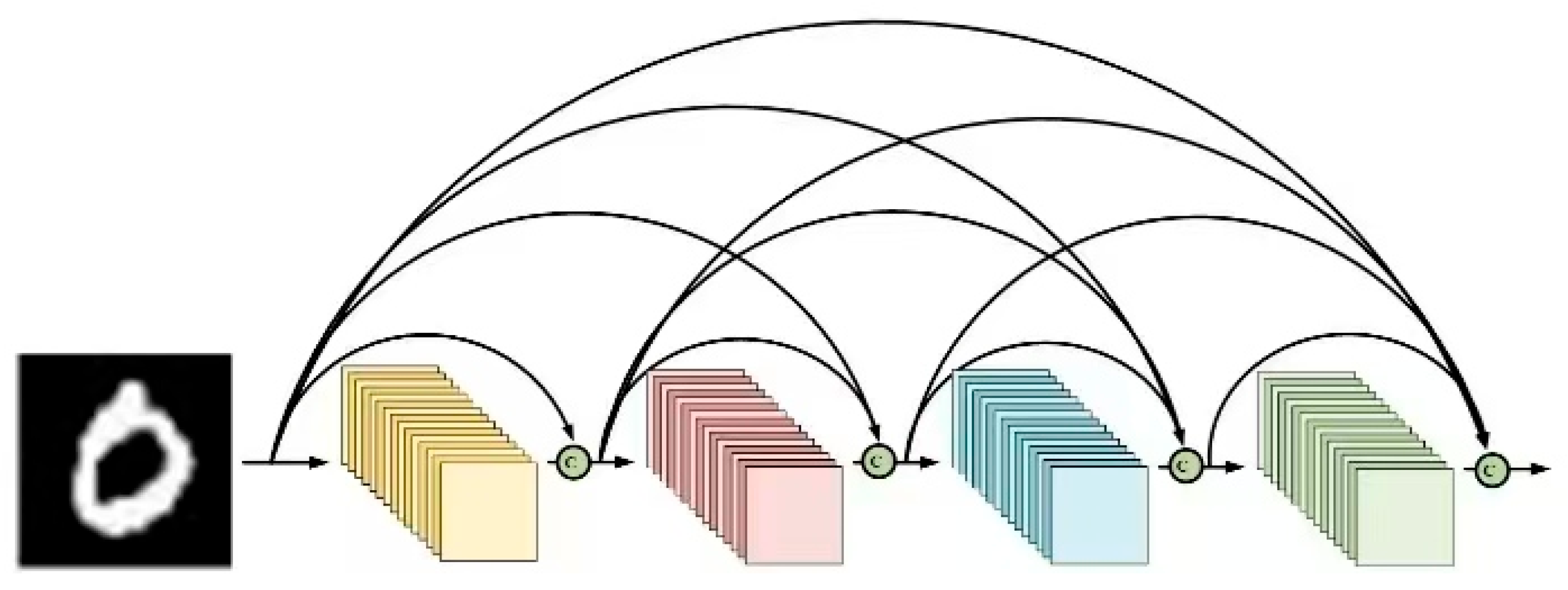
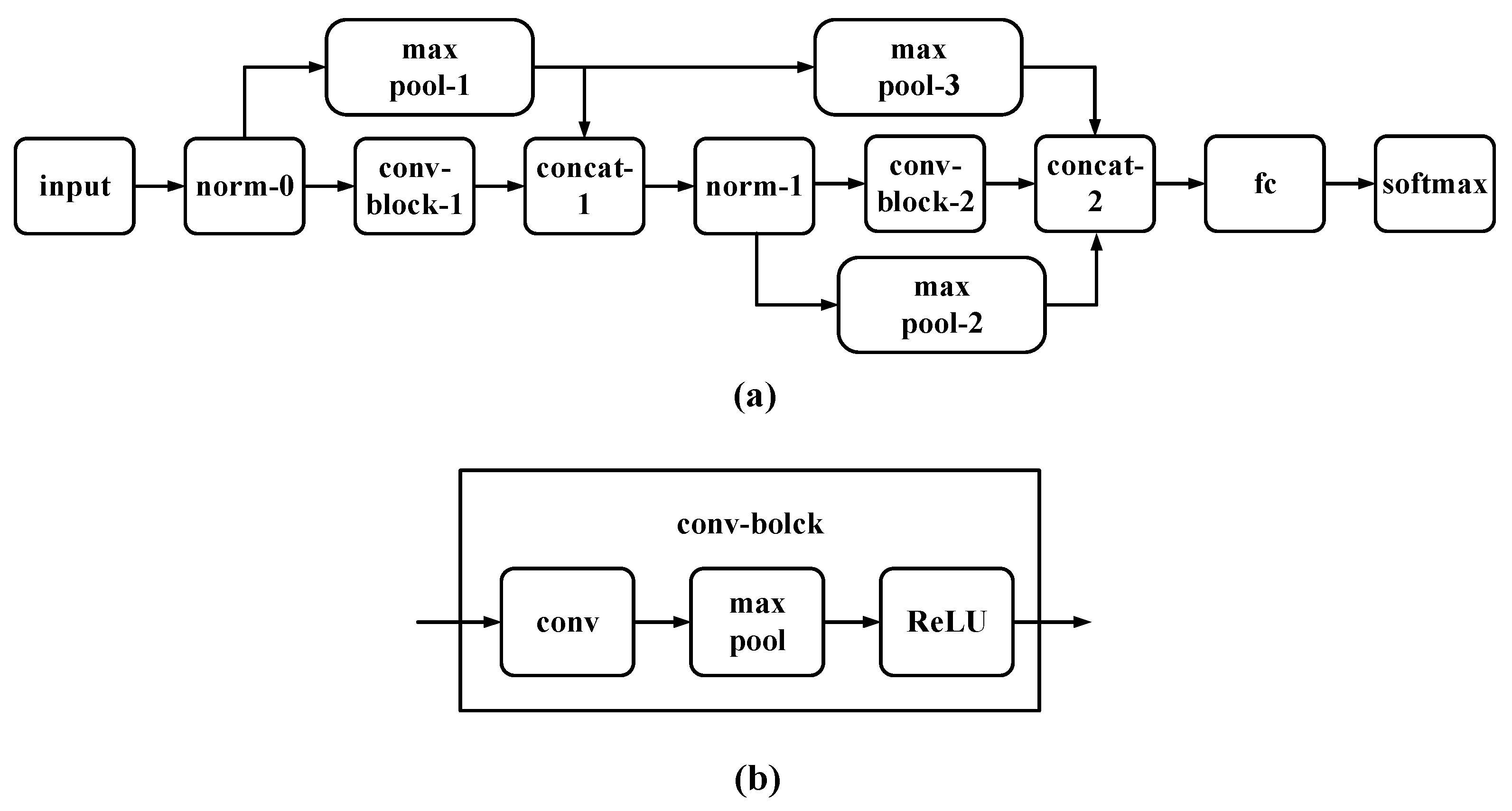
- A DenseNet convolutional neural network model was employed as the framework for an underwater acoustic target recognition system. To address issues related to the complexity of the network, fine-grained pruning was implemented to achieve sparsity.
- (2)
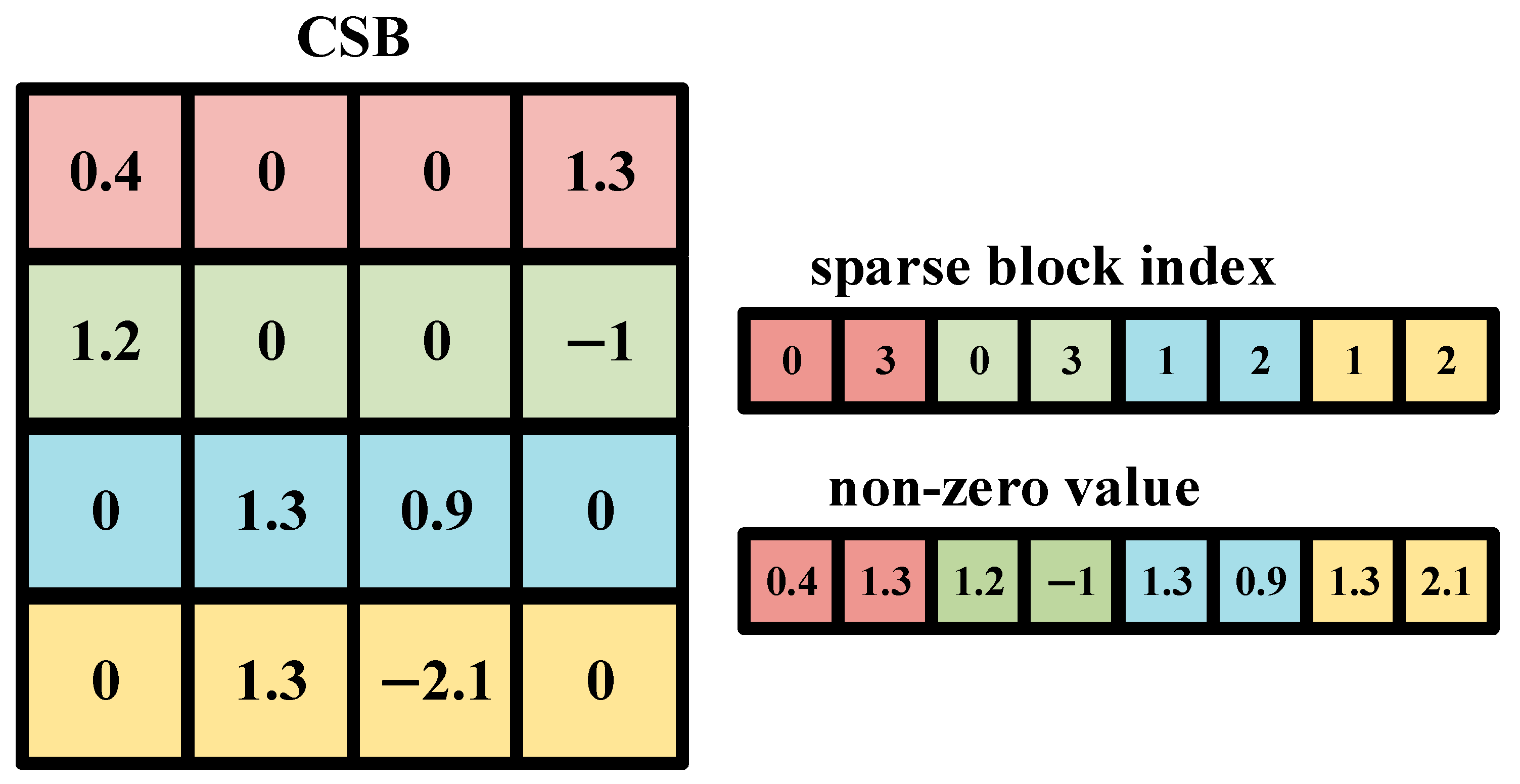
- Based on the sparse convolutional neural network structure, an underwater acoustic target recognition accelerator was designed. The accelerator’s performance was experimentally validated on FPGA.
- (3)
- The performance and power consumption of the underwater acoustic target recognition system were enhanced by optimizing the physical implementation of the circuit. The chip’s power consumption and area were evaluated using Design Compiler synthesis, and comparisons were made with the performance of software simulations and FPGA deployments.
2. Proposed Method
3. UA Target Recognition Accelerator
- Evaluate the Pre-trained Dense Network: First, the complete dense network, which has been pre-trained, is evaluated to serve as a performance baseline.
- Set the Pruning Threshold: All weights in the network are sorted globally, and a pruning threshold is set based on the target sparsity ratio.
- Remove Insignificant Connections: All weights with magnitudes below this threshold are set to zero, thereby removing these connections.
- Fine-tune the Model: The remaining non-zero weights are fine-tuned to compensate for any performance degradation caused by the pruning.
- Iterate until Target Sparsity is Reached: The above steps are repeated iteratively until the predetermined target sparsity is achieved.
| Algorithm 1: Sparse matrix convolution calculation |
| Input: , weight, Output Width: W, |
| heights: H, Number of channels: N, |
| Number of sparse weights: BN |
| Output: ; |
| 1: for do |
| 2: for do |
| 3: for do |
| 4: for do |
| 5: |
| 6: end |
| 7: end |
| 8: end |
| 9: end |
| 10: return ; |
4. Experimental Results and Discussion
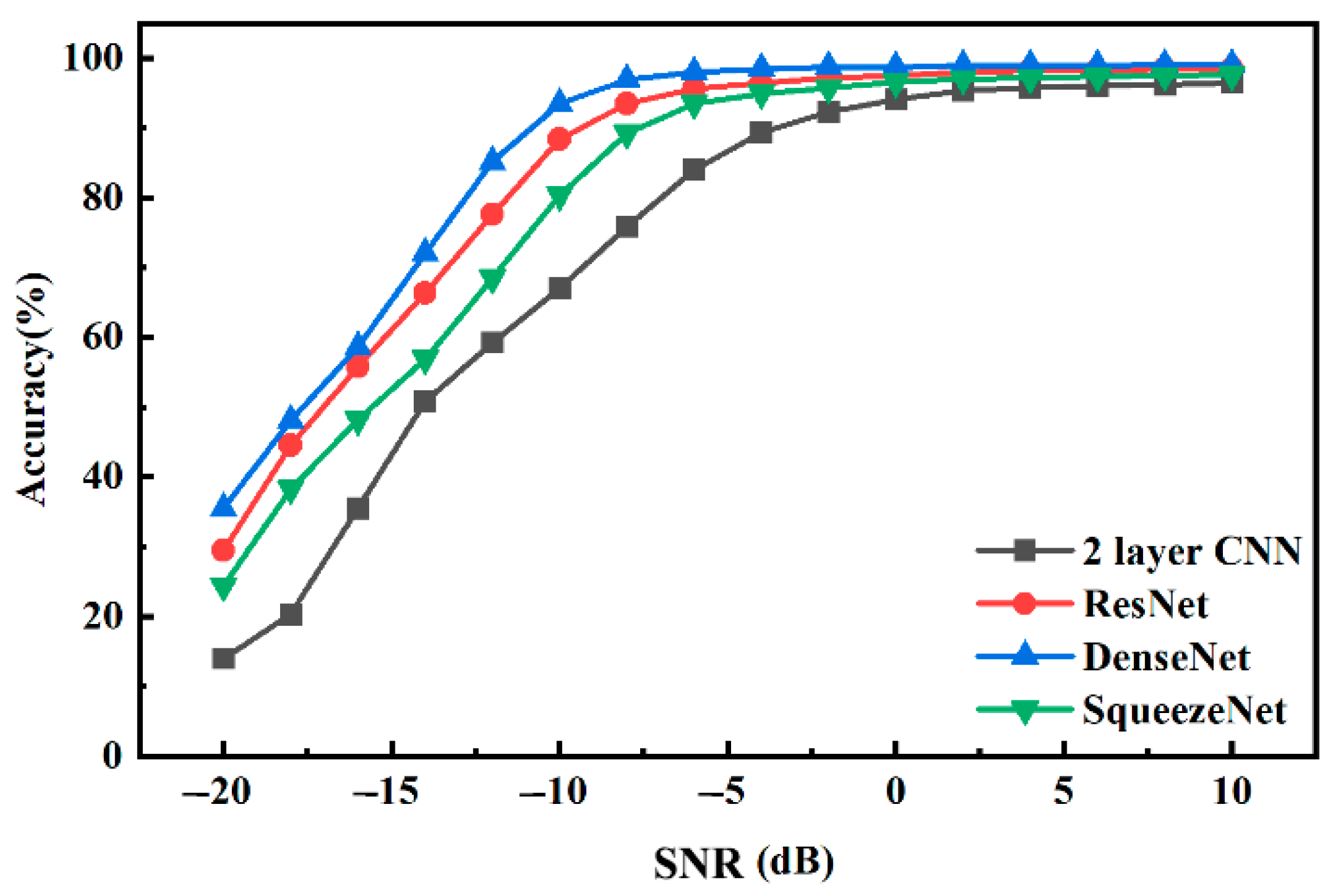
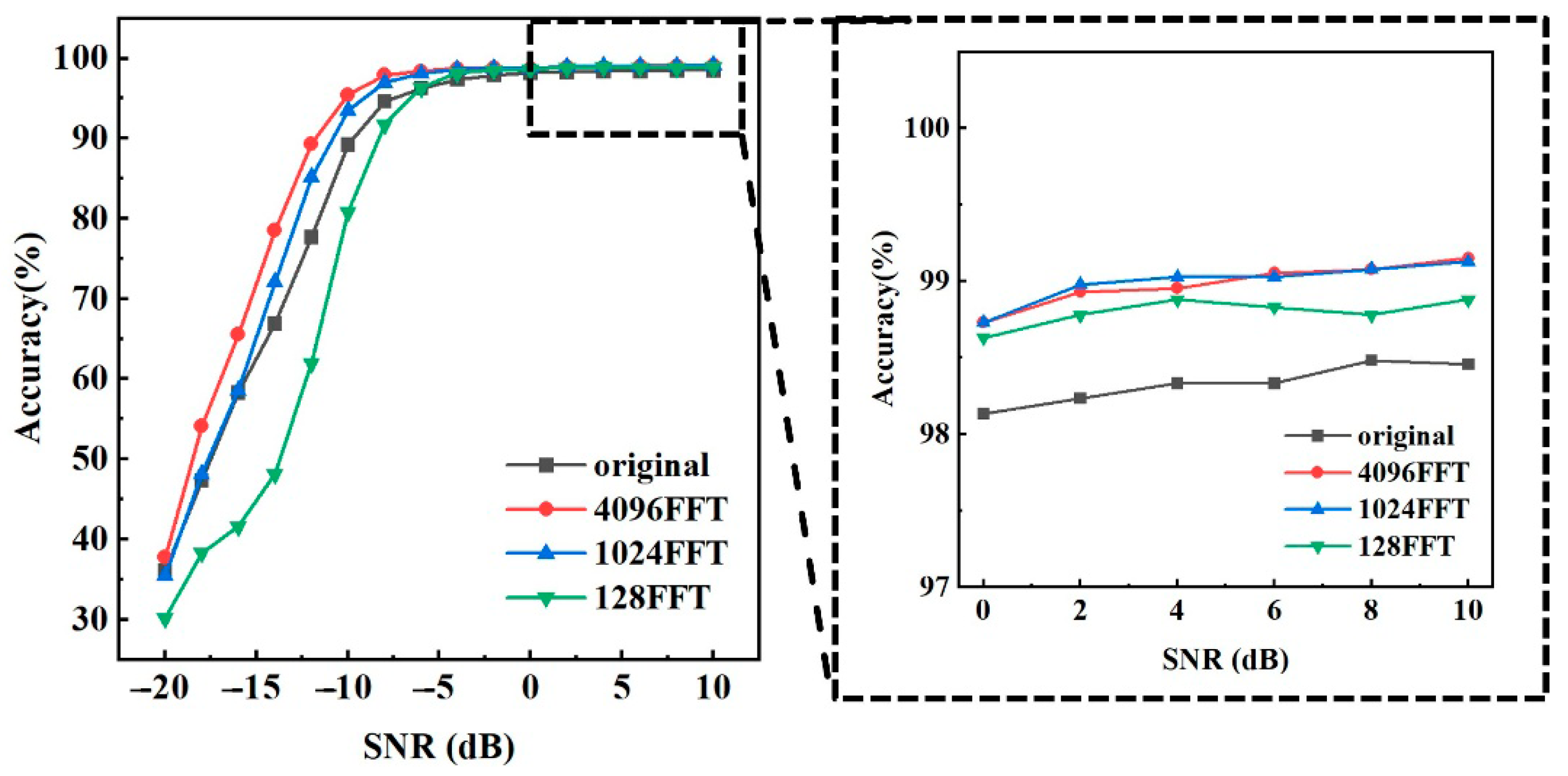
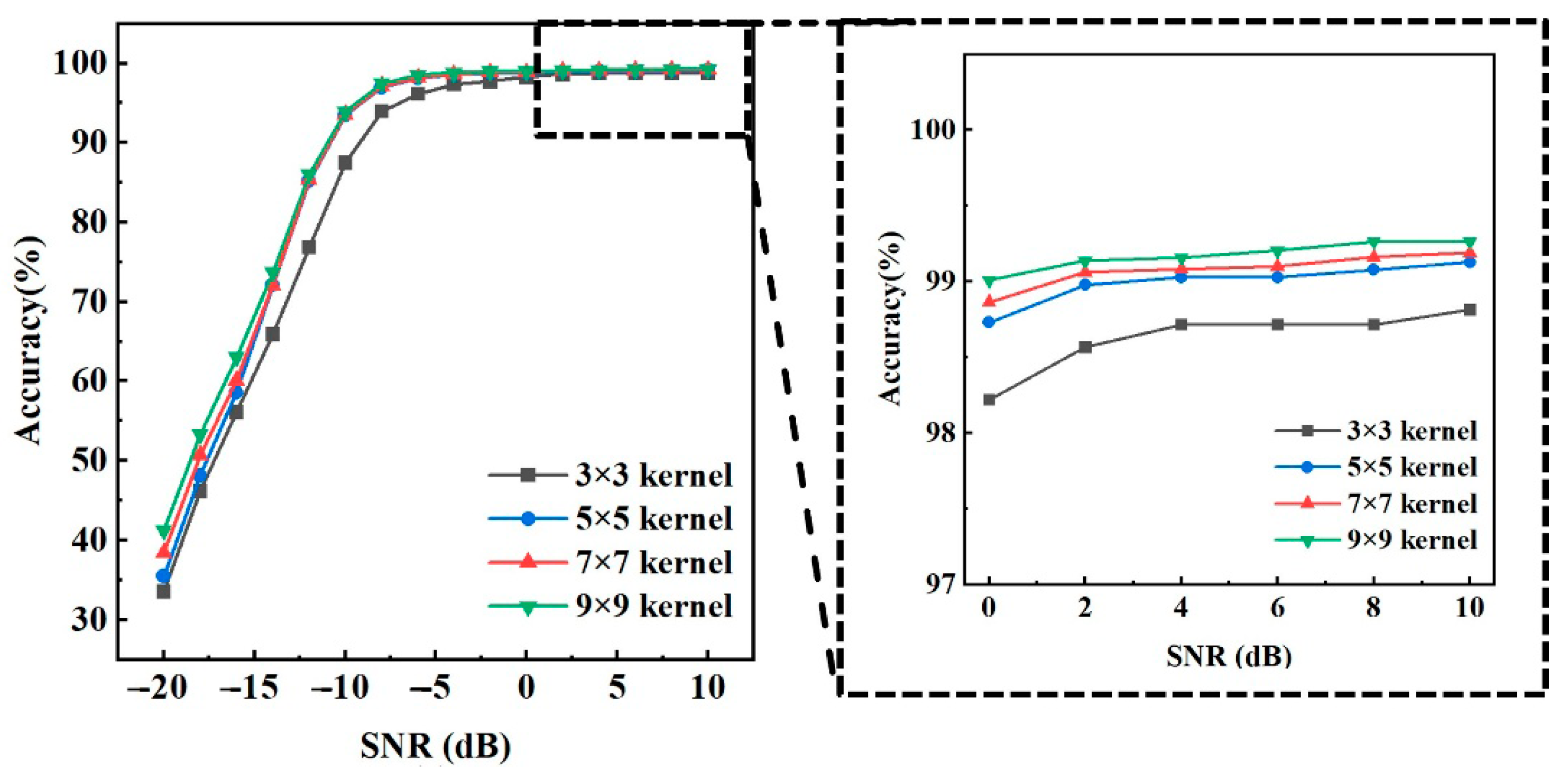
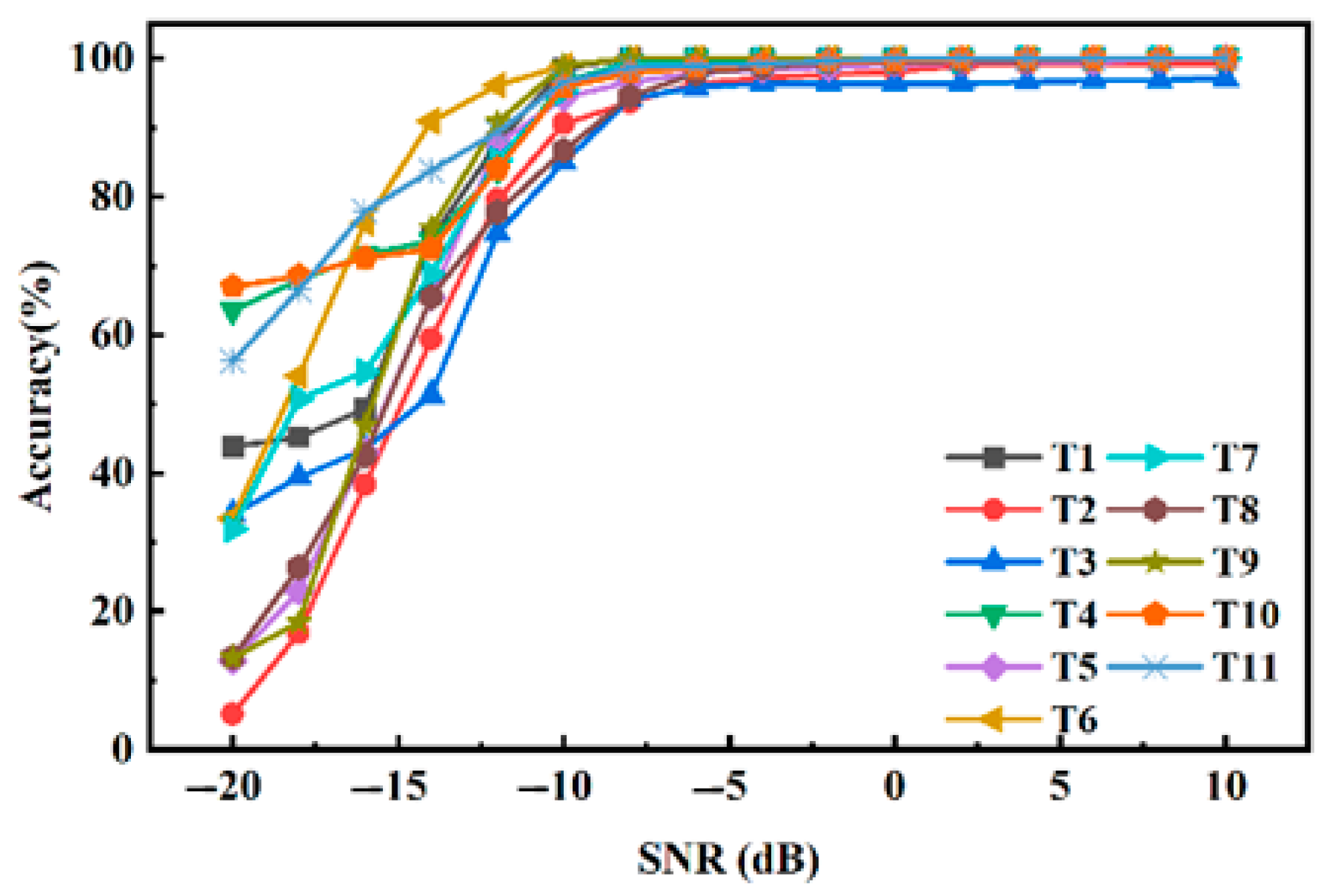
4.1. Simulation Results of Different Neural Network Parameters
4.2. Dataset Description and Experimental Setup
4.3. Alternative Classification Methods
- Feature Learning: Unlike traditional methods that rely on pre-extracted features, our approach learns optimal feature representations specifically for the classification task through end-to-end training.
- Non-linear Decision Boundaries: The deep network architecture can capture complex non-linear relationships in the acoustic data that traditional linear or kernel-based methods may miss.
- Task-Specific Optimization: The entire network, from feature extraction to classification, is jointly optimized for the underwater acoustic recognition task, ensuring coherent learning across all components.
- Computational Efficiency: Once trained, the neural network provides the fastest inference time, making it suitable for real-time underwater applications.
5. Conclusions
6. Limitations and Future Work
Author Contributions
Funding
Data Availability Statement
Acknowledgments
Conflicts of Interest
Abbreviations
| AI | Artificial Intelligence |
| ASIC | Application-Specific Integrated Circuit |
| CNN | Convolutional Neural Network |
| CMOS | Complementary Metal-Oxide-Semiconductor |
| CSBs | Compressed Sparse Banks |
| DNNs | Deep Neural Networks |
| DTs | Decision Trees |
| eLU | Exponential Linear Unit |
| FPGAs | Field-Programmable Gate Arrays |
| GFCCs | Gammatone Frequency Cepstral Coefficients |
| GMM | Gaussian Mixture Model |
| KNN | k-Nearest Neighbor |
| LSTM | Long Short-Term Memory |
| MEMD | Modified Empirical Mode Decomposition |
| ML | Machine Learning |
| ReLU | Rectified Linear Unit |
| SNR | Signal-to-Noise Ratio |
| SVMs | Support Vector Machines |
| UA | Underwater Acoustic |
| UASNs | Underwater Acoustic Sensor Networks |
References
- Wang, Y.; Jin, Y.; Zhang, H.; Lu, Q.; Cao, C.; Sang, Z.; Sun, M. Underwater communication signal recognition using sequence convolutional network. IEEE Access 2021, 9, 46886–46899. [Google Scholar] [CrossRef]
- Huang, J.; Diamant, R. Adaptive modulation for long-range underwater acoustic communication. IEEE Trans. Wirel. Commun. 2020, 19, 6844–6857. [Google Scholar] [CrossRef]
- Peng, X.; Ren, J.; She, L.; Zhang, D.; Li, J.; Zhang, Y. BOAT: A Block-Streaming App Execution Scheme for Lightweight IoT Devices. IEEE Internet Things J. 2018, 5, 1816–1829. [Google Scholar] [CrossRef]
- Zhang, D.; Qiao, Y.; She, L.; Shen, R.; Ren, J.; Zhang, Y. Two Time-Scale Resource Management for Green Internet of Things Networks. IEEE Internet Things J. 2018, 6, 545–556. [Google Scholar] [CrossRef]
- Jiang, F.; Wang, K.; Dong, L.; Pan, C.; Yang, K. Stacked Autoencoder-Based Deep Reinforcement Learning for Online Resource Scheduling in Large-Scale MEC Networks. IEEE Internet Things J. 2020, 7, 9278–9290. [Google Scholar] [CrossRef]
- Xu, C.; Ren, J.; She, L.; Zhang, Y.; Qin, Z.; Ren, K. EdgeSanitizer: Locally Differentially Private Deep Inference at the Edge for Mobile Data Analytics. IEEE Internet Things J. 2019, 6, 5140–5151. [Google Scholar] [CrossRef]
- Jiang, F.; Dong, L.; Wang, K.; Yang, K.; Pan, C. Distributed Resource Scheduling for Large-Scale MEC Systems: A Multiagent Ensemble Deep Reinforcement Learning with Imitation Acceleration. IEEE Internet Things J. 2021, 9, 6597–6610. [Google Scholar] [CrossRef]
- Ouyang, Y.; Liu, W.; Yang, Q.; Mao, X.; Li, F. Trust Based Task Offloading Scheme in UAV-Enhanced Edge Computing Network. Peer-to-Peer Netw. Appl. 2021, 14, 3268–3290. [Google Scholar] [CrossRef]
- Zhang, J.; Bhuiyan, M.Z.A.; Yang, X.; Wang, T.; Xu, X.; Hayajneh, T.; Khan, F. AntiConcealer: Reliable Detection of Adversary Concealed Behaviors in EdgeAI-Assisted IoT. IEEE Internet Things J. 2021, 9, 22184–22193. [Google Scholar] [CrossRef]
- Zhang, P.; Wang, J.; Guo, K. Compressive Sensing and Random Walk Based Data Collection in Wireless Sensor Networks. Comput. Commun. 2018, 129, 43–53. [Google Scholar] [CrossRef]
- Chen, X.; Xu, G.; Xu, X.; Jiang, H.; Tian, Z.; Ma, T. Multicenter Hierarchical Federated Learning with Fault-Tolerance Mechanisms for Resilient Edge Computing Networks. IEEE Trans. Neural Netw. Learn. Syst. 2024, 36, 47–61. [Google Scholar] [CrossRef]
- Liang, W.; Chen, X.; Huang, S.; Xiong, G.; Yan, K.; Zhou, X. Federal Learning Edge Network Based Sentiment Analysis Combating Global COVID-19. Comput. Commun. 2023, 204, 33–42. [Google Scholar] [CrossRef] [PubMed]
- Mao, X.; Shan, Y.; Li, F.; Chen, X.; Zhang, S. CLSpell: Contrastive Learning with Phonological and Visual Knowledge for Chinese Spelling Check. Neurocomputing 2023, 554, 126468. [Google Scholar] [CrossRef]
- Fei, F.; Li, S.; Dai, H.; Hu, C.; Dou, W.; Ni, Q. A K-Anonymity Based Schema for Location Privacy Preservation. IEEE Trans. Sustain. Comput. 2017, 4, 156–167. [Google Scholar] [CrossRef]
- Wang, L.; Yang, Y.; Liu, X. A direct position determination approach for underwater acoustic sensor networks. IEEE Trans. Veh. Technol. 2020, 69, 13033–13044. [Google Scholar] [CrossRef]
- Wang, X.; Liu, A.; Zhang, Y.; Xue, F. Underwater acoustic target recognition: A combination of multi-dimensional fusion features and modified deep neural network. Remote Sens. 2019, 11, 1888. [Google Scholar] [CrossRef]
- Zhou, X.; Li, Y.; Liang, W. CNN-RNN Based Intelligent Recommendation for Online Medical Pre-Diagnosis Support. IEEE/ACM Trans. Comput. Biol. Bioinform. 2021, 18, 912–921. [Google Scholar] [CrossRef]
- Zhou, X.; Liang, W.; Wang, K.I.-K.; Wang, H.; Yang, L.T.; Jin, Q. Deep-Learning-Enhanced Human Activity Recognition for Internet of Healthcare Things. IEEE Internet Things J. 2020, 7, 6429–6438. [Google Scholar] [CrossRef]
- Zhang, C.; Yu, S.; Li, G.; Xu, Y. The recognition method of MQAM signals based on BP neural network and bird swarm algorithm. IEEE Access 2021, 9, 36078–36086. [Google Scholar] [CrossRef]
- Zhou, X.; Xu, X.; Liang, W.; Zeng, Z.; Yan, Z. Deep-Learning-Enhanced Multitarget Detection for End–Edge–Cloud Surveillance in Smart IoT. IEEE Internet Things J. 2021, 8, 12588–12596. [Google Scholar] [CrossRef]
- Zhou, X.; Liang, W.; Li, W.; Yan, K.; Shimizu, S.; Wang, K.I.-K. Hierarchical Adversarial Attacks Against Graph-Neural-Network-Based IoT Network Intrusion Detection System. IEEE Internet Things J. 2021, 9, 9310–9319. [Google Scholar] [CrossRef]
- Zeng, X.; Wang, S. Bark-wavelet analysis and Hilbert–Huang transform for underwater target recognition. Def. Technol. 2013, 9, 115–120. [Google Scholar] [CrossRef]
- Jiang, F.; Wang, K.; Dong, L.; Pan, C.; Xu, W.; Yang, K. AI Driven Heterogeneous MEC System with UAV Assistance for Dynamic Environment: Challenges and Solutions. IEEE Netw. 2020, 35, 400–408. [Google Scholar] [CrossRef]
- Wang, J.; Lv, P.; Wang, H.; Shi, C. SAR-U-Net: Squeeze-and-Excitation Block and Atrous Spatial Pyramid Pooling Based Residual U-Net for Automatic Liver Segmentation in Computed Tomography. Comput. Methods Programs Biomed. 2021, 208, 106268. [Google Scholar] [CrossRef]
- Zhou, X.; Liang, W.; Yan, K.; Li, W.; Wang, K.I.-K.; Ma, J.; Jin, Q. Edge-Enabled Two-Stage Scheduling Based on Deep Reinforcement Learning for Internet of Everything. IEEE Internet Things J. 2022, 10, 3295–3304. [Google Scholar] [CrossRef]
- Zhao, J.; Nguyen, H.; Nguyen-Thoi, T.; Asteris, P.G.; Zhou, J. Improved Levenberg–Marquardt Backpropagation Neural Network by Particle Swarm and Whale Optimization Algorithms to Predict the Deflection of RC Beams. Eng. Comput. 2022, 38 (Suppl. 5), 3847–3869. [Google Scholar] [CrossRef]
- Zhang, W.; Wu, Y.; Wang, D.; Wang, Y.; Wang, Y.; Zhang, L. Underwater target feature extraction and classification based on gammatone filter and machine learning. In Proceedings of the 2018 International Conference on Wavelet Analysis and Pattern Recognition (ICWAPR), Chengdu, China, 15–18 July 2018; IEEE: New York, NY, USA, 2018; pp. 42–47. [Google Scholar]
- Ke, X.; Yuan, F.; Cheng, E. Underwater acoustic target recognition based on supervised feature-separation algorithm. Sensors 2018, 18, 4318. [Google Scholar] [CrossRef] [PubMed]
- Zhao, Y.; Xie, G.; Chen, H.; Chen, M.; Huang, L. Enhancing Underwater Acoustic Target Recognition Through Advanced Feature Fusion and Deep Learning. J. Mar. Sci. Eng. 2025, 13, 278. [Google Scholar] [CrossRef]
- Yao, H.; Gao, T.; Wang, Y.; Wang, H.; Chen, X. Mobile_ViT: Underwater Acoustic Target Recognition Method Based on Local–Global Feature Fusion. J. Mar. Sci. Eng. 2024, 12, 589. [Google Scholar] [CrossRef]
- Chen, Z.; Tang, J.; Qiu, H.; Chen, M. MGFGNet: An Automatic Underwater Acoustic Target Recognition Method Based on the Multi-Gradient Flow Global Feature Enhancement Network. Front. Mar. Sci. 2023, 10, 1306229. [Google Scholar] [CrossRef]
- Wang, Y.; Zhang, H.; Huang, W.; Zhou, M.; Gao, Y.; An, Y.; Jiao, H. DWSTr: A Hybrid Framework for Ship-Radiated Noise Recognition. Front. Mar. Sci. 2024, 11, 1334057. [Google Scholar] [CrossRef]
- Yang, K.; Wang, B.; Fang, Z.; Cai, B. An End-to-End Underwater Acoustic Target Recognition Model Based on One-Dimensional Convolution and Transformer. J. Mar. Sci. Eng. 2024, 12, 1793. [Google Scholar] [CrossRef]
- Huang, G.; Liu, Z.; van der Maaten, L.; Weinberger, K.Q. Densely connected convolutional networks. In Proceedings of the IEEE Conference on Computer Vision and Pattern Recognition (CVPR), Honolulu, HI, USA, 21–26 July 2017; pp. 4700–4708. [Google Scholar]
- He, K.; Zhang, X.; Ren, S.; Sun, J. Deep residual learning for image recognition. In Proceedings of the IEEE Conference on Computer Vision and Pattern Recognition (CVPR), Las Vegas, NV, USA, 27–30 June 2016; pp. 770–778. [Google Scholar]
- Cao, S.; Zhang, C.; Yao, Z.; Xiao, W.; Nie, L.; Zhan, D.; Liu, Y.; Wu, M.; Zhang, L. Efficient and effective sparse LSTM on FPGA with bank-balanced sparsity. In Proceedings of the 2019 ACM/SIGDA International Symposium on Field-Programmable Gate Arrays (FPGA ’19), Seaside, CA, USA, 24–26 February 2019; pp. 63–72. [Google Scholar]



| Method | Dataset | Accuracy (%) | F1-Score | Key Features | Deployment Platform | Reference |
|---|---|---|---|---|---|---|
| BAHTNet (ResNeXt + Transformer) | ShipsEar | 99.80 | 0.9960 | Cross-attention fusion; strong global context modeling | CPU/GPU (software) | [29] |
| Mobile_ViT (MobileNet + Transformer) | ShipsEar | 98.50 | – | Lightweight MobileNet backbone with Transformer | CPU/GPU (software) | [30] |
| MGFGNet (Multi-gradient flow CNN) | ShipsEar | 99.50 | – | Brain-inspired fusion; fewer parameters, faster training | CPU/GPU (software) | [31] |
| DWSTr (Depthwise CNN + Transformer) | ShipsEar | 96.50 | – | Depthwise-separable CNN; reduced computational cost | CPU/GPU (software) | [32] |
| 1DCTN (1D CNN + Transformer) | ShipsEar | 96.84 | 0.9684 | End-to-end; lightweight (0.45 M params) | CPU/GPU (software) | [33] |
| DenseNet-CNN (pruned) | ShipsEar | 98.73 (CPU); 95.00 (FPGA/ASIC) | – | Fine-grained pruning; high efficiency; hardware-friendly | CPU/FPGA/ASIC |
| Block | Layer | Description |
|---|---|---|
| Input | input | input 4096 samples |
| norm-0 | batch normalization | |
| Conv-block (1) | convolution | 3 kernels (5 × 5), stride (1, 1) |
| maxpool | pool-size (2 × 2), stride (1, 1) | |
| activation | activation function: ReLU | |
| Skip-connection | maxpool-1 | pool-size (2 × 2), stride (1, 1) |
| Combination | concat-1 | depth-wise concatenation |
| norm-1 | batch normalization | |
| Conv-block (2) | convolution | 3 kernels (5 × 5), stride (1, 1) |
| maxpool | pool-size (2 × 2), stride (1, 1) | |
| activation | activation function: ReLU | |
| Skip-connection | maxpool-2 | pool-size (2 × 2), stride (1, 1) |
| maxpool-3 | pool-size (2 × 2), stride (1, 1) | |
| Combination | concat-2 | depth-wise concatenation |
| Output | fully connected | output 11 classes |
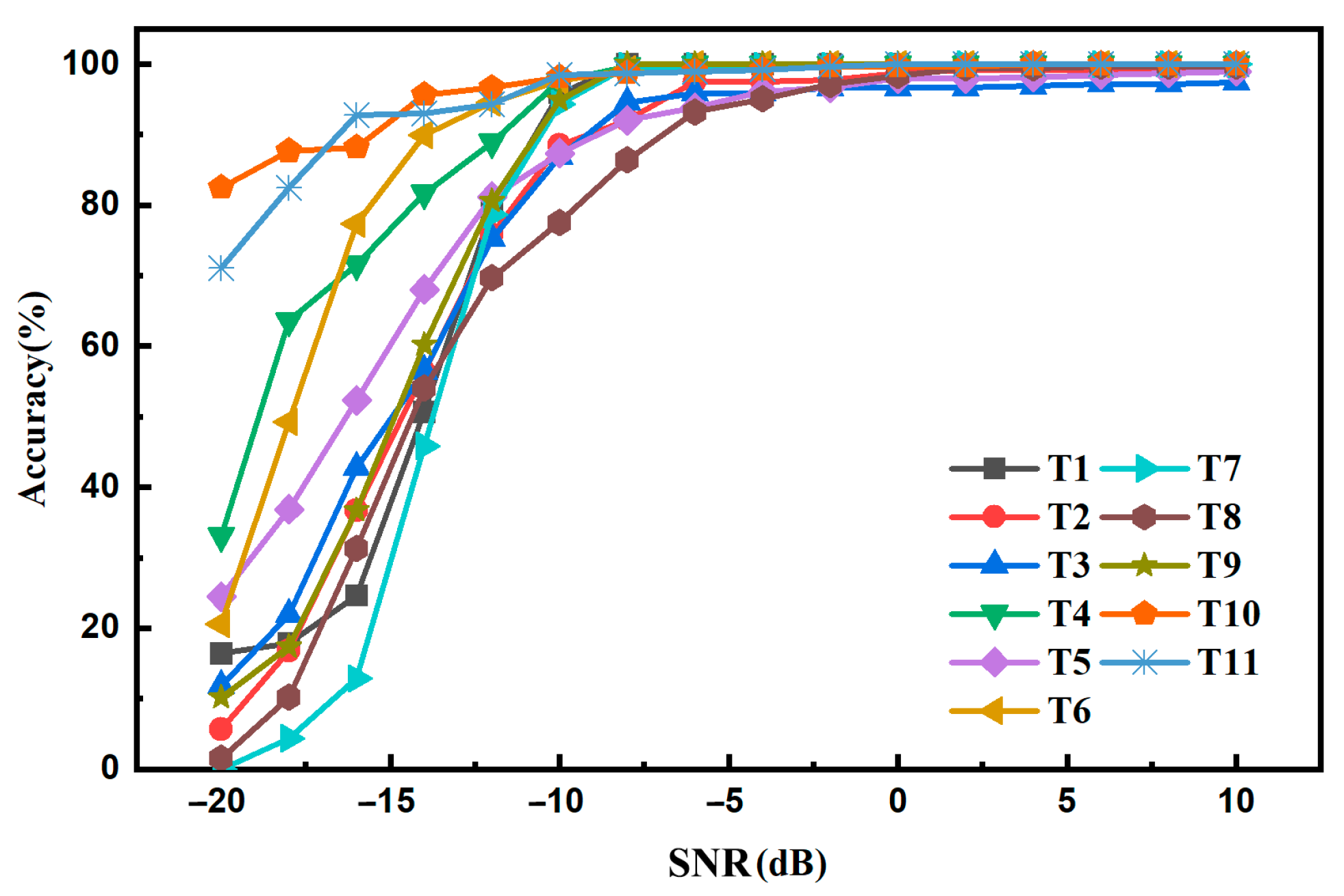
| Target Type | Precision | Recall | F1-Score | Support | Accuracy (%) |
|---|---|---|---|---|---|
| T1 (Dredger) | 0.967 | 0.952 | 0.959 | 42 | 97.6 |
| T2 (Passengers) | 0.992 | 0.995 | 0.994 | 234 | 98.9 |
| T3 (Motorboat) | 0.981 | 0.977 | 0.979 | 87 | 98.2 |
| T4 (Mussel boat) | 0.975 | 0.981 | 0.978 | 53 | 97.8 |
| T5 (Sailboat) | 0.958 | 0.962 | 0.96 | 26 | 96.4 |
| T6 (Ocean liner) | 0.995 | 0.991 | 0.993 | 89 | 99.1 |
| T7 (RORO) | 0.989 | 0.985 | 0.987 | 67 | 98.7 |
| T8 (Trawler) | 0.875 | 0.923 | 0.898 | 13 | 92.3 |
| T9 (Fishboat) | 0.967 | 0.958 | 0.962 | 48 | 97.1 |
| T10 (Pilot ship) | 0.944 | 0.95 | 0.947 | 20 | 95.2 |
| T11 (Ambient noise) | 0.934 | 0.928 | 0.931 | 108 | 94.6 |
| Macro avg | 0.961 | 0.964 | 0.962 | 787 | 96.9 |
| Weighted avg | 0.987 | 0.987 | 0.987 | 787 | 98.73 |
| Implementation | Platform | Device | Sparsity | Accuracy | Time | Power | Note |
|---|---|---|---|---|---|---|---|
| Software | CPU | 13,900 K | 0% | 98.73% | -- | -- | Dense model |
| Software | GPU | RTX4090 | 0% | 98.73% | -- | -- | Dense model |
| Software | GPU | RTX4090 | 50% | 96.11% | -- | -- | Pruned model |
| Hardware | FPGA | CYCLONE | 50% | 95.00% | 13.33 ns | 189.02 mW | Quantized |
| Hardware | ASIC | Custom | 50% | 95.00% | 7.81 ns | 90.82 mW | Quantized |
| Classification Method | Feature Extraction | Accuracy (%) | Precision | Recall | F1-Score | Training Time | Inference Time |
|---|---|---|---|---|---|---|---|
| SVM (RBF kernel) | DenseNet features | 94.2 | 0.941 | 0.938 | 0.939 | 45.2 min | 2.3 ms |
| Random Forest | DenseNet features | 92.8 | 0.926 | 0.925 | 0.925 | 12.8 min | 0.8 ms |
| k-NN (k = 5) | DenseNet features | 89.3 | 0.891 | 0.887 | 0.889 | -- | 15.6 ms |
| Naive Bayes | DenseNet features | 85.7 | 0.854 | 0.851 | 0.852 | 2.1 min | 0.5 ms |
| Softmax (Proposed) | End-to-end | 98.73 | 0.987 | 0.987 | 0.987 | 180 min | 0.05 ms |
Disclaimer/Publisher’s Note: The statements, opinions and data contained in all publications are solely those of the individual author(s) and contributor(s) and not of MDPI and/or the editor(s). MDPI and/or the editor(s) disclaim responsibility for any injury to people or property resulting from any ideas, methods, instructions or products referred to in the content. |
© 2025 by the authors. Licensee MDPI, Basel, Switzerland. This article is an open access article distributed under the terms and conditions of the Creative Commons Attribution (CC BY) license (https://creativecommons.org/licenses/by/4.0/).
Share and Cite
Ma, A.; Yang, W.; Tan, P.; Lei, Y.; Zhu, L.; Peng, B.; Ding, D. Design and Research of High-Energy-Efficiency Underwater Acoustic Target Recognition System. Electronics 2025, 14, 3770. https://doi.org/10.3390/electronics14193770
Ma A, Yang W, Tan P, Lei Y, Zhu L, Peng B, Ding D. Design and Research of High-Energy-Efficiency Underwater Acoustic Target Recognition System. Electronics. 2025; 14(19):3770. https://doi.org/10.3390/electronics14193770
Chicago/Turabian StyleMa, Ao, Wenhao Yang, Pei Tan, Yinghao Lei, Liqin Zhu, Bingyao Peng, and Ding Ding. 2025. "Design and Research of High-Energy-Efficiency Underwater Acoustic Target Recognition System" Electronics 14, no. 19: 3770. https://doi.org/10.3390/electronics14193770
APA StyleMa, A., Yang, W., Tan, P., Lei, Y., Zhu, L., Peng, B., & Ding, D. (2025). Design and Research of High-Energy-Efficiency Underwater Acoustic Target Recognition System. Electronics, 14(19), 3770. https://doi.org/10.3390/electronics14193770