We have structured our findings to directly answer each of the revised RQs outlined in
Section 3.1. To help readers navigate our analysis,
Table 2 acts as a guide, showing where each RQ is addressed through specific sections, figures, and tables. This systematic structure provides clear insight into how the reviewed literature addresses each research question.
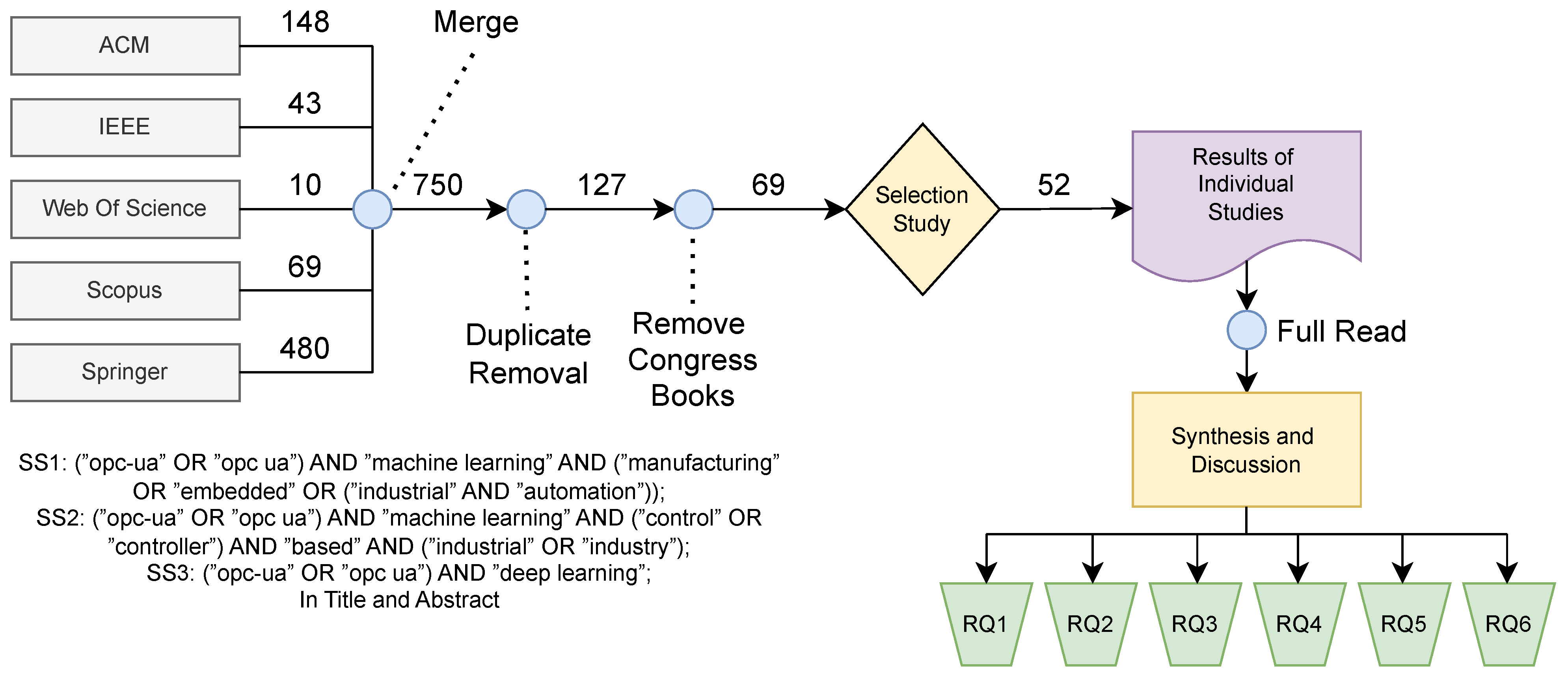
The result is a set of articles to read and answer the research questions and, based on the results, write this research.
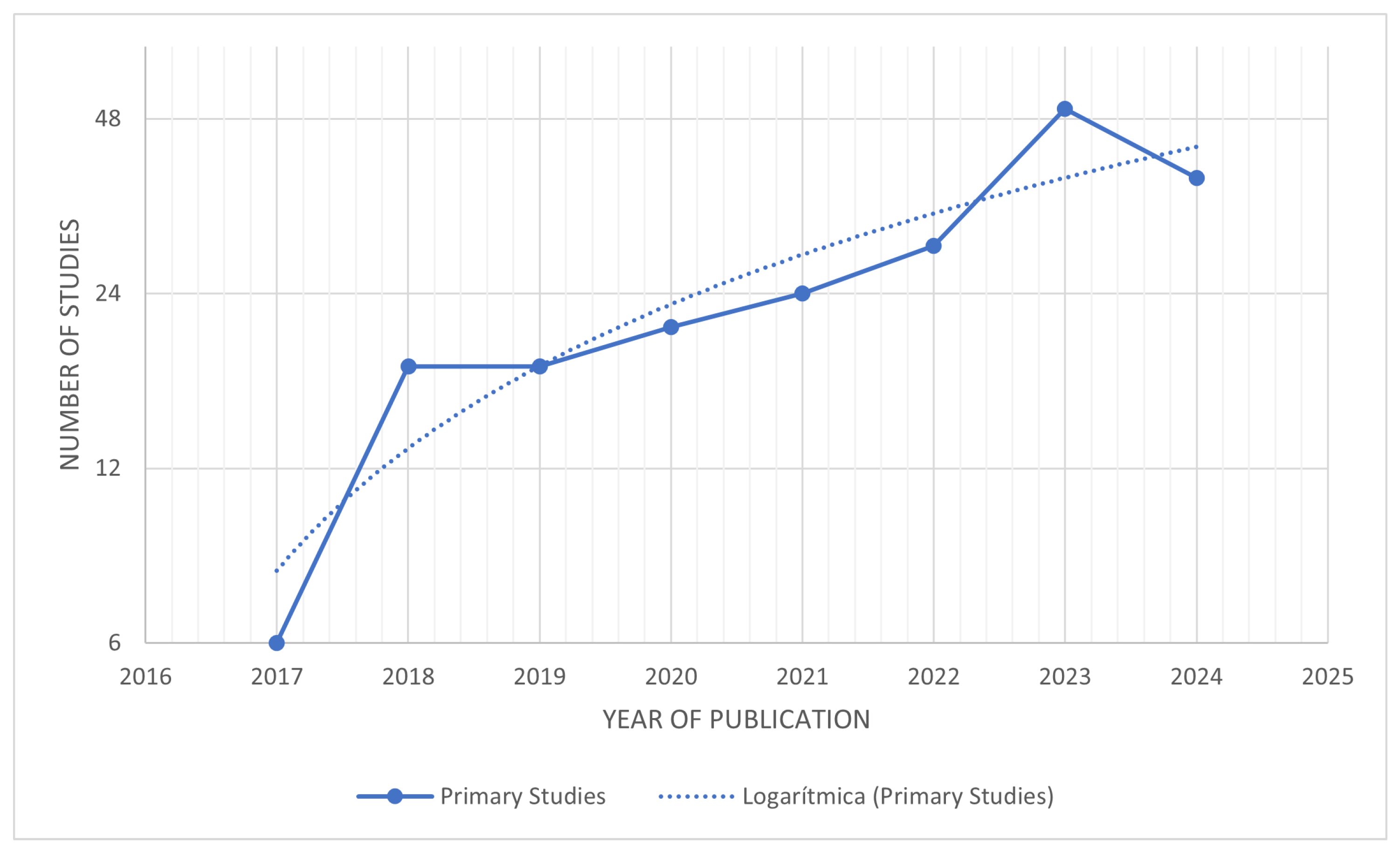
Figure 2 shows the temporal evolution of primary studies from 2017 to 2024, with a logarithmic trend line. Starting with 6 studies in 2017, a significant increase is observed up to 18 studies in 2018, followed by a period of more gradual growth. The number of studies peaks in 2023 with 48 publications, then declines to approximately 40 studies in 2024. The logarithmic trend line suggests that, although the field has experienced sustained growth, the growth rate is leveling off over time.
5.1. Applications
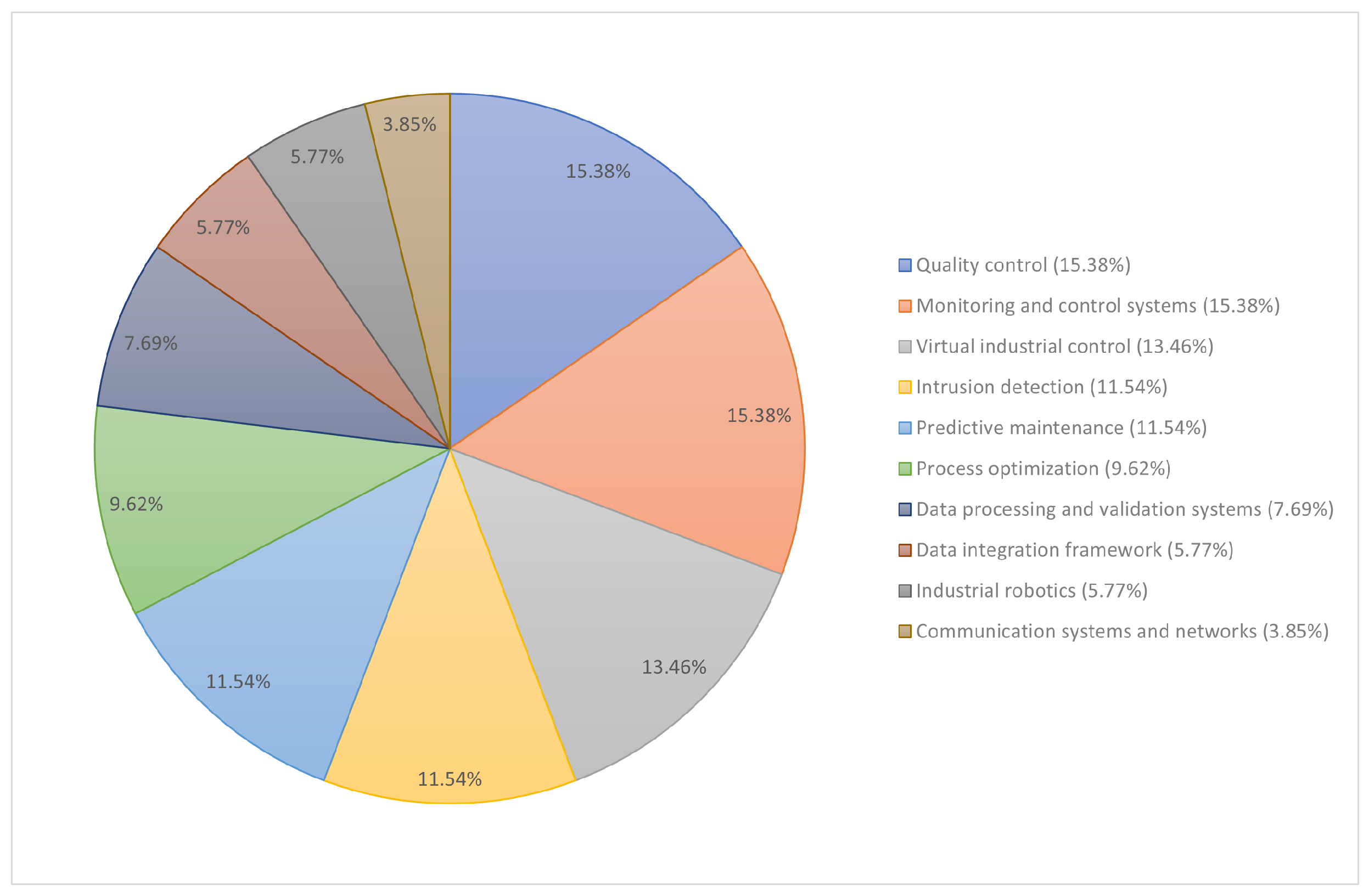
This systematic analysis identifies ten key application areas where Machine Learning and OPC-UA technologies converge.
Table 3 provides a comparative summary of these applications, while
Figure 4 illustrates their percentage distribution. Additionally,
Table 4 highlights real-world examples from primary sources, offering a practical perspective on these implementations.
Quality control: The fusion of OPC-UA with deep learning has revolutionized industrial inspection systems. Fernández et al. [
60] pioneered this integration by using thermal imaging and CNN-LSTM architectures to detect welding defects in real time. Rath et al. [
55] expanded this approach to textile manufacturing, creating vendor-independent protocols for predictive quality control across distributed production chains. Velesaca et al. [
28] now represent the cutting edge, combining thermographic imaging with deep neural networks to achieve unprecedented accuracy in defect classification.
Monitoring and control systems: The evolution of these systems began with Arévalo et al. [
70], who integrated Machine Learning into cloud-based platforms using evidence theory to fuse heterogeneous data streams. Iatrou et al. [
68] achieved a technological breakthrough by embedding OPC-UA servers directly into hardware, bridging operational devices with IT infrastructure. Kedari et al. [
46] further advanced remote monitoring capabilities, enabling secure supervision of critical processes with controlled latency thresholds.
Intrusion detection: Modern intrusion detection systems build on foundational work by Anton et al. [
66], who identified anomalous patterns in OPC-UA network traffic. Hildebrandt et al. [
62] elevated this approach by detecting supply chain vulnerabilities through encrypted data flow analysis. The current state of the art features Bindra and Aggarwal [
22], who implemented convolutional neural networks to detect multi-stage cyberattacks in real time, reducing false positives by 40% compared to conventional methods.
Virtual industrial control: Industrial process virtualization has evolved from Park et al. [
47] foundational frameworks to hybrid physical-digital architectures. Nam et al. [
36] developed OPC-UA interfaces that synchronize digital twins with physical equipment, enabling dynamic process adjustments. Rehmer et al. [
26] advanced this further with predictive simulation systems that anticipate production line failures with 92% accuracy.
Predictive maintenance: The transition from reactive to predictive models began with Arévalo et al. [
71] cloud-based vibration analysis systems. Soller et al. [
56] enhanced these models by incorporating multisensory data and multivariate trend analysis. Friedrich et al. [
24] now demonstrate self-optimizing algorithms that adjust maintenance schedules based on operational wear patterns, reducing unplanned downtime by 68%.
Process optimization: Modern optimization strategies combine real-time data streams with adaptive analytics. Torres et al. [
69] established the groundwork by correlating process variables with key performance indicators. Nohl et al. [
53] implemented unified OPC-UA architectures enabling operational adjustments in under 200 ms. Gong et al. [
45] now employ recurrent neural networks to model nonlinear processes, achieving 15–20% energy efficiency gains in pilot installations.
Data processing and validation systems: Current validation frameworks benefit from Bakakeu et al.’s [
58] semantic ontologies for multi-source data verification. Tufek [
42] enhanced these systems with contextual inference engines that detect data anomalies in real time. Tufek et al. [
43] further advanced this field by integrating federated learning techniques for distributed validation without compromising data confidentiality.
Data integration framework: Interoperability in complex environments is enabled by Kirmse et al. [
73] framework for heterogeneous data ingestion. Lockner et al. [
34] optimized integration processes through adaptive preprocessing, reducing implementation timelines by 70%. Hirsch et al. [
33] now demonstrate scalable OPC-UA architectures capable of managing petabyte-scale operational data with sub-50 ms latency.
Industrial robotics: Robotic system integration began with Pereira et al.’s [
64] DINASORE architecture for multi-robot coordination. Webb et al. [
44] enhanced these systems with reinforcement learning interfaces for contextual adaptation. Diprasetya et al. [
30] now combine 3D vision systems with remote haptic controls, enabling human-robot collaboration with micrometer-level precision.
Communication systems and networks: The evolution of industrial networks is exemplified by Sharma et al. [
40], who designed fault-tolerant architectures for critical environments. Pospisil and Fujdiak [
37] improved interoperability through dynamic protocol identification mechanisms. Current developments prioritize AI-driven network segmentation and adaptive security protocols to counter multi-vector cyber threats while maintaining sub-millisecond latency.
Finally,
Table 3 synthesizes the industrial application landscape enabled by OPC-UA and related ecosystems, linking sensors/devices with dominant data modalities and suitable ML families. Clear cross-cutting patterns emerge: convergence on PLCs, OPC-UA servers/gateways, and vision/telemetry; multimodal data (images, multivariate time series, network flows) with challenges of class imbalance, drift, and interoperability; and a toolbox spanning classical ML (RF/XGBoost, SVM), anomaly detection (One-Class, autoencoders), deep learning (CNN/LSTM/Transformers), and control/optimization methods (RL, Bayesian surrogates). This structure reflects growing maturity in quality control, predictive maintenance, and robotics, while data integration and cybersecurity continue to drive robust and interpretable methodologies. Overall, the mapping provides a practical guide to align instrumentation and data management with the most appropriate ML techniques for each operational objective.
5.2. Techniques
The convergence of artificial intelligence and OPC-UA has undergone a remarkable transformation in recent years, revealing significant patterns and trends in its implementation and evaluation. Our analysis of the specialized literature highlights a preference for certain techniques that have proven particularly effective in industrial settings, supported by a diverse set of performance metrics.
Table 5 provides the details of the techniques found in the analyzed articles. On the other hand, the description of the abbreviation of the techniques and metrics shown in
Table 5 is listed in the last section, Abbreviations.
As a starting point, it is important to highlight the studies related to FUT, encompassing 16 references. These works present approaches specifically designed to facilitate the future incorporation of Machine Learning techniques in industrial environments. While they currently do not directly implement ML algorithms, they establish the necessary structural foundations for future integration, underscoring their crucial role in the evolution toward more intelligent industrial systems [
25,
30,
72].
Among specific techniques, Convolutional Neural Networks (CNNs) have established themselves as one of the most robust and reliable approaches in OPC-UA implementations. Recent studies by Bindra, Revankar, and Rahadian [
22,
27,
49] consistently report accuracies above 98%, setting a high standard for industrial applications that demand visual analysis and real-time signal processing.
On the other hand, Random Forest (RF) is another highly effective technique, distinguished by its robustness and consistency across various application scenarios. Research by Kedari and Anton [
46,
66] demonstrates RF implementations achieving accuracies between 98–100%, significantly outperforming alternative techniques such as SVM and SLR. Its ability to handle non-linear data and resistance to overfitting have contributed to its widespread adoption in industrial settings.
Hybrid architectures, particularly CNN-LSTM integration, have gained prominence in applications requiring simultaneous temporal and spatial processing. Fernandez’s work [
60] demonstrates the effectiveness of this combination, achieving 98.9% accuracy by leveraging the complementary strengths of both techniques.
Federated learning (FL) represents an emerging trend, as evidenced by studies from Friedrich, Pop, Parto, and Kaymakci [
24,
52,
54,
63]. This technique has gained relevance due to its ability to maintain data privacy while enabling distributed learning, a crucial aspect in modern industrial environments.
Recent implementations also show a clear trend toward more sophisticated architectures such as YOLOv8, which has demonstrated exceptional performance in real-time detection and classification tasks. The works of Filimonov and Velesaca [
23,
28] validate the effectiveness of this technique, achieving accuracies up to 99% with notably low processing times.
In the domain of collective decision-making, Majority Voting Classifiers (MVC) have emerged as an elegant and effective approach. Their fundamental principle of combining multiple algorithmic perspectives allows them to overcome the limitations inherent to individual classifiers [
51,
71]. This consensus capability is especially valuable in industrial environments where reliability and robustness are a priority, allowing heterogeneous data and complex situations to be handled competently.
In unstructured information processing, Named Entity Recognition (NER) is opening new horizons, transforming how industrial systems interpret and process technical documentation. This technology facilitates the digital transition of legacy systems and significantly improves interoperability between different industrial platforms [
42,
43].
Recent studies reveal a clear trend towards more diversified Machine Learning techniques, particularly hybrid models such as CNN-LSTM for handling complex time-series and image data. However, a significant limitation is that most published results are derived from small datasets or simulated environments. This highlights a critical need for standardized benchmarks and open datasets to enable fair comparisons and enhance reproducibility across studies. Furthermore, while techniques like DetNet and DQN are promising, their computational requirements may limit their widespread adoption in resource-constrained industrial settings.
The ongoing evolution of artificial intelligence in industrial environments consistently demonstrates the adaptability and robustness of various algorithmic approaches. From the versatile capabilities of ANNs in handling dynamic operational environments to the strength of MVC in building reliable consensus, each technique brings unique advantages to industrial applications. The increasing integration of multiple techniques, exemplified by combinations like DBN-BPNN, suggests a future where technological convergence will be the primary driver of innovation in industrial automation.
In conclusion, while CNNs, RF, and hybrid CNN-LSTM models report high accuracy, their relative advantages are scenario-dependent:
Visual inspection (thermal or RGB): CNNs/YOLO excel when sufficient labeled data and controlled optics are available; performance degrades with domain shifts (illumination, angle, lens contamination) unless data augmentation or domain adaptation is applied.
Tabular/heterogeneous signals: RF delivers robust performance on mixed, non-linear features with limited tuning, often outperforming SVMs in noisy environments; however, it may underperform deep sequential models on long temporal dependencies.
Temporal dynamics: CNN-LSTM hybrids are preferable when spatio-temporal patterns matter (e.g., welding beads, robot trajectories), but they increase compute and latency costs at the edge.
Drivers of disparities observed across studies include dataset size (small/simulated vs. large/real-world), sensor noise and environmental variability, operator-induced process changes, and strict real-time constraints. Studies reporting near-perfect accuracy often rely on small or controlled datasets; reproducibility under diverse industrial conditions remains limited, highlighting the need for open benchmarks (see
Section 5.6 and Future Work
Section 6).
5.3. Metrics
In terms of evaluation metrics, there is an evolution towards more comprehensive approaches that go beyond simply measuring accuracy. While accuracy continues to be the most reported metric, more rigorous studies incorporate a broader set of metrics, including F1-Score, Precision, and Recall, providing a more complete assessment of system performance.
Metrics specific to regression and prediction applications, such as Root Mean Squared Error (RMSE) and Mean Absolute Percentage Error (MAPE), have proven to be fundamental in the evaluation of predictive models. For example, the work of Minh et al. [
35] reported impressive MAPE errors below 2% and coefficients of determination (
R2) above 0.94, showing high accuracy in predictions.
Performance evaluation in industrial implementations has evolved to include domain-specific metrics such as quality of control (QoC) and production efficiency. The work proposed by Wang et al. [
29] exemplifies this trend, reporting 100% production efficiency and 95% resource utilization rates, crucial metrics in industrial production environments.
The current trend in the evaluation of OPC-UA-based systems clearly favors multi-metric evaluation frameworks. These frameworks consider not only technical accuracy, but also practical aspects such as computational efficiency, scalability, and system robustness. In this way, metrics to evaluate real-time and latency considerations have gained significant importance, reflected in the use of metrics such as RTT (Round Trip Time) and E2E (End-to-end delay) [
24,
28]. The study by Nam et al. [
36] demonstrates the importance of these metrics in robotic applications, reporting low RTTs (83–156 ms), while Sharma et al. [
40] obtain low E2E (5–20 ms) using the DetNet approach.
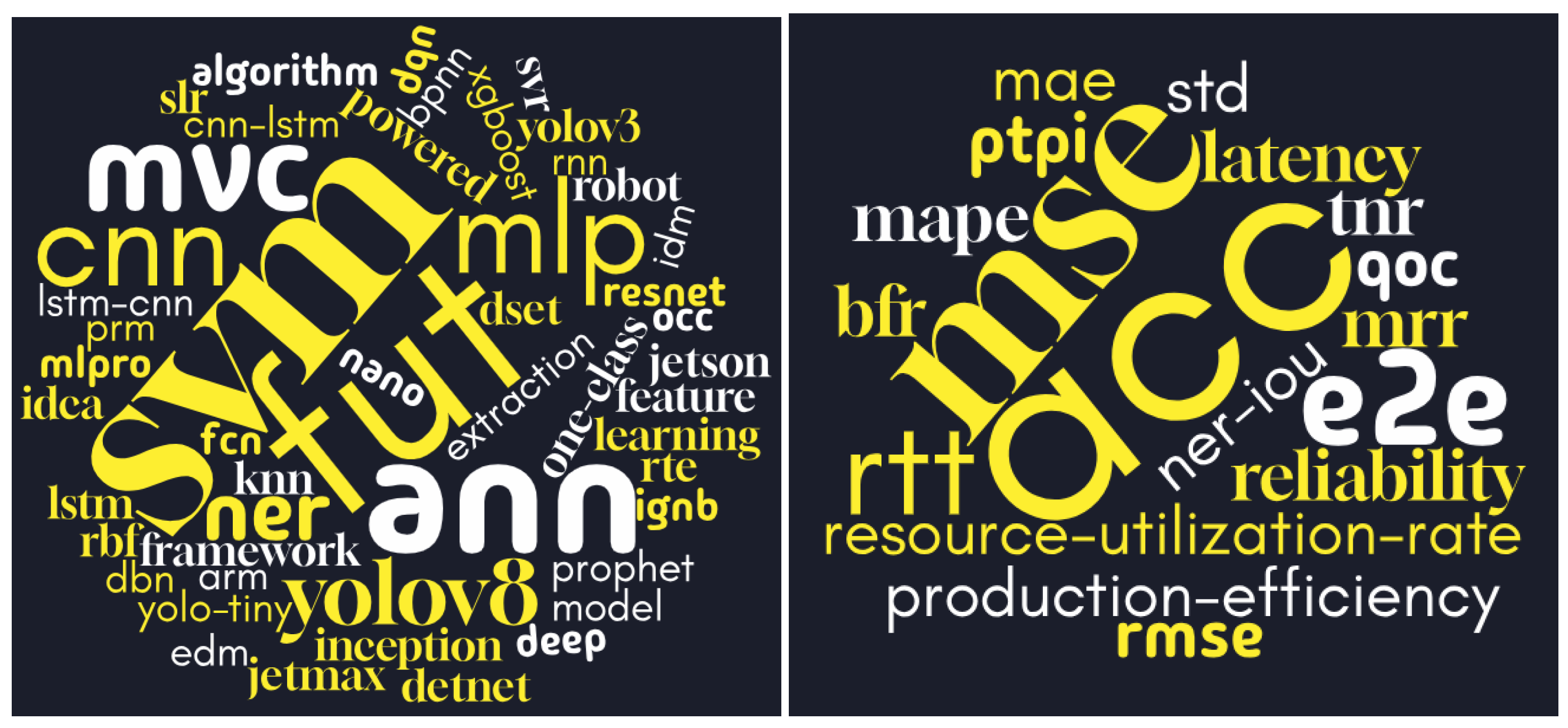
To visually analyze the techniques and metrics, word cloud graphics are used. The two-word clouds created reveal different aspects of a study related to Machine Learning and performance metrics. The first-word cloud
Figure 5 (left) emphasizes frequently mentioned deep-learning algorithms and technologies, such as “SVM”, “ANN”, “CNN”, “MVC”, and “MLP”. Interestingly, the term “FUT” also appears prominently, indicating ongoing efforts to design architectures for future integration with Machine Learning techniques. Furthermore, frameworks such as “YOLOv3” and “YOLOv8” are mentioned. The second-word cloud
Figure 5 (right) focuses on metrics and evaluation measures, highlighting terms like “Latency”, “Reliability”, “Resource utilization rate”, and “Production Efficiency”, along with technical metrics such as “Acc.”, “MSE”, “MAPE”, “E2E”, and “RTT”. This distribution suggests a study that encompasses both performance and efficiency aspects, as well as specific implementations of deep-learning algorithms and their specific industrial implementation.
Table 5.
Techniques found in the main primary information sources.
Table 5.
Techniques found in the main primary information sources.
| Reference | Year | Techniques | ML Metrics | OPC-UA Metrics |
|---|
| Bindra and Aggarwal [22] | 2024 | CNN, RF, GB, SVM | CNN (Acc. = 98%, P = 98%, F1 = 97%, R = 97%); RF, GB, SVM (Acc. = 86–91%); RF, GB, SVM (P = 85–90%); RF, GB, SVM (F1 = 84–89%); RF, GB, SVM (R = 84–89%) | |
| Revankar et al. [27] | 2024 | CNN (Inception Model V3) | Acc. = 98.84% | - |
| Rahadian et al. [49] | 2022 | CNN | Acc. = 99.9%, P = 99.9%, R = 1.0, F1 = 0.999 | - |
| Kaymakci et al. [52] | 2021 | FL, LSTM-CNN | MAE = 0.12 | - |
| Fernandez et al. [60] | 2020 | CNN-LSTM | Acc. = 98.9% | - |
| Kedari et al. [46] | 2022 | RF, SLR | RF (Acc. = 98%), SLR (Acc. = 75%) | - |
| Pereira et al. [64] | 2020 | RF, SVM, ANN | Best RF; Metrics (P, R, F1); No values are presented | - |
| Anton et al. [66] | 2019 | RF, SVM | RF (Acc. = 99.84–99.98%); SVM (Acc. = 90.81–92.53%, F1 = 85.2–94.9%) | - |
| Arévalo et al. [70] | 2018 | RF, AB, ANN MLP, DSET | RF (Acc. = 99.83–100.00%); ANN MLP (Acc. = 71.31–96.65%); AB (Acc. = 87.80–100%); DSET (Acc. = 99.83–100%) | - |
| Friedrich et al. [24] | 2024 | FL | - | - |
| Pop et al. [54] | 2021 | FL | QoC = 0.4103 | - |
| Parto et al. [63] | 2020 | FL, IGNB | - | Latency of IGNB prediction in the fog cluster = 828.8 ± 24.2 ms, Latency of IGNB federated learning in the cloud = 2.4 ± 0.4 ms |
| Filimonov et al. [23] | 2024 | YOLOv8 | Acc. = 100%, F1 = 1.0 | PTPI = 80.4 ms |
| Velesaca et al. [28] | 2024 | YOLOv8 | Acc. = 93% | E2E = 159 ms, RTT = 168 ms |
| Gichane et al. [61] | 2020 | YOLOv3, YOLO-Tiny | YOLOv3 (Acc. = 79.21%), YOLO-Tiny (Acc. = 47.75%) | - |
| Minh et al. [35] | 2023 | ANN | RMSE (X = 0.0150, Y = 0.0104, Z = 0.0100); MAPE (X = 1.598%, Y = 1.707%, Z = 1.824%), R2 (X = 0.944, Y = 0.975, Z = 0.964) | - |
| Park et al. [47] | 2022 | ANN | Acc. = 99.4% | - |
| Bonomi et al. [51] | 2021 | MVC, DT, RF, MLP, AB, GB | Best MVC (Acc. = 100%, R = 100%, TNR = 100%, F1 = 100%) | - |
| Arévalo et al. [71] | 2018 | MVC, KNN, SVM, NB | MVC (Acc. = 96.99–99.88%); KNN (Acc. = 96.34–99.54%); SVM (Acc. = 93.07–99.77%); NB (Acc. = 89.64–94.75%) | - |
| Tufek [42] | 2023 | NER | No final metrics are specified as this is an ongoing research proposal | - |
| Tufek et al. [43] | 2023 | NER, SVM with RBF | NER (IoU = 0.21–0.27); SVM (P = 0.55–0.57, R = 0.55–0.57, Acc. = 0.52–0.57, F1 = 0.53–0.57) | - |
| Schäfer et al. [50] | 2022 | RL | - | - |
| Bakakeu et al. [58] | 2020 | RL | MRR = 76–83, HITS@10 = 88–96, HITS@3 = 76–88, HITS@1 = 68–85 | - |
| Lockner et al. [34] | 2023 | SVM, RNN, AB, SVR | SVM (R2 = 0.92); RNN (MSE = 0.031); AB (R2 = 0.805); AB with SVR (MSE = 0.0032, STD = 0.0055) | - |
| Soller et al. [56] | 2021 | One-Class SVM, IF, AE, MVC | One-Class SVM (Acc. = 46.97%, P = 0.57, R = 0.57); AE (Acc. = 45.43%, P = 0.34, R = 0.64); IF (Acc. = 27.73%, P = 0.26, R = 0.64); MVC (Acc. = 46.52%, P = 0.59, R = 0.57) | - |
| Wang et al. [29] | 2024 | DQN | Production efficiency = 100%, Resource utilization rate = 95% | - |
| Gönnheimer et al. [31] | 2023 | LSTM, RF, FCN, ResNet | LSTM (Acc. = 95.71%) | - |
| Haghshenas et al. [32] | 2023 | Prophet Algorithm | - | - |
| Nam et al. [36] | 2023 | JetMax robot arm powered by Jetson Nano and Deep Learning | - | RTT (Min = 83 ms, Max = 156 ms) |
| Pospisil and Fujdiak [37] | 2023 | XGBoost | Acc. = 90.91%, P = 93.18%, R = 90.91%, F1 = 90.65% | - |
| Tiwari et al. [41] | 2023 | GA, RTE | Path tracking accuracy (up to 0.23 mm), MSE position = 0.53 mm2 | - |
| Hildebrandt et al. [62] | 2020 | OCC | Acc. = 89.5% | - |
| Pinto et al. [48] | 2022 | iDCA | Acc. = 93% | - |
| Rehmer et al. [26] | 2024 | MLP, PRM, EDM, IDM | All techniques BFR = >90% | - |
| Sharma et al. [40] | 2023 | DetNet | Reliability = >99.999% | E2E = 5–20 ms |
| Wang et al. [57] | 2021 | DBN, BPNN | DBN (Acc. = 97.1%, MSE = 4.2%); BPNN (Acc. = 88.2%, MSE = 11.2%) | - |
| Poka et al. [25] | 2024 | FUT | - | - |
| Diprasetya et al. [30] | 2023 | FUT, MLPro Framework | - | - |
| Hirsch et al. [33] | 2023 | FUT | - | - |
| Rosa et al. [38] | 2023 | FUT | - | - |
| Schneider et al. [39] | 2023 | FUT | - | - |
| Webb et al. [44] | 2023 | FUT | - | - |
| Gong et al. [45] | 2022 | FUT | - | - |
| Nohl et al. [53] | 2021 | FUT | - | - |
| Rath et al. [55] | 2021 | FUT | - | - |
| Céspedes and Barrera [59] | 2020 | FUT | - | - |
| Anton et al. [65] | 2019 | FUT | - | - |
| Cupek et al. [67] | 2019 | FUT | - | - |
| Torres et al. [69] | 2019 | FUT | - | - |
| Iatrou et al. [68] | 2019 | FUT | - | - |
| Hormann et al. [72] | 2018 | FUT, Feature extraction | - | - |
| Kirmse et al. [73] | 2018 | FUT | - | - |
5.4. OPC-UA Based Topology Using Machine Learning Techniques
The implementation of ML techniques in industrial environments with OPC-UA shows diverse deployment patterns across different architectural levels.
Table 6 shows an OPC-UA-based topology using Machine Learning techniques. Cloud deployments represent a significant trend, with studies like Rath et al. and Friedrich et al. [
24,
55] demonstrating the effective use of OPC-UA as a communication protocol in cloud-based architectures. Some implementations extend beyond simple cloud deployment, incorporating fog layer capabilities and federated learning approaches, as shown in the works of Parto and Pop [
54,
63], leading to more sophisticated distributed architectures.
Edge computing has also emerged as another prominent deployment location. Basic edge deployments, as demonstrated by Rosa et al. [
38] and Gong et al. [
45], primarily utilize OPC-UA as a communication protocol. More specialized edge implementations, such as the DINASORE framework used by Pereira et al. [
64] and Pinto et al. [
48], leverage OPC-UA’s information model and address space model capabilities. Furthermore, hardware-specific edge implementations using Raspberry Pi and Nvidia Jetson Nano platforms, as shown in Revankar and Torres’ work [
27,
69], demonstrate the versatility of OPC-UA on resource-constrained edge devices.
Local computer implementations represent the largest category of deployments, with numerous studies from researchers like Gonnheimer, Bindra, and Wang [
22,
31,
57], demonstrating the effectiveness of OPC-UA as a communication protocol in traditional computing environments. These implementations often focus on specific industrial applications and demonstrate the protocol’s versatility in handling various Machine Learning tasks.
Table 6 further details specialized deployment scenarios. For instance, Hardware-in-the-Loop (HiL) simulation demonstrated by Schafer et al. [
50] uniquely utilizes both OPC-UA’s information modeling and communication protocol capabilities. Process control level implementations, as shown in Poka’s work [
25], and workstation-based deployments, including Anton’s [
66] anomaly detection system and Velesaca’s [
28] implementation using OPC-UA Finite State Machine, represent more specific architectural approaches. On the other hand, Fernandez et al. [
60] use a part of the OPC-UA specification that proposes a finite state machine for vision tasks.
Another key use of OPC-UA involves leveraging its information model to extract data and logs for subsequent specific analyses, as performed by Kedari et al. [
46], Park et al. [
47], and Pospisil et al. [
37]. Interestingly, a significant number of studies, including works by Anton, Bakakeu, and Hildebrandt [
58,
62,
65], utilize OPC-UA as a communication protocol without explicitly specifying their deployment location. This suggests that the protocol’s core functionality can be effectively employed regardless of the specific underlying architecture.
Finally, this diverse range of deployment locations and implementation approaches demonstrates OPC-UA’s flexibility and scalability across different architectural levels, from resource-constrained edge devices to powerful cloud infrastructures, while maintaining its core functionality as either a communication protocol or information model framework.
5.5. ML Techniques Classification and OPC-UA
This section classifies the Machine Learning techniques found in the analyzed articles, aligning with the taxonomy proposed by Kotsiantis et al. [
74,
75], as detailed in
Table 7. The table also includes the specific usage role of OPC-UA for each ML category.
Detailed analysis reveals that OPC-UA plays a multifaceted role in ML implementations for industrial automation.
Table 7 shows that OPC-UA primarily serves as a universal communication protocol (ComProto) in 71.43% of implementations, enabling interoperability between heterogeneous systems.
Additionally, 21.43% of implementations leverage its semantic information model (InfoModel) to structure data in a semantically rich manner, optimizing Machine Learning processing. A smaller portion, 7.14%, utilizes advanced features such as finite state machines and companion specifications (FSM and VDMA) for highly specific applications. This versatility is complemented by its architectural adaptability, supporting consistent deployments across cloud, edge, and on-premises environments.
Among the Machine Learning techniques found, Convolutional Neural Networks (CNN) establish themselves are the most popular technique in OPC-UA implementations, primarily utilizing the communication protocol while occasionally leveraging the information model for enhanced data structuring, as demonstrated in [
22,
27,
49]. These implementations excel in industrial quality control applications, where they perform real-time visual analysis and defect detection in manufacturing processes. The hybrid CNN-LSTM architectures, in [
52,
60], extend these capabilities by incorporating OPC-UA’s VDMA specification for complex temporal-spatial applications, particularly in welding defect detection using thermal imaging systems. CNN-YOLO implementations, referenced in [
23,
61], combine the communication protocol with the information model to enable intelligent object identification systems within CODESYS PLCs and industrial computer vision applications that require real-time processing capabilities.
On the other hand, Random Forest emerges as a highly effective technique that exclusively employs OPC-UA’s communication protocol, as shown in [
46,
66], specializing in critical intrusion detection systems and secure remote monitoring applications. This technique demonstrates exceptional robustness in handling non-linear industrial data and provides resistance to overfitting, making it particularly suitable for critical supervision systems where reliability is paramount. Naive Bayes techniques, proposed in [
63,
71], also utilize the communication protocol for process monitoring and optimization applications, though they are less common in industrial automation scenarios where deterministic performance is required.
Also, Support Vector Machines (SVM) and their One-Class variants exclusively utilize OPC-UA’s communication protocol, according to [
34,
43,
56,
62], specializing in anomaly detection and predictive maintenance applications within industrial environments. These techniques demonstrate particular effectiveness in integrating heterogeneous data sources and systems where model interpretability is crucial for operational decision making. The One-Class SVM variant has consolidated as a specialized solution for anomaly detection in complex industrial systems, where identifying atypical patterns is fundamental for preventive maintenance strategies and operational safety protocols in manufacturing environments.
Other techniques, such as reinforcement learning (RL), represent an advanced category that leverages both OPC-UA’s communication protocol and information model, according to [
50,
58], specializing in Hardware-in-the-Loop simulations and reasoning over information models through graph embeddings. These implementations are characterized by their adaptive optimization capabilities in complex industrial processes where dynamic decision making is required. Genetic Algorithms (GA), documented in reference [
41], use the communication protocol for process optimization applications, while techniques like Deep Q-Network (DQN) combine both OPC-UA approaches for intelligent control applications and automated decision-making systems in industrial automation scenarios.
The latest reviewed approach, combining techniques among which are AdaBoost (AB) and XGBoost, utilizes OPC-UA’s communication protocol according to [
34,
37,
51,
70], finding application in distributed monitoring systems and advanced communication networks for industrial IoT platforms. Federated learning (FL), documented in references [
24,
54], represents an innovative approach for industrial IoT platforms that maintains data privacy while enabling distributed learning across industrial networks. Specialized techniques like DetNet, referenced in [
40], focus on deterministic communications for 6G networks with stringent reliability requirements and ultra-low latency constraints. Lastly, techniques such as iDCA utilize the information model for anomaly detection by design in cyber-physical production systems, facilitating proactive quality control and system monitoring capabilities.
The integration of native security features and real-time communication services positions OPC-UA as a fundamental element for ML implementations in critical industrial environments that demand immediate response. This diversity of roles transcends the traditional function of a communications protocol, establishing OPC-UA as a comprehensive platform for the effective integration of Machine Learning in industrial environments, where the combination of interoperability, semantic data structure, robust security, and real-time capabilities is essential for the success of intelligent automation implementations.