Article

Design and Temperature Control of a Novel Aeroponic Plant Growth Chamber

Department of Electrical and Electronics Engineering, Faculty of Engineering, Karadeniz Technical University, 61080 Trabzon, Türkiye
*
Author to whom correspondence should be addressed.
Electronics 2025, 14(14), 2801; https://doi.org/10.3390/electronics14142801
Submission received: 31 May 2025 / Revised: 4 July 2025 / Accepted: 8 July 2025 / Published: 11 July 2025
(This article belongs to the Special Issue Intelligent and Autonomous Sensor System for Precision Agriculture)

Abstract

It is projected that the world population will quadruple over the next century, and to meet future food demands, agricultural production will need to increase by 70%. Therefore, there has been a transition from traditional farming methods to autonomous modern agriculture. One such modern technique is aeroponic farming, in which plants are grown without soil under controlled and hygienic conditions. In aeroponic farming, plants are significantly less affected by climatic conditions, infectious diseases, and biotic and abiotic stresses, such as pest infestations. Additionally, this method can reduce water, nutrient, and pesticide usage by 98%, 60%, and 100%, respectively, while increasing the yield by 45–75% compared to traditional farming. In this study, a three-dimensional industrial design of an innovative aeroponic plant growth chamber was presented for use by individuals, researchers, and professional growers. The proposed chamber design is modular and open to further innovation. Unlike existing chambers, it includes load cells that enable real-time monitoring of the fresh weight of the plant. Furthermore, cameras were integrated into the chamber to track plant growth and changes over time and weight. Additionally, RGB power LEDs were placed on the inner ceiling of the chamber to provide an optimal lighting intensity and spectrum based on the cultivated plant species. A customizable chamber design was introduced, allowing users to determine the growing tray and nutrient nozzles according to the type and quantity of plants. Finally, system models were developed for temperature control of the chamber. Temperature control was implemented using a proportional-integral-derivative controller optimized with particle swarm optimization, radial movement optimization, differential evolution, and mayfly optimization algorithms for the gain parameters. The simulation results indicate that the temperatures of the growing and feeding chambers in the cabinet reached a steady state within 260 s, with an offset error of no more than 0.5 °C. This result demonstrates the accuracy of the derived model and the effectiveness of the optimized controllers.

1. Introduction

The world’s population is increasing rapidly, resulting in a significant demand for food. According to a study conducted by the United Nations in 2009, the world population was 2.53 billion in 1950, 4.06 billion in 1975, and 6.03 billion in 2009. It is projected to reach 8.01 billion by 2025 and 9.15 billion by 2050 [1]. Over the next century, the world’s population is expected to increase by approximately fourfold. According to the Food and Agriculture Organization, to provide sufficient food for the rapidly growing global population, agricultural production needs to increase by approximately 70% [2]. Agriculture is not only essential for meeting human food demand but also serves as a crucial source of raw materials for industry. Due to increasing global warming and drought, the water and agricultural land required for farming is gradually decreasing. Developing and developed countries are facing significant water crises owing to rapid urbanization and industrialization. Additionally, approximately 70% of the world’s freshwater resources are used for agriculture [3]. The availability of freshwater for irrigated farmland is expected to decline in the future. The main challenges for agriculture include poor land management, soil degradation, regional climate change, rapid urbanization, industrialization, drought, inefficient water management, and pollution [4]. In light of these data, traditional agricultural methods are no longer sufficient to meet the current food demand.
In recent years, there has been a transition from traditional agriculture to modern farming methods to meet the increasing food demand of the growing population and raw material needs of the industry. One of these modern agricultural techniques is aeroponic plant cultivation, a soilless farming method conducted under controlled conditions [5]. In aeroponic farming, plant roots are suspended in the air using artificial holders. Instead of soil, plants receive the necessary nutrients from a nutrient solution mist sprayed onto their roots using atomizing nozzles [6]. Because aeroponic cultivation is carried out under controlled conditions, plants are less affected by climate fluctuations, infectious diseases, and biotic or abiotic stresses, such as pest infestations. A 2006 study conducted by NASA revealed that aeroponic farming reduces water usage by 98%, nutrient consumption by 60%, and pesticide use by 100% compared to traditional farming [7]. Additionally, compared to traditional soil-based farming, aeroponic agriculture increases yield by 45–75% [8]. The growing global food demand can be addressed with the wider adoption of aeroponic plant cultivation. Furthermore, this method provides numerous benefits, including the efficient use of natural resources, and enables continuous, fresh, and hygienic vegetable production throughout the year [9]. In aeroponic farming, plants are grown in a closed environment without soil. Therefore, precise and minimal-error control of parameters, such as the required light wavelength for plant growth, temperature, humidity, root temperature, nutrient solution pH and electrical conductivity (EC) values, nutrient solution temperature, and timing of atomization nozzles, is essential. Furthermore, the waste heat generated by LED lighting, pump systems, climate control, and air circulation equipment used in aeroponic farming should be recovered to improve energy efficiency [10]. Because aeroponic farming is a relatively new and developing plant growth technique, there are a limited number of studies in this field, and the technique has not yet become widespread among farmers [11].
In the literature review on temperature control of the aeroponic plant growth chamber, the focus has generally been on remotely monitoring parameters rather than system control. In most studies, parameters have been regulated using the simplest control method, that is, on-off control. Montoya et al. designed a system for measuring and recording the temperature, pH, and EC of the nutrient solution in an aeroponic system. In this system, an Arduino controller board and temperature and humidity sensors were used, and the collected data were stored in memory. In this study, temperature and humidity were controlled using the on-off control method, with the temperature fluctuating between 20 °C and 30 °C and humidity ranging from 40% to 90% [12]. Sani et al. monitored and recorded the temperature, pH, and light intensity of an aeroponic plant growth chamber through a web-based system. In this study, the temperature, pH, and light intensity were controlled using relays with the on-off control [13]. Kerns and Lee observed and recorded the humidity, temperature, and pH values in an aeroponic system using the internet of things method. In this study, the three parameters were controlled using the on-off control [14]. In a study conducted by Idris and Sani, the temperature, pH, humidity, and atomization nozzles in an aeroponic system used for potato cultivation were controlled using relays with the on-off control [15]. Jonas et al. designed an aeroponic plant growth chamber and controlled temperature, pH, humidity, and the nutrient pump using the simplest control method: the on-off control. Additionally, the data read by the Arduino controller board from the sensors were designed to be monitored via a web server on Twitter. In this study, the temperature fluctuated between 16 °C and 22 °C, whereas the humidity varied between approximately 75% and 85% [16]. In the study conducted by Lucero et al., the traditional cultivation technique was compared with the aeroponic plant growth method. This study was conducted in an open environment using lettuce. The temperature, humidity, and pH were monitored using sensors. The nutrient-providing water pump and light intensity were controlled using relays with the on-off control based on the data read from the sensors. In the greenhouse conditions of the study, the temperature fluctuated between 8 °C and 44 °C, the humidity varied between 10% and 94%, and the pH ranged from 5.9 to 6.9. Additionally, it was observed that the root length of plants grown using the traditional method was approximately 5 cm, whereas the root length of plants grown using the aeroponic system was approximately 20 cm [17]. In all the studies mentioned above, the focus was on monitoring and recording the system parameters rather than controlling them. The control method applied in these studies was the simplest, that is, on-off control, which resulted in a relatively high system error.
In traditional farming methods, these parameters are generally controlled using advanced control techniques. Setiawan and his team used pseudo derivative feedback (PDF) and proportional-integral (PI) controllers for temperature control in a greenhouse environment. In this study, a system model for the temperature parameter was first developed, and the necessary K P , K I , and K D parameters were determined for the PDF and PI controllers. It was observed that the PDF method exhibited less overshoot than the PI method and achieved temperature control with a precision of 0.2 °C [18]. Salgado and Cunha controlled the temperature and humidity parameters in greenhouses using hierarchical fuzzy logic control. In this study, the temperature was controlled with an error margin of approximately 0.7 °C, and the humidity with an error margin of 3% [19]. Jun and Linli conducted temperature control in greenhouses using fuzzy proportional-integral-derivative (FPID) and classical proportional-integral-derivative (PID) control methods, comparing the two approaches. The FPID controller achieved stability much faster and with significantly less overshoot than the classical PID controller. In both methods, the steady-state error was found to be negligible [20]. Heidari and Khodadadi studied temperature and humidity control in greenhouses using classical PID and self-tuning PID controllers. In this study, temperature and humidity parameters were simulated in MATLAB (R2023b Update 4), and humidity control was tested in a designed mini greenhouse [21].
In this paper, the design of an innovative aeroponic plant growth chamber is presented, which enables professionals and individuals to engage in aeroponic farming and conduct research and development projects. A system model for temperature control was developed, and the temperature control of the aeroponic plant growth chamber was performed using particle swarm optimization (PSO)-PID, radial movement optimization (RMO)-PID, differential evolution (DE)-PID, and mayfly optimization algorithms (MOA)-PID controllers. The novel contributions of this study are as follows:
  • Real-time fresh weight tracking of plants: Load cells were placed on the growing tray inside the chamber to monitor the fresh weight of the plants in real time.
  • Modeling plant growth: Cameras were installed inside the chamber to model the relationship between the plant’s fresh weight and growth.
  • Modular design: Both the chamber frame and body were assembled with connecting fittings, producing a modular structure for the novel aeroponic chamber. This design is open to development and facilitates fault detection and repairs.
  • Flexibility: In the proposed chamber design, the user can adjust the growing tray according to the plants they wish to cultivate. Additionally, the user can define the number and position of the nozzles based on the number of plants grown. The nozzles inside the chamber are adjustable, allowing for changes in the particle size and spraying pattern according to the plant species.
  • Adaptive lighting: In the proposed chamber, the light intensity and spectrum of each RGB LED block were adjusted using pulse-width modulation (PWM). This ensures an appropriate lighting intensity and spectrum for the cultivated plant species, leading to increased yield and energy savings. Additionally, the designed chamber can support academic studies aimed at determining the optimum light intensity and spectrum for plant species grown using aeroponic farming.
  • Nutrient solution temperature control: The temperature of the nutrient solution was controlled in the proposed chamber to accelerate plant growth.
  • Temperature control model: The temperature model for the upper and lower chambers of the chamber was obtained, and the controllability of the model was demonstrated through simulation results.
In Table 1, a comparison of the proposed cabin with existing similar ones is provided, and the remainder of the paper is organized as follows. In Section 2, the novel aeroponic plant growth chamber and experimental setup is detailed. The simulation results are discussed in Section 3, and the mathematical model is verified. Finally, Section 4 concludes the paper.

2. Materials and Methods

In this section, the electromechanical design of the innovative plant growth chamber and its control loops are explained. Additionally, a brief overview of the heuristic algorithms used to optimize the parameters of the PID controller for temperature control is provided. Finally, the performance criteria of the error area, which was selected as the fitness function in the parameter optimization, are presented.

2.1. Aeroponic Plant-Growing Chamber

This section presents the electromechanical design of a novel aeroponic plant growth chamber. During the design phase of the chamber, critical parameters such as light intensity, ambient temperature, humidity, nutrient temperature, nutrient quantity, nutrient pH, and nutrient EC value, which are necessary for aeroponic farming, were considered [22]. Additionally, four high-precision load cells, which are not present in existing chambers and provide real-time tracking of the plant fresh weight, were installed at the corners of the growth tray in the proposed chamber. Furthermore, cameras were placed inside the chamber to reveal the relationship between plant development and fresh weight.

2.1.1. Mechanical Design of the Aeroponic Plant-Growing Chamber

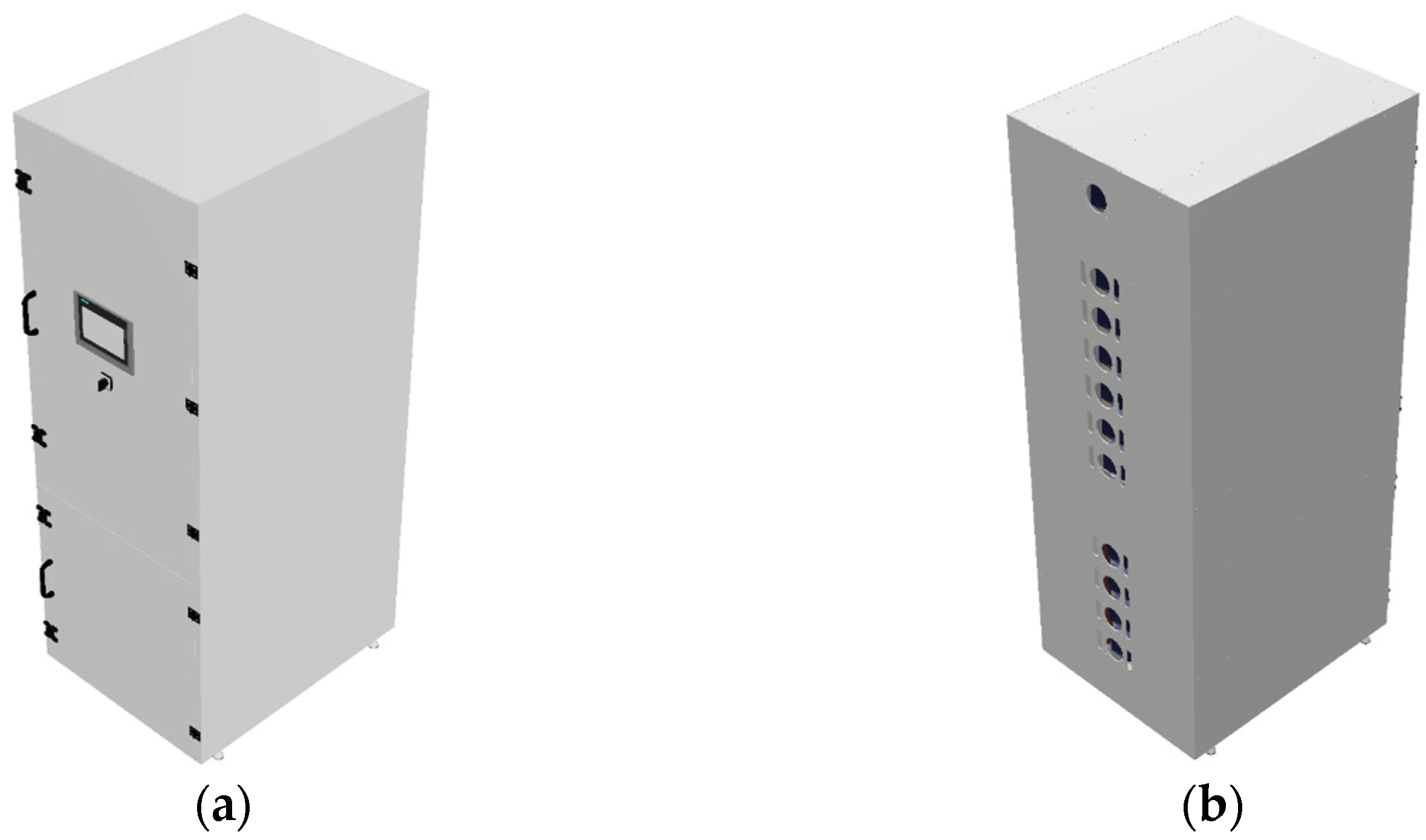
The chamber was designed using Autodesk Fusion 360 software. The frame of the chamber was made from a 20 × 20 mm channel 6 sigma profile. A 4 mm-thick aluminum composite panel was placed on this frame. The chamber was designed to be 60 × 72 × 150 cm in size, and its perspective view is shown in Figure 1. In the cabin design, the physical characteristics of the plants listed in Table 2, which are commonly grown in aeroponic farming, have been considered. Additionally, because the proposed cabin has a modular structure, the sizes of the nutrient and growing chambers can be adjusted according to the plant species to be cultivated.
The mechanical components of the chamber comprise five main components. These components are briefly explained below.
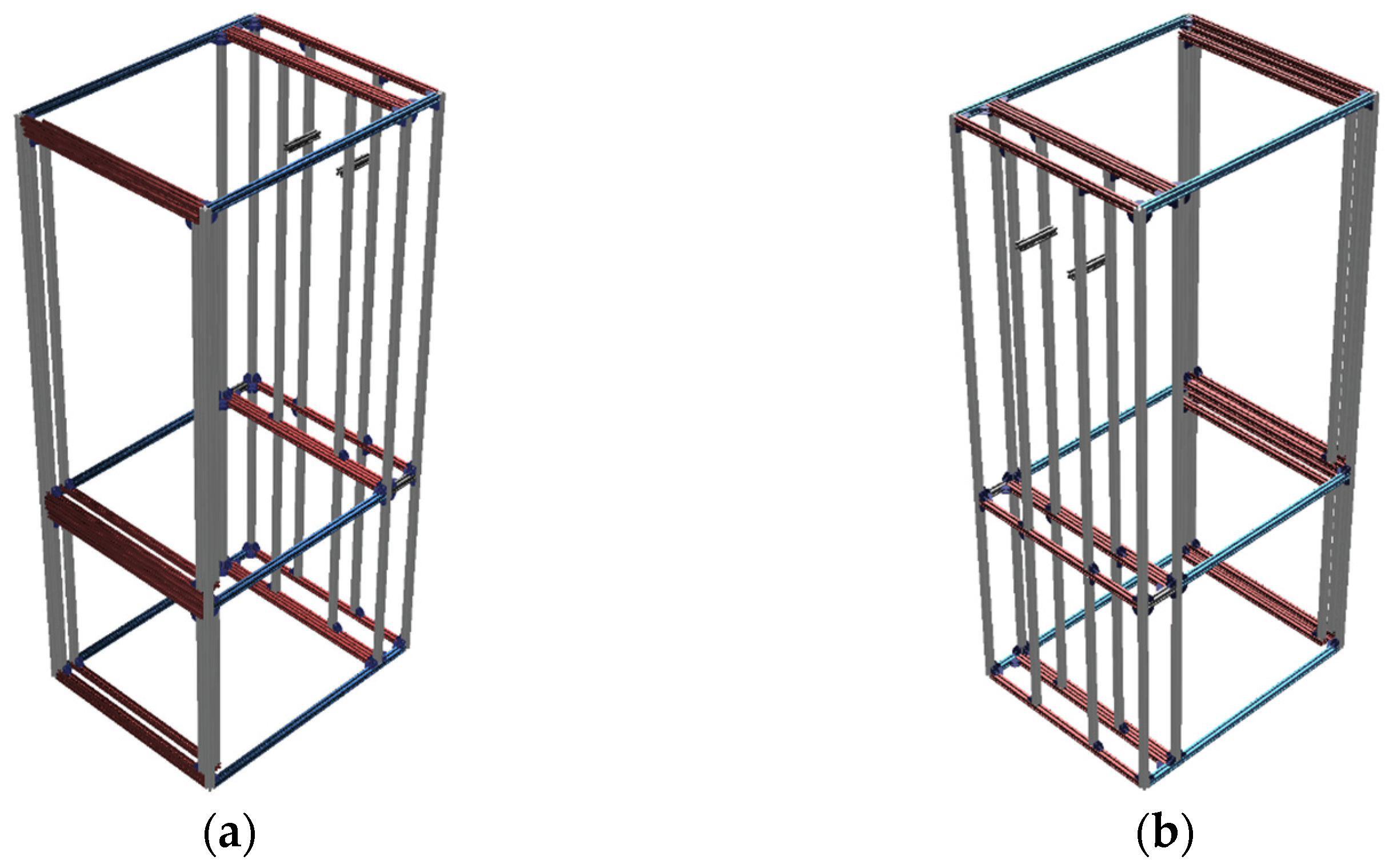
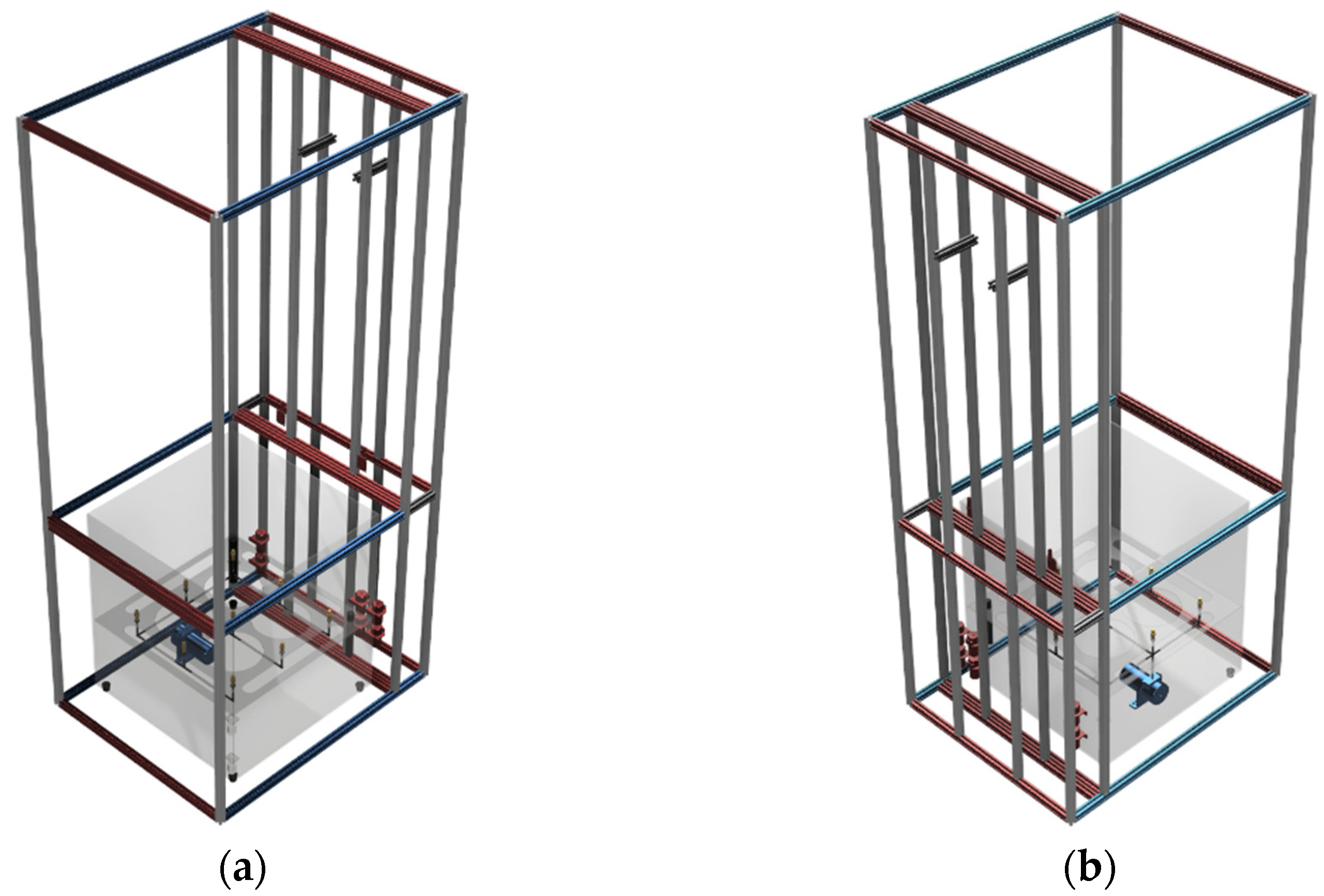
Chamber frame: This forms the frame of the plant growth chamber. The mechanical, electromechanical, and electronic components of the chamber were placed on this frame. The sigma profiles that comprise the frame are connected to each other using fittings. The frame of the designed chamber is illustrated in Figure 2.
Chamber body: Aluminum composite panels are widely used in the manufacturing industry because of their resistance to environmental effects, thermal and sound insulation properties, ease of processing, and the fact that they do not require painting. The body of the plant growth chamber was made using a high-quality aluminum composite panel with a thickness of 0.8 mm and a total thickness of 4 mm. After the composite panels were cut, they were mounted onto the chamber frame using screws and channel nuts. Because both the chamber frame and the body are connected with fasteners (screws, channel nuts, and fittings), the proposed novel aeroponic chamber has a modular structure and is open to updates. Additionally, it offers ease of fault detection and repairs.
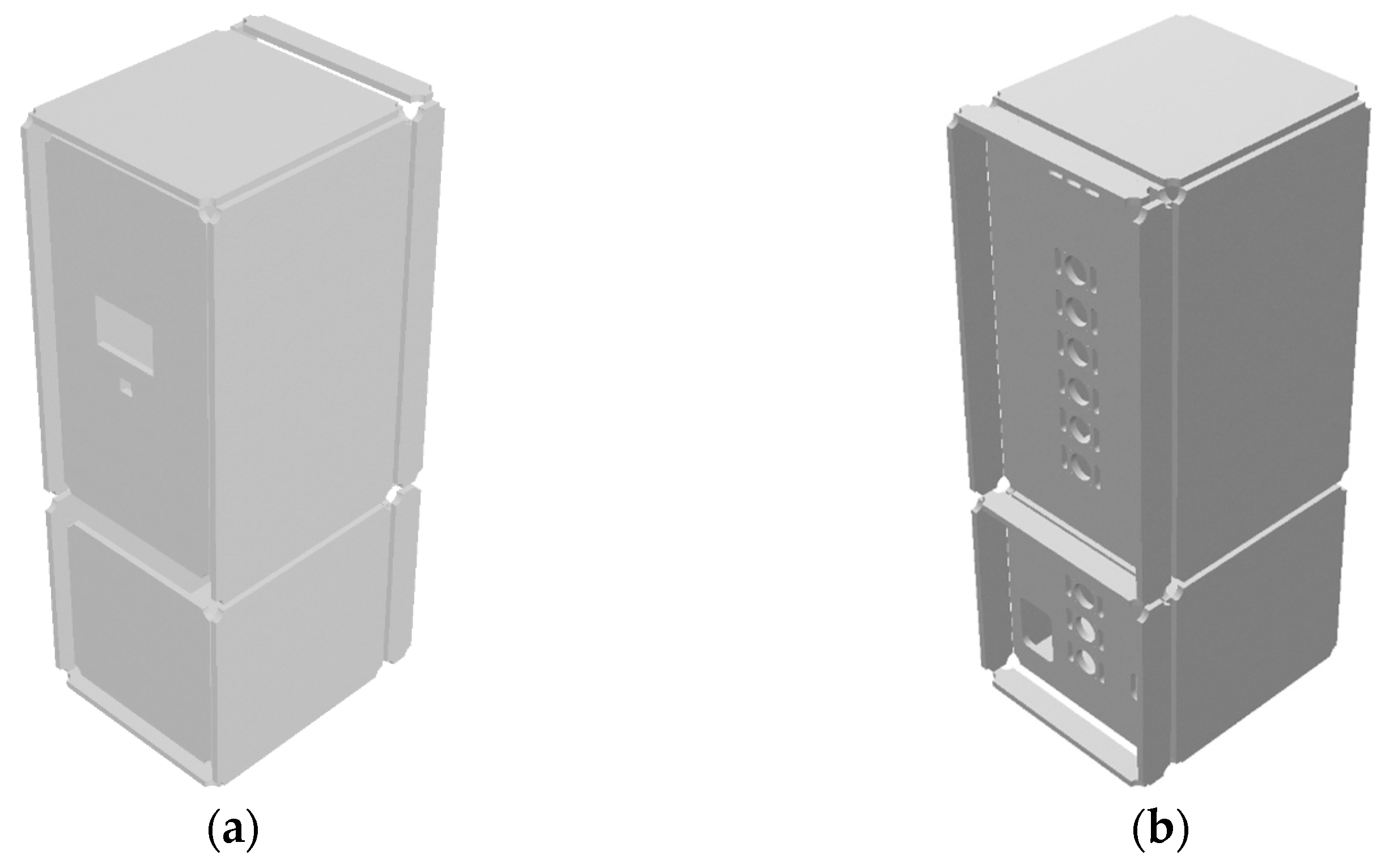
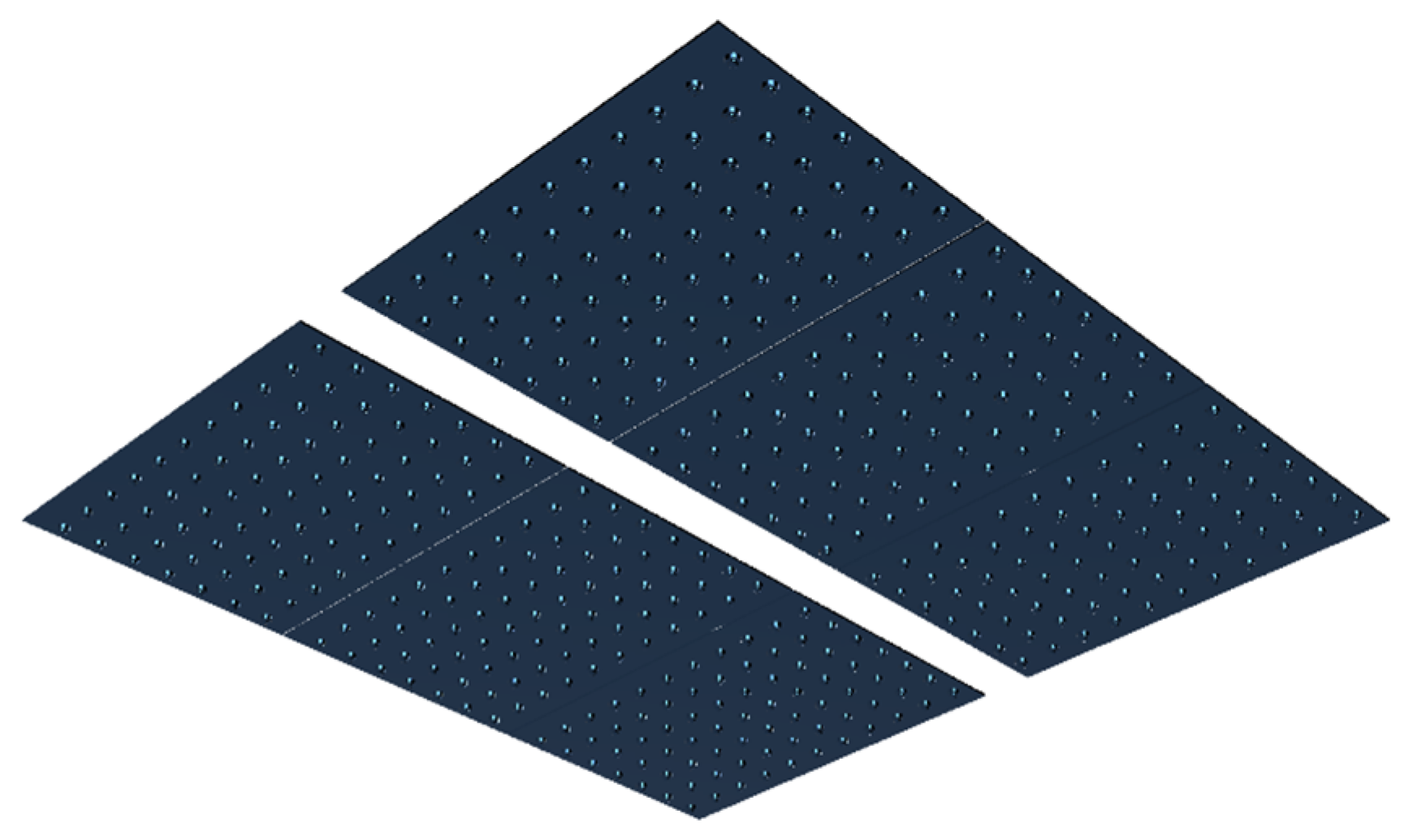
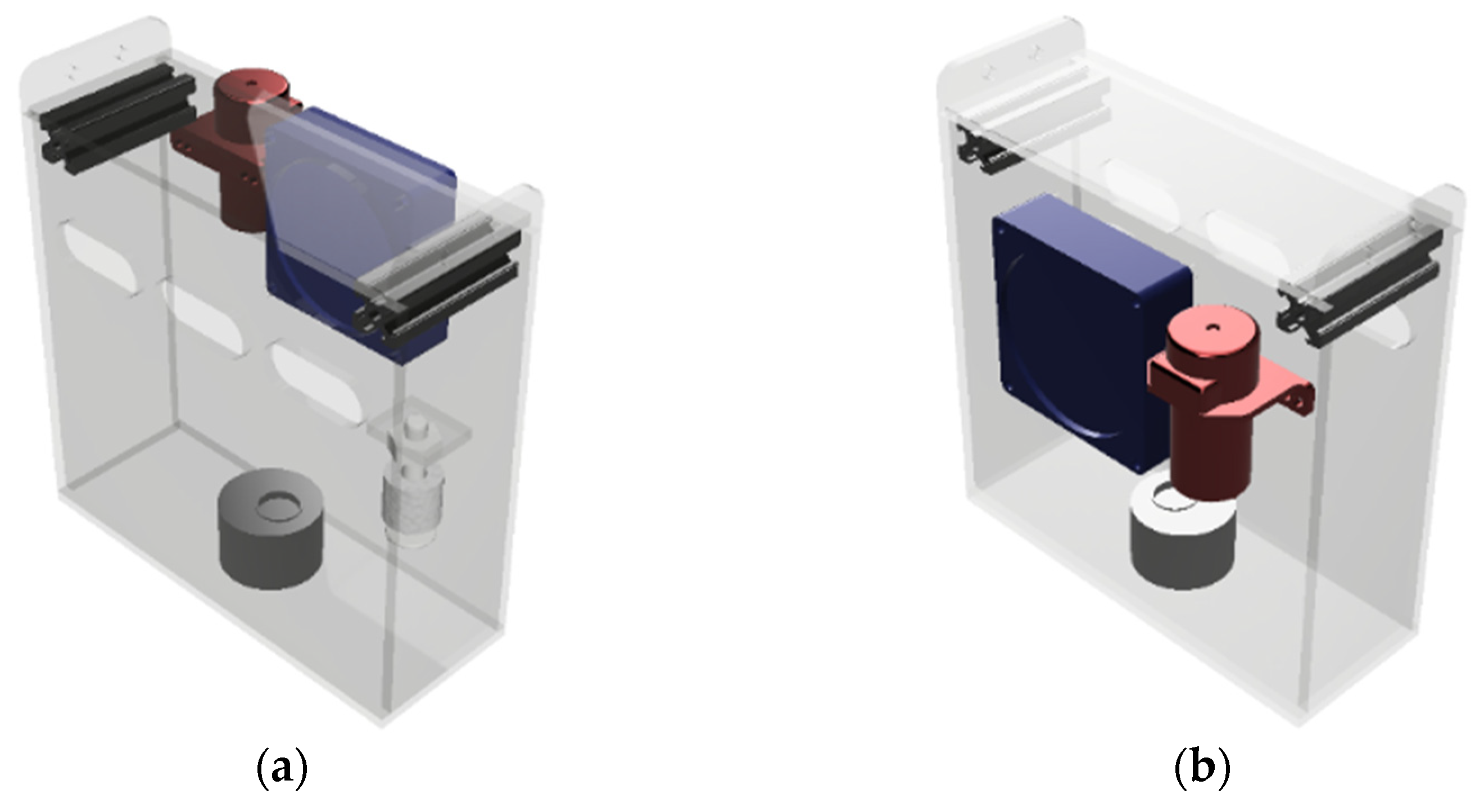
Chamber insulation: The aluminum composite panels that comprise the body of the chamber provide moderate thermal insulation. However, for energy efficiency, the growth and nutrient chambers must be insulated from the external environment to quickly bring the ambient temperatures of the chambers to the selected reference value with minimal error and ensure system stability with minimal control actions. Therefore, 20 mm-thick extruded polystyrene thermal insulation panels were placed between the aluminum panels that formed the body of the chamber. The arrangement of the thermal insulation panels in the chamber is shown in Figure 3.
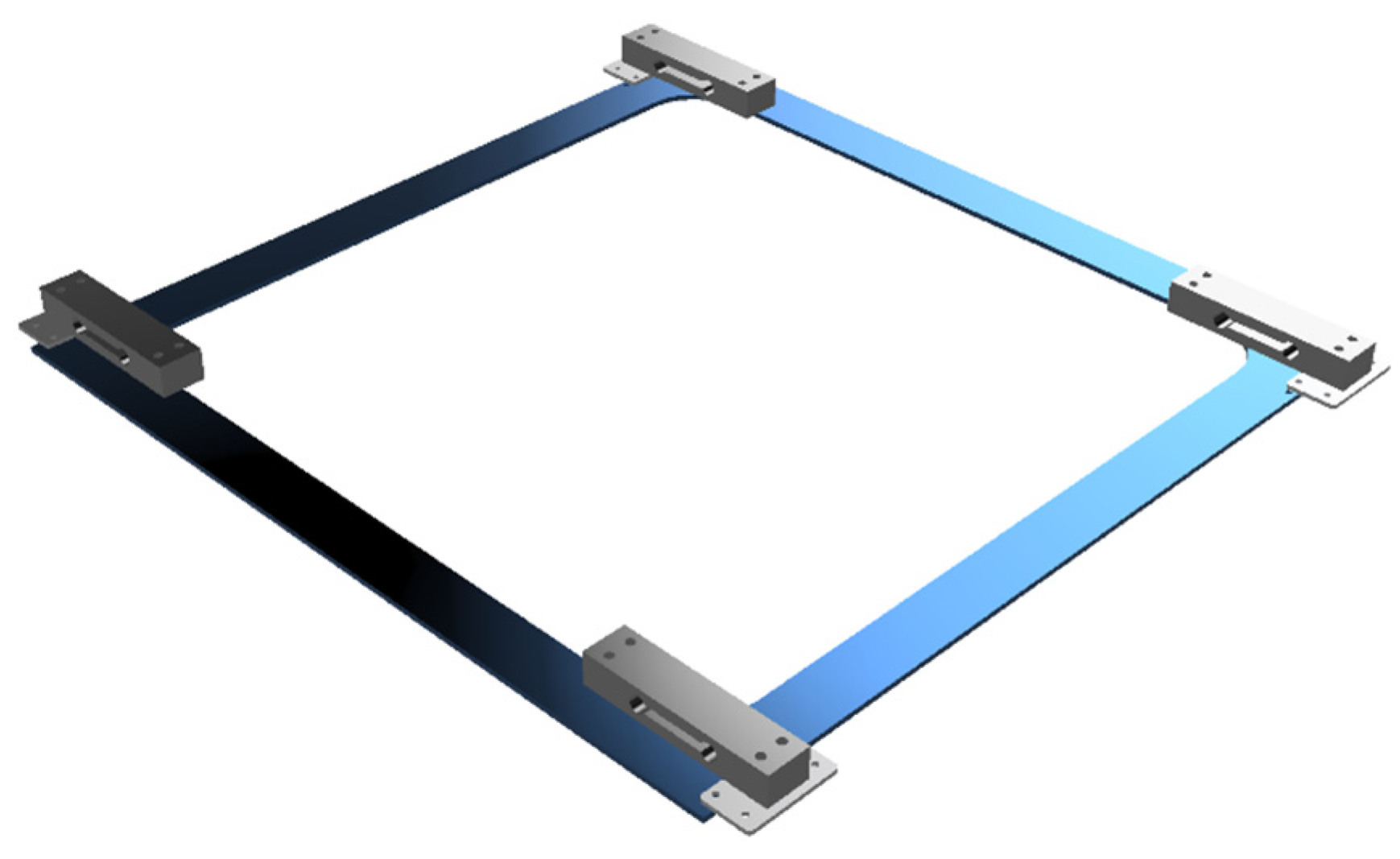
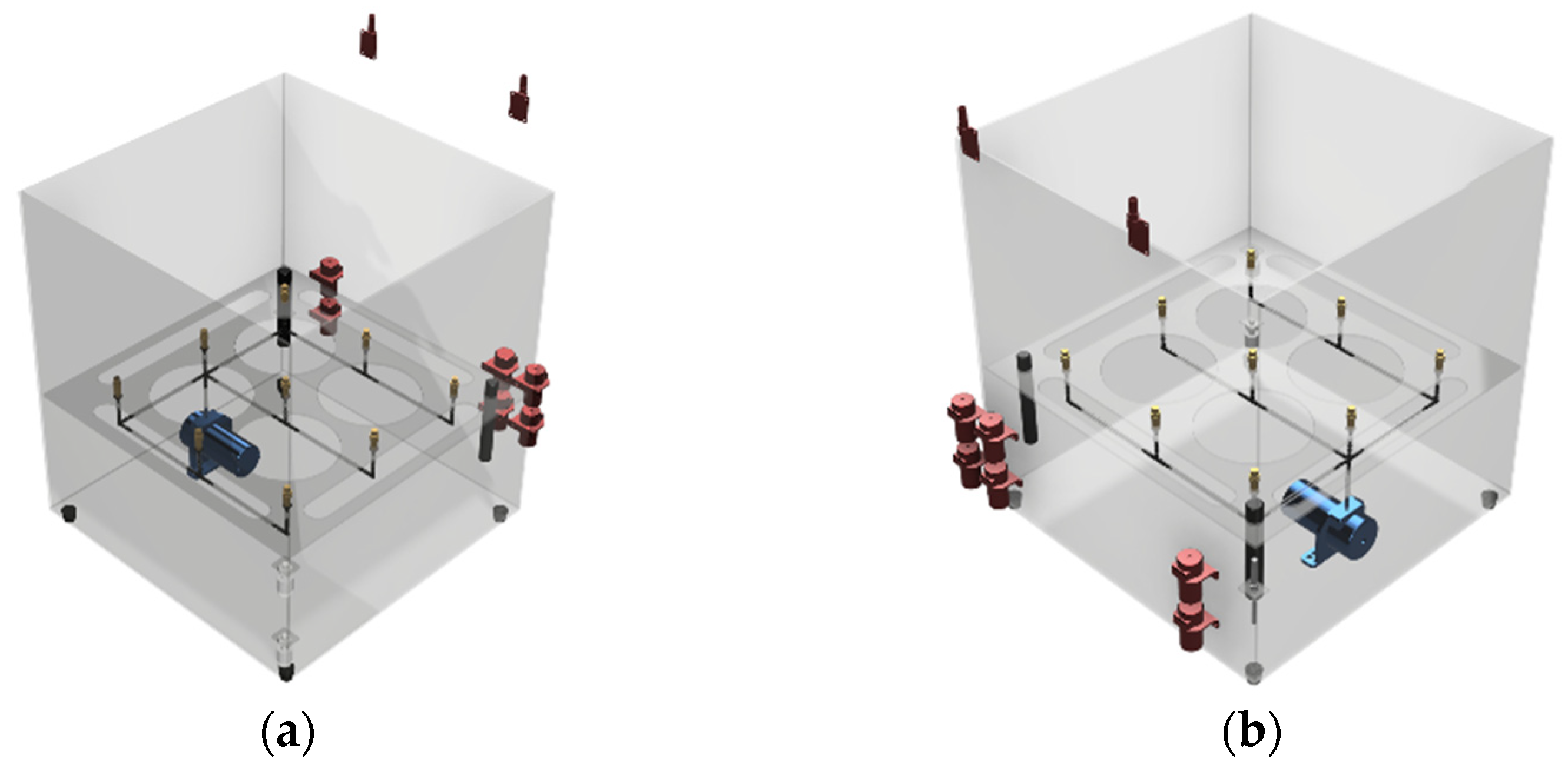
Chamber partition: It separates the growth and nutrient chambers. A 4 mm-thick aluminum composite panel was used for the partition, as shown in Figure 4. Additionally, one end of the load cells, which allowed the measurement of the plant’s instant fresh weight, was screwed into this partition.
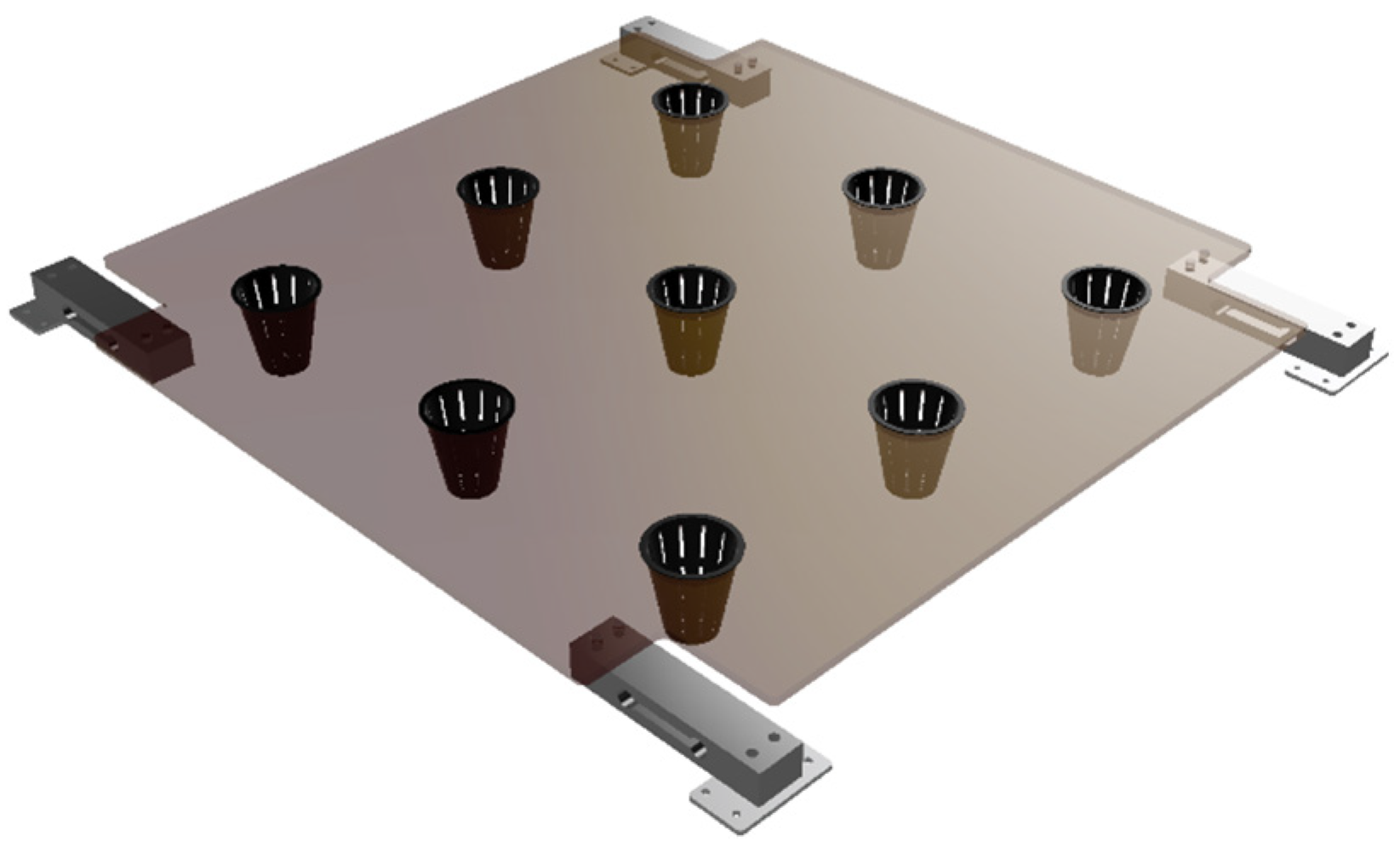
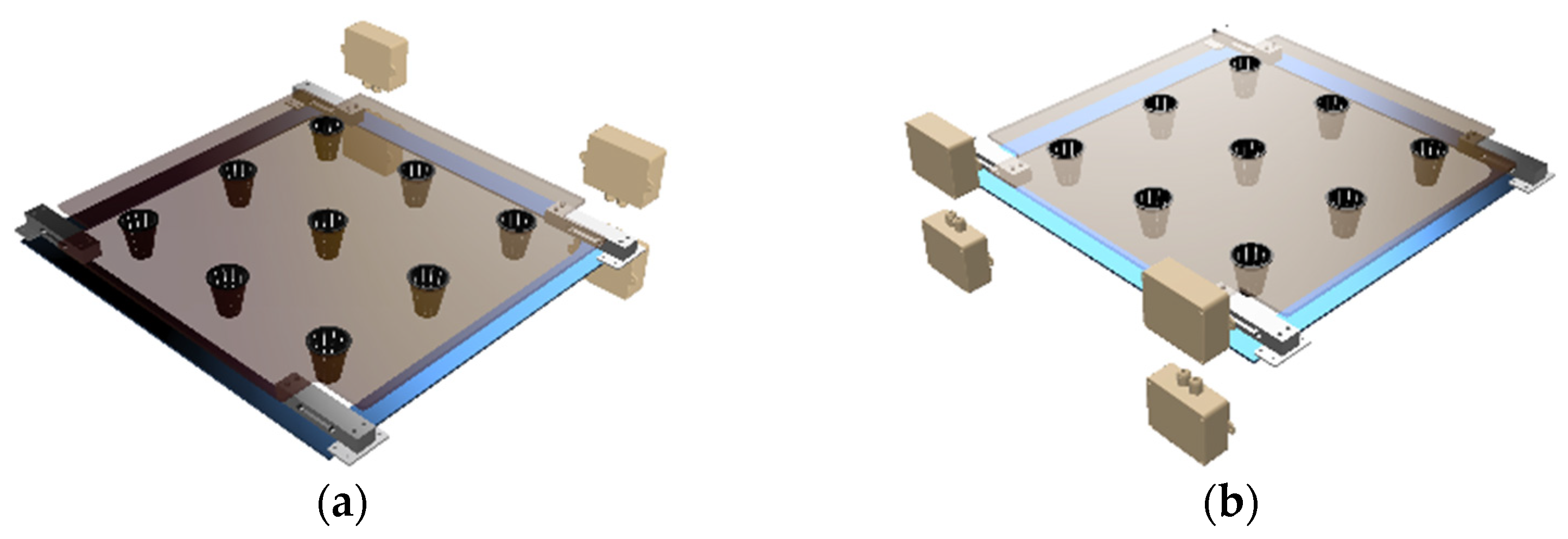
Plant-growing tray: This is the tray where the plant is placed, allowing its roots to remain suspended in the air. Because the sizes of plants grown in aeroponic farming vary, the number of plants in the tray can change. The dimensions of the growth tray in the proposed chamber are presented in detail. Thus, the user can change the tray according to the plants they wish to grow. As shown in Figure 5, 6 mm-thick acrylic glass was used in the growth tray.

2.1.2. Electronic Design of a Plant Growth Chamber

In the proposed aeroponic growth chamber, seven parameters (light intensity, temperature, humidity, nutrient temperature, nutrient pH value, nutrient EC value, and nutrient-transfer period) were controlled simultaneously. This section briefly explains the control of these parameters.
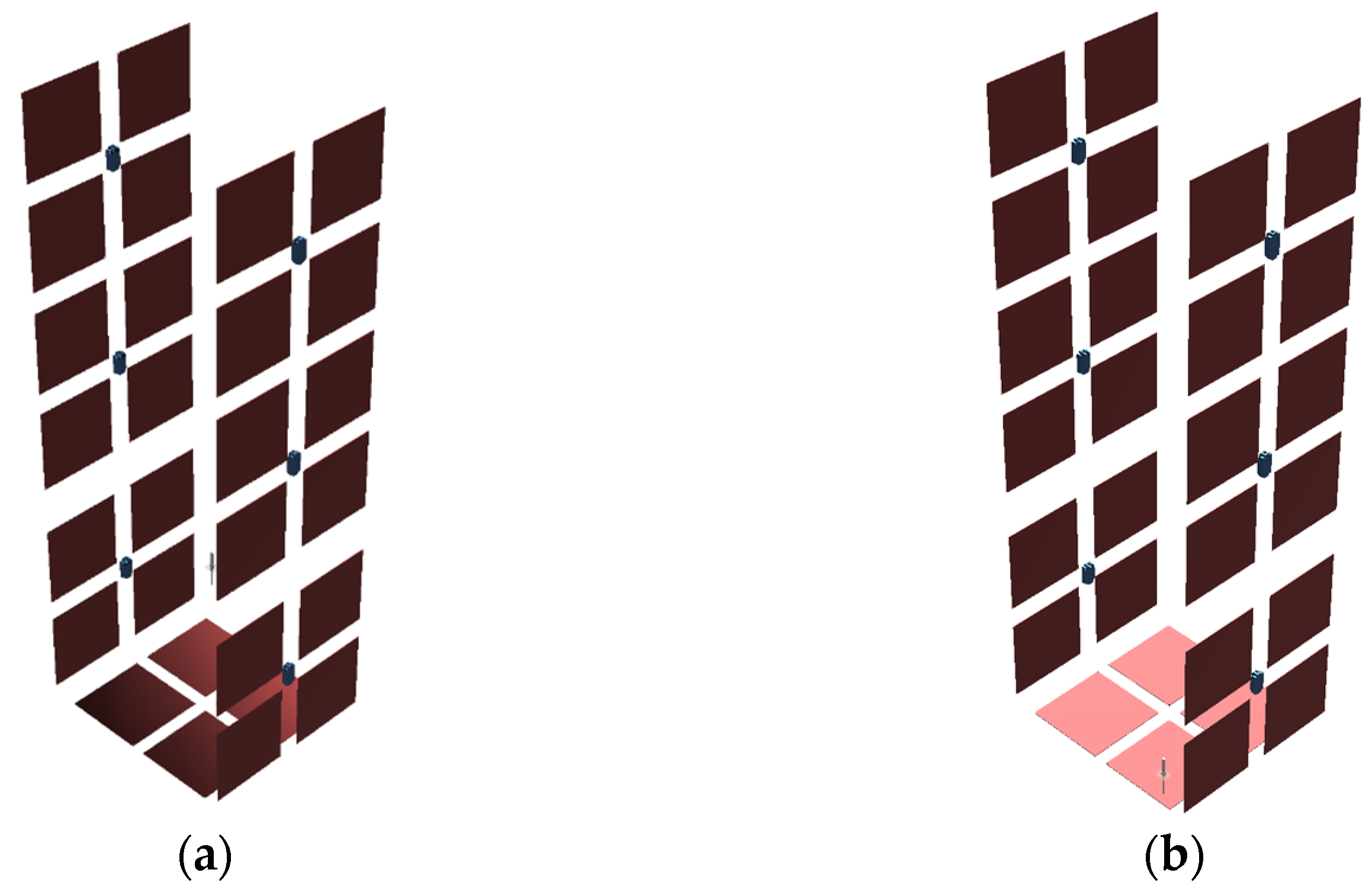
Light intensity control: The growth of a plant depends on the intensity, wavelength, and duration of the light applied. The control of light intensity has been studied in the literature [23,24,25]. However, no study has controlled the light intensity and spectrum using LED derives and RGB power LEDs. In the proposed chamber, the lighting required for plant growth is provided by RGB LED panels. Six RGB LED panels were installed on the inner ceiling of the chamber. Each LED panel, measuring 30 × 20 cm, contained 77 RGB power LEDs arranged in seven rows and 11 columns. Each LED had a power of 3 W, with the red component (R) emitting 50 lumens, the green component (G) emitting 70 lumens, and the blue component (B) emitting 20 lumens, providing a total of 140 lumens of light. When all the LEDs were operated at full power, one panel emitted 77 × 140 = 10,780 lm, and six panels emitted a total of 6 × 10,780 = 64,680 lm of light. The arrangement of the 24 V LED panels inside the chamber is illustrated in Figure 6. In contrast to the studies in the literature, in the proposed chamber, the light intensity and spectrum of each RGB LED block were adjusted using PWM. This allows light with the appropriate intensity and spectrum for the cultivated plans, thereby aiming to increase yield and save energy. Additionally, the chamber will contribute to studies aimed at determining the optimal light intensity and spectrum for plants grown using aeroponic farming.
Temperature Control: Ambient and root temperatures are critical for plant development [26,27,28]. Fan heaters are generally used to heat plant growth chambers. However, the strong airflow created by these heaters causes stress to the plants and negatively affects their growth. Additionally, malfunctions in the temperature control system can lead to the application of hot air at hundreds of degrees to plants, causing sudden plant death. Furthermore, the fans in these systems generate noise and vibrations, reducing their usability and ergonomics. Unlike existing chambers, the proposed chamber uses heating plates similar to those in 3D printers. These plates operate at a maximum of 24 V, and therefore do not pose health and safety risks. Additionally, the electrically insulated heating resistors on the plate cover the entire surface, allowing for homogeneous heating and preventing the effect of ambient humidity. Moreover, because the heating system does not include moving parts, such as fans, it requires no maintenance and is less prone to frequent malfunctions. Cooling was achieved using Peltier modules and fan arrays within the chamber. The temperature of the internal volume of the chamber was measured using high-precision SHT20 (Sensirion AG, Stäfa, Switzerland) temperature and humidity sensors, as shown in Figure 7. Because temperature measurements were taken from six different points inside the chamber, it was possible to determine whether the heating or cooling was uniform. To maintain the internal temperature at the specified reference value, the necessary control signals were calculated by the controller and applied to the fan, heater, and Peltier drivers for temperature control.
In the proposed chamber, 21 × 21 cm heating panels were used for heating. These panels are currently used in fused deposition modeling (FDM) 3D printers to heat print beds. The heating panels shown in Figure 7 draw 120 W of power at 24 VDC. To uniformly heat the interior of the chamber, 28 heating panels, each rated at 120 W, were used. To increase the heating surface and reduce power consumption, every four heating panels were connected in two series and two parallel configurations, ensuring a total power of 120 W. In this setup, the total power of the 24 panels inside the chamber was 28/4 × 120 = 840 W. Additionally, when each panel is operated at full power, its temperature can reach a maximum of 100 °C. This temperature limit is sufficiently high to raise the chamber temperature to the desired level, depending on the plant species being grown, and low enough to avoid damaging the chamber’s electronic and mechanical components.
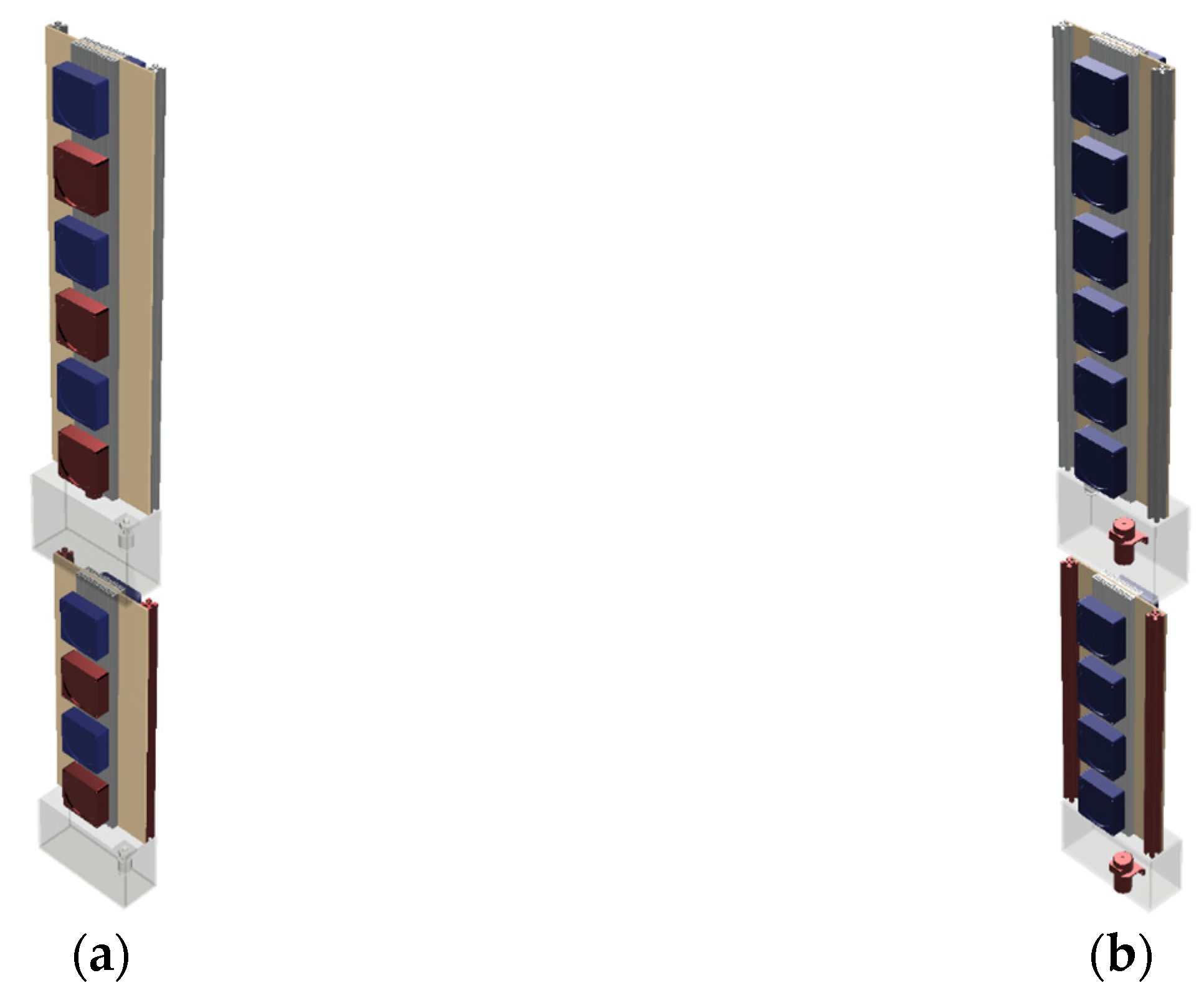
The cooling of the chamber was provided by Peltier arrays, and the cooling and dehumidification units are shown in Figure 8. The cooling and dehumidification unit located in the growth chamber consisted of 12 fans, eight 40 W Peltier modules, and two aluminum heat exchangers measuring 60 × 8 × 2 cm. Six of these fans were located on the front side of the cooling and dehumidification unit, whereas the other six were on the rear side. When the Peltier array is energized, the temperature of the aluminum heat exchanger on the front side decreases, and the temperature of the aluminum heat exchanger on the rear side increases. In cooling mode, the 2nd, 4th, and 6th fans on the front side drew air from the growing chamber of the cabinet and passed it through the cooled aluminum heat exchanger, thereby reducing the temperature of the air inside the growing chamber.
The cooling and dehumidification unit in the nutrient chamber consisted of eight 24 VDC fans, four 40 W Peltier modules, and two aluminum heat exchangers measuring 40 × 8 × 2 cm, with four fans at the front and four at the rear. When this unit operates in cooling mode, the Peltier array is energized, reducing the temperature of the aluminum heat exchanger on the front side. The 2nd and 4th fans drew air from the lower chamber, passed it through the aluminum heat exchanger, and reduced the temperature of the air in the nutrient chamber.
The six-fan and four-fan arrays located on the rear side of the cooling and dehumidification units in the growth and nutrient chambers expel the heat from the aluminum heat exchangers at the rear, which become heated when the Peltier modules are energized. This allows for further reduction of the temperature on the front side of the Peltier modules and provides more efficient cooling of the chamber.
Humidity Control: The humidity of the internal volume of the chamber was measured at six different points, as shown in Figure 7. Dehumidification and humidification processes were performed to adjust the humidity inside the chamber to the desired level. Dehumidification was performed using the cooling and dehumidification unit shown in Figure 8. When the Peltier array in this unit is energized, the temperature of the aluminum heat exchanger on the front side decreases significantly. Additionally, the 1st, 3rd, and 5th fans on the front side of the cooling and dehumidification unit in the growth chamber blew air across the cooled aluminum heat exchanger, causing the moisture in the air to condense and turn into water. In the nutrient chamber, this process was carried out by the 1st and 3rd fans. Thus, the humidity inside the chamber was reduced. The water produced was stored in the humidification unit, as shown in Figure 9. This water was used to humidify the air inside the chamber when necessary. Therefore, in the proposed next-generation plant growth chamber, a water cycle was established to enable water conservation.
The humidification of the chamber was provided by a humidifier consisting of an atomizer, fan, pump, liquid-level sensor, and water reservoir, as shown in Figure 9. The humidifier operates at 24 VDC voltage and can produce 350 mL of cold mist per hour. The cold mist was generated by the atomizer located at the bottom of the humidifier and transferred into the chamber using a 24 V fan. The fan speed is adjusted by a PWM control signal generated by the programmable logic controller (PLC). Thus, the amount of humidity delivered to the chamber was controlled by the PLC. The second control loop in the humidifier is the water-level control. To ensure that the atomizer, which produces the cold mist, continuously and effectively generates humidity, the water level in the humidifier must be maintained at the desired value. Therefore, the water level was detected by a float when it reached the reference value. Similarly, when the water level drops, the peristaltic pump in the humidifier is activated to restore the water level to its reference value.
Nutrient Solution Temperature Control: The temperature of the nutrient solution applied to the plant roots is critical for plant development. Unlike similar systems, the proposed chamber also controlled the temperature of the nutrient solution. The temperature of the nutrient solution was measured using a PT100 (JUMO GmbH & Co. KG, Fulda, Germany) temperature sensor and an interface circuit connected to the analog input of the PLC. The PLC energizes four 120 W heaters, located on the lower inner surface of the chamber and powered by 24 VDC, through a driver circuit to maintain the reference temperature set by the user. The power of the heaters was determined by the PWM control signal generated by the PLC.
Nutrient-Transfer Control: In aeroponic farming, the duration and period of nutrient transfer to plant roots are important parameters [29,30,31]. The nutrient-transfer period and duration vary depending on the plant and developmental stage. The proposed chamber serves as an excellent experimental setup for researchers to determine the optimum nutrient-transfer period and duration for plants grown using aeroponic farming. This will also allow researchers to optimize the nutrient-transfer period and duration based on plant development.
The nutrient solution transfer system is illustrated in Figure 10. The nutrient solution was contained in a tank made of 5 mm plastic glass, measuring 52 × 52 × 52 cm. The nutrient solution was applied to the plant roots through a submersible pump powered by 24 VDC, nine nozzles, and six-millimeter diameter plastic pipes, which were placed inside the tank. Unlike existing systems, the proposed chamber allows the user to determine the number and position of the nozzles based on the number of plants being grown. Additionally, the nozzles used in the chamber were adjustable, and the particle size and spraying pattern could be altered according to the plant species. Furthermore, the operation time and period of the submersible pump can be adjusted to achieve the desired nutrient-transfer regime.
Nutrient pH and EC Control: The pH and EC values of the nutrient solution applied to plant roots are crucial for plant growth. The literature provides recommended pH and EC values for commonly grown plants in soilless agriculture [32,33]. In aeroponic farming, incorrect adjustment of the pH of the nutrient solution can lead to the deterioration of plants.
Unlike similar systems, the proposed chamber controls the pH and EC of the nutrient solution using pH and EC sensors, as shown in Figure 10 and Figure 11, and six peristaltic pumps. The PLC reads the pH and EC sensors through its analog input and compares them with the pH and EC values entered by the user. To achieve the desired pH and EC values, the PLC transferred the appropriate amounts of Nutrient A, Nutrient B, pH increaser, pH decreaser, and water to the solution tank. Additionally, the PLC monitored the minimum and maximum levels of the nutrient solution using two liquid-level sensors, as shown in Figure 10. When the nutrient solution reached the minimum level, the PLC energized the peristaltic pumps to add more Nutrient A, Nutrient B, pH increaser, pH decreaser, and water to the solution. Furthermore, when the nutrient solution reached the maximum level, the discharge pump expelled the nutrient solution from the chamber. The effects of Nutrient A, Nutrient B, pH increaser, pH decreaser, and water on the pH and EC values of the nutrient solution are listed in Table 3 [34].
Real-Time Plant Fresh Weight Tracking: In soilless agriculture, the fresh weight of the plant is obtained from the growing chamber and weighed. Subsequently, the plant is placed back into the growing chamber [35]. However, this process presents challenges in terms of its application. Additionally, removing the plant from the growing environment and placing it back can damage the delicate plant roots and leaves. This also leads to plant stress. Unlike the studies in the literature, the proposed chamber can measure the fresh weight of a plant in real time without removing it from the growing chamber. The measurement was carried out with four load cells, each with a 5 kg weighing capacity, located under the partition. As shown in Figure 12, each load cell has its own amplifier and converter board. Therefore, in the proposed chamber, the fresh weight of the plant can be measured with an accuracy of ±0.1 g. The ability to measure the fresh weight of plants in real time with high precision will enable researchers working in this field to obtain fresh weight vs. time curves for each plant grown. This will contribute to modeling plants grown in soilless agriculture and help determine optimal growing conditions.
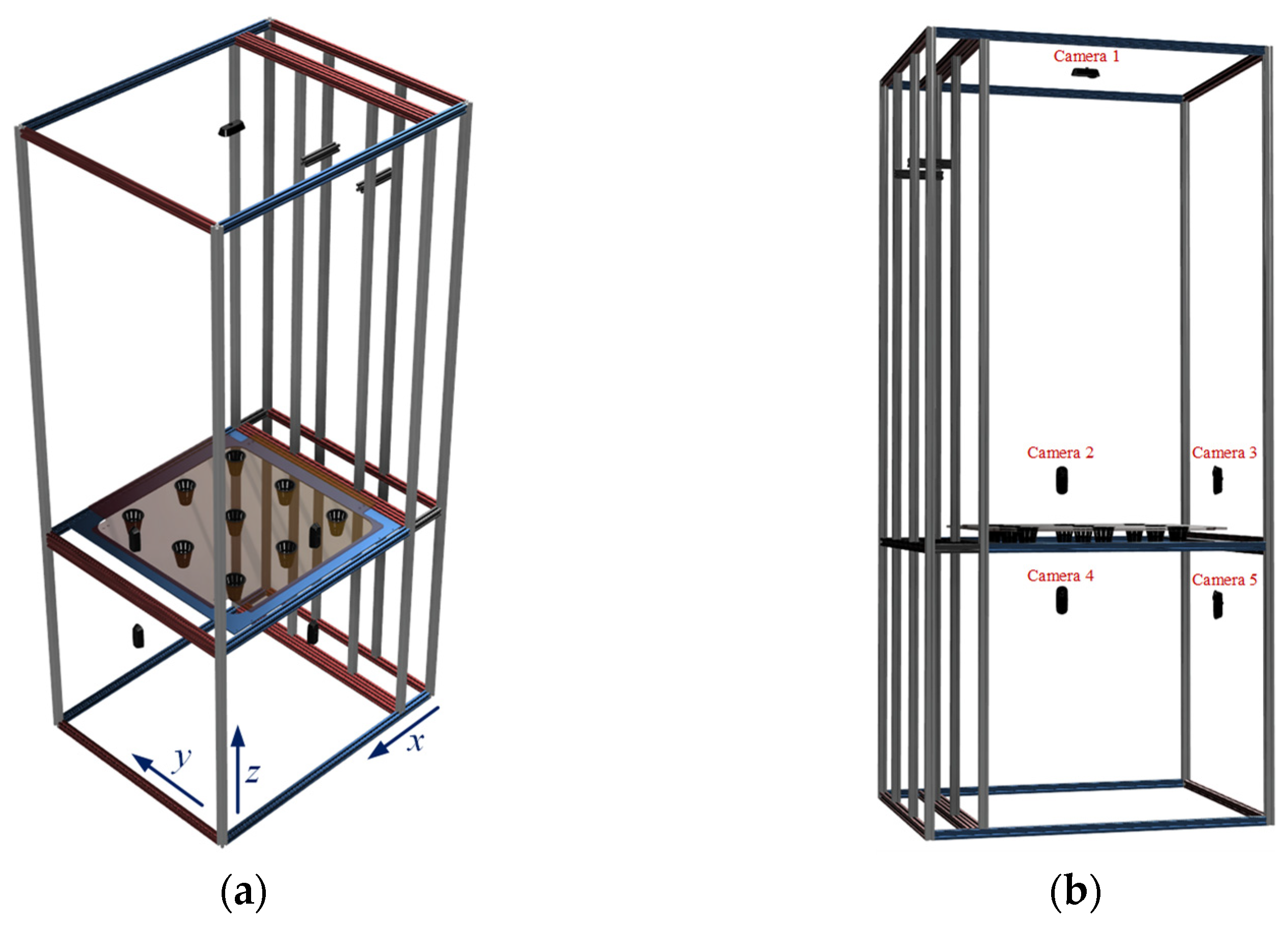
Real-Time Plant Growth Tracking: In the literature, there are studies in which only the top view of the plant is captured to monitor the growth of the plant stem [36]. However, no system has been proposed in the literature that can track plant stem and root development from different angles over time. In the chamber presented in this study, plant development was tracked in real time and recorded using five cameras. The placement of the cameras within the chamber is illustrated in Figure 13. The development of the plant stem was monitored in the xy plane using camera 1, in the xz plane using camera 2, and in the yz plane using camera 3. Similarly, plant root development was tracked in the xz plane using camera 4 and in the yz plane using camera 5. Thus, stem and root development in plants can be monitored in real time and in three dimensions. The general features of the camera are listed in Table 4.
Another innovation of the proposed chamber is its ability to relate the time-dependent three-dimensional development of the plant to its fresh weight. While the proposed chamber tracks plant growth using five cameras, it also measures the plant weight using four load cells. With this setup, researchers can obtain various growth graphs, such as:
  • Plant stem height [cm]–time [s] curve
  • Root length [cm]–time [s] curve
  • Leaf area [cm2]–time [s] curve
  • Plant stem three-dimensional growth (stem volume [cm3])–time [s] curve
  • Plant root three-dimensional growth (root volume [cm3])–time [s] curve
  • Fresh weight [g]–time [s] curve
  • Plant volume [cm3]–fresh weight [g] curve
The energy consumption of plant growth chambers is important for determining grid infrastructure requirements (single-phase or three-phase) and operational costs. The visuals and maximum operating powers of the components of the proposed chamber are listed in Table 5.

2.1.3. Industrial Control Hardware and Integration into the Plant Growth Chamber

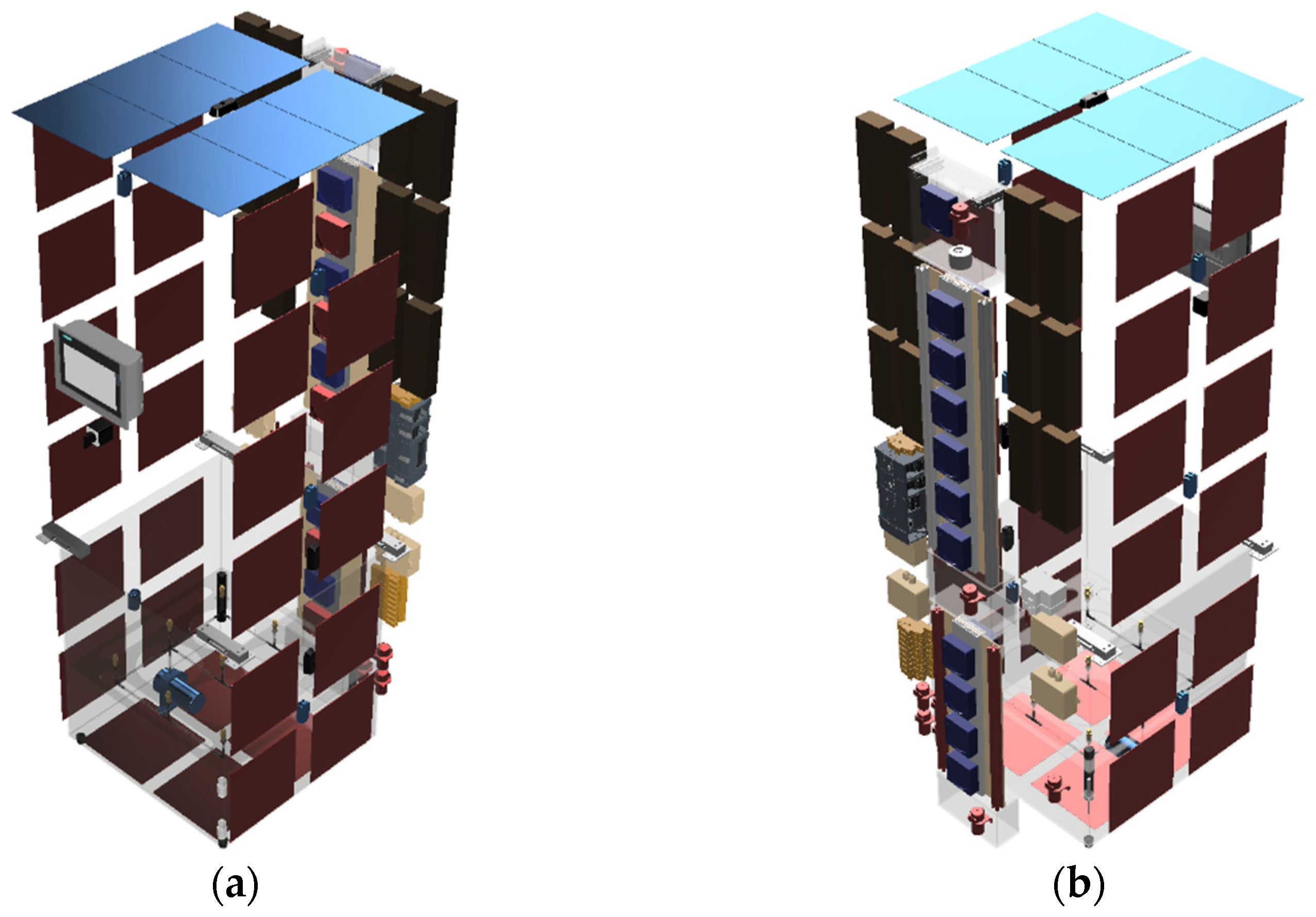
Plant growth chambers should be able to operate continuously for months without faults. Therefore, the electronic components responsible for communication and control processes within the plant growth chamber must adhere to industrial standards. In the proposed chamber, system control was performed using a PLC. Additionally, to allow users to input growth parameters and monitor measurement results, the proposed chamber includes a human–machine interface (HMI) screen. Furthermore, the PLC can be accessed via the TCP/IP protocol, enabling users to adjust the growth parameters and obtain measurement results. Figure 14 shows the placement of all electronic and electromechanical components within the chamber.

2.2. Derivation of the Transfer Function for Temperature Control of Plant Growth Chamber

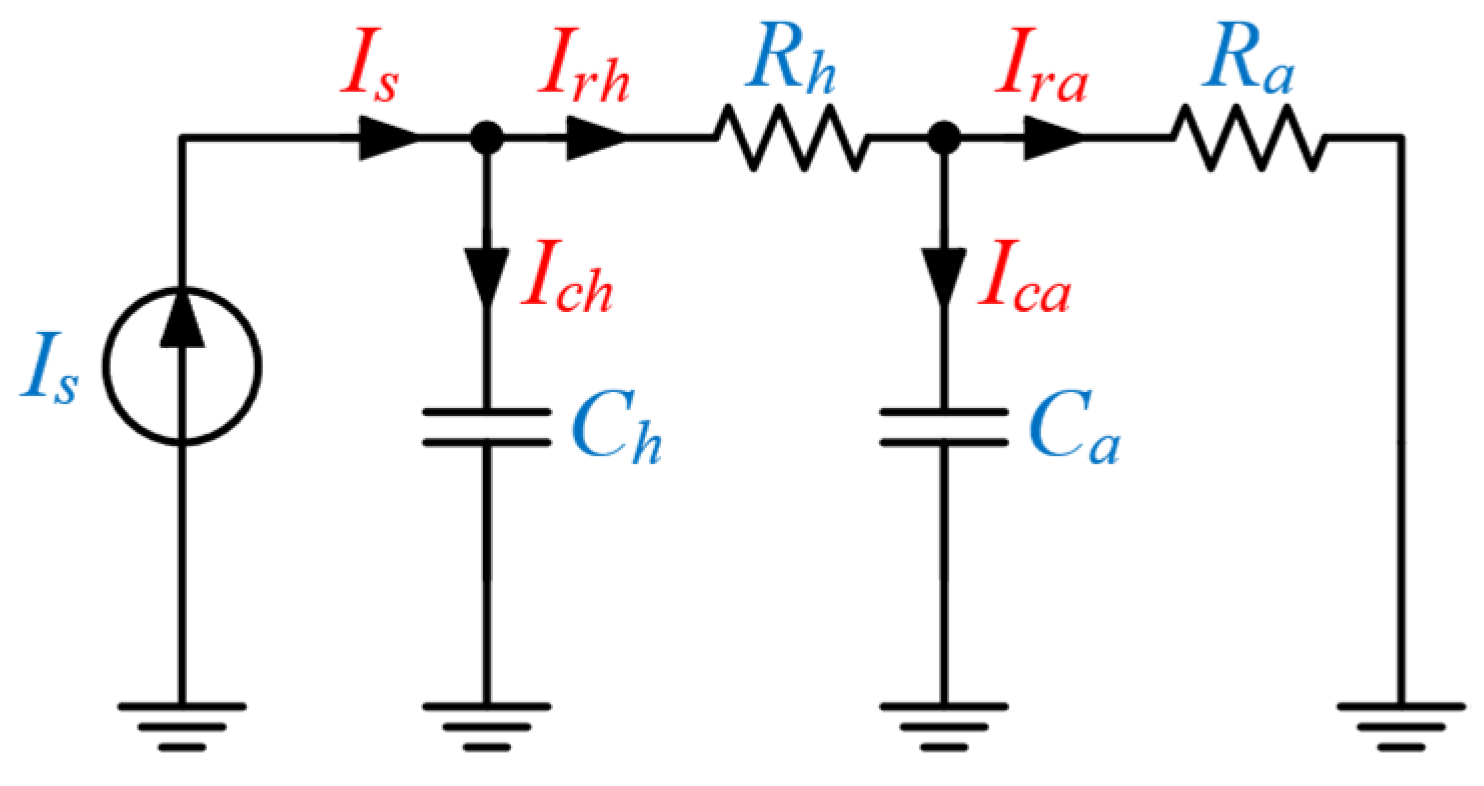
The analogy method was used to derive the transfer function for temperature control of the proposed chamber [37,38]. The analogy model of the system is illustrated in Figure 15.
In Figure 15, T h is the heater temperature, T a is the ambient air temperature, C a is the heat capacity of the ambient air, R h is the thermal resistance of the heater, C h is the heat capacity of the heater, and R a is the thermal resistance of the air.
In the analogy model, branch currents are calculated using Equations (1)–(7)
I s = I r h + I c h                   I c h = I s I r h
I r h = I r a + I c a               I c a = I r h I r a
I c h = C h × d T h d t
I c a = C a × d T a d t
I r h = T h T a R h
I r a = T a R a
P s = V s 2 R s
where I s is the output current of the heater, I r h and I c h are the branch currents, V s is the operating voltage of the heater, and P s is the output power of the heater. The solid-solid conduction thermal resistance and solid-air convection resistance were determined using Equations (8)–(13).
C h × d T h d t = V s R s T h T a R a
C a × d T a d t = T h T a R h T a R a
R h = t h λ h × S h
R a = 1 λ a × S h
C h = ς h × m h
C a = ς a × m a
where λ h is the thermal conductivity coefficient of the heater, λ a is the thermal conductivity coefficient of air, ς h is the specific heat capacity of the heater, ς a is the specific heat capacity of the air, R s is the electrical resistance of the heater, t h is the thickness of the heater, and S h is the surface area of the heater.
The temperature-dependent difference equations for the plant growth chamber are given by Equations (14) and (15). Using these difference equations, the state-space model of the system is derived as follows (Equation (16)):
d T h d t = T h 1 R h × C h + T a 1 R a × C a + V s R s × C h
d T a d t = T h 1 R h × C a + T a 1 R h × C a 1 R a × C a
T ˙ h T ˙ a = 1 R h × C h 1 R h × C h 1 R h × C a 1 R h × C a 1 R a × C a T h T a + 1 R s × C h 0 V s
The placement of the heaters inside the chamber is illustrated in Figure 7. The electrical and mechanical properties of the heater panels used in the proposed chamber are listed in Table 6.

2.2.1. Transfer Function of Upper Chamber of Aeroponic Plant Growth Cabinet

The thermal resistance of the heater ( R h u ) used for heating the upper (growth) chamber of the aeroponic plant growth chamber with 16 panels was calculated using Equations (17)–(19).
S u = w h × l h = 0.045796   m 2
S t u = 16 × S u = 0.732736   m 2
R h u = t h λ h × S t u = 0.007891   ° C W
where w h is the width of the heater panel, l h is the length of the heater panel, S u is the surface area of a single heater panel, and S t u is the total surface area of the 16 heater panels in the upper chamber.
The capacity of the heaters in the upper chamber of the chamber ( C h u ) can be calculated using Equations (20)–(22).
V h u = S t u × t h = 12.456512 × 10 4   m 3
m h u = ρ h × V h u = 2.366737   k g
C h u = ς h × m h u = 2721.747872   J ° C
It was assumed that the upper chamber of the chamber was filled with air. The physical properties of the upper chamber are listed in Table 7.
The thermal resistance of the air in the upper chamber of the chamber ( R a u ) can be calculated using Equations (23) and (24).
S a u = w a u × l a u = 0.54   m 2
R a u = 1 λ a × S a u   = 0.092   ° C W
The capacity of the air in the upper chamber ( C a u ) can be calculated using Equations (25)–(27).
V a u = S a u × t a u = 0.324   m 3
m a u = ρ a × V a u = 0.3888   k g
C a u = ς a × m a u = 388.8   J ° C
To increase the heating area without increasing the power consumption for heating in the upper chamber, the 16 heaters were divided into four groups. Each group consisted of four heaters connected in a series-parallel arrangement, with two heaters in series and two in parallel. This resulted in a power consumption of 120 W per group. In other words, each group, consisting of four heaters with 120 W power, consumed 120 W of power. Therefore, the total power consumption of the 16 heaters in the upper panel ( P U ) was 4 × 120 = 480 W.
The equivalent resistance of the 16 heaters in the upper chamber ( R U ) can be calculated using Equations (28) and (29).
P u = 16 4 × 120 = 480   W
R u = V s 2 P u = 1.2   Ω
where V s is the supply voltage of the heater panel. The time constants can be obtained using Equations (30)–(33).
1 R h u × C h u = 0.046558
1 R h u × C a u = 0.325927
1 R a u × C a u = 0.027957
1 R s × C h u = 0.000306
Consequently, the state-space model of the system is obtained by substituting the coefficients calculated using Equations (30)–(33) into Equation (16), as shown in Equations (34) and (35).
T ˙ h u T ˙ a u = 0.046558           0.046558       0.325927 0.353883 T h u T a u + 0.000306 0 V s
y = 0 1 T h u T a u
The transfer function for temperature control of the upper chamber of the aeroponic plant growth chamber ( G u ) is obtained using Equations (36)–(45).
X   ˙ = A × X + B × U       a n d       y = C × X
s X s = A × X s + B × U s               s X s A × X s = B × U s
X s s I A = B × U s                                 X s = s I A 1 × B × U s
Y s = C × X s         Y s = C   s I A 1 × B × U s
s I A = s + 0.046558 0.046558 0.325927 s + 0.353883
Δ = s 2 + 0.400442 s + 0.001302
s I A 1 = s + 0.353883 Δ 0.046558 Δ 0.325927 Δ s + 0.046558 Δ
C s I A 1 = 0.325927 Δ s + 0.046558 Δ
Y s U s = C s I A 1 B = 9.979081 × 10 5 Δ
G u s = 9.979081 × 10 5 s 2 + 0.400442 s + 0.001302               G u s 9.9791 × 10 5 s 2 + 0.4004 s + 0.0013
Increasing the height of the chamber ( l a u ) increases the internal volume of the chamber ( V a u ) and, consequently, the thermal capacity of the air within it ( C a u ). The increase in the thermal capacity reduces the gain of the transfer function defined in Equation (45), which causes a decrease in the system response speed. The proposed chamber has a modular design, and to increase the response speed, the number of heating panels can be increased. However, this will also lead to an increase in maximum power consumption. In the proposed chamber, the balance between the response speed and energy consumption, depending on the type of plant being grown, can be adjusted by the user.

2.2.2. Transfer Function of Lower Chamber of Aeroponic Plant Growth Cabinet

The lower chamber of the aeroponic plant growth chamber was controlled using 12 panel heaters. The electrical and mechanical properties of the heater panels are listed in Table 6.
The thermal resistance of the heater for 12 panels ( R h l ) is determined using Equations (46)–(48).
S l = w l × h l = 0.045796   m 2
S t l = 12 × S l = 0.549552   m 2
R h l = t l λ h S t l = 0.010522   ° C W
The capacity value of the heater is calculated using Equations (49)–(51).
m h l = ρ h l × V l
V l = S t l × w l = 9.342384 × 10 4   m 3
C h l = ς h × m h l = 2041.310904   J ° C
In Table 8, the electrical and mechanical properties of the chamber are provided for the case in which the chamber is assumed to be filled with air.
The thermal resistance of the air ( R a d ) is determined using Equations (52) and (53).
S t d = w d × h d = 0.36   m 2
R a d = 1 λ a × S t d = 0.139 ° C W
The capacity of the air ( C a d ) is calculated using Equations (54)–(56).
V d = S t d × t d = 0.216   m 3
m a d = ρ a × V d = 0.2592   k g
C a d = ς a × m a d = 259.2   J ° C
As shown in Figure 7, the 12 heater panels in the lower (nutrient) chamber of the chamber were installed in a configuration of two parallel and two series. In this case, the total power of the heaters in the lower chamber ( P t d ) is determined using Equation (57), and the equivalent resistance of the heater resistances ( R s d ) is calculated using Equation (58).
P t d = 12 4 × 120 = 360   W
R s d = V s 2 P t d = 1.6   Ω
The time constants are calculated using Equations (59)–(62).
1 R h d × C h d = 0.046558
1 R h d × C a d = 0.366667
1 R a d × C a d = 0.027756
1 R s d × C h d = 0.000306
Consequently, the state-space model of the system is obtained as shown in Equations (63) and (64).
T ˙ h d T ˙ a d = 0.046558               0.046558         0.366667 0.394429 T h d T a d + 0.000306 0 V s
y = 0 1 T h d T a d
The transfer function for the temperature control of the lower chamber of the chamber is determined using Equations (65)–(75).
X   ˙ = A × X + B × U         v e       y = C × X
s X s = A × X s + B × U s s X s A × X s = B × U s
X s × s I A = B × U s X s = s I A 1 × B × U s
Y s = C × X s Y s = C × s I A 1 × B × U s
Y s U s = C × s I A 1 × B × U s
s I A = s + 0.046558       0.046558         0.366667 s + 0.394429
Δ = s 2 + 0.409872 s + 0.001293
s I A 1 = s + 0.394428773 Δ 0.046558399 Δ 0.36666732 Δ s + 0.046558399 Δ
C × s I A 1 = 0.366667 Δ s + 0.046558 Δ
Y S U S = C × s I A 1 × B = 0.366667 Δ s + 0.046558 Δ × 0.000306 0 = 1.122647 × 10 4 Δ
G d s = 1.122647 × 10 4 s 2 + 0.409872 s + 0.001293         G d s 1.1226 × 10 4 s 2 + 0.4099 s + 0.0013

2.3. Optimization Algorithms

2.3.1. Particle Swarm Optimization

PSO is an optimization algorithm based on the social interactions between the individuals that constitute the swarm. The first simulation of the method was carried out by Kennedy and Eberhart in 1995, based on the work of Heppner and Grenander [39]. The method was later improved and introduced as an optimization technique [40,41].
In PSO, the swarm consists of particles, each representing a potential solution to a problem. After the particles are distributed across the search space, each particle determines its movement in a given iteration based on its best fitness value and the best fitness value obtained by the swarm. When this process is repeated, the particles move similarly to a flock of birds searching for food and converge to the optimal solution.
In PSO, the size of the particles is the same as the problem to be solved, and each particle has three vectors. These are the x i vector, which holds the current position of the particle, p i vector, which represents the best fitness value obtained up to that point, and v i vector, which stores the velocity information.
The x i vector, which holds the current position of the particle, can be considered a point in the solution space. In each iteration, the fitness value was calculated based on the current position of the particle. If the fitness value obtained in that iteration is better than the best fitness value the particle has achieved so far, the current position is assigned to the p i vector. Simultaneously, the fitness value calculated for the p i position is stored in the p b e s t i variable. These operations are repeated in each iteration, and when a better fitness value is obtained, the p i vector and p b e s t i variable are updated. The new position of the particle is determined by adding the velocity vector ( v i ) in that iteration to the position vector ( x i ). In each iteration, the best fitness value obtained by the swarm is stored in the g b e s t variable, and the particle position that yields this value is stored in the p g vector.
In PSO, the velocity vector of each particle in each iteration is determined based on the p i and p g vectors, causing the particles to move in a swarm. In this way, the particles converge to the global minimum without getting stuck in the local minima of the problem. When termination criteria, such as the maximum number of iterations, best fitness value, or change in the minimum fitness value, are met, the p g vector provides a solution to the problem.
The velocity vector (76) and position vector (77) are calculated as follows:
v i = v i + φ 1 r a n d 1 p i x i + φ 2 r a n d 2 p g x i
x i = x i + v i
where φ 1 and φ 2 are learning constants, and r a n d 1 and r a n d 2 are uniform random number generators that produce random real numbers between 0 and 1.

2.3.2. Radial Movement Optimization

RMO is a swarm-based stochastic optimization technique [42,43]. In some ways, it is similar to PSO and DE algorithms, with the most notable difference being the movement of the particles that constitute the swarm. In the RMO, particles make radial movements around a central point, which is updated at each iteration. Additionally, in each iteration, the current positions of all particles are given as inputs to the fitness function of the problem to be solved, and each particle has a corresponding fitness value. Furthermore, the particle that yields the best fitness value at each iteration is stored in the variable R b e s t . The position of the particle with the best fitness value obtained so far across all iterations is defined as G b e s t . When the stopping conditions are met, such as the maximum number of iterations, the best fitness value, or minimal fitness value change, G b e s t provides the solution to the problem.
Before moving the particles in the RMO, the center point ( c p ) must be determined. After the center point is determined, the particles move randomly at a certain distance from the center. In each iteration, the speeds of all the particles were stored in the V i j matrix. The indices and size of this matrix are the same as those of the X i j position matrix. The particle speeds were randomly determined in each iteration, as defined in (78)
V i j = r a n d 0 ,   1 V max j V max j = X max j X min j N
where the V i j velocity matrix represents the speed of the particle, with i being the particle index, j being the dimension index, V max j being the maximum speed of the particle in the jth dimension, r a n d 0 , 1 being a random number generator that produces a real number uniformly distributed between 0 and 1, and N being a positive integer greater than zero. If the particle speeds are to be reduced depending on the iteration index, Equation (79) can be used. In this case, as the number of iterations increased, the particles began to move closer to each other and performed a more precise search.
W k = W m a x W m a x W m i n k m a x k V i j k = W k r a n d 0 ,   1 V max j
where W is the inertia weight, W m a x is the upper bound of the inertia weight, W m i n is the lower bound of the inertia weight, k is the iteration index, and k m a x is the upper limit of the iteration index.
After the particle velocities were determined, the positions of the particles were determined using Equation (80).
X i j = V i j + c p j
The fitness values were recalculated according to the newly calculated particle positions. Based on these fitness values, the R b e s t and G b e s t variables were updated. The center point ( c p ) is then calculated using Equations (81) and (82).
c p k + 1 = c p k + u p
u p = C 1 G b e s t c p k + C 2 R b e s t c p k
Here, C 1 and C 2 are weighting constants, typically in the range of 0.4 to 0.9, and it is recommended that C 2 be greater than C 1 .

2.3.3. Differential Evolution Algorithm

DE is a population-based direct search algorithm. In solving a problem with DE, individuals can be generated at equal intervals to cover the solution space or randomly, as given in (83) [44,45]
X i j = a i + r a n d j 0,1 × a j b j             i = 1 ,   2 ,     ,   N p ,             j = 1 ,   2 ,   ,   D  
where X is the population matrix, a is the lower limit vector, b is the upper limit vector, r a n d 0,1 is a random real number uniformly distributed between 0 and 1, i is the individual index, j is the dimension index, N p is the number of individuals, and D is the problem dimension.
When the x i vector is accepted as a candidate solution to the problem, successive individuals are found by adding the weighted difference between two randomly selected vectors to the third vector.
In the DE algorithm, for each iteration, a x i mutant vector is defined for all v i vectors as given in Equation (84).
v i k = x a k + F x c k x b k
where, v is the mutant vector, F is the weighting constant, i is the individual index, k is the iteration index, and a , b , and c are distinct, randomly selected integers.
The crossover operation involves mixing two competing vectors to produce a new solution vector. This operation also increases population diversity. In the classical DE algorithm, binary crossover is used, and as a result, a trial vector is obtained. This operation is expressed by Equations (85) and (86).
u i k = u i 1 k ,   u i 2 k ,   ,   u i D k
U i j k =         V i j k ,         i f   r a n d j 0,1 C r   o r   j = d X i j k ,       o t h e r   c a s e s                                                        
where U is the mutant matrix, V is the trial matrix, C r is the crossover rate, and d is the random-parameter index value. The crossover rate is a random real number uniformly distributed between 0 and 1, typically chosen in the range of 0.4–1. Similarly, the d index is a random integer uniformly distributed between 0 and D .
In the DE algorithm, to generate a new population, the mutation, crossover, and selection loops are repeated for the number of individuals at each iteration. This process continues until the predefined stopping condition is met. The termination criterion can be set as the best fitness value or maximum number of iterations. When the loop terminates, the individual with the best fitness value provides a solution to the problem.

2.3.4. Mayfly Optimization Algorithm

MOA is a population-based method inspired by the mating and movement dynamics of mayflies, similar to the firefly algorithm and PSO [46]. Mayflies have a short lifespan, focused on reproduction.
In the MOA, after determining the problem parameters to be solved, the mayfly population is randomly generated. The initial values for the speed and position were assigned. The fitness value of each individual is then calculated, and the best solution is found. After the fitness evaluation, the search phase begins. During this phase, male individuals apply a repulsive force on each other and move in different directions. Speed and position update formulas were applied. In the exploitation phase, males and females mate, and new individuals are produced. The population is updated by selecting better solutions. After updating the population, the stopping criteria (such as maximum iterations and desired convergence in the solution) were evaluated. If the stopping criteria are not met, the mayfly population is regenerated, and the cycle is repeated until the best solution is found.
The speed and position update formulas for the mayflies are given by Equations (87) and (88), respectively. These equations direct individuals toward the best solution.
v i t + 1 = a v i t + c 1 r 1 g x i t + c 2 r 2 b x i t
x i t + 1 = x i t + v i t + 1
where v is the speed of the individual, x is the position of the individual, a is the inertia coefficient, c 1 and c 2 are the learning factors, r 1 and r 2 are random real numbers in the range [0, 1], b is the best position of the individual, g is the global best position, i is the individual index, and t is the iteration index.
During the exploitation phase, male and female mayflies are attracted to each other for mating. The female’s orientation towards the male is calculated using Equations (89) and (90).
v f t + 1 = a v f t + c 3 r 3 m x f t
x f t + 1 = x f t + v f t + 1
where v f is the speed of the female individual, x f is the position of the female individual, m is the position of the male individual with which the female has mated, c 3 is the attraction factor that guides the female individual towards the male, r 3 are random real numbers in the range [0, 1], and f is the female individual index.
New individuals are generated by applying crossover and mutation operations to the parent individuals. The crossover is performed according to Equation (91).
y i = λ x m + 1 λ + x f
where y is the position of the new individual, x m and x f are the parent positions, λ is a randomly generated genetic contribution coefficient in the range [0, 1], and i is the individual index.
The mutation is performed by randomly altering the existing solutions, as defined in Equation (92).
y i t + 1 = y i t + μ N 0,1
where μ is the mutation factor, N 0,1 is a randomly generated real number from a normal distribution with a mean of 0 and variance of 1, i is the individual index, and t is the iteration index. The mutation process increases the population diversity, preventing it from getting stuck in local minima.
Currently, MOA is used in various fields, such as engineering design, machine learning, data mining, and route optimization, because it converges quickly and can optimize complex functions.

2.3.5. Error-Area-Based Performance Criteria

The error area is defined as the area between the system response curve and the reference value. In the optimization of the PID parameters, the error area can be used as a fitness function. The most commonly used error-area-based metrics in the literature are given in (93)–(96). These metrics are essentially the total absolute magnitude of the error, total power (energy), time-weighted magnitude total, and time-weighted power total.
I A E = 0 T e t d t
I S E = 0 T e 2 t d t
I T A E = 0 T t e t d t
I T S E = 0 T t . e 2 t d t
where IAE is the total absolute error, ISE is the total squared error, ITAE is the total time-weighted absolute error, ITSE is the total time-weighted squared error, e t is the system error, t is the time, T is the instantaneous time, and . denotes an absolute value operation.

3. Results

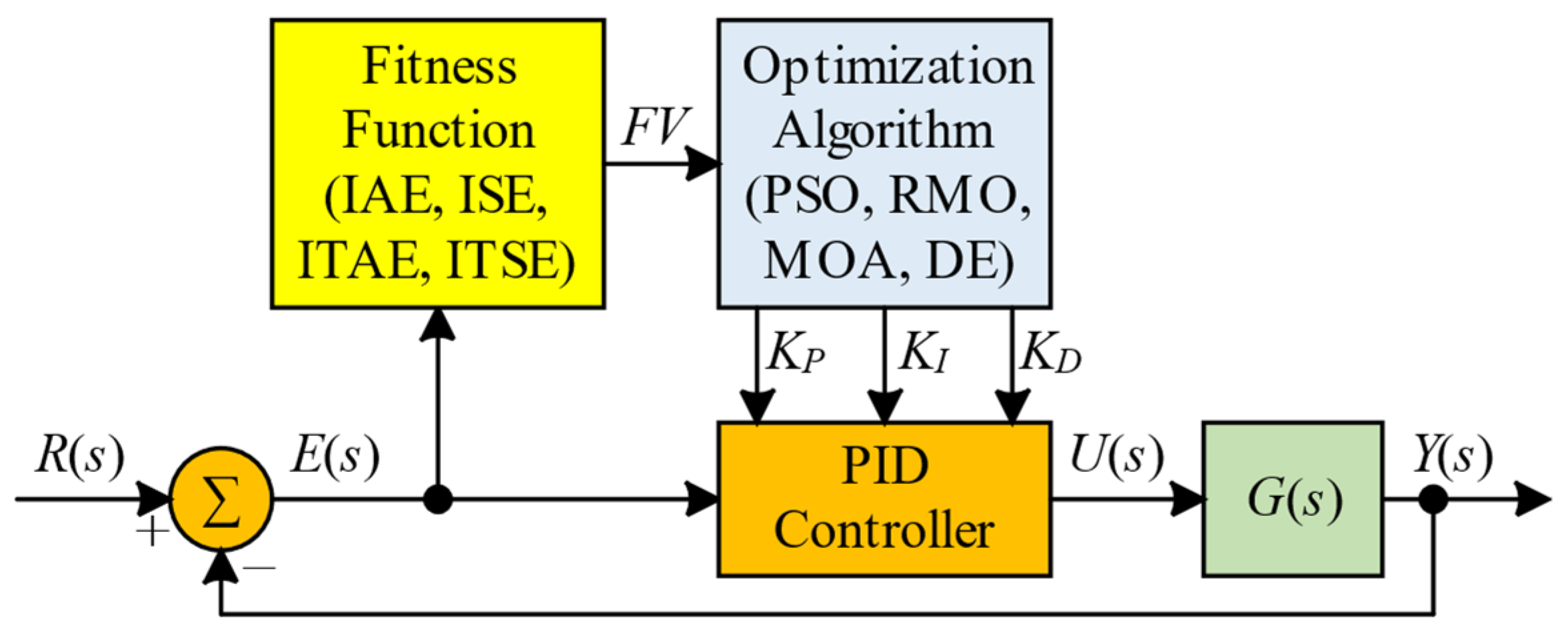
In this section, the temperature control of the upper (growth) and lower (nutrient) chambers of the proposed plant growth cabinet is performed using a PID controller. The gain factors determine the performance of the PID controller. The PID controller has three gain factors, each with different effects on the controller’s performance, and manually optimizing these parameters is not possible. However, heuristic algorithms can optimize PID parameters more quickly and effectively than traditional methods [47]. Additionally, they can optimize the gain constants to simultaneously maximize multiple performance criteria [48]. Furthermore, whereas traditional methods may work well under constant system conditions, heuristic algorithms can adapt to dynamic and changing system conditions [49]. Finally, because heuristic algorithms are typically based on evolutionary or random processes, they can reach the global optimum without getting stuck in local optima. Thus, with the PID controller, the temperature control of dynamic systems can be achieved quickly and stably, with minimal error and oscillation, without generating permanent errors. As shown in Figure 16, the controller gain factors were optimized using PSO, RMO, DE, and MOA based on error-area-based performance criteria.
In aeroponic agriculture, the reference temperature varies depending on the type of plant. However, the reference temperature is generally chosen within the range of 18–24 °C, which is considered ideal for the healthy development of plants. In some specific applications, such as growing plants from warm climates, the reference temperature can be raised to 25 °C as the upper limit. In temperature control, an increase in the difference between the initial and reference temperatures prolongs the system settling time. In addition, this difference increases the maximum error and oscillations in the system response. To analyze the temperature control performance of the proposed chamber under challenging conditions, the reference temperature of 25 °C was selected. The simulation time was set to 300 s, and the sampling period was set to 1 s. The search space for the gain factors was defined as [0, 100], and the maximum number of iterations was set to 50. The simulation parameters of the optimization algorithms are presented in Table 9.

3.1. Simulation Results of Temperature Control for the Upper Chamber

In this section, the temperature control of the upper chamber, defined by the transfer function in (45), is performed using PSO-PID, RMO-PID, DE-PID, and MOA-PID controllers. Error-area-based performance metrics are used to optimize the gain factors of the PID controller. In Table 10, the performance indices and gain factors of the PID controllers optimized using the IAE fitness function are presented.
As shown in Table 10, the DE-PID and MOA-PID algorithms have the lowest rise time, smallest maximum error, and best fitness value. Additionally, the lowest settling time was achieved with PSO-PID.
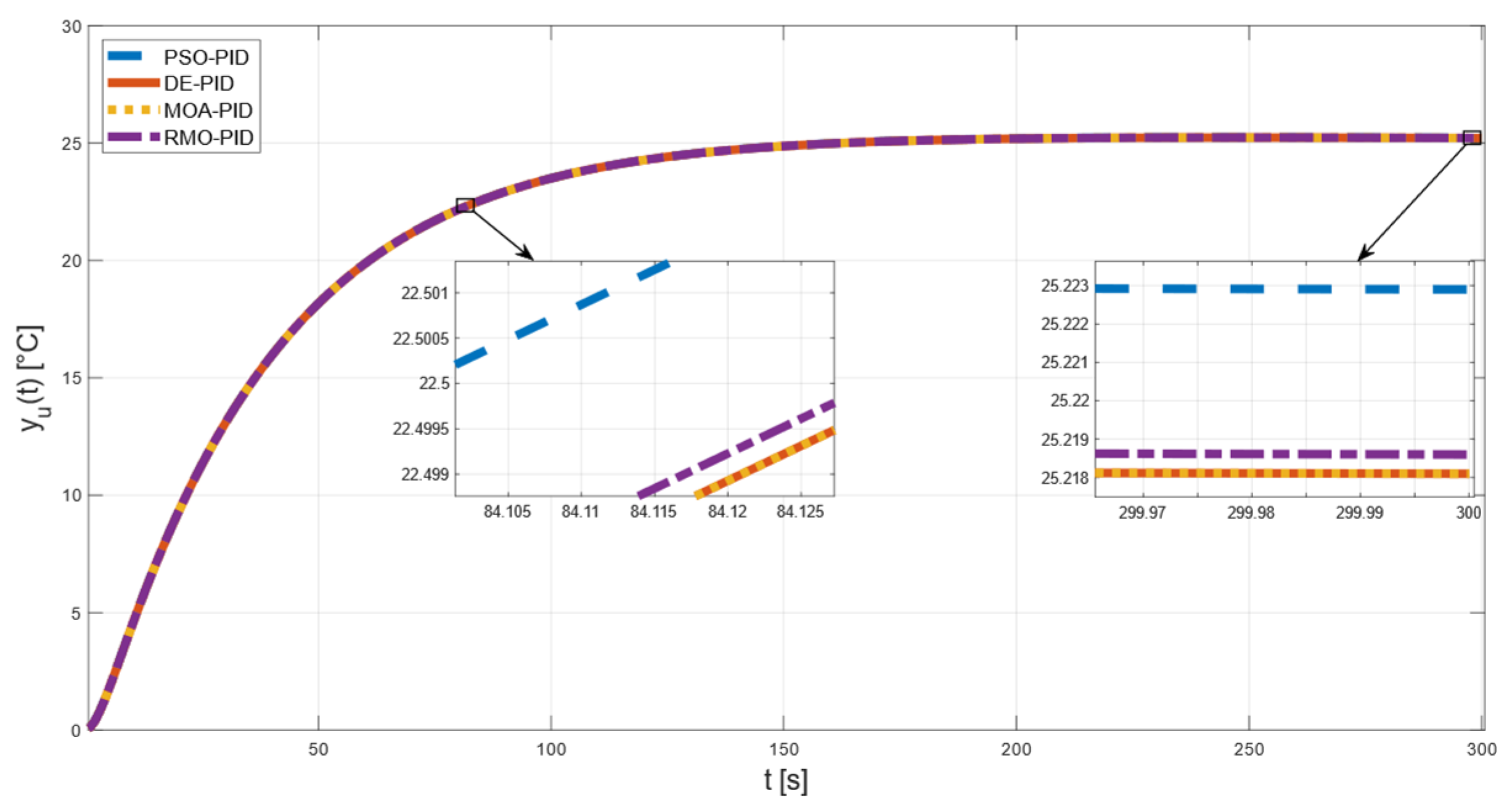
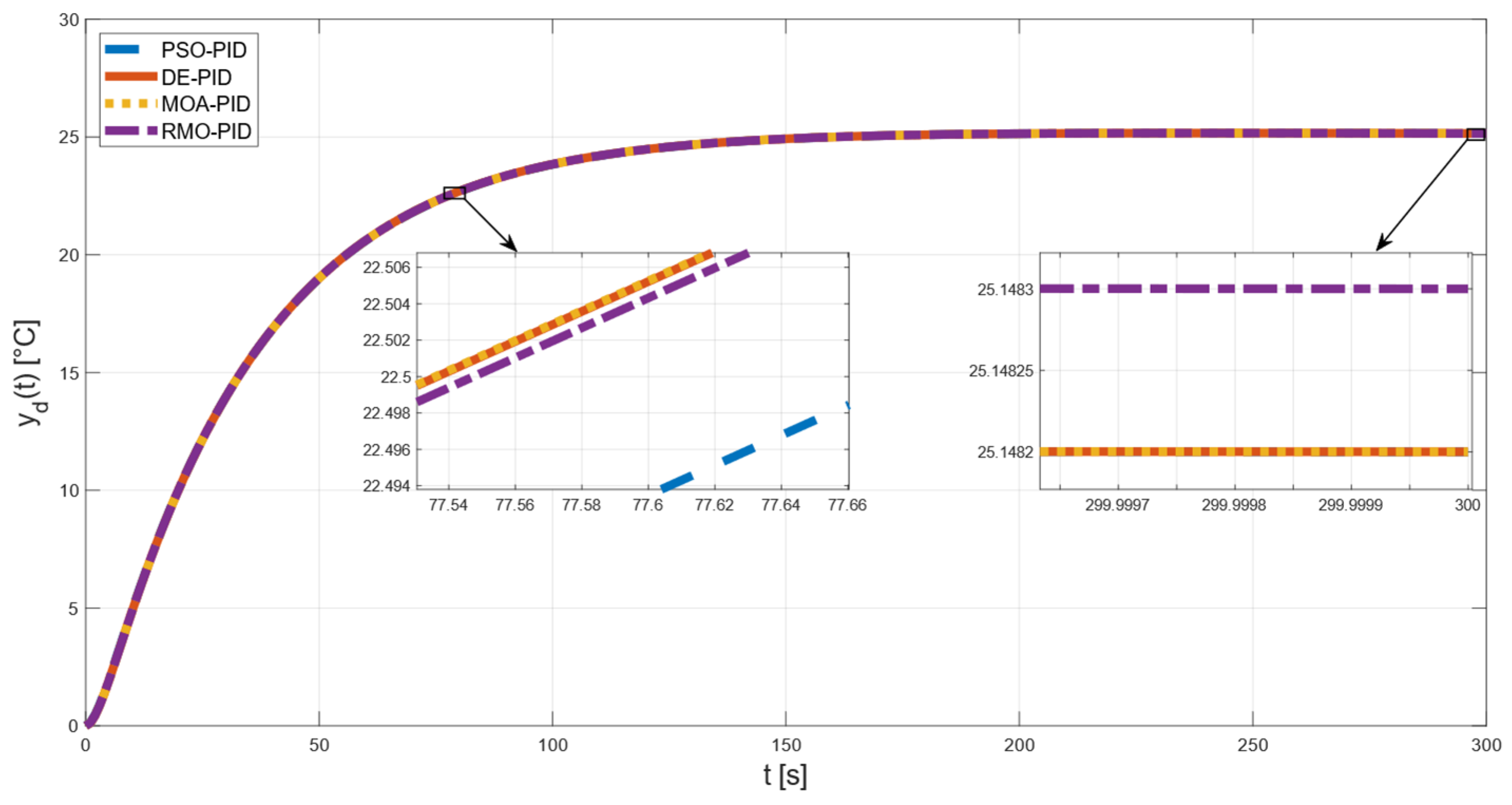
In Figure 17, the temperature–time graph of the upper chamber, where the temperature is controlled using controllers optimized using the IAE fitness function, is shown along with the gain parameters.
In Figure 17, the steady-state error for all control methods is observed to be below 0.23 °C. Additionally, the smallest steady-state error was achieved using the MOA-PID and DE-PID controllers. Furthermore, the PSO-PID controller produced the largest offset error.
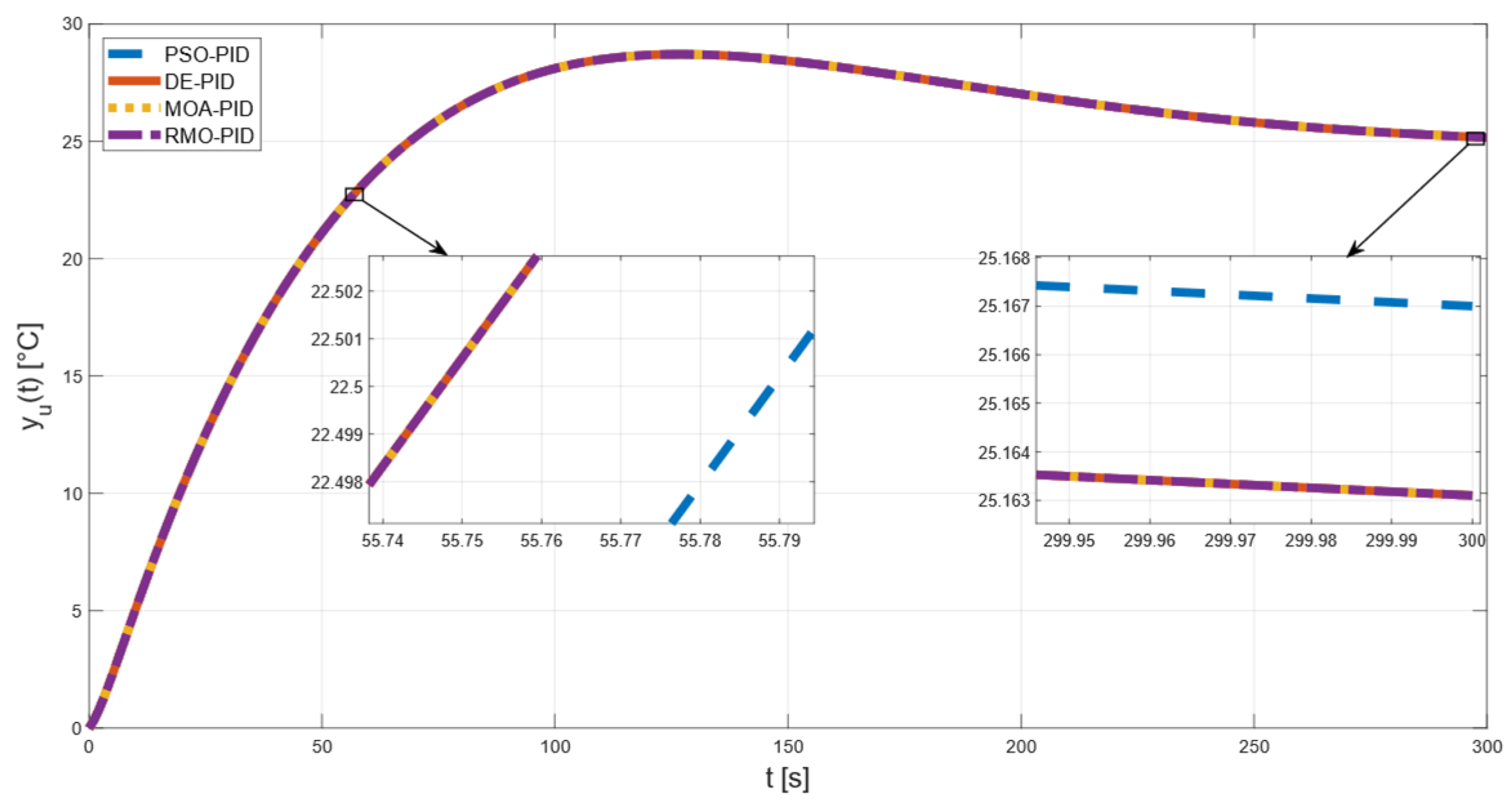
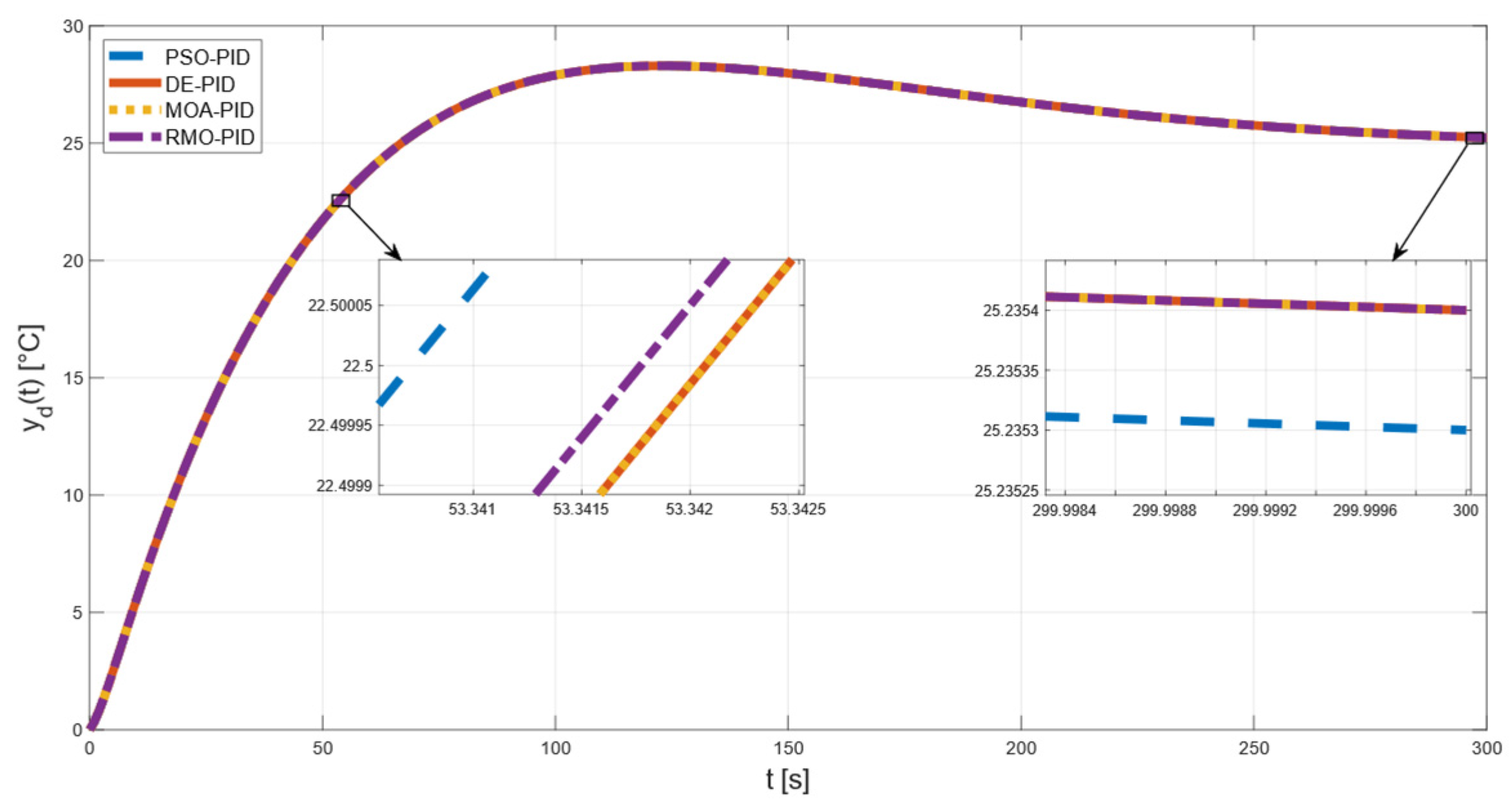
The performance indices of the controllers optimized using the ISE fitness function are listed in Table 11, and the temperature–time graphs are presented in Figure 18.
As shown in Table 11, the RMO-PID controller has the smallest rise time, best settling time, and best fitness value. Additionally, the lowest maximum error was achieved using the PSO-PID controller.
In Figure 18, the steady-state error for all controllers is less than 0.17 °C. Moreover, the MOA-PID, RMO-PID, and DE-PID controllers produced the same steady-state error. In addition, the largest steady-state error was observed with the PSO-PID controller.
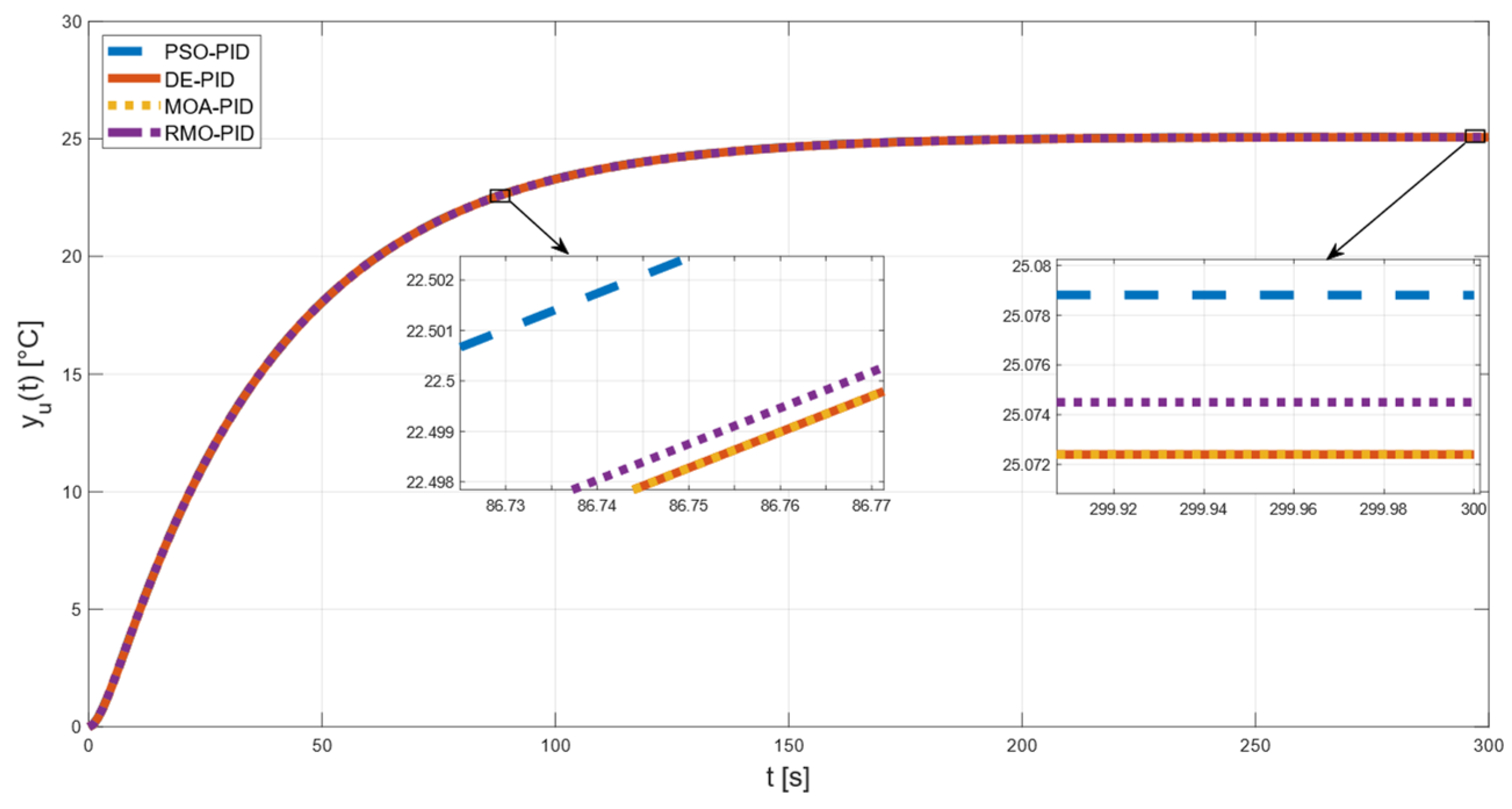
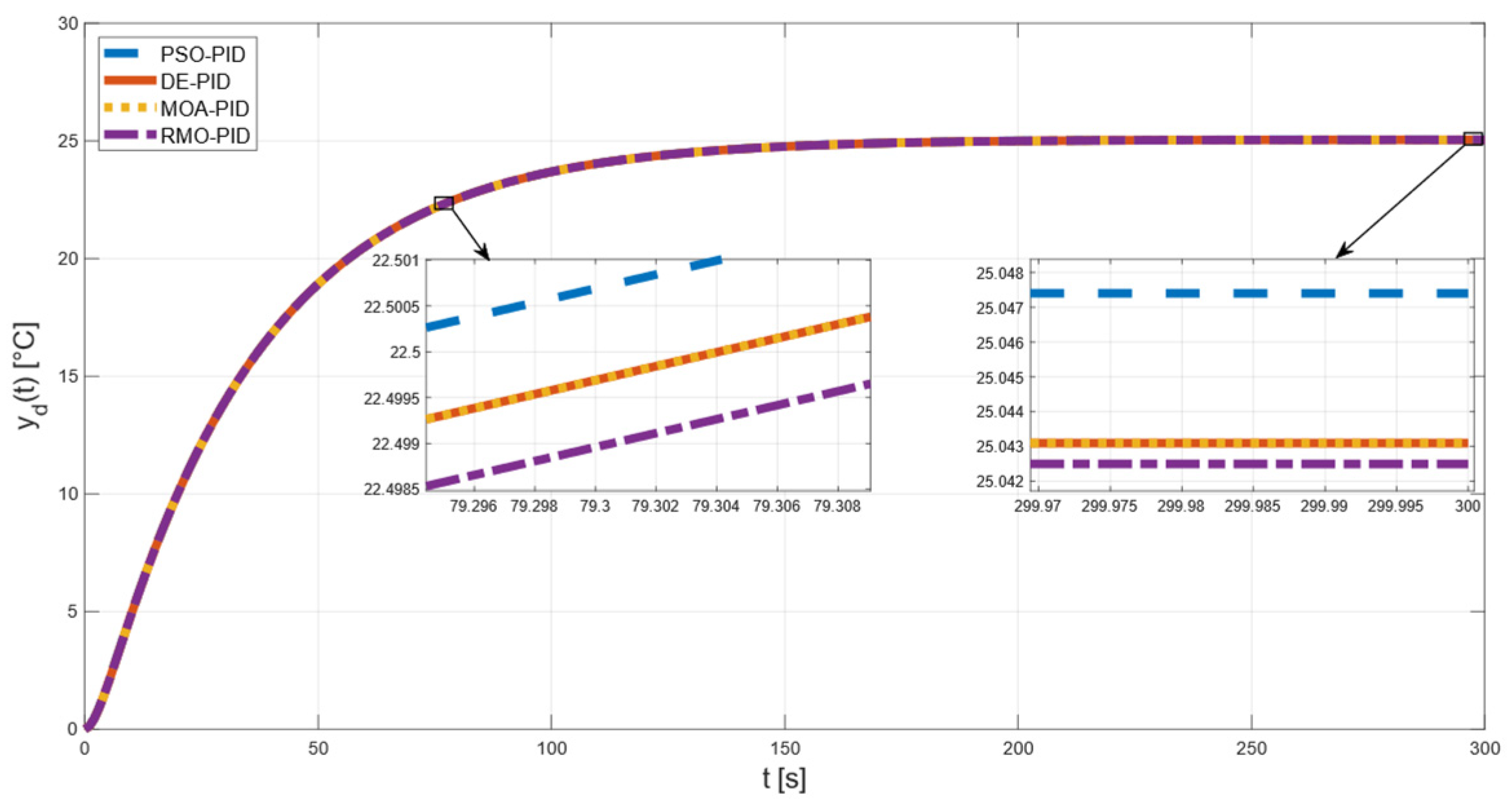
The performance indices of the controllers optimized using the ITAE fitness function are presented in Table 12, and the temperature–time graphs are shown in Figure 19.
As shown in Table 12, the MOA-PID controller achieved the lowest rise time, smallest maximum error, and best fitness value. In addition, the PSO-PID controller had the shortest settling time.
In Figure 19, the steady-state error is less than 0.08 °C for all control methods. Additionally, the MOA-PID and DE-PID controllers produced the least steady-state error. Furthermore, the largest steady-state error was observed as a result of the PSO-PID controller.
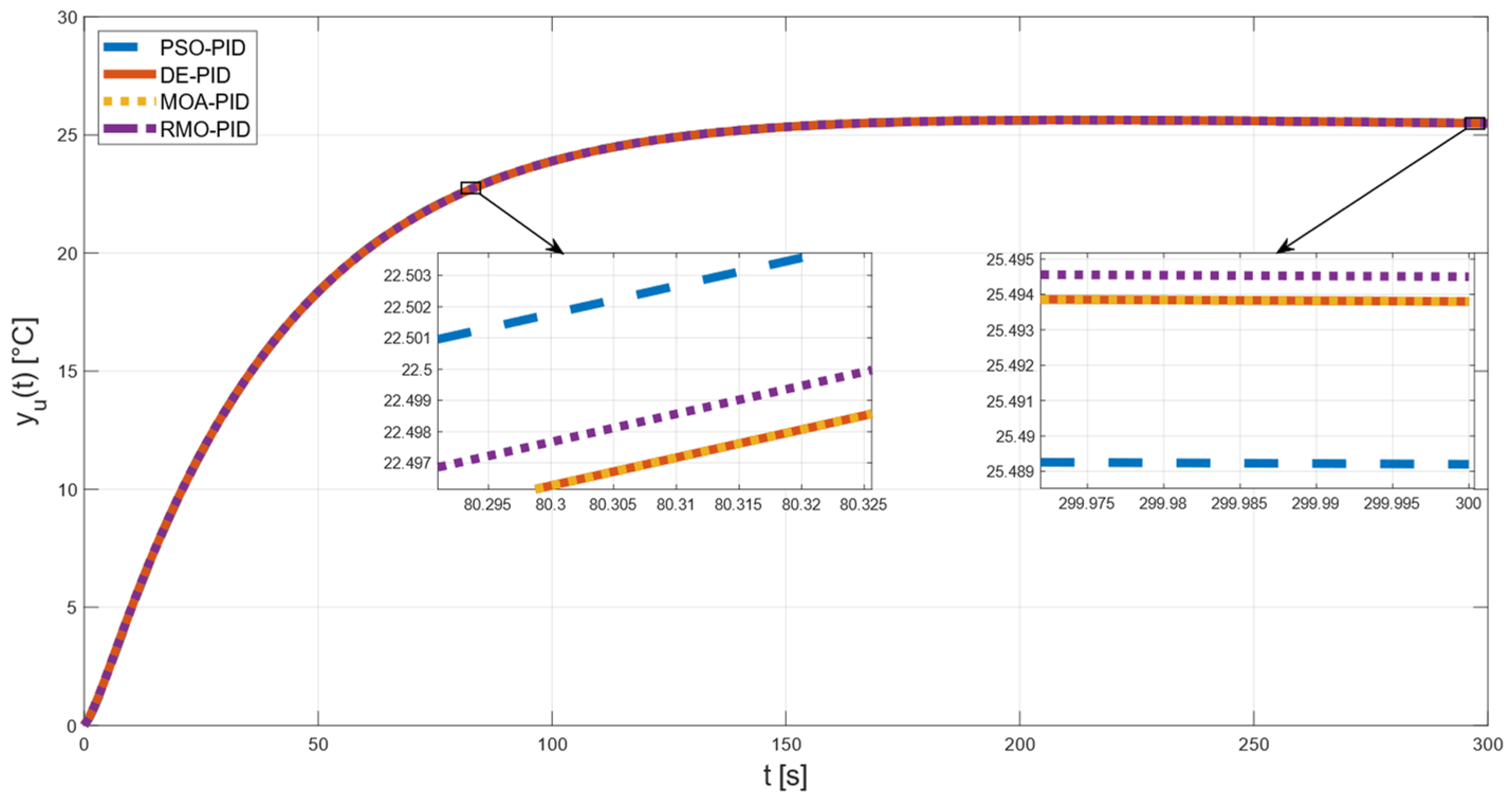
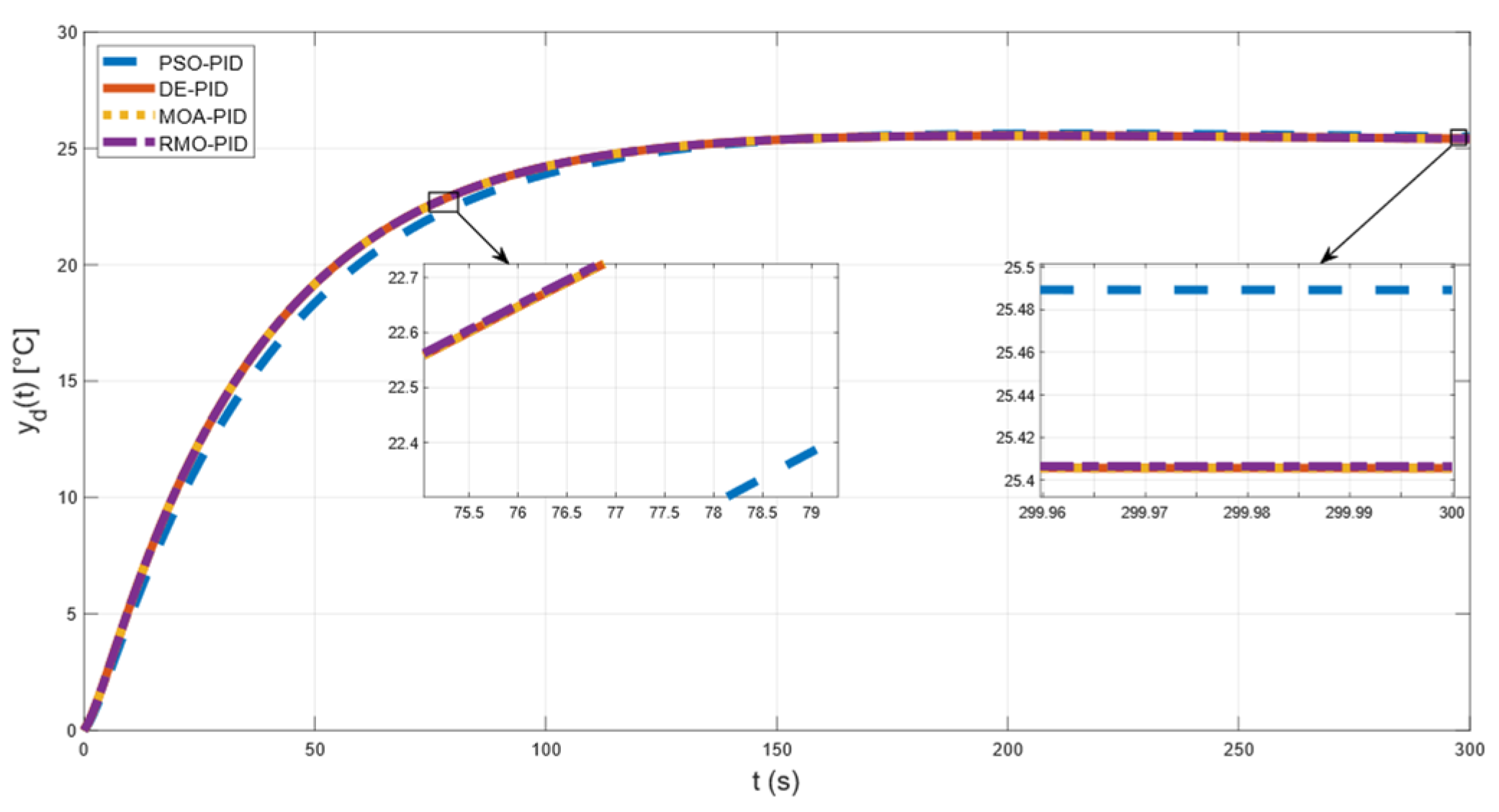
The performance indices of the controllers optimized using the ITSE fitness function are shown in Table 13, and the temperature–time graphs are presented in Figure 20.
As shown in Table 13, the PSO-PID controller achieved the lowest rise time, settling time, and maximum error. Additionally, the best fitness value was obtained using the MOA-PID and DE-PID controllers.
In Figure 21, the steady-state error of all PID controllers is below 0.5 °C. Additionally, the smallest steady-state error was achieved with the PSO-PID, MOA-PID, DE-PID, and RMO-PID controllers, in that order. Furthermore, the MOA-PID and DE-PID controllers produced the same steady-state error.
The performance values obtained by the PID controllers optimized using heuristic algorithms according to the error-based performance criteria are presented in Table 10, Table 11, Table 12 and Table 13, respectively. The simulation results show that all optimization methods successfully optimized the gain factors, and the controller performances were very similar. Accordingly, when a low rise time is desired for temperature control, the optimization algorithm should be the MOA. If quick stabilization of the system is desired, the PID parameters should be optimized using PSO. If minimizing the maximum error in temperature control is the goal, DE-PID or MOA-PID can be selected as the controller. Considering all the performance values presented in Table 10, Table 11, Table 12 and Table 13, as expected, the best performance was achieved with MOA-PID [50,51]. As a result, when the proposed cabinet’s cultivation chamber temperature control is performed with MOA-PID, it will provide the ideal environmental temperature for plant growth.

3.2. Simulation Results of Temperature Control for the Lower Chamber

In this section, the temperature control of the lower chamber, given by the transfer function in (75), is performed using the PSO-PID, RMO-PID, DE-PID, and MOA-PID methods.
In Table 14, the gain factors and performance indices of the PID controllers optimized using the IAE fitness function are presented.
In Table 14, the lowest rise time, shortest settling time, and best fitness value were achieved with the MOA-PID controller. Additionally, the least overshoot was obtained using the PSO-PID controller.
Figure 21 shows the temperature–time graph of the lower chamber where temperature control was performed with the PID controller, whose gain constants were optimized using the IAE fitness function.
In Figure 22, it can be seen that the steady-state error is below 0.15 °C for all control methods. In addition, the MOA-PID, DE-PID, and PSO-PID methods produce similar results, whereas the RMO-PID controller generates a higher steady-state error.
The performance indices of the controllers, whose gain factors were optimized using the ISE fitness function, are listed in Table 15, and the temperature–time graphs of the lower chamber are shown in Figure 23.
In Table 15, the lowest rise and settling times are achieved using the PSO-PID controller. In addition, all the optimization methods achieved the same fitness value. Furthermore, the lowest overshoot was achieved by the DE-PID controller.
In Figure 22, it can be seen that the steady-state error is below 0.24 °C for all controllers. Additionally, the lowest steady-state error was achieved using the PSO-PID controller. Furthermore, the MOA-PID, DE-PID, and RMO-PID controllers produced identical steady-state errors.
The performance indices of the PID controllers, whose gain factors were optimized using the ITAE fitness function, are provided in Table 16, and the temperature–time variation of the lower chamber is shown in Figure 23.
In Table 16, the best rise time and fitness value were achieved using the MOA-PID and DE-PID controllers. Additionally, the lowest settling time was achieved using the PSO-PID controller, and the least overshoot was obtained using the RMO-PID controller.
In Figure 23, it can be seen that the steady-state error is below 0.05 °C for all controllers. Additionally, the lowest steady-state error was achieved using the RMO-PID controller, whereas the highest steady-state error was obtained using the PSO-PID controller. Furthermore, the MOA-PID and DE-PID controllers produced identical steady-state errors.
The performance indices of the controllers, whose gain factors were optimized using the ITSE fitness function, are provided in Table 17, and the temperature–time graph of the lower chamber is shown in Figure 24.
In Table 17, the lowest rise and settling times were achieved using the PSO-PID controller. Additionally, the lowest maximum error and best fitness values were provided by the MOA-PID and DE-PID controllers.
In Figure 24, it can be seen that the steady-state error of all controllers is less than 0.5 °C. In addition, the MOA-PID, DE-PID, and RMO-PID controllers produced the same steady-state error, whereas the PSO-PID controller produced a higher steady-state error.
When the simulation results presented in Table 14, Table 15, Table 16 and Table 17 are examined, it is observed that the DE-PID and MOA-PID methods performed better in the temperature control of the nutrient chamber, as expected [50,51]. Additionally, the temperature control performance values with PSO-PID were close to those of the DE-PID and MOA-PID methods. Finally, among the four methods, the lowest performance values were obtained using RMO-PID.

4. Conclusions

In this study, the design of an innovative aeroponic plant-growing chamber was carried out. A mathematical model for temperature control of the chamber was obtained, and temperature control simulation results were presented. In the design of the chamber, parameters critical for aeroponic farming, such as light intensity, ambient temperature, humidity, nutrient temperature, nutrient amount, nutrient pH, and nutrient EC value, were considered. Furthermore, unlike existing chambers, load cells were placed on the plant-growing tray in the proposed chamber design to continuously monitor the wet weight of the plants. This allows for the generation of wet weight–time curves for the plants, and by modeling the plants, it facilitates the determination of optimal growing conditions. Additionally, to relate plant development to the wet weight of the plant, digital cameras were installed inside the chamber.
The parts that formed the frame and body of the chamber were assembled with connection fittings, ensuring that the chamber had a modular structure. In the proposed design, the spectrum of each RGB LED block can be adjusted using PWM. This flexibility aims to achieve optimal lighting for the growth of plants, ensuring increased yield and energy savings. Furthermore, to reduce the growth time and maintain plant health, a temperature control feature for the nutrient solution was added to the chamber design, and users were enabled to adjust the number and position of the nozzles based on the plant species and quantity being cultivated.
Finally, the temperature control models of the upper and lower chambers of the designed plant-growing cabinet were derived, and the gain factors of the PID controller were optimized using heuristic optimization algorithms (PSO, RMO, MOA, and DE). The simulation results showed that the temperatures of the upper and lower chambers of the cabinet reached a steady state within 260 s, with the offset error below 0.5 °C. These results demonstrate the accuracy of the derived model and the performance of the optimized controllers (PSO-PID, RMO-PID, MOA-PID, and DE-PID).
The proposed innovative chamber has a modular structure; therefore, in future studies, hydroponic and aquaponic plant-growing chambers can be produced based on this design. Moreover, by utilizing machine learning and artificial intelligence algorithms, optimal environmental parameters can be automatically determined according to the plant species, and suitable cultivation strategies can be developed. Additionally, to increase the energy efficiency of the chamber, the waste heat generated by the RGB power LEDs used in the lighting can be converted into a voltage using Peltier arrays. This voltage can be used to power low-energy consumption units, such as chamber control and humidification systems. Finally, in aeroponic farming, the chamber should be cleaned and disinfected after each harvest. For this purpose, a UV sterilization system can be added to the chamber, and by disinfecting the chamber at the beginning of each harvest cycle, production, time, and energy losses caused by plant diseases can be avoided.

Author Contributions

Conceptualization, A.G. and O.C.; Methodology, A.G. and O.C.; Software, A.G. and O.C.; Writing—original draft, A.G.; Writing—review & editing, O.C.; Visualization, A.G. and O.C.; Supervision, O.C. All authors have read and agreed to the published version of the manuscript.

Funding

This research received no external funding.

Data Availability Statement

Data are contained within the article.

Conflicts of Interest

The authors declare no conflict of interest.

References

  1. United Nations. World Urbanization Prospects the 2009 Revision; United Nations: New York City, NY, USA, 2010; pp. 1–47. [Google Scholar]
  2. Alexandrates, N.; Burinsma, J. World agriculture towards 2030/2050: The 2012 revision. Glob. Perspect. Stud. 2012, 12, 1–154. [Google Scholar]
  3. Pimentel, D.; Berger, B.; Filiberto, D. Water resources agricultural and environmental issues. Bioscience 2004, 54, 909–918. [Google Scholar] [CrossRef]
  4. Popp, J.; Lakner, Z.; Harangirakos, M.; Fari, M. The effect of bioenergy expansion food energy and environment. Renew. Sust. Energy Rev. 2014, 32, 559–578. [Google Scholar] [CrossRef]
  5. Garzón, J.; Montes, L.; Garzón, J.; Lampropoulos, G. Systematic Review of Technology in Aeroponics: Introducing the Technology Adoption and Integration in Sustainable Agriculture Model. Agronomy 2023, 13, 2517. [Google Scholar] [CrossRef]
  6. Zhao, J.; Huang, Q.; Li, J.; Zhuang, T.; Zhan, R.; Ma, X. Development of an aeroponic system for the rare tree species Phoebe zhennan: Aeroponic root production and resource assessment. Ind. Crops Prod. 2025, 232, 121318. [Google Scholar] [CrossRef]
  7. Hasrak, S.; Zarghami, R. Comparison of minituber production in designed aeroponic system and soil cultivation. Acta Physiol. Plant 2023, 45, 57. [Google Scholar] [CrossRef]
  8. Kim, J.; Park, H.; Seo, C.; Kim, H.; Choi, G.; Kim, M.; Kim, B.; Lee, W. Sustainable and Inflatable Aeroponics Smart Farm System for Water Efficiency and High-Value Crop Production. Appl. Sci. 2024, 14, 4931. [Google Scholar] [CrossRef]
  9. Lakhiar, I.A.; Gao, J.; Syed, T.N.; Chandio, F.A.; Buttar, N.A. Modern plant cultivation technologies in agriculture under controlled environment a review on aeroponics. J. Plant Interact. 2018, 13, 338–352. [Google Scholar] [CrossRef]
  10. Zhao, J.; Ma, L.; Zayed, M.E.; Elsheikh, A.H.; Li, W.; Yan, Q.; Wang, J. Industrial reheating furnaces: A review of energy efficiency assessments, waste heat recovery potentials, heating process characteristics and perspectives for steel industry. Process Saf. Environ. Prot. 2021, 147, 1209–1228. [Google Scholar] [CrossRef]
  11. Lakhiar, I.A.; Gao, J.; Syed, T.N.; Chandio, F.A.; Buttar, N.A.; Qureshi, A. Monitoring and control systems in agriculture using intelligent sensor techniques: A review of the aeroponic system. J. Sens. 2018, 1, 1–18. [Google Scholar] [CrossRef]
  12. Montoya, A.P.; Obando, F.A.; Morales, J.G.; Vargas, G. Automatic aeroponic irrigation system based on Arduino’s platform. J. Phys. Conf. Ser. 2016, 5, 1–11. [Google Scholar] [CrossRef]
  13. Sani, M.I.; Siregar, S.; Kurniawan, A.P.; Jauhari, R.; Mandalahi, C.N. Web-based monitoring and control system for aeroponics growing chamber. In Proceedings of the 2016 International Conference on Control Electronics Renewable Energy and Communications, Bandung, Indonesia, 13–15 September 2016. [Google Scholar]
  14. Kerns, S.C.; Lee, F.L. Automated aeroponics system using IoT for smart farming. In Proceedings of the 8th International Scientific Forum, Prague, Czech Republic, 28–30 August 2017. [Google Scholar]
  15. Idris, I.; Sani, M.I. Monitoring and control of aeroponic growing system for potato production. In Proceedings of the 2012 IEEE Conference on Control Systems and Industrial Informatics, Bandung, Indonesia, 18–20 December 2012. [Google Scholar]
  16. Jonas, P.; Maskara, A.; Salguero, A.; Truong, A. Garduino a cyber-physical aeroponics system. J. Phys. Conf. Ser. 2017, 1, 1–11. [Google Scholar]
  17. Lucero, L.; Lucero, D.; Mejia, E.O.; Collaguazo, G. Automated aeroponics vegetable growing system case study lettuce. In Proceedings of the 2020 IEEE ANDESCON, Quito, Ecuador, 13–16 October 2020. [Google Scholar]
  18. Setiawan, A.; Albright, L.D.; Phelan, R.M. Application of pseudo-derivative-feedback algorithm in greenhouse air temperature control. Comput. Electron. Agric. 2000, 26, 283–302. [Google Scholar] [CrossRef]
  19. Salgado, P.; Cunha, J.B. Greenhouse climate hierarchical fuzzy modelling. Control Eng. Pract. 2005, 13, 613–628. [Google Scholar] [CrossRef]
  20. Jun, X.; Linli, Z. Design of fuzzy PID control algorithm facing to greenhouse. In Proceedings of the 9th International Conference on Intelligent Human Machine Systems and Cybernetics, Hangzhou, China, 26–27 August 2017. [Google Scholar]
  21. Heidari, M.; Khodadadi, H. Climate control of an agricultural greenhouse by using fuzzy logic self-tuning PID approach. In Proceedings of the 23rd International Conference on Automation Computing, Huddersfield, UK, 7–8 September 2017. [Google Scholar]
  22. Min, A.; Nguyen, N.; Howatt, L.; Tavares, M.; Seo, J. Aeroponic systems design: Considerations and challenges. J. Agric. Eng. 2023, 54, 1–12. [Google Scholar] [CrossRef]
  23. Kim, K.; Huh, J.; Ko, H. Research on crop growing factory focusing on lighting and environmental control with technological proposal. Energies 2021, 14, 2624. [Google Scholar] [CrossRef]
  24. Chowdhury, M.; Gulandaz, A.; Islam, S.; Reza, N.; Ali, M.; Islam, N.; Park, S.; Chung, S. Lighting conditions affect the growth and glucosinolate contents of Chinese kale leaves grown in an aeroponic plant factory. Hortic. Environ. Biotechnol. 2023, 64, 97–113. [Google Scholar] [CrossRef]
  25. Rahman, M.H.; Islam, M.J.; Mumu, U.H.; Ryu, B.R.; Lim, J.-D.; Azad, M.O.K.; Cheong, E.J.; Lim, Y.-S. Effect of Light Quality on Seed Potato (Solanum tuberose L.) Tuberization When Aeroponically Grown in a Controlled Greenhouse. Plants 2024, 13, 737. [Google Scholar] [CrossRef]
  26. Kuncoro, D.B.C.; Sutandi, T.; Adristi, C.; Kuan, Y. Aeroponics root chamber temperature conditioning design for smart mini-tuber potato seed cultivation. Sustainability 2021, 13, 5140. [Google Scholar] [CrossRef]
  27. Díaz, F.G.; Santibañez, J.M.; Sánchez, L.S.; Meléndez, D.G.; Villalobos, I.T.; Bañuelos, H.G.; Esquivel, M.A.; García, G.E.; Escalante, J.G.; Olvera, C.O. Modeling and simulation of temperature and relative humidity inside a growth chamber. Energies 2019, 12, 4056. [Google Scholar] [CrossRef]
  28. Shen, P.; Wang, L.; Qureshi, W.A.; Gao, J. Influence of Rhizosphere Temperature and Humidity Regulation on Rooting, Mortality, and Transplant Survival of Aeroponically Rapid Growth Mulberry Cutting. Agronomy 2025, 15, 583. [Google Scholar] [CrossRef]
  29. Amankwaa-Yeboah, P.; Yeboah, S.; Kyei-Baffour, N.; Agyare, W.A.; Otoo, E. The design and technical performance of two aeroponic systems in Ghana. J. Agric. Sci. 2022, 14, 104–115. [Google Scholar] [CrossRef]
  30. Yang, X.; Luo, Y.; Jiang, P. Sustainable soilless cultivation mode: Cultivation study on droplet settlement of plant roots under ultrasonic aeroponic cultivation. Sustainability 2022, 14, 13705. [Google Scholar] [CrossRef]
  31. Qureshi, W.A.; Gao, J.; Elsherbiny, O.; Mosha, A.H.; Tunio, M.H.; Qureshi, J.A. Boosting Aeroponic System Development with Plasma and High-Efficiency Tools: AI and IoT—A Review. Agronomy 2025, 15, 546. [Google Scholar] [CrossRef]
  32. Tang, L.; Syed, A.-u.-A.; Otho, A.R.; Junejo, A.R.; Tunio, M.H.; Hao, L.; Asghar Ali, M.N.H.; Brohi, S.A.; Otho, S.A.; Channa, J.A. Intelligent Rapid Asexual Propagation Technology—A Novel Aeroponics Propagation Approach. Agronomy 2024, 14, 2289. [Google Scholar] [CrossRef]
  33. Irawan, M.S.; Arifuddin, R.; Setiawan, A.B. Kontrol pH sistem aeroponik pada tanaman strawberry menggunakan metode fuzzy logic. Cyclotron 2021, 4, 51–54. [Google Scholar]
  34. Rincón, A.; Candelo-Becerra, J.E.; Hoyos, F.E. Modelling of phosphorus accumulation in an aeroponic coriander crop. Int. J. Agric. Biol. Eng. 2022, 15, 73–79. [Google Scholar]
  35. Mehra, M.; Saxena, S.; Sankaranarayanan, S.; Tom, R.J.; Veeramanikandan, M. IoT based hydroponics system using deep neural networks. Comput. Electron. Agric. 2018, 155, 473–486. [Google Scholar] [CrossRef]
  36. Mohagheghi, A.; Moallem, M. IoT based plant identification using multi-level classification. IEEE Access 2024, 12, 146366–146375. [Google Scholar] [CrossRef]
  37. Turner, J.S. New directions in communications. IEEE J. Sel. Areas Commun. 1995, 13, 11–23. [Google Scholar]
  38. Risk, W.P.; Kino, G.S.; Shaw, H.J. Fiber-optic frequency shifter using a surface acoustic wave incident at an oblique angle. Opt. Lett. 1986, 11, 115–117. [Google Scholar] [CrossRef] [PubMed]
  39. Kennedy, J.; Eberhart, R.C. Particle swarm optimization. In Proceedings of the IEEE International Conference on Neural Networks IV, Perth, Australia, 27 November–1 December 1995; pp. 1942–1948. [Google Scholar]
  40. Kennedy, J.; Eberhart, R.C. A discrete binary version of the particle swarm algorithm. In Proceedings of the Conference on Systems, Man and Cybernetics, Orlando, FL, USA, 12–15 October 1997; pp. 4104–4109. [Google Scholar]
  41. Eberhart, R.C.; Kennedy, J. A new optimizer using particle swarm theory. In Proceedings of the Sixth International Symposium on Micro Machine and Human Science, Nagoya, Japan, 4–6 October 1995; pp. 39–43. [Google Scholar]
  42. Rahmani, R.; Yusof, R. A new simple, fast and efficient algorithm for global optimization over continuous search-space problems radial movement optimization. Appl. Math. Comput. 2014, 248, 287–300. [Google Scholar] [CrossRef]
  43. Rahmani, R.; Yusof, R.; Ismail, N. A new metaheuristic algorithm for global optimization over continuous search space. ICIC Express Lett. 2015, 9, 1335–1340. [Google Scholar]
  44. Price, K.; Storn, R.; Lampinen, J. Differential Evolution: A practical Approach to Global Optimization; Springer: Berlin/Heidelberg, Germany, 2005. [Google Scholar]
  45. Price, K.; Storn, R. Differential evolution: Numerical optimization made easy. Dr. Dobb’s J. 1997, 220, 18–24. [Google Scholar]
  46. Hu, H.; Li, H.; Liang, G.; Zhao, L.; Yang, J.; Wei, X. Phase-Only Pattern Synthesis for Spaceborne Array Antenna Based on Improved Mayfly Optimization Algorithm. Electronics 2023, 12, 895. [Google Scholar] [CrossRef]
  47. Xu, Y.; Jin, Y.; Sun, Z.; Xue, X. PSO-Based System Identification and Fuzzy-PID Control for EC Real-Time Regulation in Fertilizer Mixing System. Agronomy 2025, 15, 1259. [Google Scholar] [CrossRef]
  48. Zishan, F.; Akbari, E.; Montoya, O.D.; Giral-Ramírez, D.A.; Molina-Cabrera, A. Efficient PID Control Design for Frequency Regulation in an Independent Microgrid Based on the Hybrid PSO-GSA Algorithm. Electronics 2022, 11, 3886. [Google Scholar] [CrossRef]
  49. Feleke, S.; Satish, R.; Tatek, W.; Abdelaziz, A.Y.; El-Shahat, A. DE-Algorithm-Optimized Fuzzy-PID Controller for AGC of Integrated Multi Area Power System with HVDC Link. Energies 2022, 15, 6174. [Google Scholar] [CrossRef]
  50. Boopathi, D.; Jagatheesan, K.; Anand, B.; Samanta, S.; Dey, N. Frequency Regulation of Interlinked Microgrid System Using Mayfly Algorithm-Based PID Controller. Sustainability 2023, 15, 8829. [Google Scholar] [CrossRef]
  51. Ouyang, P.; Pano, V. Comparative Study of DE, PSO and GA for Position Domain PID Controller Tuning. Algorithms 2015, 8, 697. [Google Scholar] [CrossRef]
Figure 1. Perspective view of the chamber: (a) top-right front; (b) top-left rear.
Electronics 14 02801 g001
Figure 2. Perspective view of the cabin frame: (a) right upper front; (b) left upper rear.
Electronics 14 02801 g002
Figure 3. Perspective view of the cabin’s thermal insulation panels: (a) right upper front; (b) left upper rear.
Electronics 14 02801 g003
Figure 4. Perspective view of the cabin partition.
Electronics 14 02801 g004
Figure 5. Perspective view of the plant-growing tray.
Electronics 14 02801 g005
Figure 6. Perspective view of the cabin RGB lighting system.
Electronics 14 02801 g006
Figure 7. Perspective view of the heating panels and sensors: (a) right upper front; (b) left upper rear.
Electronics 14 02801 g007
Figure 8. The positions of the cooling and dehumidifying unit inside the cabin were: (a) right upper front; (b) left upper rear.
Electronics 14 02801 g008
Figure 9. Cabin humidification unit: (a) right upper front; (b) left upper rear.
Electronics 14 02801 g009
Figure 10. Perspective view of the nutrient-transfer system: (a) right upper front; (b) left upper rear.
Electronics 14 02801 g010
Figure 11. Location of the nutrient-transfer system inside the cabin: (a) right upper front; (b) left upper rear.
Electronics 14 02801 g011
Figure 12. Perspective view of the plant-growing tray and weight measurement: (a) top-right front, (b) top-left rear.
Electronics 14 02801 g012
Figure 13. The placement of the cameras inside the cabin: (a) top-right front; (b) left front.
Electronics 14 02801 g013
Figure 14. The placement of all electronic equipment inside the cabin: (a) top-right front; (b) top-left rear.
Electronics 14 02801 g014
Figure 15. Temperature analogy model for plant growth chambers.
Electronics 14 02801 g015
Figure 16. Block diagram of the temperature control system.
Electronics 14 02801 g016
Figure 17. Temperature–time graph of the upper chamber controlled by the PID controller with gain parameters optimized using IAE.
Electronics 14 02801 g017
Figure 18. Temperature–time graph of the upper chamber controlled by the PID controller with gain parameters optimized using ISE.
Electronics 14 02801 g018
Figure 19. Temperature–time graph of the upper chamber controlled by the PID controller with gain parameters optimized using ITAE.
Electronics 14 02801 g019
Figure 20. Temperature–time graph of the upper chamber controlled by the PID controller with gain parameters optimized using ITSE.
Electronics 14 02801 g020
Figure 21. Temperature–time graph of the lower chamber controlled by the PID controller with gain parameters optimized using IAE.
Electronics 14 02801 g021
Figure 22. Temperature–time graph of the lower chamber controlled by the PID controller with gain parameters optimized using ISE.
Electronics 14 02801 g022
Figure 23. Temperature–time graph of the lower chamber controlled by the PID controller with gain parameters optimized using ITAE.
Electronics 14 02801 g023
Figure 24. Temperature–time graph of the lower chamber controlled by the PID controller with gain parameters optimized using ITSE.
Electronics 14 02801 g024
Table 1. Comparison of the innovative aeroponic cabin with its counterparts.
SpecificationProposed ChamberNukleon (Ankara, Turkey) NIT250Nuve (Ankara, Turkey) TK252MMM
Medcenter (Planegg, Germany)
Climacell 404 EVO
Plant cultivationAeroponicConventionalConventionalConventional
Nutrient transferAutomaticNoneNoneNone
Nutrient solution pH, EC and temperature controlAutomaticNoneNoneNone
Light spectrum controlYesNoneNoneNone
Plant weight monitoringReal timeNoneNoneNone
Maximum light intensity64,680 lm6000 lm12,000 lm21,000 lm
Temperature and humidity control methodPIDPIDPIDPID
Type of lightingLED (RGB)FluorescentFluorescentLED (White)
Type of controllerPLCMicrocontrol.MicrocontrollerMicrocontroller
Remote accessYesNoneNoneNone
Maximum power consumption2685.18 W2000 W2000 W2700 W
Table 2. Physical characteristics of plants commonly grown in aeroponic farming.
PlantRoot Length (cm)Stem Length (cm)
Lettuce15–2025–30
Basil10–2030–50
Spinach20–3030–45
Tomato30–40100–150
Cucumber30–50100–200
Pepper20–4040–100
Strawberry20–3030–50
Coriander15–2525–35
Cauliflower30–4050–60
Broccoli30–4060–80
Lettuce15–2025–30
Basil10–2030–50
Spinach20–3030–45
Tomato30–40100–150
Cucumber30–50100–200
Table 3. The effect of Nutrient A, Nutrient B, pH Increaser, pH Decreaser, and water on pH and EC values.
LiquidNutrient Solution
pH Value
Nutrient Solution
EC Value
Nutrient ADecreasesIncreases
Nutrient BDecreasesIncreases
pH IncreaserIncreasesIncreases
pH DecreaserDecreasesIncreases
WaterIncreasesDecreases
Table 4. General features of the camera.
CategorySpecification
Height31.91 mm
Width72.91 mm
Depth66.64 mm
Weight75 g
Image resolutions1920 × 1080 pixels or 1280 × 720 pixels
Video resolutions1080 p/30 fps or 720 p/30 fps
Camera megapixel2 MP
Focus typeFixed focus
Lens typeFour element plastic lenses with
anti-reflective coating
Diagonal field of view58°
Table 5. Power consumption of the components of the innovative aeroponic plant growth chamber.
ComponentMaximum
Power (W)
QuantityTotal
Power (W)
Electronics 14 02801 i001PLC processor module
(Siemens (Munich, Germany) CPU 1212C DC/DC/DC)
9.0019.00
Electronics 14 02801 i002PLC digital output module
(Siemens SM 1222)
2.5012.50
Electronics 14 02801 i003PLC analog input module
(Siemens SM 1231)
1.5011.50
Electronics 14 02801 i004PLC communication module
(Siemens CM1241)
1.1011.10
Electronics 14 02801 i005PLC Human–machine interface
(Siemens TP700)
12.00112.00
Electronics 14 02801 i006Relay and socket
(Wago (Minden, Germany) 788-312 DC 24 V 2x8A)
0.50105.00
Electronics 14 02801 i007RGB power LED
(Foryard (Ningbo, China) 3 W RGB power LED)
3.004621386.00
Electronics 14 02801 i008PCB heat bed array
(Prusa Research (Prague, Czech Republic) MK2A PCB Heatbed 216 × 216 × 2)
120.007840.00
Electronics 14 02801 i009Ultrasonic mist maker
(Suntek (Shenzhen, China) 350 mL/H)
24.00124.00
Electronics 14 02801 i010Peltier array
(Adafruit Industries (New York City, NY, USA) TEC1-12706)
56.006336.00
Electronics 14 02801 i011Peristaltic Pump
(Grothen (Düsseldorf, Germany) G328)
1.0066.00
Electronics 14 02801 i012Diaphragm Pump
(Seaflo (Xiamen, China) SFDP2-016-100-34)
36.00136.00
Electronics 14 02801 i013Load cell and 24-bit ADC
(Sparkfun (Niwot, CO, USA) HX711)
0.0540.20
Electronics 14 02801 i014Temperature and humidity sensor
(HiLetgo (Shenzhen, China) RS485 SHT20)
0.2061.20
Electronics 14 02801 i015pH sensor kit
(DFRobot (Shanghai, China) Gravity Meter Pro Kit V2)
0.5010.50
Electronics 14 02801 i016EC sensor kit
(DFRobot (Shanghai, China) Gravity Analog EC)
0.5010.50
Electronics 14 02801 i017DC Fan
(Marxlow (Guangzhou, China) 24 V Fan 80 × 80 × 25)
1.082122.68
Electronics 14 02801 i018Adjustable Voltage Regulator
(XLSEMI (Shenzhen, China) LM2596 Power Module)
1.0011.00
Maximum Power Consumption of the Chamber2685.18
Table 6. Electrical and mechanical properties of the heater.
ParameterValue
Insulating materialFR4
Thermal conductivity coefficient ( λ h )0.294 W/m2 °C
Density ( ρ h )1.9 × 10³ kg/m3
Specific heat capacity ( ς h )1.15 × 10³ J/kg °C
Width ( w h )214 mm
Length ( l h )214 mm
Thickness ( t h )1.7 mm
Table 7. Electrical and mechanical properties of the air in growth chamber.
ParameterValue
Thermal conductivity coefficient of air ( λ a )20 W/m2 °C
Density of air ( ρ a )1.2 kg/m3
Specific heat capacity of air ( ς a )1000 J/kg °C
Width ( w a u )600 mm
Length ( l a u )900 mm
Depth ( t a u )600 mm
Table 8. Electrical and mechanical properties of the air in nutrient chamber.
ParameterValue
Thermal conductivity coefficient of air ( λ a )20 W/m2 °C
Density of air ( ρ a )1.2 kg/m3
Specific heat capacity of air ( ς a )1000 J/kg °C
Width ( w d )600 mm
Length ( l d )600 mm
Depth ( t d )600 mm
Table 9. Simulation parameters of the optimization algorithms.
AlgorithmParameterValue
PSO φ 1 2
φ 2 2
Number of particles50
RMO C 1 0.7
C 2 0.8
W m a x 1
W m i n 0
Number of particles50
DE F 0.8
C R 0.9
Number of agents50
MOA n P o p 50
n P o p f 50
g 0.8
g d a m p 1
a 1 1
a 2 1.5
a 3 1.5
b e t a 2
d a n c e 5
f l 1
d a n c e d a m p 0.8
f l d a m p 0.99
n c 20
n m r o u n d 0.05 × n P o p
m u 0.01
where φ 1 is the cognitive factor, φ 2 is the social factor, C 1 and C 2 are the acceleration constants, W m a x is the maximum inertia weight, W m i n is the minimum inertia weight, F is the differential weight, C R is the crossover probability, n P o p is the male population size, n P o p f is the female population size, g is the inertia weight, g d a m p is the inertia weight damping ratio, a 1 is the personal learning coefficient, a 2 and a 3 are the global learning coefficient, b e t a is the distance sight coefficient, d a n c e is the nuptial dance, f l is the random flight, d a n c e d a m p is the nuptial dance damping ratio, f l d a m p is the random flight damping ratio, n c is the number of offsprings, n m is the number of mutants, and m u is the mutation rate.
Table 10. Performance indices for the upper chamber of the PID controllers with gain parameters optimized using IAE.
Parameters and IndicesPSO-PIDRMO-PIDDE-PIDMOA-PID
KP100.000000100.000000100.000000100.000000
KI0.3803880.3793400.3792030.379203
KD3.3054540.3654420.0000000.000000
Rise Time80.35747680.31413080.30895080.308950
Settling Time139.030332139.100385139.110253139.110253
Maximum Error0.0868120.0831630.0826820.082682
IAE984.411902984.387662984.384534984.384534
Table 11. Performance indices for the upper chamber of the PID controllers with gain parameters optimized using ISE.
Parameters and IndicesPSO-PIDRMO-PIDDE-PIDMOA-PID
KP100.000000100.000000100.000000100.000000
KI1.3403811.3432141.3432091.343210
KD100.000000100.000000100.000000100.000000
Rise Time51.00974550.95183250.95192750.951924
Settling Time257.767743257.728283257.728348257.728347
Maximum Error14.02840614.07604014.07596214.075964
ISE12422.328012,422.326912,422.326912,422.3269
Table 12. Performance indices for the upper chamber of the PID controllers with gain parameters optimized using ITAE.
Parameters and IndicesPSO-PIDRMO-PIDDE-PIDMOA-PID
KP100.000000100.000000100.000000100.000000
KI0.3459900.3450460.3445970.344598
KD3.4100201.8568020.0000000.000000
Rise Time81.33511581.31959881.28356981.283567
Settling Time144.510275144.607973144.617174144.617160
Maximum Error0.0014130.0008680.0006630.000663
ITAE35,341.972335,322.470235,304.168435,304.1683
Table 13. Performance indices for the upper chamber of the PID controllers with gain parameters optimized using ITSE.
Parameters and IndicesPSO-PIDRMO-PIDDE-PIDMOA-PID
KP100.000000100.000000100.000000100.000000
KI0.4594260.4610500.4607960.460796
KD89.73701099.942198100.000000100.000000
Rise Time79.81973780.01446780.02558980.025589
Settling Time129.651247129.732526129.771576129.771578
Maximum Error0.5289970.5369190.5349690.534969
ITSE23,2124.565232,086.351232,086.092232,086.092
Table 14. Performance indices for the lower chamber of the PID controllers with gain parameters optimized using IAE.
Parameters and IndicesPSO-PIDRMO-PIDDE-PIDMOA-PID
KP100.000000100.000000100.000000100.000000
KI0.3569840.3570980.3570920.357095
KD8.9485120.7562960.0000000.000000
Rise Time73.44813673.23368873.21425173.214181
Settling Time128.761109128.471194128.446665128.446265
Maximum Error0.0662660.0674790.0675310.067541
IAE903.860319903.783245903.776167903.776167
Table 15. Performance indices for the lower chamber of the PID controllers with gain parameters optimized using ISE.
Parameters and IndicesPSO-PIDRMO-PIDDE-PIDMOA-PID
KP100.000000100.000000100.000000100.000000
KI1.2327681.2326921.2326851.232685
KD100.000000100.000000100.000000100.000000
Rise Time49.26967349.27120149.27135049.271345
Settling Time251.498601251.499348251.499420251.499418
Maximum Error12.14528612.14406012.14394012.143944
ISE11,451.338011,451.338011,451.338011,451.3380
Table 16. Performance indices for the lower chamber of the PID controllers with gain parameters optimized using ITAE.
Parameters and IndicesPSO-PIDRMO-PIDDE-PIDMOA-PID
KP100.000000100.000000100.000000100.000000
KI0.3315410.3303980.3305320.330532
KD3.6323940.0000000.0000000.000000
Rise Time73.91252773.84439873.84150673.841506
Settling Time132.287018132.330305132.310774132.310775
Maximum Error0.0020280.0011280.0012260.001226
ITAE29,673.917229,637.772129,637.554829,637.5548
Table 17. Performance indices for the lower chamber of the PID controllers with gain parameters optimized using ITSE.
Parameters and IndicesPSO-PIDRMO-PIDDE-PIDMOA-PID
KP100.000000100.000000100.000000100.000000
KI0.4379020.4374830.4371150.437115
KD88.37647598.270733100.000000100.000000
Rise Time73.07440173.33531873.39048273.390482
Settling Time119.870885120.241049120.346524120.346524
Maximum Error0.5277610.5208120.5173360.517336
ITSE195,114.219195,078.084195,071.840195,071.840
Disclaimer/Publisher’s Note: The statements, opinions and data contained in all publications are solely those of the individual author(s) and contributor(s) and not of MDPI and/or the editor(s). MDPI and/or the editor(s) disclaim responsibility for any injury to people or property resulting from any ideas, methods, instructions or products referred to in the content.