1. Introduction
EVs are becoming popular as a means to reducing pollution and GHG emission from transportation. Recent analysis reported a 20–30% reduction in GHG emissions due to EVs as compared to conventional vehicles on a global average [
1]. It is estimated that 25% EV adoption will prevent US
$1.7 billion in health and climate damages annually in the USA [
2]. The global EV market is predicted to increase at a robust compound annual growth rate of 31% between 2020 and 2027 [
3].
The placement of charging stations is critical to the viability of an EV charging infrastructure and the adoption of EVs [
4]. Placement of an EV charging station in the distribution system severely affects system parameters like power loss, voltage, reliability, peak demand, transformer life of the charging station, and power quality [
4]. Range anxiety is the biggest concern regarding the adoption of EVs [
5]. It can be minimized by proper coordination between the distribution network and road network during the planning of the charging station. The main goal of charging station placement problem is to consider the parameters of the distribution system and road network [
6].
In this paper, the installation cost and operational cost of the charging station, voltage deviation, reliability of the distribution network, and distance are considered to formulate the charging station placement problem, yielding a unique combination of the parameters of the distribution system and road network. Moreover, to solve the charging station placement problem, a novel metaheuristic optimization technique, the Levy-enhanced opposition-based gradient-based optimizer (LE-OB-GBO), is proposed. In LE-OB-GBO, the Levy strategy and opposition based strategy are applied to the gradient-based optimizer. The contribution of this work is as follows:
A novel LE-OB-GBO is proposed.
The LE-OB-GBO is evaluated with CEC-2017 benchmark functions, and the performance is compared with other state-of-the-art optimization algorithms.
The charging station placement problem is formulated in three objective functions as case 1 to case 3.
The performance of LE-OB-GBO for the solution of the charging station placement problem is compared with other state-of-the-art optimization algorithms.
The effect of change in the distribution system parameters is analyzed before and after the placement of charging station.
In this paper,
Section 2 reviews the literature on the charging station placement problem and the outlines the development of new metaheuristic algorithm. The novel LE-OB-GBO is formulated in
Section 3.
Section 4 presents the charging station placement problem, and numerical results are reported in
Section 5.
Section 6 concludes the paper and states the future steps of this research.
2. Literature Review
This section reports the existing research work in terms of problem formulation and the development of a new metaheuristic optimization algorithm for the solution of problem.
2.1. Review of the Charging Station Placement Problem
The charging station placement problem is formulated to minimize distribution network parameters, i.e., power loss, voltage deviation, and reliability indices, as well as the distance between the EV and charging station. In [
7], the AHP approach is used to determine the location of the charging station in terms of accessibility, environmental effect, power network indices, and traffic flow impacts. Ref. [
8] determines the optimal planning of the charging station placement with the road network and power distribution network expansion using MILP. Probabilistic load modelling used in [
9] for optimal placement of EV charging stations considers the loss minimization of the electrical grid, as well as EVs’ power loss during travel toward the charging station.
In [
10], the charging station placement problem is represented in a multiobjective framework with cost, VRP Index, accessibility index, and waiting time as objective functions and solved via a hybrid CSO-TLBO algorithm. Hybrid GWO-PSO is used to investigate the suitable nodes for EVCS and DGs in a balanced distribution system in [
11]. A hybrid BFOA-PSO technique is proposed for the optimal placement of EVCS into the distribution network with high penetration of randomly distributed rooftop PV systems [
12]. For locating and sizing, the method of charging station placement based on the neighborhood mutation immune clone selection algorithm is proposed in [
13]. A novel quantum-classical solution is proposed to solve the charging station placement problem in [
14]. In [
15], PSO is used to determine the location of charging stations with consideration given to power loss cost and installation cost. In [
16], the problem is formulated as MINLP to optimize the loss of the EV user, network power loss, fast charger development cost, and improvement of the voltage profile of the electrical distribution system. AOA is used to find the optimal location of charging station to minimize line power loss in [
17].
In [
18], optimal location and capacity of charging stations is determined though considering the benefit of the charging station owner, EV user, and distribution system operator with renewable energy sources and the battery storage system at the charging station. Modified TLBO is used to find the optimal location of the RES and EVCS in [
19]. In [
20], the traffic intensity, highway network, and existing EVCS infrastructure is considered for the optimal location of the EVCS on highways.
Table 1 states the different objectives and optimization techniques to the charging station placement problem.
2.2. Development of a New Metaheuristic Optimization Algorithm
Real-world optimization problems are nonconvex and nonlinear in nature [
29]. Metaheuristic techniques are widely used to solve complex real-world problems due to their greater flexibility and derivative-free mechanism [
30,
31,
32]. Generally, metaheuristics are based on physics (GSA [
33] and CBO [
34] etc.), swarm intelligence (PSO [
35] and ACO [
36] etc.), and biology (GA [
37], DE [
38] and ES [
39] etc.). Recently, GBO was developed [
40] and applied to the power system-related optimization problem [
41,
42] for its fast convergence rate and good balance between exploitation and exploration process.
According to the No Free Lunch theorem [
43], any given metaheuristic technique cannot solve all optimization problems, and there is always a scope for the development of a new algorithm or modification of an existing optimization algorithm. Generally, Levy strategy is in optimization used to improve the exploitation capability of search space [
44]. On the other hand, the opposition-based learning strategy is used for improvement in the exploration of search space [
45]. In [
46], the Levy strategy was used to enhance the exploitation process to improve the solution given by GBO. In [
47], the opposition-based learning strategy was used to improve the exploration process of GBO to update the solution. Levy strategy and opposition-based strategy were both used in [
48] to balance the exploitation and exploration process in the BAT algorithm. In a similar way, this work combines the Levy strategy and opposition-based learning strategy to update the solution given by GBO. This improves the convergence rate and avoids the local optimum avoidance.
3. Novel Levy-Enhanced Opposition-Based Gradient-Based Optimizer
The gradient-based optimizer is the combination of population-based techniques and Newton’s method [
40]. It has two main operators: gradient search rule and local escaping operator. This section proposes the novel Levy-enhanced opposition-based GBO.
3.1. Gradient Search Rule (GSR)
The
introduces random behavior in the exploration process. Equation (1) updates the position of the current vector (
).
where
here
and
are 0.2 and 1.2, respectively;
is the iteration count;
is the total iteration count;
is a normally distributed random number; and
is a small number within the range of [0, 0.1].
is given as follows:
where
is a random number with
N dimensions;
) are different integers randomly chosen from [1,
N]; and
is step size. By replacing the best vector (
) position with the current vector (
) in Equation (1), the new vector (
) can be generated as follows:
where
Based on the positions
,
, and
the new solution
is calculated from Equation (12).
and
are random numbers between 0 and 1.
3.2. Local Escaping Operator (LEO)
The LEO increases the efficiency of the algorithm.
is calculated from Equation (14).
where
is a uniform random number between [−1, 1],
is a random number from a normal distribution with a mean of 0 and a standard deviation of 1, and
is probability.
,
, and
are three random numbers, as shown in Equations (16)–(18).
where
has the value of 0 or 1. To find the solution of
, Equations (19) and (20) are used.
is random number between [0, 1].
where
is the new solution, and
is a randomly selected solution of the population (
]). Equation (19) can be modified as shown in Equation (21). Here,
is a binary value of 0 or 1. If
is less than 0.5, the value of
is 1; otherwise, it is 0.
3.3. Levy-Enhanced GBO (LE-GBO)
Levy distribution mimics the food searching behaviors of animals like lizards, pet dogs, and birds [
49]. It alternates the exploration and enables the jump out of the local optimum solution with a smaller step. Thus, it improves the exploitation capability. Levy distribution is given as follows:
The random distributed number from the Levy distribution is shown in Equation (23).
where
here
u and
v are the standard normal distribution, and
is 1.5. The solution of GBO is updated by following Equation (25) for the
ith solution.
3.4. Opposition-Based GBO (OB-GBO)
The opposition-based strategy gives a global solution by taking into account the opposite value of the current solution [
50] for dimension D, as shown in Equation (26).
After generating the opposite population, it combines with the original population set . The solution is updated by selecting the best population from based on the fitness value of the function. The opposition-based strategy explores the search space and removes the problem of being trapped in the local optima.
3.5. Levy-Enhanced Opposition-Based GBO (LE-OB-GBO)
This is the proposed novel algorithm which integrates the Levy and opposition-based strategy with GBO. The main contribution of this algorithm is the improvement of the performance of GBO. GBO has the tendency to be trapped in the local optima and to have a slower convergence rate.
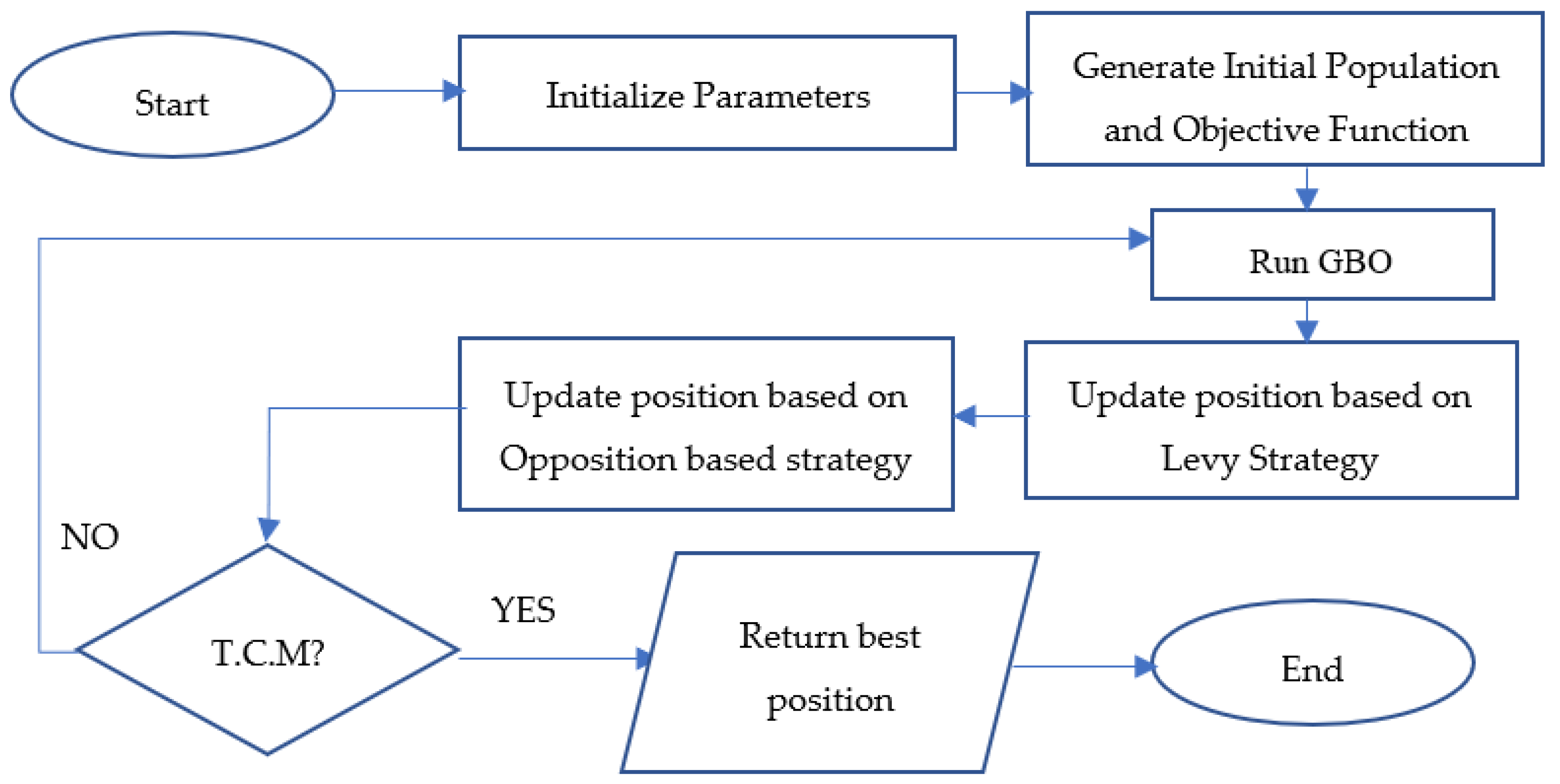
In the proposed LE-OB-GBO, the first solution of GBO is updated by the Levy strategy and then again updated by opposition-based strategy. The Levy strategy avoids the possibility of being trapped in the local optima while the opposition-based strategy considers the counterpart solution simultaneously in the algorithm.
The Levy strategy enhances the exploitation of the search space while the opposition-based strategy increases the exploration capability of the search space. Thus, the proposed LE-OB-GBO balances the exploitation and exploration process.
Figure 1 shows the flowchart of the proposed Levy-enhanced opposition-based gradient-based optimizer (LE-OB-GBO).
4. The Charging Station Placement Problem
The charging station placement problem is a nonlinear optimization problem and gives the number of charging stations and the optimal location of the charging stations in a considered distribution system as output. In the charging station placement problem, decision variables are the bus number c , number of fast charging stations , and the number of slow charging stations .
In this work, three cases of objective functions are formulated as case 1 to case 3 to minimize the consideration of the relevant constraints. Case 1 minimizes the installation cost, operational cost, penalty for AENS, and penalty for voltage deviation. Case 2 is concerned with the minimization of installation cost, operational cost, penalty for AENS, and penalty for traveling time. Case 3 considers the minimization of installation cost, operational cost, penalty for voltage deviation, and penalty for travelling time. The equations for installation cost, operational cost, penalty for AENS, penalty for voltage deviation, and penalty for traveling time are formulated as , , , , and , respectively, in Equations (27) and (36).
From Equations (27) and (28), it can be observed that installation cost and operational cost are dependent on the number of charging stations to be placed and independent of the location of the charging stations, as capital cost and electricity cost are assumed to be the same for the entire considered network. AENS is a load-dependent reliability index which can be calculated using Equation (35). Based on AENS, a penalty is imposed using Equation (29). Equation (30) calculates the voltage penalty if the voltage drops below 0.9 per unit. The voltage drop in the network is calculated using Equation (36).
where,
Bus voltages at buses are calculated using the forward–backward sweep load flow method. The objective functions of case 1 to case 3 are shown in Equations (37)–(39).
To solve the objective functions of case 1 to case 3, Equations (40) and (41) and Equations (42)–(45) are considered as equality and inequality constraints, respectively. Equations (40) and (41) are the power flow balance equations. The maximum and minimum numbers of fast and slow charging stations are constrained in Equations (42) and (43), respectively. The maximum and minimum values of reactive power are constrained in Equation (44). Equation (45) constrains the maximum load that can be added to a bus for safe operation of the distribution system.
5. Numerical Analysis
In this section, the performance of LE-OB-GBO for solving the CEC-2017 benchmark function and charging station placement problem is demonstrated. For the computation, MATLAB 2021a was used in a Core i5 (7th Gen), 16 GB RAM workstation.
5.1. Solution of the Benchmark Functions
To validate the proposed algorithm, the performance of LE-OB-GBO was checked for 29 functions of CEC-2017. The F1 and F3 functions are unimodal, the F4 to F10 functions are multimodal, the F11 to F19 functions are hybrid, and the F20 to F29 functions are composite functions. The CEC-2017 definitions are given in [
51]. Here, dimension D is taken as 30. The statistical analysis was performed based on 50 independent runs with 300,000 iterations and 50 populations. The search range was [−100, 100]
D.
Table 2 shows the algorithm-specific parameters. The mean value of LE-OB-GBO was compared with that of OB-GBO, LE-GBO, GBO [
40], SCDLPSO [
52], PSO-GSA [
53], AOA [
54], SMA [
55], HGS [
56], and HHO [
57] and is mentioned in
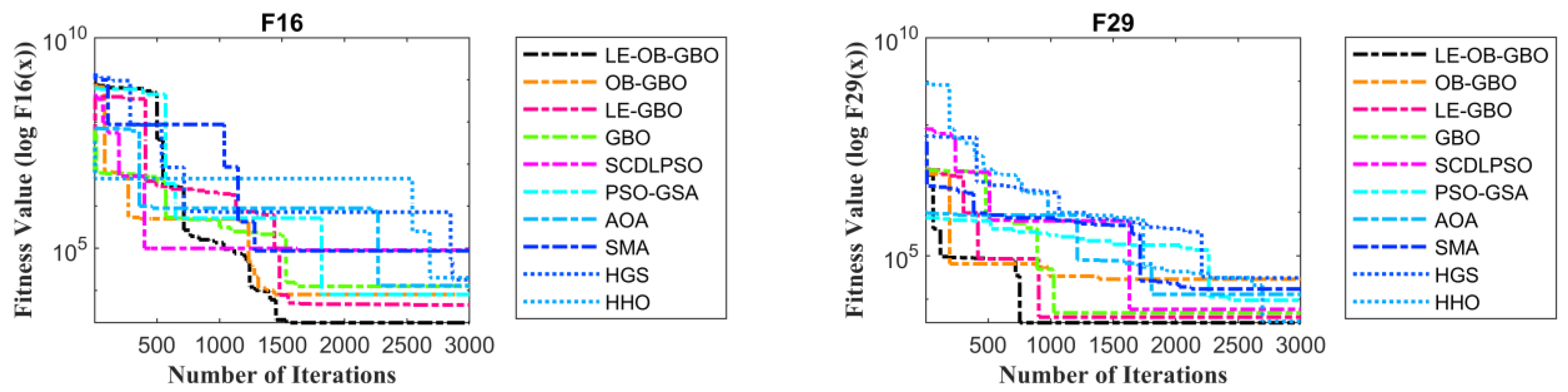
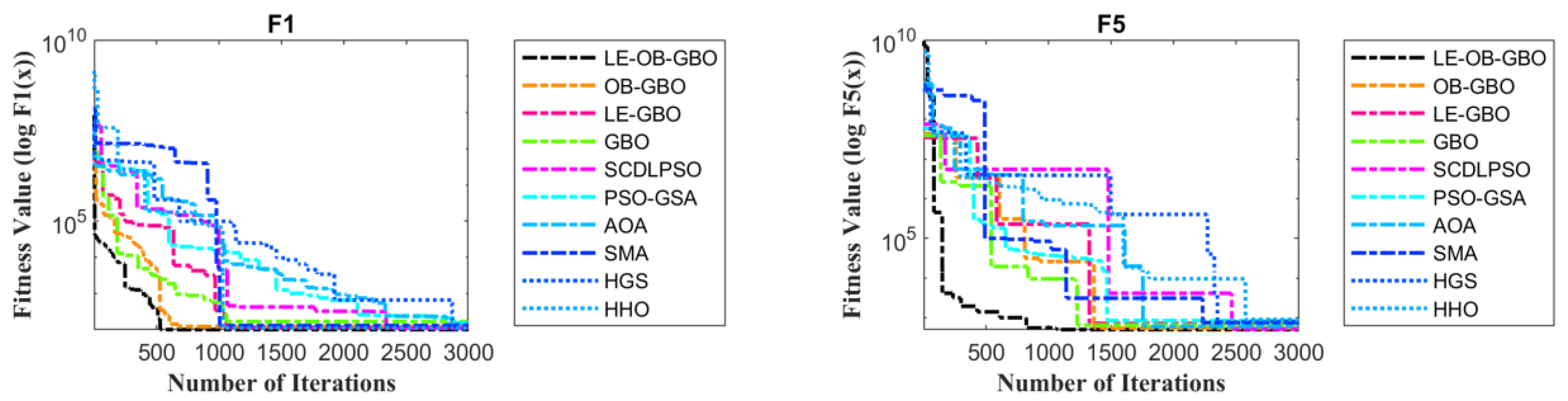
Table 3. It can be observed that for the unimodal function, F1 and F3 have lowest mean value. Out of the seven multimodal functions, F5, F7, F9, F10, and F12 have the lowest mean values. Out of the nine hybrid functions, five functions (F12, F14, F16, F17, and F18) have the lowest mean value. From the nine composite functions, F21, F23, F24, F25, F29, and F30 have the lowest mean value. Therefore, LE-OB-GBO outperforms in 17 out of 29 benchmark functions. The convergence curve of some of the benchmark functions is shown in
Figure 2 and
Figure 3. For a better understanding, the convergence curve is plotted with limited iterations. From the convergence curve, it can be seen that LE-OB-GBO converges faster than do the other algorithms.
5.2. Solution of the Charging Station Placement Problem
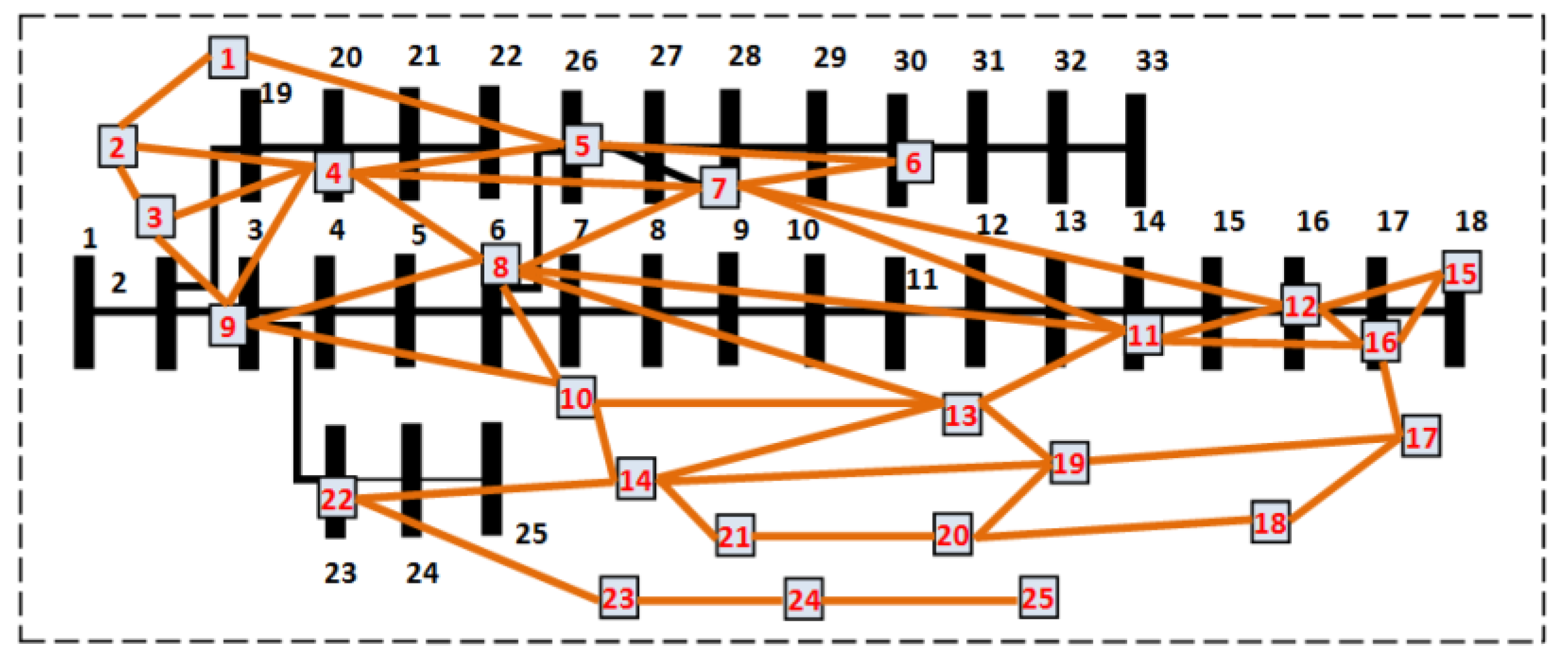
The solution of the charging station placement problem can obtained with LE-OB-GBO for the superimposed network of the IEEE- 33 bus and the 25-node road network as shown in
Figure 4. This network resembles Rajula City of Gujarat, India.
Here two routes are considered for EVs:
Route 1—[1-2-3-4-5-6-7-8-10-13-11-12-15-16-17-18-20-21-14-22-23-24-25]—and
Route 2—[1-2-3-4-5-6-7-8-9-10-13-11-12-15-16-17-19-20-21-14-22-23-24-25].
The input parameters to solve the charging station placement problem are shown in
Table 4. The performance of LE-OB-GBO for case 1, case 2, and case 3 is compared with that of OB-GBO, LE-GBO, and GBO. The solution is obtained based on 50 independent runs with 50 iterations and 30 populations. The algorithm-specific parameters are the same as those shown in
Table 2.
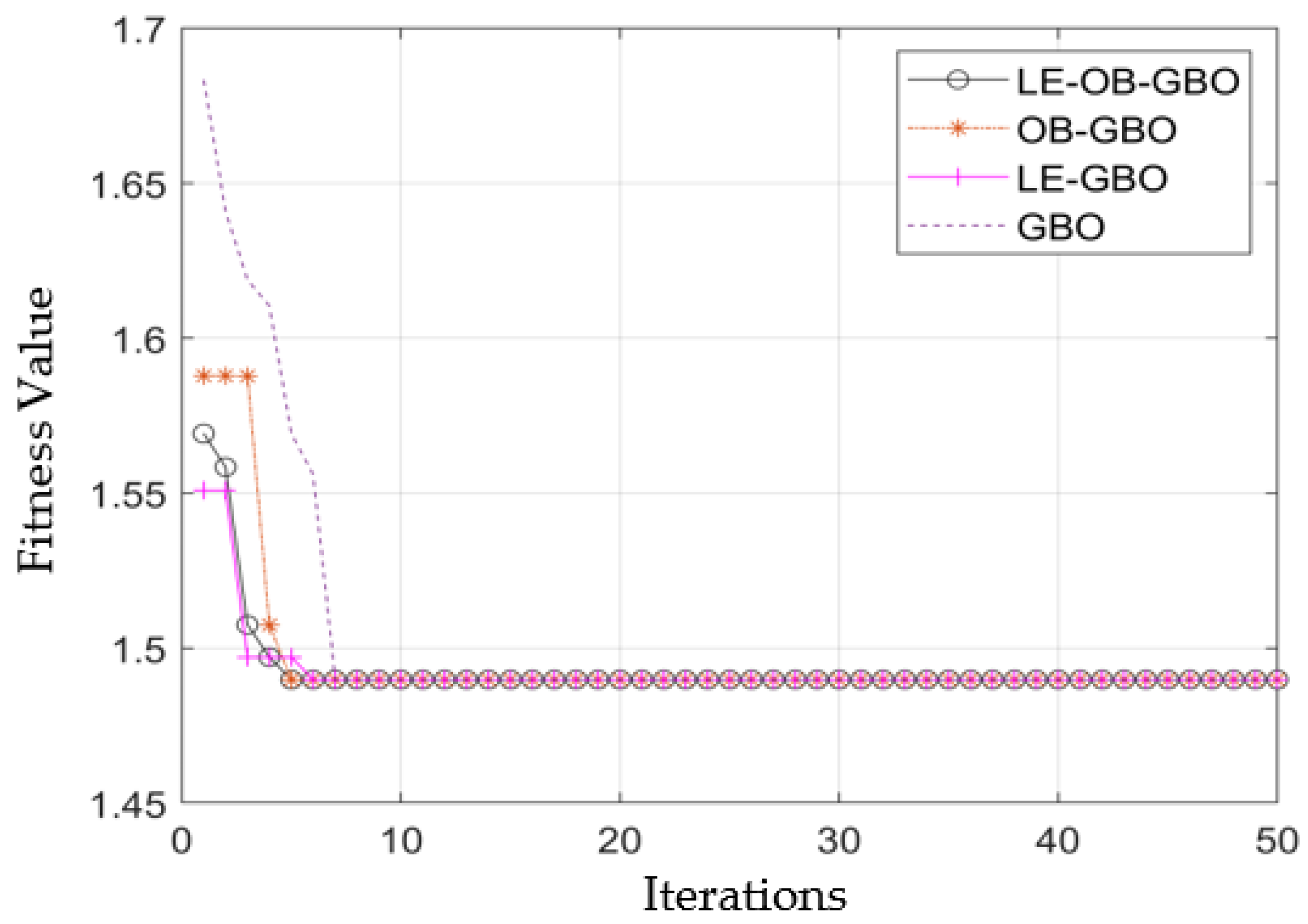
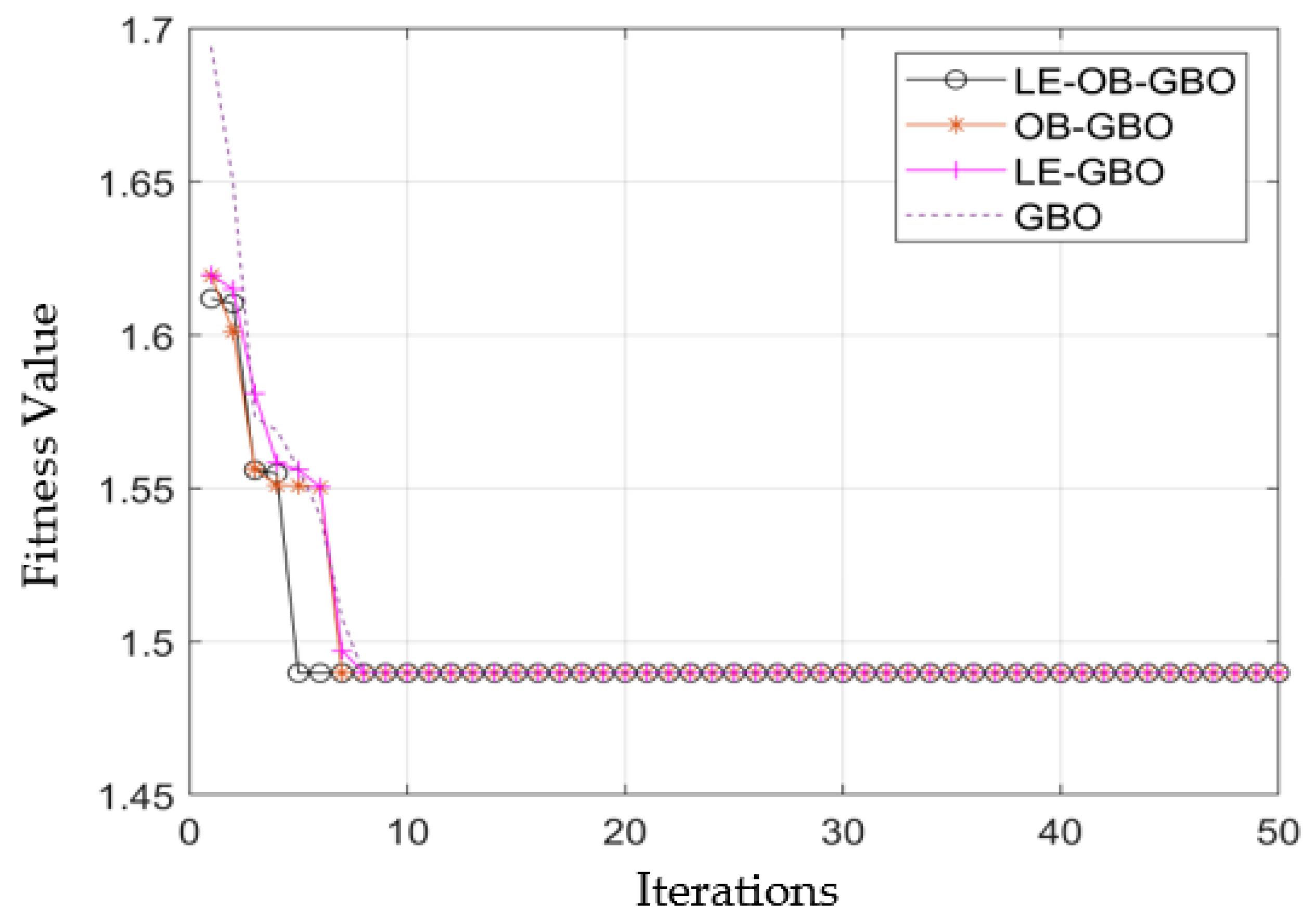
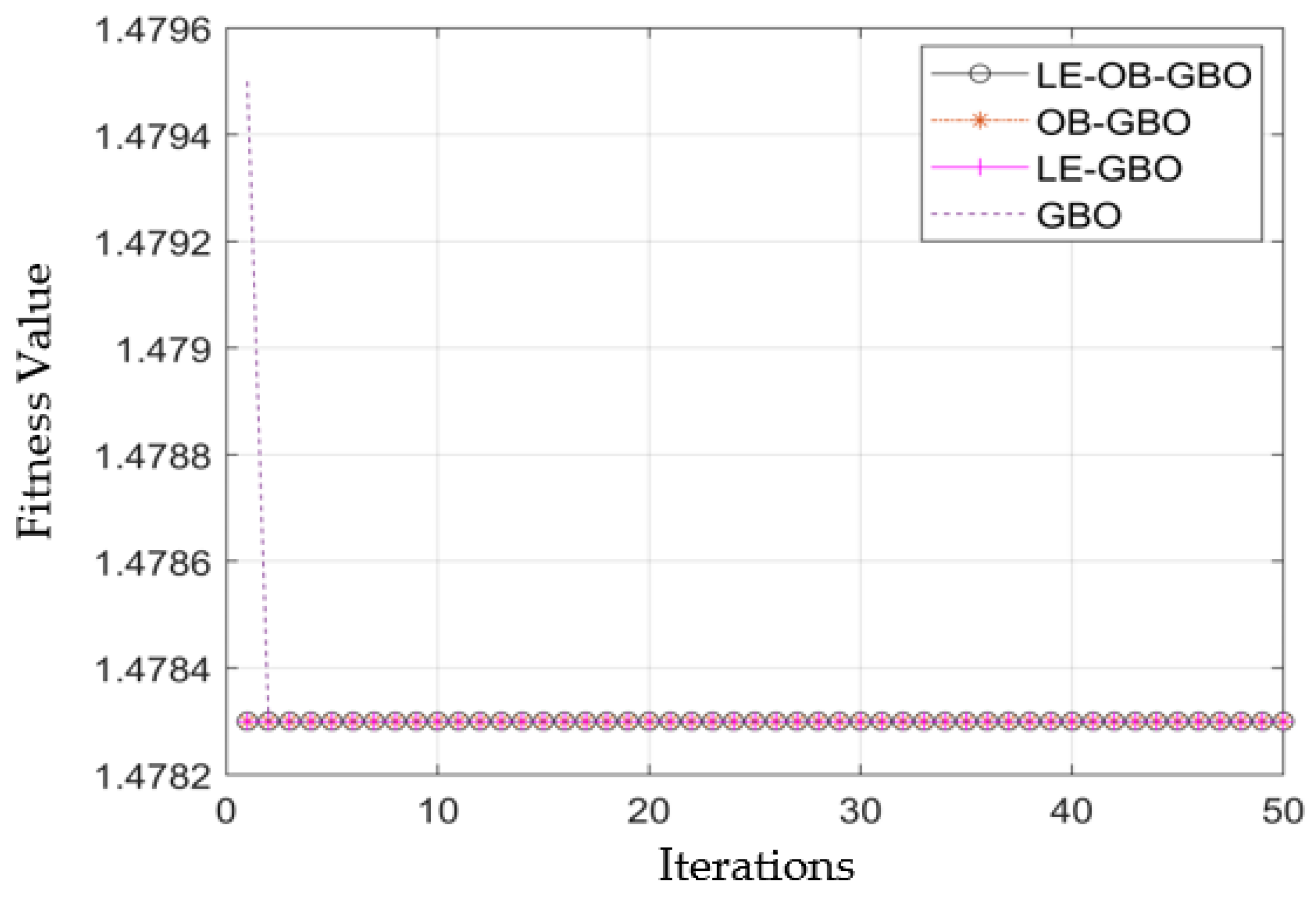
Figure 5,
Figure 6 and
Figure 7 respectively show the convergence graph for case 1, case 2, and case 3 of the charging station problem. For case 1 and case 3, LE-OB-GBO converges fast to its best fitness value of 1.4898 than do the other algorithms due to its good balance between exploration and exploitation. In case 2, LE-OB-GBO, OB-GBO, and LE-GBO converge to 1.4783 in the same manner as does GBO.
The optimal placement of the charging stations for case 1, case 2, and case 3 as calculated by algorithms are stated in
Table 5,
Table 6 and
Table 7, respectively. For case 1, LE-OB-GBO gives the optimal location of the charging station at bus no {23, 6, 3} with the addition of a 303.6 kW load in the system. Similarly, for case 2 and case 3, the optimal locations given by LE-OB-GBO are at bus no {6, 23, 28} and {23, 6, 3}, respectively. A statistical comparison of the solution to the charging station problem is stated in
Table 8,
Table 9 and
Table 10 for the three cases, and LE-OB-GBO has lowest mean values of 1.4912, 1.4783, and 1.5217, respectively.
Table 11 presents the distribution network parameters before and after placement of the charging station for case 1, case 2, and case 3. It can be seen that parameters are underperformed because of the addition of the charging station load in the system. For case 1 and case 3, the voltage deviation is below 0.05 pu, but for case 2, it violates the limit due to case 2 considering only cost, the reliability penalty, and the traveling time penalty. The above analysis supports the superiority of LE-OB-GBO compared to the other algorithms in terms of convergence rate and statistical analysis.
6. Conclusions
For the better adoption of EVs, it is necessary to install charging stations such that the distribution system parameters are maintained with driver convenience in charging. In this work, a novel LE-OB-GBO is proposed to solve the charging station placement problem. To validate the performance of LE-OB-GBO, the CEC-2017 benchmark function was evaluated, and the results were compared with those of other state-of-art optimization algorithms. The benchmark function analysis indicated that LE-OB-GBO outperforms its competitors, as it achieved best mean fitness values for 17 out of 29 functions. When LE-OB-GBO was applied to three cases of charging station placement problems, it had the best minimum fitness value and best mean fitness value for all three cases. This proves its superiority over GBO and its other two variants.
In this work cost, the reliability, voltage deviation, and distance between EV and charging station were considered. Other parameters, such as geographical condition, traffic congestion, and urban development were not considered. Moreover, the possibility of an electric transmission network to provide necessary power in the absence of the distribution network in remote places was not taken into account. Therefore, future work in this study series will address these limitations and further explore the application of LE-OB-GBO on the optimal power flow problem of the transmission and distribution system, the unit commitment problem, and the multiobjective version of LE-OB-GBO.