Article

Establishing a Real-Time Multi-Step Ahead Forecasting Model of Unbalance Fault in a Rotor-Bearing System


1
Department of Mechanical Engineering, National Taiwan University of Science and Technology, Taipei City 10607, Taiwan
2
Department of Electrical Engineering, Ming Chi University of Technology, New Taipei City 24301, Taiwan
3
Department of Mechanical Engineering, Ming Chi University of Technology, New Taipei City 24301, Taiwan
*
Author to whom correspondence should be addressed.
Electronics 2023, 12(2), 312; https://doi.org/10.3390/electronics12020312

Submission received: 14 December 2022 / Revised: 30 December 2022 / Accepted: 4 January 2023 / Published: 7 January 2023
(This article belongs to the Special Issue Selected Papers from Advanced Robotics and Intelligent Systems 2021)

Abstract

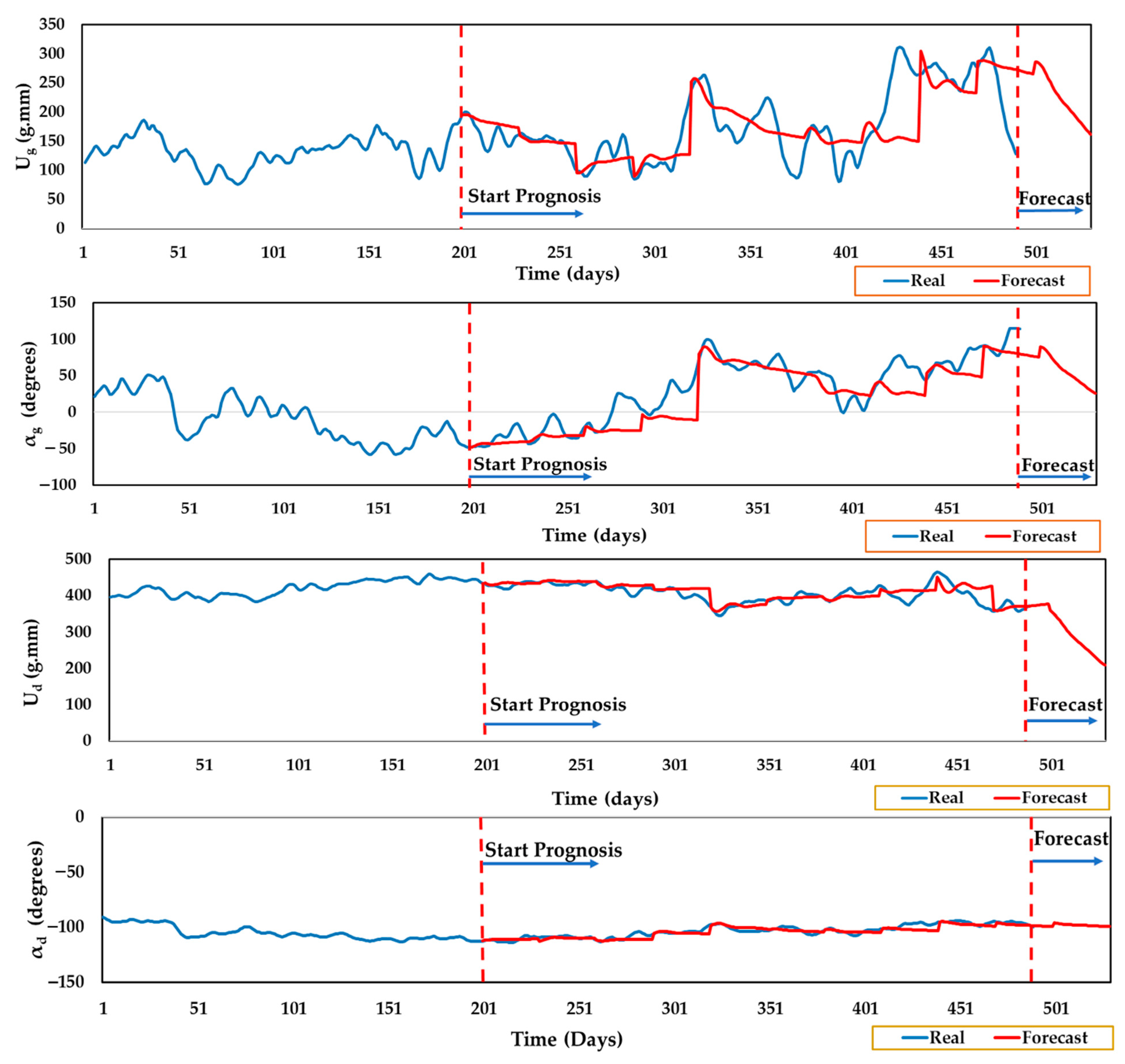
Recently, prognostics and health management (PHM) has garnered a lot of attention in the industrial sector for its cost-effective maintenance and safe operation of the system. In this regard, vibration-based predictive maintenance using sensors plays a significant role in the diagnosis and prognosis of various faults. The need of the hour is to know when and which part must be replaced in advance for efficient and reliable operation. Unbalance is one major fault acting on any rotary system leading to excessive vibration and causing various other faults developing early failure in components directly or indirectly. In this paper, we show how a prognostic model can be built for the identification of future unbalance trend of a rotor-bearing system with the aid of a mathematical model of the system and statistical/machine learning methods. The prognostic model developed is used to forecast the unbalance time-series data of an industrial turbine rotor in real-time which forecasts the month ahead unbalance values. The proposed model is verified for prognostic analysis using datasets from a local plastic company. After careful examination of the results, it is concluded that the proposed model can aid in precisely detecting future system unbalance.
Keywords: unbalance prognostics and health management; prognostics and health management; rotor-bearing unbalance; time series forecasting unbalance prognostics and health management; prognostics and health management; rotor-bearing unbalance; time series forecasting