Article

Research on Spectrum Prediction Technology Based on B-LTF

School of Measurement and Communication Engineering, Harbin University of Science and Technology, Harbin 150080, China
*
Author to whom correspondence should be addressed.
Electronics 2023, 12(1), 247; https://doi.org/10.3390/electronics12010247

Submission received: 17 November 2022 / Revised: 30 November 2022 / Accepted: 1 January 2023 / Published: 3 January 2023
(This article belongs to the Special Issue Deep Learning in Image Processing and Pattern Recognition)

Abstract

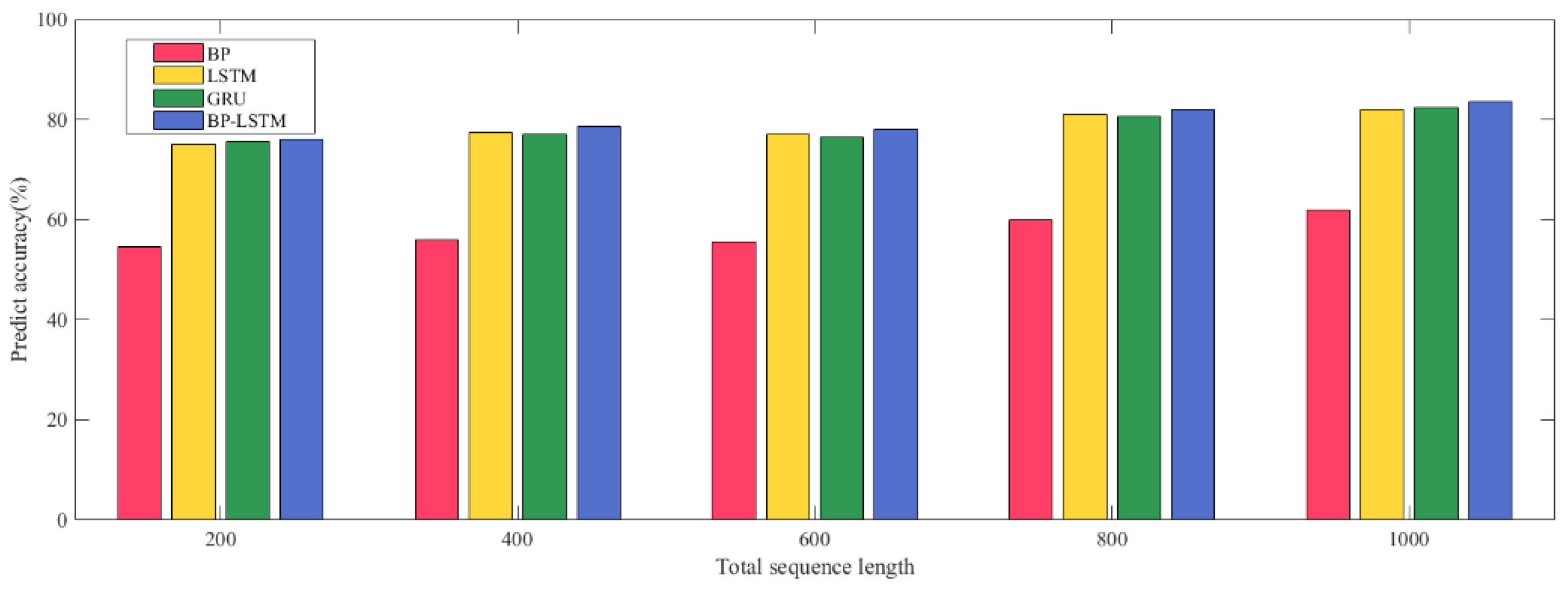
With the rapid development of global communication technology, the problem of scarce spectrum resources has become increasingly prominent. In order to alleviate the problem of frequency use, rationally use limited spectrum resources and improve frequency utilization, spectrum prediction technology has emerged. Through the effective prediction of spectrum usage, the number of subsequent spectrum sensing processes can be slowed down, and the accuracy of spectrum decisions can be increased to improve the response speed of the whole cognitive radio technology. The rise of deep learning has brought changes to traditional spectrum predicting algorithms. This paper proposes a spectrum predicting method called Back Propagation-Long short-term memory Time Forecasting (B-LTF) by using Back Propagation-Long Short-term Memory (BP-LSTM) network model. According to the historical spectrum data, the future spectrum trend and the channel state of the future time node are predicted. The purpose of our research is to achieve dynamic spectrum access by improving the accuracy of spectrum prediction and better assisting cognitive radio technology. By comparing with BP, LSTM and Gate Recurrent Unit (GRU) network models, we clarify that the improved model of recurrent time network can deal with time series more effectively. The simulation results show that the proposed model has better prediction performance, and the change in time series length has a significant impact on the prediction accuracy of the deep learning model.
Keywords: cognitive radio (CR); spectrum prediction; deep learning; long short-term memory network (LSTM); long sequence time-series forecasting (LSTF) cognitive radio (CR); spectrum prediction; deep learning; long short-term memory network (LSTM); long sequence time-series forecasting (LSTF)