Article

A Novel Deep Learning Model Compression Algorithm
1
School of Computer Science, Yangtze University, Jingzhou 434025, China
2
Department of Creative Technologies and Product Design, National Taipei University of Business, Taipei 10051, Taiwan
*
Author to whom correspondence should be addressed.
Electronics 2022, 11(7), 1066; https://doi.org/10.3390/electronics11071066

Submission received: 26 February 2022 / Revised: 22 March 2022 / Accepted: 25 March 2022 / Published: 28 March 2022
(This article belongs to the Special Issue New Trends in Deep Learning for Computer Vision)

Abstract

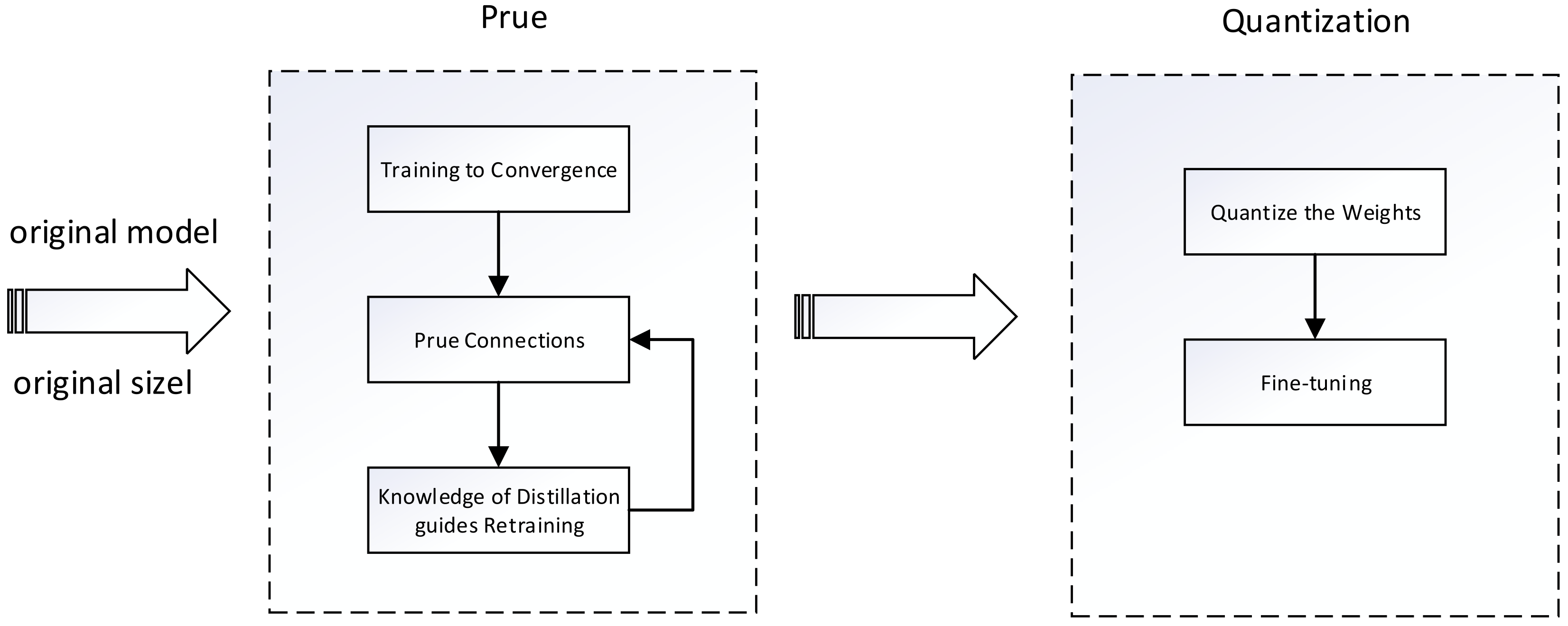
In order to solve the problem of large model computing power consumption, this paper proposes a novel model compression algorithm. Firstly, this paper proposes an interpretable weight allocation method for the loss between a student network (a network model with poor performance), a teacher network (a network model with better performance) and real label. Then, different from the previous simple pruning and fine-tuning, this paper performs knowledge distillation on the pruned model, and quantifies the residual weights of the distilled model. The above operations can further reduce the model size and calculation cost while maintaining the model accuracy. The experimental results show that the weight allocation method proposed in this paper can allocate a relatively appropriate weight to the teacher network and real tags. On the cifar-10 dataset, the pruning method combining knowledge distillation and quantization can reduce the memory size of resnet32 network model from 3726 KB to 1842 KB, and the accuracy can be kept at 93.28%, higher than the original model. Compared with similar pruning algorithms, the model accuracy and operation speed are greatly improved.
Keywords: deep learning; model compression; knowledge distillation; quantization; network pruning deep learning; model compression; knowledge distillation; quantization; network pruning