Article

A Non-Destructive Method for Hardware Trojan Detection Based on Radio Frequency Fingerprinting

1
School of Cyber Science and Engineering, Southeast University, Nanjing 211189, China
2
Purple Mountain Laboratories, No. 9 Mouzhou East Road, Nanjing 211111, China
3
School of Computer Science and Engineering, Southeast University, Nanjing 211189, China
4
Key Laboratory of Computer Network and Information Integration (Ministry of Education), Southeast University, Nanjing 211189, China
5
School of Information Science and Engineering, Southeast University, Nanjing 211189, China
*
Author to whom correspondence should be addressed.
Electronics 2022, 11(22), 3776; https://doi.org/10.3390/electronics11223776

Submission received: 28 September 2022 / Revised: 10 November 2022 / Accepted: 13 November 2022 / Published: 17 November 2022

Abstract

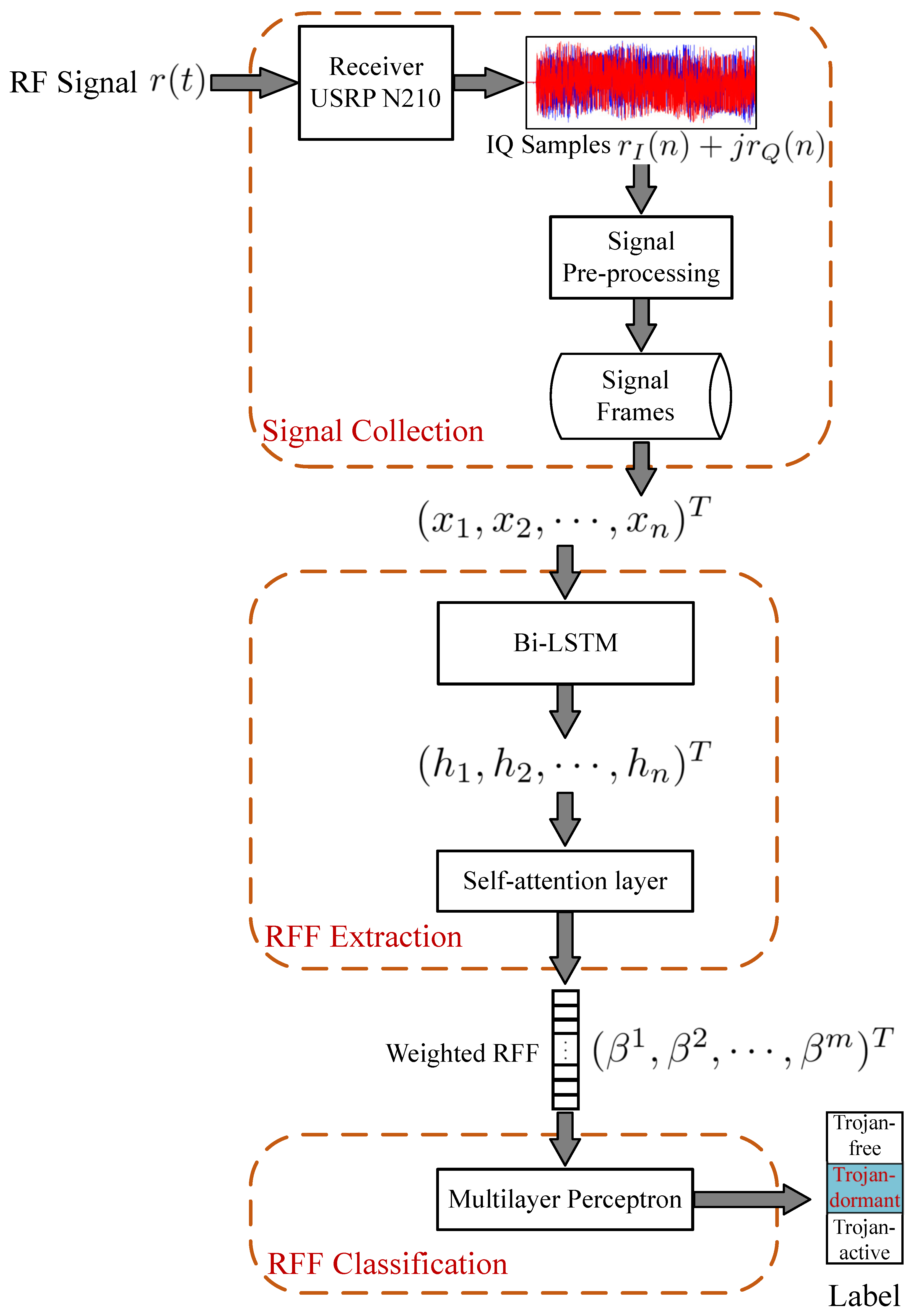
Hardware Trojans (HTs) pose a security threat to the Internet of Things (IoT). Attackers can take control of devices in IoT through HTs, which seriously jeopardize the security of many systems in transportation, finance, healthcare, etc. Since subtle differences in the circuit are reflected in far-field signals emitted by the system, the detection of HT status can be performed by monitoring the radio frequency fingerprinting (RFF) of the transmitting signals. For the detection of HTs, a non-destructive detection method based on RFF is proposed in this paper. Based on the proposed method, the detection of HTs can be achieved without integrating additional devices in the receiver, which reduces associated costs and energy consumption. QPSK and triangular-wave signals are measured and identified via experimentation, and the results validate the proposed method. For identifying the presence and operating state of Trojan, the average accuracy achieved measures as high as 98.7%. Notably, with regard to capturing the moment of Trojan activation in the AES encryption circuit, the accuracy of the proposed method is 100% and can provide warning of the threat in a timely manner.
Keywords: hardware security; hardware Trojan detection; radio frequency fingerprinting; AES; USRP; triangular wave; QPSK hardware security; hardware Trojan detection; radio frequency fingerprinting; AES; USRP; triangular wave; QPSK