Article

Word Sense Disambiguation Using Prior Probability Estimation Based on the Korean WordNet
1
Department of Software, Catholic University of Pusan, Busan 46252, Korea
2
School of Computer Science and Engineering, Pusan National University, Busan 46241, Korea
*
Author to whom correspondence should be addressed.
Electronics 2021, 10(23), 2938; https://doi.org/10.3390/electronics10232938

Submission received: 31 August 2021 / Revised: 22 November 2021 / Accepted: 23 November 2021 / Published: 26 November 2021
(This article belongs to the Special Issue Electronic Solutions for Artificial Intelligence Healthcare Volume II)

Abstract

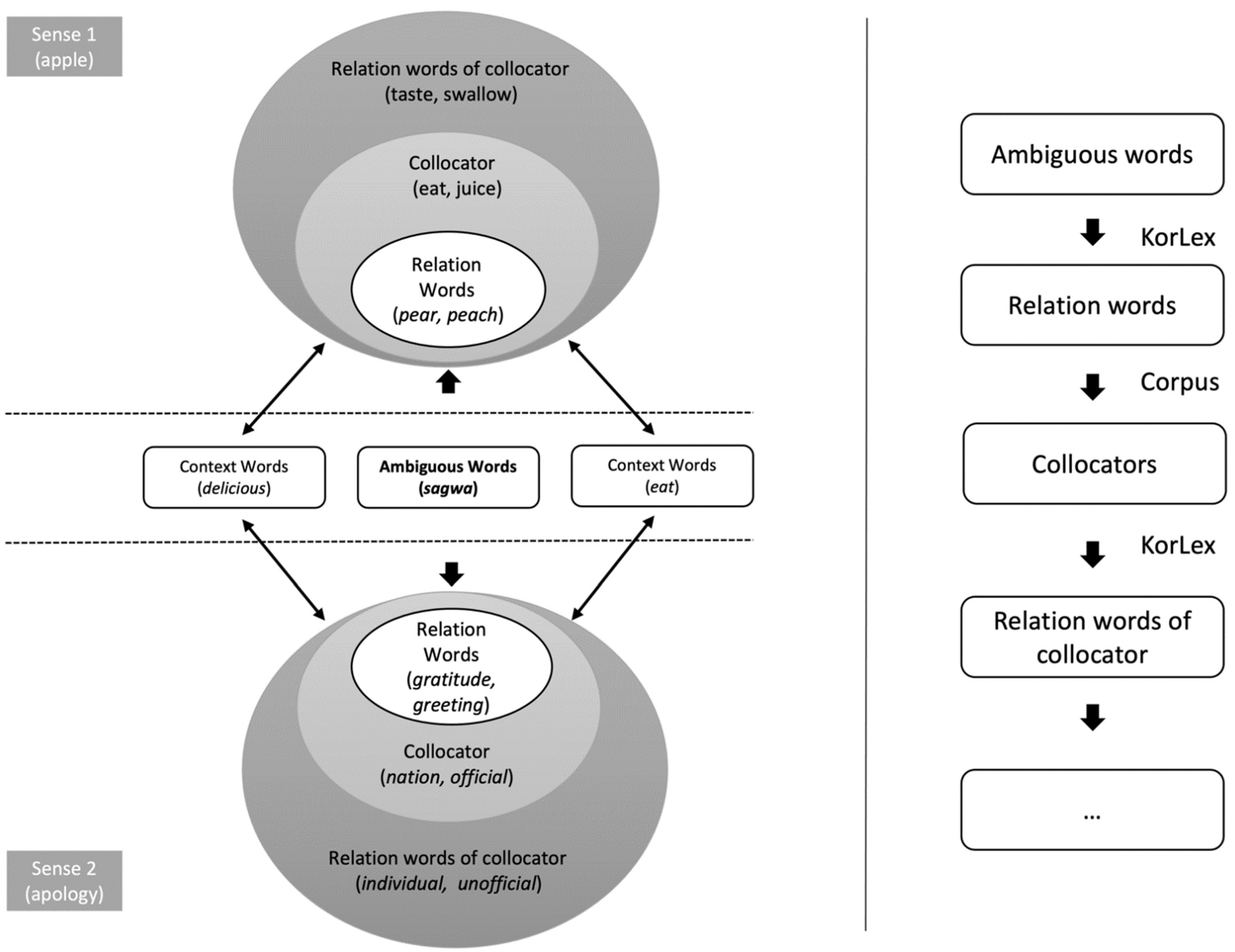
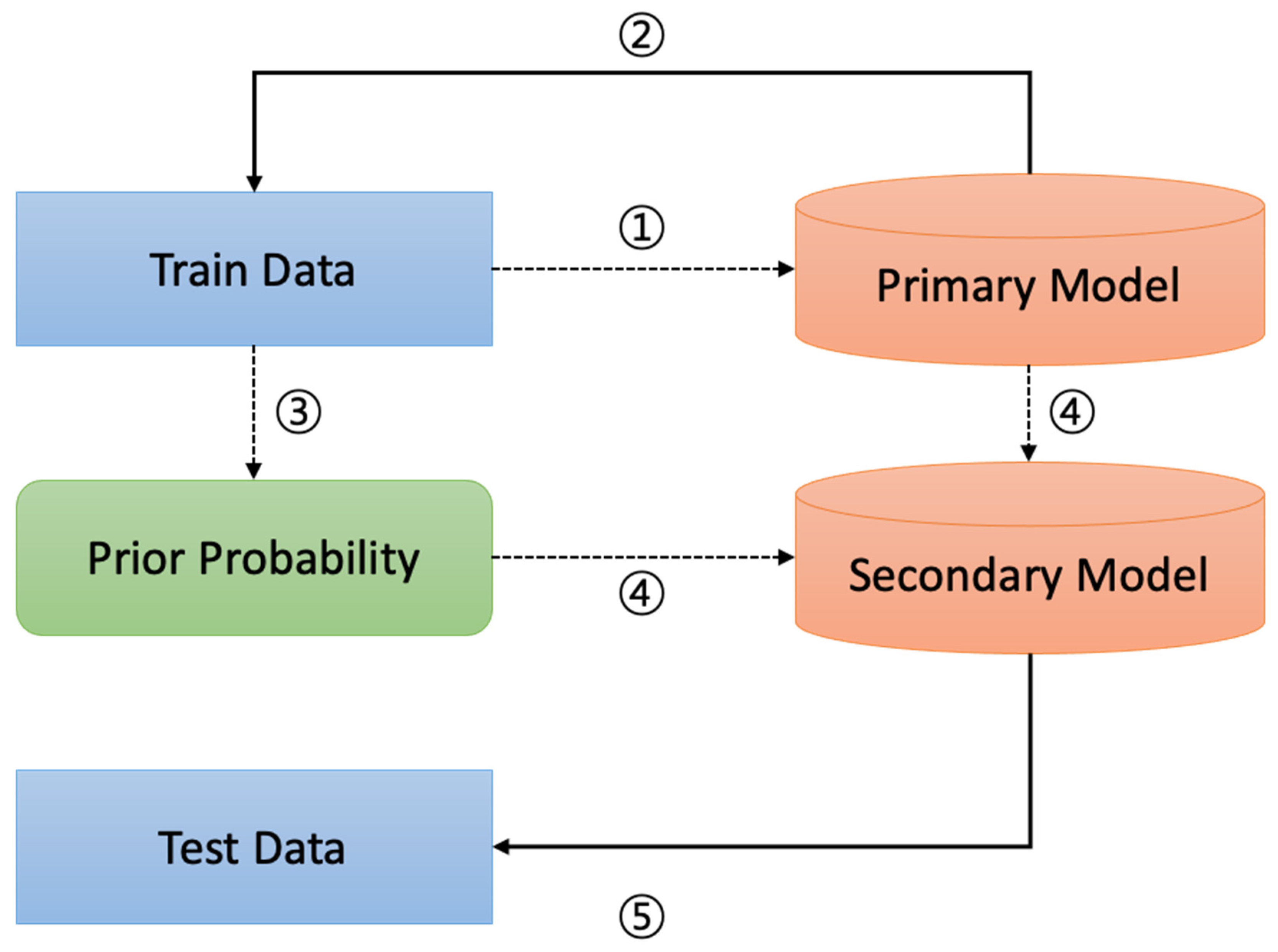
Supervised disambiguation using a large amount of corpus data delivers better performance than other word sense disambiguation methods. However, it is not easy to construct large-scale, sense-tagged corpora since this requires high cost and time. On the other hand, implementing unsupervised disambiguation is relatively easy, although most of the efforts have not been satisfactory. A primary reason for the performance degradation of unsupervised disambiguation is that the semantic occurrence probability of ambiguous words is not available. Hence, a data deficiency problem occurs while determining the dependency between words. This paper proposes an unsupervised disambiguation method using a prior probability estimation based on the Korean WordNet. This performs better than supervised disambiguation. In the Korean WordNet, all the words have similar semantic characteristics to their related words. Thus, it is assumed that the dependency between words is the same as the dependency between their related words. This resolves the data deficiency problem by determining the dependency between words by calculating the χ2 statistic between related words. Moreover, in order to have the same effect as using the semantic occurrence probability as prior probability, which is used in supervised disambiguation, semantically related words of ambiguous vocabulary are obtained and utilized as prior probability data. An experiment was conducted with Korean, English, and Chinese to evaluate the performance of our proposed lexical disambiguation method. We found that our proposed method had better performance than supervised disambiguation methods even though our method is based on unsupervised disambiguation (using a knowledge-based approach).
Keywords: word sense disambiguation; Korean WordNet; knowledge-based model; data mining; information extraction word sense disambiguation; Korean WordNet; knowledge-based model; data mining; information extraction