
Comparative In Vitro Evaluation of Selected Essential Oils and Commercial Blends Against Skin-Associated Pathogens

 , and
, and
Abstract
1. Introduction
2. Materials and Methods
2.1. Essential Oil Composition
2.2. Preparation of Essential Oil Working Solutions
2.3. Bacterial Strains
2.4. Determination of the Minimum Inhibitory Concentrations
2.5. Determination of the Minimum Bactericidal Concentrations
2.6. Statistical Analysis
3. Results
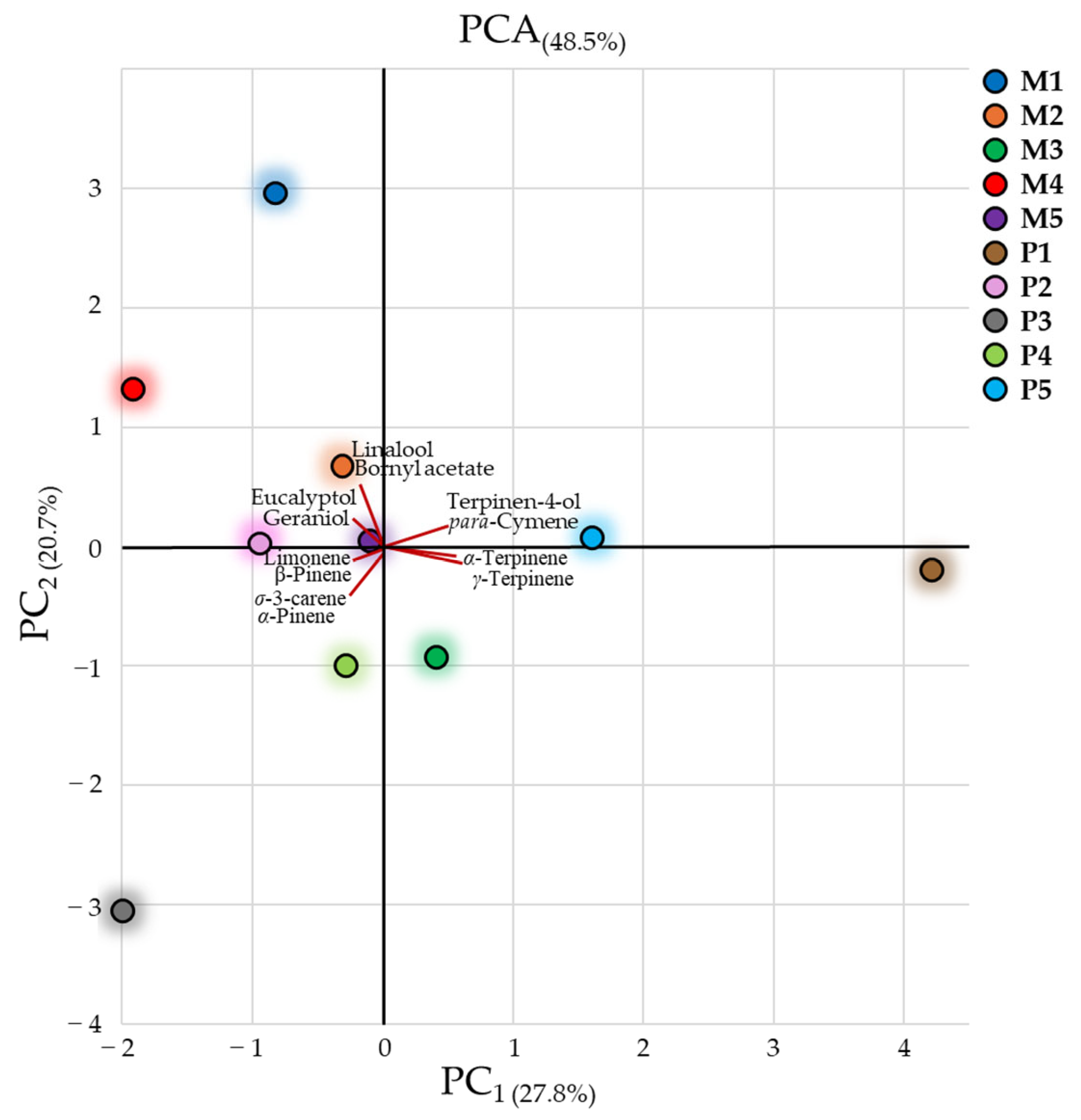
3.1. Chemical Composition of Essential Oils and Principal Component Analysis
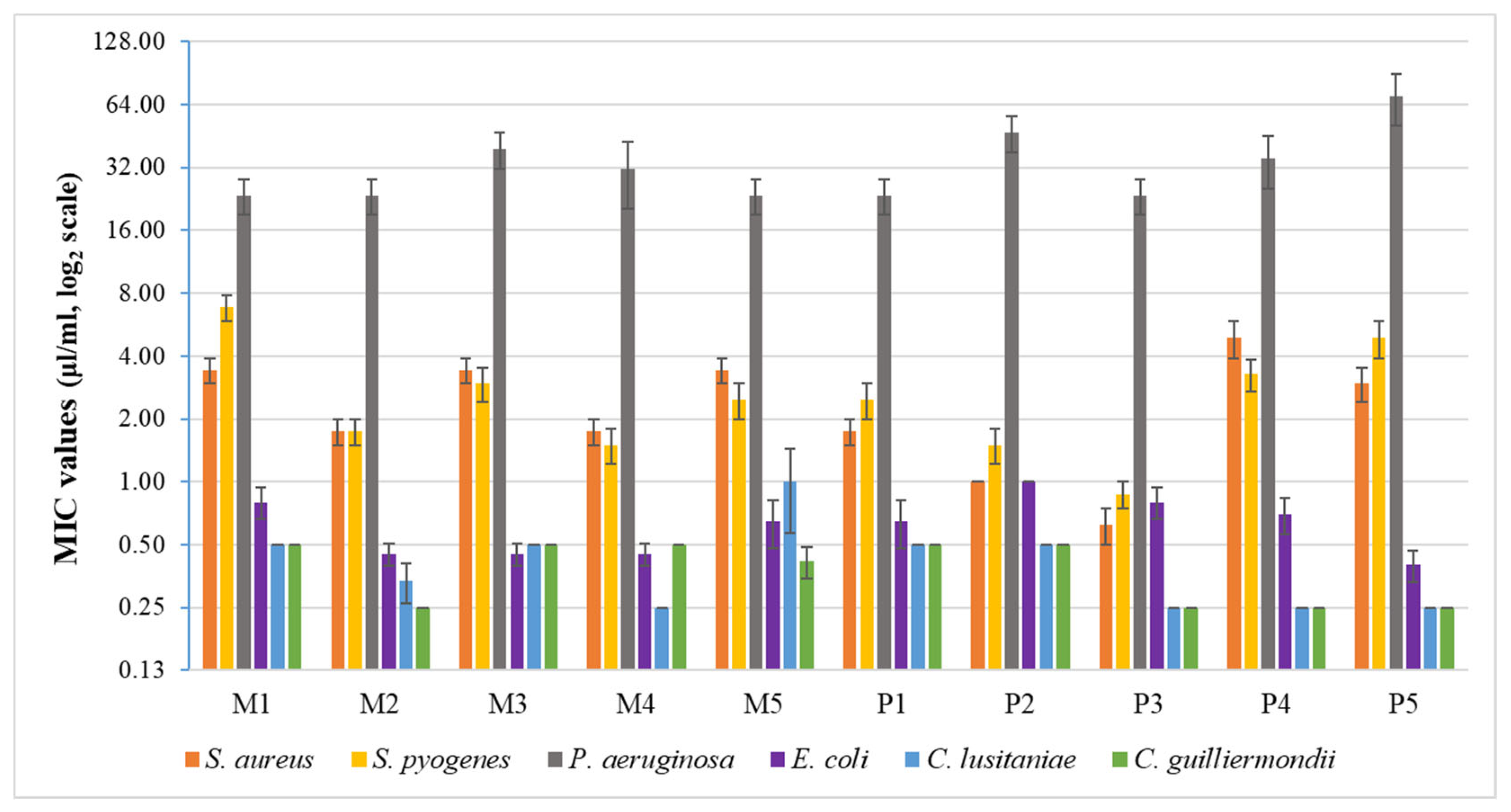
3.2. Minimum Inhibitory Concentrations
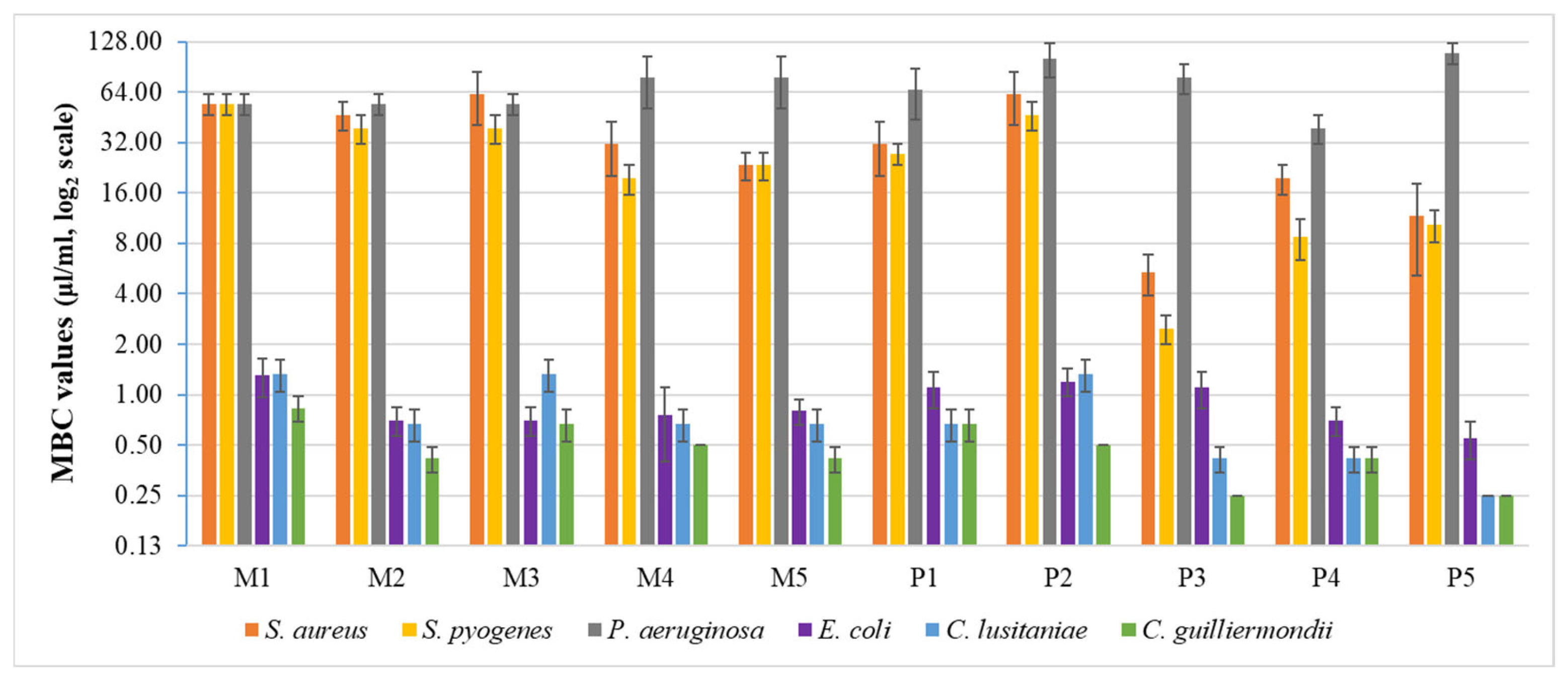
3.3. Minimum Bactericidal Concentrations
4. Discussion
Supplementary Materials
Author Contributions
Funding
Institutional Review Board Statement
Informed Consent Statement
Data Availability Statement
Acknowledgments
Conflicts of Interest
Abbreviations
| AMR | Antimicrobial resistance |
| EO | Essential oil |
| DMSO | Dimethyl sulfoxide |
| MIC | Minimum inhibitory concentration |
| MBC | Minimum bactericidal concentration |
| MDR | Multidrug resistance |
| TSA | Tryptone soy agar |
| YPD | Yeast peptone dextrose |
References
- Sukumaran, V.; Senanayake, S. Bacterial Skin and Soft Tissue Infections. Aust. Prescr. 2016, 39, 159–163. [Google Scholar] [CrossRef]
- Kujath, P.; Kujath, C. Complicated Skin, Skin Structure and Soft Tissue Infections—Are We Threatened by Multi-Resistant Pathogens? Eur. J. Med. Res. 2010, 15, 544–553. [Google Scholar] [CrossRef] [PubMed]
- Lwigale, F.; Kibombo, D.; Kasango, S.D.; Tabajjwa, D.; Atuheire, C.; Kungu, J.; Kalule, J.B.; Otita, M.; Kakooza, F.; Nabukenya, I.; et al. Prevalence, Resistance Profiles and Factors Associated with Skin and Soft-Tissue Infections at Jinja Regional Referral Hospital: A Retrospective Study. PLoS Glob. Public Health 2024, 4, e0003582. [Google Scholar] [CrossRef] [PubMed]
- Masyita, A.; Mustika Sari, R.; Dwi Astuti, A.; Yasir, B.; Rahma Rumata, N.; Emran, T.B.; Nainu, F.; Simal-Gandara, J. Terpenes and Terpenoids as Main Bioactive Compounds of Essential Oils, Their Roles in Human Health and Potential Application as Natural Food Preservatives. Food Chem. X 2022, 13, 100217. [Google Scholar] [CrossRef] [PubMed]
- Elshafie, H.S.; Camele, I. An Overview of the Biological Effects of Some Mediterranean Essential Oils on Human Health. Biomed. Res. Int. 2017, 2017, 9268468. [Google Scholar] [CrossRef]
- de Sousa, D.P.; Damasceno, R.O.S.; Amorati, R.; Elshabrawy, H.A.; de Castro, R.D.; Bezerra, D.P.; Nunes, V.R.V.; Gomes, R.C.; Lima, T.C. Essential Oils: Chemistry and Pharmacological Activities. Biomolecules 2023, 13, 1144. [Google Scholar] [CrossRef]
- Chouhan, S.; Sharma, K.; Guleria, S. Antimicrobial Activity of Some Essential Oils—Present Status and Future Perspectives. Medicines 2017, 4, 58. [Google Scholar] [CrossRef]
- Cox, S.D.; Mann, C.M.; Markham, J.L.; Bell, H.C.; Gustafson, J.E.; Warmington, J.R.; Wyllie, S.G. The Mode of Antimicrobial Action of the Essential Oil of Melaleuca alternifolia (Tea Tree Oil). J. Appl. Microbiol. 2000, 88, 170–175. [Google Scholar] [CrossRef]
- Carson, C.F.; Hammer, K.A.; Riley, T.V. Melaleuca alternifolia (Tea Tree) Oil: A Review of Antimicrobial and Other Medicinal Properties. Clin. Microbiol. Rev. 2006, 19, 50–62. [Google Scholar] [CrossRef]
- Iacovelli, F.; Romeo, A.; Lattanzio, P.; Ammendola, S.; Battistoni, A.; La Frazia, S.; Vindigni, G.; Unida, V.; Biocca, S.; Gaziano, R.; et al. Deciphering the Broad Antimicrobial Activity of Melaleuca alternifolia Tea Tree Oil by Combining Experimental and Computational Investigations. Int. J. Mol. Sci. 2023, 24, 12432. [Google Scholar] [CrossRef]
- Giovannini, D.; Gismondi, A.; Basso, A.; Canuti, L.; Braglia, R.; Canini, A.; Mariani, F.; Cappelli, G. Lavandula Angustifolia Mill. Essential Oil Exerts Antibacterial and Anti-Inflammatory Effect in Macrophage Mediated Immune Response to Staphylococcus aureus. Immunol. Investig. 2016, 45, 11–28. [Google Scholar] [CrossRef] [PubMed]
- de Rapper, S.; Viljoen, A.; van Vuuren, S. The In Vitro Antimicrobial Effects of Lavandula angustifolia Essential Oil in Combination with Conventional Antimicrobial Agents. Evid. Based Complement. Altern. Med. 2016, 2016, 2752739. [Google Scholar] [CrossRef]
- Betlej, I.; Andres, B.; Cebulak, T.; Kapusta, I.; Balawejder, M.; Jaworski, S.; Lange, A.; Kutwin, M.; Pisulewska, E.; Kidacka, A.; et al. Antimicrobial Properties and Assessment of the Content of Bioactive Compounds Lavandula angustifolia Mill. Cultivated in Southern Poland. Molecules 2023, 28, 6416. [Google Scholar] [CrossRef] [PubMed]
- Abdelhamed, F.M.; Abdeltawab, N.F.; ElRakaiby, M.T.; Shamma, R.N.; Moneib, N.A. Antibacterial and Anti-Inflammatory Activities of Thymus Vulgaris Essential Oil Nanoemulsion on Acne Vulgaris. Microorganisms 2022, 10, 1874. [Google Scholar] [CrossRef]
- Vassiliou, E.; Awoleye, O.; Davis, A.; Mishra, S. Anti-Inflammatory and Antimicrobial Properties of Thyme Oil and Its Main Constituents. Int. J. Mol. Sci. 2023, 24, 6936. [Google Scholar] [CrossRef]
- Ait Benlabchir, A.; Fikri-Benbrahim, K.; Moutawalli, A.; Alanazi, M.M.; Halmoune, A.; Benkhouili, F.Z.; Oubihi, A.; Kabra, A.; Hanoune, E.; Assila, H.; et al. GC-MS Characterization and Bioactivity Study of Eucalyptus globulus Labill. (Myrtaceae) Essential Oils and Their Fractions: Antibacterial and Antioxidant Properties and Molecular Docking Modeling. Pharmaceuticals 2024, 17, 1552. [Google Scholar] [CrossRef]
- Bachir, R.G.; Benali, M. Antibacterial Activity of the Essential Oils from the Leaves of Eucalyptus globulus against Escherichia coli and Staphylococcus aureus. Asian Pac. J. Trop. Biomed. 2012, 2, 739–742. [Google Scholar] [CrossRef]
- Nabavi, S.F.; Di Lorenzo, A.; Izadi, M.; Sobarzo-Sánchez, E.; Daglia, M.; Nabavi, S.M. Antibacterial Effects of Cinnamon: From Farm to Food, Cosmetic and Pharmaceutical Industries. Nutrients 2015, 7, 7729–7748. [Google Scholar] [CrossRef]
- Coșeriu, R.L.; Vintilă, C.; Pribac, M.; Mare, A.D.; Ciurea, C.N.; Togănel, R.O.; Cighir, A.; Simion, A.; Man, A. Antibacterial Effect of 16 Essential Oils and Modulation of Mex Efflux Pumps Gene Expression on Multidrug-Resistant Pseudomonas aeruginosa Clinical Isolates: Is Cinnamon a Good Fighter? Antibiotics 2023, 12, 163. [Google Scholar] [CrossRef]
- Elangovan, S.; Mudgil, P. Antibacterial Properties of Eucalyptus globulus Essential Oil against MRSA: A Systematic Review. Antibiotics 2023, 12, 474. [Google Scholar] [CrossRef]
- Jiang, Q.; Wu, Y.; Zhang, H.; Liu, P.; Yao, J.; Yao, P.; Chen, J.; Duan, J. Development of Essential Oils as Skin Permeation Enhancers: Penetration Enhancement Effect and Mechanism of Action. Pharm. Biol. 2017, 55, 1592–1600. [Google Scholar] [CrossRef]
- Adams, R. Identification of Essential Oil Components by Gas Chromatography/Quadrupole Mass Spectroscopy. Carol. Stream 2005, 16, 65–120. [Google Scholar]
- Man, A.; Santacroce, L.; Iacob, R.; Mare, A.; Man, L. Antimicrobial Activity of Six Essential Oils Against a Group of Human Pathogens: A Comparative Study. Pathogens 2019, 8, 15. [Google Scholar] [CrossRef] [PubMed]
- Cui, Z.-H.; He, H.-L.; Wu, S.-B.; Dong, C.-L.; Lu, S.-Y.; Shan, T.-J.; Fang, L.-X.; Liao, X.-P.; Liu, Y.-H.; Sun, J. Rapid Screening of Essential Oils as Substances Which Enhance Antibiotic Activity Using a Modified Well Diffusion Method. Antibiotics 2021, 10, 463. [Google Scholar] [CrossRef] [PubMed]
- Lastauskienė, E.; Zinkevičienė, A.; Girkontaitė, I.; Kaunietis, A.; Kvedarienė, V. Formic Acid and Acetic Acid Induce a Programmed Cell Death in Pathogenic Candida Species. Curr. Microbiol. 2014, 69, 303–310. [Google Scholar] [CrossRef]
- Liu, X.; Cai, J.; Chen, H.; Zhong, Q.; Hou, Y.; Chen, W.; Chen, W. Antibacterial Activity and Mechanism of Linalool against Pseudomonas aeruginosa. Microb. Pathog. 2020, 141, 103980. [Google Scholar] [CrossRef]
- Mann, C.M.; Cox, S.D.; Markham, J.L. The Outer Membrane of Pseudomonas aeruginosa NCTC 6749 Contributes to Its Tolerance to the Essential Oil of Melaleuca alternifolia (Tea Tree Oil). Lett. Appl. Microbiol. 2000, 30, 294–297. [Google Scholar] [CrossRef]
- Puvača, N.; Milenković, J.; Galonja Coghill, T.; Bursić, V.; Petrović, A.; Tanasković, S.; Pelić, M.; Ljubojević Pelić, D.; Miljković, T. Antimicrobial Activity of Selected Essential Oils against Selected Pathogenic Bacteria: In Vitro Study. Antibiotics 2021, 10, 546. [Google Scholar] [CrossRef]
- Nguyen, L.; DeVico, B.; Mannan, M.; Chang, M.; Rada Santacruz, C.; Siragusa, C.; Everhart, S.; Fazen, C.H. Tea Tree Essential Oil Kills Escherichia coli and Staphylococcus epidermidis Persisters. Biomolecules 2023, 13, 1404. [Google Scholar] [CrossRef]
- Lara, V.M.; Carregaro, A.B.; Santurio, D.F.; de Sá, M.F.; Santurio, J.M.; Alves, S.H. Antimicrobial Susceptibility of Escherichia coli Strains Isolated from Alouatta Spp. Feces to Essential Oils. Evid. Based Complement. Altern. Med. 2016, 2016, 1643762. [Google Scholar] [CrossRef]
- Jurado, P.; Uruén, C.; Martínez, S.; Lain, E.; Sánchez, S.; Rezusta, A.; López, V.; Arenas, J. Essential Oils of Pinus sylvestris, Citrus limon and Origanum vulgare Exhibit High Bactericidal and Anti-Biofilm Activities against Neisseria gonorrhoeae and Streptococcus suis. Biomed. Pharmacother. 2023, 168, 115703. [Google Scholar] [CrossRef] [PubMed]
- Motiejūnaite, O.; Peciulyte, D. Fungicidal Properties of Pinus sylvestris L. for Improvement of Air Quality. Medicina 2004, 40, 787–794. [Google Scholar] [PubMed]
- Orchard, A.; van Vuuren, S. Commercial Essential Oils as Potential Antimicrobials to Treat Skin Diseases. Evid. Based Complement. Altern. Med. 2017, 2017, 4517971. [Google Scholar] [CrossRef]
- Tadtong, S.; Suppawat, S.; Tintawee, A.; Saramas, P.; Jareonvong, S.; Hongratanaworakit, T. Antimicrobial Activity of Blended Essential Oil Preparation. Nat. Prod. Commun. 2012, 7, 1401–1404. [Google Scholar] [CrossRef]
- Nguyen, M.M.; Karboune, S. Combinatorial Interactions of Essential Oils Enriched with Individual Polyphenols, Polyphenol Mixes, and Plant Extracts: Multi-Antioxidant Systems. Antioxidants 2023, 12, 486. [Google Scholar] [CrossRef]
- Couteau, C.; Diarra, H.; Lecoq, M.; Ali, A.; Bernet, M.; Coiffard, L. The Role of Essential Oils in Homemade Cosmetics: A Study of 140 Recipes. J. Clin. Aesthet. Dermatol. 2023, 16, 18–24. [Google Scholar]
- International Fragrance Association. IFRA Standards—51st Amendment: Essential Guidance. 2023. Available online: https://ifrafragrance.org/initiatives-positions/safe-use-fragrance-science/ifra-standards/ifra-standards-documentation (accessed on 5 January 2026).
- Guidance on Essential Oils in Cosmetic Products, 2nd Edition. European Directorate for the Quality of Medicines & HealthCare (EDQM), Council of Europe. 2024. Available online: https://www.edqm.eu/en/guidance-on-essential-oils-in-cosmetic-products (accessed on 5 January 2026).
- Sarkic, A.; Stappen, I. Essential Oils and Their Single Compounds in Cosmetics—A Critical Review. Cosmetics 2018, 5, 11. [Google Scholar] [CrossRef]
- Sharmeen, J.B.; Mahomoodally, F.M.; Zengin, G.; Maggi, F. Essential Oils as Natural Sources of Fragrance Compounds for Cosmetics and Cosmeceuticals. Molecules 2021, 26, 666. [Google Scholar] [CrossRef]
- Pezantes-Orellana, C.; German Bermúdez, F.; Montalvo, J.; Packer, T.; Orellana-Manzano, A. Evaluating Efficacy, Safety, and Innovation in Skin Care Applications of Essential Oils: A Systematic Review. Front. Med. 2025, 12, 1589691. [Google Scholar] [CrossRef]



| Code | Source |
|---|---|
| M1 | Picea mariana, Citrus limonum, Thymus zygis, Eucalyptus globulus, Melaleuca alternifolia |
| M2 | Melaleuca alternifolia, Pinus sylvestris, Cimbopogon martini var. motia, Eucalyptus globulus, Thymus hyemalis |
| M3 | Melaleuca alternifolia, Pinus sylvestris, Boswellia carterii, Ravensara aromatica, Rosmarinus officinalis, Cimbopogon citratus |
| M4 | Eucalyptus globulus, Abies balsamea, Eucalyptus radiata, Cinnamonum camphora linaloolifera, Backhousia citriodora, Eucalyptus staigerania |
| M5 | Cinnamonum camphora linaloolifera, Rosmarinus officinalis, Citrus limonum, Eucalyptus globulus, Eugenia caryophylus, Cinnamonum cassia |
| P1 | Melaleuca alternifolia |
| P2 | Eucalyptus globulus |
| P3 | Pinus sylvestris |
| P4 | Citrus limonum |
| P5 | Thymus hyemalis |
| Microorganism | Means of Essential Oil Blends | Means of Pure Essential Oils | ||||||||
|---|---|---|---|---|---|---|---|---|---|---|
| M1 | M2 | M3 | M4 | M5 | P1 | P2 | P3 | P4 | P5 | |
| MIC | ||||||||||
| S. aureus | 3.43 | 1.75 | 3.43 | 1.75 | 3.43 | 1.75 | 1.00 | 0.63 | 4.88 | 2.95 |
| S. pyogenes | 6.83 | 1.75 | 2.95 | 1.50 | 2.48 | 2.48 | 1.50 | 0.88 | 3.27 | 4.88 |
| P. aeruginosa | 23.44 | 23.44 | 39.06 | 31.25 | 23.44 | 23.44 | 46.88 | 23.44 | 35.16 | 70.31 |
| E. coli | 0.80 | 0.45 | 0.45 | 0.45 | 0.65 | 0.65 | 1.00 | 0.80 | 0.70 | 0.40 |
| C. lusitaniae | 0.50 | 0.33 | 0.50 | 0.25 | 1.00 | 0.50 | 0.50 | 0.25 | 0.25 | 0.25 |
| C. guilliermondii | 0.50 | 0.25 | 0.50 | 0.50 | 0.42 | 0.50 | 0.50 | 0.25 | 0.25 | 0.25 |
| Grand mean | 5.91 | 4.66 | 7.81 | 5.95 | 5.23 | 4.89 | 8.56 | 4.37 | 7.42 | 13.17 |
| MBC | ||||||||||
| S. aureus | 54.69 | 46.88 | 62.50 | 31.25 | 23.44 | 31.25 | 62.50 | 5.38 | 19.53 | 11.71 |
| S. pyogenes | 54.69 | 39.06 | 39.06 | 19.53 | 23.44 | 27.34 | 46.88 | 2.48 | 8.78 | 10.41 |
| P. aeruginosa | 54.69 | 54.69 | 54.69 | 78.13 | 78.13 | 66.41 | 101.56 | 78.13 | 39.06 | 109.38 |
| E. coli | 1.30 | 0.70 | 0.70 | 0.75 | 0.80 | 1.10 | 1.20 | 1.10 | 0.70 | 0.55 |
| C. lusitaniae | 1.33 | 0.67 | 1.33 | 0.67 | 0.67 | 0.67 | 1.33 | 0.42 | 0.42 | 0.25 |
| C. guilliermondii | 0.83 | 0.42 | 0.67 | 0.50 | 0.42 | 0.67 | 0.50 | 0.25 | 0.42 | 0.25 |
| Grand mean | 27.92 | 23.73 | 26.49 | 21.80 | 21.15 | 21.24 | 35.66 | 14.62 | 11.48 | 22.09 |
Disclaimer/Publisher’s Note: The statements, opinions and data contained in all publications are solely those of the individual author(s) and contributor(s) and not of MDPI and/or the editor(s). MDPI and/or the editor(s) disclaim responsibility for any injury to people or property resulting from any ideas, methods, instructions or products referred to in the content. |
© 2026 by the authors. Licensee MDPI, Basel, Switzerland. This article is an open access article distributed under the terms and conditions of the Creative Commons Attribution (CC BY) license.
Share and Cite
Bikmurzin, R.; Būdienė, J.; Daunoravičienė, R.; Pumputienė, I.; Graželytė, J. Comparative In Vitro Evaluation of Selected Essential Oils and Commercial Blends Against Skin-Associated Pathogens. Cosmetics 2026, 13, 39. https://doi.org/10.3390/cosmetics13010039
Bikmurzin R, Būdienė J, Daunoravičienė R, Pumputienė I, Graželytė J. Comparative In Vitro Evaluation of Selected Essential Oils and Commercial Blends Against Skin-Associated Pathogens. Cosmetics. 2026; 13(1):39. https://doi.org/10.3390/cosmetics13010039
Chicago/Turabian StyleBikmurzin, Ruslan, Jurga Būdienė, Rūta Daunoravičienė, Ingrida Pumputienė, and Jūratė Graželytė. 2026. "Comparative In Vitro Evaluation of Selected Essential Oils and Commercial Blends Against Skin-Associated Pathogens" Cosmetics 13, no. 1: 39. https://doi.org/10.3390/cosmetics13010039
APA StyleBikmurzin, R., Būdienė, J., Daunoravičienė, R., Pumputienė, I., & Graželytė, J. (2026). Comparative In Vitro Evaluation of Selected Essential Oils and Commercial Blends Against Skin-Associated Pathogens. Cosmetics, 13(1), 39. https://doi.org/10.3390/cosmetics13010039