Article

Beyond Composite Suitability: Evidence-Aware Pareto Frontiers for Geothermal Exploration Decisions in Colombia


by
Carlos Robles-Algarín
1,*,
Víctor Olivero-Ortiz
1,* and
Carolina Diosa Rosas
2
1
Facultad de Ingeniería, Universidad del Magdalena, Santa Marta 470004, Colombia
2
Agencia Nacional de Hidrocarburos (ANH), Bogotá 111321, Colombia
*
Authors to whom correspondence should be addressed.
Resources 2026, 15(9), 119; https://doi.org/10.3390/resources15090119

Submission received: 14 August 2026 / Revised: 5 September 2026 / Accepted: 10 September 2026 / Published: 14 September 2026

Abstract

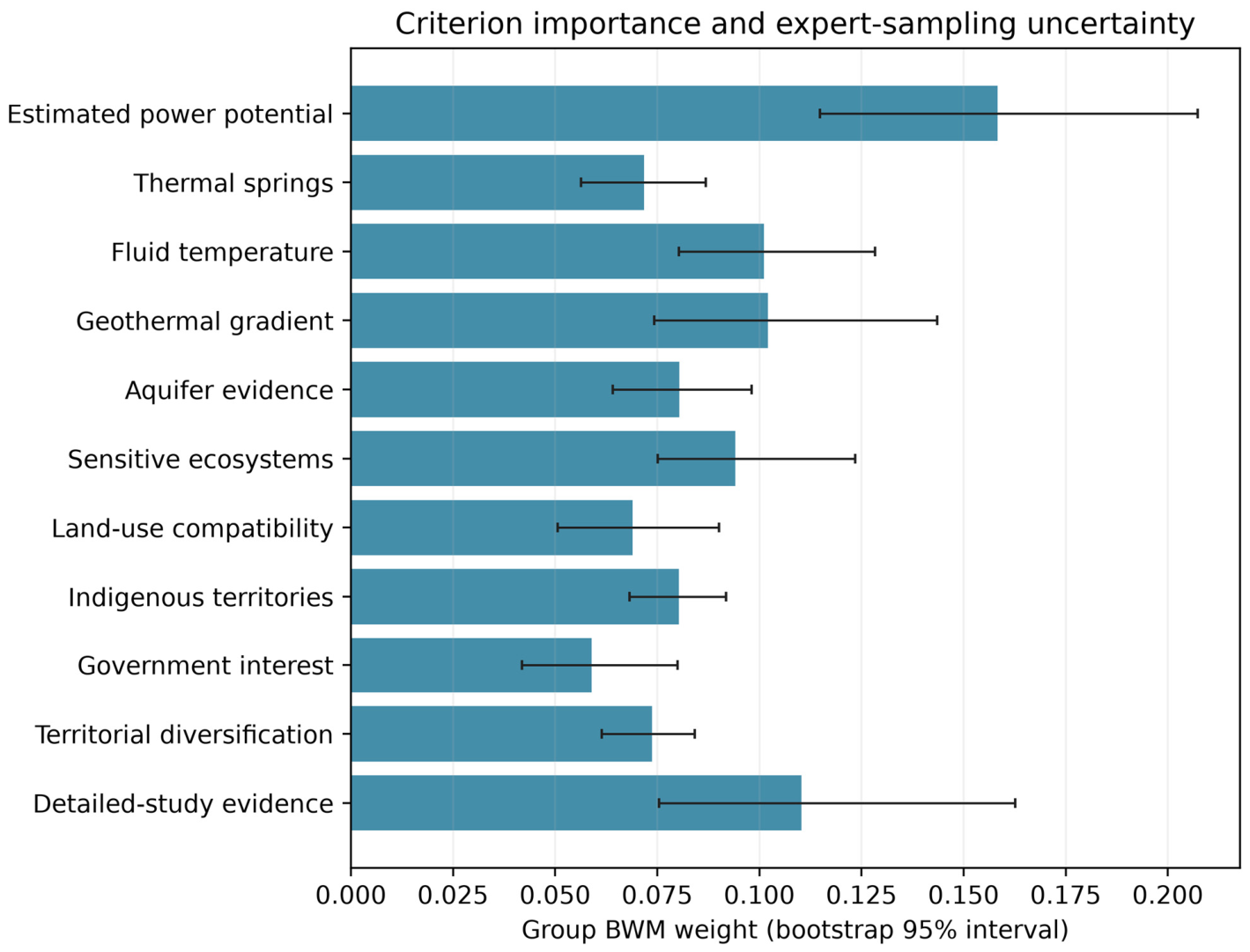
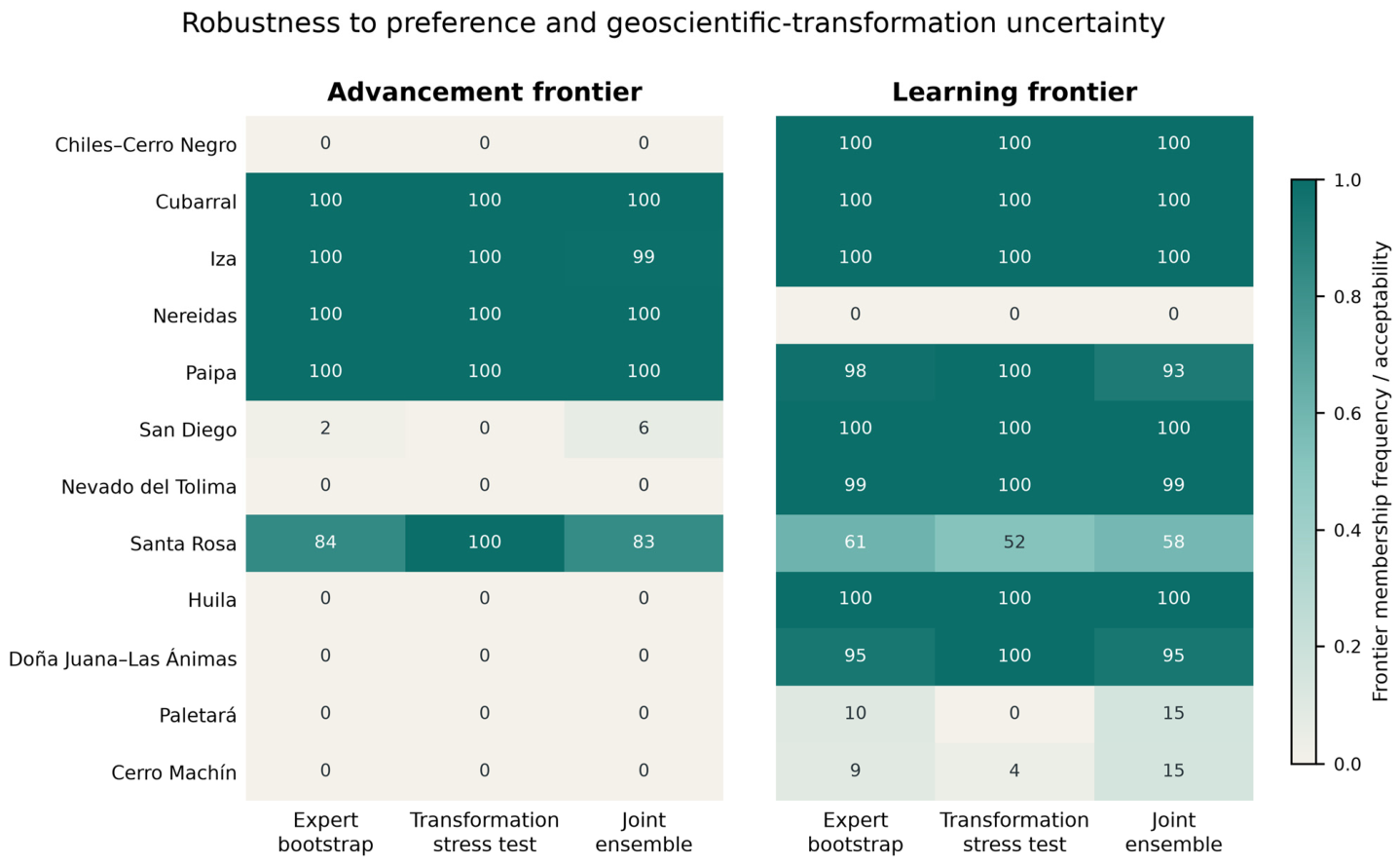
Regional geothermal screening often collapses prospectivity, territorial constraints, institutional support, and data maturity into a compensatory score, obscuring why an area ranks highly. We develop an evidence-aware, non-compensatory framework for Colombia. Eleven criteria were standardized at 300 m and weighted using Best–Worst Method judgments from 15 experts. Results for 23 registered areas were decomposed into geoscientific prospectivity, territorial compatibility, institutional alignment, and evidence gap. Institutional alignment remained a contextual implementation dimension but was excluded from Pareto dominance. Paired frontiers distinguish advancement screening from information-acquisition screening. Robustness was evaluated through 10,000 expert-panel bootstrap replicates, 81 transformations of four dominant geoscientific layers, and directed missing-data tests. Cubarral, Nereidas, Iza, Paipa, and Santa Rosa formed the advancement frontier, which was unchanged across all transformation scenarios; joint robustness frequencies ranged from 83.4% to 100%. However, neutral score-3 imputation retained only Cubarral, Nereidas, and Santa Rosa (Jaccard = 0.600). Eight of nine learning-front members persisted across all transformation scenarios, while Santa Rosa was transformation-sensitive. Apiay ranked second in every expert bootstrap but belonged to neither frontier, showing that rank stability does not imply non-dominance. The framework separates preference uncertainty from evidence-model and missing-data assumptions while providing screening sets requiring costed feasibility appraisal.
Keywords: geothermal exploration; Pareto efficiency; GIS–MCDA; Best–Worst Method; evidence gap; expert-panel sensitivity; transformation uncertainty; robustness frequency; Colombia geothermal exploration; Pareto efficiency; GIS–MCDA; Best–Worst Method; evidence gap; expert-panel sensitivity; transformation uncertainty; robustness frequency; Colombia