Article

Half a Century of Global Agricultural Commodity Connectedness Under Geopolitical Risk: The Role of Threats and Acts (1975–2026)

Department of Finance, College of Business, Imam Mohammad Ibn Saud Islamic University (IMSIU), Riyadh 11623, Saudi Arabia
Resources 2026, 15(6), 82; https://doi.org/10.3390/resources15060082 (registering DOI)
Submission received: 5 May 2026 / Revised: 15 June 2026 / Accepted: 17 June 2026 / Published: 22 June 2026

Abstract

Using a dataset covering January 1975 to March 2026 and six agricultural commodities, wheat, corn, soybeans, oats, sugar, and coffee, this paper explores the role of geopolitical risk (acts and threats) in shaping cross-market connectedness. It proposes a multilayer methodology based on the time-varying parameter vector autoregressive (TVP-VAR), the exponential GARCH with exogenous variables (EGARCH-X), and the wavelet quantile correlation (WQC) frameworks. This methodology captures cross-market volatility spillovers, assesses the effects of geopolitical risk and its components on the strength and instability of connectedness, and incorporates nonlinearity and asymmetry across investment horizons and market conditions. The results show a time-varying pattern in agricultural cross-market connectedness. Corn and soybeans transmit volatility shocks, while the other commodities are net receivers. These commodities have a central position in the connectivity network, whereas sugar and coffee are in the peripheral zone. The EGARCH-X results show that geopolitical acts and threats do not significantly alter the overall level of connectedness but intensify its volatility, suggesting that geopolitical tensions primarily influence stability rather than the intensity of connectedness. Economic policy uncertainty and oil price volatility have similar effects. In line with these results, the WQC analysis uncovers significant nonlinearity and state-dependent linkages, underscoring that the effect of geopolitical acts and threats becomes prominent over medium- and long-term horizons and during periods of market stress. These findings contribute to the literature by differentiating the effects of geopolitical incidents on agricultural market connectedness versus volatility. From an operational standpoint, these results imply that policymakers and market operators should enhance their risk-monitoring and hedging strategies during periods of high geopolitical stress, as such events can amplify instability across agricultural commodity markets.

1. Introduction

Although the last half-century has been marked by a peaceful and stable environment, significant extreme geopolitical events have occurred and become more frequent, including regional military conflicts, political unrest, financial crises, civil wars, inter-state disputes such as the Soviet–Afghan war, Iran–Iraq war, the Yugoslav wars, the Gulf war, the Asian financial crisis, the 9/11 attacks, the Arab Spring, the annexation of Crimea, China–US tensions, the COVID-19 pandemic, the ongoing Russia–Ukrainian war, the Israel–Palestine conflict, and the recent Israel–US–Iran tensions. These large-scale incidents have not only heightened international geopolitical risk but also deeply destabilized financial and commodity markets. Geopolitical risk refers to “the threat, realization, and escalation of adverse events related to wars, terrorism, and tensions among states and political actors that can impact the peaceful course of international relations” ([1], p. 1195).
The publication of the news-based geopolitical risk index by [1] has opened new avenues for research into its effects on international markets. Existing studies have mainly focused on the effects of geopolitical risk and large-scale extreme events on energy markets [2,3,4]; commodity markets [5,6,7,8], and agricultural markets [9,10,11,12,13,14,15] highlighting substantial volatility spillover effects on such markets.
Agricultural markets are closely linked to global food security, which is vital for human survival [13]. In this context, food security and agriculture play crucial roles in implementing the 2030 Agenda for Sustainable Development and the Sustainable Development Goals (SDGs). Specifically, SDG-2 aims to end hunger, ensure food security, and promote sustainable agriculture by 2030 (United Nations, SDG-2: Zero Hunger (https://www.un.org/sustainabledevelopment/hunger/) accessed on 20 February 2026).
It is noteworthy that agricultural commodities should not be perceived merely as food products but as strategic resources that underpin economic stability, industrial production and social welfare. Therefore, the production and distribution of core commodities are strongly affected by the efficient management of critical resources, including arable land, water, energy, fertilizers, and other agricultural inputs. Heightened geopolitical stress may subsequently exert pressure on global resource availability and allocation through agricultural supply chains.
Several key factors are driving volatility in the agricultural market, including demand-side shocks [16], natural resource competition [17], substitution effects [18], access to markets and technology [19], global energy price volatility [9,20,21], and economic policy uncertainty [22]. In this regard, agricultural commodity markets also mirror mounting global challenges related to resource scarcity, resource competition, and the sustainable use of agricultural and energy resources.
Geopolitical risk is another significant factor driving volatility in agricultural markets. In recent decades, geopolitical incidents and interstate conflicts have become increasingly frequent, particularly in regions abundant in agricultural resources, seriously affecting global agricultural markets [13]. Many studies confirm that volatility shocks are transmitted to agricultural commodity prices, with this effect becoming more pronounced during periods of heightened geopolitical risk [6,12,23]. Using the Russia–Ukraine war as an example, ref. [6] show that volatility spillovers to agricultural markets increased by 30–85% during the ongoing war. As a result, global wheat prices increased by up to 40% by May 2022 following the Russian invasion of Ukraine (https://aces.illinois.edu/news/how-russian-invasion-ukraine-has-impacted-global-wheat-market, accessed on 20 February 2026). However, the existing literature has primarily examined how agricultural markets respond to geopolitical risk in the context of major global shocks, including the Global Financial Crisis (GFC), the COVID-19 pandemic, oil price collapses, and the Russia–Ukraine war. In contrast, far less attention has been paid to how geopolitical risk shapes agricultural cross-market connectedness, leaving the transmission mechanisms and dynamic connectedness within agricultural commodity markets largely unexplored. The present study attempts to fill this gap. Against this backdrop, the following question arises. How do geopolitical risks, geopolitical acts, and threats reconfigure the dynamic connectedness and risk transmission among agricultural commodity markets across different time horizons and market conditions?
From a theoretical perspective, several economic channels underlie the connectedness among agricultural commodities. The first channel is inherent to the substitution effects. Some commodities, such as wheat, corn, and soybeans, exhibit substitution effects across food, feed, and industrial operations; thus, any volatility shock originating in one commodity will affect the supply and demand of the others, which in turn will affect their price movements. In this regard, ref. [24] state that agricultural commodity prices are affected by business-cycle fluctuations and that exogenous forces (i.e., shocks) are transmitted across commodities. The second channel concerns the production process and market competition. Indeed, agricultural producers face competition for limited acreage and production inputs. This implies that changes in the expected profitability of one commodity can alter planting and supply conditions across the competing agricultural commodities [25]. The third channel focuses on the common exposure of agricultural commodities to external systemic risk factors and underlies the theoretical background of the present study.
Global risk factors affect agricultural commodity markets, including energy prices [26,27,28], fertilizer costs [28,29], trade policy shocks [30,31], and supply chain and transportation costs [28]. Geopolitical risk, with its two components, acts and threats, stands within these global risk drivers of agricultural commodity markets. The geopolitical risk affects the agricultural commodities through various mechanisms: (a) The geopolitical risk causes disruptions in the supply chain, the shipping networks and logistic infrastructure, transportation routes, which in turn may affect the supply–demand sides of agricultural commodity prices and thereby their connectedness [28]. The Russia–Ukraine war disruption of black sea exports of wheat and the ongoing Strait of Hurmuz closure constitute two relevant illustrations. (b) In tandem with the first mechanism, geopolitical tensions result in a substantial increase in fertilizer prices, which in turn increase the production input costs for many agricultural commodities resulting in an increase in their price and becoming more connected. (c) During periods of high geopolitical stress, governments often impose sanctions and restrictions to protect their domestic food security. Such trade restrictions may increase the synchronization of agricultural commodity prices. (d) During periods of high geopolitical risk, investors often perceive agricultural commodities as a single asset class when allocating their portfolios and designing their hedging strategies. Portfolio reallocation and speculative trading tend to increase connectedness in agricultural commodity markets.
Several reasons make the research question relevant. First, prior studies have largely focused on the geopolitical risk–agriculture price nexus [9,31,32,33,34,35,36,37] and have overlooked how such risk reconfigures agricultural cross-market relationships. Exploring volatility transmission is essential to understanding how geopolitical factors propagate across agricultural commodities. Agricultural markets are extremely vulnerable to systemic risks, including geopolitical events and interstate tensions. Neglecting cross-market connectedness may underestimate the “true” extent of contagion effects and volatility spillovers, especially during extreme market conditions. Third, exploring such research questions across scales (i.e., short vs. long investment horizons) and market conditions (i.e., quantiles) will offer deeper insights into how the geopolitical effect varies across time horizons and market states (i.e., normal vs. crisis episodes), which is very useful for both agricultural-commodity portfolio managers and policymakers.
To answer the research question, this study suggests a three-step complementary framework. First, it implements the time-varying autoregressive parameter (TVP) model to capture time-varying connectedness, pairwise connectedness, and network connectivity among agricultural commodities. Then, it incorporates the total connectedness index (TCI) extracted from the TVP-VAR model as an exogenous variable into an exponential GARCH (EGARCH-X), while geopolitical risk acts and threats are sequentially incorporated into the mean and variance equations of the EGARCH-X. The third step extends prior analysis by exploring the connectedness–geopolitical risk nexus across scales (i.e., short- vs. long-term investment horizons) and quantiles (i.e., market conditions) using the wavelet quantile correlation (WQC) method. The suggested methodology is implemented on daily data for six core agricultural commodities (wheat, soybeans, corn, oats, sugar, and coffee) covering the period from 2 January 1975 to 16 March 2026.
The study contributes to the literature on geopolitics and agricultural market dynamics in four ways. First, the study provides fresh evidence on how geopolitical risk influences agricultural cross-market connectedness. Prior studies [13,14] have examined volatility transmission between geopolitical risk and agricultural commodities in isolation. Here, the study shifts the focus to the relationship between geopolitical risk, acts and threats, and agricultural commodity connectedness.
Second, the study distinguishes itself methodologically from previous research by employing a three-step complementarity framework based on the TVP-VAR model, the EGARCH-X model, and the WQC. Specifically, by integrating the TCI generated by the TVP-VAR into the EGARCH-X model and the WQC method, the study offers a deeper analysis of how geopolitical risk impacts and propagates through the agricultural commodity network under conditional volatility modelling and across different time horizons and market conditions. Based on the existing literature, this is the first empirical study to propose such an approach to address the complexity of the relationship between geopolitical risk and agricultural cross-market dynamic connectedness.
Third, compared with earlier works, this study considers geopolitical risk, measured by the composite index and its two components, threats and acts [1]. In fact, isolating these two elements helps to better understand the complexity of the relationships. Geopolitical threats (such as inter-state tensions and warnings) reflect anticipated risks that influence market operators’ expectations and thereby trigger gradual adjustments in the connectivity of global commodity markets. Conversely, geopolitical events refer to realized shocks (such as terrorist attacks, trade and economic sanctions, and military conflicts) that can destabilize agricultural supply chains and trade flows, impacting the volatility of time-varying connectedness. Disentangling these two components may enhance analysis and highlight the nonlinear and asymmetrical effects across different time horizons and market conditions. In this regard, the study makes another contribution to the resources-related literature by examining the extent to which, and how, geopolitics is reshaping the dynamics of globally traded agricultural resources and their interconnections.
Fourth, the study advances the literature through its unique and extensive database, which covers six commodities daily over a long period from 1975 to 2026. This sample period enables us to capture frequent geopolitical incidents, financial crises, and extreme global events, thereby improving the generalizability of the results, especially given that prior studies have focused on the post-2000 period and examined specific incidents such as the Russia–Ukraine war and the COVID-19 pandemic.
Fifth, the study considers other global risk factors, such as oil volatility, economic policy uncertainty, and trade policy uncertainty, as additional systemic factors that help explain the time-varying connectedness among agricultural commodities, thereby distinguishing this paper from prior studies. Finally, exploring dynamics is crucial for enhancing resource resilience, supporting sustainable agricultural resource management, and powering global food supply systems amid geopolitical tensions.
The remainder of the paper is structured as follows. Section 2 reviews previous empirical studies, with particular emphasis on geopolitical risk and the dynamic connectedness of agricultural markets. Section 3 details the data and methods employed. Section 4 presents and discusses the findings, while Section 5 concludes with key managerial and policy implications.

2. Brief Review of Prior Studies and Research Gap

2.1. Prior Studies

Table 1 reviews prior studies investigating the interplay between geopolitical risk factors and agricultural commodities. It summarizes the data, methodologies, and key findings.
The literature review above highlights several interesting points.
First, it documents extensive evidence showing that geopolitical risk and other global uncertainty factors, including trade policy, economic uncertainties and energy market volatility, have a pivotal role in shaping agricultural commodity markets via their effect on the volatility dynamics, volatility spillovers and direct impact on their price levels [11,22,31,46,49].
Secondly, the results indicate that major grains, especially wheat and maize, are the most sensitive to geopolitical risks and other uncertainties. They serve as the main transmitters of exogenous volatility shocks [13,45,49]. Meanwhile, other food commodities, such as soybeans, sugar, and coffee, are mostly identified as volatility receivers. However, these conclusions are not uniform and do not yield a consensus. The effects of global factors vary significantly across commodities, time horizons (i.e., short- vs. long-term), specific periods, and market conditions. In this regard, some studies have documented a notable increase in volatility spillovers during global extreme events (COVID-19 pandemic) [6,9,22,31], as well as episodes of heightened geopolitical tensions (Russia–Ukraine war) [6,44,47].
Thirdly, the reviewed literature highlights that agricultural commodities are influenced not only by geopolitical risk but also by other uncertainties stemming from economic policies, climate change, and volatility in global energy markets. They conclude that the global food market is highly embedded within a complex network of interconnected shocks.

2.2. Research Gap

Despite this extensive literature, several shortcomings remain. For instance, most studies are conducted over relatively short sample periods, particularly after 2000, to account for major extreme events such as COVID-19 (March 2020) and the Russia–Ukraine war (February 2022), thus overlooking long-term structural changes and volatility-shifting behaviors. Moreover, most research concentrates on how agricultural and agricultural commodity prices respond to exogenous risk factors rather than analyzing the connectedness among these commodities and the extent to which global risk factors influence their time-varying connectedness. Additionally, the distinction between the two components of geopolitical risk, especially geopolitical threats and acts, remains largely underexplored within a unified connectedness framework. On the methodological side, the influence of global risk factors on agricultural commodity connectedness across different timescales and investment horizons under various market conditions remains insufficiently examined.
Building on this context, this study contributes to the literature in several ways. First, the study provides a comprehensive long-term analysis of agricultural commodity connectedness using high-frequency data covering a substantial sample period, spanning the last five decades (January 1975 to March 2026). Such an extended period allows us to capture the effects of multiple geopolitical events, regime shifts, global crises, and structural changes in global food markets. Second, this study distinguishes itself from previous research by examining the time-varying interconnectedness among the major global food markets within a connectivity-network framework. Third, it considers the two main components of geopolitical risk, namely geopolitical threats and acts, as well as the geopolitical index, offering new and insightful findings on how geopolitical risk influences the major food intra-market connectivity. Fourth, the study proposes a three-step complementary method. It combines the TVP-VAR to derive the total connectivity index, includes it as an endogenous variable in a GARCH-X model, and extends the analysis to evaluate the impact of geopolitical factors on food connectivity within a time-frequency framework under various market conditions using the WQC. This approach aims to deepen understanding of how risk transmission evolves across short-, medium-, and long-term horizons, and under both normal and extreme market scenarios. Overall, the findings contribute to the literature by elucidating the mechanisms through which global geopolitical risks propagate within agricultural commodity connectedness.

3. Data and Methods

3.1. Data and Preliminary Analysis

Drawing on previous studies, including [9,13,48], six core agricultural commodities are selected: wheat, corn, soybeans, oats, sugar, and coffee. The choice of these commodities is motivated by at least two main reasons. First, these commodities are sufficiently representative of the global food system. In fact, wheat and corn dominate agricultural production and trade, serving as the primary staples for human and animal nutrition. According to the Food and Agriculture Organization (FAO), as of 2023, global primary crop production reached 9.9 billion tons, with corn, wheat, and rice accounting for a substantial share of this total (FAO, 2024). Soybeans play a central role in linking food, feed, and energy markets. Global soybean production has increased significantly, from 10,960 to 350 million metric tons annually. This dramatic rise is mainly driven by global demand for animal feed and vegetable oil (Sustainable Nutrition Initiatives Report, 2025). Sugar and coffee are largely regarded as traded commodities influenced by trade dynamics and volatility shocks. Second, the selected food commodities include the core components of the FAO Food Price Index: wheat, corn, soybeans, and sugar. Consequently, it is assumed that these agricultural commodities represent key aspects of global food security, trade integration, and market interconnectedness, making them well-suited for analyzing dynamic connectedness under geopolitical risk. Third, the choice of the agricultural commodities was conditioned by the data availability. For instance, rice, despite its importance to global food security and its sensitivity to geopolitical actions, was not considered due to data limitations. Indeed, a continuous, reliable daily price time series covering the entire sample period (1975–2026) is unavailable, which would reduce the consistency of the empirical analysis and the comparability of results across commodities. On the other hand, the inclusion of oats is motivated by data availability, its role in global cereal markets, and its increasing integration into agricultural commodity systems. In addition, including oats expands coverage of the agricultural sector and contributes to a more comprehensive assessment of market connectedness. Data were sourced from the Macrotrends database, which represents benchmark market prices, mainly derived from front-month future contracts. Prices are recorded daily, spanning from 2 January 1975 to 16 March 2026, resulting in 12,910 observations. Several arguments motivated our choice of the sample period. First, it was selected to capture a large range of geopolitical, economic, and market states that could affect global agricultural markets. Indeed, the sample period encloses the period of major geopolitical extreme events, including the Cold War era, the Gulf wars, the 2007–2008 global food crisis, the GFC, the COVID-19 pandemic, and the Russia–Ukraine war, as well as the ongoing Israel–Iran–US military conflict, all of which have had substantial relevance for agricultural production, trade, and food security. Secondly, the long sample helps explore the connectedness across various market regimes characterized by varying degrees of globalization, trade policy, and geopolitical risk. Finally, accounting for multiple cycles and structural shifts, the analysis offers a more robust investigation of the interplays between geopolitical risk and agricultural commodity connectedness than would be possible using a shorter sample period.
For geopolitical risk, we refer to the GPR index developed by [1]. In brief, it is a news-based index measuring geopolitical tensions. It is calculated from the frequency of newspaper articles reporting on geopolitical events such as wars, military conflicts, tensions between neighboring countries, terrorist acts, and political disputes. The index ranges from 0 to 100. Higher values reflect greater geopolitical risk. We also collect the geopolitical acts (GPR-acts) and geopolitical threats (GPR-threats) developed by [1]. GPR-acts reflect realized geopolitical extreme events, including terrorist attacks and military conflicts. This index shows the extent to which geopolitical risk is translated into realized events. Similarly, the GPR-threats index assesses the risk posed by potential geopolitical events, such as escalating international tensions, sanctions, military threats, and diplomatic disputes. It reflects predictive concerns about future geopolitical conflicts rather than realized events. The GPR and its two components were extracted from the database (https://www.matteoiacoviello.com/gpr.htm, accessed on 20 February 2026) [1].
Two other global risk factors are included as control variables: crude oil volatility and trade policy uncertainty. For crude oil volatility, the CBOE crude oil ETF volatility index is used as a proxy. The news-based EPU index is used as a proxy for economic policy uncertainty, while the trade policy uncertainty index is used as a proxy for trade policy uncertainty. All these indices cover the sample period at a monthly frequency.
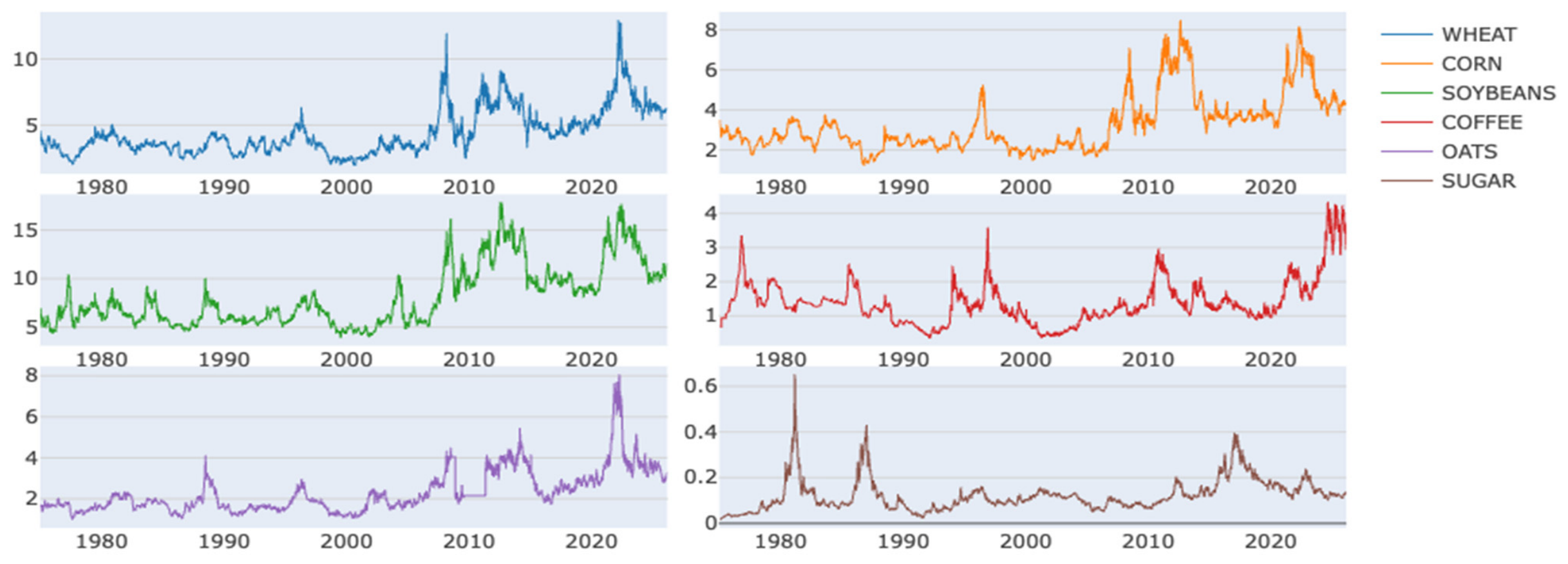
The six price time series are converted into daily returns as follows: r i , t = 100 × l n ( I t / I t 1 ) where ( I t ) and ( I t 1 ) designate the stock indexes at times ( t ) and ( t 1 ) , respectively. Figure 1 displays the time movements of the selected agricultural commodities over the entire sample period.
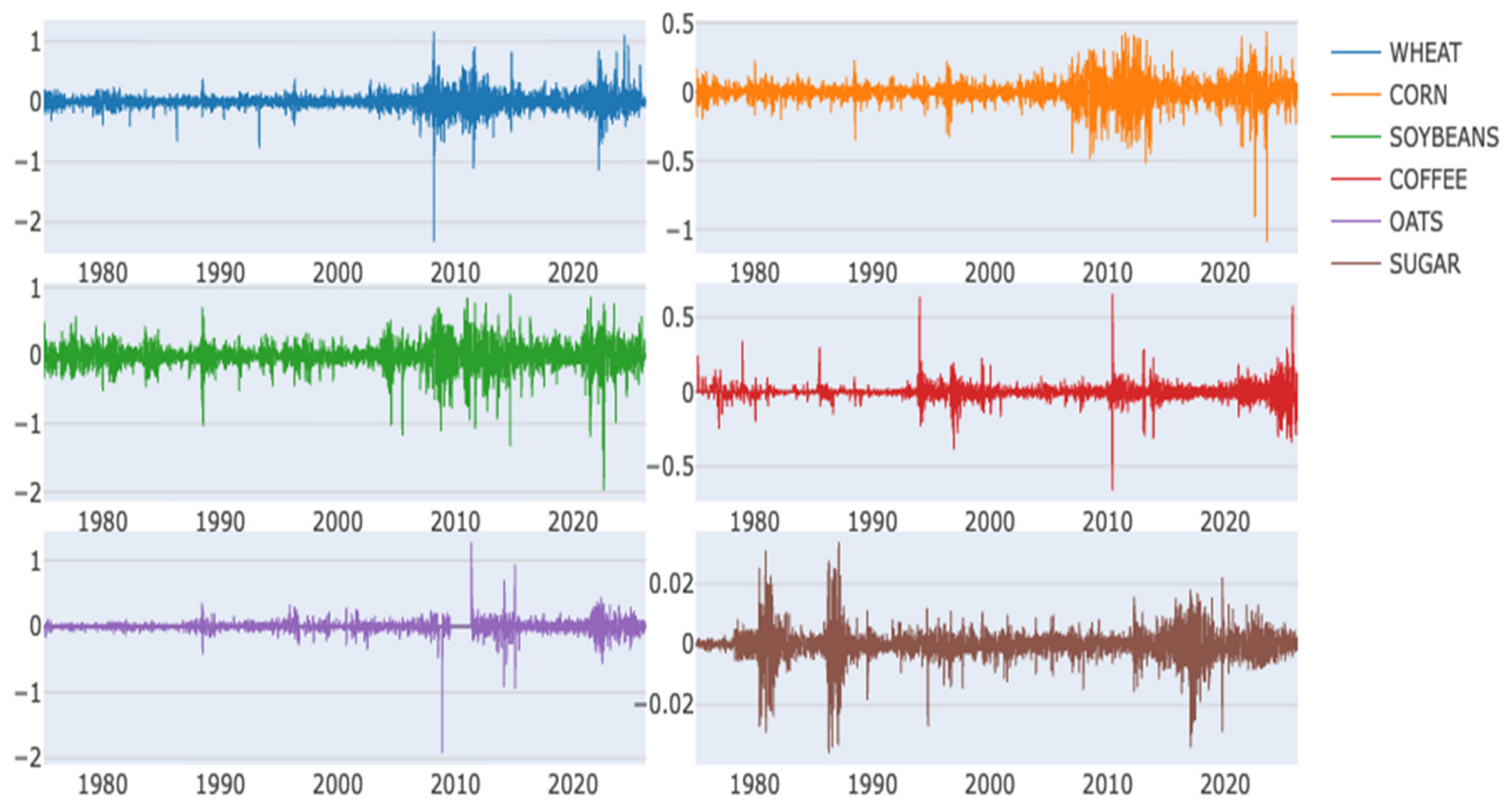
Three main comments emerge from the visual inspection of this figure. First, all six food prices exhibit a clear upward trend, particularly in the mid-2000s. Second, a substantial increase in agricultural commodity prices around 2007–2008, corresponding to the GFC. The sharpest increases are observed in soybeans and wheat. Third, corn and coffee exhibit cyclical surges throughout the sample period, while sugar and oats prices remain relatively stable, with lower fluctuations than the other commodities but still following the same upward trend. In sum, the figure underscores a global trend toward greater co-movement and sensitivity to external risk factors and economic shocks. Figure 2 shows the daily returns for the six commodities over the entire sample period. As shown, all the daily returns exhibit strong volatility clustering, with a relatively calm period before the 2000s, followed by episodic spikes. Notably, high spikes correspond to turbulent global economic conditions, such as the 2007–2008 GFC. Another marked volatility spike occurs after 2020, in relation to major extreme events: the COVID-19 pandemic and the resulting collapse in energy markets in March 2020, as well as the onset of the Russia–Ukraine war in February 2022. Overall, the figure highlights substantial volatility in the global agricultural commodity market, with pronounced transmission of exogenous shocks in the post-2000s period. Table 2 reports descriptive statistics and preliminary tests of daily returns.
All mean average returns are close to zero but differ in volatility. Soybeans and wheat have the highest volatility, as measured by variance. Most commodity returns are left-skewed (except coffee) and exhibit extremely high kurtosis, reflecting the presence of extreme returns (i.e., fat-tailed returns). The Jarque–Bera normality tests are highly significant, indicating that all the time series deviate from normality. Before implementing the TVP-VAR model, the stationarity of the daily logarithmic returns of the agricultural commodities (logarithmic daily returns) was tested using the Elliott–Rothenberg–Stock (ERS) unit-root test. The ERS test was selected because it has greater power than standard unit-root tests, particularly when applied to persistent financial and commodity time series [51]. The reported results show that all variables are stationary at levels, as evidenced by the statistically significant negative ERS statistics. Confirming stationarity is essential for the TVP-VAR framework, since the computation of dynamic connectedness measures and generalized forecast error variance decompositions (GFEVD) relies on the stable stochastic properties of the time series used. Subsequently, no further differencing was required prior to estimation. The Ljung–Box test statistic reveals strong evidence of an ARCH effect, implying volatility clustering.
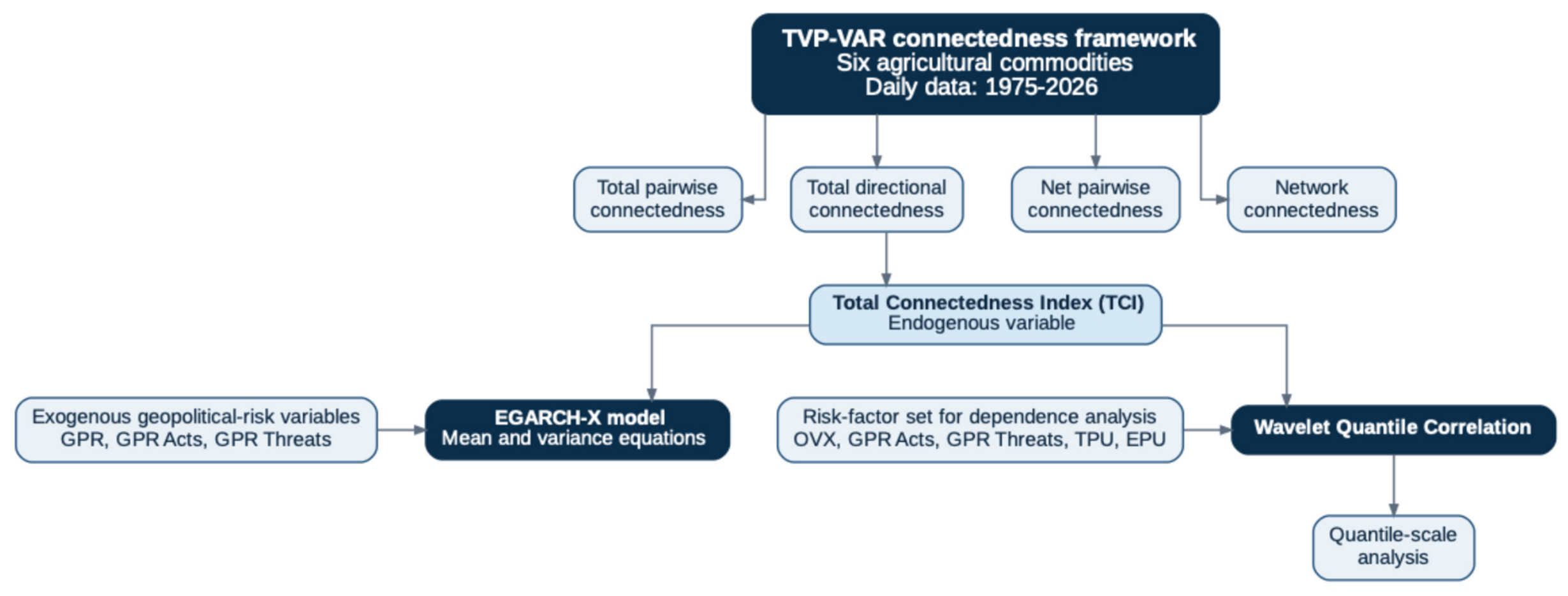
As a preliminary step, it is worthwhile to clarify the three-step methodology. The TVP-VAR framework is first used to analyze time-varying connectedness among the six agricultural commodities. In this step, the extracted total directional connectedness among the six commodities, total pairwise connectedness, net pairwise connectedness, and connectivity network are presented and analyzed. In the second step, the generated TCI as the measure of the cross-market connectedness is regressed on the geopolitical risk, geopolitical risk threats, acts, and other control variables, including the economic policy uncertainty (EPU), the oil volatility market (OVX) and the trade policy uncertainty index (TPU) within a multivariate EGARCH-X framework. These variables are included in the conditional mean equation or the conditional variance of the EGARCH model. The idea is to explore how these geopolitical risk factors, particularly acts and threats, affect the strength or instability of connectedness among the six agricultural commodities. In the third step, the WQC framework is employed to examine how geopolitical risk factors (acts and threats) and other global systemic factors affect connectedness when market conditions change and across various investment horizons (i.e., short, medium, and long). These steps are shown in the following flow chart (Figure 3).

3.2. Methods

3.2.1. The TVP-VAR Framework

To investigate the time-varying connectedness among agricultural commodities, this study combines the connectivity method suggested by [42] with the TVP-VAR approach. The TVP-VAR was proposed by [52] and improved by [53,54]. The TVP-VAR method features several properties. (1) It is based on the Kalman filter, which employs decaying factors to allow the variance to vary over time. (2) It avoids the main weakness of arbitrarily selecting the rolling window size, which can lead to flattened values and the loss of important information and (3) it can be implemented to limited sample periods ([55] p. 2).
In formal terms, the TVP-VAR can be expressed as follows:
Y t = β t Y t 1 + ϵ t ϵ t | F t 1   N ( 0 ,   S t )
β t = β t 1 + ν t ν t | F t 1   N ( 0 ,   R t ) .
where Y t designates a ( N × 1 ) conditional volatility vector. Y t 1 is a N p × 1 lagged conditional vector. β t is a ( N × N p ) dimensional time-varying coefficient matrix, while ϵ t represents an ( N × 1 ) dimensional error term vector having an ( N × N ) time-varying variance-covariance matrix ( S t ) . The β t coefficients depend on their own lagged values ( β t 1 ) and on an ( N × N p ) n-dimensional error matrix having ( N p × N p ) a variance-covariance matrix ([55], p. 4).
The next step is to estimate the generalized connectedness procedure suggested by [42] which is based on generalized impulse response functions (GIRF) and the generalized forecast error variance decomposition (GFEVD) procedure suggested by [56,57]. By doing so, the VAR is then transformed into its vector moving average (VMA) representation, founded on the Wald decomposition theorem. The GIRFs show the responses of all variables to a shock initiated by variable (i). Ref. [55] calculate the differences between the J-step-ahead forecast where one variable (i) is shocked and one variable (i) is not shocked, which can be calculated as follows:
G I R t = ( J ,   δ j , t , F t 1 ) = E ( Y t + 1 | i , t = δ j , t , F t 1 ) E ( Y t + j | F t 1 ) .
Ψ j , t g ( J ) = A J S t ϵ j , t S j j , t δ j , t S j j , t ,   with δ j , t = S j j , t
Ψ j , t g ( J ) = S j j , t 1 2 A J , t S t ϵ j , t
In Equation (2), ( J ) denotes the forecast horizons. δ j , t designates to the selection vector one on the jth position and zero otherwise. F t 1 is the information available at time (t − 1). In the next step, the (GFEVD) is computed and can be analyzed as the variance of one variable relative to the others. The variance shares are normalized, with their raw sum equaling 1, implying that all variables explain 100% of the variables’ (i) forecast error variance. This is calculated as follows:
ϕ i j , t g ~ ( J ) = t = 1 J 1 Ψ i j , t 2 , g j = 1 N t = 1 J 1 Ψ i j , t 2 , g
with, j = 1 N ϕ i j , t N ~ ( J ) = 1 and i , j = 1 N ϕ i j , t N ~ ( J ) = N .
Employing the GFEVD, ref. [55] construct the total connectedness index (TCI) as follows:
C t g ( J ) = i , j = 1 , i j N ϕ ~ i j , t ( J ) i , j = 1 N ϕ ~ i j , t g ( J ) × 100 .
= i , j = 1 , i j N ϕ ~ i j , t g ( J ) N × 100 .
When considering the case where a variable (i) transmits its shocks to all the other variables (j), this is called the total directional connectedness to the others. It can be calculated as follows:
C i j , t g ( J ) = j , j = 1 , i j N ϕ ~ j i , t ( J ) , j = 1 N ϕ ~ j i , t g ( J ) × 100 .
The total directionality connectedness from others is given by:
C i j , t g ( J ) = , j = 1 , i j N ϕ ~ j i j , t ( J ) i = 1 N ϕ ~ i j , t g ( J ) × 100 .
From the indices, a net total directional connectedness can be computed as follows:
C i , t g = C i j , t g ( J ) C i j , t g ( J )
This ( C i , t g ) is interpreted as follows. If it is positive, it shows that variable (i) influences the network more than being affected by it. By contrast, if it is negative, it implies that the variable (i) is driven by the network.

3.2.2. The WQC

The WQC combines the quantile correlation (QC) method developed by [58] with the maximal overlap discrete wavelet transform (MODWT). The WQC allows detailed analysis of stylized facts in commodity and financial markets, including asymmetries and nonlinearities, across varying market conditions and investment horizons. The WQC method is particularly relevant for analyzing financial market behaviors in which extreme events and asymmetric dependencies prevail [59,60,61] shows that the WQC is useful for detecting heterogeneity in market reactions across investment horizons. Formally, the quantile correlation is specified as follows [58]:
q c o r t ( r t ( 1 ) , r t ( 2 ) ) = q c o v t ( r t ( 1 ) , r t ( 2 ) ) V a r [ ϕ τ ( r t ( 1 ) Q τ | r t ( 2 ) ( r t ( 1 ) ) ) ] v a r ( r t ( 2 ) )
q c o v t ( r t ( 1 ) , r t ( 2 ) ) designates the quantile-specific covariance between the TCI time series r t ( 1 ) and the geopolitical risk-related indicators r t ( 2 ) . Q τ | r t ( 2 ) ( r t ( 1 ) ) designates the conditional quantile function of r t ( 1 ) given r t ( 2 ) and ϕ τ ( ) is the quantile check function. To explore these dependencies across different investment horizons, this study builds on [62] and uses the MODWT decomposition based on the Haar wavelet. The MODWT provides a time-invariant, scale-preserving decomposition of the original time series, allowing robust multiresolution analysis without loss of alignment or the introduction of boundary artefacts [62]. Formally iterative filtering process of the MODWT decomposition method is given by:
a j + 1 [ i ] = k h [ i k ] a j [ k ]
d j + 1 [ i ] = k g [ i k ] a j [ k ]
In these equations, a j and d j state, respectively, for the approximation and detail coefficients at scale j , while h   and   g designating the scaling and wavelet filters. As a result, the QC corresponding to each j is expressed as follows:
W Q C τ ( d j [ r t ( 2 ) ] , d j [ r t ( 1 ) ] ) = q c o v t ( d j [ r t ( 1 ) ] , d j [ r t ( 2 ) ] ) V a r ( d j [ r t ( 1 ) ] ϕ τ , d j [ r t ( 1 ) ] ) V a r ( d j [ r t ( 2 ) ] )

3.2.3. The EGARCH-X Model

The EGARCH model of [63] is a widely recognized modelling framework for accounting for asymmetric behavior and leverage effects, in which negative shocks driven by global risk factors may increase volatility more than positive shocks of equal magnitude. The EGARCH-X is an extension of the standard EGARCH that incorporates external factors into the conditional mean or conditional variance equations. Building on this, the mean equation of the EGARCH-X model is written as follows:
T C I t = μ + i = 1 p ϕ T C I t i + k = 1 K β k X k , t + ε t
In this equation, μ is a constant. ϕ captures the autoregressive dynamics of the TCI. β k assesses the effect of the exogenous risk factors on the conditional mean of the connectedness. The innovation term ( ε t ) satisfies: ε t = h t   z t , where h t is the conditional variance z t ~ i . i . d . X k , t is a vector of exogenous factors, including geopolitical risk (GPR), GPR threats, and GPR acts, as well as other global risk factors such as trade policy uncertainty (TPU), economic policy uncertainty (EPU), and oil price volatility (OVX). All these control variables are monthly, cover the period 1975–2026, and are synchronized with the aggregate TCI time series. Including these exogenous systemic factors in the EGARCH-X model allows us to assess their impact on the strength of the connectedness of agricultural commodities.
The conditional variance equation, which is written as follows:
ln ( h t ) = ω + α | ε t 1 h t 1 | + γ ( ε t 1 h t 1 ) + ρ ln ( h t 1 ) + k = 1 K δ k X k , t
In the conditional variance equation, ω is a constant. α measures the effect of past standardized shocks. γ is measuring the asymmetric effects of shocks. If γ < 0 negative shocks exert a greater impact on TCI volatility than their positive counterparts. ρ is capturing the persistent behavior in TCI volatility. X k , t is a vector of the exogenous variables. δ k captures the direct impact of the exogenous risks on the TCI conditional volatility. Positive values imply that systemic risk tends to intensify the TCI’s volatility, while negative values suggest a damping effect on the TCI. It is worth noting that geopolitical risk and its components (acts and threats) are included sequentially to avoid potential multicollinearity.

4. Empirical Results and Discussion

4.1. The Total Directional Connectedness

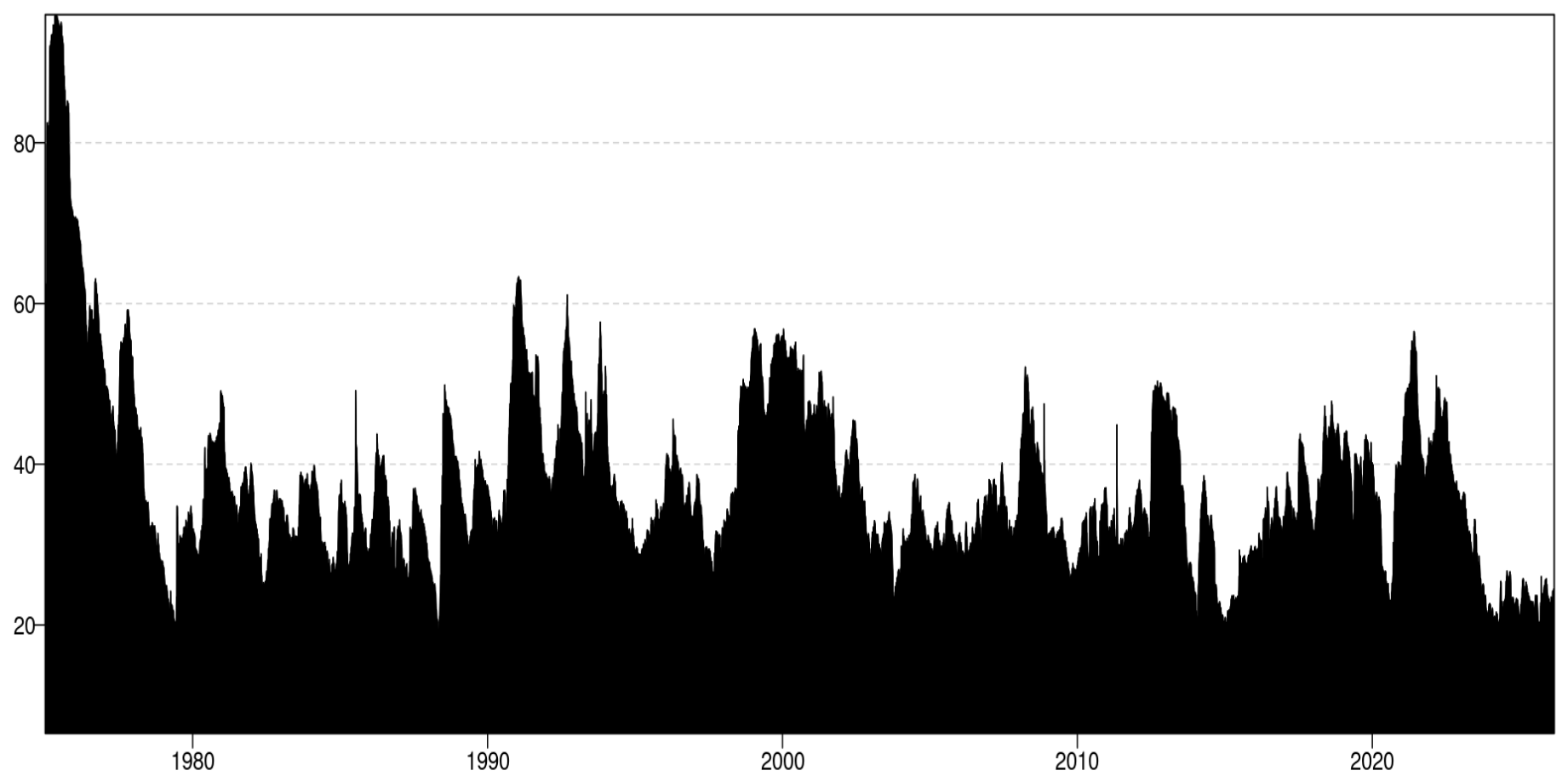
We start our analysis by examining the total connectedness index extracted from the TVP-VAR framework. As emphasized earlier, the TCI assesses the overall degree of shock transmission and interdependence among the six agricultural commodity markets. More precisely, a higher TCI value indicates that commodity returns are more closely interconnected, implying that shocks initiated in one market will propagate to others. By contrast, lower values imply greater disconnections and higher segmentation. That being said, the TCI offers a comprehensive measure. Therefore, the TCI provides a comprehensive measure of systemic interconnectedness and allows us to understand how major economic, financial, and geopolitical events affect the interconnectedness of agricultural commodities over time. The TCI time-movement is displayed in Figure 4.
Several comments emerge from the TCI’s time path. The TCI displays a high level of connectedness among the selected commodities at the beginning of the sample period. Connectedness reaches around 70–80%, indicating strong integration of the agricultural markets. This could be explained by the global macroeconomic instability of the 1970s. Throughout the 1980s, the TCI remained volatile, with moderate connectivity. In the late 1980s, episodic amplification of connectedness was observed. During the 1990s and early 2000s, the TCI ranged from 20% to 40%. This range indicates moderate-to-weak integration in the agricultural commodity cross-market. The TCI entered another phase from the mid-2000s, showing more temporary peaks around major global extreme events. For instance, the 2007-08 GFC was marked by a substantial increase in total connectedness. The GFC significantly heightened the volatility spillovers among the six core commodities. Another TCI intensification occurred between 2010 and 2012. This period coincided with the escalation of geopolitical tensions. Over the past decade, particularly during 2020–2022, the TCI has sharply increased. This mirrors the COVID-19 health crisis and the subsequent energy market crash, which have substantially impacted the supply chain in global agricultural commodity markets. The spikes in connectedness levels reflect high integration among core food markets during the COVID-19 pandemic. During the last sub-period, 2022–2026, the TCI appears to be in a decline phase but remains volatile, with small, episodic spikes reflecting its sensitivity to systemic risk factors. In conclusion, the figure underscores substantial time-varying and strong state-dependent patterns in the TCI path throughout the period 1975–2026. These episodic patterns highlight the influence of external risk factors on the connectedness among commodities and underscore their role in the stability of the global food system. These results corroborate existing studies by [5,13,22,45,47].

4.2. Total Average Dynamic Connectedness

This subsection examines the average dynamic connectedness across the six core agricultural commodities. The main goal is to provide insights into the configuration of their volatility spillovers. The total average connectedness results generated by the TVP-VAR are conveyed in Table 3. As shown, the average total connectivity index equals 31.21%, showing a moderate level of connectedness among the six commodities. Even though volatility transmission is evident, the results indicate that around 96–107% of volatility remains driven by own-market shocks. In other words, most of the observed volatility is generated by idiosyncratic risk factors (i.e., own market-specific factors rather than exogenous factors). More importantly, the inspection of directional volatility spillovers (i.e., TO and FROM) shows that corn and soybeans are the largest transmitters of volatility shocks to other commodities, followed by wheat. Corn transmits 52.98% of volatility shocks to the other, while soybeans and wheat transmit 46.55% and 36.76%, respectively. Conversely, sugar and coffee transmit only 12.18% and 13.12% to others. Looking at the receiving side, corn and soybeans are again the most vulnerable to external shocks, which may reflect their strong integration into the global core grain agricultural connectedness structure. In terms of net volatility spillovers, corn and soybeans remain the net transmitters, with respective net transmittances of 7.05% and 2.11%, underscoring their key role in the volatility transmission structure. Negative average indexes are observed for wheat (−2.06%), oats (−3.63%%), sugar (−2.98%), and coffee (−0.49%), indicating that these commodities are mostly net recipients of volatility shocks. The diagonals in Table 3 indicate the pairwise bilateral volatility spillovers. As shown, the grain–grain pairings exhibit the strongest bilateral spillover levels with wheat–corn (17.33%; 14.02%) and corn–soybeans (20.49%; 21.90%). Such high bilateral volatility spillovers may be explained by the fact that these core grain agricultural commodities lead global markets, and their strong interplay reflects their common influence of fundamental factors on both global demand and production. Referring to net pairwise transmission (NPT), core and soybeans are the largest net transmitters, with NPTs of 5.00%, respectively. All things considered, corn and soybeans occupy pivotal positions in the agricultural connectedness structure, serving as net volatility transmitters, while wheat plays an intermediate role. Coffee, oats, and sugar are in the network periphery and primarily receive volatility shocks. These results corroborate the findings of [13]. The authors used the TVP-VAR-BEK framework to analyze the connectedness of core agricultural commodities, including rice, for the period from January 2001 to July 2024. However, the sample period in this study is longer, covering 1975 to 2026, and excludes rice because of the unavailability of continuous data.

4.3. Net Total Directional Connectedness

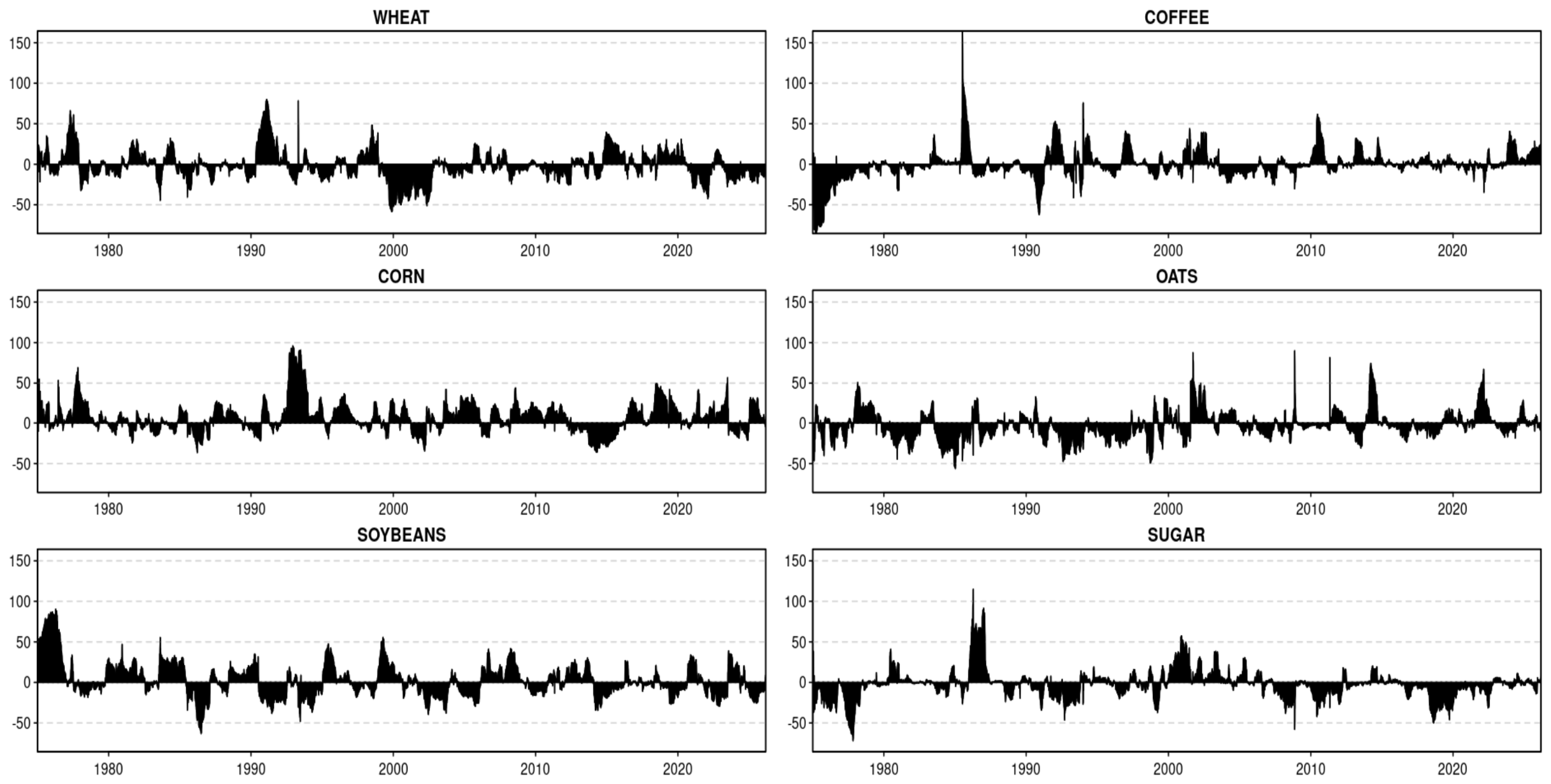
Here, the study goes deeper into the connectivity analysis and shifts the focus from the total average connectedness to the net total connectedness (NET). It is computed as the difference between total directional spillovers transmitted to others (TO) and those received from others (FROM). Positive (negative) values show that a commodity is a net transmitter (receiver) of volatility shocks. The NET plots are shown in Figure 5. Broadly speaking, all NET time movements are around zero, indicating that no commodity has a permanent position as a volatility net transmitter. The NETs vary significantly throughout the entire sample period, indicating extensive time variability and regime dependence. However, some clear disparities are identified across the six commodities. First, corn and soybeans are frequently identified as net transmitters because their NETs are generally positive, particularly during turbulent market conditions. However, wheat has a clear, balanced position with its NETs, oscillating between positive and negative values, underscoring a relevant switching behavior. Oats are most often identified as a net recipient of volatility shocks, with NETs predominantly negative. By contrast, coffee and sugar distinguish themselves from the other commodities, with weak, relatively stable NETs indicating limited dependence on other commodities and reinforcing their position at the periphery of the agricultural commodity structure. A final pattern is characterized by sharp spikes in the NETs’ time series, which could be attributed to a reaction to external risk factors. In this regard, soybeans and corn act as net transmitters of volatility, and their role is most pronounced during periods of extreme stress.
From an economic standpoint, corn and soybeans serve as volatility transmitters, especially during periods of stress, due to their pivotal positions in global food, feed, and biofuel markets. These results are consistent with the common conclusion that these commodities play a central role in the agricultural commodity connectedness structure due to their production and trading volumes and substitution effects [40]. However, the position of coffee and sugar at the periphery reveals that these commodities are more influenced by their own fundamentals than by external shocks originating in other agricultural commodities. More importantly, the pronounced time-varying pattern in volatility spillovers is consistent with the argument that agricultural commodities’ connectedness is highly dependent on market conditions and tends to increase during global crises and periods of geopolitical escalation, as underscored by [53,54].

4.4. Dynamic Pairwise Connectedness

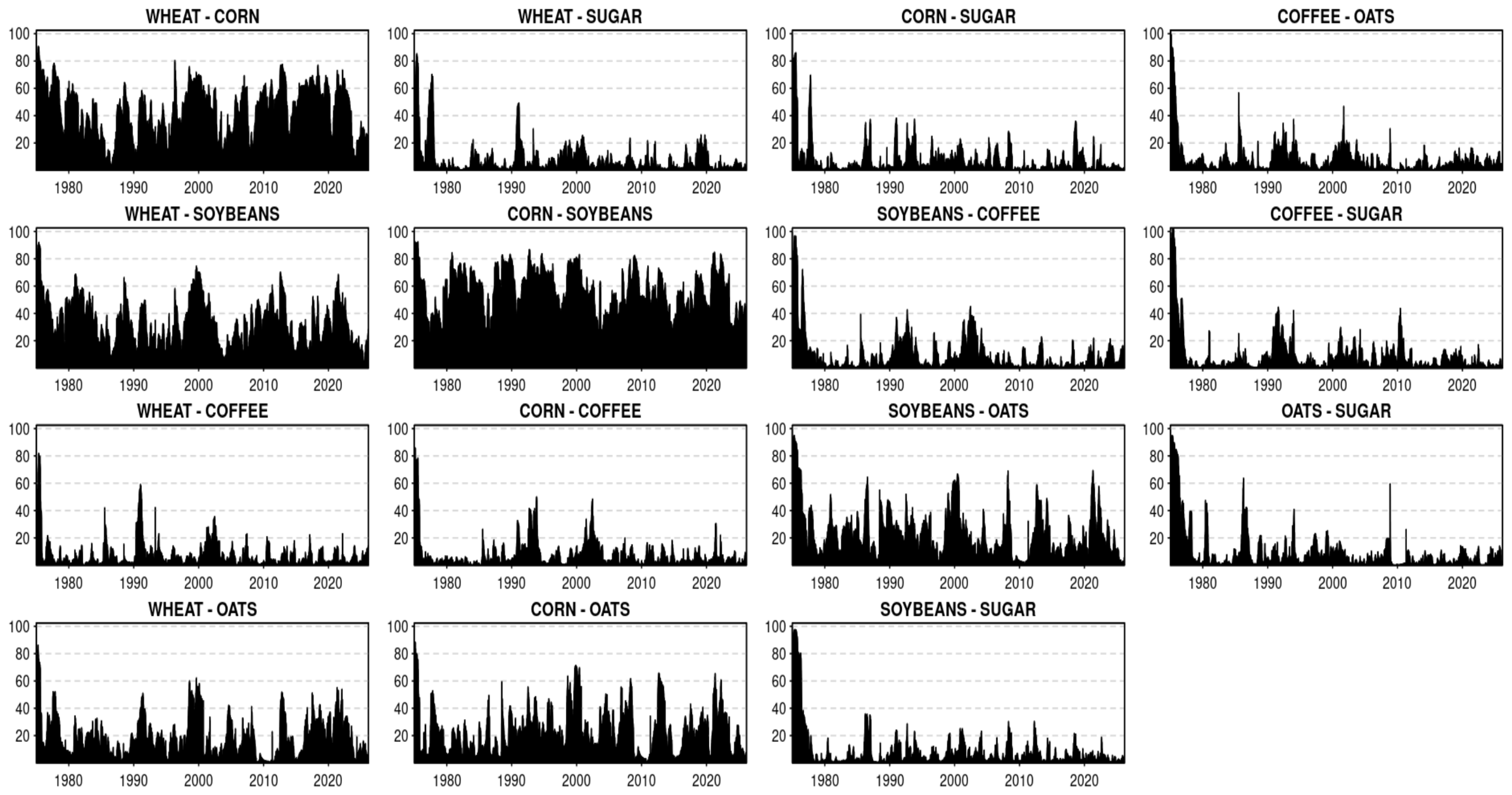
This sub-section extends the previous connectedness analysis by inspecting the dynamic pairwise connectedness generated by the TVP-VAR model. Figure 6 displays the dynamic pairwise connectedness among the agricultural commodities.
The visual inspection of these plots highlights significant heterogeneity across commodity pairs in power, persistence, and instability over the entire sample period. As shown, grain–grain linkages dominate the entire agricultural commodity markets. The highest connectedness is observed for corn and soybeans, with this high connectivity extending throughout the entire sample period. This result implies that these two commodities are strongly integrated and largely governed by common fundamentals.
A quite similar configuration is observed for wheat-corn and wheat-soybeans, with a relatively low degree of connectivity, which confirms their role as core commodities in global commodity markets. A different configuration is noted for the oats. The commodity exhibits intermittent, episodic peaks in high connectivity with corn and soybeans. This result shows that oats are becoming more integrated into the global market, especially during occasional sub-periods. Sugar and coffee seem to be weakly integrated with the other commodities. In fact, most commodity pairs involving either of these two commodities exhibit very low connectivity. This suggests that these two peripheral commodities are largely decoupled from the core global grain markets. All things considered, these plots exhibit substantial spikes in their time series, especially during periods of turbulent market conditions, such as food crises, the GFC, the COVID-19 pandemic, and large-scale geopolitical extreme events. This reflects that the volatility of these commodities varies significantly over time and intensifies under extreme market conditions. Such results align with most prior studies, including [6,13,22,45,47].

4.5. Net Pairwise Connectedness

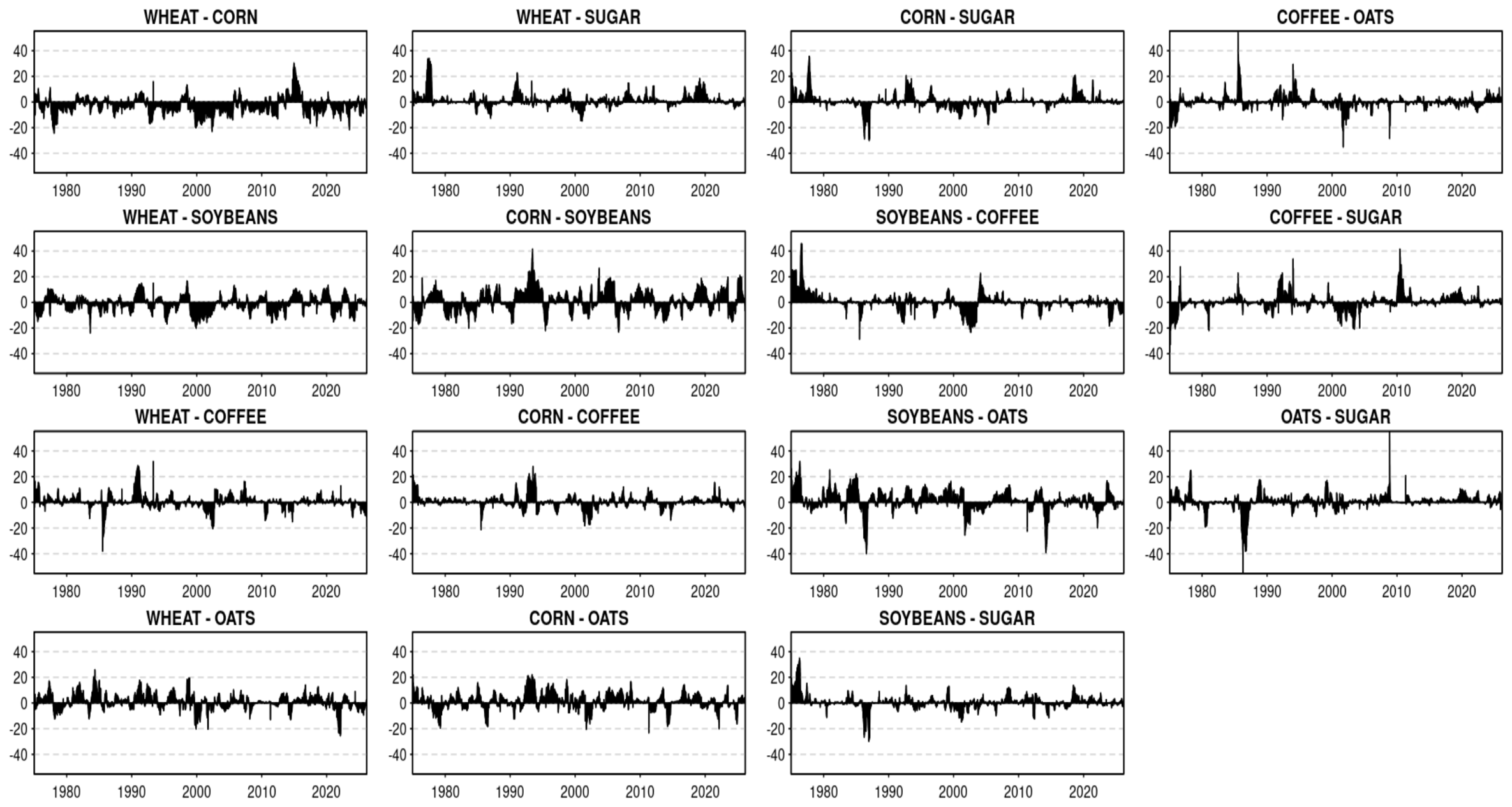
This subsection expands the previous analysis of the pairwise connectedness (NPT) by examining the net pairwise effects. It is worth noting that the NPT represents the difference between shocks transmitted from commodity (i) to (j) and those transmitted from (j) to (i). The commodity is a net transmitter if its corresponding NPT is positive, and a net receiver if it is negative. The NPT plots are reported in Figure 7.
At first glance, all NPTs are close to zero and alternate between net-transmitter and net-receiver states (positive and negative values). This shows that the pairwise connectedness structure among these agricultural commodities is weak but varies substantially over time, indicating it is affected by market conditions. Moreover, as perceived, the NPT for core grain commodities is higher than that for other commodities. In this regard, wheat–corn and corn–soybeans show the greatest instability throughout the entire sample period, indicating that these commodities switch from net receivers to net transmitters under market conditions. However, the other commodities (sugar, coffee and oats) show more stable net pairwise connectedness around zero. This underscores that these commodities have limited weak integration into the core grain market, thereby confirming their peripheral position in the overall commodity network. Another insightful pattern is observed in these NPT plots. All the NPTs exhibit significant sharp peaks and sometimes shifting behavior, which may be explained by the response of these commodity markets to extreme events. Taken together, the NPT analysis shows that net connectedness among the six core commodities varies substantially over time, with corn and soybeans serving mainly as volatility transmitters, while the other commodities are net receivers, confirming the core–periphery structure of the connectivity network.

4.6. Total Connectivity Network

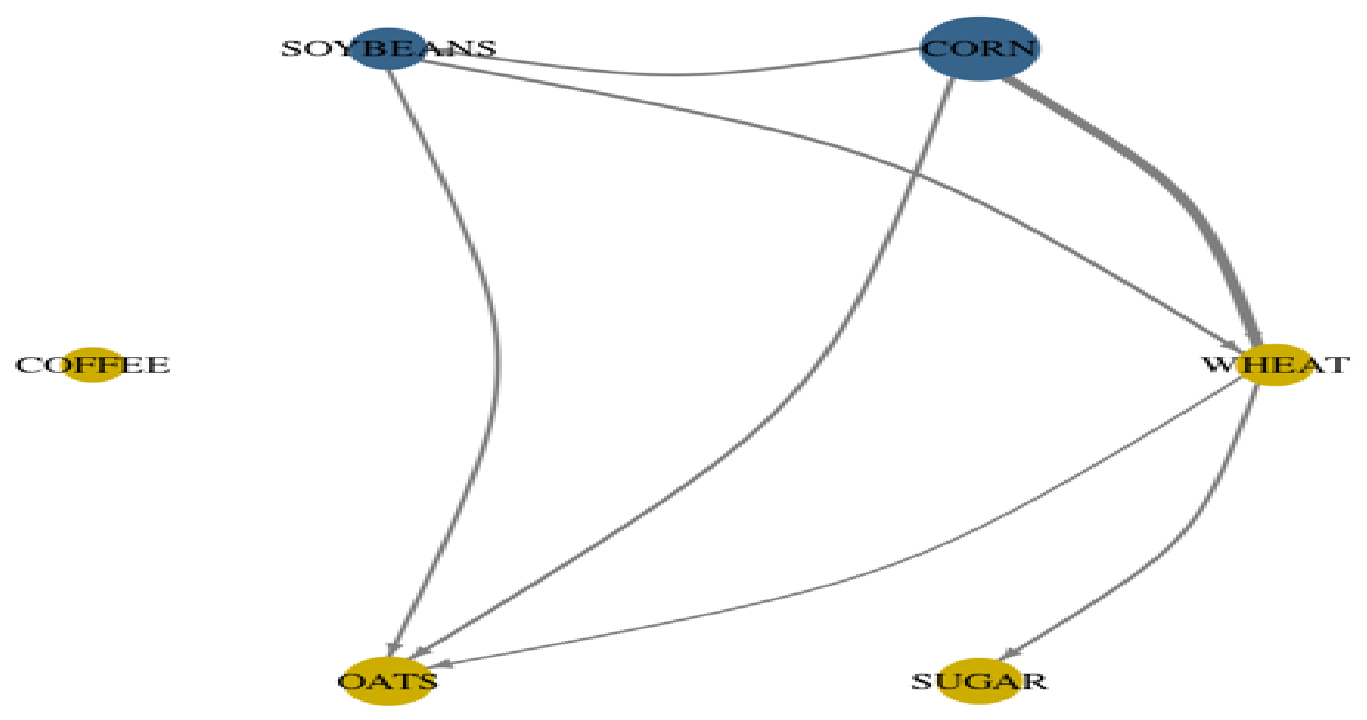
The connectivity network visualizes the volatility spillover relationships among the six agricultural commodities. It allows identification of the transmitters and receivers of net volatility shocks. Therefore, this representation offers valuable insights into how volatility shocks are transmitted and the integration of the agricultural cross-market. For a straightforward interpretation of the total connectedness network plot, each node refers to one of the six core agricultural commodities. The links between nodes represent volatility spillovers among agricultural commodities, while their thickness reflects the strength of the pairwise connectedness. The size of the node indicates the importance of each commodity market as a volatility receiver or transmitter. The total connectedness network generated by the TVP-VAR model is reported in Figure 8.
Several observations arise from this network. First, wheat and corn hold central positions, as shown by the node sizes and the thickest, most noticeable links. This indicates that these two commodities mainly act as net transmitters of volatility shocks to other food products. Additionally, this highlights the crucial role of these commodities in global agricultural markets, particularly in production and in their integration into international trade flows. Second, soybeans are closely linked to corn, primarily due to substitution effects in agriculture. However, oats exhibit multiple outgoing connections to other commodities, indicating their role as a secondary volatility transmitter, though with less influence than wheat and corn. Third, the connectedness network reveals that both sugar and coffee are weakly connected to other commodities. The strength of their internal linkages remains limited. This suggests that these commodities are not well integrated into the core grain system. Overall, the results imply that wheat, corn, and soybeans serve as key volatility transmitters in the global agricultural system, while sugar and coffee are marginally integrated. Consequently, wheat and corn serve as the primary conduits of external shocks within the global system before they propagate to other commodities. These findings align with the conclusions in [13]. Using the TVP-VAR approach, the authors demonstrate that wheat, corn, and soybeans serve as transmitters of net volatility shocks (originating from geopolitical risk) and play a central role, with extensive interconnections with other commodities (Ref. [13], p. 12).

4.7. Effects of GPR and Its Components on TCI: The EGARCH-X Modelling

In this sub-section, TVP-VAR analysis is extended by estimating an EGARCH-X model. This approach allows us to explore the impact of geopolitical risk (GPR) and its related components (threats and acts), as well as other global risk factors, on the strength and volatility of the interconnectedness of agricultural commodities. Two reasons motivate the choice of the EGARCH-X model. On the one hand, compared to the standard GARCH-X model, the EGARCH-X model models the logarithm of the conditional variance, which overcomes the non-negativity constraints on the variance parameters. On the other hand, the model accounts for asymmetry and volatility clustering.
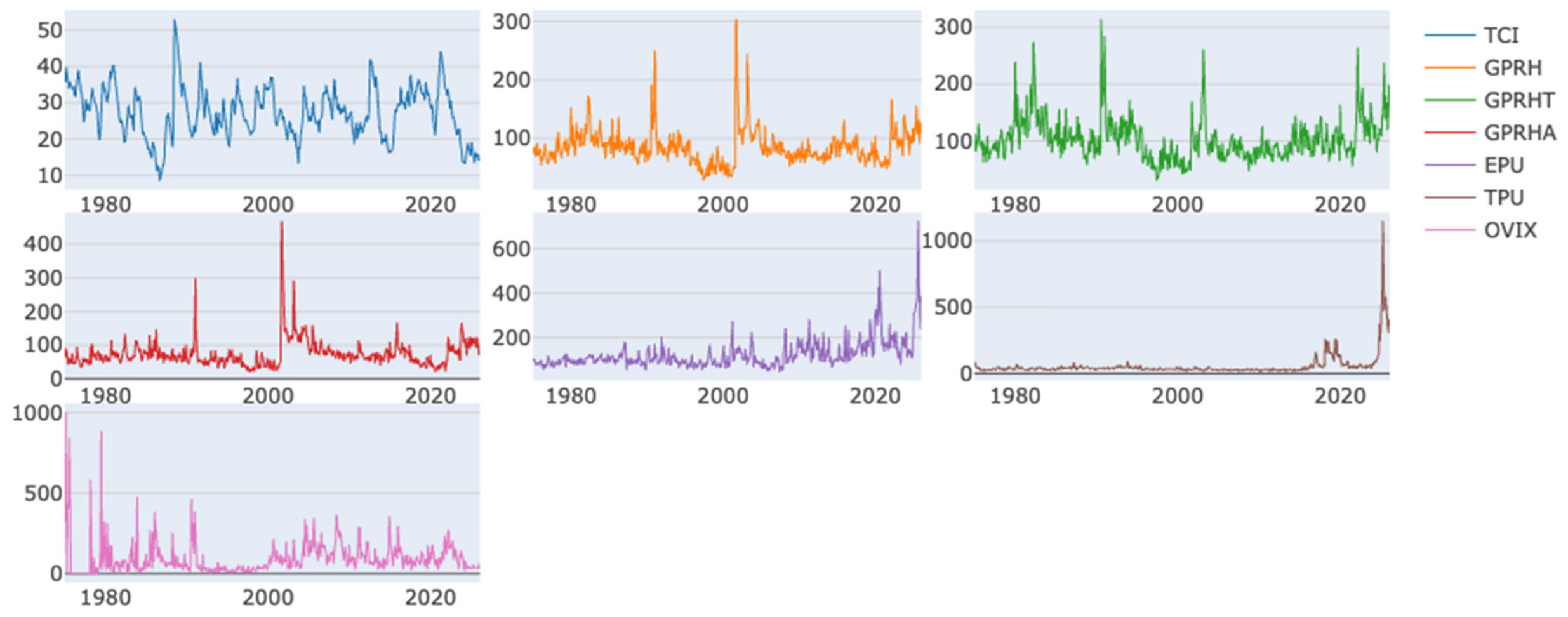
As a preliminary step before estimating the EGARCH-X model, we visualized the systemic risk factors, the geopolitical risk index, geopolitical acts, geopolitical threats, and other risk factors, economic policy uncertainty (EPU), trade policy uncertainty (TPU), and the oil volatility index (OVIX). All the variables have a monthly frequency and cover the period from January 1975 to February 2026. The TCI time series generated by the TVP-VAR model is aggregated into monthly indexes, synchronized with the five systemic risk factors, and yields 614 observations. Figure 9 portrays the temporal dynamics of all systemic factors.
All the time series display sharp, episodic peaks corresponding to major global extreme events. It is observed that the GPR-acts and GPR-threats surge during large-scale geopolitical incidents such as the Iranian Revolution (1979), the Gulf War (1990–1991), the 9/11 terrorist attacks, the Iraq War (2003), and the Russia–Ukraine war (2022). Obviously, the GPR acts show sharper spikes, indicating the realized incidents. EPU and TPU peak during the GFC, while OVX exhibits sharp spikes associated with oil market collapses. The TCI seems to react more smoothly but intensifies during these turbulent periods, indicating heightened connectedness under global stress. Table 4 reports the descriptive statistics for the TCI and the risk-factor time series, expressed at their first levels.
The means show that most series fluctuate around small positive levels, except for TCI and OVX, which show weak negative averages. The variance underscores significant heterogeneity in volatility across the series. OVX displays the highest variability, followed by EPU and TPU, confirming that uncertainty-related indicators are notably more volatile than the TCI, which remains relatively stable. All the time series display significant skewness, underscoring their asymmetrical distributions. It is worth noting that TCI and the GPR-related indices are positively skewed, indicating the presence of extreme events. All the Kurtosis are high and statistically significant, reflecting the presence of highly tailed distributions. The Jarque–Bera statistic confirms the rejection of the normal distribution, confirming that none of the time series follow a Gaussian distribution. The ERS unit root test indicates that all the time series are stationary and can be integrated into an EGARCH-X model without further differencing. More importantly, the Ljung–Box statistics indicate serial correlation and conditional heteroscedasticity in both the level and squared series, suggesting volatility clustering and persistence, supporting the use of the EGARCH-X model. The estimation results for the EGARCH-X models are reported in Table 5.
Models 1 and 2 incorporate GPR and its components, GPR-threats and GPR-acts, sequentially into the EGARCH conditional mean equation. No other systemic risk factors are included in the conditional variance equation. The primary aim is to isolate the influence of geopolitical risk, acts and threats on the strength of connectedness among the core agricultural commodities. The results show that, across the two models, GPR and its two components are insignificant, indicating that geopolitical risk does not significantly affect the strength of network connectedness. This result is consistent with [10], who find no significant effect on food and agricultural prices, but it partially aligns with the conclusions of [13]. The authors claim that “geopolitical risk tends to increase connectedness in the short term, and this effect diminishes over the long term as market participants gradually adapt to the new economic environment while inter-variable relationships loosen” ([10], p. 13). For these two models, the estimations of the EGARCH-X conditional variance equation reveal two important outcomes. First, the parameter measuring asymmetric effects is negative and statistically significant, indicating that negative shocks have a greater impact on the volatility of the TCI than positive shocks of equal magnitude. This could be explained by market participants’ risk profiles, who rebalance their portfolios and adjust their trading strategies in response to bad news initiated by systemic risk factors. Second, the parameter ( ρ ) is insignificant, indicating the absence of persistence behavior in the volatility process. In models 3, 4, and 5, GPR, GPR-acts, and GPR-threats are sequentially incorporated into the conditional variance of the EGARCH-X model, along with other selected risk factors (EPU, TPU, and OVX) (see panel b). The estimation reveals some insightful findings. First, results show that the estimated parameters for GPR and GPR-threats are positive and significant in models 4 and 5, respectively. Meanwhile, GPR-acts are insignificant (Model 5). These results indicate that increases in GPR and GPR-threats tend to amplify instability in the cross-market of agricultural commodities. This outcome could be attributed to market participants anticipating potential disruptions to the agricultural sector and thus taking proactive measures, such as securing alternative supply chains, reducing risk through suitable hedging strategies, and governments beginning to utilize their strategic reserves. Regarding the other systemic risk factors, results are mixed. Only the EPU is positively impacting the instability of the connectedness. In other words, an increase in economic uncertainty destabilizes the inter-relationships among agricultural commodities and therefore has a similar effect to GPR and GPR-threats. The global oil price uncertainty has a pronounced effect. The related parameter is positive and significant only in models (4) and (5), indicating that an increase in oil market volatility intensifies the TCI instability. Trade policy uncertainty (TPU) has no significant impact. Finally, in models (3), (4), and (5), asymmetric effects are evident, as the corresponding parameter is negative and statistically significant. Furthermore, as in models (1) and (2), no persistence behavior in the TCI is observed. The diagnostic tests (panel c) demonstrate the suitability of the EGARCH-X model, as there is no significant remaining heteroscedasticity in the squared standardized residuals.

4.8. Connectedness—GPR Nexus: A Scale-Quantile Analysis

The EGARCH-X analysis offers insights into how geopolitical risk and its components influence the strength and volatility of cross-market connectedness in agricultural commodities. However, the EGARCH-X is limited to the time dimension and does not consider two other relevant aspects: investment horizons (i.e., scales) and market conditions (i.e., quantiles). Here, the analysis is expanded to incorporate these two dimensions into the WQC method. Three main reasons motivate the use of WQC. First, it is a suitable tool for capturing changes in relationships across different time scales and the nonlinearity in GPR-TCI interactions. Second, it provides a deeper understanding of how the relationship evolves over short-, medium-, and long-term horizons. Finally, the method is appropriate for analyzing long time series that include hidden state-dependent relationships.
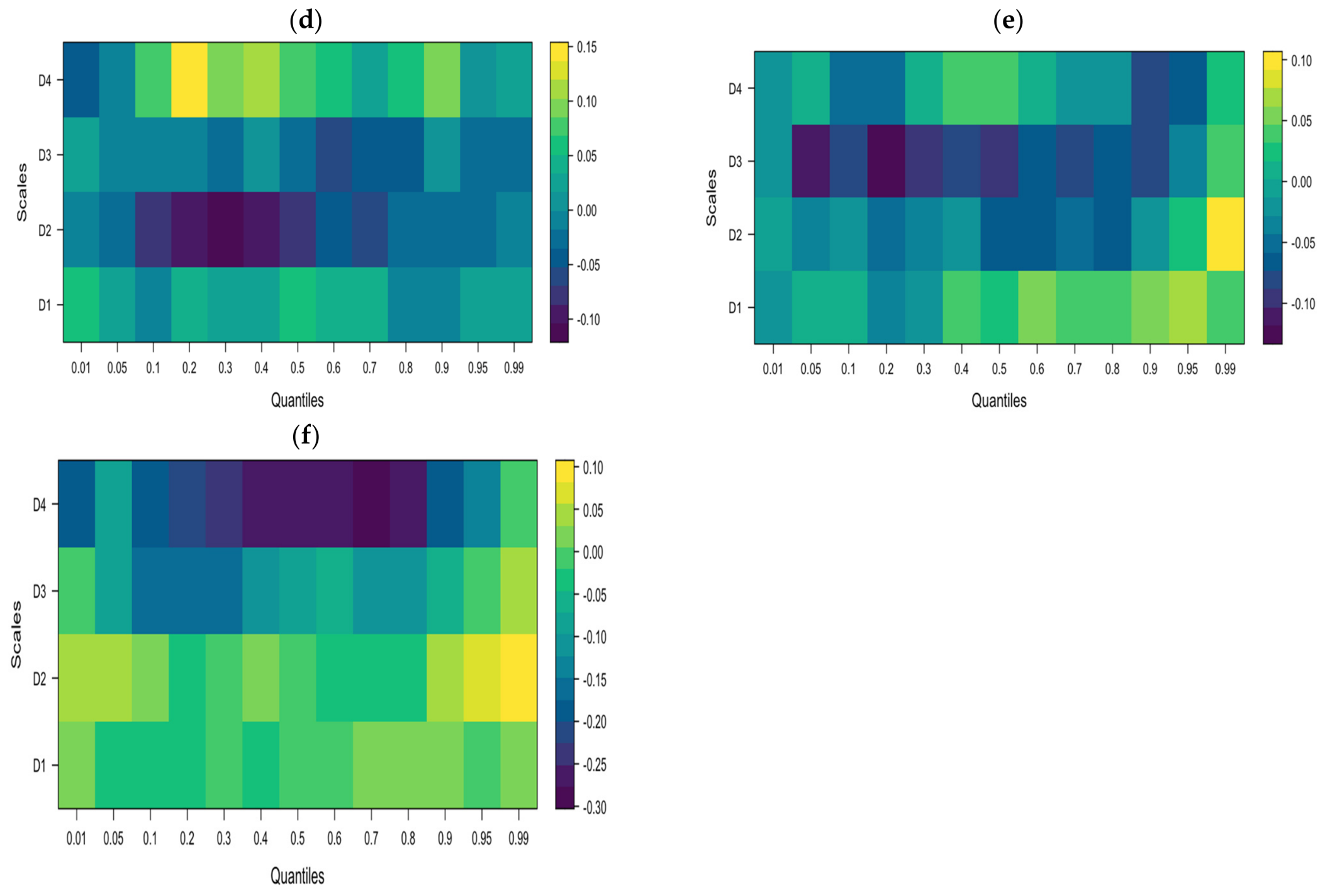
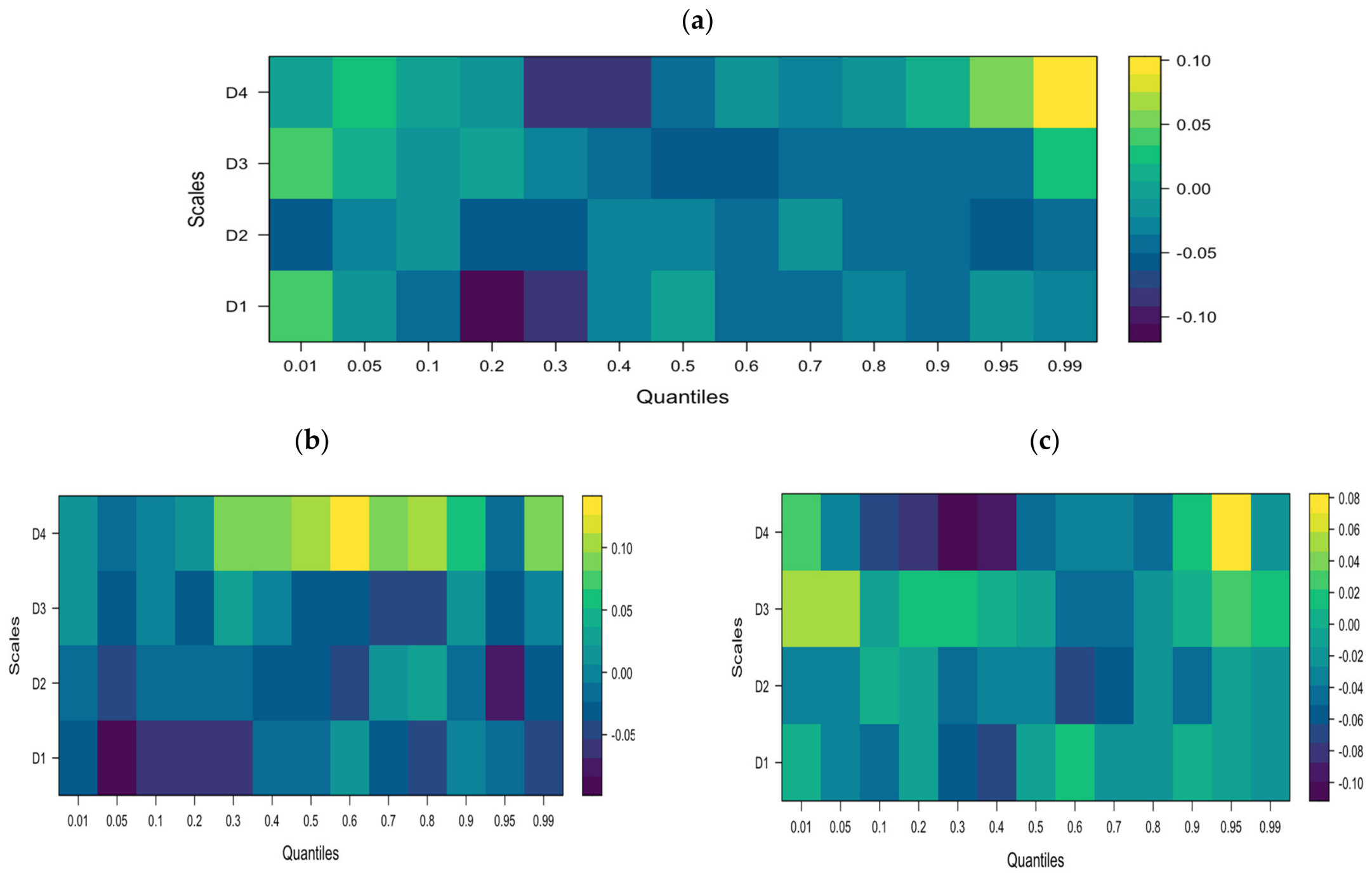
The WQC heatmaps between GPR and other systemic risk factors, and between TCI and other systemic risk factors, are shown in Figure 10. To enhance Interpretability, the x-axis of the heatmaps ranges from the 0.01st to the 0.99th quantiles. The quantiles are (x-axis, τ = 0.01 to 0.99). These quantiles capture different parts of the conditional distribution: the lower quantiles (τ = 0.1–0.3) correspond to market downturns/bearish states, the median quantiles (τ ≈ 0.5) show normal/typical states, while the upper quantiles (τ = 0.7–0.9) indicate market booms/bullish states. The y-axis shows nine MODWT scales, illustrating investment horizons ranging from ultra-short-term (D1) (<1 month), short-term (D2) 1 month), medium-term (D3) (2–12 months), and long-term (D4) (12 to 24 months). The color bar on the right shows the strength and direction of correlations (positive in yellow/white, negative in red/black).
The linkages between geopolitical risk and the total connectivity index of the selected agricultural commodities are shown in the heatmap (Figure 10a). At first glance, the GPR-TCI relationship is characterized by strong nonlinearity, state-dependent patterns, and high sensitivity to scale. At lower quantiles (0.01–0.1), which capture extreme bearish and stress–market conditions, the GPR-TCI nexus is primarily positive at short-term horizons (D1) but tends to increase at D3. This result indicates that geopolitical risk tends to amplify volatility spillovers among global agricultural commodities during episodes of high geopolitical tension. However, during normal or calm market conditions, the GPR-TCI nexus is weak or even negative at short scales (D1 to D2), implying that GPR may episodically weaken the connectivity. This could be explained by heterogeneity in commodity markets’ responses to shocks in geopolitical volatility shocks. In this regard, ref. [13] showed substantial heterogeneity in agricultural future responses to geopolitical risk. Accordingly, such heterogeneity confirms the presence of a “financialization gradient” [64]. For the upper quantiles (0.9–0.99), which capture bullish market conditions, the geopolitical risk-total connectedness intensifies, with positive correlations ranging from 0 to 0.10 at the longer scale D4 scale (12 to 24 months). This result shows that, over the long-term, geopolitical risk tends to amplify integration among global agricultural commodities. These results are consistent with prior studies such as [6] and [44], which show a significant impact of geopolitical risk on global agricultural markets but are inconsistent with [10] The authors found no significant long-term impact of GPR on major agricultural commodities (including corn, soybeans, oats, and rice). All in all, the multiscale analysis unveils a substantial asymmetric effect of geopolitical risk on the global agricultural commodity cross-market connectedness. Its impact is stronger in the lower tail at medium horizons and over the upper tail at long horizons. Such a result implies that accounting for time horizon and market conditions is a key aspect for better understanding the nexus between geopolitical risk and connectedness.
Figure 10b displays the WQC heatmap between TCI and GPR-acts. It is noticed that the TCI-GPR-Acts nexus exhibits strong scale dependence, with notable disparities across quantiles and time horizons. At the intra-month term (D1 < 1 month), the correlation is mostly negative, as indicated by the dark blue areas, especially at the lower quantiles (0.05 to 0.4), implying that during calm periods, GPR tends to attenuate agricultural commodity connectivity. However, for upper quantiles (0.6 to 0.9), the correlation is positive, indicating that during periods of increased stress, the GPR extreme events tend to reinforce synchronization among global agricultural commodities and contribute to their short-term interactions. For the D2 scale ( 1 month), the relationship is predominantly mixed, with both positive and negative correlations (ranging from −0.05 to 0). A similar pattern is depicted over the medium-term horizon (D3: 3–6 months). The correlations oscillate between positive and negative values across most quantiles. This may be because the adjustment process of commodity responses to geopolitical events is still underway, and the market remains driven by idiosyncratic factors rather than exogenous systemic ones. The most important finding is observed over the long-term investment horizons (D4). For almost all quantiles, the heatmaps indicate positive correlations in the bright green and yellow areas, and the GPR-Acts-TCI is mostly above 0.05, exceeding 0.10 in some medium quantiles (0.5 to 0.8). This pattern indicates that the GPR-Acts exert a certain delayed but structural effect on the TCI. The GPR-acts seem to amplify the agricultural cross-market connectedness. From an economic perspective, such a delayed effect may be explained by global supply chain adjustments and international trade reallocations. In sum, the GPR-Acts’ effects on TCI vary across quantiles and are largely state- and market-dependent. They have limited negative effects in the ultra-short-term but prove to be strongly positive over long-term horizons. The GPR acts are long-run systemic drivers of the connectedness of agricultural commodity prices, which may substantially reduce diversification in commodity portfolios over long-term investment horizons.
Figure 10c shows the WQC heatmaps for TCI and GPR-Threats. When inspecting the short-term scales (D1 scale), the correlation is weak and negative, mostly in the lower and middle quantiles (0.1 to 0.4), and becomes positive at higher quantiles (0.6 to 0.9). This result implies that GPR threats do not affect intra-market connectivity during calm market conditions but tend to tighten interplay during distressed periods. At D2 ( 1 month), the heatmap patterns are strongly heterogeneous. Positive correlations are observed at both the lower and upper quantiles, and negative correlations at the medium quantiles. Such heterogeneity reflects irregularities in intra-market responses to GPR threats at medium-term investment horizons. Economically, this could be explained by the heterogeneity of traders’ beliefs and perceptions of GPR-related news threats, as reflected in their expectations and price reactions. Over medium-term investment horizons (scale D3), the correlations are steadily positive, particularly at the upper and lower quantiles (0.01 to 0.1 and 0.8 to 0.9). These results imply a significant tail dependence between GPR threats and TCI. At longer time horizons (D4), the WQC heatmap reveals negative correlations in the middle quantiles and positive correlations in the upper quantiles (0.9–0.95). Such a result means that the escalation and persistence of GPR threats will intensify the connectedness over the long-run.
Figure 10d,e display the WQC heatmaps for the OVX and TPU and for TCI, respectively. The OVX-TCI heatmaps (Figure 10d) show that OVX exhibits strong, immediate, persistent, and positive effects on intra-market connectedness across most scales and quantiles. This positive effect becomes clearer over the long-term (Scale D4), underscoring the role of oil volatility in driving time-varying connectedness in agricultural markets. Higher oil volatility is intensifying price movements in agricultural commodities. Compared to OVX-TCI patterns, the TPU-TCI multiscale relationship is strongly heterogeneous across scales and investment horizons. In fact, a negative correlation in the median quantiles at medium horizons (D2–D3) indicates that an increase in TPU leads to greater fragmentation in the agricultural commodity market. Conversely, over the long-term, the relationship becomes positive, especially in upper quantiles. Taken together, the OVX intensifies commodity connectedness evenly, and its impact becomes more pronounced over long-term investment horizons. However, the effect of TPU is heterogeneous across horizons. The correlation is slightly negative in the short and medium terms and becomes positive in the long-term. Figure 10f shows the EPU-TCI heatmap. The relationship is strong and scale-dependent, with visible discrepancies through horizons. At the shorter scales (D1), the EPU-TCI is positive across almost all quantiles. This pattern indicates that an increase in economic uncertainty will instantaneously increase agricultural commodity synchronization. This positive effect extends to the D2 scales (≈1 month). Therefore, the EPU appears to serve as a short-term systemic driver of intra-market connectedness, particularly in the upper quantiles (i.e., extreme market conditions). Conversely, the heatmap pattern changes over the long-term (D4), with EPU-TCI correlations mostly negative in the median quantiles but remaining positive at the extreme quantiles. Summing up, EPU appears to be a short-term synchronizer on agricultural commodities and a long-term asymmetric risk driver.

5. Key Conclusions, Discussion and Policy Implications

5.1. Main Conclusions

Geopolitical risk stems from events such as military conflicts, inter-state political tensions, and terrorist attacks that disrupt the peaceful development of international relations and destabilize global markets. Over the past fifty years, geopolitical incidents have become more frequent and often larger in scale, making these tensions key drivers of volatility in global agricultural markets. This paper examines the impact of geopolitical risk on the interconnectedness of the agricultural commodity market using a comprehensive dataset covering six agricultural commodities: wheat, corn, oats, soybeans, coffee, and sugar, from January 1975 to March 2026. This period includes multiple major events, wars, financial crises, and health emergencies. Methodologically, the paper distinguishes itself from previous studies by applying three complementary frameworks: TVP-VAR, EGARCH-X, and WQC. First, this study investigates the total connectedness index across the six commodities and analyzes the network’s relationship with volatility shocks, including transmitters and receivers. Next, it incorporates the total connectedness index into EGARCH-X as an endogenous variable. The geopolitical risk and its two components, acts and threats, are sequentially added to the conditional mean and variance of the time-varying connectedness. Finally, it investigates the quantile multi-scale relationships between geopolitical risk, acts and threats, and agricultural connectedness across different investment horizons and market conditions using the WQC method.
The three-step approach unveils some insightful results. First, the TVP-VAR method shows a substantial time-varying pattern in the total, with notable changes in connectivity during episodes of geopolitical tensions or crises, such as the Gulf War, the 9/11 terrorist attacks, the 2008 GFC, the COVID-19 pandemic, and the ongoing Russia–Ukraine war. In addition, this study uncovers that corn and soybeans hold pivotal positions in agricultural cross-market structure, serving as net transmitters of volatility, while wheat plays an intermediate role. Coffee, oats, and sugar are in the network periphery and primarily receive volatility shocks. Second, the EGARCH-X results indicate that geopolitical risk and its two components, acts and threats, significantly affect the strength of connectedness in agricultural commodities. However, these three risk indicators significantly increase the volatility of their time-varying total connectedness. Oil price volatility and economic policy uncertainty exhibit similar patterns and tend to reduce the instability of agricultural connectedness, whereas trade policy uncertainty is insignificant. Third, the EGARCH-X outcomes are supported by the WQC analysis, which offers deeper insights. This study provides evidence that the relationships between GPR, GPR-acts, GPR-threats, and TCI are characterized by strong nonlinearity, state-dependent patterns, and high sensitivity to scale. GPR, GPR-acts, and threats serve as amplifiers of volatility spillovers within the agricultural commodity cross-market. The positive effect is slightly weak or negative in the short-term but gradually increases in the lower tail at medium horizons and in the upper tail at long-term investment horizons. GPR acts and threats act as long-term, structural, systemic drivers of the market. This influence tends to grow during periods of geopolitical tensions.
Aside from agricultural commodity connectedness, the results also underscore the strategic role of agricultural-food commodities as critical resources associated with global food security, resource sustainability, and supply-chain resilience. In this regard, geopolitical escalations not only disturb financial stability but also increase global pressure on core agricultural resources through disruptions in international trade, fertilizer accessibility and production chains. The higher connectedness observed during geopolitical stress periods suggests that agricultural resource markets have become more integrated, thereby making global food systems more vulnerable to adverse exogenous shocks. Subsequently, the management of agricultural resources requires the establishment of integrated frameworks that account for financial risk management, resource sustainability, and geopolitics.

5.2. Discussion and Policy Implications

Based on these results, several relevant policy and managerial implications can be derived. (1) As geopolitical risk (acts and threats) amplifies volatility spillovers and instability in the agricultural market, portfolio managers should incorporate geopolitical risk and acts-and-threats indicators into their portfolio management strategies, especially during turbulent and stressed periods. (2) Given that GPR-connectedness is highly sensitive to scales (i.e., investment horizons), traders operating in agricultural markets should consider the gradual and delayed impact of geopolitical risk on the connectedness among agricultural assets. Furthermore, agricultural-commodity portfolio managers should account for time-varying patterns in agricultural commodities, and it is useful to refer to the total connectivity portfolio optimization (TCoP) framework to design their hedging strategies. (4) The result showing that corn and soybeans are the main risk transmitter and source of volatility shock transmission implies that these two agricultural commodities should be carefully monitored especially during episodes of high geopolitical risk levels. (6) The presence of sugar and coffee at the periphery of the agricultural commodities’ connectedness structure implies they these assets can serve as portfolio diversifier during calm periods but they lose this main feature during periods of heightened geopolitical risk especially over medium- and long-term investment horizons. (7) From a resource-management standpoint, the findings highlight the need to power the resilience and sustainability of global agricultural resources. Given the adverse effects of geopolitical risk on volatility spillovers among agricultural commodities, policymakers are invited to enhance strategic national food reserves, diversify import sources, and boost regional agricultural cooperation through appropriate policies to reduce dependence on concentrated supply chains. In addition, governments are asked to adopt more sustainable agricultural policies based on efficient water use and land resource allocation, and to invest in climate-resilient agricultural infrastructure, in order to reduce the long-term adverse effects of geopolitics on agricultural resource accessibility. (8) From a technical side, the nonlinearity and the state-dependent nature of the GPR-connectedness is highlighting the usefulness of traditional linear models to assess risk in agricultural markets and underscore the need for a quantile-based or a switching regime frameworks to capture and assess downside risk. Finally, the significant impact of geopolitical risk on volatility and connectedness, rather than on their strength, underscores the relevance of volatility-based trading strategies using commodity derivatives such as options and futures contracts.

5.3. Some Research Avenues

These results may pave the way for several research avenues. First, given the long sample period, it would be useful to explore the role of geopolitical fragmentation and regional blocs in shaping connectivity in the key agricultural markets, especially during periods of alliance realignments and supply chain reconfigurations. Second, incorporating the climate change risk and climate physical risk attention indexes as potential drivers of agricultural intra-relationships may offer new insights into the strength and instability of time-varying connectedness. Third, implementing other non-linear frameworks, such as Markov-switching models and spectral causality tests, may help better understand the asymmetry and shifting behavior in volatility spillovers among agricultural commodities during calm and turbulent episodes. Fourth, analyzing high-frequency (intra-day) data on major agricultural commodities and fertilizers, particularly during the recent US–Iran–Israel conflict and the resulting disruptions to global supply chains amid tensions in the Strait of Hormuz, could be a promising research topic. Fifth, while agricultural commodity prices are influenced by supply and demand conditions and speculative trading, this may raise concerns about endogeneity in the geopolitical risk and potential reverse causality. Thus, a structural or instrumental variable approach may constitute a promising research avenue to addressing potential endogeneity issues. It would finally be interesting to investigate the impact of natural resource constraints, such as water scarcity, fertilizer dependency, land degradation, and other external shocks to energy resources, on the time-varying connectivity of agricultural commodities. Exploring how these external factors affect the agricultural market’s intra-connectivity and volatility transmission processes could offer relevant insights into the sustainability and resilience of the agricultural-food resources system.

Funding

This work was supported and funded by the Deanship of Scientific Research at Imam Mohammad Ibn Saud Islamic University (IMSIU) (Grant number IMSIU-DDRSP2604).

Data Availability Statement

Data are available upon request addressed to the corresponding author.

Conflicts of Interest

The author declares no conflicts of interest.

References

  1. Caldara, D.; Iacoviello, M. Measuring geopolitical risk. Am. Econ. Rev. 2022, 112, 1194–1225. [Google Scholar] [CrossRef]
  2. Koirala, K.H.; Mishra, A.K.; D’Antoni, J.M.; Mehlhorn, J.E. Energy prices and agricultural commodity prices: Testing correlation using copulas method. Energy 2015, 81, 430–436. [Google Scholar] [CrossRef]
  3. Liu, Z.; Wang, Y.; Yuan, X.; Ding, Z.; Ji, Q. Geopolitical risk and vulnerability of energy markets. Energy Econ. 2024, 141, 108055. [Google Scholar] [CrossRef]
  4. Zhu, Q.; Ma, D.; Pan, Y. Dynamic spillover between geopolitical risk and energy markets: Portfolio hedging implication. Energy Econ. 2026, 157, 109254. [Google Scholar] [CrossRef]
  5. Yang, C.; Niu, Z.; Gao, W. The time-varying effects of trade policy uncertainty and geopolitical risks shocks on the commodity market prices: Evidence from the TVP-VAR-SV approach. Resour. Policy 2022, 76, 102600. [Google Scholar] [CrossRef]
  6. Wang, Y.; Bouri, E.; Fareed, Z.; Dai, Y. Geopolitical risk and the systemic risk in the commodity markets under the war in Ukraine. Financ. Res. Lett. 2022, 49, 103066. [Google Scholar] [CrossRef]
  7. Banerjee, A.K. Second-order moment risk connectedness across climate and geopolitical risk and global commodity markets. Econ. Lett. 2024, 235, 111551. [Google Scholar] [CrossRef]
  8. Yang, J.; Yang, H.; Feng, Y. Quantifying the geopolitical risk resilience of commodity futures markets. Econ. Lett. 2025, 247, 112172. [Google Scholar] [CrossRef]
  9. Tiwari, A.K.; Boachie, M.K.; Suleman, M.T.; Gupta, R. Structure dependence between oil and agricultural commodities returns: The role of geopolitical risks. Energy 2021, 219, 119584. [Google Scholar] [CrossRef]
  10. Hudecova, K.; Rajcaniova, M. The impact of geopolitical risk on agricultural commodity prices. Agric. Econ. 2023, 69, 129–139. [Google Scholar] [CrossRef]
  11. Sohag, K.; Islam, M.M.; Tomas Žiković, I.; Mansour, H. Food inflation and geopolitical risks: Analyzing European regions amid the Russia-Ukraine war. Br. Food J. 2023, 125, 2368–2391. [Google Scholar] [CrossRef]
  12. Karkowska, R.; Urjasz, S. Importance of geopolitical risk in volatility structure: New evidence from biofuels, crude oil, and grains commodity markets. J. Commod. Mark. 2024, 36, 100440. [Google Scholar] [CrossRef]
  13. Ren, X.; Wang, T.; Liu, Z.; Xu, H. The risk transmission mechanism between Geopolitical risks and the international agricultural product market: An analysis based on the cross-quantilogram and TVP-VAR-BK Models. Humanit. Soc. Sci. Commun. 2025, 12, 1799. [Google Scholar] [CrossRef]
  14. Belhoula, M.M.; Ghorbali, B.; Mensi, W.; Al-Yahyaee, K. Risk connectedness and portfolio optimization across agricultural commodity markets: Soybean oil, corn, wheat, soybeans and oats. Agric. Financ. Rev. 2026, 86, 128–146. [Google Scholar] [CrossRef]
  15. Li, S.; Yao, X.; Li, J. The impact of co-movements in idiosyncratic volatility of international commodities on China’s financial market risk. Res. Int. Bus. Financ. 2026, 82, 103248. [Google Scholar] [CrossRef]
  16. Vos, R.; Glauber, J.; Hebebrand, C.; Rice, B. Global shocks to fertiliser markets: Impacts on prices, demand and farm profitability. Food Policy 2025, 133, 102790. [Google Scholar] [CrossRef]
  17. Teck, V.; Poortinga, A.; Riano, C.; Dahal, K.; Legaspi, R.M.B.; Ann, V.; Chea, R. Land use and land cover change implications on agriculture and natural resource management of Koah Nheaek, Mondulkiri province, Cambodia. Remote Sens. Appl. Soc. Environ. 2022, 29, 100895. [Google Scholar] [CrossRef]
  18. Xuan, J.; Wang, X.; Yuan, C.; Jin, S.; Tian, X. Substitute or complement? Quantity–quality effects of agricultural production diversity and market access on diets. World Dev. 2026, 204, 107400. [Google Scholar] [CrossRef]
  19. Diego, A.-R. Access to Markets and Technology Adoption in the Agricultural Sector: Evidence from Brazil; EconStor Preprints 289868; ZBW—Leibniz Information Centre for Economics: Kiel, Germany, 2024; Available online: https://www.econstor.eu/bitstream/10419/289868/1/Brasil_highways.pdf (accessed on 17 May 2026).
  20. Khalfaoui, R.; Shahzad, U.; Ghaemi Asl, M.; Ben Jabeur, S. Investigating the spillovers between energy, food, and agricultural commodity markets: New insights from the quantile coherency approach. Q. Rev. Econ. Financ. 2023, 88, 63–80. [Google Scholar] [CrossRef]
  21. Vo, D.H.; Tran, M.P.B. Volatility spillovers between energy and agriculture markets during the ongoing food & energy crisis: Does uncertainty from the Russo-Ukrainian conflict matter? Technol. Forecast. Soc. Change 2024, 208, 123723. [Google Scholar] [CrossRef]
  22. Frempong, J.A. Mapping the transmission of global risk to African food markets. Int. Econ. 2026, 185, 100680. [Google Scholar] [CrossRef]
  23. Al-Haddad, A.; Abu-Rayash, A. Volatility modeling in energy commodity markets: A review of responses to shocks and the path towards resiliency and sustainability. Appl. Energy 2026, 411, 127559. [Google Scholar] [CrossRef]
  24. Alquist, R.; Bhattarai, S.; Coibion, O. Commodity-price comovement and global economic activity. J. Monet. Econ. 2020, 112, 41–56. [Google Scholar] [CrossRef]
  25. Osborne, T. Imperfect competition in agricultural markets: Evidence from Ethiopia. J. Dev. Econ. 2005, 76, 405–428. [Google Scholar] [CrossRef]
  26. Liu, Q.; Xu, C.; Xu, Z. The impact of geopolitical risk on food prices: Evidence from the TVP-SV-VAR model. J. Econ. Financ. 2025, 49, 450–473. [Google Scholar] [CrossRef]
  27. Amagbo, R.; Geman, H. Dynamic and asymmetric spillovers between crude oil, biofuels and agricultural commodities: Evidence from periods of geopolitical tensions and energy policy uncertainty. Int. Rev. Econ. Financ. 2026, 108, 105276. [Google Scholar] [CrossRef]
  28. Kang, S.H.; Rehman, M.U.; Nautiyal, N.; Alessa, N.; Vo, X.V. Extreme quantile connectedness across shipping freights, agriculture and energy commodities. Int. Rev. Econ. Financ. 2026, 109, 105238. [Google Scholar] [CrossRef]
  29. Olagunju, K.O.; Feng, S.; Patton, M. Dynamic relationships among phosphate rock, fertilisers and agricultural commodity markets: Evidence from a vector error correction model and Directed Acyclic Graphs. Resour. Policy 2021, 74, 102301. [Google Scholar] [CrossRef]
  30. Yu, T.; Tokgoz, S.; Wailes, E.; Chavez, E. A quantitative analysis of trade policy responses to higher world agricultural commodity prices. Food Policy 2011, 36, 545–561. [Google Scholar] [CrossRef]
  31. Sun, T.; Su, C.; Mirza, N.; Umar, M. How does trade policy uncertainty affect agriculture commodity prices? Pac.-Basin Financ. J. 2021, 66, 101514. [Google Scholar] [CrossRef]
  32. Jacks, D.S. What drove 19th century commodity market integration? Explor. Econ. Hist. 2006, 43, 383–412. [Google Scholar] [CrossRef]
  33. Van Campenhout, B. Modelling trends in food market integration: Method and an application to Tanzanian maize markets. Food Policy 2007, 32, 112–127. [Google Scholar] [CrossRef]
  34. Kang, S.H.; McIver, R.; Yoon, S. Dynamic spillover effects among crude oil, precious metal, and agricultural commodity futures markets. Energy Econ. 2017, 62, 19–32. [Google Scholar] [CrossRef]
  35. Wen, J.; Khalid, S.; Mahmood, H.; Zakaria, M. Symmetric and asymmetric impact of economic policy uncertainty on food prices in China: A new evidence. Resour. Policy 2021, 74, 102247. [Google Scholar] [CrossRef]
  36. Gong, X.; Xu, J. Geopolitical risk and dynamic connectedness between commodity markets. Energy Econ. 2022, 110, 106028. [Google Scholar] [CrossRef]
  37. Zmami, M.; Ben-Salha, O. What factors contribute to the volatility of the food prices? New global evidence. Agric. Econ. 2023, 69, 171–184. [Google Scholar] [CrossRef]
  38. Pindyck, R.S.; Rotemberg, J.J. The Excess Co-Movement of Commodity Prices on JSTOR. Econ. J. 1990, 100, 1173–1189. [Google Scholar] [CrossRef]
  39. Goodwin, B.K.; Schroeder, T.C. Cointegration Tests and Spatial Price Linkages in Regional Cattle Markets. Am. J. Agric. Econ. 1991, 73, 452–464. [Google Scholar] [CrossRef]
  40. Ji, Q.; Fan, Y. How does oil price volatility affect non-energy commodity markets? Appl. Energy 2011, 89, 273–280. [Google Scholar] [CrossRef]
  41. Bonato, M. Realized correlations, betas and volatility spillover in the agricultural commodity market: What has changed? J. Int. Financ. Mark. Inst. Money 2019, 62, 184–202. [Google Scholar] [CrossRef]
  42. Diebold, F.X.; Yilmaz, K. Better to give than to receive: Predictive directional measurement of volatility spillovers. Int. J. Forecast. 2012, 28, 57–66. [Google Scholar] [CrossRef]
  43. Bossman, A.; Gubareva, M.; Teplova, T. Asymmetric effects of market uncertainties on agricultural commodities. Energy Econ. 2023, 127, 107080. [Google Scholar] [CrossRef]
  44. Cui, J.; Maghyereh, A. Unveiling interconnectedness: Exploring higher-order moments among energy, precious metals, industrial metals, and agricultural commodities in the context of geopolitical risks and systemic stress. J. Commod. Mark. 2024, 33, 100380. [Google Scholar] [CrossRef]
  45. Zhu, H.Y.; Dai, P.F.; Zhou, W.X. Uncovering the Sino-US dynamic risk spillovers effects: Evidence from agricultural futures markets. J. Futur. Mark. 2024, 44, 1888–1910. [Google Scholar] [CrossRef]
  46. Eissa, M.A.; Al Refai, H.; Chortareas, G. Climate policy uncertainty, geopolitical risk, oil volatility, and global food price volatility: A time-varying analysis. Econ. Model. 2025, 152, 107272. [Google Scholar] [CrossRef]
  47. Mei, D.; Zhang, H. Impact of global tensions on commodity futures from a geopolitical risk perspective. Financ. Res. Lett. 2025, 86, 108605. [Google Scholar] [CrossRef]
  48. Dai, Y.S.; Dai, P.F.; Zhou, W.X. Geopolitical Risk and the Volatility of the International Grain Futures Market. J. Futur. Mark. 2025, 45, 1757–1794. [Google Scholar] [CrossRef]
  49. Zeng, H.; Xu, W.; Lu, R. Quantile frequency connectedness between crude oil volatility, geopolitical risk and major agriculture and livestock markets. Appl. Econ. 2025, 57, 3345–3360. [Google Scholar] [CrossRef]
  50. Çelik, A.K.; Yalçınkaya, Ö.; Kutlu, M. Do Geopolitical Risk and Economic Policy Uncertainties Affect Food and Energy Commodity Prices? Evidence From Time-Varying Granger Causality Test. Sage Open 2026, 16, 21582440261420449. [Google Scholar] [CrossRef]
  51. Elliott, G.; Rothenberg, T.J.; Stock, J.H. Efficient Tests for an Autoregressive Unit Root. Econometrica 1996, 64, 813–836. [Google Scholar] [CrossRef]
  52. Koop, G.; Korobilis, D. Large time-varying parameter VARs. J. Econom. 2013, 177, 185–198. [Google Scholar] [CrossRef]
  53. Baruník, J.; Křehlík, T. Measuring the Frequency Dynamics of Financial Connectedness and Systemic Risk. J. Financ. Econom. 2018, 16, 271–296. [Google Scholar] [CrossRef]
  54. Antonakakis, N.; Chatziantoniou, I.; Gabauer, D. Refined Measures of Dynamic Connectedness based on Time-Varying Parameter Vector Autoregressions. J. Risk Financ. Manag. 2020, 13, 84. [Google Scholar] [CrossRef]
  55. Antonakakis, N.; Gabauer, D. Refined Measures of Dynamic Connectedness Based on TVP-VAR. MPRA Paper 78282, University Library of Munich, Germany. 2017. Available online: https://mpra.ub.uni-muenchen.de/78282/1/MPRA_paper_78282.pdf (accessed on 20 February 2026).
  56. Koop, G.; Pesaran, M.; Potter, S.M. Impulse response analysis in nonlinear multivariate models. J. Econom. 1996, 74, 119–147. [Google Scholar] [CrossRef]
  57. Pesaran, H.; Shin, Y. Generalized impulse response analysis in linear multivariate models. Econ. Lett. 1997, 58, 17–29. [Google Scholar] [CrossRef]
  58. Li, G.; Li, Y.; Tsai, C.L. Quantile Correlations and Quantile Autoregressive Modeling. J. Am. Stat. Assoc. 2015, 110, 246–261. [Google Scholar] [CrossRef]
  59. Patel, R.; Goodell, J.W.; Chishti, M.Z. Assessing connectedness of transportation cryptocurrencies and transportation stocks: Evidence from wavelet quantile correlation. Financ. Res. Lett. 2023, 58, 104504. [Google Scholar] [CrossRef]
  60. Abakah, E.J.A.; Goodell, J.W.; Sulong, Z.; Abdullah, M. Wavelet quantile correlation between DeFi assets and banking stocks. Financ. Res. Lett. 2024, 70, 106272. [Google Scholar] [CrossRef]
  61. Kristoufek, L. BitCoin meets Google Trends and Wikipedia: Quantifying the relationship between phenomena of the Internet era. Sci. Rep. 2013, 3, 3415. [Google Scholar] [CrossRef] [PubMed]
  62. Percival, D.B.; Walden, A.T. Wavelet Methods for Time Series Analysis; Cambridge University Press: Cambridge, UK, 2000. [Google Scholar]
  63. Nelson, D.B. Conditional Heteroskedasticity in Asset Returns: A New Approach. Econom. J. Econom. Soc. 1991, 59, 347–370. [Google Scholar] [CrossRef]
  64. Tang, K.; Xiong, W. Index Investment and the Financialization of Commodities. Fin. Anal. J. 2012, 68, 54–74. [Google Scholar] [CrossRef]
Figure 1. Time movements of agricultural commodity prices (January 1975–March 2026, daily frequency). Notes: Time series of six agricultural daily prices covering the period 2 January 1975 to 16 March 2026.
Resources 15 00082 g001
Figure 2. Time movements of agricultural commodity returns (1975–2026, daily frequency). Notes: Time series of six commodity daily returns covering the period 2 January 1975 to 16 March 2026.
Resources 15 00082 g002
Figure 3. The methodology flow chart.
Resources 15 00082 g003
Figure 4. Total directional connectedness among the agricultural commodities (January 1975–March 2026). Notes: The graph shows the daily total directional connectedness among the six agricultural commodities (wheat, corn, soybeans, oats, sugar and coffee) for the period going from 2 January 1975 to 4 March 2026, yielding 12,910 observations.
Resources 15 00082 g004
Figure 5. Net total connectedness among agricultural commodities. Notes: Net total connectedness (NET) is computed as the difference between total directional spillovers transmitted to others (TO) and those received from others (FROM). Positive (negative) values show that a commodity is a net transmitter (receiver) of volatility shocks.
Resources 15 00082 g005
Figure 6. The dynamic pairwise connectedness among the agricultural commodities (1975–2026). Notes: The dynamic pairwise connectedness plots are generated from the TVP-VAR model.
Resources 15 00082 g006
Figure 7. Net pairwise connectedness among the agricultural commodities (1975–2026). Notes: NPT represents the difference between shocks transmitted from commodity (i) to (j) and those transmitted from (j) to (i). The commodity is a net transmitter if its corresponding NPT is positive and net receiver if the NPT is negative.
Resources 15 00082 g007
Figure 8. Total network connectedness. Notes: In this graph, each node refers to one of the four core agricultural commodities (wheat, corn, soybeans, oats, coffee and sugar). The links between the nodes represent the volatility spillovers among the agricultural commodities, while their thickness reflects the power of the pairwise connectedness. The size of the node indicates the importance of each commodity market in terms of volatility receiver or volatility transmitters.
Resources 15 00082 g008
Figure 9. Time movement of the GPR, GPR acts, GPR threats, EPU, TPU and OVX. Notes: Time series are monthly and covering the period January 1975 to February 2026.
Resources 15 00082 g009
Figure 10. WQC heatmaps between total connectedness index, GPR components and other global risk factors. Notes: The x-axis shows the quantiles (0.1–0.9) and the y-axis shows the MODWT scales. The wavelet scales are converted from daily frequency into approximate monthly horizons using trading days. Accordingly, 4–8 days correspond to D1, 16–32 days to D2, 64–128 days to D3, and 256–512 days to D4. (Color intensity indicates correlation strength and direction). (a) TCI—GPR; (b) TCI—GPR Acts; (c) TCI—GPR Threats; (d) TCI-OVX; (e) TCI-TPU; (f) TCI-EPU.
Resources 15 00082 g010aResources 15 00082 g010b
Table 1. Literature review.
AuthorsSample PeriodMethodKey Findings
[38]Commodity markets.OLS regression and latent variable models
  • To conclude that prices exhibit excess co-movements, we must account for effects of any common macroeconomic shocks” ([38], p. 1173).
[39]1980–1987
Several regional livestocks.
Cointegration
  • The degree of market integration is significantly affected by several factors such as distances between markets, industry concentration, market volume and type of the market” ([39], p. 452).
[32]Grain markets.Cross section analysis
  • Transport technology, monetary regimes, geography, commercial networks and geopolitical conflicts are the main drivers of agricultural commodities during the 19th century.
[33]7 food markets.TAR
  • The food markets are highly integrated.
  • The TAR model is suitable to model the food markets‘ connectedness.
[40]Oil and agricultural commodities.EGARCH-DCC
  • The DCCs are increasing during crisis.
  • The DCCs are affected by economic recession after the 2008 GFC.
  • The agricultural commodities have a core position in the global commodity market.
[2]High-frequency data. Agricultural commodities (corn, soybeans).Copula method
  • Oil and agricultural commodities are positively correlated.
[34]Six agricultural commodities; gold, oil, silver (future prices).DECO-GARCH model
  • The DECOs are increasing substantially during crisis.
  • Bidirectional causalities are evidenced between oil, gold and silver and other agricultural commodities.
[41]High-frequency data (2002–2027).
Grain commodities and oil.
Realized Beta- GARCH volatility model
  • The DCCs are increasing temporarily.
  • Positive correlations between oil and grain commodities.
  • The correlations are substantially increasing during the 2008 GFC.
[31]EPU and food price times series.
Monthly data from 2002 to 2020.
Bootstrap and rolling window methods
  • TPU has a mixed impact on foods.
  • Food prices affect EPU.
  • Significant effects of COVID-19 and trade conflicts.
[9]GPR (acts and threats), oats, corn, wheat and soybean—April 1990 to February 2019.Copula framework
  • Significant volatility spillovers between energy and agriculture commodities.
  • GPR negatively influenced.
  • Corn, oats and wheat act as hedgers against oil downward.
  • Oil and agriculture commodities are negatively correlated when the former is bullish and the latter bearish.
[35]Food prices, China:
monthly data from 1988 to 2020.
ARDL and NARDL
  • EPU shocks affect food prices volatility.
  • Negative effect on food prices over the long-run.
[6]Commodities including wheat and soybeans
January 2020–April 2022.
TVP-VAR approach
  • Total volatility spillovers increase from 30% to 85% during the Ukrainian war.
  • The volatility spillovers are higher than the COVID-19 effect.
  • The geopolitical risk causes the volatility spillover index.
[36]The S&P Goldman Sachs Commodity Index (S&P GSCI)Diebold and Yilmaz (2012) [42] method and TVP-VAR
  • Geopolitics largely driving connectedness among commodities.
  • Geopolitics acts as driver of connectedness rather than geopolitical threats.
[43]Agricultural commodities, crude oil, oil implied volatility market sentiment (VIX), EPU, and (GPR). Daily data, 2013–2022.Nonparametric quantile-on-quantile regression framework.
  • Oil cannot serve as a hedger for agricultural commodities.
  • Agriculture commodities can act as hedgers during episodes of high geopolitical risk.
[37]January 1993–December 2021
Oil, fertilizer, foods and geopolitical risk.
GJR-GARCH models
  • GPR is evidenced as the dominant factor driving of food price volatility.
  • Cereals are the most volatility shock receivers.
[11]January 2021 to December 2022.Cross-quantilogram method
  • At the aggregate level, GPR reduces food prices in the short-term and increases them over the long-run.
  • Russia-Ukraine war rises food inflation.
[10]January 2020–July 2022.
Core agricultural commodities.
ARDL and NARDL
  • Asymmetric impact of GPR on the prices of rapeseed, sugar, sunflower, and wheat.
  • No long-term relationship between GPR and corn, cotton, lumber, milk, oats, rice and soybeans.
[44]Energy, precious metals, industrial metals, and agricultural commodities.22-day rolling ex-post higher-order moments with quantile–VAR joint connectedness framework.
  • Significant impacts of geopolitical risks and systemic stress on equicorrelations and spillovers.
  • The total volatility spillovers of higher-order moments at the extreme upper (0.95) and lower (0.05) quantiles are higher than those at the median quantile.
  • Geopolitical risks exert significant net spillovers of higher-order moment risks to commodity futures, in extreme market status.
[45]11 agricultural futures prices (July 2014 to December 2024) in China and USA.TVP-VAR and Diebold and Yilmaz (2012) [42] frameworks.
  • CBOT corn, soybeans and wheat are the volatility shock transmitters.
  • Corn and soybeans are volatility shock receivers.
[13]Daily data (January 2021 to July 2024). 8 core agricultural commodities.TVP-VAR-BK and cross quantilogram
  • Grains such as wheat and corn exhibit immediate sensitivity driven by financialization; wheat and corn are the main volatility transiters.
  • The geopolitical risk is transmitting over ultra short-term horizons.
[46](CPU), (GPR), (EPU), (OVX) on global food price volatility (VFPI), June 2007 to August 2023.TVP-VAR and MS-VAR
  • CPU is a significant driver of food price volatility, especially after 2015.
  • GPR and OVX have strong short-term effects.
  • EPU shows a stabilizing role, particularly during crises.
[47]Monthly data running from 2000 to 2024. Global GPR, US–China Tension Index. Wheat, oil and gold.Granger causality, and quantile Granger causality tests
  • Both GPR and US–China tension exert a significant impact on the three core commodities.
  • The impact is heterogenous and varies across the three commodities.
[15]Commodities including cotton and soybeans.
Monthly data January 1980 to July 2022
GSADF
  • Several commodity bubbles are identified during the period 1980–2020.
  • GPR has a significant influence on price bubbles, which are propagating through specific geopolitical acts rather than through geopolitical threats.
[26]Monthly data, January 1997–August 2023
GPR, Oil, EPU, FX USD.
TVP-SV-VAR
  • GPR has an immediate positive effect on food price during GPR escalations.
  • The effect varies over episodes and extreme events.
[48]Wheat, corn, soybeans and and rice.
GPR index.
GJR-GARCH-MIDAS—rolling window modelling
  • Rolling window approach performs well in capturing the overall volatility.
  • GPR reveals different directions and degrees of effects in explaining long-term volatility of these assets.
[49]GPR index, oil volatility indexQuantile–VAR method.
  • The volatility spillovers is more pronounced during extreme geopolitical episodes.
  • Grain markets are volatility transmitters, while OVX are mainly receivers of risk.
[22]Climate policy uncertainty (CPU, GPR, oil market.
2006–2023.
TVP-VAR framework.
  • Total connectedness index of 11–17%, with food prices as net receivers, showing high external vulnerability.
  • GPR is predominantly a shock transmitter, while other uncertainty factors influence food prices indirectly through spillover interactions.
  • Connectedness rises during extreme incidents such as GFC and food crisis and COVID-19.
[50]Core food and energy commoditiesRecursive Granger Causality tests
  • No causality relationship between GPR, food and energy prices.
  • EPU has a temporary effect
  • Food and energy assets exhibit bidirectional causalities.
[14]Corn, wheat, soybeans, oats, soybeans oil—post 2020TVP-VAR
MCoP method
  • Notable increase in volatility connectedness during the Russia–Ukraine war and COVID-19.
  • Soybeans and soybean oil are the net volatility transmitters while wheat and oats are net receivers.
Notes: OLS: Ordinary least squares; ARDL: Autoregressive lag distributed model; NARDL: Non-linear autoregressive lag distributed model. GJR-GARCH: Glosten–Jagannathan–Runkle GARCH; TVP-VAR: Time-varying parameter autoregressive vector; MS-VAR: Markov-switching vector autoregressive model. MCoP: Minimum connectedness portfolio optimization model; TAR: Threshold autoregressive model; GARCH-MIDAS: Generalized Autoregressive Conditional Heteroskedasticity—Mixed Data Sampling. GSADF: The Generalized Supremum Augmented Dickey–Fuller; TVP-SV-VAR: Time-Varying Parameter Stochastic Volatility Vector Autoregression; TVP-VAR-BK: Time-Varying Parameter Vector Autoregression with the Baruník–Křehlík Frequency. DECO: dynamic equicorrelations.
Table 2. Descriptive statistics and preliminary diagnostics.
WheatCornSoybeansCoffeeOatsSugar
Mean000000
Var.0.0110.0040.0190.0010.0030.002
Skew−0.779 ***−0.948 ***−0.848 ***0.635 ***−2.656 ***−0.477 ***
Ex.Kur35.552 ***18.399 ***11.468 ***52.191 ***142.046 ***15.206 ***
JB681,145.434 ***184,019.497 ***72,291.561 ***1,465,964.198 ***10,867,864.4 ***124,864.079 ***
ERS−23.081 ***−32.100 ***−31.147 ***−49.891 ***−52.962 ***−46.155 ***
Q(10)35.468 ***34.390 ***16.786 ***24.730 ***42.464 ***101.465 ***
Q2(10)3872.821 ***1594.698 ***1474.453 ***1127.766 ***49.257 ***7478.977 ***
Notes: ERS is the Elliot–Rothenberg–Stock unit-root test. Q(10) and Q2(10) are the Ljung–Box statistics for the residual and squared residuals for the 10th lags. (***) designates the significance at the 1% level.
Table 3. Total average dynamic connectedness.
WheatCornSoybeansCoffeeOatsSugarFROM
Wheat61.1817.3311.802.235.691.7738.82
Corn14.0254.0720.492.187.142.1045.93
Soybeans10.2521.9055.562.936.922.4344.44
Coffee2.542.583.0486.392.512.9413.61
Oats6.788.608.322.6270.732.9429.27
Sugar3.162.562.903.163.3884.8415.16
TO36.7652.9846.5513.1225.6412.18187.23
Inc.Own97.94107.05102.1199.5196.3797.02cTCI/TCI
NET−2.067.052.11−0.49−3.63−2.9837.45/31.21
NPT3.005.004.002.001.000.00
Notes: NET refers to net total directional connectedness. Positive values indicate that the commodity is a net transmitter, while negative values show that it is a net volatility shock receiver. NPT designates the net pairwise transmission. High values shows that the commodity is dominating the bilateral volatility transmission structure. Inc.Own refers to inclusive own variance share (part of the forecast error explained by the own market volatility shocks. High values reflect high idiosyncratic effects.
Table 4. Descriptive statistics and preliminary tests.
TCIGPRGPR-ThreatsGPR-Acts EPUTPUOVX
Mean−0.0350.0570.1220.0170.4410.478−0.419
Var.5.1469.06778.023834.3191689.551440.5011,952.17
Skew.2.092 ***2.609 ***1.074 ***4.582 ***−0.45 ***2.712 ***−1.640 ***
Ex.Kur.10.38 ***29.73 ***9.160 ***69.98 ***8.53 ***102.80 ***31.33 ***
JB3200.5 ***23,282.4 ***2261.2 ***127,241 ***1881.8 ***270,714.1 ***25,351.9 ***
ERS−11.05 ***−6.75 ***−3.63 ***−13.54 ***−13.26 ***−5.58 ***−8.72 ***
Q(10)88.11 ***40.39 ***54.16 ***41.225 ***50.29 ***54.22 ***186.16 ***
Q2(10)93.01 ***15.01 ***25.99 ***16.43 ***150.2 ***230.67 ***151.99 ***
Notes: Var is the variance. Ex. Kur is the excess Kurtosis test. Skew is the Skewness test. JB is the Jarque–Bera normality test. ERS is the Elliot-Rotenberg–Stock Unit root test. Q2(10) is the Ljung–Box serial correlation in the squared time residuals. *** refers to the significance at the 1% level.
Table 5. The EGARCH-X model estimations.
Model (1)Model (2)Model (3)Model (4)Model (5)
Panel (a): EGARCH-X conditional mean equation:
T C I t = μ + i = 1 p ϕ T C I t i + k = 1 K β k X k , t + ε t
( T C I t 1 ) 0.277 ***
(5.81)
0.281 ***
(5.95)
0.284 ***
(6.04)
0.295 ***
(6.15)
0.278 ***
(5.94)
( G P R ) −0.003
(−0.27)
----
( G P R T h r e a t s ) -−0.004
(−0.34)
---
( G P R A c t s ) -----
Panel (b): EGARCH-X conditional variance equation:
ln ( h t ) = ω + α | ε t 1 h t 1 | + γ ( ε t 1 h t 1 ) + ρ ln ( h t 1 ) + k = 1 K δ k X k , t
( ω ) 0.108 ***
(−9.07)
−4.782 ***
(−9.32)
−4.725 ***
(−7.95)
−4.494
(−8.48)
−4.933 ***
(−9.83)
( α ) 0.454 ***
(8.02)
0.454 ***
(8.58)
0.441 ***
(7.14)
0.441 ***
(7.08)
0.462 ***
(7.46)
( γ ) −0.272 ***
(−8.19)
−0.275 ***
(−8.34)
−0.242 ***
(−6.35)
−0.239 ***
(−6.46)
−0.266 ***
(−7.42)
( ρ ) 0.11
(1.08)
0.114
(1.15)
0.121
(1.05)
0.167 *
(1.62)
0.084
(0.86)
( δ ) G P R --0.630 ***
(2.78)
--
( δ ) G P R T h r e a t s ---0.582 ***
(2.89)
-
( δ ) G P R A c t s ----0.018
(0.14)
( δ ) E P U --0.498 ***
(4.10)
0.493 ***
(4.02)
0.563 ***
(4.86)
( δ ) T P U --0.001
(0.019)
0.010
(0.11)
0.023
(0.24)
( δ ) O V X --0.012
(0.76)
0.013 *
(1.69)
0.015 ***
(2.89)
Panel (c): Diagnostics
Schwartz−2.134−2.144−2.146−2.147−2.138
H-Q−2.165−2.171−2.181−2.182−2.187
Q2(20)0.23
[0.99]
0.31
[0.99]
0.19
[0.99]
0.17
[0.99]
0.16
[0.99]
Notes: EPU: Economic policy uncertainty; OVX: global oil price volatility; TPU: trade policy uncertainty. H-Q refers to the Hannan–Quinn test. Q2(20) is the Ljung–Box statistic for the serial correlations of the squared residuals. * designates the significance at the 10%, while *** refers to 1%. Numbers between parentheses are the corresponding t-students. The time series are monthly and covering the period January 1975 to February 2026.
Disclaimer/Publisher’s Note: The statements, opinions and data contained in all publications are solely those of the individual author(s) and contributor(s) and not of MDPI and/or the editor(s). MDPI and/or the editor(s) disclaim responsibility for any injury to people or property resulting from any ideas, methods, instructions or products referred to in the content.