Advances in the Green Extraction of Phytochemicals from Fruit Matrices Using Emerging Technologies and Natural Deep Eutectic Solvents: A Systematic Review

 ,
,  , ,
, ,  , ,
, ,
Abstract
1. Introduction
2. Materials and Methods
2.1. Search Strategy
2.2. Eligibility Criteria
- (a)
- Inclusion:
- Original studies.
- Studies published in English or Spanish.
- Studies using fruit or fruit-derived matrices (including by-products).
- Use of natural deep eutectic solvents (NADES) as extraction media, and at least one emerging technology.
- Studies reporting experimental data on extraction performance, such as yield, compound recovery, or characterization of bioactive compounds.
- (b)
- Exclusion:
- Reviews, conference proceedings, and book chapters.
- Studies not using eutectic solvents.
- Studies on matrices other than fruits (e.g., tubers, cereals, and vegetables).
- Studies without experimental data
2.3. The Study Selection Process
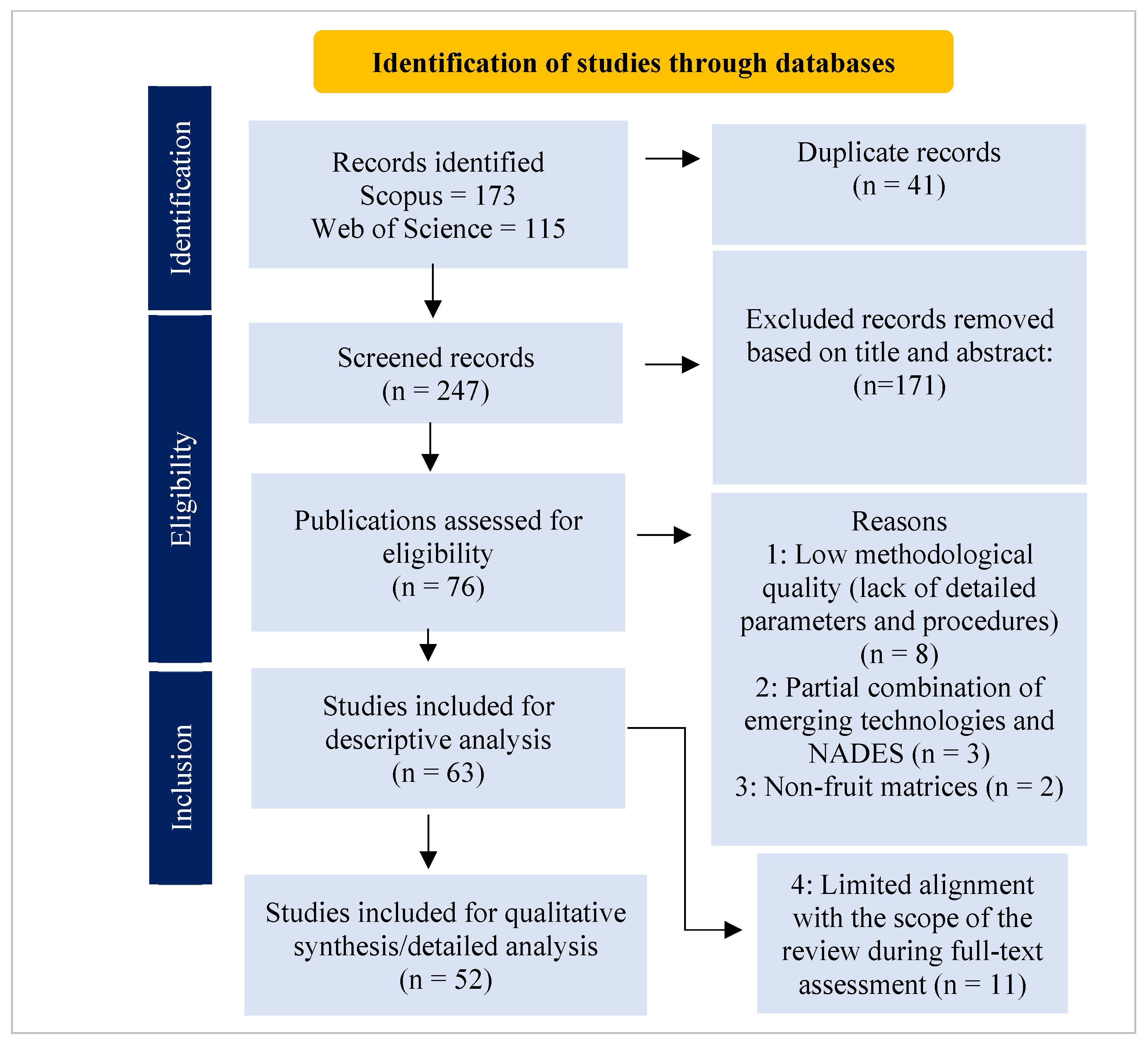
- Identification: A total of 173 articles were identified in Scopus and 115 in Web of Science. After removing duplicates, 247 records remained.
- Screening: Titles and abstracts were reviewed to exclude non-relevant articles.
- Eligibility: The full texts of the articles were assessed for thematic relevance and methodological quality using a scale from 1 to 3 for each dimension (Table 1). The studies were ranked by total score (maximum of 10 points), and those scoring 5 or higher were selected. A 5-point assessment scale was established to ensure the inclusion of studies of moderate to high quality. This scale was strategically selected in accordance with the research objectives to exclude articles that did not report critical operational parameters. A total of 63 articles with the highest relevance were included.
- Inclusion: As shown in Figure 1, a total of 288 records were identified through the database search. After removing 41 duplicate records, 247 records were assessed by title and abstract. During this stage, 171 records were excluded because they did not meet the inclusion criteria. Subsequently, 76 full-text articles were assessed in the eligibility stage. After this assessment, 13 articles were excluded for the following reasons: low methodological quality due to a lack of detailed parameters and procedures (n = 8), partial combination of emerging technologies and NADES (n = 3), and non-fruit matrices (n = 2). Finally, 63 studies were included in the descriptive and bibliometric analysis. Of these, 52 were selected for the qualitative synthesis because they reported sufficiently detailed and comparable information on the core elements of the review.
3. Results and Discussion
3.1. Bibliometric and Descriptive Analyses of the Studies Included
3.2. Physicochemical Properties of NADES in Bioactive Compound Extraction
3.2.1. Components and Their Relationship with the Compound’s Nature
3.2.2. Water Content and Polarity and Viscosity Modifications
3.3. Application of Emerging Technologies and NADES in Plant Matrices and Extraction Process Intensification
3.3.1. Microwave-Assisted Extraction + NADES
3.3.2. Ultrasound-Assisted Extraction + NADES
3.3.3. Pulsed Electric Fields and Pressurized Liquids + NADES
3.4. Identification of Phytochemicals and Antioxidant Potential of the Obtained Extracts
3.4.1. Phytochemical Profile
3.4.2. Antioxidant Activity and Antioxidant Capacity of NADES and Emerging and Conventional Technologies
3.5. Technological Impact and Industrial Prospects of NADES-Derived Extracts
3.5.1. Potential Use in Functional Foods and Ready-to-Use Products
- Functional beverages and clean-label extracts
- Functional ingredients derived from polyphenols and anthocyanins
- Polysaccharide fractions with prebiotic functionality
3.5.2. Technological Formulation Compatibility and Extract Stability
3.5.3. Industrial Applications in Materials and Packaging
3.5.4. Clean-Label, Sustainable, and By-Product Valuation
3.5.5. Industrial Compatibility
- Operational efficiency
- Downstream processing and recovery/separation of NADES according to application
- Scale-up: toward reproducible and competitive processes
- Qualitative techno-economic considerations
- Scale-up: toward reproducible and competitive processes
3.5.6. Limitations of This Review
4. Conclusions
Supplementary Materials
Author Contributions
Funding
Data Availability Statement
Conflicts of Interest
Abbreviations
| PLE | Pressurized liquid extraction |
| MAE | Microwave technology |
| HP | High-pressure technology |
| UAE | Ultrasound technology |
| pulse-UAE | Pulsed ultrasound-assisted extraction |
| DES | Deep eutectic solvents |
| NADES | Natural deep eutectic solvents |
| PEF | Pulsed electric field |
| HBD | Hydrogen bond donor |
| HBA | Hydrogen bond acceptor |
| ChCl | Choline chloride |
| GAE | Gallic acid |
| TPC | total phenolic content |
| DW | Dry weight |
| SSR | Sample-to-solvent ratio |
| C3G | Cyanidin 3-glucoside |
| CAT | Total anthocyanins |
| QE | Quercetin |
| AAE | Ascorbic acid equivalent |
| TE | Trolox |
| TAL | Total anthocyanin levels |
| FW | Fresh weight |
References
- Mulia, K.; Fauzia, F.; Krisanti, E.A. Polyalcohols as hydrogen-bonding donors in choline chloride-based deep eutectic solvents for extraction of xanthones from the pericarp of Garcinia mangostana L. Molecules 2019, 24, 636. [Google Scholar] [CrossRef] [PubMed]
- Krgović, N.; Jovanović, M.S.; Nedeljković, S.K.; Šavikin, K.; Lješković, N.J.; Ilić, M.; Živković, J.; Menković, N. Natural deep eutectic solvents extraction of anthocyanins—Effective method for valorisation of black raspberry (Rubus occidentalis L.) pomace. Ind. Crops Prod. 2025, 223, 120237. [Google Scholar] [CrossRef]
- Guo, Y.; Li, Y.; Li, Z.; Jiang, L.; Cao, X.; Gao, W.; Wang, J.; Luo, D.; Chen, F. Deep eutectic solvent-homogenate based microwave-assisted hydrodistillation of essential oil from Litsea cubeba (Lour.) Pers. fruits and its chemical composition and biological activity. J. Chromatogr. A 2021, 1646, 462089. [Google Scholar] [CrossRef] [PubMed]
- Yaakob, M.; Salim, N.; Mustapha, S.N.H.; Misnon, I.I.; Rahim, M.H.A.; Roslan, R. Efficient lignin extraction of lignin from oil palm empty fruit bunchbunches using guanidine-based deep eutectic solvents withunder microwave assistance. Ind. Crops Prod. 2024, 218, 118968. [Google Scholar] [CrossRef]
- Vargas, C.L.; Ochoa-Martínez, C.I.; Vélez-Pasos, C. Microwave-assisted extraction of phenolic compounds from pineapple peel using deep eutectic solvents. Horticulturae 2022, 8, 791. [Google Scholar] [CrossRef]
- González, J.; Mero, A.; Husanu, E.; Mezzetta, A.; Ferrari, C.; D’Andrea, F.; Bramanti, E.; Pomelli, C.S.; Guazzelli, L. Combining acid-based deep eutectic solvents and microwave irradiation for improved chestnut shell waste valorization. Green. Chem. 2021, 23, 10101–10115. [Google Scholar] [CrossRef]
- Page, M.J.; McKenzie, J.E.; Bossuyt, P.M.; Boutron, I.; Hoffmann, T.C.; Mulrow, C.D.; Shamseer, L.; Tetzlaff, J.M.; Akl, E.A.; Brennan, S.E.; et al. The PRISMA 2020 Statement: An Updated Guideline for Reporting Systematic Reviews. BMJ 2021, 372. [Google Scholar] [CrossRef]
- Vanda, H.; Dai, Y.; Wilson, E.G.; Verpoorte, R.; Choi, Y.H. Green solvents from ionic liquids and deep eutectic solvents to natural deep eutectic solvents. Comptes Rendus Chim. 2018, 21, 628–638. [Google Scholar] [CrossRef]
- Cao, Q.; Li, J.; Xia, Y.; Li, W.; Luo, S.; Ma, C.; Liu, S. Green Extraction of Six Phenolic Compounds from Rattan (Calamoideae faberii) with Deep Eutectic Solvent by Homogenate-Assisted Vacuum-Cavitation Method. Molecules 2018, 24, 113. [Google Scholar] [CrossRef]
- Velásquez, P.; Bustos, D.; Montenegro, G.; Giordano, A. Ultrasound-assisted extraction of anthocyanins using natural deep eutectic solvents and their incorporation in edible films. Molecules 2021, 26, 984. [Google Scholar] [CrossRef]
- Bozkurt, R.N.; Falsafi, S.R.; Şahin, S. Tailoring natural solvents: Deep eutectic approach for recovering bioactives from Prunus spinosa L. Chem. Biodivers. 2025, 22, e01858. [Google Scholar] [CrossRef]
- Liang, Y.; Pan, Z.; Chen, Z.; Fei, Y.; Zhang, J.; Yuan, J.; Zhang, L.; Zhang, J. Ultrasound-assisted natural deep eutectic solvents as separation-free extraction media for hydroxytyrosol from olives. ChemistrySelect 2020, 5, 10939–10944. [Google Scholar] [CrossRef]
- Suksawat, T.; Boonthaworn, N.; Junseedeechai, Y.; Kitisripanya, T.; Chewchinda, S.; Aneklaphakij, C. Development of naringin extract from pomelo peel using natural deep eutectic solvent system as green technology for antidiabetic purpose: Box-Behnken Design Approach. J. Pharm. Innov. 2025, 20, 190. [Google Scholar] [CrossRef]
- Yan, K.; Liu, X.; Li, L.; Zhu, S.; Zheng, L.; He, S.; Jia, X.; Dong, W.; Liu, Y.; Lu, Z.; et al. Ultrasound-assisted deep eutectic solvents extraction of polysaccharides from loquat leaf: Process optimization and bioactivity study. Int. J. Biol. Macromol. 2024, 274, 133308. [Google Scholar] [CrossRef]
- Molnar, M.; Jakovljević Kovač, M.; Jakobek, L.; Mihajlović, L.; Pavić, V. Green extraction of phenolic compounds from Aronia melanocarpa using deep eutectic solvents. Antioxidants 2025, 14, 31. [Google Scholar]
- Domínguez, G.; Castro-Puyana, M.; Marina, M.L. Innovative microwave-assisted extraction with biobased solvents to enhance recovery of bioactive extractable and non-extractable polyphenols from lemon peels. Food Chem. 2025, 494, 146195. [Google Scholar] [CrossRef]
- Li, Z.; Shu, X.; Chen, Y.; Guo, Y.; Yu, W.; Qu, L.; Wang, Q.; Zhang, Y.; Ning, F.; Li, J.; et al. Ultrasound-assisted extraction with natural deep eutectic solvents coupled with metabolomic and KEGG pathway analyses for bioactive compounds from thinned young citrus fruits. Food Chem. 2025, 495, 146187. [Google Scholar] [CrossRef]
- Görüşük, E.M.; Lalikoglu, M.; Aşçı, Y.S.; Bener, M.; Bekdeşer, B.; Apak, R. Novel tributyl phosphate-based deep eutectic solvent: Application in microwave-assisted extraction of carotenoids. Food Chem. 2024, 459, 140418. [Google Scholar] [CrossRef]
- Lopes de Oliveira, I.; Domínguez-Rodríguez, G.; Montero, L.; Viganó, J.; Cifuentes, A.; Rostagno, M.A.; Ibáñez, E. Advanced Extraction Techniques Combined with Natural Deep Eutectic Solvents for Extracting Phenolic Compounds from Pomegranate (Punica granatum L.) Peels. Int. J. Mol. Sci. 2024, 25, 9992. [Google Scholar] [CrossRef] [PubMed]
- Mohd Rosdan, M.D.E.; Awang, M.A.; Benjamin, M.A.Z.; Andrew, F.A.; Saini, A.; Mohd Amin, S.F.; Julmohammad, N. Natural deep eutectic solvents vs. Conventional solvents: Effects on crude yield, mangiferin content, antioxidant activity, and toxicity in Mangifera pajang kosterm. Fruit extracts. Malays. Appl. Biol. 2025, 54, 87–97. [Google Scholar] [CrossRef]
- de Lima, N.D.; da Silva Monteiro Wanderley, B.R.; Andrade Ferreira, A.L.; Pereira-Coelho, M.; da Silva Haas, I.C.; Vitali, L.; dos Santos Madureira, L.A.; Müller, J.M.; Fritzen-Freire, C.B.; de Mello Castanho Amboni, R.D. Green extraction of phenolic compounds from the by-product of purple araçá (Psidium myrtoides) with natural deep eutectic solvents assisted by ultrasound: Optimization, comparison, and bioactivity. Food Res. Int. 2024, 191, 114731. [Google Scholar] [CrossRef]
- Gómez-López, I.; Lobo-Rodrigo, G.; Portillo, M.P.; Cano, M.P. Ultrasound-Assisted “Green” Extraction (UAE) of Antioxidant Compounds (Betalains and Phenolics) from Opuntia stricta var. Dilenii’s Fruits: Optimization and Biological Activities. Antioxidants 2021, 10, 1786. [Google Scholar] [CrossRef]
- Milošević, S.; Bebek Markovinović, A.; Teslić, N.; Mišan, A.; Pojić, M.; Brčić Karačonji, I.; Jurica, K.; Lasić, D.; Putnik, P.; Bursać Kovačević, D.; et al. Use of natural deep eutectic solvent (NADES) as a green extraction of antioxidant polyphenols from strawberry tree fruit (Arbutus unedo L.): An optimization study. Microchem. J. 2024, 200, 110284. [Google Scholar] [CrossRef]
- Liu, X.; Yang, X.; Sun, Y.; Ji, F.; Guo, M.; He, D.; Hu, J.; Hao, F.; Hu, K.; Wen, X. Two birds with one switchable deep eutectic solvent: Integration of digestion and extraction for multi-ingredient quantitative analysis and quality evaluation of Amomi fructus. Food Chem. 2025, 492, 145538. [Google Scholar] [CrossRef] [PubMed]
- Costa, D.; Rupasinghe, H.P.V. Development of a scalable extraction process for anthocyanins of haskap berry (Lonicera caerulea). Molecules 2025, 30, 1071. [Google Scholar] [CrossRef]
- Sánchez, A.; Hernández-Corroto, E.; García, M.C.; Castro-Puyana, M.; Marina, M.L. Sustainable extraction of proteins from lime peels using ultrasound, deep eutectic solvents, and pressurized liquids, as a source of bioactive peptides. Food Chem. 2024, 458, 140139. [Google Scholar] [CrossRef]
- Yu, L.; Jovcevski, B.; Pukala, T.L.; Bulone, V. Profiling and optimized extraction of bioactive polyphenolic compounds from young, red-fleshed apple using eco-friendly deep eutectic solvents. Food Res. Int. 2024, 187, 114334. [Google Scholar] [CrossRef] [PubMed]
- Socas-Rodríguez, B.; Torres-Cornejo, M.V.; Álvarez-Rivera, G.; Mendiola, J.A. Deep eutectic solvents for the extraction of bioactive compounds from natural sources and agricultural by-products. Appl. Sci. 2021, 11, 4897. [Google Scholar] [CrossRef]
- Natnoi, S.; Pirak, T. Effect of ultrasonic-assisted extraction on the properties, antioxidant and inflammatory activities of carotenoids from gac (Momordica cochinchinensis) fruit pericarp. Cogent Food Agric. 2019, 5, 1696512. [Google Scholar] [CrossRef]
- Algan-Cavuldak, Ö. Green Extraction of Antioxidant Polyphenols from Strawberry Tree (Arbutus unedo L.) Fruits and Leaves: Application of Deep Eutectic Solvents in the Ultrasound-Assisted Extraction. An. Acad. Bras. Ciências 2025, 97, e20241084. [Google Scholar] [CrossRef]
- Oliva, E.; Mir-Cerdà, A.; Sergi, M.; Granados, M.; Sentellas, S.; Saurina, J. Green extraction of phenolic compounds from strawberry waste based on natural deep eutectic solvents. Int. J. Food Sci. Technol. 2024, 59, 3967–3977. [Google Scholar] [CrossRef]
- Zannou, O.; Pashazadeh, H.; Ghellam, M.; Ali Redha, A.; Koca, I. Enhanced ultrasonically assisted extraction of bitter melon (Momordica charantia) leaf phenolic compounds using choline chloride-acetic acid–based natural deep eutectic solvent: An optimization approach and in vitro digestion. Biomass Convers. Biorefin. 2024, 14, 11491–11503. [Google Scholar] [CrossRef]
- Hamza, H.; Elfalleh, W.; Nagaz, K. Date Palm Seed Oil (Phoenix dactylifera L.) Green Extraction: Physicochemical Properties, Antioxidant Activities, and Phenolic and Fatty Acid Profiles. J. Food Qual. 2021, 2021, 2394220. [Google Scholar] [CrossRef]
- da Silva, L.C.; Souza, M.C.; Sumere, B.R.; Silva, L.G.S.; da Cunha, D.T.; Barbero, G.F.; Bezerra, R.M.N.; Rostagno, M.A. Simultaneous extraction and separation of bioactive compounds from apple pomace using pressurized liquids coupled on-line with solid-phase extraction. Food Chem. 2020, 318, 126450. [Google Scholar] [CrossRef] [PubMed]
- Handayani, R.; Bangun, A.; Deborah, P.D.; Mun’im, A. Optimization of microwave- and ultrasonic-assisted extraction of mahkota dewa (Phaleria Macrocarpa [scheff.] boerl.) fruit pulp. Int. J. Appl. Pharm. 2020, 12, 32–37. [Google Scholar] [CrossRef]
- Montero-Calderón, A.; Cortés, C.; Zulueta, A.; Frigola, A.; Esteve, M.J. Green solvents and ultrasound-assisted extraction of bioactive orange (Citrus sinensis) peel compounds. Sci. Rep. 2019, 9, 16120. [Google Scholar] [CrossRef] [PubMed]
- Zhang, Q.; Peng, Y.; Xu, Y.; Li, F.; Liu, S.; Bukvicki, D.; Zhang, Q.; Lin, S.; Wang, M.; Zhang, T.; et al. Extraction, Characterization, and In Vitro Biological Activity of Polyphenols from Discarded Young Fig Fruits Based on Deep Eutectic Solvents. Antioxidants 2024, 13, 1084. [Google Scholar] [CrossRef] [PubMed]
- Vo, T.P.; Pham, N.D.; Pham, T.V.; Nguyen, H.Y.; Vo, L.T.V.; Tran, T.N.H.; Tran, T.N.; Nguyen, D.Q. Green extraction of total phenolic and flavonoid contents from mangosteen (Garcinia mangostana L) rind using natural deep eutectic solvents. Heliyon 2023, 9, e14884. [Google Scholar] [CrossRef]
- Lin, S.; Meng, X.; Tan, C.; Tong, Y.; Wan, M.; Wang, M.; Zhao, Y.; Deng, H.; Kong, Y.; Ma, Y. Composition and antioxidant activity of anthocyanins from Aronia melanocarpa extracted using an ultrasonic-microwave-assisted natural deep eutectic solvent extraction method. Ultrason. Sonochem. 2022, 89, 106102. [Google Scholar] [CrossRef]
- Vannuchi, N.; Braga, A.R.C.; De Rosso, V.V. High-Performance Extraction Process of Anthocyanins from Jussara (Euterpe edulis) Using Deep Eutectic Solvents. Processes 2022, 10, 615. [Google Scholar] [CrossRef]
- Wang, H.; Li, X.; Cui, L.; Guo, L.; Wang, A.; Chu, G.; He, S.; Liu, S.; Fu, Y.; Liu, Z. Microwave-assisted deep eutectic solvent extraction and quantification of six bioactive compounds from Vaccinium vitis-idaea L. Leaves. J. Food Meas. Charact. 2025, 19, 8988–9002. [Google Scholar] [CrossRef]
- Ma, P.; Li, Z.; Jin, Y.; Zuo, J.; Zhang, Y.; Dong, A.; Xiao, D.; Burenjargal, M. Green and efficient extraction process of flavonoids from sea buckthorn fruits by natural deep eutectic solvents aided with ultrasound. Microchem. J. 2024, 205, 111265. [Google Scholar] [CrossRef]
- Fu, X.; Wang, D.; Belwal, T.; Xu, Y.; Li, L.; Luo, Z. Sonication-synergistic natural deep eutectic solvent as a green and efficient approach for extraction of phenolic compounds from peels of Carya cathayensis Sarg. Food Chem. 2021, 355, 129577. [Google Scholar] [CrossRef] [PubMed]
- Fu, X.; Wang, D.; Belwal, T.; Xie, J.; Xu, Y.; Li, L.; Zou, L.; Zhang, L.; Luo, Z. Natural deep eutectic solvent enhanced pulse-ultrasonication assisted extraction as a multi-stability protective and efficient green strategy to extract anthocyanin from blueberry pomace. LWT 2021, 144, 111220. [Google Scholar] [CrossRef]
- El Kantar, S.; Rajha, H.N.; Boussetta, N.; Vorobiev, E.; Maroun, R.G.; Louka, N. Green extraction of polyphenols from grapefruit peels using high voltage electrical discharges, deep eutectic solvents and aqueous glycerol. Food Chem. 2019, 295, 165–171. [Google Scholar] [CrossRef] [PubMed]
- Fernandez, D.; Cintas, P. Intensification factor for green chemistry and engineering: Decision-making tool in process assessment. Sustain. Chem. Pharm. 2022, 27, 100651. [Google Scholar] [CrossRef]
- Rivas, D.F.; Castro-Hernández, E.; Villanueva Perales, A.L.; van der Meer, W. Evaluation method for process intensification alternatives. Chem. Eng. Process. 2018, 123, 221–232. [Google Scholar] [CrossRef]
- Cegledi, E.; Dobroslavić, E.; Pidišić, S.; Magnabosca, I.; Zorić, M.; Pavić, R.; Šuto, M.; Štargl, O.; Repajić, M.; Elez Garofulić, I. Green Approaches for the Extraction of Banana Peel Phenolics Using Deep Eutectic Solvents. Molecules 2024, 29, 3672. [Google Scholar] [CrossRef]
- Wang, Q.; Chen, J.J.; Qiu, B.; Zhou, L.; Liu, R.Y.; Huang, J.F.; He, Y.; Xie, Q. Optimization of ultrasound-assisted deep eutectic solvents extraction of rutin from Ilex asprella using response surface methodology. Sci. Rep. 2025, 15, 6205. [Google Scholar] [CrossRef]
- Sik, B.; Székelyhidi, R.; Lakatos, E.; Ajtony, Z. Using natural deep eutectic solvents for the extraction of antioxidant compounds from cornelian cherry (Cornus mas L.) fruits. Green. Anal. Chem. 2024, 11, 100154. [Google Scholar] [CrossRef]
- Chaudhary, K.; Khalid, S.; Alomar, T.S.; AlMasoud, N.; Ansar, S.; Ghazal, A.F.; Aït-Kaddour, A.; Aadil, R.M. Ultrasound assisted natural deep eutectic solvents based sustainable extraction of Spirulina platensis and orange peel extracts for the development of strawberry-cantaloupe based novel clean-label functional drink. Ultrason. Sonochem. 2025, 118, 107357. [Google Scholar] [CrossRef]
- Bertolo, M.R.V.; Azzolini, A.E.C.S.; Souza, A.C.C.; Bogusz, S., Jr. Utilization of pomegranate peel waste: Natural deep eutectic solvents as a green strategy to recover valuable phenolic compounds. J. Clean. Prod. 2021, 327, 129471. [Google Scholar] [CrossRef]
- Subhash, A.J.; Bamigbade, G.B.; Tarique, M.; Al-Ramadi, B.; Abu-Jdayil, B.; Kamal-Eldin, A.; Nyström, L.; Ayyash, M. Bioactive properties and gut microbiota modulation by date seed polysaccharides extracted using ultrasound-assisted deep eutectic solvent. Food Chem. X 2024, 22, 101354. [Google Scholar] [CrossRef] [PubMed]
- Cádiz-Gurrea, M.L.; Villegas-Aguilar, M.C.; Leyva-Jiménez, F.J.; Pimentel-Moral, S.; Fernández-Ochoa, Á.; Alañón, M.E.; Segura-Carretero, A. Revalorization of bioactive compounds from tropical fruit by-products and industrial applications by means of sustainable approaches. Food Res. Int. 2020, 138, 109786. [Google Scholar] [CrossRef] [PubMed]
- Otero-Guzman, N.; Andrade-Pizarro, R. Bioactive compounds from tropical fruit by-products: Extraction, characterization and therapeutic potential. J. Agric. Food Res. 2025, 21, 101983. [Google Scholar] [CrossRef]
- Liu, Z.; Li, G.; Wen, Y.; Chen, H. Ultrasound-assisted extraction of polysaccharides from Syzygium jambos (L.) Alston fruit by deep eutectic solvent and its biological functions. Nat. Prod. Res. 2025. [Google Scholar] [CrossRef]
- Kitrytė, V.; Kavaliauskaitė, A.; Tamkutė, L.; Pukalskienė, M.; Syrpas, M.; & Rimantas Venskutonis, P. Zero waste biorefining of lingonberry (Vaccinium vitis-idaea L.) pomace into functional ingredients by consecutive high pressure and enzyme assisted extractions with green solvents. Food Chem. 2020, 322, 126767. [Google Scholar] [CrossRef]
- Casazza, A.A.; Pettinato, M.; Perego, P. Polyphenols from apple skins: A study on microwave-assisted extraction optimization and exhausted solid characterization. Sep. Purif. Technol. 2020, 240, 116640. [Google Scholar] [CrossRef]
- Ali, M.C.; Chen, J.; Zhang, H.; Li, Z.; Zhao, L.; Qiu, H. Effective extraction of flavonoids from Lycium barbarum L. fruits by deep eutectic solvents-based ultrasound-assisted extraction. Talanta 2019, 203, 16–22. [Google Scholar] [CrossRef]
- Baria, B.; Upadhyay, N.; Singh, A.K.; Malhotra, R.K. Optimization of ‘green’ extraction of carotenoids from mango pulp using split plot design and its characterization. LWT 2019, 104, 186–194. [Google Scholar] [CrossRef]
- Silva, Y.P.A.; Ferreira, T.A.P.C.; Jiao, G.; Brooks, M.S. Sustainable approach for lycopene extraction from tomato processing by-product using hydrophobic eutectic solvents. J. Food Sci. Technol. 2019, 56, 1649–1654. [Google Scholar] [CrossRef]
- Vorobyova, V.; Vasyliev, G.; Skiba, M.; Frolenkova, S.; Zaporozhets, J.; Gnatko, O.; Linyucheva, O. Green extraction of phenolic compounds from grape pomace by deep eutectic solvent extraction: Physicochemical properties, antioxidant capacity. Chem. Pap. 2023, 77, 2447–2458. [Google Scholar] [CrossRef]
- Kanberoglu, G.S.; Yilmaz, E.; Soylak, M. Application of deep eutectic solvent in ultrasound-assisted emulsification microextraction of quercetin from some fruits and vegetables. J. Mol. Liq. 2019, 279, 571–577. [Google Scholar] [CrossRef]
- Koraqi, H.; Yüksel Aydar, A.; Pandiselvam, R.; Qazimi, B.; Khalid, W.; Trajkovska Petkoska, A.; Çesko, C.; Ramniwas, S.; Mohammed Basheeruddin Asdaq, S.; Rustagi, S. Optimization of extraction condition to improve blackthorn (Prunus spinosa L.) polyphenols, anthocyanins and antioxidant activity by natural deep eutectic solvent (NADES) using the simplex lattice mixture design method. Microchem. J. 2024, 200, 110497. [Google Scholar] [CrossRef]
- Machmudah, S.; Lestari, S.D.; Widiyastuti; Wahyudiono; Kanda, H.; Winardi, S.; Goto, M. Subcritical water extraction enhancement by adding deep eutectic solvent for extracting xanthone from mangosteen pericarps. J. Supercrit. Fluids 2018, 133, 615–624. [Google Scholar] [CrossRef]
- Bamigbade, G.B.; Subhash, A.J.; Al-Ramadi, B.; Kamal-Eldin, A.; Gan, R.-Y.; Liu, S.Q.; Ayyash, M. Gut microbiota modulation, prebiotic and bioactive characteristics of date pomace polysaccharides extracted by microwave-assisted deep eutectic solvent. Int. J. Biol. Macromol. 2024, 262, 130167. [Google Scholar] [CrossRef] [PubMed]




| Score | Description |
|---|---|
| Thematic relevance: Does the study address the review question? | |
| Low (1) | The article addresses the topic only marginally or is not clearly related. |
| Medium (2) | The article partially addresses the objective (e.g., only NADES, but not emerging technologies or in fruit matrices). |
| High (3) | This study directly aligns with the objectives, combining NADES, bioactive compounds, and emerging technologies in fruit matrices. |
| Methodological quality: Is the article well designed and described? | |
| Low (1) | Poorly described methodology or lack of procedural details; and lack of quantitative or statistical analysis. |
| Medium (2) | An acceptable methodology, but with limitations; the design is reasonably explained. |
| High (3) | A clear methodology with well-presented procedures and rigorous statistical analysis was used. |
| Bioactive Compound Group | Fruit Matrix | NADES Composition | HBD–HBA Ratio | Co-Solvent Content | Extraction Efficiency/Main Result | Reference |
|---|---|---|---|---|---|---|
| Anthocyanins | Black raspberry pomace | ChCl–citric acid | 1:1 | 20% water | 7.50 mg cyanidin-3-O-rutinoside g−1 dry weight | [2] |
| Black raspberry pomace | ChCl–citric acid | 1:1 | 20% water | 7.32 mg cyanidin-3-O-glucoside equivalents g−1 dry weight | [2] | |
| Black raspberry pomace | ChCl–tartaric acid | 1:1 | 20% water | 38.2 mg cyanidin-3-O-glucoside equivalents kg−1 | [15] | |
| Flavonoids | Lemon peel | ChCl–citric acid | 1:2 | 50% ethanol | limocitrol-hexoside-rutinoside detected with a m/z ion at 681 [M–H]− | [16] |
| Lemon peel | ChCl–citric acid | 1:2 | 50% ethanol | vicenin-2 detected with a m/z ion at 593 [M–H]− | [16] | |
| Black chokeberry | ChCl–malonic acid | 1:1 | 20% water | 1188.7 mg flavonols kg−1 | [15] | |
| Chestnut shell waste | ChCl–oxalic acid dihydrate | 1:1 | Water of crystallization; no added co-solvent | 38.6 μg procyanidin B2 g−1 dry weight | [6] | |
| Total phenolics and phenolic acids | Chestnut shell waste | ChCl–oxalic acid dihydrate | 1:1 | Water of crystallization; no added co-solvent | 109.9 mg gallic acid g−1 dry weight | [6] |
| Chestnut shell waste | ChCl–oxalic acid dihydrate | 1:1 | Water of crystallization; no added co-solvent | 582.8 μg gallic acid g−1 dry weight | [6] | |
| Purple araçá by-product | ChCl–glycerol | 1:2 | Not reported | 336.48 mg catechin g−1 26.09 mg isoquercetin g−1 | [17] | |
| Black chokeberry | ChCl–tartaric acid | 1:1 | 20% water | 1428.2 mg chlorogenic acid kg−1 | [15] | |
| Chestnut shell waste | ChCl–oxalic acid dihydrate | 1:1 | Water of crystallization; no added co-solvent | 458.1 μg hydrated catechin g−1 dry weight | [6] | |
| Functional components | Chestnut shell waste | ChCl–oxalic acid dihydrate | 1:1 | Water of crystallization; no added co-solvent | 24.1% hemicellulose 37.4% cellulose 21.1% lignin | [6] |
| Ref. | Fruit Matrix | Matrix Part | Conventional Technique | Technologies | Solvent | |||||
|---|---|---|---|---|---|---|---|---|---|---|
| Common Name | Scientific Name | PLE | MAE | HP | UAE | DES | NADES | |||
| [17] | Mandarin | Citrus reticulata Blanco | Fruit | ✔ | ✔ | |||||
| [16] | Lemon peel | Citrus limon Rutaceae | Peel | ✔ | ✔ | ✔ | ✔ | |||
| [21] | Purple araçá | Psidium myrtoides | Frui | ✔ | ✔ | ✔ | ||||
| [22] | Prickly pear | Opuntia stricta | Pee | ✔ | ✔ | |||||
| [23] | Strawberry | Fragaria × ananassa | Fruit | ✔ | ||||||
| [24] | Sha Ren | Amomi fructus | Fruit | ✔ | ✔ | ✔ | ||||
| [25] | Haskap Berry | Lonicera caerulea | Fruit | ✔ | ✔ | |||||
| [15] | - | Aronia melanocarpa | Fruit | ✔ | ||||||
| [2] | Black raspberry | Rubus occidentalis L. | Residues | ✔ | ||||||
| [26] | Lime peel | Citrus × aurantiifolia | Peel | ✔ | ✔ | ✔ | ||||
| [27] | Apple | alus domestica Borkh | Fruit | ✔ | ||||||
| [28] | Goji | Lycium barbarum L. | Residues | ✔ | ✔ | ✔ | ✔ | |||
| [29] | Gac | Momordica cochinchinensis | Pericarp | ✔ | ✔ | |||||
| [30] | Strawberry tree | Arbutus unedo | Leaf | ✔ | ✔ | |||||
| [4] | Oil palm empty fruit bunches | Elaeis guineensis Jacq. | Fruit | ✔ | ✔ | |||||
| [19] | Pomegranate | Punica granatum L. | Peel | ✔ | ✔ | ✔ | ||||
| [14] | Loquat | Eriobotrya japonica (Thunb.) | Fruit | ✔ | ✔ | |||||
| [31] | Strawberry | Fragaria × ananassa | Residues | ✔ | ✔ | |||||
| [32] | Melon | Momordica charantia | Leaf | ✔ | ✔ | ✔ | ||||
| [6] | Chestnut | Castanea sativa | Fruit | ✔ | ✔ | |||||
| [33] | Date | Phoenix dactylifera L. | Seed | ✔ | ✔ | |||||
| [34] | Apple | Malus domestica Borkh | Residues | ✔ | ✔ | |||||
| [35] | Mahkota Dewa | Phaleria macrocarpa (Scheff.) Boerl | Residues | ✔ | ✔ | ✔ | ||||
| [36] | Orange | Citrus sinensis | Peel | ✔ | ✔ | |||||
| [1] | Mangosteen | Garcinia mangostana L. extract | Pericarp | ✔ | ||||||
| [9] | Rattan | Calamoideae faberii | Fruit | ✔ | ||||||
| [37] | Figs | Ficus carica L. | Fruit | ✔ | ||||||
| [38] | Mangosteen | Garcinia mangostana L. extract | Peel | ✔ | ✔ | |||||
| [5] | Pineapple | Ananas comosus | Peel | ✔ | ✔ | |||||
| [39] | Black aronia | Aronia melanocarpa | Fruit | ✔ | ✔ | |||||
| [40] | Jussara | Euterpe edulis | Fruit | ✔ | ✔ | ✔ | ||||
| Ref. | Matrix/Predominant Bioactive Compound | Parameters/Emerging Technologies | NADES Composition | The Dominant Intensification Mechanism | Intensification Factor | Evidence of Synergy |
|---|---|---|---|---|---|---|
| [48] | Banana peel/polyphenols | Microwave Optimal conditions: 400 W SSR 1:50 (v/w) for 10 min at 60 °C | ChCl–glycerol (1:3) + 30% water (w/w) | Hydrogen-bonding interactions enhance solubilization Microwave energy absorption | 1.26 | 68.62 mg/100 g DW (total polyphenols) |
| [48] | Banana peel/polyphenols | Ultrasound Optimal conditions: SSR 1:60 5 min, 75% amplitude 200 W, 26 kHz; ≤30 °C | ChCl–glycerol (1:3) + 30% water (w/w) | Capacity to dissolve polyphenols via intermolecular interactions Reduced need for high amplitudes as polyphenols are transferred more rapidly. | 2.01 | 73.64 mg/100 g DW (total polyphenols) |
| [19] | Pomegranate peel/tannin | Ultrasound 50 min SSR 1:50 (v/w) Ambient temperature Maximum ultrasonic bath power: 240 W | ChCl–lactic acid (1:2) + 40% water (w/w) | Viscosity reduces diffusive resistance Formation of hydrogen-bonding networks | 1.61 | 89 μg β-punicalagin/g sample |
| [19] | Pomegranate peel/tannin | Ultrasound 50 min SSR 1:50 (v/w) Ambient temperature Maximum ultrasonic bath power: 240 W | ChCl–lactic acid (1:1) + 40% water (w/w) | Viscosity reduces mass transfer resistance | 2.01 | 111 μg β-punicalagin/g sample |
| [19] | Pomegranate peel/tannin | Ultrasound 50 min SSR 1:50 (v/w) Ambient temperature Maximum ultrasonic bath power: 240 W | ChCl–glucose (1:2) + 40% water (w/w) | Viscosity dampens acoustic waves | 1.06 | 57 μg β-punicalagin/g sample |
| [31] | Strawberry waste/phenolic compounds | Ultrasound for 15 min at 40 °C Power/frequency: not reported | ChCl–lactic acid (1:5) + 30% water (w/w) | Formation of hydrogen-bonding networks between ChCl–lactic acid and the phenolic compounds | 1.26 | 2348 μg Isoquercetin/g of strawberry waste |
| [26] | Mexican lime peel/protein with potential for functional peptide release | Ultrasound Optimal conditions: 60% amplitude 23 min Sample: 150 mg | ChCl–urea–water (1:1:3) 1 | Protein solubilization capacity of NADES | 1.2 | 1.2 g protein/100 g peel |
| [26] | Spanish lime peel/protein with potential for functional peptide release | Ultrasound Optimal conditions: 70% amplitude for 30 min. Sample: 225 mg | ChCl–urea–water (1:1:3) 1 | Facilitated disruption of PSPNs | 1.4 | 0.7 g protein/100 g peel |
| [6] | Chestnut shell waste/polyphenols | Microwave Optimal conditions: 30 W, 85 °C, 60 min, SSR 1:10 (v/w) | ChCl–oxalic acid dihydrate (1:1 molar ratio) | Structural disruption of lignin Acid-induced depolymerization | 1.49 | 295.2 mg gallic acid/g CSW |
| Ref. | Matrix/By-Product | NADES | Emerging Technology | Phytochemicals/ Target Fraction | Technological Finding | Application or Industrial Potential | Industrial Critical Points |
|---|---|---|---|---|---|---|---|
| [17] | Thinned young citrus fruits | ChCl–glycerol ChCl–malic acid ChCl–glucose | UAE + metabolomics/KEGG | Phenolics and flavonoids | Comparison of “green solvents”: evidence of the competitive performance of ChCl–glycerol in citrus matrices | Antioxidant/functional ingredients; by-product valorization | NADES selection conditioned by viscosity and performance; formulation control (% water) |
| [2] | Black raspberry pomace | Chlorine + natural organic acids | UAE | Anthocyanins | NADES = high performance and improved anthocyanin stability during storage (4 °C/25 °C/40 °C) | Natural colorants/antioxidants; functional foods and beverages | NADES high viscosity (mitigated with water); balance of performance and stability; storage control |
| [51] | Spirulina platensis + orange peel | Lactic acid–Ch1Cl ratio (2:1) | UAE-NADES | Antioxidants: functional compounds from microalgae/citrus | Clean-label beverage with enhanced stability, functional properties, and sensory attributes | Ready-to-drink functional drink (clean label) | Integration of extraction and formulation, sensory compatibility, and decision to use the extract directly in NADES |
| [52] | Pomegranate peel | ChCl–lactic acid ChCl–citric acid ChCl–glycerol ChCl–glucose ChCl–sucrose | “Green strategy” approach + (U.A.E. in the design) | Phenolics | ChCl–Lactic acid stands out as an effective NADES; recovery/separation is explicitly discussed as part of industrial viability. | Antioxidant ingredient; agro-industrial waste valorization | Downstream (NADES recovery/solute separation) as a key scaling gap |
| [44] | Blueberry pomace | ChCl–oxalic acid | Pulse ultrasonication + NADES | Anthocyanins | “Multi-stability protective” strategy: This strategy combines efficient extraction with protection/stability under environmental conditions. | Antioxidant/coloring ingredient; potential direct use depending on application | Water management in NADES (flow vs. H-bond network rupture); stability of pH, temperature, and light |
| [48] | Banana peel | ChCl–glycerol ratio (1:3) | Comparison of the UAE/MAE and green approaches | Phenolics and flavonoids | Comparative evidence of intensification (UAE/MAE) to maximize recovery using naphthalene diacetate | Antioxidant ingredient; waste valorization | Technology selection based on cost/energy; operation with NADES (handling/viscosity) |
| [10] | Luma chequen fruit | Lactic acid–glucose (8:1) Citric acid–glycerol (4:6) Glycerol–glucose (8:1) Tartaric acid–glycerol (1:4) | Incorporation of UAE-NADES+ into edible films | Anthocyanins (extract) | NADES extracts incorporated into bioactive edible films (antioxidant/antibacterial) | Active packaging/edible coatings | Solvent compatibility with the material and potential advantage of glycerol extracts (use without solvent removal) |
| Criterion | Conventional Solvent Extraction | NADES-Assisted Extraction Systems | Industrial Implication |
|---|---|---|---|
| Extraction performance | Hydroalcoholic solvents are effective but may require longer extraction times or higher solvent volumes. | NADES combined with UAE or MAE can improve recovery of phenolics, anthocyanins, proteins, and polysaccharides in fruit matrices and by-products [2,6,16,26,48]. | NADES are promising when selectivity, compound preservation, or intensified extraction is required. |
| Process handling | Ethanol–water systems usually show low viscosity and are easier to pump, mix, and filter. | Many NADES have high viscosity, which may restrict mass transfer; water addition, temperature control, UAE, or MAE can improve processability [2,19,26]. | Viscosity management is a critical requirement for scale-up. |
| Stability and direct use | Solvent removal is commonly required before incorporation into food or pharmaceutical products. | NADES may stabilize sensitive compounds and allow direct or semi-direct use in beverages, edible films, active packaging, or functional formulations [10,44,51]. | Direct use can reduce purification steps, but requires sensory, toxicological, and regulatory validation. |
| Downstream processing and reuse | Solvent evaporation and recovery are well established for ethanol-based systems. | Separation of target compounds from NADES and solvent reuse are still insufficiently standardized; recrystallization, adsorption, and anti-solvents have been proposed [52]. | Recovery efficiency and reuse cycles remain key barriers for industrial implementation. |
| Economic and environmental feasibility | Conventional solvents may involve volatility, flammability, and environmental concerns, but their cost and regulation are well established. | NADES show low volatility and tunable properties, but their cost, biodegradability, and environmental superiority depend on their components [52,54,55]. | NADES should be assessed case by case through techno-economic, regulatory, and sustainability criteria. |
Disclaimer/Publisher’s Note: The statements, opinions and data contained in all publications are solely those of the individual author(s) and contributor(s) and not of MDPI and/or the editor(s). MDPI and/or the editor(s) disclaim responsibility for any injury to people or property resulting from any ideas, methods, instructions or products referred to in the content. |
© 2026 by the authors. Licensee MDPI, Basel, Switzerland. This article is an open access article distributed under the terms and conditions of the Creative Commons Attribution (CC BY) license.
Share and Cite
Guillén Sánchez, J.S.; Javier-Ninahuaman, H.; Salvador-Reyes, R.; Rojas-Hurtado, G.; Quispe, G.; Yauri, B.; Quispe-Calla, A. Advances in the Green Extraction of Phytochemicals from Fruit Matrices Using Emerging Technologies and Natural Deep Eutectic Solvents: A Systematic Review. Resources 2026, 15, 75. https://doi.org/10.3390/resources15060075
Guillén Sánchez JS, Javier-Ninahuaman H, Salvador-Reyes R, Rojas-Hurtado G, Quispe G, Yauri B, Quispe-Calla A. Advances in the Green Extraction of Phytochemicals from Fruit Matrices Using Emerging Technologies and Natural Deep Eutectic Solvents: A Systematic Review. Resources. 2026; 15(6):75. https://doi.org/10.3390/resources15060075
Chicago/Turabian StyleGuillén Sánchez, Jhoseline Stayce, Henry Javier-Ninahuaman, Rebeca Salvador-Reyes, Gary Rojas-Hurtado, Grimaldo Quispe, Brenda Yauri, and Anhell Quispe-Calla. 2026. "Advances in the Green Extraction of Phytochemicals from Fruit Matrices Using Emerging Technologies and Natural Deep Eutectic Solvents: A Systematic Review" Resources 15, no. 6: 75. https://doi.org/10.3390/resources15060075
APA StyleGuillén Sánchez, J. S., Javier-Ninahuaman, H., Salvador-Reyes, R., Rojas-Hurtado, G., Quispe, G., Yauri, B., & Quispe-Calla, A. (2026). Advances in the Green Extraction of Phytochemicals from Fruit Matrices Using Emerging Technologies and Natural Deep Eutectic Solvents: A Systematic Review. Resources, 15(6), 75. https://doi.org/10.3390/resources15060075