Systematic Review

Advances in the Green Extraction of Phytochemicals from Fruit Matrices Using Emerging Technologies and Natural Deep Eutectic Solvents: A Systematic Review


by
Jhoseline Stayce Guillén Sánchez
1,*,
Henry Javier-Ninahuaman
2,*,
Rebeca Salvador-Reyes
3,
Gary Rojas-Hurtado
4,
Grimaldo Quispe
2,
Brenda Yauri
2 and
Anhell Quispe-Calla
2
1
Programa de Investigación Formativa e Integridad Científica, Dirección de Investigación, Universidad César Vallejo, Av. Larco 1770, Trujillo 13001, Peru
2
Escuela Profesional de Ingeniería Agroindustrial, Facultad de Ingeniería, Universidad Nacional Autónoma Altoandina de Tarma, Acobamba 12701, Peru
3
Facultad de Ingeniería, Universidad Tecnológica del Perú, Lima 150101, Peru
4
Escuela Profesional de Administración, Facultad de Administración, Universidad Nacional Autónoma Altoandina de Tarma, Acobamba 12701, Peru
*
Authors to whom correspondence should be addressed.
Resources 2026, 15(6), 75; https://doi.org/10.3390/resources15060075
Submission received: 16 April 2026 / Revised: 16 May 2026 / Accepted: 28 May 2026 / Published: 3 June 2026

Abstract

In accordance with the PRISMA 2020 guidelines, a systematic review was conducted on the green extraction of bioactive compounds from fruit matrices through the integration of emerging technologies and natural deep eutectic solvents (NADES). Studies published between 2015 and 2025 were analyzed from databases such as Scopus and Web of Science, and 63 relevant studies were selected following a rigorous methodological evaluation process. The results demonstrate a growing scientific interest in the use of NADES due to their sustainable nature, low toxicity, and high extraction efficiency, particularly when combined with technologies such as ultrasound and microwaves. These synergies enhance yield, reduce energy consumption, and preserve the stability of polyphenols, flavonoids, and anthocyanins. Furthermore, the physicochemical properties of NADES, such as polarity and viscosity, together with operational factors, such as temperature and water content, significantly influence process efficiency, indicating that the combination of NADES with emerging technologies represents a promising alternative for agri-food valorization with potential application as functional ingredients and in clean-label systems. Moreover, it is established as a robust strategy for the development of sustainable extraction processes with industrial scale-up prospects.

1. Introduction

The transition toward sustainable production models has intensified the search for eco-efficient technologies for the recovery of bioactive compounds from plant matrices, particularly fruits and their by-products, whose richness in secondary metabolites positions them as strategic resources within the contemporary bioeconomy. Recent evidence confirms that agro-industrial residues constitute relevant reservoirs of polyphenols, flavonoids, and anthocyanins with high antioxidant activity and potential applications in functional foods, nutraceuticals, cosmetics, and advanced formulation systems. However, conventional extraction methods based on volatile organic solvents continue to present structural limitations associated with low selectivity, toxicological risks, solvent residues, and a high environmental footprint, which has driven a technological reconfiguration aligned with the principles of green chemistry and the circular economy.
Fruit matrices exhibit physicochemical characteristics that distinguish them from other plant sources and directly influence the performance of extraction processes. Their high natural water content modifies solute–solvent interactions and may alter the molecular organization of extraction systems, particularly solvents. Likewise, the acidic pH characteristic of many fruits significantly affects the stability and molecular conformation of sensitive phytochemicals, such as anthocyanins and flavonoids, whose antioxidant activity depends on acid–base equilibria. Similarly, the presence of pectins and other structural polysaccharides increases matrix viscosity and generates diffusion barriers that limit mass transfer and the release of intracellular compounds.
Natural deep eutectic solvents (NADES) have emerged as highly versatile extraction platforms whose efficiency lies in the formation of supramolecular networks governed by hydrogen-bonding interactions between hydrogen bond donors (HBDs) and hydrogen bond acceptors (HBAs) [1]. The evidence systematized in this review demonstrates the ability of NADES to modulate critical properties, such as polarity, viscosity, and solvent extraction capacity, enabling highly selective phytochemical solubilization and outperforming conventional systems. However, despite their biodegradable nature, low volatility, and reduced toxicity, NADES still present important limitations for industrial implementation. Their intrinsically high viscosity restricts mass transfer, slows extraction kinetics, and may reduce process efficiency, especially in dense fruit tissues rich in pectic substances. The subsequent separation of the extracted compounds, as well as solvent recovery and reuse, also remains relevant technological and economic challenges for industrial scale-up [2,3,4].
It should be noted that the term NADES is used in accordance with its common usage in the literature, although the “natural” nature of some components remains a subject of debate within the scientific community. In this review, the term rerefers to eutectic systems composed of naturally occurring, bio-derived, biocompatible, or metabolite-related substances, recognizing that some components, such as choline chloride and glycerol, can also be chemically synthesized.
The privileged position of NADES over volatile organic solvents is challenged by their industrial implementation, mainly due to their high viscosity, which undoubtedly increases operational costs by limiting mass transfer and slowing extraction kinetics. In addition, the separation and recovery of the solvent after extraction, associated with its low vapor pressure and the strong hydrogen-bonding network formed with solutes, further restrict their use as standalone extraction systems. Therefore, the technological coupling of NADES with assisted extraction methods may be regarded as a synergistic strategy that achieves a tripartite balance: a green process, improved kinetic efficiency, and mild conditions that preserve bioactivity.
To overcome these limitations, the integration of NADES with emerging technologies has gained increasing relevance. Ultrasound-assisted extraction (UAE) and microwave-assisted extraction (MAE) represent the most widely used strategies, accounting for 61.29% and 22.58% of the analyzed studies, respectively. UAE intensifies the process mainly through acoustic cavitation, in which the formation and collapse of microbubbles generate localized shear forces, cell disruption, and greater solvent penetration into plant tissues. In contrast, MAE is based on dielectric heating, whereby electromagnetic radiation induces molecular oscillation and rapid internal heating, accelerating the diffusion and release of phytochemicals. These mechanisms not only increase mass transfer and reduce extraction time but also contribute to decreasing the effective viscosity of NADES during processing. As a result, the synergistic combination of NADES with technologies such as UAE or MAE enables three fundamental advantages to be achieved simultaneously: greener processes, higher extraction efficiency, and better preservation of thermolabile compounds such as polyphenols and anthocyanins [3,5,6].
However, dilution alone is insufficient; the coupling of external intensification mechanisms is required. When the extraction system is assisted by ultrasound (UAE), acoustic cavitation reduces the viscosity of NADES. In addition, the implosion of microbubbles generates high-velocity microjets and shock waves that create intense internal turbulence, forcing solvent penetration into the micropores of the plant matrix. Microwave assistance (MAE) acts mainly through dielectric heating and ionic conduction. This heating induces an exponential decrease in NADES viscosity, following the Arrhenius relationship, and enhances the diffusion coefficient of solutes. Such mechanical disruption represents the technological synergy that enables NADES to access plant compartments that are otherwise inaccessible under conventional conditions.
The literature shows that extraction performance emerges from the complex interaction among three interdependent dimensions: (i) the molecular architecture of NADES, (ii) the energy transfer associated with the applied technology, and (iii) the intracellular localization of the analyte within the fruit matrix. However, relevant controversies and knowledge gaps persist in this field, as current studies report inconsistent findings regarding the optimal water content required to reduce viscosity without destabilizing the eutectic structure, the relative contribution of physical mechanisms versus intermolecular interactions during extraction intensification, and the specific influence of fruit matrix composition on phytochemical stability and recovery. Although the synergistic effects between NADES and emerging technologies have been widely reported, their mechanistic bases remain not fully elucidated, particularly under conditions with potential for industrial scale-up.
In parallel, recent studies show a growing trend toward the valorization of agro-industrial by-products under circular economy approaches, where NADES combined with emerging technologies enable the production of extracts with high antioxidant capacity and greater functional stability. These extracts have shown potential applications in functional foods, active materials, edible coatings, and clean-label formulations, understood as products made with natural and minimally processed ingredients while avoiding the use of synthetic additives.
The present systematic review aims to critically analyze the application of emerging technologies combined with NADES for the extraction of bioactive compounds from fruit matrices, with emphasis on physicochemical interactions, intensification mechanisms, and process limitations. Unlike previous reviews focused mainly on extraction yields, transport phenomena associated with viscosity, synergistic extraction mechanisms, and the feasibility of industrial scale-up, this review proposes an integrative perspective in which extraction efficiency is understood as a systemic property resulting from the synergy among solvent molecular design, technological configuration, and the structural complexity of fruit matrices.

2. Materials and Methods

A systematic review was conducted following the Preferred Reporting Items for Systematic Reviews and Meta-Analyses (PRISMA) 2020 guidelines to identify and analyze studies on the extraction of bioactive compounds from fruit matrices using emerging technologies assisted by NADES [7]. The research question was: “How have emerging technologies been applied in combination with NADES over the past 10 years for the green extraction of bioactive compounds from fruit matrices?”

2.1. Search Strategy

The search strategy combined controlled and free terms, employing Boolean operators to retrieve studies related to the extraction of bioactive compounds from fruit matrices (pulp, peel, seed, and/or residues) using natural deep eutectic solvents and emerging technologies. A literature search was conducted in the Scopus and Web of Science databases, covering the period from 2015 to 2025. The last search was conducted on 24 March 2025.
TITLE-ABS-KEY ((“pulsed electric fields” OR PEF OR ultrasound OR UAE OR microwaves OR MAE OR “high pressure” OR HPP OR “emerging technologies” OR “non-thermal technologies” OR “novel extraction methods” OR “green extraction”) AND (“natural deep eutectic solvents” OR NADES OR “deep eutectic solvents” OR DES OR eutectic OR “green solvents” OR “sustainable solvents”) AND (“bioactive compounds” OR “phytochemicals” OR “phenolic compounds” OR polyphenols OR flavonoids OR antioxidants OR pigments OR “plant metabolites” OR “functional compounds”) AND (fruits OR “fruit by-products” OR “fruit waste” OR “fruit peels” OR “fruit pulp” OR “fruit residues” OR “fruit matrix” OR “fruit processing” OR “fruit sources” OR “fruit extracts”)).

2.2. Eligibility Criteria

(a)
Inclusion:
  • Original studies.
  • Studies published in English or Spanish.
  • Studies using fruit or fruit-derived matrices (including by-products).
  • Use of natural deep eutectic solvents (NADES) as extraction media, and at least one emerging technology.
  • Studies reporting experimental data on extraction performance, such as yield, compound recovery, or characterization of bioactive compounds.
(b)
Exclusion:
  • Reviews, conference proceedings, and book chapters.
  • Studies not using eutectic solvents.
  • Studies on matrices other than fruits (e.g., tubers, cereals, and vegetables).
  • Studies without experimental data

2.3. The Study Selection Process

The study selection followed the four stages established in the PRISMA model, as detailed in the Supplementary Materials (Tables S1–S5).
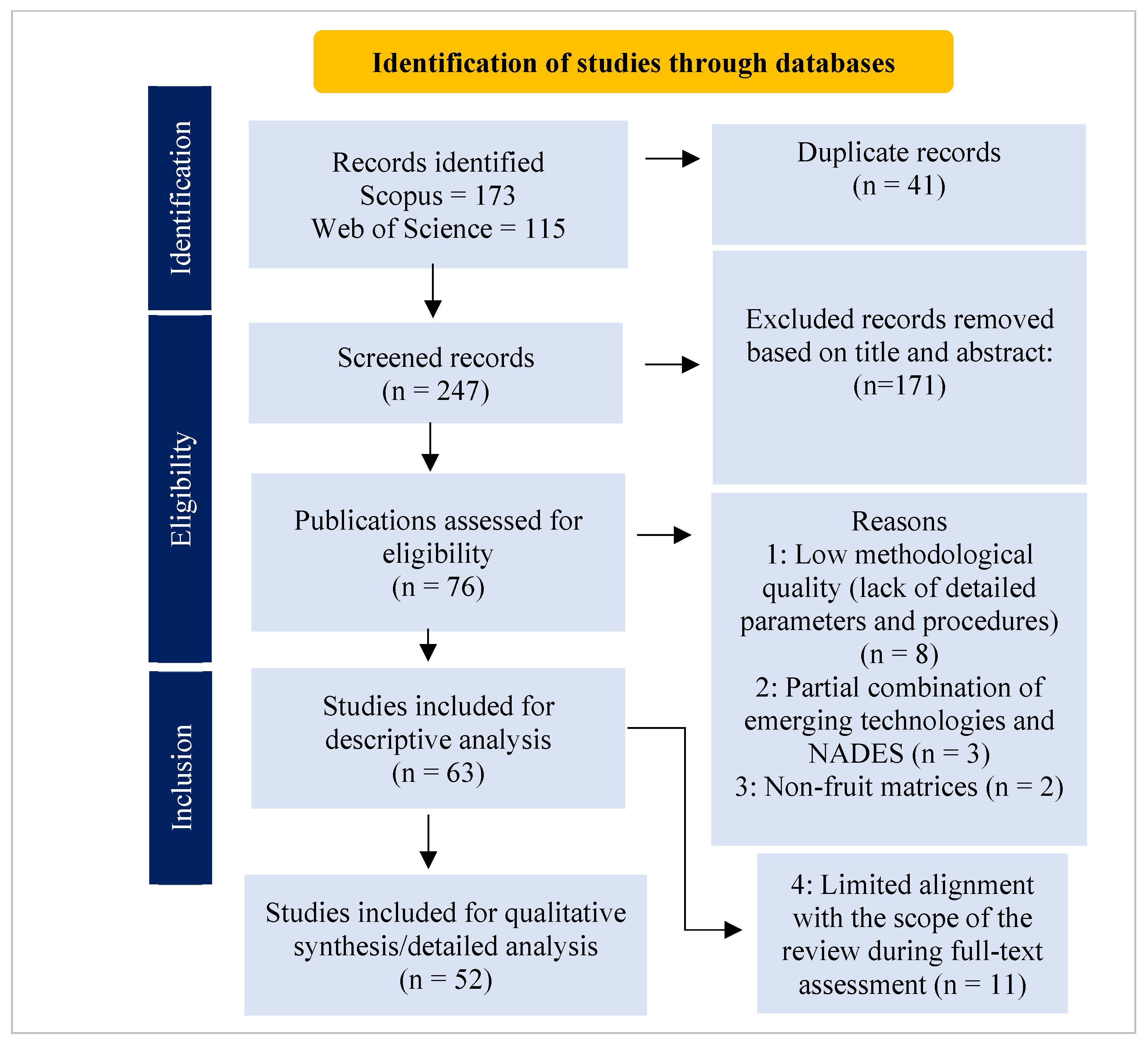
  • Identification: A total of 173 articles were identified in Scopus and 115 in Web of Science. After removing duplicates, 247 records remained.
  • Screening: Titles and abstracts were reviewed to exclude non-relevant articles.
  • Eligibility: The full texts of the articles were assessed for thematic relevance and methodological quality using a scale from 1 to 3 for each dimension (Table 1). The studies were ranked by total score (maximum of 10 points), and those scoring 5 or higher were selected. A 5-point assessment scale was established to ensure the inclusion of studies of moderate to high quality. This scale was strategically selected in accordance with the research objectives to exclude articles that did not report critical operational parameters. A total of 63 articles with the highest relevance were included.
  • Inclusion: As shown in Figure 1, a total of 288 records were identified through the database search. After removing 41 duplicate records, 247 records were assessed by title and abstract. During this stage, 171 records were excluded because they did not meet the inclusion criteria. Subsequently, 76 full-text articles were assessed in the eligibility stage. After this assessment, 13 articles were excluded for the following reasons: low methodological quality due to a lack of detailed parameters and procedures (n = 8), partial combination of emerging technologies and NADES (n = 3), and non-fruit matrices (n = 2). Finally, 63 studies were included in the descriptive and bibliometric analysis. Of these, 52 were selected for the qualitative synthesis because they reported sufficiently detailed and comparable information on the core elements of the review.
Based on the PRISMA flow diagram, search accuracy was calculated as the proportion of included studies relative to the total number of records identified in Scopus and Web of Science. Two complementary metrics were considered in the inclusion phase: (i) the 63 studies included in the descriptive and bibliometric analysis and (ii) the 52 studies included in the qualitative synthesis and in-depth analysis, with search accuracy of 21.88% and 18.06%, respectively.

3. Results and Discussion

Emerging technologies in combination with natural deep eutectic solvents (NADES) have been applied for the green extraction of bioactive compounds in fruits over the past 10 years in an increasing number of studies. The fruit matrix sector is configured as an important resource due to its richness in bioactive compounds and elements that have recently been highly valued.

3.1. Bibliometric and Descriptive Analyses of the Studies Included

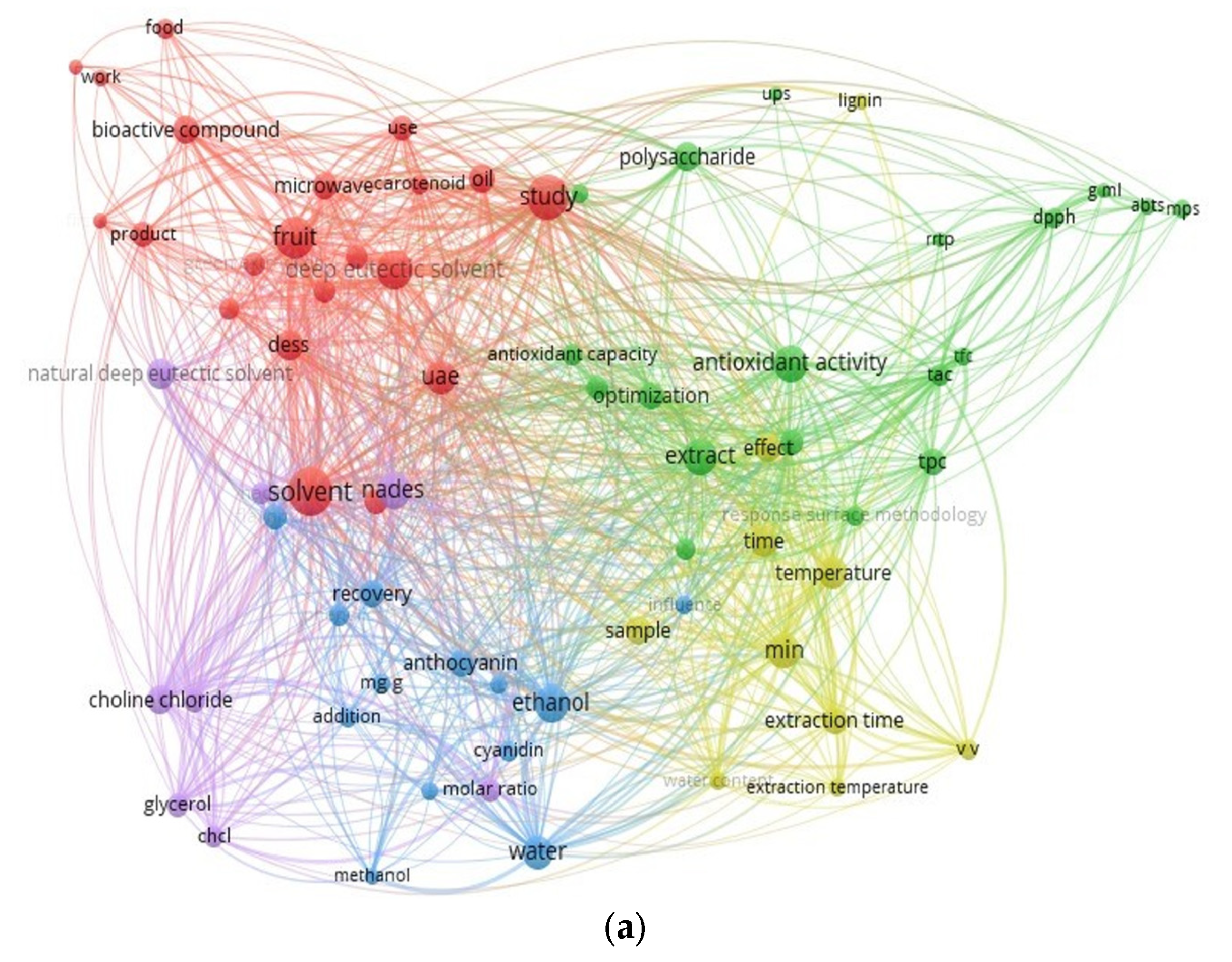
Thematic analysis based on the co-occurrence network shown in Figure 2a reveals the formation of five clusters. The red cluster is centered on the types of assays performed, such as antioxidant activity and process variable optimization. The yellow cluster is focused on extraction parameters, including time and temperature. The blue cluster mainly addresses the use of ethanol or methanol and water for anthocyanin recovery. The purple cluster represents the HBA and HBD components of NADES. A methodological approach focused on the optimization of extraction processes predominates (yellow and red clusters), alongside an orientation toward in vitro antioxidant assays (green cluster). Furthermore, the cluster corresponding to the design of NADES components shows lower integration with the others (purple cluster), suggesting a gap between solvent formulation and its functional impact on phytochemical recovery. The centrality of these themes in the analyzed literature identifies research lines oriented toward assisted extraction techniques, aiming at the development of efficient, environmentally responsible methods applicable to fruit matrices.
A higher concentration of studies was observed in 2024, followed by 2025 and 2021, indicating a sustained increase in scientific output in recent years. This trend reflects the growing interest in developing sustainable extraction methods and using natural deep eutectic solvents, confirming their role as a leading technology due to their efficiency, low cost, and compatibility with NADES.
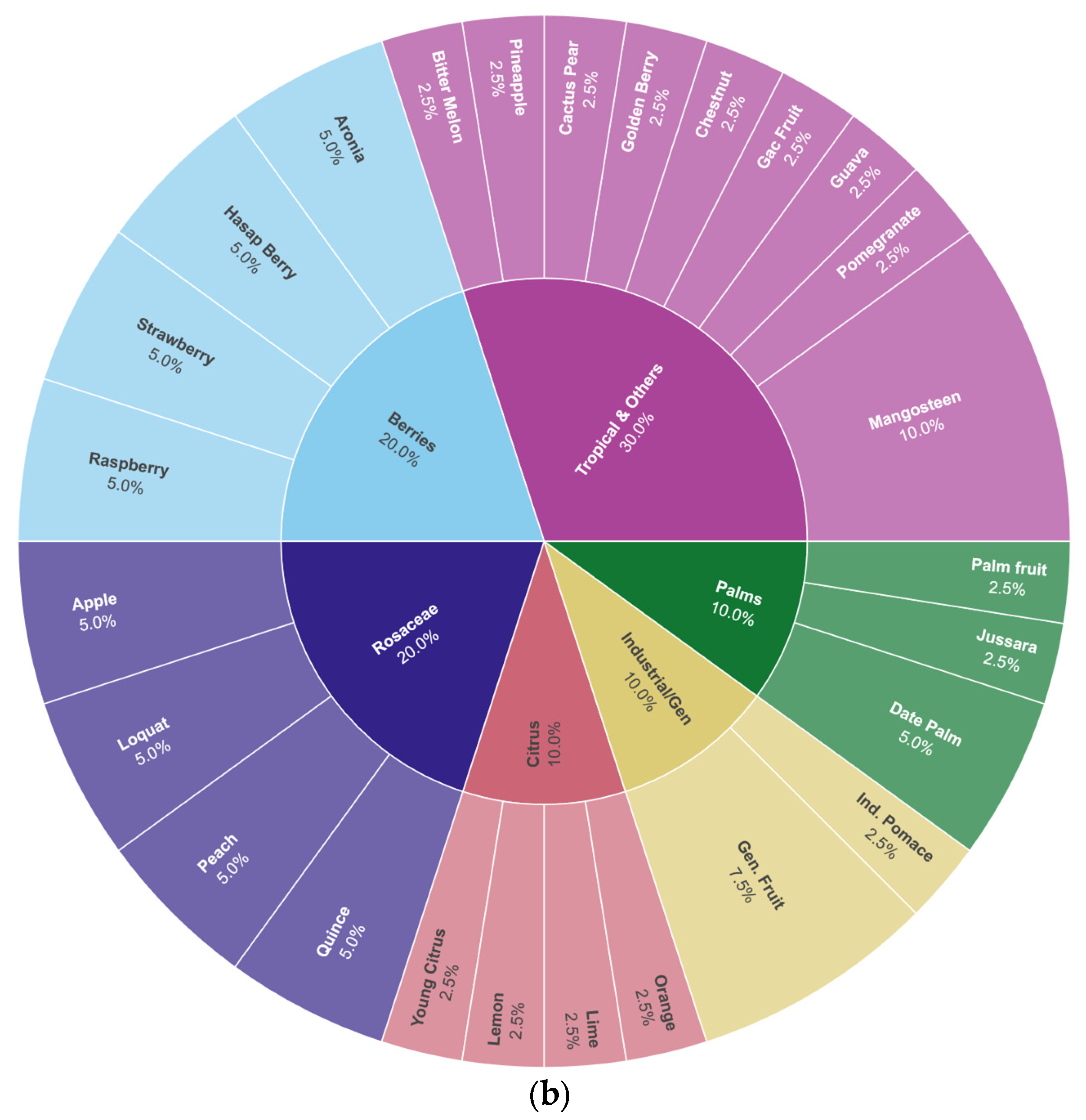
Figure 2b shows the normalized hierarchical distribution (100%) of the plant matrices used. It evidences a clear predominance of tropical fruits and other categories (30%), followed by berries (20%) and Rosaceae (20%), which together account for 70% of the total analyzed. This reflects a research focus on matrices rich in bioactive compounds with high functional value. Mangosteen has the highest contribution (10%) to tropical fruits, indicating a growing interest in exotic species with high antioxidant and phytochemical potential. Blueberry, raspberry, strawberry, haskap, and aronia have a homogeneous distribution of 5% each. This suggests a balanced diversification in their study associated with their well-established phenolic profile. Similarly, the Rosaceae group, including apple, peach, quince, and loquat, showed an equal contribution of 5%. This consolidates their role as traditional yet relevant matrices in applied research. The results indicate an emerging interest in agro-industrial by-products and their valorization, with an emphasis on non-conventional and underutilized matrices. This aligns with contemporary approaches to sustainability, the circular economy, and the integral utilization of biomass in the development of functional compounds. The geographical distribution was evaluated through a choropleth map of scientific production associated with the use of NADES and emerging extraction technologies, revealing a marked concentration in Asia, with China accounting for 38.10% of scientific output. This reflects its predominant role in the development and application of green solvents and intensified techniques, such as the use of UAE and MAE. At a second level, countries such as Saudi Arabia, Spain, and Turkey, each with 7.94% participation, stand out as relevant research hubs linked to the utilization of regional biomass and sustainability policies in agro-industrial processes. Brazil and India, each contributing 6.35%, consolidate the role of emerging economies with high biodiversity, favoring studies focused on the valorization of residues and bioactive compounds using NADES. These results indicate that research on NADES and emerging technologies is not only led by scientific powers but is also undergoing a process of globalization, driven by the pursuit of sustainable processes, energy efficiency and the integral utilization of natural resources.
The bibliometric treemap of the scientific sources analyzed regarding the application of natural deep eutectic solvents (NADES) and emerging extraction technologies reflects each journal’s relative productivity, while the color scale highlights the temporal evolution of publications from 2018 to 2025. High-impact journals, particularly Food Chemistry, are evident in volume and recency in 2024 and 2025, serving as the primary dissemination platform for research focused on the green extraction of bioactive compounds using NADES. Journals such as Microchemical Journal, Journal of Food Measurement and Characterization, Industrial Crops and Products, and Food Research International show significant participation in recent years, evidencing an increasing integration of emerging techniques such as ultrasound (UAE) and microwave (MAE) and other strategies with the use of natural deep eutectic solvents as a sustainable alternative to conventional solvents.
The presence of specialized journals in green chemistry and analytical methods, such as Green Analytical Chemistry, Analytical Methods, and Ultrasonics Sonochemistry, reinforces the trend toward eco-efficient approaches in which NADES act not only as extraction media but also as functional systems that enhance the selectivity, stability, and yield of extracted compounds. The bibliometric pattern demonstrates an accelerated evolution toward the consolidation of NADES as a central axis in contemporary research on sustainable extraction, in synergy with emerging technologies that enable process intensification and the efficient valorization of agro-food biomass.

3.2. Physicochemical Properties of NADES in Bioactive Compound Extraction

3.2.1. Components and Their Relationship with the Compound’s Nature

NADES comprise a hydrogen bond donor (HBD) and a hydrogen bond acceptor (HBA). HBDs may include sugars, alcohols, and organic acids, whereas HBAs are typically quaternary ammonium salts, as well as certain amino acids and organic acids; the latter two exhibit amphoteric behavior, meaning they can also act as donors depending on the pH and chemical environment of the system.
A. Gray (ChCl: glycerol 4:6), achieving yields of 0.32 % for cyanidin-3-glucoside. In contrast, its effect is reduced when organic acids such as tartaric (1:3) or lactic acid (1:2) are used as acceptors, yielding 0.17 % and 0.24 %, respectively [7]. According to [8], the most effective eutectic solvent for anthocyanins in Prunus spinosa L. is ChCl and formic acid (2:1), rather than lactic acid. The differences among acids can be analyzed in terms of their functional groups; acids with multiple carboxyl groups, such as citric and tartaric acids, form more compact and rigid networks, which may increase viscosity and alter systemic acidity, thereby reducing the stability of the flavylium cation due to nucleophilic attack by water [7,8,9,10].
However, this mixture is not necessarily binary and may comprise more than two components, with its functionality depending on the interactions between them, including hydrogen bonding, van der Waals forces, and electrostatic interactions [8]. The acceptor molecule (HBA) forms intermolecular interactions with one or more donor molecules (HBD), reducing the melting point of the mixture to significantly lower temperatures than those of its individual components, thereby enabling energy savings and easier handling [1].
Despite belonging to the same chemical family, polyalcohols exhibit different extraction performances when acting as donors. For example, combinations of choline chloride (ChCl) with 1,2-propanediol, 1,2-butanediol, and glycerol in molar ratios of 1:3 yield extraction efficiencies of 2.63%, 2.40%, and 0.12%, respectively, in the extraction of α-mangostin (a lipophilic polyphenol) from the pericarp of Garcinia mangostana L. [1]. Due to their carbon chains with fewer hydroxyl groups, diols promote hydrophobic interactions with the target phytochemical and reduce the formation of hydrogen-bonding networks within the system, in contrast to glycerol, which exhibits higher polarity. This may explain why glycerol performs better when extracting hydrophilic phenolic compounds, such as anthocyanins, from the Chilean berry Luma chequen (Molina) A. Gray (ChCl–glycerol 4:6), achieving yields of 0.32% for cyanidin-3-glucoside. In contrast, its effect is reduced when organic acids such as tartaric (1:3) or lactic acid (1:2) are used as acceptors, yielding 0.17% and 0.24%, respectively [10]. According to [11], the most effective eutectic solvent for anthocyanins in Prunus spinosa L. is ChCl and formic acid (2:1), rather than lactic acid. The differences among acids can be analyzed in terms of their functional groups; acids with multiple carboxyl groups, such as citric and tartaric acids, form more compact and rigid networks, which may increase viscosity and alter system acidity, thereby reducing the stability of the flavylium cation due to nucleophilic attack by water [10].
Similar yields were reported by [12] when citric and lactic acids were used as donors and combined with matrine (an alkaloid) at the same molar ratio (1:1); both solvent systems achieved extraction efficiencies of 0.18% and 0.15%, respectively, for hydroxytyrosol from olive fruit. However, with malic acid, the yields exceeded 0.4% when betaine (an amino acid) was used as the acceptor.
In addition, ref. [13] employed citric acid as a donor together with ChCl (1:1) to obtain extracts containing 0.19% naringin, a flavonoid present in grapefruit peel with antidiabetic potential, whereas malic and oxalic acids yielded 0.18% and 0.13%, respectively. Furthermore, the extract remained stable for six months, exhibiting compound degradation between 0.24% and 0.25%. It is suggested that the stabilization of NADES based on alkaloid–organic acid systems is governed by electrostatic forces, in contrast to amino acid–acid systems, which are dominated by hydrogen bonding; in the former, the system acquires a structurally amphiphilic character, whereas it exhibits a more polar nature in the latter. According to [10], glycerol and lactic acid as acceptors tend to perform better with sugars such as glucose [10].
For biomolecules such as polymers and polysaccharides, ref. [4] introduced guanidine hydrochloride as an acceptor in the formation of the eutectic solvent together with lactic acid (1:2) for lignin extraction from oil palm bunches [4], achieving yields of 57.12% compared with the ChCl control. Furthermore, ref. [14] reported higher yields (57.82 mg/g) with ChCl–ethylene glycol (1:6) than with lactic acid; additionally, the polysaccharides exhibited lower molecular weight and higher glucuronic acid content. These differences may be attributed to structural variations in the molecules and the action of lactic acid. While lignin benefits from acidic media, polysaccharides require more basic conditions to facilitate hydrogen-bonding networks and diffusion processes.
To complement the discussion on the relationship between NADES components and the extraction of bioactive compounds, Table 2 summarizes representative studies considering solvent composition, HBD–HBA ratio, fruit matrix, target compounds, and reported extraction efficiency. This synthesis allows for a clearer comparison of how molecular variations in NADES preparation influence the recovery of phenols, flavonoids, anthocyanins, and other phytochemicals.
The extraction of phenolic compounds, flavonoids, and anthocyanins from fruit matrices is dominated by systems based on ChCl combined primarily with organic acids, HBD–HBA molar ratios of 1:1, and the use of 20% water as a cosolvent. Its ability to form hydrogen bonds and maintain a sufficiently stable bond network likely favors the solubilization of polar compounds.
On the other hand, the use of ethanol in high proportions should be interpreted with caution, as it can modify the supramolecular structure; although in this case, it is assumed that the action of NADES was not isolated but rather assisted by this cosolvent in the extraction medium, improving the solubility of certain flavonoids and the penetration of the solvent into the fruit matrix.
The target compounds and the units reported in the studies limit direct comparison between studies; therefore, the table shows a comparative synthesis of trends and not an absolute comparison of extraction efficiency.

3.2.2. Water Content and Polarity and Viscosity Modifications

The molar ratio of hydrogen bond acceptors and donors in NADES alters the system’s effective polarity, the medium’s overall viscosity, and the functional fraction available to interact with the phytochemical. An increase in the proportion of these components or the incorporation of water as a co-solvent may reduce internal intermolecular competition and promote the specific stabilization of the phytochemical through the previously described targeted interactions.
The addition of water to NADES involves the incorporation of water molecules into the supramolecular network without disrupting the eutectic organization of the system, allowing a balance between solvent molecular mobility and solute–solvent affinity. This results in modifications of physicochemical properties, such as polarity and viscosity, as well as enhanced extraction efficiency for bioactive compounds. The addition of 20–40% water to a mixture composed of choline chloride and organic acids is generally favorable when extracting polar phenolic compounds such as gallic acid and anthocyanins or relatively polar compounds such as chlorogenic acid and catechin, as it enhances interactions with hydroxyl and carboxyl functional groups in these compounds [9].
On the other hand, for lipophilic compounds, significant increases of 20–25% in essential oil extraction have been observed with a progressive increase in water content from 30% to 50%. However, when the water content is further increased beyond this level up to 90%, a reduction of 32–35% is observed [3]. Consequently, it can be suggested that excessive increases (>50%) are detrimental to the supramolecular structure of the solvent, as water molecules tend to form clusters through their own hydrogen-bonding network, leading to behavior similar to that of an aqueous solution and reducing the extraction efficiency of phytochemicals, particularly those with lower polarity such as xanthones and lignins [4].
Ref. [16] reported that the preparation of NADES diluted with 50% water or ethanol results in similar extraction of phenolic compounds; however, more hydrophobic phenols with higher anti-inflammatory activity are obtained with the latter. Ref. [6] demonstrated that the addition of water may also occur indirectly by selecting NADES components containing structural water. For example, the use of oxalic acid dihydrate, which contains approximately 13.5% structural water, enhances the extraction of phenolic compounds such as catechin and gallic acid.
The incorporation of water also influences viscosity, as it reduces the density of intermolecular interactions within NADES through the establishment of new interactions, partially replacing hydrogen bonds between HBA and HBD [18]. According to [12], NADES based on betaine and organic acids may exceed 1000 mPa·s; however, upon dilution with water up to 30% (w/v), viscosity decreases markedly to values close to 1–2.5 mPa·s, enabling the extraction of amphipathic compounds such as hydroxytyrosol. Other studies have reported that hydrophobic NADES based on esters and organic acids may exceed 10 mPa·s and are used for the extraction of exclusively lipophilic molecules such as lycopene [18]. This can be explained by the ability of hydrophilic NADES to form extensive hydrogen-bonding networks, in contrast to hydrophobic systems, which exhibit a lower capacity and a predominance of weaker interactions (van der Waals forces).
In the case of choline chloride and organic acids with 40% water content, viscosity reaches 52.6 mPa·s; however, when the temperature is increased to 80 °C, it decreases to values between 3.7 and 8.7 mPa·s, thereby reducing flow resistance and accelerating the partition equilibrium of ellagic acid and punicalagin from pomegranate peel tissues into the solvent [19].
Overall, these studies demonstrate the positive effect of water addition in NADES systems for maintaining the supramolecular interactions responsible for phytochemical solubilization. Nevertheless, lipophilic compounds require an adequate level of solvation to maintain relatively low viscosity without compromising compatibility with less polar metabolites.

3.3. Application of Emerging Technologies and NADES in Plant Matrices and Extraction Process Intensification

The studies investigated various fruit matrices, including both sweet and citrus fruits, focusing on different parts of the plant, although most were centered on the edible fraction (45.16%). These fruits demonstrate considerable potential in terms of antioxidant contribution, as they have been primarily characterized by their polyphenol and anthocyanin content. However, further research on plant residues is necessary, as peels and other by-products (35.48%) represent a valuable recycling opportunity in support of sustainability. Some studies have extended their scope to the examination of plant parts not commonly used in industry, such as post-processing residues, enabling the valorization of wastes, peels, and pomace [5].
Fruit matrices were investigated using different technologies; 38.7% of the studies employed conventional extraction using ethanol or methanol. Notably, conventional techniques were examined with the intention of being replaced by methodologies that reduce environmental impact [20]. This indicates that a significant number of researchers are exploring more sustainable extraction approaches, suggesting a promising future development.
The use of assisted extraction techniques is a determining factor in terms of effectiveness and performance. The most applied techniques for fruit matrices were ultrasound (61.29%), followed by microwave-assisted extraction (22.58%). This finding may indicate a greater emphasis on low-temperature technologies rather than on the heating rate, which is the main characteristic of microwave systems.
Choline chloride was predominantly used in the formulation of eutectic solvents (80%), along with carboxylic acids such as oxalic acid and citric acid, although physicochemical properties were only assessed to a limited extent. Table 3 summarizes the evaluated plant matrices, extraction technologies employed, and solvent systems used in the studies.
Refs. [10,17,21,22,23] combined NADES-based extraction with ultrasound, while ref. [16] employed microwave and high-pressure techniques using solvents such as cyclopentyl methyl ether (CPME), ethyl acetate (EtAc), and GVL (γ-valerolactone). Ref. [24] combined a deep eutectic solvent (DES) with ultrasound, oil bath, microwave, and vortex techniques to extract polyphenols. These combinations enable improved outcomes by optimizing both the quantities used and the process parameters. An increasing trend in the use of NADES has also been observed, reflecting a growing awareness of responsibility and sustainability in extraction processes.
Previous studies have reported clean methods for the extraction of anthocyanins [25] that combine ultrasound with anhydrous ethanol as the solvent. For the carotenoid extraction, ref. [18] employed microwave-assisted extraction and DES. Meanwhile, ref. [26] extracted proteins using NADES along with ultrasound, pressurized liquid extraction (PLE), and microwave. Ref. [14] extracted polysaccharides using NADES and ultrasound, whereas [6] only used DES and microwave.
Some authors opted not to combine techniques; for example, ref. [15] used only DES, whereas refs. [19,27] used only NADES for the extraction of polyphenols and anthocyanins. Similarly, ref. [2] employed only NADES, whereas ref. [28] compared solvent systems such as DES and NADES. Compared with conventional technologies, all studies reported improvements or comparable results with NADES and their combinations relative to other techniques in the extraction of phenolic compounds or carotenoids [29]. The use of DES also yielded favorable results [1], as did their combinations [9].

3.3.1. Microwave-Assisted Extraction + NADES

The studies reviewed in this section reported different microwave-assisted extraction conditions, including temperature, extraction time, and frequency. Based on this, it can be stated that the performance of MAE-NADES systems varies according to the structural characteristics of the plant matrix and is not determined solely by microwave irradiation but also depends on the solvent formulation and the selection of the cosolvent. This trend is not limited to phenolic compounds but also extends to the recovery of essential oils.
In microwave-assisted extraction (MAE), the extraction yield can be increased due to the rapid volumetric heating of the NADES system, although excessive irradiation or high temperatures can compromise the stability of thermolabile compounds, such as anthocyanins, flavonoids, and other phenols, due to thermal degradation processes. Likewise, the addition of water must be controlled, since moderate hydration can improve the dielectric response, while excessive dilution can weaken the hydrogen bond network and decrease solvent selectivity.
Ref. [6] evaluated extraction yield in terms of mass percentage and total phenolic content from chestnut shell during a process that integrated microwave-assisted extraction at 65 °C for 30 min and a frequency of 2.45 GHz, using NADES composed of choline chloride and carboxylic acids: levulinic, malic, and citric acids, at molar ratios of 1:2, 1:1, and 1:1, respectively. In the case of levulinic and citric acids, water was used as a cosolvent (25%) due to the viscosity of the system. The most effective treatment was the combination of ChCl with levulinic acid (12.6%), followed by ChCl with malic acid (11.1%) and ChCl with citric acid (10.5%), and the phenolic content ranged from 80 to 120 mg gallic acid/100 g biomass. Ref. [15] also used citric acid for the extraction of polyphenols from lemon peel through a microwave-assisted process under conditions of 62.5 °C for 60 min, using ethanol as a cosolvent (60%), obtaining a value of 200.64 mg gallic acid/100 g sample, whereas 25 mg gallic acid/100 g sample was obtained with 10% ethanol. This method was compared with conventional extraction methods such as acid hydrolysis (20 h) and alkaline hydrolysis (4 h). The results showed that this synergy increased the yield, based on phenolic content, by 40% and 19%, respectively, compared with conventional techniques. In this regard, it should be noted that the high proportion of ethanol used in the NADES system should be interpreted as a cosolvent-assisted extraction process. Therefore, the extraction performance should not be attributed to the NADES system in isolation but rather to the combined effect with ethanol.
In both studies, the use of water and alcohol as cosolvents can be observed, as well as the intrinsic acidity of the system associated with the presence of acids, which allowed viscosity reduction and increased extraction of bioactive compounds, respectively, through possible non-covalent interactions with the aromatic rings of phenols. This process may have been facilitated by the dielectric heating of molecules and intracellular water in the plant matrix caused by the application of microwave energy, which intensifies extraction and enables easier penetration of NADES, which solubilize and stabilize phytochemicals. However, ethanol as a cosolvent showed better performance in terms of phenolic compound content within the lemon peel study, unlike the use of water in chestnut shell, although they cannot be directly compared because they do not fulfill the same function. Therefore, the findings suggest that alcohols may be particularly effective for phenolic compounds of intermediate polarity.
In the extraction of essential oils such as D-limonene, m-cymene, and eucalyptol, ref. [3] reported that microwave-assisted hydrodistillation at 700 W for 2 min, combined with ChCl and oxalic acid (1:1) with 50% water, yields twice the amount of essential oil compared to using the emerging technology alone. Furthermore, energy consumption time and environmental impact (grams of CO2) were reduced by 3.44% and 3.43%, respectively. Microwave irradiation is responsible for this effect, as it generates rapid heating and increases the internal pressure of the plant tissue, weakening and rupturing the cellular structure. In turn, the water as a cosolvent effectively reduces viscosity and improves molecular mobility, which, under irradiation, favors the release of volatile compounds. This demonstrates that solute-solvent affinity and viscosity-polarity balance are critical determinants and that, when combined with microwave irradiation, the pressure gradient between the interior of the plant cell and the extraction medium maximizes thermodiffusion efficiency.
In addition to these findings, this effectiveness has also been demonstrated in other plant matrices with distinct physicochemical characteristics. For example, the application of a system based on choline chloride–lactic acid for the extraction of flavonoids from Vaccinium vitis-idaea L. leaves enabled a high extraction rate of 269.99 ± 1.42 mg/g, highlighting that the total flavonoid content was 3.4 times higher than that of the fruit of the same species. Moreover, the extracts exhibited superior antioxidant capacity against DPPH and ABTS radicals compared to conventional alcohol-based extraction methods. Furthermore, Fourier transform infrared spectroscopy analyses indicated that hydrogen bonding interactions between NADES and flavonoids constitute a key mechanism underlying the enhanced extraction efficiency. This is consistent with previous observations in which solvent composition, water content, and the polarity–viscosity balance have been identified as critical factors influencing extraction efficiency [41]. From the perspective of microwave-assisted extraction, the high flavonoid recovery observed may be related to the volumetric heating generated by irradiation, which produces localized thermal stress and internal pressure that weaken cell walls. This effect may be relevant in leaf matrices due to the structural complexity associated with epidermal barriers and the presence of polysaccharides, which can limit solvent penetration under conventional techniques.

3.3.2. Ultrasound-Assisted Extraction + NADES

In the reviewed UAE–NADES studies, extraction was generally performed under moderate thermal conditions, mainly from room temperature to 40 °C, with reported ultrasonic power levels of approximately 160 to 400 W when specified. These conditions favored the recovery of phytochemicals; however, the response varied depending on the accessibility of intracellular compounds in each matrix and the interaction between ultrasound-induced mechanical effects and the microenvironment formed by the components of the eutectic solvent.
It is worth noting that in ultrasound-assisted extraction (UAE), the ultrasonic power and frequency regulate the intensity of acoustic cavitation. However, excessive power or prolonged sonication affects the stability of compounds susceptible to oxidation, generating free radicals through localized heating. High processing temperatures degrade thermolabile compounds, reducing extraction efficiency. Therefore, process conditions should focus not only on maximizing yield but also on preserving the presence of these compounds in the final product.
Ultrasound-assisted extraction, applied through ultrasonic baths or probe systems, has therefore been widely explored in combination with NADES. During this process, acoustic cavitation induces cell disruption, which is enhanced by eutectic solvents due to the formation of hydrogen bonds; consequently, greater solubilization and diffusion of bioactive compounds within plant tissues are achieved. This has been corroborated in previous studies [12,35].
Ultrasonic irradiation at 30 °C for 30 min using betaine and malic acid (1:1) was 2–2.5 times more efficient than ethanol and water in the recovery of polyphenol hydroxytyrosol from olive fruits. Meanwhile, ChCl–lactic acid (1:4) enabled the extraction of 4–32% higher phenolic content, expressed as gallic acid equivalents, from the pulp of Phaleria macrocarpa (Scheff.) Boerl fruit at room temperature, 20 min, and 37 kHz compared with microwave-assisted extraction and reflux using 70% ethanol. Both studies did not specify the applied acoustic power, which limits the reproducibility and mechanistic analysis of the cavitation process.
Ref. [37] also employed choline chloride (ChCl–malic acid 1.5:1) and subjected discarded figs to ultrasonic extraction for 20–30 min at 400 W and 40 °C. This process resulted in a higher phenolic content, expressed as gallic acid, but a lower flavonoid content; the opposite trend was observed when using betaine and lactic acid (1:2). In the case of flavonoids from sea buckthorn fruit, the use of a system based on betaine–lactic acid enabled process optimization through response surface methodology, achieving conditions of 37 min, 40 °C, 17% water content, a liquid-to-solid ratio of 40 mL g−1, and an ultrasonic power of 160 W, with a maximum yield of 5.248 mg g−1, which was higher than that obtained using 60% ethanol and water. Likewise, the use of NADES (ChCl—malic acid) coupled with pulsed ultrasound for the recovery of phenolic compounds from Carya cathayensis shells showed a significant synergistic effect compared to other methods applied individually [42,43].
However, ref. [38] reported that during the extraction of phytochemicals from mangosteen peel using lactic acid and glucose, a higher phenolic content but lower flavonoid content was obtained at similar ultrasonic power and temperature conditions (300 W and 30 °C). In contrast, ref. [19] demonstrated that the combination of ChCl–lactic acid (1:2), assisted by an ultrasonic bath at a maximum power of 240 W, 50 °C for 25 min, and diluted with 40% water, enabled a twofold increase in tannin content (β-punicalagins) from pomegranate peel, although with a 1% reduction in phenolic acids (ellagic acid) compared with a control extraction using water as the solvent.
This difference may be attributed to the fact that the mangosteen peel is a more rigid and lignified matrix, whereas the fig tissue presents relatively thinner cell walls. Additionally, flavonoids are typically located in vacuoles and in conjugated forms, whereas phenolic acids may occur in free form across different tissue parts, making them less dependent on structural disruption and therefore more accessible for extraction. This suggests that extraction performance is determined not only by the emerging technology but also by the structural organization of the plant tissue and the phytochemical’s intracellular localization.
Ref. [44] captured microscopic images during the extraction of polyphenols from C. cathayensis peel using pulsed sonication coupled with NADES, particularly ChCl–malic acid (1:1) with 30% water. The initial contact between the solvent and the sample involved partial erosion of the external surface, forming a rough-like structure, followed by drastic fragmentation during pulses applied every 2 s (20 kHz). As a result, the increased exposure of intracellular structures led to a greater number of nonlinear collapses in the cell wall caused by solvent bubbles. These bubbles, containing less vapor due to the low vapor pressure of NADES, undergo more violent collapse, releasing higher energy and enhancing phenolic release.
Another advantage of NADES is its high capacity to form hydrogen bonds, which can prevent the oxidation of phytochemicals induced by free radicals generated during the sonolysis of water.

3.3.3. Pulsed Electric Fields and Pressurized Liquids + NADES

Compared to MAE and UAE, fewer studies have explored combining NADES with technologies based on electric fields or pressurized liquid extraction. These systems involve higher thermal, electrical, or pressure requirements. Although NADES contribute to the solubilization of bioactive compounds, their coupling with electrical treatments or pressurized systems may require more demanding operating conditions to overcome limitations associated with solvent viscosity and the structural strength of the plant matrix. Therefore, their sustainability should be evaluated considering the energy consumption-performance ratio.
Ref. [45] evaluated the intensification of polyphenol extraction from grapefruit peel through the application of high-voltage electrical discharges (40 kV and 10 kA currents) as a pre-treatment, followed by solid–liquid extraction using lactic acid–glucose eutectic solvents. Increasing the energy input in the system from 7.27 to 218 kJ/kg progressively enhanced the polyphenol content from 1.33 g gallic acid equivalents (GAE)/100 g to 1.88 g GAE/100 g dry matter within 10 min.
On the other hand, ref. [19] reported that the optimal processing conditions for pressurized liquid extraction using eutectic solvents were 10 MPa, 120 °C, and 15 min, achieving a total phenolic content (TPC) of approximately 45–50 mg GAE/g extract, surpassing the pressurized system using only 50% ethanol (≈38–42 mg GAE/g). At lower temperatures (80 °C), the values ranged from 25 to 30 mg GAE/g, indicating a marked temperature dependence under pressure.
From a critical perspective, the performance of NADES under pressurized and electroporation conditions suggests that intensification is not solely because of elevated temperature or tissue fragmentation induced by electric pulses but rather the simultaneous modification of plant tissue structure and the solubilization capacity of the extraction medium. However, the requirement for high thermal and electrical energy input in these processes may compromise the stability of more sensitive fruit matrices. Therefore, in green extraction processes, efficiency should not be assessed solely in terms of bioactive compound yield but also by considering the yield–energy consumption relationship and industrial scale-up feasibility.
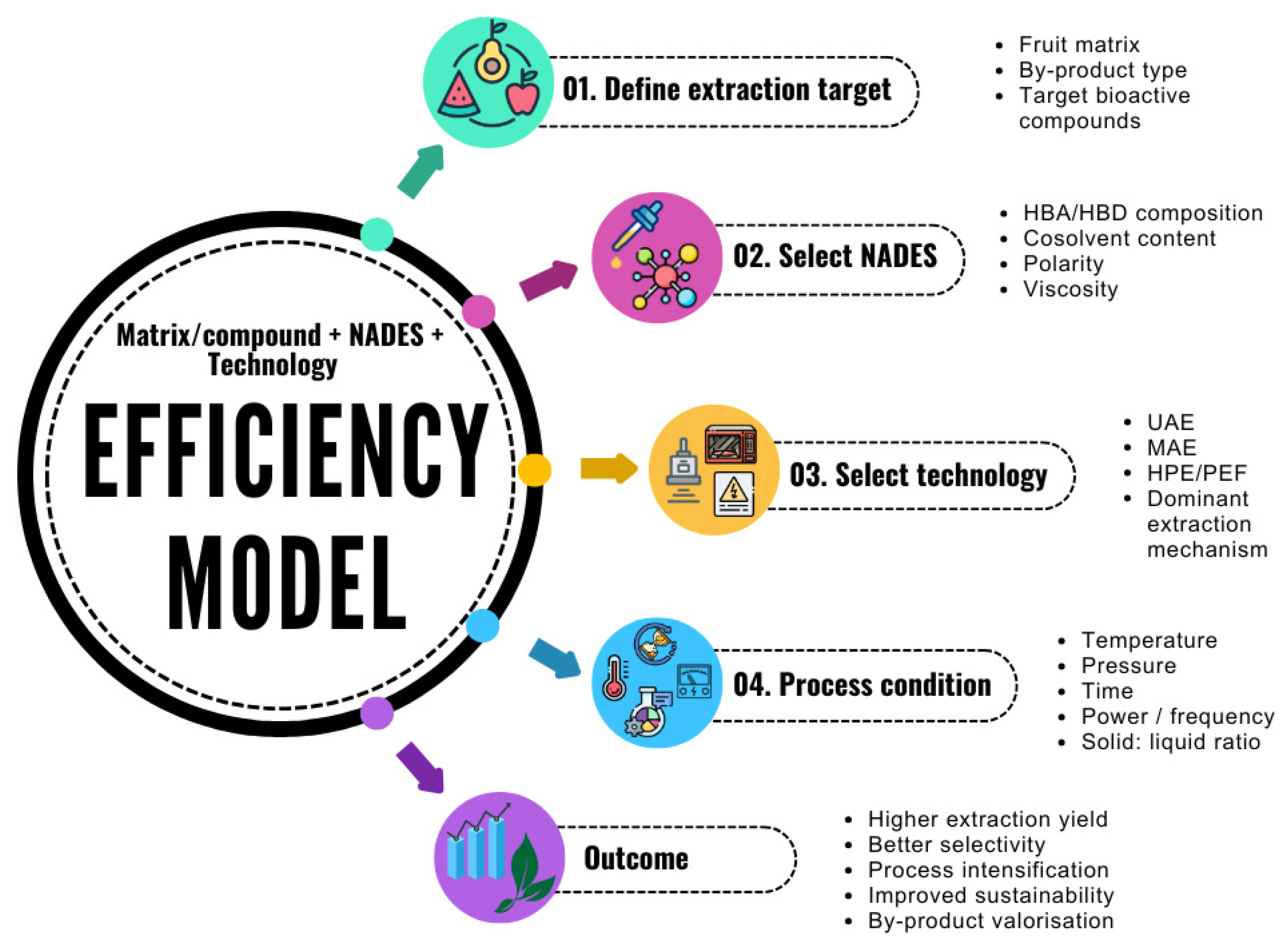
Overall, the evidence suggests that the intensification of these extraction processes depends not only on solvent substitution but also on the synergy between (i) the physicochemical properties of the solvent, (ii) the dominant energy mechanism of the applied technology, and (iii) the chemical nature and localization of the target bioactive compound. Figure 3 presents a visual framework that integrates these three dimensions and provides a structured basis for selecting NADES and technology combinations, as well as for interpreting process efficiency according to the extraction objective.
For comparative purposes, intensification factors (IF) were determined from the reviewed literature based on yield data and classified as low (IF < 1.5), moderate (IF 1.5–2), and high (IF > 2). This metric was based on that reported by [46,47] for evaluating the superiority of a new alternative process over an existing process. Table 4 shows that the intensification factors ranged from 1.06 to 2.01, with more pronounced increases observed when the phytochemicals are phenolic compounds, the hydrogen bond donors in NADES are alcohols and/or monocarboxylic acids, and the temperatures of the emerging technologies exceed 30 °C.
High IF values (>2) were predominantly associated with ultrasound-assisted systems and alcohol-based NADES, suggesting that the dominant intensification driver is mass transfer enhancement rather than thermal effects.

3.4. Identification of Phytochemicals and Antioxidant Potential of the Obtained Extracts

3.4.1. Phytochemical Profile

Extracts obtained from fruit matrices were characterized through phytochemical profiling to identify the compounds recovered using NADES and extraction technologies. Ref. [16] compared the compounds in lemon peel extracts obtained using microwave-assisted extraction combined with NADES (MAE-NADES) and alkaline methods. The MAE-NADES system enabled the recovery of various phenolic compounds and flavonoids, including orientin, limonin glucoside, ferulic acid, limocitrol-glucoside, eriodictyol, chrysoeriol, limocitrin, and limbitrol. A higher content of glucosides and eriodictyol was observed in the case of lemon peel. Furthermore, this approach enabled the identification of other relevant metabolites, such as stellarine-2, rutin, vitexin, diosmetin glucoside, naringin, isorhamnetin-rutinoside, and diosmin, demonstrating a greater diversity of compounds recovered through the combination of NADES and assisted technologies.
Among the identified flavonoids, rutin stands out as a flavonoid glycoside with antioxidant and anti-inflammatory properties. Several studies have reported its recovery using NADES combined with extraction technologies. Ref. [49] reported a rutin content of 86.553 ± 1.35 µg/g using systems based on choline chloride, while ref. [48] identified a concentration of 7.40 ± 0.21 µg/g in banana matrices. Similarly, ref. [15] reported the presence of quercetin-3-rutinoside (653.1 mg/kg fresh weight) in extracts obtained using NADES. In contrast, ref. [33] reported lower rutin contents of 0.63 ± 0.03 and 1.22 ± 0.06 mg/100 g in date palm fruits using conventional extraction methods such as Soxhlet.
Anthocyanins have also been extensively studied because of their high antioxidant capacity. Ref. [25] reported cyanidin-3-glucoside contents of up to 16.1 mg per gram of dry weight, whereas ref. [50] found values ranging from 1.49 to 7.56 mg cyanidin-3-glucoside equivalents per gram of dry plant material (mg C3G/g) for monomeric anthocyanins in Cornelian cherry using NADES. Similarly, ref. [10] reported 330.6 ± 4.2 mg C3G/100 g of anthocyanins in Luma chequen using ultrasound-assisted extraction with NADES, significantly exceeding extraction with ethanol (116.2 ± 3.6 mg C3G/100 g).
Ref. [39] also reported high anthocyanin contents of up to 448.873 mg/g in A. melanocarpa using NADES combined with assisted technologies, while ref. [40] obtained TAL levels ranging from 829.29 to 1394.97 mg/100 g dry weight in Jussara fruits using NADES systems.
Various studies have reported the recovery of total flavonoids and other phenolic compounds using NADES in addition to anthocyanins. Ref. [30] reported total flavonoid contents of 16.39 ± 0.29 mg total anthocyanins (TAC)/g in strawberry leaves and 2.05 ± 0.04 mg TAC/g in fruits using choline chloride-based NADES. Similarly, ref. [50] reported contents of 1.01 ± 0.02 mg quercetin equivalents per gram of dry plant material (mg QE/g) in Cornus mas.
Ref. [22] identified major flavonoids in O. stricta, including isorhamnetin-glucosyl-rhamnosyl-pentoside (0.26 ± 0.01 mg/g dry weight), quercetin-3-O-rhamnosyl-rutinoside (0.02 ± 0.01 mg/g dry weight), and quercetin-hexose-pentose (0.05 ± 0.00 mg/g dry weight). Furthermore, ref. [35] reported the presence of rutin (2.83 ± 0.35 mg/100 g), naringin (0.35 ± 0.01 mg/100 g), quercetin (0.19 ± 0.00 mg/100 g), apigenin (0.12 ± 0.00 mg/100 g), and hesperetin (0.14 ± 0.00 mg/100 g) in Citrus sinensis extracts.

3.4.2. Antioxidant Activity and Antioxidant Capacity of NADES and Emerging and Conventional Technologies

The 2,2-diphenyl-1-picrylhydrazyl (DPPH) assay is one of the most widely used methods for evaluating the antioxidant capacity of plant extracts. Ref. [16] assessed lemon peel extracts obtained using microwave-assisted NADES and reported an experimental DPPH inhibition of 57 ± 6%, which was higher than the estimated theoretical value of 44.64%, suggesting a possible synergistic effect in the release of antioxidant compounds.
Similarly, ref. [15] reported an even higher antioxidant activity, with 86.93% DPPH inhibition in A. melanocarpa extracts using systems based on choline chloride. Furthermore, the combination of choline chloride-based NADES with organic acids enabled the recovery of non-extractable phenolics with antioxidant activities of 98 ± 2% and 92 ± 4%, demonstrating the ability of these solvents to release phenolic compounds associated with the plant matrix.
Ref. [30] also reported high antioxidant activity values using the DPPH assay in strawberry extracts obtained with NADES based on choline chloride and malic acid, reaching 70.19 ± 2.01% in leaves and 83.64 ± 3.14% in fruits. Meanwhile, ref. [50] reported values of 35.4 ± 0.65 mg ascorbic acid equivalents (AAE/g) in extracts obtained with NADES based on glucose and glycerin, highlighting the ability of these systems to extract phenolic compounds through multiple hydrogen-bonding interactions.
The FRAP (Ferric Reducing Antioxidant Power) assay evaluates the reducing capacity of extracts through electron transfer mechanisms. Ref. [50] reported values of 0.141 ± 0.000 millimoles of Trolox equivalents per gram of sample (mmol TE/g) in strawberry leaves using NADES based on choline chloride and glycerol, whereas in fruits, values of 0.025 ± 0.000 mmol TE/g were obtained using systems based on lactic acid.
Ref. [48] reported values of 39.19 ± 1.4 mmol Trolox equivalents (TE)/100 g, as well as 36.60 ± 2.58 mmol TE/100 g and 34.32 ± 2.03 mmol TE/100 g in extracts obtained with NADES based on choline chloride and glycerol. Similarly, values of 37.15 ± 3.44 mmol TE/100 g, 33.75 ± 2.68 mmol TE/100 g, and 33.23 ± 2.67 mmol TE/100 g were reported in comparable systems assisted by ultrasound. These results suggest that polyalcohol-based systems, such as glycerol, may favor the preservation of the extracts’ reducing power.
Ref. [15] also reported high values of 116.19 mmol TE/100 g FW using systems based on choline chloride and thiourea, demonstrating a high TE capacity in A. melanocarpa extracts.
The ABTS (2,2′-azino-bis (3-ethylbenzothiazoline-6-sulfonic acid)) assay has also been widely used to determine total antioxidant capacity. Ref. [15] reported values of 0.450 ± 0.001 mmol TE/g in strawberry leaves using NADES based on choline chloride and glycerol, whereas in fruits, values of 0.113 ± 0.002 mmol TE/g were obtained using systems based on choline chloride and lactic acid.
Additional results were reported by [48], who obtained values ranging from 18.64 ± 1.35 to 24.88 ± 1.35 mmol TE/100 g in extracts obtained using choline chloride and glycerol-based NADES. These findings suggest that ultrasound-assisted processes may enhance antioxidant release without causing significant degradation of phenolic compounds.
Finally, ref. [17] reported high antioxidant content in extracts obtained with NADES based on choline chloride and glycerol, including ellagic acid (111.0 ± 0.9 µg/g), α-punicalagin (82.4 ± 0.5 µg/g), and β-punicalagin (105.9 ± 0.7 µg/g), confirming the potential of these systems to recover bioactive compounds with high antioxidant activity.

3.5. Technological Impact and Industrial Prospects of NADES-Derived Extracts

The growing industrial interest in NADES arises from their dual functionality as both extraction media and formulation media for bioactive ingredients in certain systems (Table 5). In anthocyanin-rich matrices, the combination of NADES with ultrasound has proven to be competitive from a green chemistry perspective, integrating nontoxic and biodegradable solvents with technologies that reduce solvent consumption, energy use, and processing time, thereby enhancing industrial feasibility [43].
Furthermore, natural NADES may be regarded not only as extraction solvents but also as carriers for applications in food, cosmetics, or pharmaceutical formulations, provided that the system is compatible with the intended end use. This versatility extends their technological relevance beyond the extraction stage. However, industrial-scale implementation requires addressing the inherent limitations of these systems, particularly their high viscosity, which may reduce mass transfer and affect extraction yield. This limitation has been mitigated in the recovery of anthocyanins from black raspberry pomace through controlled water addition, temperature adjustment, and the application of appropriate assisted technologies [2]. Consequently, the rational design of both the solvent system and operating conditions is essential for establishing NADES as a robust industrial alternative.

3.5.1. Potential Use in Functional Foods and Ready-to-Use Products

  • Functional beverages and clean-label extracts
The development of functional beverages enriched with extracts obtained through ultrasound-assisted extraction (UAE) using NADES is a near-industrial application, as reported in formulations incorporating Spirulina platensis and orange peel extracts into strawberry and melon juice matrices [51]. In this context, ultrasound-assisted homogenization contributes to improving market-relevant attributes, including stability, texture, bioaccessibility, and sensory profile.
The incorporation of these extracts enhances technological and functional parameters such as proximate composition, mineral content, concentration of bioactive compounds, antioxidant activity, antimicrobial properties, and sensory acceptance. These findings support the feasibility of integrating NADES-derived extracts into ready-to-use foods without the need for synthetic additives, which is consistent with the clean-label trend.
  • Functional ingredients derived from polyphenols and anthocyanins
Various studies have demonstrated the effectiveness of NADES in recovering polyphenols and anthocyanins with high antioxidant capacity from by-products and plant matrices, enabling their use as functional ingredients [2,17,44,52].
Extracts obtained from red-fleshed apples using environmentally friendly eutectic solvents have been described as promising sources of polyphenols with potential applications in the production of functional foods and other industrial sectors [27]. Similarly, in thinned citrus by-products, extraction with ChCl–glycerol systems is associated with higher phenolic content and greater antioxidant capacity compared with conventional solvents, highlighting their applicability in the food industry [19]. These findings indicate that the technological value of NADES extends beyond improving extraction yield, contributing to the generation of extracts with distinctive functional profiles that are attractive for product development.
  • Polysaccharide fractions with prebiotic functionality
The functional scope of NADES extends to non-phenolic fractions. In polysaccharides from date seed obtained through NADES-assisted ultrasound extraction (NADES-UAE), superior antioxidant and antimicrobial properties have been reported compared with those obtained using conventional organic solvents, as well as effects on digestibility and potential interactions with the intestinal microbiota [53]. This evidence confirms that NADES can be integrated into functional food formulation strategies not only as “carriers of antioxidants” but also as facilitators for obtaining fractions with physiological relevance.

3.5.2. Technological Formulation Compatibility and Extract Stability

Industrial viability does not exclusively depend on extraction efficiency but also on the stability and functionality of the ingredient during processing and storage. In blueberry pomace, the combination of NADES with pulsed ultrasonication not only improved extraction but also enabled the exploration of multilevel stability protection strategies, suggesting advantages in terms of storage and potential direct application of the extract depending on the context [44].
Nevertheless, technological compatibility is conditioned by the intrinsic variables of NADES, including viscosity, polarity, pH, and water content, which influence both extraction performance and the antioxidant activity of the resulting extract. This has been discussed for polyphenols from A. melanocarpa, where the role of NADES physicochemical properties and their contribution to overall antioxidant performance were emphasized [15]. In this sense, the industrial use of NADES-derived extracts requires the optimization of ultrasound and microwave processing parameters, including power, frequency, exposure time, temperature, water content, and solvent viscosity, since these factors affect not only extraction yield but also the stability of sensitive bioactive compounds such as polyphenols, flavonoids, and anthocyanins.
In practice, this suggests that formulation engineering should consider the entire system, “NADES + extract + food matrix”, rather than focusing solely on the content of recovered compounds. Therefore, the selection of NADES composition and assisted extraction conditions should be aligned with the intended application, considering extract stability, antioxidant preservation, sensory compatibility, technological functionality, and potential direct incorporation into the final product.
Nevertheless, technological compatibility is conditioned by the intrinsic variables of NADES (viscosity, polarity, pH), which influence both the extraction performance and the antioxidant activity of the extract. This is discussed for polyphenols from A. melanocarpa, where the role of NADES physicochemical properties and their contribution to overall antioxidant performance is emphasized [15]. In practice, this suggests that formulation engineering should consider the entire system, “NADES + extract + food matrix”, rather than focusing solely on the content of recovered compounds.

3.5.3. Industrial Applications in Materials and Packaging

In addition to direct incorporation into foods, extracts obtained using NADES show potential in the development of active packaging materials. Improvements in antioxidant and antibacterial properties have been reported in edible films enriched with anthocyanin-rich extracts obtained by UAE with NADES, with activity against both Gram-positive and Gram-negative bacteria [10]. This type of application broadens industrial prospects toward complementary markets, such as active packaging and edible coatings, enabling the valorization of extracts even when regulatory or sensory constraints may be encountered with their direct use in foods.
The potential application of red apple extracts in materials engineering has also been highlighted in studies [15], demonstrating the cross-sector integration of these systems across diverse value chains (Table 5).

3.5.4. Clean-Label, Sustainable, and By-Product Valuation

The use of agro-industrial by-products as raw materials for green extraction represents one of the most consistent themes in the recent literature. This approach has been applied to pomegranate peel [52], berry pomaces [2,44], banana peel [48], and citrus by-products [17].
From an industrial perspective, the integration of NADES with emerging technologies, such as UAE, MAE, or pulsed UAE, contributes to the production of functional ingredients and the reduction of environmental impact associated with agro-industrial waste. Recent reviews have highlighted that the valorization of by-products within a circular bioeconomy framework enables the development of high value-added products while mitigating environmental externalities [54], whereas the adoption of green and scalable technologies can strengthen resilient bio-industries and facilitate the transition from laboratory protocols to industrial applications [55].

3.5.5. Industrial Compatibility

  • Operational efficiency
Ultrasound-assisted extraction using NADES can achieve high performance from a process engineering perspective, although a trade-off persists between extraction yield and solvent manageability. In black raspberry, high viscosity at room temperature reduces mass transfer, requiring water dilution and temperature control to maintain anthocyanin stability without compromising extraction performance [2].
Similarly, the physical properties of NADES, such as viscosity, polarity, and pH, have been identified as key determinants of both yield and antioxidant activity in A. melanocarpa [25], suggesting that eutectic solvent selection should be based on integrated chemical and industrial operation criteria. Parameter optimization in intensified techniques, such as MAE and UAE, applied to banana peel has enabled reduced extraction times and operation at moderate temperatures while maintaining adequate performance with NADES, which is relevant for pilot-scale scenarios in terms of productivity and energy consumption [48].
From an industrial viewpoint, solvent selection should therefore be based on integrated criteria that include extraction efficiency, viscosity, pumping requirements, temperature sensitivity, stability of target compounds, and compatibility with downstream unit operations. Parameter optimization in intensified techniques such as MAE and UAE, applied to banana peel, has enabled reduced extraction times and operation at moderate temperatures while maintaining adequate performance with NADES, which is relevant for pilot-scale scenarios in terms of productivity and energy consumption [48].
  • Downstream processing and recovery/separation of NADES according to application
A critical aspect of industrial implementation is solvent management after extraction. In pomegranate peel, the need to evaluate the recovery of eutectic components has been recognized, with recrystallization, adsorption chromatography and the use of anti-solvents proposed to separate phenolics from NADES components when required by the intended application [52]. This directly impacts process costs, unit operation design, and regulatory compliance.
In contrast, some studies have proposed the direct application of NADES-based extracts depending on the technological context [44], which would allow the avoidance of additional downstream processing steps. From an industrial perspective, the decision between “direct use” and “separation” should be guided by the final application (food/beverage, packaging material, cosmetics, etc.), sensory profile, technological compatibility, and the regulatory framework.
  • Scale-up: toward reproducible and competitive processes
Scale-up requires not only yield optimization but also reproducibility, quality control, and stable operation. Certain emerging NADES (e.g., maltose–citric acid) can be as effective as optimized processes under specific conditions, pointing toward alternative routes more aligned with green extraction at scale [26]. Complementarily, reviews on tropical by-products emphasize the need for selective and scalable green methods and the importance of designing valorization pathways oriented toward industrial application [54,55].
Overall, the available evidence indicates that the most promising industrial pathway combines (i) rational selection of NADES (physicochemical properties), (ii) process intensification using emerging technologies (UAE/MAE/pulsed-UAE), and (iii) strategic downstream decisions (direct use vs. separation).
Therefore, the decision between “direct use” and “separation” should be guided by the final application, target purity, acceptable solvent residue, sensory profile, matrix compatibility, and regulatory framework. At present, the reviewed literature provides limited systematic information on NADES recovery efficiency, the number of feasible reuse cycles, and the effect of reuse on extraction capacity and extract composition. This remains a key knowledge gap for industrial translation.
  • Qualitative techno-economic considerations
From an industrial perspective, NADES-assisted extraction should not be evaluated only in terms of extraction yield. Its feasibility also depends on solvent handling, extract stability, downstream processing, reuse potential, regulatory compatibility, and the possibility of incorporating the extract directly into the final product. Therefore, a concise qualitative techno-economic comparison is presented in Table 6 to summarize the main advantages and limitations of NADES-assisted systems compared with conventional solvent extraction.
This comparison indicates that NADES-assisted systems should not be considered automatically superior to conventional extraction. Their industrial competitiveness is stronger when they provide additional technological advantages, such as improved selectivity, stabilization of sensitive phytochemicals, reduced processing time, by-product valorization, or direct incorporation into the final formulation. However, when complete solvent removal, extensive purification, high-cost components, or complex recovery steps are required, the techno-economic advantage may be reduced.
  • Scale-up: toward reproducible and competitive processes
Scale-up requires not only yield optimization but also reproducibility, quality control, stable operation, and regulatory feasibility. Certain emerging NADES, such as maltose–citric acid systems, can be as effective as optimized processes under specific conditions, pointing toward alternative routes more aligned with green extraction at scale [25]. However, the transition from laboratory to industrial application still requires standardization of solvent preparation, control of water content, viscosity monitoring, batch-to-batch reproducibility, and validation of extract stability during storage.
In addition, a patent landscape analysis was not included in the present review because the search protocol was restricted to peer-reviewed scientific literature. Nevertheless, patent mapping should be considered in future studies to evaluate technology readiness, commercial protection, industrial adoption, and market transfer of NADES-based extraction systems. This would complement scientific evidence with a clearer view of industrial maturity and innovation potential.

3.5.6. Limitations of This Review

Despite the growing interest in the use of NADES as alternative solvents for green extraction, it is necessary to consider some limitations that must be acknowledged, particularly when combined with emerging technologies.
First, regarding the scope of the literature search, the exclusion of other databases may have limited the retrieval of some relevant studies focused on the chemical composition of NADES.
Future reviews could include other high-quality, publisher-specific indexing platforms to broaden the literature coverage.
Second, although many NADES can be described as biodegradable, these characteristics largely depend on the nature and concentration of their components, as some systems based on synthetic derivatives exhibit ecotoxicological effects and slow degradation under ambient conditions. Therefore, environmental impact assessments are necessary.
Third, the complete recovery and recyclability of eutectic solvents hinder the sustainability of green extraction due to their high viscosity and the lack of information on decomposition products, which reduces their advantage over ethanolic solvents.
From an economic standpoint, NADES are recognized for their ease of preparation at moderate temperatures and lower operating costs compared to ionic liquids. However, integration with emerging technologies such as high pressure, microwave, or pulsed electric fields can increase initial costs due to the purchase of specialized equipment and the implementation of automated monitoring and sensor systems to adjust process parameters.
Finally, the lack of standardized protocols poses a significant challenge to their regulatory acceptance and industrial implementation.

4. Conclusions

Recent advances in the extraction of bioactive compounds from fruit matrices through the combination of emerging technologies and natural deep eutectic solvents (NADES) were comprehensively analyzed, revealing a clear scientific trend toward the development of more sustainable, efficient, and green chemistry-compatible extraction processes. Based on the analysis of 63 studies selected under the PRISMA methodological framework, a sustained growth in scientific output over the past decade was identified, confirming the increasing interest of the scientific community in optimizing the recovery of phytochemicals from plant resources through innovative technological strategies.
The obtained results indicate that NADES is a highly promising alternative to conventional organic solvents. Their ability to form extensive hydrogen-bonding networks, low toxicity, generally natural origin, and high solubilization capacity make them highly versatile extraction media for phenolic compounds, flavonoids, anthocyanins, and other secondary metabolites present in fruits and their by-products.
Furthermore, the controlled addition of water reduces system viscosity, improves molecular mobility, and facilitates the diffusion of phytochemicals from the plant matrix into the solvent medium. However, excessive water content may disrupt the system’s eutectic structure, reducing extraction efficiency and leading to behavior similar to that of conventional aqueous solutions.
The evidence demonstrates that the combination of NADES with emerging technologies, such as ultrasound, microwave, pulsed electric fields, and pressurized liquid extraction, produces synergistic effects that significantly intensify the release of bioactive compounds. These effects operate through mechanisms such as cell disruption, acoustic cavitation, and thermo-diffusive gradients, thereby accelerating mass transfer and reducing processing times compared with conventional methods. In this context, ultrasound-assisted NADES stands out as the predominant technology due to its lower energy demand and its ability to operate at relatively low temperatures, thus preserving the stability of thermolabile compounds under the following conditions: solid-to-solvent ratio (SSR) between 1:50 and 1:60 (v/w); extraction time between 5 and 50 min; temperature generally at ambient or ≤40 °C, avoiding thermal degradation; and power up to 240 W (ultrasonic bath).
Additionally, the obtained extracts exhibit more complex phytochemical profiles and higher levels of antioxidant activity, demonstrating not only greater efficiency in metabolite recovery but also potential synergistic effects in their stabilization. This finding reinforces the potential of these systems in functional foods, nutraceuticals, and other high-value-added industries. NADES stand out for their versatility as solvents and formulation media, contributing to the valorization of agro-industrial by-products and the implementation of sustainable processes. However, challenges such as high viscosity, downstream processing, and scalability must be addressed through an integrated approach that combines molecular design, process optimization, and techno-economic evaluation to consolidate their implementation at the industrial scale.
Despite the comprehensive approach of this review, it is necessary to acknowledge some limitations: the heterogeneity among matrices, technologies, extraction conditions, and solvent systems limited the direct comparability of the results. Access to some full-text articles, the selection of databases, and inclusion criteria may have led to the exclusion of relevant studies, thus restricting the scope of the identified literature.

Supplementary Materials

The following supporting information can be downloaded at: https://www.mdpi.com/article/10.3390/resources15060075/s1, Table S1: identification stage_Search results obtained from database Scopus; Table S2: identification stage_Search results obtained from database WoS; Table S3: screening stage_Records after duplicate removal and initial screening; Table S4: Eligibility stage_Full-text articles assessed for eligibility; Table S5: included studies_Final studies included in the systematic review_Bibliometric analysis. The PRISMA 2020 checklist is provided in the Supplementary Materials.

Author Contributions

Conceptualization: J.S.G.S., G.Q. and H.J.-N.; methodology: J.S.G.S., H.J.-N., R.S.-R., A.Q.-C. and B.Y.; original draft: J.S.G.S., H.J.-N., R.S.-R., G.Q. and G.R.-H.; revision and editing: J.S.G.S. and H.J.-N. All authors have read and approved the final version of the manuscript.

Funding

This research is part of the funded project: “Utilization of the Cape Gooseberry Calize: Nutritional Profile, Identification of Bioactive Compounds and Functional Properties of Extracts Obtained by Emerging Technologies and Natural Eutectic Solvents” of the Universidad Nacional Autónoma Altoandina de Tarma with code P3-25-03-02 and financing contract CF-02-2025-UNAAT.

Data Availability Statement

No new data were created in this study.

Conflicts of Interest

The authors declare no conflicts of interest.

Abbreviations

The following abbreviations are used in this manuscript:
PLEPressurized liquid extraction
MAEMicrowave technology
HPHigh-pressure technology
UAEUltrasound technology
pulse-UAEPulsed ultrasound-assisted extraction
DESDeep eutectic solvents
NADESNatural deep eutectic solvents
PEFPulsed electric field
HBDHydrogen bond donor
HBAHydrogen bond acceptor
ChClCholine chloride
GAEGallic acid
TPCtotal phenolic content
DWDry weight
SSRSample-to-solvent ratio
C3GCyanidin 3-glucoside
CATTotal anthocyanins
QEQuercetin
AAEAscorbic acid equivalent
TETrolox
TALTotal anthocyanin levels
FWFresh weight

References

  1. Mulia, K.; Fauzia, F.; Krisanti, E.A. Polyalcohols as hydrogen-bonding donors in choline chloride-based deep eutectic solvents for extraction of xanthones from the pericarp of Garcinia mangostana L. Molecules 2019, 24, 636. [Google Scholar] [CrossRef] [PubMed]
  2. Krgović, N.; Jovanović, M.S.; Nedeljković, S.K.; Šavikin, K.; Lješković, N.J.; Ilić, M.; Živković, J.; Menković, N. Natural deep eutectic solvents extraction of anthocyanins—Effective method for valorisation of black raspberry (Rubus occidentalis L.) pomace. Ind. Crops Prod. 2025, 223, 120237. [Google Scholar] [CrossRef]
  3. Guo, Y.; Li, Y.; Li, Z.; Jiang, L.; Cao, X.; Gao, W.; Wang, J.; Luo, D.; Chen, F. Deep eutectic solvent-homogenate based microwave-assisted hydrodistillation of essential oil from Litsea cubeba (Lour.) Pers. fruits and its chemical composition and biological activity. J. Chromatogr. A 2021, 1646, 462089. [Google Scholar] [CrossRef] [PubMed]
  4. Yaakob, M.; Salim, N.; Mustapha, S.N.H.; Misnon, I.I.; Rahim, M.H.A.; Roslan, R. Efficient lignin extraction of lignin from oil palm empty fruit bunchbunches using guanidine-based deep eutectic solvents withunder microwave assistance. Ind. Crops Prod. 2024, 218, 118968. [Google Scholar] [CrossRef]
  5. Vargas, C.L.; Ochoa-Martínez, C.I.; Vélez-Pasos, C. Microwave-assisted extraction of phenolic compounds from pineapple peel using deep eutectic solvents. Horticulturae 2022, 8, 791. [Google Scholar] [CrossRef]
  6. González, J.; Mero, A.; Husanu, E.; Mezzetta, A.; Ferrari, C.; D’Andrea, F.; Bramanti, E.; Pomelli, C.S.; Guazzelli, L. Combining acid-based deep eutectic solvents and microwave irradiation for improved chestnut shell waste valorization. Green. Chem. 2021, 23, 10101–10115. [Google Scholar] [CrossRef]
  7. Page, M.J.; McKenzie, J.E.; Bossuyt, P.M.; Boutron, I.; Hoffmann, T.C.; Mulrow, C.D.; Shamseer, L.; Tetzlaff, J.M.; Akl, E.A.; Brennan, S.E.; et al. The PRISMA 2020 Statement: An Updated Guideline for Reporting Systematic Reviews. BMJ 2021, 372. [Google Scholar] [CrossRef]
  8. Vanda, H.; Dai, Y.; Wilson, E.G.; Verpoorte, R.; Choi, Y.H. Green solvents from ionic liquids and deep eutectic solvents to natural deep eutectic solvents. Comptes Rendus Chim. 2018, 21, 628–638. [Google Scholar] [CrossRef]
  9. Cao, Q.; Li, J.; Xia, Y.; Li, W.; Luo, S.; Ma, C.; Liu, S. Green Extraction of Six Phenolic Compounds from Rattan (Calamoideae faberii) with Deep Eutectic Solvent by Homogenate-Assisted Vacuum-Cavitation Method. Molecules 2018, 24, 113. [Google Scholar] [CrossRef]
  10. Velásquez, P.; Bustos, D.; Montenegro, G.; Giordano, A. Ultrasound-assisted extraction of anthocyanins using natural deep eutectic solvents and their incorporation in edible films. Molecules 2021, 26, 984. [Google Scholar] [CrossRef]
  11. Bozkurt, R.N.; Falsafi, S.R.; Şahin, S. Tailoring natural solvents: Deep eutectic approach for recovering bioactives from Prunus spinosa L. Chem. Biodivers. 2025, 22, e01858. [Google Scholar] [CrossRef]
  12. Liang, Y.; Pan, Z.; Chen, Z.; Fei, Y.; Zhang, J.; Yuan, J.; Zhang, L.; Zhang, J. Ultrasound-assisted natural deep eutectic solvents as separation-free extraction media for hydroxytyrosol from olives. ChemistrySelect 2020, 5, 10939–10944. [Google Scholar] [CrossRef]
  13. Suksawat, T.; Boonthaworn, N.; Junseedeechai, Y.; Kitisripanya, T.; Chewchinda, S.; Aneklaphakij, C. Development of naringin extract from pomelo peel using natural deep eutectic solvent system as green technology for antidiabetic purpose: Box-Behnken Design Approach. J. Pharm. Innov. 2025, 20, 190. [Google Scholar] [CrossRef]
  14. Yan, K.; Liu, X.; Li, L.; Zhu, S.; Zheng, L.; He, S.; Jia, X.; Dong, W.; Liu, Y.; Lu, Z.; et al. Ultrasound-assisted deep eutectic solvents extraction of polysaccharides from loquat leaf: Process optimization and bioactivity study. Int. J. Biol. Macromol. 2024, 274, 133308. [Google Scholar] [CrossRef]
  15. Molnar, M.; Jakovljević Kovač, M.; Jakobek, L.; Mihajlović, L.; Pavić, V. Green extraction of phenolic compounds from Aronia melanocarpa using deep eutectic solvents. Antioxidants 2025, 14, 31. [Google Scholar]
  16. Domínguez, G.; Castro-Puyana, M.; Marina, M.L. Innovative microwave-assisted extraction with biobased solvents to enhance recovery of bioactive extractable and non-extractable polyphenols from lemon peels. Food Chem. 2025, 494, 146195. [Google Scholar] [CrossRef]
  17. Li, Z.; Shu, X.; Chen, Y.; Guo, Y.; Yu, W.; Qu, L.; Wang, Q.; Zhang, Y.; Ning, F.; Li, J.; et al. Ultrasound-assisted extraction with natural deep eutectic solvents coupled with metabolomic and KEGG pathway analyses for bioactive compounds from thinned young citrus fruits. Food Chem. 2025, 495, 146187. [Google Scholar] [CrossRef]
  18. Görüşük, E.M.; Lalikoglu, M.; Aşçı, Y.S.; Bener, M.; Bekdeşer, B.; Apak, R. Novel tributyl phosphate-based deep eutectic solvent: Application in microwave-assisted extraction of carotenoids. Food Chem. 2024, 459, 140418. [Google Scholar] [CrossRef]
  19. Lopes de Oliveira, I.; Domínguez-Rodríguez, G.; Montero, L.; Viganó, J.; Cifuentes, A.; Rostagno, M.A.; Ibáñez, E. Advanced Extraction Techniques Combined with Natural Deep Eutectic Solvents for Extracting Phenolic Compounds from Pomegranate (Punica granatum L.) Peels. Int. J. Mol. Sci. 2024, 25, 9992. [Google Scholar] [CrossRef] [PubMed]
  20. Mohd Rosdan, M.D.E.; Awang, M.A.; Benjamin, M.A.Z.; Andrew, F.A.; Saini, A.; Mohd Amin, S.F.; Julmohammad, N. Natural deep eutectic solvents vs. Conventional solvents: Effects on crude yield, mangiferin content, antioxidant activity, and toxicity in Mangifera pajang kosterm. Fruit extracts. Malays. Appl. Biol. 2025, 54, 87–97. [Google Scholar] [CrossRef]
  21. de Lima, N.D.; da Silva Monteiro Wanderley, B.R.; Andrade Ferreira, A.L.; Pereira-Coelho, M.; da Silva Haas, I.C.; Vitali, L.; dos Santos Madureira, L.A.; Müller, J.M.; Fritzen-Freire, C.B.; de Mello Castanho Amboni, R.D. Green extraction of phenolic compounds from the by-product of purple araçá (Psidium myrtoides) with natural deep eutectic solvents assisted by ultrasound: Optimization, comparison, and bioactivity. Food Res. Int. 2024, 191, 114731. [Google Scholar] [CrossRef]
  22. Gómez-López, I.; Lobo-Rodrigo, G.; Portillo, M.P.; Cano, M.P. Ultrasound-Assisted “Green” Extraction (UAE) of Antioxidant Compounds (Betalains and Phenolics) from Opuntia stricta var. Dilenii’s Fruits: Optimization and Biological Activities. Antioxidants 2021, 10, 1786. [Google Scholar] [CrossRef]
  23. Milošević, S.; Bebek Markovinović, A.; Teslić, N.; Mišan, A.; Pojić, M.; Brčić Karačonji, I.; Jurica, K.; Lasić, D.; Putnik, P.; Bursać Kovačević, D.; et al. Use of natural deep eutectic solvent (NADES) as a green extraction of antioxidant polyphenols from strawberry tree fruit (Arbutus unedo L.): An optimization study. Microchem. J. 2024, 200, 110284. [Google Scholar] [CrossRef]
  24. Liu, X.; Yang, X.; Sun, Y.; Ji, F.; Guo, M.; He, D.; Hu, J.; Hao, F.; Hu, K.; Wen, X. Two birds with one switchable deep eutectic solvent: Integration of digestion and extraction for multi-ingredient quantitative analysis and quality evaluation of Amomi fructus. Food Chem. 2025, 492, 145538. [Google Scholar] [CrossRef] [PubMed]
  25. Costa, D.; Rupasinghe, H.P.V. Development of a scalable extraction process for anthocyanins of haskap berry (Lonicera caerulea). Molecules 2025, 30, 1071. [Google Scholar] [CrossRef]
  26. Sánchez, A.; Hernández-Corroto, E.; García, M.C.; Castro-Puyana, M.; Marina, M.L. Sustainable extraction of proteins from lime peels using ultrasound, deep eutectic solvents, and pressurized liquids, as a source of bioactive peptides. Food Chem. 2024, 458, 140139. [Google Scholar] [CrossRef]
  27. Yu, L.; Jovcevski, B.; Pukala, T.L.; Bulone, V. Profiling and optimized extraction of bioactive polyphenolic compounds from young, red-fleshed apple using eco-friendly deep eutectic solvents. Food Res. Int. 2024, 187, 114334. [Google Scholar] [CrossRef] [PubMed]
  28. Socas-Rodríguez, B.; Torres-Cornejo, M.V.; Álvarez-Rivera, G.; Mendiola, J.A. Deep eutectic solvents for the extraction of bioactive compounds from natural sources and agricultural by-products. Appl. Sci. 2021, 11, 4897. [Google Scholar] [CrossRef]
  29. Natnoi, S.; Pirak, T. Effect of ultrasonic-assisted extraction on the properties, antioxidant and inflammatory activities of carotenoids from gac (Momordica cochinchinensis) fruit pericarp. Cogent Food Agric. 2019, 5, 1696512. [Google Scholar] [CrossRef]
  30. Algan-Cavuldak, Ö. Green Extraction of Antioxidant Polyphenols from Strawberry Tree (Arbutus unedo L.) Fruits and Leaves: Application of Deep Eutectic Solvents in the Ultrasound-Assisted Extraction. An. Acad. Bras. Ciências 2025, 97, e20241084. [Google Scholar] [CrossRef]
  31. Oliva, E.; Mir-Cerdà, A.; Sergi, M.; Granados, M.; Sentellas, S.; Saurina, J. Green extraction of phenolic compounds from strawberry waste based on natural deep eutectic solvents. Int. J. Food Sci. Technol. 2024, 59, 3967–3977. [Google Scholar] [CrossRef]
  32. Zannou, O.; Pashazadeh, H.; Ghellam, M.; Ali Redha, A.; Koca, I. Enhanced ultrasonically assisted extraction of bitter melon (Momordica charantia) leaf phenolic compounds using choline chloride-acetic acid–based natural deep eutectic solvent: An optimization approach and in vitro digestion. Biomass Convers. Biorefin. 2024, 14, 11491–11503. [Google Scholar] [CrossRef]
  33. Hamza, H.; Elfalleh, W.; Nagaz, K. Date Palm Seed Oil (Phoenix dactylifera L.) Green Extraction: Physicochemical Properties, Antioxidant Activities, and Phenolic and Fatty Acid Profiles. J. Food Qual. 2021, 2021, 2394220. [Google Scholar] [CrossRef]
  34. da Silva, L.C.; Souza, M.C.; Sumere, B.R.; Silva, L.G.S.; da Cunha, D.T.; Barbero, G.F.; Bezerra, R.M.N.; Rostagno, M.A. Simultaneous extraction and separation of bioactive compounds from apple pomace using pressurized liquids coupled on-line with solid-phase extraction. Food Chem. 2020, 318, 126450. [Google Scholar] [CrossRef] [PubMed]
  35. Handayani, R.; Bangun, A.; Deborah, P.D.; Mun’im, A. Optimization of microwave- and ultrasonic-assisted extraction of mahkota dewa (Phaleria Macrocarpa [scheff.] boerl.) fruit pulp. Int. J. Appl. Pharm. 2020, 12, 32–37. [Google Scholar] [CrossRef]
  36. Montero-Calderón, A.; Cortés, C.; Zulueta, A.; Frigola, A.; Esteve, M.J. Green solvents and ultrasound-assisted extraction of bioactive orange (Citrus sinensis) peel compounds. Sci. Rep. 2019, 9, 16120. [Google Scholar] [CrossRef] [PubMed]
  37. Zhang, Q.; Peng, Y.; Xu, Y.; Li, F.; Liu, S.; Bukvicki, D.; Zhang, Q.; Lin, S.; Wang, M.; Zhang, T.; et al. Extraction, Characterization, and In Vitro Biological Activity of Polyphenols from Discarded Young Fig Fruits Based on Deep Eutectic Solvents. Antioxidants 2024, 13, 1084. [Google Scholar] [CrossRef] [PubMed]
  38. Vo, T.P.; Pham, N.D.; Pham, T.V.; Nguyen, H.Y.; Vo, L.T.V.; Tran, T.N.H.; Tran, T.N.; Nguyen, D.Q. Green extraction of total phenolic and flavonoid contents from mangosteen (Garcinia mangostana L) rind using natural deep eutectic solvents. Heliyon 2023, 9, e14884. [Google Scholar] [CrossRef]
  39. Lin, S.; Meng, X.; Tan, C.; Tong, Y.; Wan, M.; Wang, M.; Zhao, Y.; Deng, H.; Kong, Y.; Ma, Y. Composition and antioxidant activity of anthocyanins from Aronia melanocarpa extracted using an ultrasonic-microwave-assisted natural deep eutectic solvent extraction method. Ultrason. Sonochem. 2022, 89, 106102. [Google Scholar] [CrossRef]
  40. Vannuchi, N.; Braga, A.R.C.; De Rosso, V.V. High-Performance Extraction Process of Anthocyanins from Jussara (Euterpe edulis) Using Deep Eutectic Solvents. Processes 2022, 10, 615. [Google Scholar] [CrossRef]
  41. Wang, H.; Li, X.; Cui, L.; Guo, L.; Wang, A.; Chu, G.; He, S.; Liu, S.; Fu, Y.; Liu, Z. Microwave-assisted deep eutectic solvent extraction and quantification of six bioactive compounds from Vaccinium vitis-idaea L. Leaves. J. Food Meas. Charact. 2025, 19, 8988–9002. [Google Scholar] [CrossRef]
  42. Ma, P.; Li, Z.; Jin, Y.; Zuo, J.; Zhang, Y.; Dong, A.; Xiao, D.; Burenjargal, M. Green and efficient extraction process of flavonoids from sea buckthorn fruits by natural deep eutectic solvents aided with ultrasound. Microchem. J. 2024, 205, 111265. [Google Scholar] [CrossRef]
  43. Fu, X.; Wang, D.; Belwal, T.; Xu, Y.; Li, L.; Luo, Z. Sonication-synergistic natural deep eutectic solvent as a green and efficient approach for extraction of phenolic compounds from peels of Carya cathayensis Sarg. Food Chem. 2021, 355, 129577. [Google Scholar] [CrossRef] [PubMed]
  44. Fu, X.; Wang, D.; Belwal, T.; Xie, J.; Xu, Y.; Li, L.; Zou, L.; Zhang, L.; Luo, Z. Natural deep eutectic solvent enhanced pulse-ultrasonication assisted extraction as a multi-stability protective and efficient green strategy to extract anthocyanin from blueberry pomace. LWT 2021, 144, 111220. [Google Scholar] [CrossRef]
  45. El Kantar, S.; Rajha, H.N.; Boussetta, N.; Vorobiev, E.; Maroun, R.G.; Louka, N. Green extraction of polyphenols from grapefruit peels using high voltage electrical discharges, deep eutectic solvents and aqueous glycerol. Food Chem. 2019, 295, 165–171. [Google Scholar] [CrossRef] [PubMed]
  46. Fernandez, D.; Cintas, P. Intensification factor for green chemistry and engineering: Decision-making tool in process assessment. Sustain. Chem. Pharm. 2022, 27, 100651. [Google Scholar] [CrossRef]
  47. Rivas, D.F.; Castro-Hernández, E.; Villanueva Perales, A.L.; van der Meer, W. Evaluation method for process intensification alternatives. Chem. Eng. Process. 2018, 123, 221–232. [Google Scholar] [CrossRef]
  48. Cegledi, E.; Dobroslavić, E.; Pidišić, S.; Magnabosca, I.; Zorić, M.; Pavić, R.; Šuto, M.; Štargl, O.; Repajić, M.; Elez Garofulić, I. Green Approaches for the Extraction of Banana Peel Phenolics Using Deep Eutectic Solvents. Molecules 2024, 29, 3672. [Google Scholar] [CrossRef]
  49. Wang, Q.; Chen, J.J.; Qiu, B.; Zhou, L.; Liu, R.Y.; Huang, J.F.; He, Y.; Xie, Q. Optimization of ultrasound-assisted deep eutectic solvents extraction of rutin from Ilex asprella using response surface methodology. Sci. Rep. 2025, 15, 6205. [Google Scholar] [CrossRef]
  50. Sik, B.; Székelyhidi, R.; Lakatos, E.; Ajtony, Z. Using natural deep eutectic solvents for the extraction of antioxidant compounds from cornelian cherry (Cornus mas L.) fruits. Green. Anal. Chem. 2024, 11, 100154. [Google Scholar] [CrossRef]
  51. Chaudhary, K.; Khalid, S.; Alomar, T.S.; AlMasoud, N.; Ansar, S.; Ghazal, A.F.; Aït-Kaddour, A.; Aadil, R.M. Ultrasound assisted natural deep eutectic solvents based sustainable extraction of Spirulina platensis and orange peel extracts for the development of strawberry-cantaloupe based novel clean-label functional drink. Ultrason. Sonochem. 2025, 118, 107357. [Google Scholar] [CrossRef]
  52. Bertolo, M.R.V.; Azzolini, A.E.C.S.; Souza, A.C.C.; Bogusz, S., Jr. Utilization of pomegranate peel waste: Natural deep eutectic solvents as a green strategy to recover valuable phenolic compounds. J. Clean. Prod. 2021, 327, 129471. [Google Scholar] [CrossRef]
  53. Subhash, A.J.; Bamigbade, G.B.; Tarique, M.; Al-Ramadi, B.; Abu-Jdayil, B.; Kamal-Eldin, A.; Nyström, L.; Ayyash, M. Bioactive properties and gut microbiota modulation by date seed polysaccharides extracted using ultrasound-assisted deep eutectic solvent. Food Chem. X 2024, 22, 101354. [Google Scholar] [CrossRef] [PubMed]
  54. Cádiz-Gurrea, M.L.; Villegas-Aguilar, M.C.; Leyva-Jiménez, F.J.; Pimentel-Moral, S.; Fernández-Ochoa, Á.; Alañón, M.E.; Segura-Carretero, A. Revalorization of bioactive compounds from tropical fruit by-products and industrial applications by means of sustainable approaches. Food Res. Int. 2020, 138, 109786. [Google Scholar] [CrossRef] [PubMed]
  55. Otero-Guzman, N.; Andrade-Pizarro, R. Bioactive compounds from tropical fruit by-products: Extraction, characterization and therapeutic potential. J. Agric. Food Res. 2025, 21, 101983. [Google Scholar] [CrossRef]
  56. Liu, Z.; Li, G.; Wen, Y.; Chen, H. Ultrasound-assisted extraction of polysaccharides from Syzygium jambos (L.) Alston fruit by deep eutectic solvent and its biological functions. Nat. Prod. Res. 2025. [Google Scholar] [CrossRef]
  57. Kitrytė, V.; Kavaliauskaitė, A.; Tamkutė, L.; Pukalskienė, M.; Syrpas, M.; & Rimantas Venskutonis, P. Zero waste biorefining of lingonberry (Vaccinium vitis-idaea L.) pomace into functional ingredients by consecutive high pressure and enzyme assisted extractions with green solvents. Food Chem. 2020, 322, 126767. [Google Scholar] [CrossRef]
  58. Casazza, A.A.; Pettinato, M.; Perego, P. Polyphenols from apple skins: A study on microwave-assisted extraction optimization and exhausted solid characterization. Sep. Purif. Technol. 2020, 240, 116640. [Google Scholar] [CrossRef]
  59. Ali, M.C.; Chen, J.; Zhang, H.; Li, Z.; Zhao, L.; Qiu, H. Effective extraction of flavonoids from Lycium barbarum L. fruits by deep eutectic solvents-based ultrasound-assisted extraction. Talanta 2019, 203, 16–22. [Google Scholar] [CrossRef]
  60. Baria, B.; Upadhyay, N.; Singh, A.K.; Malhotra, R.K. Optimization of ‘green’ extraction of carotenoids from mango pulp using split plot design and its characterization. LWT 2019, 104, 186–194. [Google Scholar] [CrossRef]
  61. Silva, Y.P.A.; Ferreira, T.A.P.C.; Jiao, G.; Brooks, M.S. Sustainable approach for lycopene extraction from tomato processing by-product using hydrophobic eutectic solvents. J. Food Sci. Technol. 2019, 56, 1649–1654. [Google Scholar] [CrossRef]
  62. Vorobyova, V.; Vasyliev, G.; Skiba, M.; Frolenkova, S.; Zaporozhets, J.; Gnatko, O.; Linyucheva, O. Green extraction of phenolic compounds from grape pomace by deep eutectic solvent extraction: Physicochemical properties, antioxidant capacity. Chem. Pap. 2023, 77, 2447–2458. [Google Scholar] [CrossRef]
  63. Kanberoglu, G.S.; Yilmaz, E.; Soylak, M. Application of deep eutectic solvent in ultrasound-assisted emulsification microextraction of quercetin from some fruits and vegetables. J. Mol. Liq. 2019, 279, 571–577. [Google Scholar] [CrossRef]
  64. Koraqi, H.; Yüksel Aydar, A.; Pandiselvam, R.; Qazimi, B.; Khalid, W.; Trajkovska Petkoska, A.; Çesko, C.; Ramniwas, S.; Mohammed Basheeruddin Asdaq, S.; Rustagi, S. Optimization of extraction condition to improve blackthorn (Prunus spinosa L.) polyphenols, anthocyanins and antioxidant activity by natural deep eutectic solvent (NADES) using the simplex lattice mixture design method. Microchem. J. 2024, 200, 110497. [Google Scholar] [CrossRef]
  65. Machmudah, S.; Lestari, S.D.; Widiyastuti; Wahyudiono; Kanda, H.; Winardi, S.; Goto, M. Subcritical water extraction enhancement by adding deep eutectic solvent for extracting xanthone from mangosteen pericarps. J. Supercrit. Fluids 2018, 133, 615–624. [Google Scholar] [CrossRef]
  66. Bamigbade, G.B.; Subhash, A.J.; Al-Ramadi, B.; Kamal-Eldin, A.; Gan, R.-Y.; Liu, S.Q.; Ayyash, M. Gut microbiota modulation, prebiotic and bioactive characteristics of date pomace polysaccharides extracted by microwave-assisted deep eutectic solvent. Int. J. Biol. Macromol. 2024, 262, 130167. [Google Scholar] [CrossRef] [PubMed]
Figure 1. PRISMA flow diagram.
Resources 15 00075 g001
Figure 2. Thematic analysis of research on the use of natural deep eutectic solvents (NADES) in the extraction of bioactive compounds: (a) keyword co-occurrence network; (b) hierarchical distribution of fruit matrix applications.
Resources 15 00075 g002aResources 15 00075 g002b
Figure 3. Visual selection framework based on the three-dimensional efficiency model for NADES-assisted extraction in fruit matrices. Source Figure created by the authors using Canva. Icons obtained from Flaticon were designed by mim_studio, Freepik, Justicon, Gravisio, Ranksol graphics, Juicy_fish, and ultimatearm and were used under the Flaticon Free License with attribution. Additional free graphical elements from Canva were used under the Canva Content License Agreement.
Resources 15 00075 g003
Table 1. Scoring matrix of articles included in the eligibility stage.
ScoreDescription
Thematic relevance: Does the study address the review question?
Low (1)The article addresses the topic only marginally or is not clearly related.
Medium (2)The article partially addresses the objective (e.g., only NADES, but not emerging technologies or in fruit matrices).
High (3)This study directly aligns with the objectives, combining NADES, bioactive compounds, and emerging technologies in fruit matrices.
Methodological quality: Is the article well designed and described?
Low (1)Poorly described methodology or lack of procedural details; and lack of quantitative or statistical analysis.
Medium (2)An acceptable methodology, but with limitations; the design is reasonably explained.
High (3)A clear methodology with well-presented procedures and rigorous statistical analysis was used.
Note: This ad hoc relevance assessment tool was developed by the authors specifically for this review. A score of 5 or higher was considered indicative of sufficient thematic and methodological alignment for inclusion.
Table 2. NADES composition, fruit matrices, target bioactive compounds, and extraction efficiency reported in representative studies.
Bioactive Compound GroupFruit MatrixNADES Composition HBD–HBA RatioCo-Solvent ContentExtraction Efficiency/Main ResultReference
AnthocyaninsBlack raspberry pomaceChCl–citric acid 1:120% water7.50 mg cyanidin-3-O-rutinoside g−1 dry weight[2]
Black raspberry pomaceChCl–citric acid1:120% water7.32 mg cyanidin-3-O-glucoside equivalents g−1 dry weight[2]
Black raspberry pomaceChCl–tartaric acid1:120% water38.2 mg cyanidin-3-O-glucoside equivalents kg−1[15]
FlavonoidsLemon peelChCl–citric acid1:250% ethanollimocitrol-hexoside-rutinoside detected with a m/z ion at 681 [M–H][16]
Lemon peelChCl–citric acid1:250% ethanolvicenin-2 detected with a m/z ion at 593 [M–H][16]
Black chokeberryChCl–malonic acid1:120% water1188.7 mg flavonols kg−1[15]
Chestnut shell wasteChCl–oxalic acid dihydrate1:1Water of crystallization; no added co-solvent38.6 μg procyanidin B2 g−1 dry weight[6]
Total phenolics and phenolic acidsChestnut shell wasteChCl–oxalic acid dihydrate1:1Water of crystallization; no added co-solvent109.9 mg gallic acid g−1 dry weight[6]
Chestnut shell wasteChCl–oxalic acid dihydrate1:1Water of crystallization; no added co-solvent582.8 μg gallic acid g−1 dry weight[6]
Purple araçá by-productChCl–glycerol1:2Not reported336.48 mg catechin g−1
26.09 mg isoquercetin g−1
[17]
Black chokeberryChCl–tartaric acid1:120% water1428.2 mg chlorogenic acid kg−1[15]
 Chestnut shell wasteChCl–oxalic acid dihydrate1:1Water of crystallization; no added co-solvent458.1 μg hydrated catechin g−1 dry weight[6]
Functional componentsChestnut shell wasteChCl–oxalic acid dihydrate1:1Water of crystallization; no added co-solvent24.1% hemicellulose
37.4% cellulose
21.1% lignin
[6]
HBA: hydrogen bond acceptor; HBD: hydrogen bond donor; NADES: natural deep eutectic solvents. Extraction efficiency is reported according to the units used in each original study.
Table 3. Fruit matrices studied according to extraction technologies, assisted extraction methods, and eutectic solvent systems.
Ref.Fruit MatrixMatrix PartConventional TechniqueTechnologiesSolvent
Common NameScientific NamePLEMAEHPUAEDESNADES
[17]MandarinCitrus reticulata BlancoFruit     
[16]Lemon peelCitrus limon Rutaceae Peel   
[21]Purple araçáPsidium myrtoidesFrui
[22]Prickly pearOpuntia strictaPee
[23]StrawberryFragaria × ananassaFruit
[24]Sha RenAmomi fructusFruit    
[25]Haskap BerryLonicera caeruleaFruit     
[15]-Aronia melanocarpaFruit      
[2]Black raspberryRubus occidentalis L.Residues      
[26]Lime peelCitrus × aurantiifoliaPeel
[27]Applealus domestica BorkhFruit
[28]GojiLycium barbarum L.Residues
[29]GacMomordica cochinchinensisPericarp
[30]Strawberry treeArbutus unedoLeaf     
[4]Oil palm empty fruit bunchesElaeis guineensis Jacq.Fruit     
[19]PomegranatePunica granatum L.Peel    
[14]LoquatEriobotrya japonica (Thunb.)Fruit     
[31]StrawberryFragaria × ananassaResidues     
[32]MelonMomordica charantiaLeaf    
[6]ChestnutCastanea sativaFruit     
[33]DatePhoenix dactylifera L.Seed     
[34]Apple Malus domestica BorkhResidues     
[35]Mahkota DewaPhaleria macrocarpa (Scheff.) BoerlResidues    
[36]OrangeCitrus sinensisPeel     
[1]MangosteenGarcinia mangostana L. extractPericarp      
[9]RattanCalamoideae faberiiFruit      
[37]FigsFicus carica L.Fruit      
[38]MangosteenGarcinia mangostana L. extractPeel     
[5]PineappleAnanas comosusPeel     
[39]Black aroniaAronia melanocarpaFruit     
[40]JussaraEuterpe edulisFruit    
Table 4. Qualitative and quantitative analysis of process intensification in fruit matrices using NADES-assisted emerging extraction technologies.
Ref.Matrix/Predominant Bioactive CompoundParameters/Emerging TechnologiesNADES CompositionThe Dominant Intensification MechanismIntensification FactorEvidence of Synergy
[48]Banana peel/polyphenolsMicrowave
Optimal conditions:
400 W
SSR 1:50 (v/w)
for 10 min at 60 °C
ChCl–glycerol (1:3) + 30% water (w/w)Hydrogen-bonding interactions enhance solubilization
Microwave energy absorption
1.2668.62 mg/100 g DW (total polyphenols)
[48]Banana peel/polyphenolsUltrasound
Optimal conditions:
SSR 1:60
5 min, 75% amplitude
200 W, 26 kHz; ≤30 °C
ChCl–glycerol (1:3) + 30% water (w/w)Capacity to dissolve polyphenols via intermolecular interactions
Reduced need for high amplitudes as polyphenols are transferred more rapidly.
2.0173.64 mg/100 g DW (total polyphenols)
[19]Pomegranate peel/tanninUltrasound
50 min
SSR 1:50 (v/w)
Ambient temperature
Maximum ultrasonic bath power: 240 W
ChCl–lactic acid (1:2) + 40% water (w/w)Viscosity reduces diffusive resistance
Formation of hydrogen-bonding networks
1.6189 μg β-punicalagin/g sample
[19]Pomegranate peel/tanninUltrasound
50 min
SSR 1:50 (v/w)
Ambient temperature
Maximum ultrasonic bath power: 240 W
ChCl–lactic acid (1:1) + 40% water (w/w)Viscosity reduces mass transfer resistance2.01111 μg β-punicalagin/g sample
[19]Pomegranate peel/tanninUltrasound
50 min
SSR 1:50 (v/w)
Ambient temperature
Maximum ultrasonic bath power: 240 W
ChCl–glucose (1:2) + 40% water (w/w)Viscosity dampens acoustic waves1.0657 μg β-punicalagin/g sample
[31]Strawberry waste/phenolic compoundsUltrasound
for 15 min at 40 °C
Power/frequency: not reported
ChCl–lactic acid (1:5) + 30% water (w/w)Formation of hydrogen-bonding networks between ChCl–lactic acid and the phenolic compounds1.262348 μg Isoquercetin/g of strawberry waste
[26]Mexican lime peel/protein with potential for functional peptide releaseUltrasound
Optimal conditions:
60% amplitude
23 min
Sample: 150 mg
ChCl–urea–water (1:1:3) 1Protein solubilization capacity of NADES1.21.2 g protein/100 g peel
[26]Spanish lime peel/protein with potential for functional peptide releaseUltrasound
Optimal conditions:
70% amplitude
for 30 min. Sample: 225 mg
ChCl–urea–water (1:1:3) 1 Facilitated disruption of PSPNs1.40.7 g protein/100 g peel
[6]Chestnut shell waste/polyphenolsMicrowave
Optimal conditions:
30 W, 85 °C, 60 min, SSR 1:10 (v/w)
ChCl–oxalic acid dihydrate (1:1 molar ratio)Structural disruption of lignin
Acid-induced depolymerization
1.49295.2 mg gallic acid/g CSW
1 Considering that NADES constitute a subclass within deep eutectic solvents (DES), certain DES systems are selectively included where they contribute to the contextualization of extraction performance and process intensification mechanisms. IF, the intensification factor, was calculated as the ratio between the yield obtained using the emerging technology (ET) combined with NADES and the yield obtained with the corresponding control or conventional method reported by the original authors. The control condition refers to conventional solvent extraction, non-intensified extraction, or the extraction method used as a reference in each original study.
Table 5. Industrial evidence map of extracts obtained using NADES combined with emerging technologies.
Ref.Matrix/By-ProductNADESEmerging TechnologyPhytochemicals/
Target Fraction
Technological FindingApplication or Industrial PotentialIndustrial Critical Points
[17]Thinned young citrus fruitsChCl–glycerol
ChCl–malic acid
ChCl–glucose
UAE + metabolomics/KEGGPhenolics and flavonoidsComparison of “green solvents”: evidence of the competitive performance of ChCl–glycerol in citrus matricesAntioxidant/functional ingredients; by-product valorizationNADES selection conditioned by viscosity and performance; formulation control (% water)
[2]Black raspberry pomaceChlorine + natural organic acidsUAE Anthocyanins NADES = high performance and improved anthocyanin stability during storage (4 °C/25 °C/40 °C)Natural colorants/antioxidants; functional foods and beveragesNADES high viscosity (mitigated with water); balance of performance and stability; storage control
[51]Spirulina platensis + orange peelLactic acid–Ch1Cl ratio (2:1)UAE-NADES Antioxidants: functional compounds from microalgae/citrusClean-label beverage with enhanced stability, functional properties, and sensory attributesReady-to-drink functional drink (clean label)Integration of extraction and formulation, sensory compatibility, and decision to use the extract directly in NADES
[52]Pomegranate peelChCl–lactic acid
ChCl–citric acid
ChCl–glycerol
ChCl–glucose
ChCl–sucrose
“Green strategy” approach + (U.A.E. in the design)PhenolicsChCl–Lactic acid stands out as an effective NADES; recovery/separation is explicitly discussed as part of industrial viability.Antioxidant ingredient; agro-industrial waste valorizationDownstream (NADES recovery/solute separation) as a key scaling gap
[44]Blueberry pomaceChCl–oxalic acidPulse ultrasonication + NADESAnthocyanins“Multi-stability protective” strategy: This strategy combines efficient extraction with protection/stability under environmental conditions.Antioxidant/coloring ingredient; potential direct use depending on applicationWater management in NADES (flow vs. H-bond network rupture); stability of pH, temperature, and light
[48]Banana peelChCl–glycerol ratio (1:3)Comparison of the UAE/MAE and green approachesPhenolics and flavonoidsComparative evidence of intensification (UAE/MAE) to maximize recovery using naphthalene diacetateAntioxidant ingredient; waste valorizationTechnology selection based on cost/energy; operation with NADES (handling/viscosity)
[10]Luma chequen fruitLactic acid–glucose (8:1)
Citric acid–glycerol (4:6)
Glycerol–glucose (8:1)
Tartaric acid–glycerol (1:4)
Incorporation of UAE-NADES+ into edible filmsAnthocyanins (extract)NADES extracts incorporated into bioactive edible films (antioxidant/antibacterial)Active packaging/edible coatingsSolvent compatibility with the material and potential advantage of glycerol extracts (use without solvent removal)
Table 6. Qualitative analysis of process intensification in fruit matrices using NADES-assisted emerging extraction technologies.
CriterionConventional Solvent ExtractionNADES-Assisted Extraction SystemsIndustrial Implication
Extraction performanceHydroalcoholic solvents are effective but may require longer extraction times or higher solvent volumes.NADES combined with UAE or MAE can improve recovery of phenolics, anthocyanins, proteins, and polysaccharides in fruit matrices and by-products [2,6,16,26,48].NADES are promising when selectivity, compound preservation, or intensified extraction is required.
Process handlingEthanol–water systems usually show low viscosity and are easier to pump, mix, and filter.Many NADES have high viscosity, which may restrict mass transfer; water addition, temperature control, UAE, or MAE can improve processability [2,19,26].Viscosity management is a critical requirement for scale-up.
Stability and direct useSolvent removal is commonly required before incorporation into food or pharmaceutical products.NADES may stabilize sensitive compounds and allow direct or semi-direct use in beverages, edible films, active packaging, or functional formulations [10,44,51].Direct use can reduce purification steps, but requires sensory, toxicological, and regulatory validation.
Downstream processing and reuseSolvent evaporation and recovery are well established for ethanol-based systems.Separation of target compounds from NADES and solvent reuse are still insufficiently standardized; recrystallization, adsorption, and anti-solvents have been proposed [52].Recovery efficiency and reuse cycles remain key barriers for industrial implementation.
Economic and environmental feasibilityConventional solvents may involve volatility, flammability, and environmental concerns, but their cost and regulation are well established.NADES show low volatility and tunable properties, but their cost, biodegradability, and environmental superiority depend on their components [52,54,55].NADES should be assessed case by case through techno-economic, regulatory, and sustainability criteria.
Note: The articles [56,57,58,59,60,61,62,63,64,65,66] were not selected for detailed qualitative analysis, but their scattered data provided important information for bibliometric analysis.
Disclaimer/Publisher’s Note: The statements, opinions and data contained in all publications are solely those of the individual author(s) and contributor(s) and not of MDPI and/or the editor(s). MDPI and/or the editor(s) disclaim responsibility for any injury to people or property resulting from any ideas, methods, instructions or products referred to in the content.