
Review

Analysis of Modern Challenges and Technological Solutions in Natural Gas Production at Fields with Complex Geological Structure: A Review

1
System Analysis and Control Department, Empress Catherine II Saint Petersburg Mining University, 199106 Saint Petersburg, Russia
2
Faculty of Computer Science and Technology, Saint Petersburg Electrotechnical University “LETI”, 197022 Saint Petersburg, Russia
*
Author to whom correspondence should be addressed.
Resources 2026, 15(2), 32; https://doi.org/10.3390/resources15020032
Submission received: 14 January 2026 / Revised: 8 February 2026 / Accepted: 13 February 2026 / Published: 16 February 2026
(This article belongs to the Topic Exploitation and Underground Storage of Oil and Gas)

Abstract

Due to the depletion of traditional hydrocarbon fields in the Russian Federation, the development of structurally complex fields is currently a pressing issue. The challenge is to ensure a high gas recovery factor (GRF). This paper presents a comprehensive analysis of the scientific and technical literature, including a classification of factors affecting gas recovery; a review of existing approaches to neutralising their impact; and the identification of unsolved challenges and promising research areas at the pore, layer, and field scales. The study identified and classified the key factors affecting gas recovery. It was determined that, from the standpoint of automating gas production processes, changes in reservoir pressure are the key factor influencing gas recovery. Promising solutions are proposed, including the implementation of digital technologies, machine learning, proxy models, and the concept of digital twins. Unresolved challenges and research gaps are identified. The study results generalise existing knowledge on the challenges and promising approaches to improving the efficiency of developing the resource potential of fields with complex geological structures.

1. Introduction

Currently, the reserves of traditional energy resources such as coal, oil, and gas, according to scientists [1,2], are steadily declining. This decrease has a negative impact on the economy, since the functioning of industrial enterprises is directly related to the consumption of these resources.
Natural gas provides approximately 24% of the world’s energy, as it is the primary source for heating, electricity generation, and industrial use in many industrialised countries. Moreover, natural gas is not only a fuel but also a valuable raw material for the chemical industry (the production of fertilisers, plastics, methanol, and many other products). Therefore, a sudden transition away from it is impossible without economic collapse. Natural gas is also an alternative to coal. This is because, when burnt, it emits 40–50% less carbon dioxide than coal and produces significantly fewer pollutants (ash and sulphur dioxide). Therefore, many countries are using gas as a cleaner alternative to coal to quickly reduce emissions in the short- and medium-terms.
It should be noted that the GRF is important in gas production; it is characterised by the ratio of total gas production from a deposit, from the beginning of development to the date of its determination, compared to the initial geological reserves of gas. A decline in the GRF, caused by various factors, leads to incomplete gas recovery during gas field development. Therefore, it is a pressing issue to develop solutions aimed at increasing the GRF.
To increase the GRF, technologies for natural gas production are being improved [3,4]. Furthermore, increased gas production is driven by the development of hard-to-recover hydrocarbon fields, particularly those with complex reservoir structures. These fields contain vast amounts of natural gas reserves, and their production represents the most promising area for the gas industry.
The development of unconventional resources aims to meet the projected increase in demand for natural gas [5]. The implementation of integrated solutions that combine reservoir property forecasting, rational placement of wells based on these forecasts, as well as monitoring and control of the reservoir pressure field can increase the estimated recoverable gas reserves [6].
Gas fields with complex geological structures (multiple layers, faults, and heterogeneities) present particular development challenges. Uneven reservoir pressure distribution leads to premature declines in gas production rates and incomplete recovery of reserves. Furthermore, water-driven reservoir operation exacerbates this challenge, significantly reduces well productivity and the final GRF. Therefore, maintaining optimal reservoir pressure is key to improving gas production efficiency.
Despite the large number of studies devoted to the development and production of natural gas from fields with complex geological structures, the existing publications are often local in scope and focus on individual aspects of the overall production process. This review presents the results of the authors’ work aimed at systematising the key challenges identified through the conducted analysis that affect gas recovery from structurally complex reservoirs. In addition, the paper summarises advanced technological approaches that are being implemented in practice to mitigate their negative impact. The review emphasises the key role of reservoir pressure dynamics as the primary parameter from the perspective of production process control and automation. Finally, by identifying unresolved issues and research gaps, the article provides a structured basis for the further development of integrated solutions for the operation of gas fields with complex geology.
The study aims to develop a classification of the most significant challenges in gas production at fields with complex geological structures, to analyse the cause–effect relationships between these challenges, and to identify promising approaches to their solution at the pore, layer, and field scales.
The Section 2 is devoted to the research methodology, based on a comprehensive review of the scientific literature. The Section 3 presents the challenges in the development and operation of structurally complex fields identified through a synthesis and analysis of the sources. The Section 4 describes the methods and techniques used to address these challenges. The Section 5 identifies the key unresolved issues related to the research topic and the limitations of the solutions discussed in Section 4.
The practical significance is to reduce economic losses during the development and operation of structurally complex deposits by increasing the GRF.

2. Research Methodology

The research methodology is based on a critical analysis of scientific publications, taking into account their reliability and relevance. The goal of the review is to evaluate and summarise data on unconventional reservoirs’ development and operation.
The research algorithm is based on searching for sources in scientometric databases, selecting the most relevant sources, and then conducting an in-depth analysis of the selected sources, taking into account their practical applicability. Generally, it consists of several stages:
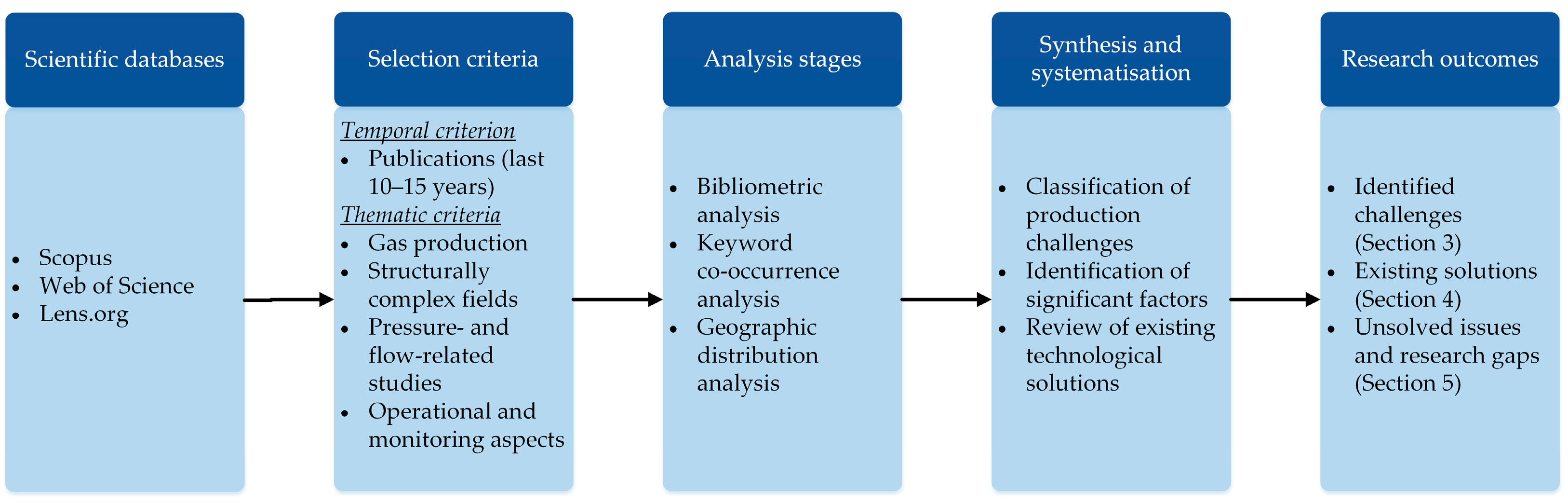
  • Comprehensive analysis of scientific and technical literature. The goal of this stage is to identify the current state of research in the field of unconventional reservoir development. The analysis is based on publications in scientific journals and international conference proceedings, as well as company technical reports and patents. Literature retrieval was conducted using international scientometric databases (Scopus, Web of Science, Lens.org) covering the last 10–15 years. Publications were included if they addressed challenges, influencing factors, or technological solutions related to gas production from structurally complex reservoirs at the pore, layer, or field scales. The selected studies were subsequently subjected to qualitative analysis and synthesis to classify key challenges, identify dominant factors, and generalise approaches to their mitigation, as illustrated in Figure 1. The search was structured around four thematic groups of keywords:
    • gas production and recovery (e.g., “gas production”, “gas recovery factor”);
    • complex geological structure (e.g., “reservoir heterogeneity”, “tight reservoirs”);
    • pressure- and flow-related processes (e.g., “pressure decline”, “interlayer interaction”);
    • operational and monitoring aspects (e.g., “well flooding”, “digital twin”).
  • Classification of production challenges. The aim is to systematise the main challenges that arise during the development of deposits with complex geological structures. Research methods: literature analysis and synthesis, comparative analysis, and systematisation and generalisation;
  • Review of existing systems and technologies. This stage aims to identify existing approaches to solving the challenges identified in the second stage;
  • Identifying aspects that require modernisation and promising areas. This stage is characterised by identifying promising areas for future research related to the extraction of deposits with complex geological structures;
  • This stage also involves formulating conclusions and recommendations. The goal of this stage is to systematise the research and formulate recommendations on areas and methods for further research.
Thus, the research methodology is based on a sequential review of literature, which includes determining the current state of the research area; identifying key challenges in developing structurally complex fields; analysing existing technical solutions and systems; and formulating directions for further research. The results obtained will enable the development of scientifically sound recommendations for improving gas production processes at structurally complex fields.

3. Challenges of Gas Production from Structurally Complex Deposits

Maintaining high levels of natural gas production is a strategic goal for the oil and gas industry both in the Russian Federation and worldwide [7]. This is due to its contribution to the national economy. A promising solution in this area is the development and exploitation of unconventional hydrocarbon sources, which include structurally complex deposits. However, the development of reservoirs with complex geological structures is accompanied by a number of interrelated organisational, operational, technical, geological, and technological challenges that require a systematic analysis.
Within this section, the challenges arising during the development of gas fields with complex geological structures are systematised based on an analysis of domestic and international studies. This analysis makes it possible to identify the main groups of challenges that, in the authors’ view, have the greatest impact on the efficiency of gas production.
The search for new ways to develop industrial energy is the primary focus of many scientific studies, which seek to identify the most effective ones (in terms of economics and environmental impact). Key aspects of this search in our country are presented in [8,9,10]. Many studies are devoted to improving existing technologies for the development and operation of structurally complex deposits.
Understanding the processes and models of the formation and accumulation of unconventional reservoirs is essential to identifying the key challenges in hydrocarbon production in structurally complex fields. This topic has received significant attention in the scientific literature. Studies [11,12,13] present the key factors influencing the formation of unconventional reservoirs throughout history. The technologies used in their exploitation are also described. The early stages of development were based on geological mapping and laboratory studies of the properties of low-permeability rocks. Subsequently, the emphasis shifted to the development of multi-stage fracturing methods and horizontal drilling technologies. Currently, scientific efforts are focused on the integration of digital technologies and the application of intelligent systems.
Another view of the challenge is proposed in [14]. In addition to the mechanisms underlying the formation of unconventional hydrocarbon sources, the authors analyse the production process, taking into account its stages and determining their efficiency. This approach is useful when formulating a field development strategy.
Reference [15] presents various models for the formation of large hydrocarbon accumulations. An analysis of the application of these models to tight oil and gas reservoirs has shown that they are currently unable to effectively identify locations where hard-to-recover hydrocarbons accumulate.
The work [16] is devoted to the formation and genesis of hydrocarbons in deep-sea environments. The authors presented a comprehensive study of processes for forming energy resources and modelling methods for predicting fluid phase states, with pressure, temperature, heating rate, and initial composition playing key roles. Thermodynamic modelling revealed the following relationships: liquid components can be preserved at temperatures above 200 °C and pressures above 30 MPa; heating duration has a significant impact on the degree of oil transition to the gas phase.
In the Russian Federation, vast reserves of unconventional hydrocarbons are contained in the Arctic regions, which have unique natural and environmental factors. Developing deposits in northern conditions is a complex task, one that scientists are constantly working on. For example, studies [17,18] examine the influence of various factors on the formation and conservation of hydrocarbon raw materials and also describe the process of modelling the prospects for extracting hard-to-recover resources on the Arctic shelf. Thus, the authors, using stochastic seismic inversion, established that uplifts act as barriers and negatively affect reservoir properties (RP). The modelling resulted in the identification of zones of optimal accumulation; it was established that resource potential is essentially controlled by tectonics and sedimentation; the distribution of porosity and areas with high parameter values (temperature and pressure) were assessed.
The studies reviewed above form the scientific basis necessary for understanding and identifying the key challenges that arise directly during the development of oil and gas fields with complex geological structures. In this regard, the following part of this section examines the main groups of challenges identified by the authors and presents their structuring, which is summarised at the end of Section 3.

3.1. Causes of Uneven Reservoir Pressure Decline and Difficulties in Its Prediction: Reservoir Heterogeneity, Complex Tectonics, and Geomechanical Effects

3.1.1. Studies of Heterogeneity in Reservoir Properties

One of the key challenges is reservoir heterogeneity and complex tectonics, which significantly affect various aspects of the hydrocarbon recovery process. This heterogeneity manifests in the presence of sections with different RP. During production, low-permeability or isolated sections retain higher pressure than other sections, resulting in pressure differentials between them. These differences can lead to mutual influence between interlayers, making hydrocarbon recovery more difficult and leading to uneven field depletion.
Determining the properties of developed reservoirs is a relevant task for various types of gas reservoirs. Reservoirs with high porosity and permeability provide relatively favourable flow conditions during hydrocarbon production; however, in recent years the focus has increasingly shifted toward complex reservoirs. Fields of this type are characterised by poor RP, which significantly complicates their development and negatively affects the final production rates [19,20].
Studies [21,22,23] describe methodologies and a range of experimental approaches for determining the filtration properties of the Achimov deposits, which are classified as reservoirs with complex geological structures. A wide variety of methods and experiments were applied to identify reservoir formation patterns as well as factors that negatively affect reservoir quality. Studies [24,25] focus on identifying the main trends in the formation of the Achimov deposits. The results of the reviewed studies indicate that significant structural variability of the Achimov Formation leads to differences in RP even within a single productive interval, which substantially complicates reservoir modelling and development planning.
The presence of tight gas in complex fields is widespread. For example, in paper [26], the authors present the results of a study of reservoirs in volcanically active rocks. Here, it was determined that volcanic activity contributed to gas generation, while volcanic rocks retain more stable RP than tight sandstones. The results showed that gas reservoirs in volcanically active zones are more stable at depth because they can generate gas due to the elevated thermal regime in the formations. These characteristics must be taken into account in further exploration of unconventional reservoirs of this type.
For shale tight reservoirs with nanoscale pore structures, the study shows that gas flow behaviour depends on the geometry of the pore space. The results establish relationships between reservoir characteristics and gas flow parameters that cannot be described by classical filtration models [27].
Thus, studies of Achimov, volcanic, and shale reservoirs demonstrate that a wide class of unconventional reservoirs is characterised by high variability of RP, driven by lithological structure, thermobaric conditions, burial depth, and hydrocarbon generation mechanisms.
Studies aimed at determining the rock properties of tight reservoirs indicate that accurate characterisation of pore structure is a critical factor for assessing RP and reservoir productivity. The results demonstrate the presence of a correlation between pore throat structure and rock permeability, enabling a more detailed description of filtration processes at the microscale [28]. The additional implementation of experimental and digital approaches facilitates the application of surfactants as well as combined methods for determining RP, thereby improving the accuracy of data interpretation [29,30].
Accounting for reservoir property heterogeneity when planning field development strategies can increase the GRF by enabling more accurate forecasting of reservoir pressure dynamics and mitigating negative impacts on the reservoir during operation.

3.1.2. Modelling of Gas Particle Transport in Reservoirs with Complex Geological Structures

Modelling the motion of gas particles in the micro- and nanopores of tight reservoirs represents a complex problem for which no optimal solution has yet been established. This is due to the fact that, at such scales, physical effects emerge that are not accounted for by classical fluid flow laws, which are primarily developed and validated at the macroscopic scale.
A large body of research is focused on investigating the applicability of the lattice Boltzmann method for modelling dense hydrocarbon filtration. These approaches allow for the consideration of gas compression and rarefaction effects, the influence of abnormal thermobaric conditions, and the specific interactions between fluids and pore walls of the rock. The results of these studies indicate that additional physical effects arise at this scale, which have a significant impact on fluid flow behaviour [31,32,33,34]. Analysis of the reviewed works suggests that lattice Boltzmann models are highly informative for laboratory and numerical investigations; however, their widespread application to field-scale problems requires substantial adaptation and validation using real production data.
Filtration processes are traditionally analysed using Darcy’s law in its various forms. However, due to the complex structure of the reservoirs under consideration, flow behavior often deviates from Darcy flow, which has a critical impact on filtration processes within the formation. Russian researchers have reported the results of a study [35] demonstrating that the classical Darcy-based approach to describing fluid motion in reservoirs is not always reliable. The authors experimentally showed that reverse osmosis can significantly influence fluid movement in the formation, leading to deviations from classical Darcy flow.
In this context, filtration models that account for boundary layer effects in the reservoir, deformation of the porous medium, stress sensitivity, and the presence of a threshold pressure gradient are being actively developed. These effects can substantially reduce the efficiency of gas field development and therefore cannot be neglected. The proposed models demonstrate high reliability; however, their application is primarily limited to the description of single-phase flow and cannot always be adapted to real development conditions [36,37].
Another approach to modelling unsteady flow that does not conform to Darcy’s law is presented in [38]. The authors propose a model that provides valuable insight into unsteady flow behavior in complex reservoirs by accounting for the temporal variability of filtration parameters. While this model offers a qualitative understanding of unsteady flow dynamics, its application is limited to a narrow class of problems.
Fluid movement within a reservoir is governed by a large number of interacting factors; therefore, increasing attention is being paid to a systems-based approach to modelling filtration processes. Such studies consider transient processes with mutual interactions, as well as the influence of external parameters. A comprehensive consideration of multiple physical phenomena and forces enables a more complete description of filtration processes and facilitates the identification of key parameters that exert the greatest influence on development efficiency [39,40,41,42].
Additional studies aimed at assessing the efficiency of fluid flow in tight reservoirs demonstrate that pore structure and mineral composition are key factors governing filtration behavior [43]. These findings are consistent with the results of productivity modelling of tight gas reservoirs that account for gas slippage effects and the presence of macro- and nanopores [44].
Predicting fluid behavior has become an increasingly prominent research topic in recent years. Such studies make it possible to identify the main driving forces of natural gas filtration and to establish patterns of fluid distribution within the reservoir. Modelling results allow key factors influencing fluid redistribution to be identified; however, practical validation of these findings is often lacking [45,46,47].

3.1.3. Modelling of Pressure Dynamics in Multilayer Reservoirs

Despite the large number of existing models describing the distribution of pressure, permeability, and production rates in multilayer reservoirs, the challenge of adequately accounting for differences in the properties of individual layers remains unresolved. Many of the available approaches exhibit high accuracy only under specific geological conditions and lack scalability to other fields. This indicates a limited consideration of fundamental intra-reservoir processes characteristic of heterogeneous reservoirs. As a result, such models remain to a certain extent local in nature and do not allow the formulation of universal recommendations [48,49].
The development prospects of tight reservoirs are addressed in numerous studies, with a primary focus on analysing controlling factors, interlayer flow processes, and gas filtration dynamics. These studies examine the geological foundations of reservoir formation in complex geological settings, as well as engineering aspects of their development, including recommendations for selecting development schemes and well operating regimes. The results emphasise that production efficiency depends on interlayer fluid interactions and the spatial distribution of RP; therefore, these factors must be taken into account when adjusting gas production management strategies [50,51,52].
The multilayer structure of reservoirs is a central focus of this study. During the operation of structurally complex reservoirs, a range of challenges arises that are directly associated with their multilayer geological architecture. Interlayer interactions and interlayer interference have a significant impact on the total hydrocarbon production rate, as well as on the operational stability of wells. The proposed models enable the prediction of production rates in multilayer reservoirs and serve as a basis for developing recommendations aimed at mitigating the negative effects of interlayer interactions [53,54].
Numerical modelling of multilayer reservoirs demonstrates the possibility of a complete decline in production rates due to fluid crossflow between individual layers. In this context, the development of methods for optimising operating regimes and well configurations become particularly relevant. To this end, data processing technologies are being continuously improved to enhance the accuracy of reservoir property evaluation [55,56,57]. Analysis of the results of these studies leads to the conclusion that regulation of the reservoir pressure field is the most critical task in improving the efficiency of developing structurally complex reservoirs.
Significant progress is being observed in the development of intelligent technologies that are being integrated into various technological processes in gas production. A key characteristic of fields with complex geological structures is the multiphase nature of the reservoir, where high-permeability layers alternate with low-permeability layers. This feature represents a fundamental aspect of the traditional understanding of hydrocarbon flow within the reservoir. In this context, models of single-phase and multiphase filtration are being actively developed. Analysis of such models highlights their advantages and limitations and indicates the necessity of accounting for interlayer interactions. These aspects are further explored within the framework of the digital twin concept, which enables digital core modelling and the simulation of filtration processes [58,59]. Alongside these approaches, analytical methods for describing filtration processes remain relevant due to their high computational efficiency, making them attractive for engineering calculations [60].
The development of interdisciplinary approaches enables addressing a wide range of challenges from new perspectives. In particular, models based on morphological analysis and fuzzy mathematics have been proposed for estimating reservoir parameters using well log data, allowing uncertainty in the input information to be taken into account [61].
Despite the large number of existing models, a complete understanding of the processes governing interlayer fluid interactions in geologically complex fields has not yet been achieved. Recent studies indicate that numerous factors influence flow behaviour, leading to nonlinear filtration processes [62]. These findings emphasise the importance of accounting for pore-scale physics, as neglecting gas transport and mobility effects can result in inaccurate assessments of RP and gas recovery.

3.1.4. Studies of the Impact of Geomechanical Effects on Reservoir Properties and the Operation of Structurally Complex Reservoirs

Geomechanical effects have a significant impact on the structurally complex reservoirs during their operation. Pressure dynamics during hydrocarbon production cause rock deformation, which can result in changes in the fracture network, reservoir failure, and other effects. Furthermore, changes in reservoir structure also affect RP, reducing reservoir development efficiency.
Since hydraulic fracturing is one of the most frequently used technologies to improve gas production efficiency in hard-to-recover reservoirs, studying the behavior of flow during fracturing can help improve the effectiveness of this method. High fracturing and heterogeneity are key challenges, even when using hydraulic fracturing technology. In [63], a significant drop in reservoir permeability can occur during the hydraulic fracturing stage. Despite the restoration of conductivity during the transition to the gas phase, accounting for the full “fracturing-return-production” cycle and the correct selection of fluid are key to minimising conductivity losses in structurally complex reservoirs. The authors of [64] also highlight the challenge of fractured reservoirs, emphasising that traditional models cannot fully reflect the complexity of filtration processes, which can lead to an incorrect assessment of the RP.
The application of hydraulic fracturing methods enables the formation of fracture networks, which significantly affect the final volume of fluid extracted from the reservoir. Numerous studies propose various models for evaluating the productivity of hydraulically fractured wells, including gas production under conditions of high-water saturation. The results of these studies present methodologies for implementing different hydraulic fracturing techniques aimed at increasing the GRF [65,66,67].
The influence of fractures on fluid flow within the reservoir can be substantial; therefore, this issue has been extensively investigated. Studies [68,69] provide descriptions of existing modelling approaches and propose semi-analytical models that enable efficient computation of transient reservoir pressure behavior while maintaining an acceptable level of computational accuracy.
Summarising the results of the studies reviewed in Section 3.1, it can be concluded that reservoir heterogeneity, complex tectonics, nonlinear filtration, and geomechanical effects form a group of interrelated factors that significantly complicate the development of oil and gas fields with complex geological structures. The analysis of existing research in this subsection shows that most proposed models and technologies demonstrate acceptable performance under specific conditions but cannot be readily scaled to other geological settings. In this context, management of reservoir pressure distribution becomes a key factor, which is addressed in the following section.

3.2. Studies on the Consequences of Reservoir Pressure Decline

When developing structurally complex reservoirs, a drop in reservoir pressure inevitably occurs, leading to a significant reduction in flow rates in the later stages of production and, ultimately, the under-recovery of hydrocarbon reserves. Reservoir pressure not only acts as the primary driving force for fluids in the reservoir but also has a significant impact on the petrophysical and RP of the reservoir. Numerous studies have been devoted to the dependence of these parameters on pressure.
Studies show that pressure dynamics lead to changes in reservoir permeability, while the nature of this relationship varies significantly depending on RP. It is demonstrated that reservoir pressure decline often results in a reduction in permeability, which is attributed to deformation of the pore space and rock damage. This effect is particularly important in the context of hydraulic fracturing as a method for increasing the GRF [70,71,72]. An analysis of these studies in combination with [73] indicates that pressure variations affect RP as a whole, rather than permeability alone, and this must be taken into account when developing structurally complex fields.
A more accurate description of these effects requires the development of fundamentally new models that account for stress-dependent permeability, thermobaric conditions, and the complex state of the reservoir. Such approaches should enable the analysis of pressure distribution processes and changes in RP under conditions of abnormal temperatures and pressures. These models are commonly based on regression analysis and statistical methods of varying levels of detail, as well as on the analysis of reservoir petrophysical properties [74,75,76,77]. The analysis of the results shows that the proposed approaches cannot be regarded as universal for reservoirs with different geological characteristics.
Predicting pressure evolution is a critical task in gas production, as it enables a significant improvement in field development efficiency. For example, in [78], the authors present a method for modelling fluid flow in porous media using novel solutions of the pressure diffusion equation based on Gaussian pressure transition processes. This work builds on a series of studies by another research group that proposed an analytical model simulating unsteady flow through fractures [79]. Further improvements to this method are presented in [80]. These models enhance the accuracy of reservoir dynamics prediction by accounting for variations in reservoir parameters and complex boundary conditions.
Abnormally high reservoir pressures represent one of the key challenges in the development of structurally complex fields. Understanding the processes governing pressure distribution within the reservoir enables more accurate identification of overpressured zones. In [81], the authors propose integrating multiple approaches—geomechanical, hydrodynamic, and geochemical—when modelling reservoirs with high-pressure conditions. This integration improves modelling accuracy and contributes to reducing drilling-related risks while increasing the efficiency of hydrocarbon field development.
An important aspect of reservoir characterisation is the determination of the physical parameters of the developed formations. A comprehensive study presenting existing models of pressure dynamics during the development of unconventional reservoirs is reported in [82]. In turn, in [83], reservoir pressure is estimated using data on pressure drawdown during well operation. This approach demonstrates high convergence; however, its applicability has not been validated for complex reservoirs.
In [84], the authors present the development of a pressure management system for a low-permeability reservoir. They identify reservoir pressure distribution and bottom-hole pressure as the most critical parameters from the perspective of gas production control. Using the proposed model, coefficients of effective control and effective capacity were derived, which characterise the efficiency of reservoir management. Integrating the results of this study with those of [85] may provide a foundation for implementing the concept of adaptive control.
Obtaining highly reliable and analytically valuable data is associated with comprehensive studies based on the integration of multiple existing methodologies. The application of appropriate approaches for acquiring information on various parameters, including pore pressure dynamics, enables the implementation of the most effective field development strategies [86,87].
The analysis of the studies reviewed in this subsection leads to the conclusion that pressure dynamics represent one of the most important parameters in improving the efficiency of developing structurally complex fields. Changes in pressure result in variations in RP and in the nature of filtration processes. It should also be noted that the character of this influence is often nonlinear and partially irreversible.
Insufficient consideration of the relationships between pressure and reservoir parameters may lead not only to a reduction in final production rates but also to the premature formation of local zones of intensive withdrawal. This, in turn, results in the development of depression cones and well water encroachment, which are discussed in the following subsection.

3.3. Studies of the Consequences of Uneven Reservoir Pressure Decline: Depression Cones, Premature Well Water Encroachment, and Condensate Formation

3.3.1. Formation of Depression Cones

During gas well operation, a zone of reduced pressure forms in the near-wellbore region, which subsequently develops into a depression cone (pressure cone) [88]. The presence of such cones adversely affects production, as the low-pressure zone near the wellbore can induce water inflow and the ingress of undesirable fluids, as well as promote the formation of condensate blockages. In this context, reducing the negative impact of depression cones remains a relevant challenge.
Study [89] presents a mathematical modelling of depression cones that develop during gas production in heterogeneous fields. The occurrence of these phenomena represents a significant problem that reduces the overall efficiency of gas production operations due to premature well water encroachment.
Work [90] is devoted to the investigation and modelling of the dynamic evolution of depression cones in tight coal seams during methane production. The authors classify different types of cones and propose relationships describing the influence of pressure decline on the depth and radius of the depression cone. Adjusting the rate of pressure decline allows a significant increase in the ultimate gas recovery. The dynamics of depression cones were also examined in [91], where the nonlinear behavior of the depression zone was taken into account. It was shown that cone geometry depends on water saturation, pressure drawdown, and the mechanical sensitivity of the reservoir.
The authors of [92] present the results of a study on the formation mechanisms of depression cones in a tight gas field. A key finding is the consideration of an initial pressure gradient that must be exceeded for gas flow to occur.
The processes governing depression cone formation vary depending on multiple factors, including field type, the presence of multilayer production, RP, and other parameters. In [93], the dynamics of the depression cone boundary under conditions of multilayer production from multiple layers are analysed.

3.3.2. Studies in the Field of Well Water Encroachment and Condensate Formation Issues

One of the main challenges inherent to most gas-producing fields is well water encroachment. Water inflow into wells can be caused by various factors but ultimately leads to a reduction in the GRF and, in some cases, to complete well failure. Closely related to this issue is the process of condensate formation, which occurs when pressure drops below the dew point and affects hydrocarbon recovery through partially similar mechanisms. Investigation of these processes therefore represents an important and complex research task.
In [94], the mechanisms of well productivity decline associated with the formation of low-pressure zones are investigated. The authors conclude that management of the depression cone is a central element in controlling well water encroachment.
Study [95] analyses more than forty years of experience in the development of a tight reservoir in the Sichuan Basin. An assessment of the effectiveness of various water-control measures shows that early forecasting and timely selection of development strategies, combined with the individual adaptation of specific methods, can significantly increase the GRF.
In [96], existing studies on the movement of formation water during field operation are summarised. A theoretical method is proposed for evaluating the transition of so-called bound water into mobile water. Based on this approach, recommendations are formulated for the optimal placement of production wells. A similar study is presented in [97], where the microporous structure of the reservoir and fluid distribution within it are analysed. It is shown that the efficiency of tight sandstone reservoirs deteriorates significantly during well water encroachment due to clay mineral swelling and the formation of clay aggregates within the rock matrix. This process leads to a reduction in both permeability and porosity of the developed reservoirs. In [98], the authors classify intra-reservoir water into several categories and describe their specific roles in gas–water interactions.
Many studies focus on the empirical description of well water encroachment processes. However, at present, increasing attention is being given to forecasting approaches and the implementation of proactive measures aimed at preventing potential water inflow during gas production.
In [99], a model is proposed for calculating gas productivity while accounting for non-Darcy flow behavior and multiple filtration effects. Modelling fluid flow in hard-to-reach reservoirs is a challenging task due to various complications and the nonlinear nature of fluid movement. The authors of [100] highlight the limitations of existing models and propose their own approach for describing two-phase water–gas production. The semi-analytical solution of this model provides sufficiently good results in terms of both economic efficiency and computational accuracy. However, the assumptions adopted in its development indicate significant limitations in its applicability.
Researchers in [101] also address challenges associated with hydrocarbon production in geologically complex fields. As conventional methods are often ineffective, the authors propose the use of autonomous inflow control devices (AICDs), which enable improved flow distribution along the wellbore.
Another challenge characteristic of gas production is condensate formation, which occurs when reservoir pressure drops below the dew point. This process leads to pore blockage within the reservoir and is associated with a decline in hydrocarbon production from wells. Research in this area focuses on investigating condensate formation mechanisms [102,103,104] as well as on developing various mitigation methods [105,106,107].

3.4. Conclusions for the Section

As a result of the analysis of the reviewed literature, a classification of the main challenges characteristic of gas production from structurally complex fields has been developed (Table 1). This table presents qualitative characteristics of the identified challenges, including the dominant mechanisms and the scale at which they manifest.
An analysis of the reviewed studies indicates that the development of gas fields with complex geological structures is complicated by a set of interrelated challenges that directly affect production efficiency. Reservoir heterogeneity, complex tectonics, and geomechanical effects lead to nonlinear fluid redistribution and filtration processes within the reservoir, which significantly complicates their modelling.
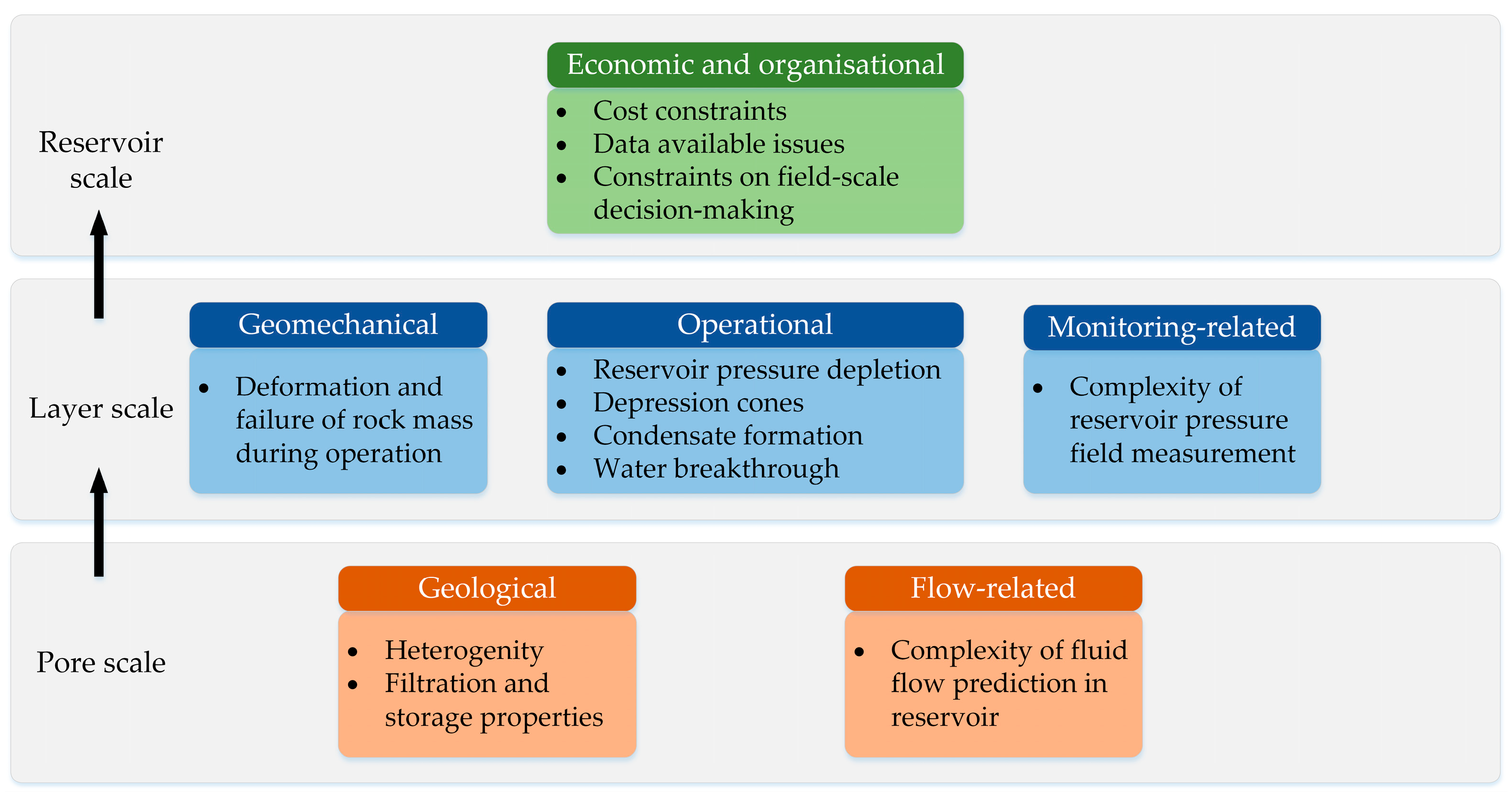
Reservoir pressure decline during gas field operation governs the evolution of RP, permeability, and flow regimes in structurally complex reservoirs. Insufficient understanding of the relationships between pressure and reservoir parameters may result in an accelerated decline in production rates and the emergence of additional geological complications. The multilevel nature of the identified challenges—from pore-scale heterogeneity to operational and organisational constraints at the reservoir scale—is schematically illustrated in Figure 2.
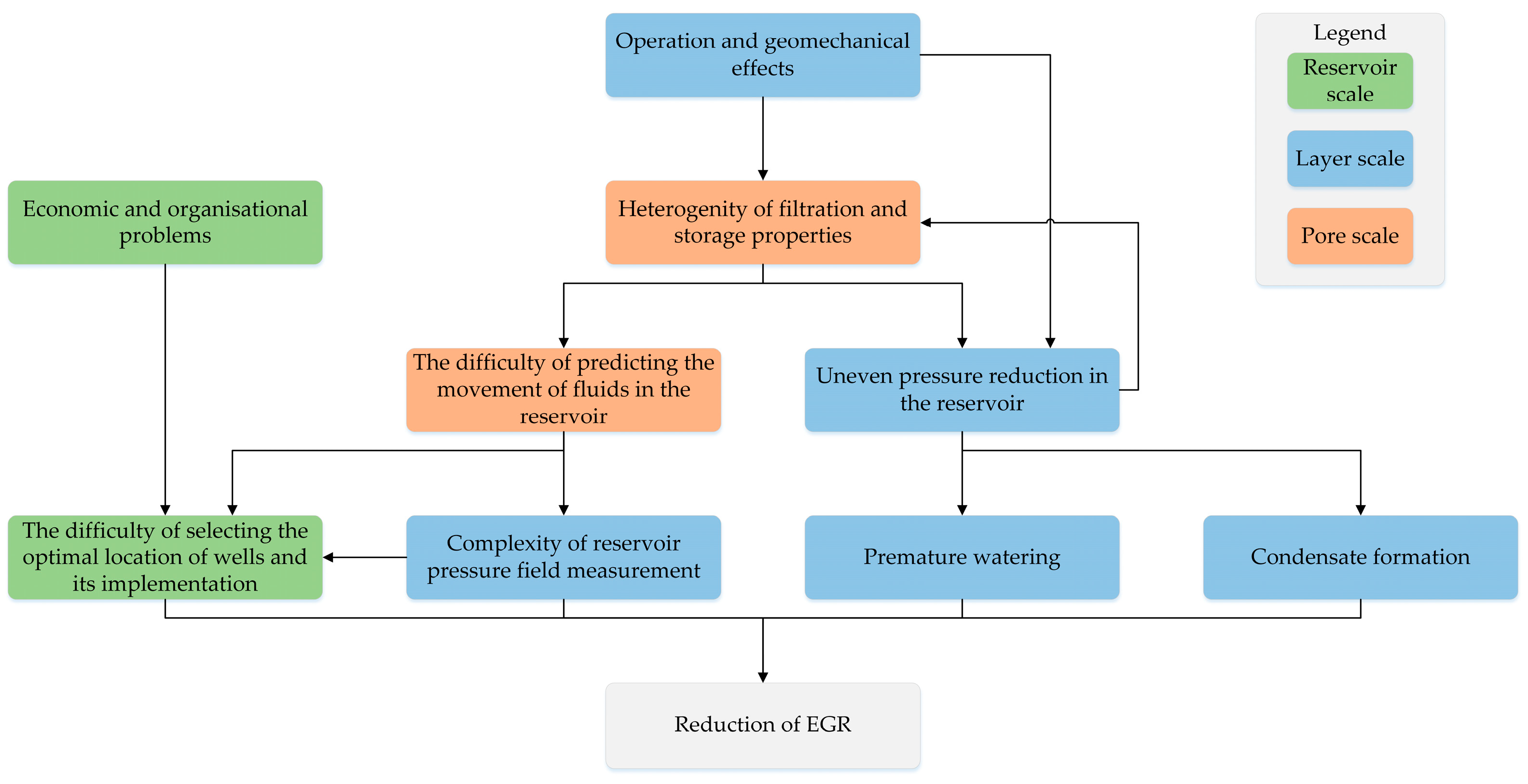
The most pronounced manifestation of these complications is the premature formation of depression cones, which lead to well water encroachment and condensate formation and, in turn, result in reductions in production rates and the GRF. The literature analysis indicates that these processes are closely interconnected and require integrated consideration within a unified gas production management framework. In addition to their multidimensional nature, the identified challenges are strongly interrelated, forming cause–effect chains that collectively lead to reduced gas production efficiency, as illustrated in Figure 3.
The combination of the identified challenges highlights the need to shift from solving isolated problems toward the development of integrated approaches to gas production management in reservoirs with complex geological structures. To this end, it is necessary to consider currently available advanced technological solutions. An analysis of studies addressing such approaches is presented in the following section.

4. Existing Approaches to Solving the Challenges of Gas Production from Structurally Complex Deposits

Numerous studies have been devoted to solving the above challenges. The research focuses primarily on approaches to pressure field management. This phenomenon is due to the fact that reservoir heterogeneity, complex tectonics, and geomechanical effects are virtually impossible to directly influence. By directly managing the reservoir pressure field, it is possible to control the formation of depression cones, water cuts, and condensate.
Pressure field management in structurally complex gas fields is based on technologies such as:
  • Injection of reservoir pressure maintenance agents;
  • Aquifer isolation methods;
  • Intelligent systems enabling remote control of well inflows;
  • Combined interlayer production schemes;
  • Optimisation of operating modes;
  • Implementation and development of automated process control systems and supervisory control and data acquisition (SCADA) systems.

4.1. Adjustment of Operating Regimes

Many studies report [125,126] that excessive reservoir drawdown leads to deterioration of reservoir conductivity and degradation of filtration properties, resulting in a reduction in the GRF. In this context, pressure management strategies that ensure controlled pressure depletion within the reservoir are of primary importance. Such approaches are aimed at increasing the ultimate GRF [127]. Similar conclusions are presented in [128], where the authors indicate a significant decline in filtration properties under aggressive reservoir drawdown. At the same time, wells operated under controlled pressure depletion regimes demonstrate improved hydrocarbon recovery efficiency.
Study [129] summarises technologies developed for the exploitation of fields with complex geological structures. The authors consider natural gas accumulations associated with the Upper Paleozoic era. The application of technologies such as multiscale reservoir forecasting, accurate determination of reservoir characteristics using near-bit rock property analysis during drilling, stereoscopic development based on hybrid well configurations, and related approaches enables effective development of complex tight gas reservoirs. Promising technologies for the development of complex oil reservoirs are also discussed in [130], where particular attention is given to multilayer reservoirs with poor filtration properties. Similar results are reported in studies [131,132].

4.2. Review of Models Used for Forecasting and Optimising Production

A large number of studies are devoted to developing methods for evaluating the efficiency of oil and gas field development. However, due to the unique geological characteristics of each individual field, a universal optimisation approach has yet to be established. As a result, modelling methods based on analytical and semi-analytical representations of heterogeneous reservoirs are being actively developed. In [133], a model for multistage hydraulically fractured horizontal wells is proposed, enabling more accurate prediction of reservoir pressure behavior. According to the authors, particular attention should be paid to factors such as well placement, fracture properties, fluid mobility, and related parameters.
Decline curve analysis methods are widely applied for conventional reservoirs; however, they are not sufficiently effective for forecasting production and remaining reserves in unconventional reservoirs. Study [134] analyses existing decline curve models to identify the most suitable approaches for structurally complex reservoirs. The results show that classical methods (the Arps model and its modifications) tend to overestimate recoverable reserves, whereas the SEPD and Duong models provide more conservative estimates. The closest agreement with actual production data is observed for the fractional model.
One of the key directions in intelligent hydrocarbon production management is the application of proxy modelling, which significantly accelerates calculations compared to conventional reservoir simulation approaches. In [135], the authors review the use of proxy models in the oil and gas industry and conclude that these models are effective for uncertainty assessment and for adjusting production regimes. The use of hybrid models is proposed to compensate for the inherent limitations of proxy-based approaches.
Study [136] presents a three-dimensional model for analysing pressure transient behavior in shale gas reservoirs. In [137], the authors propose a new approach for estimating average reservoir pressure using wellhead pressure data.
Another approach to improving the efficiency of gas field development is proposed in [138], where tight gas reservoirs are analysed using a two-phase gas–water flow model that accounts for the threshold pressure gradient. The results indicate that well water encroachment is a key parameter whose regulation can lead to an increase in the GRF.
Integrated solutions aimed at improving the efficiency of gas production operations have also attracted significant research interest. In [139], an approach is proposed for adjusting the parameters of the stimulated reservoir volume to increase the GRF in low-permeability gas hydrate reservoirs with complex fracture systems. This method is considered promising for managing filtration processes in structurally complex reservoirs.
The adaptation of technologies developed in other fields has also demonstrated considerable potential. As shown in [140,141,142], the implementation of simulation modelling, artificial intelligence, and big data analytics can significantly enhance operational efficiency. The adoption of such approaches in the oil and gas industry can expand the toolbox for managing structurally complex fields and improve the quality of decision-making processes.

4.3. Application of Artificial Intelligence Methods

At present, artificial intelligence (AI) methods—particularly machine learning (ML)—are undergoing rapid development. Study [143] analyses existing examples of AI applications in the oil and gas sector, ranging from field management to the forecasting and adjustment of fluid production.
A model based on the processing of large volumes of geological and production data is proposed in [144]. The analysis of more than 9000 well pressure transient tests, well log data, and field measurements of production rates and pressure enabled the development of an adaptive model for pressure transient interpretation. The model determines permeability, reservoir pressure, and skin factor with high accuracy. However, this approach has been tested only on oil wells. Another application of neural networks is presented in [145], where ML-based models are developed to estimate reservoir characteristics. The study employs three ensemble learning algorithms—Random Forest, LightGBM, and CatBoost. The comparison shows that the CatBoost model provides acceptable accuracy in predicting production characteristics.
In [146], the operating regime of a well equipped with a plunger lift system is investigated. During operation, a two-phase depression cone is formed, the geometry of which varies depending on the direction of plunger movement. The application of a deep learning algorithm resulted in an increase in the GRF of approximately 5%, as well as a significant improvement in water removal efficiency. In [147], a neural network-based pressure control model is applied. This approach enables much faster prediction of pressure values; however, it requires further development to account for fluid multicomponent and multiphase behavior, as well as geomechanical effects.
The use of ML and predictive analytics enables efficient processing of large data volumes and the construction of forecasts for individual stages of the overall production cycle. However, due to the limited availability of industrial-scale data, achieving fully trained neural network models remains a significant challenge at present.

4.4. Approaches Based on the Injection of Agents into the Reservoir

One approach to addressing pressure management in complex reservoirs is the application of reservoir pressure maintenance (RPM) systems [148]. Studies of carbonate reservoirs have shown that the proper design and implementation of RPM systems can stabilise reservoir pressure and increase the GRF.
The authors of [149] investigated pressure propagation mechanisms in sealed reservoirs. The study presents the results of laboratory experiments examining pressure behavior under constant injection pressure, constant injection rate, and reservoir depletion regimes. Water injection is proposed as a method for increasing reservoir pressure, thereby enhancing the GRF. Further development of this approach is presented in [150,151], where CO2 is used as the injected agent. Due to its higher density and viscosity, CO2 enables more efficient gas displacement and the formation of a stable pressure front, reducing the risk of deterioration of reservoir filtration properties. A significant advantage of CO2 injection is that, unlike water injection, it does not lead to well water encroachment and additionally provides opportunities for CO2 sequestration. In [152], the impact of permeability and water saturation on gas production from a geologically complex field is investigated using supercritical CO2 injection. The study characterises reservoir behavior under varying permeability and water saturation conditions.
Further studies [153,154] demonstrate that multicomponent gas mixtures influence methane displacement efficiency, pressure redistribution, and filtration characteristics. While this approach offers several advantages for structurally complex reservoirs, its applicability is strongly dependent on thermodynamic conditions, which limits its scalability.
Condensate formation during the development of gas-condensate fields often leads to a significant reduction in permeability and complicates hydrocarbon production. In [155], a thermochemical method is proposed to mitigate the negative effects of condensate formation, thereby improving production efficiency.
Overall, the development of technologies based on the injection of agents into the reservoir represents a promising direction for further research.

4.5. Approaches in the Field Development and Infrastructure Design

Improving the efficiency of natural gas production from fields with complex geological structures can be achieved through various approaches.
In [156], the authors investigate the petrophysical properties of a tight reservoir and identify several directions for improving applied technologies, including adjustment of well spacing, implementation of controlled reservoir drawdown regimes, and enhancement of multistage hydraulic fracturing techniques. It is noted that improvements in technologies for characterising and describing multilayer reservoirs, as well as production technologies under negative pressure conditions, can have a significant impact on natural gas production volumes.
The economic efficiency of shale gas development is a critical component of project justification for this type of resource. The application of regression-based models for forecasting total field reserves can provide a basis for optimising production capacity in shale gas development [157]. In [158], the authors present a statistical assessment of shale gas production efficiency using numerical and stochastic modelling approaches.
Study [159] introduces a novel approach to improving the efficiency of tight reservoir development. The authors propose a model for determining effective placement of production wells based on a comprehensive analysis of reservoir physical properties. This model can be applied in practice as a viable means of enhancing the economic performance of gas fields.
Another method for improving production efficiency focuses on the analysis of horizontal gas wells under structurally complex conditions [160]. The performance analysis of horizontal wells indicates that an appropriate selection of well design and operating regimes can significantly enhance production efficiency in heterogeneous reservoirs.
One of the challenges in oil and gas field development is the lack of adequate consideration of well-to-well interactions. In [161], the authors propose a method for the quantitative assessment of well interference. By applying a comprehensive analysis of dynamic and static data, an interference coefficient and an optimal well spacing density are determined, enabling the mitigation of adverse well interactions. A similar issue is addressed in [162], where insufficient recovery efficiency under existing well densities in structurally complex reservoirs is highlighted. Using the proposed methodology, an optimal well density is identified that enhances hydrocarbon recovery efficiency.

4.6. Review of Patented Developments

The patent review highlights the practical implementation of the results of the studies discussed above. In invention [163], a solution is proposed for optimising production from unconventional oil and gas fields. In this context, optimisation includes the derivation of a continuous adjoint equation based on a continuous model of unconventional oil and gas reservoirs, the treatment of control and state constraints, and the determination of an optimal production calculation regime through analysis of the influence of time-step length on the optimisation structure.
Another invention [164] proposes the application of an intelligent pressure control system and a pressure regulation method for unconventional gas wells. These solutions enable continuous production control in wells located in structurally complex fields. The proposed method is based on continuous measurement of pressure and flow rate at well nodes, comparison of actual parameters with calculated values, and automatic adjustment of choke opening depending on pressure deviations. One of the key advantages of this invention is the effective extension of gas well operating life, which has a positive impact on the economic performance of production.
In invention [165], a method for calculating optimal reservoir drawdown during gas reservoir operation is presented. This approach represents an example of adaptive gas production management and is based on the determination of technological parameters, with fluid production rate and bottom-hole pressure calculated automatically.
The authors of patent [166] propose a new method for developing hydrocarbon accumulations in low-permeability formations. The main effect of this method is an increase in recovery factors—gas recovery, condensate recovery, and oil recovery—achieved through enhanced productivity of production wells.
Another method for developing low-permeability fields is proposed in invention [167]. The primary advantage of this approach is an increase in the content of saturated hydrocarbons in the produced fluids and an improvement in the oil recovery factor through thermal impact of the near-wellbore zone.
Overall, a wide range of technical and intelligent solutions aimed at improving the efficiency of gas and oil production in fields with complex geological structures has already been developed. Particularly promising are technologies related to pressure management, integration of digital solutions, advanced modelling, and the development of integrated approaches. In the field of modelling, numerical and semi-analytical methods for simulating filtration processes, as well as neural network- and proxy-based models, are being actively developed. Approaches based on machine learning and big data analytics are also gaining increasing attention. At the same time, a substantial proportion of these technologies require expanded field-scale testing to support their further development and industrial implementation.

4.7. Conclusions for the Section

The studies reviewed in this section, addressing both the challenges and the technological approaches to their mitigation in hydrocarbon production from structurally complex reservoirs, are conducted across multiple scales. The analysed publications cover processes characteristic of the pore scale and interlayer interactions, while a number of studies also focus on geological and operational effects at the field scale.
Field-scale decisions—such as the number and placement of wells, as well as the selection of applied technologies and equipment—directly influence reservoir pressure dynamics and pressure distribution during subsequent operation. Accounting for RP and ensuring accurate modelling of fluid flow enable more reliable prediction of pressure evolution and distribution, which, in turn, supports the selection of appropriate operating regimes. Operating regimes themselves have a direct impact on RP. At the reservoir scale, there remains a need to adjust production regimes through regulation of well production rates and, where necessary, the injection of agents into the reservoir.
It should be noted that, due to significant differences in the dominant physical mechanisms and processes occurring at different scales, solutions proposed for one level (pore scale, interlayer interaction, or field scale) are not always effective when directly applied at another level. This largely explains the limited universality and scalability of existing methods aimed at increasing the GRF in fields with complex geological structures.
The analysis of the technological approaches reviewed in this section, aimed at addressing the challenges identified in Section 3, highlights the key role of pressure as the primary parameter in gas production management. The effectiveness of GRF enhancement depends on the ability to monitor pressure variations and to promptly adjust operating regimes. At the same time, the applicability of specific methods for increasing the GRF is often context-dependent, and decisions regarding their implementation are situational, determined by a wide range of factors characteristic of the reservoir under development.

5. Unsolved Challenges and Research Gaps

Despite the rapid development of technologies for gas production from structurally complex fields, it has not yet been possible to overcome all existing barriers. A number of directions can be identified that characterise the key challenges to be addressed by future research in the field of gas production.

5.1. Field Scale

First, the weak integration of the reservoir–well–surface model should be highlighted. A number of studies address this issue and propose various approaches; however, a universal solution has not yet been achieved. For example, in [168], a comprehensive system optimisation approach based on integrated modelling of the reservoir and surface infrastructure is proposed. However, this approach is highly sensitive to the quality and volume of data available at each level. Other studies [169,170] summarise the challenges associated with integrated reservoir–well–surface modelling, identifying key obstacles such as data synchronisation complexity, high computational demand, and the need for software standardisation.
Second, despite continuous technological progress, the capabilities of real-time adaptive control remain limited. In [171], a decision-tree-based approach is applied to maximise net present value and improve reservoir development efficiency. However, the authors note a strong dependence on model completeness and input data quality.
Third, methods for optimising well spacing are highly dependent on the geological structure of the developed field. In a study of water-bearing tight gas reservoirs, the authors of [172] evaluate natural gas production efficiency and assess the influence of RP on fluid flow within the rock and subsequent pressure redistribution between layers. It is shown that water saturation has a significantly smaller impact on reservoir pressure variation than permeability. The proposed model enables determination of optimal well spacing density; however, it does not account for reservoir property heterogeneity. In [173], an alternative method is proposed for optimising well configurations and assessing gas recovery efficiency from tight reservoirs with complex formation conditions. This model accounts for variable development regimes.
The authors of [174] raise the issue of applying uniform productivity equations at different stages of field development. To address this problem, a system of equations is proposed that accounts for changes in average reservoir pressure according to Darcy’s law. Numerical modelling results and comparisons with field data confirm the validity of the model. Nevertheless, the problem remains relevant, as in real conditions the simultaneous consideration of water encroachment dynamics and filtration properties within a single framework may lead to inaccuracies. The development of robust models that account for operating regimes and adapt to changing conditions is therefore required to improve production forecasting accuracy.
Another unresolved issue is the integration of existing methods for evaluating the performance of production wells and fields developed for conventional reservoirs into the context of structurally complex reservoirs.
In addition, the high cost of developing and implementing new technologies remains a critical challenge [175], requiring not only technological efficiency improvements but also careful consideration of economic constraints.

5.2. Reservoir Scale

Increasing attention is being paid to challenges associated with depression cones that form during field operation. Despite the progress achieved in this research area, a comprehensive solution to this problem has not yet been attained [127].
Another persistent challenge is the management of hydrocarbon phase behavior. In [176], it is shown that the combination of abnormally high thermobaric conditions characteristic of geologically complex fields leads to condensate formation and reduced production efficiency. Existing operating regimes do not adequately account for this tendency, resulting in a reduction in the GRF. As promising directions for future research, the authors propose the application of PVT analysis and the development of models that account for filtration behavior in fractured media.

5.3. Pore Scale

Accounting for nonlinear fluid flow that does not conform to Darcy’s law represents a major challenge in modelling complex multilayer reservoirs. The authors of [177] propose an improved model that accounts for:
  • The effect of gas slippage in pores;
  • Sensitivity of permeability to pressure dynamics;
  • High-velocity flows that do not conform to Darcy’s law in a fracture system.
Further advances are presented in [178], where a model describing the dynamics of pseudo-threshold pressure under effective stress conditions is proposed, incorporating pressure variability.
An analysis of the scientific literature indicates a persistent challenge in integrating diverse technologies into a unified, comprehensive framework for managing the processes inherent to the development and operation of gas fields with complex geological structures.

6. Discussion

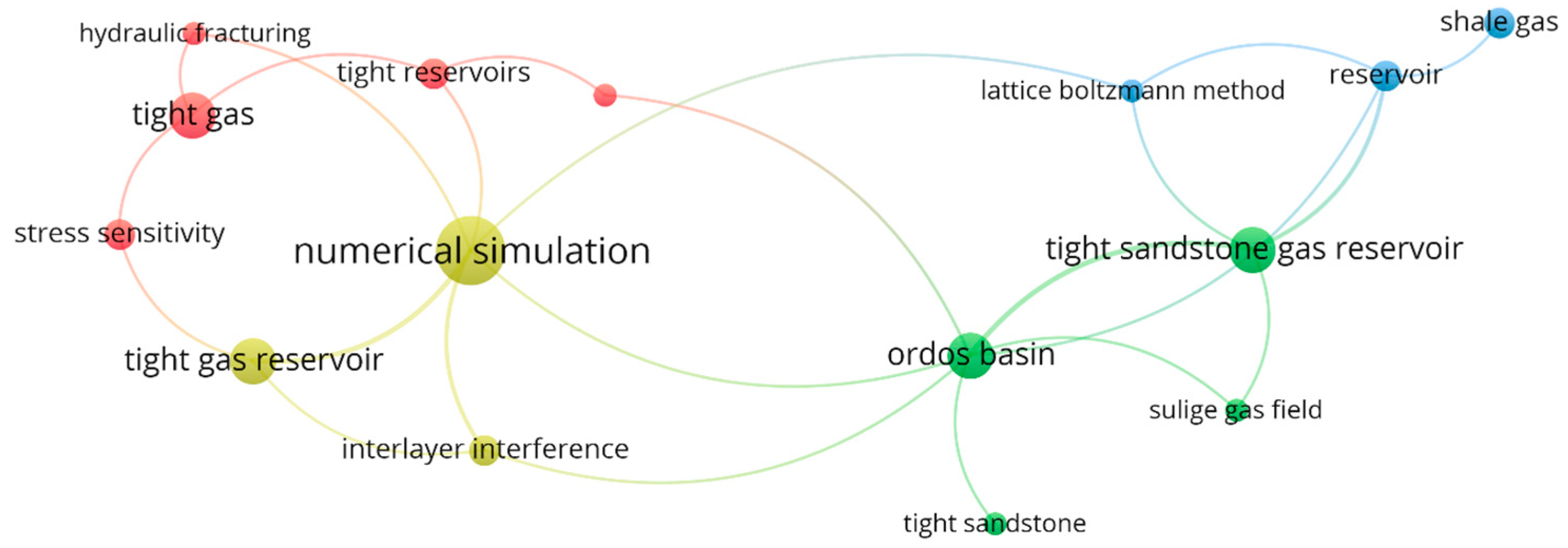
The literature review reveals that the development of structurally complex fields remains a highly relevant research topic and continues to raise numerous scientific challenges. Figure 4 presents a diagram illustrating the relationships between key terms used in scientific publications related to the subject of this study. The proposed visualisation highlights the main thematic directions within the analysed body of literature—including numerical modelling, tight reservoirs, interlayer interactions, and related topics—and demonstrates the systemic nature of the challenges addressed in this review.
The study identified the most significant challenges inherent in developing structurally complex fields. It was noted that reservoir pressure decline is a component of hydrocarbon extraction. Reservoir pressure maintenance is the most studied issue in the scientific community. However, the emergence of new approaches and technologies (proxy modelling, machine learning, etc.) significantly improves operational efficiency and opens new avenues for further development.
Accounting for reservoir heterogeneity and the geomechanical effects caused by applied technologies when planning field development is a complex task. Technological advances enable higher-quality and faster research. However, the challenge of individual reservoir structures hinders the development of universal technologies that could be scaled up to other fields.
Well flooding and condensate formation are also common challenges for gas production. Complex structures, low RP, and abnormal pressure drops all pose significant obstacles to the efficient exploitation of these reservoirs.
The study of depression cones is increasingly underway. This is due to both the development of modelling technologies and the modernisation of process equipment. Together, this makes it possible to implement adaptive control algorithms in wells.
The issues identified above do not exhaust the entire range of challenges in developing fields with complex geological structures. However, the analysis revealed that they are the most pressing and significant in this area.
An analysis of existing technologies aimed at solving the above-mentioned challenges and improving gas production efficiency shows that production process management requires a comprehensive, interdisciplinary approach.
At present, there is a growing number of scientific studies focused on the development of new technologies for hydrocarbon production. Figure 5 presents a heat map illustrating the distribution of scientific publications across major fields of knowledge within which research related to structurally complex gas fields is conducted. The map displays data on scientific publications in this research area over the past ten years and is compiled based on information from the Lens.org database.
Figure 5 shows that the dominant fields of knowledge are chemistry, materials science, and multidisciplinary research. This can be explained by the fact that a substantial proportion of studies focus on the lithological characteristics of structurally complex reservoirs, the occurrence of physicochemical processes within the reservoir, reservoir alteration during production, as well as the development of new modelling and production management methods. The presented heat map highlights the necessity of a comprehensive and interdisciplinary approach to investigating the challenges associated with the development of structurally complex gas fields, which is fully consistent with the logic and structure of the present review.
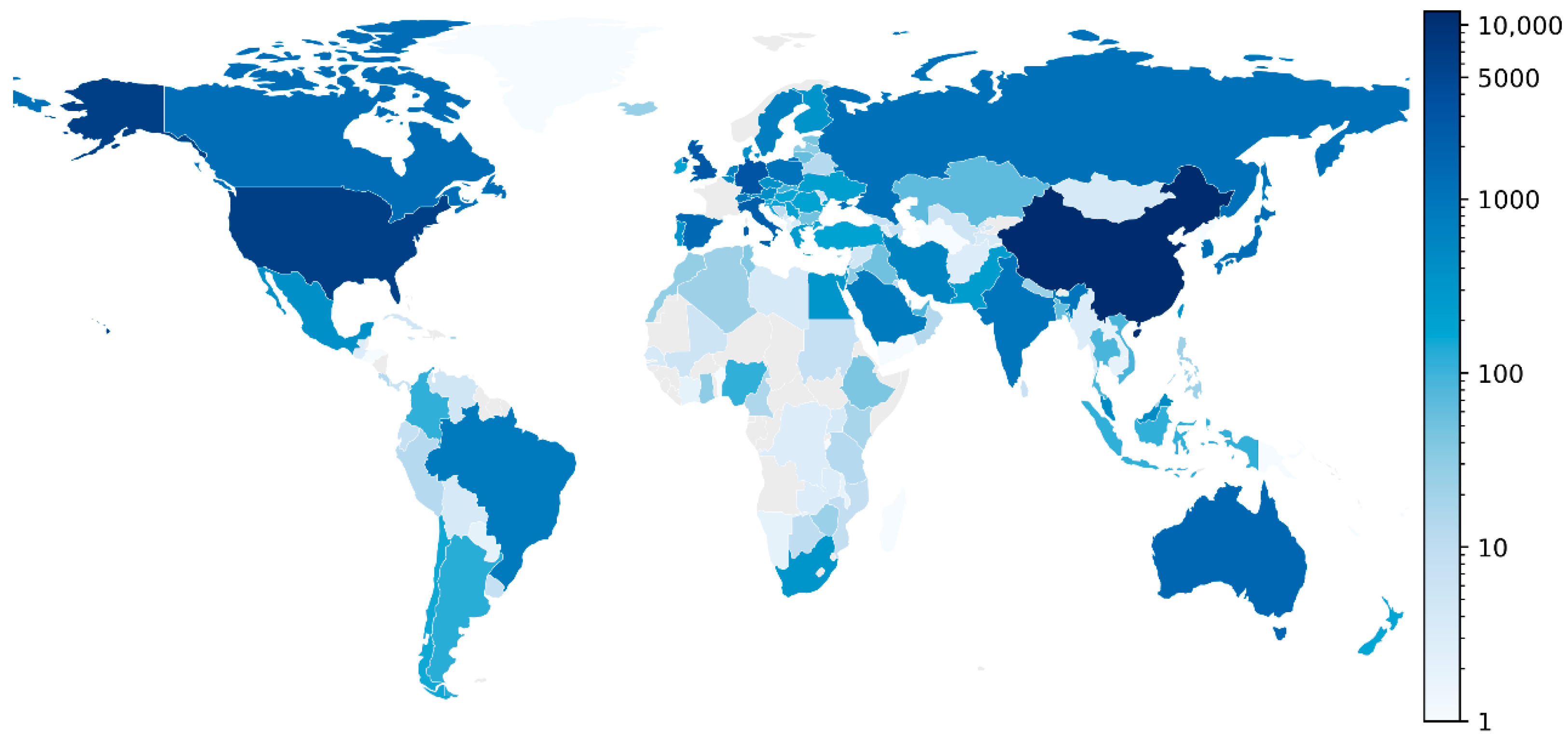
As noted above, the research topic is globally relevant, as hydrocarbons currently remain the primary source of energy for both industrial and domestic consumption [179]. Figure 6 presents a global map of publications related to gas production from fields with complex geological structures, based on data from the Lens.org database.
Analysis of this figure indicates that the largest number of studies on structurally complex fields is conducted by researchers from China and the United States. This observation reflects the scale of the resource base in these countries, as well as the highest levels of investment in the development of hydrocarbon production technologies under complex geological conditions.
A significant share of publications is attributed to researchers from European countries, Australia, Canada, and Japan, indicating the global nature of the topic and a high level of worldwide scientific interest in improving the efficiency of developing structurally complex oil and gas fields.
The obtained data confirm that research in this area follows a global trend and should be advanced within an interdisciplinary framework. This further substantiates the need for a comprehensive and systematic analysis, as presented in this review.
Summarising all the issues, reservoir pressure can be identified as the target function that is of greatest importance in reservoir development. In this regard, it can be noted that managing reservoir pressure distribution is a critical task for the efficient production of hydrocarbons.
A review of the literature has identified the most promising areas for developing gas production from structurally complex fields. First, the development and integration of integrated real-time process monitoring and control systems. Existing SCADA systems effectively monitor key well and surface equipment parameters. Their further integration with field models will enable the implementation of optimal control algorithms in production, which is essential for improving the GRF.
Second, the concept of digital twins of fields, as well as the use of AI and ML technologies, is currently popular. Finding optimal synergies between these approaches will significantly improve the accuracy of reservoir pressure distribution forecasting, taking into account complex geology, production history, and many other factors. These improvements will enable the development of proactive measures to prevent undesirable situations during production. Another area of focus is the design and testing of new technologies (jet systems, autonomous valves, etc.). Despite the widespread development of this area, many developments are still in the prototype or model stages and require extensive field testing.
To address the challenges of identifying solutions in situations where the research object is not fully defined, particularly in the planning and development of structurally complex deposits, various methods of system analysis can be applied [180,181,182,183,184,185,186,187].
A promising approach to solving the identified challenges is the application of the theory of distributed control systems for technological processes. Methods for analysing and synthesising systems with distributed parameters have proven effective in controlling similar objects. Aspects of synthesising distributed systems for hydrolithospheric processes are presented in [159]. The results of developing a mathematical model, its verification, and the procedure for synthesising a distributed controller are presented. Works [188,189,190,191] reveal the specifics of developing models for hydrolithospheric processes in mineral water extraction, taking into account stochastic disturbances to the system. A methodology for improving the efficiency of mineral water deposit exploitation is presented.
Much attention has been devoted to modelling structurally complex reservoirs. The study [192] examines various approaches to 3D modelling (deterministic, stochastic, and discrete network models) and their further development through the application of machine learning and artificial intelligence (ML) methods. A promising approach is the use of multivariate modelling, which is capable of accounting for processes of various natures that influence filtration and may lead to the creation of new control systems and the development of structurally complex reservoirs.
A summary of the results of this study is presented in Table 2.
The main factors complicating control are:
  • Geological conditions (reservoir heterogeneity, changes in permeability, abnormal reservoir pressures);
  • Technological factors (complexity of mathematical reservoir models and control processes, large vector dimensions for point impacts over large areas, changes in reservoir parameters over time and control actions, long response times to control actions due to the low transmission rate of hydrodynamic impacts in the reservoir, and errors in wellbore pressure determination).
The difficulty of pressure management, taking these factors into account, and failure to adhere to well operating procedures lead to well flooding, condensate formation, and the formation of depression cones.
Based on the analysis conducted in this study, the summary of which is presented in Table 2, it can be concluded that integrated solutions for gas production management in structurally complex fields are the most promising. At the field development stage, the application of methods for well placement planning—taking into account geological investigation results and the forecasting methods discussed for reservoir parameter estimation—should form the foundation for subsequent measures aimed at increasing the GRF. During the production stage, it is advisable to focus efforts on managing the reservoir pressure field as the key parameter determining production efficiency, process stability and quality, as well as long-term economic viability.
Within this framework, the gas-bearing reservoir (the system under consideration) is treated as an object with spatially distributed parameters and can be described by three main components.
The first component is the monitoring layer, which includes a comprehensive set of measurement sensors—both physical and virtual—required to track pressure dynamics within the reservoir–well system. The second component consists of actuating mechanisms (control valves, chokes, and intelligent devices) through which distributed control actions are implemented. The third component is a distributed control algorithm that enables uniform pressure regulation across the system. A key feature of this approach is its independence from the specific causes of pressure deviations. Instead, emphasis is placed on deviations from target pressure values and their spatiotemporal dynamics, which form the basis for implementing adaptive control under conditions of evolving RP.
The proposed integrated solution has the potential to enhance production efficiency and increase the GRF, while also providing additional operational benefits for gas production facilities. By limiting pressure gradients, operating regimes are stabilised, which improves operational safety and extends the service life of production equipment.

7. Conclusions

A comprehensive assessment of existing approaches to solving challenges specific to gas production from structurally complex fields was conducted. This assessment highlighted a trend toward developing integrated adaptive control systems that can account for the dynamic evolution of technological processes and promptly generate control actions to maintain optimal process parameters during hydrocarbon production.
An analysis of the mechanisms underlying gas accumulation formation was conducted using rapidly developing methods for modelling in situ processes. Accounting for heterogeneities and processes occurring at the pore scale in reservoirs with poor RP allows for more accurate modelling, forecasting, and selection of development regimes. The result leads to an improved GRF.
Research into the formation of depression cones and their impact on reservoir structure and well flooding has recently begun. Research has also recently focused on reverse flow processes caused by pressure differences between interlayers. Modelling of these processes is performed at the layer and field scales. Various digital technologies, such as digital twins, AI and ML, and adaptive automated control systems, are being actively studied and implemented. These technologies thus define the main areas of research in natural gas production from structurally complex fields.
The study showed that:
  • The main challenges characteristic of gas production from structurally complex fields are related to reservoir pressure decline, reservoir heterogeneity and complex tectonics, depression cones, well flooding and condensate formation, and geomechanical effects;
  • Despite the extensive development of the oil and gas industry, there are a significant number of issues and challenges for which optimal solutions have not been found;
  • Modern technologies that offer significant advantages in data processing require significant investment for implementation. This requires the development of cost-effective technical solutions;
  • The key parameter determining the GRF is the distribution of reservoir pressure during production. One of the most promising directions in this area is the application of distributed parameter systems theory to the implementation of distributed algorithms and adaptive control.

Author Contributions

Conceptualization, T.K., P.M. and S.A.; methodology, T.K. and P.M.; formal analysis, T.K. and P.M.; investigation, T.K., P.M. and S.A.; data curation, S.A. and T.K.; writing—original draft preparation, P.M. and T.K.; writing—review and editing, T.K., P.M. and S.A.; visualization, T.K. and P.M.; supervision, I.N.; validation, I.N.; resources, I.N.; project administration, I.N.; funding acquisition, I.N. All authors have read and agreed to the published version of the manuscript.

Funding

This research received no external funding.

Data Availability Statement

The data presented in this study are available on request from the corresponding author.

Conflicts of Interest

The authors declare no conflicts of interest.

References

  1. Volkov, P.V.; Zyatikov, P.N.; Malshakov, E.N.; Mazitov, R.F. Application of physico-chemical methods of increasing oil recovery with joint periodic shutdown of injection wells and changing the operating mode at the producing fund in order to involve non-drained oil reserves in operation. Bull. Tomsk. Polytech. Univ. Geo Assets Eng. 2025, 336, 16–24. [Google Scholar] [CrossRef]
  2. Amiraslanli, N. The Exploitation Potential and Economic Efficiency of Gas Reserves. Sci. Work. 2025, 19, 104–107. [Google Scholar] [CrossRef]
  3. Costa Da Silva, N.V.; Albuquerque Pontes, F.; Santos Da Silva, M.; Cagide Fialho, B.; Eleutério Delesposte, J.; Garcia Borges De Souza, D.; De Oliveira Chaves, L.A.; Cardoso, R. Leveraging FMMEA for Digital Twin Development: A Case Study on Intelligent Completion in Oil and Gas. Sensors 2025, 25, 5846. [Google Scholar] [CrossRef]
  4. Wu, B.; Sheng, J.; Wu, D.; Yang, C.; Zhang, X.; He, Y. A Critical Review of Limited-Entry Liner (LEL) Technology for Unconventional Oil and Gas: A Case Study of Tight Carbonate Reservoirs. Energies 2025, 18, 5159. [Google Scholar] [CrossRef]
  5. Toscano, A.; Bilotti, F.; Asdrubali, F.; Guattari, C.; Evangelisti, L.; Basilicata, C. Recent Trends in the World Gas Market: Economical, Geopolitical and Environmental Aspects. Sustainability 2016, 8, 154. [Google Scholar] [CrossRef]
  6. Tariq, Z.; Mahmoud, M.; Abdulraheem, A.; Al-Nakhli, A.; BaTaweel, M. An experimental study to reduce the breakdown pressure of the unconventional carbonate rock by cyclic injection of thermochemical fluids. J. Pet. Sci. Eng. 2020, 187, 106859. [Google Scholar] [CrossRef]
  7. Tang, H.; Yu, Y.; Sun, Q. Progress, Challenges, and Strategies for China’s Natural Gas Industry Under Carbon-Neutrality Goals. Processes 2024, 12, 1683. [Google Scholar] [CrossRef]
  8. Litvinenko, V. The Role of Hydrocarbons in the Global Energy Agenda: The Focus on Liquefied Natural Gas. Resources 2020, 9, 5. [Google Scholar] [CrossRef]
  9. Shklyarskiy, Y.; Andreeva, I.; Sutikno, T.; Jopri, M.H. Energy management in hybrid complexes based on wind generation and hydrogen storage. Bull. Electr. Eng. Inform. 2024, 13, 3. [Google Scholar] [CrossRef]
  10. Zhukovskiy, Y.; Tsvetkov, P.; Koshenkova, A.; Skvortsov, I.; Andreeva, I.; Vorobeva, V. A Methodology for Forecasting the KPIs of a Region’s Development: Case of the Russian Arctic. Sustainability 2024, 16, 15. [Google Scholar] [CrossRef]
  11. Sun, L.; Zou, C.; Jia, A.; Wei, Y.; Zhu, R.; Wu, S.; Guo, Z. Development characteristics and orientation of tight oil and gas in China. Pet. Explor. Dev. 2019, 46, 1073–1087. [Google Scholar] [CrossRef]
  12. Li, Y.; Zhou, D.-H.; Wang, W.-H.; Jiang, T.-X.; Xue, Z.-J. Development of unconventional gas and technologies adopted in China. Energy Geosci. 2020, 1, 55–68. [Google Scholar] [CrossRef]
  13. Jin, Z.; Zhang, J.; Tang, X. Unconventional natural gas accumulation system. Nat. Gas Ind. B 2022, 9, 9–19. [Google Scholar] [CrossRef]
  14. Jia, C.; Pang, X.; Song, Y. The mechanism of unconventional hydrocarbon formation: Hydrocarbon self-sealing and intermolecular forces. Pet. Explor. Dev. 2021, 48, 507–526. [Google Scholar] [CrossRef]
  15. Zhao, J.; Li, J.; Cao, Q.; Bai, Y.; Wu, W.; Ma, Y. Quasi-continuous hydrocarbon accumulation: An alternative model for the formation of large tight oil and gas accumulations. J. Pet. Sci. Eng. 2019, 174, 25–39. [Google Scholar] [CrossRef]
  16. Prishchepa, O.M.; Lutskii, D.S.; Kireev, S.B.; Sinitsa, N.V. Thermodynamic modelling as a basis for forecasting phase states of hydrocarbon fluids at great and super-great depths. J. Min. Inst. 2024, 269, 815–832. [Google Scholar]
  17. Nefedov, Y.V.; Yashmolkin, A.M.; Vostrikov, N.N. Identification of Facies Zonation Features of Aptian Deposits in Pokur Suite Using Seismic Data, Well Logging, and Core Sedimentological Analysis. Int. J. Eng. 2025, 38, 1932–1938. [Google Scholar] [CrossRef]
  18. Nefedov, Y.V.; Vostrikov, N.N.; Yashmolkin, A.M. Impact of Tectono-sedimentation Factor on Prospects of Oil and Gas Potential of Sakhalin Offshore of Okhotsk Oil and Gas Province Established through Stochastic Seismic Data Inversion and Constructed Digital Paleotectonic Model. Int. J. Eng. 2025, 38, 1726–1736. [Google Scholar] [CrossRef]
  19. Zhao, D.; Hou, J.; Sarma, H.; Guo, W.; Liu, Y.; Xie, P.; Dou, L.; Chen, R.; Zhang, Z. Pore throat heterogeneity of different lithofacies and diagenetic effects in gravelly braided river deposits: Implications for understanding the formation process of high-quality reservoirs. Geoenergy Sci. Eng. 2023, 221, 111309. [Google Scholar] [CrossRef]
  20. Zhang, Y.; Li, X.; Yang, S.; Qiang, K.; Zhang, B.; Liu, J.; Wei, Q.; Wang, R. Research on Intelligent Production Optimization of Low-Permeability Tight Gas Wells. Symmetry 2025, 17, 1311. [Google Scholar] [CrossRef]
  21. Olhin, A.; Vishnyakov, A. Pore Structure and Permeability of Tight-Pore Sandstones: Quantitative Test of the Lattice–Boltzmann Method. Appl. Sci. 2023, 13, 16. [Google Scholar] [CrossRef]
  22. Orlov, D.; Ebadi, M.; Muravleva, E.; Volkhonskiy, D.; Erofeev, A.; Savenkov, E.; Balashov, V.; Belozerov, B.; Krutko, V.; Yakimchuk, I.; et al. Different methods of permeability calculation in digital twins of tight sandstones. J. Nat. Gas Sci. Eng. 2021, 87, 103750. [Google Scholar] [CrossRef]
  23. Yu, Y.; Lin, L.; Zhai, C.; Chen, H.; Wang, Y.; Li, Y.; Deng, X. Impacts of lithologic characteristics and diagenesis on reservoir quality of the 4th member of the Upper Triassic Xujiahe Formation tight gas sandstones in the western Sichuan Basin, southwest China. Mar. Pet. Geol. 2019, 107, 1–19. [Google Scholar] [CrossRef]
  24. Punanova, S.A. Hydrocarbon accumulations of the Achimov deposits of the northern regions of Western Siberia. E’Kspoziciya Neft’ Gaz 2020, 3, 3. [Google Scholar] [CrossRef]
  25. He, M.; Xie, Q.; Lobusev, A.V.; Lobusev, M.A.; Liang, X. Overview of Lower Cretaceous Achimov Formation: Physical Properties and Their Distribution Pattern in West Siberian Basin, Russia. Geofluids 2021, 2021, 5560117. [Google Scholar] [CrossRef]
  26. Zeng, F.; Liu, B.; Zhang, C.; Zhang, G.; Gao, J.; Liu, J.; Ostadhassan, M. Accumulation and Distribution of Natural Gas Reservoir in Volcanic Active Area: A Case Study of the Cretaceous Yingcheng Formation in the Dehui Fault Depression, Songliao Basin, NE China. Geofluids 2021, 2021, e2900224. [Google Scholar] [CrossRef]
  27. Liu, X.; Zhang, L.; Zhao, Y.; He, X.; Wu, J.; Su, S. Shale Gas Transport in Nanopores: Contribution of Different Transport Mechanisms and Influencing Factors. Energy Fuels 2021, 35, 2033–2047. [Google Scholar] [CrossRef]
  28. Zeng, F.; Dong, C.; Lin, C.; Wu, Y.; Tian, S.; Zhang, X.; Lin, J. Analyzing the effects of multi-scale pore systems on reservoir Properties—A case study on Xihu Depression, East China Sea Shelf Basin, China. J. Pet. Sci. Eng. 2021, 203, 108609. [Google Scholar] [CrossRef]
  29. Pereponov, D.; Kazaku, V.; Scerbacova, A.; Avdonin, A.; Tarkhov, M.; Rykov, A.; Filippov, I.; Krutko, V.; Maksyutin, A.; Cheremisin, A.; et al. Digital core on a chip: Surfactant flooding in low-permeability reservoir. J. Mol. Liq. 2024, 414, 126073. [Google Scholar] [CrossRef]
  30. Zhou, S.; Dong, D.; Zhang, J.; Zou, C.; Tian, C.; Rui, Y.; Liu, D.; Jiao, P. Optimization of key parameters for porosity measurement of shale gas reservoirs. Nat. Gas Ind. B 2021, 8, 455–463. [Google Scholar] [CrossRef]
  31. Zhang, J.; Gao, S.; Xiong, W.; Ye, L.; Liu, H.; Zhu, W.; Mu, Y.; Niu, W. Physical and Numerical Simulation of Tight Gas Flow at the Microscale. Energies 2023, 16, 16. [Google Scholar] [CrossRef]
  32. Zhao, Y.; Liu, X.; Zhang, L.; Tang, H.; Xiong, Y.; Guo, J.; Shan, B. Laws of gas and water flow and mechanism of reservoir drying in tight sandstone gas reservoirs. Nat. Gas Ind. B 2021, 8, 195–204. [Google Scholar] [CrossRef]
  33. Han, W.; Yuliang, S.; Wendong, W.; Guanqun, L.; Qi, Z. Simulation on liquid flow in shale nanoporous media based on lattice Boltzmann method. Acta Pet. Sin. 2023, 44, 534. [Google Scholar] [CrossRef]
  34. Hu, C.; Wang, F.; Liu, Y.; Zhi, J. Three-dimensional Lattice Boltzmann simulation of gas-water transport in tight sandstone porous media: Influence of microscopic surface forces. Energy Sci. Eng. 2020, 8, 1924–1940. [Google Scholar] [CrossRef]
  35. Fu, J.; Su, Y.; Li, L.; Wang, W.; Wang, C.; Li, D. Productivity model with mechanisms of multiple seepage in tight gas reservoir. J. Pet. Sci. Eng. 2022, 209, 109825. [Google Scholar] [CrossRef]
  36. Bo, N.; Zuping, X.; Xianshan, L.; Zhijun, L.; Zhonghua, C.; Bocai, J.; Xin, Z.; Huan, T.; Xiaolong, C. Production prediction method of horizontal wells in tight gas reservoirs considering threshold pressure gradient and stress sensitivity. J. Pet. Sci. Eng. 2020, 187, 106750. [Google Scholar] [CrossRef]
  37. Agaie, B.G.; Mbaya, J.H.; Ibrahim, A.; Sani, U. Modelling and simulation of transient flow characteristics in a producing gas well. Sci. World J. 2020, 15, 2. [Google Scholar]
  38. Nie, R.-S.; Fan, X.; Li, M.; Chen, Z.; Deng, Q.; Lu, C.; Zhou, Z.-L.; Jiang, D.-W.; Zhan, J. Modeling transient flow behavior with the high velocity non-Darcy effect in composite naturally fractured-homogeneous gas reservoirs. J. Nat. Gas Sci. Eng. 2021, 96, 104269. [Google Scholar] [CrossRef]
  39. Zhao, W.; Zhang, T.; Jia, C.; Li, X.; Wu, K.; He, M. Numerical simulation on natural gas migration and accumulation in sweet spots of tight reservoir. J. Nat. Gas Sci. Eng. 2020, 81, 103454. [Google Scholar] [CrossRef]
  40. Zhao, W.; Jia, C.; Song, Y.; Li, X.; Hou, L.; Jiang, L. Dynamic mechanisms of tight gas accumulation and numerical simulation methods: Narrowing the gap between theory and field application. Adv. Geo-Energy Res. 2023, 8, 146–158. [Google Scholar] [CrossRef]
  41. Bera, A.; Kumar, S.; Foroozesh, J.; Gharavi, A. Multiphysics gas transport in nanoporous unconventional reservoirs: Challenges of mathematical modelling. J. Nat. Gas Sci. Eng. 2022, 103, 104649. [Google Scholar] [CrossRef]
  42. Namdari, S.; Baghbanan, A.; Hashemolhosseini, H. Investigation of the effect of the discontinuity direction on fluid flow in porous rock masses on a large-scale using hybrid FVM-DFN and streamline simulation. Rud.-Geološko-Naft. Zb. 2021, 36, 4. [Google Scholar] [CrossRef]
  43. Pan, H.; Jiang, Y.; Guo, G.; Yang, C.; Deng, H.; Zhu, X.; Zeng, Q.; Song, L.; Cao, J.; Wang, Z.; et al. Pore-throat structure characteristics and fluid mobility analysis of tight sandstone reservoirs in Shaximiao Formation, Central Sichuan. Geol. J. 2023, 58, 4243–4256. [Google Scholar] [CrossRef]
  44. Chen, F.; Duan, Y.; Wang, K. Productivity Model Study of Water-Bearing Tight Gas Reservoirs Considering Micro- to Nano-Scale Effects. Processes 2024, 12, 7. [Google Scholar] [CrossRef]
  45. Belhaj, H.; Qaddoura, R.; Ghosh, B.; Saqer, R. Modeling Fluid Flow in Tight Unconventional Reservoirs: Nano Scale Mobility/Trapability Mechanistic Approach! In Proceedings of the SPE Gas & Oil Technology Showcase and Conference, Dubai, United Arab Emirates, 21–23 October 2019. [Google Scholar] [CrossRef]
  46. He, X.; Li, J.; Duan, D.; Liu, B.; Shang, X.; Li, W.; Xu, Z.; Du, Z.; Xu, C. Driving Forces of Natural Gas Flow and Gas–Water Distribution Patterns in Tight Gas Reservoirs: A Case Study of NX Gas Field in the Offshore Xihu Depression, East China. Energies 2023, 16, 16. [Google Scholar] [CrossRef]
  47. Santos, J.E.; Xu, D.; Jo, H.; Landry, C.J.; Prodanović, M.; Pyrcz, M.J. PoreFlow-Net: A 3D convolutional neural network to predict fluid flow through porous media. Adv. Water Resour. 2020, 138, 103539. [Google Scholar] [CrossRef]
  48. Li, H.; Yu, G.; Chen, Y.; Zhang, D. Research on Quantitative Evaluation Methods and Influencing Factors of Natural Gas Reservoir Development. Shock. Vib. 2021, 2021, 1684178. [Google Scholar] [CrossRef]
  49. Alotaibi, M.; Alotaibi, S.; Weijermars, R. Stream and Potential Functions for Transient Flow Simulations in Porous Media with Pressure-Controlled Well Systems. Fluids 2023, 8, 5. [Google Scholar] [CrossRef]
  50. Wu, P.; Zhao, P.; Chen, Y.; Yang, H.; Yang, Y.; Dong, Q.; Chang, Y.; Wen, L.; Yuan, K.; Du, Y.; et al. Tight Reservoir Characteristics and Controlling Factors of Permian Lucaogou Formation in Yongfeng Sub-Sag, Chaiwopu Sag. Processes 2023, 11, 11. [Google Scholar] [CrossRef]
  51. Tao, H.; Yan, L.I.U.; Jianhua, H.E.; Tairan, Y.E.; Hucheng, D.; Ruixue, L.I.; Kesai, L.I.; Jiawei, Z. Evaluation method and engineering application of in−situ stress of deep tight sandstone reservoir in the second member of Xujiahe Formation in Xiaoquan−Fenggu area, western Sichuan. Geol. China 2024, 51, 89–104. [Google Scholar] [CrossRef]
  52. Zheng, D.; Pang, X.; Jiang, F.; Liu, T.; Shao, X.; Huyan, Y. Characteristics and controlling factors of tight sandstone gas reservoirs in the Upper Paleozoic strata of Linxing area in the Ordos Basin, China. J. Nat. Gas Sci. Eng. 2020, 75, 103135. [Google Scholar] [CrossRef]
  53. Zhang, T.; Wang, B.-R.; Zhao, Y.-L.; Zhang, L.-H.; Qiao, X.-Y.; Zhang, L.; Guo, J.-J.; Thanh, H.V. Inter-layer interference for multi-layered tight gas reservoir in the absence and presence of movable water. Pet. Sci. 2024, 21, 1751–1764. [Google Scholar] [CrossRef]
  54. Wang, C.-W.; Jia, C.-S.; Peng, X.-L.; Chen, Z.; Zhu, S.-Y.; Sun, H.-S.; Zhang, J. Effects of wellbore interference on concurrent gas production from multi-layered tight sands: A case study in eastern Ordos Basin, China. J. Pet. Sci. Eng. 2019, 179, 707–715. [Google Scholar] [CrossRef]
  55. Chai, X.; Tian, L.; Dong, P.; Wang, C.; Peng, L.; Wang, H. Study on recovery factor and interlayer interference mechanism of multilayer co-production in tight gas reservoir with high heterogeneity and multi-pressure systems. J. Pet. Sci. Eng. 2022, 210, 109699. [Google Scholar] [CrossRef]
  56. Oloruntobi, O.; Butt, S. Energy-based formation pressure prediction. J. Pet. Sci. Eng. 2019, 173, 955–964. [Google Scholar] [CrossRef]
  57. Ding, J.; Yan, C.; He, Y.; Wang, C. Secondary formation damage of low-pressure layer during commingled production in multilayered tight gas reservoirs. Sci. Rep. 2019, 9, 17542. [Google Scholar] [CrossRef] [PubMed]
  58. Gerke, K.M.; Korost, D.V.; Karsanina, M.V.; Korost, S.R.; Vasiliev, R.V.; Lavrukhin, E.V.; Gafurova, D.R. Modern approaches to pore space scale digital modeling of core structure and multiphase flow. Georesur. Georesour 2021, 23, 197–213. (In Russian) [Google Scholar] [CrossRef]
  59. Wang, W.; Fan, D.; Sheng, G.; Chen, Z.; Su, Y. A review of analytical and semi-analytical fluid flow models for ultra-tight hydrocarbon reservoirs. Fuel 2019, 256, 115737. [Google Scholar] [CrossRef]
  60. Lu, Y.-H.; Chen, K.-P.; Jin, Y.; Li, H.-D.; Xie, Q. An approximate analytical solution for transient gas flows in a vertically fractured well of finite fracture conductivity. Pet. Sci. 2022, 19, 3059–3067. [Google Scholar] [CrossRef]
  61. Liu, S.; Chen, G.; Lou, Y.; Zhu, L.; Ge, D. A novel productivity evaluation approach based on the morphological analysis and fuzzy mathematics: Insights from the tight sandstone gas reservoir in the Ordos Basin, China. J. Pet. Explor. Prod. Technol. 2020, 10, 1263–1275. [Google Scholar] [CrossRef]
  62. Wang, X.; Li, S.; Tong, B.; Jiang, L.; Lv, P.; Zhang, Y.; Song, Y. Wettability and capillary behavior in a CO2–oil–solid system under near-miscible conditions: A pore-scale study. Fuel 2024, 364, 131164. [Google Scholar] [CrossRef]
  63. Xu, D.; Li, Z.; Li, C.; Guo, Y. The Variation Law of Fracture Conductivity of Shale Gas Reservoir Fracturing–Flowback Integration. Processes 2024, 12, 2908. [Google Scholar] [CrossRef]
  64. Daramola, G.O.; Jacks, B.S.; Ajala, O.A.; Akinoso, A.E. AI Applications in Reservoir Management: Optimising Production and Recovery in Oil and Gas Fields. Comput. Sci. IT Res. J. 2024, 5, 972–984. [Google Scholar] [CrossRef]
  65. Gu, T.; Yan, L.; Fan, T.; Guo, X.; Fan, F.; Zhang, Y. Numerical Simulation Study of Pressure Transfer Based on the Integration of Fracturing, Shut-in and Production in Tight Reservoirs. Sustainability 2023, 15, 16. [Google Scholar] [CrossRef]
  66. Wei, B.; Nie, X.; Zhang, Z.; Ding, J.; Shayireatehan, R.; Ning, P.; Deng, D.; Cao, Y. Productivity Equation of Fractured Vertical Well with Gas–Water Co-Production in High-Water-Cut Tight Sandstone Gas Reservoir. Processes 2023, 11, 11. [Google Scholar] [CrossRef]
  67. Guo, J.; Lu, Q.; Liu, Z.; Zeng, F.; Guo, T.; Liu, Y.; Liu, L.; Qiu, L. Concept and key technology of “multi-scale high-density” fracturing technology: A case study of tight sandstone gas reservoirs in the western Sichuan Basin. Nat. Gas Ind. B 2023, 10, 283–292. [Google Scholar] [CrossRef]
  68. Chen, Z.; Liao, X.; Yu, W. A semianalytical well-testing model of fracture-network horizontal wells in unconventional reservoirs with multiple discretely natural fractures. Nat. Gas Ind. B 2020, 7, 567–582. [Google Scholar] [CrossRef]
  69. Dorhjie, D.B.; Yusupov, R.; Krutko, V.; Cheremisin, A. Deviation from Darcy Law in Porous Media Due to Reverse Osmosis: Pore-Scale Approach. Energies 2022, 15, 18. [Google Scholar] [CrossRef]
  70. Zhong, X.; Zhu, Y.; Liu, L.; Yang, H.; Li, Y.; Xie, Y.; Liu, L. The characteristics and influencing factors of permeability stress sensitivity of tight sandstone reservoirs. J. Pet. Sci. Eng. 2020, 191, 107221. [Google Scholar] [CrossRef]
  71. Zhang, Y.; Jiang, S.; Mei, S.; Tao, Z.; Hou, S. An experimental investigation of gas permeability of a low permeability sandstone under deviatoric loading with loading/unloading cycles. Geomech. Geophys. Geo-Energy Geo-Resour. 2023, 9, 173. [Google Scholar] [CrossRef]
  72. Afagwu, C.; Alafnan, S.; Mahmoud, M.A.; Patil, S. Permeability model for shale and ultra-tight gas formations: Critical insights into the impact of dynamic adsorption. Energy Rep. 2021, 7, 3302–3316. [Google Scholar] [CrossRef]
  73. Afagwu, C.; Abubakar, I.; Kalam, S.; Al-Afnan, S.F.; Awotunde, A.A. Pressure-transient analysis in shale gas reservoirs: A review. J. Nat. Gas Sci. Eng. 2020, 78, 103319. [Google Scholar] [CrossRef]
  74. Gao, Y.; Jiang, R.; Xu, X.; Sun, Z.; Yuan, Z.; Ma, K.; Jiang, B.; Kang, B.; Chen, G.; Li, C. The Pressure Buildup Well Test Analysis considering Stress Sensitivity Effect for Deepwater Composite Gas Reservoir with High Temperature and Pressure. Geofluids 2021, 2021, e5054246. [Google Scholar] [CrossRef]
  75. Martyushev, D.A.; Ponomareva, I.N.; Galkin, V.I. Estimation of the reliability of determination of filtering parameters of productive formations using multi-dimensional regression analysis. SOCAR Proc. 2021, 1, 50–59. [Google Scholar] [CrossRef]
  76. Horsfall, O.I.; Akpan, M.J.; George, N.J. Reservoir characterization of GABO field in the niger delta basin using facies and petrophysical analyses. Results Earth Sci. 2024, 2, 100038. [Google Scholar] [CrossRef]
  77. Idudje, H.; Adewole, S. A Method of Estimating Reservoir Pressure using Drawdown Test Data. In Proceedings of the SPE Nigeria Annual International Conference and Exhibition, Virtual, 11–13 August 2020. [Google Scholar] [CrossRef]
  78. van Harmelen, A.; Weijermars, R. Complex analytical solutions for flow in hydraulically fractured hydrocarbon reservoirs with and without natural fractures. Appl. Math. Model. 2018, 56, 137–157. [Google Scholar] [CrossRef]
  79. Nelson, R.; Zuo, L.; Weijermars, R.; Crowdy, D. Applying improved analytical methods for modelling flood displacement fronts in bounded reservoirs (Quitman field, east Texas). J. Pet. Sci. Eng. 2018, 166, 1018–1041. [Google Scholar] [CrossRef]
  80. Zakharov, L.A.; Martyushev, D.A.; Ponomareva, I.N. Predicting dynamic formation pressure using artificial intelligence methods. J. Min. Inst. 2022, 253, 23–32. [Google Scholar] [CrossRef]
  81. Li, C.; Zhan, L.; Lu, H. Mechanisms for Overpressure Development in Marine Sediments. J. Mar. Sci. Eng. 2022, 10, 4. [Google Scholar] [CrossRef]
  82. Chen, M.; Cheng, L.; Wang, X.; Lyu, C.; Cao, R. Pore network modelling of fluid flow in tight formations considering boundary layer effect and media deformation. J. Pet. Sci. Eng. 2019, 180, 643–659. [Google Scholar] [CrossRef]
  83. Zhang, Y.; Yang, Z.; Li, D.; Liu, X.; Zhao, X. On the Development of an Effective Pressure Driving System for Ultra-Low Permeability Reservoirs. Fluid Dyn. Mater. Process. 2021, 17, 1067–1075. [Google Scholar] [CrossRef]
  84. Zhu, W.; Liu, Y.; Li, Z.; Yue, M.; Kong, D. Study on Pressure Propagation in Tight Oil Reservoirs with Stimulated Reservoir Volume Development. ACS Omega 2021, 6, 2589–2600. [Google Scholar] [CrossRef]
  85. Song, F.; Bo, L.; Zhang, S.; Sun, Y. Nonlinear flow in low permeability reservoirs: Modelling and experimental verification. Adv. Geo-Energy Res. 2019, 3, 76–81. [Google Scholar] [CrossRef]
  86. Gharavi, A.; Abbas, K.A.; Hassan, M.G.; Haddad, M.; Ghoochaninejad, H.; Alasmar, R.; Al-Saegh, S.; Yousefi, P.; Shigidi, I. Unconventional Reservoir Characterization and Formation Evaluation: A Case Study of a Tight Sandstone Reservoir in West Africa. Energies 2023, 16, 22. [Google Scholar] [CrossRef]
  87. Rutter, E.; Mecklenburgh, J.; Bashir, Y. Matrix gas flow through “impermeable” rock–shales and tight sandstone. Solid Earth 2022, 13, 725–743. [Google Scholar] [CrossRef]
  88. Nie, R.-S.; Zhou, H.; Chen, Z.; Guo, J.-C.; Xiong, Y.; Chen, Y.-Y.; He, W.-F. Investigation radii in multi-zone composite reservoirs. J. Pet. Sci. Eng. 2019, 182, 106262. [Google Scholar] [CrossRef]
  89. Sirota, D.D. Development of a computer model of unsteady gas filtration taking into account the heterogeneity of the filtration properties of the reservoir. In Proceedings of the 2020 International Conference on Soft Computing and Measurements (SCM), St. Petersburg, Russia, 27–29 May 2020; Volume 1, pp. 193–197. [Google Scholar]
  90. Yan, X.; Tang, S.; Fu, X.; Dong, X.; Li, Z.; Deng, Z.; Meng, Y. A Semianalytical Model for Advanced Description of Pressure Drop Funnel during Coalbed Methane Production. ACS Omega 2024, 9, 32210–32225. [Google Scholar] [CrossRef]
  91. Li, J.; Liu, L.; Zhu, Y.; Zhao, L.; Chai, X.; Tian, L. A new dynamic model of supply boundary at low pressure in tight gas reservoir. Sci. Rep. 2025, 15, 12178. [Google Scholar] [CrossRef] [PubMed]
  92. Hu, Y.; Li, X.; Wan, Y.; Lu, J.; Zhu, H.; Zhang, Y.; Zhu, Q.; Yang, M.; Niu, L. Physical simulation on gas percolation in tight sandstones. Pet. Explor. Dev. 2013, 40, 621–626. [Google Scholar] [CrossRef]
  93. Xin, C.; Zhou, W.; Zhang, L.; Qiao, X.; Wang, Y.; Xiao, Y. Calculation Model of Drainage Radius of Single-Layer/Multi-Layer Commingled Gas Production Wells in a Closed Constant-Volume Gas Reservoir and Its Application. Appl. Sci. 2024, 14, 1873. [Google Scholar] [CrossRef]
  94. Roozshenas, A.A.; Hematpur, H.; Abdollahi, R.; Esfandyari, H. Water Production Problem in Gas Reservoirs: Concepts, Challenges, and Practical Solutions. Math. Probl. Eng. 2021, 2021, 9075560. [Google Scholar] [CrossRef]
  95. Feng, X.; Zhong, B.; Yang, X.; Deng, H. Effective water influx control in gas reservoir development: Problems and countermeasures. Nat. Gas Ind. B 2015, 2, 240–246. [Google Scholar] [CrossRef]
  96. Chen, F.; Wang, Z.; Fu, S.; Li, A.; Zhong, J. Research on Transformation of Connate Water to Movable Water in Water-Bearing Tight Gas Reservoirs. Energies 2023, 16, 19. [Google Scholar] [CrossRef]
  97. Guo, T.; Fu, D.; Xiong, L.; Wang, Y. The investigation of microporous structure and fluid distribution mechanism in tight sandstone gas reservoirs: A case study on the second member of Xujiahe gas reservoirs in Yuanba area. Front. Energy Res. 2022, 10, 974655. [Google Scholar] [CrossRef]
  98. Gao, Y.; Chen, S.; Huang, F.; Gao, Y.; Song, T.; Wang, S.; Jia, P.; Liu, C. Micro-occurrence of formation water in tight sandstone gas reservoirs of low hydrocarbon generating intensity: Case study of northern Tianhuan Depression in the Ordos Basin, NW China. J. Nat. Gas Geosci. 2021, 6, 215–229. [Google Scholar] [CrossRef]
  99. Lv, M.; Xue, B.; Guo, W.; Li, J.; Guan, B. Novel calculation method to predict gas–water two-phase production for the fractured tight-gas horizontal well. J. Pet. Explor. Prod. Technol. 2024, 14, 255–269. [Google Scholar] [CrossRef]
  100. Guo, J.; Meng, F.; Jia, A.; Dong, S.; Yan, H.; Zhang, H.; Tong, G. Production behavior evaluation on multilayer commingled stress-sensitive carbonate gas reservoir. Energy Explor. Exploit. 2021, 39, 86–107. [Google Scholar] [CrossRef]
  101. Sleptsov, A.; Medvedeva, L.; Marinina, O.; Savenok, O. Feasibility Study on the Applicability of Intelligent Well Completion. Processes 2024, 12, 8. [Google Scholar] [CrossRef]
  102. Zhang, Y.-Z.; Ju, B.; Zhang, M.-L.; Guo, P.; Du, J.-F. Development strategies of a gas condensate reservoir with a large gas cap, thin oil rim, strong bottom water, and natural barriers. Pet. Sci. 2025, 22, S1995822625002250. [Google Scholar] [CrossRef]
  103. Li, Y.; Bi, C.; Fu, C.; Xu, Y.; Yuan, Y.; Tong, L.; Tang, Y.; Wang, Q. Controls on the Hydrocarbon Production in Shale Gas Condensate Reservoirs of Rift Lake Basins. Processes 2025, 13, 1868. [Google Scholar] [CrossRef]
  104. Reis, P.K.P.; Carvalho, M.S. Pore-scale analysis of gas injection in gas-condensate reservoirs. J. Pet. Sci. Eng. 2022, 212, 110189. [Google Scholar] [CrossRef]
  105. Gajbhiye, R. Impact of gas composition, pressure, and temperature on interfacial Tension dynamics in CO2-Enhanced oil recovery. Sci. Rep. 2025, 15, 3821. [Google Scholar] [CrossRef] [PubMed]
  106. Wang, Y.; Kang, Y.; Wang, D.; You, L.; Chen, M.; Yan, X. Liquid phase blockage in micro-nano capillary pores of tight condensate reservoirs. Capillarity 2022, 5, 12–22. [Google Scholar] [CrossRef]
  107. Farhoodi, S.; Sadeghnejad, S.; Saeedi Dehaghani, A.H. Simultaneous effect of geological heterogeneity and condensate blockage on well test response of gas condensate reservoirs. J. Nat. Gas Sci. Eng. 2019, 66, 192–206. [Google Scholar] [CrossRef]
  108. Sidorenko, A.A.; Sirenko, Y.G.; Sidorenko, S.A. An assessment of multiple seam stress conditions using a 3-D numerical modelling approach. J. Phys. Conf. Ser. 2019, 1333, 032078. [Google Scholar] [CrossRef]
  109. Nevskaya, M.; Shabalova, A.; Nikolaichuk, L.; Kirsanova, N. Development of a Quantitative Assessment Algorithm for Operational Risks in Mining Engineering. Resources 2025, 14, 53. [Google Scholar] [CrossRef]
  110. Bratskikh, D.S.; Konopelko, A.Y.; Nikolaychuk, L.A. Model of supply chain management in the oil and gas industry using digital technologies. Neft. Khozyaystvo Oil Ind. 2024, 7, 120–125. [Google Scholar] [CrossRef]
  111. Semenova, T.; Sokolov, I. Theoretical Substantiation of Risk Assessment Directions in the Development of Fields with Hard-to-Recover Hydrocarbon Reserves. Resources 2025, 14, 64. [Google Scholar] [CrossRef]
  112. Tsvetkov, P.; Andreichyk, A. The Analysis of Goals, Results, and Trends in Global Climate Policy Through the Lens of Regulatory Documents and Macroeconomics. Sustainability 2025, 17, 4532. [Google Scholar] [CrossRef]
  113. Stoianova, A.D.; Trofimets, V.Y.; Stoianova, O.V.; Matrokhina, K.V. Structural model of decision support system for sustainable development of oil and gas companies. Int. J. Eng. 2025, 38, 701–709. [Google Scholar] [CrossRef]
  114. Tukeev, D.L.; Afanaseva, O.V.; Tulyakov, T.F. Realization of Statistical Models Based on Symmetric Unimodal Distributions. Int. J. Eng. 2026, 39, 407–419. [Google Scholar] [CrossRef]
  115. Safiullin, R.N.; Zalyubovskiy, A.F.; Safiullin, R.R.; Sorokin, K.V.; Avksentiev, S.Y. An Algorithm to Process Big Data of Remote Technical Condition Assessment System for Mining Machines. Int. J. Eng. 2026, 39, 613–622. [Google Scholar] [CrossRef]
  116. Safiullin, R.; Safiullin, R.; Ungefuk, A.; Sorokin, K. Method of optimising charge-discharge modes taking into account various compositions of lithium-ion power sources of mining machines. Sustain. Dev. Mt. Territ. 2025, 17, 134–150. [Google Scholar] [CrossRef]
  117. Nazarychev, A.; Iliev, I.; Manukian, D.; Beloev, H.; Suslov, K.; Beloev, I. Review of Operating Conditions, Diagnostic Methods, and Technical Condition Assessment to Improve Reliability and Develop a Maintenance Strategy for Electrical Equipment. Energies 2025, 18, 5832. [Google Scholar] [CrossRef]
  118. Nasibova, G.J.; Gasimov, E.E.; Ganbarova, S.A.; Karimov, V.M.; Zimina, D.A.; Davardoost, H.; Viktorovich, S.A. Structural Dynamics and Resource Potentional of South Caspian Megadepression: Insights from Mud Volcanism and Oil-Gas Exploration. Int. J. Eng. 2025, 38, 1010–1018. [Google Scholar] [CrossRef]
  119. Ponomarenko, T.V.; Gorbatyuk, I.G.; Cherepovitsyn, A.E. Industrial clusters as an organizational model for the development of Russia petrochemical industry. J. Min. Inst. 2024, 270, 1024–1037. [Google Scholar]
  120. Talanov, N.A.; Khloponina, V.S.; Fedorov, M.C. Systematic and Analytical Research of Methods for Analysing and Identifying the Technical Condition of Complex Technical Systems. In Proceedings of the 2023 V International Conference on Control in Technical Systems (CTS), St. Petersburg, Russia, 26–28 September 2023; pp. 92–95. [Google Scholar] [CrossRef]
  121. Maksarov, V.V.; Sinyukov, M.S. Methods of Ensuring the Quality of Assembly of Non-removable Joints from Dissimilar Materials. Int. J. Eng. 2026, 39, 1191–1199. [Google Scholar] [CrossRef]
  122. Barykin, S.E.; Sergeev, S.M.; Vasilyevich Provotorov, V.; Lavskaya, K.; Shidlovskaya, K.A.; Dedyukhina, N.; Mikhov, O.; Buniak, V.; Dzhamaludinova, M.Y. Sustainability Analysis of Energy Resources Transport Based on A Digital N-D Logistics Network. Eng. Sci. 2024, 29, 1093. [Google Scholar] [CrossRef]
  123. Zhang, B.; Ma, J.; Khan, M.A.; Repnikova, V.; Shidlovskaya, K.; Barykin, S.; Ahmad, M.S. The Effect of Economic Policy Uncertainty on Foreign Direct Investment in the Era of Global Value Chain: Evidence from the Asian Countries. Sustainability 2023, 15, 6131. [Google Scholar] [CrossRef]
  124. Eremeeva, A.M.; Chumachenko, Y.A.; Khasanov, A.F.; Oleynik, I.L. Advanced hydroprocessing technology for sustainable diesel: Hydrotreatment of renewable and fossil feedstocks. Bioresour. Technol. Rep. 2026, 33, 102499. [Google Scholar] [CrossRef]
  125. Tao, S. Exploration and Development of Unconventional Oil and Gas Resources: Latest Advances and Prospects. Energies 2025, 18, 3933. [Google Scholar] [CrossRef]
  126. Jia, M.; Su, Y.; Wang, W.; Chen, Z.; Deng, Y.; Xian, Y.; Jia, C. Bidirectional Coupling Simulation of Pressure-Saturation Decoupling to Enhance Fracturing-Flooding Performance in Low-Permeability Reservoirs. In Proceedings of the Middle East Oil, Gas and Geosciences Show (MEOS GEO), Manama, Bahrain, 16–18 September 2025. [Google Scholar] [CrossRef]
  127. Xu, Y.; Liu, X.; Hu, Z.; Duan, X.; Chang, J. Pressure Drawdown Management Strategies for Multifractured Horizontal Wells in Shale Gas Reservoirs: A Review. ACS Omega 2022, 7, 14516–14526. [Google Scholar] [CrossRef] [PubMed]
  128. Belyadi, H.; Fathi, E.; Belyadi, F. Managed Pressure Drawdown in Utica/Point Pleasant with Case Studies. In Proceedings of the SPE Eastern Regional Meeting, Canton, OH, USA, 13–15 September 2016. [Google Scholar] [CrossRef]
  129. Wang, X.; Qiao, X.; Mi, N.; Wang, R. Technologies for the benefit development of low-permeability tight sandstone gas reservoirs in the Yan’an Gas Field, Ordos Basin. Nat. Gas Ind. B 2019, 6, 272–281. [Google Scholar] [CrossRef]
  130. Palyanitsina, A.; Sukhikh, A. Peculiarities of assessing the reservoir properties of clayish reservoirs depending on the water of reservoir pressure maintenance system properties. J. Appl. Eng. Sci. 2020, 18, 1. [Google Scholar] [CrossRef][Green Version]
  131. Hong, L.; Jin, P.; Xiaolu, W.; Xinan, Y.; Qing, L. Analysis of Interlayer Interference and Research of Development Strategy of Multilayer Commingled Production Gas Reservoir. Energy Procedia 2012, 16, 1341–1347. [Google Scholar] [CrossRef]
  132. Wei-yao, Z.H.U.; Zhen, C.; Xin-chun, S. Multiphysical field coupling in unconventional oil and gas reservoirs. Chinese Journal of Engineering 2023, 45, 1045–1056. [Google Scholar] [CrossRef]
  133. Zhang, J.; Wang, R.; Xu, Q.; Lei, C.; Yang, X.; Zheng, X. The investigation of fracture pattern effect on fluid transport and production prediction in M field. Energy Explor. Exploit. 2021, 39, 1770–1785. [Google Scholar] [CrossRef]
  134. Tan, L.; Zuo, L.; Wang, B. Methods of Decline Curve Analysis for Shale Gas Reservoirs. Energies 2018, 11, 552. [Google Scholar] [CrossRef]
  135. Jia, A.; Wei, Y.; Guo, Z.; Wang, G.; Meng, D.; Huang, S. Development status and prospect of tight sandstone gas in China. Nat. Gas Ind. B 2022, 9, 467–476. [Google Scholar] [CrossRef]
  136. Hu, P.; Geng, S.; Liu, X.; Li, C.; Zhu, R.; He, X. A three-dimensional numerical pressure transient analysis model for fractured horizontal wells in shale gas reservoirs. J. Hydrol. 2023, 620, 129545. [Google Scholar] [CrossRef]
  137. Wen, X.; Yang, J.; Geng, S.; Li, K. Study on new method for evaluating reservoir formation pressure by wellhead pressure. IOP Conference Series: Earth Environ. Sci. 2019, 384, 012037. [Google Scholar] [CrossRef]
  138. Yao, J.; Ding, Y.; Sun, H.; Fan, D.; Wang, M.; Jia, C. Productivity Analysis of Fractured Horizontal Wells in Tight Gas Reservoirs Using a Gas–Water Two-Phase Flow Model with Consideration of a Threshold Pressure Gradient. Energy Fuels 2023, 37, 8190–8198. [Google Scholar] [CrossRef]
  139. Xu, J.; Liu, Y.; Sun, W. Production Simulation of Stimulated Reservoir Volume in Gas Hydrate Formation with Three-Dimensional Embedded Discrete Fracture Model. Sustainability 2024, 16, 9803. [Google Scholar] [CrossRef]
  140. Tang, L.; Pervukhin, D.A. Enhancing operational efficiency in coal enterprises through capacity layout optimisation: A cost-effectiveness analysis. ORESTA 2024, 7, 144–163. [Google Scholar] [CrossRef]
  141. Pervukhin, D.A.; Neyrus, S.K. Improving the Efficiency of the Bunkering Enterprise on the Basis of Simulation Modelling. In Research Perspectives on Software Engineering and Systems Design, Proceedings of the CoMeSySo 2024, Chengdu, China, 12–14 October 2024; Springer: Berlin/Heidelberg, Germany, 2025; pp. 481–490. [Google Scholar] [CrossRef]
  142. Afanaseva, O.; Pervukhin, D.; Khatrusov, A. Vibration-Based Condition Monitoring of Diesel Engines in Industrial Energy Applications: A Scoping Review. Energies 2025, 18, 5717. [Google Scholar] [CrossRef]
  143. Han, Z.; Jin, X.; Li, W.; Fu, Z. Research Progress of Three-dimensional Geological Modeling and Multi-field Coupling of Fractured Oil and Gas Reservoirs. Acad. J. Sci. Technol. 2024, 12, 120–124. [Google Scholar] [CrossRef]
  144. Martyushev, D.A.; Ponomareva, I.N.; Shen, W. Adaptation of transient well test results. J. Min. Inst. 2023, 264, 919–925. [Google Scholar]
  145. Liu, B.; Li, C. Mining and Analysis of Production Characteristics Data of Tight Gas Reservoirs. Processes 2023, 11, 11. [Google Scholar] [CrossRef]
  146. Xing, Z.-S.; Han, G.-Q.; Jia, Y.-L.; Tian, W.; Gong, H.-F.; Jiang, W.-B.; Mai, P.-D.; Liang, X.-Y. Optimization of plunger lift working systems using reinforcement learning for coupled wellbore/reservoir. Pet. Sci. 2025, 22, 2154–2168. [Google Scholar] [CrossRef]
  147. Pachalieva, A.; O’Malley, D.; Harp, D.R.; Viswanathan, H. Physics-informed machine learning with differentiable programming for heterogeneous underground reservoir pressure management. Sci. Rep. 2022, 12, 18734. [Google Scholar] [CrossRef]
  148. Isaev, A.A.; Levitina, E.E. Integrated approach to determining the effectiveness of the reservoir pressure maintenance system in carbonate reservoirs. Bull. Tomsk. Polytech. Univ. Geo Assets Eng. 2024, 335, 220–230. [Google Scholar] [CrossRef]
  149. Sun, J.; Liu, D.; Zhu, X.; Huang, W.; Cheng, L. Experimental Investigation on the Pressure Propagation Mechanism of Tight Reservoirs. Fluid Dyn. Mater. Process. 2020, 16, 425–440. [Google Scholar] [CrossRef]
  150. Lin, B.; Wei, Y.; Gao, S.; Ye, L.; Liu, H.; Zhu, W.; Zhang, J.; Han, D. Current Progress and Development Trend of Gas Injection to Enhance Gas Recovery in Gas Reservoirs. Energies 2024, 17, 1595. [Google Scholar] [CrossRef]
  151. Liu, L.; Li, J.; Liu, P.; Yang, Z.; Fu, B.; Liao, X. Study on Main Controlling Factors of CO2 Enhanced Gas Recovery and Geological Storage in Tight Gas Reservoirs. Processes 2025, 13, 3097. [Google Scholar] [CrossRef]
  152. Syah, R.; Alizadeh, S.M.; Nurgalieva, K.S.; Grimaldo Guerrero, J.W.; Nasution, M.K.M.; Davarpanah, A.; Ramdan, D.; Metwally, A.S.M. A Laboratory Approach to Measure Enhanced Gas Recovery from a Tight Gas Reservoir during Supercritical Carbon Dioxide Injection. Sustainability 2021, 13, 21. [Google Scholar] [CrossRef]
  153. Song, X.; Zhao, W.; Wang, S.; Liu, F.; Liu, H.; Jiang, L.; Lv, P.; Zhang, L. Representative Volume and Seepage in Gas Hydrate-Bearing Sands: Insights from Improved Pore Network Modeling. Energy Fuels 2025, 39, 8073–8085. [Google Scholar] [CrossRef]
  154. Zhu, Z.; Zhao, X.; Wang, S.; Jiang, L.; Dong, H.; Lv, P. Gas Production and Storage Using Hydrates Through the Replacement of Multicomponent Gases: A Critical Review. Energies 2025, 18, 975. [Google Scholar] [CrossRef]
  155. Hassan, A.; Abdalla, M.; Mahmoud, M.; Glatz, G.; Al-Majed, A.; Al-Nakhli, A. Condensate-Banking Removal and Gas-Production Enhancement Using Thermochemical Injection: A Field-Scale Simulation. Processes 2020, 8, 6. [Google Scholar] [CrossRef]
  156. Cheng, M.; Xue, W.; Guo, Z.; Hou, M.; Wang, C. Development of Large-Scale Tight Gas Sandstone Reservoirs and Recommendations for Stable Production—The Example of the Sulige Gas Field in the Ordos Basin. Sustainability 2023, 15, 13. [Google Scholar] [CrossRef]
  157. Lu, Y.; Pan, L.; Wu, R.; Shi, M.; Ma, L. Evaluation of shale gas reservoir reserves and production capacity based on Arps regression. Geosyst. Eng. 2024, 27, 87–99. [Google Scholar] [CrossRef]
  158. Soage, A.; Ramirez, L.; Juanes, R.; Cueto-Felgueroso, L.; Colominas, I. Statistical assessment of the financial performance of shale-gas wells coupling stochastic and numerical simulation. Pet. Sci. 2024, 21, 4497–4511. [Google Scholar] [CrossRef]
  159. Pershin, I.M.; Tsapleva, V.V.; Malkov, A.V.; Pomelyaiko, I.S. Design of a distributed well cluster control system. In Proceedings of the XII All-Russian Scientific Conference “System Synthesis and Applied synergetics”, Novosibirsk, Russia, 23–29 September 2024; pp. 330–336. [Google Scholar] [CrossRef]
  160. Zhang, L.; Cheng, S.; Wu, K.; Xin, C.; Song, J.; Zhang, T.; Xie, X.; Zhao, Z. A Full-Stage Productivity Equation for Constant-Volume Gas Reservoirs and Its Application. Processes 2024, 12, 9. [Google Scholar] [CrossRef]
  161. Gong, M.; Zhang, J.; Yan, Z.; Wang, J. Prediction of interwell connectivity and interference degree between production wells in a tight gas reservoir. J. Pet. Explor. Prod. Technol. 2021, 11, 3301–3310. [Google Scholar] [CrossRef]
  162. Ji, G.; Jia, A.; Meng, D.; Guo, Z.; Wang, G.; Cheng, L.; Zhao, X. Technical strategies for effective development and gas recovery enhancement of a large tight gas field: A case study of Sulige gas field, Ordos Basin, NW China. Pet. Explor. Dev. 2019, 46, 629–641. [Google Scholar] [CrossRef]
  163. Hu, Y.; Pang, K.; Sun, Y.; Liu, Z.; Min, C.; Ding, X. Control Method and System for Unconventional Oil and Gas Reservoir Production Optimization Problem. Patent No. CN112580861, 11 December 2020. Available online: https://patentscope.wipo.int/search/ru/detail.jsf?docId=CN321739796&_cid=P11-LV17OT-64670-1 (accessed on 9 September 2025).
  164. Liu, M.; Deng, X.; Zeng, W.; Lin, J.; Zhang, J.; Meng, Z. Intelligent Pressure Control System and Pressure Control Method for Unconventional Gas Well. Patent No. CN114673476, 24 April 2022. Available online: https://patentscope.wipo.int/search/ru/detail.jsf?docId=CN368375390&_cid=P11-LV17OT-64670-1 (accessed on 9 September 2025).
  165. Kozyrev, N.D. Software Implementation of Adaptive Depression Control for Production Wells When Predicting Process Development Parameters in Tempest More 8.6 (ROXAR) Software. Patent No. RU2021661506, 5 July 2021. Available online: https://www.elibrary.ru/item.asp?id=46482630 (accessed on 9 September 2025).
  166. Zakirov, S.N.; Indrupskyi, I.M.; Zakirov, E.S.; Anikeev, D.P.; Lysenko, A.D.; Boganova, M.N.; Spesivtsev Yu, N. A Method for Developing Hydrocarbon Deposits in Low-Permeability Sediments. Patent No. RU2625829C2, 19 July 2017. Available online: https://patents.google.com/patent/RU2625829C2/ru (accessed on 9 September 2025).
  167. Lifantyev, A.V.; Osnos, V.B. Method for Developing a Productive Low-Permeability Formation. Patent No. RU2732936C2, 24 September 2020. Available online: https://patents.google.com/patent/RU2732936C2/ru (accessed on 9 September 2025).
  168. Yu, H.; Wang, P.; Wang, Y.; Tang, L.; Wang, J.; Shu, Q.; Yang, S.; Zhu, Y.; Wu, Y.; Li, X.; et al. Integrated Simulation and Optimization of Reservoir-Wellbore-Surface Systems in Ultrahigh Water Cut Oil Fields. Energy Sci. Eng. 2025, 13, 3503–3514. [Google Scholar] [CrossRef]
  169. Yu, H.; Wang, Y.; Cheng, C.; Dai, Q.; Sun, J.; Zhang, Q. Advances and outlook of integrated reservoir-wellbore-pipe network simulation technology. Energy Geosci. 2024, 5, 100315. [Google Scholar] [CrossRef]
  170. Ma, H.; Yu, C.; Dong, L.; Fu, Y.; Shuai, C.; Sun, H.; Zhu, X. Review of intelligent well technology. Petroleum 2020, 6, 226–233. [Google Scholar] [CrossRef]
  171. Kuk, E.; Stopa, J.; Kuk, M.; Janiga, D.; Wojnarowski, P. Petroleum Reservoir Control Optimization with the Use of the Auto-Adaptive Decision Trees. Energies 2021, 14, 5702. [Google Scholar] [CrossRef]
  172. Gao, S.; Liu, H.; Ye, L.; Wen, Z.; Zhu, W.; Zhang, C. A new method for well pattern density optimization and recovery efficiency evaluation of tight sandstone gas reservoirs. Nat. Gas Ind. B 2020, 7, 133–140. [Google Scholar] [CrossRef]
  173. Li, Q.; Li, Y.; Gao, S.; Liu, H.; Ye, L.; Wu, H.; Zhu, W.; An, W. Well network optimization and recovery evaluation of tight sandstone gas reservoirs. J. Pet. Sci. Eng. 2021, 196, 107705. [Google Scholar] [CrossRef]
  174. Wei, B.; Nie, X.; Zhang, Z.; Ding, J.; Shayireatehan, R.; Ning, P.; Deng, D.; Xiong, J. Zoning Productivity Calculation Method of Fractured Horizontal Wells in High-Water-Cut Tight Sandstone Gas Reservoirs under Complex Seepage Conditions. Processes 2023, 11, 12. [Google Scholar] [CrossRef]
  175. Li, G.; Song, X.; Tian, S.; Zhu, Z. Intelligent Drilling and Completion: A Review. Engineering 2022, 18, 33–48. [Google Scholar] [CrossRef]
  176. Zhang, Y.; Tang, Y.; Shi, J.; Dai, H.; Jia, X.; Feng, G.; Yang, B.; Li, W. Phase Behavior and Rational Development Mode of a Fractured Gas Condensate Reservoir with High Pressure and Temperature: A Case Study of the Bozi 3 Block. Energies 2024, 17, 5367. [Google Scholar] [CrossRef]
  177. Lu, M.; Wang, Z.; Li, A.; Zhang, L.; Zheng, B.; Zhang, Z. Simulation of Gas-Water Two-Phase Flow in Tight Gas Reservoirs Considering the Gas Slip Effect. Fluid Dyn. Mater. Process. 2022, 19, 1269–1281. [Google Scholar] [CrossRef]
  178. Dong, M.; Yue, X.; Shi, X.; Ling, S.; Zhang, B.; Li, X. Effect of dynamic pseudo threshold pressure gradient on well production performance in low-permeability and tight oil reservoirs. J. Pet. Sci. Eng. 2019, 173, 69–76. [Google Scholar] [CrossRef]
  179. Jefferson, O.A.; Jaffe, A.; Ashton, D.; Warren, B.; Koellhofer, D.; Dulleck, U.; Ballagh, A.; Moe, J.; DiCuccio, M.; Ward, K.; et al. Mapping the global influence of published research on industry and innovation. Nat. Biotechnol. 2018, 36, 31–39. [Google Scholar] [CrossRef]
  180. Afanaseva, O.V.; Tulyakov, T.F. A methodology to develop an information and control system to monitor the technical state of power transmission lines. Elektrotehniski Vestn. 2025, 92, 221–228. [Google Scholar]
  181. Ilyushin, Y.V.; Boronko, E.A. Analysis of Energy Sustainability and Problems of Technological Process of Primary Aluminum Production. Energies 2025, 18, 2194. [Google Scholar] [CrossRef]
  182. Martirosyan, A.V.; Martirosyan, K.V.; Chernyshev, A.B. Investigation of Popov’s Lines’ Limiting Position to Ensure the Process Control Systems’ Absolute Stability. In Proceedings of the 2023 XXVI International Conference on Soft Computing and Measurements (SCM), St. Petersburg, Russia, 24–26 May 2023; pp. 69–72. [Google Scholar] [CrossRef]
  183. Afanaseva, O.V.; Ilyushin, Y. Analysis and synthesis of distributed icedrill heating control system of mountain reconnaissance drilling rig. In Proceedings of the International Multidisciplinary Scientific Geoconference Surveying Geology and Mining Ecology Management SGEM 2018, Albania, Bulgaria, 3–8 July 2018; Volume 18, pp. 41–48. [Google Scholar] [CrossRef]
  184. Ilyushin, Y.V.; Boronko, E.A. Development of a Mathematical Model of the Electromagnetic Field Formation Process Based on System Analysis Methods. Mathematics 2026, 14, 399. [Google Scholar] [CrossRef]
  185. Khasanov, A.F.; Eremeeva, A.M. Creation of Artificial Aeration System to Improve Water Quality in Reservoirs. Hydrology 2025, 12, 48. [Google Scholar] [CrossRef]
  186. Ivanov, V.V.; Sidorenko, S.A. Transportless mining systemin developing the suite of three horizontal seams carbonate rocks. Int. J. Pharm. Technol. 2016, 8, 27216–27224. [Google Scholar]
  187. Ilyushin, Y.; Golovina, E.I. Stability of temperature field of the distributed control system. Arpn J. Eng. Appl. Sci. 2020, 15, 664–668. [Google Scholar]
  188. Asadulagi, M.-A.M.; Pershin, I.M.; Tsapleva, V.V. Research on Hydrolithospheric Processes Using the Results of Groundwater Inflow Testing. Water 2024, 16, 3. [Google Scholar] [CrossRef]
  189. Ilyushin, Y.V.; Asadulagi, M.-A.M. Development of a Distributed Control System for the Hydrodynamic Processes of Aquifers, Taking into Account Stochastic Disturbing Factors. Water 2023, 15, 4. [Google Scholar] [CrossRef]
  190. Ilyushin, Y.V.; Nosova, V.A. Methodology to Increase the Efficiency of the Mineral Water Extraction Process. Water 2024, 16, 10. [Google Scholar] [CrossRef]
  191. Pershin, I.M.; Pervukhin, D.A.; Ilyushin, Y.V.; Afanaseva, O.V. Design of distributed systems of hydrolithospere processes management. Selection of optimal number of extracting wells. In Proceedings of the IOP Conference Series: Earth and Environmental Science, Prague, Czech Republic, 11–15 September 2017; Volume 87, p. 032030. [Google Scholar] [CrossRef]
  192. Igwe, J.U. Strategic Reservoir Management for Sustainable Tight Gas Extraction: Navigating Future Prospects and Challenges in Exploration. In Proceedings of the SPE Nigeria Annual International Conference and Exhibition, Lagos, Nigeria, 5–7 August 2024. [Google Scholar] [CrossRef]
Figure 1. Workflow of the literature review methodology incorporating bibliometric analysis.
Resources 15 00032 g001
Figure 2. Multi-scale classification of challenges in structurally complex gas reservoirs.
Resources 15 00032 g002
Figure 3. Cause-and-effect relationships between key challenges leading to reduced gas recovery efficiency.
Resources 15 00032 g003
Figure 4. Network visualisation of the co-presence of keywords in scientific papers on the research topic.
Resources 15 00032 g004
Figure 5. Heat map of the distribution of publications by knowledge area. Data sourced from The Lens (https://www.lens.org/ (accessed on 15 December 2025)).
Resources 15 00032 g005
Figure 6. Map of world publications by research topic. Data sourced from The Lens (https://www.lens.org/ (accessed on 15 December 2025)).
Resources 15 00032 g006
Table 1. Challenges of gas production from structurally complex fields.
ChallengeMechanism of Negative Impact on GRFScaleSource
1Heterogeneity of reservoirs, complex tectonics, and geomechanical effectsUneven distribution of pressure and permeabilityPore scale, reservoir scale, interlayer interaction[19,20,36,37,43,44,108]
2Maintaining reservoir pressureReduction in the driving force for gas filtration due to pressure declineReservoir scale, field scale[70,71,72,77,83,84]
3Depression cones, flooding, and condensate formationLocal pressure decline causing water or condensate inflow into the near-wellbore zoneReservoir scale, interlayer interaction[89,95,96,101,102,103,104]
4Economic and organizational issuesLimitations in the implementation of monitoring and control technologiesField scale[109,110,111,112,113,114,115,116,117,118,119,120,121,122,123,124]
Table 2. Challenges, solution approaches, and unsolved challenges related to the research topic.
Challenge NameSolution ApproachesUnsolved Issues within the Challenge
Heterogeneity of layers and complex tectonics
  • Development and implementation of geomechanical and hydrodynamic models;
  • Difficulty accounting for multilayer interactions;
  • Application of the lattice Boltzmann model, non-Darcy flow models, and multiphase flows;
  • Limited field testing and verification with real data;
  • Industrial application of hydraulic fracturing technologies;
  • Requirement for large amounts of computing power;
  • Development of digital twin concepts, application of proxy modelling;
  • Difficulty scaling technologies to different fields;
  • Integration of AI and ML technologies.
  • Poor understanding of the influence of in situ effects on complex reservoir structures.
Reservoir pressure drop
  • Application of reservoir pressure management methods;
  • Insufficient development of models suitable for multilayer reservoir structures;
  • Implementation of modelling of controlled processes typical for gas production in structurally complex fields;
  • Dependence of modelling on the quality of initial data;
  • Implementation of proactive measures based on forecasting results, including the use of intelligent technologies, etc.
  • Difficulty in creating a universal method for pressure field control;
Flooding of wells, formation of condensate and formation of depression cones
  • Analysis of depression cone formation and modelling;
  • Poor predictability of depression cone behavior;
  • AICDs;
  • Complexity and limitations of existing models;
  • Application of effective condensate removal methods;
  • Cone parameters depend on RP;
  • Implementation of two-phase flow (gas-water) modelling;
  • Lack of integrated approaches to modelling and control implementation;
  • Optimisation of fluid extraction modes;
  • Need for large amounts of computing power.
  • Integration of intelligent systems.
Geomechanical effects
  • Development of models for pressure-deformation interactions;
  • Limited field testing of models; much of the research is laboratory experiments;
  • Development of research on fluid reverse flow processes;
  • Poor integration of dynamic models across different fields;
  • Implementation of multi-field models (temperature, pressure field, mechanical, and hydrodynamic) for accounting;
  • Limited accuracy when moving from the micro to the macro level.
  • Integration of digital twins for the analysis and prediction of fractured formation behavior;
  • Development of experimental and numerical methods for reservoir failure prediction.
Economic and organizational constraints
  • Attempts to implement integrated reservoir-well-surface management;
  • High cost of implementing intelligent systems;
  • Well placement optimisation models;
  • Difficulty obtaining high-quality field data;
  • Integration of intelligent technologies.
  • A significant gap between scientific research and industry.
Disclaimer/Publisher’s Note: The statements, opinions and data contained in all publications are solely those of the individual author(s) and contributor(s) and not of MDPI and/or the editor(s). MDPI and/or the editor(s) disclaim responsibility for any injury to people or property resulting from any ideas, methods, instructions or products referred to in the content.