1. Introduction
Complex systems development projects in the infrastructure, defense, aerospace, and information technology sectors face recurring challenges related to requirements management. Inadequate definition, lack of traceability, volatile requirements, and poor integration between technical teams are among the main factors that lead to partial or total project failure. Studies conducted by the Standish Group have consistently highlighted the challenges associated with project success. While early CHAOS reports identified very low success rates, more recent editions indicate gradual improvement. However, a significant proportion of projects still fail or face substantial challenges, reinforcing the importance of effective requirements management in complex environments [
1].
Complex projects are increasingly being characterized by interactions among multiple stakeholders with distinct value systems, which frequently generates conflicts and governance challenges throughout project networks [
2]. Well-structured requirements not only align stakeholder expectations but also serve as the basis for planning, execution, and control to mitigate risks and reduce ambiguity [
3]. Digital transformation has reshaped requirements engineering by enabling more precise capture, analysis, and continuous refinement of project specifications. This transformation is particularly relevant in agile and modular environments, where collaboration among diverse teams is essential [
4]. Empirical evidence has indicated that projects with well-defined requirements exhibit lower failure rates, as precise specifications reduce rework and improve the level of communication among the involved parties [
5]. The adoption of advanced technologies such as artificial intelligence (AI), virtual reality (VR), and digital twins (DTs) has further enhanced the efficiency of requirements management by enabling real-time analysis and adaptive responses to changing project needs [
6].
Beyond operational benefits, the increasing integration of AI into project environments is reshaping traditional project management practices and demanding new theoretical and methodological approaches [
7]. Despite these innovations, there is a persistent gap between the available technological capabilities and their systematic, integrated application in complex project environments characterized by high uncertainty.
Thus, requirements management in complex projects faces multidimensional challenges, which include uncertainty, exposure to risk, and the need for team maturity to support effective implementation. Engineering projects that involve emerging technologies or dynamic regulatory contexts require holistic approaches to risk assessment and adaptive planning [
8]. Moreover, the effectiveness of requirements management is strongly associated with the maturity of project teams, under which structured methodologies, shared understanding, and collaborative tools improve the accuracy of requirements definition and execution [
9].
Although the literature has offered isolated approaches focused on documentation practices, team maturity, contractual mechanisms, or risk management, integrative models that systematically articulate these dimensions remain scarce. This limitation constrains organizations’ ability to react rapidly, maintain real-time traceability, and ensure delivery reliability in multidisciplinary and highly volatile contexts. As system complexity continues to increase, the demand for integrated strategies that combine requirements management with digital transformation, computer simulation, and AI to support requirements analysis, validation, and governance continues to grow.
In response to this gap, this study addresses the following central research question:
How can the key dimensions of requirements management in complex systems projects be systematically integrated into a coherent theoretical framework?
To address this question, this study proposes an integrative theoretical framework that does not introduce isolated novel constructs but rather systematically organizes and connects fragmented knowledge on requirements management in complex systems projects. By synthesizing recurring patterns identified across the literature, the framework provides a structured articulation of technical, organizational, and digital dimensions that are typically addressed separately in prior studies.
This article presents an integrative theoretical framework for requirements management in complex systems projects on the basis of a systematic review of the international scientific literature. The objective is to identify and systematize the principal critical factors, recurring challenges, and conceptual dimensions that influence project success by providing a structured foundation to support theoretical development and future empirical validation.
The remainder of this article is organized as follows. In
Section 2, a literature review addressing the definition and quality of requirements, digitalization, and the role of requirements engineering in mitigating uncertainty and risk is presented. In
Section 3, the methodology adopted for this review, including the literature selection criteria and analytical procedures, is described. In
Section 4, the results of the review are reported, highlighting the impact of requirements management on project success, risk mitigation, team maturity, and digital transformation. In
Section 5, the proposed integrative framework for effective requirements management in complex projects is introduced. Finally, in
Section 6, the conclusions are presented, outlining the main contributions, limitations, and directions for future research.
2. Bibliographic Review
The focus of this literature review is the discovery, organization, and detailing of the main ideas and practices and the identification of any gaps in requirements management in complex projects. An analysis was conducted and then refined on the basis of a weighted screening of articles published from 2010 to 2024, focusing on five main themes: (i) requirements definition and quality, (ii) uncertainties and risks in complex projects, (iii) team maturity, (iv) contracts and requirements structuring, and (v) digitalization processes and systems engineering via models.
In this review, classic theoretical references are combined with new contributions from the applied literature, making it easier to understand the underlying principles and the emerging trends in the field. Although the topic is independently discussed in each subsection, the interconnections between the subjects are evident, highlighting the importance of an integrative approach, which becomes apparent throughout the development process of the theoretical model.
Importantly, the main findings of this review are presented in
Section 4, where they are represented and reinterpreted in an analytical and critical way. This separation is meant to ensure that this section is dedicated to explaining the basis of the research concepts and evidence.
The first dimension to be analyzed addresses the definition and quality of requirements, which is considered in the literature as the first step in the quest to achieve project success [
10].
2.1. Defining Requirements
Defining requirements is essential for ensuring that stakeholders’ needs are met and that the project is successful [
3]. Well-structured requirements underpin project planning, execution, and control, thereby aligning expectations, reducing ambiguity, and promoting traceability.
Another aspect that has led to new approaches to modeling and managing requirements is digitalization, which makes it easier to adapt complex systems to market demands [
4]. This technological evolution has improved the accuracy in capturing and analyzing requirements, particularly for agile and modular projects in which collaboration between multidisciplinary teams is critical [
6].
Verner et al. [
11] reported that projects with well-defined requirements have lower failure rates. Collaboration between stakeholders improves accuracy and reduces the need for rework, saving as much as 50% of the effort required [
12]. In addition, high-quality requirements reduce ambiguity, improve communication, and mitigate risks [
5].
2.1.1. Requirements Quality and Project Success
In the context of this study, the concept of requirements quality is adopted on the basis of the guidelines of the ISO/IEC/IEEE 29148 standard [
13], in which the fundamental characteristics for well-formulated requirements are established. In accordance with this standard, quality requirements must present attributes such as clarity, consistency, verifiability, feasibility, and traceability, allowing for the unequivocal expression of stakeholder needs and enabling their validation and verification throughout the system’s life cycle.
This standard also distinguishes the quality of individual requirements from the properties of a set of requirements, which must be complete, consistent, and free from ambiguities or redundancies to ensure that an integrated view of the system is developed. In this sense, the quality of requirements is not only an isolated property but also a systemic attribute that directly influences project performance.
This perspective is particularly relevant for complex projects, in which the quality and coherence of the set of requirements directly affect the reduction in rework, the mitigation of risks, and the capacity for coordination among multiple stakeholders [
14].
The quality of requirements directly affects project success [
5,
15,
16]. In this context, the use of formal models—particularly within model-based systems engineering (MBSE)—allows for better alignment among requirements, design, and implementation, which reduces ambiguity and facilitates early validation [
17]. Well-defined specifications contribute to cost efficiency and meeting deadlines, whereas poorly formulated requirements often lead to budget overruns and delays [
18]. A study of 32 software projects revealed that balanced software requirements specifications (SRSs) increase the chances of on-time and on-budget completion by 70% [
16]. Recent evidence from knowledge-intensive new product development (NPD) portfolios confirms that systematically clustering and prioritizing knowledge requirements further improves selection accuracy and downstream project outcomes [
19]. On the other hand, fragmented or excessively detailed requirements that lacked an overall context led to cost increases in 60% of the cases [
5].
In the modular construction sector, a lack of collaboration in design and construction planning can increase costs and deadlines by 70.6% [
6].
2.1.2. Digitalization and Requirements Engineering
Digitalization has transformed requirements engineering through digital modeling, automated verification, and real-time collaboration [
20]. Technologies such as building information modeling (BIM) in modular construction increase the accuracy of requirements documentation and reduce the occurrence of cascading failures [
6]. AI and machine learning enable automated analyses for detecting inconsistencies and improving requirements in real time [
4]. AI is being increasingly recognized as a transformative force in project management, particularly in areas such as data analysis, decision-making, and performance monitoring [
7].
Digitalization has reshaped the way that requirements are modeled and managed, especially in complex systems and agile environments. Technologies for digital modeling, data analysis, and interactive prototyping increase the accuracy of capturing and adapting requirements to market demands [
4,
6]. Tools such as VR and DTs enable more accurate simulations and the identification of any incompatibilities prior to execution [
21]. In software engineering, agile methods and data analysis help anticipate regulatory changes and user demands [
22]. Digitalization also democratizes stakeholder involvement. Collaborative platforms allow end users to participate in defining requirements through interactive prototyping, which narrows communication gaps [
4]. In addition, the perception of progress promoted by digital tools keeps parties engaged and prevents the early abandonment of complex projects [
12].
Despite the growing use of digital tools, few studies have investigated how these solutions directly affect decision-making in the face of uncertainty. This shortcoming is addressed in the following subsection.
2.2. Uncertainties and Risks in Complex Projects
Uncertainty and risk are fundamental concepts in project management, particularly in engineering projects, where the dynamic and unpredictable nature of the factors involved can lead to significant deviations from the initial objectives. Uncertainty refers to the lack of precise information about how certain events or variables may behave over time [
23], whereas risk involves measuring the likelihood of the occurrence of an undesired event and the potential impact of such an event on the project [
24].
Beyond these definitions, project complexity must be understood not only from a technical perspective but also in terms of its structural and dynamic dimensions, which require management approaches that are contingent on both the internal and external project environment [
25].
2.2.1. Difference Between Uncertainty and Risk
According to Vieira et al. [
26,
27], risk and uncertainty differ fundamentally. Risk can be quantified via probabilistic distributions, whereas uncertainty is related to the impossibility of assigning exact probabilities to certain events. This difference directly impacts project management: while risks can be mitigated by the adoption of quantitative approaches, uncertainty requires qualitative strategies, such as scenario analysis and adaptive planning. Taking an adaptive-heuristic view of contingency allocation in megaprojects further illustrates why conventional probabilistic tools have issues with true ambiguity [
28].
In complex projects, uncertainty can be classified into different levels, ranging from uncertainties related to technical and operational variables to those associated with external factors, such as regulatory changes or economic fluctuations [
29,
30]. Jaafari [
8] argued that uncertainty is an intrinsic characteristic of complex projects, especially those involving innovative technologies or dynamic environments. He proposed taking a lifecycle management approach to projects, in which uncertainty is addressed in a continuous and integrated way throughout all project phases.
Uncertainty can also be classified according to its predictability. To represent events that cannot be anticipated through traditional forecasting models, Glette-Iversen and Flage [
31] proposed a typology of uncertainties that includes predictable variations, known contingencies, unpredictable accidents, and “
unknown-unknowns.” Therefore, effective risk management must combine predictive methods with adaptive strategies to address the uncertainty inherent in engineering projects.
In large-scale projects, such as infrastructure financed by public–private partnerships (PPPs), risk exposure is often transferred to the private sector through contracts that are not always sufficiently flexible to accommodate the evolution of uncertainties over time. The traditional approach of setting capital structures and performance measurements can be inadequate, as it does not capture the dynamics of the risks that emerge during project development [
32].
2.2.2. Uncertainty in Engineering Projects
Uncertainty in complex projects can be divided into two main categories: endogenous and exogenous uncertainties. Endogenous uncertainties are related to variables within the project itself, such as changes in scope, technological failures, or problems in coordination between teams. Exogenous uncertainties, on the other hand, involve external factors that can impact the project, such as regulatory changes, market variations, and economic crises [
8].
In addition, Golkar and Crawley [
33] noted that uncertainty can be classified into four levels, as proposed by Courtney et al. [
34]: (1) a clear future, where forecasts are accurate enough to determine strategy; (2) alternative futures, where there are some discrete possible scenarios; (3) a range of futures, where there is a range of possible outcomes; and (4) true ambiguity, where there is no basis for predicting the future. In complex projects, uncertainty often falls into levels 3 and 4. While level (3) uncertainty allows the development of a range of plausible scenarios, level (4), characterized as true ambiguity, implies that it is not possible to define or enumerate a complete set of possible future outcomes.
In such contexts, the focus shifts from prediction to adaptability. Rather than attempting to anticipate all possible scenarios, management approaches emphasize flexibility, continuous monitoring, and the ability to respond to unforeseen changes [
35].
Qualitative approaches, including exploratory thinking, iterative planning, and adaptive decision-making, are therefore applied not to predict outcomes, but to enhance preparedness and resilience in highly uncertain environments.
2.3. Team Maturity: Theoretical and Practical Foundations
Even if the methodologies used to reduce risks have formidable technical reservations, their success directly depends on the adaptability of the teams involved in the process [
36]. Therefore, the maturity of teams directly affects the quality of requirements, influencing everything from definition to implementation. Team maturity translates into hiring teams of experts, who reduce errors in the specification and implementation of requirements because of the possibility of foreseeing ambiguities and the alignment of expectations between stakeholders [
37]. Cross-industry benchmarking indicates that advancing from lower to more structured levels of maturity is associated with improvements in project performance, particularly in terms of cost control and schedule adherence. In this context, maturity progression is commonly discussed in the literature using structured models such as capability maturity model integration (CMMI), in which level 2 represents a “managed” stage and level 3 represents a “defined” stage with organization-wide standardized processes. This transition is associated with improved coordination, predictability, and performance outcomes [
9,
38,
39].
2.3.1. Maturity Models
The maturity of teams directly influences the effectiveness of requirements management, affecting collaboration, adaptability to change, and the quality of deliveries. More mature teams demonstrate a greater ability to integrate continuous feedback, adjust requirements in an agile manner, and minimize rework. Various models have been developed to measure and drive team maturity, and each addresses specific aspects of team development. Among the main models are the Tuckman model, which describes the evolution of teams through developmental stages, and the group development questionnaire (GDQ), which classifies teams on the basis of their productivity and self-management skills.
These models provide valuable guidelines for the creation of effective team development strategies that directly impact project success.
Tuckman model: Teams go through the stages of formation, storming, norming, and performance, with the advanced stages being characterized by greater autonomy and increased sharing of responsibilities, which are essential factors for dynamic requirements [
38].
GDQ: Wheelan’s [
40] model classifies teams into four stages (dependence, conflict, trust, and productivity). Teams in stage 4 (productivity) demonstrate a greater ability to integrate continuous feedback and prioritize critical requirements, reducing rework by 30% [
9].
2.3.2. Team Development Strategies
Smolska [
41] proposes a situational approach to selecting team development methods:
Technical training: This strategy involves teams in the early stages (formation), with a focus on “hard” skills, for example, agile methodologies and MBSE tools.
Coaching and mentoring: This strategy is used for teams in the conflict and norming stages, strengthening communication and managing expectations. Studies indicate that coaching reduces internal conflicts by 40% [
41].
Educational matrix: This strategy is used to diagnose needs and allocate appropriate methods (e.g., mentoring to integrate new members and workshops to align vision).
The analysis presented in this section shows that the literature still lacks studies in which team development is related to the definition of requirements and management systems. This issue is considered in more depth in the Results section.
2.4. Contracts and Requirements Management
Projects under external contracts need clearly defined requirements to minimize ambiguity and contractual disputes [
3]. Well-structured contracts can reduce risk exposure and align the expectations between the parties involved.
According to Markopoulos et al. [
42], requirements management should be treated as a central element in controlling project progress, as it directly impacts costs and risk management. Agile contract models have been increasingly adopted to enable dynamic adjustments as new needs arise, particularly in highly complex sectors such as shipbuilding and the aerospace industry [
43].
Leite et al. [
44] reported that effective requirements management in low-income housing projects in Brazil is directly related to continuous communication between clients and suppliers, which ensures that requirements are gradually developed into project needs. In addition, Heumann [
45] proposed a maturity model for requirements management that allows organizations to progressively evolve in terms of the structuring and tracking requirements in their contracts.
In highly regulated environments, such as the aviation sector, the implementation of rigorous requirements management systems is essential for ensuring compliance with international standards. According to Gurov et al. [
46], a well-structured traceability system helps validate and verify requirements throughout the project lifecycle to avoid contractual failures and optimize risk management.
The definition and management of requirements in complex systems projects are crucial to the success of the initiative. Team maturity, risk mitigation, and contractual flexibility directly influence the predictability and effectiveness of a project. Digitalization and the use of computer modeling have become key strategies for improving the requirements development process. Future studies could explore the application of AI in the modeling and optimization of requirements in complex environments.
Thus, the contractual definition of requirements cannot be separated from elements such as team maturity and project volatility. In
Section 2.5, a summary of the main pillars identified in the literature is presented.
To promote an understanding of the key axes investigated in the literature and the contributions and gaps associated with each axis, these dimensions are summarized and organized in
Table 1 on the basis of the evidence gathered in the systematic review.
Although the literature presents relevant advances in each of the analyzed dimensions—quality of requirements, risk and uncertainty management, team maturity, contractual structure, and digitalization—there is a clear predominance of fragmented approaches, largely driven by the limitations of the structural scope of individual studies, which tend to focus on isolated aspects. This fragmentation limits integration among these factors and the development of models addressing technical, organizational, and digital dimensions. Most studies focus on specific aspects, reflecting the structurally bounded scope of individual research articles that typically address well-defined problems. In contrast, broader initiatives developed by organizations such as OMG and INCOSE are not subject to these constraints and are therefore able to propose more comprehensive frameworks at the architectural and lifecycle levels. Although comprehensive frameworks such as the unified architecture framework (UAF), standardized by the object management group, and MBSE approaches, including those promoted by INCOSE, provide structured ways to describe and analyze complex systems, their primary focus involves architectural modeling and lifecycle representation rather than explicitly addressing requirements management as an integrative process [
47,
48,
49,
50].
For instance, UAF provides a structured set of viewpoints and model elements that enable the representation of enterprise architectures, capabilities, and system interactions, supporting traceability, analysis, and decision-making in complex environments [
47]. Recent studies further demonstrate the use of UAF to structure lifecycle information, align architectural views with process activities, and support digital engineering initiatives through model-based approaches [
48]. In addition, MBSE approaches based on UAF have been applied to the development of systems-of-systems, integrating requirements, functional analysis, and design stages within a model-driven environment [
49].
From a systems engineering perspective, INCOSE-based approaches emphasize structured lifecycle processes, requirements definition, and traceability practices as fundamental elements for managing complex systems development. These approaches reinforce the importance of requirements as central artifacts across the system lifecycle but typically address them within broader engineering processes rather than as an explicit integrative mechanism across organizational, technological, and project dimensions [
20].
In this context, the framework proposed in this study complements these efforts by focusing specifically on the integration of critical dimensions of requirements management and their functional interdependencies within complex project environments.
This contribution is not intended to substitute enterprise architecture frameworks such as UAF or systems engineering approaches promoted by INCOSE. Instead, it addresses a specific gap by positioning requirements management as a central integrative mechanism that connects technical, organizational, and digital dimensions, offering a complementary perspective to existing architectural and lifecycle-oriented approaches.
Additionally, the review identifies important gaps related to the absence of frameworks that enable a systemic understanding of the interdependencies among requirements, risks, maturity, and digital transformation, as well as the limited incorporation of systems engineering-based approaches in integrated requirements management. These limitations hinder the practical application of relevant concepts and reduce organizations’ ability to respond adaptively to dynamic and uncertain environments.
Considering these gaps, proposing an integrative theoretical framework that consolidates these dimensions into a coherent and implementable model is necessary. In this context, the framework proposed in this study, which is presented in
Section 5, is an attempt to overcome the identified fragmentation and offer a conceptual basis for future advances, in both the academic field and professional practice.
From the systematic literature analysis, identifying the recurring patterns and analytical dimensions that stand out in explaining the effectiveness of requirements management in complex projects was possible. These elements emerge not in isolation but rather as interdependent categories that, when considered together, offer a structured basis for understanding the focal phenomenon. These dimensions constitute the starting point for the construction of the theoretical framework proposed in this study.
3. Methodology
3.1. Study Design
In this study, a systematic literature review is adopted as the primary research method, which is combined with a theoretical-exploratory approach aimed at synthesizing existing knowledge and proposing an integrative theoretical framework for requirements management in complex systems projects. This approach was adopted because of the interdisciplinary nature of the research problem, which spans systems engineering, project management, digital technologies, and organizational theory and requires the consolidation of fragmented knowledge to formulate a comprehensive conceptual model.
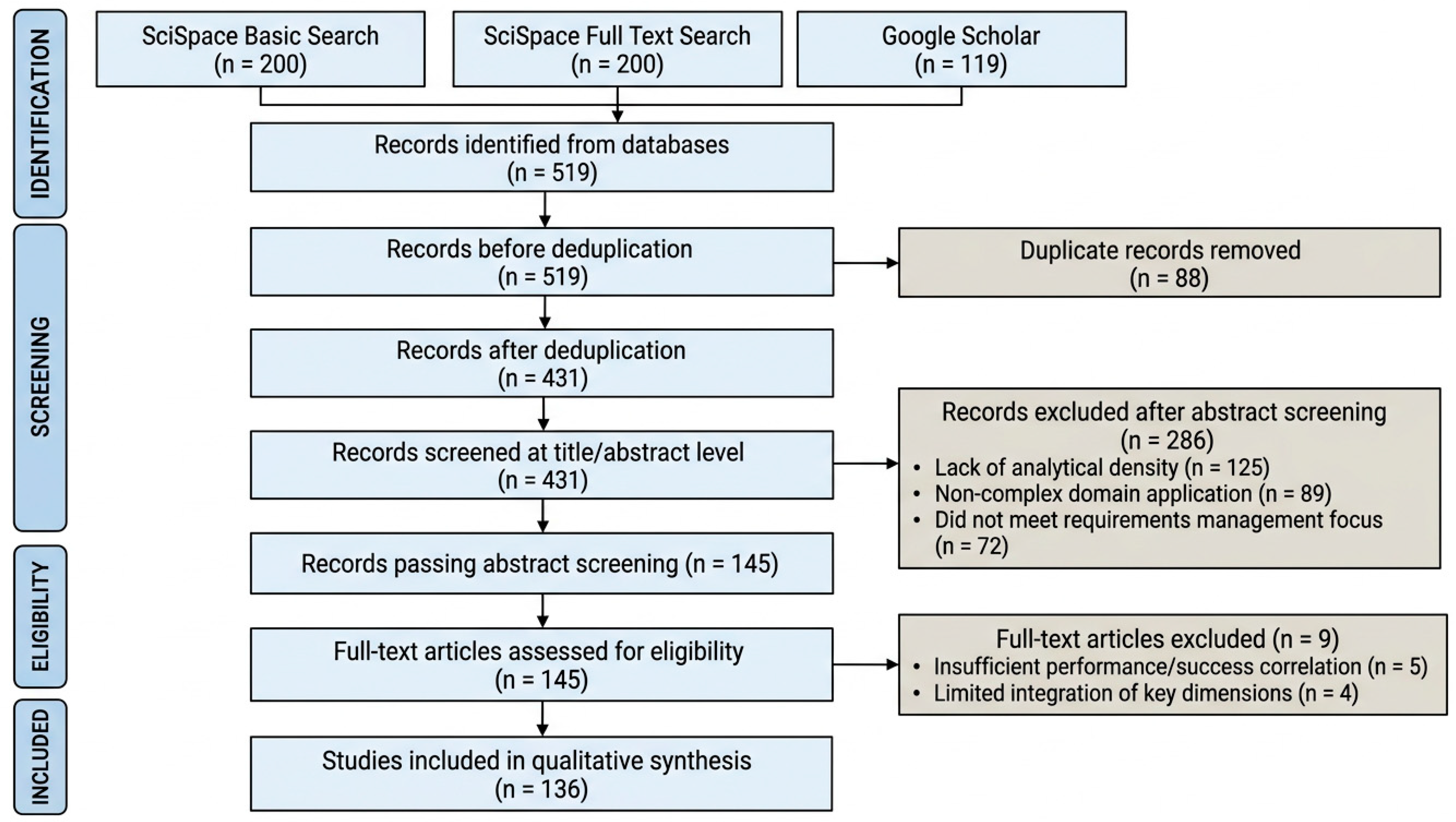
This systematic review was conducted and reported in accordance with the 2020 preferred reporting items for systematic reviews and meta-analyses (PRISMA) guidelines [
50]. The completed PRISMA 2020 checklist is provided in the
Supplementary Material; the study selection process is documented using the PRISMA 2020 flow diagram (
Figure 1).
3.2. Research Questions
The systematic review was guided by the following research questions:
RQ1: What critical dimensions of requirements management in complex systems projects are identified in the literature?
RQ2: What relationships among these dimensions are identified in the literature?
RQ3: How can these dimensions be integrated into a comprehensive theoretical framework for requirements management in complex systems projects?
3.3. Information Sources and Search Strategy
A comprehensive literature search was conducted using the following electronic databases:
The searches covered peer-reviewed publications that had been published between 2010 and 2024 and were written in English.
The search strategy employed Boolean combinations of terms directly related to requirements management and complex systems, including the following:
(“requirements engineering” OR “requirements management”) AND (“complex systems” OR “complex projects”);
(“requirements management”) AND (“risk” OR “uncertainty”);
(“team maturity” OR “organizational maturity”) AND (“requirements” OR “project management”);
(“digital transformation” OR “digital twins” OR “MBSE”) AND (“requirements management” OR “project success”).
The selection of these search terms was informed by a preliminary exploratory phase aimed at identifying recurring themes and potentially relevant research streams within the literature. These terms were intended to maximize the coverage of relevant topics rather than predetermine the review findings.
The choice of search queries can influence the retrieval of studies. To address this limitation, the search strategy was designed to include multiple dimensions related to requirements management, thereby avoiding a narrow or single-dimensional focus.
3.4. Eligibility Criteria
Studies were included if they met the following criteria:
They addressed complex systems or engineering projects;
they considered requirements management as a central focus;
they provided analytical insights into project performance, risk and uncertainty management, team or organizational maturity, coordination, contractual arrangements, or digital transformation; and
they presented empirical, theoretical, or methodological contributions relevant to the research questions.
Studies were excluded if they
were focused on low-complexity or routine project contexts;
mentioned requirements only superficially; or
lacked sufficient analytical depth or relevance to the objectives under review.
3.5. Study Selection Process
The study selection process followed a two-stage screening procedure. First, the titles and abstracts were screened on the basis of the predefined inclusion and exclusion criteria. Second, the potentially relevant articles were assessed at the full-text level to determine their eligibility for inclusion in the qualitative synthesis. A total of 519 records were initially identified through database searches. After 88 duplicate records were removed, 431 records were screened at the title and abstract level. A total of 145 full-text articles were subsequently assessed for eligibility, of which 9 were excluded because of insufficient analytical alignment with the research objectives. Ultimately, 136 studies were included in the qualitative synthesis. The complete selection process is illustrated in the PRISMA 2020 flow diagram below (
Figure 1).
3.6. Data Extraction and Synthesis
Data were extracted from the included studies using a structured analytical matrix. The analysis focused on the following dimensions:
requirements definition, quality, and traceability;
risk and uncertainty management;
team and organizational maturity;
coordination mechanisms and contractual arrangements;
digital transformation and MBSE; and
the effects on project performance and resilience.
The synthesis was conducted via qualitative thematic analysis to identify recurring patterns, relationships, and interdependencies across the literature.
To minimize the potential influence of search-term bias, the analytical dimensions were not defined directly by the search strings. Instead, following the screening phase, the selected studies were analyzed through qualitative thematic synthesis, enabling the identification of recurring patterns and emergent dimensions across the literature.
This approach ensured that the analytical categories were derived from the data rather than being imposed a priori by the search queries. Consequently, the identification of key dimensions reflects their recurrence and analytical relevance across the selected studies.
3.7. Risk-of-Bias Assessment
A formal risk-of-bias assessment was not conducted, as the primary objective of this review was theoretical synthesis and conceptual framework development.
However, potential sources of bias—particularly those related to search-query design—are acknowledged. To mitigate this effect, a broad search strategy combined with multistage screening and qualitative thematic synthesis was adopted, ensuring that the identification of key dimensions was not dependent solely on predefined search terms.
3.8. Registration and Protocol
This systematic review was not registered in a public registry such as PROSPERO. Registration was not pursued because the study adopts a qualitative, theoretical–exploratory systematic review approach aimed at conceptual synthesis and framework development rather than evaluating intervention effects or clinical outcomes. This decision is consistent with the PRISMA 2020 guidance for nonclinical and engineering-focused reviews, in which protocol registration is recommended but not mandatory.
In addition to the studies included in the systematic review, this article also cites international standards, methodological guidelines, and conceptual background literature that support the theoretical framing but were not included in the systematic selection process.
Only the main elements that affect requirements management in complex systems projects were included. This approach was chosen because of the need to aggregate knowledge spread across several fields—systems engineering, project management, digital technologies, and organizational theory—prior to constructing a comprehensive theoretical model.
4. Results
The findings presented in this section are derived from the synthesis of the literature and reflect recurring patterns and reported associations rather than empirically tested causal relationships.
The results are organized into five analytical categories on the basis of a systematic literature review: (i) the impact of requirements on project success, (ii) strategies for mitigating uncertainties and risks, (iii) the role of team maturity in adapting requirements, (iv) the digitalization and transformation of complex systems, and (v) the application of MBSE. Each category consolidates evidence reported in the literature that supports the development of a theoretical framework for managing requirements in complex systems projects.
The selected studies were examined to identify recurrent patterns, key contributions, and research gaps across the five analytical categories. The qualitative synthesis involved the organization and comparison of the different approaches reported in the literature to enable the identification of consistent challenges and gaps reported in the literature.
The following subsections present the results in a structured manner, organizing the bibliographical evidence to highlight the main elements identified across the five analytical categories. The section ends with a synthesis of the results, as summarized in
Table 1, which presents the main conceptual contributions and practical challenges associated with each thematic axis.
4.1. Impact of Requirements on Project Success
The reviewed literature indicates that the requirement definition is a collaborative activity that is consistently associated with the success of complex projects. Evidence reported in sectors such as modular construction indicates that insufficient integration among engineers, suppliers, and clients is associated with cascading failures, which have been reported to negatively affect cost, schedule, and product quality. In this context, Nabi et al. [
6] identified 25 critical collaboration factors and grouped them into four dimensions: project organization, stakeholder relationships, information sharing, and design planning.
In this context, the literature indicates that trust among stakeholders mediates requirements definition processes. Studies such as Luna-Reyes et al. [
12] have indicated that knowledge sharing and joint learning are essential for reducing ambiguity in requirements interpretation. Evidence has also shown that the use of interactive prototypes supports uncertainty reduction by enabling continuous adjustment and lowering the likelihood of conflicts. Furthermore, greater precision in the definition of requirements and a stronger commitment to established project goals tend to be reported for projects characterized by higher levels of stakeholder engagement and clear communication mechanisms.
4.1.1. Volatility of Requirements
Volatility—which is understood in terms of the frequency and magnitude of requirements changes throughout a project—is consistently reported in the literature as a factor that is associated with reduced predictability and overall project performance. Kulk and Verhoef [
51] reported an association between frequent requirement changes and cost overruns, schedule extensions, and scope redefinition. Similarly, a statistical analysis by Jun et al. [
52] revealed a moderate negative correlation between requirements volatility and project success (
p < 0.01).
Across the reviewed studies, approaches such as agile methods, iterative validation, and continuous stakeholder involvement are frequently reported as mechanisms used to manage requirements volatility. Evidence has indicated that these practices are associated with increased adaptability and facilitate the updating of requirements with a reduced impact on allocated resources. Overall, the literature reports that effective requirements management in volatile environments is characterized by the coexistence of mechanisms that support both stability and controlled flexibility.
4.1.2. Requirements Documentation
The literature consistently reports documentation quality as a factor that determines requirements reliability and traceability. In this context, the ISO/IEEE 29148:2011 standard defines the essential attributes—such as atomicity, completeness, consistency, and verifiability—that ensure auditability and alignment with project objectives [
53].
The literature also indicates that the structure of requirements documentation is associated with project outcomes. Van Lamsweerde [
54] and Rüping [
55] reported that well-constructed introductory sections (purpose, scope, and context) contribute significantly to the clarity and organization of requirements. Conversely, vague initial descriptions, even when followed by detailed functionalities, are associated with a higher likelihood of budget overruns, as documented by Tamai and Kamata [
5].
Luna-Reyes et al. [
12] have reported that the use of digital tools support the dynamic adaptation of requirements throughout the project lifecycle, particularly in agile and iterative documentation contexts. The literature further indicates that such tools facilitate active stakeholder participation in the writing and review of requirements.
According to Vaz [
56], high-quality requirements are associated with lower failure rates and more efficient use of resources and execution time. Effective documentation management is therefore described in the literature as both a technical control mechanism and a means of supporting alignment among project stakeholders.
4.1.3. Critical Analysis
The literature consistently reports the importance of requirements management for the successful performance of complex projects. Across the reviewed studies, shared requirements definition, structured documentation, and the management of requirements volatility are recurrently associated with lower failure rates and improved predictability. However, the synthesis also reveals that many studies adopt descriptive or sector-specific approaches, with limited efforts to integrate these elements into a unified requirements management model. The main findings of this section, along with their associated practical implications and recurring challenges, are summarized in
Table 1.
4.2. Strategies for Mitigating Uncertainty and Risks
Risk and uncertainty management are consistently reported in the literature as critical dimensions in complex systems engineering projects. The reviewed studies report a range of qualitative and quantitative approaches for addressing these variables, which manifest throughout the project lifecycle, ranging from conception to execution. Evidence presented in the literature further indicates that the dynamic nature of such projects is associated with the use of mechanisms aimed at anticipating and adapting to uncertain technical, operational, and contextual events.
4.2.1. Use of Digital Modeling to Simulate Requirements
The literature frequently identifies digital tools, such as BIM, as mechanisms for mitigating risk in complex projects. According to Li et al. [
57], BIM-based simulations are associated with the anticipation of structural, logistical, and operational issues, which are linked to reduced delays and cost overruns. These studies further report that the visualization of alternative scenarios prior to execution supports more informed decision-making processes and contributes to improved project predictability.
4.2.2. Implementing Iterative Processes for the Review of Continuous Requirements
The literature reports that highly dynamic projects frequently face operational challenges associated with rigid requirements definitions. Across the reviewed studies, the use of iterative and agile approaches—such as that of Scrum and Kanban—is posited to support the continuous reassessment and adaptation of requirements as new information becomes available. In this context, Thamhain [
58] reported that such approaches are associated with more responsive decision-making and reduce resource waste caused by poorly defined project scopes.
4.2.3. Establishing Flexible Contracts
In the literature, contractual flexibility is a component associated with organizational resilience under uncertainty. In studies examining contractual models that include mechanisms such as periodic capital reallocation or financial rebalancing clauses, their use is described as being particularly relevant in PPP arrangements, as highlighted by Sundararajan and Tseng [
32]. The reviewed literature further indicates that such contractual structures are associated with an enhanced capacity to accommodate scope changes, shifts in economic context, and unforeseen cost variations throughout the project lifecycle.
4.2.4. Integrating Risk Management into the Strategic Planning Process
According to Zwikael and Ahn [
59], the integration of project planning and risk management is associated with more effective risk mitigation efforts. The reviewed literature further indicates that organizations that adopt formal risk management frameworks tend to report lower failure rates in large-scale projects [
60]. These studies highlight the fact that such frameworks are characterized by the alignment of risk identification and mapping activities with strategic decision-making, beginning with the earliest stages of the project lifecycle.
4.2.5. Use of Technologies for Real-Time Risk Monitoring and Management
The literature reports the application of technologies such as the internet of things (IoT), big data, and AI as mechanisms used for the continuous monitoring of critical risk variables in complex projects. According to Jaafari [
8], these technologies are associated with more dynamic response capabilities, which support earlier detection and more proactive reactions to potential negative impacts. The reviewed literature further indicates that the predictive capabilities of such systems are linked to enhanced project resilience in contexts characterized by sudden or unforeseen changes.
4.2.6. Critical Analysis
The literature indicates that the effective mitigation of uncertainty in complex projects is associated with integrated approaches in which digital technologies, iterative practices, and adaptable contractual instruments are combined [
61]. The synthesis further reveals a persistent fragmentation between technical and managerial perspectives, which hinders the adoption of systemic risk management models. The main findings of this section, along with their associated implications and recurring challenges that have been identified in the literature, are summarized in
Table 1.
4.3. Role of Team Maturity in Adapting Requirements
The literature indicates that team maturity is a key factor associated with the effectiveness of requirements management in complex projects. Studies show that teams exhibiting higher levels of maturity have greater capacities to address ambiguity, adapt requirements throughout the project lifecycle, and integrate technical and organizational perspectives. In this context, Westrum and Adamski [
62] reported that compared with those involving teams at earlier stages of development, projects involving mature teams tend to exhibit substantially higher success rates in the implementation of critical requirements.
4.3.1. Impact on Agile Practices
The literature reports an association between higher levels of team maturity and more effective use of agile methodologies, particularly in contexts characterized by continuous feedback and reflective prioritization practices. In this respect, Gren et al. [
9] revealed that teams classified via stage 4 of the GDQ model tend to achieve measurable reductions in unrealistic project scope—reported to be as high as 25%—through more deliberate and informed prioritization of requirements.
The literature reports that the use of structured retrospectives is associated with higher levels of team maturity. Rather than focusing solely on the identification of operational failures, studies indicate that mature teams employ retrospectives to support the development of systemic solutions. In this context, one case study in the logistics sector reported a reduction of approximately 35% in rework when retrospective studies were conducted from this perspective [
41].
4.3.2. Case Studies
The literature provides illustrative case-based evidence indicating an association between team maturity and the quality of requirements management. Two examples reported in the reviewed studies highlight this relationship.
Integration of New Members: In an information technology team, the absence of structured technical mentoring was reported to be associated with significant errors in requirements documentation. The introduction of mentoring practices reportedly coincided with an approximately 60% reduction in such failures within a two-month period [
41].
Strategic Coaching: In a construction project context, the implementation of coaching practices to align roles with project objectives has been associated with an increase of approximately 45% in adherence to client requirements [
9].
Persistent Challenges
Despite the reported benefits of team maturity, the literature indicates that projects involving distributed or multidisciplinary teams frequently encounter persistent challenges in achieving collective maturity. Studies associate factors such as geographical fragmentation, high team turnover, and cultural differences with difficulties in sustaining mature collaborative practices. In this context, Smolska [
41] reported the use of collaborative platforms, such as BIM 360, along with frequent integration routines—such as short, structured meetings focused on updates and alignment—as team practices meant to address these challenges.
General Integrative Requirements (GIR) Framework Integration
The synthesis of the literature on requirements management consistently describes team maturity as a structuring dimension within integrated approaches to requirements management. The reviewed studies associate higher levels of team maturity with differences in how requirements are discussed, interpreted, and adapted throughout the project lifecycle.
Across the analyzed literature, there are two recurrent patterns related to maturity integration. The first concerns continuous maturity assessment, in which instruments such as the GDQ are used to identify team developmental stages and to inform the selection of context-appropriate support practices, including technical training or coaching and mentoring. The second pattern relates to the adaptation of management processes to maturity levels, with the literature reporting that teams at earlier stages of development are more frequently associated with rigid contractual arrangements and formalized requirements, whereas more mature teams are associated with more flexible contractual mechanisms, renegotiation clauses, and continuous adaptation practices.
4.3.3. Critical Analysis
The analyzed studies indicate that higher levels of team maturity are associated with a greater capacity for the adaptation of requirements and a reduced incidence of project failure. The synthesis further reveals that although group development models and practices such as coaching and structured retrospectives have been adopted in specific sectors, their broader implementation remains constrained by persistent cultural and structural barriers. The main findings of this section, together with their practical implications and recurring challenges identified in the literature, are summarized in
Table 1.
4.4. Digitalization and Transformation of Complex Systems
The literature reports that digital transformation is an important factor in shaping contemporary approaches to requirements management in complex systems. In this context, Lakemond [
4] reported that the use of digital technologies enables real-time simulation and analysis is associated with an improved capacity to address uncertainty-related challenges. The reviewed studies further indicate that organizations that adopt such digital approaches tend to exhibit enhanced adaptability to changing market demands, particularly when these approaches are combined with automation, traceability, and data management tools [
63].
The reviewed literature describes DTs as a relevant digital technology used for the real-time simulation, monitoring, and optimization of complex processes. Studies further report that the application of DTs to end-to-end supply chain modeling is associated with improvements in resilience and traceability across organizational boundaries [
64]. In this context, Javaid et al. [
65] and Ammar [
66] reveal how DT-based approaches are associated with the creation of accurate digital representations of physical systems, supporting predictive analysis aimed at the early detection of potential failures and dynamic adjustment of operational parameters without interrupting production.
The reviewed literature further reports that the integration of DTs with corporate information systems—such as enterprise resource planning (ERP) platforms, automated accounting systems, and data management infrastructures—is associated with a broader scope of digitalization and increased reliance on data-driven decision-making processes. In industrial systems and critical infrastructure contexts, studies describe this integration as being linked to enhanced organizational resilience and sustainability. The literature also reports that the incorporation of AI-enabled learning loops into complex intelligent systems leads to additional benefits and highlights the need for careful consideration of system boundaries and governance arrangements [
67].
The literature describes the risky opportunity analysis method (ROAM) as a complementary analytical approach for assessing the viability of digital transformation initiatives, as reported by Ardebili et al. [
68]. The reviewed studies indicate that the ROAM employs indicators such as stress (the ratio of identified threats to expected benefits) and strain (relative implementation cost) to support decision-making regarding the prioritization of investments in digital technologies. Evidence in the literature has been used to further link the application of this method with contexts such as the search for stability in production chains and include scenarios involving the substitution of critical environmental inputs.
The reviewed literature provides empirical examples to illustrate the application of digital approaches in different contexts. In the payments sector, Dominguez-Lugo et al. [
69] reported that the replacement of paper receipts with digital alternatives such as SMSs or email, in conjunction with digital tracking mechanisms, is associated with reductions in environmental impact and improvements in information security. In manufacturing contexts, studies describe the use of DT-based simulations as supportive of the exploration of alternative production scenarios, which are associated with the identification of bottlenecks and workflow optimization prior to physical implementation.
Despite these reported benefits, persistent structural, cultural, and technical barriers to digital transformation are also reported in the literature, particularly with respect to small and medium-sized enterprises (SMEs). Farahani [
70] reported that the misalignment between organizational culture and the requirements imposed by new technologies is frequently associated with difficulties in sustaining digitalization initiatives. In this regard, the reviewed studies highlight workforce training and organizational cultural change as supportive factors for the more effective use of digital tools.
The literature further reports that digitalization is associated with sustainability-oriented practices in complex systems contexts. Studies report that the replacement of physical or chemically intensive processes—such as the use of thermal paper containing bisphenol A (BPA)—with digital alternatives is linked to reductions in toxic waste. In addition, the adoption of digital traceability systems is reported to support environmental management practices and compliance with regulatory standards.
Critical Analysis
The synthesis of the reviewed literature indicates that digitalization is frequently associated with advances in requirements management in complex systems, particularly through the integration of predictive analysis, enhanced traceability, and increased automation of decision-support processes. Moreover, the analyzed studies consistently highlight a lack of robust empirical evidence to validate the effectiveness of these digital approaches across diverse organizational contexts, particularly in small organizations or those with low levels of digital maturity. The main findings of this section, together with their associated implications and recurring challenges identified in the literature, are summarized in
Table 1.
4.5. Application of Model-Based Systems Engineering
The reviewed literature reports MBSE as an approach that is being increasingly adopted to address complexity in engineering projects, particularly through the replacement of document-centric practices with integrated models that support traceability, consistency, and stakeholder communication [
17]. In complex engineering contexts, studies describe the application of MBSE as being associated with enhanced support for requirements management by facilitating the integration of design, analysis, and validation activities. In this context, Fernandez and Hernandez [
3] have reported that the adoption of MBSE is associated with improved clarity in the definition of requirements and more effective coordination among multidisciplinary teams.
The reviewed literature describes an association between MBSE and digitalization, in which MBSE operates as a methodological foundation that enables the structured implementation of digital tools in requirements management. In this context, digital technologies—such as DTs, simulation models, and data-driven platforms—are not independent elements but are operationalized through MBSE, establishing a direct and functional relationship between digitalization practices and the systematic representation and integration of system requirements. In this context, Madni et al. [
71] reported that the integration of MBSE with DT concepts is associated with capabilities such as continuous system monitoring, the early identification of potential faults, and performance evaluation under simulated operating conditions.
In the construction sector, Chen and Jupp [
72] examined the integration of MBSE with BIM and product lifecycle management (PLM). The reviewed literature describes this convergence as being associated with improved requirements traceability across project phases, ranging from design to operation and maintenance. In infrastructure megaprojects, Chatzimichailidou et al. [
73] have reported that the alignment between BIM and system integration (SI) is frequently emphasized in studies on coordination challenges. Case-based evidence from the Crossrail project described how limited integration between these elements was associated with schedule delays and the coexistence of unverified requirements. Overall, the literature associates the closer integration of SI and BIM with enhanced system interoperability and reduced exposure to information fragmentation risks.
In the aerospace sector, Gratius et al. [
74] have described the application of DT approaches in the environmental management of space missions. The reviewed studies report that the integration of information models (e.g., SysML) with simulation models (e.g., Bayesian networks) is associated with enhanced traceability regarding the relationship between changes in individual system components and overall system performance. The literature further indicates that such tracing capabilities are particularly emphasized in studies that address autonomous and life-support systems that operate in extreme environments.
The reviewed literature also shows that digitalization is associated with changes in traditional systems engineering workflows. In this regard, Legner et al. [
75] have linked digital tools to higher degrees of automation and predictive analysis in requirements management, which are considered in the literature to support failure anticipation and the exploration of future operational scenarios. Additional case-based evidence from non-industrial contexts further illustrates the applicability of MBSE. For example, Agua and Mendes [
76] have reported the use of systems engineering principles for large-scale cash flow modeling, thereby supporting the dynamic monitoring of financial risks and the adaptation of requirements in response to changing economic conditions.
Finally, Nwulu et al. [
77] and Davidz [
78] have reported the role of technical leadership within systems engineering contexts. The literature highlights this role as critical to ensuring that system models reflect multidisciplinary requirements and maintain coherence, traceability, and ethical considerations across the formulation and evolution of requirements.
Critical Overview of the Section
A synthesis of the literature indicates that MBSE, particularly when combined with complementary technologies such as BIM, PLM, and DT approaches, is frequently described as a relevant method for supporting requirements management in complex projects. Moreover, the analyzed studies consistently report that the practical adoption of MBSE remains constrained by persistent challenges, including limited standardization, organizational fragmentation, and resistance to change within established technical cultures. The main findings of this section, together with their associated implications and observed challenges, are summarized in
Table 1.
Taken together, these results provide a structured synthesis of the literature on requirements management in complex projects organized around five interrelated analytical dimensions: requirements definition and traceability, risk and uncertainty mitigation, team maturity, digitalization and organizational transformation, and the application of model-based systems engineering. While these findings highlight the consistent patterns, complementarities, and persistent challenges reported across the reviewed studies, their implications become clearer when they are examined in an integrated manner. Accordingly, in the following section, the ways that these dimensions interact and are conceptually combined to inform the development of the proposed integrative theoretical framework for requirements management in complex systems projects are discussed.
5. Proposed Framework for Requirements Management
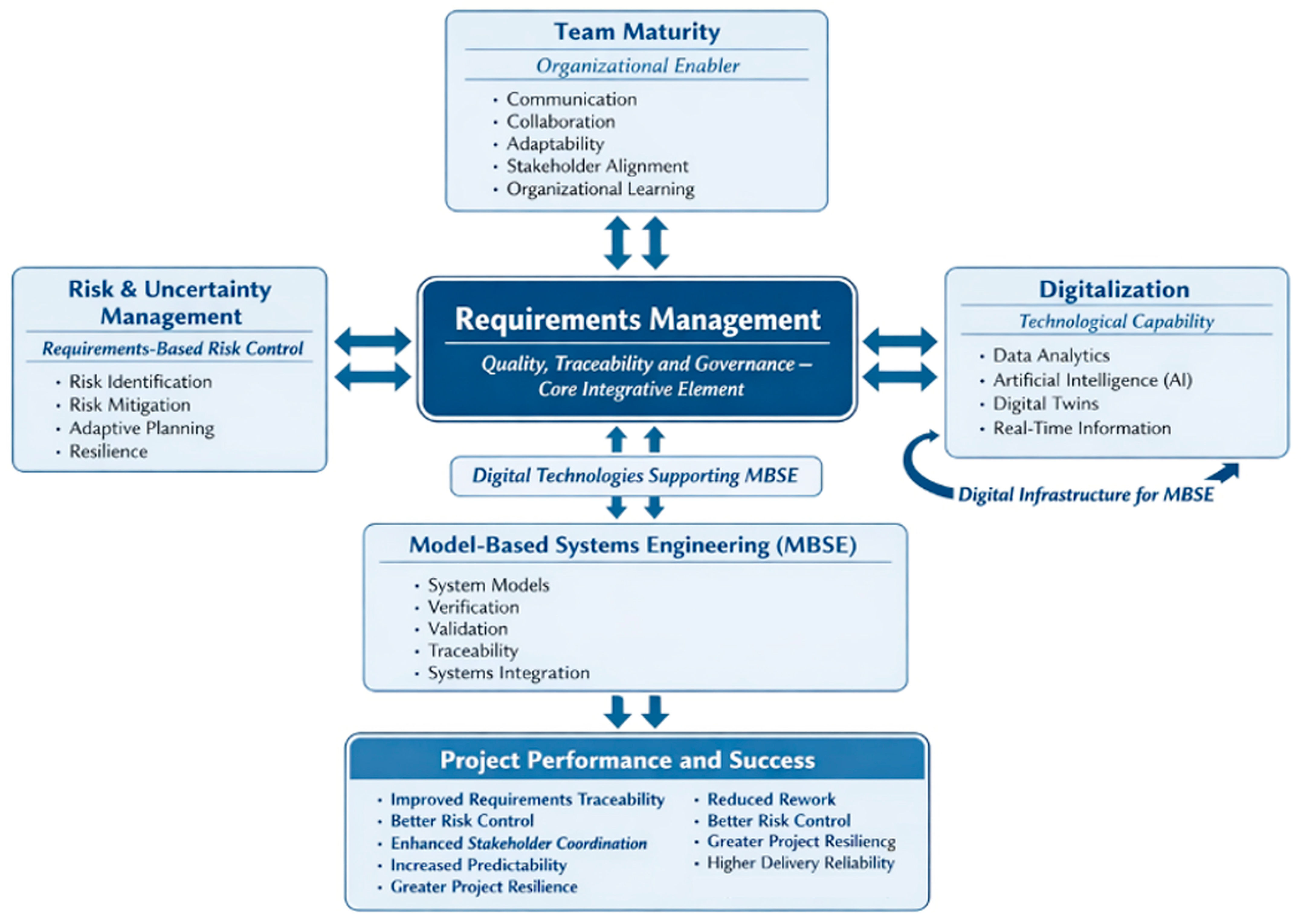
The framework proposed in this study builds upon the findings of a systematic literature review, from which five recurring analytical dimensions associated with requirements management in complex systems projects were identified: (i) the quality and traceability of requirements, (ii) the mitigation of risks and uncertainties, (iii) team maturity, (iv) digitalization and organizational transformation, and (v) systemic integration through MBSE approaches. These dimensions were selected on the basis of their frequency, relevance, and explanatory power in the analyzed studies and were systematically integrated into a coherent conceptual model that explicitly captures their interdependencies, positioning requirements management as a central integrative mechanism across technical, organizational, and digital domains. Together, they constitute an integrative conceptual model intended to provide a theoretical basis for understanding how the reduction in uncertainty and the improvement in predictability and performance are addressed in the literature on complex projects.
In line with contingency-based perspectives, existing studies emphasize that there is no single optimal approach to project management, as strategies are described in the literature as being adapted to different levels and types of complexity [
25]. Accordingly, the structure proposed in this study is not a simple aggregation of factors, but a theoretical synthesis derived from the literature to integrate technical, organizational, and technological dimensions into a coherent conceptual model.
The proposed framework is exploratory and theoretical in nature and has not yet been empirically validated. Its primary purpose is to offer a conceptual structure that can inform professional practice and support the development of future empirical research on integrated requirements management.
A visual representation of the proposed framework, which is structured as an integrated system with hierarchical and interdependent relationships among its components, is presented in
Figure 2. At its core, the model places the definition and traceability of requirements as foundational elements that support risk mitigation and continuous adaptation processes. These core elements are conceptually interrelated with team maturity, the adoption of digital tools, and the application of MBSE approaches, which are theorized, on the basis of the literature, to be associated with greater consistency, flexibility, and control in requirements management. At the conceptual level, the framework relates these integrated dimensions to project success, which is understood as the alignment between defined requirements, delivered outcomes, and value perceived by stakeholders.
The proposed framework presented in
Figure 2 is an interconnected and hierarchical system. Requirements management is positioned at the core of the model, serving as the structural foundation that integrates the other dimensions.
The framework explicitly represents both hierarchical and functional relationships among its components. Requirements definition and traceability operate as foundational elements that influence risk mitigation, team maturity, and digitalization. These dimensions interact dynamically, with team maturity acting as a mediating organizational factor and digitalization and MBSE serving as enabling mechanisms for integration and traceability.
The model also incorporates bidirectional relationships, reflecting feedback loops and interdependencies among all components, thereby reinforcing the integrative role of requirements management across technical, organizational, and digital domains.
In particular, MBSE is depicted as an integrative mechanism that enables the implementation of digitalization, establishing a direct and operational linkage between these two dimensions.
5.1. Framework Components
The proposed framework comprises five interdependent components that are not merely listed but explicitly connected through hierarchical and functional relationships. Requirements management is positioned as the core element of the model, serving as the structural foundation upon which risk mitigation, team maturity, digitalization, and MBSE operate in an integrated manner. These dimensions interact dynamically, forming a systemic structure in which changes in one component influence the behavior and effectiveness of the others, thereby characterizing the framework as an interconnected and operational model rather than a set of independent conceptual pillars.
Requirements management constitutes the core of the proposed framework, which encompasses the systematic definition, documentation, traceability, and verification of requirements as aligned with established standards such as ISO/IEEE 29148. Within the model, this central function provides the structural basis through which the other dimensions—risk and uncertainty mitigation, team maturity, digitalization, and model-based systems engineering—are conceptually integrated and interact.
- 2.
Mitigating Risks and Uncertainties
The mitigation of risks and uncertainties, drawing on strategies recurrently described in the literature to address the inherent unpredictability of complex projects, constitutes a core component of the proposed framework. Within the model, this dimension conceptually encompasses the use of digital modeling approaches (e.g., BIM); preventive and adaptive contractual mechanisms; and analytical techniques supported by AI and big-data-based forecasting. These elements are integrated into the framework as a complementary means for anticipating, monitoring, and responding to uncertainty throughout the project lifecycle.
- 3.
Team Maturity
Team maturity represents a central human-organizational component of the proposed framework and refers to attributes such as team cohesion, self-organization, and adaptive capacity in project-related work. In the literature reviewed, models such as the GDQ and the Tuckman model are frequently used as conceptual bases for characterizing the stages of team development and maturity and providing reference structures to understand how teams evolve and respond to increasing project complexity.
- 4.
Digitalization and Transformation
Digitalization and organizational transformation constitute key technological dimensions of the proposed framework. As described in the literature reviewed, this component encompasses DT technologies; analytical tools such as ROAM; enterprise systems (e.g., ERP); and digital collaboration platforms. Within the conceptual model, these digital elements are associated with enhanced agility, improved requirements traceability, and strengthened governance in complex project environments.
- 5.
MBSE
MBSE constitutes the integrative dimension of the proposed framework, encompassing the use of system models to support the simulation, traceability, and coordination of multiple disciplinary perspectives. Within the conceptual model, MBSE links requirements, functions, and operational elements into a coherent digital representation of the system, thereby supporting the alignment and integration of the other framework components [
79].
5.2. Limitations and Directions for Future Validation
The proposed framework was developed exclusively on the basis of a systematic review of the available scientific literature. At this stage, no empirical application through case studies, computational simulations, or expert validation was conducted.
Therefore, future research should explore the following:
Apply the framework to real projects across different sectors (e.g., construction, energy, and technology) and levels of complexity;
Evaluate the framework through Delphi studies, professional interviews, and expert workshops;
Develop measurable indicators for each of the five proposed interdependent components;
Explore the potential use of artificial intelligence to automate requirements tracking, validation, and monitoring; and
Adapt the framework to regulated or public-sector contexts to automate requirements tracking, validation, and monitoring.
Recent contributions in the systems engineering literature have increasingly emphasized the growing complexity of modern systems and the need for integrated approaches that combine technical, organizational, and digital dimensions. For example, studies on autonomous systems highlight the challenges associated with uncertainty, interoperability, and system integration, particularly in systems-of-systems environments [
80]. Similarly, the importance of traceability, information integration, and the establishment of a “single source of truth” to support decision-making in complex projects has been emphasized in digital engineering and MBSE research [
81].
In parallel, recent discussions on the evolution of roles in systems engineering reflect the growing need for coordination among multiple stakeholders, disciplines, and system levels, which reinforces the sociotechnical nature of contemporary engineering systems [
82]. Despite these advances, existing studies tend to address these dimensions in a fragmented way, with a focus on specific aspects such as architecture development, digital transformation, or role definition that lack full integration into a unified analytical framework.
In this context, the framework proposed in this study is aimed at advancing the state of the art by systematically integrating these dimensions into a coherent analytical model centered on requirements management in complex systems. By articulating requirements quality, risk and uncertainty mitigation, team maturity, contractual and organizational structures, and digital transformation within a single framework, the proposed approach offers a consolidated theoretical basis for examining factors associated with predictability and performance in complex engineering projects.
6. Final Considerations
The literature on complex systems projects consistently highlights the definition and management of requirements as central elements associated with project outcomes while also linking factors such as team maturity, risk and uncertainty mitigation, contractual adaptability, and digitalization to improvements in predictability and operational performance. In this context, an integrative theoretical framework that articulates these five core dimensions of requirements management, which is grounded in a systematic review of the literature, is proposed. The primary contribution of this study does not lie in introducing isolated novel concepts but in advancing the literature by systematically integrating fragmented knowledge that has traditionally been treated separately. While existing studies often address aspects such as uncertainty management, team capabilities, or digital transformation in isolation, the proposed framework synthesizes recurring patterns identified in the literature and organizes them into a unified analytical structure that explicitly connects technical, organizational, and digital dimensions.
From a theoretical perspective, this work advances the literature by consolidating multiple research streams into a coherent conceptual model that connects technical, organizational, and digital dimensions. However, this contribution does not aim to replace existing enterprise architecture frameworks or systems engineering approaches.
Instead, the proposed framework is positioned as a complementary approach that focuses specifically on requirements management as a central integrative mechanism across technical, organizational, and digital dimensions. While frameworks such as the UAF and INCOSE-based systems engineering provide robust support for architecture development and lifecycle processes, the present study addresses a more specific analytical gap by structuring the interdependencies between requirements, risk, team maturity, and digitalization.
Unlike existing approaches that typically address individual dimensions—such as maturity models focusing on organizational capability or MBSE approaches emphasizing technical modeling—the proposed framework provides an integrative perspective that explicitly connects these dimensions within a single analytical structure centered on requirements management.
From a practical standpoint, the proposed framework offers a structured lens for supporting decision-making in engineering-intensive sectors—such as aerospace, infrastructure, and energy—by offering a conceptual structure that may help practitioners identify critical weaknesses, prioritize interventions, and improve coordination among stakeholders throughout the project lifecycle.
Future research should prioritize the empirical validation of the proposed framework in real-world projects characterized by high complexity and stakeholder diversity. Additional validation efforts could include expert workshops, interviews, or case-based studies, as well as the development of quantitative metrics that operationalize key aspects of the model, such as requirements quality, system integration, and organizational maturity [
83].
Despite its contributions, this study has several limitations. The framework remains theoretical in nature and has not yet been empirically validated across different organizational or cultural contexts. Moreover, contextual factors—such as institutional constraints or sector-specific characteristics—were not explored in depth and warrant further investigation to enhance the robustness and generalizability of the proposed model.
In summary, the framework presented in this study consolidates existing knowledge while offering a structured foundation for developing more integrated approaches to requirements management in complex systems. By shifting the perspective from static requirements documentation to dynamic and interdependent structures, this work contributes to advancing the theoretical understanding by systematically integrating fragmented research streams into a unified conceptual model that connects the technical, organizational, and digital dimensions within requirements management. Notably, the relationships and effects described in this study are derived from a synthesis of the literature and should not be interpreted as empirically validated within a single applied context. Future studies are needed to assess the applicability and effectiveness of the proposed framework in real-world project environments.