


Abstract
Resource allocation exhibits systematic divergence across heterogeneous time horizons, which aggregate measures fail to capture. This paper models allocation as a multi-component dynamic system composed of three coupled mechanisms: long-term accumulation, short-cycle response, and phase stabilization. A dual-horizon framework is developed to integrate finite-horizon local adjustment with infinite-horizon path evolution. The results show that system dynamics are governed by the coupling of these mechanisms under a shared resource constraint, which endogenously generates a unified adjustment signal and redistributes marginal resources across components. This process jointly determines short-term deviation correction, structural stabilization, and long-term equilibrium formation. Equilibrium is therefore characterized as an emergent system state shaped by intertemporal feedback and dynamic interactions. Numerical simulations further illustrate the dynamic adjustment paths and confirm the theoretical mechanisms. The framework provides a system-level explanation for divergent findings by showing how structural decomposition reveals heterogeneous mechanisms obscured under aggregate representations.
1. Introduction
Resource allocation in organizations is not a one-time decision but an evolving process spanning multiple time horizons and heterogeneous instruments [1]. These allocation choices are continuously influenced by external economic conditions, market environments, and internal adjustment pressures, leading organizations to revise their allocation structures over time. Resource allocation systems often exhibit divergent outcomes when heterogeneous components are represented through aggregate measures. Such aggregation conceals structural differences in how components contribute to system adjustment, leading to inconsistent patterns that cannot be reconciled within a unified framework. This limitation becomes particularly evident when allocation processes involve multiple temporal dimensions, as interactions across different adjustment scales generate complex system behavior. These considerations highlight the need to examine resource allocation as a dynamic, multi-dimensional decision system rather than a static outcome, and to analyze allocation behavior from the perspective of structural heterogeneity and feedback-driven adjustment mechanisms.
The proposed framework integrates structural decomposition with a multi-horizon representation to capture how the resource allocation system operates across both component and temporal dimensions. The decomposition distinguishes the functional roles of different components in system adjustment, while the multi-horizon structure captures how these roles unfold over time. Rather than being defined by a single dimension, the decomposition is grounded in differences in response timing, persistence, and transmission across states. These dimensions are not linearly additive, and their interactions may generate amplification, crowding-out, or corrective effects under non-equilibrium conditions [2], thereby jointly determining system adjustment paths and eventual stability. These dimensions simultaneously define the classification of components and their evolution across time horizons. By integrating structural differentiation with temporal organization, the framework provides a unified representation in which heterogeneous mechanisms can be traced along adjustment paths, enabling the identification of distinct dynamic processes and their interactions in shaping system outcomes.
Research on resource allocation has increasingly adopted system-oriented perspectives, particularly emphasizing interaction, feedback, and dynamic adjustment [3]. These approaches often model allocation processes as interconnected structures, capturing decision evolution through state transitions and feedback-driven system behavior over time. These contributions provide important insights into the dynamic nature of allocation and highlight the interdependence among decision components. However, even within system-based approaches, resource allocation is often represented at an aggregate level or through simplified structural distinctions that fail to capture differences in adjustment roles. As a result, heterogeneous mechanisms are often only partially captured or implicitly embedded, limiting the ability to trace how distinct processes propagate and interact within the system [4]. This limitation becomes more pronounced when allocation unfolds across multiple time horizons, where short-term responses, stabilization processes, and cumulative effects operate simultaneously without being explicitly differentiated. In parallel, most studies rely on static or single-period optimization frameworks or focus on partial decision processes under given constraints. While these studies offer valuable insights into allocation efficiency and behavioral responses, they often yield divergent conclusions in complex settings, reflecting the underlying heterogeneity that remains unmodeled. Taken together, existing approaches provide important but fragmented insights, lacking a unified representation that integrates structural differentiation with intertemporal dynamics. This gap motivates the development of a system-level framework capable of capturing how heterogeneous mechanisms interact and evolve across multiple time horizons to shape system outcomes.
This study develops a unified analytical framework that integrates structural decomposition, multi-horizon modeling, and equilibrium formation within a single system architecture. The framework decomposes resource allocation into heterogeneous components defined by their adjustment roles, and embeds these components within a dual-horizon structure that distinguishes bounded local coordination from intertemporal path formation. This model connects component-level heterogeneity with system-level dynamics.
Within this framework, system evolution emerges from the interaction of multiple mechanisms rather than any single driver. These mechanisms are coupled across temporal dimensions, jointly shaping system dynamics. Under resource constraints and return structures, the system endogenously generates a unified constraint signal that governs marginal allocation and regulates adjustment direction and intensity across components. This coordination mechanism induces a sequential adjustment process in which short-term deviations are corrected, medium-term stability is maintained, and long-term trajectories gradually emerge. As a result, equilibrium is no longer a static allocation outcome at a given point in time, but an emergent system state arising from dynamic interactions and intertemporal feedback.
2. Literature Review
2.1. System-Oriented Resource Allocation
Research on resource allocation has increasingly shifted toward system-oriented analysis, in which allocation is viewed not as an isolated decision problem but as a dynamic process embedded in a structured environment [5]. This process is not a simple aggregation of isolated choices, rather, it constitutes a resource allocation system characterized by internal structure, decision rules, and temporal evolution [6], such as financial constraints, governance mechanisms, and market environments [7]. Its outcomes are jointly shaped by internal organizational mechanisms and external information conditions [8]. Within this perspective, resource allocation is shaped by state transitions, interdependence among decision components, and feedback mechanisms that connect current decisions to future system evolution.
Operations research and management science provide a rigorous methodological foundation for this approach. In this literature, resource allocation is typically modeled as a sequential decision problem under constraints [9], using tools such as dynamic programming, stochastic control, and online learning algorithms [10]. A central finding is that allocation decisions are inherently interdependent: the marginal value of allocating resources to a given component depends not only on its own payoff, but also on its interaction with other components within the system [11]. For example, studies on multi-category platform allocation show that optimal policies cannot be decomposed into independent decisions across categories, but must account for cross-category and cross-side effects [9]. This implies that resource allocation outcomes are determined by the joint configuration of the system rather than by isolated marginal evaluations.
Building on this foundation, another stream of research emphasizes information processing, learning, and behavioral adaptation in dynamic resource allocation [8]. These studies show that allocation performance depends on how decision-makers update beliefs, decompose complex problems, and adjust strategies over time. Experimental evidence suggests that effective allocation requires structuring decisions across stages rather than optimizing each stage independently. This perspective highlights that resource allocation is not only an optimization problem, but also a coordination problem across time.
Complementary to these approaches, system dynamics research focuses on feedback structures, delays, and nonlinear interactions. Instead of deriving closed-form optimal solutions, these studies analyze how allocation decisions propagate through feedback loops and accumulate into long-term system outcomes. A key insight is that allocation results are often emergent properties of the system, shaped by internal structures such as feedback and path dependence rather than by single-period decision rules.
Taken together, existing system-oriented studies provide three key insights. First, resource allocation should be understood as a dynamic and evolving process rather than a static outcome. Second, allocation decisions are shaped by interdependence across components, rather than by isolated marginal contributions. Third, feedback and state transitions play a central role in determining how allocation outcomes evolve over time.
However, despite these advances, an important limitation remains. Most existing studies focus on decision rules, optimization performance, or simulation outcomes, while paying relatively limited attention to how heterogeneous components should be structurally decomposed according to their adjustment roles. Moreover, although dynamic allocation studies recognize the importance of time, they typically treat temporal dynamics as a single continuous dimension without distinguishing between bounded local adjustment and long-run path formation. This leaves a gap for a framework that explicitly integrates structural decomposition with multi-horizon dynamics within a unified system representation.
2.2. Structural Heterogeneity in Corporate Investment Decision Systems
A growing body of research suggests that resource allocation systems are inherently heterogeneous, consisting of multiple components that differ in their functional roles, response characteristics, and dynamic contributions [12]. Rather than operating as a homogeneous aggregate, allocation systems are structured compositions in which different components perform distinct functions within the overall adjustment process [13]. These differences imply that allocation outcomes depend not only on the total volume of resources but also on how resources are distributed among structurally heterogeneous components [14]. For example, short-term assets typically feature higher liquidity and faster return realization [15], whereas long-term assets involve delayed returns and greater persistence, with returns released gradually through intertemporal accumulation. These differences generate distinct allocation incentives and adjustment patterns [16,17].
In system-oriented studies, heterogeneity is often reflected in differences in how components respond to external inputs, how their effects persist over time, and how they interact with other components [18,19]. For example, dynamic resource allocation research in operations and management science shows that allocation decisions across multiple components are interdependent and cannot be optimized independently. The effectiveness of allocating resources to one component depends on how that decision influences the state and behavior of other components [20], implying that system outcomes are determined by the configuration of interactions rather than isolated contributions [21]. At the same time, existing research indicates that mismatches within internal structures may lead to resource misallocation or inefficient allocation [17], suggesting that structural configuration itself plays a decisive role in shaping system outcomes [22].
Similarly, system dynamics research emphasizes that components within a system may exhibit fundamentally different adjustment patterns. Some components respond rapidly to changes in system conditions but generate only short-lived effects [15], while others adjust more slowly but produce persistent impacts through accumulation and feedback processes. These differences imply that system behavior is shaped not only by the magnitude of allocation but also by the structural roles that different components play in transmitting and transforming adjustment signals.
Despite recognizing the importance of heterogeneity, most existing studies treat it as a descriptive feature rather than a structural mechanism. Components are often categorized or compared, but their interactions are not explicitly modeled within a unified system framework [23]. In particular, limited attention is paid to how heterogeneous components jointly determine system dynamics through coupled adjustment processes. This limitation suggests that structural heterogeneity should be understood as a core system property, reflecting differences in adjustment roles, interaction patterns, and dynamic effects across components. A system-level perspective therefore requires not only distinguishing components but also modeling how their structural differences shape the evolution of the system as a whole.
2.3. Multi-Horizon Dynamics as a System Property
Another important strand of literature emphasizes that resource allocation unfolds across multiple temporal dimensions and should be understood as a time-structured system rather than a single-period decision process [9]. In this perspective, time is not merely an index of decision stages, but a fundamental dimension that shapes how allocation mechanisms operate and interact [24]. Traditional intertemporal investment models primarily focus on determining the optimal allocation of resources within a given time horizon under specified constraints, emphasizing equilibrium outcomes rather than the underlying adjustment process [25].
In operations research and dynamic allocation studies, time is typically incorporated through sequential decision models, where allocation decisions are made under evolving system states and future consequences are explicitly considered [26]. These studies show that optimal allocation policies depend on the trajectory of the system rather than on current conditions alone [27]. In particular, dynamic resource allocation models demonstrate that decisions must balance immediate returns with future opportunities [28] and that early-stage allocation choices may constrain or enable subsequent adjustments. This highlights the path-dependent nature of allocation processes, in which system evolution is shaped by cumulative decisions over time. Resource allocation is not completed instantaneously but unfolds through a series of adjustments toward a stable state [29].
Beyond sequential decision models, research on dynamic systems further distinguishes between different temporal patterns of adjustment. Some processes are characterized by rapid responses to short-term fluctuations, while others evolve gradually through accumulation and feedback. System dynamics studies show that these temporal differences are associated with fundamentally different mechanisms [30]: short-term dynamics are often driven by local feedback and adjustment loops, whereas long-term dynamics emerge from delayed effects, nonlinear interactions, and accumulation processes. As a result, system behavior cannot be fully understood without considering how these temporal mechanisms coexist and interact.
A key implication of this literature is that temporal structure is not homogeneous. Instead, resource allocation systems involve multiple time horizons with distinct functional roles. However, most existing studies treat time as a continuous and unified dimension, focusing either on short-term optimization or long-term outcomes in isolation. Limited attention is paid to how different temporal processes—such as bounded local adjustment and long-run path formation—are jointly organized within the same system. Investment decisions are frequently characterized by nonlinear feedback and time-lag effects, implying that different allocation strategies may lead to significantly divergent evolutionary paths and long-term outcomes [31].
This limitation suggests that multi-horizon dynamics should be explicitly incorporated as a structural feature of resource allocation systems. A system-level framework therefore requires not only modeling decisions over time, but also distinguishing how different temporal processes interact, and how short-term adjustments are connected to long-term system evolution [32].
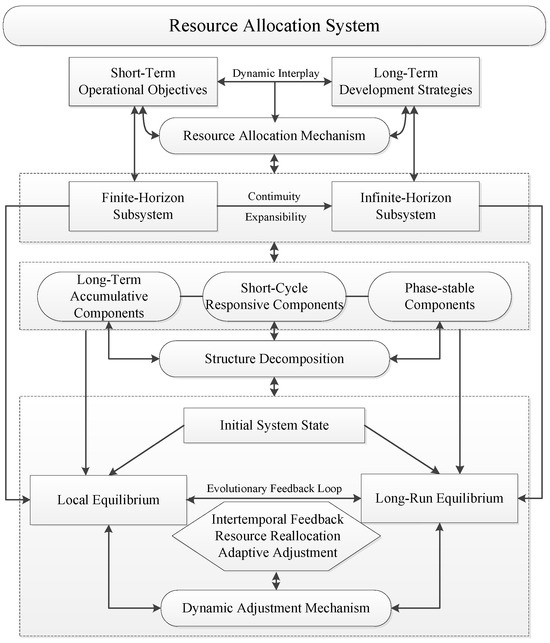
Taken together, the above literature highlights that resource allocation has been widely examined from system-oriented perspectives, with increasing attention to interaction, feedback, and dynamic adjustment. However, existing studies either abstract allocation processes at an aggregate level or treat structural and temporal dimensions separately, making it difficult to capture how heterogeneous components interact across time to jointly shape system evolution. To address this limitation, this study develops a unified analytical framework that integrates structural decomposition with multi-horizon dynamics within a single system architecture. In this framework, resource allocation is organized into heterogeneous components according to their functional roles, and these components are embedded into a dual-horizon structure to characterize the interaction between bounded local adjustment and long-term path formation. To provide a clear and formal representation of this framework, Figure 1 presents the system architecture, illustrating how heterogeneous components are coordinated under unified constraints and how their interactions generate dynamic adjustment processes across time horizons. This structural representation serves as the foundation for the formal model developed in Section 3 and the subsequent analysis of system dynamics.
Figure 1.
System Architecture of Multi-Horizon Resource Allocation.
3. System Formulation and Dynamic Architecture
3.1. System Architecture and Structural Decomposition
From a structural perspective, the system is specified as a unified generative framework. It includes three allocation components with distinct dynamic properties: long-term accumulative, short-cycle responsive, and phase-stable components. These components jointly form three internal transmission channels, rather than independent decision units. Their differences arise from how state effects are generated over time, transmitted across components, and retained along system trajectories.
Specifically, the long-term accumulative component is characterized by pronounced lag and intertemporal persistence. Its current allocation continuously propagates forward through accumulation and feedback, generating path dependence in the system’s state evolution. Such dynamics are commonly observed in strategic resource allocation activities, including R&D expenditure, fixed-asset investment, capability building and long-term equity holdings, where the effects of current decisions unfold gradually and accumulate across multiple periods. By contrast, the short-cycle component operates on a high-frequency timescale. It responds directly to external disturbances, with state adjustments driven by continuous fluctuations and occasional discrete shocks, thereby providing rapid feedback and local corrective capacity. This type of behavior is typically reflected in liquidity management, short-term financial investment, inventory adjustment, and other highly flexible allocation decisions that can be rapidly reconfigured in response to changing market conditions. The phase-stable component occupies an intermediate role. Its return process evolves more smoothly over time, supplying a stabilizing effect that buffers short-term volatility and maintains continuity across adjacent states. In practice, this characteristic is often associated with relatively stable-yield allocation arrangements, such as bond investments, bond funds, dividend-oriented portfolios, and other income-generating assets whose primary function is to preserve continuity and reduce fluctuations in overall system performance. Taken together, these examples illustrate how the three abstract component types can be interpreted as different forms of resource allocation behavior operating over distinct temporal horizons. These components do not act independently; rather, their interaction defines the system’s evolutionary trajectory. Their differences are not reducible to parameter variation, but are embedded in the temporal structure of their dynamics, including timing of action, persistence of effects, and adjustment responsiveness. Taken together, these structural asymmetries constitute the internal heterogeneity of the resource allocation system. Aggregating them into a single composite measure would eliminate the temporal structure underlying system dynamics, making it impossible to capture the heterogeneous evolution patterns observed across different time horizons.
At the target-structure level, the resource allocation system is governed by two constraint regimes defined over distinct time horizons, forming a dual-driven control structure. One regime operates within a finite horizon and regulates state performance, emphasizing immediate adjustment capacity and local stability. The other regime operates over an extended horizon and regulates path performance, with its effect arising from cumulative dynamics and the preservation of long-term structural continuity. These two regimes are not separable. By jointly shaping allocation rules, they endogenously determine the system’s state evolution, giving rise to a temporally layered dynamic structure. Based on this distinction, the system can be decomposed into two interdependent subsystems: a finite-horizon subsystem and an infinite-horizon subsystem. The finite-horizon subsystem is characterized by high sensitivity to current states, rapid feedback, and localized adjustments. Its dynamics favor fast responses within bounded intervals and tend to produce phased equilibrium configurations. In contrast, the infinite-horizon subsystem is governed by intertemporal accumulation and persistent feedback, supporting path extension and the emergence of long-term equilibria. Despite these differences, the two subsystems remain intrinsically coupled. Their interaction is mediated through state transmission, accumulation of feedback effects, and continuous reallocation across time, which together determine the global evolutionary direction of the system.
Let the system’s state at time t be the allocation vector of the three component types:
where each component denotes the allocation level of long-term accumulative, short-cycle responsive, and phase-stable structures, respectively. At any point in time, the system is subject to a resource constraint:
This constraint not only limits the scale of the configuration but also determines the coexistence structure of the three types of components within the same state, thereby influencing the feasible paths for system state transitions.
Given this structure, each component follows a distinct dynamic evolution process consistent with its temporal characteristics. The evolution of the long-term accumulative component is described by:
This captures the joint effects of accumulated input, delayed release, stochastic perturbations, and cost adjustment.
The above equations characterize the joint stochastic evolution of short-cycle responsive and phase-stable components within a unified dynamic framework. Although both components share a common stochastic representation, they differ fundamentally in their temporal organization and response patterns, leading to structural differentiation in the system. The phase-stable component evolves along a relatively smooth trajectory, preserving state continuity over time. Its dynamics exhibit strong persistence and low-frequency variation, enabling it to maintain stability across adjacent system states. In contrast, the short-cycle component is driven by high-frequency fluctuations and external disturbances, resulting in rapid but less persistent adjustments. Within this coupled structure, the phase-stable component functions as an intermediate stabilizing channel. It does not primarily drive immediate adjustments but regulates the transmission of fluctuations across time. By buffering short-term disturbances, it constrains excessive state deviations and preserves the coherence of system evolution. As a result, system stability does not arise from the suppression of fluctuations alone, but from the coordinated interaction between high-frequency responsiveness and low-frequency stabilization, which jointly sustain local configuration integrity and support continuous path evolution.
In contrast, short-cycle responsive components capture external disturbances through a combination of continuous fluctuations and discrete jump processes, where is a Poisson process with intensity , capturing the frequency of discrete external disturbances, while characterizes the magnitude of the resulting state adjustment. Their evolution is governed by a hybrid stochastic structure in which diffusion dynamics are coupled with jump mechanisms, leading to high responsiveness, rapid feedback, and strong sensitivity to shocks. These components primarily regulate the system’s instantaneous adjustments. Continuous perturbations generate high-frequency fluctuations, while jump processes introduce abrupt state shifts. As a result, the system can deviate rapidly from its current trajectory and transition into a new adjustment regime within a short time horizon. Rather than defining a fixed baseline path, these mechanisms establish a flexible local adjustment process that underlies the system’s dynamic reconfiguration. Subsequent subsystem analyses are therefore conducted with respect to this endogenous adjustment structure.
More generally, system evolution is not driven by any single component but emerges from the interactions among heterogeneous components over time. The dynamic trajectory is shaped by feedback, substitution, and coordination effects across components, which jointly determine the direction and stability of state transitions. Resource allocation is thus a continuous adaptive process rather than a one-time decision. Building on this structure, the following analysis examines state adjustment within a finite horizon, as well as cumulative evolution and structural stability over an extended time horizon.
3.2. Finite-Horizon Dynamics and Local Equilibrium Formation
In a finite-horizon subsystem, resource allocation is inherently constrained by a bounded time interval [0, T], within which only observable and realizable state adjustments can occur. Under this condition, the system cannot rely on long-term accumulation or path extension to absorb shocks or reorganize its structure. Instead, its dynamic behavior is dominated by short-term corrections to state deviations and coordinated adjustments across phases within the finite horizon. Consequently, the system manifests as a dynamic adjustment process aimed at local stability. Three types of components do not operate independently through their full mechanisms. Rather, their effective roles become differentiated during the adjustment process, jointly shaping the system’s locally stable configuration. To characterize this process, the phased objective of the finite-horizon subsystem can be expressed as:
The objective function characterizes the allocation outcome attainable within the finite horizon. However, local equilibrium is not determined solely by the aggregate outcome itself. Rather, it depends on whether the adjustment effects generated by heterogeneous allocation components become coordinated under the common resource constraint. As resource reallocations continuously modify the relative influence of different components, a locally stable configuration emerges only when further directional adjustments are no longer required. Therefore, identifying local equilibrium requires examining the coordination conditions implied by the constrained allocation problem. To identify the coordination conditions governing local equilibrium formation, the constrained optimization problem is reformulated using a Lagranaian framework. The first-order conditions with respect to the three component allocations yield a set of marginal equilibrium relationships that jointly determine the local equilibrium configuration. The resulting equilibrium conditions can be represented through a common adjustment signal, denoted by , which reflects the marginal coordination benchmark under the shared resource constraint. These conditions imply that the adjustment pressures generated by heterogeneous components become mutually balanced under the common constraint, such that further reallocations no longer alter the direction of system evolution. The system output represents the realizable contributions of the three types of components within the finite horizon and corresponds to the observable segment of the reference generation path over this interval. The resulting optimality conditions can therefore be expressed as follows:
This condition implies that the system reaches a locally stable state when marginal returns, under current constraints, converge to a common adjustment benchmark. Within this constraint structure, the system forms an asymmetric coupling mechanism among the three components. The long-term accumulative component is characterized by a weighted accumulation process with memory features, thereby mapping the long-term release process to observable phased evolution states within a bounded interval, where the state contribution depends on the lagged release of historical inputs:
However, within a finite horizon, the effective support of the accumulation kernel is truncated. As a result, the long-term mechanism cannot fully release its intertemporal value. It enters the system only through lagged and partial contributions, functioning as a potential constraint rather than an active driver of adjustment. Its marginal effect is therefore compressed and cannot dominate short-term allocation decisions.
In contrast, the short-cycle responsive component exhibits high adjustment elasticity within the finite horizon. Its dynamics incorporate both continuous fluctuations and discrete shocks:
Here, denotes the allocation level of the short-cycle responsive component at time s, whose frequent adjustments reflect its strong responsiveness to short-term fluctuations and external disturbances. The parameter is a risk-penalty coefficient that measures the sensitivity of the component’s effective return to volatility. Accordingly, the risk-adjustment term represents the expected loss associated with risk exposure and serves to balance return generation against stability considerations. Because its returns are immediately realizable, this component responds first to external disturbances and drives rapid deviations from the current state. Its marginal effects are highly sensitive to local fluctuations, making it the primary source of short-term adjustment and instability. The phase-stable component evolves through a smooth diffusion process:
denotes the price of the phase-stable component at time t, represents its initial price. denotes the initial holding quantity of the phase-stable asset. The evolution of follows the stochastic price process specified above, reflecting the gradual accumulation of returns and market fluctuations over time. Since the holding quantity is assumed to remain relatively stable over the adjustment horizon, the cumulative contribution of the phase-stable component is measured through the appreciation of its asset value relative to the initial state. Its contribution lies in providing continuity and buffering within the adjustment process. By smoothing state trajectories, it suppresses excessive fluctuations and maintains coherence in local configurations. It therefore functions as an intermediate stabilizing mechanism between rapid response and delayed accumulation.
The interaction of these three components does not constitute a simple superposition. Instead, it forms a directional coupling structure characterized by differentiated functional roles. The short-period component drives deviations, the phase-stable component constrains volatility, and the long-term component remains latent due to horizon limitations. Under this asymmetric coupling, the system exhibits a dynamic adjustment pattern characterized by rapid deviation, constraint-induced correction, and temporary convergence. The unified constraint signal does not affect all components symmetrically. Short-period components retain high responsiveness under constraints, phase-stable components enforce trajectory continuity, and long-term components remain partially suppressed. As a result, the system gradually forms a configuration dominated by short-term responses and buffered stability. When the marginal adjustment effects of the three components converge under , the system enters a locally stable state. In this state, allocation adjustments diminish, and the system exhibits temporary stability.
This locally stable configuration has three defining properties. First, it is temporally bounded. Stability exists only within the finite horizon and depends on the realizable contributions of each component. Once the time horizon expands, the influence of long-term accumulation changes, and the stability condition may no longer hold. Second, it is constraint-dependent. Local equilibrium is jointly determined by resource constraints and the constraint multiplier. Changes in either will alter the relative adjustment intensities across components. Third, it lacks long-term persistence. Because the long-term accumulation mechanism is not fully activated, the local equilibrium cannot be extended into a stable long-run structure.
In summary, within a finite-horizon subsystem, the system does not converge to a global optimum or a long-term stable configuration. Instead, it forms a phased equilibrium under resource constraints and incomplete accumulation. This equilibrium reflects the joint effects of short-term responsiveness, intermediate buffering, and suppressed long-term dynamics. It also indicates that finite-horizon analysis alone is insufficient to explain the system’s long-term evolution, which necessitates the introduction of the infinite-horizon subsystem.
3.3. Infinite-Horizon Evolution and Path Equilibrium Dynamics
A finite-horizon subsystem reveals the phased stable structures that emerge within a bounded time window. However, such structures are conditional on limited observability and cannot determine whether the system maintains structural consistency as time extends. When the time horizon approaches infinity, the evaluation criterion shifts from realizable short-term performance to the sustainability of the system’s dynamic structure over time. Under the infinite-horizon setting, the system no longer focuses on whether the current state achieves phased stability. Instead, it evaluates whether the interactions among heterogeneous components can generate a trajectory that is self-sustaining, repeatable, and structurally stable in the long run. The system objective can therefore be expressed as the discounted aggregation of intertemporal state contributions:
The introduction of the discount factor fundamentally alters the system’s evaluation logic. It not only reweights the contributions of different components over time but also determines which mechanisms can effectively participate in long-term evolution. Mechanisms characterized by sustained accumulation and intertemporal transmission become progressively dominant, while those relying on short-term fluctuations are constrained by both risk accumulation and discounting effects. As the finite-horizon truncation disappears, the output-generating mechanisms of the three allocation components can be fully expressed over time. Consequently, the aggregate system output in the infinite-horizon subsystem is directly constructed from the component-specific output functions defined in the basic setting, without requiring additional reformulation.
Within this framework, the system undergoes a structural transition from state correction to path formation. The long-term accumulative component is no longer restricted by finite-horizon truncation and becomes the primary channel through which the current state influences future trajectories. Through continuous accumulation, it expands the set of reachable future states, gradually shifting the system away from local equilibrium configurations toward path-dependent evolution. In contrast, the short-cycle responsive component loses its dominant role in determining system dynamics. While it continues to respond to local disturbances, its contribution to long-term evolution is limited by the accumulation of risk and the discounting of short-term gains. As a result, it functions primarily as a local adjustment mechanism rather than a driver of long-term equilibrium. The phase-stable component maintains its role as a structural stabilizer, but its function evolves. Instead of merely buffering short-term fluctuations, it provides continuity between adjacent states along the evolving path. Its smooth release characteristics ensure that transitions between short-term adjustments and long-term accumulation remain coherent, preventing structural discontinuities during path extension.
As the evaluation horizon extends indefinitely, the contributions of the three allocation components become fully reflected in the system’s discounted objective function through their respective state-generation processes. Consequently, long-run equilibrium is not determined by the performance of any single component but by the coordinated balance of their intertemporal marginal contributions under the common resource constraint. To identify this balance condition, the infinite-horizon allocation problem is formulated as a constrained intertemporal optimization problem. By incorporating the resource constraint into the discounted objective function and solving the corresponding Lagrangian optimization problem, the following first-order optimality condition characterizing the long-run equilibrium can be obtained:
To characterize the long-run equilibrium, the short-cycle component must first be evaluated within an infinite-horizon framework. Specifically, its instantaneous return process is transformed into a discounted expected value over an infinite time horizon, allowing its cumulative contribution to system evolution to be assessed under intertemporal evaluation. For analytical tractability, we assume that the holding quantity of the short-cycle asset remains proportional to its asset value, i.e., . Under this assumption, the first- and second-order moments of the asset price process can be derived as and from the stochastic dynamics specified in the basic setting. and denote the first and second moments of the jump-size distribution, which capture the average effect of stochastic price jumps on long-run price dynamics.
Based on these moments, the effective growth rates associated with the first- and second-order moment dynamics are summarized by and , respectively. The phase-stable component is evaluated under the assumption that its holding quantity remains fixed over the adjustment horizon, i.e., is constant. Consequently, the cumulative contribution of this component is determined by the appreciation of its asset value and the continuous output generated during the holding period. Here, denotes the periodic distribution rate associated with the phase-stable component, representing the proportion of system output continuously released from the accumulated asset value. This mechanism reflects the role of the phase-stable component as a stabilizing channel that provides persistent and smooth contributions to system evolution.
Unlike in the finite-horizon subsystem, which reflects instantaneous resource constraints, captures the system’s intertemporal scarcity condition. It incorporates discounting, risk accumulation, and future return expectations, thereby serving as a benchmark for long-term marginal return equalization across components. Under , the system no longer aligns marginal effects based on short-term realizability but on their contribution to the entire discounted trajectory. Consequently, long-term accumulative components gain structural dominance, short-cycle components are progressively constrained, and phase-stable components act as mediators that sustain continuity along the evolving path.
As the system evolves, it approaches a long-term equilibrium structure characterized by the convergence of marginal contributions under . This equilibrium is not defined by a fixed allocation ratio but by a stable configuration of dynamic interactions among components.
This long-term equilibrium exhibits three defining properties. First, it is path-dependent. The system’s steady-state configuration depends on the entire evolution history rather than on any single-period allocation. Accumulation mechanisms embed historical information into current states, making the equilibrium inherently dependent on prior trajectories. Second, it exhibits structural persistence. Unlike finite-horizon local equilibria, which are contingent on temporary constraints, the long-term equilibrium is sustained by the continuous interaction of accumulation, discounting, and feedback mechanisms. It remains stable under small perturbations and maintains its structure over extended time horizons. Third, it is governed by intertemporal consistency. The equilibrium reflects a balance between current returns and future potential, as determined by the discount factor and risk-adjusted accumulation processes. This ensures that resource allocation remains aligned with long-term system sustainability rather than short-term performance.
Importantly, the long-term equilibrium does not emerge as a simple extension of finite-horizon local stability. Instead, it represents a structural reorganization of the system under infinite-horizon evaluation. The transition from local equilibrium to long-term equilibrium is driven by the gradual activation of accumulation mechanisms, the attenuation of short-term responsiveness, and the stabilizing role of phase-continuity components.
This process highlights that long-term equilibrium is an emergent property of component coupling, rather than the outcome of independent optimization by individual components. It provides the structural foundation for understanding how the system evolves from short-term adjustment toward sustained long-term stability.
3.4. Coupling Mechanisms Among Subsystems and System Evolutionary Trajectories
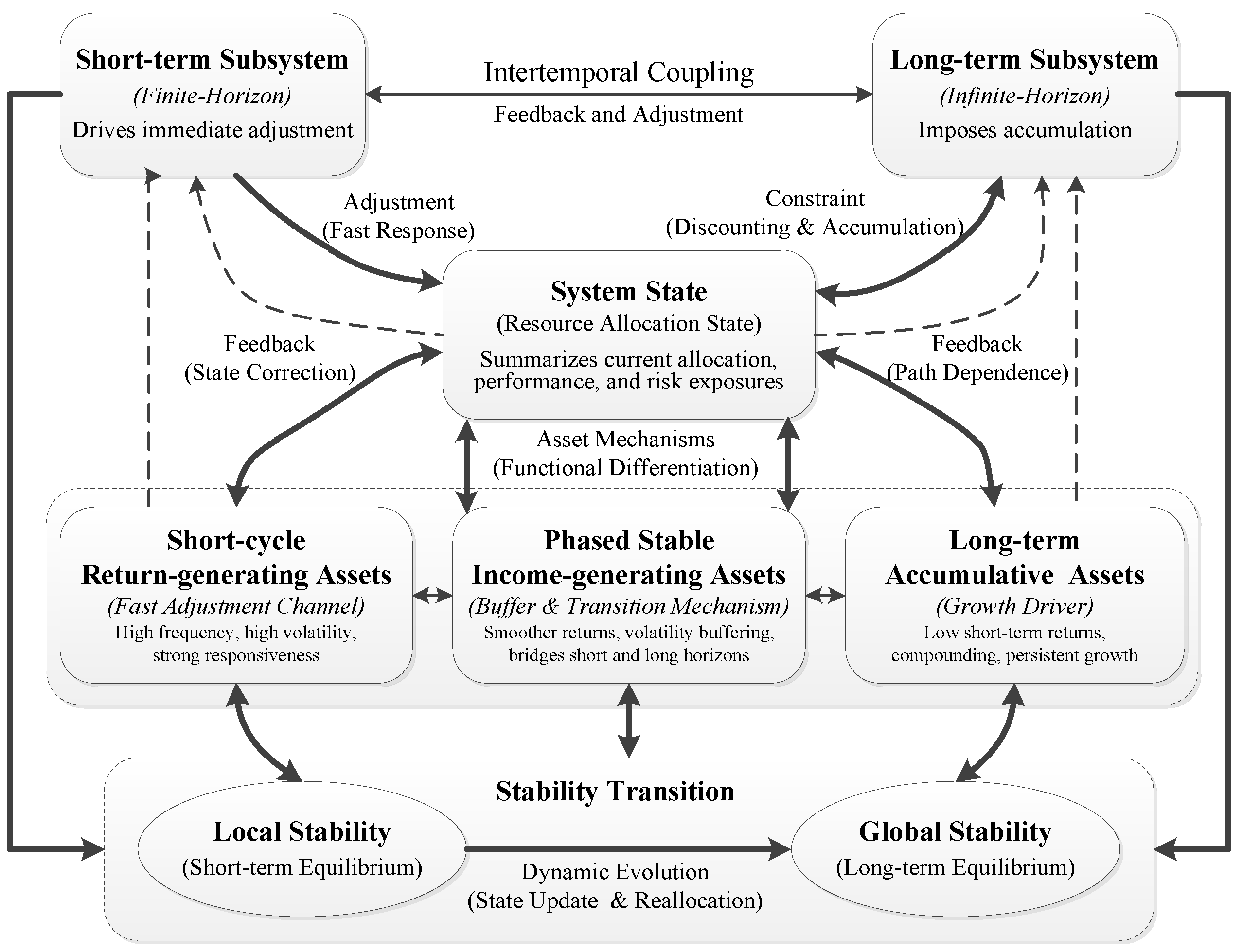
Finite-horizon and infinite-horizon subsystems are intrinsically coupled through shared resource constraints and intertemporal state transmission. Their interaction does not take the form of a simple aggregation of effects. It jointly determines the system’s evolutionary trajectory through constraint propagation and feedback across time. The finite-horizon subsystem characterizes how the system achieves local stability within a bounded interval, whereas the infinite-horizon subsystem explains how such locally stable configurations are reorganized and extended into long-term equilibrium structures. The overall evolution of the system is therefore not governed by any single component or subsystem, but by the coupling relationships that operate across different time horizons. The coupling structure underlying these cross-horizon interactions is illustrated in Figure 2.
Figure 2.
System Coupling Structure and Evolutionary Pathways.
At the component level, coupling manifests as a structured division of functional roles among the three dynamic mechanisms. Short-cycle responsive components process perturbations and generate rapid adjustments in response to external shocks or local deviations. Phase-stable components act as buffering mechanisms, constraining the propagation of high-frequency fluctuations and maintaining continuity across adjacent states. Long-term accumulative components provide directional constraints through cumulative transmission, gradually shaping the set of feasible future trajectories. The interaction among these components is not additive. Instead, it forms a progressive structural mechanism that can be summarized as disturbance absorption to fluctuation buffering, and finally to path anchoring. Through this mechanism, short-term deviations are first amplified and corrected, then moderated, and ultimately integrated into a stable long-term trajectory.
At the subsystem level, this coupling exhibits clear temporal asymmetry. Within the finite-horizon subsystem, local coordination dominates. Short-cycle and phase-stable mechanisms jointly determine the system’s short-term equilibrium, while the long-term accumulative mechanism remains only partially activated and functions as a latent path constraint. The system relies primarily on short-term responsiveness to absorb shocks and on phase-stable buffering to maintain bounded stability. As the time horizon extends, the coupling structure is gradually reorganized. The influence of accumulation mechanisms increases, the dominance of short-cycle responses weakens, and phase-stable components transition from local stabilizers to intertemporal continuity carriers. This reallocation of functional roles enables the system to move from a locally stable configuration toward a long-term equilibrium structure governed by cumulative dynamics.
The transition between the two subsystems is not instantaneous but unfolds as a dynamic reweighting process. During this process, the constraint signals evolve from , which reflects short-term marginal coordination, to , which captures intertemporal value consistency. This shift alters the basis of resource allocation from immediate marginal returns to long-term discounted contributions. As a result, system evolution follows a structured trajectory. In the initial stage, short-cycle mechanisms dominate and drive rapid adjustments. In the intermediate stage, phase-stable mechanisms suppress excessive volatility and maintain continuity. In the long-term stage, accumulative mechanisms progressively anchor the system’s trajectory and determine the direction of convergence.
Consequently, system evolution is not a static transition between two equilibrium states, but a continuous transformation shaped by intertemporal coupling. Local stability provides the foundation for short-term operability, while long-term equilibrium reflects the system’s ability to sustain coherent dynamics over time. The coupling of subsystems ensures that these two forms of stability are not independent but are linked through a unified adjustment process.
In summary, the evolution of the resource allocation system can be understood as the outcome of dynamic coupling among heterogeneous components across finite and infinite horizons. This coupling governs how local adjustments are transformed into long-term structural stability, thereby providing an integrated framework for analyzing system dynamics under multi-scale temporal constraints.
4. Numerical Simulation and Dynamic Analysis
4.1. Differentiation of Evolution Paths
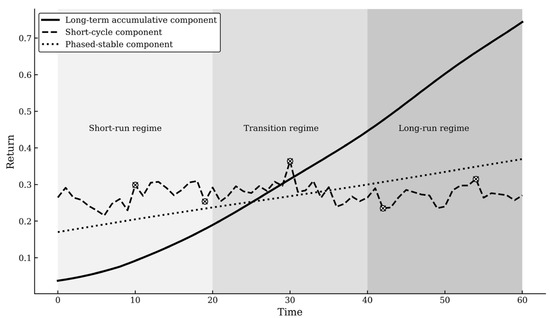
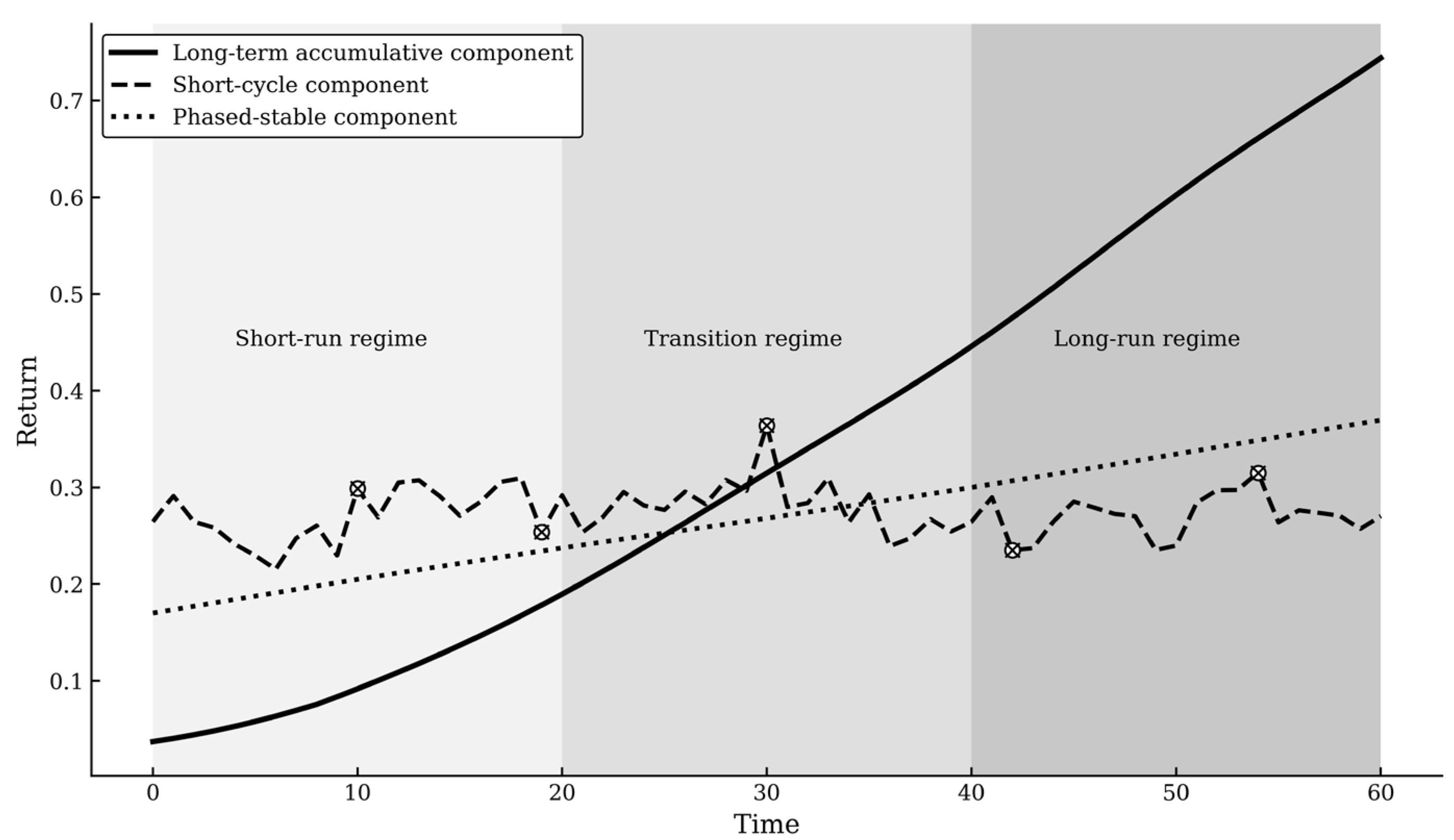
This subsection characterizes the multi-scale evolutionary dynamics resulting from the structural coupling of diverse return mechanisms in Section 3, focusing on the structural differentiation of asset classes across multiple dimensions of system dynamics. Figure 3 presents the baseline evolution trajectories of the three asset classes under a unified dynamic setting. These trajectories reflect distinct evolution logics that unfold over time.
Figure 3.
Structural differentiation of model-based return paths.
The trajectory of long-term accumulative assets reflects endogenous self-reinforcement, where current output is filtered through a time-lagged weight function, ensuring systemic inertia. Returns emerge gradually as past investments are progressively released, leading to a sustained upward path that becomes increasingly smooth over time. Although marginal effects weaken, the accumulated stock continues to support total return growth, demonstrating a low-pass filtering characteristic that isolates the strategic growth core from high-frequency stochastic noise. In contrast, short-cycle assets represent the high-entropy components of the system, characterized by instantaneous state transitions in response to environmental shocks. Their trajectory fluctuates around a stable level, with frequent adjustments and occasional jumps driven by stochastic disturbances. This results in a highly responsive but unstable path, where returns are realized quickly but lack persistence over time. Phased stable-return assets follow a continuity-driven evolution path characterized by steady and low-volatility progression. Their trajectory evolves smoothly without pronounced fluctuations or abrupt changes, reflecting a stable return generation process that neither amplifies past accumulation nor reacts strongly to short-term shocks.
These hierarchies confirm that the system exhibits emergent properties that cannot be captured by linear aggregation in Section 3. These trajectories represent fundamentally different evolution logics—cumulative growth, shock-responsive adjustment, and smooth progression—which cannot be reduced to a single aggregated measure. The structural differences embedded in their dynamic paths highlight that asset classification is necessary to preserve intertemporal heterogeneity. As a result, asset classes cannot be treated as homogeneous components or aggregated into a single measure without obscuring their structural differences. Any static aggregation would eliminate the intertemporal heterogeneity embedded in their evolution paths, leading to a loss of essential system-level information.
4.2. System Coupling and Interactive Dynamics
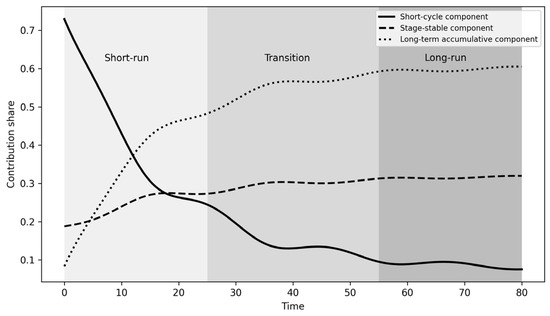
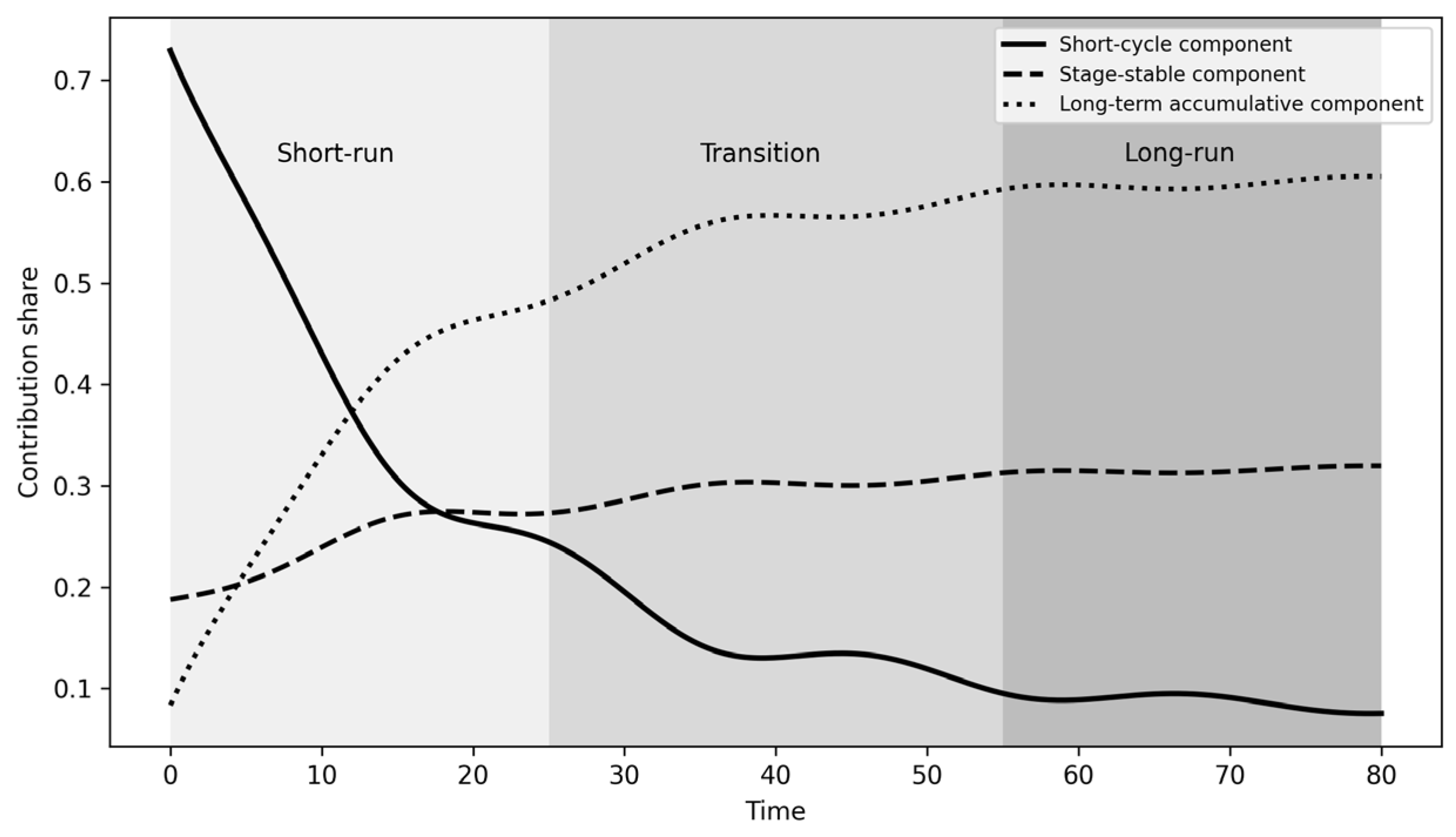
While Section 4.1 establishes the structural heterogeneity of individual evolution paths, this subsection investigates how these heterogeneous components are synthesized into a functional whole through inter-scale coupling. The focus is shifted from individual trajectories to the regulatory feedback loops that maintain systemic coherence across different temporal scales, rather than simple functional coexistence. Figure 4 decomposes the system response into three fundamental components, corresponding to the contributions of the three asset classes. In the early stage, the system response is primarily driven by short-cycle assets, whose high-frequency adjustments enable rapid responses to external shocks. As time progresses, the contribution of phased-stable assets increases, providing a buffering effect that smooths fluctuations and stabilizes the adjustment process. In the long run, the contribution of accumulative assets becomes dominant, reflecting the increasing importance of persistent return generation and intertemporal accumulation.
Figure 4.
Muti-scale contribution dynamics.
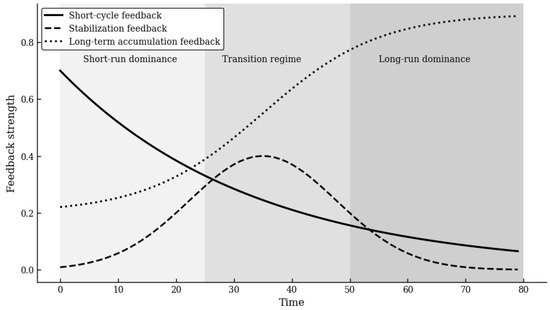
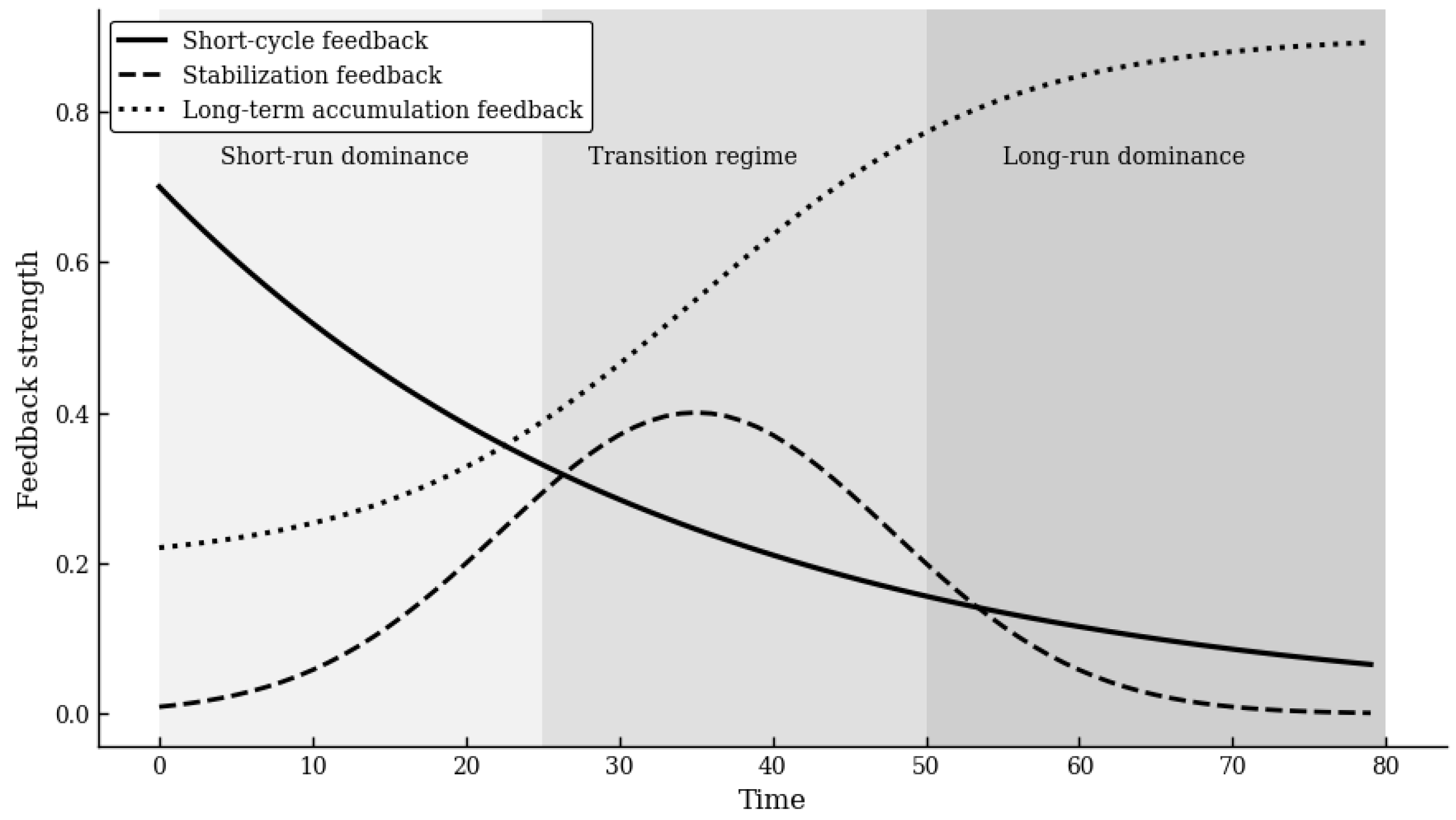
The evolution of the system is governed by the interaction of heterogeneous return-generating mechanisms rather than by any single asset class. Specifically, the short-cycle, phased-stable, and long-term accumulative assets jointly determine system behavior through a set of interdependent feedback loops. These loops operate at different temporal scales and collectively shape the dynamic adjustment process of resource allocation. Figure 5 illustrates the emergent synergy under this coupled architecture. At the initial stage, the system’s state is dominated by the volatility of . As the simulation progresses, the cumulative feedback effect of becomes more pronounced, moderating fluctuations and facilitating smoother adjustments. Over time, accumulation effects become more pronounced, leading to a gradual shift in the system’s dominant mechanism. The observed dynamics indicate that system evolution is not driven by any single component, but emerges from continuous interaction among heterogeneous mechanisms. Short-cycle assets provide adaptability, stable assets ensure continuity, and long-term assets drive structural transformation. These coupled dynamics define the system trajectory prior to any equilibrium realization.
Figure 5.
Evolution of feedback dominance across muti-scale loops.
The coupled system is governed by the interaction of three feedback loops: a volatility-amplifying loop driven by short-cycle dynamics, a stabilizing loop induced by phased assets, and a persistence-based accumulation loop associated with long-term investment. The system trajectory emerges from the dynamic balance among these loops, where no single mechanism dominates in isolation, but each contributes to shaping the path of state evolution. This interaction implies that system dynamics should be understood as a state-dependent evolutionary process rather than a static adjustment. The evolution of allocation shares in Figure 2 reflects the continuous reconfiguration of feedback dominance, which precedes any equilibrium outcome and defines the system’s dynamic structure.
The underlying mechanism driving this structural evolution is further illustrated in Figure 5, which depicts the evolution of feedback dominance over time. Initially, the system is dominated by a volatility-driven feedback loop associated with short-cycle assets. This loop amplifies short-term responsiveness but also introduces instability. As the system evolves, the stabilization loop associated with phased-stable assets becomes more prominent, mitigating excessive fluctuations. Eventually, the accumulation-driven feedback loop dominates, anchoring the system dynamics through persistent growth effects and intertemporal reinforcement.
The interaction among these feedback loops does not simply stabilize the system but fundamentally reshapes its structural configuration. In particular, the relative dominance among volatility-driven, stabilization, and accumulation mechanisms evolves endogenously over time. This evolving dominance implies that the system does not remain in a fixed configuration, but gradually transitions across different dynamic regimes.
4.3. Intertemporal Equilibrium Structure and Transition Dynamics
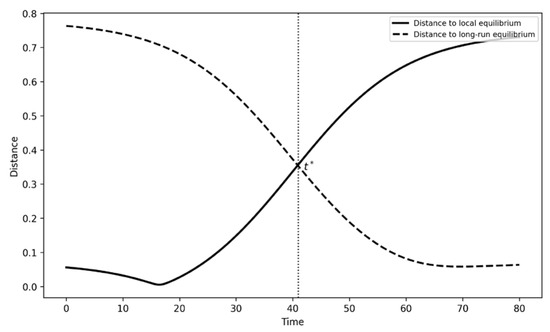
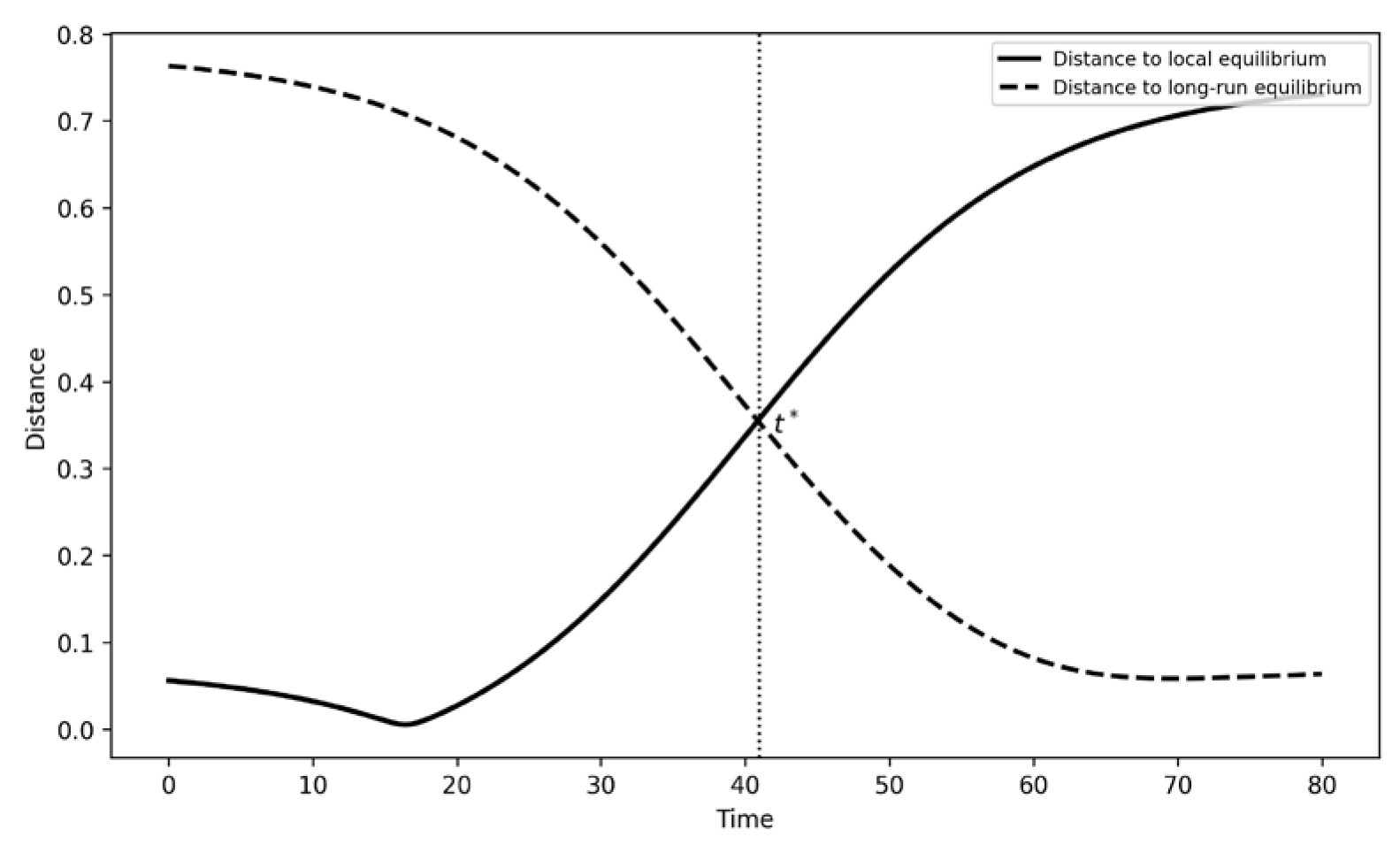
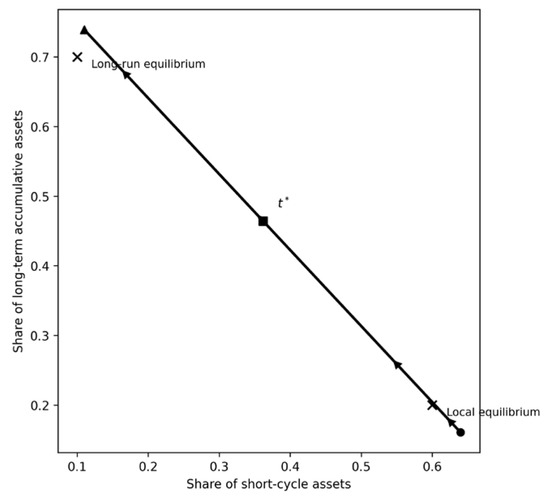
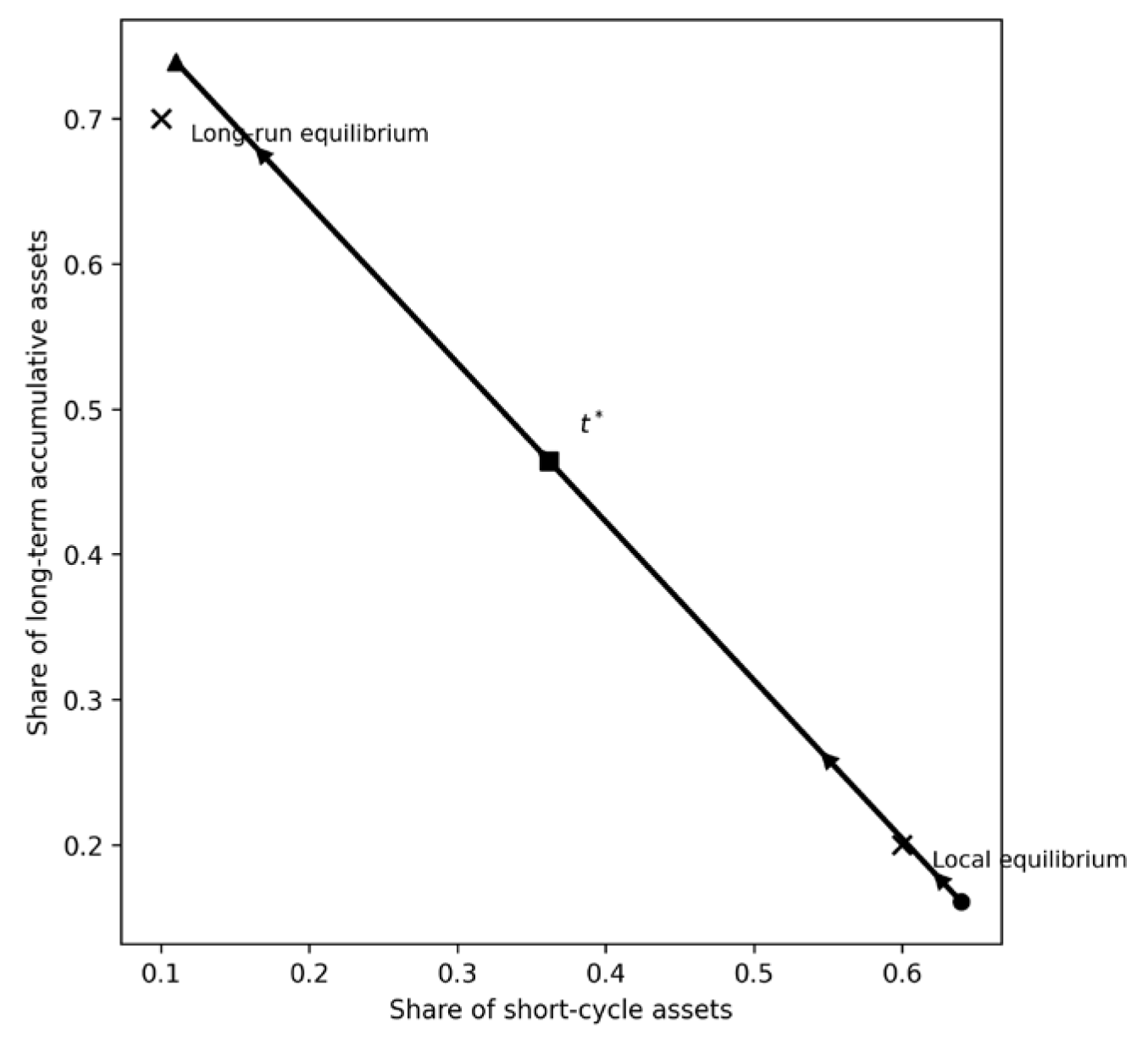
The coupled system described in Section 4.2 does not converge to a single static configuration, but instead exhibits a multi-layered equilibrium structure as shown in Figure 6 and Figure 7. Specifically, two distinct equilibrium states emerge endogenously: a short-run local equilibrium dominated by high-frequency adjustment mechanisms, and a long-run structural equilibrium driven by accumulation dynamics. The transition between these equilibria is not imposed externally, but arises from the internal evolution of state variables and feedback interactions.
Figure 6.
Evolutionary transition between local and long-run equilibria.
Figure 7.
Phase diagram of equilibrium transition.
In the early stage, the system operates near a local equilibrium characterized by the dominance of short-cycle assets. This is reflected in Figure 6 by the small distance to the local equilibrium. In this regime, system stability is maintained through continuous short-term adjustments rather than through persistent structural forces. As the influence of accumulation mechanisms increases, the system undergoes a structural transition. The point t* represents the crossover at which the system becomes closer to the long-run equilibrium than to the local equilibrium, reflecting the progressive increase in the influence of accumulation mechanisms relative to short-cycle adjustment mechanisms. It indicates a gradual shift in equilibrium dominance from short-cycle responsiveness toward long-term accumulation rather than a fixed analytical threshold. Consistent with the coupling mechanism development in Section 3.4, the relative influence of heterogeneous components is continuously reweighted over time. Consequently, the system does not move abruptly between two equilibrium states. Instead, the transition emerges gradually as long-term accumulation gains prominence over short-cycle responsiveness. Figure 6 visualizes this evolutionary crossover process.
An important feature of this transition is its partial irreversibility. Once the system crosses the threshold t*, short-term disturbances are no longer sufficient to revert the system to its initial state. This reflects the path-dependent nature of accumulation processes, which anchor the system dynamics in the long-run equilibrium regime.
Overall, the system’s evolution is governed by the dynamic transition between equilibrium regimes driven by interacting feedback mechanisms. This provides a structural explanation for intertemporal allocation dynamics and highlights the importance of considering asset heterogeneity within a system-level framework.
4.4. Sensitivity Analysis of Control Parameters
To further uncover the structural drivers behind the transition dynamics identified in Section 4.2 and Section 4.3, this subsection investigates how key control parameters reshape both the speed of system transition and the configuration of equilibrium regimes. The analysis emphasizes how parameter variations alter the system’s dynamic trajectory and structural positioning within the state space.
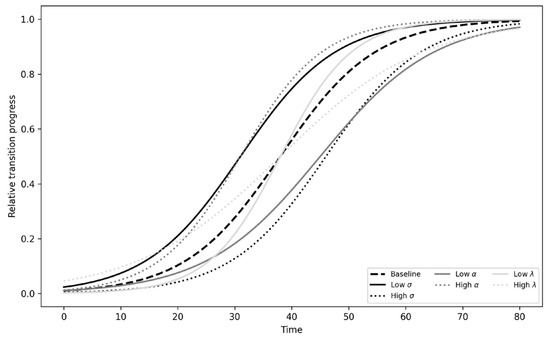
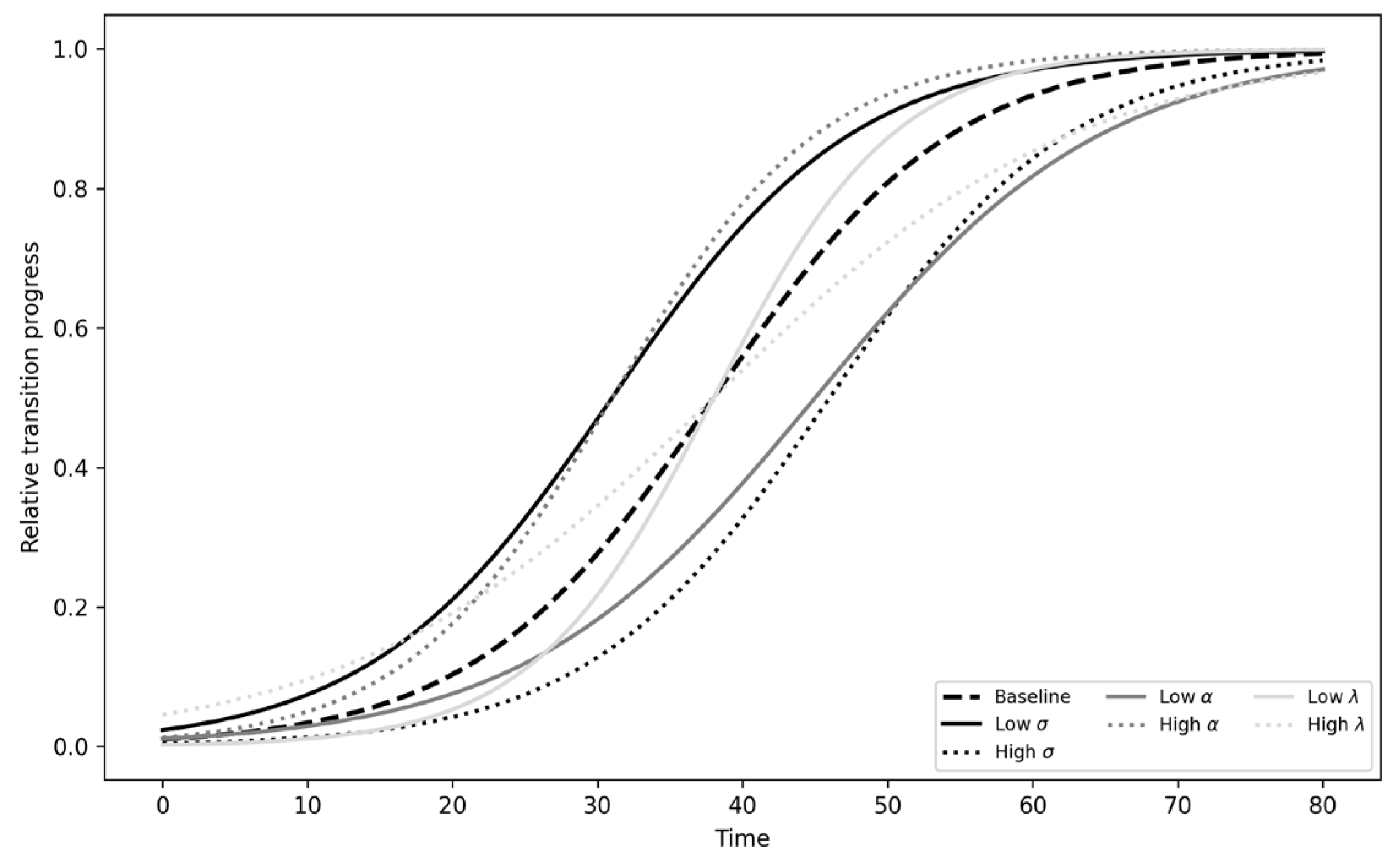
Figure 8 illustrates the sensitivity of the system’s transition path under variations in three key parameters: volatility intensity , accumulation efficiency , and constraint strength . These parameters correspond to the core mechanisms established in Section 3, governing respectively the short-cycle fluctuation amplitude, the persistence of intertemporal accumulation, and the degree of resource allocation rigidity. For illustration purposes, the benchmark parameter configuration is set as = 38, = 0.12, and = 0.12. These values are selected to generate a representative equilibrium-transition trajectory and are used as baseline settings for qualitative sensitivity analysis, which is performed by varying one parameter around its benchmark value while holding the remaining parameters constant, thereby isolating the individual influence of each mechanism on the system’s transition dynamics. Since Figure 8 is intended to illustrate the qualitative influence of parameter variations on equilibrium-transition dynamics rather than provide empirical estimation, these benchmark values serve as reference settings that generate a stable and representative transition trajectory, allowing the comparative effects of individual parameter changes to be clearly observed.
Figure 8.
Sensitivity of equilibrium transition to key parameters.
A clear structural pattern emerges. An increase in volatility amplifies high-frequency fluctuations and prolongs the dominance of the short-cycle component. As a result, the system exhibits delayed convergence toward the long-run equilibrium, reflecting a persistence of local exploratory dynamics. In contrast, higher accumulation efficiency strengthens the intertemporal propagation of returns, accelerating the shift toward accumulation-driven dominance and compressing the transition window. The constraint parameter plays a qualitatively different role. Rather than directly altering the direction of the transition, it regulates the smoothness and stability of the adjustment process. Stronger constraints dampen abrupt reallocations, producing a more gradual and continuous convergence path. This indicates that constraints function as a dynamic stabilizer, ensuring that the system evolves within a feasible trajectory without excessive oscillations.
Figure 8 examines how variations in key parameters reshape the transition dynamics. Increased volatility prolongs the dominance of short-cycle mechanisms by amplifying high-frequency fluctuations, thereby delaying the onset of structural transition. In contrast, higher accumulation efficiency accelerates convergence toward the long-run equilibrium by strengthening the persistence of intertemporal gains. The constraint parameter primarily affects the smoothness of the transition, with stronger constraints dampening abrupt adjustments.
Taken together, these results confirm that the transition from local to long-run equilibrium is not fixed, but endogenously modulated by the interplay of volatility, accumulation, and constraints, consistent with the multi-mechanism framework derived in Section 3.
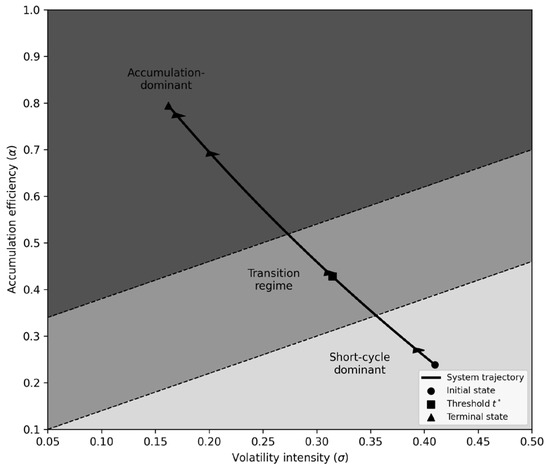
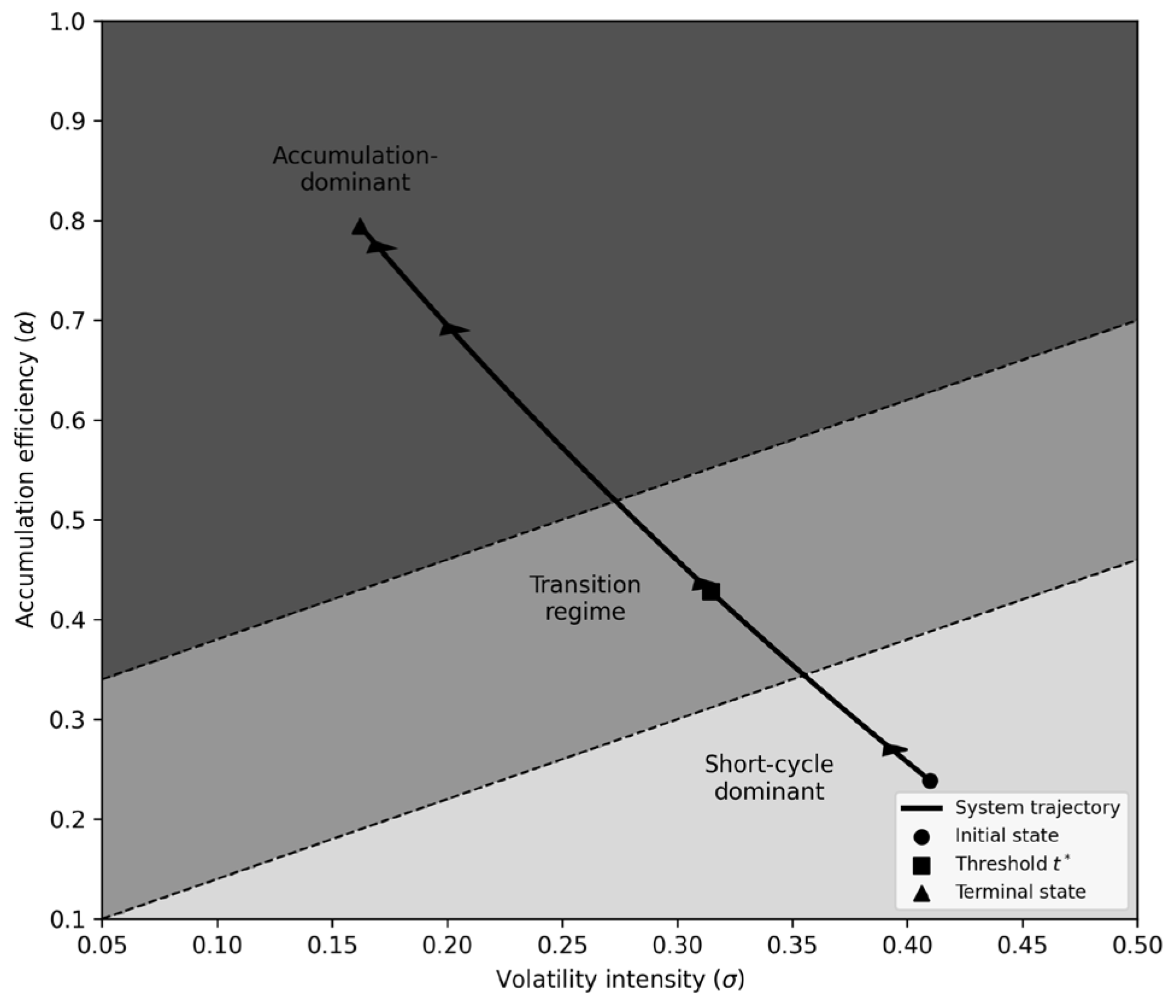
Figure 9 extends the analysis by mapping the parameter space into distinct structural regimes. Instead of examining parameter effects along a single trajectory, this representation reveals how different combinations of parameters give rise to qualitatively different system behaviors.
Figure 9.
Regime map with transition trajectory.
Three primary regimes can be identified. In regions characterized by high volatility and low accumulation efficiency, the system remains trapped in a short-cycle-dominated configuration, where fluctuations persist and long-run convergence is weak. Conversely, regions with high accumulation efficiency and moderate constraints are associated with stable convergence toward the long-run equilibrium, where accumulation becomes the dominant driver of system dynamics.
Between these two extremes lies a transition regime, where neither short-cycle fluctuations nor long-term accumulation fully dominate. In this region, the system exhibits hybrid behavior, with alternating influence across mechanisms. Importantly, the baseline trajectory illustrated in Figure 5 traverses this intermediate region before reaching the accumulation-dominated regime, indicating that equilibrium is achieved through a structured path across multiple regimes, rather than through a direct adjustment.
This regime-based perspective highlights a key implication: the system’s equilibrium outcome is not solely determined by initial conditions or isolated parameter values, but by its relative position within the parameter space. As a result, small parameter shifts near regime boundaries can lead to disproportionately large changes in system behavior, underscoring the importance of structural classification.
5. Conclusions
This paper investigates the dynamic behavior of a multi-component decision-making system composed of multiple heterogeneous mechanisms. Rather than treating the system as a single aggregate, this study characterizes it as a structural whole comprising multiple subsystems with distinct dynamic properties and response characteristics.
The research indicates that this decision-making system exhibits significant multi-timescale structural differentiation. Different subsystems dominate system behavior at different stages. Short-period mechanisms provide high-frequency perturbations and expand the system’s state space; intermediate mechanisms play a stabilizing and regulating role during transitional phases; while long-term mechanisms constrain the system’s trajectory through their persistent effects. This division of labor is not exogenously imposed but is endogenously formed through the interaction of internal system mechanisms.
The system’s evolution manifests as a gradual transition from short-period responses to a state dominated by cumulative mechanisms. System trajectories are jointly determined by the interactions of multiple feedback structures. As evidenced by the reciprocal feedback between different subsystems, system evolution does not simply converge to a single equilibrium but manifests as a cross-equilibrium structural transition process characterized by continuous structural reconfiguration. The transition from local equilibrium to long-term equilibrium is, in essence, a process of structural reconfiguration driven by internal feedback mechanisms. This transition exhibits path dependence and requires passing through a transitional phase where multiple mechanisms act in concert.
Further analysis indicates that system behavior depends on its structural position within the parameter space rather than on the value of a single parameter. The partitioning of the parameter space reveals that different regions correspond to different types of system dynamics, and movement across regions may lead to discontinuous changes in system behavior. This suggests that system outcomes exhibit significant structural dependence. From a system control perspective, this implies that system optimization cannot rely on static optimization criteria but must instead involve a comprehensive assessment that integrates the system’s dynamic evolution path with its structural configuration. Ignoring the system’s multiscale characteristics or structural interval differences may lead to system instability or control failure.
The contribution of this paper lies in integrating heterogeneous dynamic mechanisms, feedback-dominated structures, and parameter interval partitioning into a unified analytical framework, thereby providing a new analytical approach for the study of multi-mechanism coupled systems. Future research could further incorporate adaptive mechanisms, stochastic perturbations, and higher-dimensional state interaction structures to expand the applicability of this framework in the analysis of complex systems. Simultaneously, the primary objective of this study is to establish a theoretical framework for identifying structural heterogeneity, moderate allocation intervals, and the dynamic transition mechanisms between local and long-run equilibria within a multi-horizon resource allocation system. To achieve this objective, numerical simulations are employed as a complementary tool to illustrate and verify the internal consistency, feasibility, and dynamic implications of the proposed theoretical model. Future research may extend the proposed framework to empirical settings and examine how the identified equilibrium structures, transition dynamics, and moderate allocation intervals manifest in actual resource allocation practices. Such efforts would further enrich the practical applicability and empirical relevance of the framework.
Author Contributions
Conceptualization: P.Y. and Y.T.; methodology: P.Y. and Y.T.; formal analysis: P.Y. and Y.T.; investigation: Y.T.; data curation: P.Y. and Y.T.; software: Y.T.; validation: P.Y.; resources: P.Y.; visualization: Y.T.; writing—original draft: Y.T.; writing—review and editing: P.Y.; supervision: P.Y.; project administration: P.Y.; funding acquisition: P.Y. All authors have read and agreed to the published version of the manuscript.
Funding
This research received no external funding.
Institutional Review Board Statement
Not applicable.
Informed Consent Statement
Not applicable.
Data Availability Statement
The original contributions presented in this study are included in the article. All numerical results were generated from the theoretical model and parameter settings describe in the manuscript. Further inquiries can be directed to the corresponding author.
Acknowledgments
The authors would like to thank the anonymous reviewers for their valuable comments and suggestions, which helped improve the quality and clarify of this manuscript. AI-based language tools were used solely for language editing and grammar improvement during manuscript preparation in order to enhance the clarity and readability of the text. The authors have reviewed and edited the output and take full responsibility for the content of this publication.
Conflicts of Interest
The authors declare no conflicts of interest.
References
- Liao, S.; Nolte, I.; Pawlina, G. Can capital adjustment costs explain the decline in investment–cash flow sensitivity? J. Financ. Quant. Anal. 2024, 59, 2399–2424. [Google Scholar]
- Khamse, J.; Lambadaris, I.; Kesidis, G.; Urgaonkar, B.; Zhao, Y. An efficient and fair multi-resource allocation mechanism for heterogeneous servers. IEEE Trans. Parallel Distrib. Syst. 2018, 29, 2686–2699. [Google Scholar] [CrossRef] [Scilit]
- Helfat, C.E.; Maritan, C.A. Resource allocation capability and routines in multibusiness firms. Organ. Sci. 2024, 35, 1110–1130. [Google Scholar] [CrossRef] [Scilit]
- Wang, Y.; Lyu, M.; Sun, B. Emergency resource allocation considering the heterogeneity of affected areas during the COVID-19 pandemic in China. Humanit. Soc. Sci. Commun. 2024, 11, 225. [Google Scholar] [CrossRef] [Scilit]
- Pufahl, L.; Stiehle, F.; Ihde, S.; Weske, M.; Weber, I. Resource allocation in business process executions—A systematic literature study. Inf. Syst. 2025, 132, 102541. [Google Scholar] [CrossRef] [Scilit]
- Sibony, O.; Lovallo, D.; Powell, T.C. Behavioral strategy and the strategic decision architecture of the firm. Calif. Manag. Rev. 2017, 59, 5–21. [Google Scholar] [CrossRef] [Scilit]
- Chen, S.; Sun, Z.; Tang, S.; Wu, D. Government intervention and investment efficiency: Evidence from China. J. Corp. Financ. 2011, 17, 259–271. [Google Scholar] [CrossRef] [Scilit]
- Beil, D.; Duenyas, I.; Leider, S.; Li, J.; Qi, A. Human decision making in dynamic resource allocation. Manag. Sci. 2026, 72, 4569–5489. [Google Scholar] [CrossRef] [Scilit]
- Li, H.; Shen, Q.; Bart, Y. Dynamic resource allocation on multi-category two-sided platforms. Manag. Sci. 2021, 67, 984–1003. [Google Scholar]
- Besbes, O.; Kanoria, Y.; Kumar, A. Dynamic resource allocation: Algorithmic design principles and spectrum of achievable performances. Oper. Res. 2025, 73, 1273–1288. [Google Scholar] [CrossRef] [Scilit]
- Vera, A.; Arlotto, A.; Gurvich, I.; Levin, E. Dynamic resource allocation: The geometry and robustness of constant regret. Math. Oper. Res. 2025, 50, 2834–2872. [Google Scholar] [CrossRef] [Scilit]
- Gnewuch, M.; Zhang, D. Monetary policy, firm heterogeneity, and the distribution of investment rates. J. Monet. Econ. 2025, 149, 103721. [Google Scholar] [CrossRef] [Scilit]
- Chen, X.; Shen, A. Smart decision framework for financial planning and investment optimization. Sci. Rep. 2026, 16, 13089. [Google Scholar] [CrossRef] [Scilit] [PubMed]
- Cristofaro, M.; Hristov, I.; Cimini, R.; Lovallo, D. From start to stardom: The impact of resource allocation strategies on new venture survival and growth. Long Range Plan. 2025, 58, 102513. [Google Scholar] [CrossRef] [Scilit]
- Islam, M.N.; Bepari, M.K.; Nahar, S. Asset liquidity and trade credit: International evidence. Int. Trade J. 2022, 36, 24–42. [Google Scholar] [CrossRef] [Scilit]
- Arteta, C.; Carey, M.; Correa, R.; Kotter, J. Revenge of the steamroller: ABCP as a window on risk choices. Rev. Financ. 2020, 24, 497–528. [Google Scholar]
- Sun, Y.; Zhang, X.; Dong, Z. The impact of top management team heterogeneity and financial misallocation on corporate resource allocation efficiency. Int. Rev. Econ. Financ. 2025, 103, 104549. [Google Scholar] [CrossRef] [Scilit]
- Liu, Y. Financial Heterogeneity, Investment, and Firm Interactions; International Monetary Fund: Washington, DC, USA, 2023; pp. 1–4. [Google Scholar]
- Liu, H.; Wei, J.; Li, J. Research on the impact of diversity in financial ecosystems on new energy systems. Sci. Rep. 2026, 16, 13536. [Google Scholar] [CrossRef] [Scilit] [PubMed]
- Szabo, M. Cyclical investment behavior of investment funds: Its heterogeneity and drivers. Macroecon. Financ. Emerg. Mark. Econ. 2026, 19, 369–390. [Google Scholar]
- Akguc, S.; Choi, J.J. Time horizon and corporate investment: Evidence from private and public firms around the world. Res. Int. Bus. Financ. 2025, 73, 102577. [Google Scholar] [CrossRef] [Scilit]
- Zhang, H.; Aumeboonsuke, V. Technological innovation, risk-taking and firm performance—Empirical evidence from Chinese listed companies. Sustainability 2022, 14, 14688. [Google Scholar] [CrossRef] [Scilit]
- Maghsoudi, M.; Nezafati, N. Navigating the acceptance of implementing business intelligence in organizations: A system dynamics approach. Telemat. Inform. Rep. 2023, 11, 100070. [Google Scholar] [CrossRef] [Scilit]
- Monschang, V.; Trede, M.; Wilfling, B. Multi-horizon uniform superior predictive ability revisited. J. Bus. Econ. Stat. 2026. [Google Scholar] [CrossRef] [Scilit]
- Rösch, D.M.; Subrahmanyam, A.; Dijk, M. Investor short-termism and real investment. J. Financ. Mark. 2022, 59, 100645. [Google Scholar] [CrossRef] [Scilit]
- Gupta, R.; Ma, W. Investment adjustment costs and growth dynamics. Econ. Lett. 2025, 257, 112726. [Google Scholar] [CrossRef] [Scilit]
- Xu, K.; Zhong, Y. Information and memory in dynamic resource allocation. Oper. Res. 2020, 68, 1698–1715. [Google Scholar] [CrossRef] [Scilit]
- Ladika, T.; Sautner, Z. Managerial short-termism and investment: Evidence from accelerated option vesting. Rev. Financ. 2020, 24, 305–344. [Google Scholar]
- Wiersema, M.; Koo, H.; Chen, W.; Zhang, Y. Corporate short-termism: A review and research agenda. J. Manag. 2025, 51, 2389–2418. [Google Scholar] [CrossRef] [Scilit]
- Xie, X.; Gurvich, I.; Küçükyavuz, S. Dynamic allocation of reusable resources: Logarithmic regret in overloaded networks. Oper. Res. 2025, 73, 2097–2124. [Google Scholar] [CrossRef] [Scilit]
- Zhao, J.; Xi, X.; Wang, S.; Gong, C. Dynamic analysis of different resource allocations: Implications for resource orchestration management of strategic alliances. Comput. Ind. Eng. 2021, 158, 107393. [Google Scholar] [CrossRef] [Scilit]
- Chen, Q.; Heydari, B. Dynamic resource allocation in systems-of-systems using a heuristic-based interpretable deep reinforcement learning. J. Mech. Des. 2022, 144, 091711. [Google Scholar]
Disclaimer/Publisher’s Note: The statements, opinions and data contained in all publications are solely those of the individual author(s) and contributor(s) and not of MDPI and/or the editor(s). MDPI and/or the editor(s) disclaim responsibility for any injury to people or property resulting from any ideas, methods, instructions or products referred to in the content. |
© 2026 by the authors. Licensee MDPI, Basel, Switzerland. This article is an open access article distributed under the terms and conditions of the Creative Commons Attribution (CC BY) license.