Co-Evolutionary Dynamics of Mission-Oriented Innovation Consortia and Future Industries


Abstract
1. Introduction
2. Literature Review and Theoretical Framework
2.1. Conceptual Definition and Review of Related Studies
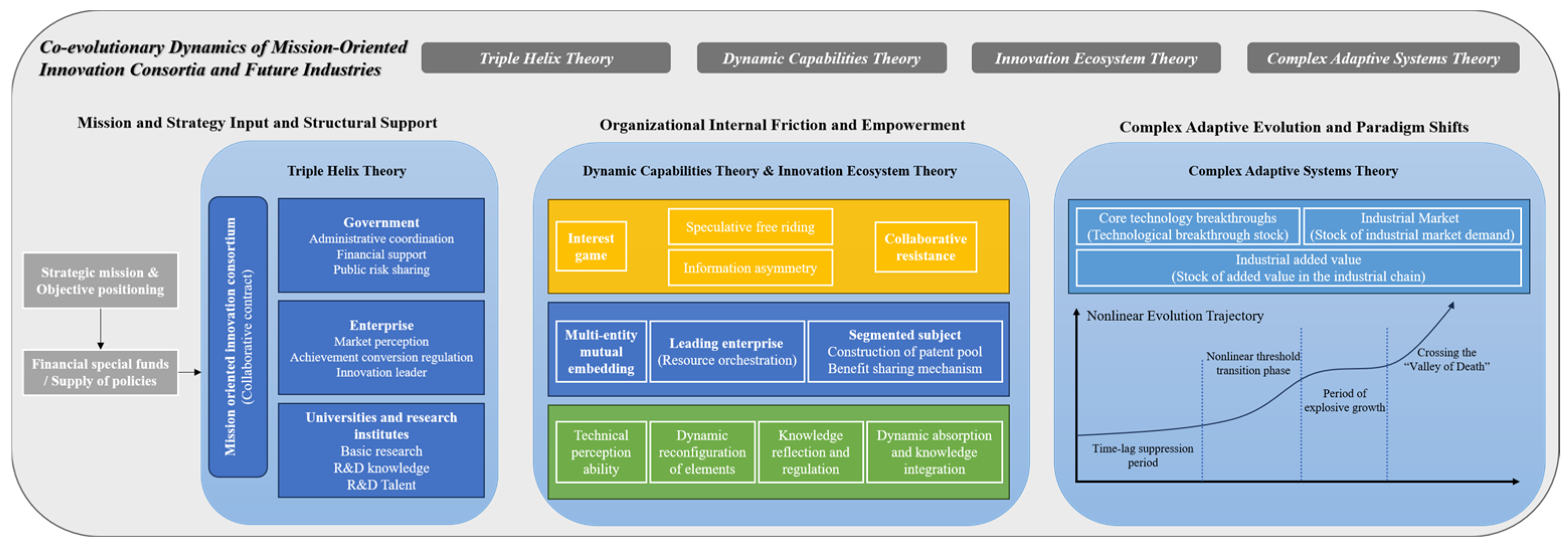
2.2. Integrated Multi-Theoretical Framework
2.2.1. Triple Helix Theory
2.2.2. Dynamic Capabilities Theory
2.2.3. Innovation Ecosystem Theory
2.2.4. Complex Adaptive Systems Theory
3. System Dynamics Model Construction
3.1. System Boundaries and Basic Assumptions
3.2. Causal Relationship Construction
- (1)
- Strategic Mission–Technology Breakthrough Loop (R1)
- (2)
- Value Co-creation–Enterprise Innovation Loop (R2)
- (3)
- Knowledge Transfer–Collaborative Innovation Loop (R3)
- (4)
- Standardization–Industrial Upgrading Loop (R4)
- (5)
- Technology Adaptation–Market Expansion Loop (R5)
- (6)
- Internal Friction Loop (B1)
- (7)
- Adaptive Resilience–Shock Mitigation Loop (B2)
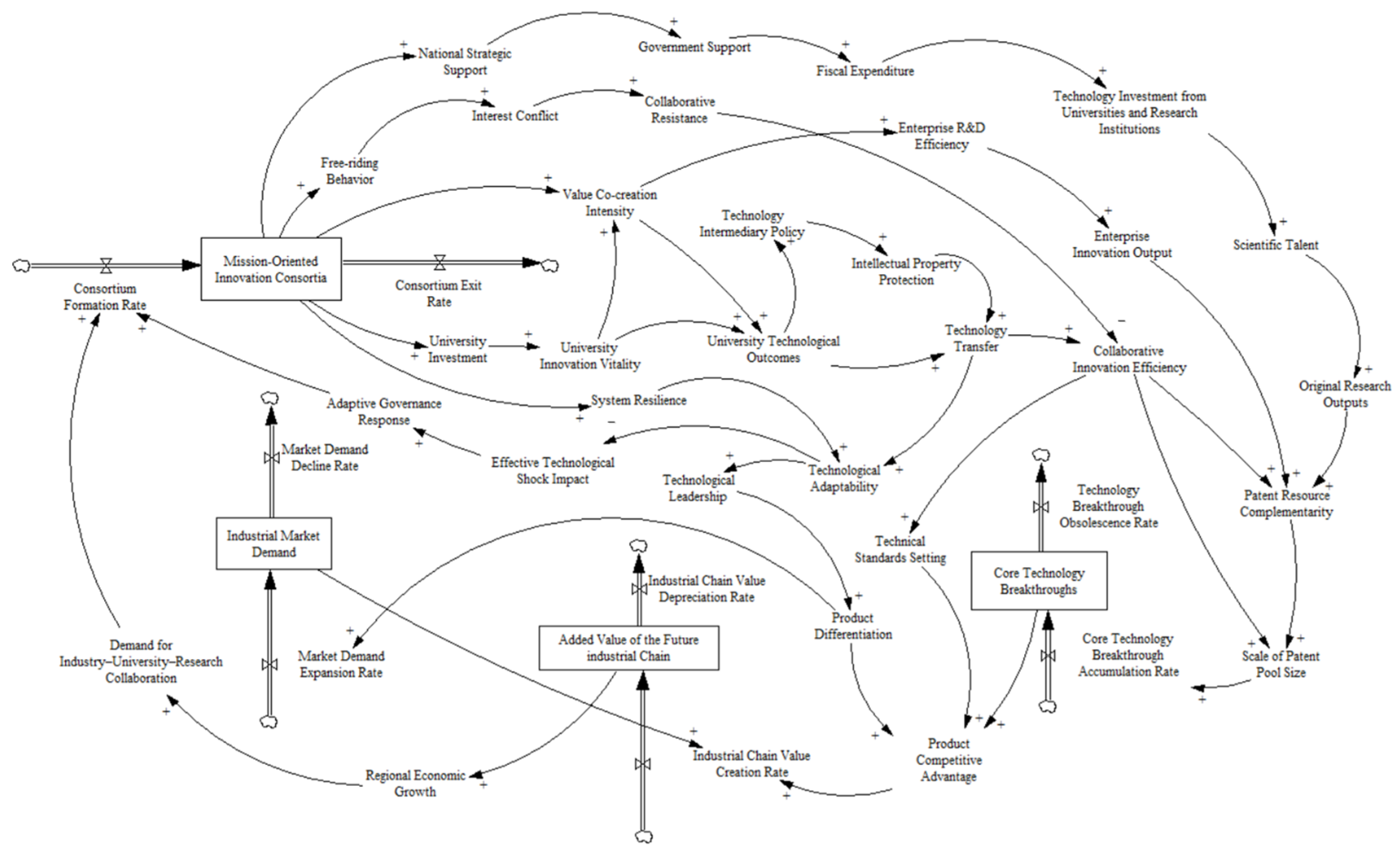
3.3. Visualization of the Stock-Flow Diagram
3.4. Multi-Source Parameter Identification
4. Simulation and Analysis
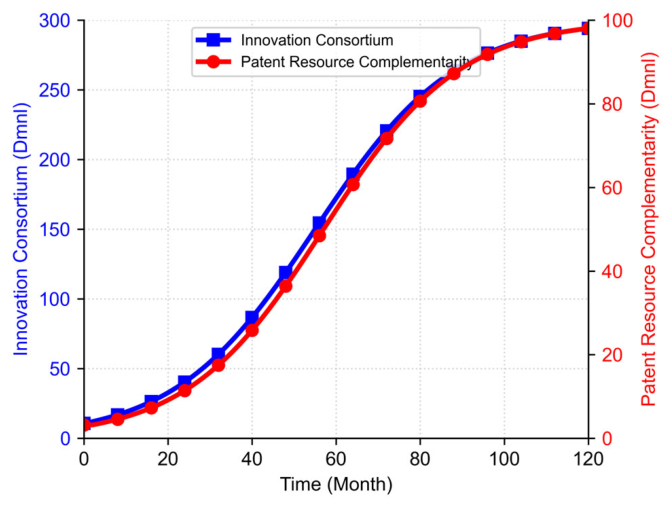
4.1. Baseline Analysis: Macro-Level Effects of Innovation Consortia in Empowering Future Industry Development
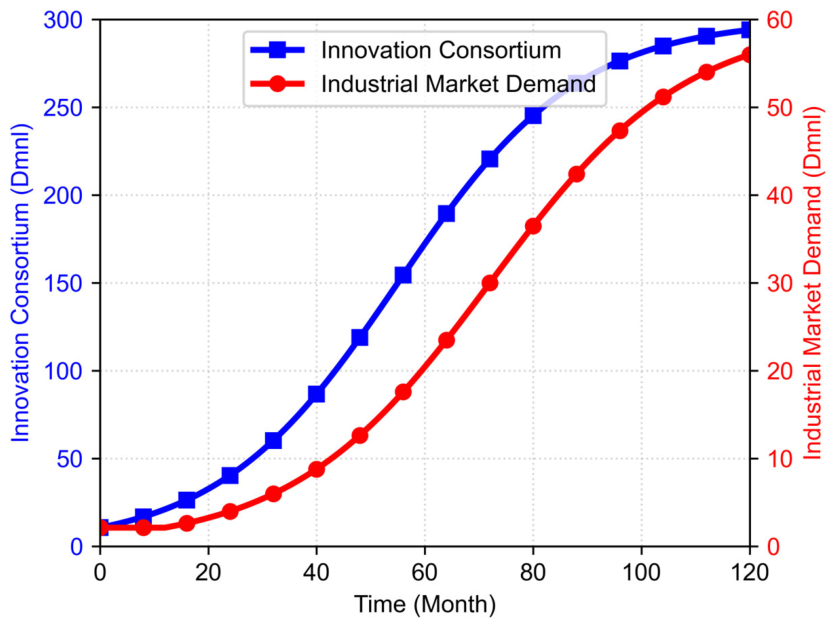
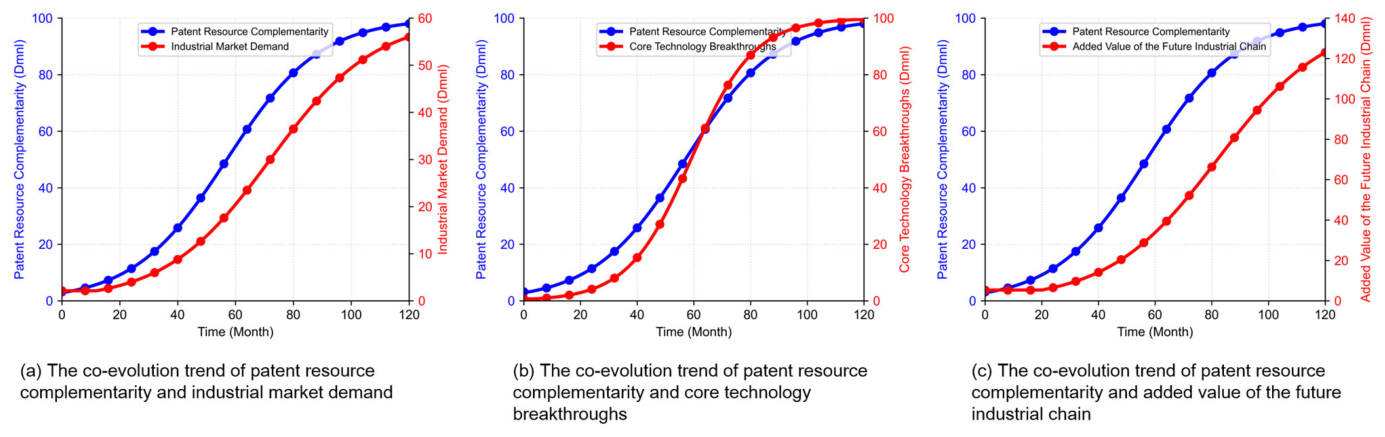
4.1.1. Innovation Consortia and Industrial Market Demand in Future Industries
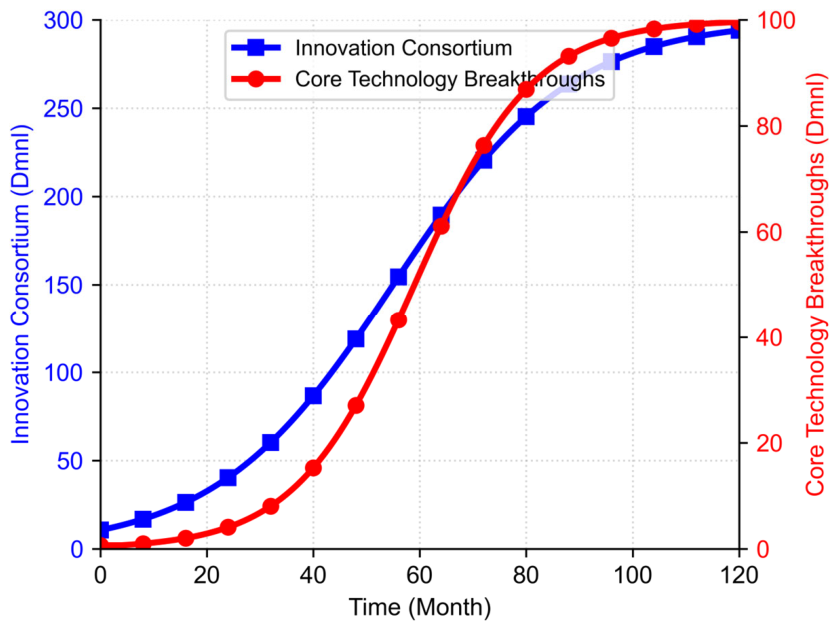
4.1.2. Innovation Consortia and Core Technology Breakthroughs
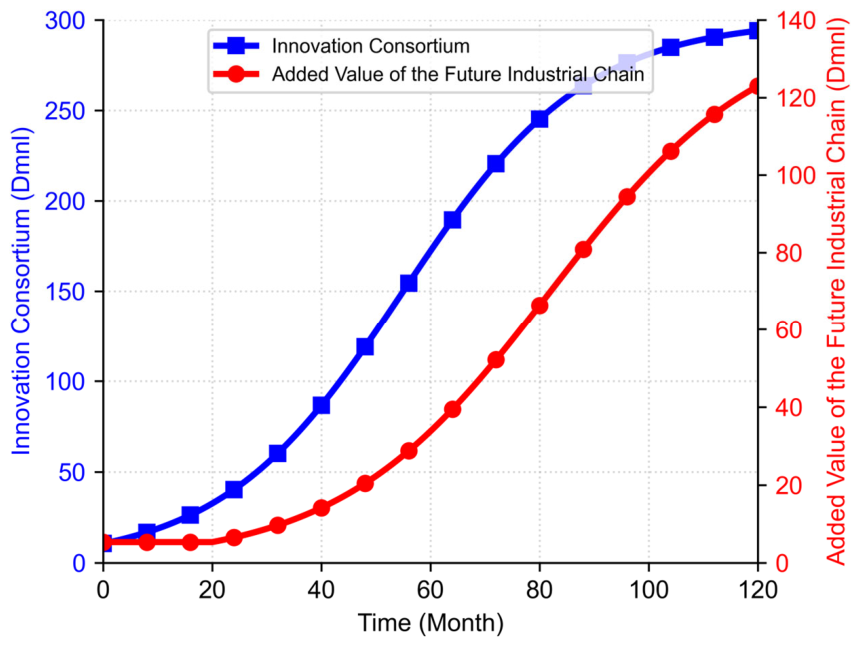
4.1.3. Innovation Consortia and Added Value of the Future Industrial Chain
4.2. Mechanism Analysis: Mechanisms Through Which Innovation Consortia Empower Future Industry Development
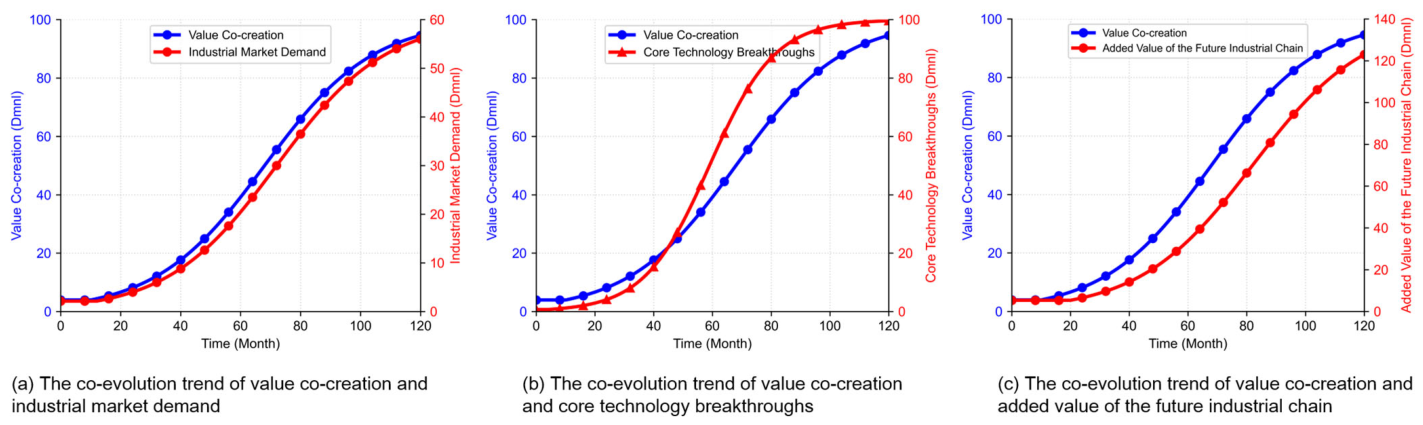
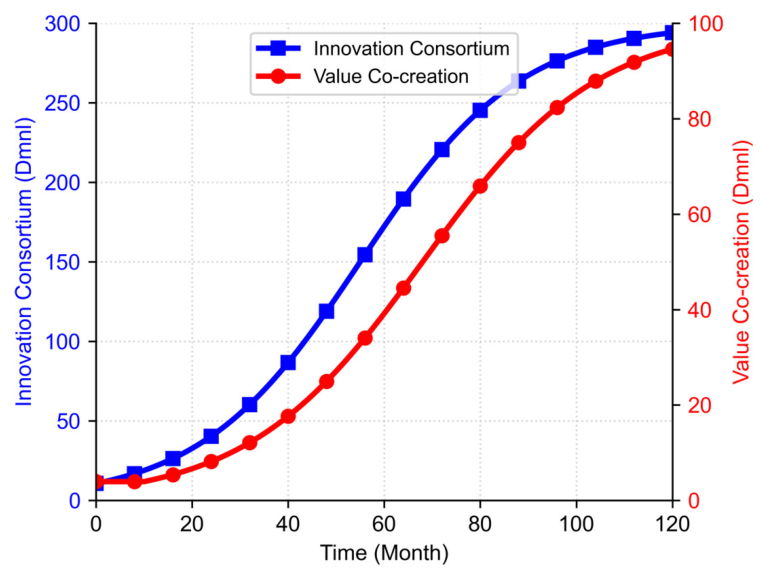
4.2.1. Value Co-Creation
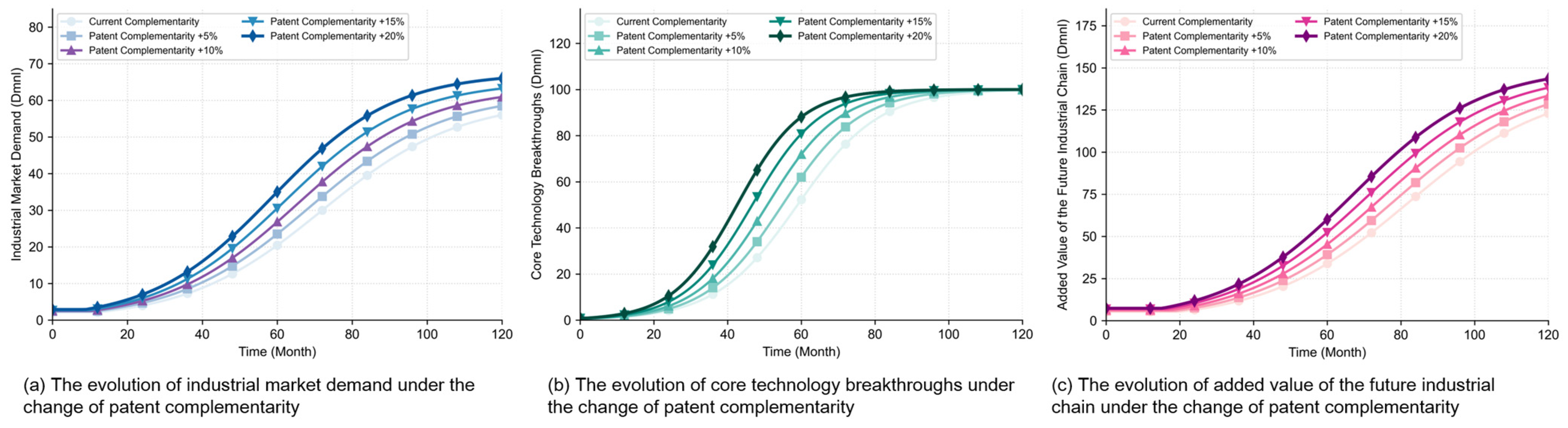
4.2.2. Patent Resource Complementarity
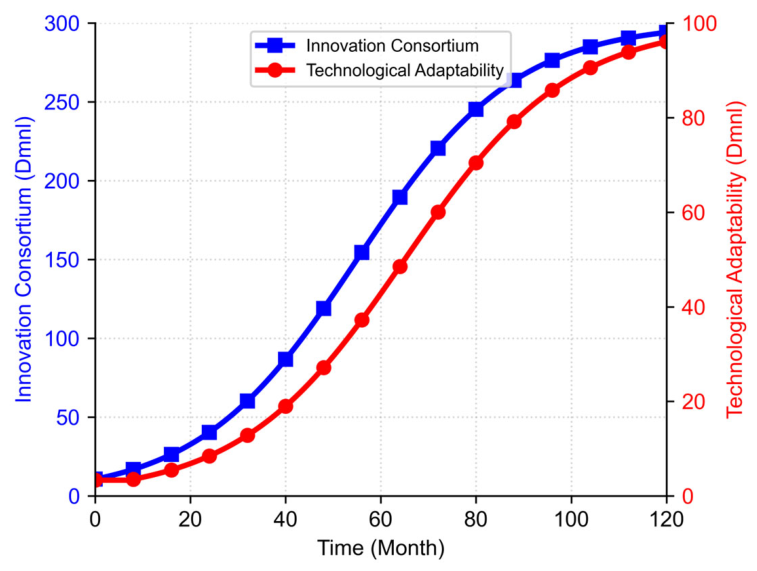
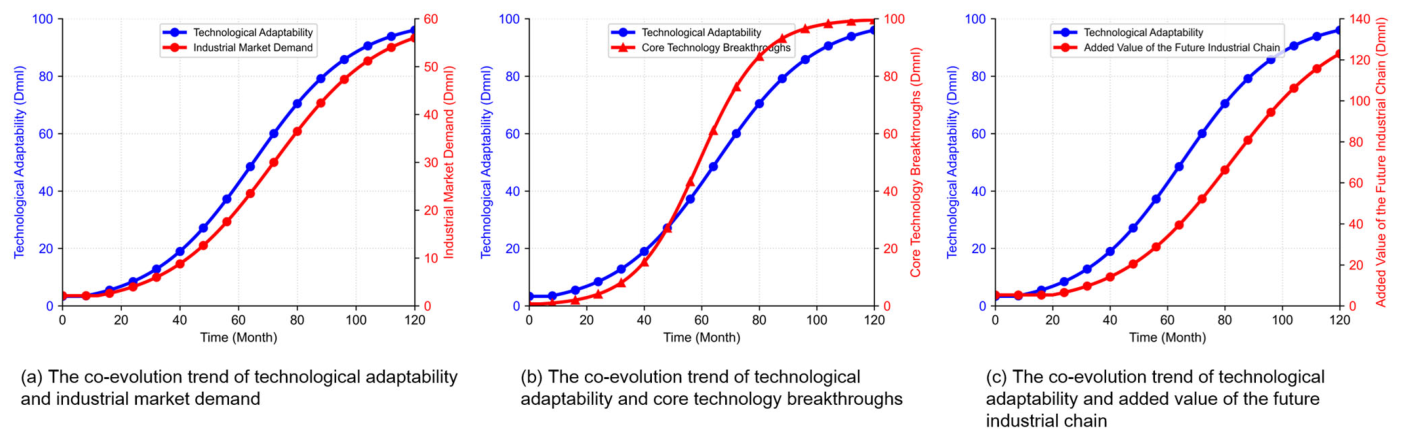
4.2.3. Technological Adaptability
4.3. Policy Simulation Analysis Under Multiple Governance Scenarios
4.3.1. Scenario Design
4.3.2. Strong Mission-Oriented Scenario
4.3.3. Market-Driven Scenario
4.3.4. High-Friction Governance Scenario
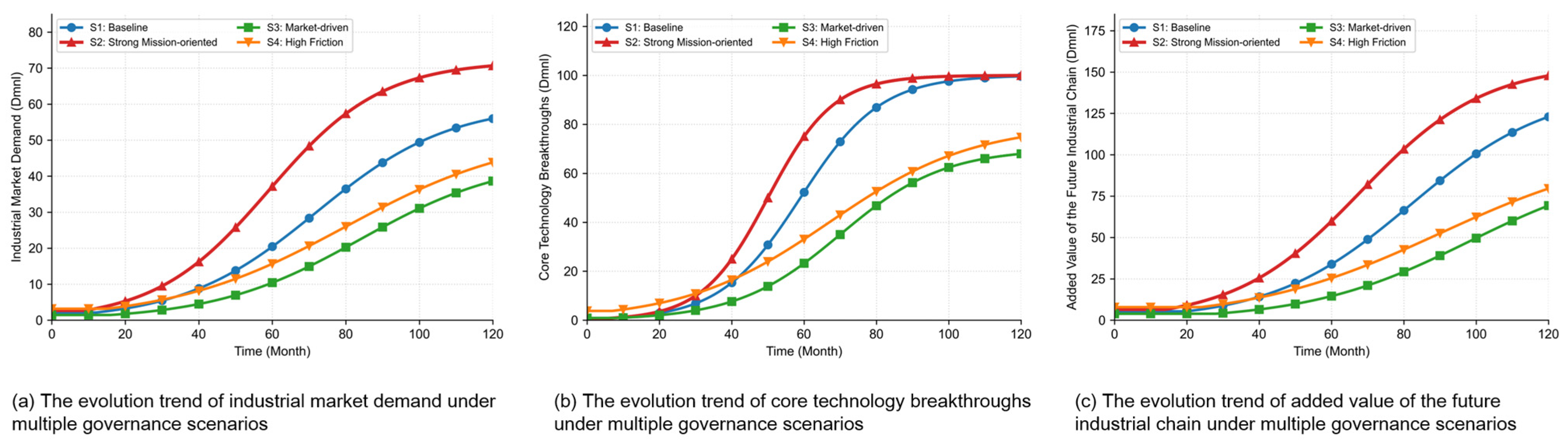
4.3.5. Scenario Comparison and Implications
4.4. Model Validity Explanation
4.4.1. Structural Validity
4.4.2. Behavioral Consistency
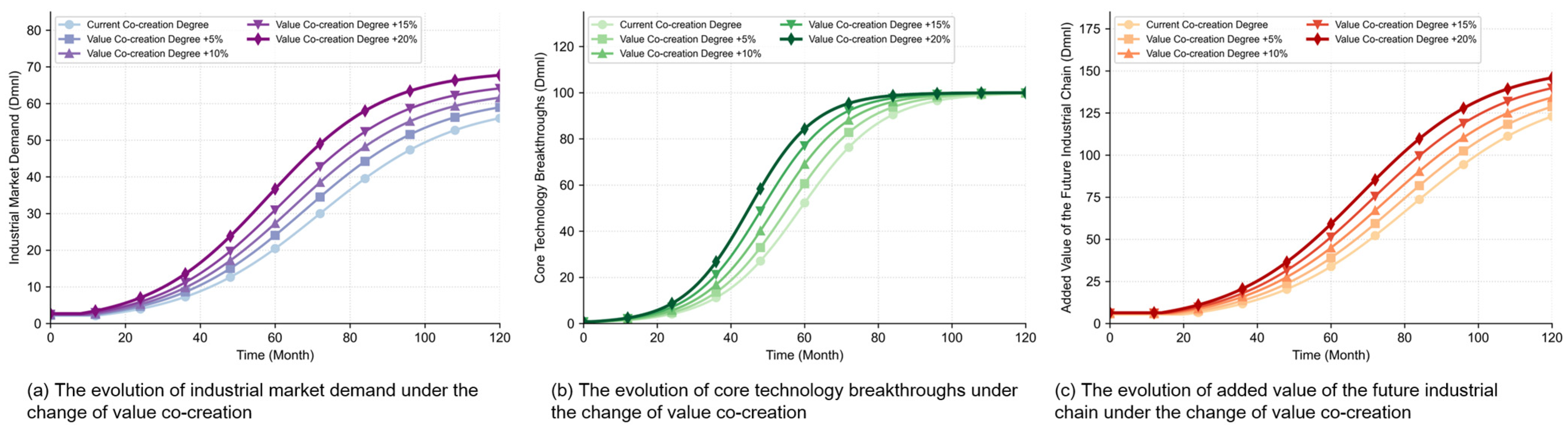
4.4.3. Parameter Sensitivity Analysis
- (1)
- Sensitivity analysis of the impact of value co-creation intensity on future industry development
- (2)
- Sensitivity analysis of the impact of patent resource complementarity on future industry development
- (3)
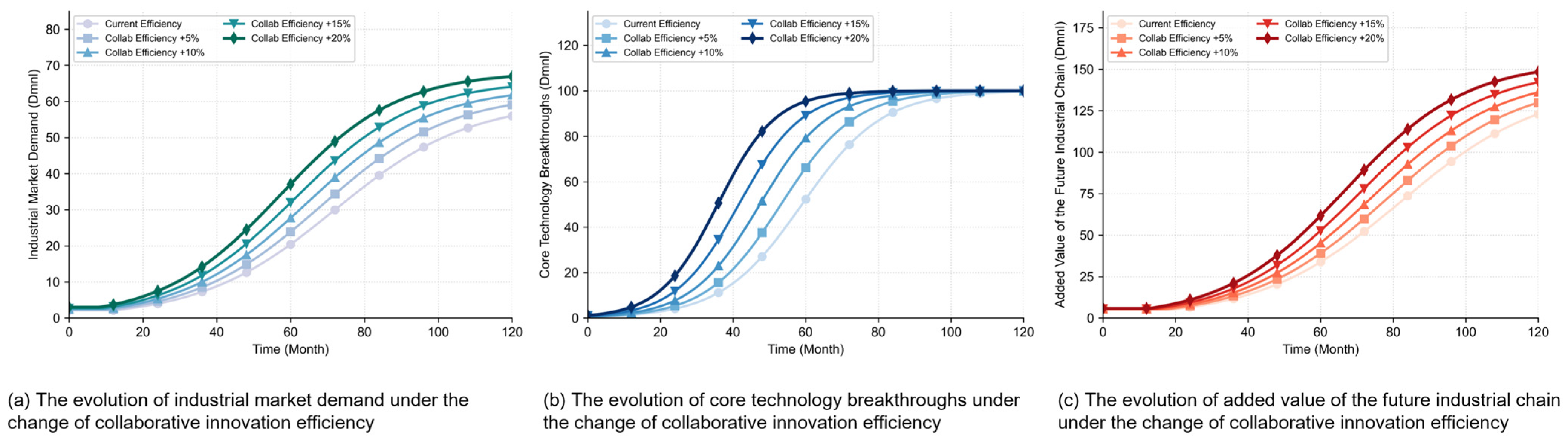
- Sensitivity analysis of the impact of collaborative innovation efficiency on future industry development
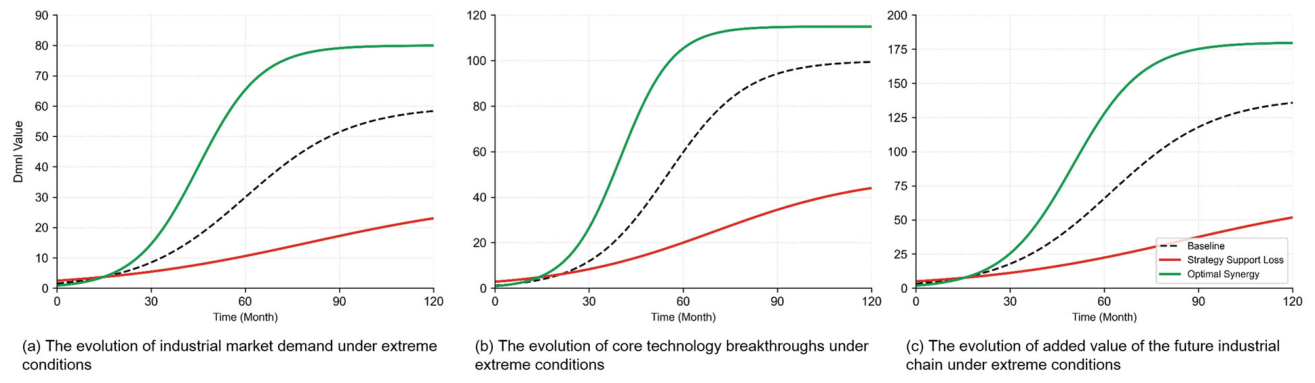
4.4.4. Extreme Condition Testing
5. Case Study
5.1. Case Selection
5.2. Next-Generation Artificial Intelligence and Large Model Ecosystem
5.3. Humanoid Robots
5.4. Model Consistency Assessment and Case Implications
6. Conclusions
6.1. Main Conclusions
6.2. Discussion
6.2.1. Theoretical Contributions
6.2.2. Limitations and Future Paths
6.3. Managerial Implications
Author Contributions
Funding
Data Availability Statement
Conflicts of Interest
References
- Yin, Z.; Fan, R.; Wang, Y.; Yang, L. Sustainable digital infrastructure and firm-level energy consumption: Evidence from China’s manufacturing sector. Energy 2026, 356, 141277. [Google Scholar]
- An, Z.; Yin, Z.; Yin, Z. Dual innovation and enterprise productivity: A resource conservation perspective. Int. Rev. Econ. Financ. 2025, 103, 104537. [Google Scholar] [CrossRef] [Scilit]
- Liu, M.; Shan, Y.; Li, Y. Heterogeneous Partners, R&D cooperation and corporate innovation capability: Evidence from Chinese manufacturing firms. Technol. Soc. 2023, 72, 102183. [Google Scholar]
- Durugbo, C. Collaborative networks: A systematic review and multi-level framework. Int. J. Prod. Res. 2016, 54, 3749–3776. [Google Scholar]
- Reypens, C.; Lievens, A.; Blazevic, V. Hybrid orchestration in multi-stakeholder innovation networks: Practices of mobilizing multiple, diverse stakeholders across organizational boundaries. Organ. Stud. 2021, 42, 61–83. [Google Scholar]
- Intarakumnerd, P.; Goto, A. Role of public research institutes in national innovation systems in industrialized countries: The cases of Fraunhofer, NIST, CSIRO, AIST, and ITRI. Res. Policy 2018, 47, 1309–1320. [Google Scholar] [CrossRef] [Scilit]
- Cao, L. Humanoid robots and humanoid AI: Review, perspectives and directions. ACM Comput. Surv. 2025, 58, 1–37. [Google Scholar] [CrossRef] [Scilit]
- Lavin, A.; Gilligan-Lee, C.M.; Visnjic, A.; Ganju, S.; Newman, D.; Ganguly, S.; Lange, D.; Baydin, A.G.; Sharma, A.; Gibson, A.; et al. Technology readiness levels for machine learning systems. Nat. Commun. 2022, 13, 6039. [Google Scholar] [CrossRef] [Scilit] [PubMed]
- Shi, J.; Xiao, Z. Research on the impact of inter-industry innovation networks on collaborative innovation performance: A case study of strategic emerging industries. Systems 2024, 12, 211. [Google Scholar] [CrossRef] [Scilit]
- Doz, Y.L.; Olk, P.M.; Ring, P.S. Formation processes of R&D consortia: Which path to take? Where does it lead? Strateg. Manag. J. 2000, 21, 239–266. [Google Scholar]
- Bosch-Sijtsema, P.M.; Postma, T.J. Cooperative innovation projects: Capabilities and governance mechanisms. J. Prod. Innov. Manag. 2009, 26, 58–70. [Google Scholar]
- Zou, T. Technological innovation promotes industrial upgrading: An analytical framework. Struct. Change Econ. Dyn. 2024, 70, 150–167. [Google Scholar] [CrossRef] [Scilit]
- Eisner, A.B.; Rahman, N.; Korn, H.J. Formation conditions, innovation, and learning in R&D consortia. Manag. Decis. 2009, 47, 851–871. [Google Scholar] [CrossRef] [Scilit]
- Das, T.K.; Teng, B.S. A resource-based theory of strategic alliances. J. Manag. 2000, 26, 31–61. [Google Scholar] [CrossRef] [Scilit]
- Sony, M.; Naik, S. Industry 4.0 integration with socio-technical systems theory: A systematic review and proposed theoretical model. Technol. Soc. 2020, 61, 101248. [Google Scholar] [CrossRef] [Scilit]
- Mazzucato, M. Mission-oriented innovation policies: Challenges and opportunities. Ind. Corp. Change 2018, 27, 803–815. [Google Scholar] [CrossRef] [Scilit]
- Al-Jayyousi, O.; Amin, H.; Al-Saudi, H.A.; Aljassas, A.; Tok, E. Mission-oriented innovation policy for sustainable development: A systematic literature review. Sustainability 2023, 15, 13101. [Google Scholar] [CrossRef] [Scilit]
- Jütting, M. Crafting mission-oriented innovation ecosystems: Strategic levers for directing collaborative innovation toward the grand challenges. IEEE Trans. Eng. Manag. 2022, 71, 12053–12067. [Google Scholar] [CrossRef] [Scilit]
- Rouyre, A.; Fernandez, A.S. Managing knowledge sharing-protecting tensions in coupled innovation projects among several competitors. Calif. Manag. Rev. 2019, 62, 95–120. [Google Scholar] [CrossRef] [Scilit]
- Fonti, F.; Maoret, M.; Whitbred, R. Free-riding in multi-party alliances: The role of perceived alliance effectiveness and peers’ collaboration in a research consortium. Strateg. Manag. J. 2017, 38, 363–383. [Google Scholar]
- Manyika, J.; Sinclair, J.; Dobbs, R.; Strube, G.; Rassey, L.; Mischke, J.; Remes, J.; Roxburgh, C.; George, K.; O’Halloran, D.; et al. Manufacturing the Future: The Next Era of Global Growth and Innovation; McKinsey Global Institute: New York, NY, USA, 2012. [Google Scholar]
- Benitez, G.B.; Ayala, N.F.; Frank, A.G. Industry 4.0 innovation ecosystems: An evolutionary perspective on value cocreation. Int. J. Prod. Econ. 2020, 228, 107735. [Google Scholar] [CrossRef] [Scilit]
- Wang, R.; Hu, Y. Capital–Technology Structural Coupling and Evolutionary Resilience in China’s AI Industry. Sustainability 2026, 18, 4374. [Google Scholar]
- Samara, E.; Georgiadis, P.; Bakouros, I. The impact of innovation policies on the performance of national innovation systems: A system dynamics analysis. Technovation 2012, 32, 624–638. [Google Scholar] [CrossRef] [Scilit]
- Walrave, B.; Raven, R. Modelling the dynamics of technological innovation systems. Res. Policy 2016, 45, 1833–1844. [Google Scholar] [CrossRef] [Scilit]
- Rad, V.Z.; Seifi, A.; Fadai, D. Policy design for transition from imitation to innovation in emerging photovoltaic sectors using a system dynamics model. Energy Policy 2023, 183, 113831. [Google Scholar] [CrossRef] [Scilit]
- Wu, Y.; Gu, X.; Tu, Z.; Zhang, Z. System dynamic analysis on industry-university-research institute synergetic innovation process based on knowledge flow. Scientometrics 2022, 127, 1317–1338. [Google Scholar]
- Ge, L.; Li, C.; Cheng, D.; Jiang, L. Research on innovation network features of patent-intensive industry clusters and their evolution. Systems 2025, 13, 795. [Google Scholar] [CrossRef] [Scilit]
- Broström, A. The triple helix: University–industry–government innovation in action–by Henry Etzkowitz. Pap. Reg. Sci. 2011, 90, 441–442. [Google Scholar]
- Lyu, L.; Wu, W.; Hu, H.; Huang, R. An evolving regional innovation network: Collaboration among industry 2011, university, and research institution in China’s first technology hub. J. Technol. Transf. 2019, 44, 659–680. [Google Scholar]
- Van Beers, C.; Zand, F. R&D cooperation, partner diversity, and innovation performance: An empirical analysis. J. Prod. Innov. Manag. 2014, 31, 292–312. [Google Scholar]
- Autio, E.; Hameri, A.P.; Vuola, O. A framework of industrial knowledge spillovers in big-science centers. Res. Policy 2004, 33, 107–126. [Google Scholar] [CrossRef] [Scilit]
- Song, Y.; Elsner, W.; Zhang, Z.; Berger, R. Collaborative innovation and policy support: The emergence of trilateral networks. Appl. Econ. 2020, 52, 3651–3668. [Google Scholar]
- Li, D.Y.; Liu, J. Dynamic capabilities, environmental dynamism, and competitive advantage: Evidence from China. J. Bus. Res. 2014, 67, 2793–2799. [Google Scholar] [CrossRef] [Scilit]
- Kyrdoda, Y.; Balzano, M.; Marzi, G. Learn to survive crises: The role of firm resilience, innovation capabilities and environmental dynamism. Technol. Soc. 2023, 74, 102285. [Google Scholar] [CrossRef] [Scilit]
- Rycroft, R.W. Does cooperation absorb complexity? Innovation networks and the speed and spread of complex technological innovation. Technol. Forecast. Soc. Change 2007, 74, 565–578. [Google Scholar] [CrossRef] [Scilit]
- Dixon, S.; Meyer, K.; Day, M. Building dynamic capabilities of adaptation and innovation: A study of micro-foundations in a transition economy. Long Range Plan. 2014, 47, 186–205. [Google Scholar] [CrossRef] [Scilit]
- Granstrand, O. A cooperative game theory systems approach to the value analysis of (innovation) ecosystems. Technovation 2024, 130, 102926. [Google Scholar]
- Arena, M.; Azzone, G.; Piantoni, G. Uncovering value creation in innovation ecosystems: Paths towards shared value. Eur. J. Innov. Manag. 2022, 25, 432–451. [Google Scholar]
- Deng, Q. Spatiotemporal evolution and configuration pathways of digital-intelligent regional innovation ecosystem sustainability: Evidence from China based on Symbiosis Theory. Technol. Soc. 2025, 85, 103144. [Google Scholar] [CrossRef] [Scilit]
- Ye, X.; Liang, W.; Yu, Z.; Guan, H.; Liu, H. Evolutionary mechanisms of global AI collaborative innovation networks: Evidence from patent data. Scientometrics 2025, 130, 5695–5729. [Google Scholar] [CrossRef] [Scilit]
- McCarthy, I.P.; Tsinopoulos, C.; Allen, P.; Rose-Anderssen, C. New product development as a complex adaptive system of decisions. J. Prod. Innov. Manag. 2006, 23, 437–456. [Google Scholar] [CrossRef] [Scilit]
- Davis, J.P.; Eisenhardt, K.M. Rotating leadership and collaborative innovation: Recombination processes in symbiotic relationships. Adm. Sci. Q. 2011, 56, 159–201. [Google Scholar]









| Dimension | Ordinary Market-Oriented R&D Alliance | Traditional Industry–University–Research Alliance | Mission-Oriented Innovation Consortia |
|---|---|---|---|
| Driving core | market interests and technological complementarity | staged project cooperation and university achievement transformatio | dual drive of national strategic objectives and market mechanisms |
| Value orientation | short-term commercial returns and partial competitive advantage | knowledge spillover, talent cultivation, and paper or patent outputs | core technology breakthroughs, industrial chain value, and future industry cultivation |
| Organizational boundary | relatively clear boundaries, mainly based on contractual alliances | relatively loose boundaries, mostly point-to-point horizontal cooperation | dynamic embedding across actors, fields, and stages, with strong vertical coordination |
| Risk sharing | mainly borne by alliance members, with relatively low risk preference | mainly borne by universities or research actors, with high uncertainty in achievement transformation | shared by public finance, leading enterprises, and research actors, oriented toward highly uncertain frontier technologies |
| Transformation characteristics | mainly incremental technological improvement, with a relatively short commercialization cycle | transformation gaps easily arise between laboratory achievements and production lines | crossing the “valley of death” through full-life-cycle collaboration and pilot-scale transformation mechanisms |
| Applicable context | technological improvement and product development in mature industries | university achievement transformation and general industry–university–research cooperation | core technology breakthroughs, strategic emerging industries, and future industry cultivation |
| Scenario | National Strategic Support | Collaborative Innovation Efficiency | Collaborative Resistance | Scenario Meaning |
|---|---|---|---|---|
| S1 baseline scenario | baseline value | baseline value | baseline value | current governance level |
| S2 strong mission-oriented scenario | +30% | +20% | −20% | strengthened national strategy and optimized collaborative governance |
| S3 market-driven scenario | −30% | baseline value | +20% | weakened policy support and market-dominated mechanisms |
| S4 high-friction governance scenario | +20% | −20% | +30% | increased resource input but ineffective internal governance |
| Future Industry Scenario | Typical Practice Carrier | Specific Real-World Case |
|---|---|---|
| Next-generation artificial intelligence and large model ecosystem | large model open platforms, industry large model joint innovation ecosystems, and artificial intelligence open innovation platforms | multimodal artificial intelligence industrial consortium (Wuhan, China) |
| Humanoid robots | humanoid robot innovation consortia, robot innovation centers, and key component–whole-machine collaborative platforms | national-local co-built embodied intelligent robot innovation center (Beijing, China) |
Disclaimer/Publisher’s Note: The statements, opinions and data contained in all publications are solely those of the individual author(s) and contributor(s) and not of MDPI and/or the editor(s). MDPI and/or the editor(s) disclaim responsibility for any injury to people or property resulting from any ideas, methods, instructions or products referred to in the content. |
© 2026 by the authors. Licensee MDPI, Basel, Switzerland. This article is an open access article distributed under the terms and conditions of the Creative Commons Attribution (CC BY) license.
Share and Cite
Wang, P.; Yin, Z.; Xiong, Z. Co-Evolutionary Dynamics of Mission-Oriented Innovation Consortia and Future Industries. Systems 2026, 14, 762. https://doi.org/10.3390/systems14070762
Wang P, Yin Z, Xiong Z. Co-Evolutionary Dynamics of Mission-Oriented Innovation Consortia and Future Industries. Systems. 2026; 14(7):762. https://doi.org/10.3390/systems14070762
Chicago/Turabian StyleWang, Pengju, Zhixiang Yin, and Zhuang Xiong. 2026. "Co-Evolutionary Dynamics of Mission-Oriented Innovation Consortia and Future Industries" Systems 14, no. 7: 762. https://doi.org/10.3390/systems14070762
APA StyleWang, P., Yin, Z., & Xiong, Z. (2026). Co-Evolutionary Dynamics of Mission-Oriented Innovation Consortia and Future Industries. Systems, 14(7), 762. https://doi.org/10.3390/systems14070762