1. Introduction
The economic benefits of digital technology are reflected not only in improvements in production efficiency but also in its role in accelerating data and information flows and reshaping the spatial allocation of resources. Based on the digital representation of information, digital technology can substantially lower data storage barriers, computation, and transmission, while further lowering economic costs related to search, replication, transportation, tracking, and verification [
1]. Therefore, digital technology can be regarded as an important force that weakens spatial frictions and reduces the cost of cross-regional information flows. On the one hand, the dependence of economic activities on geographical proximity has been weakened. For example, under e-commerce and platform-based transactions, consumers can more easily access information about products from other regions and enter external markets. Existing research also shows that the expansion of e-commerce can improve market access and welfare for consumers in some remote areas [
2]. This suggests that digital technology, to some extent, reduces market segmentation caused by physical distance. However, the spatial distribution of online transactions is not completely free from geographical constraints. Studies based on online transaction data from eBay and Mercado Libre find that distance still inhibits interregional transactions and that online transactions continue to exhibit a certain degree of local bias [
3]. Research on firms’ broadband adoption and trade relationships also reveals that while information and communication technologies alleviate information frictions, they do not necessarily eliminate the role of distance; rather, they may reshape the relationships among distance, market size, and trade connections [
4]. Therefore, the weakening of spatial frictions by digital technology does not occur uniformly across all regions. Instead, it is more likely to manifest as the coexistence of weakened distance constraints and localized agglomeration diffusion.
On the other hand, the establishment of data trading platforms, the opening of public data, and the improvement of digital infrastructure further release the advantages of data elements, such as low replication costs and high shareability. These developments endow digital technology with the capacity for low-cost cross-regional transmission and diffusion. Unlike traditional industrial agglomeration, which relies heavily on geographical proximity, digital technology can expand the spatial boundaries of resource allocation through digital platforms, information networks, and data flows, thereby facilitating the wider circulation of entrepreneurial opportunities, knowledge resources, and market information. Autio et al. [
5] point out that a key feature distinguishing digital entrepreneurial ecosystems from traditional regional clusters lies in their use of digital affordances, horizontal knowledge spillovers, and the identification and integration of external entrepreneurial opportunities. Accordingly, when a region develops advantages in digital resources, such advantages are often not confined to the local area. Instead, they may diffuse outward through data flows, information flows, and knowledge networks, forming spatial transmission channels with positive externalities and displaying more complex spatial linkages than traditional production factors such as labor and land. In this sense, examining the effects of digital technology only from the perspective of cities or industries within a region makes it difficult to fully explain the regional linkages and externalities emerging in the process of digitalization. Therefore, investigating the cross-regional impacts and spatial effects of digital technology from a spatial perspective constitutes an important prerequisite for further research in this field [
1,
4,
5].
As an economic activity that is highly dependent on access to dynamic market information and resource matching, entrepreneurship is constrained not only by local resource endowments and institutional environments but also closely associated with knowledge spillovers from non-local markets and cross-regional factor interactions. The knowledge spillover theory of entrepreneurship argues that knowledge not fully absorbed or commercialized by existing organizations can generate entrepreneurial opportunities and be transformed into new firm entry and economic growth through entrepreneurial activity [
6]. Tsvetkova and Partridge [
7], from the perspective of the relationship between the knowledge-intensive service economy and firm entry, also emphasize the importance of regional knowledge bases and external interactions for firm entry. Following this logic, the impact of digital technology on entrepreneurial activity is also likely to transcend the boundaries of a single region and exhibit clear spatial effects. In particular, digital technology can reduce the costs for entrepreneurs to obtain external market information, identify business opportunities, and connect with non-local resources, thereby making entrepreneurial activity less constrained by local resource conditions. Nambisan [
8] notes that digital technology is making entrepreneurial processes and outcomes less bounded and more open in terms of action space. Belitski et al. [
9], based on regional data from Europe, further show that digital affordances influence entrepreneurial dynamics such as new firm formation, firm survival, and high-growth employment. Therefore, when examining the impact of digital technology on entrepreneurial activity, it is necessary not only to focus on its direct effects within a region, but also to further analyze whether it generates spillover effects on entrepreneurial activity in neighboring regions through spatial linkage mechanisms [
5,
8,
9].
Regarding the relationship between digital technology and entrepreneurial activity, existing studies have begun to examine the effects of digital platforms, digital infrastructure, and digital finance on entrepreneurial activity. For example, Kim and Orazem [
10] find that broadband Internet significantly affects the location choices of new firms in rural areas, suggesting that digital infrastructure can alter the spatial conditions for entrepreneurial entry. Belitski et al. [
9] further suggest that the complementarity between digital affordances and regional human capital and cultural environments affects new firm formation and entrepreneurial performance. It should be noted that although these studies provide an important foundation for understanding the relationship between digital technology and entrepreneurial activity, their analyses are mainly based on intra-regional or non-spatial perspectives and often implicitly assume that different regions are independent of one another. In reality, however, cities, especially neighboring cities and cities within urban agglomerations, are often closely connected through industrial linkages, factor mobility, and information transmission. The effects of digital technology may therefore not be limited to the local region, but may be transmitted to surrounding areas through channels such as information diffusion, knowledge spillovers, and demonstration effects. Accordingly, it is necessary to further examine the impact of digital technology on entrepreneurial activity from a spatial perspective.
Against this background, this study introduces spatial econometric methods and systematically examines the spatial spillover effects of digital technology on entrepreneurial activity from the perspective of spatial linkages. Specifically, this study constructs a spatial Durbin model to identify whether digital technology affects other cities through spatial associations while controlling for the spatial dependence structure of entrepreneurial activity, and further distinguishes its direct and indirect effects through effect decomposition. The spatial Durbin model can simultaneously incorporate the spatial dependence of the dependent variable and the spatial lag terms of explanatory variables, making it suitable for identifying interregional interactions and spillover effects. Meanwhile, the decomposition of direct, indirect, and total effects helps avoid the bias that may arise from a simple interpretation based solely on regression coefficients [
11,
12]. On this basis, this study further analyzes the heterogeneous manifestations of the spatial spillover effects of digital technology across city size, city hierarchy, and geographical location, and identifies the scope and attenuation path of these effects using a distance-band approach.
This study contributes to a systems-based understanding of the relationship between digital technology development and entrepreneurial activity. First, it moves beyond the conventional local-effect perspective by conceptualizing digital technology development as a systemic force embedded in an interregional entrepreneurial system. In this framework, digital technology shapes entrepreneurship through both local effects and cross-city flows of information, resources, markets, and opportunities. Second, this study provides empirical evidence on the spatial spillover effects of digital technology development by applying a spatial Durbin model, which enables the decomposition of direct and indirect effects. This approach helps reveal whether digital technology development in one city can generate entrepreneurial externalities for surrounding cities. Third, the study uncovers the differentiated transmission mechanism of these spillovers by examining heterogeneity across city size, city hierarchy, and geographical location, and by identifying the distance-decay pattern of spatial effects. These results indicate that the impact of digital technology on entrepreneurship is shaped by spatial dependence and regional system structure rather than operating uniformly across locations. In this sense, the study enriches the literature by linking digital technology, entrepreneurial activity, and spatial spillovers within a unified systems-oriented analytical framework.
The remainder of this paper is organized as follows.
Section 2 develops the hypotheses.
Section 3 describes the research design.
Section 4 reports the empirical results and robustness checks.
Section 5 presents additional analyses.
Section 6 discusses the implications, limitations, and conclusions.
3. Research Design
3.1. Sample and Data Sources
This study constructs a balanced panel dataset covering 281 prefecture-level and above cities in China from 2006 to 2020. The dataset includes manually compiled indicators of digital technology development and entrepreneurial activity, as well as city-level control variables obtained from official statistical yearbooks and databases. The sample period is set as 2006–2020 because the construction of a consistent city-level balanced panel is constrained by the availability and comparability of firm registration data and socioeconomic variables. In addition, ending the sample in 2020 helps reduce potential disturbances from the COVID-19 pandemic, which may have affected entrepreneurial activity and the spatial diffusion of digital technology. Although this period provides a relatively stable window for empirical analysis, it may not fully capture post-pandemic changes in digital transformation and entrepreneurship. This represents a limitation of this study and a direction for future research. The data processing procedures are described as follows.
For digital technology data, this study uses patent data directly obtained from the China National Intellectual Property Administration. The data cover patent application and grant records during the sample period and include basic information such as patent applicants, patent types, and International Patent Classification codes. Based on these records, this study systematically identifies and aggregates patenting activities related to digital technology across different cities, providing a reliable data foundation for constructing city-level indicators of digital technology development.
For entrepreneurial activity data, the original data on business registrations are obtained from the National Enterprise Credit Information Publicity System. The raw dataset contains more than 200 million business registration records in China. It covers registered market entities nationwide and records key information such as firm name, establishment date, enterprise type, industry category, registered capital, and the administrative division corresponding to the registered address. These records provide a comprehensive basis for measuring firm entry into the market. Considering that the raw business registration data contain missing information and irregular records, this study conducts a strict data cleaning procedure. First, observations with unidentifiable registration dates, obviously abnormal registration information, or records that cannot be matched with corresponding fields are removed. Second, firms with missing registered address information or addresses that can only be located at the provincial level are excluded, ensuring that all observations can be accurately matched to the city level. Third, observations with incomplete industry information, especially those that can only be identified at a broad industry-category level but cannot be further classified, are removed. After these procedures, the cleaned data are used to construct indicators of city-level entrepreneurial activity.
In addition to digital technology and entrepreneurial activity data, the city-level control variables used in this study are mainly obtained from the China Statistical Yearbook, the China City Statistical Yearbook, the China Stock Market & Accounting Research Database, the EPS Database, and the Chinese Research Data Services Platform. During the data integration process, variables from different sources are standardized to ensure consistency and comparability in variable definitions.
Because the spatial Durbin model imposes strict requirements on the data structure and requires a balanced panel dataset, this study further screens the original sample. City-year observations with severe missing values are removed, while a small number of missing values are supplemented using interpolation methods. After these data processing steps, the final sample consists of a balanced panel dataset covering 281 prefecture-level and above cities from 2006 to 2020.
3.2. Variable Measurement
Level of digital technology development. Existing studies generally measure the level of digital technology development in three ways. The first group of studies uses digital economic activities, information and communication technology inputs, digital industry outputs, or Internet infrastructure as proxy variables for digital technology development. These indicators can characterize the development of the digital economy at the macro level, but they focus more on the digital economy sector or digital infrastructure construction and therefore cannot directly reflect the actual level of digital technology innovation and technological accumulation at the regional level [
1,
31]. The second group of studies constructs comprehensive evaluation index systems to measure digital economy or digitalization development indices, usually from dimensions such as digital infrastructure, digital industrialization, industrial digitalization, digital finance, and digital governance. Although such methods can comprehensively reflect the digital development environment, they may still involve a certain degree of subjectivity in indicator selection, weight assignment, and cross-regional comparability, which may affect the stability of measurement results [
24,
32,
33]. The third group of studies focuses on firm-level digital transformation and often uses the frequency of digital technology terms in annual reports of listed companies, digitalization-related keywords, or survey data to measure firms’ degree of digitalization. While these methods can better reflect firms’ digital practices, their samples are usually concentrated among listed firms or specific survey respondents, making it difficult to comprehensively capture the overall level of digital technology development at the city level [
34,
35,
36].
In general, patent data can objectively reflect technology formation, technological accumulation, and technology application, and thus serve as an important indicator for measuring regional technological innovation and technological development. Griliches [
37] pointed out early on that patent statistics are an important data source for measuring technological change and innovation output in economic research; Haupt et al. [
38] also showed that patent indicators can be used to identify technology life cycles and technological evolution. Compared with macro-output indicators, comprehensive evaluation indices, or survey-based indicators, patent data have several advantages, including strong technological specificity, long time series, broad coverage, and high traceability. They can therefore systematically capture the dynamic changes in digital technology across different regions. In recent years, an increasing number of studies have also used digital technology-related patents or digital innovation patents to identify the technological basis and spatial evolution of digital economy development [
39,
40]. Therefore, this study selects patents related to key digital technologies as the core variable reflecting the level of regional digital technology development.
It should be noted that patent-based indicators mainly capture the innovation, formation, and accumulation of digital technologies, rather than the full process of digital technology adoption, diffusion, or actual use. A city with fewer digital technology patents may still achieve a relatively high level of digital technology penetration through technology imports, platform applications, or the adoption of external digital solutions. Therefore, this study does not interpret digital technology patents as a comprehensive measure of all dimensions of digitalization. Instead, they are used to capture the regional technological foundation and innovation capacity underlying digital technology development. This choice is consistent with the focus of this study, which examines how locally accumulated digital technological capabilities affect entrepreneurial activity and generate spatial spillovers across cities. Compared with indicators of digital infrastructure or digital economy output, digital technology patents provide a more direct and traceable measure of regional digital technological capability, especially for identifying the spatial distribution and evolution of key digital technologies. To further alleviate potential measurement bias arising from the use of a single patent-based indicator, this study also uses Internet penetration as an alternative proxy for digital technology development in the subsequent robustness checks.
Specifically, based on the Classification System for Key Digital Technology Patents issued by the China National Intellectual Property Administration, this study uses the International Patent Classification codes corresponding to key digital technology patents as the identification criteria and screens patents in the field of key digital technologies from the patent database. This classification system focuses on emerging digital industries and frontier technologies, covering key digital technology categories such as artificial intelligence, high-end chips, quantum information, the Internet of Things, blockchain, industrial Internet, and the metaverse. It also establishes correspondence between each technological branch and international patent classifications, providing a relatively clear classification basis for systematically identifying digital technology patents. In international research, identifying digital technology innovation based on patent classifications, keyword searches, and technology-field mapping has become a common practice, especially for analyzing the spatial distribution and technological evolution of digital technologies such as artificial intelligence, blockchain, cloud computing, the Internet of Things, and robotics [
39,
41]. This study uses the per capita number of digital technology patents as the core explanatory variable in the spatial econometric analysis and constructs the spatial Durbin model accordingly. Following the same classification system, this study further divides key digital technology patents into three functional categories: Digital Infrastructure Technology, Digital Intelligent Support Technology, and Digital Integration Application Technology. Digital Infrastructure Technology refers to foundational technologies that support computing, transmission, and sensing capabilities, such as high-end chips and quantum information. Digital Intelligent Support Technology refers to core technologies that support intelligent decision-making, trusted data processing, and value transmission, such as artificial intelligence and blockchain. Digital Integration Application Technology refers to scenario-based and platform-based technologies that promote industrial digitalization and integrated applications, such as the Internet of Things, the industrial Internet, and the metaverse.
Entrepreneurial activity. The number of firm registrations has been widely used to measure entrepreneurship at the regional level and has gradually become an important indicator for characterizing entrepreneurial activity and new firm entry. The World Bank Entrepreneurship Database uses the number of newly registered firms and its population-standardized indicators as important measures of entrepreneurial entry, emphasizing that firm registration data can reflect market entry and private-sector dynamics [
42]. In the Chinese context, many recent studies have also used business registration data to identify new firm entry and entrepreneurial activity [
14,
43,
44,
45]. These studies indicate that business registration data can effectively reflect entrepreneurial entry at the city level in China.
Accordingly, in line with the common practice in existing studies and to maintain consistency with the city-level statistical scope of the core explanatory variable, this study uses Chinese business registration data to measure entrepreneurial activity. Specifically, based on firms’ registration dates, this study identifies the number of firms newly entering the market in each city and each year. Then, using firms’ registered address information, these firms are matched to the corresponding city level, thereby forming city-year-level firm registration data. Furthermore, considering differences in population size across cities, this study standardizes the number of firm registrations by population in the spatial econometric model to improve comparability across regions. The per capita number of firm registrations is ultimately used as the measure of entrepreneurial activity.
Control variables. To prevent other city-level factors during the sample period from interfering with the estimation of the impact of digital technology development on entrepreneurial activity, this study follows Cui and Li [
43] and controls for the interaction terms between city characteristic variables in the year before the sample period, namely 2005, and time trends. This approach helps avoid the potential endogeneity problems that may arise from directly including contemporaneous city-level control variables in the regression. The city-level control variables include economic development level (Pgdp), measured by the logarithm of per capita GDP; population density (Pop), measured by the logarithm of population per square kilometer; fixed asset investment ratio (Fix), measured by the ratio of total fixed asset investment to regional GDP; industrial structure (Stru), measured by the share of secondary industry value added in regional GDP; and industrial development level (Firmnum), measured by the logarithm of the number of above-scale industrial enterprises.
3.3. Spatial Weight Matrix
Considering that this study focuses on the spatial effects of digital technology on entrepreneurial activity, and that the diffusion of entrepreneurial activity, information transmission, and regional linkages usually decline as geographical distance increases, this study constructs a spatial weight matrix based on the inverse squared geographical distance between cities to characterize the intensity of spatial interactions among regions. Specifically, the elements of the spatial weight matrix
are defined as follows:
where
denotes the geographical distance between city
and city
, calculated as the spherical distance based on the longitude and latitude coordinates of the two cities. On this basis, the spatial weight matrix is row-standardized so that the sum of the weights in each row equals 1. The standardized matrix
is obtained as follows:
This transformation allows the spatial lag term to be interpreted as the weighted average effect of relevant variables in other regions.
The use of the inverse-squared geographical distance matrix in this study is mainly based on two considerations. First, this matrix form can strengthen the distance-decay feature by assigning higher weights to linkages between nearby cities while allowing the influence of distant cities to decline rapidly. This is consistent with the basic patterns of entrepreneurial activity diffusion and digital technology diffusion. Second, compared with an adjacency matrix, which only captures whether regions are contiguous, a distance-based matrix preserves the continuity of spatial linkages and is more conducive to identifying differentiated spatial interactions across regions.
Within the framework of this study, the impact of digital technology on entrepreneurial activity is mainly realized through channels such as information diffusion and regional coordination, and these mechanisms generally weaken as geographical distance increases. Therefore, adopting a distance-decay spatial weight matrix has clear economic implications. Overall, the inverse squared geographical distance matrix can effectively characterize the spatial correlation structure examined in this study and provide a basis for identifying spatial spillover effects in the subsequent analysis. In addition, the results using alternative spatial weight matrices are also reported in the robustness checks.
3.4. Model Specification
The spatial Durbin model (SDM) can characterize the spatial correlation structure among regional variables within a unified framework. In particular, by introducing the spatial lag terms of explanatory variables, the SDM can directly identify cross-regional spillover effects. Therefore, it is well-suited for analyzing the spatial diffusion effects of digital technology on entrepreneurial activity. This study examines whether the impact of digital technology is transmitted through interregional linkages and whether it leads to differences in entrepreneurial activity. Based on this consideration, the following spatial Durbin model is constructed:
where
and
denote cities,
denotes year, and
denotes the number of cities.
represents entrepreneurial activity, and
is the element of the spatial weight matrix, which is used to capture the intensity of spatial linkages between cities.
Among them, is the spatial lag term of digital technology. Its coefficient captures the association between digital technology development in surrounding cities and local entrepreneurial activity, and thus provides an important basis for identifying spatial spillovers. However, because the SDM includes the spatially lagged dependent variable and therefore involves spatial feedback effects, the spatial spillover effect of digital technology cannot be inferred directly from alone. It should instead be identified through the decomposition of direct, indirect, and total effects. By comparison, is mainly used to capture the spatial dependence structure of entrepreneurial outcomes themselves, so as to control for the mutual influence of entrepreneurial performance across regions and avoid mistakenly interpreting such endogenous spatial correlation as the spatial spillover effect of the explanatory variable. In addition, is used to control for the influence of other regional characteristics transmitted through spatial channels.
It should be further noted that, because the model includes the spatially lagged dependent variable, there is an explicit spatial feedback mechanism. As a result, the impact of explanatory variables on the dependent variable cannot be directly inferred from the estimated regression coefficients. Therefore, it is necessary to decompose the estimated effects into direct effects, indirect effects, and total effects. The direct effect represents the average impact of digital technology on local entrepreneurial outcomes. The indirect effect, namely the spatial spillover effect, represents the impact of digital technology on entrepreneurial outcomes in other cities transmitted through the spatial weight matrix, which is the core focus of this study. The total effect is the sum of the direct and indirect effects, reflecting the overall impact of digital technology.
In matrix form, the spatial Durbin model can be expressed as:
Further, the partial derivative matrix can be written as:
The average of the diagonal elements of this matrix represents the direct effect, while the average row sum represents the total effect. The indirect effect, namely the spatial spillover effect, is obtained by subtracting the direct effect from the total effect. Based on the above specification, this study focuses on the indirect effect of digital technology and compares its spatial impact on entrepreneurial activity. If digital technology influences entrepreneurial activity mainly through mechanisms such as information diffusion and demonstration effects, it is more likely to exhibit significant spatial spillover effects on entrepreneurial activity.
5. Additional Analysis
5.1. Urban Size Heterogeneity: Large Cities and Small and Medium-Sized Cities
Urban size is an important dimension for examining the heterogeneity of the spatial spillover effects of digital technology. The development of digital technology not only affects local entrepreneurial activity but may also influence surrounding regions through intercity information linkages, market connections, and the diffusion of entrepreneurial activity. Cities of different sizes occupy different positions in regional networks, and their ability to absorb external digital technology spillovers may therefore vary. Large cities are usually major agglomeration centers of digital technology and entrepreneurial activity. Although their surrounding areas may benefit from certain spillover effects, large cities themselves have a strong capacity to attract resources and entrepreneurial opportunities, which may weaken the conversion of external spillovers into local entrepreneurial activity. By contrast, the connections between small and medium-sized cities and surrounding cities rely more heavily on external technology diffusion and market linkages. The cross-regional information flows and reductions in transaction costs brought by digital technology development are more likely to break through local market-size constraints and be transformed into new entrepreneurial opportunities. Therefore, analyzing heterogeneity from the perspective of city size helps identify differences in the spatial spillover effects of digital technology across cities of different scales.
Following the
Notice on Adjusting the Standards for City Size Classification issued by the State Council of China, this study uses a resident population of one million in municipal districts as the threshold and divides the sample cities into large cities and small and medium-sized cities. The grouped regression results show that digital technology development has significant spatial spillover effects on entrepreneurial activity in both types of cities, but the external driving effect is more pronounced in small and medium-sized cities. According to the spatial effect decomposition results in
Table 8, the indirect effect for small and medium-sized cities is significantly higher than that for large cities, indicating that digital technology development in surrounding regions has a stronger promotional effect on entrepreneurial activity in small and medium-sized cities. This suggests that the spatial spillover effects of digital technology do not occur uniformly across cities of different sizes, but are more likely to be transformed into increased entrepreneurial activity in small and medium-sized cities. A possible reason is that small and medium-sized cities have relatively limited local entrepreneurial conditions and depend more heavily on external information, market connections, and the diffusion of digital applications. Therefore, the spillover effects generated by digital technology development in surrounding regions can more easily compensate for their local resource constraints and promote the growth of entrepreneurial activity. Overall, differences in city size affect the intensity of digital technology spillovers, and small and medium-sized cities constitute a more sensitive receiving space for the entrepreneurial spillover effects of digital technology. These findings are consistent with H2, indicating that the spatial spillover effects of digital technology on entrepreneurial activity differ across cities of different sizes.
5.2. Urban Hierarchy Heterogeneity: Central Cities and Peripheral Cities
Urban hierarchy is a necessary dimension for examining the heterogeneity of the spatial spillover effects of digital technology. Unlike city size, which mainly focuses on population scale, urban hierarchy emphasizes differences in cities’ positions within regional linkages. Central cities usually maintain more frequent economic connections with surrounding cities, and their entrepreneurial activity is not only affected by local digital technology development, but is also more likely to be influenced by digital technology development in neighboring cities. Peripheral cities are also embedded in regional linkages, but their entrepreneurial activity may depend more on improvements in local digital technology conditions, and their response to digital technology development in surrounding cities may not be the same. Therefore, grouping cities into central and peripheral cities helps determine whether the spatial spillover effects of digital technology on entrepreneurial activity differ across urban hierarchies.
Consistent with prior studies on China’s urban administrative hierarchy, this study defines municipalities directly under the central government, provincial capitals, and sub-provincial cities as central cities, while the remaining prefecture-level cities are defined as peripheral cities [
50,
51]. As shown in
Table 6, digital technology development affects entrepreneurial activity in both types of cities, but the structure of its effects differs markedly. The local effect is stronger in peripheral cities, indicating that digital technology development more directly promotes local entrepreneurial activity in peripheral cities. By contrast, the indirect effect is significantly higher in central cities than in peripheral cities, suggesting that entrepreneurial activity in central cities is more likely to be influenced by digital technology development in surrounding cities, and that the spatial linkage between digital technology and entrepreneurial activity is more pronounced in central cities. It should be noted that this result does not directly prove that central cities diffuse the entrepreneurial effects of digital technology to external cities. Rather, under the current spatial effect decomposition framework, it indicates that central cities show a stronger response to the spillover effects of digital technology development in surrounding cities. Overall, differences in urban hierarchy shape how the spatial spillover effects of digital technology are manifested: peripheral cities mainly exhibit stronger local direct effects, whereas central cities show stronger responses to digital technology development in surrounding cities. This pattern is consistent with H3, which predicts that the spatial spillover effects of digital technology on entrepreneurial activity differ between central and peripheral cities.
5.3. Geographical Location Heterogeneity: Eastern, Central, Western, and Northeastern Regions
Geographical location is an important dimension for examining the heterogeneity of the spatial spillover effects of digital technology. The impact of digital technology on entrepreneurial activity involves cross-regional linkages, but such linkages do not occur uniformly across different regions. Cities in different geographical locations differ in the intensity of regional connections, conditions for digital technology diffusion, and the extent of external linkages in entrepreneurial activity. These differences affect whether digital technology development in surrounding cities can be effectively transformed into an increase in local entrepreneurial activity. In general, the closer the interregional connections, the more likely digital technology development is to generate positive external effects through information flows and market linkages. Conversely, if intercity connections within a region are relatively weak, or if digital development in surrounding cities mainly functions as a competitive attraction force, spatial spillover effects may weaken or even become negative. Therefore, grouping cities into the eastern, central, western, and northeastern regions helps identify spatial differences in the entrepreneurial effects of digital technology across geographical locations.
Based on the
Several Opinions of the State Council on Promoting the Rise of the Central Region, the Implementation
Opinions of the State Council on Several Policies and Measures for the Development of the Western Region, and the relevant regional classification standards of the
National Bureau of Statistics of China, this study divides the sample cities into the eastern, central, western, and northeastern regions. The grouped regression results in
Table 6 suggest that digital technology development generally promotes entrepreneurial activity in the eastern, central, and western regions, but its spatial spillover effects differ significantly across regions. The indirect effect in the eastern region is significantly positive, indicating that digital technology development in surrounding cities can effectively promote local entrepreneurial activity. This suggests that the spatial spillover effect of digital technology is most stable in the eastern region. Although the central and western regions reveal relatively strong local promotional effects, their indirect effects do not form stable positive spillovers. This indicates that digital technology development in the central and western regions mainly promotes local entrepreneurial activity through direct local effects, whereas cross-city external driving effects remain relatively insufficient.
In the regional analysis, the northeastern region presents a particularly noteworthy pattern, as digital technology development exhibits a negative spatial spillover effect in this region. Specifically, in the northeastern region, the local promotional effect of digital technology is unstable, and the indirect effect is significantly negative. This counterintuitive result may be related to the structural characteristics of Northeast China. As a traditional old industrial base, this region has long faced challenges such as heavy-industry dependence, slower industrial restructuring, population outflow, and relatively weak entrepreneurial vitality [
52,
53,
54,
55]. Under these conditions, digital technology development in surrounding cities may not easily generate complementary entrepreneurial opportunities for local cities. Instead, it may intensify competition for limited entrepreneurial resources, skilled labor, market demand, and investment opportunities within the region. In addition, because many northeastern cities share similar industrial structures and face relatively limited market expansion, digital technology development in neighboring cities may generate substitution effects rather than positive knowledge spillovers. Therefore, the negative indirect effect should not be interpreted as evidence that digital technology itself suppresses entrepreneurship, but rather as suggesting that, in regions with weaker entrepreneurial ecosystems and insufficient intercity complementarity, surrounding digital technology development may crowd out local entrepreneurial activity through competitive and substitution channels. However, this explanation should be interpreted as a plausible mechanism rather than direct empirical evidence of the underlying channel. Because the present study focuses on the spatial effect of digital technology development rather than the internal mechanism of regional decline, the competition and substitution explanation remains interpretive. Future research could further test this mechanism by incorporating mediating variables such as industrial structure change, talent outflow, labor mobility, or indicators of entrepreneurial ecosystem quality.
Taken together, these regional differences suggest that digital technology-enabled entrepreneurship depends not only on the level of local digital development but also on the formation of effective intercity linkages within a region. The positive external effects are concentrated mainly in the eastern region, while the northeastern region exhibits negative spillover effects, indicating that the spatial spillover effects of digital technology vary substantially across geographical regions; this finding is consistent with H4.
5.4. Spatial Spillover Boundary Test
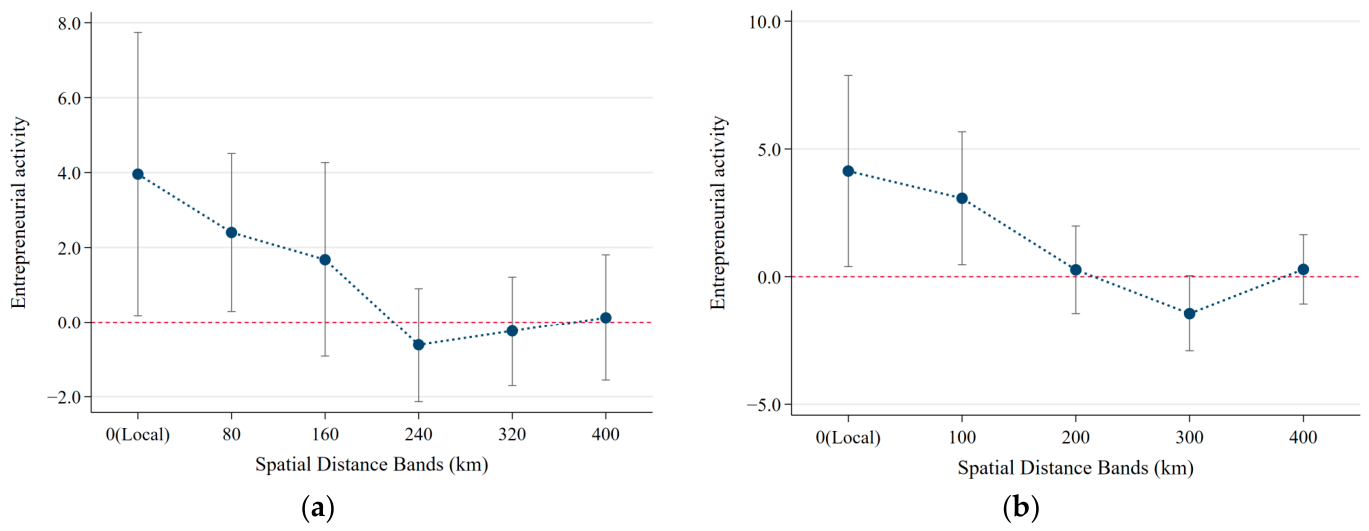
Based on the previous confirmation that digital technology has a significant spatial spillover effect on entrepreneurial activity, it is still necessary to further identify the effective range of this effect. Spatial spillover does not mean that the influence of digital technology can diffuse across cities without limit; rather, its intensity may gradually decline as geographical distance increases. To test this, this study constructs distance-band variables based on the geographical distance between cities and adopts two step-size settings, namely 100 km and 80 km, to examine the impact of digital technology development in surrounding cities on local entrepreneurial activity within different spatial ranges. This also helps avoid being dependent on a single distance classification standard.
Following the approach of existing studies [
56,
57], this study first calculates the spherical distance between any two cities based on their longitude and latitude coordinates. Then, distance bands are constructed using 100 km and 80 km intervals, respectively. Under the 100 km interval setting, intercity distances are divided into bands of 0–100 km, 100–200 km, 200–300 km, and 300–400 km. Under the 80 km interval setting, intercity distances are divided into bands of 0–80 km, 80–160 km, 160–240 km, 240–320 km, and 320–400 km. Taking city
as the reference city, this study calculates the average level of digital technology development of other cities located within each distance band in each year and constructs distance-band variables to capture the external influence of digital technology development within different spatial ranges. These distance bands are mutually exclusive, so each neighboring city is assigned to only one distance interval according to its distance from city
. The corresponding fixed-effects model is specified as follows:
where
denotes the entrepreneurial activity of city
in year
, and
denotes the level of local digital technology development.
represents the average level of digital technology development of other cities located within the
-th distance band around city
. The coefficient
captures the spatial spillover effect of surrounding digital technology development on local entrepreneurial activity within the corresponding distance range. If
decreases as distance increases, or becomes insignificant in farther distance bands, indicating that the spatial spillover effect of digital technology exhibits distance decay and has an effective spatial boundary.
denotes control variables, while
and
represent city fixed effects and year fixed effects, respectively. The model is estimated using a fixed-effects approach, with cluster-robust standard errors at the city level.
As shown in
Figure 1, under different distance-band settings, the spatial impact of digital technology on entrepreneurial activity exhibits a clear distance-decay pattern. Local digital technology development has a positive effect on entrepreneurial activity, and digital technology development in neighboring cities can also generate certain external driving effects. However, as spatial distance expands, this positive effect gradually weakens and tends toward zero or fluctuates after reaching a medium distance, while the confidence intervals gradually cover zero. This indicates that the spatial spillover effect of digital technology on entrepreneurial activity does not extend indefinitely, but is mainly concentrated within adjacent or relatively short-distance ranges.
This result is generally consistent with the mechanism through which digital technology affects entrepreneurial activity. Digital technology development in surrounding cities can influence local entrepreneurial activity through information transmission, market connections, and entrepreneurial demonstration effects, but these channels remain constrained by geographical distance. Cities located closer to each other usually have more frequent interactions, and entrepreneurs are more likely to obtain digital application experience and market information from nearby cities. Therefore, digital technology spillovers are more likely to be transformed into increased entrepreneurial activity. As distance increases, the intensity of intercity connections declines, and the costs of information transmission and market interaction rise, thereby weakening the driving effect of surrounding digital technology development on local entrepreneurial activity. Combined with the overall estimation results of the SDM model above, the boundary test further indicates that digital technology development indeed has spatial spillover effects, but these spillover effects have clear geographical boundaries. The impact of digital technology on entrepreneurial activity mainly occurs within short- and medium-distance ranges. Beyond a certain spatial distance, its external driving effect is no longer stable. This suggests that digital technology can promote entrepreneurial activity through regional linkages, but its spatial diffusion still depends on the actual strength of intercity connections, rather than naturally spreading with digital development alone.
6. Implications and Conclusions
6.1. Conclusions
This study uses spatial econometric methods to examine the spatial effects of digital technology development on entrepreneurial activity. The results show that entrepreneurial activity exhibits significant spatial dependence across cities. After controlling for spatial correlation, digital technology development still significantly promotes entrepreneurial activity, and its indirect effect is stronger than its direct effect, indicating that spatial spillover is an important channel through which digital technology affects entrepreneurial activity. These findings are consistent with prior research on digital entrepreneurship, knowledge spillovers, and regional innovation diffusion [
5,
8,
13,
46], while extending this literature by highlighting the spatial and heterogeneous nature of digital technology’s entrepreneurial effects. Further analyses indicate that the spillover effects of digital technology differ across technology types, city size, urban hierarchy, and geographical location. The heterogeneous results also resonate with recent studies emphasizing that knowledge spillovers and entrepreneurial outcomes depend on regional absorptive capacity and entrepreneurial ecosystems [
58]. The spatial boundary test further shows that positive spillover effects mainly occur within adjacent or relatively short-distance ranges and weaken as distance increases. Overall, digital technology can promote entrepreneurial activity through regional linkages, but its spatial influence depends on actual intercity connections.
6.2. Theoretical Implications
This study provides a spatial perspective for understanding the relationship between digital technology development and entrepreneurial activity. Existing studies often focus on the impact of digital technology on local entrepreneurial activity, while this study further examines whether such effects extend across cities through spatial linkages. The findings suggest that entrepreneurial activity exhibits significant spatial dependence. Digital technology development not only promotes local entrepreneurial entry but also stimulates entrepreneurial entry in surrounding cities through spatial associations. This finding suggests that digital technology not only functions as a development condition within a single city but may also affect entrepreneurial activity through interregional information diffusion, market connections, and opportunity transmission. Accordingly, this study extends the relationship between digital technology and entrepreneurial activity from local effects to spatial spillover effects, which helps further understand the role of digital technology in regional entrepreneurial systems. In addition, by analyzing technology types, city characteristics, geographical locations, and distance boundaries, this study shows that the entrepreneurial effects of digital technology do not occur uniformly, but are shaped by intercity spatial linkages and regional structural differences.
6.3. Practical Implications
The findings suggest that policies promoting digital technology and entrepreneurship should not focus only on individual cities, but should also pay attention to regional linkages. Since digital technology can generate spatial spillover effects on entrepreneurial activity, local governments may strengthen intercity cooperation, digital infrastructure connectivity, and information-sharing mechanisms. For small and medium-sized cities, improving the ability to absorb external digital resources may help transform surrounding digital technology development into local entrepreneurial opportunities. For central cities, policy efforts may focus on enhancing their functions in regional coordination and resource matching. Regional differences should also be considered. The eastern region indicates more stable positive spillover effects, while the central, western, and northeastern regions may need to further strengthen market integration and digital resource sharing. In addition, because spillover effects decline as distance increases, entrepreneurship policies should place greater emphasis on neighboring-city cooperation and regional cluster development.
Beyond the Chinese context, these findings also provide useful implications for other countries, particularly emerging economies and countries with pronounced regional disparities. The results suggest that digital technology policies may generate broader entrepreneurial effects when they are embedded in regional networks rather than confined to individual urban centers. For countries seeking to promote digital entrepreneurship, policy attention should therefore be given not only to strengthening leading cities, but also to improving the digital absorptive capacity of smaller, peripheral, or less-developed cities so that they can benefit from nearby digital technology spillovers. At the same time, the applicability of these findings should be interpreted with caution, as the strength and direction of spatial spillovers may depend on country-specific conditions, including institutional arrangements, digital infrastructure, market integration, and the maturity of entrepreneurial ecosystems.
6.4. Limitations and Future Research
This study has several limitations. First, digital technology development is mainly measured using digital technology patents. Although patent data can reflect technological accumulation, they may not fully capture the actual application and commercialization of digital technologies. Future research could combine patent data with indicators such as digital infrastructure, digital platforms, and firm-level digital transformation to construct a more comprehensive measure. Second, this study uses city-level data, which is suitable for examining spatial spillover effects but cannot fully reveal micro-level entrepreneurial decisions. Future studies could use firm-level or entrepreneur-level data to further examine specific mechanisms such as opportunity recognition, financing, and digital technology adoption. Third, although this study analyzes heterogeneity across technology types, city characteristics, regions, and distance bands, the mechanisms behind these differences still require further testing. Future research could further examine channels such as digital finance, digital platforms, and talent mobility to more clearly explain the formation conditions of digital technology’s spatial spillover effects. Finally, because the sample period ends in 2020, the findings may not fully capture the accelerated digital transformation and changes in entrepreneurial behavior after the COVID-19 pandemic. Post-2020 changes in remote work, platform-based entrepreneurship, and digital infrastructure may have further influenced the mechanisms through which digital technology affects entrepreneurial activity. Future research could extend the sample to the post-2020 period to examine whether the spatial spillover effects of digital technology remain consistent under these new digital transformation trajectories.