1. Introduction
Digital transformation is a critical enabler of sustainable development, especially for SMEs in developing countries [
1]. The United Nations Sustainable Development Goals (SDGs)—particularly SDGs 8 (Decent Work and Economic Growth), 9 (Industry, Innovation, and Infrastructure), and 10 (Reduced Inequalities)—identify technology adoption as a path to economic inclusion and lasting growth [
2]. However, digital transformation’s effectiveness depends on whether adoption models address the sociocultural contexts of target populations, a factor largely neglected in the existing literature.
Building on this understanding, for SMEs in developing countries, which represent over 90% of businesses and provide more than 50% of employment [
3], sustainable digital transformation requires models that move beyond technological determinism to incorporate cultural, institutional, and ecosystem factors that shape adoption behavior. The persistent application of adoption models developed in industrialized-country contexts risks what Heeks [
4] termed ‘design-reality gaps,’ in which technology initiatives fail to align with local realities. This article proposes a Culturally Contextualized Digital Transformation Model (CC-DTM) that incorporates cultural dimensions as structural moderators within a unified TOE-TAM framework, thereby advancing the discourse on sustainable technology transfer in development economics.
In light of these challenges, it is important to note that existing technology adoption models (predominantly TAM [
5], TOE [
6], UTAUT [
7], and IDT [
8]) were developed within and for industrialized-country contexts. Their direct transposition to SMEs in developing countries introduces a systematic validity gap, as these models do not account for the sociocultural specificities that shape technology adoption behavior in such circumstances [
9].
This lack of contextualization has been documented in prior work by the authors. In a systematic mapping of 256 articles from five databases (2018–2023), Diaz-Arancibia et al. [
10] demonstrated that while the TOE framework dominates the literature (33.87%), followed by TAM (27.02%), only 14 of 256 articles mention cultural behavior as a factor, and none employ a standardized cultural instrument such as Hofstede’s Values Survey Module (VSM) [
10]. The VSM is Hofstede’s standardized questionnaire designed to measure cultural value dimensions at both national and individual levels [
11]. This finding was further corroborated by an umbrella review that synthesized 21 secondary studies, none of which operationalize national culture using validated dimensional frameworks [
12].
Independent analyses outside the authors’ research program support this gap: McCoy, Galletta, and King [
13] cautioned that applying TAM across cultures without accounting for cultural variation risks systematic misspecification, and Jan et al. [
14] located only a small number of primary studies (k ranging from 6 to 12 per dimension) that quantitatively integrate Hofstede’s dimensions into TAM, despite three decades of research.
This gap pertains to the secondary literature on SME technology adoption; primary studies in the broader IS field, have operationalized cultural dimensions at the individual level. The CC-DTM builds on this primary-study foundation while addressing the fact that it has not been integrated into the SME adoption frameworks synthesized in these secondary reviews.
To build on this evidence, the meta-analysis by Jan, Alshare, and Lane [
14] provides the most direct quantitative evidence for the mechanism by which cultural dimensions influence technology acceptance constructs. Their analysis of studies from 1989 to 2019 found that: (a) Individualism negatively predicts Intention to Use (weight = 0.83); (b) Power Distance positively predicts Behavioral Intention (weight = 1.0, 6/6 studies significant, though the small number of primary studies limits the robustness of this estimate); and (c) Uncertainty Avoidance appears as a strong predictor of Perceived Ease of Use. These findings show that cultural dimensions systematically moderate the relationships between core TAM constructs.
Meta-analytic weights derived from small study counts (k = 6 for PDI) should be interpreted as directional indicators of effect consistency rather than as precise parameter estimates. The CC-DTM applies these findings to justify the selection and directionality of cultural moderators, rather than to quantify their expected effect sizes.
Taken together, these findings establish the empirical warrant for a culturally contextualized adoption framework. The remainder of this paper is devoted to constructing that framework, the CC-DTM, rather than to extending the mapping or meta-analytic evidence cited above.
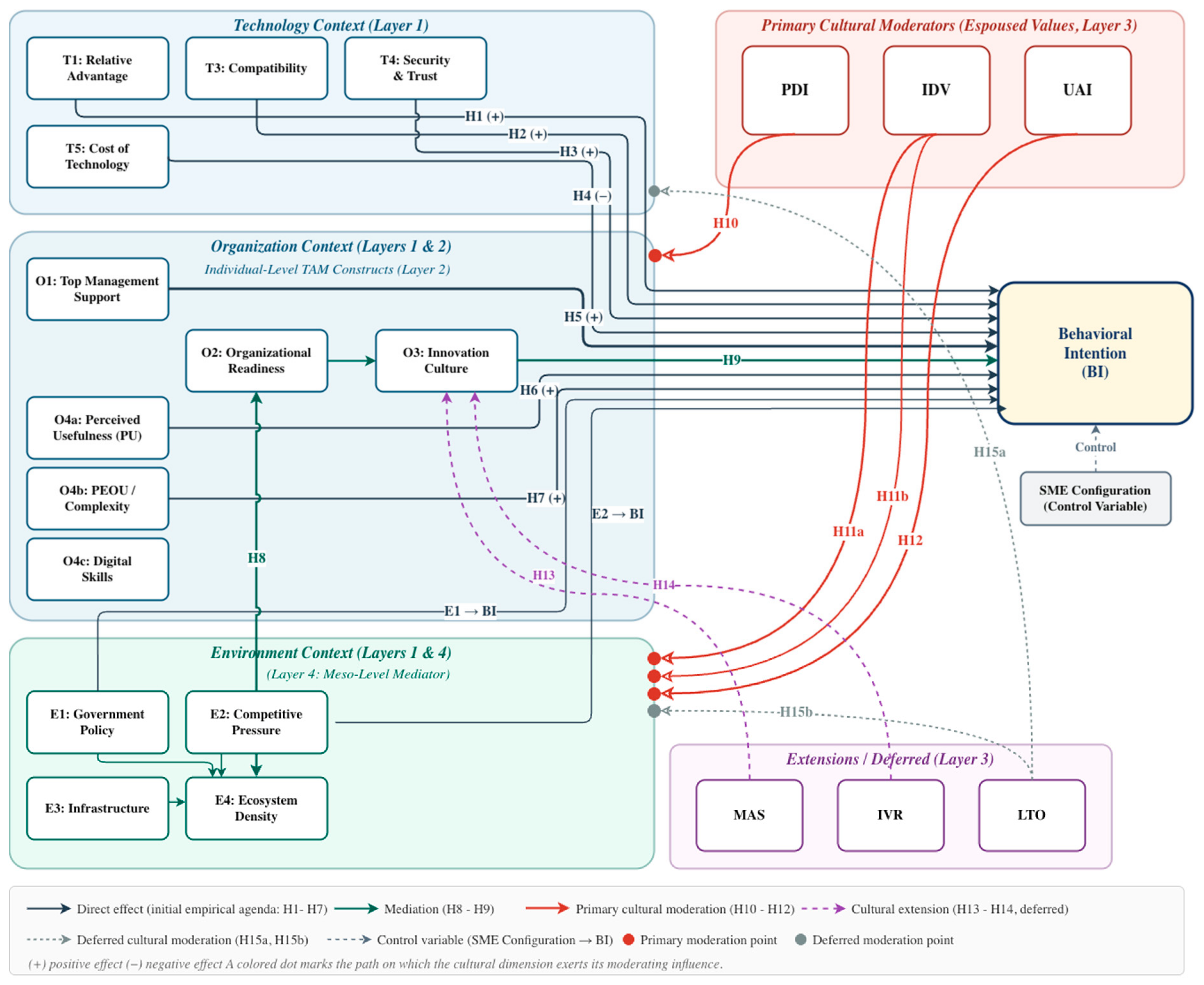
The CC-DTM integrates four theoretical foundations in a deliberate hierarchical sequence. The TOE framework provides the macro-level structural classification of adoption determinants but lacks individual-level mechanisms explaining how decision-makers process technology. TAM fills this gap by specifying perceived usefulness and perceived ease of use as individual-level predictors, yet neither TOE nor TAM accounts for the cultural conditioning that shapes these perceptions in non-Western contexts. Hofstede’s cultural dimensions, operationalized as individual-level espoused values rather than national aggregate scores, supply the cultural moderation layer that addresses this omission. Finally, Ecosystem Density introduces a meso-level mediator between the environmental context and organizational readiness, bridging a structural gap that none of the preceding frameworks address. Each successive layer responds to a specific limitation of the previous one, producing a unified architecture rather than an additive combination of independent theories. The full model specifies 22 constructs and 15 directional hypotheses; however, the initial empirical agenda centers on a Minimum Viable Model (MVM) comprising five core constructs and three cultural moderators (H1–H12), with the remaining hypotheses (H13–H15) deferred as theoretical extensions for subsequent validation phases.
1.1. The TOE Framework as Structural Base
The Technology-Organization-Environment (TOE) framework [
6] provides the structural foundation of the proposed model. Its dominance in the SME technology adoption literature (33.87% of 256 articles in the primary SLR; 33.9% across 21 secondary studies in the umbrella review) justifies its selection as the base architecture into which individual-level acceptance constructs and cultural moderators can be integrated [
10,
12].
Qalati [
15], studying 316 SMEs in Pakistan, demonstrated that TOE factors explain 77.7% of variance in social media adoption (R-squared = 0.777), with top management support as the strongest predictor (beta = 0.381,
p < 0.01). Ghobakhloo et al. [
16] identified eight clusters of technological determinants and 11 clusters of organizational determinants, confirming that organizational factors override technological factors in explaining adoption among manufacturing SMEs.
1.2. TAM at the Individual/Decision-Maker Level
The Technology Acceptance Model [
5] contributes individual-level constructs: Perceived Usefulness (PU), Perceived Ease of Use (PEOU), and Behavioral Intention (BI). These are critical because SMEs, particularly MSEs, are characterized by owner-manager concentration of decision-making authority. Of 256 articles in the reviewed corpus, only 10 simultaneously employ both TAM and TOE, including Gunawan et al. [
17], who integrated TAM, TOE, DOI, and Guanxi theory for e-wallet adoption in Indonesian SMEs, and Bvuma and Marnewick [
18] who combined Actor-Network Theory with TAM and TOE for ICT adoption in South African township SMMEs.
1.3. Hofstede’s Cultural Dimensions as Moderators
Hofstede’s cultural dimensions model [
11,
19] (first and second editions, respectively) provides six national-level dimensions: Power Distance Index (PDI), Individualism vs. Collectivism (IDV), Masculinity vs. Femininity (MAS), Uncertainty Avoidance Index (UAI), Long-Term Orientation (LTO), and Indulgence vs. Restraint (IVR). The rationale for selecting Hofstede’s framework rests on: (a) it is the most recognized framework for studying cross-cultural issues in technology adoption [
14]; (b) the VSM provides standardized instruments enabling cross-national comparison; and (c) existing country scores provide baseline profiles for contextualizing adoption behavior. Chile’s scores (PDI = 63, IDV = 23, MAS = 28, UAI = 86, LTO = 31, IVR = 68) are broadly aligned with Latin American regional averages (PDI = 67, IDV = 21, MAS = 49, UAI = 80, LTO = 25, IVR = 66). A notable exception is MAS, where Chile (28) scores well below the regional mean (49) and all comparator countries (Colombia 49, Ecuador 63, Peru 42). This divergence means that MAS-related hypotheses (H13) may behave differently in Chile and is acknowledged as a boundary condition on cross-country transferability.
The selection of Hofstede’s framework has been subject to considerable debate. Multiple critiques have emerged: McSweeney [
20] questions the methodological validity of inferring national culture from a single-company (IBM) sample; Baskerville [
21] contends that equating nations with cultures constitutes a category error that obscures subnational heterogeneity; Kirkman, Lowe, and Gibson [
22] demonstrate through meta-analyses that many Hofstede-based studies do not test the framework’s core assumptions; and Taras, Kirkman, and Steel [
23] find that cultural values shift across generations, challenging the temporal stability of Hofstede’s original scores. The CC-DTM addresses the most significant of these critiques, specifically the ecological fallacy and temporal decay, by operationalizing cultural dimensions at the individual level as espoused values, measured using validated survey items administered contemporaneously with data collection. This approach eliminates dependence on national aggregate scores and reflects the respondent’s current cultural orientation rather than a historical national average. Remaining limitations of this operationalization, such as potential conceptual overlap among dimensions, social-desirability bias in self-reported values, and the influence of culturally familiar language in translated items, are discussed in
Section 5.2.
1.4. Ecosystem Density as Meso-Level Construct
Previous research [
12] introduced ‘ecosystem density’ as a meso-level mediator, defined as the concentration and accessibility of specialized support resources, such as financial institutions, training providers, technology vendors, peer networks, and public programs, within a given territorial unit. To prevent conceptual circularity between the configurational typology and the ecosystem density construct (E4), the CC-DTM defines configurations exclusively on the basis of internal SME attributes, including firm size, the concentration of decision-making authority, internal digital capability, and organizational complexity. External contextual features, such as ecosystem density, territorial infrastructure, and policy reach, are represented as independent constructs (E1, E3, E4) that interact with, but do not define, the configurations [
12].
Configuration 1 (Resource-Lean) describes microenterprises (1–9 employees) characterized by sole owner-manager decision-making, minimal internal digital capability, absence of dedicated IT or management functions, and low organizational complexity. Adoption decisions collapse onto a single individual and depend primarily on owner-manager perceptions and skills.
Configuration 2 (Resource-Transitioning) characterizes small enterprises (10–49 employees) with partial internal digital capability, emerging functional differentiation between operational and managerial roles, and incipient formalization of decision processes. Adoption becomes distributed between the owner-manager and newly specialized staff.
Configuration 3 (Resource-Rich, Capability-Constrained) applies to medium enterprises (50–199 employees) with dedicated IT staff or designated technology managers, formalized internal processes, and substantially higher organizational complexity. Adoption is constrained by legacy systems, coordination costs across functions, and resistance-to-change mechanisms rather than by resource scarcity.
The interaction between a firm’s internal configuration (C1–C3) and external ecosystem density (E4) produces context-specific adoption patterns. In low-density ecosystems, the constraints of C1 firms are magnified. Conversely, high-density ecosystems enhance the capabilities of C3 firms while simultaneously increasing their coordination complexity. This configuration and ecosystem density interaction represents a theoretical proposition of the CC-DTM, rather than a component of either construct’s definition.
The Ecosystem Density construct aligns conceptually with established frameworks in the entrepreneurial ecosystems literature [
24,
25,
26] and regional innovation systems [
27,
28]. These frameworks describe the density and interconnectedness of support actors, such as financial, knowledge, market, and institutional entities, within a geographic region. However, the CC-DTM’s Ecosystem Density construct diverges from these frameworks in three key dimensions. First, regarding scope, entrepreneurial ecosystem frameworks (e.g., Stam, 2015 [
25]) address the entire lifecycle of venture creation, including market access, talent pools, and exit mechanisms. In contrast, Ecosystem Density in the CC-DTM is limited to support resources directly relevant to technology adoption by existing small and medium-sized enterprises (SMEs), specifically financial institutions, training providers, technology vendors, peer networks, and public programs. Second, in terms of level of analysis, regional innovation systems typically operate at the meso-to-macro level (region or nation), whereas Ecosystem Density is operationalized at the territorial unit surrounding the individual firm, allowing for within-region variance. Third, concerning functional role, in the CC-DTM, Ecosystem Density serves as a mediator (H8: E4 implies O2) that links environmental conditions to organizational readiness, rather than functioning as a standalone outcome or background condition. Thus, the construct should be regarded as a domain-specific adaptation of the ecosystem concept, tailored to the technology-adoption context and formalized for structural equation modeling.
3. Formal Hypotheses
The CC-DTM generates testable propositions that together comprise the full conceptual model (22 constructs and 15 directional hypotheses, with H11 and H15 each specifying two subroutes: H11a/H11b and H15a/H15b). The hypotheses are organized into four tiers: direct-effect hypotheses (H1–H7), mediating hypotheses (H8–H9), primary cultural moderation hypotheses (H10–H12), and extension and deferred hypotheses (H13–H15). Throughout the manuscript, the initial empirical agenda refers to H1–H12 and corresponds to the Minimum Viable Model; the deferred extensions refer to H13–H15 and require either larger samples, multi-country data, or specific contextual conditions and are not part of the initial Chilean validation.
A methodological clarification regarding terminology is necessary. Certain theory-building traditions distinguish between ‘propositions’ for conceptual articles and ‘hypotheses’ for empirical studies (Whetten [
44]; Dubin [
45]). In alignment with MacKenzie, Podsakoff, and Podsakoff [
46], this paper intentionally employs the term ‘hypotheses,’ as they contend that theory-building is enhanced when relationships are articulated with sufficient directionality and precision to allow for direct empirical testing. The CC-DTM provides a comprehensive validation roadmap (
Section 4) that details instrument design, sample parameters, and the analytical technique (PLS-SEM). Consequently, the relationships presented here constitute testable directional predictions rather than open-ended explanatory statements. The use of ‘hypotheses’ signals empirical readiness, without implying that data collection or analysis has occurred within this paper.
3.1. Direct-Effect Hypotheses
These hypotheses specify the baseline structural relationships within the TOE-TAM integration, independent of cultural moderation. The formal specification is provided in
Table 9.
3.2. Mediating Hypotheses
Two mediating hypotheses specify the indirect transmission mechanisms within the CC-DTM architecture (see
Table 10).
3.3. Primary Cultural Moderation Hypotheses (MVM)
These are the core hypotheses that distinguish the CC-DTM from existing models. They specify that cultural dimensions, measured as individually espoused values [
29], moderate specific structural paths. The full specification appears in
Table 11.
3.4. Extension and Deferred Hypotheses
These hypotheses are retained for theoretical completeness and are not included in the initial empirical agenda (see
Table 12). Their inclusion serves two primary functions that justify their specification prior to empirical testing. First, they delineate the full theoretical scope of the CC-DTM, indicating to the field which relationships the model predicts but cannot yet empirically test. This approach aligns with conventions in theory-building articles, which aim to prevent future researchers from treating untested paths as unanticipated or post hoc [
44]. Second, these hypotheses provide explicit criteria for when the deferred paths become testable: H13 and H14 require multi-country variance on MAS and IVR, while H15a and H15b necessitate either a larger sample or longitudinal data to capture LTO moderation effects. Without this specification, the conditions for advancing the research program would remain implicit.
6. Conclusions
The Culturally Contextualized Digital Transformation Model (CC-DTM) is introduced as a conceptual, theory-building contribution that addresses the persistent gap in technology adoption research concerning the sociocultural specificities of small and medium-sized enterprises (SMEs) in developing countries. The CC-DTM proposed in this paper and its 15 propositions constitute an exploratory framework at the theoretical construction stage, and its validity awaits verification through subsequent empirical research. The CC-DTM synthesizes three established theoretical foundations: the Technology-Organization-Environment (TOE) framework [
6] for structural classification, the Technology Acceptance Model (TAM) [
5] for individual-level acceptance, and Hofstede’s cultural dimensions [
18] as moderators. This integration is further enhanced by the novel Ecosystem Density construct [
12], which serves as a meso-level mediator. The model is presented as a theoretically grounded framework intended for empirical validation, rather than as a report of empirical findings [
5,
6,
12,
19].
The CC-DTM advances three primary theoretical contributions. First, it addresses the ecological fallacy in cross-cultural information systems research by employing Srite and Karahanna’s [
29] espoused cultural values approach, which measures cultural dimensions at the individual level rather than relying on national-level aggregates. Second, it delineates the mechanisms by which cultural dimensions moderate adoption relationships, offering architectural explanations [
41] that extend beyond mere statistical associations. Third, it introduces a three-configuration typology—Resource-Lean, Resource-Transitioning, and Resource-Rich Capability-Constrained—that reflects the structural heterogeneity of SMEs in developing countries [
29,
41].
Practically, the CC-DTM provides actionable guidance for policymakers and technology program designers. The identified cultural moderation mechanisms indicate that technology promotion strategies should be culturally calibrated. For example, in high power distance index (PDI) contexts, hierarchical authority channels should be leveraged; in low individualism (IDV) contexts, peer validation and community-based adoption should be emphasized; and in high uncertainty avoidance index (UAI) contexts, usability and operational simplicity should be prioritized over functional richness. The configurational framework further supports the design of targeted interventions, acknowledging that a uniform approach to SME digitalization is unsustainable.
The CC-DTM advances the sustainability discourse in development economics through three explicit mechanisms, as detailed below. First, by embedding cultural contextualization within the technology adoption process, the model facilitates sustainable technology transfer. Digital initiatives that align with local values, practices, and institutional structures are less likely to experience design-reality gaps, as Heeks [
4] theorizes, and more likely to generate enduring economic value for firms and their communities (SDG 8). The CC-DTM does not operationalize Heeks’s ITPOSMO framework directly; rather, it draws on the design-reality gap concept as a diagnostic lens to motivate the need for culturally contextualized adoption models. The specific operationalization of contextual mismatch in the CC-DTM is achieved through the cultural moderation and Ecosystem Density constructs.
Second, the ecosystem density construct establishes a direct link between SME digitalization and sustainable infrastructure. Regions with denser support ecosystems offer more sustainable pathways for digital industrialization, indicating that investments in ecosystem development can yield compounding sustainability benefits across the SME sector (SDG 9) [
2]. Third, the espoused-IDV moderator identifies a mechanism through which culturally calibrated policy instruments can reach resource-lean firms that uniform interventions often exclude, thereby reducing the digital divide among SMEs in collectivist contexts (SDG 10). These mechanisms establish testable connections between the model and sustainability outcomes that extend beyond adoption intention [
2,
4]. As conceptual propositions, these mechanisms require empirical examination in the subsequent quantitative validation phase [
2,
4].
This paper establishes the CC-DTM as a conceptual contribution. The next phase involves quantitative validation, as outlined in
Section 4, utilizing a sample of at least 200 Chilean SMEs and partial least squares structural equation modeling (PLS-SEM). Subsequent cross-country replication will assess the stability of cultural moderation effects across structurally similar developing countries, forming the immediate research agenda.





 ,
,