Article

Digital Transformation in SMEs in Developing Countries: A Culturally Contextualized Theory-Building Model

by
Jaime Díaz-Arancibia
1,*,
Ana Bustamante-Mora
1,
Jeferson Arango-López
2 and
Gabriel M. Ramírez Villegas
3
1
Departamento de Ciencias de la Computación e Informática, Universidad de La Frontera, Temuco 4780000, Chile
2
Departamento de Sistemas e Informática, Facultad de Inteligencia Artificial e Ingenierías, Universidad de Caldas, Caldas 170004, Colombia
3
Facultad de Ingenierías, Universidad de Medellín, Medellín 050010, Colombia
*
Author to whom correspondence should be addressed.
Systems 2026, 14(7), 724; https://doi.org/10.3390/systems14070724 (registering DOI)
Submission received: 20 April 2026 / Revised: 12 June 2026 / Accepted: 16 June 2026 / Published: 23 June 2026

Abstract

Digital transformation among small and medium enterprises (SMEs) in developing countries is limited by a persistent gap between prevailing adoption frameworks and the sociocultural realities of target populations. Frameworks such as the Technology Acceptance Model (TAM), the Technology-Organization-Environment (TOE) framework, UTAUT, and IDT were originally developed for industrialized contexts and do not adequately account for the cultural factors influencing adoption behavior in structurally distinct environments. A systematic mapping of 256 articles revealed that only 14 consider cultural behavior as a variable, and none utilize a validated cultural measurement instrument. This study introduces the Culturally Contextualized Digital Transformation Model (CC-DTM), a four-layer theoretical architecture that integrates the TOE framework, TAM constructs, and Hofstede’s cultural dimensions, operationalized as individual-level espoused values rather than national aggregate scores. The model incorporates a novel meso-level construct, Ecosystem Density, which mediates the relationship between environmental context and organizational readiness. The CC-DTM specifies 22 constructs and 15 directional hypotheses, organized into an initial empirical agenda (H1–H12) and deferred extensions (H13–H15). Additionally, a three-configuration typology based on internal SME attributes is developed. A two-phase validation roadmap, consisting of expert-panel content assessment and configurational case illustration across ten Chilean SMEs, is proposed.

1. Introduction

Digital transformation is a critical enabler of sustainable development, especially for SMEs in developing countries [1]. The United Nations Sustainable Development Goals (SDGs)—particularly SDGs 8 (Decent Work and Economic Growth), 9 (Industry, Innovation, and Infrastructure), and 10 (Reduced Inequalities)—identify technology adoption as a path to economic inclusion and lasting growth [2]. However, digital transformation’s effectiveness depends on whether adoption models address the sociocultural contexts of target populations, a factor largely neglected in the existing literature.
Building on this understanding, for SMEs in developing countries, which represent over 90% of businesses and provide more than 50% of employment [3], sustainable digital transformation requires models that move beyond technological determinism to incorporate cultural, institutional, and ecosystem factors that shape adoption behavior. The persistent application of adoption models developed in industrialized-country contexts risks what Heeks [4] termed ‘design-reality gaps,’ in which technology initiatives fail to align with local realities. This article proposes a Culturally Contextualized Digital Transformation Model (CC-DTM) that incorporates cultural dimensions as structural moderators within a unified TOE-TAM framework, thereby advancing the discourse on sustainable technology transfer in development economics.
In light of these challenges, it is important to note that existing technology adoption models (predominantly TAM [5], TOE [6], UTAUT [7], and IDT [8]) were developed within and for industrialized-country contexts. Their direct transposition to SMEs in developing countries introduces a systematic validity gap, as these models do not account for the sociocultural specificities that shape technology adoption behavior in such circumstances [9].
This lack of contextualization has been documented in prior work by the authors. In a systematic mapping of 256 articles from five databases (2018–2023), Diaz-Arancibia et al. [10] demonstrated that while the TOE framework dominates the literature (33.87%), followed by TAM (27.02%), only 14 of 256 articles mention cultural behavior as a factor, and none employ a standardized cultural instrument such as Hofstede’s Values Survey Module (VSM) [10]. The VSM is Hofstede’s standardized questionnaire designed to measure cultural value dimensions at both national and individual levels [11]. This finding was further corroborated by an umbrella review that synthesized 21 secondary studies, none of which operationalize national culture using validated dimensional frameworks [12].
Independent analyses outside the authors’ research program support this gap: McCoy, Galletta, and King [13] cautioned that applying TAM across cultures without accounting for cultural variation risks systematic misspecification, and Jan et al. [14] located only a small number of primary studies (k ranging from 6 to 12 per dimension) that quantitatively integrate Hofstede’s dimensions into TAM, despite three decades of research.
This gap pertains to the secondary literature on SME technology adoption; primary studies in the broader IS field, have operationalized cultural dimensions at the individual level. The CC-DTM builds on this primary-study foundation while addressing the fact that it has not been integrated into the SME adoption frameworks synthesized in these secondary reviews.
To build on this evidence, the meta-analysis by Jan, Alshare, and Lane [14] provides the most direct quantitative evidence for the mechanism by which cultural dimensions influence technology acceptance constructs. Their analysis of studies from 1989 to 2019 found that: (a) Individualism negatively predicts Intention to Use (weight = 0.83); (b) Power Distance positively predicts Behavioral Intention (weight = 1.0, 6/6 studies significant, though the small number of primary studies limits the robustness of this estimate); and (c) Uncertainty Avoidance appears as a strong predictor of Perceived Ease of Use. These findings show that cultural dimensions systematically moderate the relationships between core TAM constructs.
Meta-analytic weights derived from small study counts (k = 6 for PDI) should be interpreted as directional indicators of effect consistency rather than as precise parameter estimates. The CC-DTM applies these findings to justify the selection and directionality of cultural moderators, rather than to quantify their expected effect sizes.
Taken together, these findings establish the empirical warrant for a culturally contextualized adoption framework. The remainder of this paper is devoted to constructing that framework, the CC-DTM, rather than to extending the mapping or meta-analytic evidence cited above.
The CC-DTM integrates four theoretical foundations in a deliberate hierarchical sequence. The TOE framework provides the macro-level structural classification of adoption determinants but lacks individual-level mechanisms explaining how decision-makers process technology. TAM fills this gap by specifying perceived usefulness and perceived ease of use as individual-level predictors, yet neither TOE nor TAM accounts for the cultural conditioning that shapes these perceptions in non-Western contexts. Hofstede’s cultural dimensions, operationalized as individual-level espoused values rather than national aggregate scores, supply the cultural moderation layer that addresses this omission. Finally, Ecosystem Density introduces a meso-level mediator between the environmental context and organizational readiness, bridging a structural gap that none of the preceding frameworks address. Each successive layer responds to a specific limitation of the previous one, producing a unified architecture rather than an additive combination of independent theories. The full model specifies 22 constructs and 15 directional hypotheses; however, the initial empirical agenda centers on a Minimum Viable Model (MVM) comprising five core constructs and three cultural moderators (H1–H12), with the remaining hypotheses (H13–H15) deferred as theoretical extensions for subsequent validation phases.

1.1. The TOE Framework as Structural Base

The Technology-Organization-Environment (TOE) framework [6] provides the structural foundation of the proposed model. Its dominance in the SME technology adoption literature (33.87% of 256 articles in the primary SLR; 33.9% across 21 secondary studies in the umbrella review) justifies its selection as the base architecture into which individual-level acceptance constructs and cultural moderators can be integrated [10,12].
Qalati [15], studying 316 SMEs in Pakistan, demonstrated that TOE factors explain 77.7% of variance in social media adoption (R-squared = 0.777), with top management support as the strongest predictor (beta = 0.381, p < 0.01). Ghobakhloo et al. [16] identified eight clusters of technological determinants and 11 clusters of organizational determinants, confirming that organizational factors override technological factors in explaining adoption among manufacturing SMEs.

1.2. TAM at the Individual/Decision-Maker Level

The Technology Acceptance Model [5] contributes individual-level constructs: Perceived Usefulness (PU), Perceived Ease of Use (PEOU), and Behavioral Intention (BI). These are critical because SMEs, particularly MSEs, are characterized by owner-manager concentration of decision-making authority. Of 256 articles in the reviewed corpus, only 10 simultaneously employ both TAM and TOE, including Gunawan et al. [17], who integrated TAM, TOE, DOI, and Guanxi theory for e-wallet adoption in Indonesian SMEs, and Bvuma and Marnewick [18] who combined Actor-Network Theory with TAM and TOE for ICT adoption in South African township SMMEs.

1.3. Hofstede’s Cultural Dimensions as Moderators

Hofstede’s cultural dimensions model [11,19] (first and second editions, respectively) provides six national-level dimensions: Power Distance Index (PDI), Individualism vs. Collectivism (IDV), Masculinity vs. Femininity (MAS), Uncertainty Avoidance Index (UAI), Long-Term Orientation (LTO), and Indulgence vs. Restraint (IVR). The rationale for selecting Hofstede’s framework rests on: (a) it is the most recognized framework for studying cross-cultural issues in technology adoption [14]; (b) the VSM provides standardized instruments enabling cross-national comparison; and (c) existing country scores provide baseline profiles for contextualizing adoption behavior. Chile’s scores (PDI = 63, IDV = 23, MAS = 28, UAI = 86, LTO = 31, IVR = 68) are broadly aligned with Latin American regional averages (PDI = 67, IDV = 21, MAS = 49, UAI = 80, LTO = 25, IVR = 66). A notable exception is MAS, where Chile (28) scores well below the regional mean (49) and all comparator countries (Colombia 49, Ecuador 63, Peru 42). This divergence means that MAS-related hypotheses (H13) may behave differently in Chile and is acknowledged as a boundary condition on cross-country transferability.
The selection of Hofstede’s framework has been subject to considerable debate. Multiple critiques have emerged: McSweeney [20] questions the methodological validity of inferring national culture from a single-company (IBM) sample; Baskerville [21] contends that equating nations with cultures constitutes a category error that obscures subnational heterogeneity; Kirkman, Lowe, and Gibson [22] demonstrate through meta-analyses that many Hofstede-based studies do not test the framework’s core assumptions; and Taras, Kirkman, and Steel [23] find that cultural values shift across generations, challenging the temporal stability of Hofstede’s original scores. The CC-DTM addresses the most significant of these critiques, specifically the ecological fallacy and temporal decay, by operationalizing cultural dimensions at the individual level as espoused values, measured using validated survey items administered contemporaneously with data collection. This approach eliminates dependence on national aggregate scores and reflects the respondent’s current cultural orientation rather than a historical national average. Remaining limitations of this operationalization, such as potential conceptual overlap among dimensions, social-desirability bias in self-reported values, and the influence of culturally familiar language in translated items, are discussed in Section 5.2.

1.4. Ecosystem Density as Meso-Level Construct

Previous research [12] introduced ‘ecosystem density’ as a meso-level mediator, defined as the concentration and accessibility of specialized support resources, such as financial institutions, training providers, technology vendors, peer networks, and public programs, within a given territorial unit. To prevent conceptual circularity between the configurational typology and the ecosystem density construct (E4), the CC-DTM defines configurations exclusively on the basis of internal SME attributes, including firm size, the concentration of decision-making authority, internal digital capability, and organizational complexity. External contextual features, such as ecosystem density, territorial infrastructure, and policy reach, are represented as independent constructs (E1, E3, E4) that interact with, but do not define, the configurations [12].
  • Configuration 1 (Resource-Lean) describes microenterprises (1–9 employees) characterized by sole owner-manager decision-making, minimal internal digital capability, absence of dedicated IT or management functions, and low organizational complexity. Adoption decisions collapse onto a single individual and depend primarily on owner-manager perceptions and skills.
  • Configuration 2 (Resource-Transitioning) characterizes small enterprises (10–49 employees) with partial internal digital capability, emerging functional differentiation between operational and managerial roles, and incipient formalization of decision processes. Adoption becomes distributed between the owner-manager and newly specialized staff.
  • Configuration 3 (Resource-Rich, Capability-Constrained) applies to medium enterprises (50–199 employees) with dedicated IT staff or designated technology managers, formalized internal processes, and substantially higher organizational complexity. Adoption is constrained by legacy systems, coordination costs across functions, and resistance-to-change mechanisms rather than by resource scarcity.
The interaction between a firm’s internal configuration (C1–C3) and external ecosystem density (E4) produces context-specific adoption patterns. In low-density ecosystems, the constraints of C1 firms are magnified. Conversely, high-density ecosystems enhance the capabilities of C3 firms while simultaneously increasing their coordination complexity. This configuration and ecosystem density interaction represents a theoretical proposition of the CC-DTM, rather than a component of either construct’s definition.
The Ecosystem Density construct aligns conceptually with established frameworks in the entrepreneurial ecosystems literature [24,25,26] and regional innovation systems [27,28]. These frameworks describe the density and interconnectedness of support actors, such as financial, knowledge, market, and institutional entities, within a geographic region. However, the CC-DTM’s Ecosystem Density construct diverges from these frameworks in three key dimensions. First, regarding scope, entrepreneurial ecosystem frameworks (e.g., Stam, 2015 [25]) address the entire lifecycle of venture creation, including market access, talent pools, and exit mechanisms. In contrast, Ecosystem Density in the CC-DTM is limited to support resources directly relevant to technology adoption by existing small and medium-sized enterprises (SMEs), specifically financial institutions, training providers, technology vendors, peer networks, and public programs. Second, in terms of level of analysis, regional innovation systems typically operate at the meso-to-macro level (region or nation), whereas Ecosystem Density is operationalized at the territorial unit surrounding the individual firm, allowing for within-region variance. Third, concerning functional role, in the CC-DTM, Ecosystem Density serves as a mediator (H8: E4 implies O2) that links environmental conditions to organizational readiness, rather than functioning as a standalone outcome or background condition. Thus, the construct should be regarded as a domain-specific adaptation of the ecosystem concept, tailored to the technology-adoption context and formalized for structural equation modeling.

2. The CC-DTM: Model Formalization

2.1. Model Architecture Overview

The CC-DTM framework comprises four theoretical layers (see Table 1). The first layer includes the three Technology-Organization-Environment (TOE) dimensions: Technology Context, Organization Context, and Environment Context. The second layer incorporates Technology Acceptance Model (TAM) constructs, specifically Perceived Usefulness (PU) and Perceived Ease of Use (PEOU), within the Organization Context, with mediation by owner-manager characteristics. The third layer introduces three primary Hofstede cultural dimensions (Power Distance Index (PDI), Individualism versus Collectivism (IDV), and Uncertainty Avoidance Index (UAI)) as moderators of specific TOE-TAM relationships, measured at the individual level as espoused values. The fourth layer positions Ecosystem Density as a meso-level mediator between the Environment Context and Organization Context. Three additional Hofstede cultural dimensions (Masculinity versus Femininity (MAS), Long-Term Orientation (LTO), and Indulgence versus Restraint (IVR)) are retained as theoretical extensions for future empirical investigation.

2.2. Representative Model Diagram

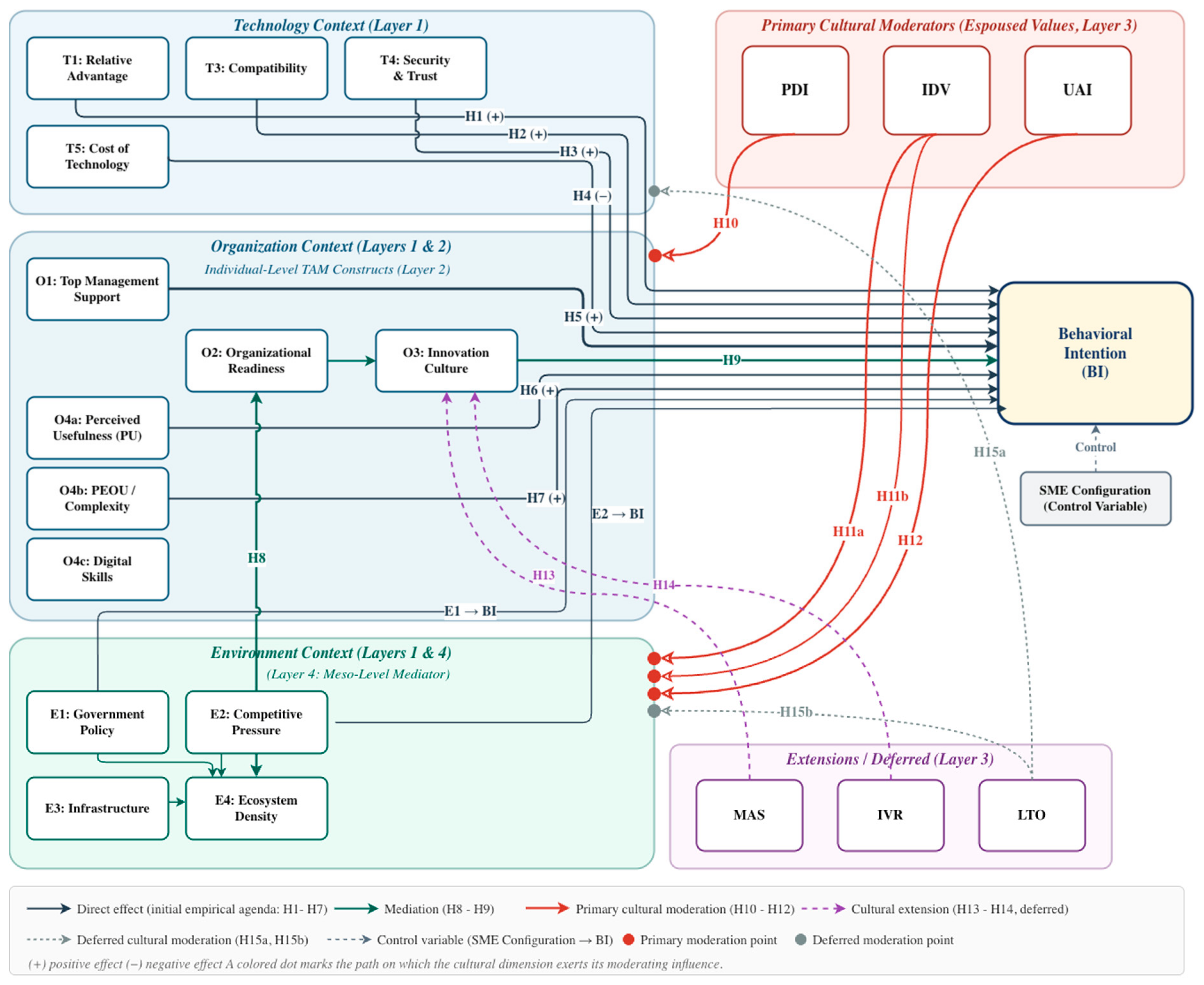
Figure 1 presents the CC-DTM architecture. Solid dark arrows show the direct paths of the initial empirical agenda (H1–H7). Teal arrows indicate the mediation chain: H8 (E4 to O2) and H9 (O3 to BI). E4 acts as a meso-level mediator. It links E1, E2, and E3 to organizational readiness. Solid red arrows ending in red dots mark the main cultural moderation points (H10–H12). The H11b dot is on the E2 to BI path. The H11a dot is on the O4a (PU) to BI path. Dashed purple arrows represent the cultural extension hypotheses: H13 (MAS to O3) and H14 (IVR to O3). Gray dotted arrows ending in gray dots depict the deferred cultural moderation paths: H15a (LTO on T5 to BI) and H15b (LTO on the newly explicit E1 to BI path). Cultural dimensions are measured at the individual level as espoused values, not national Hofstede scores. SME Configuration is a control variable on BI. The broader Configuration by Ecosystem Density interaction is a theoretical proposition of the CC-DTM.

2.3. Construct Specification (Compact Summary)

The CC-DTM encompasses 22 constructs organized across four levels. The following table provides a compact specification integrating all constructs with their definitions, measurement levels, moderation roles, and key theoretical sources. Subsequent subsections discuss only the conceptual rationale and level-of-analysis decisions behind each construct group; readers are referred to Table 2 for the complete specification.

2.4. Cultural Dimension Scores and Individual-Level Measurement

Table 3 summarizes Chile’s Hofstede cultural dimension scores alongside the Latin American regional averages, providing the empirical reference values for the CC-DTM’s cultural moderation hypotheses. Each dimension is mapped to its role within the model architecture, primary moderator (H10–H12), extension (H13–H14), or deferred (H15a/H15b).
Table 4 specifies the level-of-analysis mapping for each CC-DTM construct, distinguishing between individual-level perceptions, firm-level attributes, and meso-level environmental conditions. This mapping is critical because the CC-DTM operates across multiple analytical levels, and misalignment between the theoretical level and the measurement level is a recognized source of validity threats in cross-cultural IS research.

2.5. Cultural Moderation Mechanisms

The CC-DTM identifies three primary cultural moderators (power distance (PDI), individualism (IDV), and uncertainty avoidance (UAI)) which are measured at the individual level using espoused values [29]. This methodology addresses the ecological fallacy in cross-cultural information systems research [13] by assessing cultural dimensions based on individually endorsed values rather than national-level Hofstede scores. Empirical validation by Srite and Karahanna [29] demonstrates that cultural moderation occurs at the level of individually held values rather than national aggregates. This individual-level operationalization addresses three widely recognized limitations of Hofstede’s framework. First, it eliminates the assumption of a single, stable national cultural profile by measuring each respondent’s cultural orientation independently, thereby allowing for within-country variance rather than imposing a national average. Second, it removes reliance on the original IBM survey data from the 1970s, as cultural values are assessed contemporaneously, reflecting respondents’ current orientations shaped by migration, generational change, globalization, and digitalization. Third, intra-national heterogeneity (regional, ethnic, generational, and organizational) is not obscured but instead becomes the primary source of between-respondent variance that the moderation hypotheses (H10–H12) utilize. Thus, the CC-DTM relies on cultural heterogeneity within the sample to detect moderation effects, treating it as a methodological strength rather than a confounding factor. Table 5 specifies the path, moderation type, and supporting evidence for each cultural dimension.
The theoretical distinction between moderation and mediation has direct implications for model specification. Cultural dimensions serve as moderators rather than mediators because they provide conditioning contexts rather than direct causes of adoption. For example, a high level of uncertainty avoidance (UAI) does not directly cause adoption but alters the relative importance of factors such as perceived ease of use (PEOU) compared to perceived usefulness (PU). A moderator is defined by its ability to change the strength or direction of the relationship between an independent and a dependent variable [36]. Furthermore, cultural dimensions are relatively stable over time, whereas TOE-TAM constructs are situation-specific, positioning cultural dimensions as antecedents to adoption decisions.
Table 5. Cultural dimension path specification summary.
Hofstede DimensionPathTypeHypothesisEvidence
PDIO1(TMS) --> BIModerationH10Jan et al. [14]: weight = 1.0, 6/6 significant
IDVO4a(PU) --> BIModerationH11aJan et al. [14]: weight = 0.83, negatively predicts BI
IDVE2(Pressure) --> BIModerationH11bQalati et al. [15]: Pakistan IDV = 14, pressure significant
UAIO4b(PEOU) --> BIModerationH12Jan et al. [14]: strong predictor of PEOU
MASMAS --> O3 --> ReadinessMediation via O3H13Leso et al. [33]; Diaz-Arancibia et al. [37]
IVRIVR --> O3 --> ReadinessMediation via O3H14Sumrit [35]: digital culture as root cause
LTOE1(GovPolicy)/T5(Cost)ModerationH15a, H15bGhobakhloo et al. [16]: 27% cost barriers

2.6. Minimum Viable Model and Parsimony

The MVM retains 5 core constructs and 3 cultural moderators, yielding 4 primary moderation paths (see Table 6) envisaged for testing with the target sample of 150–200 respondents:
The reduction from the full architecture to the MVM is guided by three parsimony criteria, rather than solely by sample-size constraints. The first criterion, theoretical centrality, ensures that the retained constructs (T1–T3 at the technology layer, O4a/O4b at the individual layer, and BI as the dependent variable) represent the paths most consistently supported in the Technology Acceptance Model (TAM) and Technology-Organization-Environment (TOE) literatures (Davis [5]; Tornatzky and Fleischer [6]; Qalati [15]). The second criterion, cultural moderation salience, prioritizes the three retained moderators (PDI, IDV, UAI), which Jan et al. [14] identify as having the strongest meta-analytic weights and the most consistent directional effects on TAM constructs. MAS, LTO, and IVR are deferred not because they are theoretically insignificant, but because their effects are weaker, less consistently directional, or require contextual conditions, such as multi-country variance for LTO, which the initial Chilean sample does not provide. The third criterion, empirical tractability, is met as five core constructs and three moderators yield a structural model that can be estimated with 150–200 respondents under Partial Least Squares Structural Equation Modeling (PLS-SEM) minimum thresholds (Hair et al. [38]), while preserving the cultural distinctiveness central to the CC-DTM’s contribution. The deferred hypotheses (H13–H15) remain in the full architecture to indicate the model’s intended scope and to provide a roadmap for future research phases involving expanded samples and cross-country designs.
An a priori power analysis confirms that the target sample size is sufficient to detect the MVM’s moderation effects. According to Kock and Hadaya [39], the inverse square root method for partial least squares structural equation modeling (PLS-SEM) requires a minimum sample size of n = 146 to detect a medium effect size (f-squared = 0.15) with an alpha of 0.05 and power of 0.80. The more conservative approach by Aguirre-Urreta and Ronkko [40], which accounts for measurement error in interaction terms, recommends a minimum sample size of n = 160 for models with three interaction terms. Although the CC-DTM’s MVM specifies four moderation paths, the PDI moderation on O4a -> BI and IDV moderation on O4b -> BI share the same dependent variable, thereby reducing the effective model complexity. Therefore, the target of 150–200 respondents meets or exceeds both recommended thresholds. In terms of within-sample cultural variance, Chile exhibits extreme national scores on IDV (23) and UAI (86). However, the CC-DTM assesses culture at the individual level as espoused values, which Srite and Karahanna [29] demonstrated can vary substantially within nations. This individual-level operationalization does not assume homogeneity among Chilean respondents; instead, it leverages the between-respondent variance that national averages may obscure. Consequently, null results in this design would provide evidence against the moderation hypothesis rather than reflect artifacts of restricted variance.
SME Configuration (Resource-Lean, Resource-Transitioning, Resource-Rich Capability-Constrained) is treated as a categorical control variable in the structural model, allowing its effect on adoption intention to be estimated without requiring separate multi-group analyses. With a target sample of 150–200 respondents, multi-group PLS-SEM (requiring 50 per group) was not feasible, particularly if sample concentration differed across configurations. Multi-group PLS-SEM is recognized as the preferred analytical strategy for testing configuration-specific path differences and is planned for subsequent research phases with larger, stratified samples (minimum n = 50 per configuration group). For initial validation, the control-variable approach provides a conservative, lower-bound test of whether configuration membership exerts a detectable effect on adoption intention, thereby avoiding unstable estimates that may result from underpowered subgroup analyses. Regarding configurations and firm size, although firm size (number of employees) is one of four defining attributes, configurations are not reducible to size bands. Decision-making concentration, internal digital capability, and organizational complexity are conceptually and empirically distinct from headcount. For instance, a 40-employee firm (nominally C2 by size) with a dedicated IT manager, formalized processes, and legacy-system constraints would be classified as C3 based on its internal attributes. The typology’s value lies in its ability to capture structural heterogeneity that a continuous size variable would obscure.

2.7. Scope and Boundary Conditions

According to Wieringa and Daneva [41], every scientific theory must explicitly define its scope. The CC-DTM is classified as a middle-range theory [42]; it does not assert universal applicability to all organizations and technologies, but instead addresses a specific, substantively important class of phenomena. Table 7 specifies these conditions:

2.8. Geographic and Cultural Setting: Chile

The primary empirical validation focuses on small and medium-sized enterprises (SMEs) in Chile, chosen due to its pronounced cultural profile on key dimensions (IDV = 23, UAI = 86), which increases the likelihood of identifying cultural moderation effects. Chile is situated in the southern cone of Latin America and possesses economic structures and digital infrastructure similar to those of other upper-middle-income developing countries in the region, such as Colombia, Ecuador, and Peru. The theoretical scope encompasses developing countries, as classified by the World Bank (low-income, lower-middle-income, or upper-middle-income economies), that exhibit sufficient cultural and structural similarity to Chile (see Table 8).
Chile was selected as the initial validation context based on a strategic-case logic [43]. Its extreme scores on individualism (IDV = 23) and uncertainty avoidance (UAI = 86) maximize the likelihood of detecting cultural moderation effects, rendering it an information-rich case for theory testing. Detection of moderation under these conditions would support extending the model’s applicability to countries with more moderate cultural profiles, such as Colombia (IDV = 13, UAI = 80) and Mexico (IDV = 30, UAI = 82), as a plausible rather than speculative claim. The CC-DTM architecture is intentionally country-agnostic: constructs are defined at the individual and organizational levels, cultural dimensions are measured per respondent rather than assigned by nationality, and Ecosystem Density is operationalized relative to the respondent’s territorial unit. Consequently, cross-country replication requires only instrument translation and local sampling, without necessitating structural modification of the model.

3. Formal Hypotheses

The CC-DTM generates testable propositions that together comprise the full conceptual model (22 constructs and 15 directional hypotheses, with H11 and H15 each specifying two subroutes: H11a/H11b and H15a/H15b). The hypotheses are organized into four tiers: direct-effect hypotheses (H1–H7), mediating hypotheses (H8–H9), primary cultural moderation hypotheses (H10–H12), and extension and deferred hypotheses (H13–H15). Throughout the manuscript, the initial empirical agenda refers to H1–H12 and corresponds to the Minimum Viable Model; the deferred extensions refer to H13–H15 and require either larger samples, multi-country data, or specific contextual conditions and are not part of the initial Chilean validation.
A methodological clarification regarding terminology is necessary. Certain theory-building traditions distinguish between ‘propositions’ for conceptual articles and ‘hypotheses’ for empirical studies (Whetten [44]; Dubin [45]). In alignment with MacKenzie, Podsakoff, and Podsakoff [46], this paper intentionally employs the term ‘hypotheses,’ as they contend that theory-building is enhanced when relationships are articulated with sufficient directionality and precision to allow for direct empirical testing. The CC-DTM provides a comprehensive validation roadmap (Section 4) that details instrument design, sample parameters, and the analytical technique (PLS-SEM). Consequently, the relationships presented here constitute testable directional predictions rather than open-ended explanatory statements. The use of ‘hypotheses’ signals empirical readiness, without implying that data collection or analysis has occurred within this paper.

3.1. Direct-Effect Hypotheses

These hypotheses specify the baseline structural relationships within the TOE-TAM integration, independent of cultural moderation. The formal specification is provided in Table 9.

3.2. Mediating Hypotheses

Two mediating hypotheses specify the indirect transmission mechanisms within the CC-DTM architecture (see Table 10).

3.3. Primary Cultural Moderation Hypotheses (MVM)

These are the core hypotheses that distinguish the CC-DTM from existing models. They specify that cultural dimensions, measured as individually espoused values [29], moderate specific structural paths. The full specification appears in Table 11.

3.4. Extension and Deferred Hypotheses

These hypotheses are retained for theoretical completeness and are not included in the initial empirical agenda (see Table 12). Their inclusion serves two primary functions that justify their specification prior to empirical testing. First, they delineate the full theoretical scope of the CC-DTM, indicating to the field which relationships the model predicts but cannot yet empirically test. This approach aligns with conventions in theory-building articles, which aim to prevent future researchers from treating untested paths as unanticipated or post hoc [44]. Second, these hypotheses provide explicit criteria for when the deferred paths become testable: H13 and H14 require multi-country variance on MAS and IVR, while H15a and H15b necessitate either a larger sample or longitudinal data to capture LTO moderation effects. Without this specification, the conditions for advancing the research program would remain implicit.

4. Validation Roadmap

4.1. Research Design

Consistent with the conceptual positioning of this paper, the CC-DTM is presented as a theory-building contribution; the validation roadmap outlined here constitutes its immediate empirical agenda. Two phases are envisaged. Phase 1 is a structured expert-panel assessment using Lawshe’s [32] Content Validity Ratio (CVR) to establish that the instrument adequately represents the 22 constructs. Phase 2 combines a translate-back-translate protocol with cognitive pre-testing and a configurational case illustration across ten purposively selected Chilean SMEs. The initial empirical agenda does not seek to validate all 22 constructs and 15 hypotheses simultaneously; the MVM (Section 2.6) narrows the testable model to five core constructs and three cultural moderators. The current 102-item instrument is an initial item pool from which a shorter administration-ready form is to be derived.

4.2. Expert Panel Composition

The expert panel comprises 8–12 reviewers drawn from three pools: (a) academics with publications in technology adoption, PLS-SEM methodology, or cross-cultural IS research (minimum 4 members); (b) practitioners with experience in Chilean SME digitalization, including CORFO or SERCOTEC program managers, technology consultants, and SME association leaders; and (c) a methodologist with expertise in survey instrument design and psychometric validation. Including both academics and practitioners ensures that items are assessed simultaneously for theoretical accuracy and contextual relevance in the Chilean SME setting.

4.3. Ethics and Methodological Controls

Standard procedural controls for common method bias are incorporated into the instrument design [36], including psychological separation of predictor and criterion variables, anonymity assurances, counterbalanced item ordering, a subset of reverse-coded items, and a theoretically unrelated marker variable. The study protocol was approved by the Institutional Ethics Committee of Universidad de La Frontera (protocol 036_23, 22 March 2023); informed consent, data encryption, and participant anonymization follow standard institutional procedures [47].

4.4. Illustrative Theoretical Scenarios

The conceptual plausibility of the CC-DTM across the three SME configurations is examined through two complementary analytical exercises: a within-configuration analysis (Table 13) and a cross-configuration comparison (Table 14). Table 13 profiles each configuration based on firm characteristics, decision-making locus, dominant adoption drivers, and anticipated cultural moderation patterns. Table 14 contrasts adjacent configurations across four dimensions: dominant adoption driver, cultural moderation visibility, O2 measurement behavior, and the function of Ecosystem Density as a meso-level mediator.
Considered as a whole, the illustrative-scenario approach contributes to the CC-DTM in three complementary ways. First, it enhances conceptual plausibility by making the model’s constructs and mechanisms recognizable within characteristic SME contexts, serving as a form of conceptual illustration rather than empirical validation. Second, it reveals construct boundary conditions unlikely to be detected in aggregate survey data and should inform the instrument-reduction stage. Third, it offers interpretive scaffolding for future case-based validation by providing a structured articulation of how cultural moderation mechanisms are expected to manifest, thereby supporting the interpretation of quantitative moderation results. These contributions do not replace quantitative psychometric testing; instead, they provide the conceptual foundation that renders such testing theoretically meaningful.

5. Theoretical Discussion and Contributions

This section consolidates the three core theoretical contributions of the CC-DTM and identifies the boundaries and limitations of the framework.

5.1. Theoretical Contributions

The CC-DTM makes three primary theoretical contributions. First, it integrates the TOE framework, TAM, and Hofstede’s cultural dimensions into a unified four-layer architecture with Ecosystem Density as a novel meso-level mediator, producing an integrated model specifically designed for SMEs in developing countries. Unlike existing TOE-TAM hybrids, which treat culture as an undifferentiated contextual variable, the CC-DTM positions cultural dimensions as structural moderators on specific adoption paths, with each hypothesis specifying both the direction and mechanism of the effect. Second, it resolves the ecological fallacy in cross-cultural information systems research by operationalizing cultural dimensions as individual-level espoused values [29] rather than national aggregate scores, ensuring that moderation effects are measured at the level where they theoretically operate. Third, it introduces a three-configuration typology defined exclusively on internal SME attributes (firm size, decision-making concentration, digital capability, and organizational complexity), enabling researchers to account for structural heterogeneity without confounding firm-level characteristics with external ecosystem conditions. These configurations are logically independent of Ecosystem Density, which is defined on external support-actor density, so the two constructs can interact without redundancy.

5.2. Boundaries and Limitations

As stated in the Conclusions, the CC-DTM constitutes an exploratory framework at the theoretical construction stage. Empirical validation is mapped out in the two-phase roadmap (Section 4) and forms the immediate research agenda.
There are four main limitations to note. First, as a conceptual study, the CC-DTM draws on cited theory and literature, but it has not yet received construct-level psychometric validation. This will need to be tested for convergent, discriminant, and criterion validity in the planned quantitative study.
Second, the set of 10 Chilean SME cases is designed for maximum variation across configurations and serves an illustrative, not confirmatory, function. It does not represent the larger Chilean SME population statistically. Cross-regional generalizability depends on subsequent replication in structurally similar developing economies; the model’s individual-level operationalization of cultural dimensions and its country-agnostic construct definitions are designed to facilitate such replication without structural modification.
Third, the cultural moderation mechanisms (H10–H12) are formulated as directional hypotheses supported by theory and meta-analytic evidence, but they have not yet been subjected to empirical testing. Fourth, although the individual-level espoused-values operationalization addresses the ecological fallacy and temporal-stability critiques of Hofstede’s framework (see Section 1.3), it does not resolve concerns about conceptual overlap among dimensions or the potential for social-desirability effects in self-reported cultural values. These remaining vulnerabilities represent a boundary condition for the cultural moderation hypotheses (H10–H15). Fifth, the voluntariness boundary condition excludes mandatory technology adoption (e.g., e-invoicing), but regulatory mandates may indirectly influence voluntary adoption behavior through institutional legitimation and digital-infrastructure spillovers. This indirect pathway is not modeled in the current version of the CC-DTM.

6. Conclusions

The Culturally Contextualized Digital Transformation Model (CC-DTM) is introduced as a conceptual, theory-building contribution that addresses the persistent gap in technology adoption research concerning the sociocultural specificities of small and medium-sized enterprises (SMEs) in developing countries. The CC-DTM proposed in this paper and its 15 propositions constitute an exploratory framework at the theoretical construction stage, and its validity awaits verification through subsequent empirical research. The CC-DTM synthesizes three established theoretical foundations: the Technology-Organization-Environment (TOE) framework [6] for structural classification, the Technology Acceptance Model (TAM) [5] for individual-level acceptance, and Hofstede’s cultural dimensions [18] as moderators. This integration is further enhanced by the novel Ecosystem Density construct [12], which serves as a meso-level mediator. The model is presented as a theoretically grounded framework intended for empirical validation, rather than as a report of empirical findings [5,6,12,19].
The CC-DTM advances three primary theoretical contributions. First, it addresses the ecological fallacy in cross-cultural information systems research by employing Srite and Karahanna’s [29] espoused cultural values approach, which measures cultural dimensions at the individual level rather than relying on national-level aggregates. Second, it delineates the mechanisms by which cultural dimensions moderate adoption relationships, offering architectural explanations [41] that extend beyond mere statistical associations. Third, it introduces a three-configuration typology—Resource-Lean, Resource-Transitioning, and Resource-Rich Capability-Constrained—that reflects the structural heterogeneity of SMEs in developing countries [29,41].
Practically, the CC-DTM provides actionable guidance for policymakers and technology program designers. The identified cultural moderation mechanisms indicate that technology promotion strategies should be culturally calibrated. For example, in high power distance index (PDI) contexts, hierarchical authority channels should be leveraged; in low individualism (IDV) contexts, peer validation and community-based adoption should be emphasized; and in high uncertainty avoidance index (UAI) contexts, usability and operational simplicity should be prioritized over functional richness. The configurational framework further supports the design of targeted interventions, acknowledging that a uniform approach to SME digitalization is unsustainable.
The CC-DTM advances the sustainability discourse in development economics through three explicit mechanisms, as detailed below. First, by embedding cultural contextualization within the technology adoption process, the model facilitates sustainable technology transfer. Digital initiatives that align with local values, practices, and institutional structures are less likely to experience design-reality gaps, as Heeks [4] theorizes, and more likely to generate enduring economic value for firms and their communities (SDG 8). The CC-DTM does not operationalize Heeks’s ITPOSMO framework directly; rather, it draws on the design-reality gap concept as a diagnostic lens to motivate the need for culturally contextualized adoption models. The specific operationalization of contextual mismatch in the CC-DTM is achieved through the cultural moderation and Ecosystem Density constructs.
Second, the ecosystem density construct establishes a direct link between SME digitalization and sustainable infrastructure. Regions with denser support ecosystems offer more sustainable pathways for digital industrialization, indicating that investments in ecosystem development can yield compounding sustainability benefits across the SME sector (SDG 9) [2]. Third, the espoused-IDV moderator identifies a mechanism through which culturally calibrated policy instruments can reach resource-lean firms that uniform interventions often exclude, thereby reducing the digital divide among SMEs in collectivist contexts (SDG 10). These mechanisms establish testable connections between the model and sustainability outcomes that extend beyond adoption intention [2,4]. As conceptual propositions, these mechanisms require empirical examination in the subsequent quantitative validation phase [2,4].
This paper establishes the CC-DTM as a conceptual contribution. The next phase involves quantitative validation, as outlined in Section 4, utilizing a sample of at least 200 Chilean SMEs and partial least squares structural equation modeling (PLS-SEM). Subsequent cross-country replication will assess the stability of cultural moderation effects across structurally similar developing countries, forming the immediate research agenda.


Author Contributions

Conceptualization, J.D.-A. and J.A.-L.; methodology, J.D.-A., G.M.R.V. and A.B.-M.; validation, J.D.-A., J.A.-L. and G.M.R.V.; formal analysis, J.D.-A. and A.B.-M.; investigation, J.D.-A.; resources, J.D.-A.; data curation, J.D.-A. and A.B.-M.; writing—original draft preparation, J.D.-A.; writing—review and editing, J.A.-L., A.B.-M. and G.M.R.V.; project administration, J.D.-A.; funding acquisition, J.D.-A. All authors have read and agreed to the published version of the manuscript.

Funding

Jaime Díaz-Arancibia is supported by Agencia Nacional Investigación y Desarrollo, ANID, CHILE: FONDECYT DE INICIACIÓN EN INVESTIGACIÓN, Project Nº 11230141.

Institutional Review Board Statement

The study was conducted in accordance with the Declaration of Helsinki and approved by Ethics Committee of Universidad de La Frontera (protocol code Nº 036_23 and date of approval, 22 March 2023).

Informed Consent Statement

Informed consent was obtained from all subjects involved in the study.

Data Availability Statement

The original contributions presented in this study are included in the article. Further inquiries can be directed to the corresponding author.

Acknowledgments

Grammarly (https://app.grammarly.com/, accessed on 20 April 2026) was used exclusively for the English-language manuscript text, not for the Spanish instrument items. During the preparation of this manuscript, the author(s) used Grammarly for the purposes of grammar correction. The authors have reviewed and edited the output and take full responsibility for the content of this publication.

Conflicts of Interest

The authors declare no conflicts of interest.

References

  1. Yousaf, Z.; Radulescu, M.; Sinisi, C.I.; Serbanescu, L.; Păunescu, L.M. Towards Sustainable Digital Innovation of SMEs from the Developing Countries in the Context of the Digital Economy and Frugal Environment. Sustainability 2021, 13, 5715. [Google Scholar] [CrossRef]
  2. Three Ways Digital Transformation Accelerates Sustainable and Inclusive Development. Available online: https://www.undp.org/blog/three-ways-digital-transformation-accelerates-sustainable-and-inclusive-development (accessed on 12 April 2026).
  3. Small and Medium Enterprises (SMEs) Finance. Available online: https://www.worldbank.org/ext/en/topic/competitiveness/small-and-medium-enterprises-smes-finance (accessed on 12 April 2026).
  4. Heeks, R. Information Systems and Developing Countries: Failure, Success, and Local Improvisations. Inf. Soc. 2002, 18, 101–112. [Google Scholar] [CrossRef]
  5. Davis, F.D. Perceived Usefulness, Perceived Ease of Use, and User Acceptance of Information Technology. MIS Q. 1989, 13, 319–340. [Google Scholar] [CrossRef] [PubMed]
  6. Tornatzky, L.G.; Fleischer, M.; Chakrabarti, A.K. The Processes of Technological Innovation; Lexington Books: Lanham, MD, USA, 1990; ISBN 9780669203486. [Google Scholar]
  7. Venkatesh, V.; Morris, M.G.; Davis, G.B.; Davis, F.D. User Acceptance of Information Technology: Toward A Unified View1. MIS Q. 2003, 27, 425–478. [Google Scholar] [CrossRef]
  8. Rogers, E.M.; Singhal, A.; Quinlan, M.M. Diffusion of Innovations. In An Integrated Approach to Communication Theory and Research; Lawrence Erlbaum Associates: Mahway, MJ, USA, 2009. [Google Scholar]
  9. Díaz, J.; Rusu, C.; Collazos, C.A. Experimental Validation of a Set of Cultural-Oriented Usability Heuristics: E-Commerce Websites Evaluation. Comput. Stand. Interfaces 2017, 50, 160–178. [Google Scholar] [CrossRef]
  10. Díaz-Arancibia, J.; Hochstetter-Diez, J.; Bustamante-Mora, A.; Sepúlveda-Cuevas, S.; Albayay, I.; Arango-López, J. Navigating Digital Transformation and Technology Adoption: A Literature Review from Small and Medium-Sized Enterprises in Developing Countries. Sustainability 2024, 16, 5946. [Google Scholar] [CrossRef]
  11. Hofstede, G. Culture’s Consequences: International Differences in Work-Related Values; SAGE: Newcastle upon Tyne, UK, 1984; ISBN 9780803913066. [Google Scholar]
  12. Díaz-Arancibia, J.; Bustamante-Mora, A.; Hochstetter-Diez, J.; Ramírez Villegas, G.M. Systematic Mappings on Technology Adoption in Small and Medium-Sized Enterprises from Developing Countries: An Umbrella Review. PeerJ Comput. Sci. 2025, 11, e3395. [Google Scholar] [CrossRef]
  13. McCoy, S.; Galletta, D.F.; King, W.R. Applying TAM across Cultures: The Need for Caution. Eur. J. Inf. Syst. 2007, 16, 81–90. [Google Scholar] [CrossRef]
  14. Jan, J.; Alshare, K.A.; Lane, P.L. Hofstede’s Cultural Dimensions in Technology Acceptance Models: A Meta-Analysis. Univers. Access Inf. Soc. 2024, 23, 717–741. [Google Scholar] [CrossRef]
  15. Qalati, S.A.; Ostic, D.; Sulaiman, M.A.B.A.; Gopang, A.A.; Khan, A. Social Media and SMEs’ Performance in Developing Countries: Effects of Technological-Organizational-Environmental Factors on the Adoption of Social Media. Sage Open 2022, 12, 21582440221094594. [Google Scholar] [CrossRef]
  16. Ghobakhloo, M.; Iranmanesh, M.; Vilkas, M.; Grybauskas, A.; Amran, A. Drivers and Barriers of Industry 4.0 Technology Adoption among Manufacturing SMEs: A Systematic Review and Transformation Roadmap. Int. J. Manuf. Technol. Manag. 2022, 33, 1029–1058. [Google Scholar] [CrossRef]
  17. Gunawan, H.; Wee, S.Y.; Rina, R.; Ikram, B.R. A Model of the E-Wallet Adoption in Small and Medium Enterprises (Sme) Indonesia. J. Theor. Appl. Inf. Technol. 2020, 98, 3100–3111. [Google Scholar]
  18. Bvuma, S.; Marnewick, C. An Information and Communication Technology Adoption Framework for Small, Medium and Micro-Enterprises Operating in Townships South Africa. S. Afr. J. Entrep. Small Bus. Manag. 2020, 12, 12. [Google Scholar] [CrossRef]
  19. Hofstede, G. Culture’s Consequences, 2nd ed.; SAGE Publications: Thousand Oaks, CA, USA, 2001. [Google Scholar]
  20. McSweeney, B. Hofstede’s Model of National Cultural Differences and Their Consequences: A Triumph of Faith—A Failure of Analysis. Hum. Relat. 2002, 55, 89–117. [Google Scholar] [CrossRef]
  21. Baskerville, R.F. Hofstede Never Studied Culture. Account. Organ. Soc. 2003, 28, 1–14. [Google Scholar] [CrossRef]
  22. Kirkman, B.L.; Lowe, K.B.; Gibson, C.B. A Quarter Century of Culture’s Consequences: A Review of Empirical Research Incorporating Hofstede’s Cultural Values Framework. J. Int. Bus. Stud. 2006, 37, 285–320. [Google Scholar] [CrossRef]
  23. Taras, V.; Kirkman, B.L.; Steel, P. Examining the Impact of Culture’s Consequences: A Three-Decade, Multilevel, Meta-Analytic Review of Hofstede’s Cultural Value Dimensions. J. Appl. Psychol. 2010, 95, 405–439. [Google Scholar] [CrossRef] [PubMed]
  24. Isenberg, D. The Entrepreneurship Ecosystem Strategy as a New Paradigm for Economic Policy: Principles for Cultivating Entrepreneurship; Babson College: Babson Park, MA, USA, 2011. [Google Scholar]
  25. Stam, E. Entrepreneurial Ecosystems and Regional Policy: A Sympathetic Critique. Eur. Plan. Stud. 2015, 23, 1759–1769. [Google Scholar] [CrossRef]
  26. Spigel, B. The Relational Organization of Entrepreneurial Ecosystems. Entrep. Theory Pract. 2017, 41, 49–72. [Google Scholar] [CrossRef]
  27. Cooke, P. Regional Innovation Systems, Clusters, and the Knowledge Economy. Ind. Corp. Chang. 2001, 10, 945–974. [Google Scholar] [CrossRef]
  28. Asheim, B.; Gertler, M.S. The Geography of Innovation: Regional Innovation Systems. In The Oxford Handbook of Innovation; Oxford University Press: Oxford, UK, 2005; pp. 291–317. [Google Scholar]
  29. Srite, M.; Karahanna, E. The Role of Espoused National Cultural Values in Technology Acceptance. MIS Q. 2006, 30, 679–704. [Google Scholar] [CrossRef]
  30. Rogers, E.M. Diffusion of Innovations; Free Press: New York, NY, USA, 2003. [Google Scholar]
  31. Ahmad, M.; Siraj, S. A Systematic Review and Analysis of Determinants Impacting Adoption and Assimilation of E-Commerce in Small and Medium Enterprises. Int. J. Electron. Bus. 2018, 14, 326–351. [Google Scholar] [CrossRef]
  32. Parra, D.T.; Talero-Sarmiento, L.H.; Ortiz, J.D.; Guerrero, C.D. Technology Readiness for IoT Adoption in Colombian SMEs. In Proceedings of the 2021 16th Iberian Conference on Information Systems and Technologies (CISTI), Chaves, Portugal, 23 June 2021; IEEE: New York, NY, USA, 2021; pp. 1–6. [Google Scholar]
  33. Leso, B.H.; Cortimiglia, M.N.; Ghezzi, A. The Contribution of Organizational Culture, Structure, and Leadership Factors in the Digital Transformation of SMEs: A Mixed-Methods Approach. Cogn. Technol. Work 2023, 25, 151–179. [Google Scholar] [CrossRef] [PubMed]
  34. Rozak, H.A.; Adhiatma, A.; Fachrunnisa, O.; Rahayu, T. Social Media Engagement, Organizational Agility and Digitalization Strategic Plan to Improve SMEs’ Performance. IEEE Trans. Eng. Manag. 2023, 70, 3766–3775. [Google Scholar] [CrossRef]
  35. Sumrit, D. What Are the Obstacles Hindering Digital Transformation for Small and Medium Enterprise Freight Logistics Service Providers? An Interpretive Structural Modeling Approach. Uncertain Supply Chain Manag. 2021, 9, 719–730. [Google Scholar] [CrossRef]
  36. Baron, R.M.; Kenny, D.A. The Moderator-Mediator Variable Distinction in Social Psychological Research: Conceptual, Strategic, and Statistical Considerations. J. Pers. Soc. Psychol. 1986, 51, 1173–1182. [Google Scholar] [CrossRef] [PubMed]
  37. Díaz-Arancibia, J.; Bustamante-Mora, A.; Hochstetter-Diez, J. An Early Look at the Role of Culture and Gender in Small and Medium Enterprises’ Technology Adoption in Developing Countries. In Proceedings of the 2023 IEEE CHILEAN Conference on Electrical, Electronics Engineering, Information and Communication Technologies (CHILECON), Región de los Ríos, Chile, 5 December 2023; IEEE: New York, NY, USA, 2023. [Google Scholar]
  38. Hair, J.F.; Risher, J.J.; Sarstedt, M.; Ringle, C.M. When to Use and How to Report the Results of PLS-SEM. Eur. Bus. Rev. 2019, 31, 2–24. [Google Scholar] [CrossRef]
  39. Kock, N.; Hadaya, P. Minimum Sample Size Estimation in PLS-SEM: The Inverse Square Root and Gamma-exponential Methods. Inf. Syst. J. 2018, 28, 227–261. [Google Scholar] [CrossRef]
  40. Aguirre-Urreta, M.I.; Rönkkö, M. Statistical Inference with PLSC Using Bootstrap Confidence Intervals1. MIS Q. 2018, 42, 1001–1020. [Google Scholar] [CrossRef]
  41. Wieringa, R.; Daneva, M. Six Strategies for Generalizing Software Engineering Theories. Sci. Comput. Program. 2015, 101, 136–152. [Google Scholar] [CrossRef]
  42. Merton, R.K. Social Theory and Social Structure; Free Press: New York, NY, USA, 1968. [Google Scholar]
  43. Flyvbjerg, B. Five Misunderstandings about Case-Study Research. Qual. Inq. 2006, 12, 219–245. [Google Scholar]
  44. Whetten, D.A. What Constitutes a Theoretical Contribution? Acad. Manag. Rev. 1989, 14, 490. [Google Scholar] [CrossRef]
  45. Willer, D.; Dubin, R. Theory Building. Contemp. Sociol. 1979, 8, 473. [Google Scholar] [CrossRef]
  46. MacKenzie, S.B.; Podsakoff, P.M.; Podsakoff, N.P. Construct Measurement and Validation Procedures in MIS and Behavioral Research: Integrating New and Existing Techniques1. MIS Q. 2011, 35, 293-A5. [Google Scholar] [CrossRef]
  47. Podsakoff, P.M.; MacKenzie, S.B.; Lee, J.-Y.; Podsakoff, N.P. Common Method Biases in Behavioral Research: A Critical Review of the Literature and Recommended Remedies. J. Appl. Psychol. 2003, 88, 879–903. [Google Scholar] [CrossRef] [PubMed]
Figure 1. CC-DTM: A Culturally Contextualized Theory-Building Model for Digital Transformation in SMEs in developing countries. Initial empirical agenda (H1–H12, solid paths) with deferred extensions (H13–H15, dashed paths). Note. Cultural dimensions (PDI, IDV, UAI, MAS, IVR, LTO) are operationalized at the individual level as espoused values, not as national Hofstede scores. E4 (Ecosystem Density) is modeled as a meso-level mediator linking environmental conditions (E1, E2, E3) to organizational readiness (O2), consistent with H8. The broader interaction between SME Configuration and Ecosystem Density is a theoretical proposition of the CC-DTM and is not explicitly diagrammed.
Systems 14 00724 g001
Table 1. CC-DTM architecture layers and component mapping.
LayerComponentSource FrameworkRole in CC-DTM
L1 (Base)T-Context (4 constructs), O-Context (7 constructs), E-Context (4 constructs)TOE (Tornatzky et al., 1990) [6]Three-dimensional factor classification
L2 (Individual)PU, PEOU (incl. complexity), Digital Skills, Owner-Manager Char.TAM (Davis, 1989) [5]Decision-maker perceptions within O-Context
L3 (Cultural Primary)PDI, IDV, UAIHofstede (2001) [19]; measured per Srite & Karahanna (2006) [29]Primary moderators (espoused individual values)
L3 (Cultural Extension)MAS, LTO, IVRHofstede (2001) [19]Theoretical extensions; MAS/IVR via O3 mediation
L4 (Meso)Ecosystem DensityDíaz-Arancibia et al. (2025) [12]Mediator between E-Context and O-Context
Table 2. CC-DTM construct specification summary (all 22 constructs).
ConstructDefinition (Brief)LevelMeasurementModeration RoleKey Source
T1: Rel. AdvantagePerceived superiority over current practiceIndividualLikert (7-pt)None (baseline)Rogers (2003) [30]; Qalati et al. (2020) [15]
T3: CompatibilityFit with existing values and processesOrg./IndividualLikert (7-pt)None (baseline)Rogers (2003) [30]
T4: Security/TrustConfidence in data protectionIndividualLikert (7-pt)None (baseline)Ahmad & Siraj (2018) [31]
T5: CostFinancial burden of adoptionOrg./ObjectiveLikert + objectiveH15a/H15b: LTO moderates (deferred)Ghobakhloo et al. (2022) [16]
O1: Top Mgmt SupportActive promotion and resourcing by leadershipOrg./BehavioralLikert (7-pt)H10: PDI moderates O1 → BIQalati et al. (2020), [15], beta = 0.381
O2a: IT InfrastructureHardware, software, connectivity readinessOrg.Likert (7-pt)None (baseline)Parra et al. (2021), [32]
O2b: Financial CapacityAbility to allocate resourcesOrg.Likert (7-pt)None (baseline)Diaz-Arancibia et al. (2025), [12]
O2c: Human CapitalCollective digital skills and trainingOrg.Likert (7-pt)None (baseline)Diaz-Arancibia et al. (2025), [12]
O3: Innovation CultureShared values supporting experimentationOrg.Likert (7-pt)H13: MAS → O3 → BI (ext.); H14: IVR → O3 → BI (ext.)Leso et al. (2023), [33]
O4a: Perceived UsefulnessBelief tech enhances performanceIndividualLikert (7-pt)H11a: IDV moderates O4a → BIDavis (1989), [5]; Jan et al. (2024), [14]
O4b: Perceived Ease of UseBelief tech is easy to learn/useIndividualLikert (7-pt)H12: UAI moderates O4b → BIDavis (1989), [5]; Jan et al. (2022), [14]
O4c: Digital SkillsOwner-manager digital literacyIndividualSelf-assess + experienceNone (baseline)Rozak et al. (2023), [34] beta = 0.543
E1: Gov. PolicyAvailability of public adoption supportMacro, perceivedLikert (7-pt)H15a/H15b: LTO moderates (deferred)Diaz-Arancibia et al. (2025), [12]
E2: Competitive PressureExternal market/institutional pressureOrg., perceivedLikert (7-pt)H11b: IDV moderates E2 → BIQalati et al. (2020) [15], IP scale
E3: InfrastructureExternal tech infrastructure availabilityMacro/TerritorialObjective + LikertNone (baseline)Parra et al. (2021), [32]
E4: Ecosystem DensityConcentration of support resourcesMeso/TerritorialComposite indexH8: E4 mediates E-Context → O2Diaz-Arancibia et al. (2025), [12]
PDI: Power DistanceAcceptance of hierarchical authorityIndividual (espoused)Likert (7-pt)H10: Moderates O1 → BIHofstede (2001) [19]; Jan et al. [14] weight = 1.0
IDV: IndividualismIndividual vs. group orientationIndividual (espoused)Likert (7-pt)H11a/b: Moderates O4a → BI, E2 → BIHofstede (2001) [19]; Jan et al. [14] weight = 0.83
UAI: Uncertainty Avoid.Tolerance for ambiguityIndividual (espoused)Likert (7-pt)H12: Moderates O4b → BIHofstede (2001) [19]; Jan et al. strong [14]
MAS: MasculinityGender role distribution & cooperationIndividual (espoused)Likert (7-pt)H13: MAS → O3 → BI (extension)Hofstede (2001) [19]; Leso et al. (2023) [33]
LTO: Long-Term Orient.Future vs. present orientationIndividual (espoused)Likert (7-pt)H15a: Moderates T5 → BI (deferred); H15b: Moderates E1 → BI (deferred)Hofstede (2001) [19]; Ghobakhloo et al. (2022) [16]
IVR: IndulgenceDesires/impulses vs. restraintIndividual (espoused)Likert (7-pt)H14: IVR → O3 → BI (extension)Hofstede (2001) [19]; Sumrit (2021) [35]
BI: Behavioral IntentionIntention to adopt technologyIndividualLikert (7-pt)Dependent variable across all hypothesesDavis (1989) [5]; Venkatesh et al. (2003) [7]
Table 3. Hofstede cultural dimension scores: Chile and Latin American average.
DimensionChile ScoreConceptual DefinitionCC-DTM Role and Hypothesis
PDI63 (LA avg: 67)The extent to which less powerful members of organizations accept and expect unequal power distribution.PRIMARY: Moderates O1(TMS) → BI (H10). Amplifies hierarchical authority effect.
IDV23 (LA avg: 21)The degree to which individuals are integrated into groups vs. expected to look after themselves.PRIMARY: Moderates O4a(PU) → BI (H11a, weakens individual utility) and E2 → BI (H11b, amplifies social pressure).
UAI86 (LA avg: 80)The extent to which members of a culture feel threatened by ambiguous or unknown situations.PRIMARY: Moderates O4b (PEOU) → BI (H12). Amplifies ease-of-use importance.
MAS28 (LA avg: 49)The distribution of emotional roles between genders; feminine = quality of life and cooperation.EXTENSION (H13): Influences BI via O3 mediation. Shapes collaborative innovation culture.
LTO31 (LA avg: 25)The extent to which a society maintains links with its past while dealing with present/future challenges.DEFERRED (H15a, H15b): LTO moderates T5 → BI (H15a) and E1 → BI (H15b). Short-term orientation amplifies cost sensitivity and reduces the perceived value of long-term policy incentives.
IVR68 (LA avg: 66)The extent to which people try to control their desires and impulses vs. allow free gratification.EXTENSION (H14): Influences BI via O3 mediation. Facilitates experimentation tolerance.
Table 4. Level-of-analysis mapping for CC-DTM constructs.
ConstructLevelMeasurementCross-Level Articulation
T1, T3, T4Individual (perception)Likert scale, owner-managerDirect individual-level; no cross-level inference
T5OrganizationalObjective financial + perceptionTechnology cost is organizational; perception adds individual component
O1Org./Individual (MSEs)Likert; in MSEs self-assessmentIn MSEs, org. and individual levels collapse; acknowledged as scope condition
O2a-O2cOrganizationalMixed: objective + LikertFirm-size contingency: composite for MSEs, decomposed for small businesses
O3OrganizationalAdapted Leso et al. [33]; culturally adjustableCollective values via individual perception; indicators adjusted by national profile
O4a-O4cIndividualTAM scales [5]; skills assessmentDirect individual-level; no cross-level inference
E1-E2Macro, perceived at org.Likert on awareness and accessibilitySubjective proxy of macro phenomena; acknowledged
E3Macro (territorial)Objective indicatorsTerritorial-level; no individual inference drawn
E4Meso (territorial)Composite index of support densityMeso-level; bridges macro-to-org gap
PDI, IDV, UAIIndividual (espoused)Adapted VSM/Srite & Karahanna [29]Espoused values avoid ecological fallacy per McCoy et al. [13]
Table 6. Minimum viable model priority paths.
PriorityPathModeratorHypothesisJustification
PRIMARYO1(TMS) --> BIPDIH10Jan et al. [14], weight = 1.0; Qalati [15] beta = 0.381; Chile PDI = 63
PRIMARYO4a(PU) --> BIIDVH11aJan et al. [14] weight = 0.83; Chile IDV = 23 (extreme)
PRIMARYO4b(PEOU) --> BIUAIH12Jan et al. [14]: UAI strong predictor; Chile UAI = 86 (extreme)
PRIMARYE2(Pressure) --> BIIDVH11bChile IDV = 23; Qalati [15] beta = 0.111; collectivism amplifies
SECONDARYT5(Cost) --> BILTOH15a, H15bGhobakhloo [16] 27%; Chile LTO = 31
EXTENSIONMAS --> O3 --> ReadinessMAS mediationH13Leso et al. [33]; Chile MAS = 28
EXTENSIONIVR --> O3 --> ReadinessIVR mediationH14Sumrit [35]; Chile IVR = 68
Table 7. CC-DTM boundary conditions.
Boundary ConditionSpecification
Firm sizeMicro (1–9), small (10–49), and medium (50–199) enterprises. Large enterprises (200+) are excluded because their adoption dynamics involve different organizational structures (dedicated IT departments, formal change management) that the model does not capture.
FormalizationThe target SME must be formally registered. Informal enterprises are excluded because they lack the organizational structures (e.g., top management, institutional pressures) that the model assumes.
Adoption stageThe CC-DTM models the adoption decision (pre-adoption and adoption), not post-adoption use, continuance, or diffusion within the firm. Behavioral Intention (BI) is the primary dependent variable.
Cultural measurementThe model requires individual-level cultural measurement via espoused values (Srite & Karahanna, 2006) [29]. Contexts where such measurement is infeasible (e.g., secondary data analyses using only national-level Hofstede scores) fall outside the model’s intended use.
VoluntarinessThe adoption decision must be voluntary or semi-voluntary. Mandatory technology adoption imposed by regulation (e.g., e-invoicing mandates) is outside the scope of the behavioral intention mechanism that the CC-DTM models. However, we acknowledge that regulatory mandates such as electronic invoicing (obligatory in Chile since 2014) create an institutional environment that may indirectly shape voluntary adoption decisions for adjacent technologies. This indirect effect is partially captured by the Government Policy construct (E1) and is discussed as a limitation in Section 5.2.
Table 8. Cultural profile comparison: Chile vs. Regional Peers.
DimensionChileColombiaEcuadorPeruLA AverageStructural Similarity
PDI6367786467Moderate-high: hierarchical business culture
IDV231381621Extreme-low: highly collectivist context (target for H11a/b)
UAI8680678780Extreme-high: intolerance for ambiguity (target for H12)
MAS2849634249Extreme-low: feminine/cooperative values
LTO3125212525Short-term orientation: cost sensitivity high
IVR6866624666Indulgent: tolerance for experimentation
Table 9. Direct-effect hypotheses (H1–H7).
IDHypothesisSource
H1Relative Advantage (T1) positively influences Behavioral Intention (BI) to adopt digital technologies among SME owner-managers.Rogers [30]; Qalati et al. [15]: RA --> adoption, beta significant
H2Compatibility (T3) positively influences Behavioral Intention (BI) to adopt digital technologies among SME owner-managers.Rogers [30]; Ghobakhloo et al. [16]: compatibility in 19% of studies
H3Perceived Security and Trust (T4) positively influences Behavioral Intention (BI) to adopt digital technologies.Ahmad & Siraj [31]; Gunawan et al. [17]
H4Cost of Technology (T5) negatively influences Behavioral Intention (BI), with the effect being stronger for resource-lean SMEs (Configuration 1).Ghobakhloo et al. [16] cost = 27% of barriers; Diaz-Arancibia et al. [12]: Resources & Finances = 24.1%
H5Top Management Support (O1) positively influences Behavioral Intention (BI) to adopt digital technologies.Qalati et al. [15]: beta = 0.381, p < 0.01, strongest predictor
H6Perceived Usefulness (O4a) positively influences Behavioral Intention (BI) to adopt digital technologies.Davis [5]; Jan et al. [14]: PU central TAM construct
H7Perceived Ease of Use (O4b, unified with Complexity) positively influences Behavioral Intention (BI) to adopt digital technologies.Davis [5]; Rogers [30]; Jan et al. [14]: UAI --> PEOU
Table 10. Mediating hypotheses (H8–H9).
IDHypothesisSource
H8Ecosystem Density (E4) mediates the relationship between Environment Context constructs (E1, E2, E3) and Organizational Readiness (O2), such that higher ecosystem density strengthens the translation of external pressures and resources into internal organizational capacity.Diaz-Arancibia et al. [12]: three configurations differentiated by ecosystem density
H9Innovation Culture (O3) mediates the relationship between Organizational Readiness (O2) and Behavioral Intention (BI), such that higher innovation culture amplifies the effect of available resources on adoption willingness.Leso et al. [33]: O3 sub-dimensions INN, DIGE, EXP; Sumrit [35]: digital culture as root cause
Table 11. Primary cultural moderation hypotheses (H10–H12).
IDHypothesisSource
H10Power Distance (PDI), measured as an espoused individual value, positively moderates the relationship between Top Management Support (O1) and Behavioral Intention (BI). Specifically, the positive effect of O1 on BI is stronger for individuals who espouse higher power distance values, because deference to hierarchical authority amplifies the influence of management directives on adoption decisions.Jan et al. [14]: PDI weight = 1.0, 6/6 significant; Srite & Karahanna [29]
H11aIndividualism-Collectivism (IDV), measured as an espoused individual value, negatively moderates the relationship between Perceived Usefulness (O4a) and Behavioral Intention (BI). Specifically, the positive effect of PU on BI is weaker for individuals who espouse more collectivist values, because personal utility assessment carries less decisional weight when group-level validation is the dominant adoption trigger.Jan et al. [14]: IDV negatively predicts Intention to Use, weight = 0.83
H11bIndividualism-Collectivism (IDV), measured as an espoused individual value, positively moderates the relationship between Competitive/Institutional Pressure (E2) and Behavioral Intention (BI). Specifically, the positive effect of E2 on BI is stronger for individuals who espouse more collectivist values, because group conformity norms amplify the influence of external social and institutional pressure.Qalati et al. [15]: significant institutional pressure in Pakistan (IDV = 14)
H12Uncertainty Avoidance (UAI), measured as an espoused individual value, positively moderates the relationship between Perceived Ease of Use (O4b) and Behavioral Intention (BI). Specifically, the positive effect of PEOU on BI is stronger for individuals who espouse higher uncertainty avoidance values, because intolerance of ambiguity elevates the importance of operational simplicity and predictability as preconditions for adoption.Jan et al. [14]: UAI strong predictor of PEOU; Srite & Karahanna [29]: UAI moderates SN --> BI
Table 12. Extension and deferred hypotheses (H13–H15).
IDHypothesisSource
H13Masculinity-Femininity (MAS) influences Behavioral Intention (BI) indirectly through Innovation Culture (O3). In feminine cultures (low MAS), O3 emphasizes collaborative and consensus-based innovation, which fosters broader adoption readiness through social inclusion mechanisms.Leso et al. [33]; Diaz-Arancibia et al. [37]: MAS = 28 in Chile
H14Indulgence-Restraint (IVR) influences Behavioral Intention (BI) indirectly through Innovation Culture (O3). In indulgent cultures (high IVR), O3 incorporates greater tolerance for experimentation, which reduces perceived risk associated with technology adoption.Sumrit [35]: digital culture as root; Chile IVR = 68
H15a, H15bH15a: Long-Term Orientation (LTO) moderates the Cost of Technology (T5) -> BI path. H15b: LTO moderates the Government Policy (E1) -> BI path. Short-term-oriented cultures (low LTO) amplify cost sensitivity and reduce the perceived value of long-term policy incentives.Ghobakhloo et al. [16]: 27% cost barriers; Chile LTO = 31
Table 13. Within-configuration analysis template.
Analytical ElementReporting FormatTheoretical Purpose
Case profileStructured summary: size, sector, years operating, digital maturity, location, ecosystem densityConfirms configuration assignment and provides contextual embedding.
Construct manifestation matrixConceptual mapping: each CC-DTM construct flagged as expected to be clearly present, partially present, absent, or differently manifested for the configuration.Provides a structured basis for interpreting whether the 22-construct architecture coherently captures adoption dynamics within the configuration; signals where future case validation should refine the model.
Cultural moderation interpretationNarrative: how the cultural moderation mechanisms (H10–H12) are expected to manifest in the configuration, articulated as interpretive expectations rather than empirical claims.Interpretive basis for the cultural moderation paths, to be confirmed or revised through future case validation.
Ecosystem density illustrationNarrative: how external support actors are conceptually expected to interact with the firm’s adoption process under varying levels of E4.Conceptual illustration of how E4 mediates the resource-environment-organization linkage (H8); supports the theoretical positioning of E4 as a novel meso-level construct, pending future case validation.
Table 14. Cross-configuration comparison framework.
Comparison DimensionC1 vs. C2 (Resource-Lean vs. Resource-Transitioning)C2 vs. C3 (Resource-Transitioning vs. Resource-Rich, Capability-Constrained)C1 vs. C3 (Resource-Lean vs. Resource-Rich, Capability-Constrained)
Dominant adoption driverHow does Top Management Support (O1) operate when decision-making is personally concentrated in the owner-manager (C1) versus partially delegated within an emerging functional structure (C2)?Does the dominant constraint shift from limited internal capability and concentrated decision-making (C2) toward organizational complexity and capability-resource decoupling (C3)?Is a full-spectrum contrast between minimal internal infrastructure (C1) and resource-rich but capability-constrained configurations (C3) conceptually observable?
Cultural moderation visibilityPDI mechanism: authority compliance vs. personal judgmentIDV mechanism: institutional pressure amplification vs. individual utilityUAI mechanism: PEOU importance variation across technology sophistication?
O2 measurement behaviorDoes O2 collapse into single composite as predicted for microenterprises?Is O2 decomposition beginning to emerge with functional differentiation?Are O2a, O2b, O2c empirically distinct as predicted for medium enterprises?
E4 variationHow does Ecosystem Density (E4) interact with C1 firms whose internal capability base is minimal? E4 is treated as an meso-level mediator and is not part of the configuration definition.How does E4 interact with C2 firms whose internal capability is partially developed? Variation in E4 is expected to amplify or dampen, but not redefine, the configuration.Does E4 variation reveal whether internal capability constraints in C3 firms persist independently of the surrounding ecosystem density?
Disclaimer/Publisher’s Note: The statements, opinions and data contained in all publications are solely those of the individual author(s) and contributor(s) and not of MDPI and/or the editor(s). MDPI and/or the editor(s) disclaim responsibility for any injury to people or property resulting from any ideas, methods, instructions or products referred to in the content.