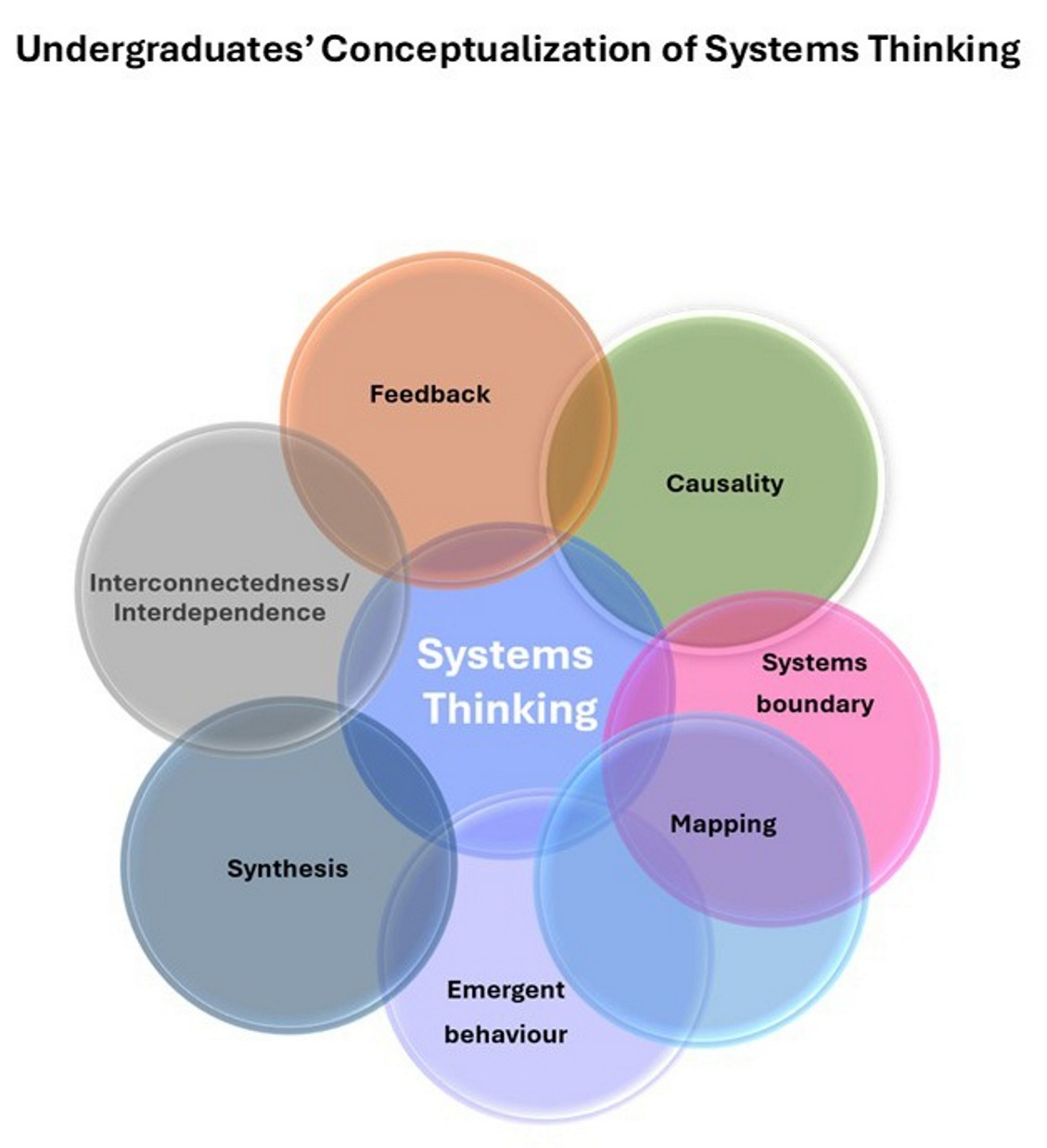
Undergraduates’ Conceptualization of Systems Thinking


Abstract
1. Introduction and Literature Background
- No study has explored students’ understanding of ST from a general perspective though there are studies that have investigated students’ understanding in specific contexts. The former type of studies is needed as it can provide a perspective not constrained by contexts.
- There is underrepresentation of undergraduate samples in ST studies in general. While undergraduates may be argued to possess more developed ST skills due to their disciplinary exposure and maturity, this assumption remains largely untested and warrants investigation.
2. Theoretical Frameworks
3. Methodology
3.1. Research Design and Ethics Approval
3.2. Participants
3.3. Course
- Is a system identified with its elements or components?
- Do these elements or components represent the system adequately?
- Are these elements or parts interdependent and affect each other?
- Are these interdependent and circular cause and effect relationships mapped out correctly to identify and develop feedback loops?
- Do all the elements or parts together through the feedback loops produce an effect as a dynamic behaviour that is different from the effect of each individual part?
- Does this dynamic behaviour or effect over time persist under different circumstances?
- Through the above, can a system be modelled and represented as comprising feedback loops?
3.4. Instrument
3.5. Procedure
3.6. Data Analysis
- The pre-test was conducted via electronic polling at the start of the course. It was configured in anonymous mode so as to get as many of the students to share in writing their conceptualization of what is ST.
- Not all students took the pre-test at the start of the course. Some came late for the lesson while others registered for the course only later. As a result, the number of pre-test responses are lower than the post test.
- Since the pre-test was done via anonymous mode while the post-test was done using students’ names, it is not possible to match their responses.
- Naïve: Rather simplistic mention of conceptualization of ST.
- Acceptable to limited extent: Responses are not wrong when viewed through a broad lens but not expressed in the lingo of the discipline.
- Informed to some extent: Responses demonstrate elements of some conceptualisation of what ST is but lacks depth.
4. Results
- Are initially absent or are poorly articulated in pre-test responses (Table 2);
- Emerge unevenly and with difficulty in post-test responses (Table 3), especially with low prevalence or partial integration;
- Represent transformative shifts from naïve/linear thinking to systemic reasoning.
5. Discussion
- It explored the ST conceptualizations of a multi-disciplinary cohort of undergraduate students. To the best of our knowledge, we have not come across another study that has used such samples.
- It explored students’ conceptualization of ST through just one open-ended question. To the best of our knowledge, we have not come across another study in the ST literature that has used such an approach.
- The analysis approaches we have used have not been reported before in the ST literature to the best of our knowledge.
- The findings show that, overall, the undergraduates have a range of conceptualizations of ST—this is, after attending the course on ST involving energy systems. Prior to the start of the course, their conceptualization of ST was rather limited.
- An interesting aspect of our data analysis is the framing of the ‘attributes’ continuum.
- While the instructional design aimed to develop broad ST competencies (both qualitative modelling through CLDs and quantitative through SFDs and simulations) the course progression moved from foundational ST concepts—such as CLDs (feedback structures)—to a stronger emphasis on SD modelling using SFDs for analyzing energy-related scenarios and projects. This pedagogical emphasis may have influenced participants’ responses and how they articulated their conceptualisation of ST, potentially foregrounding SD over other dimensions of ST in some cases.
- The course on energy systems based on ST curriculum could have shaped the interpretation and generalizability of the findings. Its approach is designed and characterized by inherently interdisciplinary and application-oriented domain, situated at the intersection of scientific, technological, economic, social, and policy considerations. It is specifically designed to help students understand the complex behaviour arising from non-linear interdependent interactions among multiple system actors and factors, including economic, political, environmental, and technological dimensions. As such, it provides a natural context for teaching and learning of ST tools and concepts, and application to model energy-related problems. This context would not have influenced the pre-test responses but could have influenced the post-test outcomes. Students engaging with real-world energy policy scenarios, case studies, and modelling tasks are likely to demonstrate contextualized forms of ST, which may differ from those elicited in more abstract or purely theoretical disciplines. The applied and project/problem-based nature of the course may have facilitated the expression of relational and dynamic reasoning, particularly when supported by structured tools such as CLDs, which are one of the modelling constructs in SD. However, irrespective of the discipline, key attributes and constructs of ST remain fundamental to its conceptualization. In addition, the relatively short duration of the intervention (two weeks), undertaken alongside other ongoing modules, is an important consideration. While the findings suggest that meaningful shifts in students’ representations of ST can generally occur and typically develop over extended periods of practice and reinforcement, it needs further research to verify this assertion.
6. Implications
- The sample here largely highlighted ST attributes such as mapping out interconnectedness/interdependencies and causality with a conceptualization that ST fundamentally involves understanding cause-and-effect relationships to develop feedback loops. This generally aligns with the intended intervention and learning outcomes of the course mentioned earlier. However, while this indicates students made good progress with these attributes, some attributes of ST appear in low frequencies, which suggests that there is still room for improvement in achieving a fully comprehensive and holistic understanding of ST through further interventions.
- ST and SD skills are recognized as essential 21st-century competencies in various educational curricula [40]. While our study indicates that the undergraduates have room for improvement in fully comprehending ST skills, it also suggests that fostering these skills in pre-university or school students may require even more work.
7. Limitations
- The ST conceptualization of students in this study represents those of a multi-disciplinary cohort. Care should be taken not to extrapolate this on a disciplinary basis.
- The findings represent those from two cohorts of students. The findings from the data cannot be extrapolated to those from other cohorts.
- The ST conceptualization of students was assessed based on their responses to an open-ended question. It should be noted that there are other approaches for assessing ST. So, our findings are restricted to this context.
- ST is a multi-faceted construct that spans several attributes. However, for this study, the seven attributes which emerged at post-test were adequate for the purpose of exploring the students’ conceptualization.
- The conceptualisation of students’ ST skills in this study should not be taken as an index of sophistication of their ST abilities; this would need their further articulation or assessment in more robust contexts.
- The generic ST conceptualizations of the students, as uncovered from their responses to the same open-ended question, represent their state of conceptualization of this construct before and after they have undergone the course related to energy systems.
- The pre-test and post-test numbers are different for the reasons stated earlier; matched pair analysis was also not done for the reasons mentioned. We kept all the responses so as to preserve the uniqueness of the ‘as obtained’ data. Since we are not doing a robust statistical analysis or matched pairs comparison but more of qualitative analyses, we felt that the chosen approach is not unreasonable. However, it remains a limitation of this study.
- Though the study sought to explore students’ conceptualisation of what is meant by the term ‘ST’, we deliberately used the term ‘understanding’ in the instrument so that students can comprehend it easily. It is a given that the terms ‘conceptualization’ and ‘understanding’, though sharing commonalities, are quite different from a science education research perspective.
- We acknowledge that there might be some subjectivity involved in the classification of the pre-test responses owing to the nature of the coding used. We do not see this as an issue as we are looking at the intervention from a broad lens—and it is clear that the post-test responses are richer from a ST perspective than the pre-test responses.
- The brevity of the responses at both pre-test and post-test means that unpacking further insights into the students’ conceptualizations was not possible. Also, just because they have used the ST attributes in their responses to varying extents in the post-test does not necessarily mean they have in-depth understanding of these terms; this would need further ascertaining.
- Interviews after post-test could have provided richer insights into the students’ conceptualization of ST as well as their understanding of the attributes present in their responses. However, this could not be done as the university examinations were in the following weeks, and it would be long semester holidays after that, when they would not be available for follow-up on their written responses.
8. Conclusions
Author Contributions
Funding
Institutional Review Board Statement
Informed Consent Statement
Data Availability Statement
Acknowledgments
Conflicts of Interest
References
- Charissa, P.C. System Theories: An Overview of Various System Theories and Its Application in Healthcare. Am. J. Syst. Sci. 2013, 2, 3–22. [Google Scholar]
- von Bertalanffy, L. An Outline of General System Theory. Br. J. Philos. Sci. 1950, 1, 134–165. [Google Scholar] [CrossRef]
- von Bertalanffy, L. General System Theory; George Braziller: New York, NY, USA, 1968. [Google Scholar]
- Kramer, N.J.; de Smit, J. Systems Thinking: Concepts and Notions; H. E. Stenfert Kroese B. V.: Leiden, The Netherlands, 1977. [Google Scholar]
- Gharajedaghi, J. Systems Thinking, Managing Chaos and Complexity: A Platform for Designing Business Architecture, 3rd ed.; Butterworth-Heinemann: Burlington, MA, USA, 1999. [Google Scholar]
- Midgley, G. Systems Thinking; Sage: London, UK, 2003; Volume I–IV. [Google Scholar]
- Richmond, B. Systems Thinking: Critical Thinking Skills for the 1990s and Beyond. Syst. Dyn. Rev. 1993, 9, 113–133. [Google Scholar] [CrossRef]
- Sweeney, L.B.; Sterman, J.D. Bathtub Dynamics: Initial Results of a Systems Thinking Inventory. Syst. Dyn. Rev. 2000, 16, 249–286. [Google Scholar] [CrossRef]
- Sterman, J.D. Business Dynamics: Systems Thinking and Modeling for a Complex World; McGraw-Hill: Boston, MA, USA, 2000. [Google Scholar]
- Meadows, D.H. Thinking in Systems: A Primer; Earthscan: London, UK, 2008. [Google Scholar]
- Mathews, L.G.; Jones, A. Using Systems Thinking to Improve Interdisciplinary Learning Outcomes: Reflections on a Pilot Study in Land Economics. Issues Integr. Stud. 2008, 26, 73–104. [Google Scholar]
- Sreenivasulu, B. Undergraduates’ Perspectives Regarding Interdisciplinary Learning through Systems Thinking and Computer-Based System Dynamics Modelling (Special Issue). Asian J. Scholarsh. Teach. Learn. 2023, 13, 135–151. [Google Scholar]
- Assaraf, O.B.Z.; Orion, N. Development of System Thinking Skills in the Context of Earth System Education. J. Res. Sci. Teach. 2005, 42, 518–560. [Google Scholar] [CrossRef]
- Hopper, M.; Stave, K.A. Assessing the Effectiveness of Systems Thinking Interventions in the Classroom. In Proceedings of the 26th International Conference of the System Dynamics Society, Athens, Greece, 20–24 July 2008; pp. 1–26. [Google Scholar]
- Richmond, B. The Thinking in Systems Thinking: Seven Essential Skills; Pegasus Communications: Waltham, MA, USA, 2000. [Google Scholar]
- Arnold, R.D.; Wade, J.P. A Complete Set of Systems Thinking Skills. Insight 2017, 20, 9–17. [Google Scholar] [CrossRef]
- Arnold, R.D.; Wade, J.P. A Definition of Systems Thinking: A Systems Approach. Procedia Comput. Sci. 2015, 44, 669–678. [Google Scholar] [CrossRef]
- Plate, R. Assessing Individuals’ Understanding of Non-Linear Causal Structures in Complex Systems. Syst. Dyn. Rev. 2010, 26, 19–33. [Google Scholar] [CrossRef]
- Cronin, M.A.; Gonzalez, C.; Sterman, J.D. Why Don’t Well-Educated Adults Understand Accumulation? A Challenge to Researchers, Educators, and Citizens. Organ. Behav. Hum. Decis. Process. 2009, 108, 116–130. [Google Scholar] [CrossRef]
- Capra, F. The Web of Life: A New Synthesis of Mind and Matter; HarperCollins: London, UK, 1996. [Google Scholar]
- Evagorou, M.; Korfiati, K.; Nicolaou, C.; Constantinou, C. An Investigation of the Potential of Interactive Simulations for Developing Systems Thinking Skills in Elementary School: A Case Study with Fifth- and Sixth-Graders. Int. J. Sci. Educ. 2009, 31, 655–674. [Google Scholar] [CrossRef]
- Liu, L.; Hmelo-Silver, C.E. Promoting Complex Systems Learning through the Use of Conceptual Representations in Hypermedia. J. Res. Sci. Teach. 2009, 46, 1023–1040. [Google Scholar] [CrossRef]
- Sommer, C.; Lücken, M. System Competence—Are Elementary Students Able to Deal with a Biological System? Nord. Stud. Sci. Educ. 2010, 6, 125–143. [Google Scholar]
- Richmond, B. System Dynamics/Systems Thinking: Let’s Just Get on with It. Syst. Dyn. Rev. 1994, 10, 135–157. [Google Scholar] [CrossRef]
- Sterman, J.D.; Sweeney, L.B. Cloudy Skies: Assessing Public Understanding of Global Warming. Syst. Dyn. Rev. 2002, 18, 207–240. [Google Scholar] [CrossRef]
- Hung, W. Enhancing Systems-Thinking Skills with Modelling. Br. J. Educ. Technol. 2008, 39, 1099–1120. [Google Scholar]
- Kim, D.H. Introduction to Systems Thinking; Pegasus Commun: Waltham, MA, USA, 1999; Volume 16. [Google Scholar]
- Senge, P.M. The Fifth Discipline. Meas. Bus. Excell. 1997, 1, 46–51. [Google Scholar] [CrossRef]
- Clark, K.; Hoffman, A. Educating Healthcare Students: Strategies to Teach Systems Thinking to Prepare New Healthcare Graduates. J. Prof. Nurs. 2019, 35, 195–200. [Google Scholar] [CrossRef] [PubMed]
- Miller, A.N.; Kordova, S.; Grinshpoun, T.; Shoval, S. To Be or Not to Be a Systems Thinker: Do Professional Characteristics Influence How Students Acquire Systems-Thinking Skills? Front. Educ. 2023, 8, 1026488. [Google Scholar]
- Fanta, D.; Braeutigam, J.; Riess, W. Fostering Systems Thinking in Student Teachers of Biology and Geography—An Intervention Study. J. Biol. Educ. 2020, 54, 226–244. [Google Scholar]
- Rosenkränzer, F.; Hörsch, C.; Schuler, S.; Riess, W. Student Teachers’ Pedagogical Content Knowledge for Teaching Systems Thinking: Effects of Different Interventions. Int. J. Sci. Educ. 2017, 39, 1932–1951. [Google Scholar] [CrossRef]
- Streiling, S.; Hörsch, C.; Rieß, W. Effects of Teacher Training in Systems Thinking on Biology Students—An Intervention Study. Sustainability 2021, 13, 7631. [Google Scholar] [CrossRef]
- Li, R.; Li, G. Developing and Validating a Biological System Thinking Test for Middle School Students. Int. J. Sci. Math. Educ. 2024, 23, 827–847. [Google Scholar] [CrossRef]
- Karga, B.; Ceyhan, G.D. Investigating Middle School Science Teachers’ Stock-Flow, Causal-Loop, and Dynamic Thinking Skills with Scenario-Based Questions. Int. J. Sci. Educ. 2024, 48, 268–287. [Google Scholar]
- Gilbert, L.A.; Gross, D.S.; Kreutz, K.J. Developing Undergraduate Students’ Systems Thinking Skills with an InTeGrate Module. J. Geosci. Educ. 2019, 67, 34–49. [Google Scholar]
- Huang, S.; Muci-Kuchler, K.H.; Bedillion, M.D.; Ellingsen, M.D.; Degen, C.M. Systems Thinking Skills of Undergraduate Engineering Students. In Proceedings of the 2015 IEEE Frontiers in Education Conference, El Paso, TX, USA, 21–24 October 2015; pp. 1–5. [Google Scholar]
- Liu, S.C. Examining Undergraduate Students’ Systems Thinking Competency through a Problem Scenario in the Context of Climate Change Education. Environ. Educ. Res. 2023, 29, 1780–1795. [Google Scholar]
- Brandstädter, K.; Harms, U.; Grossschedl, J. Assessing System Thinking through Different Concept-Mapping Practices. Int. J. Sci. Educ. 2012, 34, 2147–2170. [Google Scholar] [CrossRef]
- Forrester, J.W. Learning through System Dynamics as Preparation for the 21st Century. Syst. Dyn. Rev. 2016, 32, 187–203. [Google Scholar] [CrossRef]
- Vachliotis, T.; Salta, K.; Tzougraki, C. Meaningful Understanding and Systems Thinking in Organic Chemistry: Validating Measurement and Exploring Relationships. Res. Sci. Educ. 2014, 44, 239–266. [Google Scholar]
- Vachliotis, T.; Salta, K.; Tzougraki, C. Developing Basic Systems Thinking Skills for Deeper Understanding of Chemistry Concepts in High School Students. Think. Ski. Creat. 2021, 41, 100881. [Google Scholar]
- Wilkerson, B.; Trellevik, L.-K.L. Sustainability-Oriented Innovation: Improving Problem Definition through Combined Design Thinking and Systems Mapping Approaches. Think. Ski. Creat. 2021, 42, 100932. [Google Scholar] [CrossRef]
- Grohs, J.R.; Kirk, G.R.; Soledad, M.M.; Knight, D.B. Assessing Systems Thinking: A Tool to Measure Complex Reasoning through Ill-Structured Problems. Think. Ski. Creat. 2018, 28, 110–130. [Google Scholar] [CrossRef]
- Dawidowicz, P. The Person on the Street’s Understanding of Systems Thinking. Syst. Res. Behav. Sci. 2012, 29, 2–13. [Google Scholar]
- Tobin, K.G. The Practice of Constructivism in Science Education; Psychol. Press: New York, NY, USA, 1993. [Google Scholar]
- Jackson, M.C. Critical Systems Thinking and the Management of Complexity, 4th ed.; Wiley: Chichester, UK, 2024. [Google Scholar]
- Lodico, M.G.; Spaulding, D.T.; Voegtle, K.H. Methods in Educational Research: From Theory to Practice; John Wiley & Sons: Hoboken, NJ, USA, 2010. [Google Scholar]
- Seoh, K.H.R.; Subramaniam, R.; Hoh, Y.K. How Humans Evolved According to Grade 12 Students in Singapore. J. Res. Sci. Teach. 2016, 53, 291–323. [Google Scholar]
- Loh, A.S.L.; Subramaniam, R. Mapping the Knowledge Structure Exhibited by a Cohort of Students Based on Their Understanding of How a Galvanic Cell Produces Energy. J. Res. Sci. Teach. 2018, 55, 777–809. [Google Scholar] [CrossRef]
- Sreenivasulu, B.; Subramaniam, R. Mapping the Conceptual Space Formed by Students’ Understanding of Coordination Number of a Transition Metal Complex. Chem. Educ. Res. Pract. 2019, 20, 468–483. [Google Scholar] [CrossRef]
- Leow, S.H.; Kaur, B. A Study of Grade Two Students Solving a Non-Routine Problem with Access to Manipulatives. Int. J. Sci. Math. Educ. 2024, 22, 1457–1478. [Google Scholar] [CrossRef]
- Terry, G.; Hayfield, N.; Clarke, V.; Braun, V. Thematic Analysis. In SAGE Handbook of Qualitative Research in Psychology, 2nd ed.; Sage: London, UK, 2017; pp. 17–37. [Google Scholar]
- Khishfe, R.; Abd-El-Khalick, F. Influence of Explicit and Reflective versus Implicit Inquiry-Oriented Instruction on Sixth Graders’ Views of Nature of Science. J. Res. Sci. Teach. 2002, 39, 551–578. [Google Scholar]
- McKibben, W.B.; Cade, R.; Purgason, L.L.; Wahesh, E. How to Conduct a Deductive Content Analysis in Counseling Research. Couns. Outcome Res. Eval. 2020, 13, 156–168. [Google Scholar] [CrossRef]
- Bresciani, M.J.; Oakleaf, M.; Kolkhorst, F.; Nebeker, C.; Barlow, J.; Duncan, K.; Hickmott, J. Examining Design and Inter-Rater Reliability of a Rubric Measuring Research Quality across Multiple Disciplines. Pract. Assess. Res. Eval. 2019, 14, 12. [Google Scholar]
- Sandri, O.J. Threshold Concepts, Systems and Learning for Sustainability. Environ. Educ. Res. 2013, 19, 810–822. [Google Scholar] [CrossRef]
- Randle, J.M.; Stroink, M.L. The Development and Initial Validation of the Paradigm of Systems Thinking. Syst. Res. Behav. Sci. 2018, 35, 645–657. [Google Scholar] [CrossRef]
- Reid, L.D.; Foels, R. Cognitive Complexity and the Perception of Subtle Racism. Basic Appl. Soc. Psychol. 2010, 32, 291–301. [Google Scholar] [CrossRef]
- Gilissen, M.G.; Knippels, M.C.P.; van Joolingen, W.R. Bringing Systems Thinking into the Classroom. Int. J. Sci. Educ. 2020, 42, 1253–1280. [Google Scholar] [CrossRef]
- Mambrey, S.; Timm, J.; Landskron, J.J.; Schmiemann, P. The Impact of System Specifics on Systems Thinking. J. Res. Sci. Teach. 2020, 57, 1632–1651. [Google Scholar] [CrossRef]
- Warren, K. Why Has Feedback Systems Thinking Struggled to Influence Strategy and Policy Formulation? Suggestive Evidence, Explanations and Solutions. Syst. Res. Behav. Sci. 2004, 21, 331–347. [Google Scholar] [CrossRef]
- Georgiou, I. Thinking Through Systems Thinking; Routledge: London, UK, 2013. [Google Scholar]
- Richardson, G.P. Can Systems Thinking Be an Antidote to Extensive Evil? Syst. Res. Behav. Sci. 2021, 38, 401–412. [Google Scholar]
- Plate, R.; Monroe, M. A Structure for Assessing Systems Thinking. Creat. Learn. Exch. 2014, 23, 1–12. [Google Scholar]
- Norris, M.B.; Grohs, J.R.; Knight, D.B. Investigating Student Approaches to Scenario-Based Assessments of Systems Thinking. Front. Educ. 2022, 7, 1055403. [Google Scholar] [CrossRef]
- Lavi, R.; Bertel, L.B. The System Architecture–Function–Outcome Framework for Fostering and Assessing Systems Thinking in First-Year STEM Education and Its Potential Applications in Case-Based Learning. Educ. Sci. 2024, 14, 720. [Google Scholar]
- Spivack, M. Applying Systems Thinking to Education: The RISE Systems Framework; RISE Programme Insights. 2021. Available online: https://riseprogramme.org/sites/default/files/2021-05/Applying_Systems_Thinking_Education_FINAL.pdf (accessed on 15 June 2026).
- Flood, R.L.; Carson, E.R. Dealing with Complexity: An Introduction to the Theory and Application of Systems Science; Springer Science+Business Media: New York, NY, USA, 2013. [Google Scholar]
- Cabrera, D.; Cabrera, L. What Is Systems Thinking? In Learning, Design, and Technology: An International Compendium of Theory, Research, Practice, and Policy; Springer International Publisher: Cham, Switzerland, 2023; pp. 1495–1522. [Google Scholar]
- Kuijpers, A.J.; Dam, M.; Janssen, F.J. A Systems Thinking Approach to Capture the Complexity of Effective Routes to Teaching. Eur. J. Educ. 2024, 59, e12623. [Google Scholar]
- Riess, W.; Mischo, C. Promoting Systems Thinking through Biology Lessons. Int. J. Sci. Educ. 2010, 32, 705–725. [Google Scholar]
- Rachmatullah, A.; Wiebe, E.N. Building a Computational Model of Food Webs: Impacts on Middle School Students’ Computational and Systems Thinking Skills. J. Res. Sci. Teach. 2022, 59, 585–618. [Google Scholar]
- Stefaniak, J.E.; Giacumo, L.A.; Mao, J.J.; Asino, T.I. A Systems Thinking Perspective on Learning Design in Higher Education. J. Comput. High. Educ. 2025, 37, 657–678. [Google Scholar] [CrossRef]
- Sreenivasulu, B.; Subramaniam, R. Undergraduates’ Ability to Apply and Transfer Systems Thinking Skills When Modelling Global Warming via Causal Loop Diagrams: An Exploratory Study. Think. Ski. Creat. 2026, 62, 102255. [Google Scholar] [CrossRef]

| Attribute Number | Attribute | Definition [6,10,13,15,17,40] |
|---|---|---|
| 1 | Interconnectedness/Interdependence | ST involves understanding interconnections and interconnectedness among system components. |
| 2 | Feedback | ST is a closed-loop thinking to understand feedback loops operating in system. |
| 3 | Causality | ST is to understand cause and effect relationships in a system. |
| 4 | Systems boundary | ST is to understand the system boundary by identifying its components and what is considered relevant within a system. |
| 5 | Mapping | ST involves mapping interdependent interactions among system components. |
| 6 | Emergent behaviour or behaviour of a system over time | ST is to understand the emerging behaviour patterns of a system over time. |
| 7 | Synthesis | ST involves the segmentation of complex problem into parts/components and then integrating them into new models containing feedback loops to derive and interpret emerging dynamic behaviours. |
| Naïve | Acceptable to Limited Extent but Not Grounded Canonically | Informed to Some Extent |
|---|---|---|
| It is a sort of thinking to see what is there in a system. Systems thinking is about collection of knowledge together to understand a system. Systems thinking involves systematic analysis Understanding about systems It is systematic thinking like flow charting Thinking fearlessly challenging assumptions Inquisitive thinking Rational thinking Any forms of behaviour are likely to be from a system, and a system can always be part of another system. It is a systematic approach to analyze to predict the outcome of the system. To study Correlation Delays patterns language Addiction. Small Action Big Result. Wrong Goal Direction. Distancing. Systems thinking is simplifying language Systems thinking is a skill used to see clearer understanding to solve a problem. It is a qualitative analysis about a system “Systems thinking” means looking at different view of a problem and solve it Methodical thinking It is about causation Interconnected. Interconnectivity A thinking oriented around the existence of concepts of systems | Critical thinking Analysis thinking Logical thinking Analytical and clear Critical thinking Logical and systematic thinking Insightful thinking It is about thinking as a whole Thinking and looking things at a broad perspective Looking at various systems around us as there are many factors intertwined. | Able to identify causalities and interconnectedness of a system Interconnected thinking Thinking to seeing the big picture Holistic thinking Systems thinking is understanding how each part of the system affects one another Systems thinking is about how a system works like car or laptop We need to think a question including nearly every relevant element into consideration and analyze the connections and interactions within the whole system. Examining and modelling a dynamic pattern of behaviours that arise from a number of different variables interacting with each other. It is a way to seeing an individual thing but as a part of the system Systems thinking is about a different point of view to consider more connected relations and related things. Bigger picture, all affect one another. Systems thinking is a way of effective thinking to solve a problem, ability to put things together and form a “system.” Systems thinking is about all the factors should be interconnected and dependent on one another. Systems thinking is the in-depth analysis of systems see between possible components. |
| 22 (47.82%) | 10 (21.74%) | 14 (30.43%) |
| ST Attribute | Prevalence (Number/%) | Sample Responses |
|---|---|---|
| 1 + 2 + 3 + 4 + 5 + 6 + 7 | 2 (2.90) | Systems thinking is understanding a system and its parts, and how the system’s behaviour is affected by its parts, through the use of dynamic hypothesis and CLDs. Systems thinking to me is about taking on the perspective that almost everything can be seen as a system, and we can study how one variable, no matter how small or insignificant, can cause impacts to other parts of the system, whether it reinforces the phenomenon or diminishes it by balancing. Overall, the study of systems allows us to see the big picture. |
| 1 + 3 + 4 + 5 + 6 + 7 | 8 (11.59) | System thinking is a method of processing complex data and hypothesising the results. When there are many factors in a system, their interconnected and interdependent relationships are no easy to predict, hence using system thinking will help with the process. By considering how each variable interacts with one another, we can see the bigger picture of how the system will change over time. This is the qualitative analysis. Assigning values to the variables and observing outcome will be the quantitative analysis. Thinking about the world as a whole, rather than its individual bits. It can be applied at any scale: e.g., computer needs a processor, motherboard, RAM, Graphics card to work and each component may have a job, but they must work as a whole to display emerging behaviour. Another example is the global economy. Each country’s economic policies do not determine how well the country is in as it is affected by those globally. |
| 1 + 2 + 3 + 5 + 6 + 7 | 1 (1.45) | It is a sort of thinking that allows people to identify stocks, flows, variables, and constants and see the interconnection and interaction between a set of elements, and thus draw feedback loops, SFD, CLD, etc. to predict the behaviour if the elements over time. |
| 1 + 3 + 5 + 6 + 7 | 6 (8.70) | It is a sort of thinking that allows people to identify stocks, flows, variables, and constants and see the interconnection and interaction between a set of elements, and thus draw feedback loops, SFD, CLD, etc. to predict the behaviour if the elements over time. System thinking is the analytics of interdependencies of factors that contribute of a specific behaviour in a system. By identifying factors involved, we can account for reasons behind phenomena and also formulate policies for control |
| 1 + 2 + 3 + 5 + 7 | 4 (5.80) | System thinking is think not just based on basic linear causal relationship but looking how one change in an element might bring about another change in other element might bring about another change in other elements through feedback loops. It makes us think how system interacts, interdependent, and interconnected. Thinking in systems. Expanding our mental models into more complicated models so that we can examine them further through feedback qualitative loops and quantitative analysis to make better and more informed decisions |
| 1 + 2 + 3 + 5 | 1 (1.45) | Systems thinking is a concept where things are interrelated and connected. Understanding how different factors come together and balances or reinforces each other. |
| 1 + 4 + 5 + 6 | 1 (1.45) | Systems thinking is a way of thinking such that when there are different things come into your mind, you can put them together, find some or many causations between them or even come out with a behaviour presumption based on them. It is like the ability to put things together and form a “system.” |
| 1 + 3 + 5 + 7 | 3 (4.35) | Systems thinking is about visualising a problem in a system way in which we identify the cause and effect of a situation and how it affects the other components in the system. Systems thinking is about the interdependence of the various involved components in which they need to work together for it to be an effective system. Systems thinking is a concept where things are interrelated and connected. A certain factor can be affected by a multitude of other factors, and all these combined create a system. Thinking of things as individual items may restrict one’s perception of how such things operate in the real world, and systems thinking adds a layer of depth to one’s understanding. |
| 1 + 3 + 4 + 5 | 4 (4.35) | Systems thinking, to me, is a way of simplifying the constraints in a system and identifying that everything is connected. How important each variable is to contribute to that factor also plays a part but primarily, we must be able to identify each relationship between each variable so we can build a bigger picture of the issue at hand and formulate out a plan that is relevant. System thinking is the mindset to think in systems—to understand and analyse the interconnectedness and interrelations between different variables in a complete and complex system and therefore make use of these connections to anticipate long term situations and device on the most effective polices to tackle this problem. |
| 1 + 5 + 6 + 7 | 1 (1.45) | A mindset of thinking oriented around the existence of concepts of systems, which are sets of variables that are interconnected and interdependence on one another and may exhibit certain behaviours that are more than the sum of its parts. |
| 1 + 3 + 5 | 9 (13.04) | Systems thinking is a skill used to see the bigger picture. It helps us to see how one variable can affect the rest of the variables in the system. Using systems thinking, it enables us a clearer understanding and helps us to better strategize the approach we can take or improve if needed. Systems thinking is the understanding of all independent, interconnected and interactions between each factor. |
| 1 + 5 + 6 | 2 (2.90) | The interconnection between the different variables that simulates the dynamic of an entire system. I understand systems thinking as a form of analytical thinking where practitioners identify and analyse the interconnected and interdependent relationships between the different variables within a system. They then leverage these relationships to predict future outcomes or trends of the different variables and form conclusions about them. |
| 3 + 5 + 6 | 1 (1.45) | The thought process of thinking non-linearly and considering impacts variables may have on each other (as opposed to cause-and-effect), to a system structure and its behaviour. |
| 1 + 4 + 5 | 2 (2.90) | It is about thinking of systems as a whole, looking at boundary and things within the system as many interconnected parts rather than individual parts. |
| 1 + 5 | 10 (14.49) | The interaction between the variables within an ecosystem and the complexities of how often times there are many factors intertwined. Systems thinking involves the links drawn within a system as well as the extension to form relations. |
| 1 + 6 | 1 (1.45) | A combination of multitude of factors culminating in a sense of interactions in which are in a way interdependent to produce a behaviour over time |
| 1 + 7 | 2 (2.90) | Systems thinking is the construction of mental models to best illustrate different processes and stakeholders in a system that are interdependent and interconnected with one another. After the model is formed, it is the job of the systems thinker to devise plans and policies to achieve the most optimal leverage on the system to best solve a problem over time. It is to keep an open mind and be able to look at the bigger picture. It is to think meticulously how one system can interconnect and influence other factors and may result in unintended consequences. To solve real world problems, it is extremely important as we hope to minimise risk and look for a balance. |
| 1 + 3 | 4 (5.80) | It is about identifying what are the factors and how they affect each other. Systems thinking is the process of viewing everything as a system of smaller things that are always interacting with and affecting one another. |
| 5 only | 2 (2.90) | System thinking is about the looking things at a broad perspective, separating into different component and analysing the system. System thinking is about the looking things at a broad perspective, separating into different component and analysing the system. |
| 6 only | 1 (1.45) | Systems thinking” means looking at different view of a problem and thus identify the behaviours that the system will exhibit. |
| 1 only | 0 (0.0) | Not seen in the responses |
| 2 only | 0 (0.0) | Not seen in the responses |
| 3 only | 3 (4.35) | It is a method to link different factors together. Linking different variable together systematically |
| 4 only | 1 (1.45) | Systems thinking involves the links drawn within a system as well as the extension to form relations. |
| 1 + 2 + 3 + 4 + 5 + 6 | 0 (0.0) | (Not seen in responses) |
| 1 + 2 + 3 | 0 (0.0) | (Not seen in responses) |
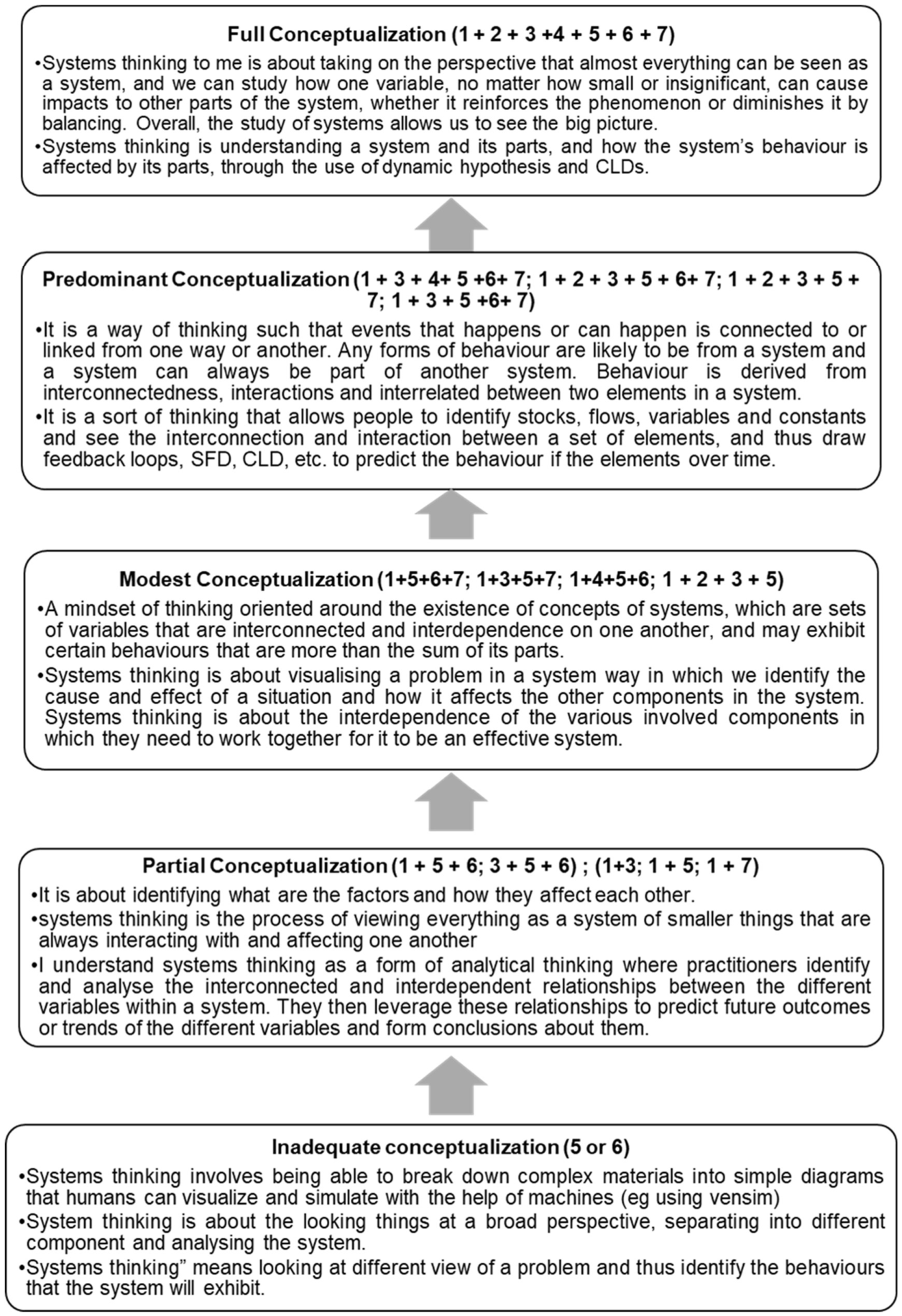
| Number of ST Attributes | Combination of Attributes | Number Students | Total Number Students | % Sample | Conceptualization Category |
|---|---|---|---|---|---|
| 7 | 1 + 2 + 3 + 4 + 5 + 6 + 7 | 2 | 2 | 2.90 | Full |
| 6 | 1 + 3 + 4 + 5 + 6 + 7 | 8 | 9 | 13.0 | Predominant |
| 1 + 2 + 3 + 5 + 6 + 7 | 1 | ||||
| 5 | 1 + 3 + 5 + 6 + 7 | 6 | 10 | 14.9 | |
| 1 + 2 + 3 + 5 + 7 | 4 | ||||
| 4 | 1 + 2 + 3 + 5 | 1 | 10 | 14.9 | Modest |
| 1 + 4 + 5 + 6 | 1 | ||||
| 1 + 3 + 5 + 7 | 3 | ||||
| 1 + 3 + 4 + 5 | 4 | ||||
| 1 + 5 + 6 + 7 | 1 | ||||
| 3 | 1 + 3 + 5 | 9 | 14 | 20.29 | Partial |
| 1+ 5 + 6 | 2 | ||||
| 3 + 5 + 6 | 1 | ||||
| 1 + 4+ 5 | 2 | ||||
| 2 | 1 + 5 | 10 | 17 | 24.64 | |
| 1 + 7 | 2 | ||||
| 1 + 3 | 4 | ||||
| 1 + 6 | 1 | ||||
| 1 | 3 | 3 | 7 | 10.14 | Inadequate |
| 4 | 1 | ||||
| 5 | 2 | ||||
| 6 | 1 | ||||
| Total = 69 |
| Attribute Number for System Thinking | Prevalence of Specific Attribute (Number of Responses) |
|---|---|
| 1 Interconnectedness/interdependence | 67 |
| 2 Feedback | 9 |
| 3 Causality | 54 |
| 4 Systems boundary | 20 |
| 5 Mapping | 65 |
| 6 Emergent behaviour or behaviour of a system over time | 29 |
| 7 Synthesis | 27 |
| Concept | Empirical Evidence (Table 1 and Table 2) | Prevalence/Difficulty in Articulation | Conceptual Transformation Required | Threshold Characteristics (Justification) |
|---|---|---|---|---|
| Feedback (closed-loop thinking) | Absent in pre-test; least mentioned attribute post-test (9 responses) | Very low prevalence and articulation. | Shift from linear causation to recognizing reciprocal, circular interactions within systems. | Feedback is a key threshold concept because it shifts students’ conceptualization from linear cause–effect reasoning to recursive, circular causality, which is often counterintuitive and difficult to internalize. |
| Systems boundary | Not evident in pre-test; low representation post-test (20 responses) | Low prevalence and articulation | Diffuse “holistic” thinking to explicit delimitation of system scope. Reframing boundaries as constructed and flexible, rather than fixed or given. | This concept is transformative as it requires students to critically determine what to include or exclude in a system, challenging the assumption that systems are fixed and instead revealing them as constructed and context-dependent. It requires judgement, ontologically transformative (redefines system vs. environment) and discipline-specific gateway for modelling. |
| Emergent behaviour (behaviour over time) | Absent in pre-test; moderate occurrence post-test (29 responses) | Moderate uptake and articulation | Transition from focusing on isolated events to understanding patterns and behaviours that arise over time through the interdependent interactions of system components. | Transformative (whole ≠ sum of parts), integrative (requires feedback and causality), threshold-like liminality (partially grasped but inconsistently applied). The concept of emergence is troublesome because it requires understanding that system-level non-lineear emergent behaviour patterns arise from interdependent interactions and feedback processes over time, not from individual components alone, demanding a departure from reductionist thinking. |
| Synthesis (integration of ST attributes) | Not visible in pre-test; full integration seen in only 2 students (≈2.9%) | Very low prevalence; persistently difficult | Fragmented attributes to coherent, systemic understanding. Moving from fragmented and individual attributes of ST concepts to integrating them into a cohesive, holistic understanding of system behaviour. | Synthesis represents capstone threshold concept by requiring students to integrate multiple systems thinking elements into a coherent whole, moving beyond isolated understanding to holistic reasoning (signals stable conceptual shift). |
| Causality (non-linear/systemic) | Minimally and simplistically expressed in pre-test; widely present post-test (54 responses) | High prevalence but often linearised | Shift from simple, direct cause–effect reasoning to appreciating complex, non-linear relationships involving delays, feedback loops, and indirect effects | Foundational threshold and acts as a gateway concept enabling understanding of feedback and emergence. Non-linear causality is transformative as it disrupts simple, direct cause–effect assumptions and introduces complexity, delays, and indirect effects that are often difficult for learners to grasp. |
Disclaimer/Publisher’s Note: The statements, opinions and data contained in all publications are solely those of the individual author(s) and contributor(s) and not of MDPI and/or the editor(s). MDPI and/or the editor(s) disclaim responsibility for any injury to people or property resulting from any ideas, methods, instructions or products referred to in the content. |
© 2026 by the authors. Licensee MDPI, Basel, Switzerland. This article is an open access article distributed under the terms and conditions of the Creative Commons Attribution (CC BY) license.
Share and Cite
Sreenivasulu, B.; Subramaniam, R. Undergraduates’ Conceptualization of Systems Thinking. Systems 2026, 14, 720. https://doi.org/10.3390/systems14060720
Sreenivasulu B, Subramaniam R. Undergraduates’ Conceptualization of Systems Thinking. Systems. 2026; 14(6):720. https://doi.org/10.3390/systems14060720
Chicago/Turabian StyleSreenivasulu, Bellam, and R. Subramaniam. 2026. "Undergraduates’ Conceptualization of Systems Thinking" Systems 14, no. 6: 720. https://doi.org/10.3390/systems14060720
APA StyleSreenivasulu, B., & Subramaniam, R. (2026). Undergraduates’ Conceptualization of Systems Thinking. Systems, 14(6), 720. https://doi.org/10.3390/systems14060720