Dynamic Feedbacks Among Physical Activity, Health Capital, and Household Financial Resilience: A Systems Analysis Using China Family Panel Studies


Abstract
1. Introduction
2. Literature Review and Hypothesis
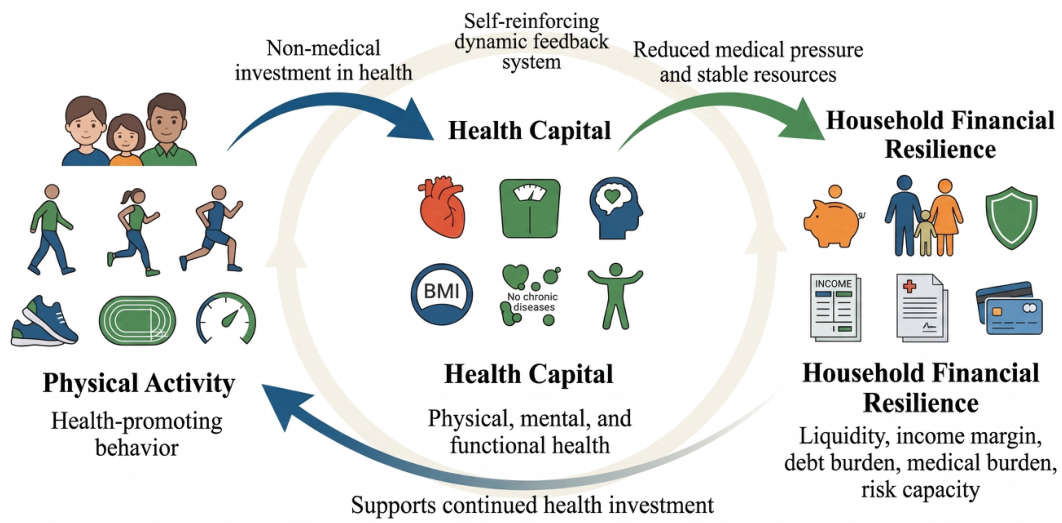
2.1. A Systems Perspective on Physical Activity, Health Capital, and Household Financial Resilience
2.2. Physical Activity and Health Capital
2.3. Health Capital and Household Financial Resilience
2.4. Financial Resilience and Feedback to Physical Activity
2.5. Dynamic Feedback Loop and Research Hypotheses
3. Data and Methods
3.1. Data Source and Sample Construction
3.2. Variable Measurement
3.3. Construction of the Health-Capital Index and Household Financial-Resilience Index
3.4. Baseline Dynamic Panel Models
3.5. Panel Vector Autoregression and Dynamic Feedback Analysis
3.6. Robustness Checks and Heterogeneity Analysis
4. Results
4.1. Descriptive Statistics and Preliminary Evidence
4.2. Baseline Dynamic Panel Results
4.3. Dynamic Mediation Through Health Capital
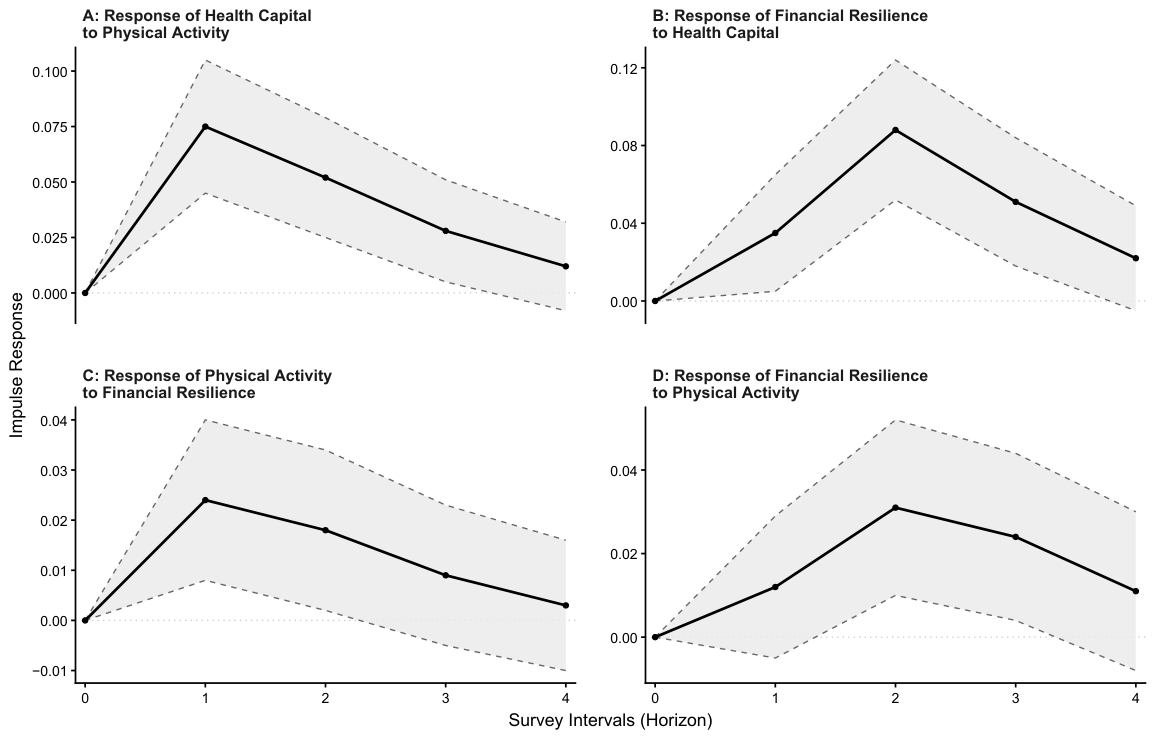
4.4. Panel Vector Autoregression Results
4.5. Variance-Decomposition Evidence
4.6. Robustness Assessment
4.7. Heterogeneity Patterns
5. Discussion
5.1. Dynamic Feedback Among Physical Activity, Health Capital, and Financial Resilience
5.2. Level of Interpretation and Practical Meaning
5.3. Theoretical Contributions to Health Capital and Household Finance Research
5.4. Policy Implications for Household Health and Financial Resilience
5.5. Limitations and Future Research
6. Conclusions
Author Contributions
Funding
Institutional Review Board Statement
Informed Consent Statement
Data Availability Statement
Conflicts of Interest
References
- Lee, I.M.; Shiroma, E.J.; Lobelo, F.; Puska, P.; Blair, S.N.; Katzmarzyk, P.T.; the Lancet Physical Activity Series Working Group. Effect of Physical Inactivity on Major Non-Communicable Diseases Worldwide: An Analysis of Burden of Disease and Life Expectancy. Lancet 2012, 380, 219–229. [Google Scholar] [CrossRef] [Scilit] [PubMed]
- Santos, A.C.; Willumsen, J.; Meheus, F.; Ilbawi, A.; Bull, F.C. The Cost of Inaction on Physical Inactivity to Public Health-Care Systems: A Population-Attributable Fraction Analysis. Lancet Glob. Health 2023, 11, e32–e39. [Google Scholar] [CrossRef] [Scilit] [PubMed]
- Strain, T.; Flaxman, S.; Guthold, R.; Semenova, E.; Cowan, M.; Riley, L.M.; Bull, F.C.; Stevens, G.A.; Group, C.D.A. National, Regional, and Global Trends in Insufficient Physical Activity among Adults from 2000 to 2022: A Pooled Analysis of 507 Population-Based Surveys with 5.7 Million Participants. Lancet Glob. Health 2024, 12, e1232–e1243. [Google Scholar] [CrossRef] [Scilit]
- Grossman, M. On the Concept of Health Capital and the Demand for Health. J. Political Econ. 1972, 80, 223–255. [Google Scholar] [CrossRef] [Scilit]
- Salignac, F.; Marjolin, A.; Reeve, R.; Muir, K. Conceptualizing and Measuring Financial Resilience: A Multidimensional Framework. Soc. Indic. Res. 2019, 145, 17–38. [Google Scholar] [CrossRef] [Scilit]
- He, L.; Zhou, S. Household Financial Vulnerability to Income and Medical Expenditure Shocks: Measurement and Determinants. Int. J. Environ. Res. Public Health 2022, 19, 4480. [Google Scholar] [CrossRef] [Scilit] [PubMed]
- Liu, T.; Fan, M.; Li, Y.; Yue, P. Financial Literacy and Household Financial Resilience. Financ. Res. Lett. 2024, 63, 105378. [Google Scholar] [CrossRef] [Scilit]
- Huang, D.; Tam, K.P.; Chen, B. Does Exercise Keep Your Wallet Healthy? An Empirical Study between Physical Activity and Household Financial Vulnerability. Financ. Res. Lett. 2026, 94, 109601. [Google Scholar] [CrossRef] [Scilit]
- He, D.; Zhou, J.; Li, Y.; Zhong, Z. The Impact of Physical Exercise on Risk Asset Allocation. Financ. Res. Lett. 2025, 86, 108757. [Google Scholar] [CrossRef] [Scilit]
- Holtz-Eakin, D.; Newey, W.; Rosen, H.S. Estimating Vector Autoregressions with Panel Data. Econometrica 1988, 56, 1371–1395. [Google Scholar] [CrossRef] [Scilit]
- Love, I.; Zicchino, L. Financial Development and Dynamic Investment Behavior: Evidence from Panel VAR. Q. Rev. Econ. Financ. 2006, 46, 190–210. [Google Scholar] [CrossRef] [Scilit]
- Abrigo, M.R.M.; Love, I. Estimation of Panel Vector Autoregression in Stata. Stata J. 2016, 16, 778–804. [Google Scholar] [CrossRef] [Scilit]
- Smith, J.P. Healthy Bodies and Thick Wallets: The Dual Relation between Health and Economic Status. J. Econ. Perspect. 1999, 13, 145–166. [Google Scholar] [CrossRef] [Scilit]
- Kass-Hanna, J.; Lyons, A.C.; Liu, F. Building Financial Resilience through Financial and Digital Literacy in South Asia and Sub-Saharan Africa. Emerg. Mark. Rev. 2022, 51, 100846. [Google Scholar] [CrossRef] [Scilit]
- Anderloni, L.; Bacchiocchi, E.; Vandone, D. Household Financial Vulnerability: An Empirical Analysis. Res. Econ. 2012, 66, 284–296. [Google Scholar] [CrossRef] [Scilit]
- Brunetti, M.; Giarda, E.; Torricelli, C. Is Financial Fragility a Matter of Illiquidity? An Appraisal for Italian Households. Rev. Income Wealth 2016, 62, 628–649. [Google Scholar] [CrossRef] [Scilit]
- Midões, C.; Seré, M. Living with Reduced Income: An Analysis of Household Financial Vulnerability Under COVID-19. Soc. Indic. Res. 2022, 161, 125–149. [Google Scholar] [CrossRef] [Scilit]
- Sterman, J.D. Learning from Evidence in a Complex World. Am. J. Public Health 2006, 96, 505–514. [Google Scholar] [CrossRef] [Scilit]
- Warburton, D.E.R.; Nicol, C.W.; Bredin, S.S.D. Health Benefits of Physical Activity: The Evidence. CMAJ 2006, 174, 801–809. [Google Scholar] [CrossRef] [Scilit]
- Garcia, L.; Pearce, M.; Abbas, A.; Mok, A.; Strain, T.; Ali, S.; Crippa, A.; Dempsey, P.C.; Golubic, R.; Kelly, P.; et al. Non-Occupational Physical Activity and Risk of Cardiovascular Disease, Cancer and Mortality Outcomes: A Dose–Response Meta-Analysis of Large Prospective Studies. Br. J. Sports Med. 2023, 57, 979–989. [Google Scholar] [CrossRef] [Scilit] [PubMed]
- Singh, B.; Olds, T.; Curtis, R.; Dumuid, D.; Virgara, R.; Watson, A.; Szeto, K.; O’Connor, E.; Ferguson, T.; Eglitis, E.; et al. Effectiveness of Physical Activity Interventions for Improving Depression, Anxiety and Distress: An Overview of Systematic Reviews. Br. J. Sports Med. 2023, 57, 1203–1209. [Google Scholar] [CrossRef] [Scilit] [PubMed]
- Ding, D.; Lawson, K.D.; Kolbe-Alexander, T.L.; Finkelstein, E.A.; Katzmarzyk, P.T.; van Mechelen, W.; Pratt, M. The Economic Burden of Physical Inactivity: A Global Analysis of Major Non-Communicable Diseases. Lancet 2016, 388, 1311–1324. [Google Scholar] [CrossRef] [Scilit]
- De Nardi, M.; French, E.; Jones, J.B. Why Do the Elderly Save? The Role of Medical Expenses. J. Political Econ. 2010, 118, 39–75. [Google Scholar] [CrossRef] [Scilit]
- Dobkin, C.; Finkelstein, A.; Kluender, R.; Notowidigdo, M.J. The Economic Consequences of Hospital Admissions. Am. Econ. Rev. 2018, 108, 308–352. [Google Scholar] [CrossRef] [Scilit]
- Xie, Y.; Hu, J. An Introduction to the China Family Panel Studies (CFPS). Chin. Sociol. Rev. 2014, 47, 3–29. [Google Scholar]
- Xie, Y.; Lu, P. The Sampling Design of the China Family Panel Studies (CFPS). Chin. J. Sociol. 2015, 1, 471–484. [Google Scholar] [CrossRef] [Scilit]
- Abdi, H.; Williams, L.J. Principal Component Analysis. Wiley Interdiscip. Rev. Comput. Stat. 2010, 2, 433–459. [Google Scholar] [CrossRef] [Scilit]
- Arellano, M.; Bond, S. Some Tests of Specification for Panel Data: Monte Carlo Evidence and an Application to Employment Equations. Rev. Econ. Stud. 1991, 58, 277–297. [Google Scholar] [CrossRef] [Scilit]
- Blundell, R.; Bond, S. Initial Conditions and Moment Restrictions in Dynamic Panel Data Models. J. Econom. 1998, 87, 115–143. [Google Scholar] [CrossRef] [Scilit]
- Luke, D.A.; Stamatakis, K.A. Systems Science Methods in Public Health: Dynamics, Networks, and Agents. Annu. Rev. Public Health 2012, 33, 357–376. [Google Scholar] [CrossRef] [Scilit] [PubMed]
- Rutter, H.; Savona, N.; Glonti, K.; Bibby, J.; Cummins, S.; Finegood, D.T.; Greaves, F.; Harper, L.; Hawe, P.; Moore, L.; et al. The Need for a Complex Systems Model of Evidence for Public Health. Lancet 2017, 390, 2602–2604. [Google Scholar] [CrossRef] [Scilit]
- Carey, G.; Malbon, E.; Carey, N.; Joyce, A.; Crammond, B.; Carey, A. Systems Science and Systems Thinking for Public Health: A Systematic Review of the Field. BMJ Open 2015, 5, e009002. [Google Scholar] [CrossRef] [Scilit]
- Bull, F.C.; Al-Ansari, S.S.; Biddle, S.; Borodulin, K.; Buman, M.P.; Cardon, G.; Carty, C.; Chaput, J.P.; Chastin, S.; Chou, R.; et al. World Health Organization 2020 Guidelines on Physical Activity and Sedentary Behaviour. Br. J. Sports Med. 2020, 54, 1451–1462. [Google Scholar] [CrossRef] [Scilit]
- Lusardi, A.; Mitchell, O.S. The Economic Importance of Financial Literacy: Theory and Evidence. J. Econ. Lit. 2014, 52, 5–44. [Google Scholar] [CrossRef] [Scilit]
- Klapper, L.; Lusardi, A. Financial Literacy and Financial Resilience: Evidence from Around the World. Financ. Manag. 2020, 49, 589–614. [Google Scholar] [CrossRef] [Scilit]
- Finkelstein, A.; Taubman, S.; Wright, B.; Bernstein, M.; Gruber, J.; Newhouse, J.P.; Allen, H.; Baicker, K.; Group, O.H.S. The Oregon Health Insurance Experiment: Evidence from the First Year. Q. J. Econ. 2012, 127, 1057–1106. [Google Scholar] [CrossRef] [Scilit] [PubMed]
- Fang, H.; Eggleston, K.; Hanson, K.; Wu, M. Enhancing Financial Protection under China’s Social Health Insurance to Achieve Universal Health Coverage. BMJ 2019, 365, l2378. [Google Scholar] [CrossRef] [Scilit] [PubMed]
- Sallis, J.F.; Cerin, E.; Conway, T.L.; Adams, M.A.; Frank, L.D.; Pratt, M.; Salvo, D.; Schipperijn, J.; Smith, G.; Cain, K.L.; et al. Physical Activity in Relation to Urban Environments in 14 Cities Worldwide: A Cross-Sectional Study. Lancet 2016, 387, 2207–2217. [Google Scholar] [CrossRef] [Scilit]
- Cerin, E.; Sallis, J.F.; Salvo, D.; Hinckson, E.; Conway, T.L.; Owen, N.; van Dyck, D.; Lowe, M.; Higgs, C.; Moudon, A.V.; et al. Determining Thresholds for Spatial Urban Design and Transport Features that Support Walking to Create Healthy and Sustainable Cities: Findings from the IPEN Adult Study. Lancet Glob. Health 2022, 10, e895–e906. [Google Scholar] [CrossRef] [Scilit] [PubMed]



| Name | Role | Definition |
|---|---|---|
| core system variables | ||
| pa | physical activity | Binary indicator equal to one if the household head participates in physical exercise in the survey wave, and zero otherwise. |
| pafrq | activity frequency | Ordered measure of physical exercise frequency. This variable is used as an alternative measure of pa in robustness checks. |
| hc | health capital | Standardized health-capital index constructed from srh, noch, bmi, nodis, and mh. Higher values indicate stronger health capital. |
| fri | financial resilience | Standardized household financial-resilience index constructed from mgn, liq, debt, med, and risk. Higher values indicate stronger household financial resilience. |
| components of health capital | ||
| srh | self-rated health | Single-item self-rated health measure of the household head. The original scale ranges from 1 = excellent to 5 = poor and is reverse-coded so that higher values indicate better perceived health. |
| noch | no chronic disease | Indicator equal to one if the household head reports no physician-diagnosed chronic disease, and zero otherwise. |
| bmi | body mass status | Indicator equal to one if the household head’s body mass index falls within the normal adult range, and zero otherwise. |
| nodis | no discomfort | Indicator equal to one if the household head reports no recent physical discomfort or activity limitation, and zero otherwise. |
| mh | mental health | Wave-specific mental-health score constructed from the CFPS mental-health module. The 2014 wave uses six psychological-distress items, whereas the 2016–2022 waves use the common eight-item CES-D subset. Items are coded so that higher values indicate better mental health before aggregation and standardization. |
| components of household financial resilience | ||
| mgn | income margin | Income–expenditure margin, calculated as . Higher values indicate stronger current financial buffer. |
| liq | liquidity buffer | Ratio of liquid financial assets to annual household consumption, calculated as . Higher values indicate stronger short-term liquidity. |
| debt | debt burden | Ratio of total household liabilities to annual household income, calculated as . This component is reverse-coded when constructing fri. |
| med | medical burden | Ratio of out-of-pocket medical expenditure to annual household consumption, calculated as . This component is reverse-coded when constructing fri. |
| risk | risk capacity | Average of three indicators: commercial insurance ownership, financial product holding, and absence of borrowing rejection. Higher values indicate stronger risk-management capacity. |
| individual-level controls | ||
| age | age | Age of the household head. |
| agesq | age squared | Squared age divided by 100. |
| male | gender | Indicator equal to one for male household heads, and zero otherwise. |
| marr | marital status | Indicator equal to one if the household head is married or cohabiting, and zero otherwise. |
| edu | education | Years of schooling of the household head. |
| emp | employment | Indicator equal to one if the household head is employed or self-employed, and zero otherwise. |
| smk | smoking | Indicator equal to one if the household head currently smokes, and zero otherwise. |
| drk | drinking | Indicator equal to one if the household head currently drinks alcohol, and zero otherwise. |
| household-level controls | ||
| hhsz | household size | Number of household members. |
| dep | dependency burden | Ratio of children and older adults to total household members. |
| home | home ownership | Indicator equal to one if the household owns residential property, and zero otherwise. |
| urb | urban residence | Indicator equal to one for urban households, and zero for rural households. |
| identifiers and fixed effects | ||
| hid | household id | Household identifier used to construct the panel and cluster standard errors. |
| wave | wave effect | Survey-wave fixed effects capturing common shocks across CFPS waves. |
| prov | province effect | Province identifier used to construct province-by-wave fixed effects. |
| Component | Item Source and Number of Items | Coding | Reliability and Validity Note |
|---|---|---|---|
| srh | Single-item self-rated health question: “How would you rate your health status?” | Original scale ranges from 1 = excellent to 5 = poor. The item is reverse-coded so that higher values indicate better perceived health. | Internal consistency reliability is not applicable because this is a single-item global health measure. The item captures the household head’s overall perceived health status. |
| noch | Single indicator of physician-diagnosed chronic disease status. | Coded as 1 if the household head reports no chronic disease and 0 otherwise. | This indicator captures the chronic disease dimension of health capital. Internal consistency reliability is not applicable to a binary disease-status indicator. |
| bmi | Body mass index calculated from reported height and weight. | Coded as 1 if the household head’s BMI falls within the normal adult range and 0 otherwise. | This indicator captures the body mass and physical-risk dimension of health capital. Internal consistency reliability is not applicable to this anthropometric indicator. |
| nodis | Single indicator of recent physical discomfort or activity limitation. | Coded as 1 if the household head reports no recent physical discomfort or activity limitation and 0 otherwise. | This indicator captures recent physical functioning. Internal consistency reliability is not applicable to a single functional-status indicator. |
| mh | Wave-specific mental-health items from the CFPS mental-health module. The 2014 wave contains six psychological-distress items, whereas the 2016–2022 waves use the common eight-item CES-D subset. | All items are coded so that higher values indicate better mental health before aggregation and wave standardization. | Cronbach’s is 0.782 in 2014, 0.814 in 2016, 0.809 in 2018, 0.827 in 2020, and 0.811 in 2022, indicating acceptable-to-good internal consistency across waves. |
| Index and Component Indicator | Loading | Eigenvalue | Variance Explained | KMO | Bartlett’s Test |
|---|---|---|---|---|---|
| Health-capital index (hc) | 1.846 | 36.92% | 0.739 | ||
| Self-rated health (srh) | 0.704 | ||||
| Mental health (mh) | 0.681 | ||||
| No physical discomfort (nodis) | 0.632 | ||||
| No chronic disease (noch) | 0.553 | ||||
| Body mass status (bmi) | 0.427 | ||||
| Financial-resilience index (fri) | 1.723 | 34.46% | 0.704 | ||
| Income margin (mgn) | 0.646 | ||||
| Liquidity buffer (liq) | 0.621 | ||||
| Medical burden, reversed (med) | 0.585 | ||||
| Risk capacity (risk) | 0.584 | ||||
| Debt burden, reversed (debt) | 0.487 |
| Analysis | Temporal Requirement | Obs. | Households | Main Reason for Sample Change |
|---|---|---|---|---|
| Descriptive statistics | Valid current-wave core variables | 49,162 | – | Uses all household-wave observations available for the main analytic sample. |
| Baseline lagged FE models | Valid variables at t and | 38,427 | 10,215 | Requires one-wave-ahead outcomes; the last wave cannot serve as a baseline wave. |
| Dynamic mediation models | Valid variables at t, , and | 28,145 | 8932 | Requires a longer three-wave structure for the two-step lagged pathway. |
| PVAR model | Complete lagged endogenous variables and valid internal instruments | 26,854 | 8112 | Requires lagged system variables and usable observations after forward orthogonal deviations and GMM instrumentation. |
| Var | Obs | Mean | Sd | p25 | p50 | p75 |
|---|---|---|---|---|---|---|
| pa | 49,162 | 0.342 | 0.474 | 0.000 | 0.000 | 1.000 |
| pafrq | 49,162 | 1.831 | 2.584 | 0.000 | 0.000 | 3.000 |
| hc | 49,162 | 0.003 | 0.988 | −0.635 | 0.114 | 0.742 |
| fri | 49,162 | −0.011 | 0.992 | −0.584 | −0.078 | 0.517 |
| mgn | 49,162 | 0.354 | 1.218 | −0.127 | 0.203 | 0.681 |
| liq | 49,162 | 0.841 | 1.652 | 0.053 | 0.315 | 0.942 |
| debt | 49,162 | 0.412 | 0.935 | 0.000 | 0.000 | 0.356 |
| med | 49,162 | 0.095 | 0.183 | 0.008 | 0.034 | 0.105 |
| risk | 49,162 | 0.427 | 0.286 | 0.333 | 0.333 | 0.667 |
| age | 49,162 | 51.34 | 13.82 | 41.00 | 51.00 | 62.00 |
| edu | 49,162 | 8.243 | 4.156 | 6.000 | 9.000 | 12.000 |
| emp | 49,162 | 0.678 | 0.467 | 0.000 | 1.000 | 1.000 |
| hhsz | 49,162 | 3.521 | 1.643 | 2.000 | 3.000 | 5.000 |
| dep | 49,162 | 0.315 | 0.284 | 0.000 | 0.250 | 0.500 |
| pa | hc | fri | |
|---|---|---|---|
| pa | 1.000 | ||
| hc | 0.217 | 1.000 | |
| fri | 0.134 | 0.283 | 1.000 |
| Dependent Variable | |||
|---|---|---|---|
| hct+1 | frit+1 | pat+1 | |
| pat | 0.084 *** | ||
| (0.021) | |||
| hct | 0.115 *** | ||
| (0.018) | |||
| frit | 0.032 *** | ||
| (0.009) | |||
| controls | Yes | Yes | Yes |
| hh fe | Yes | Yes | Yes |
| prov×wave fe | Yes | Yes | Yes |
| obs | 38,427 | 38,427 | 38,427 |
| households | 10,215 | 10,215 | 10,215 |
| 0.142 | 0.187 | 0.093 | |
| Path or Estimate | Estimate | Meaningful Unit | Practical Interpretation |
|---|---|---|---|
| Baseline FE: pat hct+1 | 0.084 | SD of hc | Physical activity participation is associated with a 0.084-standard-deviation higher subsequent health-capital index. |
| Baseline FE: hct frit+1 | 0.115 | SD of fri | A one-standard-deviation higher health-capital index predicts a 0.115-standard-deviation higher subsequent financial-resilience index. |
| Baseline FE: frit pat+1 | 0.032 | Percentage points | A one-standard-deviation higher financial-resilience index predicts a 3.2 percentage-point higher probability of subsequent physical activity participation, about 9.4% of the sample mean of pa. |
| Dynamic mediation: indirect path through hc | 0.009 | SD of fri | The indirect association is small in absolute magnitude and accounts for approximately 19.1% of the modeled total association in the mediation specification. |
| PVAR: pat−1 hct | 0.063 | SD of hc | The PVAR cross-lagged association from physical activity to health capital is positive but modest. |
| PVAR: hct−1 frit | 0.088 | SD of fri | The PVAR cross-lagged association from health capital to financial resilience is positive and larger than the feedback path from financial resilience to physical activity. |
| PVAR: frit−1 pat | 0.024 | Percentage points | The feedback path corresponds to a 2.4 percentage-point higher probability of physical activity participation and is the smallest of the three core cross-lagged paths. |
| hct+1 | frit+2 | |
|---|---|---|
| pat | 0.081 *** | 0.038 ** |
| (0.022) | (0.016) | |
| hct+1 | 0.107 *** | |
| (0.019) | ||
| controls | Yes | Yes |
| hh fe | Yes | Yes |
| prov×wave fe | Yes | Yes |
| obs | 28,145 | 28,145 |
| households | 8932 | 8932 |
| 0.145 | 0.191 | |
| indirect effect | 0.009 | |
| bootstrap 95% ci | [0.004, 0.015] | |
| Dependent Variable | |||
|---|---|---|---|
| pat | hct | frit | |
| pat−1 | 0.312 *** | 0.063 *** | 0.031 ** |
| (0.028) | (0.017) | (0.013) | |
| hct−1 | 0.018 ** | 0.458 *** | 0.088 *** |
| (0.008) | (0.025) | (0.021) | |
| frit−1 | 0.024 *** | 0.027 ** | 0.384 *** |
| (0.007) | (0.012) | (0.031) | |
| controls | Yes | Yes | Yes |
| fod | Yes | Yes | Yes |
| wave fe | Yes | Yes | Yes |
| obs | 26,854 | 26,854 | 26,854 |
| households | 8112 | 8112 | 8112 |
| largest eig | 0.472 | ||
| Response | Horizon | pa Shock | hc Shock | fri Shock |
|---|---|---|---|---|
| pa | 1 | 100.00 | 0.00 | 0.00 |
| 2 | 97.24 | 1.15 | 1.61 | |
| 3 | 94.51 | 2.38 | 3.11 | |
| 4 | 92.18 | 3.42 | 4.40 | |
| hc | 1 | 4.52 | 95.48 | 0.00 |
| 2 | 6.81 | 91.04 | 2.15 | |
| 3 | 8.16 | 87.52 | 4.32 | |
| 4 | 9.37 | 84.62 | 6.01 | |
| fri | 1 | 1.23 | 5.84 | 92.93 |
| 2 | 2.15 | 8.42 | 89.43 | |
| 3 | 3.46 | 11.27 | 85.27 | |
| 4 | 4.87 | 13.56 | 81.57 |
| freq | hceq | hcen | frieq | frien | bal | no20 | gmm | |
|---|---|---|---|---|---|---|---|---|
| pa→hc | 0.028 *** | 0.079 *** | 0.088 *** | 0.083 *** | 0.085 *** | 0.094 *** | 0.076 *** | 0.105 *** |
| (0.007) | (0.022) | (0.020) | (0.021) | (0.021) | (0.028) | (0.025) | (0.031) | |
| hc→fri | 0.113 *** | 0.108 *** | 0.121 *** | 0.102 *** | 0.126 *** | 0.132 *** | 0.098 *** | 0.148 *** |
| (0.019) | (0.017) | (0.021) | (0.019) | (0.020) | (0.025) | (0.022) | (0.029) | |
| fri→pa | 0.095 *** | 0.031 *** | 0.033 *** | 0.028 *** | 0.036 *** | 0.041 *** | 0.026 ** | 0.047 *** |
| (0.024) | (0.009) | (0.009) | (0.008) | (0.010) | (0.014) | (0.011) | (0.015) | |
| controls | Yes | Yes | Yes | Yes | Yes | Yes | Yes | Yes |
| hh fe | Yes | Yes | Yes | Yes | Yes | Yes | Yes | Yes |
| prov×wave fe | Yes | Yes | Yes | Yes | Yes | Yes | Yes | Yes |
| obs | 38,427 | 38,427 | 38,427 | 38,427 | 38,427 | 14,520 | 18,934 | 28,145 |
| Component or Diagnostic | Pooled | 2014 | 2016 | 2018 | 2020 | 2022 |
|---|---|---|---|---|---|---|
| Panel A. Health-capital index (hc) | ||||||
| srh loading | 0.704 | 0.695 | 0.711 | 0.701 | 0.688 | 0.706 |
| noch loading | 0.553 | 0.535 | 0.558 | 0.547 | 0.561 | 0.551 |
| bmi loading | 0.427 | 0.440 | 0.421 | 0.432 | 0.409 | 0.426 |
| nodis loading | 0.632 | 0.620 | 0.635 | 0.627 | 0.645 | 0.631 |
| mh loading | 0.681 | 0.682 | 0.679 | 0.681 | 0.708 | 0.684 |
| Eigenvalue | 1.846 | 1.812 | 1.858 | 1.834 | 1.872 | 1.849 |
| Variance explained (%) | 36.92 | 36.24 | 37.16 | 36.68 | 37.44 | 36.98 |
| KMO statistic | 0.739 | 0.744 | 0.731 | 0.741 | 0.728 | 0.735 |
| Correlation with pooled index | – | 0.994 | 0.996 | 0.995 | 0.991 | 0.997 |
| Panel B. Household financial-resilience index (fri) | ||||||
| mgn loading | 0.646 | 0.635 | 0.652 | 0.642 | 0.661 | 0.643 |
| liq loading | 0.621 | 0.612 | 0.626 | 0.618 | 0.634 | 0.619 |
| debt loading, reversed | 0.487 | 0.495 | 0.481 | 0.491 | 0.468 | 0.490 |
| med loading, reversed | 0.585 | 0.573 | 0.589 | 0.581 | 0.602 | 0.583 |
| risk loading | 0.584 | 0.586 | 0.588 | 0.583 | 0.581 | 0.585 |
| Eigenvalue | 1.723 | 1.694 | 1.741 | 1.712 | 1.758 | 1.719 |
| Variance explained (%) | 34.46 | 33.88 | 34.82 | 34.24 | 35.16 | 34.38 |
| KMO statistic | 0.704 | 0.709 | 0.701 | 0.711 | 0.693 | 0.706 |
| Correlation with pooled index | – | 0.992 | 0.996 | 0.994 | 0.988 | 0.995 |
| Lag Order | MBIC | MAIC | MQIC | Hansen J p-Value | Stability |
|---|---|---|---|---|---|
| 1 | −41.28 | −11.77 | −24.52 | 0.114 | Stable |
| 2 | −22.15 | −5.16 | −12.08 | 0.231 | Stable |
| Path | Lag 1 Baseline | Lag 2 Check |
|---|---|---|
| pa→hc | 0.063 *** | 0.041 |
| hc→fri | 0.088 *** | 0.053 * |
| fri→pa | 0.024 *** | 0.012 |
| Subgroup | pa→hc | hc→fri | fri→pa |
|---|---|---|---|
| urban | 0.091 *** | 0.102 *** | 0.038 *** |
| (0.023) | (0.019) | (0.011) | |
| rural | 0.075 *** | 0.131 *** | 0.024 ** |
| (0.025) | (0.024) | (0.012) | |
| low inc | 0.078 *** | 0.142 *** | 0.037 *** |
| (0.024) | (0.026) | (0.012) | |
| high inc | 0.088 *** | 0.095 *** | 0.026 ** |
| (0.021) | (0.017) | (0.010) | |
| age | 0.072 *** | 0.096 *** | 0.028 ** |
| (0.022) | (0.018) | (0.011) | |
| age | 0.095 *** | 0.138 *** | 0.036 *** |
| (0.027) | (0.025) | (0.013) | |
| chronic risk | 0.092 *** | 0.145 *** | 0.041 *** |
| (0.026) | (0.028) | (0.014) | |
| low risk | 0.075 *** | 0.091 *** | 0.025 ** |
| (0.020) | (0.016) | (0.010) |
| Target Group | Relevant Heterogeneity Pattern | Suggested Policy Combination | Implementation Focus |
|---|---|---|---|
| Low-income households | The health-capital-to-financial-resilience association is stronger among low-income households, suggesting that health capital may be especially financially protective when resources are limited. | Low-cost community physical activity opportunities combined with basic financial counseling, emergency savings support, liquidity-protection services, and medical-expense risk screening. | Community centers, public sports facilities, local social-assistance programs, and primary-care outreach. |
| Older-head households | The dynamic links are more pronounced among households with older heads, indicating that maintaining health capital may be particularly important for financial resilience in later life. | Age-friendly physical activity programs combined with primary health care, chronic disease management, fall-prevention services, and community-based social support. | Community health stations, senior centers, family-doctor services, and age-friendly neighborhood facilities. |
| Chronic-risk households | The health-capital-to-financial-resilience association is strongest among chronic-risk households, suggesting that health maintenance and financial protection are closely connected for households facing ongoing health risks. | Physical activity guidance or exercise prescriptions combined with chronic disease follow-up, medical expenditure protection, insurance coverage, and affordable preventive care. | Primary-care clinics, chronic disease registries, insurance programs, and coordinated follow-up services. |
Disclaimer/Publisher’s Note: The statements, opinions and data contained in all publications are solely those of the individual author(s) and contributor(s) and not of MDPI and/or the editor(s). MDPI and/or the editor(s) disclaim responsibility for any injury to people or property resulting from any ideas, methods, instructions or products referred to in the content. |
© 2026 by the authors. Licensee MDPI, Basel, Switzerland. This article is an open access article distributed under the terms and conditions of the Creative Commons Attribution (CC BY) license.
Share and Cite
Dang, Q.; Yu, W.; Fan, Q. Dynamic Feedbacks Among Physical Activity, Health Capital, and Household Financial Resilience: A Systems Analysis Using China Family Panel Studies. Systems 2026, 14, 674. https://doi.org/10.3390/systems14060674
Dang Q, Yu W, Fan Q. Dynamic Feedbacks Among Physical Activity, Health Capital, and Household Financial Resilience: A Systems Analysis Using China Family Panel Studies. Systems. 2026; 14(6):674. https://doi.org/10.3390/systems14060674
Chicago/Turabian StyleDang, Qingkai, Wenwen Yu, and Qiyuan Fan. 2026. "Dynamic Feedbacks Among Physical Activity, Health Capital, and Household Financial Resilience: A Systems Analysis Using China Family Panel Studies" Systems 14, no. 6: 674. https://doi.org/10.3390/systems14060674
APA StyleDang, Q., Yu, W., & Fan, Q. (2026). Dynamic Feedbacks Among Physical Activity, Health Capital, and Household Financial Resilience: A Systems Analysis Using China Family Panel Studies. Systems, 14(6), 674. https://doi.org/10.3390/systems14060674