Article

Policy Incentive Mechanisms for the Diffusion of Organic Agricultural Production Technologies: Based on a Complex Network Evolutionary Game Model

1
School of Business, Hunan Agricultural University, Changsha 410128, China
2
School of Management, Hunan University of Information Technology, Changsha 410151, China
*
Author to whom correspondence should be addressed.
Systems 2026, 14(6), 675; https://doi.org/10.3390/systems14060675 (registering DOI)

Submission received: 27 April 2026 / Revised: 4 June 2026 / Accepted: 10 June 2026 / Published: 12 June 2026

Abstract

Using a complex network evolutionary game model, this study examines the effects of policy incentives, certification mechanisms, price premiums, production costs, and neighborhood learning on farmers’ adoption of organic farming technologies. It aims to reveal the dynamic mechanisms of organic farming technology diffusion under subsidy policies and certification mechanisms. Numerical simulations are conducted to analyze the effects of the subsidy rate and the effectiveness of organic certification on the diffusion level of organic farming technologies. The results show that both subsidy policies and certification mechanisms can promote the diffusion of organic farming technologies; however, the effect of subsidy policies is relatively limited, whereas certification mechanisms play a more significant role. Furthermore, the effects of the subsidy rate and certification effectiveness are influenced by factors such as the proportion of consumers with a preference for organic products, increased production costs, and the organic price premium. Under different levels of bounded rationality and strategy updating rules, the combined “subsidy–certification” policy consistently outperforms single-policy scenarios, with certification mechanisms generally exerting a stronger promotional effect than subsidy policies. In addition, the initial adoption proportion and network size also affect the evolutionary outcomes of the system. A higher initial adoption proportion cannot sustain a higher steady-state diffusion level in the long run, while an increase in network size tends to weaken the effectiveness of policy interventions. Finally, this study proposes policy recommendations, including improving certification and market development mechanisms and strengthening information dissemination and technical service systems, thereby providing practical insights for promoting the diffusion of organic farming technologies.

1. Introduction

With the intensification of global climate change and increasing constraints on agricultural resources, countries around the world are placing growing emphasis on the importance and urgency of sustainable agricultural development. The United Nations 2030 Agenda for Sustainable Development, adopted in 2015, identifies sustainable agriculture as a core component of global green development and highlights its role in achieving the goals of “Zero Hunger” and “Life on Land” through sustainable food production and environmentally friendly agricultural practices [1]. As a production model that integrates ecological protection, food safety, and agricultural sustainability, organic farming has emerged as an important pathway to address ecological pollution and resource inefficiency in conventional agriculture, owing to its low fossil energy consumption and closed nutrient cycling. According to reports from the Food and Agriculture Organization (FAO), the promotion of organic farming can reduce global agricultural greenhouse gas emissions by approximately 20% and decrease soil nitrous oxide emissions by about 40%, making it highly significant for advancing the green transformation of agriculture and enhancing agro-ecological resilience [2].
Despite the significant benefits of organic farming, its share of global agricultural land remains relatively low, accounting for only 2.1% [3]. This phenomenon highlights both the substantial potential and the challenges associated with the global diffusion of organic farming technologies. To accelerate the development of organic agriculture, many countries have introduced a series of policy measures aimed at reducing farmers’ transition costs and lowering barriers to technology adoption, with the synergy between policy incentives and certification mechanisms being particularly crucial. For example, the European Union aims to increase the share of organic farmland to at least 25% by 2030 and provides dedicated financial support to alleviate the economic burden on farmers during the transition period [4]. Meanwhile, China has established a unified organic product certification system and improved the coordination between certification and policy incentives to enhance policy effectiveness [5]. Against this backdrop, it is of great importance to examine the synergistic effects of policy incentives and certification mechanisms on technology diffusion, thereby providing practical insights for the global promotion of organic farming.
In recent years, research on organic agriculture technology diffusion and policy incentives has gradually increased, forming an initial theoretical and empirical framework [6]. Existing studies indicate that farmers’ individual characteristics, technology attributes, and external conditions jointly determine the efficiency and extent of technology diffusion. Specifically, farmers’ education, economic status, and other individual traits influence their awareness and adoption willingness of organic agricultural technologies, while the short-term economic benefits and long-term environmental gains of technologies are key factors affecting adoption [7]. Short-term economic benefits depend not only on production-side cost–benefit structures but also on external market conditions. Higher market demand and price premiums can improve the expected returns from organic production, thereby affecting farmers’ adoption decisions and the diffusion process [8]. Moreover, the stability of market demand largely depends on consumer trust. As a typical credence good, consumers cannot fully assess the true quality and production practices of organic products before purchase [9]. Therefore, institutional arrangements that enhance consumer trust and market recognition constitute a crucial factor in organic agriculture technology diffusion.
In this context, policy incentives play a particularly important role [10]. Existing research generally categorizes policy incentives into economic, capacity-building, and institutional types. Among them, institutional incentives—such as organic certification, labeling, and traceability mechanisms—link production and consumption, ensuring product quality, reducing information asymmetry, and enhancing consumer trust and market recognition, thereby influencing product demand, farmers’ expected returns, and adoption behavior [11]. At the same time, market demand and technology benefits do not automatically translate into actual adoption, especially when farmers face high transition costs, limited technical knowledge, or uncertain expected returns. Economic incentives and capacity support remain important drivers of technology diffusion. Studies show that production subsidies and cost-sharing can reduce farmers’ transition costs and adoption risks, while technical training and targeted advisory services improve farmers’ knowledge and application ability [12]. Furthermore, the effect of a single policy tool is limited; policy mixes can complement each other across cost mitigation, capacity building, and market incentives, enhancing farmers’ long-term adoption willingness and diffusion stability. Policy effectiveness is also modulated by regional agricultural development levels, farmers’ social network structures, and market conditions [13].
Although previous studies provide a solid foundation for understanding organic agriculture technology diffusion, there remains room for further exploration. The existing literature often focuses on technology attributes, market conditions, or production efficiency to explain farmers’ adoption behavior, mainly through case studies, empirical testing, or qualitative discussion. Analyses of how policy tools alter cost–benefit structures to influence diffusion via game-theoretic mechanisms remain insufficient. Most studies examine the direct effects of single policies on farmer transitions, lacking efforts to compare and analyze different policy tools such as subsidies and certification within a unified framework. Policy parameters such as subsidy intensity and certification requirements not only affect the speed and extent of diffusion but also the cost and sustainability of policy implementation. Excessive subsidies, for example, may increase fiscal burden and weaken the feasibility of long-term policy implementation. Therefore, systematically examining the relative effects and synergies of subsidy and certification policies within a common analytical framework remains a key gap in current research.
Complex network evolutionary game models are considered an effective approach for analyzing the impact of policy combinations on technology diffusion in agriculture [14]. Unlike the static perspective of individual farmers making independent decisions with full information, the diffusion of organic agriculture technologies is embedded in external market conditions, cost–benefit structures, and social networks, exhibiting dynamic evolution and interactive spread—features that are well aligned with the modeling logic of complex network evolutionary games. Specifically, factors such as subsidy policies, certification mechanisms, price premiums, and market demand can alter farmers’ cost–benefit expectations and thereby influence their adoption decisions; at the same time, farmers’ choices are often affected by the performance, experience, and strategies of their neighbors, with imitation behavior being widespread in agricultural technology adoption [15]. Therefore, analyzing the effects of policy combinations on organic agriculture technology diffusion requires not only modeling the influence of policy parameters on farmers’ payoffs but also accounting for information exchange, payoff comparison, and imitation learning among farmers. Based on this approach, this study constructs a complex network evolutionary game model to reveal the micro-level decision-making processes of farmers during technology adoption and to analyze the effects of policy interventions [16]. Previous studies have shown that interactions between policy combinations (e.g., tax incentives, subsidies, and certification mechanisms) and social network structures significantly affect the critical thresholds, diffusion speed, and long-term equilibria of technology spread [17]. Thus, integrating evolutionary games with complex network models and examining the differential and combined effects of subsidy policies and certification mechanisms within a unified framework provides a more targeted perspective for analyzing organic agriculture technology diffusion.
Building on the above analysis, this study aims to examine how government subsidy policies and organic certification mechanisms affect farmers’ adoption decisions and the diffusion of organic farming technologies by reshaping farmers’ cost–benefit structures. To achieve this aim, we develop a complex network evolutionary game model of organic farming technology diffusion and conduct numerical simulations to analyze the effects of the subsidy rate, certification effectiveness, price premiums, production costs, consumer preference for organic products, and network structure on the diffusion level of organic farming technologies. The main contributions of this study are twofold. First, it extends the theoretical framework of organic farming technology diffusion from the perspective of policy incentives, revealing the dynamic process through which farmers respond to policy interventions and adjust their technology adoption behavior within social networks. Second, it moves beyond the limitations of single-policy analysis by incorporating subsidy policies and certification mechanisms into a unified framework, thereby comparing their relative effects and examining their combined influence. The findings provide theoretical support and practical insights for governments to design targeted agricultural policies, improve certification and market mechanisms, and promote the diffusion of organic farming technologies.

2. Model Setup

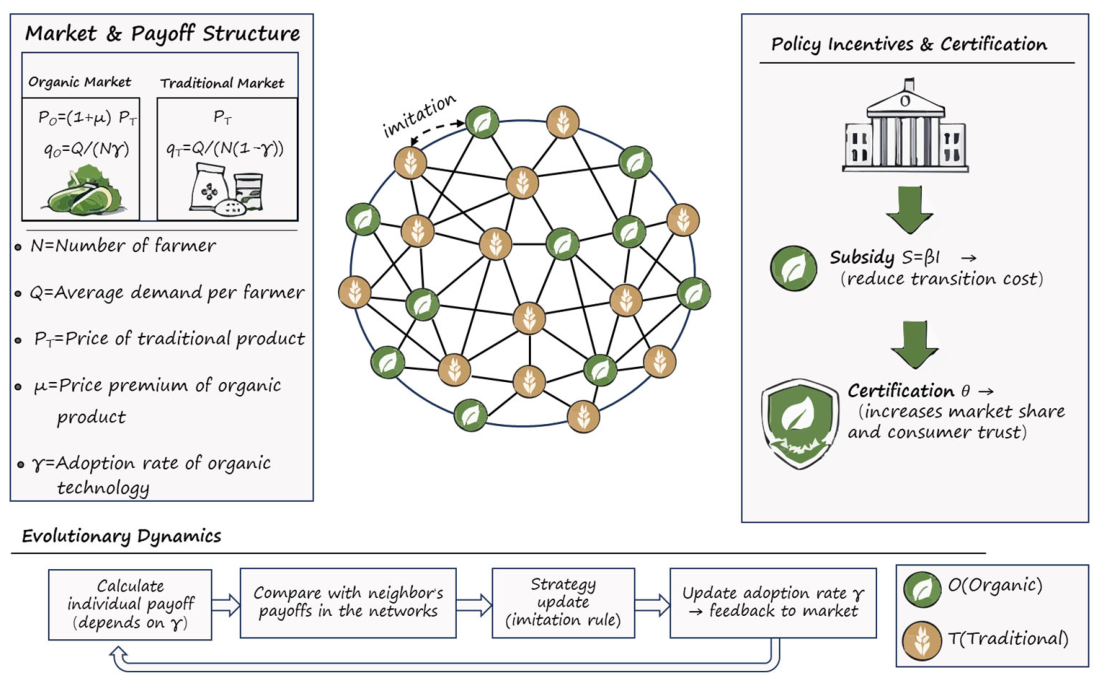
The diffusion model of organic farming technologies in this study consists of three components: a farmers’ evolutionary game model, the network structure, and the evolutionary rules. The overall framework of the model is illustrated in Figure 1.
First, an evolutionary game model of farmers’ adoption of organic farming technologies is constructed, including the formulation of basic assumptions and the specification of farmers’ payoff functions.
Second, an NW small-world network is employed to simulate information exchange and imitation learning among farmers within rural social networks.
Finally, strategy updating rules are defined, and numerical simulations are conducted to analyze the evolutionary dynamics of the system.

2.1. Parameter Settings and Basic Assumptions

First, the background settings of the evolutionary game are specified as follows.
Organic agricultural products and conventional agricultural products circulated in the market essentially belong to the same category of vegetables, differing only in production methods (organic versus conventional farming), and thus exhibit strong market substitutability. Let the total market demand for this category of vegetables be Q . Among all consumers, the proportion of consumers with a preference for organic products is denoted by α   [ 0 ,   1 ] . Accordingly, the baseline demand for organic products can be expressed as
Q O = α Q ,
while the baseline demand for conventional products is
Q T = 1 α Q .
Let the total number of farmers be N , and the market demand faced by each farmer is given by q = Q / N . Suppose that the diffusion level of organic farming technologies among farmers is γ ( 0 < γ < 1 ). Then, the average market demand faced by organic farmers is
q O = α q γ ,
while that faced by conventional farmers is
q T = ( 1 α ) q 1 γ .
Assume that the market equilibrium price of conventional agricultural products is P T . Due to the ecological and safety premium associated with organic products, their price is given by
P O = 1 + μ P T ,
where μ > 0 denotes the organic price premium, capturing the relative price advantage of organic products over conventional ones.
Second, the basic assumptions of the evolutionary game are proposed as follows.
H1. 
If farmers adopt organic farming technologies, they incur transition costs.
The adoption of organic farming technologies is inevitably accompanied by upfront transition costs. These costs primarily arise from the initial adjustment of the production system and the provision of supporting technical training, representing unavoidable resource expenditures during the transition from conventional to organic production.
Therefore, farmers engaging in organic farming must bear multidimensional transition costs, including labor, financial, and time inputs, which are denoted by I .
H2. 
If farmers adopt organic farming technologies, the unit production cost increases.
The adoption of organic farming technologies generally leads to higher unit production costs due to the specific requirements of organic production in terms of ecological management, input use, and cultivation practices. The high-input characteristics of organic farming are mainly reflected in three aspects.
First, organic production requires the use of certified organic fertilizers, specialized seeds, and related inputs, which are typically more expensive than conventional agricultural inputs. Second, more intensive land maintenance and field management are necessary to sustain ecological balance. Third, the strict restriction or elimination of chemical fertilizers and pesticides necessitates alternative practices such as manual weeding and biological pest control, thereby increasing labor input and additional management costs.
In addition, organic production may also be accompanied by lower yields per unit area and a higher proportion of non-marketable products. Due to pest and disease risks, irregular product specifications, appearance defects, or smaller product size, some products may be difficult to sell at the normal market price, thereby reducing the actual marketable output. In this case, fixed costs, as well as cultivation, maintenance, seed, and labor costs incurred per unit area, must be spread over a smaller quantity of marketable products, which further increases the effective unit production cost.
Therefore, assuming that, under the current technological conditions, the unit production cost of conventional agricultural products is C T . Then, the unit production cost of organic agricultural products can be expressed as
C O = 1 + η C T ,
where η > 0 represents the cost increase factor of organic farming relative to conventional farming.
H3. 
If farmers adopt organic farming technologies, they can receive government incentives.
Governments typically provide subsidies or incentives to farmers who adopt organic farming practices in order to promote green agricultural transformation and sustainable development. These incentives may include direct financial subsidies, certification-related subsidies, and technical support. Such policy support helps reduce farmers’ transition costs and encourages the adoption of organic farming technologies.
Assume that the subsidy rate is β   ( β > 0 ), and the corresponding subsidy amount is given by
S = β I ,
where I denotes the transition cost.
Meanwhile, organic certification, as a government-led standardized institutional arrangement, serves as an important policy instrument to promote the normative development and market diffusion of organic agriculture. Organic products possess typical credence-good attributes, as consumers cannot directly verify whether the production process complies with organic standards at the point of purchase [9]. Therefore, certification labels and other external information serve as critical tools for consumers to identify product attributes. Specifically, product assurance mechanisms such as packaging labels, certification logos, country or region of origin, and traceability information can mitigate information asymmetry between producers and consumers and enhance consumer trust in food quality and safety [11]. In the organic food market, certification logos provide consumers with authoritative signals that a product has been certified as organic, which is particularly important given that consumers cannot directly assess organic attributes themselves [18]. Accordingly, organic certification not only performs regulatory functions but also acts as an information signal and trust-building mechanism. Through certification, information asymmetry between producers and consumers can be reduced, consumer trust and market recognition of organic products can be enhanced, and farmers’ market share can be expanded. Based on this analysis, this study defines the effectiveness of organic certification as a composite market-recognition parameter that reflects certification credibility, consumer trust, enforcement strength, and market recognition. Let the effectiveness of organic certification be represented by θ ( 0 < θ < 1 ), such that certification increases farmers’ market share by θ .
H4. 
Market demand is influenced by price differences.
Although organic and conventional agricultural products differ in production methods, certification attributes, and market positioning, they usually belong to differentiated products within the same food category. Therefore, they may exhibit a certain degree of substitutability and price competition in consumer markets. Existing studies have shown that organic products often command price premiums over their conventional counterparts [19], and that price is an important factor influencing consumer demand for organic food [20]. When the price of organic products is significantly higher than that of conventional products, some price-sensitive consumers may reduce their willingness to purchase organic products and switch to relatively lower-priced conventional alternatives, thereby leading to an adjustment in the demand shares of the two types of products.
From the perspective of demand systems, the consumption substitution relationship between organic and conventional products can usually be characterized by price elasticities, especially cross-price elasticities [21,22]. However, it should be noted that the existence and magnitude of such substitution effects are not necessarily identical across all product categories and marketing channels, but may vary depending on product type, consumer preferences, market maturity, and distribution channels. Therefore, in the present model, the demand reallocation between organic and conventional products is treated as a stylized market-competition effect to capture the impact of price differences on market shares, rather than as a fixed empirical result for a specific market.
Based on the above analysis, this study introduces the price-sensitivity coefficient k to describe the effect of the price difference between organic and conventional products on market-share adjustment. Specifically, k denotes the standardized market-share adjustment caused by a unit price difference, P O P T represents the price difference between organic and conventional products, and k P O P T denotes the proportion of market demand shifted from organic products to conventional products due to the price disadvantage of organic products.
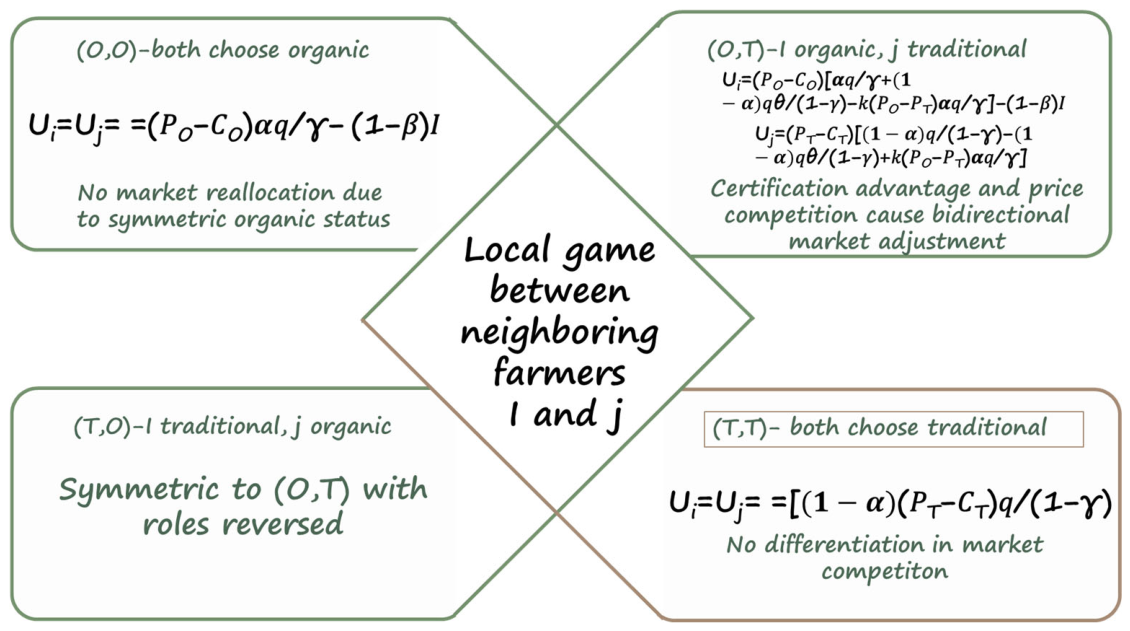
Based on H1–H4, taking neighboring farmers i and j as examples, the payoff matrix of the game between farmers is constructed, as shown in Figure 2, where U i and U j denote the payoffs of farmers i and j , respectively.
When both farmer i and farmer j adopt organic farming strategies, they are both organic producers. In this case, there is no competitive advantage arising from price differences in the market, and the effect of organic certification is symmetric between the two farmers. Therefore, neither farmer can capture the other’s market share. The payoff functions for both farmers are identical and can be expressed as:
P O C O α q γ 1 β I .
When farmer i adopts the organic strategy while farmer j adopts the conventional strategy, market shares are adjusted due to both organic certification and price differences.
On the one hand, farmer i gains a trust advantage from organic certification and captures part of farmer j ’s conventional market share, with an increase given by
( 1 α ) q θ 1 γ .
On the other hand, since organic products are more expensive than conventional products ( P O > P T ), farmer i loses part of the market due to price disadvantage, with a loss of
k P O P T α q γ .
Correspondingly, farmer j , as a conventional producer, loses part of the market due to farmer i ’s certification advantage, with a loss of
( 1 α ) q θ 1 γ ,
while simultaneously gaining market share due to the price advantage of conventional products, with an increase of
k P O P T α q γ .
Based on the above adjustments in market shares, the payoffs of farmers i and j are given by:
U i = P O C O α q γ + 1 α q θ 1 γ k P O P T α q γ 1 β I , U j = P T C T ( 1 α ) q 1 γ ( 1 α ) q θ 1 γ + k ( P O P T ) α q γ .
Similarly, when farmer i adopts the conventional strategy and farmer j adopts the organic strategy, the market share adjustment mechanism is symmetric to the case above, with the roles of the two farmers reversed. The corresponding payoff functions can be derived analogously.
When both farmer i and farmer j adopt conventional farming strategies, they are both conventional producers. In this case, there are no competitive differences arising from price or certification, and neither farmer captures the other’s market share. The payoff functions for both farmers are identical and can be expressed as:
( P T C T ) ( 1 α ) q 1 γ .

2.2. Network Structure

In rural societies, farmers form stable and complex social interaction networks through kinship ties, geographical proximity, and production cooperation. When making decisions about whether to adopt organic farming technologies, farmers do not rely solely on independent rational judgment. Instead, they tend to observe the production behaviors and economic performance of neighboring farmers and continuously adjust their strategies through experience sharing and imitation learning. As a result, the interaction among farmers exhibits typical complex network characteristics, featuring dense local connections alongside a small number of long-range links.
Within a small-world network structure, farmers who are not directly connected can achieve rapid information transmission through a limited number of random links. This significantly shortens the path length of information diffusion and enhances the efficiency of technology dissemination within the population.
Compared with classical small-world network models, the Watts–Strogatz model modifies the original network structure by rewiring existing links, whereas the Newman–Watts model introduces additional random links while preserving the original network connections. The latter is more consistent with the characteristics of rural social networks, where stable acquaintance-based relationships coexist with occasional cross-regional interactions and technology extension activities.
Therefore, this study adopts the NW small-world network constructed through random link addition to characterize the interaction structure among farmers and to simulate the evolutionary game process of organic farming technology diffusion.
Based on the above framework, a technology diffusion network among farmers is constructed and denoted as G = ( V , E ) . Here, V = ( v 1 , v 2 , , v N ) represents the set of all nodes in the network, where each node corresponds to a farmer. E denotes the set of edges representing the relationships among farmers, with each edge indicating the existence of information exchange, technology learning, or production interactions between farmers.
The adjacency matrix of the network is defined as follows:
E = e 11 e 12 e 1 N e 21 e 22 e 2 N e N 1 e N 2 e N N ,
specifically, e i j = 1 indicates that there exists a direct interaction between farmers v i and v j , whereas e i j = 0 indicates that no direct connection exists between them.
The network is modeled as an undirected simple graph, with no self-loops or multiple edges. The degree of farmer v i is defined as:
d i = j = 1 N e i j ,
which represents the number of neighboring farmers directly connected to farmer v i , reflecting its influence within the social network.
The network structure is initially constructed as a regular ring lattice consisting of N nodes, where each node is connected to its k nearest neighbors. On this basis, additional edges are randomly added with probability p , forming a Newman–Watts (NW) small-world network.
The process of random link addition can be interpreted as the information spillover effects generated by agricultural extension programs, training activities, and cross-regional cooperation, which enable the establishment of new interactions among farmers who were previously weakly connected.
Considering that social relationships in rural areas are not static, interactions among farmers evolve over time due to production practices, policy implementation, and information diffusion. For example, some connections may weaken or even dissolve as cooperation declines, while new links may emerge through technical training, cooperative organizations, or market interactions.
To capture this dynamic adjustment process, this study further introduces a network evolution mechanism, allowing a small fraction of edges to be rewired with a given probability during the iterative process. This approach reflects the evolving nature of farmers’ social relationships while preserving the small-world characteristics and overall network connectivity.
Specifically, in each round of evolution, a subset of edges is randomly selected with probability r as candidate edges for rewiring. For a selected edge ( i , j ) , the connection is removed with probability r , and node i then randomly establishes a new link with another node m that is not already connected to i , thereby avoiding self-loops and duplicate edges.
If removing an edge would result in network fragmentation, the original connection is retained to ensure overall network connectivity. The parameter r represents the rate of social relationship adjustment, reflecting the frequency of changes in interactions among farmers.
Under the above settings, the network preserves both local clustering and short path length characteristics, while dynamically capturing the evolution of farmers’ relationships, thereby providing a more realistic structural foundation for analyzing the diffusion of organic farming technologies.
Within the neighborhood of farmer v i , the number of neighboring farmers adopting the organic strategy O is denoted by d i O , while the number of neighboring farmers adopting the conventional strategy T is denoted by d i T . These satisfy the relationship
d i = d i O + d i T .
The proportions of neighboring strategies reflect the technological adoption atmosphere in the social environment surrounding a farmer and constitute an important basis for strategy adjustment.
During the evolutionary process, farmers imitate strategies by observing payoff differences among their neighbors, and their expected payoffs are determined by the average payoff from games played with neighboring farmers.
The probability that farmer v i encounters a neighboring farmer adopting the organic strategy is d i O / d i . Accordingly, the expected payoffs of farmer v i under different strategies can be expressed as follows:
The expected payoff of farmer v i when adopting the conventional strategy T is given by:
d i O d i ,   1 d i O d i P T C T 1 α q 1 γ 1 α q θ 1 γ + k P O P T α q γ P T C T ( 1 α ) q 1 γ .
The expected payoff of farmer v i when adopting the organic strategy O is given by:
d i O d i ,   1 d i O d i . P O C O α q γ 1 β I ( P O C O ) α q γ + ( 1 α ) q θ 1 γ k P O P T α q γ ( 1 β ) I .
Based on the above network structure, the model captures farmers’ technology adoption behavior driven by neighborhood learning and imitation within a complex social network, thereby providing a structural foundation for analyzing the effects of policy incentives and certification mechanisms on the diffusion of organic farming technologies.

2.3. Fermi Learning Rule

In the process of organic farming technology diffusion, farmers are not fully rational decision-makers. Instead, their strategy adjustments are influenced by bounded rationality, incomplete information, and imitation behavior within their social networks.
In practice, farmers tend to observe the production performance and economic outcomes of neighboring farmers, compare them with their own results, and accordingly adjust their decisions on whether to adopt organic farming technologies.
Therefore, this study employs the Fermi–Dirac learning rule, which is widely used in evolutionary game theory, to characterize the strategy updating process of farmers and to capture their imitation behavior under bounded rationality.
In each round of the game, farmer v i interacts with all neighboring farmers and obtains a payoff. Subsequently, a neighboring farmer v j is randomly selected for payoff comparison. If the payoff of the neighbor exceeds that of farmer v i , then farmer v i adopts the neighbor’s strategy with a certain probability. Even when the neighbor’s payoff is slightly lower, there remains a small probability that farmer v i will adjust its strategy, reflecting the uncertainty and behavioral noise inherent in real-world decision-making.
Considering that agricultural production exhibits path dependence, once farmers have established an organic production system, they are unlikely to completely abandon organic production in the short term. However, strategy adjustments may still occur in the long run if returns are unsatisfactory or policy support weakens.
Accordingly, this study adopts a Fermi updating rule based on current payoff comparisons to describe the strategy evolution process of farmers. The probability that farmer v i adopts the strategy of farmer v j is given by:
P s i s j = 1 1 + exp U i U j K ,
where K is the noise parameter, which captures the randomness and bounded rationality in farmers’ decision-making. A larger value of K indicates stronger fluctuations in decision behavior, implying that farmers are more likely to be influenced by random factors or social sentiments.
After multiple rounds of iteration, the system gradually converges to a stable state, in which the proportion of farmers adopting organic farming technologies in the network becomes stable.
Let V O and V T denote the sets of farmers adopting the organic strategy O and the conventional strategy T , respectively. Let V O and V T represent the number of farmers adopting each strategy, and let U i denote the payoff of farmer i .
The diffusion level of organic farming technologies at equilibrium is defined as:
Γ = V O N ,
which represents the proportion of farmers adopting organic production among all farmers.
Furthermore, the average payoffs of organic and conventional farmers are defined as:
U ¯ O = i V O U i V O , U ¯ T = i V T U i V T .
By comparing the average payoffs of different strategy groups, the effects of policy incentive intensity, certification mechanisms, and network structure on the diffusion of organic farming technologies can be analyzed, thereby providing a basis for subsequent simulation analysis.

3. Simulation Results and Discussion

3.1. Simulation Procedure and Initial Settings

Based on the complex network evolutionary game model of organic farming technology diffusion and the dynamic small-world network structure constructed above, this study employs MATLAB (R2024b) to conduct numerical simulations of the system’s evolutionary process, aiming to characterize the dynamic diffusion paths and steady-state features of organic farming technologies under policy incentives and certification mechanisms.
Following the general paradigm of evolutionary game simulations, the simulation procedure consists of the following steps:
Step 1: Network generation and strategy initialization. A Newman–Watts (NW) small-world network with N farmer nodes is generated, where each farmer is connected to w neighbors on average. Based on the initial adoption proportion of organic farming technologies, denoted by γ 0 , farmers’ initial strategies are randomly assigned. The initial values of model parameters are also specified.
Step 2: Payoff calculation and network dynamics. In each round of evolution, farmers interact with their neighbors, and their payoffs are calculated according to the payoff functions. Meanwhile, according to the network evolution rules, a subset of edges is rewired with probability r to capture the dynamic evolution of social relationships among farmers, while maintaining overall network connectivity.
Step 3: Strategy updating. Each farmer randomly selects a neighboring farmer for payoff comparison and updates its strategy according to the Fermi learning rule, thereby driving the diffusion of strategies across the network.
Step 4: Iteration until convergence. Steps 2 and 3 are repeated until the proportion of farmers adopting organic farming technologies converges to a stable level or a predefined maximum number of iterations is reached.
To intuitively analyze how policy incentives affect the diffusion of organic agricultural production technologies, this paper examines the evolutionary paths of the system under different subsidy intensities, certification influences and network adjustment rates. All initial parameters are reasonably determined based on agricultural subsidy policies, organic agriculture development reports and existing literature, as detailed in Table 1.
It should be noted that the term “farmers” in this study refers to vegetable-producing entities with independent decision-making capabilities, including family farms, large-scale growers, and cooperative members. For the convenience of simulation, the market scale as well as costs and payoffs are normalized. Specifically, Q is measured in units of 10,000 kg, while payoffs and transition costs are expressed in normalized monetary units.

3.2. Diffusion Dynamics of Organic Farming Technologies Under the Baseline Scenario

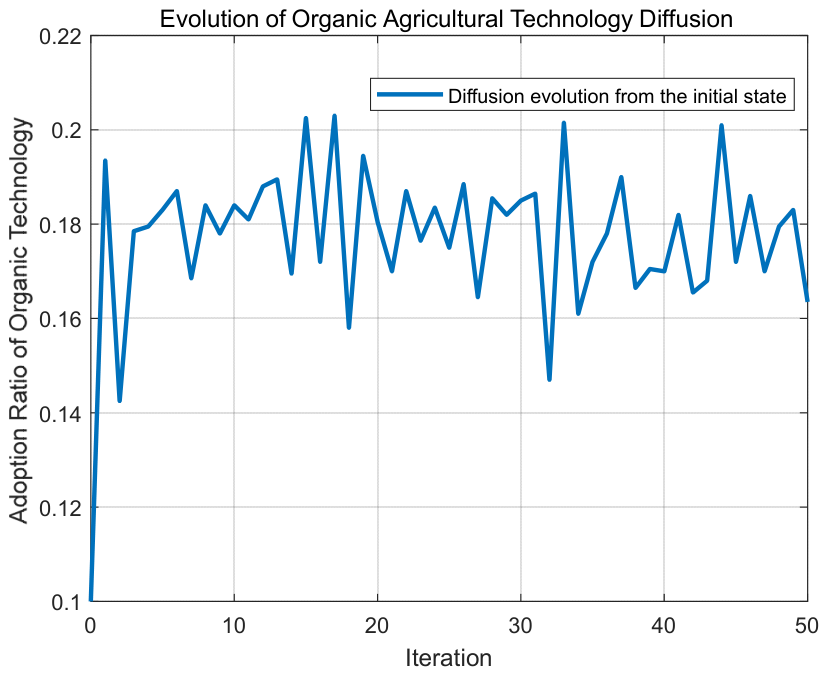
Under the above parameter settings, numerical simulations are conducted using MATLAB R2024b on small-world networks. Specifically, 20 different small-world networks are generated, and the diffusion process of organic farming technologies is simulated on this basis. Figure 3 illustrates the diffusion process of organic farming technologies (e.g., organic cultivation practices and ecological pest control) among farmers over time, starting from the initial state. As the number of iterations increases, the number of farmers adopting organic farming technologies gradually converges to a stable level. Based on the steady-state results from 20 independent simulation runs, the proportion of farmers adopting organic farming technologies stabilizes at approximately 18%. This result indicates that, under the baseline scenario, the diffusion of organic farming technologies remains limited and does not reach a high adoption level. Furthermore, compared with traditional evolutionary game models, the network topology adopted in this study better reflects real-world social systems, enabling a more realistic representation of social network effects and information diffusion mechanisms in farmers’ technology adoption behavior.

3.3. Effects of Policy Instruments on the Diffusion of Organic Farming Technologies

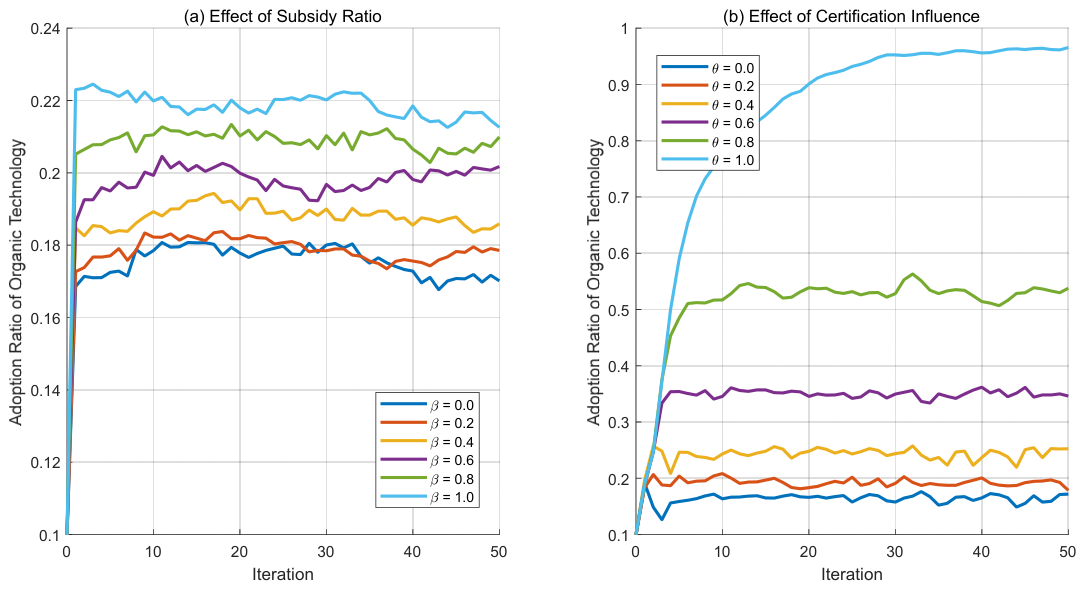
The simulation results of different policy incentive mechanisms on the diffusion of organic farming technologies are presented in Figure 4. Figure 4a illustrates the impact of different subsidy rates on the diffusion level of organic farming technologies, with β taking values of 0, 0.2, 0.4, 0.6, 0.8, and 1, while keeping other parameters constant. The results show that increasing the subsidy rate promotes the diffusion of organic farming technologies to some extent; however, the overall effect remains relatively limited. After several rounds of evolution, raising the subsidy rate from 0 to 1 increases the adoption proportion from approximately 16.5% to 22.2%, representing an increase of about 5.7 percentage points, or roughly one-third in relative terms. This indicates that simply increasing subsidy intensity has a relatively weak leverage effect on farmers’ adoption decisions. This limited impact may be explained by two main factors. First, subsidies primarily reduce the fixed transition costs faced by farmers. Although this helps alleviate the initial burden of conversion, it has a limited effect on improving long-term operational returns. Second, farmers’ continued adoption of organic technologies depends not only on initial cost compensation but also on whether organic products can generate stable market demand and sustained economic benefits. Therefore, when market demand is insufficient or certification effects are weak, increasing the subsidy rate can only encourage a limited number of farmers to adopt organic technologies and is unlikely to substantially alter the overall diffusion pattern. Overall, while subsidy policies exert a positive effect on technology diffusion, their marginal impact is relatively weak.
Figure 4b presents the impact of certification effectiveness on the diffusion of organic farming technologies, with θ taking values of 0, 0.2, 0.4, 0.6, 0.8, and 1, while holding other parameters constant. The results demonstrate that increasing certification effectiveness significantly promotes the diffusion of organic farming technologies. After multiple rounds of evolution, raising θ from 0 to 1 results in an increase of nearly 80% in the adoption proportion, which is substantially higher than the effect of subsidy policies. This finding indicates that certification mechanisms play a key role in driving technology diffusion. Further analysis shows that as certification effectiveness increases, the diffusion of organic technologies improves continuously, with more pronounced gains observed at higher levels of certification. This suggests a strong positive reinforcement effect of certification on technology diffusion. The underlying mechanism may be that organic certification enhances consumer trust, improves market recognition, and strengthens the price premium of organic products. As a result, organic farmers can expand their market share and increase their economic returns. With further improvements in certification effectiveness, the market rewards associated with adopting organic technologies continue to increase, thereby reinforcing the incentives for diffusion. However, even when certification effectiveness reaches its maximum level, full diffusion is not achieved. This indicates that although certification plays a crucial role, its effectiveness is jointly constrained by factors such as market demand, cost pressures, and farmer heterogeneity. In other words, relying solely on certification is insufficient to achieve full-scale diffusion of organic farming technologies. Instead, coordinated policy measures—including subsidies, market development, and technical support—are required to jointly promote diffusion.
To further examine the role of government policies in the micro-level interaction mechanisms of farmers’ decision-making, this study conducts a comparative analysis of the average payoffs of farmers during the diffusion of organic farming technologies.
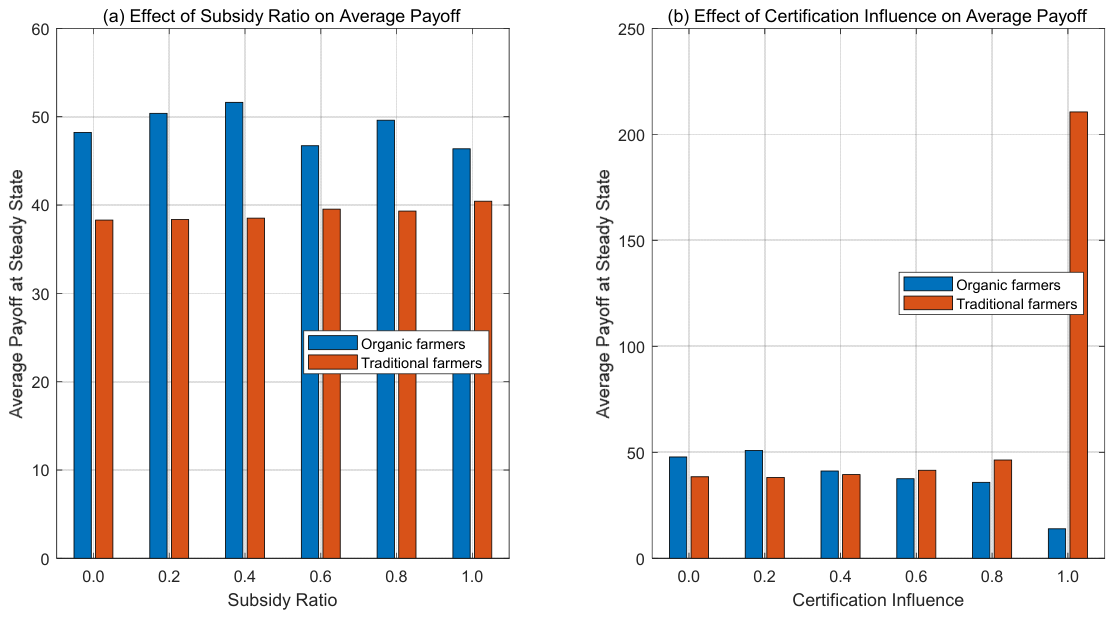
As shown in Figure 5a, under different subsidy rates, the steady-state average payoff of organic farmers consistently exceeds that of conventional farmers by approximately 25%, indicating that organic production maintains a clear profitability advantage under the baseline scenario. As the subsidy rate increases, the average payoff of organic farmers first rises, then declines, and eventually stabilizes, whereas the average payoff of conventional farmers exhibits only a slight increase. This pattern can be explained as follows. In the initial stage, subsidies effectively alleviate transition costs, thereby enhancing the relative profitability of organic production. However, as more farmers adopt organic practices, the market expansion effect associated with certification is gradually diluted. Consequently, the additional market share available to each organic farmer decreases, while the relatively high transition and production costs persist, leading to a decline and stabilization in their average payoffs. By contrast, since subsidies primarily compensate the costs of organic farmers, their direct impact on conventional farmers is limited, resulting in only minor changes in the latter’s average payoffs.
Figure 5b shows that certification effectiveness has a more pronounced impact on the steady-state average payoffs of both types of farmers. Initially, organic farmers achieve higher average payoffs than conventional farmers. As certification effectiveness increases, the average payoff of organic farmers exhibits a slight increase at first, followed by a gradual decline, whereas the average payoff of conventional farmers rises steadily and, in some cases, slightly exceeds that of organic farmers. At higher levels of certification effectiveness, the average payoff of organic farmers declines significantly, while that of conventional farmers increases sharply. This phenomenon can be attributed to the following mechanism. At low levels of certification effectiveness, certification enhances consumer trust and expands the market share of organic farmers, leading to a modest improvement in their payoffs. However, as certification effectiveness continues to increase, the diffusion of organic technologies accelerates, attracting a growing number of farmers into organic production. As a result, the market expansion effect is shared among more participants, reducing the average demand allocated to each organic farmer. Meanwhile, organic farmers continue to bear transition costs and higher production costs; when the additional benefits from certification are insufficient to offset these costs, their average payoffs decline. Conversely, given a fixed total market demand, the number of conventional farmers decreases as more farmers switch to organic production. This allows the remaining conventional farmers to capture a larger share of the conventional product market, thereby significantly increasing their average payoffs.
Overall, both the subsidy rate and certification effectiveness reshape the payoff distribution between different types of farmers, but their mechanisms differ substantially. Subsidy policies mainly influence organic farmers’ payoffs by reducing transition costs, resulting in relatively moderate marginal effects. In contrast, certification mechanisms operate by reallocating market shares between organic and conventional farmers, exerting a stronger impact on payoff structures and leading to more pronounced divergence between the two groups.

3.4. Sensitivity Analysis

To further examine the robustness of the model’s conclusions, sensitivity analyses are conducted based on the baseline scenario. Unless otherwise specified, each sensitivity analysis keeps all other parameters unchanged while varying only the target parameter or the strategy update rule; each scenario is simulated 20 times, and the curves in the figures represent the average adoption ratio of organic agricultural technology at each iteration.

3.4.1. Initial Adoption Rate

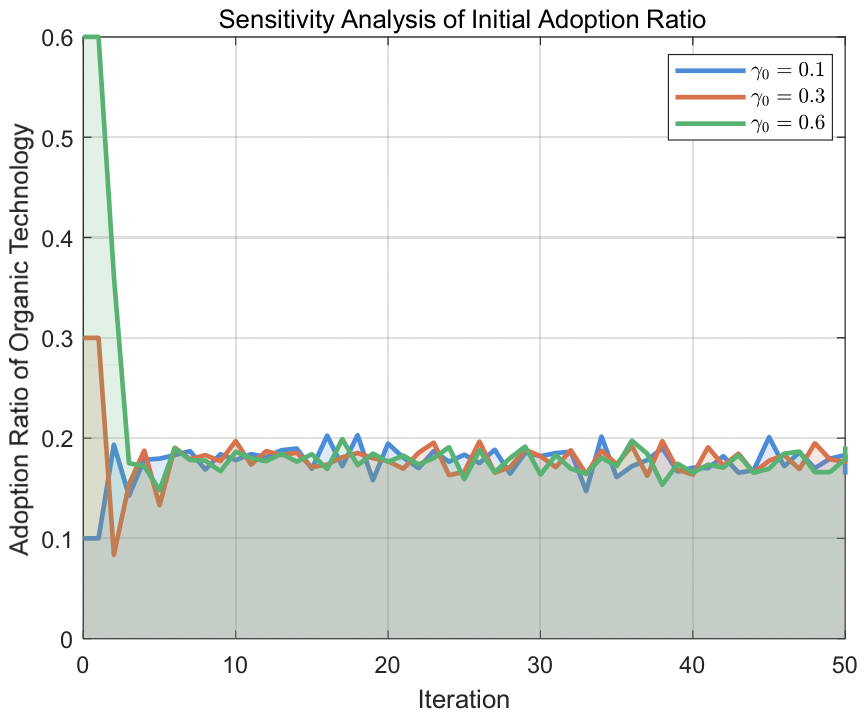
To examine the impact of the initial adoption rate of organic technologies on the baseline results, additional simulations are conducted with γ 0 = 0.3 and γ 0 = 0.6 . The results are presented in Figure 6. It can be observed that when γ 0 = 0.1 , the adoption rate of organic technologies increases from the initial 10% to approximately 18%. However, when γ 0 = 0.3 or γ 0 = 0.6 , the system experiences a rapid decline in the early stages of evolution and eventually stabilizes at around 18%. This indicates that, under the current parameter settings, the system exhibits a relatively stable equilibrium diffusion level, and a higher initial adoption rate cannot be sustained in the long run.
This outcome can be explained by the following mechanism. Given a fixed total market demand, a higher initial proportion of organic farmers implies that the average demand allocated to each organic farmer is reduced. Meanwhile, the market expansion effect generated by certification is shared among a larger number of organic producers, thereby weakening the incentive for further diffusion. When market demand is insufficient, price premiums are limited, and policy support remains moderate, the system cannot sustain a high level of organic technology adoption.
Therefore, a higher initial adoption rate does not necessarily promote the long-term diffusion of organic farming technologies. To maintain a higher steady-state diffusion level under high initial adoption conditions, it is necessary to expand market demand, enhance price premiums, and strengthen policy support.

3.4.2. Network Size

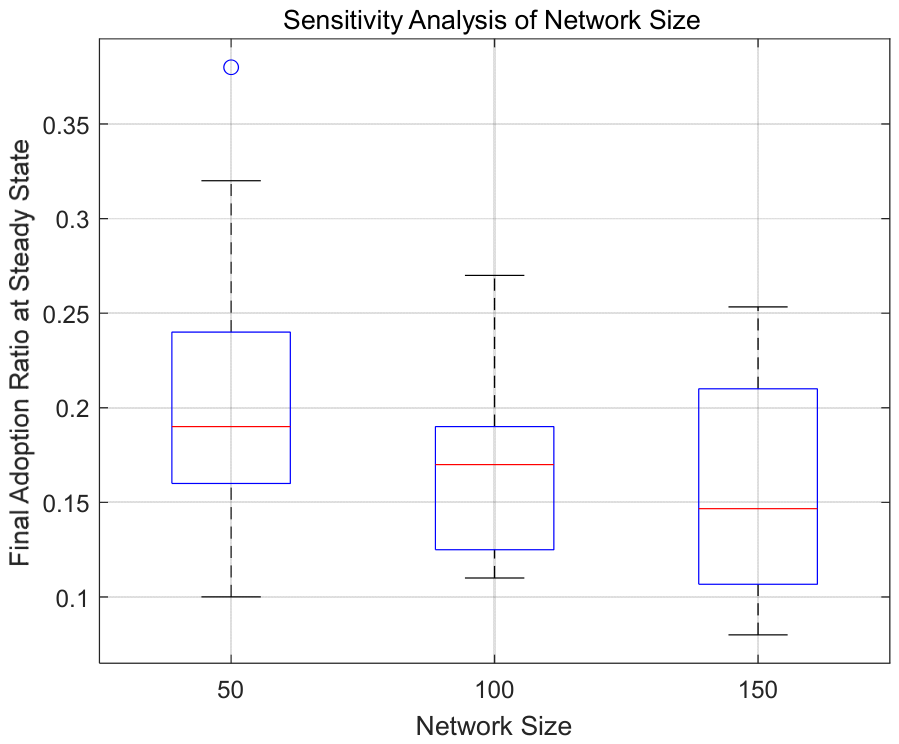
To examine the impact of network size on the baseline results, additional simulations are conducted with N = 50 and N = 150 . The results are presented in Figure 7. Figure 7 shows the distribution of steady-state adoption rates obtained from 20 independent simulation runs under different network sizes, given fixed policy parameters. Overall, as the network size increases from 50 to 150, the median adoption rate decreases from approximately 0.19 to 0.15. This suggests that, although policy interventions continue to promote the diffusion of organic farming technologies, their overall effectiveness weakens as the network size expands. Further observations indicate that when N = 50 , the distribution exhibits relatively high outliers, implying that diffusion outcomes in smaller networks are generally more favorable but also more volatile. As the network size increases to N = 100 and N = 150 , the overall distribution of steady-state adoption rates shifts downward, indicating that the equilibrium level of diffusion declines with larger network sizes. This pattern may be explained by the following mechanism. As the network size expands, the paths of information transmission among farmers become longer, and local imitation effects are relatively weakened. Consequently, the influence of given policy incentives on farmers’ strategy choices is diluted, leading to a reduced effectiveness of policy interventions.
These findings suggest that network size is not a neutral factor. Under the current parameter settings, subsidy and certification policies continue to promote the diffusion of organic farming technologies across networks of different sizes; however, their effectiveness diminishes as the network grows and may even approach ineffectiveness in large-scale systems. Therefore, promoting organic farming technology diffusion in larger farmer populations requires stronger policy support and more efficient information diffusion mechanisms.

3.4.3. Learning Parameter

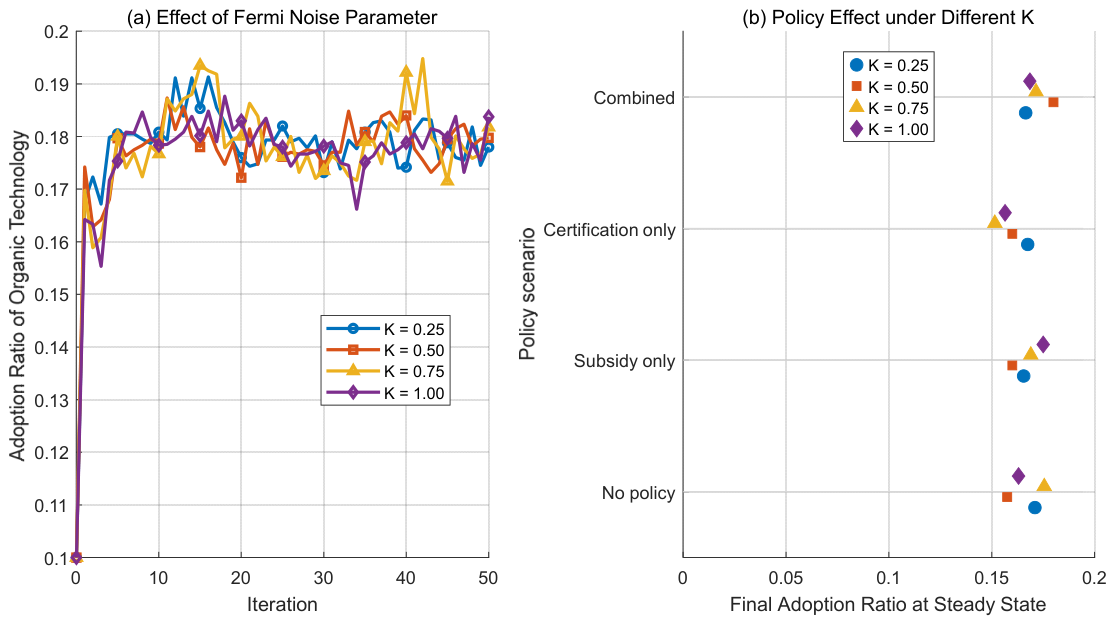
To examine the impact of variations in the Fermi learning parameter on the baseline results, additional simulations are conducted with K = 0.25,0.5,0.75 , and 1. The results are presented in Figure 8.
Figure 8a illustrates the diffusion paths of organic farming technologies under different levels of rationality, given β = 0.1 and θ = 0.1 . The results show that, under the current parameter settings, organic farming technologies can diffuse in all cases regardless of the level of rationality, and the steady-state adoption levels are largely similar. This indicates that variations in the Fermi noise parameter do not alter the overall direction of technology diffusion under baseline policy conditions, suggesting that the model results are robust with respect to changes in learning behavior.
Figure 8b presents the steady-state diffusion outcomes under different policy combinations across varying levels of K . Overall, for all values of K , the diffusion level consistently follows the same ranking: the combined policy scenario (subsidy and certification) achieves the highest diffusion level, followed by certification-only, then subsidy-only, and finally the no-policy scenario. This indicates that variations in rationality do not change the relative effectiveness of policy instruments. Certification mechanisms remain the primary driver of technology diffusion, whereas subsidy policies play a comparatively limited role.
At the same time, the results in Figure 8b reveal that perfect rationality does not necessarily lead to superior diffusion outcomes. Compared with perfectly rational farmers, systems characterized by bounded rationality tend to achieve higher steady-state diffusion levels. This can be explained as follows. Perfectly rational farmers are more likely to make decisions based strictly on current payoffs. When the advantages of organic production are not sufficiently strong or are subject to short-term fluctuations, farmers may revert to conventional production, thereby inhibiting diffusion. In contrast, under bounded rationality, strategy updating involves a degree of randomness and imitation inertia, which mitigates the impact of short-term payoff fluctuations and facilitates the sustained spread of organic farming technologies within the network. These findings suggest that a moderate level of bounded rationality is conducive to the diffusion of organic farming technologies, whereas excessively high rationality does not necessarily improve system-level outcomes.

3.4.4. Strategy Updating Rule

In real rural settings, farmers typically consider the overall performance of their neighboring farmers when deciding whether to adopt organic farming technologies, rather than relying solely on the payoff of a single neighbor. To test the robustness of the previous results, this study replaces the standard single-neighbor Fermi updating rule with a multi-neighbor average comparison rule.
Specifically, farmer v i updates its strategy based on the average payoffs of neighbors adopting organic and conventional strategies, respectively. The probability that farmer v i adopts the organic strategy is given by:
P T O = 1 1 + e U ¯ i T U ¯ i O K ,
where U ¯ i O and U ¯ i T denote the average payoffs of neighbors of farmer v i adopting organic and conventional strategies, respectively. This updating mechanism provides a more realistic representation of farmers’ imitation learning behavior and social network effects.
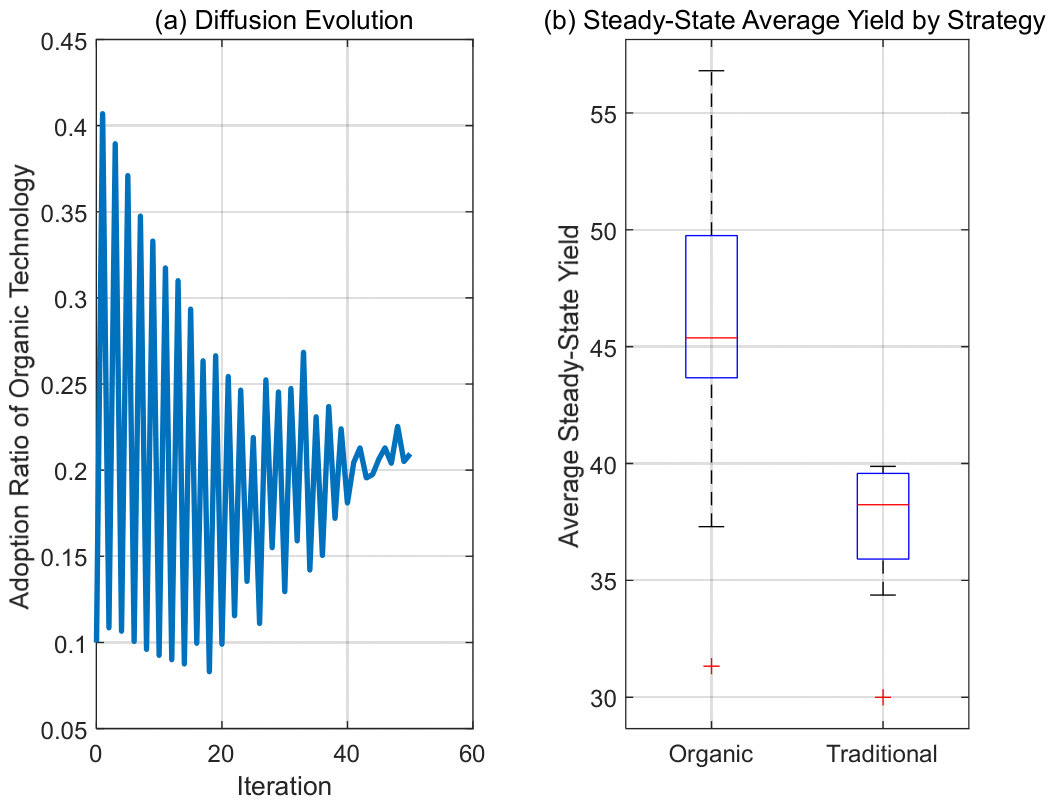
The simulation results under the multi-neighbor updating rule are presented in Figure 9. Figure 9a shows that the diffusion curve exhibits noticeable fluctuations in the early stage, followed by gradual convergence to a steady-state level of approximately 0.2. This indicates that organic farming technologies can still successfully diffuse, with a slightly higher steady-state level compared to the single-neighbor updating rule. Figure 9b presents the distribution of steady-state payoffs across 20 independent simulation runs. Although some variability exists across simulations, organic farmers generally achieve higher payoffs than conventional farmers. The observed differences can be attributed to heterogeneous adjustment dynamics among farmers. Some farmers rapidly switch to organic production under the influence of high-performing neighbors, while others adopt more gradually. At the same time, market share allocation and transition costs affect individual payoffs, contributing to the observed dispersion. Overall, the multi-neighbor updating rule increases short-term fluctuations but does not weaken the positive effect of policy interventions on technology diffusion. These findings suggest that policy design may benefit from encouraging farmers to consider broader neighborhood information, thereby improving both diffusion efficiency and payoff outcomes.

3.4.5. Parameter Sensitivity Analysis

Since the diffusion of organic farming technologies is influenced by multiple factors, including market preferences, cost constraints, and price premiums, the sensitivity and effectiveness of policy interventions may vary across different market environments.
To compare the effects of policy interventions under different scenarios and to test the robustness of the previous findings, this study perturbs three key parameters—namely, the organic preference share α , the cost increase factor η , and the organic price premium μ —and compares the diffusion levels under two policy combinations: a baseline policy ( β = 0.1 , θ = 0.1 ) and an enhanced policy ( β = 0.2 , θ = 0.2 ).
As shown in Table 2, the enhanced policy combination consistently leads to higher diffusion levels of organic farming technologies across all parameter scenarios, indicating that increasing the subsidy rate and certification effectiveness can robustly improve diffusion outcomes.
Further comparisons across parameter perturbations reveal that an increase in the organic preference share α leads to a higher diffusion level, whereas an increase in the cost increase factor η reduces diffusion. Similarly, a higher organic price premium μ also promotes diffusion. These findings suggest that stronger market demand, lower cost constraints, and higher price incentives enhance the effectiveness of policy interventions.
In terms of sensitivity, the diffusion level is more responsive to changes in the organic preference share and the cost increase factor, while it is relatively less sensitive to variations in the organic price premium. In particular, when α decreases or η increases, the diffusion level declines more significantly, indicating that insufficient market demand and rising cost pressures are key constraints on the diffusion of organic farming technologies. Overall, policy interventions are more effective in scenarios characterized by strong organic demand and low cost pressures, whereas their effectiveness is substantially constrained in environments with weak demand or high production costs.

3.4.6. Nonlinear Certification Effect

To examine whether the model conclusions depend on the linear certification assumption, we further introduce a nonlinear function representing the diminishing returns of organic certification. In the baseline model, the certification effect θ linearly influences market share. In reality, however, the enhancement of consumer trust and market recognition by certification may exhibit diminishing marginal returns. Accordingly, the effective certification is specified as:
θ N L = 1 e x p ( λ θ θ ) ,
where λ θ = 1   reflects the degree of diminishing marginal effect. This function captures that at low levels of certification, additional certification efforts rapidly increase consumer trust and market recognition, while at higher levels, the incremental increase in market share gradually slows down.
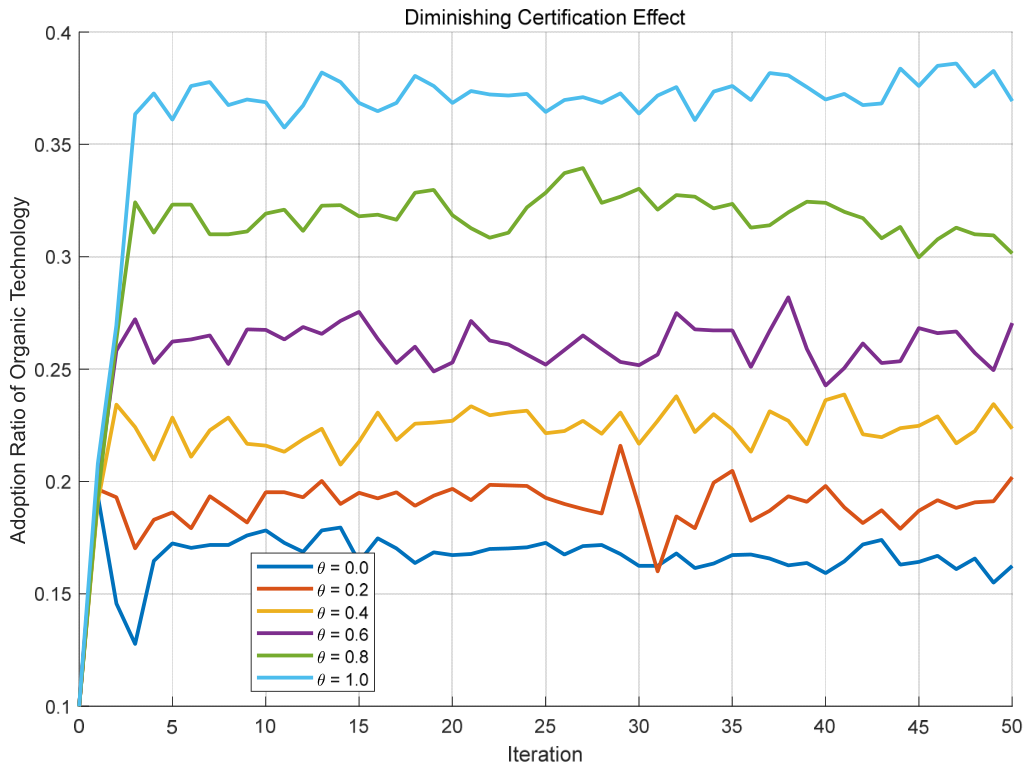
Figure 10 shows the evolution of organic technology adoption under the nonlinear certification effect. It can be observed that when the certification effect is adjusted from the linear setting to the diminishing-return nonlinear setting, the market-promoting effect of certification is moderately reduced. Nonetheless, even under this more conservative scenario, the impact of certification on the diffusion of organic technology generally remains higher than that of subsidy policies (see Figure 4). This indicates that the conclusion regarding the relative effectiveness of certification does not fully rely on the linear assumption, and the model results are robust to nonlinear certification specifications.

3.5. Results Discussion

A comprehensive comparison of the simulation results shows that both the subsidy rate and certification effectiveness promote the diffusion of organic farming technologies and improve adoption levels among farmers. However, their effects differ substantially: the impact of subsidies is relatively limited, whereas certification mechanisms exert a significantly stronger influence and consistently outperform subsidy policies. In particular, when the diffusion level is low, certification is more effective than subsidies. Even with continuous increases in subsidy intensity and certification effectiveness, full diffusion is not achieved due to the combined effects of market demand constraints, cost pressures, and farmer heterogeneity. Moreover, the effectiveness of policy interventions is influenced by several internal factors, including farmers’ rationality levels, initial adoption rates, network size, strategy updating rules, organic preference share, cost increase factor, and price premium. Although stronger policy interventions promote technology diffusion, they also reshape the payoff distribution among different types of farmers and do not necessarily lead to sustained increases in the average payoff of organic farmers. The underlying mechanisms can be summarized as follows.
(1)
Policy interventions constitute an important external driver of farmers’ transition to organic production [10]. Although organic farming can enhance product value and generate potential long-term benefits, farmers’ intrinsic motivation to adopt organic technologies remains limited due to high transition costs and uncertainty regarding future returns. Subsidy policies help alleviate financial constraints in the early stage of transition and increase farmers’ willingness to adopt organic practices. In contrast, certification mechanisms enhance consumer trust, strengthen market recognition, and improve price premiums, thereby expanding market opportunities for organic farmers and reinforcing their adoption incentives.
(2)
Subsidy policies primarily function as compensation for transition costs, whereas certification mechanisms operate by reshaping market share allocation [9]. Given a fixed level of certification effectiveness, increasing the subsidy rate reduces transition costs but has limited impact on long-term operational returns, resulting in a relatively moderate effect on technology diffusion. In contrast, certification mechanisms directly improve the profitability of organic production by enhancing market demand and price realization, thus exerting a stronger influence on diffusion. However, as the number of organic farmers increases, the market expansion benefits brought by certification are gradually shared among more participants, thereby constraining its marginal effectiveness.
(3)
Changes in the payoffs of organic and conventional farmers result from the joint effects of market share allocation and cost distribution [8]. Under a fixed total market demand, an increase in the number of organic farmers reduces the average demand allocated to each organic producer, while transition and production costs remain relatively high. As a result, the average payoff of organic farmers may exhibit an inverted-U pattern. Conventional farmers, although not bearing transition costs, face reduced market shares due to competition from organic producers. However, as the number of conventional farmers declines, the remaining demand becomes concentrated among fewer producers, leading to an increase in their average payoffs.
(4)
The system’s evolutionary outcomes also depend on initial conditions and the network interaction environment [17]. A higher initial adoption rate cannot be sustained in the long run, indicating the existence of a relatively stable equilibrium diffusion level. As network size increases, the steady-state diffusion level declines, suggesting that larger farmer populations weaken policy effectiveness due to longer information transmission paths and diluted interaction effects. Meanwhile, variations in rationality levels and strategy updating rules affect the speed and volatility of diffusion but do not alter the relative effectiveness ranking of subsidies and certification, further confirming the robustness of the model results.
(5)
Market demand, cost constraints, and price incentives are critical determinants of policy effectiveness [7]. A higher organic preference share, lower cost pressures, and stronger price premiums enhance the impact of policy interventions on technology diffusion. In particular, the system is more sensitive to changes in consumer preferences and cost factors, indicating that insufficient market demand and high cost pressures are the primary constraints on the diffusion of organic farming technologies.
In summary, both subsidy policies and certification mechanisms promote the diffusion of organic farming technologies, but their mechanisms and effects differ significantly. Subsidies primarily operate by reducing transition costs, whereas certification mechanisms function by strengthening market incentives, with the latter exerting a stronger overall impact. Therefore, promoting organic farming technology diffusion requires a coordinated policy approach that integrates subsidies, certification enhancement, market development, and cost reduction. In addition, differentiated policy measures tailored to heterogeneous farmer groups and varying market conditions are essential to improve policy effectiveness and sustain long-term diffusion.

4. Conclusions and Policy Implications

This study constructs a diffusion model of organic farming technologies among farmers based on a complex network evolutionary game model. By incorporating policy parameters calibrated from government policies, industry reports, and the relevant literature, numerical simulations are conducted to analyze how subsidy policies and certification mechanisms influence the diffusion of organic farming technologies through farmers’ interactive decision-making processes.

4.1. Main Findings

(1)
Both the subsidy rate and certification effectiveness promote the diffusion of organic farming technologies, but their effects differ significantly. Subsidy policies have a relatively limited impact, whereas certification mechanisms exert a stronger and more consistent influence, always outperforming subsidies. Moreover, policy interventions reshape the payoff distribution among different types of farmers and do not necessarily lead to sustained increases in the average payoff of organic farmers.
(2)
The effectiveness of subsidy and certification policies is strongly conditioned by market demand, cost pressures, and price premiums. Policy interventions are more effective in scenarios with a higher share of organic-preferring consumers, lower cost burdens, and stronger price premiums.
(3)
A higher initial adoption rate cannot be sustained in the long run, as the system converges to a relatively stable equilibrium diffusion level. In addition, an increase in network size weakens the effectiveness of policy interventions, suggesting that policy impacts are diluted as the scale of the farmer population expands and information transmission paths become longer.
(4)
Variations in rationality levels and strategy updating rules affect the volatility and convergence speed of diffusion, but do not alter the fundamental conclusion that the combined use of subsidies and certification yields the best outcomes, with certification playing a dominant role. Furthermore, perfect rationality or excessive reliance on payoff comparison does not necessarily facilitate diffusion; instead, a moderate degree of bounded rationality is more conducive to the sustained spread of organic technologies within farmer networks.

4.2. Policy Implications

(1)
Promote differentiated policy design to enhance targeting effectiveness. Governments should maintain uniform organic certification standards to preserve the credibility and trustworthiness of the certification system, while differentiating the use of policy instruments according to regional characteristics, farmer heterogeneity, and the level of organic agriculture development. Specifically, in regions with high cost pressures and weak adoption foundations, subsidy support should be strengthened to reduce transition costs and adoption risks; in regions with stronger market demand and higher organic price premiums, greater emphasis should be placed on certification-related support, market recognition, information disclosure, and consumer trust-building mechanisms.
(2)
Enhance certification mechanisms and align them with market demand cultivation. The model results show that certification significantly affects technology diffusion by influencing the market share of organic products and farmers’ expected returns. Therefore, the organic product certification system should be further improved to strengthen credibility and market recognition, and to reduce information asymmetry between producers and consumers. Given that the proportion of organic-preferring consumers and price premium capacity affect policy effectiveness, governments and relevant stakeholders can employ complementary measures such as standardized promotion, information disclosure, and promotion of organic certification labels to improve consumer awareness, trust, and market acceptance.
(3)
Optimize farmers’ interaction networks and information dissemination mechanisms to improve diffusion efficiency. The model shows that expanding network size diminishes the promoting effect of policy interventions on technology diffusion, indicating that farmer group scale and information propagation paths influence policy effectiveness. Differences in rationality levels and strategy update rules alter diffusion pathways and convergence speed, highlighting the importance of payoff comparison, experiential learning, and imitation behavior among farmers in the diffusion process. Therefore, policy implementation should emphasize the optimization of farmers’ network structures and information dissemination mechanisms to facilitate effective sharing of production experience, payoff information, and technical knowledge. Measures such as technical training, demonstration promotion, cooperative organizations, and grassroots agricultural extension services can serve as supportive interventions to enhance learning environments and network diffusion effects, providing sustained support for the spread of organic agricultural technologies.

4.3. Limitations and Future Research

Although this study provides valuable insights by analyzing the effects of subsidy policies and certification mechanisms on the diffusion of organic farming technologies, several limitations remain.
First, while this study considers the structure and dynamic adjustment of farmers’ social networks, real-world networks may exhibit more complex heterogeneity and adaptive characteristics. Future research could further explore policy effects under more complex and heterogeneous network structures.
Second, this study models farmers’ decision-making primarily based on current payoff comparisons and neighborhood learning. In reality, the adoption of organic farming technologies is a long-term and gradual process rather than an immediate response to observing neighboring farmers. Information flows among farmers are often incomplete, and the economic outcomes of organic farming are affected by weather variability, soil quality, farm size, machinery conditions, farmers’ age, knowledge, experience, and risk preferences. These factors may limit the transferability of experience from one farm to another. In addition, farmers’ expectations of future returns, risk preferences, and long-term ecological benefits also play important roles in technology adoption decisions. Future studies could relax these assumptions by incorporating heterogeneous farmers, learning delays, multi-period transition processes, stochastic environmental shocks, and forward-looking behavior to provide a more comprehensive understanding of organic technology adoption dynamics.
Third, in this study the organic price premium is fixed at a baseline value rather than modeled as an endogenous function of adoption rate or market supply. While endogenizing the price would better reflect real market dynamics, our primary goal is to provide a theoretical analysis of subsidy and certification mechanisms. We have conducted sensitivity analyses varying the price premium, which indicate that the main qualitative conclusions—especially the relative effectiveness of certification versus subsidy—remain robust. Future work could extend the model to endogenize the organic price premium for more detailed market analysis.

Author Contributions

Conceptualization, Y.W. and P.X.; methodology, Y.W.; software, Y.W.; validation, Y.W. and P.X.; formal analysis, Y.W.; investigation, Y.W.; resources, P.X.; data curation, Y.W.; writing—original draft preparation, Y.W.; writing—review and editing, P.X.; visualization, Y.W.; supervision, P.X.; project administration, P.X.; funding acquisition, P.X. All authors have read and agreed to the published version of the manuscript.

Funding

The authors gratefully acknowledge the financial support from the National Social Science Fund of China (Grant No. 24FGLB119), Natural Science Foundation of Hunan Province, China (Grant No. 2026JJ50546), and the Scientific Research Fund of Hunan Provincial Education Department (Excellent Youth Project, Grant No. 25B0979).

Institutional Review Board Statement

Not applicable.

Informed Consent Statement

Not applicable.

Data Availability Statement

The original contributions presented in this study are included in the article.

Acknowledgments

During the preparation of this manuscript, the authors used ChatGPT-5 for English language polishing and sentence optimization. The authors have reviewed, revised and edited all AI-generated contents, and take full responsibility for the final published version of this article.

Conflicts of Interest

The authors declare no conflicts of interest.

References

  1. United Nations General Assembly. Transforming Our World: The 2030 Agenda for Sustainable Development; United Nations: New York, NY, USA, 2015; Available online: https://sdgs.un.org/2030agenda (accessed on 26 April 2026).
  2. FAO; IFOAM Organics. Organic Agriculture and Its Benefits for Climate and Biodiversity; FAO: Rome, Italy, 2022; Available online: https://www.organicseurope.bio/content/uploads/2022/04/IFOAMEU_advocacy_organic-benefits-for-climate-and-biodiversity_2022.pdf?dd (accessed on 26 April 2026).
  3. FiBL. The World of Organic Agriculture 2025; FiBL: Frick, Switzerland, 2025; Available online: https://www.fibl.org/fileadmin/documents/shop/1797-organic-world-2025.pdf (accessed on 26 April 2026).
  4. European Commission. Action Plan for the Development of the Organic Sector; European Commission Directorate-General for Health and Food Safety: Brussels, Belgium, 2025; Available online: https://eur-lex.europa.eu/resource.html?uri=cellar:13dc912c-a1a5-11eb-b85c-01aa75ed71a1.0003.02/DOC_1&format=PDF (accessed on 26 April 2026).
  5. State Administration for Market Regulation. Administrative Measures for the Certification of Organic Products (Revised 2023). 31 December 2023. Available online: https://www.cnca.gov.cn/zwxx/bmgz/art/2017/art_0a7bee6605a44e4c97b8a1b0b36fd354.html (accessed on 26 April 2026).
  6. Möhring, N.; Muller, A.; Schaub, S. Farmers’ adoption of organic agriculture—A systematic global literature review. Eur. Rev. Agric. Econ. 2024, 51, 1012–1044. [Google Scholar] [CrossRef]
  7. Li, H.; Yang, S.; Yan, J.; Gao, W.; Cui, J.; Chen, Y. From conventional to organic agriculture: Influencing factors and reasons for tea farmers’ adoption of organic farming in Pu’er City. Sustainability 2024, 16, 10035. [Google Scholar] [CrossRef]
  8. Hu, T.; Al Mamun, A.; Reza, M.N.H.; Wu, M.; Yang, Q. Examining consumers’ willingness to pay premium price for organic food. Humanit. Soc. Sci. Commun. 2024, 11, 1249. [Google Scholar] [CrossRef]
  9. Schrobback, P.; Zhang, A.; Loechel, B.; Ricketts, K.D.; Ingham, A.B.; Mallawaarachchi, T. Food credence attributes: A conceptual framework of supply chain stakeholders, their motives, and mechanisms to address information asymmetry. Foods 2023, 12, 538. [Google Scholar] [CrossRef] [PubMed]
  10. Bui, H.T.M.; Nguyen, H.T.T. Factors influencing farmers’ decision to convert to organic tea cultivation in the mountainous areas of northern Vietnam. Org. Agric. 2021, 11, 51–61. [Google Scholar] [CrossRef]
  11. Wu, W.; Zhang, A.; van Klinken, R.D.; Schrobback, P.; Muller, J.M. Consumer trust in food and the food system: A critical review. Foods 2021, 10, 2490. [Google Scholar] [CrossRef] [PubMed]
  12. Knowler, D.; Bradshaw, B. Farmers’ adoption of conservation agriculture: A review and synthesis of recent research. Food Policy 2007, 32, 25–48. [Google Scholar] [CrossRef]
  13. El Bakali, I.; Ait El Mekki, A.; Maatala, N.; Harbouze, R. A systematic review on the impact of incentives on the adoption of conservation agriculture: New guidelines for policymakers and researchers. Int. J. Agric. Sustain. 2023, 21, 2290415. [Google Scholar] [CrossRef]
  14. Zhang, H.; Wang, Y.; Liu, H.; Chen, R. Optimizing policy mix for circular technology transitions: A networked co-evolution framework for electric vehicle battery recycling. J. Clean. Prod. 2026, 555, 148183. [Google Scholar] [CrossRef]
  15. Du, J.G.; Zhou, Z.Y.; Xu, L.Y. Evolutionary game mechanism on complex networks of green agricultural production under intensive management pattern. Complexity 2020, 2020, 8541517. [Google Scholar] [CrossRef]
  16. Chowdhury, S.; Satish, V.; Sulaiman, M.; Sun, Y. Sooner rather than later: Social networks and technology adoption. J. Econ. Behav. Organ. 2022, 203, 466–482. [Google Scholar] [CrossRef]
  17. Wang, J.; Hu, R.; Xu, H. Coupled simultaneous evolution of policy, enterprise innovation awareness, and technology diffusion in multiplex networks. Mathematics 2024, 12, 2078. [Google Scholar] [CrossRef]
  18. Janssen, M.; Hamm, U. Product labelling in the market for organic food: Consumer preferences and willingness-to-pay for different organic certification logos. Food Qual. Prefer. 2012, 25, 9–22. [Google Scholar] [CrossRef]
  19. USDA Economic Research Service. Investigating Retail Price Premiums for Organic Foods. Amber Waves. 2016. Available online: https://www.ers.usda.gov/amber-waves/2016/may/investigating-retail-price-premiums-for-organic-foods (accessed on 5 June 2026).
  20. Chen, D.; Jaenicke, E.C.; Volpe, R.J. Price promotion of organic foods and consumer demand. Renew. Agric. Food Syst. 2022, 37, 435–446. [Google Scholar] [CrossRef]
  21. McFadden, B.R. What are the overall implications of rising demand for organic fruit and vegetables? Q Open 2021, 1, qoab008. [Google Scholar] [CrossRef]
  22. Glaser, L.K.; Thompson, G.D. Demand for organic and conventional beverage milk. In Proceedings of the Western Agricultural Economics Association Annual Meeting, Vancouver, BC, Canada, 29 June–1 July 2000. [Google Scholar]
  23. He, S.; Tang, Y. Effects of personalized demands on the digital diffusion of enterprises: A complex network evolution game model-based study. J. Knowl. Econ. 2024, 15, 12854–12880. [Google Scholar] [CrossRef]
  24. Zhen, H.Y.; Gao, W.Z.; Jia, L.; Qiao, Y.H.; Ju, X.H. Environmental and economic life cycle assessment of alternative greenhouse vegetable production farms in peri-urban Beijing, China. J. Clean. Prod. 2020, 269, 122380. [Google Scholar] [CrossRef]
  25. Smoluk-Sikorska, J. Differences between prices of organic and conventional food in Poland. Agriculture 2024, 14, 2308. [Google Scholar] [CrossRef]
  26. Lin, B.H.; Yen, S.T.; Huang, C.L. U.S. demand for organic and conventional fresh fruits: The roles of income and price. Sustainability 2009, 1, 464–478. [Google Scholar] [CrossRef]
Figure 1. Evolutionary Game Model of Organic Farming Technology Diffusion among Farmers.
Systems 14 00675 g001
Figure 2. Payoff Matrix.
Systems 14 00675 g002
Figure 3. Evolution of Organic Farming Technology Diffusion from the Initial State.
Systems 14 00675 g003
Figure 4. Effects of Subsidy Rate and Certification Effectiveness on the Diffusion of Organic Farming Technologies.
Systems 14 00675 g004
Figure 5. Comparison of Steady-State Average Payoffs between Organic and Conventional Farmers under Different Policy Scenarios.
Systems 14 00675 g005
Figure 6. Effect of Initial Adoption Rate on the Diffusion of Organic Farming Technologies.
Systems 14 00675 g006
Figure 7. Effect of Network Structure on the Diffusion of Organic Farming Technologies.
Systems 14 00675 g007
Figure 8. Diffusion Extent of Organic Farming Technologies under Different Levels of Rationality.
Systems 14 00675 g008
Figure 9. Comparison of Modified Fermi Updating Rules.
Systems 14 00675 g009
Figure 10. Nonlinear certification effect on market share.
Systems 14 00675 g010
Table 1. Initial Parameter Settings.
ParameterDescriptionValue
N Number of Farmers100
Q Market Demand1000
P T Conventional Price10
C T Conventional Unit Cost6
I Transition Cost10
β Subsidy Rate10%
θ Certification Effectiveness10%
μ Organic Price Premium40%
η Cost Increase Factor50%
α Organic Preference Share25%
k Price Advantage Coefficient10%
w Average Degree4
p Rewiring Probability1%
r Network Adjustment Rate2%
K Noise Parameter10%
γ 0 Initial Adoption Rate10%
The baseline parameters of the model are set as follows. The network parameters N , Q , w , p , r , K are based on the classical Newman–Watts small-world model and commonly used settings in complex network evolutionary game simulations [23], with N = 100 , Q = 1000 (adjusted for agricultural production characteristics), w = 4 , p = 1 % , r = 2 % , and K = 10 % . The conventional product price and unit cost are set to P T = 10   and C T = 6 , yielding a cost-to-price ratio of approximately 60%, which is broadly consistent with the empirical cost–income structure of conventional greenhouse vegetable production [24]. The organic price premium is set to μ = 40 % , based on surveys of price differences between organic and conventional foods in Poland, where observed premiums ranged from approximately 35% to 270% [25]. The initial adoption rate γ 0 = 10 % and organic preference α = 25 % are based on FiBL (2025) statistics, with γ 0 reflecting the EU’s 2023 organic farmland share of 10.9% and α corresponding to the retail share of organic fresh vegetables in selected product categories [3]. The increase in unit cost for organic production ( η = 50 % ) and the farmer transition cost ( I = 10 ) are informed by empirical evidence on greenhouse vegetable production [24], capturing the increase in labor, fertilizer, and management inputs and the upfront fixed costs incurred during the transition from conventional to organic production, respectively. The price advantage coefficient k = 10 % is based on evidence from the demand system of organic and conventional fresh fruits in the United States [26], representing the effect of price differences on market-share allocation. The certification effect is set to θ = 10 % in the baseline scenario, with subsequent simulations varying θ within the range 0–1 to examine sensitivity to certification intensity. It should be noted that the term “farmers” in this study refers to vegetable-producing entities with independent decision-making capabilities, including family farms, large-scale growers, and cooperative members. For the convenience of simulation, the market scale as well as costs and payoffs are normalized. Specifically, Q is measured in units of 10,000 kg, while payoffs and transition costs are expressed in normalized monetary units.
Table 2. Parameter Sensitivity Analysis.
Baseline ParameterChange RateAdjusted ValueDiffusion Level of Organic Farming Technologies
β = 0.1 , θ = 0.1 β = 0.2 , θ = 0.2
Initial0-16%20%
α 10%27.5%19%22%
−10%22.5%15%19%
η 10%55%15%16%
−10%45%20%22%
μ 10%44%19%20%
−10%36%17%18%
Disclaimer/Publisher’s Note: The statements, opinions and data contained in all publications are solely those of the individual author(s) and contributor(s) and not of MDPI and/or the editor(s). MDPI and/or the editor(s) disclaim responsibility for any injury to people or property resulting from any ideas, methods, instructions or products referred to in the content.