1. Introduction
Digital payment and settlement systems have become the operational backbone of modern financial markets, shaping how transactions are executed, cleared, and sustained over time. The rapid diffusion of digital payments, platform-based financial services, and decentralized finance (DeFi) solutions has fundamentally altered payment ecosystems by increasing transaction speed, expanding participation, and generating data-rich settlement environments [
1,
2]. At the same time, rising transaction volumes, cyber risks, and system interdependencies have intensified concerns about the long-term sustainability, resilience, and stability of payment and settlement markets [
3,
4]. These developments raise an important question: why does the widespread diffusion of digital finance strengthen market performance in some contexts but not in others?
Payment and settlement markets can be understood as complex systems in which institutional actors, technological infrastructure, governance mechanisms, and user participation interact continuously to shape system-level outcomes [
5]. Within such systems, performance does not emerge from isolated technological adoption, but from coordinated functioning across interconnected layers, including regulatory oversight, digital rails, analytics capability, and institutional readiness. The effects of digital finance therefore depend on how these elements are configured, aligned, and governed within the broader market environment.
Performance heterogeneity across contexts reflects differences in capability configurations and system conditions rather than diffusion intensity alone. While diffusion explains how digital finance spreads, outcomes depend on whether organizations possess complementary capabilities that enable integration, risk control, and operational coordination [
6,
7]. In markets where digital transformation, inclusion efforts, and analytics are aligned, diffusion may translate into sustained efficiency and resilience [
8]. In contrast, misalignment among these elements may generate instability or limited performance gains. This systems-oriented perspective motivates the joint integration of Diffusion of Innovation and the Resource-Based View to explain why similar levels of digital finance adoption produce divergent market-level outcomes.
Existing research provides valuable insights into digital transformation, financial inclusion, and FinTech adoption. Studies show that digital transformation reshapes organizational processes, platforms, and governance structures, enabling faster and more efficient transaction services [
9,
10]. Similarly, digital financial inclusion expands access to payment systems and promotes participation in formal financial channels, which can enhance efficiency and transparency at scale [
11,
12]. However, much of this literature focuses on firm-level outcomes or user adoption, offering limited explanation of how these forces translate into market-level performance in payment and settlement systems [
13].
Research on DeFi further highlights this gap. While DeFi has been widely examined as a technological and architectural innovation, recent evidence suggests that its institutional impact depends less on protocol design and more on governance, integration, and operational control capabilities [
13,
14]. DeFi is increasingly diffusing through hybrid models, where decentralized settlement logic interacts with regulated financial infrastructures rather than replacing them outright [
15]. Yet, empirical work rarely examines how institutional readiness to adopt DeFi influences the sustainable performance of payment and settlement markets.
From a theoretical perspective, this limitation reflects an overreliance on diffusion-based explanations. Diffusion of Innovation (DOI) theory explains how digital finance spreads across organizations and ecosystems, emphasizing attributes such as relative advantage and compatibility [
16,
17]. However, diffusion alone does not explain performance heterogeneity. The Resource-Based View (RBV) complements DOI by emphasizing that sustained outcomes depend on firm-specific capabilities that are embedded, coordinated, and difficult to imitate [
6,
9]. Recent digital finance research increasingly argues that blockchain, analytics, and platform integration function as capability bundles rather than standalone technologies [
18,
19]. Despite this theoretical convergence, few studies empirically integrate RBV and DOI to explain market-level performance in digital payment and settlement systems.
Another underexplored dimension concerns the role of analytics. AI and big data analytical capabilities are now embedded in fraud detection, transaction monitoring, and operational risk management within payment infrastructures [
20,
21]. Evidence suggests that analytics enhances resilience and control in high-volume payment environments, yet its role as a boundary condition shaping the performance effects of digital inclusion, transformation, and DeFi adoption remains unclear [
22,
23].
Against this backdrop, this study addresses three interconnected gaps. First, it shifts the focus from firm-level or user-level outcomes to Sustainable Digital Payment and Settlement Market Performance (SDPSMP), capturing efficiency, stability, transparency, and resilience over time [
24]. Second, it conceptualizes DeFi adoption capability as an institutional capability that mediates how digital financial inclusion and digital transformation influence market performance. Third, it examines AI and big data analytical capability as a moderating mechanism that conditions these relationships.
Empirically, the study is situated in Saudi Arabia, a theoretically informative context due to rapid payment modernization under Vision 2030, strong regulatory oversight, and large-scale adoption of real-time payment infrastructure such as SARIE [
25,
26]. This setting allows examination of diffusion and capability under conditions of coordinated digital transformation rather than fragmented adoption.
To address these objectives, the study employs a dual-stage analytical approach combining Partial Least Squares Structural Equation Modelling (PLS-SEM) and ANN. This design enables both theory testing and predictive assessment, capturing linear and non-linear relationships that characterize complex digital payment ecosystems [
27,
28].
This study contributes to the digital finance and payment-systems literature in four important ways. First, it shifts the analytical focus from firm-level adoption and user-intention outcomes toward Sustainable Digital Payment and Settlement Market Performance (SDPSMP), conceptualized as a system-level construct reflecting efficiency, resilience, transparency, and stability within interconnected payment infrastructures. Second, the study reconceptualises DeFi adoption capability as an institutional and infrastructural capability rather than a user-level adoption outcome, thereby extending current DeFi research beyond protocol adoption and technological architecture. Third, by integrating RBV and DOI, the study explains why diffusion of digital finance does not uniformly generate sustainable market outcomes, emphasizing the role of complementary organizational capabilities and governance alignment. Fourth, the study demonstrates that AI and big data analytical capability functions as an adaptive conditioning mechanism that strengthens the translation of digital inclusion and DeFi capability into sustainable market performance. Through the combined SEM–ANN approach, the study further contributes by capturing both explanatory relationships and nonlinear predictive dynamics within digital payment ecosystems.
2. Literature Review
2.1. Digital Transformation in Financial Institutions
Digital transformation (DT) in financial institutions increasingly centres on the digitization of end-to-end processes, the development of integrated digital platforms, and the modernization of payment and settlement infrastructures. Contemporary research emphasizes that DT is not merely the adoption of new information technologies but a continuous organizational transformation that reshapes structures, decision-making routines, and value creation mechanisms [
9]. In banking, DT represents a shift from fragmented digital initiatives toward coordinated digital capabilities that support scalability, efficiency, and resilience [
10].
Globally, DT in financial institutions manifests through three interrelated dimensions. First, process digitization replaces manual and paper-based workflows with automated, data-driven processes that improve speed, accuracy, and control. Second, platform-based transformation enables banks to integrate internal systems with external partners through APIs, cloud services, and open banking architectures, facilitating ecosystem participation rather than isolated service delivery [
29]. Third, payment and settlement system modernization focuses on real-time processing, interoperability, and reduced transaction frictions, which are critical for market efficiency and trust.
Recent studies highlight that DT alters competitive dynamics by enabling new forms of coordination and by lowering entry barriers in transaction services [
30]. Payments and settlements, often described as the “infrastructure backbone” of financial markets, play a central role in this transformation. Faster clearing cycles, improved transparency, and data-rich transaction records enhance information flows and reduce systemic frictions, thereby supporting more stable and efficient market operations [
2]. These changes also create conditions under which FinTech and DeFi solutions can emerge and interact with incumbent institutions.
Importantly, DT in financial institutions is increasingly viewed as a capability-building process rather than a technology deployment exercise. Institutions that successfully align digital technologies with organizational processes and governance structures are better positioned to absorb external innovations, including DeFi-enabled payment and settlement mechanisms [
31]. This capability perspective explains why DT is closely linked to sustained market performance rather than short-term operational gains [
32].
Saudi Arabia has emerged as one of the fastest-growing digital payment markets in the Middle East, supported by large-scale regulatory and payment infrastructure modernization initiatives. Under Vision 2030 and the Financial Sector Development Program (FSDP), the Saudi Central Bank (SAMA) has accelerated the modernization of payment and settlement infrastructures through initiatives involving instant payment systems, open banking frameworks, digital banking licenses, and expansion of electronic payment channels [
33]. Recent official indicators from the Saudi Central Bank (SAMA) show that electronic payments accounted for 85% of total retail payments in Saudi Arabia in 2025, reflecting rapid progress toward a cashless economy and deeper participation within the national digital payment ecosystem [
34]. At the same time, the expansion of FinTech activities, digital payment services, and digitally integrated banking infrastructures has increased institutional interconnectivity while also creating greater operational complexity within the national payment ecosystem [
35]. These developments make Saudi Arabia a theoretically relevant setting for examining how digital transformation capabilities influence payment-market resilience, institutional readiness, and long-term settlement performance.
In Saudi Arabia, DT in financial institutions has accelerated under Vision 2030 and the Financial Sector Development Program [
36]. Regulatory support, investment in national payment infrastructure, and the rollout of instant payment systems such as SARIE reflect a strategic emphasis on modernizing payment and settlement markets [
25]. These initiatives also reinforce broader national objectives related to financial inclusion, operational resilience, interoperability, and digital service continuity across the financial sector. Consequently, DT has become increasingly important for enhancing market efficiency, institutional coordination, and the long-term sustainability of the Saudi payment ecosystem [
37,
38].
2.2. Digital Financial Inclusion in Digital Payment Ecosystems
Digital financial inclusion (DFI) has shifted the inclusion debate from “having a bank account” to being able to access and use digital financial services in daily life [
11]. In practice, DFI is increasingly shaped by whether people and firms can enter, navigate, and benefit from digital payment ecosystems that include wallets, cards, mobile apps, merchant acceptance tools, and identity and authentication layers [
39]. This shift matters because digital channels can lower access barriers, reduce transaction costs, and expand reach beyond physical branches, especially for underserved groups [
40].
In digital payment ecosystems, inclusion is not only about initial access. It also involves active participation: sending and receiving money, paying merchants, and using connected services such as savings, credit, and insurance [
41]. Recent evidence shows that digital payments are now treated as a core inclusion pathway and a measurable inclusion outcome. For example, studies using Global Findex-style indicators often model inclusion through observable behaviours such as making digital payments, receiving digital transfers, and using accounts for transactions.
This ecosystem view also links DFI directly to payment and settlement markets. When more users and merchants participate digitally, transaction volumes rise, data quality improves, and payment networks become more valuable. At the same time, inclusion can be constrained by weak interoperability, low acceptance density, limited trust, and uneven digital skills. These constraints are important because they affect whether digital access turns into regular usage [
42].
For payment and settlement markets, DFI is therefore best understood as digital access plus reliable usage at scale. That framing fits your paper because your respondents are professionals involved in payment and settlement functions, where inclusion is observed through adoption, continuity of use, and broad ecosystem participation rather than one-time on-boarding.
In Saudi Arabia, DFI is closely tied to the rapid expansion of electronic payments and national efforts to widen participation in formal digital financial channels. Recent indicators from the Saudi Central Bank (SAMA) show that electronic payments accounted for 85% of total retail payments in 2025, reflecting substantial growth in digital transaction participation and accelerated transition toward a cashless digital economy [
26,
34]. The continued expansion of digital wallets, mobile payment applications, FinTech platforms, and digitally integrated banking services has further strengthened user participation across the national payment ecosystem. These developments have increased transaction density, institutional interdependence, and real-time payment activity, thereby reinforcing the strategic importance of inclusive and resilient payment infrastructures. At the same time, evidence suggests that DFI in Saudi Arabia still varies across population groups due to differences in income, education, and levels of digital access, which keeps financial inclusion an ongoing institutional and policy challenge [
43].
2.3. Decentralized Finance (DeFi) Adoption Capability
Decentralized Finance (DeFi) refers to a financial model that uses distributed ledger technologies to provide services such as lending, investing, and asset exchange without depending on traditional centralized intermediaries [
1]. These services are delivered through DeFi protocols that operate via smart contracts, which are software programs designed to automate and execute the rules of conventional financial activities. DeFi systems enable peer-to-peer value exchange, automate financial operations through programmable protocols, and rely on transparent, immutable transaction records provided by blockchain infrastructure [
44,
45].
Recent research further emphasizes that DeFi represents an open and interoperable financial architecture, where interoperable protocols and applications can be combined to replicate and extend traditional financial market functions, including payment execution and asset settlement [
1]. This design allows DeFi to interact with conventional financial systems through hybrid arrangements rather than operating in complete isolation [
15].
DeFi adoption capability refers to an institution’s ability to sense, evaluate, and operationalize DeFi-related opportunities through governance, skills, and control systems, rather than individual customers’ willingness to use DeFi apps. This capability view fits DeFi because many DeFi functions depend on smart-contract rules, new coordination mechanisms, and new risk and accountability arrangements that must be designed and managed at the organizational level [
46].
Recent work also suggests that traditional finance is unlikely to “be replaced” in a simple way. Instead, DeFi is expected to diffuse through hybrid models, where institutions adopt DeFi components within regulated boundaries and focus first on back-office and infrastructure-facing functions. In this framing, adoption success depends more on strategic and operational competencies than on basic blockchain familiarity, which supports treating DeFi adoption as a capability bundle inside institutions [
14].
For payment and settlement markets, DeFi adoption capability is especially relevant because DeFi’s strongest near-term institutional use cases often sit around transaction execution, programmable transfers, and settlement logic. Research on the interaction between decentralized and centralized finance highlights that future payment technologies and digital wallet infrastructures can act as bridges, enabling integration paths where DeFi-based assets and rails connect with mainstream payment services [
47]. In practice, “integration” here means the institution can connect DeFi rails to payment flows, manage custody and key controls, monitor transactions, and handle compliance and operational risk in near real time.
Saudi Arabia’s evolving financial ecosystem has increased institutional interest in blockchain-enabled financial infrastructures, tokenized assets, and digitally programmable settlement mechanisms [
48]. Regulatory initiatives led by the Saudi Central Bank (SAMA), including FinTech sandboxes, digital innovation programs, and broader financial-sector modernization efforts under Vision 2030, have encouraged financial institutions to explore emerging digital asset applications within regulated operational environments [
26,
49]. At the same time, the growing integration of real-time payment systems, digital banking services, and interoperable financial platforms has increased the importance of institutional capabilities related to governance, smart-contract oversight, cybersecurity controls, and transaction monitoring [
47,
50]. These developments suggest that DeFi adoption in the Saudi context is less a question of speculative technology use and more a matter of institutional readiness to evaluate, integrate, and manage programmable financial infrastructures within evolving regulatory and operational boundaries.
In the Saudi context, this capability perspective is particularly relevant because the rapid modernization of payment and settlement infrastructures requires financial institutions to develop internal readiness to evaluate and pilot DeFi-linked solutions, including tokenized settlement assets and programmable transaction systems, within clearly defined governance and regulatory frameworks [
26,
51]. Consequently, DeFi adoption capability has become increasingly important for enabling institutional flexibility, operational resilience, and secure integration between decentralized and conventional financial infrastructures.
2.4. Sustainable Performance of Digital Payment and Settlement Markets
The sustainable performance of digital payment and settlement markets refers to the ability of these systems to deliver efficient, stable, transparent, and resilient transaction services over time [
24]. Recent literature emphasizes that payment and settlement infrastructures are foundational to financial markets, as they determine transaction speed, reliability, cost, and trust among participants [
52,
53]. From this perspective, sustainability is not a short-term outcome but reflects the long-term functioning and robustness of market infrastructures [
54].
Market efficiency in digital payment systems is commonly associated with faster processing times, lower transaction costs, and reduced operational frictions [
55]. Studies show that digital and instant payment systems can improve allocative efficiency by shortening settlement cycles and enhancing liquidity circulation across markets. However, efficiency alone is insufficient if not accompanied by systemic stability [
4].
Stability and resilience have therefore become central dimensions of sustainable market performance [
3]. Research highlights that digital payment and settlement systems must remain reliable during periods of stress, cyber threats, or sudden spikes in transaction volumes [
56]. Resilient infrastructures are those that can absorb shocks, maintain continuity, and recover quickly without amplifying systemic risk [
57]. This focus has grown as payment systems become increasingly interconnected with broader financial markets and digital platforms.
Transparency is another critical element of sustainable market performance [
58]. Digital payment infrastructures generate granular transaction data that can enhance traceability, oversight, and risk monitoring when governed appropriately [
59]. Recent studies argue that improved transparency supports market confidence and regulatory effectiveness, especially in digitally mediated settlement environments [
60].
Importantly, sustainability at the market level differs from firm-level financial performance. While firms may benefit individually from digital payments, sustainable market performance reflects collective outcomes, including system-wide efficiency, fairness, and long-term viability [
13]. This distinction is central to studies examining payment and settlement markets rather than organizational profitability.
In Saudi Arabia, the sustainable performance of digital payment and settlement markets is increasingly linked to national payment modernization initiatives, the expansion of real-time payment infrastructures, and broader financial-sector digitalization efforts [
61]. Regulatory priorities led by the Saudi Central Bank (SAMA) place growing emphasis on operational resilience, cybersecurity preparedness, transaction continuity, and settlement reliability as digital transaction volumes continue to increase across interconnected financial platforms [
48]. The growing dependence on instant payment systems, digitally integrated banking services, and interoperable payment networks has further increased the strategic importance of maintaining secure, transparent, and continuously functioning settlement infrastructures. Consequently, sustainable payment-market performance in the Saudi context is increasingly viewed not only in terms of efficiency gains, but also in terms of long-term system stability, infrastructure resilience, and institutional capacity to manage operational and cyber-related risks within rapidly evolving digital financial ecosystems.
2.5. AI and Big Data Analytical Capability as a Moderating Mechanism
AI and big data analytical capability (AIBDAC) refers to an institution’s ability to acquire, integrate, analyse, and act on large volumes of data using AI methods to support operational and risk decisions [
62]. In financial services, recent research shows AI is increasingly embedded in core functions, including fraud detection, credit and operational risk analytics, compliance, and process automation, which makes analytics capability a strategic enabler rather than a support tool [
20].
In payment and settlement environments, analytics capability matters because the system is high-volume, time-critical, and vulnerable to anomalies. Evidence from high-value payment systems demonstrates that machine learning can strengthen real-time transaction monitoring by separating typical from unusual payments and flagging suspicious patterns that may reflect cyberattacks or operational outages [
21]. These capabilities support market resilience by improving detection speed, operational continuity, and oversight quality [
63].
This logic explains why AIBDAC can operate as a moderating mechanism in your model. When DeFi adoption capability rises, institutions face new data complexity across wallets, tokenised instruments, smart-contract flows, and settlement processes [
64]. Strong analytics capability helps institutions convert these innovations into controlled outcomes by strengthening information discrimination, internal controls, and risk governance [
65]. Evidence also suggests that broader digital transformation reduces violations partly through enhanced information discernment and internal control quality, which is aligned with an analytics-enabled governance pathway [
23].
Similarly, for digital financial inclusion, analytics capability can strengthen effects by improving on-boarding risk checks, fraud prevention, and service reliability, which supports sustained usage rather than one-time access [
66]. This mechanism is important in payment ecosystems where trust and perceived security shape continued participation [
67].
In Saudi Arabia, where payment apps and digital payment usage are expanding, evidence shows that perceived security and trust are key drivers of usage and loyalty among payment app users and business actors, reinforcing the value of analytics-enabled risk and security controls [
68].
2.6. Digital Payment and Settlement Markets as Interconnected Systems
Digital payment and settlement markets function as interconnected systems in which institutions, technical rails, and governing rules jointly shape performance outcomes. In this study, the system boundary is defined as the payment and settlement market that links financial institutions, payment service providers, settlement infrastructure, and governance arrangements that enable clearing, settlement finality, and dispute resolution. This boundary is useful because market performance depends on coordinated functioning across actors and layers, rather than on isolated technology adoption decisions. Systems research stresses that outcomes emerge from interaction among elements and from boundary conditions that define what is inside the system and what acts as its environment [
5,
69].
Within this boundary, institutions provide governance and operational capacity, digital rails provide transaction routing and settlement processes, and rules shape interoperability, risk controls, and accountability. Digital finance and platform-based payment services can expand scale and speed, but they also raise interdependence and shared exposure to operational, cyber, and compliance risks [
7]. This environment is shaped by regulation, national digital infrastructure, cybersecurity pressures, and platform dependencies. Systems-oriented work in finance highlights that stability and resilience arise from dynamic interaction across networks of institutions, technologies, and regulatory constraints [
70].
The study’s constructs map naturally onto coupled subsystems within this market. Digital financial inclusion represents broad access and participation forces that expand transaction volume and diversify user segments. Evidence from digital payments research shows that inclusion-oriented payment technologies can reduce exclusion, but outcomes depend on supportive conditions and risk controls [
39]. Digital transformation represents institutional reconfiguration that modernizes processes, data flows, and service delivery. Systems research links digital transformation to resilience by strengthening innovation capability and adaptive response, especially under turbulence [
71].
DeFi adoption capability is treated as a market-facing capability that enables institutions to interface with decentralized infrastructures and smart-contract-based settlement logic, while managing integration and control. Recent Systems work frames FinTech-driven banking as a complex adaptive setting where capabilities and stakeholder interactions co-evolve, making evaluation at the system level more appropriate than firm-level adoption metrics alone [
72]. AI and big data analytical capability operates as an adaptive layer that strengthens sensing, monitoring, and decision quality across the payment system, which is central for resilience under fast-changing operational conditions [
73].
A key implication of this interconnected framing is that relationships may be nonlinear. Small increases in inclusion or analytics may have limited effects until interoperability, governance, and capability thresholds are reached. Once thresholds are crossed, effects can accelerate through network and learning dynamics. Systems research on complex adaptive systems emphasizes that emergent outcomes often reflect feedback, threshold behaviour, and interaction effects rather than linear causality [
5]. This justifies combining explanatory SEM with ANN-based prediction, since hybrid designs help capture both structured pathways and nonlinear patterns in system outcomes, consistent with recent Systems applications that blend econometric and machine learning estimators to reflect structural complexity [
74].
2.7. Theoretical Foundations
The Resource-Based View (RBV) was formally articulated by [
75] and later consolidated by [
6]. RBV argues that sustained performance differences arise from firm-specific resources and capabilities that are valuable, rare, difficult to imitate, and organizationally embedded. Rather than focusing on external market positioning, RBV emphasizes internal capabilities as the primary drivers of long-term performance. In digital finance, RBV has been widely applied to explain why some institutions benefit more from technological change than others do. Research shows that digital infrastructure, analytics capability, and process integration function as strategic resources that shape payment efficiency and innovation outcomes [
9].
Recent research has increasingly applied the RBV to explain how blockchain and digital asset adoption generate strategic value. The study on Swiss banking shows that blockchain and digital asset services such as custody and tokenization function as firm-specific capabilities grounded in regulatory expertise and technical know-how, enabling sustained advantage [
18]. Similarly, evidence from MSMEs demonstrates that blockchain adoption enhances financial performance when treated as an organizational capability rather than a standalone technology [
19]. Research comparing corporate adoption of Bitcoin and Ethereum further highlights how internal strategy, governance, and regulatory alignment shape blockchain-related resource deployment and outcomes [
76].
Recent DeFi-focused research also adopts an RBV lens by treating DeFi engagement as a capability bundle rather than isolated technology use. Ref. [
45] argue that institutional outcomes in DeFi depend on governance, data handling, and integration capabilities that allow organizations to manage smart-contract-based financial activities effectively. In this study, RBV explains why digital transformation, digital financial inclusion, and AI-driven analytics operate as strategic capabilities that enable DeFi adoption capability and, in turn, enhance sustainable digital payment and settlement market performance.
Diffusion of Innovation (DOI) theory was developed by [
16] to explain how new technologies spread over time through social systems. DOI highlights key attributes influencing adoption, including relative advantage, compatibility, complexity, trialability, and observability. Importantly, DOI distinguishes between adoption decisions and the broader diffusion process across organizations and markets.
DOI has been widely used in financial services to explain how users and organizations adopt new digital channels based on attributes like relative advantage, compatibility, and complexity. Evidence from Tanzania shows that FinTech diffusion can accelerate financial inclusion when adoption drivers align with DOI logic, including perceived benefits and enabling conditions [
17]. DOI has also been applied to digital wallet adoption, showing that perceived innovation attributes, together with cultural factors, shape intention to adopt Islamic digital wallets [
77].
Integrating RBV and DOI is critical because diffusion alone does not guarantee performance gains. DOI explains how DeFi and digital payment innovations spread, while RBV explains why some institutions convert diffusion into sustainable market outcomes. In the proposed model, digital transformation and inclusion facilitate diffusion, DeFi adoption capability represents institutionalized innovation, and AI and big data analytics strengthen the translation of diffusion into sustained payment and settlement market performance.
2.8. Development of Hypotheses
2.8.1. Digital Financial Inclusion (DFI), DeFi Adoption Capability (DAC), and Sustainable Digital Payment and Settlement Market Performance (SDPSMP)
DFI expands access and active use of digital financial services, especially payments, by widening participation in formal digital channels [
11]. When more users and merchants transact digitally, payment and settlement markets typically gain scale benefits, better traceability, and stronger service continuity, which supports long-run market efficiency and reliability. Global policy evidence also links broader digital access to payment systems that are faster, cheaper, and more transparent, which are core elements of sustainable payment-market performance [
12]. Therefore, higher DFI should improve SDPSMP.
From an institutional perspective, rising DFI also creates stronger demand for secure, interoperable, and innovative transaction rails. Diffusion-based evidence shows that FinTech-driven inclusion accelerates when enabling conditions and perceived advantages are present, pushing providers to upgrade their digital capabilities [
17]. This environment encourages institutions to develop DAC, defined as readiness to evaluate and integrate DeFi-linked solutions, governance arrangements, and operational controls into financial processes. Banking evidence from digital asset adoption also frames blockchain-related services as capability-building efforts involving compliance strength, technical know-how, and partnerships, rather than simple technology use [
18]. Thus, DFI should positively influence DAC.
DAC should, in turn, enhance SDPSMP because DeFi research shows that smart-contract-based infrastructures increasingly replicate functions tied to market efficiency, liquidity provision, and settlement mechanisms, while requiring robust governance to manage new risks [
45]. Evidence also suggests DeFi diffusion is moving through hybrid pathways where institutions act as conduits between decentralized protocols and mainstream financial markets, making capability a key transmission mechanism [
15]. Accordingly, DAC is expected to mediate how DFI translates into sustainable payment and settlement market outcomes.
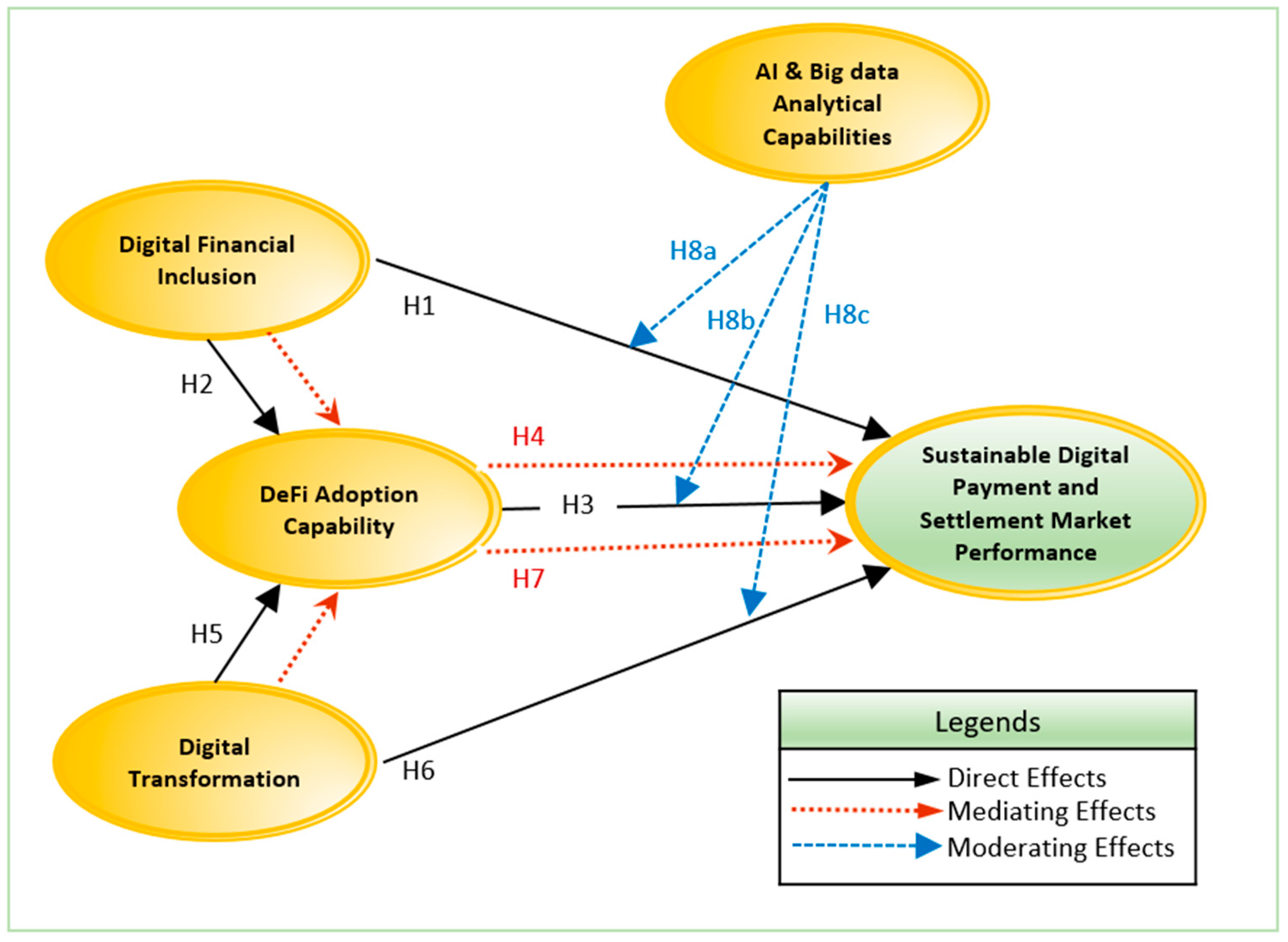
H1. DFI affects SDPSMP positively.
H2. DFI affects DAC positively.
H3. DAC affects SDPSMP positively.
H4. DAC mediates the relationship between DFI and SDPSMP.
2.8.2. Digital Transformation (DT), DeFi Adoption Capability (DAC), and Sustainable Digital Payment and Settlement Market Performance (SDPSMP)
DT in financial institutions goes beyond digitising front-end channels. It involves redesigning operations, integrating platforms, and upgrading data and governance so that payment and settlement services run faster, safer, and at scale. Recent evidence from European banks shows that DT is linked with performance improvements through IT and network efficiency, which are closely tied to how transactions are processed and managed across digital channels [
78]. In parallel, research on digitisation and operational efficiency in banking highlights that efficiency gains typically emerge when institutions build systematic capabilities for process integration, data use, and service redesign, rather than adopting isolated tools [
79]. This supports a direct DT-to-market-performance logic in digital payment and settlement contexts.
DT should also strengthen DAC because DeFi-linked rails require organizational readiness for governance, interoperability, and operational redesign. A 2025 longitudinal study on blockchain-driven digital transformation shows that scaling distributed-ledger initiatives depends heavily on formal governance structures, cross-actor coordination, training, and flexible implementation, all of which reflect institutional capability building [
80]. Complementing this, research on tokenization in financial markets argues that tokenized assets and blockchain-based systems often need to be adapted to existing financial market infrastructures and governance arrangements, which makes institutional capability and integration readiness central [
81]. Therefore, DT should positively shape DAC by providing the architecture and governance maturity needed to evaluate and pilot DeFi-linked payment and settlement use cases.
Finally, DT is likely to influence SDPSMP partly through DAC. DT creates the operational and governance foundation, while DAC captures the institution’s ability to translate that foundation into DeFi-linked settlement experimentation and controlled scaling, which then supports long-run efficiency and resilience outcomes.
H5. DT affects positively DAC.
H6. DT affects positively SDPSMP.
H7. DAC mediates the relationship between DT and SDPSMP.
2.8.3. The Moderating Role of AI & Big Data Analytical Capabilities
AI and big data analytical capability (AIBDAC) strengthens how institutions convert digital initiatives into stable, long-term outcomes because it improves data integration, decision speed, and risk visibility. Recent evidence shows that big data analytics capabilities enhance sustainable performance by enabling innovation and improving how firms translate digital inputs into measurable outcomes [
22]. In digital payment ecosystems, this logic matters because inclusion-driven growth increases transaction volume, heterogeneity of users, and exposure to fraud and operational exceptions. Analytics capability helps institutions monitor behaviour patterns, strengthen controls, and maintain service reliability, which can amplify the positive effect of DFI on SDPSMP. This expectation is consistent with evidence that big data analytics capabilities enable innovation and performance gains, especially when organizations can convert data insights into operational improvements [
82]. Thus, AIBDAC is expected to strengthen the DFI → SDPSMP relationship.
AIBDAC should also reinforce the impact of DAC on SDPSMP because DeFi-linked processes require continuous monitoring of complex transaction flows, smart-contract risks, and anomalous patterns. When analytics capability is strong, institutions can better manage experimentation, detect emerging risks early, and scale DeFi-linked settlement solutions more safely, producing stronger market-level benefits. Evidence supports that analytics capability enhances innovation outcomes and supports stronger performance effects when organizations can embed analytics into routines and learning processes [
83]. Therefore, AIBDAC is likely to strengthen the DAC → SDPSMP relationship.
Finally, DT’s impact on SDPSMP is also likely to be stronger when AIBDAC is high because transformation initiatives generate and depend on data-driven coordination across functions. Research on sustainability-oriented digital transformation and FinTech highlights that the performance value of digital transformation rises when data and FinTech capabilities support more effective execution and governance of digital initiatives [
84]. Accordingly, analytics capability should magnify the DT → SDPSMP relationship by improving control quality, responsiveness, and continuity in payment and settlement operations.
H8a. AIBDAC moderates the relationship between DFI and SDPSMP.
H8b. AIBDAC moderates the relationship between DAC and SDPSMP.
H8c. AIBDAC moderates the relationship between DT and SDPSMP.
Although the proposed model includes multiple structural relationships, the study is conceptually centred on a core explanatory pathway in which digital transformation and digital financial inclusion influence Sustainable Digital Payment and Settlement Market Performance (SDPSMP), both directly and indirectly through DeFi adoption capability. Within this framework, DAC represents the principal institutional mechanism through which digital transformation and inclusion are translated into resilient and sustainable payment-market outcomes. The moderation hypotheses involving AI and big data analytical capability are incorporated as complementary boundary conditions intended to explain variation in the strength of these relationships within complex digital payment ecosystems.
Although multiple structural relationships are examined, the study is theoretically centred on two primary explanatory pathways in which digital transformation and digital financial inclusion influence Sustainable Digital Payment and Settlement Market Performance (SDPSMP), both directly and indirectly through DeFi adoption capability. Within this framework, DAC represents the principal institutional mechanism through which digital transformation and inclusion are translated into resilient and sustainable payment-market outcomes. The moderation hypotheses involving AI and big data analytical capability are incorporated as complementary boundary conditions intended to explain variation in the strength of these relationships within complex digital payment ecosystems. This structure enables the study to maintain theoretical focus while capturing the interconnected nature of contemporary payment and settlement infrastructures.
Figure 1 shows the conceptual framework developed for this study.
3. Methodology
This study employed a quantitative survey-based research design to examine the relationships among Digital Transformation (DT), Digital Financial Inclusion (DFI), DeFi Adoption Capability (DAC), AI and Big Data Analytical Capability (AIBDAC), and Sustainable Digital Payment and Settlement Market Performance (SDPSMP) within the Saudi Arabian financial sector. Data were collected from professionals working in financial institutions involved in digital payment, settlement, FinTech, risk, and related operational functions. A dual-stage analytical approach was adopted, combining Partial Least Squares Structural Equation Modelling (PLS-SEM) and Artificial Neural Network (ANN) analysis. PLS-SEM was used to assess the measurement and structural models and examine the hypothesised relationships, while ANN analysis was employed to complement the SEM findings through nonlinear predictive assessment. The following subsections present the measurement scale design and the data collection and sampling procedures applied in the study.
3.1. Measurement Scale Design
This study employed a survey-based approach to collect data from respondents in Saudi Arabia, targeting professionals working in financial institutions who are directly involved in digital payment, settlement, FinTech, and risk-related functions. Measurement items were adapted and developed based on established literature to ensure theoretical grounding and content validity. Specifically, four items measuring DFI were adopted from [
85], three items measuring DT were adopted from [
86], three items assessing DAC were adapted from [
87], and five items measuring AIBDAC were adapted from [
88]. In addition, five items measuring SDPSMP were newly devised in this study to capture the sustainable, market-level performance of digital payment and settlement systems.
Consistent with PLS-SEM best practices [
89], a rigorous scale validation process was followed prior to full-scale analysis. All adapted and newly developed items were reviewed by three academic experts in information systems and financial technologies and two practitioners from the digital financial services domain. Their feedback was used to refine item wording and contextual relevance. A pre-test was subsequently conducted to assess clarity and instrument flow. This was followed by a pilot study involving 78 respondents, which satisfied the 10-times rule for minimum sample size requirements. Reliability results from the pilot study were satisfactory, with Cronbach’s alpha and composite reliability values exceeding recommended thresholds, indicating adequate internal consistency. No wording or comprehension issues were reported, and therefore no revisions were required before proceeding to the main data collection. The measurement items used in the study are presented in
Appendix A.
Prior to PLS-SEM estimation, Exploratory Factor Analysis (EFA) was conducted as a preliminary diagnostic step to assess the underlying factor structure. EFA was performed using Principal Axis Factoring with Promax rotation, as correlations among constructs were theoretically expected. The Kaiser–Meyer–Olkin (KMO) measure of sampling adequacy was 0.917, indicating excellent adequacy, while Bartlett’s Test of Sphericity was significant (χ2 = 6618.95, df = 190, p < 0.001), confirming the suitability of the data for factor analysis. All extraction communalities exceeded 0.40, indicating adequate shared variance. The five extracted factors explained 71.75% of the total variance, exceeding recommended thresholds. All items loaded strongly on their intended constructs (loadings ≥ 0.50), with no problematic cross-loadings observed. These results provide strong evidence of construct validity and support the use of the measurement model in subsequent PLS-SEM analysis.
All constructs in the study were modelled as reflective constructs. This specification was considered appropriate because the measurement items were conceptualized as manifestations of broader underlying institutional capabilities, orientations, or performance perceptions rather than as independent components forming composite indices. Changes in the latent construct were therefore expected to be reflected across the indicators simultaneously, and the items were assumed to exhibit conceptual overlap and covariance. In addition, the measurement specifications were aligned with prior literature from which the scales were adapted, where these constructs were operationalized reflectively.
3.2. Data Collection & Sampling Process
This study employed a two-stage sampling approach to obtain a representative and reliable dataset for examining the relationships among DT, DFI, DAC, AIBDAC, and SDPSMP in the Saudi financial sector.
In Stage 1, a stratified sampling technique was used at the institutional level to ensure proportional representation of key segments within the Saudi financial ecosystem. Financial institutions were categorized into commercial banks, digital banks, foreign licensed banks, insurance companies, non-bank financial institutions, investment and asset management firms, payment service providers, and FinTech-oriented entities. Institutions were selected proportionately from each category based on their relative presence in the national financial system. To enhance contextual diversity, selected institutions were drawn from major financial hubs including Riyadh, Jeddah, the Eastern Province, and other urban and semi-urban areas. This stratification ensured adequate coverage of institutions actively involved in digital payments, settlement infrastructure, FinTech innovation, and market-facing financial operations.
In Stage 2, convenience sampling was applied within the selected institutions to identify suitable respondents. The target respondents comprised professionals directly involved in digital payment systems, settlement operations, FinTech initiatives, treasury, risk management, compliance, and related digital transformation activities. This respondent profile was appropriate for assessing institutional capabilities, DeFi readiness, and perceptions of market-level payment and settlement performance.
Because the study relied on self-reported survey data collected from a single respondent source, several procedural remedies were implemented to minimize the potential risk of common method bias (CMB). Respondents were assured of anonymity and confidentiality to reduce evaluation apprehension and social desirability bias. In addition, the questionnaire items were carefully structured using previously validated scales, simple wording, and clear construct separation to reduce ambiguity and response pattern effects. The survey instrument was also reviewed through expert evaluation, pre-testing, and pilot assessment to improve clarity and minimize measurement-related bias.
Potential respondents were identified through professional networks, institutional contacts, industry associations, and digital communication channels related to banking, FinTech, payment services, and financial operations within Saudi Arabia. The online questionnaire link was distributed electronically to professionals whose roles were directly relevant to digital payment and settlement activities. Participation in the survey was entirely voluntary, which may introduce self-selection bias commonly associated with non-probability survey designs. In addition, no systematic information was available regarding individuals who chose not to participate; therefore, direct comparison between participants and non-participants could not be conducted. These limitations should be considered when interpreting the statistical inference and generalizability of the findings.
Regarding sample size, following [
90], a minimum of 384 responses is recommended for large populations. Consistent with [
91], this threshold was adopted as the initial target. A total of 441 responses were collected through an online structured questionnaire. After data screening, 19 responses were excluded due to missing or incomplete information, resulting in 422 valid responses used for final analysis. The processed dataset and supporting analysis reports used in this study are provided in the
Supplementary Materials (File S1). This sample size exceeded minimum requirements for PLS-SEM analysis and provided sufficient statistical power. Moreover, the final sample size and data structure were deemed adequate to support a dual-stage SEM–ANN approach, enabling both theory testing and predictive analysis.
The combined use of stratified sampling at the institutional level and convenience sampling at the individual level improves institutional coverage while maintaining practical feasibility. However, because respondents within institutions were selected using convenience sampling, the findings should be interpreted with appropriate caution regarding external validity and respondent-level generalizability. This hybrid approach helped capture perspectives from the diverse structure of Saudi Arabia’s financial sector and provided an appropriate basis for examining digital transformation, DeFi adoption capability, and sustainable payment and settlement market performance.
Moreover, the sampled institutions were actively engaged in digital transformation initiatives and digital financial operations, making the observed levels of DT and AI and big data analytical capability contextually relevant for examining sustainable payment and settlement market performance within the Saudi financial ecosystem.
The demographic and professional profile of respondents is presented in
Table 1.
4. Analytical Approach and Results
This study employed a dual-stage SEM–ANN approach to analyse the proposed research model. Prior to model estimation, preliminary data assessments were conducted using SPSS 23, including descriptive statistics, multicollinearity checks, normality assessment, and tests of linearity. Linearity was examined through ANOVA-based procedures to assess the presence of linear and non-linear relationships among construct pairs. The results of the preliminary ANOVA-based linearity assessment are presented in
Table 2.
In addition, the one-sample Kolmogorov–Smirnov test revealed that the data deviated from a normal distribution. Given these data characteristics, Partial Least Squares Structural Equation Modelling (PLS-SEM) was selected as the primary analytical technique. PLS-SEM is particularly suitable for analysing complex models with multiple constructs when the research objective emphasizes prediction and theory development rather than strict theory confirmation. It is also well suited for non-normally distributed data and moderate sample sizes [
92,
93]. PLS-SEM is widely applied in predictive and theory-development research involving complex models, non-normal data, and latent constructs. In this study, the technique was used to evaluate hypothesised relationships and assess the strength and direction of structural associations rather than to establish definitive causal proof. Compared to covariance-based SEM approaches, PLS-SEM offers greater flexibility in handling complex model structures and is more appropriate for exploratory and predictive research contexts [
94].
Following best-practice recommendations, the PLS-SEM analysis was conducted first to estimate the measurement and structural models and to assess the linear relationships among constructs. This stage was implemented using SmartPLS 4.0, enabling evaluation of reliability, validity, and path relationships. PLS-SEM’s robustness to non-normal data further justified its use at this stage [
27].
However, as preliminary analysis revealed the presence of non-linear associations, reliance on SEM alone could limit explanatory depth. Prior research indicates that traditional SEM techniques, including composite-based and factor-based approaches, face challenges in adequately capturing non-linear effects [
95]. To address this limitation, Artificial Neural Network (ANN) analysis was subsequently applied to complement the SEM results by capturing complex non-linear patterns and assessing the relative predictive importance of the independent variables. ANN analysis was performed using SPSS 23.
By integrating PLS-SEM and ANN, this study adopts a hybrid analytical strategy that leverages the strengths of both methods: SEM for theory testing and explanation, and ANN for enhanced prediction and non-linear modelling. This combined approach enables a more comprehensive understanding of the relationships among constructs and provides stronger analytical rigor when both linear and non-linear effects coexist [
28].
4.1. SEM Analysis
4.1.1. Test for Multicollinearity
Because the data for both independent and dependent variables were collected using a single survey instrument, the potential risk of common method bias (CMB) was carefully considered. In addition to procedural remedies applied during questionnaire design and data collection, statistical assessments were also conducted. Harman’s single-factor test indicated that the first factor accounted for 42.4% of the total variance, which is below the recommended 50% threshold, suggesting that CMB is unlikely to be a serious concern [
96].
SEM-based models may also be sensitive to omitted variable and endogeneity concerns; therefore, particular attention was given to theoretical specification and construct development. The proposed relationships were grounded in established RBV and DOI foundations and supported by prior empirical literature to reduce model misspecification risk. In addition, full collinearity assessment indicated that all VIF values remained below the recommended threshold of 3.3, suggesting that severe collinearity, common method bias, and potential endogeneity concerns were unlikely to substantially bias the structural estimates [
93]. Nevertheless, as with most cross-sectional survey-based SEM studies, the possibility of residual endogeneity cannot be fully eliminated and should be considered when interpreting the findings.
Although the Unmeasured Latent Method Construct (ULMC) approach is recognized as an additional statistical technique for assessing common method bias, prior PLS-SEM research suggests that the combined use of procedural remedies, Harman’s Single-Factor Test, and full collinearity assessment provides sufficient evidence when results consistently indicate low CMB risk [
93,
96]. Since all applied assessments suggested that common method bias was unlikely to substantially influence the findings, the ULMC approach was not considered necessary for the present study.
4.1.2. Validity and Reliability of the Measurement Model
The measurement model was assessed using the PLS algorithm in SmartPLS 4.0 in accordance with the recommended procedures for PLS-SEM [
97]. Internal consistency reliability was evaluated using Cronbach’s alpha and composite reliability (CR). As reported in
Table 3, all constructs (AIBDAC, DAC, DFI, DT, and SDPSMP) exhibited Cronbach’s alpha and CR values exceeding the recommended threshold of 0.70, indicating satisfactory internal consistency reliability. Indicator reliability was examined by assessing outer loadings, and all retained indicators demonstrated loadings above the minimum acceptable value of 0.70, confirming adequate indicator reliability. Convergent validity was evaluated using the average variance extracted (AVE). As shown in
Table 3, all constructs achieved AVE values greater than 0.50, indicating that the latent constructs explain more than half of the variance in their respective indicators. Collectively, these results provide evidence of the reliability and convergent validity of the measurement model. Although DFI exhibited the comparatively lowest AVE among the constructs, its AVE value remained above the recommended threshold of 0.50, thereby supporting acceptable convergent validity.
Discriminant validity was first assessed using the Fornell–Larcker criterion, following established guidelines. As shown in
Table 4, the square roots of the average variance extracted (AVE), represented by the diagonal elements, exceed the corresponding inter-construct correlations in all cases. This indicates that each construct shares more variance with its own indicators than with other constructs in the model, thereby satisfying the Fornell–Larcker criterion. Discriminant validity was further evaluated using the Heterotrait–Monotrait (HTMT) ratio of correlations, as recommended by [
98]. As reported in
Table 5, all HTMT values are below the conservative threshold of 0.90, providing additional evidence that the constructs are empirically distinct. Taken together, the results from both the Fornell–Larcker and HTMT analyses provide robust support for the establishment of discriminant validity in the measurement model.
4.1.3. Structural (Inner) Model Assessment and Predictive Relevance
Following the evaluation of the measurement model, the structural model was assessed using the coefficient of determination (R
2), effect size (f
2), inner variance inflation factor (VIF), and predictive relevance (Q
2) following recommended PLS-SEM procedures [
97]. As presented in
Table 6, the R
2 value for DAC was 0.178 (adjusted R
2 = 0.174), indicating modest explanatory power. This suggests that, although DT and DFI explain variation in DAC, additional organizational and environmental factors may also contribute to DeFi adoption capability.
The effect size (f
2) results indicate variation in the relative influence of the exogenous constructs on the endogenous variables. DFI and DT exhibited small to medium effects on SDPSMP, while DAC showed a medium effect. In contrast, AIBDAC demonstrated a comparatively smaller effect size, suggesting a supportive but less dominant contribution to SDPSMP [
97].
Collinearity was assessed using inner VIF values, which ranged from 1.094 to 1.834, remaining below the recommended thresholds [
93,
97]. These results suggest that multicollinearity is unlikely to affect the structural model estimates.
Predictive relevance was evaluated using the Stone–Geisser Q2 criterion obtained through the blindfolding procedure. The Q2 values for DAC (0.169) and SDPSMP (0.521) were both above zero, indicating acceptable predictive relevance. Overall, the structural model appears to demonstrate satisfactory explanatory and predictive capability.
4.1.4. Structural Model Analysis (Testing of Hypotheses)
A bootstrapping procedure with 10,000 resamples was conducted in SmartPLS 4.0 to evaluate the hypothesised relationships. Path coefficients were assessed using t-values and
p-values following recommended PLS-SEM procedures [
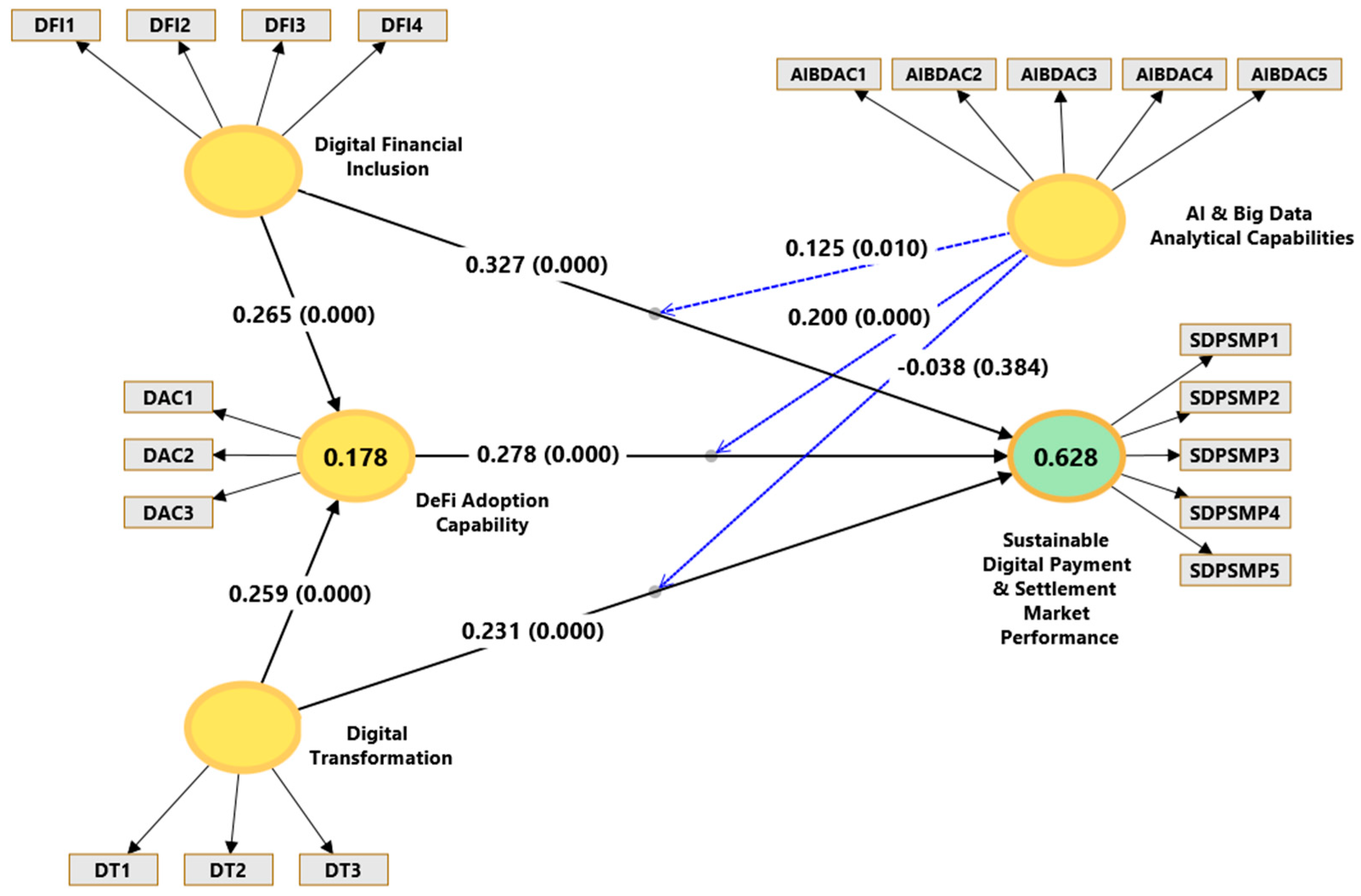
97]. The structural model results are illustrated in
Figure 2, while the detailed path estimates, mediation, and moderation results are presented in
Table 7. Significant interaction effects are further illustrated in
Figure 3 and
Figure 4.
The findings suggest support for the proposed direct effects. H1 indicated a positive relationship between DFI and SDPSMP (β = 0.327, t = 8.444, p < 0.001), implying that broader digital financial participation may contribute to stronger payment and settlement market performance. Likewise, H2 suggested that DFI positively influences DAC (β = 0.265, t = 6.064, p < 0.001), indicating that higher levels of digital participation may encourage institutions to strengthen DeFi-related operational and governance capabilities. DAC also exhibited a significant positive effect on SDPSMP, supporting H3 (β = 0.278, t = 6.521, p < 0.001). This finding suggests that institutional capability development may play an important role in translating digital financial activity into sustainable market-level outcomes.
The mediation analysis further indicated that DAC partially mediates the relationship between DFI and SDPSMP (H4: β = 0.074, t = 4.374, p < 0.001), as both the direct and indirect effects remained significant. This pattern suggests that digital financial inclusion may influence payment-market sustainability both directly and indirectly through institutional capability development.
The role of DT also appeared substantial. H5 and H6 indicated positive effects of DT on DAC (β = 0.259, t = 5.618, p < 0.001) and SDPSMP (β = 0.231, t = 5.980, p < 0.001), respectively. In addition, the indirect relationship DT → DAC → SDPSMP was significant (H7: β = 0.072, t = 3.916, p < 0.001), indicating partial mediation. These findings imply that digital transformation may enhance sustainable payment-market performance both through direct infrastructural improvements and through the development of DeFi-related institutional capabilities.
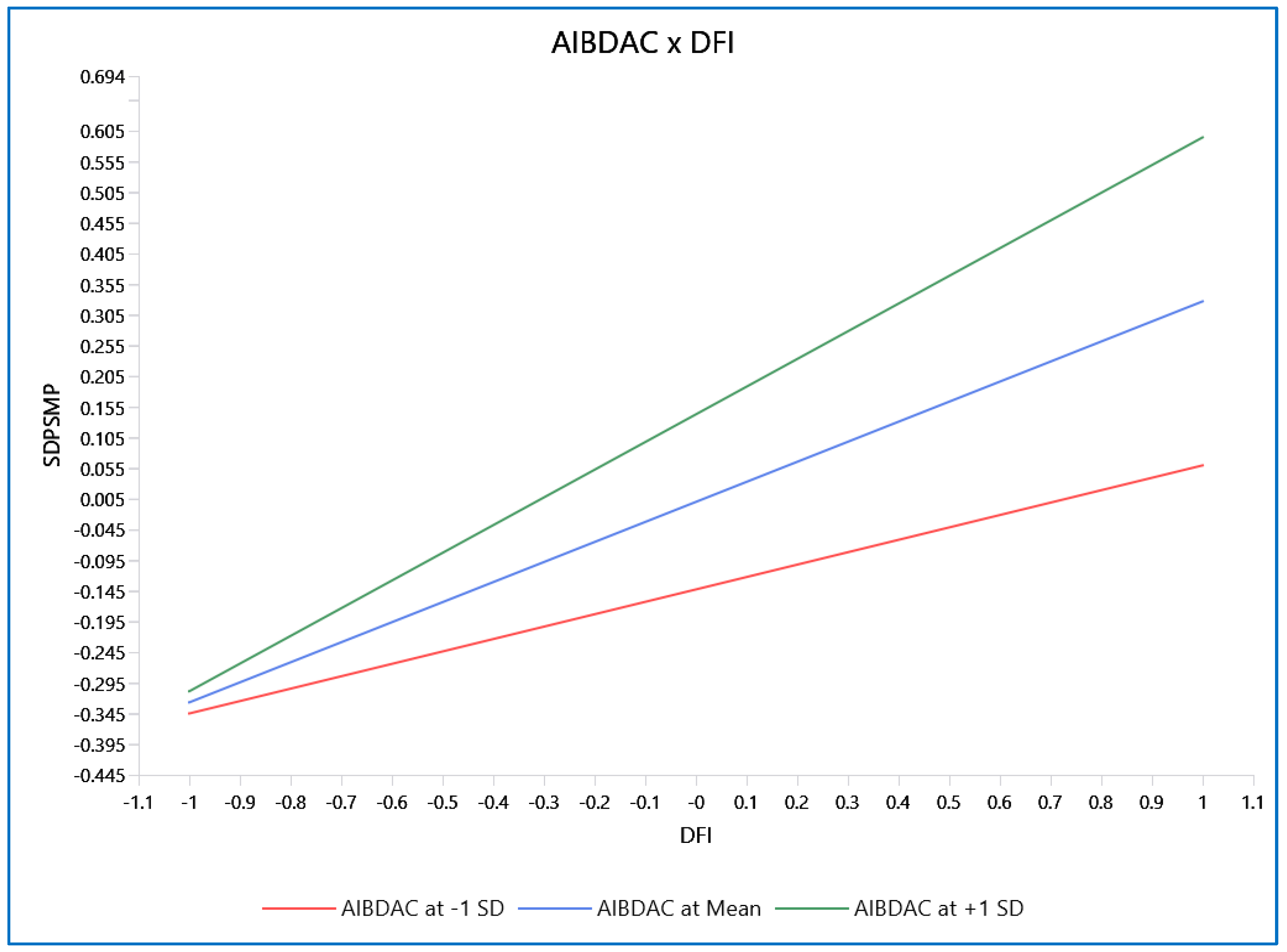
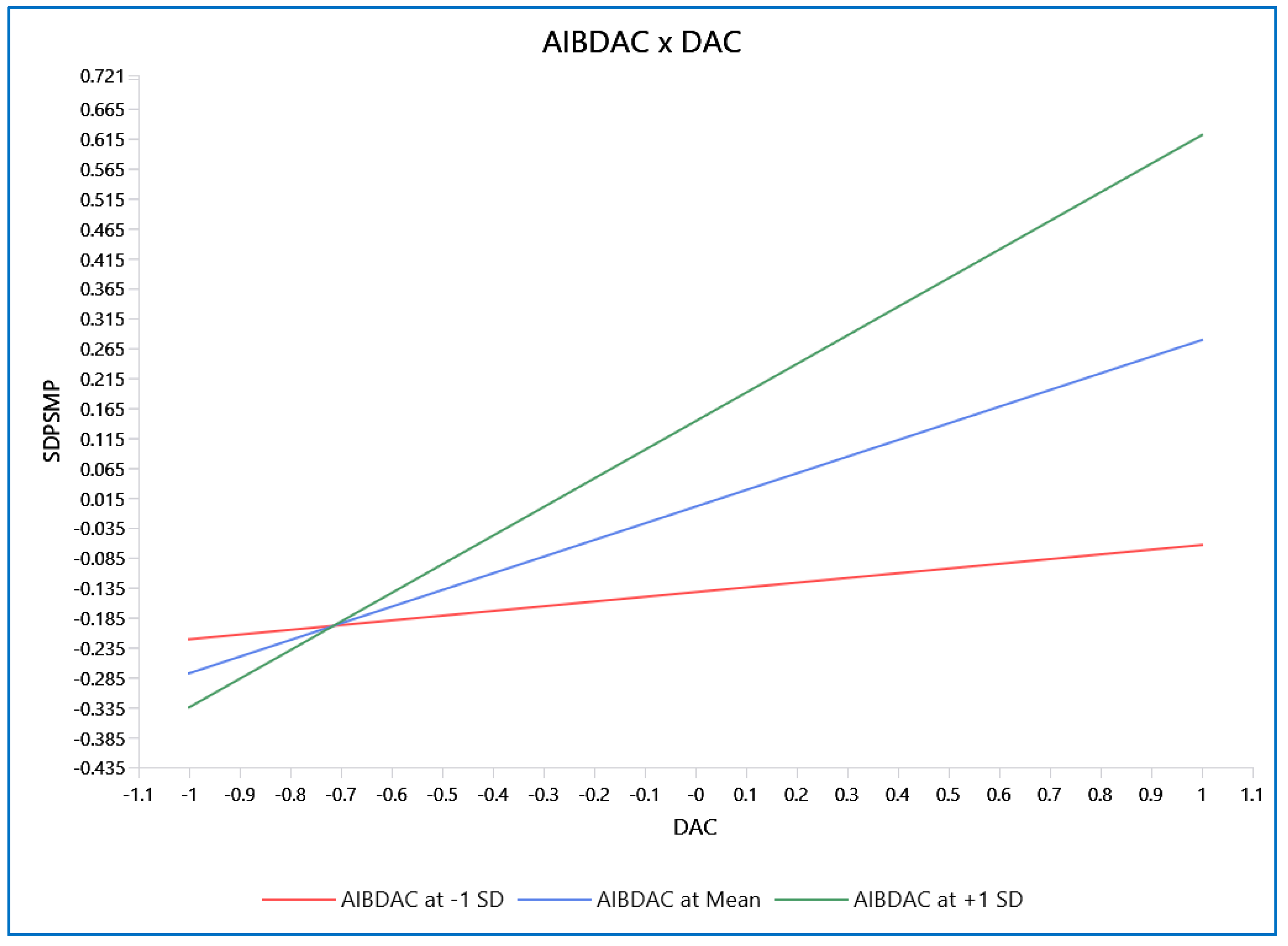
Regarding moderation effects, AIBDAC emerged as an important boundary condition. H8a indicated that AIBDAC positively moderates the relationship between DFI and SDPSMP (β = 0.125, t = 2.589,
p = 0.010). As illustrated in
Figure 3, the positive effect of DFI on SDPSMP becomes stronger at higher levels of AIBDAC. Similarly, H8b suggested that AIBDAC strengthens the relationship between DAC and SDPSMP (β = 0.200, t = 3.724,
p < 0.001), indicating that analytics capabilities may enhance the effectiveness of DeFi-related institutional capabilities in digitally interconnected payment environments.
In contrast, H8c was not supported, as the interaction between AIBDAC and DT did not significantly influence SDPSMP (β = −0.038, t = 0.870, p = 0.384). This finding may suggest that the contribution of digital transformation to payment-market performance operates through broader infrastructural and organizational mechanisms that are less dependent on advanced analytical capabilities.
Overall, the findings indicate that DFI and DT are associated with sustainable digital payment and settlement market performance, with DAC acting as a partial mediating mechanism in both relationships. The results further suggest that AI and big data analytical capabilities may strengthen the performance effects of digital inclusion and DeFi capability development within evolving digital payment ecosystems.
4.1.5. Importance Performance Map Analysis (IPMA)
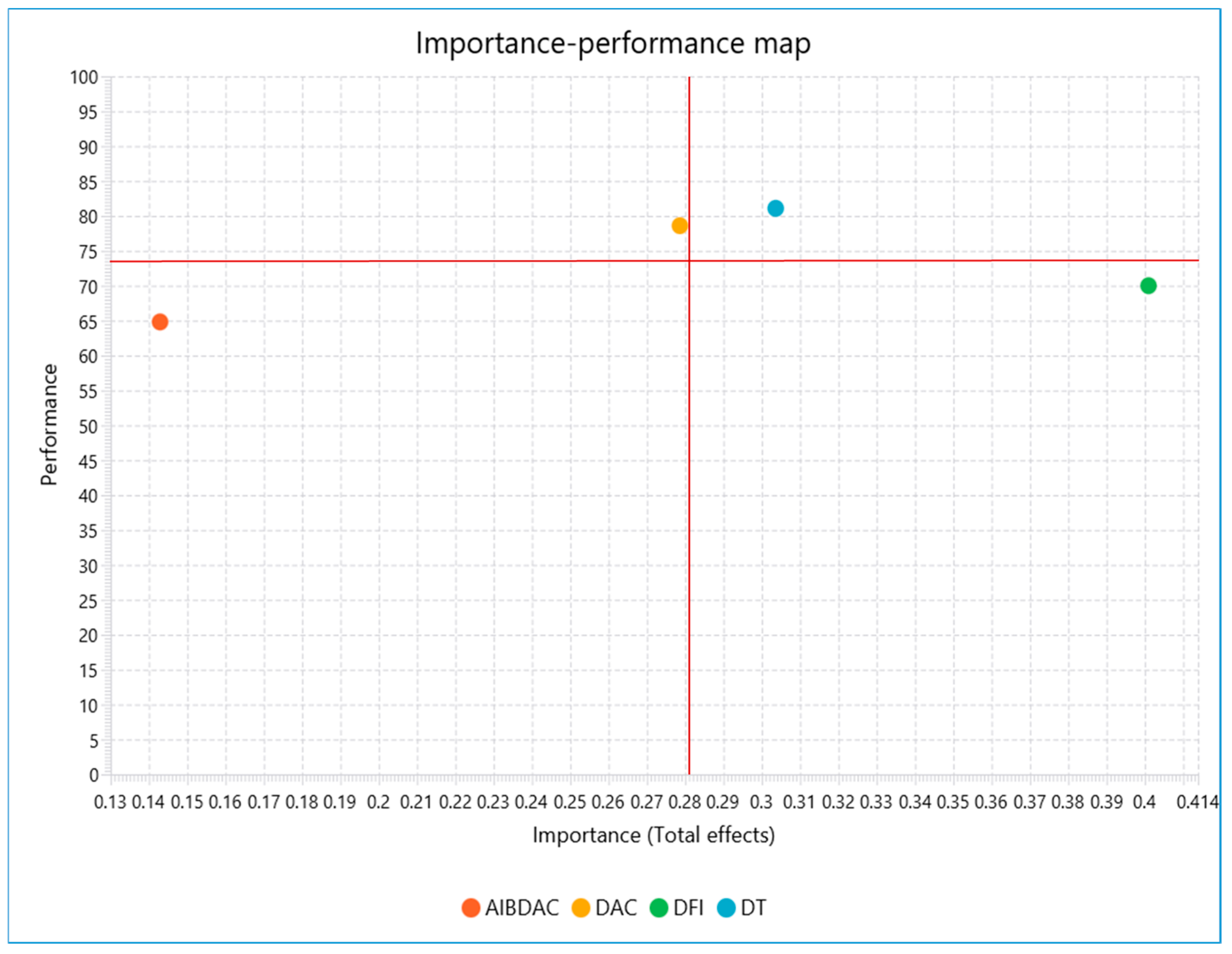
Importance–Performance Matrix Analysis (IPMA) was conducted to complement the PLS-SEM findings by jointly evaluating the importance (total effects) and performance of the key antecedent constructs influencing SDPSMP. The IPMA results provide additional managerial insight by identifying constructs that may warrant greater strategic attention.
As illustrated in
Figure 5, DFI exhibited the highest importance but comparatively lower performance, positioning it as the primary area for managerial improvement. This finding suggests that strengthening digital financial inclusion may generate comparatively greater gains in sustainable digital payment and settlement market performance. DT demonstrated both high importance and relatively strong performance, indicating that existing digital transformation initiatives appear to be contributing positively to payment-market outcomes and should be maintained. DAC showed moderate importance with comparatively higher performance, suggesting a supportive but less critical intervention role.
In contrast, AIBDAC demonstrated relatively lower importance and performance in the IPMA results. Although analytics capability remains conceptually relevant within digitally interconnected payment ecosystems, its comparatively lower positioning may indicate that its contribution is currently more supportive and longer-term rather than an immediate operational priority.
Overall, the IPMA findings complement the structural model results by providing a comparative managerial perspective on resource prioritization and capability development within the Saudi digital payment ecosystem.
4.2. ANN Analysis
In this study, Artificial Neural Network (ANN) analysis was conducted using SPSS 23 with a multilayer perceptron (MLP) architecture. ANN has been widely applied as a data-driven analytical technique capable of modelling complex and nonlinear relationships through interconnected processing neurons [
99]. In the present study, ANN analysis was used to complement the PLS-SEM findings by strengthening the predictive assessment of the proposed framework. Accordingly, the ANN model was developed using the same theoretically supported and statistically significant relationships identified in the SEM analysis, while focusing specifically on nonlinear predictive pattern evaluation rather than causal interpretation.
Consistent with established methodological practice, only constructs exhibiting statistically significant relationships in the PLS-SEM model were retained for ANN analysis to preserve model relevance and predictive efficiency [
100]. Following prior research in information systems and technology adoption studies [
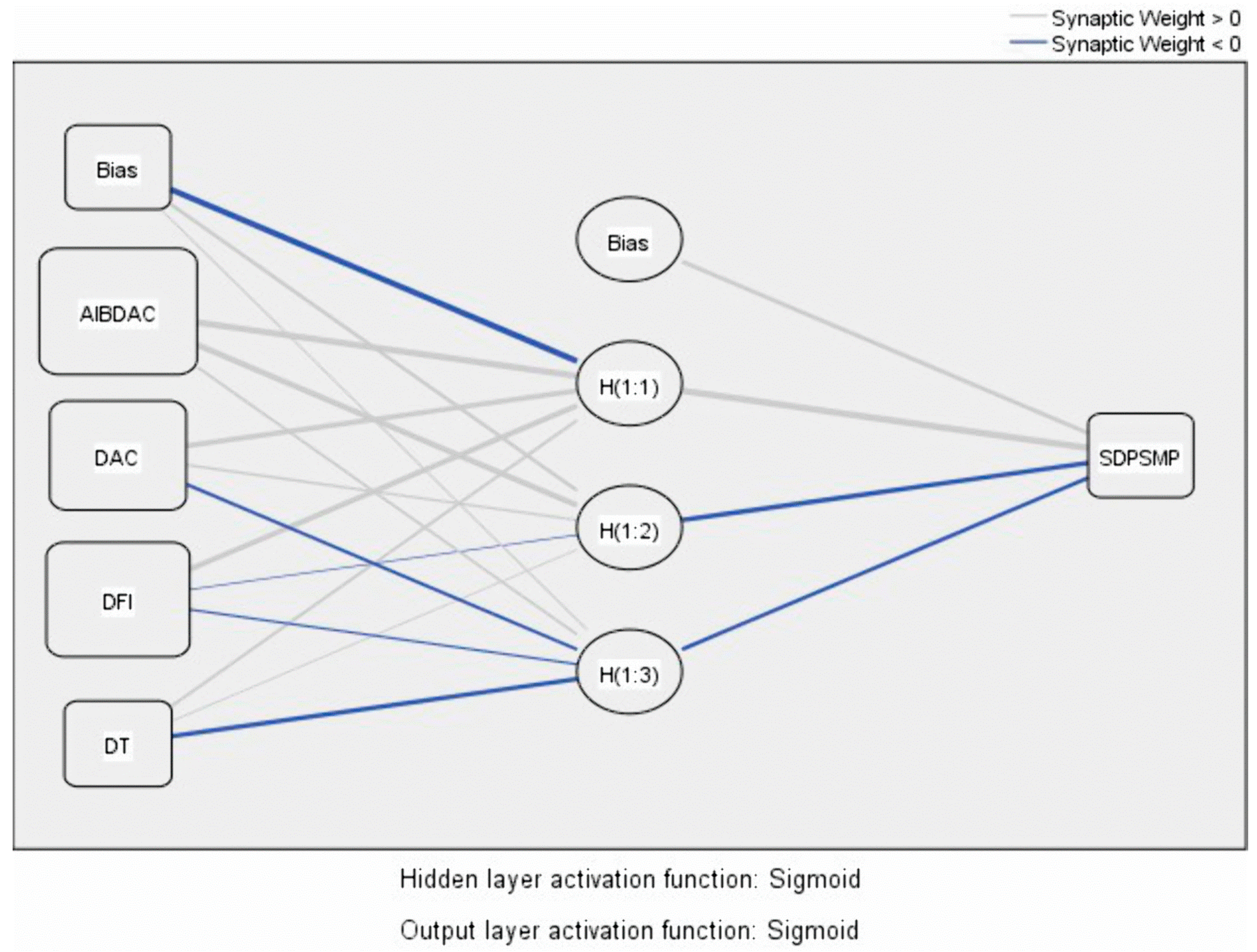
28], a single hidden layer was employed, as this structure is considered sufficient for modelling complex nonlinear relationships. The number of hidden neurons was determined automatically by SPSS to optimize predictive performance, while the sigmoid activation function was applied to both hidden and output layers due to its suitability for nonlinear social science data. An illustrative ANN configuration generated from one of the ten-fold training iterations is presented in
Figure 6.
To reduce overfitting risk and improve predictive robustness, a ten-fold cross-validation procedure was implemented. The dataset was randomly divided into 70% training data and 30% testing data. This procedure contributed to stable estimation and improved the generalizability of the predictive results.
4.2.1. Predictive Performance of the ANN Model
The predictive accuracy of the ANN model was evaluated using the root mean square error (RMSE) across both training and testing phases. RMSE values were computed for ten ANN configurations to assess model stability and predictive consistency. As reported in
Table 8, the average RMSE values for the training and testing phases were 0.085 and 0.087, respectively. The closeness of these values suggests relatively stable learning behaviour and indicates that the model is unlikely to suffer from substantial overfitting. The comparatively low standard deviations further support the consistency of predictive performance across iterations.
The explanatory capability of the ANN model was additionally examined using the coefficient of determination (R
2). Following the formulation proposed by [
101], the ANN model achieved an R
2 value of 91.1%, suggesting that the input neurons jointly explain a substantial proportion of variance in SDPSMP. This predictive capability exceeds the variance explained by the SEM model (65.3%). However, the two approaches serve different analytical purposes. SEM primarily supports theory-driven explanation and hypothesis testing, whereas ANN emphasizes nonlinear prediction and pattern recognition. The ANN findings should therefore be interpreted as complementary to, rather than substituting for, the SEM results [
28].
4.2.2. Predictive Capability Strengths: Sensitivity Analysis
A sensitivity analysis was conducted to examine the relative contribution of each input neuron to the ANN model and to assess its influence on the prediction of SDPSMP. Consistent with prior ANN-based studies, the analysis evaluates how changes in input variables influence predicted outcomes, thereby providing insight into the relative predictive importance of the explanatory constructs [
101]. Normalized importance values were calculated by dividing the average relative importance of each input variable by the maximum observed importance and expressing the result as a percentage [
95].
The results presented in
Table 9 suggest that AIBDAC is the most influential predictor of SDPSMP, with the highest average relative importance value (0.392) and a normalized importance of 85.1%. This finding may indicate that AI and big data analytical capabilities play a comparatively stronger predictive role within digitally interconnected payment environments. DAC ranked second, with a normalized importance value of 71.8%, suggesting that institutional capability development contributes meaningfully to predictive performance. DFI also demonstrated substantial predictive relevance, with a normalized importance value of 74.8%, while DT recorded the comparatively lowest normalized importance (71.0%). This comparatively lower ANN ranking does not necessarily imply that DT lacks strategic importance; rather, it may suggest that its influence operates more indirectly or structurally within the broader payment ecosystem.
Overall, the sensitivity analysis establishes a differentiated ranking of predictors in terms of nonlinear predictive relevance. The findings suggest that AIBDAC may exert a comparatively stronger influence on sustainable performance prediction within the ANN framework, while DFI, DAC, and DT continue to demonstrate meaningful but varying predictive contributions.
4.2.3. Comparison of ANN Sensitivity and IPMA Results
A comparison between the ANN sensitivity analysis and the IPMA results reveals both convergence and divergence in construct prioritization. Both approaches identify AIBDAC as an influential construct, supporting its role in shaping sustainable payment and settlement market performance. However, differences emerge regarding DFI and DT. While IPMA positions DFI as a primary area for managerial intervention due to its high importance and comparatively lower performance, the ANN findings rank AIBDAC as the strongest predictor in terms of nonlinear predictive relevance. Similarly, DT appears as a high-importance and high-performance construct in the IPMA but demonstrates comparatively lower predictive influence in the ANN model.
These differences reflect the distinct analytical objectives of the two techniques. IPMA primarily supports managerial prioritization based on importance–performance positioning, whereas ANN focuses on nonlinear predictive strength. The coexistence of convergence and divergence across the two approaches may therefore reflect the multidimensional nature of sustainable performance within digitally interconnected payment ecosystems rather than contradictory findings.
5. Discussion
The purpose of this study was to examine how digital transformation and digital financial inclusion relate to Digital Payment and Settlement Market Performance (SDPSMP) through DeFi adoption capability, while accounting for the moderating role of AI and big data analytical capabilities. Grounded in the integration of the Resource-Based View (RBV) and Diffusion of Innovation (DOI), the study explains both how digital innovations diffuse across payment ecosystems and why some institutions in Saudi Arabia may convert diffusion into sustained market outcomes. Using PLS-SEM and ANN, the findings provide support for the proposed framework.
The direct effects highlight the important role of digital financial inclusion. Hypothesis H1 suggests that digital financial inclusion positively influences SDPSMP. This finding is consistent with prior studies showing that broader participation in digital payment ecosystems enhances efficiency, transparency, and continuity at the market level [
11,
12]. It also aligns with evidence that digital payments represent a core inclusion outcome rather than a peripheral service [
41]. From a DOI perspective, widespread access and active usage may strengthen network effects, thereby supporting payment and settlement market stability. In the Saudi context, this finding may reflect the recent expansion of electronic payments and ecosystem participation [
26].
Hypothesis H2 further indicates that digital financial inclusion positively influences DeFi adoption capability. This finding is consistent with diffusion-based research suggesting that rising digital participation increases institutional pressure to upgrade transaction rails, interoperability, and governance arrangements [
17]. It also aligns with evidence that blockchain-related services are increasingly framed as capability-building efforts involving compliance, integration, and technical expertise rather than simple technology adoption [
18]. From a DOI perspective, inclusion accelerates diffusion, while from an RBV perspective it may motivate institutions to develop internal innovation capabilities.
DeFi adoption capability also appears to play an important role in shaping SDPSMP, supporting H3. This finding aligns with recent DeFi literature emphasizing that institutional outcomes depend on governance, integration, and control capabilities rather than user-level adoption alone [
45]. It is also consistent with studies highlighting hybrid finance models, where institutions act as bridges between decentralized protocols and mainstream payment infrastructures [
15]. From an RBV perspective, DeFi adoption capability may represent an embedded organizational resource that contributes to sustained market-level performance. In the Saudi context, this finding reflects the increasing institutional emphasis on payment-system modernization, regulated digital innovation, and operational readiness under Vision 2030 initiatives. As payment infrastructures become more digitally interconnected, financial institutions are required to develop governance and integration capabilities that support secure deployment of emerging decentralized financial mechanisms within regulated operational environments.
The mediation analysis further clarifies this mechanism. Hypothesis H4 suggests that DeFi adoption capability partially mediates the relationship between digital financial inclusion and SDPSMP. This finding is consistent with studies arguing that inclusion-driven diffusion improves outcomes only when institutions can operationalize innovation through governance and process integration [
19]. DOI explains the spread of participation, while RBV helps explain how DeFi adoption capability may convert diffusion into sustainable payment and settlement market outcomes.
Digital transformation also appears to play an important enabling role. Hypotheses H5 and H6 indicate that digital transformation positively influences both DeFi adoption capability and SDPSMP. These findings are consistent with research framing digital transformation as an ongoing capability-building process that reshapes processes, platforms, and governance structures [
9,
10]. They also align with evidence suggesting that modernization of payment and settlement infrastructures enhances market efficiency and resilience [
2]. In Saudi Arabia, this may reflect ongoing payment modernization initiatives such as SARIE.
The mediating role of DeFi adoption capability in the digital transformation–SDPSMP relationship is also supported. Hypothesis H7 indicates partial mediation, consistent with studies suggesting that digital transformation creates architectural readiness, while DeFi-related capabilities determine how effectively institutions deploy decentralized settlement solutions [
80]. From an RBV perspective, digital transformation may strengthen the institutional resource base, while DeFi adoption capability channels those resources into performance-enhancing outcomes.
The findings also point toward structural coupling among subsystems. Digital transformation establishes architectural readiness by modernizing infrastructure, data integration, and governance processes, whereas DeFi adoption capability enables controlled integration of decentralized protocols within regulated payment rails. This relationship appears to reflect complementarity rather than substitution. Sustainable market performance may therefore depend on alignment between transformation-driven architecture and capability-driven deployment, reinforcing the view that performance emerges from coordinated subsystem interaction rather than isolated innovation effects.
The moderation analysis identifies an important boundary condition. AI and big data analytical capabilities significantly strengthen the effects of digital financial inclusion and DeFi adoption capability on SDPSMP, supporting H8a and H8b. These findings are consistent with evidence suggesting that analytics capabilities enhance fraud detection, transaction monitoring, and operational control in high-volume payment systems [
21]. They also align with studies showing that analytics capability amplifies innovation and performance outcomes when embedded in organizational routines [
22]. From an RBV perspective, analytics capability may function as a complementary strategic resource that increases the value extracted from diffusion and innovation. This relationship is particularly relevant in the Saudi Arabian payment ecosystem, where rapid growth in electronic transactions and real-time payment activity has increased the importance of fraud detection, transaction monitoring, cybersecurity preparedness, and operational continuity across digitally integrated financial platforms.
In contrast, H8c was not supported, indicating that AI and big data analytical capabilities do not significantly moderate the digital transformation–SDPSMP relationship. This finding diverges from studies assuming that analytics capabilities uniformly strengthen all digital transformation outcomes. Instead, it may suggest that digital transformation contributes to SDPSMP through broader structural and infrastructural improvements that are comparatively less dependent on advanced analytical capabilities at the present stage of ecosystem development.
The IPMA results provide a complementary managerial perspective. Digital financial inclusion emerged as the most important construct with comparatively lower performance, which is consistent with evidence suggesting that inclusion gaps remain an important constraint within digital payment ecosystems. Digital transformation and DeFi adoption capability demonstrated comparatively stronger performance and moderate to high importance, suggesting that these capabilities should be maintained and strengthened. AI and big data analytical capabilities appear to represent a longer-term capability investment rather than an immediate intervention priority.
The ANN analysis further extends these insights by emphasizing predictive capability. The ANN model demonstrated higher predictive ability than SEM, which is consistent with prior ANN-based FinTech research. Sensitivity analysis identified AI and big data analytical capabilities as the most influential predictor of SDPSMP, followed by digital financial inclusion and DeFi adoption capability. This divergence from IPMA reflects methodological differences, as ANN captures nonlinear predictive influence whereas IPMA emphasizes managerial prioritization and performance gaps.
From a complex systems perspective, divergence between ANN sensitivity rankings and IPMA prioritization is not necessarily contradictory. ANN captures nonlinear interaction patterns and predictive dominance, whereas IPMA evaluates importance relative to current performance levels. In interconnected financial systems, predictive dominance may not always coincide with immediate managerial intervention priorities. The coexistence of convergence and divergence across these approaches therefore reflects the multidimensional nature of sustainable payment and settlement performance.
Overall, the findings suggest that SDPSMP in Saudi Arabia is shaped by the interaction of diffusion and institutional capability. Digital financial inclusion and digital transformation facilitate diffusion, DeFi adoption capability institutionalizes innovation, and AI-driven analytics appear to strengthen the translation of diffusion into sustained payment and settlement market performance. Collectively, the findings support the integrated RBV–DOI perspective and suggest that diffusion alone may be insufficient to achieve long-term market sustainability.
From a systems perspective, these relationships reflect reinforcing and balancing feedback mechanisms within digital payment markets. Expanded digital financial inclusion increases transaction volume and participation diversity, which may strengthen network effects and operational efficiency. However, higher transaction intensity simultaneously increases operational and cyber-risk exposure. In this context, AI and big data analytical capabilities may function as stabilizing mechanisms through enhanced monitoring, fraud detection, and anomaly identification. Thus, inclusion-driven growth may generate both performance gains and systemic pressures, while analytics capability helps offset risk accumulation and preserve structural stability. This systems-oriented interpretation may help explain why analytics capabilities strengthen inclusion–performance and DeFi–performance relationships but do not uniformly condition digital transformation effects.
6. Research Implications
6.1. Theoretical Implications
This study offers several theoretical implications for research on digital finance, payment systems, and innovation-driven market performance. First, by integrating the Resource-Based View (RBV) and Diffusion of Innovation (DOI), the study advances understanding of digital payment and settlement markets as interconnected infrastructures rather than isolated adoption environments. While DOI explains how digital financial inclusion and digital transformation facilitate diffusion across payment ecosystems, RBV clarifies why only institutions with aligned and embedded capabilities can convert diffusion into Sustainable Digital Payment and Settlement Market Performance (SDPSMP). This integration helps address a limitation in prior work that assumes diffusion intensity directly translates into performance without considering system-level capability configuration.
Second, the study extends RBV by conceptualizing DeFi adoption capability as a structured capability bundle embedded within market infrastructure rather than a standalone technological artefact. The empirical findings regarding its mediating role suggest that governance alignment, integration readiness, and operational control function as translation mechanisms that convert innovation diffusion into sustained system-level outcomes. This framing shifts DeFi research from adoption metrics toward infrastructural capability and systemic impact.
Third, the findings further extend DOI by showing that diffusion effects in payment and settlement markets are conditioned by complementary organizational resources. The moderating role of AI and big data analytical capabilities indicates that diffusion generates stable outcomes only when supported by adaptive sensing and control mechanisms. This reinforces the view that diffusion operates within boundary conditions shaped by institutional capability and system architecture.
Finally, the study contributes methodologically by combining PLS-SEM and ANN within a unified analytical design. SEM establishes structural relationships consistent with theory, while ANN captures nonlinear and predictive patterns characteristic of complex financial systems. The divergence between IPMA and ANN sensitivity results highlights the distinction between managerial prioritization and predictive dominance, encouraging future research to integrate explanatory and adaptive modelling approaches when examining interconnected market systems.
6.2. Managerial Implications
The findings provide practical implications for policymakers, regulators, and financial institutions operating within digital payment and settlement markets. First, digital financial inclusion emerges as a central system driver of SDPSMP. Expanding access alone is insufficient unless it results in sustained participation and transactional intensity. Policymakers should therefore strengthen interoperability, merchant integration, and trust-building mechanisms to ensure that inclusion deepens system connectivity rather than expanding surface-level adoption.
Second, the role of DeFi adoption capability indicates that institutions should treat DeFi as an infrastructural capability embedded within governance, risk management, and operational coordination frameworks. Hybrid integration models that connect decentralized protocols with regulated payment rails are more likely to enhance long-term system stability than isolated experimentation.
Third, digital transformation appears to function as a foundational architectural enabler. Institutions should align transformation initiatives with payment-system objectives, including real-time processing, data governance, and interoperability. The mediation findings suggest that transformation efforts generate stronger outcomes when linked explicitly to innovation deployment pathways such as DeFi-enabled settlement mechanisms.
Fourth, AI and big data analytical capabilities operate as adaptive control layers within payment infrastructures. Although not always an immediate intervention priority, analytics significantly enhances predictive stability and operational monitoring in high-volume environments. Institutions should therefore treat analytics development as a strategic investment supporting resilience under increasing system complexity.
For regulators and ecosystem coordinators, the results underscore the importance of balanced policy frameworks that encourage experimentation while safeguarding system integrity. In Saudi Arabia, aligning digital inclusion, modernization initiatives, and analytics-enabled oversight with Vision 2030 objectives can reinforce long-term structural resilience of digital payment and settlement markets.
7. Recommendations
7.1. Strategic Recommendations for Sustainable Digital Payment and Settlement Markets (Global Context)
Shift from adoption-centric to capability-configured strategies. Diffusion of digital finance and DeFi innovations may not automatically produce sustainable system outcomes. Long-term performance depends on embedding innovation within governance structures, operational routines, and risk controls.
Redefine digital financial inclusion beyond access indicators. Policies should prioritize sustained usage, interoperability, and ecosystem connectivity rather than account ownership alone. Deeper participation may strengthen network effects and enhance system stability.
Adopt hybrid integration pathways for DeFi. Institutions should incorporate selected decentralized components into existing payment infrastructures to maintain control and interoperability while enabling innovation.
Align digital transformation with infrastructure-level objectives. Transformation initiatives should target real-time processing, data integration, and settlement modernization rather than focusing solely on front-end digitization.
Treat AI and big data analytics as adaptive enablers. Even when not an immediate intervention focus, analytics capability should be developed as a long-term resource supporting monitoring, fraud detection, and operational resilience.
Sequence interventions using both managerial importance and predictive influence. Drivers with high importance and performance gaps require immediate attention, while those with strong predictive influence should be strengthened proactively to support future system scale and complexity.
7.2. Policy and Institutional Recommendations for DeFi Adoption in Saudi Digital Payment and Settlement Markets
Prioritize digital financial inclusion as a structural performance lever. Expansion efforts should ensure sustained usage and participation across demographic and business segments.
Institutionalize DeFi adoption capability within governance frameworks. Financial institutions should establish structured oversight, cross-functional coordination, and regulatory engagement mechanisms for controlled DeFi experimentation.
Use regulatory sandboxes for phased integration. Structured pilots allow decentralized settlement mechanisms to be tested while preserving compliance and system integrity.
Align Vision 2030 digital initiatives with infrastructure readiness. Payment modernization, interoperability, and data governance investments should be coordinated with DeFi development to prevent fragmentation.
Strengthen analytics-enabled oversight. Regulators and ecosystem leaders should promote AI-driven monitoring and risk analytics to maintain resilience as transaction volumes and system interdependence increase.
Promote ecosystem-level coordination. Shared standards for data governance, interoperability, and cybersecurity may help ensure that DeFi integration strengthens overall system performance rather than producing isolated institutional gains.
8. Limitations and Future Research
This study has several limitations that should be acknowledged, which also open avenues for future research. First, the empirical analysis is based on cross-sectional data collected from Saudi Arabia. While this context is theoretically and practically relevant due to rapid payment system modernization, the findings may not be fully generalizable to other institutional or regulatory environments. In addition, although the study employed stratified institutional sampling to improve representation across segments of the Saudi financial sector, convenience sampling at the respondent level may still introduce selection bias. Moreover, because participation in the survey was voluntary, the study may also be subject to self-selection bias, and no systematic information was available regarding non-participants for comparative assessment. Therefore, the findings should be interpreted with caution regarding respondent-level generalizability and broader external validity. Because digital payment and settlement markets operate as context-dependent systems shaped by regulatory structures and infrastructural maturity, future studies could adopt cross-country or comparative designs to examine whether the proposed relationships hold across different system configurations and governance regimes.
Second, the study relies on perceptual measures reported by professionals involved in payment and settlement functions. Although common in digital finance research, this approach may introduce subjective bias. Future research could complement survey data with objective system-level indicators such as transaction volumes, settlement latency, operational disruptions, fraud incidence, or network congestion to strengthen inference about sustainable digital payment and settlement market performance.
Third, while DeFi adoption capability is modelled as a mediator, the explanatory scope of the model could be extended. Future studies may incorporate additional mediating mechanisms such as institutional trust, regulatory coordination capacity, or platform interoperability capability, which may further clarify how diffusion processes translate into stable system-level outcomes within payment infrastructure.
Similarly, the model can be enriched by introducing additional moderators. Beyond AI and big data analytical capabilities, future research could examine regulatory flexibility, cybersecurity maturity, or data governance quality as boundary conditions that shape how digital innovations influence interconnected payment systems, particularly under increasing scale and complexity.
Finally, although the study combines PLS-SEM and ANN to enhance explanatory and predictive validity, future research could employ longitudinal or system dynamics designs to capture feedback processes and temporal evolution in diffusion, capability development, and market performance. Such approaches could deepen understanding of how sustainability in digital payment systems emerges over time rather than through static relationships.
9. Conclusions
This study examined how digital transformation and digital financial inclusion relate to Sustainable Digital Payment and Settlement Market Performance (SDPSMP), with particular emphasis on the mediating role of DeFi adoption capability and the moderating influence of AI and big data analytical capabilities. Grounded in an integrated RBV–DOI perspective and situated within the Saudi Arabian financial context, the findings provide an empirically grounded explanation of why the diffusion of digital finance may not automatically generate sustainable system-level outcomes.
The findings suggest that digital financial inclusion may strengthen SDPSMP by expanding participation and reinforcing network connectivity within payment and settlement infrastructures. However, inclusion alone may be insufficient to generate long-term performance outcomes. Its influence appears to operate partly through DeFi adoption capability, which reflects institutional readiness to govern, integrate, and operationalize decentralized settlement mechanisms within regulated payment environments. Similarly, digital transformation appears to contribute to SDPSMP both directly and indirectly through DeFi adoption capability, suggesting that transformation functions not only as a technological initiative but also as an architectural and governance-related enabler.
The moderating findings further indicate the importance of complementary organizational capabilities within interconnected payment systems. AI and big data analytical capabilities strengthen the effects of digital financial inclusion and DeFi adoption capability on SDPSMP, suggesting that advanced analytics may enhance monitoring, adaptive control, and operational responsiveness in complex digital payment environments. In contrast, the absence of moderation in the digital transformation–SDPSMP relationship may indicate that digital transformation contributes primarily through broader infrastructural and governance-related improvements that are comparatively less dependent on analytics intensity.
By combining PLS-SEM, IPMA, and ANN, the study integrates structural explanation with nonlinear predictive assessment, thereby offering insight into both managerial prioritization and system-level interaction patterns. Overall, the findings suggest that sustainable digital payment and settlement markets are shaped by the interaction of diffusion processes, institutional capabilities, and adaptive control mechanisms. Digital financial inclusion and digital transformation expand ecosystem participation and connectivity, DeFi adoption capability supports institutional integration of innovation, and analytics capability may help strengthen operational resilience under increasing system complexity. Collectively, these findings contribute to understanding digital payment ecosystems as interconnected socio-technical systems and provide a foundation for future research on sustainable financial infrastructure development.
Author Contributions
Conceptualization, I.H.-u.-R.; methodology, I.H.-u.-R. and M.N.A.; software, I.H.-u.-R.; validation, I.H.-u.-R., M.N.A. and M.S.S.; formal analysis, I.H.-u.-R.; investigation, M.N.A.; resources, S.B.A. and K.W.A.A.; data curation, I.H.-u.-R. and K.W.A.A.; writing—original draft preparation, I.H.-u.-R.; writing—review and editing, I.H.-u.-R., M.N.A. and M.S.S.; visualization, I.H.-u.-R.; supervision, I.H.-u.-R.; project administration, I.H.-u.-R. All authors have read and agreed to the published version of the manuscript.
Funding
This research was funded by DEANSHIP OF RESEARCH AND GRADUATE STUDIES AT THE UNIVERSITY OF TABUK, SAUDI ARABIA, grant number “S-1444-0066” project titled “Examining the Dimensions of Green Finance and its Impact on Sustainable Performance of Financial Institutions in Saudi Arabia for Competitive Advantage” and “The APC was funded by “S-1444-0066”.
Institutional Review Board Statement
The study was conducted in accordance with the Declaration of Helsinki, and approved by the Local Research Ethics Committee (LREC), University of Tabuk, Saudi Arabia (protocol code UT-621-379-2023, approve date: 1 October 2023).
Informed Consent Statement
Informed consent was obtained from all subjects involved in the study.
Data Availability Statement
The original contributions presented in this study are included in the article/
Supplementary Materials. Further inquiries can be directed to the corresponding author.
Acknowledgments
1. The authors extend their appreciation to the Deanship of Research and Graduate Studies at the University of Tabuk, Saudi Arabia for providing administrative and technical support to this research. 2. During the preparation of this study, the authors used ChatGPT 5.5 for the purposes of improving the language and enhancing the readability of the manuscript. The authors have reviewed and edited the output and take full responsibility for the content of this publication.
Conflicts of Interest
The authors declare no conflicts of interest.
Abbreviations
The following abbreviations are used in this manuscript:
| DT | Digital Transformation |
| DFI | Digital Financial Inclusion |
| DAC | DeFi Adoption Capability |
| AIBDAC | AI and Big Data Analytical Capability |
| SDPSMP | Sustainable Digital Payment and Settlement Market Performance |
| DeFi | Decentralized Finance |
| DOI | Diffusion of Innovation |
| RBV | Resource-Based View |
| ANN | Artificial Neural Network |
| PLS-SEM | Partial Least Squares Structural Equation Modelling |
| EFA | Exploratory Factor Analysis |
| KMO | Kaiser–Meyer–Olkin Measure |
| CR | Composite Reliability |
| AVE | Average Variance Extracted |
| HTMT | Heterotrait–Monotrait Ratio |
| VIF | Variance Inflation Factor |
| CMB | Common Method Bias |
| RMSE | Root Mean Square Error |
| MAE | Mean Absolute Error |
| Q2 | Predictive Relevance (Stone–Geisser) |
| IPMA | Importance–Performance Matrix Analysis |
| MLP | Multilayer Perceptron |
| API | Application Programming Interface |
| ICT | Information and Communication Technology |
| MSMEs | Micro, Small, and Medium Enterprises |
| ESG | Environmental, Social, and Governance |
Appendix A
Table A1.
Measurement Items.
Table A1.
Measurement Items.
| Constructs | Sources |
|---|
| Digital Financial Inclusion (DFI) | adopted from [85] |
| DFI1: Digital financial services provided by our institution are safe and secure for users. |
| DFI2: Digital payment and account services are financially accessible to a wide range of users. |
| DFI3: Digital financial platforms reduce barriers to access for underserved or remote users. |
| DFI4: Digital financial services enable broader participation in formal financial systems |
| Digital Transformation (DT) | adopted from [86] |
| DT1: Our institution is driving new business processes built on technologies such as big data, analytics, cloud, mobile and social media platform. |
| DT2: Our institution is integrating digital technologies such as social media, big data, analytics, cloud and mobile technologies to drive change. |
| DT3: Our institution shifting business operations toward making use of digital technologies such as big data, analytics, cloud, mobile and social media platform. |
| DeFi Adoption Capability (DAC) | adapted from [87] |
| DAC1: Our institution has the capability to identify and evaluate DeFi-based opportunities for financial services. |
| DAC2: Our institution has the capability to develop and implement DeFi-enabled financial solutions. |
| DAC3: Our institution has the capability to integrate DeFi applications into existing payment and settlement processes. |
| AI & Big Data Analytical Capability (AIBDAC) | adapted from [88] |
| AIBDAC1: We use AI-enabled big data analytics applications that incorporate information from both internal and external sources. |
| AIBDAC2: AI and big data analytics are used to extract knowledge about hidden patterns, correlations, market trends, and client preferences. |
| AIBDAC3: AI-driven big data analytics are an essential tool in our payment, settlement, and transaction monitoring activities. |
| AIBDAC4: AI and big data analytics are employed in decision-making across all major functional areas. |
| AIBDAC5: With a strong understanding of AI and big data analytics, we use these capabilities to drive change, reduce inefficiencies, and respond quickly to operational demands. |
| Sustainable Digital Payment and Settlement Market Performance (SDPSMP) | devised by this study |
| SDPSMP1: Digital payment and settlement systems improve long-term efficiency in market transactions. |
| SDPSMP2: Digital payment and settlement markets support stable and reliable transaction processing over time. |
| SDPSMP3: Digital payment and settlement mechanisms reduce settlement time and operational costs sustainably. |
| SDPSMP4: Digital payment and settlement markets enhance transparency and traceability of financial transactions. |
| SDPSMP5: Digital payment and settlement systems contribute to market resilience during periods of stress or disruption. |
References
- Auer, R.; Haslhofer, B.; Kitzler, S.; Saggese, P.; Victor, F. The Technology of Decentralized Finance (DeFi). Digit. Financ. 2024, 6, 55–95. [Google Scholar] [CrossRef]
- Mills, D.; Wang, K.; Malone, B.; Ravi, A.; Marquardt, J.; Chen, C.; Badev, A.; Brezinski, T.; Fahy, L.; Liao, K.; et al. Distributed Ledger Technology in Payments, Clearing and Settlement. J. Financ. Mark. Infrastruct. 2017, 6, 207–249. [Google Scholar] [CrossRef]
- Bozic, I.; Bozic, A. Commercial Banking and Financial Stability: Evaluating Internal and External Determinants. J. Bus. Econ. Options 2025, 8, 1–14. [Google Scholar] [CrossRef]
- Mishra, N.; Jain, M.; Nagpal, A. Emerging Financial Instruments and Innovations as Prospective Sustainable Solutions. In Infrastructure Finance and Sustainable Governance; World Sustainability Series; Springer: Cham, Switzerland, 2026; Volume F1269, pp. 103–122. [Google Scholar] [CrossRef]
- Ahmad, M.A.; Baryannis, G.; Hill, R. Defining Complex Adaptive Systems: An Algorithmic Approach. Systems 2024, 12, 45. [Google Scholar] [CrossRef]
- Barney, J. Firm Resources and Sustained Competitive Advantage. J. Manag. 1991, 17, 99–120. [Google Scholar] [CrossRef]
- Wang, Y.; Wen, H. Digital Finance, Digital Transformation, and the Development of Off-Balance Sheet Activities by Commercial Banks. Systems 2024, 12, 301. [Google Scholar] [CrossRef]
- Samuels, A. Digital Transformation in Supply Chains: Improving Resilience and Sustainability through AI, Blockchain, and IoT. Front. Sustain. 2025, 6, 1584580. [Google Scholar] [CrossRef]
- Vial, G. Understanding Digital Transformation: A Review and a Research Agenda. J. Strateg. Inf. Syst. 2021, 28, 13–66. [Google Scholar] [CrossRef]
- Munira, M.S.K. Digital Transformation in Banking: A Systematic Review of Trends, Technologies, and Challenges. Strateg. Data Manag. Innov. 2025, 2, 78–95. [Google Scholar] [CrossRef]
- Basnayake, D.; Naranpanawa, A.; Selvanathan, S.; Bandara, J.S. Financial Inclusion through Digitalization and Economic Growth in Asia-Pacific Countries. Int. Rev. Financ. Anal. 2024, 96, 103596. [Google Scholar] [CrossRef]
- FSB. G20 Roadmap for Enhancing Cross-Border Payments: Consolidated Progress Report for 2023. 2023. Available online: https://www.fsb.org/2023/10/g20-roadmap-for-enhancing-cross-border-payments-consolidated-progress-report-for-2023/ (accessed on 12 January 2026).
- Celestin, M.; Vasuki, M.; Dinesh Kumar, A.; Abdulameer Hashim Alghazali, T. The Synergy Between Blockchain Technology and Fintech in Reinventing Global Financial Systems. Int. J. Eng. Res. Mod. Educ. 2025, 10, 97–109. [Google Scholar] [CrossRef]
- Liebau, D. Decentralized Finance (Literacy) Today and in 2034: Initial Insights from Singapore and Beyond. Emerg. Mark. Rev. 2025, 69, 101378. [Google Scholar] [CrossRef]
- Romero-Castro, N.; López-Cabarcos, M.Á.; Vittori-Romero, V.; Piñeiro-Chousa, J. Decentralized Finance in Business and Economics Research: A Bibliometric Analysis. Int. J. Financ. Stud. 2025, 13, 211. [Google Scholar] [CrossRef]
- Rogers, E.M. Diffusion of Innovations, 5th ed.; Free Press: New York, NY, USA, 2003. [Google Scholar]
- Koloseni, D.; Mandari, H. Expediting Financial Inclusion in Tanzania Using FinTech: The Perspective of Diffusion of Innovation Theory. Technol. Sustain. 2024, 3, 171–194. [Google Scholar] [CrossRef]
- Schueffel, P.; Stuessi, D. Beyond Traditions: Swiss Banking’s Journey into Digital Assets and Blockchain. FinTech 2025, 4, 18. [Google Scholar] [CrossRef]
- Putra, P.K.W.S.; Lasmi, N.W. The Dual Impact of Blockchain Adoption: Enhancing Financial Performance and Microeconomic Stability with Emerging Challenges. J. Manaj. Bisnis 2025, 16, 558–577. [Google Scholar] [CrossRef]
- Singh, R.K.; Mishra, R.; Kumar, S.; Bag, S. Applications of Artificial Intelligence for Optimizing Banking and Financial Operations: A Systematic Literature Review and Future Research Agenda. J. Econ. Surv. 2025, 39, 2284–2302. [Google Scholar] [CrossRef]
- Desai, A.; Kosse, A.; Sharples, J. Finding a Needle in a Haystack: A Machine Learning Framework for Anomaly Detection in Payment Systems. J. Financ. Data Sci. 2025, 11, 100163. [Google Scholar] [CrossRef]
- Dang, H.C.T.; Thi Nguyen, P.L.; Thi Le, P.L.; Hoang Nguyen, T.T.; Vu, B.T. Impact of Big Data Analytics Capabilities on Sustainable Performance of Vietnamese Retail Companies: The Mediating Role of Innovation. J. Open Innov. Technol. Mark. Complex. 2025, 11, 100569. [Google Scholar] [CrossRef]
- Wang, W.; Wen, J.; Liu, M.; Du, M. Can Digital Transformation Reduce Bank Violations? Evidence from China. Int. Rev. Econ. Financ. 2025, 104, 104707. [Google Scholar] [CrossRef]
- El Hassouni, L.; Ouchekkir, A. Revolutionizing Financial Markets: The Role of Distributed Ledger Technology in Payments, Clearing, and Settlements. Int. J. Account. Financ. Audit. Manag. Econ. 2024, 5, 198–226. [Google Scholar] [CrossRef]
- Aysan, A.F.; Ozturk, O.; Selim, N.H. Local Power, Global Reach: The Rise and Impact of Domestic Payment Networks in the Financial Landscape. J. Sci. Technol. Policy Manag. 2025, 16, 143–162. [Google Scholar] [CrossRef]
- SAMA. SAMA: E-Payments Account for 79% of Total Retail Payments in 2024. Available online: https://www.sama.gov.sa/en-us/mediacenter/news/pages/news-1139.aspx (accessed on 11 January 2026).
- Hew, J.J.; Tan, G.W.H.; Lin, B.; Ooi, K.B. Generating Travel-Related Contents through Mobile Social Tourism: Does Privacy Paradox Persist? Telemat. Inform. 2017, 34, 914–935. [Google Scholar] [CrossRef]
- Lee, V.H.; Hew, J.J.; Leong, L.Y.; Tan, G.W.H.; Ooi, K.B. Wearable Payment: A Deep Learning-Based Dual-Stage SEM-ANN Analysis. Expert Syst. Appl. 2020, 157, 113477. [Google Scholar] [CrossRef]
- Thakor, A.V. Fintech and Banking: What Do We Know? J. Financ. Intermed. 2020, 41, 100833. [Google Scholar] [CrossRef]
- Verhoef, P.C.; Broekhuizen, T.; Bart, Y.; Bhattacharya, A.; Qi Dong, J.; Fabian, N.; Haenlein, M. Digital Transformation: A Multidisciplinary Reflection and Research Agenda. J. Bus. Res. 2021, 122, 889–901. [Google Scholar] [CrossRef]
- Lin, Z.; Chen, J.; Zhang, J.; Wang, Z.; Feng, Y.; Zhang, W.; Zheng, Z. SSR: Safeguarding Staking Rewards by Defining and Detecting Logical Defects in DeFi Staking. In Proceedings of the 40th IEEE/ACM International Conference on Automated Software Engineering, ASE 2025, Seoul, Republic of Korea, 16–20 November 2025; Institute of Electrical and Electronics Engineers Inc.: New York, NY, USA, 2025; pp. 571–583. [Google Scholar] [CrossRef]
- Kurniawan, I.G.W.A.; Sudiarta, M.; Wahyuni, L.M.; Sumawidari, I.A.K.; Bernadetha, M.; Zulfan, M.; Sinaga, F. The Rise of Decentralized Finance (DeFi): Opportunities for Disruption in Traditional Financial Models. J. Educ. Soc. Commun. Stud. 2025, 2, 128–136. [Google Scholar] [CrossRef]
- Islam, S.M.; Ferrer, M.A. Unlocking the Cashless Shift: Retailers’ Adoption of Digital Payment Systems in Emerging Markets. J. Theor. Appl. Electron. Commer. Res. 2025, 20, 359. [Google Scholar] [CrossRef]
- SPA. SAMA: E-Payments Account for 85% of Total Retail Payments in 2025. Available online: https://www.spa.gov.sa/en/N2558262 (accessed on 12 May 2026).
- SAMA. Financial Stability Report. 2025. Available online: https://www.sama.gov.sa/en-US/Publications/FinanceReports/Pages/FinancialStability.aspx (accessed on 12 May 2026).
- MoF. Financial Sector Development Program. 2023. Available online: https://www.mof.gov.sa/en/about/Pages/Development_Program.aspx (accessed on 11 January 2026).
- Khan, M.I.; Yasmeen, T.; Hadi, N.U.; Asif, M.; Farooq, M.; Kurniawan, T.A.; Khan, M.; Al-Ghamdi, S.G. Digital Sustainability as an Emerging Paradigm: Insights from the Saudi Arabian Experience and Global Implications. Res. Sq. 2025, 1–18. [Google Scholar] [CrossRef]
- Bajaher, M.S.; Asiri, M. The Impact of Digital Transformation on ESG Outcomes in the Saudi Stock Market. Discov. Sustain. 2025, 6, 752. [Google Scholar] [CrossRef]
- Shahen, A.M.; Sharaf, M.F. The Role of Digital Payment Technologies in Promoting Financial Inclusion: A Systematic Literature Review. FinTech 2025, 4, 59. [Google Scholar] [CrossRef]
- Fowowe, O.O.; Nnajiofor, C.M.; Phyllis, E.A. The Role of FinTech in Expanding Access to Finance for Underserved Communities: A Policy-Focused Study Linking Digital Financial Services to Economic Inclusion. Int. J. Foreign Trade Int. Bus. Upgrad. 2025, 6, 20–39. [Google Scholar] [CrossRef]
- Verma, R.; Chatterjee, D. Relative Impact of Digital and Traditional Financial Inclusion on Financial Resilience: Evidence from 13 Emerging Countries. J. Econ. Bus. 2025, 133, 106233. [Google Scholar] [CrossRef]
- Vik, P.M.; Kamerāde, D.; Dayson, K.T. The Link Between Digital Skills and Financial Inclusion—Evidence from Consumers Survey Data from Low-Income Areas. J. Consum. Policy 2024, 47, 373–393. [Google Scholar] [CrossRef]
- Sharaf, M.F.; Shahen, A.M.; Alharaib, M.A. Digital Financial Inclusion and Socioeconomic Sustainability in Saudi Arabia Examining Drivers Disparities and Policy Pathways. Discov. Sustain. 2026, 7, 19. [Google Scholar] [CrossRef]
- Hegde, S.K.; Hegde, R. An Efficient and Transparent Financial Transaction System Using Decentralized Finance (DeFi) Based on Blockchain Technology. In Proceedings of the 2nd IEEE International Conference on Recent Advances in Information Technology for Sustainable Development, ICRAIS 2024, Manipal, India, 6–7 November 2024; Institute of Electrical and Electronics Engineers Inc.: New York, NY, USA, 2024; pp. 18–23. [Google Scholar] [CrossRef]
- Castillo León, J.; Lehar, A. What Data Have Told Us About Decentralized Finance. J. Corp. Financ. 2026, 96, 102916. [Google Scholar] [CrossRef]
- Ellinger, E.W.; Gregory, R.W.; Mini, T.; Widjaja, T.; Henfridsson, O. Skin in the Game: The Transformational Potential of Decentralized Autonomous Organizations. MIS Q. Manag. Inf. Syst. 2024, 48, 245–272. [Google Scholar] [CrossRef]
- Ghaemi Asl, M.; Ben Jabeur, S. Tail Connectedness of DeFi and CeFi with Accessible Banking Pillars: Unveiling Novel Insights through Wavelet and Quantile Cross-Spectral Coherence Analyses. Int. Rev. Financ. Anal. 2024, 95, 103424. [Google Scholar] [CrossRef]
- Fridhi, B.; Mohanad, A. Assessing the influence of blockchain technology and emerging digital innovations on Saudi Arabia’s financial sector: Challenges, opportunities, and future perspectives. Lex Localis—J. Local Self-Gov. 2025, 23, 1539–1554. [Google Scholar] [CrossRef] [PubMed]
- Joy, M.; Khan, R. Integrating FinTech into Saudi Arabia’s Financial Landscape: A Study of Vision 2030 Objectives and Regulatory Developments. Acc. Financ. Manag. J. 2025, 10, 3543–3551. [Google Scholar] [CrossRef]
- Meesaala, K.M.; Al Farsi, R.I.; Sharma, R.V.K.; Begum, S. Blockchain and Machine Learning Integration for Smart Business Financial Analysis for Corporate Business. In Corporate Management in the Digital Age; IGI Global Scientific Publishing: Hershey, PA, USA, 2025; pp. 195–222. [Google Scholar] [CrossRef]
- SaudiVision2030. FinTech Strategy; Government of Saudi Arabia: Riyadh, Saudi Arabia, 2025.
- Guggenheim, B.; Kraenzlin, S.; Meyer, C. (In)efficiencies of Current Financial Market Infrastructures: An Empirical Assessment. Swiss J. Econ. Stat. 2022, 158, 19. [Google Scholar] [CrossRef]
- CBC. Banco de La República—Financial Infrastructure and Payment Instruments Report 2024. 2024. Available online: https://www.banrep.gov.co/en/publications-research/financial-infrastructure-payment-instruments-report/2024 (accessed on 11 January 2026).
- Dhar, B.K.; Roshid, M.M.; Dissanayake, S.; Chawla, U.; Faheem, M. Leveraging FinTech and GreenTech for Long-Term Sustainability in South Asia: Strategic Pathways toward Agenda 2050. Green Technol. Sustain. 2026, 4, 100263. [Google Scholar] [CrossRef]
- Vijay, T. The Immediacy Imperative: Transformations in Consumer and Merchant Behavior in the Era of Instant Payments. J. Comput. Sci. Technol. Stud. 2025, 7, 85–93. [Google Scholar] [CrossRef]
- Adejumo, A.P.; Ogburie, C.P. Strengthening Finance with Cybersecurity: Ensuring Safer Digital Transactions. World J. Adv. Res. Rev. 2025, 25, 1527–1541. [Google Scholar] [CrossRef]
- Bagnoli, L.S.; Balza, L.; Brichetti, J.P.; Cavallo, E.A.; Eguiguren-Cosmelli, J.; Libra, J.M.; Urdiales, M.P.; Rivas, M.E.; Stisman, P.R.; Suárez-Alemán, A. From Risk to Reliability: Resilient Infrastructure Services to Face Nature’s Challenges; Inter-American Development Bank: Washington, DC, USA, 2025. [Google Scholar] [CrossRef]
- Lu, W.M.; Ting, I.W.K.; Chou, C.H.; Yao, S.H. Assessing Innovation, Sustainability, and Market Performance in Taiwan’s Semiconductor Sector: Insights From ESG-Driven Analysis. Bus. Strategy Environ. 2025, 34, 4143–4164. [Google Scholar] [CrossRef]
- Ayodele, E.; Oye, M.A.; Alimi, B.C.; Obitolu, S.B. Investigating Blockchain-Based Smart Contracts for Cross-Border Payment Settlement, Regulatory Compliance and Risk Reduction in International Finance. Int. J. Sci. Res. Arch. 2025, 16, 52–73. [Google Scholar] [CrossRef]
- Sun, Y.; Su, K.; Cai, W.; Bai, M. Is Transparency in Sustainability the Fruit of Business Trust: Evidence from Sustainability Disclosure? Int. J. Financ. Econ. 2025, 30, 2407–2426. [Google Scholar] [CrossRef]
- AlBliwi, S.A.; Yusuf, N.; Almahdi, L.A.M. Service Quality and Consumer Behavior in Saudi Arabia: Examining Transactions and Technological Integration within the Vision 2030 Framework. Eur. J. Sustain. Dev. 2025, 14, 451. [Google Scholar] [CrossRef]
- Ashaari, M.A.; Singh, K.S.D.; Abbasi, G.A.; Amran, A.; Liebana-Cabanillas, F.J. Big Data Analytics Capability for Improved Performance of Higher Education Institutions in the Era of IR 4.0: A Multi-Analytical SEM & ANN Perspective. Technol. Forecast. Soc. Change 2021, 173, 121119. [Google Scholar] [CrossRef]
- Bani-Melhem, A.J.; Aboelmaged, M.; Alkhatib, S.F. Driving Service Performance: The Interplay of Innovation and Resilience in Food Retail Supply Chain. Bus. Process Manag. J. 2025. ahead of print. [Google Scholar] [CrossRef]
- Adamyk, B.; Benson, V.; Adamyk, O.; Liashenko, O. Risk Management in DeFi: Analyses of the Innovative Tools and Platforms for Tracking DeFi Transactions. J. Risk Financ. Manag. 2025, 18, 38. [Google Scholar] [CrossRef]
- Nwaimo, C.S.; Oluoha, O.M.; Oyedokun, O. Ethics and Governance in Data Analytics: Balancing Innovation with Responsibility. Int. J. Sci. Res. Comput. Sci. Eng. Inf. Technol. (IJSRCSEIT) 2023, 9, 823–856. [Google Scholar] [CrossRef]
- Tan, F.T.C.; Guo, Z.; Cahalane, M.; Cheng, D. Developing Business Analytic Capabilities for Combating E-Commerce Identity Fraud: A Study of Trustev’s Digital Verification Solution. Inf. Manag. 2016, 53, 878–891. [Google Scholar] [CrossRef]
- Islam, S. Impact of online payment systems on customer trust and loyalty in e-commerce analyzing security and convenience. SSRN Electron. J. 2025, 4, 1–15. [Google Scholar] [CrossRef]
- Bajwa, F.A.; Fu, J.; Bajwa, I.A.; Ahmad, S.; Mahmood, F. Factors Influencing Usage and Loyalty for Payment App Customers in Saudi Arabia. Acta Psychol. 2025, 255, 104961. [Google Scholar] [CrossRef]
- Kimsey, M.; Besharov, M.; Casasnovas, G.; Höllerer, M.A. Thinking in systems: From ceremonial to meaningful use of systems perspectives in organization and management research. Acad. Manag. Ann. 2025, 19, 736–762. [Google Scholar] [CrossRef]
- Lim, T.; Wang, Z.; Guan, C.; Yan, J.; Zhou, Y. Can Regulatory Sandboxes Enhance Financial System Resilience: A Systems Perspective on Regional Risk Mitigation Evidence from China. Systems 2026, 14, 185. [Google Scholar] [CrossRef]
- Zhang, J.; Li, H.; Zhao, H. The Impact of Digital Transformation on Organizational Resilience: The Role of Innovation Capability and Agile Response. Systems 2025, 13, 75. [Google Scholar] [CrossRef]
- Wang, X.; Hu, W.; Guan, N. A Systemic Approach to Evaluating Fintech-Driven Competitiveness in Commercial Banks: Integrating Delphi and ANP Methods. Systems 2025, 13, 342. [Google Scholar] [CrossRef]
- Pan, H.; Zou, N.; Wang, R.; Ma, J.; Liu, D. Artificial Intelligence Usage and Supply Chain Resilience: An Organizational Information Processing Theory Perspective. Systems 2025, 13, 724. [Google Scholar] [CrossRef]
- Teng, Z.; Xia, H.; He, Y. Rewiring Sustainability: How Digital Transformation and Fintech Innovation Reshape Environmental Trajectories in the Industry 4.0 Era. Systems 2025, 13, 400. [Google Scholar] [CrossRef]
- Wernerfelt, B. A Resource-based View of the Firm. Strateg. Manag. J. 1984, 5, 171–180. [Google Scholar] [CrossRef]
- Kazemikhasragh, A. Bitcoin vs. Ethereum: Corporate Adoption Drivers and Regulatory Impacts. Strateg. Bus. Res. 2025, 1, 100019. [Google Scholar] [CrossRef]
- Rahi, S.; Abd Ghani, M.; Alnasr, F.M.; Alghizzawi, M.; Rashid, A. What Influences Consumer’s Intention to Adopt Islamic Digital Wallet? Decoding the Role of Diffusion of Innovation and Hofstede’s Cultural Model. J. Islam. Mark. 2025, 17, 37–53. [Google Scholar] [CrossRef]
- Citterio, A.; King, T.; Locatelli, R. Is Digital Transformation Profitable for Banks? Evidence from Europe. Financ. Res. Lett. 2024, 70, 106269. [Google Scholar] [CrossRef]
- Bueno, L.A.; Sigahi, T.F.A.C.; Rampasso, I.S.; Leal Filho, W.; Anholon, R. Impacts of Digitization on Operational Efficiency in the Banking Sector: Thematic Analysis and Research Agenda Proposal. Int. J. Inf. Manag. Data Insights 2024, 4, 100230. [Google Scholar] [CrossRef]
- Saari, A.; Sinclair, S.; Leshinsky, R.; Junnila, S. Best Practices for Blockchain-Driven Digital Transformation in Cross-Industry Settings. Digit. Bus. 2025, 5, 100127. [Google Scholar] [CrossRef]
- Proskurovska, A.; Birch, K. Tokenization of Everything? Exploring the Limits of Blockchain Technologies in the Governance of Financial Markets and Assets. Financ. Soc. 2025, 1–21. [Google Scholar] [CrossRef]
- El Manzani, Y.; El Idrissi, M. Big Data Analytics Capabilities and Green Innovation: A Meta-Analysis and Necessary Condition Analysis. Manag. Rev. Q. 2025, 1–38. [Google Scholar] [CrossRef]
- Horani, O.M.; Al-Adwan, A.S.; Al-Rahmi, W.M.; Alkhalifah, A. Enabling Innovation with Big Data Analytics Capabilities: The Moderating Role of Organizational Learning Culture. Data Sci. Manag. 2025, 9, 100158. [Google Scholar] [CrossRef]
- Zaid, M.A.K.; Khan, M.F.; Al-Mekhlafi, A.W.A.G.S.; Al Koliby, I.S.; Saoula, O.; Saeed, H.A.E.M.; Mohammad, R.A. The Future of Green Finance: How Digital Transformation and FinTech Drive Sustainability. Discov. Sustain. 2025, 6, 480. [Google Scholar] [CrossRef]
- Candiya Bongomin, G.O.; Munene, J.C.; Ntayi, J.M.; Malinga, C.A. Financial Literacy in Emerging Economies: Do All Components Matter for Financial Inclusion of Poor Households in Rural Uganda? Manag. Financ. 2017, 43, 1310–1331. [Google Scholar] [CrossRef]
- Nwankpa, J.K.; Roumani, Y. IT Capability and Digital Transformation: A Firm Performance Perspective. In Proceedings of the 2016 International Conference on Information Systems, ICIS 2016, Dublin, Ireland, 11–14 December 2016. [Google Scholar]
- Nasiri, M.; Saunila, M.; Ukko, J.; Rantala, T.; Rantanen, H. Shaping Digital Innovation Via Digital-Related Capabilities. Inf. Syst. Front. 2023, 25, 1063–1080. [Google Scholar] [CrossRef]
- Bag, S. From Resources to Sustainability: A Practice-Based View of Net Zero Economy Implementation in Small and Medium Business-to-Business Firms. Benchmarking 2024, 31, 1876–1894. [Google Scholar] [CrossRef]
- Hair, J.F.; Hult, G.T.; Ringle, C.; Sarstedt, M. A Primer on Partial Least Squares Structural Equation Modeling (PLS-SEM). Int. J. Res. Method Educ. 2017, 38, 220–221. [Google Scholar]
- Krejcie, R.V.; Morgan, D.W. Sample Size Determination Table. Educ. Psychol. Meas. 1970, 30, 607–610. [Google Scholar] [CrossRef]
- Thompson, S. Sampling; John Wiley & Sons: Hoboken, NJ, USA, 2012. [Google Scholar]
- Hair, J.F.; Howard, M.C.; Nitzl, C. Assessing Measurement Model Quality in PLS-SEM Using Confirmatory Composite Analysis. J. Bus. Res. 2020, 109, 101–110. [Google Scholar] [CrossRef]
- Kock, N. Common Method Bias in PLS-SEM: A Full Collinearity Assessment Approach. Int. J. e-Collab. 2015, 11, 1–10. [Google Scholar] [CrossRef]
- Urbach, N.; Ahlemann, F. Structural Equation Modeling in Information Systems Research Using Partial Least Squares Structural Equation Modeling in Information Systems Research Using Partial Least Squares. J. Inf. Technol. Theory Appl. 2010, 11, 5–40. [Google Scholar]
- Rehman, I.H.; Ahmad, A.; Akhter, F.; Aljarallah, A. A Dual-Stage SEM-ANN Analysis to Explore Consumer Adoption of Smart Wearable Healthcare Devices. J. Glob. Inf. Manag. 2021, 29, 1–30. [Google Scholar] [CrossRef]
- Podsakoff, P.M.; MacKenzie, S.B.; Lee, J.-Y.; Podsakoff, N.P. Common Method Biases in Behavioral Research: A Critical Review of the Literature and Recommended Remedies. J. Appl. Psychol. 2003, 88, 879–903. [Google Scholar] [CrossRef]
- Hair, J.F.; Singh, S.; Kaur, R.; Dana, L.P. A Primer on Partial Least Squares Structural Equation Modeling (PLS-SEM); SAGE Publications: Thousand Oaks, CA, USA, 2022; 352p. [Google Scholar]
- Henseler, J.; Ringle, C.M.; Sarstedt, M. A New Criterion for Assessing Discriminant Validity in Variance-Based Structural Equation Modeling. J. Acad. Mark. Sci. 2015, 43, 115–135. [Google Scholar] [CrossRef]
- Hew, J.J.; Leong, L.Y.; Tan, G.W.H.; Ooi, K.B.; Lee, V.H. The Age of Mobile Social Commerce: An Artificial Neural Network Analysis on Its Resistances. Technol. Forecast. Soc. Change 2019, 144, 311–324. [Google Scholar] [CrossRef]
- Liébana-Cabanillas, F.; Marinkovic, V.; Ramos de Luna, I.; Kalinic, Z. Predicting the Determinants of Mobile Payment Acceptance: A Hybrid SEM-Neural Network Approach. Technol. Forecast. Soc. Change 2018, 129, 117–130. [Google Scholar] [CrossRef]
- Leong, L.Y.; Jaafar, N.I.; Ainin, S. Understanding Facebook Commerce (f-Commerce) Actual Purchase from an Artificial Neural Network Perspective. J. Electron. Commer. Res. 2018, 19, 75–103. [Google Scholar]
| Disclaimer/Publisher’s Note: The statements, opinions and data contained in all publications are solely those of the individual author(s) and contributor(s) and not of MDPI and/or the editor(s). MDPI and/or the editor(s) disclaim responsibility for any injury to people or property resulting from any ideas, methods, instructions or products referred to in the content. |




 ,
,