1. Introduction
The escalating frequency of extreme weather events and their devastating consequences has become a pressing concern globally, particularly in China. According to data released by the Office of the National Disaster Reduction and Relief Committee of China, climate-related disasters in 2023 alone affected 95.44 million people. These events resulted in direct economic losses totaling 345.45 billion RMB. These figures underscore that physical climate shocks profoundly impact human habitats. Moreover, they act as exogenous stressors that threaten the resilience and equilibrium of the entire economic system [
1]. Against this macroeconomic backdrop, firms serve as critical nodes within the complex economic network. Consequently, a firm’s capacity to withstand these systemic disturbances and maintain financial stability is crucial for its individual survival [
2].
In practice, climate shocks pose a severe threat to corporate operational sustainability by directly destroying physical assets and disrupting supply chains. These shocks trigger a ripple effect of risks through the industrial network [
3]. Existing literature on the adverse impact of climate shocks on firm operations highlights two primary channels. First, extreme weather events such as floods, hurricanes, and droughts can directly damage corporate fixed assets, inventories, and production equipment. These damages cause operational halts and asset impairments, representing a shock to the system’s physical capital base [
4]. Second, climate shocks often trigger localized supply chain disruptions. From a systems perspective, such disruptions can lead to cascading failures across the supply network. These failures manifest as shortages of raw materials, delivery delays, and order defaults. Consequently, they severely undermine the firm’s ability to maintain continuous operations [
5].
Furthermore, long-term climatic shifts may change the resource endowments of a firm’s operating region, posing a restructuring risk to the business models of firms in sectors such as agriculture, tourism, and water-intensive industries [
6,
7]. However, the existing literature has predominantly focused on these tangible impacts on firms’ real operations. It has paid less attention to the complex transmission mechanisms that convert physical shocks into systemic financial risks. This raises a critical, yet underexplored, question: Do physical climate shocks propagate through financial channels to exacerbate stock price crash risk, thereby signaling heightened vulnerability in the financial system? If such a relationship exists, what are the feedback mechanisms driving this process? And does the impact vary across firms with different institutional resilience characteristics?
To address these questions, this paper utilizes panel data from Chinese listed firms (2007–2023). By constructing a physical climate risk metric through machine learning techniques, we find that climate risk significantly heightens corporate stock price crash risk. This effect is more pronounced for firms with severe financing constraints, lower R&D expenditures and high climate sensitivity. Furthermore, we then explore the underlying mechanisms to identify two primary channels. First, climate risk exacerbates firms’ liquidity constraints. This financial strain significantly elevates the likelihood of a stock price crash. Second, climate risk diminishes a firm’s risk-taking capacity, thereby increasing its vulnerability to crash risk. In addition, we find that a firm’s green transformation plays a vital moderating role. Specifically, these efforts partially mitigate the stock price crash risk induced by climate shocks. Finally, our study investigates the tripartite relationship among physical climate risk, stock price crashes, and corporate sustainability. The results indicate that the heightened crash risk stemming from physical climate shocks significantly impedes corporate sustainable development.
This paper makes two primary contributions. First, we extend the literature on the nexus between climate risk and corporate financial risk. Prior research focuses on the impacts of climate shocks on market volatility and firm valuation [
8,
9]. However, it largely overlooks how corporate perceptions of physical risk translate into stock price behavior. This gap is the central focus of our analysis. More specifically, existing studies note that climate disasters increase operational uncertainty and tighten the financing environment [
10]. Yet, they seldom explore the underlying logic connecting these factors to extreme stock price downturns. Our paper expands this line of inquiry by examining the issue from the perspectives of micro-level decision-making and sustainable resilience.
We also distinguish our work from two closely related studies on stock price crash risk. Sun et al. [
11] find that ESG rating divergence increases a firm’s crash risk through the channels of information asymmetry and agency costs. Lin and Jin [
12], using textual analysis to construct a firm-level climate risk disclosure index, find that greater attention to and disclosure of climate risk is associated with a lower risk of future stock price crashes. Distinct from these studies, our paper offers new insights by focusing specifically on the impact of firm-level physical climate risk on stock price crash risk, thereby enriching the intersection of environmental economics and corporate finance.
Second, this paper enriches the growing literature on climate risk in corporate finance. While this field has explored the links between climate risk and outcomes such as corporate financial performance [
13], firm value [
14], corporate default risk [
15], and investment [
16], there is a notable absence of research dedicated specifically to the nexus of climate risk and stock price crash risk. Our paper fills this void by systematically investigating the channels through which climate risk influences crash risk, providing a comprehensive perspective on its transmission mechanisms. Furthermore, our research demonstrates that a firm’s green transformation can attenuate the impact of physical climate shocks, adding a new dimension to the literature on corporate climate adaptation strategies. Overall, our research findings offer valuable insights for business managers, enabling them to effectively address the challenges posed by climate risks amid financial system uncertainty.
The remainder of this paper is organized as follows.
Section 2 develops the theoretical analysis and hypotheses.
Section 3 describes the research design.
Section 4 presents the baseline empirical results and robustness checks.
Section 5 reports the results from the mechanism and heterogeneity analyses.
Section 6 provides further analysis, and
Section 7 concludes the paper.
2. Theoretical Analysis and Hypothesis Development
This section delineates the theoretical framework explaining how climate risk heightens corporate stock price crash risk. We posit that this effect operates through two primary channels. First, climate shocks exacerbate a firm’s liquidity constraints, thereby increasing its vulnerability to a stock price crash. Second, climate shocks diminish a firm’s risk-taking capacity, which in turn elevates the likelihood of such a crash.
First, physical climate shocks directly erode a firm’s internal liquidity and exacerbate external financing friction. Extreme weather events and shifting climate patterns inflict substantial damage on physical assets, such as plants and inventories, forcing interruptions in production and inducing a sharp decline in operating revenues [
17,
18]. Beyond these immediate revenue losses, firms face a surge in nondiscretionary cash outflows, including facility repairs, elevated insurance premiums, and emergency adaptation expenditures, which rapidly deplete cash reserves [
13].
In parallel, a firm’s access to external financing becomes severely hampered, as climate risk heightens information asymmetry and operational uncertainty, exposing the firm to credit tightening and higher financing costs [
19]. On the one hand, the value of collateralizable assets depreciates due to climate risk exposure, weakening the firm’s debt capacity. On the other hand, financial institutions are increasingly scrutinizing corporate climate vulnerability, leading them to either ration credit to high-risk firms or demand a higher risk premium, which significantly increases the cost of debt.
Crucially, severe liquidity constraints precipitate a shift in managerial behavior that exacerbates crash risk [
20]. Drawing on behavioral finance literature, managers exhibiting “salience bias” tend to overestimate future liquidity perils following climate shocks [
21]. Driven by the resulting career concerns and distress risk, they are incentivized to withhold adverse information to mask the firm’s condition and protect their reputational capital [
22]. Yet, as posited by Jin and Myers [
23], this concealed bad news inevitably accumulates until it reaches a tipping point, eventually triggering a sudden collapse in investor confidence.
Hypothesis 1. An increase in physical climate risk heightens a firm’s stock price crash risk by exacerbating its liquidity constraints.
A firm’s risk-taking capacity, its ability to allocate capital toward high-uncertainty, high-return innovations, is fundamental to sustaining long-term value [
24]. However, physical climate shocks severely impair this capacity by simultaneously depleting financial slack and altering managerial decision-making horizons.
Specifically, extreme weather events enforce a crowding-out effect, where capital originally intended for strategic R&D is forcibly diverted toward mandatory reconstruction [
4]. Beyond this objective constraint, the unpredictability of climate shocks fundamentally alters managerial behavior. Consistent with the “wait-and-see” hypothesis [
25], the surge in environmental uncertainty prompts managers to freeze long-term, irreversible projects. To minimize the risk of further distress and protect their careers, managers tend to play it safe [
26], strategically pivoting from innovation-driven exploration to conservative exploitation [
27]. This behavioral shift prioritizes short-term survival over high-risk ventures, suppressing the firm’s overall risk-taking level.
This contraction in risk-taking creates a vulnerability in the firm’s valuation. By sacrificing innovation for stability, the firm erodes its long-term adaptability and technological resilience. As the firm’s growth engine stalls, it becomes increasingly fragile to future market shifts. Investors, eventually recognizing the mismatch between the firm’s deteriorating fundamentals and its previous growth expectations, may swiftly reprice the stock. This sudden correction, triggered by the realization of the firm’s diminished future potential, precipitates a stock price crash. Accordingly, we propose our second hypothesis:
Hypothesis 2. An increase in physical climate risk heightens a firm’s stock price crash risk by diminishing its risk-taking capacity.
Furthermore, we propose that a firm’s green transformation acts as a crucial moderator. Amid increasingly frequent climate shocks, this strategy has evolved beyond a mere ethical choice or policy response. It is now a vital risk management tool for enhancing organizational resilience and stabilizing market expectations. This moderating effect stems from two primary pathways. First, green transformation substantively reduces exposure to climate risk [
28]. By investing in clean technologies and energy efficiency, firms lessen their dependence on vulnerable assets. This directly mitigates the risk of operational disruptions and asset impairments caused by physical climate disasters. Consequently, this stability curbs the accumulation of negative information that fuels crash risk.
Second, from an investor standpoint, a green transformation improves the firm’s information environment and external reputation, thereby alleviating information anxiety in the market [
29]. Firms actively engaged in green innovation are often subject to more stringent disclosure requirements and higher transparency standards. Such actions signal a commitment to long-term, stable management, which builds investor trust and reduces suspicion that the firm is hoarding bad news. Moreover, a strong environmental reputation can act as a form of reputational collateral. In the event of a climate shock, this collateral can help maintain investor patience and prevent panic selling triggered by short-term performance volatility, thus serving as a buffer against stock price crash risk. This leads to our third hypothesis:
Hypothesis 3. A firm’s green transformation negatively moderates the positive relationship between physical climate risk and stock price crash risk.
3. Research Design
3.1. Data Sources and Sample Selection
Our initial sample comprises all Chinese A-share listed companies from 2007 to 2023. The financial and stock trading data are sourced from the China Stock Market & Accounting Research (CSMAR) database. To mitigate potential biases from anomalous samples and following standard practices in the literature, we screen the initial dataset as follows: (1) We exclude firms designated as ST, *ST, or PT (Special Treatment or Particular Transfer), which are typically firms in financial distress. (2) We drop firms with fewer than 8 employees. (3) We exclude observations with missing data on total assets or where total assets are less than net fixed assets. (4) We remove observations where total assets are less than current assets. (5) We exclude firms with significant missing data for our key variables. (6) To mitigate the influence of outliers, we winsorize all continuous variables at the 1st and 99th percentiles. After these screening procedures, we obtain a final sample of 38,441 firm-year observations.
3.2. Variable Definitions
Dependent Variable: Stock Price Crash Risk (NCSKEW). Following the methodology of Wu and Hu [
30], we measure stock price crash risk using the negative conditional skewness of firm-specific weekly returns. A higher value of NCSKEW indicates a greater negative skewness in the firm’s weekly return distribution, and thus a higher risk of a stock price crash.
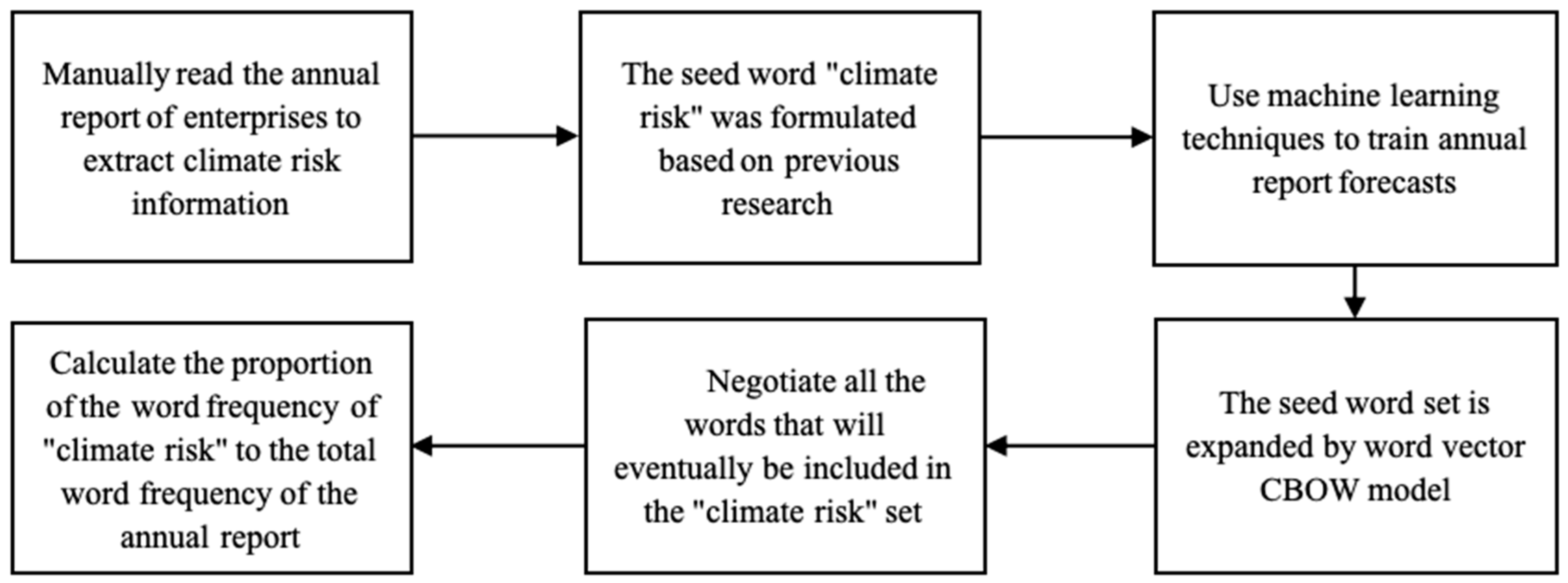
Independent Variable: Climate Risk. In this study, climate risk shocks specifically refer to physical risks. We construct a climate risk indicator through the following steps:
First, we manually review the annual reports of Chinese listed companies from 2007 to 2023 to extract textual references related to climate risk. This process incorporates information disclosed by the National Meteorological Data Center, China Meteorological Disaster Yearbook, and the study by Li et al. [
16] to develop a climate risk dictionary based on textual content in the reports. Second, to enhance the objectivity and comprehensiveness of the seed word list, we draw on the methodologies of Bengio et al. [
31] and LeCun et al. [
32], using machine learning and text analysis techniques to identify the top ten words most semantically similar to the seed terms. These similar terms are then added to the dictionary to expand the climate risk word set. Third, we calculate the ratio of the total frequency of the expanded climate risk word set to the total word count of each annual report. A higher value of this indicator reflects greater exposure to climate risk. The construction process of this explanatory variable, climate risk, is summarized in
Figure 1.
Control Variables: Following the literature on stock price crash risk and corporate finance, we include a set of control variables at the firm level to account for their potential influence. Specifically, we control for the following firm characteristics: firm age (Lnage), firm size (Lnsize), financial leverage (Lev), the ownership share of the top five largest shareholders (Top 5), Tobin’s Q (TobinQ), ownership balance (Balance), sales growth rate (Growth), and whether the firm is a state-owned enterprise (Govcon). The detailed definitions of these variables are provided in
Table 1.
3.3. Model Specification
A simple OLS model may yield biased and inconsistent estimates due to the potential presence of unobserved confounding variables that vary across firms or over time, leading to a misestimation of the true relationship between climate risk and stock price crash risk. To mitigate these endogeneity concerns, we employ a two-way fixed effects (TWFE) model. This approach allows us to control for both firm and year fixed effects simultaneously. Specifically, we establish the following baseline regression model:
where subscripts i and t represent the enterprise and year, respectively,
represents the risk of a stock price crash, CPR is the core explanatory variable of this paper, and X is the control variable of this paper.
,
,
and
, respectively, represent the firm effect, year effect, regional effect, and industry effect. On the basis of controlling the fixed effects, this paper also uses the robust standard errors clustered at the enterprise level, and the final
represents the random disturbance term. This paper will note that the coefficient β of the core explanatory variable in Equation (1) is significantly positive if the estimated results support the hypothesis. Finally, the descriptive statistics for the main variables are presented in
Table 2.
4. Baseline Regression and Robustness Checks
4.1. Baseline Results
Table 3 reports the estimation results from our baseline regression model specified in Equation (1), which examines the impact of climate risk shocks on corporate stock price crash risk.
The key finding is that the coefficient on the physical climate risk variable is positive and statistically significant at the 1% level across all specifications. This provides evidence that the physical climate risk significantly increases a firm’s stock price crash risk. This result is theoretically consistent with the findings of Zhang et al. [
33], who document that corporate carbon emission disclosures can lead to stock price declines. However, our study offers a more nuanced perspective. Compared to the macro-level nature of carbon emissions, our firm-level measure of physical climate risk, constructed via machine learning, more closely approximates the risk perceptions that drive actual corporate decision-making and helps to mitigate potential endogeneity concerns.
In terms of economic significance, the magnitude of the estimated coefficient is substantial. A one-standard-deviation increase in our climate risk measure is associated with an increase in stock price crash risk of 0.542 standard deviations. To put this into perspective, this effect accounts for approximately 54.2% of the total variation in stock price crash risk within our sample period, indicating that climate risk is a powerful determinant of extreme stock price movements.
4.2. Robustness Checks
4.2.1. Instrumental Variable (IV) Approach
The results of the baseline regression may suffer from an endogeneity problem caused by omitted variables. That is, there may exist some unobserved regional factors, such as economic policies, technological progress, and industrial structure adjustments; these variables simultaneously affect climate risk and a firm’s stock price crash risk, leading to biased estimation results. Although the two-way fixed effects model can alleviate this problem to some extent, it cannot completely solve it.
Therefore, this paper uses the sum of days with extremely low temperatures as an instrumental variable; this meteorological data comes from the NOAA (U.S. National Oceanic and Atmospheric Administration). On the one hand, extreme climate naturally has a positive correlation with corporate climate risk, which means it satisfies the relevance requirement for an instrumental variable. On the other hand, extreme climate, as an objective variable of the natural environment, is unrelated to changes in corporate stock prices, satisfying the exogeneity condition for an instrumental variable.
Furthermore, we construct a Bartik-style instrument by using the annual average climate risk of industry peers as the “share” component. Competitive pressure ensures that industry-wide trends influence individual firm risk assessments, satisfying the relevance condition. Conversely, this aggregate industry perception does not directly determine an individual firm’s specific crash risk, thereby satisfying the exogeneity condition. This design aligns with the identification logic of Goldsmith-Pinkham et al. [
34] and Borusyak et al. [
35]. Finally, this paper uses the annual average of the climate risk level of other firms within the same industry as the “share” of influence, uses extreme climate as the external shock, and uses the product of the two (IV) as the instrumental variable. This is used to overcome the endogeneity problem caused by omitted variables.
Columns (1) and (2) of
Table 4 report the estimation results from the Bartik-style instrumental variable approach. Column (1) presents the first-stage regression results. The coefficient on the instrumental variable is significantly positive, which confirms that the relevance condition is met. The Kleibergen-Paap rk LM statistic is 33.362 and is significant at the 1% level, allowing us to reject the null hypothesis of underidentification. Furthermore, the Kleibergen-Paap rk Wald F-statistic is 40.742, which is well above the conventional critical values for weak instruments, thereby passing the weak instrument test. The second-stage estimation result, shown in Column (2), reveals that the coefficient of climate risk remains significantly positive and is consistent with our baseline findings, which underscores the robustness of our results.
4.2.2. Propensity Score Matching (PSM)
To mitigate potential selection bias arising from the fact that firms’ climate risk exposure is not randomly assigned, we employ a Propensity Score Matching analysis. The primary benefit of PSM is its ability to reduce a multi-dimensional set of observable characteristics into a single scalar, the propensity score, allowing for a more balanced comparison between treated and control groups and thus yielding more reliable causal inferences.
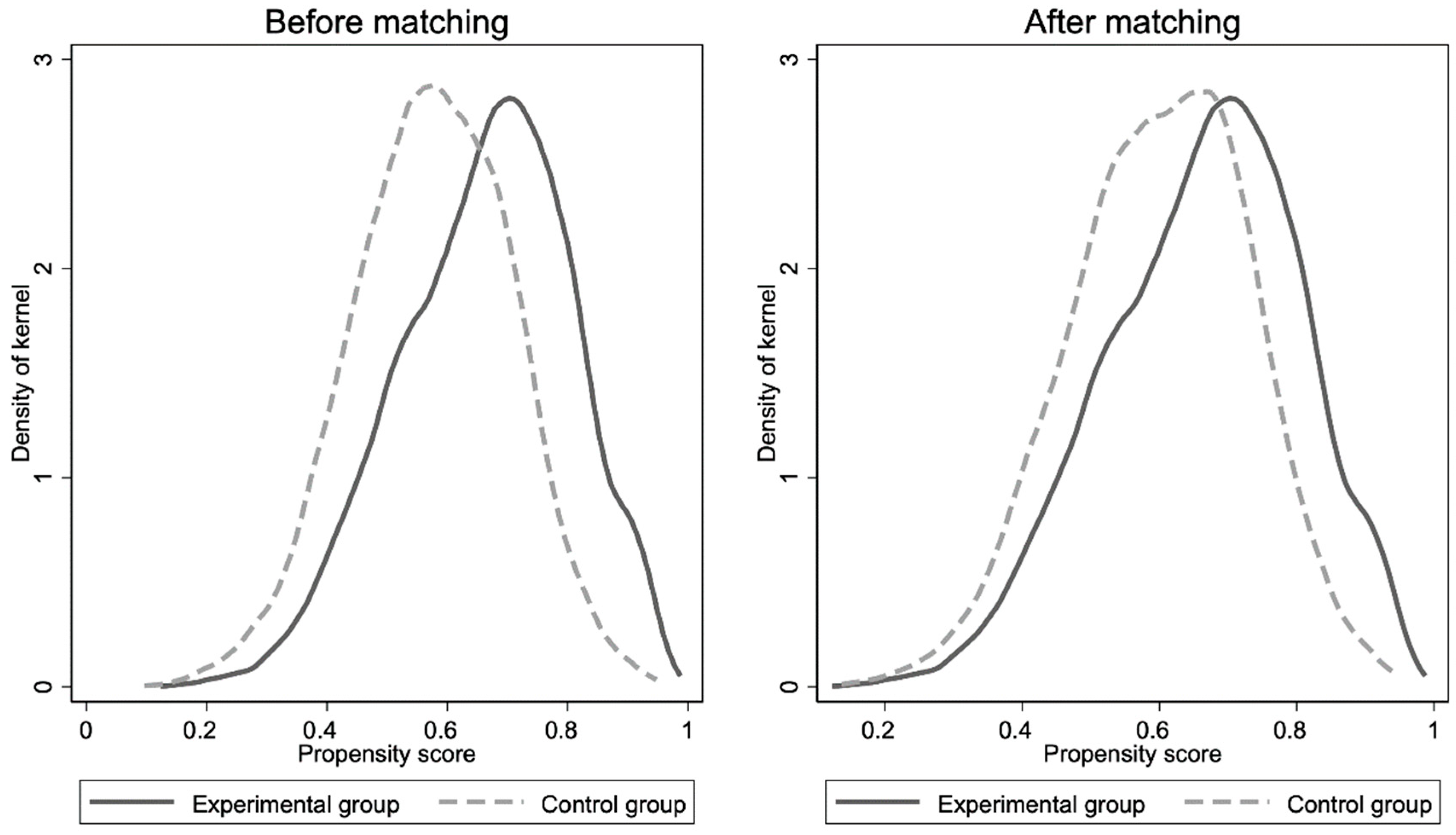
The procedure is as follows. First, we create a binary treatment indicator for high climate risk exposure. A firm is assigned to the treatment group (Treatment = 1) if its climate risk measure is above the sample median, and to the control group (Treatment = 0) otherwise. Second, we use a Logit model, based on all the firm-level control variables, to estimate the propensity score for each firm. Finally, we use a one-to-one nearest-neighbor matching algorithm to match each treated firm with a control firm and then re-estimate Equation (1) on the matched sample.
Figure 2 displays the kernel density distributions of the propensity scores for both groups. The substantial overlap between the two distributions after matching provides strong visual evidence that the common support assumption holds. Column (3) of
Table 4 reports the estimation results after PSM. The coefficient on climate risk remains positive and statistically significant, further confirming the robustness of our main conclusion.
4.2.3. Competition Hypothesis
While our instrumental variable approach mitigates endogeneity, unobserved contemporaneous factors or policy reforms may still pose confounding risks. To ensure robustness, we explicitly test and rule out several plausible alternative explanations.
Ruling Out the Short-Term Market Overreaction Effect. We consider whether the observed relationship stems from short-term market overreaction, where adverse news triggers sector-wide panic selling followed by a correction. To rule this out, we augment the baseline model with the lagged dependent variable (L.NCSKEW) and lagged average weekly returns (L.Ret). These controls account for past performance dynamics and investor sentiment. As reported in Column (1) of
Table 5, the climate risk coefficient remains significantly positive at the 1% level. This result confirms that our main finding is not an artifact of transient market sentiment and persists after controlling for past risk dynamics.
Excluding the Impact of the COVID-19 Pandemic and Financial Crisis. The outbreak of the COVID-19 pandemic starting in late 2019 dramatically increased the level of external environmental uncertainty for firms, leading to a surge in various corporate risks. To ensure that our findings are not driven by this unique and extreme shock, we re-estimate our baseline model (1) on a subsample that excludes the pandemic years (2019–2022). The regression results for this adjusted sample period are presented in Column (2) of
Table 5. The coefficient on climate risk remains positive and statistically significant, in this case at the 5% level. At the same time, in consideration of the potential impact of the financial crisis on the results, we excluded the samples from 2008 to 2009 and re-conducted the regression analysis. The results are reported in Column (3) of
Table 5.
Excluding the Impact of Major Climate Policy Shifts. In 2020, China announced its ambitious “dual carbon” goals, pledging to reach peak carbon emissions by 2030 and achieve carbon neutrality by 2060. This landmark announcement has had profound implications for China’s future energy structure, industrial policies, and environmental regulations, and could have independently influenced stock price volatility for many firms. To ensure our results are not confounded by this pivotal policy event, we conduct another robustness check by excluding all data from the year 2020. The results are reported in Column (4) of
Table 5. After removing the influence of this major policy shift, we find that our core conclusion still holds.
4.2.4. Additional Robustness Checks
Using Alternative Measures of Stock Price Crash Risk. To ensure our results are not contingent on a specific definition of crash risk, we conduct robustness checks using two alternative proxies for the dependent variable. First, following Kim et al. [
36], we employ the down-to-up volatility ratio (DUVOL) as an alternative measure. A higher value of DUVOL indicates greater downside volatility relative to upside volatility, thus signifying a higher risk of a stock price crash. Second, drawing on the methodology of Hutton et al. [
37], we use a dummy variable, Crash, to capture the actual occurrence of a crash event. Specifically, Crash equals 1 if a firm’s firm-specific weekly return in a given week is 3.09 or more standard deviations below its mean annual firm-specific weekly return for that year, and 0 otherwise. Since Crash is a binary/count variable, we replace our baseline model (1) with a Fixed Effects Poisson model for this regression. Columns (1) and (2) of
Table 6 report the regression results using these alternative measures.
To ensure our findings capture the impact of physical climate shocks rather than confounding policy pressures, we constructed a separate Transition Risk variable following the TCFD classification. This variable was generated using text analysis based on a dictionary of keywords related to environmental regulations, carbon neutrality policies, and energy transition. We introduced this Transition Risk index as an additional control variable in the baseline regression. The results, presented in Column (3) of
Table 6, indicate that the coefficient of physical climate risk remains significantly positive. This suggests that physical climate shocks exert an independent and distinct destabilizing effect on stock price crash risk, which persists even after accounting for the concurrent pressures of the green economic transition.
Controlling for City-Level Economic Characteristics. A firm’s stock price is plausibly influenced by the economic environment of the city where it is located. Key factors such as the local level of economic development and industrial structure could have a significant impact. To ensure that our results are not driven by such omitted regional variables, we augment our baseline model by incorporating a set of time-varying city-level control variables. Specifically, we control for: population density (year-end registered household population), industrial structure (the share of the secondary industry in local GDP), GDP per capita, and the level of fiscal self-sufficiency (calculated as the ratio of the fiscal deficit, public budget expenditure minus public budget revenue, to public budget revenue). Column (4) of
Table 6 presents the estimation results after including these city-level controls. The coefficient on our climate risk variable remains significantly positive, confirming that our findings are robust to the inclusion of local economic conditions.
Interactive Fixed Effects and Alternative Clustering of Standard Errors. First, to account for potentially unobservable factors that vary over time at a more granular level, we employ a more stringent fixed effects specification. Column (5) of
Table 6 reports the results after including industry-year and city-year interactive fixed effects. This specification allows us to control for any industry-specific or city-specific shocks and trends that evolve over time. The results remain statistically significant at the 5% level, further substantiating our main findings. Second, our baseline regressions report standard errors clustered at the firm level. To address potential concerns about within-region error correlation, we re-estimate our baseline model but cluster the standard errors at a higher level of aggregation—the province level. The results of this test are presented in Column (6) of
Table 6. The statistical significance of our key coefficient is unaffected by this change in clustering.
The incorporation of objective climate risk indicators. To address concerns that text-based measures may reflect managerial disclosure incentives rather than actual physical risks, we further control for objective meteorological indicators, including extreme heat (htd), extreme cold (ltd), extreme drought (erd), and extreme precipitation (eed). As reported in Column (7) of
Table 6, the coefficient of CPR remains positive and statistically significant even after netting out these exogenous shocks. This persistence suggests that our text-based metric captures firm-specific vulnerabilities beyond regional weather conditions, confirming that the findings are driven by substantive risk exposure rather than disclosure bias.
Overall, the consistent results across this extensive battery of robustness checks provide strong support for the robustness and credibility of our baseline findings.
5. Mechanism Analysis and Heterogeneity Test
5.1. Mechanism Analysis
5.1.1. The Liquidity Constraint Channel
As theorized in
Section 2, the increasing frequency of physical climate events can tighten a firm’s liquidity constraints. This occurs through various avenues, including the direct destruction of production facilities, the disruption of supply chains, and the incurrence of unexpected operational recovery costs. Faced with these sudden and unpredictable cash outflows, firms are often compelled to draw down their internal cash reserves to maintain daily operations and meet short-term obligations, leading to a decline in their cash holding levels.
To empirically test this first mechanism, we examine the direct impact of climate risk on corporate liquidity. We measure a firm’s liquidity using its cash holding level (Cashhold), defined as the ratio of cash and cash equivalents to total assets. The regression results are presented in Column (1) of
Table 7. The estimated coefficient on the climate risk variable is significantly negative at the 1% level. This indicates that an increase in climate risk exposure leads to a significant reduction in a firm’s cash holdings. This finding provides direct empirical support for the first part of the mechanism outlined in Hypothesis 1: that climate shocks indeed exacerbate liquidity constraints.
5.1.2. The Diminished Risk-Taking Channel
In corporate investment decisions, a firm’s risk-taking capacity reflects its willingness and ability to allocate resources to projects with higher uncertainty in pursuit of higher returns. We posited that the persistent intensification of physical climate risk significantly suppresses this capacity, serving as another critical channel through which stock price crash risk increases.
Following the approach of Lin and Jin [
12], we proxy for a firm’s risk-taking level using the standard deviation of its Return on Assets (ROA), calculated over rolling windows of three and five years, respectively (Risk1 and Risk2). To isolate the firm-specific component of this volatility, the measure is adjusted for both year and industry effects. A smaller value of this proxy indicates lower earnings volatility, suggesting a stronger propensity to avoid high-risk investments and thus a lower level of risk-taking.
The regression results are presented in Columns (2) and (3) of
Table 7. The estimated coefficients on the climate risk variable are significantly negative at the 5% level for both measures of risk-taking. This demonstrates that a heightened exposure to physical climate risk leads to a significant reduction in a firm’s risk-taking level. This finding empirically validates Hypothesis 2. Climate shocks suppress a firm’s risk-taking capacity, eroding its adaptability to future market and environmental shifts. This structural fragility substantially increases vulnerability to stock price crashes.
5.1.3. The Moderating Role of Green Transformation
Theoretically, a firm’s green transformation can mitigate the impact of climate shocks on crash risk through two main avenues. First, through green technological innovation and process reengineering, firms can reduce their dependence on high-carbon, pollution-intensive assets, thereby enhancing their resilience to extreme weather events and substantially reducing operational volatility. Second, proactive green initiatives send a positive signal to the market, indicating a firm’s commitment to long-term sustainability and its capacity to respond to policy shifts. This can bolster investor confidence, reduce information asymmetry, and alleviate panic selling in the wake of negative shocks.
To test this moderating effect, we construct a textual analysis-based measure of corporate green transformation, drawing inspiration from the methodology of Loughran and McDonald [
38]. We first compile a comprehensive dictionary of 113 green transformation-related keywords. This dictionary is developed based on authoritative Chinese policy documents, such as the Five-Year Plans, the Environmental Protection Law, and various technical guidelines on corporate environmental conduct, as well as the existing academic literature. The keywords cover five key dimensions: environmental advocacy, strategic philosophy, technological innovation, pollution control, and monitoring & management. We then measure the frequency of these keywords in the annual reports of each listed firm to create our Green Transformation Index (Gtindex). A higher value of Gtindex indicates a greater extent of disclosure related to green transformation and thus a deeper commitment to its implementation.
Finally, we test the moderating effect by introducing an interaction term between climate risk and our green transformation index (CPR×Gtindex) into the baseline regression model. The results are presented in Column (4) of
Table 7. The coefficient on this interaction term is significantly negative. This indicates that a firm’s green transformation effectively weakens the positive relationship between climate risk and stock price crash risk, thus providing strong empirical support for Hypothesis 3.
5.2. Heterogeneity Analyses
5.2.1. Heterogeneity by Financing Constraints
The degree of financing constraints a firm faces is directly related to its capacity to absorb and buffer external negative shocks. Firms with high financing constraints, characterized by limited access to external capital, are often less equipped to cope with the asset losses and cash flow strains caused by sudden events like climate disasters. This vulnerability may compel their management to hoard bad news to maintain operations, and once the accumulated negative information reaches a tipping point, a more severe stock price crash is likely to ensue. In contrast, firms with low financing constraints can more readily access external funds to smooth the impact of such shocks, thereby stabilizing investor expectations.
To test this logic, we conduct a subsample analysis based on the level of corporate financing constraints. Following the literature, we use the SA index as our measure of financing constraints. We partition the full sample into two groups: a high financing constraint group (firms with an SA index above the sample median) and a low financing constraint group (firms with an SA index below the sample median).
The results are reported in Columns (1) and (2) of
Table 8. In the high financing constraint subsample, the regression coefficient of climate risk on stock price crash risk (CPR) is 0.450 and is statistically significant at the 5% level. However, in the low financing constraint subsample, the coefficient, while still positive, is not statistically significant. This finding indicates that the exacerbating effect of climate shocks on stock price crash risk is primarily concentrated in firms that are financially vulnerable and have restricted access to capital. This also provides further corroborating evidence for the existence of the liquidity constraint channel we identified earlier.
5.2.2. Heterogeneity by R&D Intensity
Research and development (R&D) expenditure is a key indicator of a firm’s capacity for technological innovation and sustainable development. According to the existing literature, firms with high R&D intensity possess greater technological resilience and a stronger risk-taking capacity. Through innovation, they can develop climate-adaptive products or greener production processes, which allows them to effectively hedge against the negative impacts of climate risk [
39]. In contrast, firms with low R&D investment are often ill-prepared, both technologically and strategically, to cope with climate change, making their operations and profitability more susceptible to adverse climate shocks.
To test this proposition, we conduct another subsample analysis based on firms’ R&D intensity. The results are reported in Columns (3) and (4) of
Table 8. In the subsample of firms with low R&D intensity, the regression coefficient of climate risk is 0.675 and is statistically significant at the 5% level. This finding confirms our conjecture that the threat of climate-induced stock price crash risk is most acute for firms with insufficient innovative capacity and a lack of a “technological cushion.” This result also provides indirect, corroborating evidence for the existence of the diminished risk-taking channel.
5.2.3. Heterogeneity by Industry Characteristic
Industry characteristics fundamentally shape the transmission intensity of physical climate shocks. Industries that are heavily dependent on natural resources or outdoor operations are inherently more vulnerable to extreme weather events, owing to their high degree of asset tangibility and exposure to direct operational risks. When climate disasters strike, these industries suffer immediate physical damage and severe business interruptions, triggering acute liquidity stress and market panic.
To examine this variation, we divide the sample into High Climate Sensitivity (comprising agriculture, forestry, animal husbandry, and fishery; mining; construction; and transportation) and other groups based on the nature of their operations. The results are reported in Columns (5) and (6) of
Table 8. Consistent with our expectations, the regression coefficient of climate risk in the high-sensitivity group is significantly positive and substantially larger in magnitude compared to the other group. This finding confirms that the impact of climate shocks on crash risk is asymmetric and driven by physical vulnerabilities, thereby reinforcing the overall robustness of our paper’s primary conclusions.
6. Further Analysis
Our preceding analyses have established that climate shocks are a significant external factor that exacerbates corporate stock price crash risk. However, the economic consequences of this finding extend beyond short-term capital market volatility. A crucial question thus arises: Does this climate-induced financial market instability then feed back into the real operations of the firm, specifically by impeding its sustainable development?
We argue that an elevated stock price crash risk can trigger managerial myopia and strategic contraction. To stabilize stock prices and restore investor confidence in the short term, firms may be compelled to curtail projects that are crucial for long-term growth but have long investment horizons and uncertain immediate returns. Investments related to sustainable development, such as improving environmental performance, often fall into this category. This adverse effect is likely amplified when the root cause of the crash risk is itself climate change.
To test this transmission mechanism, we examine the impact of climate-induced stock price crash risk on corporate sustainability performance. Following Alexopoulos et al. [
40], we measure corporate sustainable development performance from two key dimensions: financial performance and environmental performance. Specifically, we use Return on Assets (ROA) to measure a firm’s financial performance. For environmental performance, we use the environmental score (E-score) from the Bloomberg ESG rating system. This score evaluates a firm based on its resource consumption, pollutant emissions, waste management, and other environmental metrics, with a higher score indicating better environmental performance. To combine these two dimensions, we first normalize both the financial performance and the environmental performance indicators to a scale between 0 and 1 using the following min-max normalization formula: Normalized Score = (Original Score − min)/(max − min). Finally, drawing on the approach of Zang and Li [
41], we construct our composite measure of Total Development Performance (TDP) by averaging the normalized scores of financial and environmental performances.
The regression results are presented in Columns (1) and (2) of
Table 9. After controlling for other relevant factors, the coefficient on the interaction term between physical climate risk and stock price crash risk is significantly negative at the 5% statistical level. This finding indicates that as climate risk intensifies, the inhibitory effect of stock price crash risk on corporate sustainability performance becomes more severe. In other words, climate risk not only acts as a catalyst for stock price crashes but also serves as an amplifier of their negative economic consequences.
7. Conclusions and Discussion
This study empirically investigates how physical climate risk affects corporate stock price crash risk. Using a sample of Chinese listed firms from 2007 to 2023, our baseline results show that climate risk shocks significantly increase the propensity for stock price crashes. Building on our theoretical framework, we find that this effect is transmitted through two primary channels: the liquidity constraint channel and the diminished risk-taking channel. Furthermore, we find that a firm’s green transformation can effectively mitigate this adverse impact. Our heterogeneity analysis reveals that the effect of climate shocks is more pronounced for firms with severe financing constraints, low R&D expenditures and high climate sensitivity. Finally, our further analysis indicates that the heightened stock price crash risk induced by climate shocks subsequently impedes corporate sustainable development.
From a system-wide perspective, these findings suggest that climate shocks do not remain confined to firm-level financial outcomes but create broader ripple effects across the financial system. The elevated crash risk reflects nonlinear and asymmetric adjustments in market expectations, indicating that climate shocks can amplify systemic vulnerabilities through interlinked financing channels, investor behavior, and information spillovers. This underscores the importance of viewing climate risk as a catalyst for financial system instability rather than as an isolated corporate risk factor.
Based on these findings, this study offers several important policy implications. First, to counteract the liquidity constraint channel, policymakers should establish a robust climate disaster insurance system. Promoting parametric insurance products and implementing region-specific liquidity support mechanisms can provide rapid payouts during extreme weather events. These tools act as financial breakwaters, preventing temporary cash flow ruptures from escalating into insolvencies or panic-induced crashes.
Second, financial institutions should design climate-sensitive credit policies to revitalize corporate risk-taking capacity. Instead of broadly withdrawing capital from vulnerable sectors, lenders should innovate green credit instruments specifically tied to adaptation efforts. By providing stable capital for infrastructure reinforcement and supply chain diversification, financial institutions can empower firms to maintain strategic innovation despite environmental uncertainty, yielding a double dividend of resilience and growth.
Third, regarding governance, the focus must be on mitigating the agency problems that lead to bad news hoarding. Regulators should enforce granular climate disclosure requirements to reduce information opacity. Simultaneously, firms should reform governance structures to align executive compensation with long-term climate resilience rather than short-term stock performance. This alignment reduces the managerial incentive to conceal negative information, thereby dampening the accumulation of bad news that ultimately triggers crashes.
This study acknowledges several limitations that open avenues for future research. First, regarding measurement, our text-mining indicator captures risk perceived by management rather than objective physical data. While crucial for understanding market reactions, this reliance on semantic expressions may introduce reporting biases. Future research should integrate geospatial meteorological data to cross-validate these text-based metrics. Second, concerning causal identification, despite employing Two-Way Fixed Effects and instrumental variables, residual endogeneity and imperfect instrument relevance cannot be entirely ruled out. The link between local climate and corporate text may be indirect. Future studies should confirm temporal causality using dynamic panel models (System-GMM), quasi-experimental designs, or more precise industry-weighted instruments to validate these claims. Third, regarding potential spatial mismatch between headquarters and operations, our text-based approach offers a compensatory advantage by capturing the aggregated risk profile of dispersed subsidiaries and supply chains. Crucially, our heterogeneity analysis reveals that the impact of climate risk is significantly stronger in industries with high physical vulnerability. This structural alignment confirms that our measure proxies for substantive physical exposure rather than mere disclosure bias, although future research could further refine estimation using georeferenced production data. Fourth, regarding economic magnitude, we quantify the probabilistic propensity for systemic instability rather than direct monetized losses. Our interpretation focuses on system vulnerability; thus, future research should bridge this gap by estimating the tangible economic implications of climate-induced crashes. Fifth, our sample is confined to Chinese listed firms, excluding SMEs and unlisted entities due to data constraints. This limits generalizability and introduces potential survivor bias. Future scholarship should employ cross-country comparisons to test robustness across diverse institutional contexts.
Author Contributions
Conceptualization, T.L. and W.Z.; methodology, W.Z.; software, W.Z.; validation, T.L.; formal analysis, T.L.; investigation, T.L.; resources, W.Z.; data curation, W.Z.; writing—original draft preparation, T.L.; writing—review and editing, W.Z.; visualization, W.Z.; supervision, T.L.; project administration, T.L. All authors have read and agreed to the published version of the manuscript.
Funding
This research received no specific grant from any funding agency in the public, commercial, or not-for-profit sectors.
Data Availability Statement
The data underlying this article will be available upon request, subject to the author’s consent.
Conflicts of Interest
The authors declare no conflict of interest.
References
- Huang, S.; Vigne, S.; Yao, D.; Xu, X. Climate risk analysis: Definitions, measurements, strategies, and sectoral impacts. J. Econ. Surv. 2025, 39, 1795–1822. [Google Scholar] [CrossRef]
- Zhao, W.; Chen, H.; Yazan, D.M.; Taghavifar, H.; Lyu, Y.; Bulis, A. Few-shot learning and deep predictive models for cost optimization and carbon emission reduction in energy-water management. J. Environ. Manag. 2025, 389, 126077. [Google Scholar] [CrossRef] [PubMed]
- Huynh, T.D.; Nguyen, T.H.; Truong, C. Climate risk: The price of drought. J. Corp. Financ. 2020, 65, 101750. [Google Scholar] [CrossRef]
- Zhao, F.; Song, C. A supply chain perspective on climate risks, corporate financing constraints, and mitigation strategies: Evidence from China. Asia Pac. Bus. Rev. 2025, 1–30. [Google Scholar] [CrossRef]
- Carvalho, D.; Rocha, A.; Costoya, X.; DeCastro, M.; Gómez-Gesteira, M. Wind energy resource over Europe under CMIP6 future climate projections: What changes from CMIP5 to CMIP6. Renew. Sustain. Energy Rev. 2021, 151, 111594. [Google Scholar] [CrossRef]
- El-Hermisy, H. The economic effects of environmental and climatic changes on the economic sector. Int. J. Mod. Agric. Environ. 2021, 1, 51–78. [Google Scholar] [CrossRef]
- Zhang, J.; Jiang, Y.; Hayashi, Y. Transformative paradigms in transport policymaking: Navigating the complexities of a post-COVID-19 turbulent era. In Research Handbook on Transport and COVID-19; Edward Elgar Publishing: Cheltenham, UK, 2025; pp. 491–506. [Google Scholar] [CrossRef]
- Kling, G.; Volz, U.; Murinde, V.; Ayas, S. The impact of climate vulnerability on firms’ cost of capital and access to finance. World Dev. 2021, 137, 105131. [Google Scholar] [CrossRef]
- Cepni, O.; Şensoy, A.; Yılmaz, M.H. Climate change exposure and cost of equity. Energy Econ. 2024, 130, 107288. [Google Scholar] [CrossRef]
- Lee, S.Y.; Klassen, R.D. Firms’ response to climate change: The interplay of business uncertainty and organizational capabilities. Bus. Strategy Environ. 2016, 25, 577–592. [Google Scholar] [CrossRef]
- Sun, G.; Yan, Z.; Gong, Z.; Li, M. The impact of ESG rating divergence on stock price crash risk. Int. Rev. Financ. Anal. 2025, 102, 104081. [Google Scholar] [CrossRef]
- Lin, S.L.; Jin, X. The Effects of Income Diversification on Operating Performance and Risk-Taking in Financial Industry: Evidences from China’s Financial Reform. J. Account. Financ. Manag. Strategy 2019, 14, 69. [Google Scholar]
- Zhang, X.; Zhang, M.; Fang, Z. Impact of climate risk on the financial performance and financial policies of enterprises. Sustainability 2023, 15, 14833. [Google Scholar] [CrossRef]
- Wang, H.T.; Qi, S.Z.; Li, K. Impact of risk-taking on enterprise value under extreme temperature: From the perspectives of external and internal governance. J. Asian Econ. 2023, 84, 101556. [Google Scholar] [CrossRef]
- Liu, Z.; Pang, T.; Sun, H. Decarbonization policy and high-carbon enterprise default risk: Evidence from China. Econ. Model. 2024, 134, 106685. [Google Scholar] [CrossRef]
- Li, Q.; Shan, H.; Tang, Y.; Yao, V. Corporate climate risk: Measurements and responses. Rev. Financ. Stud. 2024, 37, 1778–1830. [Google Scholar] [CrossRef]
- Linnenluecke, M.K.; Griffiths, A.; Winn, M. Extreme weather events and the critical importance of anticipatory adaptation and organizational resilience in responding to impacts. Bus. Strategy Environ. 2012, 21, 17–32. [Google Scholar] [CrossRef]
- Zhao, W.; Chen, H.; Bulis, A. How are Industry 4.0 technologies transforming a sustainable society across industries? Digit. Transform. Soc. 2025, 4, 363–380. [Google Scholar] [CrossRef]
- Sun, Y.; Yang, Y.; Huang, N.; Zou, X. The impacts of climate change risks on financial performance of mining industry: Evidence from listed companies in China. Resour. Policy 2020, 69, 101828. [Google Scholar] [CrossRef]
- Huang, Y.; Xu, Z. The role of principal-agent in corporate financialization and green innovation. Financ. Res. Lett. 2024, 63, 105391. [Google Scholar] [CrossRef]
- Dessaint, O.; Matray, A. Do managers overreact to salient risks? Evidence from hurricane strikes. J. Financ. Econ. 2017, 126, 97–121. [Google Scholar] [CrossRef]
- Kothari, S.P.; Shu, S.; Wysocki, P.D. Do managers withhold bad news? J. Account. Res. 2009, 47, 241–276. [Google Scholar] [CrossRef]
- Jin, L.; Myers, S.C. R2 around the world: New theory and new tests. J. Financ. Econ. 2006, 79, 257–292. [Google Scholar] [CrossRef]
- Ray, S.; Mondal, A.; Ramachandran, K. How does family involvement affect a firm’s internationalization? An investigation of Indian family firms. Glob. Strategy J. 2018, 8, 73–105. [Google Scholar] [CrossRef]
- Bloom, N. Fluctuations in uncertainty. J. Econ. Perspect. 2014, 28, 153–176. [Google Scholar] [CrossRef]
- Gormley, T.A.; Matsa, D.A. Growing out of trouble? Corporate responses to liability risk. Rev. Financ. Stud. 2011, 24, 2781–2821. [Google Scholar] [CrossRef]
- Parrino, R.; Poteshman, A.M.; Weisbach, M.S. Measuring investment distortions when risk-averse managers decide whether to undertake risky projects. Financ. Manag. 2005, 34, 21–60. [Google Scholar] [CrossRef]
- Zhou, C.; Qi, S.; Li, Y. Environmental policy uncertainty and green transformation dilemma of Chinese enterprises. J. Environ. Manag. 2024, 370, 122891. [Google Scholar] [CrossRef]
- Chai, K.C.; Zhang, J.H.; Wang, Z.L.; Lu, Y.; Jin, X. Environmental information disclosure, market competition, and green transformation: Evidence from Chinese heavily polluting listed companies. Environ. Dev. Sustain. 2025, 27, 10693–10717. [Google Scholar] [CrossRef]
- Wu, C.M.; Hu, J.L. Can CSR reduce stock price crash risk? Evidence from China’s energy industry. Energy Policy 2019, 128, 505–518. [Google Scholar] [CrossRef]
- Bengio, Y.; Ducharme, R.; Vincent, P.; Jauvin, C. A neural probabilistic language model. J. Mach. Learn. Res. 2003, 3, 1137–1155. [Google Scholar]
- LeCun, Y.; Bengio, Y.; Hinton, G. Deep learning. Nature 2015, 521, 436–444. [Google Scholar] [CrossRef]
- Zhang, L.; Fan, H.; Zhang, J.; Shan, Y.G.; Tang, Q. Climate Risk and Stock Price Crash: The Role of Text-Based Carbon Disclosure. Account. Financ. 2025, 65, 3107–3141. [Google Scholar] [CrossRef]
- Goldsmith-Pinkham, P.; Sorkin, I.; Swift, H. Bartik instruments: What, when, why, and how. Am. Econ. Rev. 2020, 110, 2586–2624. [Google Scholar] [CrossRef]
- Borusyak, K.; Hull, P.; Jaravel, X. Quasi-experimental shift-share research designs. Rev. Econ. Stud. 2022, 89, 181–213. [Google Scholar] [CrossRef]
- Kim, J.B.; Wang, Z.; Zhang, L. CEO overconfidence and stock price crash risk. Contemp. Account. Res. 2016, 33, 1720–1749. [Google Scholar] [CrossRef]
- Hutton, A.P.; Marcus, A.J.; Tehranian, H. Opaque financial reports, R2, and crash risk. J. Financ. Econ. 2009, 94, 67–86. [Google Scholar] [CrossRef]
- Loughran, T.; McDonald, B. When is a liability not a liability? Textual analysis, dictionaries, and 10-Ks. J. Financ. 2011, 66, 35–65. [Google Scholar] [CrossRef]
- Dai, D.; Han, S.; Zhao, M.; Xie, J. The impact mechanism of digital transformation on the risk-taking level of Chinese listed companies. Sustainability 2023, 15, 1938. [Google Scholar] [CrossRef]
- Alexopoulos, I.; Kounetas, K.; Tzelepis, D. Environmental and financial performance. Is there a win-win or a win-loss situation? Evidence from the Greek manufacturing. J. Clean. Prod. 2018, 197, 1275–1283. [Google Scholar] [CrossRef]
- Zang, J.; Li, Y. Technology capabilities, marketing capabilities and innovation ambidexterity. Technol. Anal. Strateg. Manag. 2017, 29, 23–37. [Google Scholar] [CrossRef]
| Disclaimer/Publisher’s Note: The statements, opinions and data contained in all publications are solely those of the individual author(s) and contributor(s) and not of MDPI and/or the editor(s). MDPI and/or the editor(s) disclaim responsibility for any injury to people or property resulting from any ideas, methods, instructions or products referred to in the content. |