Article

Human–Machine Cooperation in Environmental Education: Experimental Evidence from AI-Supported Learning in Higher Education


by
Faed Mahmoud Buojaylah Fayid
* and
Askin Kiraz
Environmental Education and Management, Near East University, 99138 Nicosia, North Cyprus, Turkey
*
Author to whom correspondence should be addressed.
Systems 2026, 14(5), 504; https://doi.org/10.3390/systems14050504
Submission received: 26 February 2026 / Revised: 28 April 2026 / Accepted: 30 April 2026 / Published: 2 May 2026

Abstract

Higher education institutions are under increasing pressure to strengthen environmental education (EE) due to critical environmental challenges, while also addressing learner support, engagement, and instructional resource constraints. Recent advances in conversational artificial intelligence (AI), particularly generative AI systems based on large language models such as ChatGPT, enable new forms of human–machine cooperation and provide opportunities for interactive guidelines and individualized feedback. This study evaluates AI-supported EE compared with conventional classroom instruction using a quasi-experimental pre-test/post-test research design. Forty undergraduate students from a Libyan university were recruited and assigned to either the AI-supported EE group (n = 20) or a conventional classroom control group (n = 20). Both groups followed the same EE curriculum over eight weeks. Learning outcomes were assessed across environmental knowledge, attitudes, and environmentally responsible behavior using structured instruments. Paired-samples t-tests indicated statistically significant improvements within the AI-supported group across all outcomes (p < 0.05). However, between-group comparisons did not show statistically significant differences. Analysis controlling for baseline differences indicated a statistically significant group effect for knowledge (p < 0.05), while attitudes and behavior remained non-significant. These findings suggest that AI-supported learning may support EE learning for higher education.

1. Introduction

Severe global environmental challenges have intensified the need for effective Environmental Education (EE) efforts [1]. Higher education institutions have played a crucial role in facilitating EE, equipping students with environmental knowledge, attitudes, and behaviors necessary for mitigating environmental deterioration [2]. EE aims not only to enhance cognitive behaviors but also to foster pro-environmental and sustainable environmental behaviors in students [3]. Traditional EE relies on classroom-based instructions that are guided by lectures, textbooks and teacher-led discussions [4]. The traditional approach of EE has been widely acknowledged as effective in transmitting foundational environmental knowledge. However, several studies have also identified its limitations, such as its limitation to address personalized learning experiences; which are highly effective for EE [5].
Recent advances in Artificial Intelligence (AI) technology, particularly in language models popularly used in chatbots or conversational AI, have introduced new possibilities for the delivery of education [6]. AI models are capable of simulating intelligent and interactive dialog, providing feedback, and adapting content delivery in the context of their users [7]. In the context of education, AI models are able to adapt education content delivery based on the user or learner; this supports individual or self-directed learning [8]. Such AI capabilities are in alignment with educational paradigms known as constructivists and self-centered learning [9]. Several researchers have investigated and proposed the use of AI systems for education delivery in different forms and fields of education [10,11,12]. However, despite these growing interests in AI-supported learning, there is limited empirical evidence regarding its effectiveness in the delivery of EE.

1.1. Study Background

EE plays a critical role in promoting awareness, attitudes, and behaviors necessary for mitigating environmental challenges. However, achieving meaningful learning outcomes in EE remains challenging, particularly in higher education contexts where traditional instructional approaches often emphasize content delivery rather than active engagement and behavioral change. These challenges are further intensified in developing contexts where limitations in instructional resources, access to up-to-date materials, and opportunities for interactive learning may constrain the effectiveness of EE. In the context of Libyan higher education, these challenges are particularly evident. Instructional practices are often constrained by limited technological infrastructure, large class sizes, and reliance on conventional lecture-based teaching methods [13]. As a result, students may have fewer opportunities for individualized feedback, interactive learning, and critical engagement with environmental topics.
The integration of AI-driven education has been proposed in many studies as a method of overcoming some of these challenges in other educational endeavors [10,11,12]. AI-based education delivery offers scalable and flexible learning opportunities [14], which may support the learning process in certain contexts [15]. Research literature suggests EE significantly benefits from interactive and learner-centered approaches. AI tools have also been reported to offer a potential learning experience by enhancing learning through interactive and learner-centered means [16]. But there is limited experimental evidence regarding the use of AI-based EE, especially in comparison to EE using conventional classroom instruction approaches. Based on the identified research gap, this study experimentally evaluates the impact of AI-based EE on higher education students, relative to environmental knowledge, attitudes, and behaviors. By addressing this gap, the study advances the understanding of how AI can be effectively integrated into EE.

1.2. Research Aim

This study seeks to examine the impact of AI-based EE on students’ environmental knowledge, attitudes, and behaviors in comparison with conventional classroom instruction. The study uses experimental research with two instructional groups for AI-supported EE and a control group using conventional. The study focuses on higher education students, by using a structured and validated EE curriculum for learning delivery and student testing. This study contributes empirical evidence on the emerging literature on the use of AI in education, by offering practical insights for educators, curriculum designers and education policy designers.
From a systems perspective, AI-supported instruction can be conceptualized as a form of evolving human–machine cooperation in which learners, instructors, and conversational AI can jointly shape learning feedback cycles, knowledge construction, and learning pathways. In this study, ChatGPT is not treated as a substitute for teaching, but rather as a cooperative learning agent that supports explanation, reflection, and adaptive learning scaffolding. By evaluating learning outcomes across knowledge, attitudes, and environmentally responsible behaviors, the study contributes empirical evidence to understanding how education systems can function as learning organizations that integrate human and machine capabilities to enhance learning, especially under resource constraints. From a systems perspective, education can be viewed as a learning organization where feedback, adaptation, and interaction among humans and technological agents shape learning outcomes.

2. Literature Review

Environmental education (EE) as a formal form of education emerged as a response to growing environmental degradation. The development of EE is closely associated with the international environmental movement and policy initiatives; these include the 1972 United Nations conference on human environment in Stockholm, the Belgrade Charter of 1975, and the 1977 Tbilisi declaration [17]. They provided the foundational framework of EE by defining the goals, core principles, and objectives of EE. EE is aimed at integrating environmental knowledge, attitude, skills, and participation among individuals in formal education systems [18]. Since its inception, EE has increasingly become institutionalized within formal school curricula globally, evolving from simple knowledge facilitation to more holistic approaches that include critical thinking and environmentally responsible behavior [19].

2.1. Environmental Education Learning Outcomes

EE is broadly characterized as a process that increases students’ awareness and understanding of environmental issues, by developing a positive attitude towards the environment and promoting sustainable environmental behaviors [20]. EE is conceptualized to deliver learning outcomes across three main domains; these include environmental knowledge, attitudes, and behaviors [21]. Environmental knowledge refers to the understanding of ecological concepts and problems [22], environmental attitudes reflect individual values and concerns for the environment [23], and environmental behaviors involve actual sustainable behaviors towards the environment [24].
Literature has shown that well-designed EE programs can have a significant impact on student environmental knowledge and attitudes [25]. However, translating knowledge and attitudes into pro-environmental behavior remains a challenge [26]. Studies have emphasized the use of instructional approaches that are engaging and interactive to foster adequate cognitive and affective EE learning [27].

2.2. Traditional Environmental Education

EE in formal higher education contexts primarily relies on conventional classroom instruction to build environmental literacy [28]. Traditional classroom approaches are commonly used to build environmental knowledge, emphasize sustainability concepts, raise awareness on environmental trends, and enable sustainable behaviors in students [29]. The global urgency of mitigating climate change has positioned EE as a critical mechanism for strengthening environmental knowledge, attitudes, and behaviors in alignment with sustainable development goals (SDGs) [30].
Traditional classroom approaches to EE are often characterized as a teacher-centered approach of learning [31]. This is defined by classroom instructors’ control of knowledge pacing and coverage, where students participate by listening, taking notes, and taking assessments [32]. The reliance of formal EE on traditional classroom approaches limits the adoption of participatory, experiential, and inquiry-based approaches of EE [33].
EE programs using traditional approaches can improve environmental knowledge, attitudes, intentions and behaviors, but their impact can significantly vary relative to the design, context, and extent to which instruction relates to meaningful and contextual actions [34]. A review carried out by Van de Wetering et al. [35] reported the impact and outcomes of EE across cognitive, affective, and behavioral domains, but with differing impacts. This reflects the significant heterogeneity in instructional and teaching models. Ardoin et al. [36] emphasized that translating EE into measurable environmental sustainability impacts is challenging and requires robust teaching models. Broad pedagogical critiques of EE, as reported by Ardoin et al. [37], are limited in environmental knowledge depth and teacher-centered instructional models, and have insufficient situated learning, low engagement, and limited teacher student interactions.

Gaps of Traditional Classroom Environmental Education

Traditional classroom EE is significantly constrained by limited teacher-to-student interactions and feedback, especially in larger cohorts [38]. Students have been reported to have reluctance towards asking questions in traditional classrooms [39]. Teachers and instructors in traditional classrooms are also unable to adequately provide individualized support for their students, and this results in unresolved misconceptions and reduced learning efficiency [40]. These challenges are closely related to student engagement and the quality of their learning environment. In the context of EE, student engagement is considered a mechanism that enables sustained interests, environmental concern, and increased will to act towards environmental sustainability [41].

2.3. Artificial Intelligence in Education

AI tools, specifically generative AI systems based on large language models (LLMs) such as ChatGPT, have increasingly gained attention in education. This is associated with their capacity to enhance instructional effectiveness, improve learner engagement, and improve educational accessibility [42]. AI educational systems are commonly used to support adaptive content delivery to students, improve real time feedback, and provide accessibility for personalized and individualized learning experiences [43]. AI in education can facilitate adaptive learning; by analyzing learner data, the systems can adjust instructional pace, content delivery and learning pathways according to individual student needs [44]. The adaptive capability that AI systems provide to education have been associated with improved learning efficiency, especially in large and diverse learning environments where individualized learning support is limited [45].
AI-enhanced learning can deliver higher-order learning with tools such as simulations, scenario-based tasks, and problem-solving activities relative to real-world complexities [46]. AI-based learning has been reported to support critical thinking, decision making, and outcomes of applied learning [47].

2.4. Related Studies

Recent studies continue to highlight the potential of generative AI tools on higher education, particularly in supporting self-directed learning, providing immediate feedback, and enhancing student engagement through interactive dialog. A study by Baxter and Sommerville [48] investigated socio-technical systems in education; their study emphasized the effectiveness of AI-supported learning depending on adequate alignment between social subsystems and technological subsystems. Research on learning organizations and adaptive education systems further suggests that institutions function as dynamic systems evolving via continuous feedback and knowledge integration [49]. AI-supported learning environments are capable of enhancing adaptability via scalable and individualized learner feedback, especially in resource-constrained higher education context [50].
Recent studies on human AI collaboration highlight the significance of human instructor integrations, reporting more reliable outcomes when AI-supported learning is carried out under human pedagogical oversight [51]. Systems-based analyses of adaptive learning environments have shown that AI-integrated instructional systems outperform conventional instructional models in contexts of learning requiring iterative reasoning and contextual applications [52]. These studies interpret AI-supported education as socio-technical learning systems where learning is achieved using human and computer interaction, adaptive feedback, and institutional integration.

2.5. Human Machine Cooperative Learning System

This study conceptualizes AI-supported environmental education as a socio-technical learning system whereby learners, instructors, and conversational AI interact as interdependent components. Learning outcomes are produced via feedback-driven interactions, where students actively generate questions and responses, conversational AI provides adaptive explanatory support, and instructors guide, validate, and contextualize the learning process.
This study adopts an approach of human–machine cooperation, in which learning outcomes emerge through the interaction among the following three components:
  • Learners actively seeking clarification and applying concepts to local environmental contexts.
  • Instructors seeking to define curriculum goals and ensuring they are aligned with learning outcomes.
  • Conversational AI (ChatGPT) that provides on-demand explanations, examples and feedback to learners.
The cooperative learning process is operationalized using a feedback loop, where students generate questions or responses, and AI provides explanatory scaffolding and prompts for reflection. Instructor led classroom engagement reinforces accuracy, context relevance, and conceptual understanding. This learning model supports the interpretation of AI not as an autonomous teacher but as an enabling subsystem that strengthens the responsiveness and adaptability of education delivery.

3. Research Design

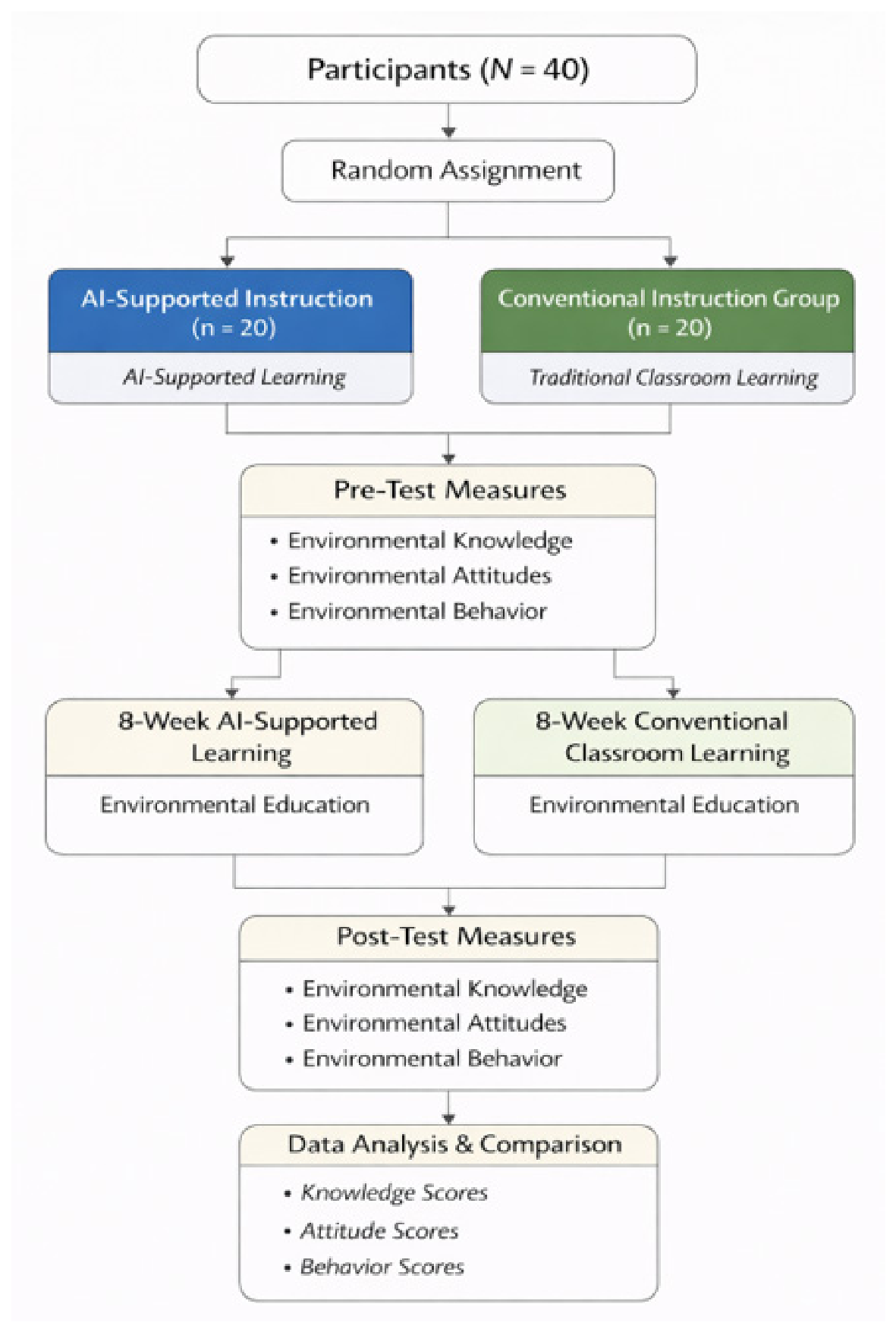
This study used a quasi-experimental research design to investigate and compare the impact of traditional classroom-based EE and AI-based EE on university students. The study uses a multidimensional analytical framework to examine the differences in learning between the two types of learning approaches. The study evaluates the learning outcomes based on the following three learning outcomes of EE: environmental knowledge, awareness, and behavior. Figure 1 illustrates the flowchart of the study.

3.1. Study Participants and Grouping

Participation in this study was voluntary, and students were informed about the purpose of the research prior to data collection, with an option to withdraw from participation at any time. This study uses a purposive sampling approach; this ensures only students with characteristics relevant to the study were selected. Following purposive selection of eligible participants, students were randomly assigned to the experimental (AI-supported EE) and control (conventional instruction) groups to ensure comparability between conditions. The participants were undergraduate university students in Libya, enrolled for a foundational EE course—only students who have not taken a university-level formal EE. Participants were then randomly assigned to one of two instructional conditions—the AI-based EE or Control group.
  • Control Group: The control group received EE using conventional classroom instructions. This includes instructor-led classroom lectures and discussion.
Experimental Group (AI-based EE): The experimental group received EE through ChatGPT as an AI-based instructional tool. The group was provided with prompts based on the learning outcomes of the institution’s EE curriculum. Both groups in the study were subjected to the same EE curriculum, learning objectives, and learning duration to ensure comparability across the two groups. Also, both groups were provided with the same instructional duration. Students in the AI-supported group engaged with ChatGPT during scheduled instructional class sessions. AI interaction is integrated as a guided activity aligned with weekly learning objectives, and students were encouraged to use the AI tool for self-directed learning even outside of class.
Prior to the intervention, students in the AI-supported group received a brief orientation session on the effective and responsible use of AI tools. This included guidance on how to formulate prompts, critically evaluate AI-generated responses, cross-check information with course materials, and avoid over-reliance on AI outputs. No advanced technical training was provided, as the goal was to simulate realistic student use of conversational AI tools.

Sample Limitations

The relatively small sample size used in this study limits the statistical power of the study, particularly in detecting between-group differences.

3.2. Course Design and Instructional Procedure

The study experiment was implemented over a period of eight weeks, with the EE course titled Foundations of Environmental Education. The EE curriculum covered fundamental environmental topics on environmental science, human impacts on the environment, energy resources, waste management, global environmental trends, environmental policies, and sustainable behavior. The control group engaged in EE through traditional classroom instructional methods.

AI-Supported EE Intervention Protocol

Participants in the experimental group used ChatGPT-4o as a guided learning assistant along with the standard course materials. Students interacted with the AI on a weekly basis in alignment with the designed course curriculum, where topics were designed to (i) clarify core EE concepts such as ecosystems, climate change, and biodiversity, (ii) generate localized examples of environmental context relevant to Libya, (iii) compare alternative solutions to justify sustainable choices, and (iv) complete reflective prompts linking course content to personal behavior.
To encourage learning-oriented use, students were instructed to request explanations, ask follow-up questions, and verify outputs with provided lecture notes rather than copying responses as final answers. Instructor oversight was also applied through brief classroom discussion and short follow-up activities that validated student understanding and corrected misconceptions. The instructor oversight via structured classroom discussion and short follow-up activities in both groups included the following activities:
  • Guided discussion of key environmental concepts (e.g., climate change causes, sustainability practices)
  • Clarification of common misconceptions identified during learning activities
  • Short application tasks such as scenario-based questions, reflective responses, and concept checks.
In the AI-supported group, these discussions also included the evaluation of AI-generated explanations, where students compared AI responses with course materials and discussed accuracy, limitations, and contextual relevance.
Table 1 shows the prompts used in this study by the experimental group to engage in EE. The prompts are used as guidelines, and students were encouraged to engage in conversations with the AI tool to seek further clarification where necessary.

3.3. Assessment and Data Collection Tool

This study used a pre-test and post-test design to evaluate the impact of both traditional classroom-based EE and AI-based EE on the student learning outcomes. Assessments were administered to all students before the eight-week EE course to measure changes attributable to the different educational approaches used in the study. The study used a baseline assessment to determine initial levels of environmental knowledge, awareness, and behavior. The baseline assessment was used to establish equivalence for evaluation between both control and experimental groups of the study. The assessment was performed using a tool designed with four distinct sections: demographic information, environmental knowledge, environmental attitudes, and environmental behavior. The assessment used in this study and results of the research instrument were not used to determine students’ final course grades; this ensured that participation in this study did not create any unfair advantage or disadvantage to students who volunteered or who did not in their academic evaluation.

Data Collection Instrument

This study uses an assessment instrument derived from established EE research; contextual adaptations are performed where necessary. The designed instrument contains 23 multiple-choice questions in quiz format for measuring student environmental knowledge. The environmental knowledge quiz is based on institutional standardized assessment; this covers topics on pollution, energy resources, waste management, climate change, and environmental conservation. Environmental attitude is evaluated using a 13-item scale, and environmental behavior is evaluated using an 11-item scale. These scales are adapted from Ivy et al. [53], and minor modifications were introduced to adequately align the scales with the study and course learning outcomes. Using these multiple outcome dimensions enabled a systems-oriented evaluation of learning effects, capturing cognitive (knowledge), affective (attitudes), and observable action tendencies (behavior) rather than relying on general knowledge gains only.

3.4. Statistical Analysis

This study carried out a statistical analysis to examine the changes in students’ environmental knowledge, attitudes, and environmental behavior before and after engaging them in EE using either the AI-based approach or a traditional classroom approach. All statistical analysis was carried out using the IBM SPSS Version 27.0 for Windows statistical tool. Before analysis of data, all student responses were screened for completeness and accuracy of feedback. Each participant was assigned a unique and anonymized identification code; this enabled the study to match the students’ pre-test and post-test evaluation and preserve participant anonymity.
Each outcome variable was computed for composite scores, and environmental knowledge scores were calculated by summing the correct responses to the multiple-choice questions, where correct answers are coded 1, and incorrect answers are coded 0, including the “I don’t know” response. Environmental attitude and behavior scores are calculated by averaging item responses, with higher scores reflecting more pro-environmental orientations. Descriptive statistics using means and standard deviations were calculated for all variables at pre-test and post-test levels; this allows for a baseline equivalence analysis both within the groups and between the groups.
Change evaluation within the groups was evaluated using paired-samples t-tests, separately for each group. The comparative effectiveness of the two instructional approaches was calculated using independent sample t-tests; this allowed the study to measure and directly compare learning gains of the instructional methods. Cohen’s dz was reported for paired-samples t-tests, and Cohen’s d for between-group comparison of gain scores. The effect sizes were interpreted using approximately 0.20 indicating small effects, 0.50 indicating moderate effects, and 0.80 or greater indicating large effects. To provide a robust comparison between instructional groups and ensure the baseline equivalence assumption is addressed, an analysis of covariance (ANCOVA) is conducted for all three outcomes of EE.
The internal consistency of environmental attitude and behavior scales was assessed and is presented in Table 2. Both environmental attitude and behavior demonstrated good and acceptable reliability, with Cronbach’s alpha of 0.82 and 0.79, respectively.
The study consisted of 40 undergraduate students as participants, from different departments, equally distributed between the AI-based EE experimental group and the traditional classroom approach group. The participant’s gender distribution was relatively balanced with 21 male and 19 female student participants. The balanced distribution of gender and instructional group suggests a comparable baseline, thereby minimizing potential demographic effects on the study outcomes. Table 3 shows the demographic characteristics of the study. The following is a presentation of the quantitative findings of the study, with the results presented by EE outcomes based on pre-test and post-test comparisons within groups and between groups.

4. Results

4.1. Environmental Knowledge

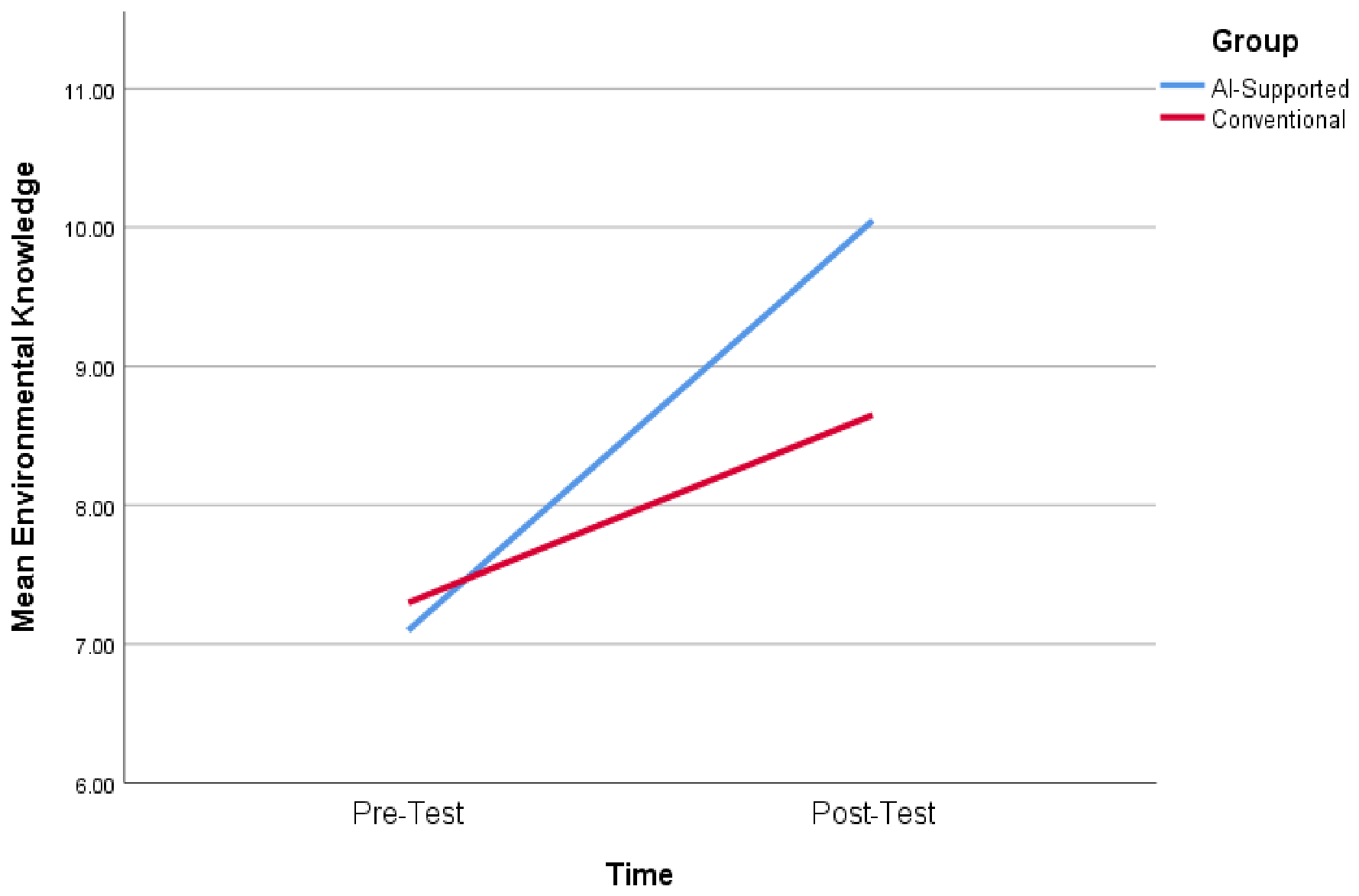
The environmental knowledge scores were derived from multiple-choice items, where each correct response is awarded one point. Possible scores for each student in this section range from 0 to 23 points. According to the results in Table 4, both traditional and AI groups demonstrated comparable environmental knowledge at the pre-test stage, whereas pre-test scores averaged 9.9 for both groups. After the EE interventions, both groups’ averages increased, with a higher mean gain observed for the AI-supported group. Figure 2 illustrates the mean environmental knowledge gains for both groups between the pre-test and post-test.
A paired-samples test, as presented in Table 5, indicates a statistically significant improvement in students’ environmental knowledge for the AI-based instruction group. In contrast, the observed improvement in the traditional classroom group did not reach a statistically significant improvement.
According to the results presented in Table 6, the effect of instructional group on post-test environmental knowledge was statistically significant. This indicates that after adjusting for differences in students’ initial environmental knowledge levels, there was a meaningful difference in knowledge outcomes between the two instructional groups. In contrast, pre-test environmental knowledge scores were not statistically significant, suggesting initial differences in environmental knowledge between the groups did not strongly influence post-test outcomes.

4.2. Environmental Attitudes

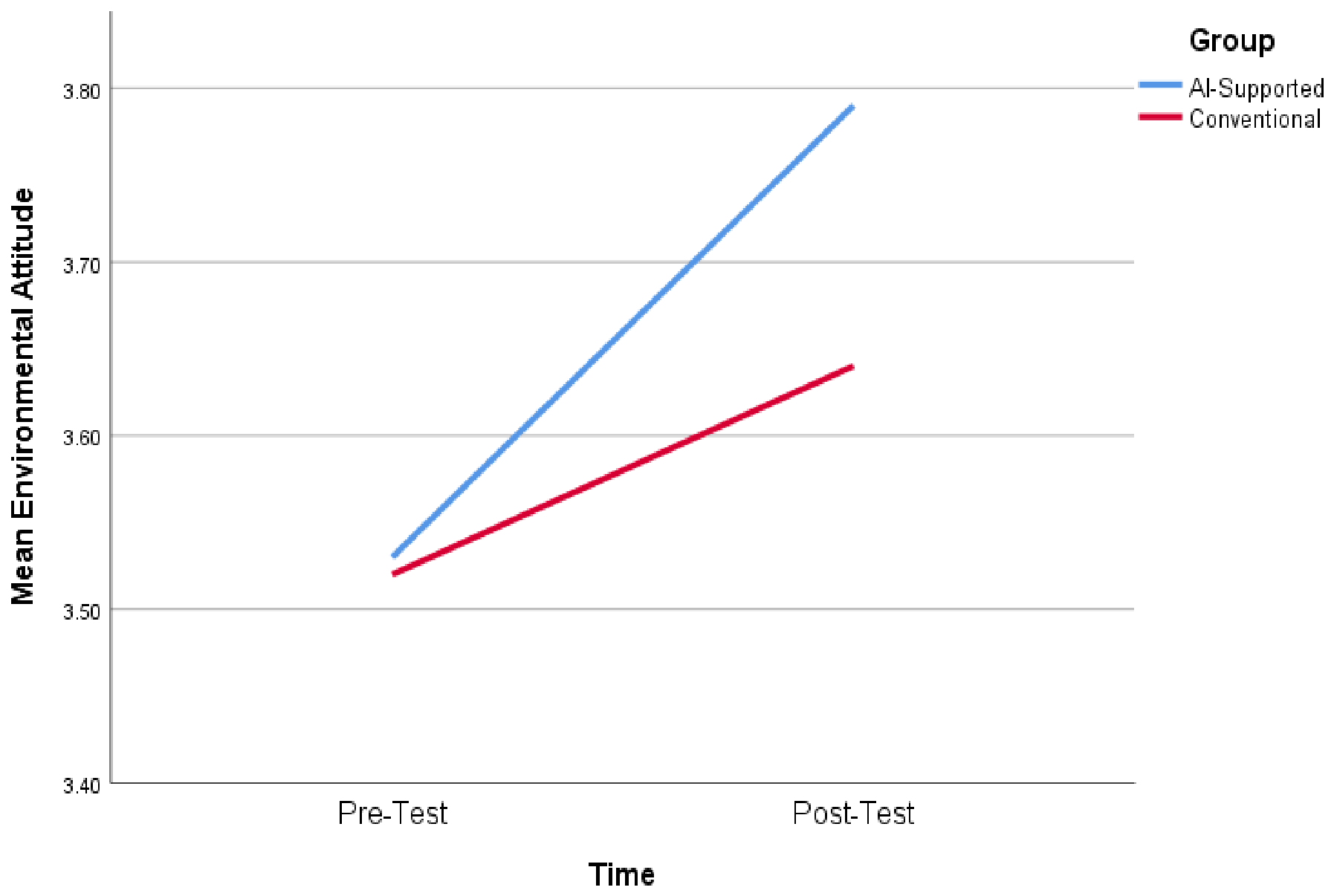
The descriptive analysis carried out for the environmental attitudes outcome of students in this study, as presented in Table 7, shows both groups having a positive attitude towards the environment in the pre-test. Post-test results after the EE intervention showed an increase in positive attitude for both groups, but the AI-based group gained slightly more than the traditional classroom approach, with a mean gain of +0.27. Figure 3 illustrates the mean environmental attitude gain among the two groups between the pre-test and post-test.
Paired-sample test results, as shown in Table 8, show a statistically significant positive change in students’ environmental attitudes for the AI-based group. The observed change in the traditional classroom approach showed a non-statistically significant increase in environmental attitude.
According to the results presented in Table 9, the effect of instructional group on post-test was not statistically significant. This indicates that after adjusting for baseline differences, there was no significant difference in environmental attitude between the two instructional groups. The covariate pre-test for attitude showed no statistical significance, suggesting that the initial attitudes between the groups did not have any influence on post-test outcomes.

4.3. Environmental Behavior

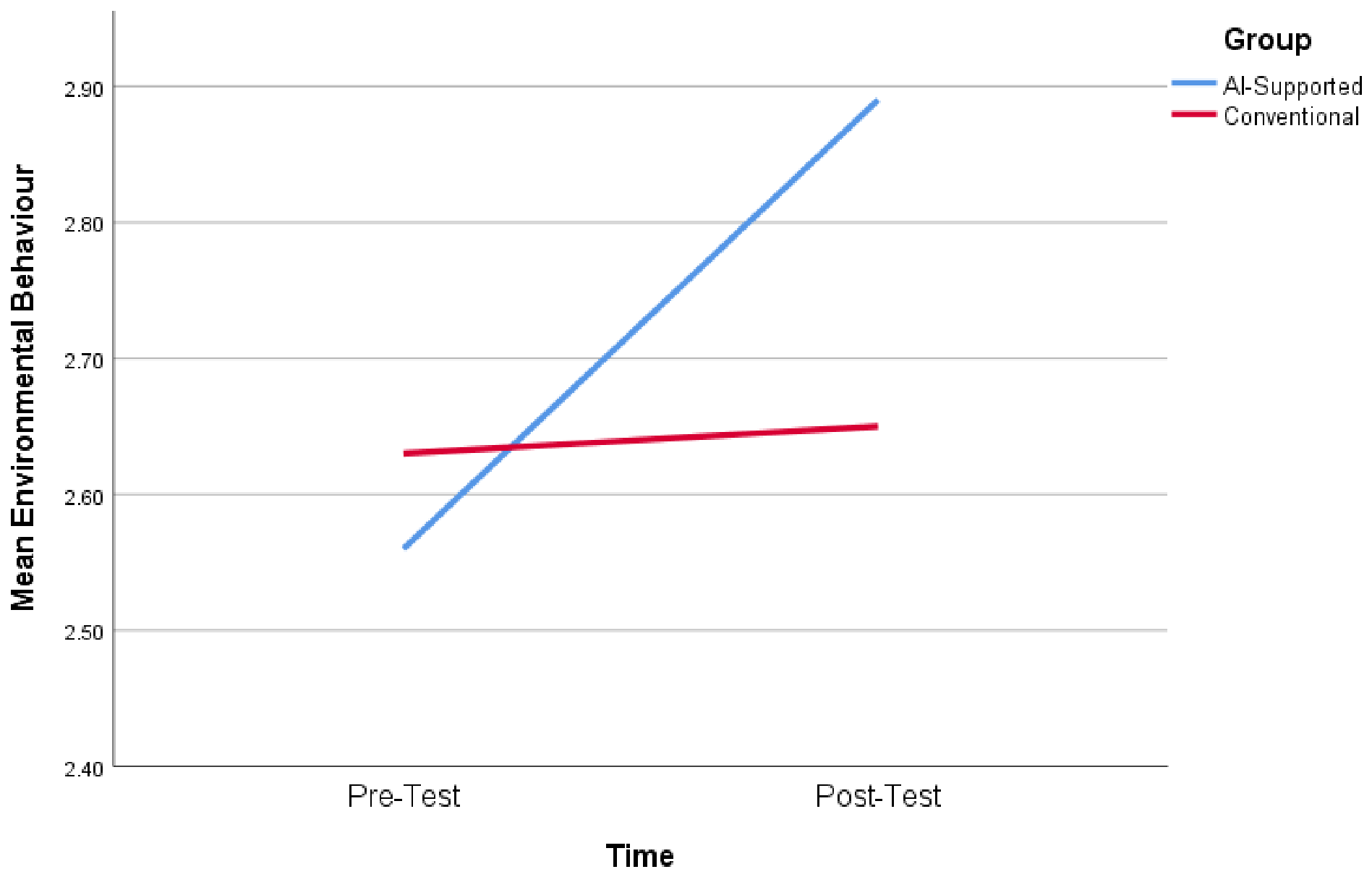
The descriptive analysis carried out for the environmental behavior outcome of students in this study, as presented in Table 10, shows a gain in environmentally responsible behavior in the AI-based group when pre- and post-test results are compared. Even though the gain is not much in the AI group, it was significantly more than the increase in the traditional classroom approach group. Figure 4 illustrates the mean environmental behavior gain among the two groups between the pre-test and post-test.
Paired-samples t-tests results, as presented in Table 11, show a statistically significant improvement in environmental behavior among the AI-based group, but the traditional classroom group showed no significant improvement in environmental behaviors.
According to the results presented in Table 12, the effect of instructional group on environmental behavior was not statistically significant. However, the covariate pre-test for environmental behavior was found to be statistically significant, indicating that baseline environmental behavior significantly influenced post-test environmental behavior outcomes.

4.4. Between-Group Comparisons of Learning Gains

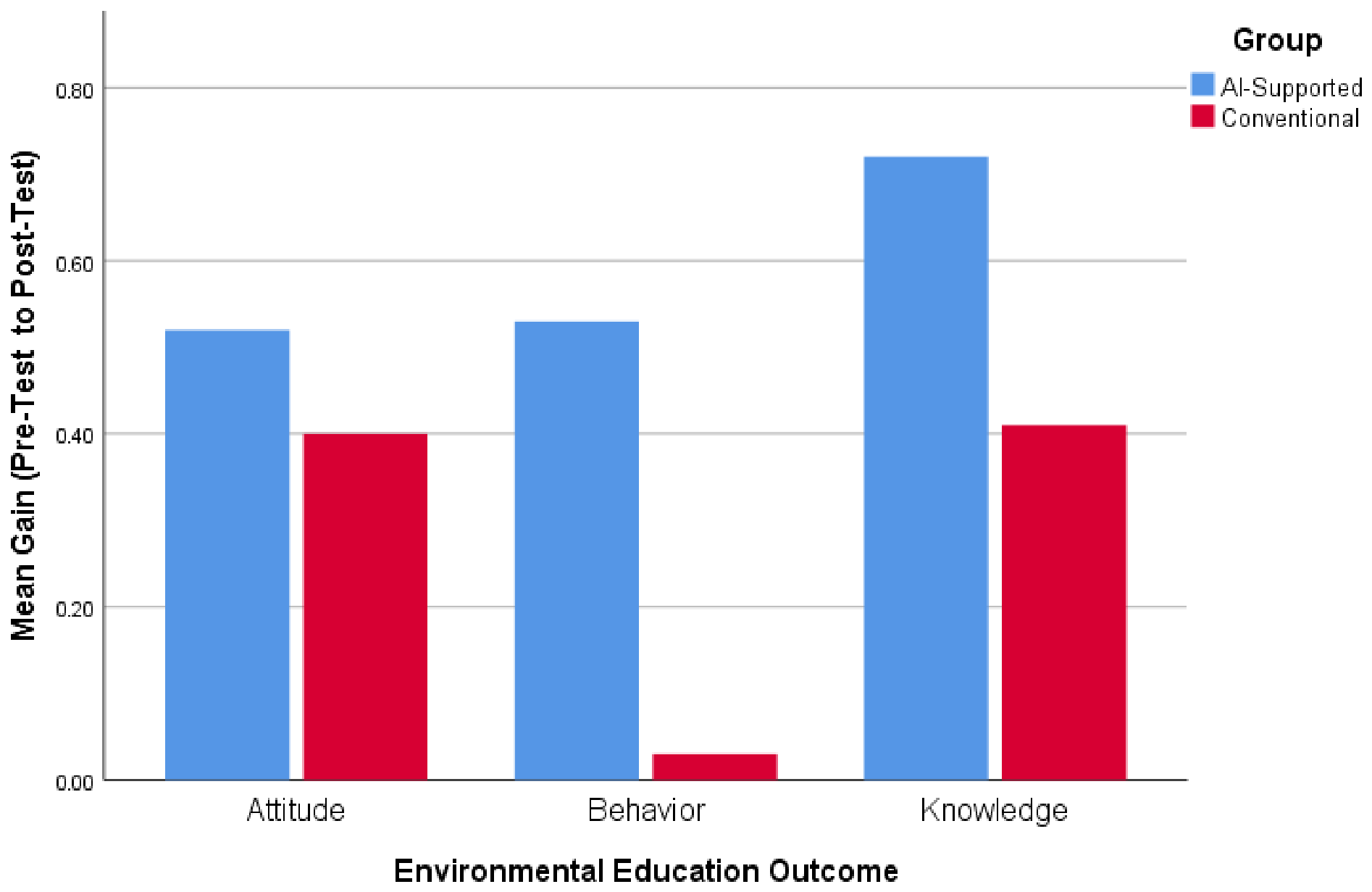
Gain scores between pre- and post-tests were calculated using independent-samples t-tests to compare the effectiveness of the two EE instruction approaches. As shown in Table 13, gain in EE outcomes consistently favored the AI-based group for all the EE outcomes, with environmental behavior having the largest observed effect. Note that differences between groups in Figure 5 are not statistically significant; the scale is presented for visualization purposes only.

5. Discussions

The findings of the study are interpreted within a socio-technical framework, where AI functions as a feedback-enhancing component within a learning organization. The interaction between learners, instructors, and AI enabled adaptive learning loops that support knowledge development and behavioral reflection in the context of EE.
A robust evaluation of the effectiveness of the instructional groups while considering the baseline differences between groups indicates that there was no significant between-group difference in effects for attitude and behavior outcomes. However, environmental knowledge showed a significant between-group effect. The findings of the study indicate that AI-supported learning contributes to improved environmental knowledge outcomes when baseline differences are controlled. This finding is consistent with previous research literature, which suggests that the use of instructional innovations that emphasize interaction and learner engagement tend to yield strong learning outcomes [54,55].

5.1. Environmental Knowledge Learning Outcomes

The findings of this study indicate that students in the AI-supported group demonstrated a meaningful improvement in environmental knowledge from pre-test to post-test, while the improvement observed in the traditional classroom group was comparatively lower. This pattern is consistent with prior research suggesting that AI-supported learning environments can enhance knowledge acquisition by providing immediate feedback, adaptive explanations, and opportunities for repeated engagement with learning content [56,57]. Similarly, technology-enhanced learning tools that are designed to scaffold understanding rather than simply deliver information have been shown to produce positive effects on learning outcomes [58].
The conversational characteristics of the AI-based tools used in this study possibly supported deeper cognitive processing that allowed students to clarify misconceptions and revisit key concepts at their own pace. Such learning features are consistent with the principles of constructivist learning approaches, where active learning is emphasized via interaction and feedback [59].

5.2. Environmental Attitudes Learning Outcomes

The findings of this study indicate that students in both instructional groups demonstrated an increase in positive environmental attitudes following the EE learning intervention, with a slightly higher improvement in the AI-supported group. This finding pattern is consistent with research suggesting that changes in attitudes are more complex than gradual changes in knowledge, as they often require meaningful engagement and reflection rather than information acquisition alone [55,60]. The interactive nature of the AI-supported learning environment may have encouraged students to reflect on environmental issues and consider their personal relevance, which can contribute to attitudinal development. Prior studies have also shown technology-enhanced learning environments incorporating dialog and reflection can support affective learning outcomes more effectively than traditional formats [61].

5.3. Environmental Behavior Learning Outcomes

The findings of this study indicate that students in the AI-supported group demonstrated an improvement in environmentally friendly responsible behavior following the intervention, while the traditional classroom group showed minimal change. However, the finding did not indicate a statistically significant difference between the two groups in influencing environmental behavior. This pattern is noteworthy given that behavioral change is widely recognized as one of the most challenging outcomes of environmental education [21]. Prior research suggests that behavioral outcomes are more likely to improve when learners perceive the personal relevance, responsibility, and practical applicability of environmental issues [56]. The interactive and reflective features of an AI-supported learning environment may have encouraged students to connect course content with their daily practices, potentially supporting the development of pro-environmental behavioral intentions.

5.4. Implications of AI-Based EE on Students

The findings of this study suggest that AI-supported environmental education may offer practical benefits for enhancing student learning, particularly in relation to knowledge acquisition. While consistent improvements were observed within the AI-supported group across all measured outcomes, the overall evidence indicates that the strength of these effects varies across different domains of learning. This observed pattern is common in educational studies relative to small sample sizes, where the statistical power may not be sufficient enough to detect significant effects [62]. Studies have shown that AI-based educational interventions often indicate positive effects at descriptive and effect-size levels of analysis, even in statistically varying studies [57,58]. The observed effects of using an AI-based EE approach across the learning outcomes of EE suggests a practical value in using AI tools for EE.
The findings in this study suggest AI-based EE instruction can serve as a valuable supplement to the conventional and traditional classroom approach of EE delivery, especially in contexts where instructional resources are limited with challenging student engagement. Research continuously highlights the scalability, flexibility and learner-centered characteristics of AI-based learning approaches, especially in higher education [52]. Based on these highlighted characteristics and the reported impact of AI tools in this study, AI-based EE learning may provide effective reinforced learning beyond conventional classrooms.

5.5. Implications for Learning Organizations

The findings of this study suggest that conversational AI can contribute to education systems by strengthening feedback mechanisms, enabling individualized learning support, and increasing institutional responsiveness to learner needs. In resource-limited contexts such as Libya, AI-supported learning can reduce bottlenecks associated with instructor time and provide scalable opportunities for iterative learning, practice and reflection. However, realizing these system-level benefits requires mechanisms of governance with clear policies for responsible AI usage, instructional supervision, and training for both educators and learners. This will ensure human judgment remains central in evaluating the accuracy and appropriateness of AI-generated learning guidance.

5.6. Limitations and Future Research

This study has some limitations that should be acknowledged. The first limitation is the modest sample size of the research experiment; this limits the statistical power for between-group comparisons. The second limitation is that the measurement and reporting of environmental behavior via self-reporting may be influenced by social desirability bias and not actual behavior. The third limitation is that although efforts were made to ensure equivalence in instructional support, subtle differences in how discussions were facilitated between AI-supported and conventional groups may still have influenced learning outcomes. Lastly, the novelty of using conversational AI may have introduced a Hawthorne effect, where increased engagement is driven by exposure to new technology rather than the instructional method itself. Additionally, conversational AI systems may generate inaccurate or incomplete information, which could influence learning outcomes if not critically evaluated by learners and instructors.
Future studies should initiate longitudinal follow-up measures to assess the persistence of the effects of EE using AI-based learning in contrast to traditional classroom approaches. Also, the AI tool types should be investigated based on their characterization and capabilities towards achieving learning outcomes in EE. Future research should employ larger samples, longer intervention periods, and more rigorous experimental designs to further examine the role of AI-supported learning in EE.

6. Conclusions

This study carried out an experimental investigation on the impact of AI-based learning in comparison to conventional learning on university-level environmental education. The findings of the study indicate that AI-supported learning is associated with improved environmental knowledge outcomes. However, no statistically significant differences were observed between the instructional approaches relative to environmental attitudes and behavior. These findings highlight the potential of conversational AI tools to support cognitive learning processes through interactive feedback and individualized learning experiences. Overall, AI-supported learning can be considered a valuable complement to conventional instruction, particularly in resource-constrained contexts where additional learning support is beneficial. While conventional classroom learning is still valuable to environmental education, the use of AI-supported learning can be used to enhance learning outcomes, especially in learning contexts requiring scalable and flexible learning tools.

Author Contributions

Conceptualization, F.M.B.F. and A.K.; methodology, F.M.B.F. and A.K.; validation, F.M.B.F. and A.K.; formal analysis, F.M.B.F.; investigation, F.M.B.F.; data curation, F.M.B.F.; writing—original draft preparation, F.M.B.F.; writing—review and editing, A.K.; and supervision, A.K. All authors have read and agreed to the published version of the manuscript.

Funding

This research received no external funding.

Institutional Review Board Statement

This study was conducted in accordance with the Declaration of Helsinki and approved by the Scientific Research Ethics Committee of Near East University with application number NEU/ES/2025/1138 and date of approval of 16 April 2025.

Informed Consent Statement

Informed consent was obtained from all subjects involved in the study.

Data Availability Statement

Data are available upon request due to restrictions (for privacy and ethical reasons).

Conflicts of Interest

The authors declare no conflicts of interest.

References

  1. Yadav, S.K.; Banerjee, A.; Jhariya, M.K.; Meena, R.S.; Raj, A.; Khan, N.; Kumar, S.; Sheoran, S. Environmental education for sustainable development. In Natural Resources Conservation and Advances for Sustainability; Elsevier: Amsterdam, The Netherlands, 2022; pp. 415–431. [Google Scholar] [CrossRef]
  2. Romanova, A. Environmental education: Principles, objectives, types and implementing at higher education institutions. In Multilingvism și Interculturalitate în Contextul Globalizării; DuraSpace: Atlanta, GA, USA, 2024; pp. 63–71. [Google Scholar] [CrossRef]
  3. Hnatyuk, V.; Pshenychna, N.; Kara, S.; Kolodii, V.; Yaroshchuk, L. Education’s role in fostering environmental awareness and advancing sustainable development within a holistic framework. Multidiscip. Rev. 2024, 7, 2024spe012. [Google Scholar] [CrossRef]
  4. Lord, T.R. A comparison between traditional and constructivist teaching in environmental science. J. Environ. Educ. 1999, 30, 22–27. [Google Scholar] [CrossRef]
  5. Vasconcelos, C. Teaching environmental education through PBL: Evaluation of a teaching intervention program. Res. Sci. Educ. 2012, 42, 219–232. [Google Scholar] [CrossRef]
  6. Alqahtani, T.; Badreldin, H.A.; Alrashed, M.; Alshaya, A.I.; Alghamdi, S.S.; Bin Saleh, K.; Alowais, S.A.; Alshaya, O.A.; Rahman, I.; Al Yami, M.S.; et al. The emergent role of artificial intelligence, natural learning processing, and large language models in higher education and research. Res. Soc. Adm. Pharm. 2023, 19, 1236–1242. [Google Scholar] [CrossRef]
  7. Eysenbach, G. The role of ChatGPT, generative language models, and artificial intelligence in medical education: A conversation with ChatGPT and a call for papers. JMIR Med. Educ. 2023, 9, e46885. [Google Scholar] [CrossRef]
  8. Navas Bonilla, C.D.R.; Viñan Carrasco, L.M.; Gaibor Pupiales, J.C.; Murillo Noriega, D.E. The future of education: A systematic literature review of self-directed learning with AI. Future Internet 2025, 17, 366. [Google Scholar] [CrossRef]
  9. Umar, U.; Purwanto, M.B. AI and decision assistance for enhancing self-directed learning. ETERNAL (Engl. Teach. J.) 2025, 16, 457–465. [Google Scholar] [CrossRef]
  10. Laubscher, D.J. Exploring AI-driven conversations as dynamic OER for self-directed learners. In Proceedings of the 15th Edition of the International Conference: The Future of Education; Filodiritto Editore: Bologna, Italy, 2025. [Google Scholar] [CrossRef]
  11. Maphalala, M.C.; Mkhasibe, R.G.; Mncube, D.W. Exploring the roles of AI-powered e-tutors in enhancing self-directed learning in open distance e-learning courses. Interdiscip. J. Educ. Res. 2025, 7, a12. [Google Scholar] [CrossRef]
  12. Bosch, C.; Kruger, D. AI chatbots as open educational resources: Enhancing student agency and self-directed learning. Ital. J. Educ. Technol. 2024, 32, 53–68. [Google Scholar] [CrossRef]
  13. Milton, S. Higher education, post-conflict democratization and the legacies of authoritarian rule: The Tripoli University Programme for Rebuilding Libya. Educ. Citizsh. Soc. Justice 2022, 17, 18–34. [Google Scholar] [CrossRef]
  14. Govea, J.; Ocampo Edye, E.; Revelo-Tapia, S.; Villegas-Ch, W. Optimization and scalability of educational platforms: Integration of artificial intelligence and cloud computing. Computers 2023, 12, 223. [Google Scholar] [CrossRef]
  15. Mahamad, S.; Chin, Y.H.; Zulmuksah, N.I.N.; Haque, M.M.; Shaheen, M.; Nisar, K. Technical review: Architecting an AI-driven decision support system for enhanced online learning and assessment. Future Internet 2025, 17, 383. [Google Scholar] [CrossRef]
  16. Byrne, L.B. Learner-centered teaching for environmental and sustainability studies. In Learner-Centered Teaching Activities for Environmental and Sustainability Studies; Springer International Publishing: Cham, Switzerland, 2016; pp. 1–28. [Google Scholar] [CrossRef]
  17. UNESCO. Intergovernmental Conference on Environmental Education; UNESCO: Paris, France, 1978; Available online: https://unesdoc.unesco.org/ark:/48223/pf0000032763 (accessed on 22 December 2025).
  18. Tilbury, D. Environmental education for sustainability: Defining the new focus of environmental education in the 1990s. Environ. Educ. Res. 1995, 1, 195–212. [Google Scholar] [CrossRef]
  19. Palmer, J. Environmental Education in the 21st Century: Theory, Practice, Progress and Promise; Routledge: Abingdon, UK, 2002. [Google Scholar] [CrossRef]
  20. Dale, R.G.; Powell, R.B.; Stern, M.J.; Garst, B.A. Influence of the natural setting on environmental education outcomes. Environ. Educ. Res. 2020, 26, 613–631. [Google Scholar] [CrossRef]
  21. McGuire, N.M. Environmental education and behavioral change: An identity-based environmental education model. Int. J. Environ. Sci. Educ. 2015, 10, 695–715. [Google Scholar]
  22. Smith, G.A.; Williams, D.R. Ecological education: Extending the definition of environmental education. Aust. J. Environ. Educ. 1999, 15, 139–146. [Google Scholar] [CrossRef]
  23. Stern, P.C.; Dietz, T. The value basis of environmental concern. J. Soc. Issues 1994, 50, 65–84. [Google Scholar] [CrossRef]
  24. Park, J.; Ha, S. Understanding pro-environmental behavior: A comparison of sustainable consumers and apathetic consumers. Int. J. Retail Distrib. Manag. 2012, 40, 388–403. [Google Scholar] [CrossRef]
  25. Legault, L.; Pelletier, L.G. Impact of an environmental education program on students’ and parents’ attitudes, motivation, and behaviours. Can. J. Behav. Sci. /Rev. Can. Sci. Comport. 2000, 32, 243. [Google Scholar] [CrossRef]
  26. Geiger, S.M.; Geiger, M.; Wilhelm, O. Environment-specific vs. general knowledge and their role in pro-environmental behavior. Front. Psychol. 2019, 10, 718. [Google Scholar] [CrossRef] [PubMed]
  27. Littledyke, M. Science education for environmental awareness: Approaches to integrating cognitive and affective domains. Environ. Educ. Res. 2008, 14, 1–17. [Google Scholar] [CrossRef]
  28. Goldman, D.; Assaraf, O.B.Z.; Shaharabani, D. Influence of a non-formal environmental education programme on junior high-school students’ environmental literacy. Int. J. Sci. Educ. 2013, 35, 515–545. [Google Scholar] [CrossRef]
  29. Cotton, D.R.; Miller, W.; Winter, J.; Bailey, I.; Sterling, S. Developing students’ energy literacy in higher education. Int. J. Sustain. High. Educ. 2015, 16, 456–473. [Google Scholar] [CrossRef]
  30. Avelar, A.B.A.; Mitchell, S.F.; Sandes-Guimarães, L.V. Integrating sustainable development goals in management education: Impact on student knowledge, attitudes, and behaviors. Int. J. Manag. Educ. 2025, 23, 101116. [Google Scholar] [CrossRef]
  31. Serin, H. A comparison of teacher-centered and student-centered approaches in educational settings. Int. J. Soc. Sci. Educ. Stud. 2018, 5, 164–167. [Google Scholar] [CrossRef]
  32. Sjöblom, P.; Eklund, G.; Fagerlund, P. Student teachers’ views on outdoor education as a teaching method—two cases from Finland and Norway. J. Adventure Educ. Outdoor Learn. 2023, 23, 286–300. [Google Scholar] [CrossRef]
  33. Zhang, X.; Jung, W.; Asari, M. Systematic review of environmental education teaching practices in schools: Trends and gaps (2015–2024). Sustainability 2025, 17, 8561. [Google Scholar] [CrossRef]
  34. Zeng, Z.; Zhong, W.; Naz, S. Can environmental knowledge and risk perception make a difference? The role of environmental concern and pro-environmental behavior in fostering sustainable consumption behavior. Sustainability 2023, 15, 4791. [Google Scholar] [CrossRef]
  35. Van De Wetering, J.; Leijten, P.; Spitzer, J.; Thomaes, S. Does environmental education benefit environmental outcomes in children and adolescents? A meta-analysis. J. Environ. Psychol. 2022, 81, 101782. [Google Scholar] [CrossRef]
  36. Ardoin, N.M.; Bowers, A.W.; Roth, N.W.; Holthuis, N. Environmental education and K-12 student outcomes: A review and analysis of research. J. Environ. Educ. 2018, 49, 1–17. [Google Scholar] [CrossRef]
  37. Ardoin, N.M.; Bowers, A.W.; Gaillard, E. Environmental education outcomes for conservation: A systematic review. Biol. Conserv. 2020, 241, 108224. [Google Scholar] [CrossRef]
  38. Remmen, K.B.; Iversen, E. A scoping review of research on school-based outdoor education in the Nordic countries. J. Adventure Educ. Outdoor Learn. 2023, 23, 433–451. [Google Scholar] [CrossRef]
  39. Robertson, C.L.; Krugly-Smolska, E. Gaps between advocated practices and teaching realities in environmental education. Environ. Educ. Res. 1997, 3, 311–326. [Google Scholar] [CrossRef]
  40. Shen, Y.S.; Wu, X.; Li, P.Y. Environmental education and sustainable development: Trends, gaps, and future directions from a bibliometric perspective. Int. Res. Geogr. Environ. Educ. 2025, 1–27. [Google Scholar] [CrossRef]
  41. Kassab, S.E.; Rathan, R.; Taylor, D.C.; Hamdy, H. The impact of the educational environment on student engagement and academic performance in health professions education. BMC Med. Educ. 2024, 24, 1278. [Google Scholar] [CrossRef]
  42. Chen, L.; Chen, P.; Lin, Z. Artificial intelligence in education: A review. IEEE Access 2020, 8, 75264–75278. [Google Scholar] [CrossRef]
  43. Pedro, F.; Subosa, M.; Rivas, A.; Valverde, P. Artificial Intelligence in Education: Challenges and Opportunities for Sustainable Development. 2019. Available online: https://unesdoc.unesco.org/ark:/48223/pf0000366994 (accessed on 21 December 2025).
  44. Ouyang, F.; Jiao, P. Artificial intelligence in education: The three paradigms. Comput. Educ. Artif. Intell. 2021, 2, 100020. [Google Scholar] [CrossRef]
  45. Strielkowski, W.; Grebennikova, V.; Lisovskiy, A.; Rakhimova, G.; Vasileva, T. AI-driven adaptive learning for sustainable educational transformation. Sustain. Dev. 2025, 33, 1921–1947. [Google Scholar] [CrossRef]
  46. Demartini, C.G.; Sciascia, L.; Bosso, A.; Manuri, F. Artificial intelligence bringing improvements to adaptive learning in education: A case study. Sustainability 2024, 16, 1347. [Google Scholar] [CrossRef]
  47. Tan, L.Y.; Hu, S.; Yeo, D.J.; Cheong, K.H. Artificial intelligence-enabled adaptive learning platforms: A review. Comput. Educ. Artif. Intell. 2025, 9, 100429. [Google Scholar] [CrossRef]
  48. Baxter, G.; Sommerville, I. Socio-technical systems: From design methods to systems engineering. Interact. Comput. 2011, 23, 4–17. [Google Scholar] [CrossRef]
  49. Digiacomo, A.; Orsini, A.; Cicchetti, R.; Spadano, L.; De Santis, S.; Di Sessa, L.; Vitale, M.; Di Nicola, M.; Tamborino, F.; Basconi, M.; et al. Chatgpt vs traditional pedagogy: A comparative study in urological learning. World J. Urol. 2025, 43, 286. [Google Scholar] [CrossRef] [PubMed]
  50. Veluvali, P.; Surisetti, J. Learning management system for greater learner engagement in higher education—A review. High. Educ. Future 2022, 9, 107–121. [Google Scholar] [CrossRef]
  51. Iku-Silan, A.; Hwang, G.J.; Chen, C.H. Decision-guided chatbots and cognitive styles in interdisciplinary learning. Comput. Educ. 2023, 201, 104812. [Google Scholar] [CrossRef]
  52. Ezzaim, A.; Dahbi, A.; Aqqal, A.; Haidine, A. AI-based learning style detection in adaptive learning systems: A systematic literature review. J. Comput. Educ. 2025, 12, 731–769. [Google Scholar] [CrossRef]
  53. Ivy, T.G.C.; Road, K.S.; Lee, C.K.E.; Chuan, G.K. A survey of environmental knowledge, attitudes and behaviour of students in Singapore. Int. Res. Geogr. Environ. Educ. 1998, 7, 181–202. [Google Scholar] [CrossRef]
  54. Amershi, S.; Weld, D.; Vorvoreanu, M.; Fourney, A.; Nushi, B.; Collisson, P.; Suh, J.; Iqbal, S.; Bennett, P.N.; Inkpen, K.; et al. Guidelines for human-AI interaction. In Proceedings of the 2019 CHI Conference on Human Factors in Computing Systems; Association for Computing Machinery: New York, NY, USA, 2019; pp. 1–13. [Google Scholar] [CrossRef]
  55. Monroe, M.C.; Plate, R.R.; Oxarart, A.; Bowers, A.; Chaves, W.A. Identifying effective climate change education strategies: A systematic review of the research. Environ. Educ. Res. 2019, 25, 791–812. [Google Scholar] [CrossRef]
  56. Okonji, N.N.; Igwe, E.A. Prospects and Challenges of Personalized Learning through Artificial IntelligenceDriven Adaptive Learning Systems in N. J. Educ. Dev. Areas 2025, 33, 139–147. Available online: https://journals.journalsplace.org/index.php/JEDA (accessed on 22 December 2025).
  57. Winkler, R.; Söllner, M. Unleashing the potential of chatbots in education: A state-of-the-art analysis. Acad. Manag. Proc. 2018, 2018, 15903. [Google Scholar] [CrossRef]
  58. Wu, R.; Yu, Z. Do AI chatbots improve students learning outcomes? Evidence from a meta-analysis. Br. J. Educ. Technol. 2024, 55, 10–33. [Google Scholar] [CrossRef]
  59. Jonassen, D.H.; Rohrer-Murphy, L. Activity theory as a framework for designing constructivist learning environments. Educ. Technol. Res. Dev. 1999, 47, 61–79. [Google Scholar] [CrossRef]
  60. Kollmuss, A.; Agyeman, J. Mind the gap: Why do people act environmentally and what are the barriers to pro-environmental behavior? Environ. Educ. Res. 2002, 8, 239–260. [Google Scholar] [CrossRef]
  61. Schindler, L.A.; Burkholder, G.J.; Morad, O.A.; Marsh, C. Computer-based technology and student engagement: A critical review of the literature. Int. J. Educ. Technol. High. Educ. 2017, 14, 25. [Google Scholar] [CrossRef]
  62. Cohen, J. Statistical Power Analysis for the Behavioral Sciences; Routledge: Abingdon, UK, 2013. [Google Scholar] [CrossRef]
Figure 1. Research design flowchart.
Systems 14 00504 g001
Figure 2. Mean environmental knowledge gain trajectories by group.
Systems 14 00504 g002
Figure 3. Mean environmental attitude gain trajectories by group.
Systems 14 00504 g003
Figure 4. Mean environmental behavior gain trajectories by group.
Systems 14 00504 g004
Figure 5. Mean gain of environmental education outcomes by group.
Systems 14 00504 g005
Table 1. Predefined AI tool prompts provided to the AI-based EE group.
WeekCourse TopicPrompt TypeSample Prompt
1Introduction to Environmental ScienceConcept clarificationExplain the concept of environmental sustainability in simple terms and provide two real-world examples.
1Introduction to Environmental ScienceConcept clarificationWhat are ecosystems and biodiversity, and why are they important for human survival?
2Human Impact on the EnvironmentApplicationDescribe how human activities contribute to air and water pollution, using examples relevant to Libya.
2Human Impact on the EnvironmentConcept clarificationWhat are the main causes of climate change, and how do human actions influence them?
3Energy Resources and Environmental ImpactComparisonCompare renewable and non-renewable energy sources and explain their environmental impacts.
3Energy Resources and Environmental ImpactApplicationWhich renewable energy source would be most suitable for Libya and why?
4Waste Management and Pollution ControlConcept clarificationExplain different types of waste and suggest practical ways individuals can reduce waste in daily life.
4Waste Management and Pollution ControlApplicationHow does improper waste management affect human health and ecosystems?
5Global Environmental IssuesCritical analysisDiscuss one major global environmental issue and explain its causes and consequences.
5Global Environmental IssuesConcept clarificationHow does biodiversity loss affect ecosystem stability?
6Environmental Policy and GovernanceConcept clarificationWhat is the Paris Agreement, and why is it important for climate change mitigation?
6Environmental Policy and GovernanceApplicationExplain the role of government policies in environmental protection.
7Environmental Behavior and Sustainable LivingReflectionIdentify three daily behaviors that contribute to environmental sustainability and explain their impact.
7Environmental Behavior and Sustainable LivingReflectionHow can individual lifestyle choices influence environmental conservation?
8Technology and Environmental ProtectionApplicationExplain how artificial intelligence can be used to address environmental challenges.
8Technology and Environmental ProtectionCritical evaluationWhat are the advantages and limitations of using technology, including AI, in environmental protection?
All 8 weeksCross-cutting reflectionReflectionHow does this topic relate to your own environmental behavior?
All 8 weeksCross-cutting reflectionCritical thinkingWhat actions could individuals, communities, and governments take to address this issue?
All 8 weeksCross-cutting reflectionEvaluationWhat limitations or uncertainties exist in the solutions discussed?
Table 2. Internal consistency reliability measurement.
ScaleNumber of ItemsCronbach’s Alpha (α)
Environmental attitude130.82
Environmental behavior110.79
Environmental knowledge23Not applicable
Table 3. Demographic characteristics of the participants (N = 40).
CharacteristicCategoryFrequency (n)Percentage (%)
GenderMale2152.5
Female1947.5
DepartmentEnvironmental Sciences2050.0
Faculty of Science (Botany)2050.0
Instructional GroupAI-Supported learning2050.0
Conventional learning2050.0
Table 4. Descriptive statistics for environmental knowledge scores.
GroupNPre-Test Mean (SD)Post-Test Mean (SD)Mean Gain
AI-Supported learning209.90 (4.52)14.35 (3.07)+4.45
Conventional learning209.95 (4.27)12.05 (4.20)+2.10
Table 5. Paired-samples t-test results for environmental knowledge.
GrouptdfpCohen’s dz
AI-Supported learning3.05190.0070.68
Conventional learning1.51190.1480.34
Table 6. ANCOVA results for environmental knowledge.
Sourcedffp-ValuePartial η2
Pre-test (covariate)12.160.1500.055
group14.860.034 *0.116
Error37
* p < 0.05.
Table 7. Descriptive statistics for environmental attitude scores.
GroupNPre-Test Mean (SD)Post-Test Mean (SD)Mean Gain
AI-Supported learning203.67 (0.33)3.94 (0.26)+0.27
Conventional learning203.52 (0.38)3.73 (0.32)+0.21
Table 8. Paired-samples t-test results for environmental attitudes.
GrouptdfpCohen’s dz
AI-Supported learning2.34190.0310.52
Conventional learning1.78190.0900.40
Table 9. ANCOVA results for environmental attitude.
Sourcedffp-ValuePartial η2
Pre-test (covariate)13.870.0660.095
group10.420.5210.011
Error37
Table 10. Descriptive statistics for environmentally responsible behavior scores.
GroupNPre-Test Mean (SD)Post-Test Mean (SD)Mean Gain
AI-Supported learning202.72 (0.34)3.01 (0.31)+0.29
Conventional learning202.82 (0.30)2.84 (0.29)+0.01
Table 11. Paired-samples t-test results for environmentally responsible behavior.
GrouptdfpCohen’s dz
AI-Supported learning2.35190.0300.53
Conventional learning0.13190.8960.03
Table 12. ANCOVA results for environmental behavior.
Sourcedffp-ValuePartial η2
Pre-test (covariate)14.220.04 *0.102
group12.910.0960.073
Error37
* p < 0.05.
Table 13. Independent-samples t-test comparing gain scores.
Outcome VariableMean Gain (AI)Mean Gain (Conventional)tdfpCohen’s d
Environmental Knowledge4.452.101.16380.2510.37
Environmental Attitude0.270.210.38380.7090.12
Environmental Behavior0.290.011.73380.0930.55
Disclaimer/Publisher’s Note: The statements, opinions and data contained in all publications are solely those of the individual author(s) and contributor(s) and not of MDPI and/or the editor(s). MDPI and/or the editor(s) disclaim responsibility for any injury to people or property resulting from any ideas, methods, instructions or products referred to in the content.