Article

The Role of Promoters in Organizational Learning Within the Digital Transformation of Schools

by
Nina Carolin von Grumbkow
*,
Amelie Sprenger
,
Cornelia Gräsel
and
Kathrin Fussangel
School of Education, University of Wuppertal, Gaußstraße 20, 42119 Wuppertal, Germany
*
Author to whom correspondence should be addressed.
Systems 2026, 14(3), 266; https://doi.org/10.3390/systems14030266
Submission received: 30 December 2025 / Revised: 13 February 2026 / Accepted: 25 February 2026 / Published: 2 March 2026

Abstract

Digital transformation demands schools to act as learning organizations in order to rethink and reform their structures and practices. Using a mixed-methods design (quantitative analysis of code co-occurrences within 60 semi-structured group interviews and qualitative structural content analysis), the study examines how teachers who act as promoters for digital transformation facilitate organizational learning (OL) processes and how these processes can be described. While five OL processes emerge (collective sense making, knowledge creation and transfer, evaluation and feedback, experimentation and piloting, and external cooperation and knowledge import), each process is mainly shaped by a distinct promoter activity. Findings reveal that school-wide systematic structural conditions for OL processes, for instance formal evaluation and scheduled collaboration time for the whole teaching staff, are scarce, leaving many learning processes informal and project-based. The study concludes that sustainable digital transformation requires schools to institutionalize adequate structural conditions for OL activities and to empower promoters through both top-down mandates and bottom-up support, ensuring all OL processes become habituated routines.

1. Introduction

Digital transformation in education has been described as a fundamental shift driven by technology. It requires school staff to rethink and reform their structures and practices [1]. This transformation presents new and significant challenges, as it involves complex changes across multiple levels within schools, in terms of technology, pedagogy and organization [2,3]. In order to successfully navigate the challenges currently being faced and to achieve school effectiveness in growing dynamic environments, schools must function as learning organizations [4]. Organizational learning (OL) enables schools to strengthen innovation, enhance teacher competence and adapt effectively to complex and changing environments [5,6]. School’s capacity for OL depends on social processes and the structures facilitating them [4,7,8,9]. Schools also need to develop teachers who can adapt to new knowledge and innovative practices [10]. In international literature the term change agents has emerged describing an individual capable of driving organizational transformation [11]. A systematic review by Brown [12] examined teachers’ role as change agents and argued that self-improving school systems are maintained by teachers rather than school leaders [13,14,15]. Such change agents play a crucial role in driving innovation: they act as connectors between specialized knowledge and the broader educational community [11,16,17,18]. In Germany, the promoter model has emerged for examining these key actors’ roles within digital school development. The model posits that digital change requires dedicated key actors who actively promote innovation by fulfilling different role-related activities [19,20,21]. In previous quantitative studies examining social networks of teachers within the digital transformation of schools, we identified such key promoters [15,22]. However, “quantitative techniques of SNA are crucial, but qualitative work is often essential if we are to understand the how and why of such associations.” [23], p. 6. Therefore, the present mixed-methods study analyzes the role of promoters in organizational learning within the digital transformation of schools.

1.1. Literature Review

The following literature review shows the extent to which OL and promoters have been conceptualized and researched in international theoretical and empirical research relevant to the present study.
(A) Organizational learning: “OL, both in schools and other types of organizations, can be identified by the presence of habituated searching for new information, processing and evaluating information with others, incorporating and using new ideas, and of generating ideas within the organization as well as importing them from outside” [7], p. 536. Whilst learning may also be observed in terms of outcomes of learning processes, the present study focuses on learning processes, defined as “activities, structures, and strategies performed by the organization to promote learning” [24], p. 157. There are various theoretical approaches and empirical studies on OL processes [4,7,8,25]. In their U.S.-based quantitative study, Seashore Louis and Lee [7] stated that three dimensions of teacher relationships within the school environment are pivotal in facilitating the evolution of OL processes: Shared responsibility, reflective dialogue and deprivatized practice are significantly associated with teachers’ capacity for OL. The main result was that these social processes increase innovative practices and thinking. Moreover, the shape of OL processes was quantitively investigated in Israeli elementary schools by Schechter [24]. Schechter examined OL processes by developing a four-factor OL mechanisms scale: Analyzing information, storing-retrieving-using information, receiving-disseminating information and seeking information within the staff. The main findings were that school members need to actively seek information, receive and share it with others. They need to collaborate in order to decide whether the information should shape routines and then embed it into practice. Schechter [24] also emphasizes that schools build organizational memory by storing experiences so teachers can retrieve and use that knowledge to guide future decisions and actions. The underlying assumption is that the more these OL processes are ‘filled with life’, the greater the capacity for organizational change. Using a mixed-methods design, Kools et al. [9,26] evaluated Wales’s efforts to develop schools as learning organizations in support of curriculum reform. Schools were guided by a framework built around seven dimensions: Strengthening learning-focused leadership, developing a shared vision, providing professional learning opportunities for all staff, promoting teamwork and collaboration, fostering a culture of enquiry, innovation and exploration, establishing systems to embed and share knowledge, and learning from the wider environment [9,26]. One of the key findings was that 59% of Welsh schools were already making strong progress concerning continuous learning opportunities for all staff, although secondary schools were finding the process more difficult [26], p. 24. In Germany, Feldhoff [8] quantitatively surveyed schools on their OL capacity in seven dimensions (organizational structure; shared goals, values and cooperation among colleagues; knowledge and skills; leadership and management; quality evaluation and feedback; interaction with the school environment; participation of teachers). The central findings suggested that a significant proportion of German schools probably lack the necessary systematic capacity for OL processes, particularly with regard to formal structural aspects like evaluation, personnel and knowledge management, cooperation, interaction with the external environment and teaching-related leadership.
While the aforementioned studies primarily focus on formal OL mechanisms and organizational capacities, there are also studies that examine informal interactions within the organization that lead to OL. Employing an exploratory sequential mixed-methods design, Karnopp [27] examined how informal interactions can facilitate OL in a rural US school district with limited formal structural capacities. When informal interactions occurred repeatedly with a certain frequency and consistency among the same individuals or in the same settings, they also established an informal learning routine or structure. For instance, she examined that there was a certain routine of turning to colleagues who are friends, who teach the same grade/subject or are known for their experience. As Huber states, an organization learns when “through its processing of information its range of potential behaviors has changed” [28], p. 89. Karnopp’s results are consistent with empirical research on knowledge sharing within (school) networks [29,30], that has also been termed as theories of transactive memory systems [31,32,33]. Transactive memory is a shared memory system where members know who holds what expertise and how to access it. Repeatedly solving similar problems can turn this knowledge into routines that improve over time [34]. As such, transactive memory serves “as a bridge between individuals and the collective capabilities expressed in organizational routines” [33], p. 112. According to Miller et al. [33], individuals can access the transactive memory of others indirectly through communication. The promoter model used in this study provides a structured framework to analyze such contacts “as critical sources of knowledge and information” [30], p. 442.
The present study assumes that OL within the digital transformation of schools results from the interplay of (1) social OL processes, (2) structural conditions for OL and (3) the activities of promoters. This conceptual framework will be presented below. It is the theoretical lens for the present empirical study. First, five key OL processes, which are found in different theoretical and empirical OL approaches, are described.
(1)
Collective sense making: Teachers facilitate the transformation of individual knowledge into organizational knowledge by analyzing, processing and evaluating information with others [7,24,25,35,36]. This form of communication may be expressed in a variety of formal or informal ways: Habitual informal conversations, online or offline, support both information flow and OL [25,27,37]. More structured communication takes place during team/department/committee meetings [27,38]. Seashore Louis and Lee [7] discovered that when collective sense making takes place in professional learning communities, they are the strongest lever for OL. For instance, teachers opening their classrooms to observers and engaging in dialogue by giving or receiving feedback, can create continuous improvement [7,24,26,39]. As indicated by the findings of both qualitative and quantitative research, teachers, who engage in deep communication and attempt to interpret their actions, are more inclined to engage in experimentation. This can in turn lead to further enhancement of change and OL [40].
(2)
Knowledge creation and transfer: In addition to engaging in collective sense making on a communicative basis, knowledge development in schools can also center on the purposeful preparation of knowledge for school-wide use and organizational memory [30,41]. Teachers who collaborate in a variety of ways, such as planning lessons and improving the curriculum, create school-wide artifacts and shared knowledge bases which are central to OL [24,42,43,44]. While meetings can be systematically documented and made accessible, it is imperative that this information circulates and that staff member actually receive it [24]. Knowledge can also be transferred to the whole school staff in the context of personnel development. According to Kruse’s [45] theoretical approach, teachers draw on three primary sources of knowledge: Individual, team-based and external. Internationally, many researchers, practitioners and policymakers increasingly stress the value of continuous, high-quality professional learning taking place within teachers’ day-to-day instructional and organizational routines [26,46,47]. Moreover, informal knowledge distribution can also lead to OL in terms of habituated transactive memory systems. These refer to how well actors in organizations know each other’s expertise and connections [30].
(3)
Evaluation and feedback: The process of analyzing and evaluating information together is also a critical component for OL [24,26,48]. Feedback and evaluation on past activities can facilitate the retrieval and utilization of stored information. This can inform present decisions and enhance practice [8,25,49,50]. Systematic feedback, data analysis and target criteria are crucial for OL [8]. However, social processing is also essential as it allows data to be used to inform decisions [51].
(4)
Experimentation and piloting: Seashore Louis and Lee [7] show that incorporating and using new ideas as well as generating ideas within the organization are pivotal OL processes. According to Schechter et al. [25], experiential learning may be part of “information acquisition”. Learning processes can be achieved through innovative thinking, which can be characterized by experimentation and taking risks [26,41,52,53]. In order for innovative learning to take place, schools can be viewed as “living organisms […] where strategies are being tested and applied in vivo” [54], p. 3. Da’as et al. [5] conducted a quantitative study to examine how the innovative behavior of school leaders directly and indirectly influences teachers’ intention to resign and their voluntary absence. Their study confirmed that learning climate is a central mediator. When principals were able to perceive themselves as innovative thinkers and doers, while simultaneously fostering an effective learning environment, the result was a heightened level of involvement among teachers in the school learning process [5].
(5)
External cooperation and knowledge import: In dynamic contexts schools also benefit from searching for new ideas, incorporating external ideas and fostering cooperation with other institutions to remain adaptable and responsive to change [26,41,42,53]. Schechter et al. [24,25,55] refer to the process of actively searching for information: Teachers can learn from other organizations’ strategies and technologies through environmental scanning.
In order for such OL processes to take habitually place, Lipshitz, Popper and Oz [56] state that organizations need “institutionalized structural and procedural arrangements […] to systematically collect, analyze, store, disseminate, and use information that is relevant to the effectiveness of the organization” [56], p. 293. The following section outlines these important structural conditions for OL processes in schools.
Structural conditions in schools: Brown et al. [12] note that the work of change agents tends to be less difficult when an organization has structural conditions for a strong learning culture [57]. According to Kruse [50], in order to advance innovation, organizations need to have an ‘organizational memory’ of what has been already learned and needs to be remembered. He claims that organizational memory can only develop if the school has structural conditions that store knowledge by shaping actions and making them repeatable. Therefore, OL processes are supported by structural conditions that help individuals and teams access, create and apply organizational memory, processes and culture [58]. Organizational learning becomes habitual when processes are either routine (time windows/routines), systematically fixed (digital infrastructure) or institutionally secured (teams/roles).
(a)
Time windows/routines: Research indicates that a critical factor in the promotion of OL is the extent to which teachers possess adequate learning resources at their disposal [42]. Kools and Stoll [53] argue that time is a cross-cutting factor that runs through all dimensions and is essential for school development [53], p. 32. Schedules may need to be changed so teachers share free periods and have dedicated ‘team time’ [26,59].
(b)
(Digital) infrastructure: It is important for schools to establish an infrastructure conducive to collaboration as social arenas that “become the property of the entire organization through dissemination and changes in standard routines and procedures” [24], p. 160. A school’s digital infrastructure can also facilitate collaboration within and across schools [53].
(c)
Institutionalized teams/roles: According to Walsh and Ungson [60], institutionalized roles become patterned over time and therefore serve as central repositories in which organizational information is retained. Moreover, institutionalized teams like steering or working groups do not only promote collaborative learning, but also distributed leadership. (In Germany, a steering group is the official group for a school’s development and the school leadership is a full member by law, while a working group/project group is often a subgroup of the official steering group [61].). They serve as infrastructures for actors initiating, coordinating and supporting development processes [61,62]. Hairon and Goh [63] show that distributed leadership is most effective in driving change when involved people have decision-making authority and engage frequently and in depth with the wider school staff.
To sum up, a multitude of empirical studies have identified central OL processes and the structures facilitating them [7,8,24,27]. However, with the exception of studies concerning leadership, the identity of the individuals responsible for the realization of OL processes remains unknown and a specific description of their roles and activities is missing [5,64]. In the present study, we refer to the promotor model as a theoretical lens to describe teachers’ possible roles in OL processes.
(B) Promoters in OL processes: The promoter model describes different roles that are important for innovative change. The model emphasizes that innovation does not occur spontaneously, but needs different innovative activities by individuals and groups [65]. While promoters take on essential roles in advancing new practices, it is their collaboration that enhances the success of transformation processes [66,67]. According to Witte [67], innovations are prevented by various barriers, such as “barriers of will” or “barriers of ability” [67], p. 13. These can arise due to a lack of skills, knowledge or competencies on the part of individuals in the context of introducing an innovation. Promoters are individuals who actively drive the innovation process forward, overcome such barriers and commit themselves personally and energetically to its successful implementation. As stated by Schültz [66], promoters also have a significant influence on an innovation-promoting organizational culture. They serve as role models, share resources and skills and promote the development of a culture of innovation. This assertion has been examined by a variety of quantitative and qualitative studies in the context of digital school development in Germany [19,20,21,22]. The special feature of the promoter model is that it focuses on innovation-promoting activities provided by promoters. It distinguishes four overlapping aspects: authority, expertise, process and relationship [19,20,21,22]:
  • Authority Promoter—This role is associated with activities like making formal decisions, managing resources in a strategic manner, implementing organizational goals and supporting professional development.
  • Expert Promoter—This role provides technical and/or pedagogical expertise and translates knowledge into practical application (e.g., by guiding teachers in digital tool integration, developing and sharing lesson plans and materials and conducting training sessions).
  • Process Promoter—Activities within this role are coordinating and moderating school development processes through planning of internal networking and coordination.
  • Relationship Promoter—This role is associated with activities like fostering collaborations beyond school boundaries by connecting the school with external partners and integrating external ideas and innovations into the school’s practice.
Our quantitative network analysis examining the networking of key promoters in digitally related school development, their roles and activity distribution, demonstrates that process, expert and authority promoters are seen as most important for digital innovation [22]. Furthermore, the evidence suggests that primary promoters of digital transformation frequently assume all four promoter activities. For instance, key players in digitization-related school development like digital coordinators implement goals (authority), have technological and pedagogical expertise (expert) and coordinate internal (process) and external (relationship) school networking [22]. Key promoters who have been found to play a significant part in promoting innovation were teachers supporting the school as ICT admins (technological support) and digital coordinators [15,22]. In Germany, digital coordinators are teachers who promote development of digital skills. They are responsible for the strategic integration of media in the pedagogical context [15].
Brown et al. [12] argue that change agents can be mobilized through top-down and bottom-up processes. Change agents who attempt to change an organization from the bottom up “take on the personal/professional commitment to advocate for transformation based on grassroot needs” [12], p. 8. However, due to Brown [12], pre-determined top-down changes dominate within schools. A top-down approach is when principals or policymakers implement distributed leadership by formally assigning institutionalized roles within schools. The results of our quantitative social network study show that most promoters, who are named as support and learning sources by their colleagues, have top-down institutionalized roles, such as digital coordinator or ICT admin [15,22]. All in all, the promoter model has been empirically identified as a useful theoretical framework for understanding the dynamics of innovation adoption within organizations by showing the interplay of bottom-up and top-down processes. However, a critical gap exists concerning the role of promoters in OL. This connection is crucial for understanding the specific activities through which knowledge is created, disseminated and utilized within schools.
The studies presented in the literature review form the basis for our own conceptual framework, which will be described below.

1.2. Conceptual Framework: OL Processes, Structural Conditions and Promoter Activities

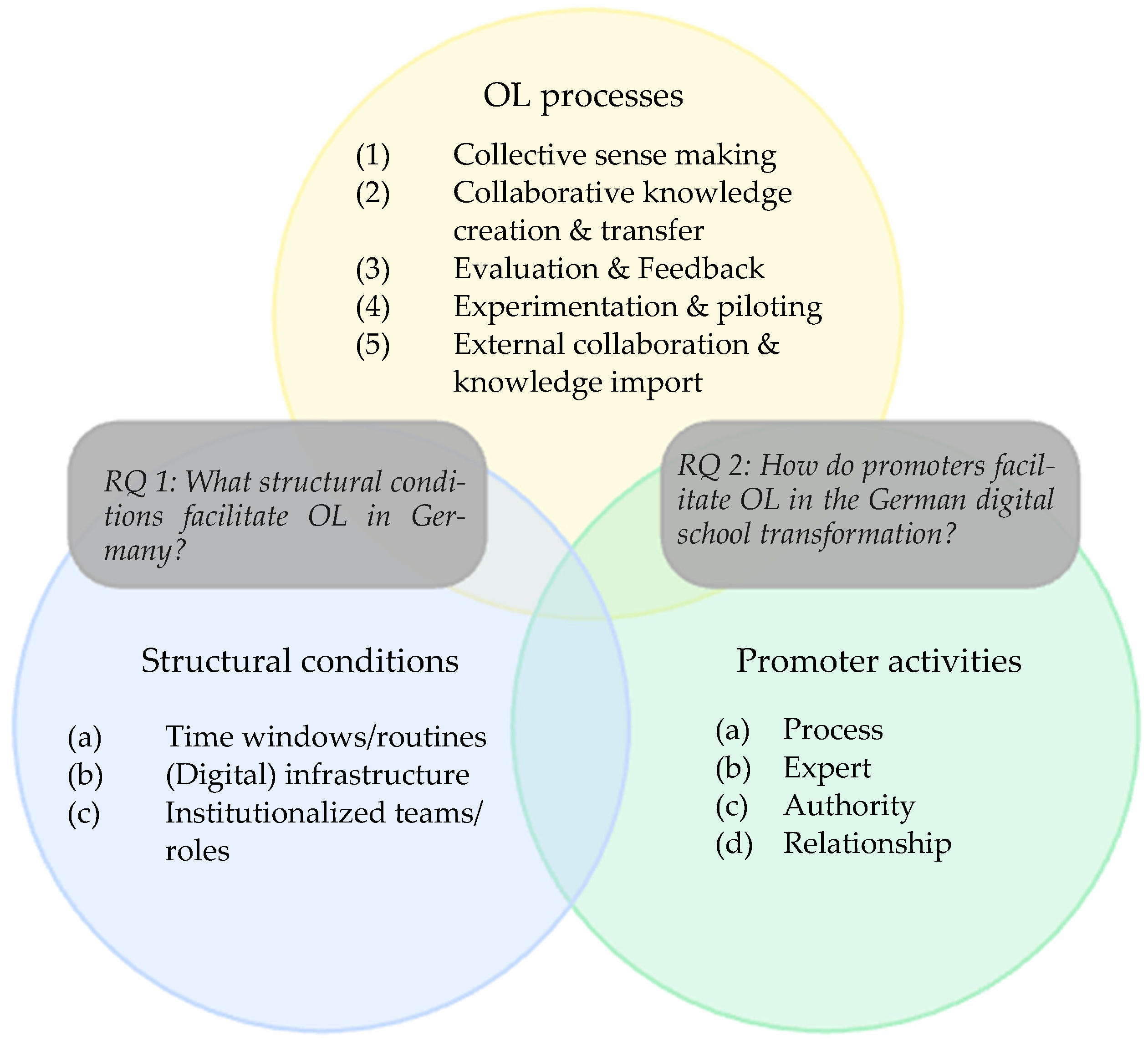
Our assumption is that habituated OL processes are associated with two conditions: Targeted activities by key actors (promoters) and structural conditions that provide temporal, organizational and human resources. The following theoretical framework (Figure 1) is the basis for our study:

1.3. Research Interest and Context of the Present Study

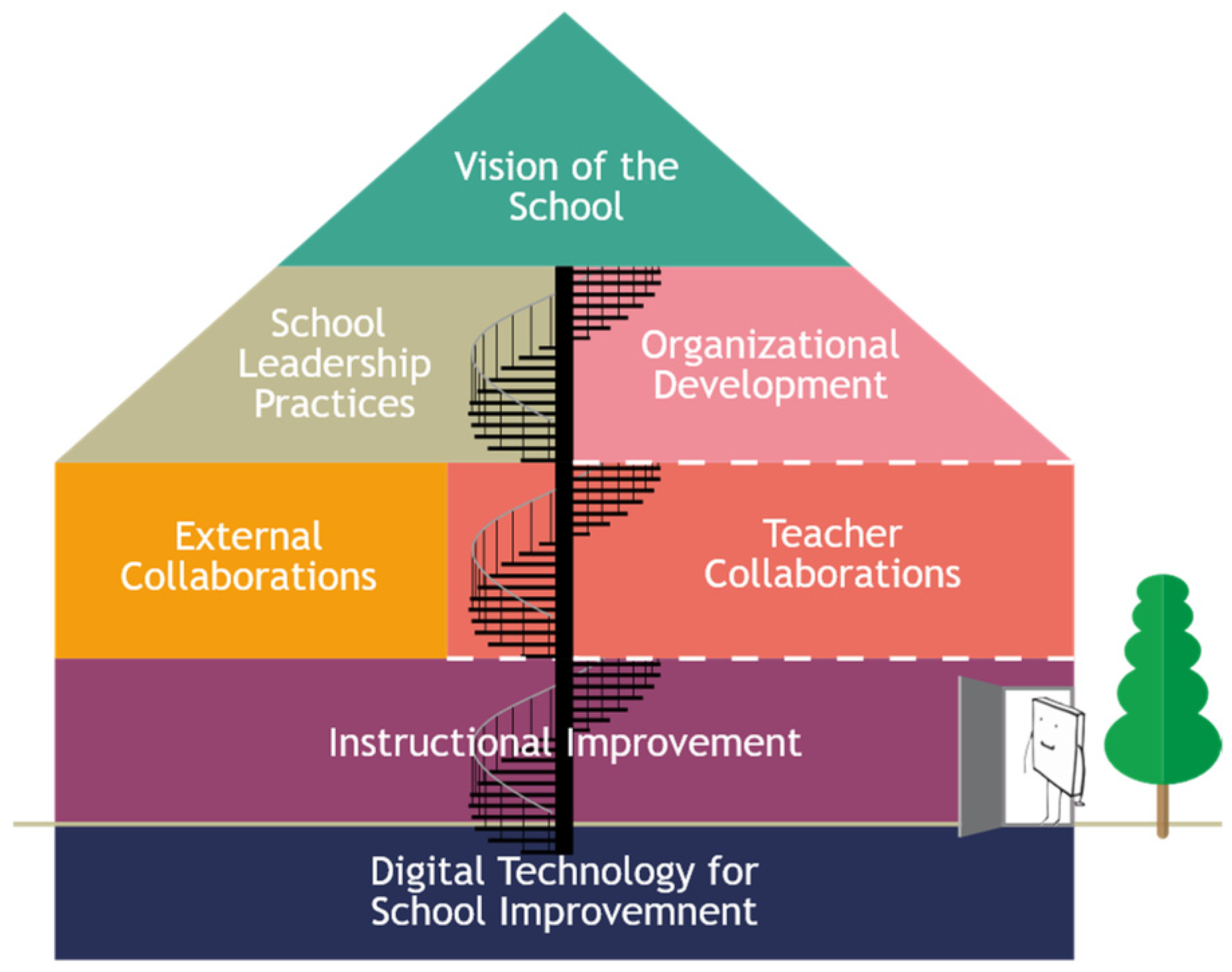
According to Eickelmann and Gerick’s [68] model, digital transformation of schools can be described as a multidimensional process comprising different dimensions: Professional development, organizational development, instructional development, technological development and collaboration. Ilomäki and Lakkala [2] present another model for categorizing digital school development: the Innovative Digital School (IDI) model. They distinguish six elements: Visions of the school, leadership, practices of the teaching community, pedagogical practices, school-level knowledge practices, digital resources. These two models provided the background for our integrated model, the “KoKon house model,” shown in Figure 2.
Various subcategories are represented as rooms in a house: school vision, school leadership practices, organizational development (including personnel development), external collaboration, teacher collaboration, instructional development and digital technology for school development. These rooms are connected by a staircase as a metaphor connecting all dimensions of digital school development by OL processes. This multidimensionality of requirements as shown by the different dimensions also calls for multidimensional processes, structures and activities in order for OL to take place.
The conceptualization of OL within schools remains unclear and difficult to define [25]. Therefore, there is limited knowledge of the structural conditions required for OL processes in the digital transformation of schools in Germany. The goal of the present study is to examine these structural conditions as well as the promoters’ facilitating activities in the context of OL processes. Structural conditions define the scope for action within which actors can operate. Accordingly, the present study first examines which structural conditions enable routine and habituated processes of digitalization-related OL. Our first research question is: What structural conditions facilitate OL in Germany?
As the title suggests, the study’s central interest lies in promoters’ activities within OL. Previous research has shown the essential role of promoters in digital school development [19,20,21,22]. However, while promoters are recognized as key drivers of digital school innovation, studies rarely examine how they facilitate OL processes in practice. Moreover, there is a paucity of research on how teachers can effectively act as change agents within the transformation of schools [12]. Therefore, our second research question is: How do promoters facilitate OL in the German digital school transformation?
In the present study, we address both research questions by examining OL processes, structural conditions and promoter activities within the context of digital school transformation in Germany. We primarily conduct qualitative analyses. This allows us to examine the quality of multidimensionality concerning the complexity of OL processes, structural conditions and promoter activities. However, quantitative co-occurrence analyses are also used to give an overview of central promoters, their institutionalized roles and OL-related promoter activities. The next section presents the materials and methods of the study.

2. Materials and Methods

Context of the Study: Our study is part of the “KoKon” project (Lehrkräftekooperation im Kontext digitaler Schulentwicklung: Teacher cooperation in the context of digital school development), funded by the European Union (NextGenerationEU) and supported by the German Federal Ministry of Education, Family, Seniors, Women and Youth (BMBFSFJ). The objective of the present subproject is to assist schools in their digitalization-related organizational development.
Sample: The sample includes 20 secondary schools in Germany: 15 High schools (Gymnasien) and five comprehensive schools (Gesamtschulen): 17 from North Rhine-Westphalia, two from Hamburg and one school from Bavaria. Eighteen schools are public, two schools are private high schools. The project was advertised to schools in North Rhine-Westphalia via district governments, education offices, and media centers; to the Department of Education and Sports in Munich; and to the State Institute for Teacher Training and School Development in Hamburg. High and comprehensive schools in these three states could register voluntarily. There were no other exclusion criteria. All high and comprehensive schools that wanted to participate in the project were accepted. The recruitment process for the interviews was as follows: Prior to the interviews, a quantitative online survey was conducted in all participating schools using LimeSurvey (Version 6.16.10+260223). Participation was voluntary for schools and teachers. Before starting the survey, teachers received a written information sheet describing the project’s objectives, the type of data collected, data protection policies, the voluntary nature of participation, and the right to withdraw without consequence. At the end of the survey, teachers could indicate their willingness to participate in an interview. This required confirming a data protection statement and (optionally) providing an email address. At many schools, no more than three teachers volunteered per group. In schools where more people volunteered, we included the principal and vice principal in the school leadership group. For the digitization group, we included key institutionalized roles such as digital coordinators, ICT administrators, and steering/working group members. For the group of teachers without digitization-related roles, we selected teachers of English, Biology and Mathematics. Professional training courses for these subjects were developed in other subprojects of the KoKon project. For our interview study, we conducted N = 60 online semi-structured group interviews with 148 teachers (76 male; 72 female) across three stakeholder groups to triangulate subject-matter, strategic and day-to-day practical perspectives (Table 1).
Instruments: The interviews took place between September 2024 and January 2025 and were conducted via Zoom as group interviews. The interviews ranged in duration from 25 min to 76 min (averaging 50 min). We utilized a largely identical interview guide for the three groups that was conceptually based on the KoKon house model (Figure 2). Questions were asked about each dimension in the house model (interview guide see Appendix B). For instance, in the domain of personnel development, which is one sub-category of organizational development, all groups were queried with the following question: “To what extent do teachers who have participated in training courses or who have a lot of knowledge in digitalization topics share their knowledge with other teachers?” However, the three respondent groups were also interviewed with slightly different questions. For example, teachers received more detailed questions about subject departmental work and no specific questions about external cooperation. Interviews were audio-recorded via Zoom. The recordings were transcribed verbatim in German using MAXQDA (version 24) Transcription. After transcription, the transcripts were pseudonymized. Two student research assistants quality-checked the transcripts against the audio recordings and corrected them. The transcripts were split between the assistants. The German transcripts were analyzed in German.
Mixed-methods analysis: The study is primarily qualitative in nature and includes a mixed-methods component. RQ 1 is addressed in part through a convergent mixed-methods design focusing on the co-occurrence of two main codes: Institutionalized teams/functional roles and OL processes [69,70]. The MAXQDA co-occurrence analysis was conducted in parallel with the qualitative content analysis and subsequently integrated. Although the results are reported in tabular form, the team/role × OL process-category matrix is conceptually equivalent to a bipartite (two-mode) adjacency matrix. This enables further research to examine the results through a network lens [71,72,73]. Institutionalized teams and roles are amenable to quantitative analysis because they can be operationalized as organizational actor categories involved in OL processes. The other structural conditions (time windows/routines and (digital) infrastructure) were examined exclusively qualitatively, as these dimensions are primarily suited to explaining why and under which conditions OL processes unfold. RQ 2 was analyzed using a convergent mixed-methods design, entailing the parallel quantitative evaluation of co-occurrences (promoter activities × OL processes) and qualitative content analysis. Integration of both analyses was achieved through meta-inferences as a combined conclusion drawn from quantitative patterns and qualitative interpretations. The integrated mixed-methods component offers a distinct advantage: It systematically highlights key institutionalized teams/roles and promoter activities in connection with OL processes. Key patterns may be overlooked when analyzing qualitative data alone, especially when dealing with 60 interviews and a substantial amount of information. The parallel qualitative analysis demonstrates the structural conditions and promoter activities in depth. Regarding the in-depth analysis, we interpret OL as episodes with signs of institutionalization and organizational memory that are observable beyond a single case or individual. These signs include time windows, routines, institutionalized teams and roles, (digital) infrastructure, artifacts (e.g., media concepts), stable communication channels, feedback loops and sustained changes in practices. OL occurs, when the five described OL processes are habituated and routine. We reserve the term ‘professional exchange’ for specific coordination efforts, such as case-specific problem solving or information sharing, without evidence of consolidation beyond the immediate episode.
Qualitative data analysis: For the qualitative structural content analysis we employed MAXQDA Analytics Pro (24.11.0) [74] guided by promoter theory and OL frameworks [7,19,20,25]. We adopted a deductive coding approach (Code manual see Appendix A):
(1)
OL processes: We coded five central OL processes grounded in established OL constructs [4,7,8,25,55]: Collective sense making, knowledge creation and transfer, evaluation and feedback, experimentation and piloting, external cooperation and knowledge import.
(2)
Structural conditions: For the school’s structural conditions we coded as main categories (a) time windows and routines, (b) the school’s (digital) infrastructure and (c) institutionalized teams and roles. When respondents talked about their own role, these statements were coded accordingly. Thus, the institutionalized team/role codes capture both self-descriptions of practice and descriptions of other actors.
(3)
Promoter activities: The promoter code always concerned the described promotion activity which could be traced back to the actions of an individual or an institutionalized group. For example, if the segment showed organization, steering or coordination, it was coded as process promotion. If formal authority or control over decisions and resources was exercised, the segment was coded as authority promotion. If segments could plausibly be assigned to two different codes, our primary strategy was to split such excerpts into separate segments whenever possible. If splitting was not feasible without losing coherence, we applied a dominance criterion and decided, by consensus, which aspect to emphasize more.
Code protocol: The unit of analysis was the meaning unit. During the coding process, we assigned codes to phrases and short stretches of text that conveyed a single, coherent meaning. Depending on where an idea began and ended, a segment could range from part of a sentence to several sentences. An analyzed segment could be related to one OL process and one promoter activity and/or structural conditions. While a segment may have only one OL process and one promoter activity, there could be more than one code for structural conditions. For instance, the following segment is coded with the process promotion activity of coordinating and facilitating digital school development by forming a working group: “The media concept was developed by asking our digital coordinator to form a small working group.” (5a 40). The code for structural conditions is the institutionalized role of the digital coordinator. However, in the next segment, the digital coordinator works “with this working group to develop a rough outline of […] which core competencies or which areas this concerns. […]” (5a 41). Here, we have two codes for two institutionalized roles (codes: digital coordinator and working group). The main activity is process promotion and the OL process knowledge creation and transfer (collaboratively creating a media concept).
The first three interviews from one school were coded jointly by two research assistants to ensure a common understanding of the categories and to refine the category definitions [75]. A found source of disagreement between the two coding persons concerned the distinction between “principal” (the single, formal head of school) and the “school leadership team” (extended leadership). This was resolved by introducing clearer decision rules. Another main ambiguity rule concerned the two OL-processes of collective sense making and knowledge creation and transfer: If there was no school-wide artefact and teachers jointly interpreted information in order to steer school development, curricula or teaching, the code chosen was collective sense making. If knowledge was being created collaboratively or prepared in a way intended for school-wide use and there was an artefact or training session, collaborative knowledge creation and transfer was coded. Those cases were aligned through joint discussion and the addition of clearer decision rules or short definitional notes. To determine the reliability of the evaluation, the intercoder reliability (random- corrected coefficient Kappa) was calculated for 15% of the material at the segment level in MAXQDA. This is in accordance with O’Conner and Joffe’s specification to multiply code 10–25% of the data [76], p. 5. According to Landis and Koch our Kappa of 0.7 was in a good range [77]. However, as the first version was not inclusive of institutionalized roles, these were incorporated subsequently. Accordingly, the two research assistants undertook the same interviews once more in order to ensure a more profound shared comprehension including the institutionalized roles. After the second coding process, the calculated Kappa was 0.73.
Quantitative data analysis: Our structured, literature-based data coding directly crosses promoter activities with OL processes to let us not only qualitatively, but also quantitatively analyze which promoter activities often catalyze which learning processes. To examine how OL processes relate to promoters in schools, we first identified all text segments in MAXQDA in which an OL process code overlapped with (a) an institutionalized team/role code and/or (b) a promoter activity code. For example, a segment coded as “experimentation & piloting” in which the principal (institutionalized role) applied an authority promoter activity (promoter activity) contributed to the co-occurrence categories “experimentation & piloting × principal” and “experimentation & piloting × authority promoter activity”. Only overlapping segments were included in the quantitative analyses. The segment-level data were aggregated into two tables:
  • OL process × institutionalized team/role (5 × 16; N = 959 co-occurrences).
  • OL process × promoter activity (5 × 4; N = 919 co-occurrences).
As previously described, segments could be co-coded with more than one institutionalized team/role code. In contrast, each co-occurrence segment in the OL process × promoter activity dimension contained exactly one OL process code (P1–P5) and exactly one promoter activity code (four promoter activities). Since co-occurrence values depend on the segmentation strategies and coding conventions, we report column-normalized percentages to make comparisons across processes easier. However, it is important to note that these co-occurrences should be interpreted as relative indicators of co-presence in the coded text rather than as causal relationships or absolute prevalence of roles or processes. Causal interpretations are addressed through the qualitative analysis. In the next chapter, both research questions will be answered sequentially, both quantitatively and qualitatively.

3. Results

3.1. What Structural Conditions Facilitate OL in Germany? (RQ 1)

3.1.1. Quantitative Results (RQ 1)

Schools employ various institutionalized teams/roles to manage digital school development. When examining the co-occurrences of institutionalized teams/roles × OL processes, institutionalized teams are most often named together with OL activities. Among individual roles, digital coordinators appear most frequently in one segment with an OL process, followed by principals and teachers acting as ICT administrators (see Table 2).
While this table shows a summary of the three interview groups (a–c), taking a look at the individual interview groups’ results, a similar picture of key promoters with slight differences emerges. For instance, in interview group c, the most often named group in co-occurrence with OL processes are subject departments, followed by the working group. The most often named individual actors are ICT admins, followed by the principal and digital coordinator.

3.1.2. Qualitative Results (RQ 1)

Based on the assumption that OL processes are supported by structural conditions, co-occurrences between (A) time windows/routines, (B) (digital) infrastructure and (C) institutionalized teams/roles and the five OL processes (P1–P5) were analyzed qualitatively. The findings for each learning process are summarized below.
  • Collective sense making
(A) Regular meetings and conferences provide institutionalized spaces for professional exchange. Digital working/steering groups meet frequently (from weekly to twice per semester). However, since the initial equipment phase has ended, some meetings are now held on an ad hoc basis. Pedagogical days (1–2 times a year) involve the teaching staff in discussions. Subject department and grade-level team meetings enable collective sense making on subject-specific topics. However, all the interviews reveal a systematic time constraint. Digitalization is often ‘one among many’ topics in conferences and exchanges are rather superficial. Pedagogical days dedicated to digital topics are rare. Asynchronous timetables make continuous collaboration difficult. Few schools report having formally established weekly times for team development or peer observation involving the whole staff. (B) Learn management systems (LMSs) and digital tools like task cards facilitate collective sense making in both synchronous and asynchronous settings: “It is really the case that these tools often bring us together and sometimes lead to interdisciplinary thinking and working” (B3b 158). This makes it easier to coordinate meetings, hold video calls and conduct quick consultations. At the same time, informal on-site professional exchange ‘between doors’ remains important for teachers. (C) Most schools have a digital working group (sometimes as a part of the steering group) that initiates discussions, prepares options and moderates conferences: “We have a group that is responsible […] On average, there are about 6 to 7 or 8 colleagues involved, some of whom are there of their role.” (7a 77). Important institutionalized roles like digital coordinators and ICT admins act as central points of contact and connect pedagogy, technology and organizational processes supporting collective sense making. In the case of subject-specific matters, issues are referred to subject departments.
2.
Knowledge creation and transfer
(A) Across all schools, the whole teaching staff can be involved in knowledge creation and transfer by short, informal micro-training sessions. These micro-training sessions have been established as voluntary, low-threshold formats that are integrated into the school day such as ‘lunch and learn’, at the end of conferences or ‘less 30 sessions’ after lessons. Mandatory formats for the entire teaching staff are often held on pedagogical days or conferences. However, systematic professional development plans are lacking in many schools, often micro-training sessions remain sporadic and attendance fluctuates: “Although we don’t currently have a specific professional development plan for digital media, we have created the necessary space and structures to be able to respond to current issues” (16a 119). Interviewees expressed concerns regarding the absence of a systematic, long-term professional development plan. Knowledge transfer also takes place through conceptual work such as when teachers collaborate on media concepts or methods curricula. This process is often prepared in digital working/steering groups and fed back into pedagogical days and subject departments. (B) In addition, LMSs and clouds serve as a central storage and distribution infrastructure. Here, meeting protocols, material pools for teaching and shared documents are uploaded: “The media concept we just had was a shared document. Everyone could work on it” (15a 155). However, in some schools it is explicitly pointed out that the media concept is hardly known among the teaching staff. Moreover, it becomes apparent, that knowledge transfer also depends on teachers’ willingness to share. In addition, many schools use digital training platforms with integrated on-demand courses. This enables individual professional development. (C) Members of the digital working group and teachers with institutionalized roles create online instructions, explanatory videos, FAQs, handouts for recurring problems and in some cases offer office hours for first-level support. They also offer micro-session trainings: “Thanks to our digital working group, we have a fairly strong multiplier effect at the school. Many opportunities are offered […] for further training” (18c 23). Subject department groups translate the media concept into subject-specific instructional improvement, curricula and methodology concepts.
3.
Evaluation and feedback
(A) Almost all schools lack structured evaluation routines. Evaluation is predominantly event-driven and often informal professional exchange. Feedback is obtained in teacher and subject department conferences, pedagogical days or school conferences. (B) At a few schools, digital tools are used for queries or evaluations but without an evaluation routine in place. Sometimes there are surveys for the teaching staff, for instance to determine professional development needs or for parents to vote on smartphone rules. (C) When there is evaluation, it is often implicitly the responsibility of the digital coordinator/working group. Only one school has an institutionalized role called ‘evaluation coordinator’.
4.
Experimentation and piloting
(A) Micro-training and barcamp sessions create opportunities to try and test new methods and share best practices. Beyond that, institutionalized experimentation time is rare. Only one school has fixed school development times during which tools are tested in practice. At two schools, regular digital distance learning days are used as an experiment to operationalize digital skills. (B) Only at a few schools there are formal innovation spaces such as ‘makerspaces’. Often, experimentation with digital infrastructure seems to take place in one’s own classroom: “There are […] innovative teaching concepts that are also taught with the support of media and they are being developed privately” (11a 44). (C) The digital working group serves as a pilot group for getting to know new systems, preparing rollouts or teaching in an iPad pilot grade. Some teachers with institutionalized roles experiment with new apps and programs.
5.
External cooperation and knowledge import
(A) The most regular routines are network meetings of digital coordinators. Other external collaborations such as conferences and barcamps with other schools and external input on professional development days often appear sporadic and project-based. (B) Platforms can facilitate sharing across schools such as the exchange of materials, but this remains rather rare. (C) Digital coordinators and educational media advisors function as brokers, integrating external concepts and providing counsel to school leadership. ICT admins often collaborate with the local school authorities for second-level support but these contacts are more focused on providing support than OL.

3.2. How Do Promoters Facilitate OL in the German Digital School Transformation? (RQ2)

3.2.1. Quantitative Results (RQ 2)

To answer RQ 2, we examined co-occurrences between promoter activities and OL processes to identify the most frequently occurring combinations (Table 3). The code of collective sense making most often occurs together with process promotion (53.3%) and expert promotion (35.7%); the code of knowledge creation and transfer with expert promotion (55.8%) and process promotion (40.4%); the code of evaluation and feedback with process promotion (88.1%); the code of experimentation and piloting with expert promotion (48.2%) and authority promotion (35.7%); the code of external cooperation and knowledge import with relationship promotion (94.3%).

3.2.2. Qualitative Results (RQ 2)

As indicated by the quantitative co-occurrences, specific promoter activities might also facilitate specific OL processes. In order to generalize the results, only promoter activities with high double-digit co-occurrence rates (in %) are qualitatively reported below.
  • Collective Sense Making
The quantification shows that collective sense making processes have most co-occurrences with process promotion (53.3%) and expert promotion (35.7%). Process promoters such as digital coordinators moderate workflows in formal institutionalized teams and coordinate school-internal development processes by discussing strategic issues in these groups: “[…] we were forced to rethink a few processes […] and first looked at where we stood, what we had, where we wanted to go.” (19b 72). Discussions are held on the school’s vision for digital learning and goals are derived. They steer organizational processes such as the effective introduction of the digital class register. Subject department groups also act as process promoters, facilitating information exchange on digital methods, materials and experiences to enable joint decision-making. This includes reflecting issues relating to the use of digital textbooks, subject-specific apps and testing in the age of AI. Technological and pedagogical expert promoters also often discuss issues and generate creative ideas collaboratively in digital working groups: “[…] Some of the topics are technical issues. […] Of course, it’s also about general educational issues, such as how we use the devices.” (7b 5). These collective sense making exchanges in institutionalized groups are complemented by a considerable number of informal professional exchanges among teachers: It has become a routine in all schools that staff members primarily tend to turn to expert promoters with top-down institutionalized roles as the digital coordinator states: “Basically the conversation develops in such a way that it ultimately leads to the other person saying, um, maybe I should try that too. You’ve given me an idea, or maybe I’ll give it a try.” (17b 188). Additionally, albeit to a lesser degree, teacher turn to bottom-up expert promoters like digitally skilled teachers or colleagues of the same subject. All in all, there is a recurring pattern: At all schools these informal “doorstep” conversations and professional exchanges are habitually used to clarify technical problems with devices, share experiences and reflect ideas for digitally supported lessons: “[…] the informal exchanges between colleagues should not be underestimated. Often, you have conversations like, ‘Oh, look, I’ve used this and that here and there, look, it’s great, take a look at it’ and these are maybe five-minute conversations, but they definitely help you take a step forward. […] which is sometimes also a form of micro-training” (5a 119).
2.
Knowledge Creation and Transfer
The co-occurrences show that knowledge creation and transfer processes have most co-occurrences with expert promotion (55.8%) and process promotion (40.4%). Expert promoters like digital coordinators and ICT admins act as multipliers by transferring digitalization-related knowledge to colleagues. They manage hardware and software as first-level support, solve problems such as configuring iPads, and create and share explanatory videos or PDF instructions for their colleagues. Moreover, they offer in-school trainings by conducting workshops, providing consultations to improve digital skills and promoting the effective use of technology in the classroom: “[The digital coordinator] offers some kind of training […] there’s also a barcamp session […], where some colleagues who are interested or who have an affinity for it get together and then try things out together and gather information and then actually share it with the entire teaching staff.” (16c 37). Many colleagues benefit from these micro-session trainings: “[The] micro-training session actually gives you a kind of self-confidence […] that allows you to try out certain things. […] I think this micro-training is really beneficial, because […] it’s with colleagues you know. And then you’re more likely to ask questions.” (15a 186). There are also different process promotors that are important for knowledge creation and transfer: Institutionalized working/steering groups coordinate internal networking and digital school transformation by developing ideas (creating knowledge), which are written down in a media or methodology concept (transfer). With these concepts they want to keep teachers aligned and shape daily routines: “I believe this media concept […] is important for us as a planning tool because it contains, for example, the goals we set ourselves in the individual areas of development for a school year. […]” (11b 101). As process promoters, subject department groups are responsible for integrating digital methods into subject curricula, coordinating digital school development for their subject and create teaching materials to implement these concepts: “[…] there is the media curriculum, which is of course compulsory, where it is clear that […] I have to do the media project travel podcasts or something like that, which is highly binding” (H5a 63).
3.
Evaluation and Feedback
The co-occurrences show that evaluation and feedback processes have almost all co-occurrences with process promotion (88.1%). Process promoters serve as usual contacts for addressing problems and issues, coordinate feedback to identify professional development needs and refine media concepts, policies and projects. At teacher conferences, process promoters ask about the needs of different subject groups: “[…] we [digital coordinator] just initiated a partial evaluation on the use of tablets as a replacement for notebooks at the last conference” (19b 125). When organizational pilot phases are evaluated, process promoters are involved, for instance when testing new technologies such as replacing notebooks with tablets or introducing apps: “I would also mention the evaluation of the digital class register, where we [working group] have now started further development work” (20b 127).
4.
Experimentation and Piloting
Experimentation and piloting are mainly driven by expert promoters (48.2%), followed by authority promoters (35.7%). As expert promoters with digital expertise, ICT admins and working groups are often the first to try out new digital practices. They provide technical and conceptual support for organizational pilot projects and model classes, for example by advising on suitable tools and preparing materials. They are habitually involved in testing ideas and assessing the didactic and technical feasibility, for instance when an ‘iPad model year’ is introduced. As expert promoters, some ICT admins even develop their own applications or specialized solutions which are integrated in the school’s organization, such as a self-programmed AI app and thus act as informal internal ‘innovation labs’. Many teachers act as informal bottom-up expert promoters experimenting in their own classrooms with apps and digital media, trying out new tools and formats with their classes: “[Teachers are free] to try something out and then, so to speak, turn to us, the specialist group, the digital group, and say, ‘I tried this out and had a good experience with it. Would that be something?’ So that happens, and also this Lunch and Learn format, which is led by [the digital coordinator], […] these are colleagues who have tried things out on their own, out of their own interest, and they bring that experience and expertise to the table.” (H5a 64). Authority promoters like principals, vice principals or leadership teams provide teachers with resources to help them try out digital tools and integrate them into their teaching practices. As role models for their staff, school principals and vice principals also initiate school-wide innovations themselves.
5.
External Cooperation and Knowledge Import
External cooperation and knowledge import processes are mainly driven by relationship promoters (94.3%). Relationship promoters collaborate with external partners such as local school authorities, companies, other schools, the Landesinstitut (state-level institute) and networks to enable digital transformation and stay up to date with new developments. At most schools, digital coordinators represent the school in regional networks for digital coordinators: “Once a quarter, we have a kind of exchange, like a self-help group. We are supposed to work on things there. But it’s more like, ‘What problems do you have?’ We help each other out a bit and get a few tips.” (18b 153). In these settings, they exchange experiences with other schools and bring this input back into the school, for example in the form of micro-training sessions or impulses in conferences. However, there aren’t many relationship promotion activities who facilitate collaborations with regard to systematic OL processes. As relationship promoters, also many school principals maintain networks and partnerships. Through these activities, they gain a broader perspective on digital training initiatives and school development projects, select suitable impulses and programs and introduce them into their schools. Relationship promoters also scan the environment: For instance, they introduce new concepts provided by the district government, compare their media concepts with those of other schools und introduce models like 21st century competencies (e.g., problem solving, creative thinking, self-regulation and collaboration [78].) and the SAMR model (A framework developed by Ruben Puentedura [79] that describes four stages of how digital technologies can change teaching: Substitution, Augmentation, Modification, Redefinition).

3.3. Summary: Promoters of OL Processes

At each school we could identify promoters facilitating OL processes in the digital transformation. Most promoters named in all three interview groups have institutionalized roles due to a mixture of top-down and bottom-up processes. Some promoters were assigned to their roles through top-down decisions, for instance job postings and political factors. However, there are also bottom-up contextual factors leading to such roles: Teachers are assigned with these tasks due to their digital expertise, interests or motivation for school development. Most promoters with institutionalized roles fulfill multiple promoter activities with little to no release time (0–4 h per week). In all schools, the digital coordinators are those individuals who combine all four promoter activities. Although they are mentioned less frequently, there are also informal promoters without an institutionalized role who show a willingness to experiment and are highly motivated to share their expertise and experiences.

4. Discussion

This study aimed to empirically investigate how promoters facilitate digitization-related OL processes and which school structures support their work. We could detect central OL processes within the digital transformation of schools, particularly the processes of collective sense making and collaborative knowledge creation and transfer. The examined schools show recurring structural conditions like institutionalized teams and individual roles, micro-session trainings and a digital infrastructure. However, most schools lack systematic and formal structural conditions such as habituated time windows and routines involving the whole teaching staff. Central formal OL processes such as collective sense making and collaborative knowledge creation and transfer take place when regular time windows and structured committees come together. Without this structural combination, learning remains sporadic and dependent on individuals. This becomes apparent when taking a look at the other three less institutionalized OL processes, especially evaluation and external cooperation. These OL processes are only selectively anchored in binding structures and reliable structural conditions at the school level. Nevertheless, our results show that habitual informal OL processes and professional exchange play a significant role in creating, analyzing and transferring knowledge in the digital transformation of schools. Despite structural obstacles, regular formal and informal OL processes are often initiated and facilitated by promoters, wherefore the present study adds to existing literature and research. We were able to describe and differentiate the institutionalized roles and activities of promoters as change agents in the context of digitization-related OL processes in Germany which have been underexplored. While we showed that each OL process is mainly driven by a specific promoter activity, we also found that the multidimensionality of digital transformation currently requires central actors with institutionalized roles to combine all four promotional activities and to address all five OL processes. Although prior scholars have examined only individuals as promoters, we also focused on institutionalized promoter teams showing that such groups function as the main OL infrastructures by scaffolding collaborative learning processes and helping to transform products into school-wide artifacts. Therefore, the present findings also highlight the critical role of institutionalized teams in enabling habitual collaboration. The following section discusses possible explanations for these results and outlines the theoretical background.
Scholars claim that schools need structural conditions that offer repeatable and routine opportunities for collaborative knowledge acquisition, application, scaling, storage in the organizational memory and retrieval [8,9,50,56,57,60]. Our study shows that the participating secondary schools often lack these structures. These findings align with research on OL in secondary schools [9,53,80]. They point to typical structures of secondary schools that hinder frequent communication and collaboration, such as asynchronous timetables. Barnard [80] concludes that secondary schools need more structures for interconnectivity and interdependencies between teachers, networks and the entire organization. Our research indicates that promoters can bridge this gap. This is why we suggest to discuss whether theories of OL should focus more on promoters.
Firstly, promoters facilitate OL processes because they are an integral part of the school’s structural conditions: Most promoters have institutionalized top-down roles and collaborate in institutionalized groups. According to Brown [12], top-down change agents (i.e., actors with institutionalized roles) are typically entrusted with the responsibility of continuous and strategic change in order to distribute and specialize leadership. A major contribution of the present study is to demonstrate that actors with institutionalized roles and institutionalized teams indeed emerge as pivotal promoters for OL. These formal roles function as central repositories for organizational information [60]. Due to their roles, institutionalized promoters gather and disseminate knowledge. They facilitate communication between groups such as the leadership team and the whole school staff. For instance, the digital coordinator acts as a bridge between specialized knowledge and individuals. Therefore, our qualitative results also align with prior quantitative network analyses showing that key promoters function as key brokers for digital information flow [15,22]. Due to their institutionalized roles they also have a certain degree of authority, wherefore our findings can contribute to distributed leadership and professional learning community designs [39,81]. Moreover, our study suggests that the promoter model can be expanded: Witte [67] notes that collaboration among promoters enhances the opportunities of transformation processes. Our findings confirm this assumption, adding that institutionalized groups offer a social collaboration space for promoters and therefore further amplify the effect.
Secondly, promoters facilitate OL processes despite the lack of structural conditions. As the promoter theory states, promoters commit themselves personally and energetically to innovative change [19,21,66]. Moreover, our study also aligns with key findings of studies on change agents. Change agents often come to their tasks because they are motivated [82,83], (digitally) talented [84,85] and show collegial solidarity [86]. Brown refers to actors being driven by the needs and priorities of the teaching staff as bottom-up change agents. These change agents encourage others because they are “effective collaborators with strong collegial standing” [12], p. 8. Similarly, our results indicate that promoters do not only have institutionalized roles, but they are also motivated and are trusted and respected by their colleagues while doing their work with little or no release time. We can also extend the promoter theory to include aspects of OL: Seashore Louis and Lee’s [7] study revealed that shared responsibility, reflective dialogue, deprivatized practice, trust and respect are significantly associated with teachers’ capacity for OL. Our findings show that promoters take “responsibility for improving the schools outside their own classroom” [7], p. 542. Furthermore, “conversations with colleagues” concerning which digital environments help students learn best, “the development of [a] new [media] curriculum […] [and] goals”, and the exchange of “suggestions for […] materials” [7], p. 542 mainly takes place in institutionalized promoter groups. While most schools don’t offer systematized peer observation hours to structurally facilitate deprivatized practice, promoters indirectly open their classrooms by giving micro-training sessions on how they use digital tools and sharing best practice materials. Promoters “lend a hand” if other staff members need it by helping and supporting others. As Schechter [24] depicted, “ongoing learning forums promote professional interactions, which in turn enhance a sense of loyalty to the organization” [24], p. 175. Our study indicates that promoters could influence a learning culture in a similar reciprocal way by encouraging other teachers to learn. Therefore, regular informal professional exchanges with promoters could also promote a rise in OL processes. Karnopp’s [27] empirical study explored some possible reasons: Repeated professional exchanges between the same individuals or in the same settings lead to habituated learning. Possible explanations for these habitual informal learning processes are discussed in studies on knowledge seeking [30] and transactive memory [31]. As Miller et al. [33] argue organizational routines emerge when individuals know who holds what expertise and how to access it. Consequently, it is plausible to conclude that OL evolves through everyday professional exchanges with knowledge brokers such as promoters. Our findings suggest that promoters connect the school’s culture to its capacity to learn by “find[ing], analyz[ing], adapt[ing] and incorporate[ing] new ideas from both inside and outside” [7], p. 535.
Thirdly, our analysis indicates that more precise definitions of promoter activities are required in the context of digitization-related OL. Expert promoters’ primary OL activity is to create and disseminate knowledge. This result distinguishes the present study from prior research on change agents. According to Brown’s systematic review, only a few studies characterized change agents as using their expertise to support the ongoing improvement of colleagues [12]. However, a recurring structural condition observed in the sample is the micro-session training, which has been implemented by promoters of all participating schools. The provision of micro-training sessions has facilitated the transfer of knowledge to the entire school staff, which is particularly important as, according to promoter theory, innovations are often prevented by barriers of will or ability [67]. Moreover, our study examines that expert promoters also facilitate experimentation and piloting. They create a learning climate and strengthen the level of involvement among teachers. Process promoters mainly initiate collective sense making by coordinating internal networks and digital strategies. Our results indicate that a regular, habitual process of collective sense making is crucial. For instance, each school has LMSs which enable the storage and dissemination of knowledge. However, this is only effective when the information circulates within the school [24]. Here, the process promotion activity of keeping teachers aligned and facilitating information flow becomes evident. Similar to previous studies on promoters [21,22], our findings demonstrate that expert and promoter activities drive most OL processes. One plausible explanation is that process promoters coordinate digital school development and “intentional orientation is one of the corner stones for innovations” [2], p. 8. Expert promoters create knowledge which helps “teachers […] because they give ‘standard’ models and ways of working” [2], p. 8. However, our study also shows that there appears to be a deficiency in schools’ capacities for the other learning processes: Although the participating schools engage in external collaborations, there is a paucity of habitual learning processes. This result is consistent with the results of previous studies on OL-related external collaborations of German schools. Feldhoff [8] claims that these results suggest that a significant proportion of schools are more likely to adopt an internal perspective and perceive their environment passively. With regard to promoter activities, this finding suggests that a more precise definition of the role-related activities of relationship promoters is required in order to facilitate learning processes. This promoter activity was seen as the least important role for digital transformation according to the results of previous studies [21,22]. However, external collaborations are crucial for OL [24]. Moreover, our qualitative interviews disclose that relationship promoter activities play indeed an important role in digital transformation. For example, relationship promoters who address the second-level support provided by local school authorities or companies play a pivotal role in establishing the technological foundation for digital transformation and providing the basis for OL processes. Therefore, a more precise definition of relationship promoter activities facilitating OL could include more habitual learning processes from external ideas and networks. Furthermore, in our study authority promoter activities are mentioned least with OL processes. Nevertheless, our analyses point out that they provide the basis for OL processes to take place within the school by securing resources and enforcing goals. For instance, although the OL process of experimentation and piloting is seldom identified as OL in the interviews, authority promoter activities are the second most important activity facilitating this process. Therefore, it may be necessary for authority promoters to focus even more on providing resources for experimentation and piloting. As Barnard [80] suggests, secondary schools need more “balance between control/bureaucracy structure and actor agency” [80], p. 1260.

Limitations and Implications for Future Research

The quantification of qualitative data should be commented on: The co-occurrence analysis in MAXQDA indicates proximity in text, not any mechanisms or directions of influence. A single long segment may be co-coded with one promoter role or OL process, whereas multiple shorter segments can each receive such co-coding, thereby producing a higher number of co-occurrences. As the interviews only capture a snapshot, we cannot establish temporal ordering or causal effects, but innovative changes facilitated by learning processes often unfold over longer periods of time. Moreover, a more detailed interpretation and comparative analysis of the interviews with the three school groups (school leadership team, digital working group, teachers) is required. Future research should also examine differences in individual schools’ OL capacities as well as mediating factors for OL (e.g., shared vision) in greater detail. Seventeen out of 20 participating schools were from one region in Germany (NRW) and we came to the conclusion that many processes (e.g., implementation of media concepts) were prescribed by policymakers and implemented in a similar manner in the participating schools. Participation in such a project might also skew towards more digitally active schools. Future studies should also examine the roles of other members of the school community more closely: As shown in our research, there are motivated teachers who have the potential to become more active promoters. Moreover, students and parents were also named as expert promoters in the interviews which requires more extensive research. Another central question is, whether more active promoters also promote an increased teachers’ sense of collective efficacy, which is significantly positively related to the extent of OL mechanisms according to Schechter [24].

5. Conclusions

Digital transformation is a major challenge for the whole teaching community, and our findings reveal that there is still much room for improvement if schools are to become learning organizations in the digital transformation. There need to be more time windows anchored in the timetable for the teaching staff to cooperate, experiment and engage in OL processes [39,40]. Otherwise, OL processes remain fragmented [4,39]. Moreover, LMSs enable the storage, reuse and dissemination of knowledge, but they are only effective if there are clear sharing standards and maintenance. Our findings confirm that formal structural conditions are indispensable for OL. This highlights the importance of authority promoters, such as leadership teams. They could institutionalize roles and groups through dedicated structures and resources, and at the same time build teachers’ capacity to enact roles that continually refine and manage those structures [66]: “Understanding which teachers are best able to encourage the take up of new ways of working is […] vital to ensuring that school leaders are able to continuously improve the education provided” [12], p. 3. While expert and process promoters are currently the most active drivers of OL, a new and precise definition of relationship and authority promotion activities could enhance less developed OL processes like systematic external cooperation or evaluation. Clear role descriptions allow various promoters to specialize in certain OL activities, reducing the workload associated with multidimensional school development. For example, OL requires well-developed evaluation routines with specific time windows and responsibilities. Each school could appoint a process promoter to act as an evaluation coordinator.
This study has allowed us to better understand the role of promoters in organizational learning within the digital transformation of schools. By recognizing promoters as strategic catalysts and providing them with clear roles, resources and time, schools can transform learning processes into systematic, sustainable organizational learning.

Author Contributions

Conceptualization, N.C.v.G. and A.S.; methodology, N.C.v.G., A.S., K.F. and C.G.; software, N.C.v.G. and A.S.; validation, N.C.v.G. and A.S.; formal analysis, N.C.v.G., A.S., K.F. and C.G.; investigation, N.C.v.G. and A.S.; writing—original draft preparation, N.C.v.G. (sole first author); writing—review and editing, A.S., K.F. and C.G.; project administration, K.F. and C.G.; funding acquisition, K.F. and C.G. All authors have read and agreed to the published version of the manuscript.

Funding

This research was funded by the European Union—NextGenerationEU and supported by the Federal Ministry of Education, Family, Seniors, Women, and Youth (BMBFSFJ). The views and opinions expressed are solely those of the author and do not necessarily reflect the views of the European Union, the European Commission, or the Federal Ministry of Education, Family, Seniors, Women, and Youth. Neither the European Union, the European Commission, nor the Federal Ministry of Education, Family, Seniors, Women, and Youth can be held responsible for them. Research Unit KOKON [Grant number 01JA23E02A]. Grant number for the subproject of the Bergische University of Wuppertal: 01JA23E02B.

Institutional Review Board Statement

The study was conducted in accordance with the Declaration of Helsinki and approved by the Ethics Committee of Bergische University of Wuppertal (SK/ats 260127, 12/02/2026).

Informed Consent Statement

Informed consent was obtained from all subjects involved in the study.

Data Availability Statement

The raw data supporting the conclusions of this article will be made available by the authors on request.

Acknowledgments

During the preparation of this manuscript, the author used deepL (team version of year 2026) Translator, for the purposes of improving the quality of the language. The authors have reviewed and edited the output and take full responsibility for the content of this publication.

Conflicts of Interest

The authors declare no conflicts of interest.

Abbreviations

The following abbreviations are used in this manuscript:
OLOrganizational learning

Appendix A

Table A1. Interview coding guide.
CodeDefinitionAnchor Example
Authority promoterTeachers/Groups with formal decision-making authority who set and enforce goals, secure resources and serve as leadership role models, specifically in the context of school digitalization. “[…] we then sought reassurance from our boss. At some point, he banged on the table and said, ‘Right, dear city, if you can’t do it, then we’ll do it ourselves.’” (8b, 17)
Expert promoterTeachers/Groups with specialized digital expertise (pedagogical/subject-specific/technical) who develop and share materials, deliver training, and act as multipliers by transferring digitalization-related knowledge to colleagues. They generate creative ideas and assess the didactic/technical feasibility.“We have several […] experts working on this, including a digital coordinator […]. We have one person who takes care of iPads, etc., and another who takes care of Logineo, Teams, and internal school networks. Those are our three experts.” (1a, 14)
Process promoterTeachers/Groups who coordinate and facilitate school-internal processes related to digitalization (e.g., moderating workflows, steering feedback loops and evaluations, keeping actors aligned, building internal networks, facilitating information exchange); Often a steering committee, working group, subject department or digitalization lead. The focus is on process governance.“So, the media concept was largely designed by 6Ar, together with me and then the steering group, ultimately. So […] we […] considered, “What does our current concept offer? What do we need? What is current, what is not current? What has changed over the years? What do we need and where do we want to go?” […]” (6a, 26)
Relationship promoterTeachers/Groups who collaborate with external partners or institutions beyond the school to advance digitalization: Bringing external ideas, concepts, or expertise into the school, networking activities or support structures with external stakeholders. “I also have my [external] network at the school leadership level, where we exchange ideas. […] Of course, this is also similar to a partner that we bring on board with expertise from outside the organization.” (17a, 144)
OL process 1:
Collective sense-making
Teachers jointly interpret, discuss and reflect on information to discuss school goals, curricula, teaching and digitalization efforts. This includes deprivatized practice (e.g., peer observation). There is no school-wide artefact. “[…] we look at this from time to time as part of our curriculum work, and […] regularly consider: […] to what extent are the things that are actually anchored in the curriculum being implemented or played out in class […].” (15c, 151)
OL process 2:
Knowledge creation and transfer
Teachers collaboratively create or curate knowledge and materials with the explicit aim of transferring and using them across the school (e.g., guides, curriculum modules, micro-training sessions, onboarding material and roll-out resources). The school disseminates, stores and retrieves this knowledge, and puts it to use via artefacts and micro-trainings, so that colleagues can access and apply it. There is a school-wide artefact.“[…] the micro-training sessions. […] So colleagues have an idea or have tried something out, have done something, and say, “I’d like to share this with the staff, and next Tuesday or Wednesday or whatever, there will be a half-hour training session during the lunch break on how I tried out lesson plan XYZ or some new tool that I’d just like to demonstrate,” […]” (6a, 104)
OL process 3:
Evaluation and feedback
Any feedback or evidence (formal or informal) that is shared or considered by the school community with an orientation toward improvement: Feedback/data/monitoring results are gathered or shared (e.g., survey results, peer/student/parent feedback, informal check-ins).“We conducted a survey. At the beginning of the school year, we asked where there was a need. […] these were our areas of work, of course, and things that we thought would be useful.” (17b, 155)
OL process 4:
Experimentation and piloting
Trying out new digital practices/tools inside the school (e.g., pilots in classes/grades), often including lessons learned to inform wider practice. “[…] in recent years we’ve often had a test group for digital things. That means, […] that the digital class register app was tested, or the digital timetable app was tested. So, we had a test group like that before we rolled it out to all our colleagues.” (1b, 12)
OL process 5:
External coop.
Exchange or cooperation with external actors (e.g., other schools, universities, authorities, companies, network meetings) or systematic scanning/import of external impulses.“We also invited a lot of external people. We had media consultants in-house, we had speakers who also offered us things in this area.” (6b, 75)
LD1: Participatory decision-makingResponsibility and decision preparation are distributed across teams/committees (e.g., steering/working groups, subject departments). The school community is systematically involved, not merely informed. “[…] the fact that the steering committee deals with this and then divides it up into small subgroups is already a way of delegating tasks or assigning work to the specialist departments.” (2a, 81)
LD 2: Innovative leadershipLeadership plays a key role in fostering innovation by allocating resources and designated time (e.g., time windows, purchases/investments, prioritization of digital initiatives, openness for pilots and experimentation in digital development).“[…] the new principal […] is the one who pushed through the whole digitization process with us […] he was definitely quite keen to ensure that progress was made and that we were equipped as well as possible, I would say.” (18b, 111)
LD 3: Caring leadershipLeadership plays a crucial role in mitigating the interpersonal risks associated with experimentation and innovation by fostering a supportive environment where staff feel comfortable sharing their ideas and questions without fear of recrimination.“Because the principal himself is very supportive, he even offers: ‘If anyone is having difficulties, they are welcome to come to me’ […] even if it is not the principal’s job to solve all the problems of the staff, it simply encourages them to do so.” (16c, 79)
ST 1: Time windows/routinesStructured timeframes and routines that facilitate collaboration and OL. A variety of professional development opportunities are available, including team times, barcamps, pedagogical days, micro-trainings and slots in the timetable.“And that’s why we have the team days at the beginning of the school year, and we have a schedule where we plan extra time for the math teachers in grade eight, for example, to get together and discuss the topics.” (6b, 188)
ST 2: (Digital) infrastructure The material and technical environment encompasses digital (software and tools) and/or physical (rooms and spaces) components, which are designed to facilitate or support OL and digital development activities.“So, we have Teams at our school and we use it […] there is also synchronous and asynchronous communication within the team, via the pinboard, via files, via collaborative files, which are also uploaded to Teams and can then be edited by all” (4c, 101)
ST 3: Institutionalized teams and rolesThe school’s official architecture includes established collaboration structures and positions, such as steering and working groups, subject departments, and designated role holders, including digital coordinators. It is evident that these entities have clearly defined mandates, responsibilities and routines. They coordinate, plan and prepare decisions.“Sub-working groups are then set up for this purpose. For example, a working group is currently working on the introduction of a digital class register[…]” (5b, 60)
CL 1: Shared goalsA shared vision or set of guidelines for digital teaching and learning that is recognized as a development priority.“[…] we defined a few goals. One aspect was certainly how we think about administration, making work easier for colleagues […] on the educational side, […] we had the child and learning in mind […] improving the learning process and individual support for the child.” (19b, 61)
CL 2: Collegial solidarity The development processes in place are characterized by norms of trust, respect and helpfulness. Furthermore, there is a short path to support, with low barriers to asking and giving help.“[…] some problems pop up quite spontaneously in everyday life. […] colleagues work together and help each other.” (6a, 31)
CL 3: Learning and innovation orientationA culture of openness and a willingness to experiment, with a focus on shared learning.“I have been active myself and had already said during my job interview that I would like to introduce iPad classes and similar things.” (1b, 18)
Functional school positionIs the person’s school function mentioned? Functional school positions that were coded: Subject department leader, computer science department, external IT administrator, school evaluation coordinator, class tutor team, grade-level team, subject department, school leadership team, principal, staff development coordinator, educational media advisor, admin (ICT advisor), digital coordinator, steering group, working group, vice principal
ChallengesAny challenges for promoters and OL processes

Appendix B

Appendix B.1. Original Interview Guide (In German)

Appendix B.1.1. Fragekatalog Interviews

Anmerkung: Die Bullet-Points enthalten optionale Nachfragen, die nur gestellt wurden, sofern die entsprechenden Aspekte zuvor noch nicht beantwortet wurden.
Gruppe A: Schulleitungsteam
1.
Vorstellung:
Können Sie sich bitte kurz vorstellen? Seit wann sind Sie als Schulleitung tätig?
2.
Ziele:
Wenn Sie die zentralen inhaltlichen Ziele Ihrer Schule in Bezug auf Digitalisierung nennen sollten, welche wären das?
3.
Umsetzungsstrategien/-pläne:
Gibt es ein schulinternes Medienkonzept (in dem steht, wie diese Ziele an Ihrer Schule umgesetzt werden)?
Welche Bedeutung hat es für die Schulgemeinde?
Gibt es eine Steuer-/Arbeitsgruppe zum Thema Digitalisierung (, die die Umsetzung dieser Ziele steuert)?
  • Trifft sich die Steuergruppe regelmäßig?
4.
Schulentwicklungsarbeit am Beispiel des Medienkonzepts: falls oben noch nicht erläutert
Wie wurde das Medienkonzept der Schule entwickelt?
  • Welche Grundlagen bzw. Quellen wurden bei der Erstellung des Medienkonzepts herangezogen?
  • Inwiefern findet der Medienkompetenzrahmen in den strategischen Überlegungen Berücksichtigung?
  • Wie binden Sie das Kollegium/die Steuergruppe ein?
5.
Digitale Schulentwicklungsarbeit im Allgemeinen:
Wie werden Lehrkräfte darüber hinaus in die digitalisierungsbezogene Schulentwicklungsarbeit miteinbezogen?
  • Inwiefern engagieren sich Lehrkräfte, um Probleme im Kontext der Digitalisierung zu lösen?
  • Wie viele Lehrkräfte nehmen im Schnitt an schulinternen Arbeitstreffen zum Themenbereich der Digitalisierung teil?
  • Welche Faktoren beziehen Sie in Ihre Entscheidungen zur digitalisierungsbezogenen Schulentwicklung mit ein?
  • Welche Aufgaben delegieren Sie? Warum?
  • Welche Entscheidungsfreiheiten gewähren Sie dem Kollegium in Bezug auf digitale Schulentwicklung? (Inwieweit lassen Sie eigene Wege des Kollegiums zu, auch wenn Sie selbst anderer Meinung sind?)
  • Werden Ziele und Fristen gesetzt sowie Prozesse regelmäßig überprüft und evaluiert?
  • Erfolgt an Ihrer Schule ein Austausch zwischen Personen aller schulischen Akteursgruppen über digitalisierungsbezogene Schulentwicklungsprozesse? (Wenn ja, wann und in welcher Form?)
6.
Akteure der digitalen Schulentwicklung:
Wer sind Ihrer Meinung nach, die wichtigsten Akteure für Digitalisierung von Unterricht an Ihrer Schule, und welche Rollen bzw. Funktionen haben Sie?
  • Gibt es klare Verantwortungszuweisungen?
  • Wer entscheidet über die Aufteilung der Zuständigkeiten?
  • Inwiefern sind diese Personen bei Problemen ansprechbar?
  • Inwiefern bestehen Angebote zur gegenseitigen Unterstützung innerhalb des Kollegiums?
  • Welche Rolle spielen Sie für die (Fortentwicklung von) Digitalisierung von Unterricht?
7.
Fortbildungen:
Welches schulinterne digitalisierungsbezogene Fortbildungsangebot steht den Lehrkräften an Ihrer Schule zur Verfügung? (Gibt es eine bestehende Fortbildungsplanung für das kommende Jahr?)
  • Inwiefern fördern Sie als Schulleitung innerschulische Fortbildungen des Kollegiums zu digitalen Medien?
  • Inwiefern teilen Lehrkräfte, die an Fortbildungen teilgenommen haben oder sich gut mit Themen der Digitalisierung auskennen, ihr Wissen mit anderen Lehrkräften?
  • Wer führt innerhalb des Kollegiums schulinterne Fortbildungen durch? Inwieweit nehmen diese Personen selbst regelmäßig an digitalisierungsbezogenen Fortbildungsangeboten teil?
  • Inwiefern erwarten Sie auch von den Lehrkräften, dass sie Wissen und Fähigkeiten im Zusammenarbeiten mit anderen Lehrkräften erwerben?
  • Wie würden Sie die Eigenmotivation und -aktivitäten des Kollegiums bezüglich der individuellen Weiterentwicklung in Bezug auf Digitalisierung beschreiben?
  • Inwiefern hospitieren Lehrkräfte bei anderen Lehrkräften, die digitale Medien im Unterricht einsetzen? Beschreiben Sie dien Feedbackkultur Ihrer Schule.
8.
Innerschulische Kooperation im Kontext der Digitalisierung:
Inwiefern arbeiten Lehrkräfte an Ihrer Schule gemeinsam in Teams?
  • Welche Teams gibt es an Ihrer Schule?
  • Wie organisieren sich diese Teams und wie wurden sie etabliert?
  • Ergeben sich aufgrund der Digitalisierung neue Formen der Zusammenarbeit zwischen den Lehrkräften?
  • Wie kommunizieren Lehrkräfte und wie werden Informationen geteilt?
9.
Externe Kooperationen:
Welche digitalisierungsbezogenen externen Partner hat Ihre Schule?
  • Welche Rolle spielt Ihrer Meinung nach die Kooperation mit anderen Schulen bei der Digitalisierung Ihrer Schule?
  • Welche Rolle spielen die Medienberatung und Kompetenzteams; Schulträger; Elternschaft; Universitäten; Unternehmen in Ihrer Region bei der Unterstützung von Schulen im Bereich der digitalen Bildung?
  • Welche Vorteile ergeben sich aus Ihrer Sicht aus der Zusammenarbeit und Vernetzung mit außerschulischen Partnern?
10.
Akzeptanz:
Wie fördern Sie die Akzeptanz digitaler Technologien im Kollegium?
11.
Herausforderungen:
Was sind Ihrer Meinung nach die größten Herausforderungen bei der Digitalisierung von Unterricht und Schule?
12.
Sonst noch was?
Gibt es sonst noch was, was Sie zu diesem Thema loswerden möchten?
Haben Sie weitere Fragen zum Projekt und Ablauf?
Gruppe B: Digitalisierungsgruppe/Lehrkräfte mit Digitalisierungsbezug
Können Sie sich bitte kurz vorstellen?
Technologische Ausstattung:
1.
Gibt es an Ihrer Schule eine 1:1 Ausstattung von mobilen Endgeräten für Schüler:innen und Lehrkräfte?
2.
Welche Art von technologischer Ausstattung ist an Ihrer Schule (darüber hinaus) vorhanden?
3.
Inwiefern ist an Ihrer Schule ein Zugang zu einem WLAN verfügbar?
  • Gibt es einen Unterschied zwischen Schüler:innen und Lehrkraft-WLAN?
4.
Inwiefern wird ein schulisches Intranet mit Anwendungen und Arbeitsplätzen von den Lehrkräften genutzt?
5.
Inwiefern wird ein Lernmanagement-System an der Schule genutzt?
6.
Inwiefern werden digitale Werkzeuge für die Schulorganisation genutzt?
7.
Wie werden die Einrichtung, Betreuung und Wartung der Technologie an Ihrer Schule sichergestellt?
  • Wie ist der First- und Second-Level-Support in Abstimmung mit dem Schulträger geregelt?
  • Kooperieren Sie mit einem IT-Dienstleister?
  • Inwiefern sind Ansprechpartner*innen Ihrer Schule/von außerhalb verfügbar und zu erreichen?
8.
Durch welche technologiebezogenen Aspekte wird der Einsatz digitaler Medien im Unterricht beeinträchtigt?
9.
Ziele:
Wenn Sie die zentralen inhaltlichen Ziele Ihrer Schule in Bezug auf Digitalisierung nennen sollten, welche wären das?
10.
Umsetzungsstrategien/-pläne:
Gibt es ein schulinternes Medienkonzept (, in dem steht, wie diese Ziele an Ihrer Schule umgesetzt werden)?
Welche Bedeutung hat es für die Schulgemeinde?
Gibt es eine Steuer-/Arbeitsgruppe zum Thema Digitalisierung (, die die Umsetzung dieser Ziele steuert)?
  • Trifft sich die Steuergruppe regelmäßig?
11.
Schulentwicklungsarbeit am Beispiel des Medienkonzepts:
Wie wurde das Medienkonzept der Schule entwickelt?
  • Welche Grundlagen bzw. Quellen wurden bei der Erstellung des Medienkonzepts herangezogen?
  • Inwiefern findet der Medienkompetenzrahmen in den strategischen Überlegungen Berücksichtigung?
  • Wie werden Sie als Steuergruppe eingebunden?
  • Wie binden Sie das Kollegium/die Schulleitung ein?
12.
Digitale Schulentwicklungsarbeit im Allgemeinen:
Wie werden Lehrkräfte darüber hinaus in die digitale Entwicklungsarbeit der Schule miteinbezogen?
  • Wie viele Lehrkräfte nehmen im Schnitt an schulinternen Arbeitstreffen zum Themenbereich der Digitalisierung teil?
  • Inwiefern engagieren sich Lehrkräfte, um Probleme im Kontext der Digitalisierung zu lösen?
  • Welche Entscheidungsfreiheiten werden Ihnen durch die Schulleitung gewährt?/Inwieweit lässt die Schulleitung eigene Wege des Kollegiums zu, auch wenn sie selbst anderer Meinung ist?
  • Werden Ziele und Fristen gesetzt sowie Prozesse regelmäßig überprüft und evaluiert?
  • Erfolgt an Ihrer Schule ein Austausch zwischen Personen aller schulischen Akteursgruppen über digitalisierungsbezogene Schulentwicklungsprozesse? Wenn ja, wann und in welcher Form?
13.
Akteure der digitalen Schulentwicklung:
Wer sind Ihrer Meinung nach, die wichtigsten Akteure für Digitalisierung von Unterricht an Ihrer Schule, und welche Rollen bzw. Funktionen haben Sie?
  • Gibt es klare Verantwortungszuweisungen?
  • Wer entscheidet über die Aufteilung der Zuständigkeiten?
  • Inwiefern sind diese Personen bei Problemen ansprechbar?
  • Inwiefern bestehen Angebote zur gegenseitigen Unterstützung innerhalb des Kollegiums?
  • Welche Rolle spielt die Schulleitung für die (Fortentwicklung von) Digitalisierung von Unterricht?
14.
Fortbildungen:
Wie werden Lehrkräfte für die Nutzung digitaler Technologien fortgebildet?
Welches schulinterne digitalisierungsbezogene Fortbildungsangebot steht den Lehrkräften an Ihrer Schule zur Verfügung? (Gibt es eine bestehende Fortbildungsplanung für das kommende Jahr?)
  • Wer führt innerhalb des Kollegiums schulinterne Fortbildungen durch? Inwieweit nehmen diese Personen selbst regelmäßig an digitalisierungsbezogenen Fortbildungsangeboten teil?
  • Inwiefern teilen Lehrkräfte, die an Fortbildungen teilgenommen haben oder sich gut mit Themen der Digitalisierung auskennen, ihr Wissen mit anderen Lehrkräften?
  • Inwiefern finden gemeinsame/individuelle Fortbildungen statt?
  • Wie würden Sie die Eigenmotivation und -aktivitäten des Kollegiums bezüglich der individuellen Weiterentwicklung in Bezug auf Digitalisierung beschreiben?
  • Inwiefern hospitieren Lehrkräfte bei anderen Lehrkräften, die digitale Medien im Unterricht einsetzen? Beschreiben Sie die Feedbackkultur Ihrer Schule.
  • Inwiefern sorgt die Schulleitung dafür, dass Unterstützungs-, Beratungs- und Fortbildungsangebote zum Arbeiten mit digitalen Medien bekannt sind?
15.
Innerschulische Kooperation im Kontext der Digitalisierung:
Ergeben sich aufgrund der Digitalisierung neue Formen der Zusammenarbeit zwischen den Lehrkräften?
  • Welche Rahmenbedingungen unterstützen Sie bzw. hindern Sie an der Zusammenarbeit mit Kolleg:innen?
16.
Externe Kooperationen:
Welche digitalisierungsbezogenen externen Partner hat Ihre Schule?
  • Welche Rolle spielt Ihrer Meinung nach die Kooperation mit anderen Schulen bei der Digitalisierung Ihrer Schule?
  • Welche Rolle spielen die Medienberatung und Kompetenzteams; Schulträger; Elternschaft; Universitäten; Unternehmen in Ihrer Region bei der Unterstützung von Schulen im Bereich der digitalen Bildung?
  • Welche Vorteile ergeben sich aus Ihrer Sicht aus der Zusammenarbeit und Vernetzung mit außerschulischen Partnern?
17.
Akzeptanz:
Wie fördern Sie die Akzeptanz digitaler Technologien im Kollegium?
18.
Herausforderungen:
Was sind Ihrer Meinung nach die größten Herausforderungen bei der Digitalisierung von Unterricht und Schule?
19.
Sonst noch was?
  • Gibt es sonst noch was, was Sie zu diesem Thema loswerden möchten?
  • Haben Sie weitere Fragen zum Projekt und Ablauf?
Gruppe C: Fachlehrkräfte
Können Sie sich bitte kurz vorstellen?
1.
Ziele:
Wenn Sie die zentralen inhaltlichen Ziele Ihrer Schule in Bezug auf Digitalisierung nennen sollten, welche wären das?
2.
Umsetzungsstrategien/-pläne:
Gibt es ein schulinternes Medienkonzept (in dem steht, wie diese Ziele an Ihrer Schule umgesetzt werden)? Welche Bedeutung hat es für die Schulgemeinde?
  • Inwiefern findet der Medienkompetenzrahmen in den strategischen Überlegungen Berücksichtigung?
  • Gibt es eine Steuer-/Arbeitsgruppe zum Thema Digitalisierung (, die die Umsetzung dieser Ziele steuert)?
  • Trifft sich die Steuergruppe regelmäßig?
3.
Digitale Schulentwicklungsarbeit im Allgemeinen:
Inwiefern fühlen Sie sich als Lehrkraft in die digitalisierungsbezogene Entwicklungsarbeit der Schule miteinbezogen?
  • Wie viele Lehrkräfte nehmen im Schnitt an schulinternen Arbeitstreffen zum Themenbereich der Digitalisierung teil?
  • Inwiefern engagieren sich Lehrkräfte, um Probleme im Kontext der Digitalisierung zu lösen?
  • Welche Entscheidungsfreiheiten werden Ihnen durch die Schulleitung gewährt in Bezug auf digitalisierungsbezogene Schulentwicklung?
  • Inwieweit lässt die Schulleitung eigene Wege des Kollegiums zu, auch wenn sie selbst anderer Meinung ist?
  • Werden Ziele und Fristen gesetzt sowie Prozesse regelmäßig überprüft und evaluiert?
  • Erfolgt an Ihrer Schule ein Austausch zwischen Personen aller schulischen Akteursgruppen über digitalisierungsbezogene Schulentwicklungsprozesse? Wenn ja, wann und in welcher Form?
4.
Akteure der digitalen Schulentwicklung:
Wer sind Ihrer Meinung nach, die wichtigsten Akteure für Digitalisierung von Unterricht an Ihrer Schule, und welche Rollen bzw. Funktionen haben Sie?
  • Gibt es klare Verantwortungszuweisungen?
  • Wer entscheidet über die Aufteilung der Zuständigkeiten?
  • Inwiefern sind diese Personen bei Problemen ansprechbar?
  • Inwiefern bestehen Angebote zur gegenseitigen Unterstützung innerhalb des Kollegiums?
  • Welche Rolle spielt die Schulleitung für die (Fortentwicklung von) Digitalisierung von Unterricht?
5.
Fortbildungen:
Wie werden Lehrkräfte für die Nutzung digitaler Technologien fortgebildet?
  • Welches schulinterne digitalisierungsbezogene Fortbildungsangebot steht den Lehrkräften an Ihrer Schule zur Verfügung? (Gibt es eine bestehende Fortbildungsplanung für das kommende Jahr?)
  • Wer führt innerhalb des Kollegiums schulinterne Fortbildungen durch? Inwieweit nehmen diese Personen selbst regelmäßig an digitalisierungsbezogenen Fortbildungsangeboten teil?
  • Inwiefern teilen Lehrkräfte, die an Fortbildungen teilgenommen haben oder sich gut mit Themen der Digitalisierung auskennen, ihr Wissen mit anderen Lehrkräften?
  • Inwiefern finden gemeinsame/individuelle Fortbildungen statt?
  • Wie würden Sie die Eigenmotivation und-aktivitäten des Kollegiums bezüglich der individuellen Weiterentwicklung in Bezug auf Digitalisierung beschreiben?
  • Inwiefern hospitieren Lehrkräfte bei anderen Lehrkräften, die digitale Medien im Unterricht einsetzen? Beschreiben Sie dien Feedbackkultur Ihrer Schule.
  • Inwiefern sorgt die Schulleitung dafür, dass Unterstützungs-, Beratungs- und Fortbildungsangebote zum Arbeiten mit digitalen Medien bekannt sind?
6.
Innerschulische Kooperation im Kontext der Digitalisierung:
Bitte beschreiben Sie die aktuelle Form der Zusammenarbeit im Kollegium in Bezug auf Unterrichtsplanung und kollegiale Kommunikation.
Inwiefern arbeiten Lehrkräfte an Ihrer Schule gemeinsam in Teams?
  • Welche Teams gibt es an Ihrer Schule?
  • Wie organisieren sich diese Teams und wie wurden sie etabliert?
  • Ergeben sich aufgrund der Digitalisierung neue Formen der Zusammenarbeit zwischen den Lehrkräften?
  • Wie kommunizieren Lehrkräfte und wie werden Informationen geteilt?
  • Welche Rahmenbedingungen unterstützen Sie bzw. hindern Sie an der Zusammenarbeit mit Kolleg:innen?
7.
Innerschulische Kooperation bei der Unterrichtsgestaltung:
Haben Sie im vergangenen Jahr in Teamarbeit Unterricht mithilfe von digitalen Tools vor-oder nachbereitet?
  • Wenn ja: Mit welchem Tool? Bitte beschreiben Sie ggf. Ihr Vorgehen—Haben Sie diese Teamarbeit als effektiv empfunden?
  • Setzen Sie sonst digitale Tools oder Plattformen zur Unterrichtsgestaltung ein?
  • Beschreiben Sie bitte einmal den Informationsaustausch in Ihrer Fachgruppe (bezogen auf unterrichtsbezogene Themen, die digitale Medien betreffen).
  • Entwickeln Sie gemeinsam mit anderen Lehrkräften Unterrichtsreihen, die den Einsatz digitaler Medien im Unterricht vorsehen?
8.
Reflexion der Unterrichtsentwicklung:
Inwiefern reflektieren Sie in Ihrer Fachgruppe regelmäßig ihr gemeinsames Verständnis digitaler Unterrichtsentwicklung?
9.
Herausforderungen:
Was sind Ihrer Meinung nach, die größten Herausforderungen bei der Digitalisierung von Unterricht und Schule?
10.
Sonst noch was?
  • Gibt es sonst noch was, was Sie zu diesem Thema loswerden möchten?
  • Haben Sie weitere Fragen zum Projekt und Ablauf?

Appendix B.2. Translated Interview Guide

Appendix B.2.1. Questionnaire Interviews

Note: The bullet points contain optional questions that were only asked if the corresponding aspects had not yet been answered.
Group A: School Leadership Team
1.
Introduction:
Could you please briefly introduce yourself? How long have you been working in the school leadership team?
2.
Goals:
If you had to name the key goals of your school in terms of digitalization, what would they be?
3.
Implementation strategies/plans:
Is there a media concept for your school (which describes how these goals are implemented at your school)?
  • How important is it for the school community?
  • Is there a steering/working group on digitalization (which oversees the implementation of these goals)?
  • Does the steering group meet regularly?
4.
School development work using the example of the media concept: if not already explained above
How was the school’s media concept developed?
  • What principles or sources were used in the creation of the media concept?
  • To what extent is the media competence framework taken into account in strategic considerations?
  • How do you involve the teaching staff/steering group?
5.
Digital school development work in general:
How are teachers involved in digitization-related school development work?
  • To what extent are teachers involved in solving problems in the context of digitization?
  • How many teachers on average participate in internal school meetings on the topic of digitization?
  • What factors do you take into account in your decisions on digitization-related school development?
  • Which tasks do you delegate? Why?
  • How much freedom do you give the teaching staff to make decisions regarding digital school development? (To what extent do you allow the teaching staff to follow their own approach, even if you disagree with it?)
  • Are goals and deadlines set and are processes regularly reviewed and evaluated?
  • Is there an exchange between people from all school stakeholder groups at your school about digitization-related school development processes? (If so, when and in what form?)
6.
Actors in digital school development:
In your opinion, who are the most important actors for the digitization of teaching at your school, and what roles or functions do they have?
  • Are responsibilities clearly assigned?
  • Who decides on the distribution of responsibilities?
  • To what extent can these people be approached if problems arise?
  • To what extent are there opportunities for mutual support within the teaching staff?
  • What role do you play in the (further development of) digitization of teaching?
7.
Continuing education:
What internal digitization-related continuing professional development opportunities are available to teachers at your school? (Is there an existing continuing professional development plan for the coming year?)
  • To what extent do you, as the school leadership team, promote internal continuing education for the teaching staff on digital media?
  • To what extent do teachers who have participated in professional development training courses or who are well versed in digitization topics share their knowledge with other teachers?
  • Who conducts internal professional training courses within the teaching staff? To what extent do these individuals themselves regularly participate in digitization-related training courses?
  • To what extent do you also expect teachers to acquire knowledge and skills by working with other teachers?
  • How would you describe the teaching staff’s self-motivation and activities with regard to individual development in relation to digitalization?
  • To what extent do teachers observe other teachers who use digital media in their lessons? Describe the feedback culture at your school.
8.
Intra-school cooperation in the context of digitalization:
To what extent do teachers at your school work together in teams?
  • What teams are there at your school?
  • How are these teams organized and how were they established?
  • Are new forms of cooperation between teachers emerging as a result of digitalization?
  • How do teachers communicate and how is information shared?
9.
External cooperation:
What external partners does your school have in relation to digitalization?
  • In your opinion, what role does cooperation with other schools play in the digitalization of your school?
  • What role do media advisors and competence teams, local school authorities, parents, universities and companies in your region play in supporting schools in the area of digital education?
  • In your opinion, what are the advantages of cooperation and networking with external partners?
10.
Acceptance:
How do you promote the acceptance of digital technologies among your colleagues?
11.
Challenges:
In your opinion, what are the biggest challenges in the digitization of teaching and schools?
12.
Anything else?
Is there anything else you would like to say on this topic?
Do you have any further questions about the project and the process?
Group B: Digitalization Group/Teachers with a Focus on Digitalization
Could you please briefly introduce yourself?
Technological equipment:
  • Does your school have a 1:1 ratio of mobile devices for students and teachers?
  • What other types of technological equipment are available at your school?
  • To what extent is Wi-Fi access available at your school?
  • Is there a difference between student and teacher Wi-Fi?
4.
To what extent is a school intranet with applications and workstations used by teachers?
5.
To what extent is a learning management system used at the school?
6.
To what extent are digital tools used for school organization?
7.
How are the setup, support and maintenance of technology ensured at your school?
  • How is first and second-level support coordinated with the local school authority?
  • Do you cooperate with an IT service provider?
  • To what extent are contact persons from your school/outside available and reachable?
8.
Which technology-related aspects impair the use of digital media in the classroom?
9.
Goals:
If you had to name the key goals of your school in terms of digitalization, what would they be?
10.
Implementation strategies/plans:
Is there an internal media concept (that describes how these goals are implemented at your school)?
  • How important is it for the school community?
  • Is there a steering/working group on digitalization (that oversees the implementation of these goals)?
  • Does the steering group meet regularly?
11.
School development work using the example of the media concept:
How was the school’s media concept developed?
  • What principles or sources were used in the creation of the media concept?
  • To what extent is the media literacy framework taken into account in strategic considerations?
  • How are you involved as a steering group?
  • How do you involve the teaching staff/school leadership?
12.
Digital school development work in general:
How are teachers further involved in the school’s digital development work?
  • How many teachers on average participate in internal school meetings on the topic of digitization?
  • To what extent are teachers involved in solving problems in the context of digitization?
  • What decision-making freedom is granted to you by the school leadership?/To what extent does the school leadership allow the teaching staff to follow their own paths, even if they themselves disagree?
  • Are goals and deadlines set and processes regularly reviewed and evaluated?
  • Is there an exchange between people from all school stakeholder groups at your school about digitization-related school development processes? If so, when and in what form?
13.
Actors in digital school development:
In your opinion, who are the most important actors for the digitization of teaching at your school and what roles or functions do they have?
  • Are responsibilities clearly assigned?
  • Who decides on the distribution of responsibilities?
  • To what extent are these individuals available to address problems?
  • To what extent are there opportunities for mutual support within the teaching staff?
  • What role does the school leadership play in the (further development of) digitization of teaching?
14.
Continuing education:
How are teachers trained in the use of digital technologies?
  • What internal digitization-related continuing professional development opportunities are available to teachers at your school? (Is there an existing continuing education plan for the coming year?)
  • Who conducts internal training within the teaching staff? To what extent do these individuals themselves regularly participate in digitization-related training opportunities?
  • To what extent do teachers who have participated in professional training or are well versed in digitization topics share their knowledge with other teachers?
  • To what extent do joint/individual training opportunities take place?
  • How would you describe the teaching staff’s self-motivation and activities with regard to individual development in relation to digitization?
  • To what extent do teachers observe other teachers who use digital media in their lessons? Describe the feedback culture at your school.
  • To what extent does the school leadership ensure that support, counseling, and training opportunities for working with digital media are well known?
15.
Internal school cooperation in the context of digitalization:
  • Are new forms of cooperation between teachers emerging as a result of digitalization?
  • What conditions support or hinder your cooperation with colleagues?
16.
External cooperation:
What external partners does your school have in relation to digitalization?
  • In your opinion, what role does cooperation with other schools play in the digitalization of your school?
  • What role do media advisors and competence teams, local school authorities, parents, universities, and companies in your region play in supporting schools in the area of digital education?
  • In your opinion, what are the advantages of cooperation and networking with external partners?
17.
Acceptance:
How do you promote the acceptance of digital technologies among your colleagues?
18.
Challenges:
In your opinion, what are the biggest challenges in digitizing teaching and schools?
19.
Anything else?
  • Is there anything else you would like to say on this topic?
  • Do you have any further questions about the project and the process?
Group C: Subject Teachers
Could you please briefly introduce yourself?
1.
Goals:
If you had to name the key content-related goals of your school with regard to digitization, what would they be?
2.
Implementation strategies/plans:
Is there an internal media concept (which describes how these goals are implemented at your school)? How important is it for the school community?
  • To what extent is the media literacy framework taken into account in strategic considerations?
  • Is there a steering/working group on the topic of digitization (that steers the implementation of these goals)?
  • Does the steering group meet regularly?
3.
Digital school development work in general:
To what extent do you, as a teacher, feel involved in the school’s digitization-related development work?
  • On average, how many teachers participate in internal school meetings on the topic of digitization?
  • To what extent are teachers involved in solving problems in the context of digitization?
  • What decision-making freedom do you have from the school leadership with regard to digitization-related school development?
  • To what extent does the school leadership allow the teaching staff to pursue their own approaches, even if they themselves disagree?
  • Are goals and deadlines set, and are processes regularly reviewed and evaluated?
  • Is there an exchange between people from all school stakeholder groups at your school about digitization-related school development processes? If so, when and in what form?
4.
Actors in digital school development:
In your opinion, who are the most important actors for the digitization of teaching at your school, and what roles or functions do they have?
  • Are responsibilities clearly assigned?
  • Who decides on the distribution of responsibilities?
  • To what extent can these individuals be approached when problems arise?
  • To what extent are there opportunities for mutual support within the teaching staff?
  • What role does the school management play in the (further development of) digitization of teaching?
5.
Professional training:
How are teachers trained in the use of digital technologies?
  • What internal digitization-related professional development opportunities are available to teachers at your school? (Is there an existing training plan for the coming year?)
  • Who conducts internal professional training within the teaching staff? To what extent do these individuals themselves regularly participate in digitization-related training opportunities?
  • To what extent do teachers who have participated in training or who are well versed in digitization topics share their knowledge with other teachers?
  • To what extent do joint/individual training opportunities take place?
  • How would you describe the teaching staff’s self-motivation and activities with regard to individual development in relation to digitalization?
  • To what extent do teachers observe other teachers who use digital media in their lessons? Describe the feedback culture at your school.
  • To what extent does the school leadership ensure that support, counseling, and training opportunities for working with digital media are well known?
6.
Intra-school cooperation in the context of digitalization:
Please describe the current form of cooperation among staff members with regard to lesson planning and collegial communication.
  • To what extent do teachers at your school work together in teams?
  • What teams are there at your school?
  • How are these teams organized and how were they established?
  • Are new forms of cooperation between teachers emerging as a result of digitalization?
  • How do teachers communicate and how is information shared?
  • What conditions support or hinder your collaboration with colleagues?
7.
Intra-school cooperation in lesson planning:
Have you prepared or followed up on lessons in a team using digital tools in the past year?
  • If so, which tool did you use? Please describe your approach, if applicable. Did you find this teamwork effective?
  • Do you use digital tools or platforms for lesson planning in other ways?
  • Please describe the exchange of information in your subject group (with regard to teaching-related topics concerning digital media).
  • Do you work with other teachers to develop lesson plans that incorporate the use of digital media in the classroom?
8.
Reflection on lesson development:
To what extent do you regularly reflect on your shared understanding of digital lesson development in your subject group?
9.
Challenges:
In your opinion, what are the biggest challenges in the digitization of teaching and schools?
10.
Anything else?
  • Is there anything else you would like to say on this topic?
  • Do you have any further questions about the project and the process?

References

  1. Lin, S. Research on the Path of The Digital Transformation of Education in The Era of Artificial Intelligence. Front. Bus. Econ. Manag. 2024, 15, 198–204. [Google Scholar] [CrossRef]
  2. Ilomäki, L.; Lakkala, M. Digital technology and practices for school improvement: Innovative digital school model. Res. Pract. Technol. Enhanc. Learn. 2018, 13, 25. [Google Scholar] [CrossRef]
  3. Pettersson, F. Understanding digitalization and educational change in school by means of activity theory and the levels of learning concept. Educ. Inf. Technol. 2021, 26, 187–204. [Google Scholar] [CrossRef]
  4. Adeniji, R. Organizational Learning in Schools: The Antecedent and Moderating Factor. Educ. Inf. Technol. 2024, 15, 59–67. [Google Scholar]
  5. Da’as, R.; Watted, A.; Barak, M. Teacher’s withdrawal behavior: Examining the impact of principals’ innovative behavior and climate of organizational learning. Int. J. Educ. Manag. 2020, 34, 1339–1355. [Google Scholar] [CrossRef]
  6. Rashid, R.A.; Mansor, M. The Influence of Organizational Learning on Teacher Leadership. Int. J. Acad. Res. Bus. Soc. Sci. 2018, 8, 1233–1246. [Google Scholar] [CrossRef]
  7. Feldhoff, T. Was Wissen Wir über Die Lernfähigkeit von Schulen? In Schulgestaltung. Aktuelle Befunde und Perspektiven der Schulqualitäts—Und Schulentwicklungsforschung; Steffens, U., Maag Merki, K., Fend, H., Eds.; Waxmann: Münster, Germany; New York, NY, USA, 2017; pp. 185–207. Available online: https://www.fachportal-paedagogik.de/literatur/vollanzeige.html?FId=3261414 (accessed on 2 February 2026).
  8. Kools, M.; Stoll, L.; George, B.; Steijn, B.; Bekkers, V.; Gouëdard, P. The school as a learning organisation: The concept and its measurement. Euro. J. Educ. 2020, 55, 24–42. [Google Scholar] [CrossRef]
  9. Seashore Louis, K.; Lee, M. Teachers’ capacity for organizational learning: The effects of school culture and context. Sch. Eff. Sch. Improv. 2016, 27, 534–556. [Google Scholar] [CrossRef]
  10. Collinson, V.; Cook, T. Organizational Learning: Improving Learning, Teaching, and Leading in School Systems; SAGE Publications, Inc.: Thousand Oaks, CA, USA, 2007. [Google Scholar] [CrossRef]
  11. Fullan, M. Why teachers must become change agents. Educ. Leadersh. 1993, 50, 12–17. [Google Scholar]
  12. Brown, C.; White, R.; Kelly, A. Teachers as educational change agents: What do we currently know? findings from a systematic review. Emerald Open Res. 2023, 1. [Google Scholar] [CrossRef]
  13. Kotter, J.P. Accelerate: Building Strategic Agility for a Faster-Moving World; Harvard Business Review Press: Brighton, MA, USA, 2014; Available online: https://store.hbr.org/product/accelerate-building-strategic-agility-for-a-faster-moving-world/16954?sku=16954-HBK-ENG (accessed on 2 February 2026).
  14. Sprenger, A.; von Grumbkow, N.C.; Fussangel, K.; Gräsel, C. School Leadership Networks in the Context of Digital School Development. Educ. Sci. 2025, 15, 1320. [Google Scholar] [CrossRef]
  15. Wenner, J.A.; Campbell, T. The Theoretical and Empirical Basis of Teacher Leadership. Rev. Educ. Res. 2017, 87, 134–171. [Google Scholar] [CrossRef]
  16. Brown, C. Exploring the current context for professional learning networks, the conditions for their success, and research needs moving forwards. Emerald Open Res. 2023, 1. [Google Scholar] [CrossRef]
  17. Rogers, E. Diffusion of Innovations; Free Press: New York, NY, USA, 2003; Available online: https://teddykw2.wordpress.com/wp-content/uploads/2012/07/everett-m-rogers-diffusion-of-innovations.pdf&ved=2ahUKEwiRmK_P4LqSAxX_8LsIHasFND4QFnoECBgQAQ&usg=AOvVaw12eaOtyoFdLJgO0CFCi_uu (accessed on 2 February 2026).
  18. Ryu, J.; Walls, J.; Seashore Louis, K. Caring school leadership, school context and organizational learning: Implications for developing professional capital. J. Prof. Capital. Community 2022, 7, 209–227. [Google Scholar] [CrossRef]
  19. Gerick, J.; Kieseler, J.; Herrmann, D.; Eickelmann, B. Schulleitungen als Promotoren. Unterstützung digitalisierungsbezogener Schulentwicklungsprozesse durch Schulleitungen und deren Wahrnehmung durch Lehrpersonen. MedienPädagogik 2024, 175–194. [Google Scholar] [CrossRef]
  20. Prasse, D. Bedingungen innovativen Handelns in Schulen: Funktion und Interaktion von InnovationsbereitSchaft, Innovationsklima und Akteursnetzwerken am Beispiel der IKT-Integration an Schulen; Waxmann: Münster, Germany, 2012; Available online: https://www.fachportal-paedagogik.de/literatur/vollanzeige.html?FId=3155897 (accessed on 2 February 2026).
  21. Wagner, A.; Gerholz, K.-H. Promotionsaktivitäten bei der Implementation digitaler Medien an beruflichen Schulen. Medien. Z. Für Theor. Und Prax. Der Medien. 2022, 49, 22–47. [Google Scholar] [CrossRef]
  22. von Grumbkow, N.C.; Sprenger, A.; Fussangel, K.; Gräsel, C. Promotor:Innen im Digitalisierungsbezogenen Schulnetzwerk: Eine Analyse von Netzwerkstrukturen in Schulentwicklungsprozessen. Medien. Z. Für Theor. Und Prax. Der Medien 2026, 64–90. [Google Scholar] [CrossRef]
  23. Crossley, N.; Edwards, G. Cases, Mechanisms and the Real: The Theory and Methodology of Mixed-Method Social Network Analysis. Sociol. Res. Online 2016, 21, 217–285. [Google Scholar] [CrossRef]
  24. Schechter, C. Organizational Learning Mechanisms: The Meaning, Measure, and Implications for School Improvement. Educ. Adm. Q. 2008, 44, 155–186. [Google Scholar] [CrossRef]
  25. Schechter, C.; Qadach, M.; Da’as, R. Organizational learning mechanisms for learning schools. Learn. Organ. 2022, 29, 85–99. [Google Scholar] [CrossRef]
  26. OECD. Developing Schools as Learning Organisations in Wales; OECD Publishing: Paris, Frnace, 2018. [Google Scholar] [CrossRef]
  27. Karnopp, J. Structures and relationships in organizational learning for change. J. Educ. Admin 2022, 60, 457–472. [Google Scholar] [CrossRef]
  28. Huber, G.P. Organizational Learning: The Contributing Processes and the Literatures. Organ. Sci. 1991, 2, 88–115. [Google Scholar] [CrossRef]
  29. Borgatti, S.P.; Cross, R. A Relational View of Information Seeking and Learning in Social Networks. Manag. Sci. 2003, 49, 432–445. [Google Scholar] [CrossRef]
  30. März, V.; Kelchtermans, G. The networking teacher in action: A qualitative analysis of early career teachers’ induction process. Teach. Teach. Educ. 2020, 87, 102933. [Google Scholar] [CrossRef]
  31. Antonsen, Y.; Jakhelln, R.; Aspfors, J.; Bjørndal, K.E.W. Solo, collaborative or collective? Newly qualified teachers’ experiences of being stirred into induction practices. Eur. J. Teach. Educ. 2025, 48, 601–619. [Google Scholar] [CrossRef]
  32. Miller, K.D.; Choi, S.; Pentland, B.T. The role of transactive memory in the formation of organizational routines. Strateg. Organ. 2014, 12, 109–133. [Google Scholar] [CrossRef]
  33. Peltokorpi, V. Transactive Memory Systems. Rev. General. Psychol. 2008, 12, 378–394. [Google Scholar] [CrossRef]
  34. Cohen, M.D.; Bacdayan, P. Organizational routines are stored as procedural memory: Evidence from a laboratory study. Organ. Sci. 1994, 5, 554–568. [Google Scholar] [CrossRef]
  35. Camburn, E.M. Embedded Teacher Learning Opportunities as a Site for Reflective Practice: An Exploratory Study. Am. J. Educ. 2010, 116, 463–489. [Google Scholar] [CrossRef]
  36. Nonaka, I.; Takeuchi, H. The Knowledge-Creating Company; Oxford University Press: New York, NY, USA, 1995. [Google Scholar] [CrossRef]
  37. Barnes, C.A.; Camburn, E.; Sanders, B.R.; Sebastian, J. Developing Instructional Leaders: Using Mixed Methods to Explore the Black Box of Planned Change in Principals’ Professional Practice. Educ. Adm. Q. 2010, 46, 241–279. [Google Scholar] [CrossRef]
  38. Zollo, M.; Winter, S.G. Deliberate Learning and the Evolution of Dynamic Capabilities. Organ. Sci. 2002, 13, 339–351. [Google Scholar] [CrossRef]
  39. Leclerc, M.; Moreau, A.C.; Dumouchel, C.; Sallafranque-St-Louis, F. Factors that promote Progression in Schools Functioning as a Professional Learning Community. Int. J. Educ. Policy Leadersh. 2012, 7. [Google Scholar] [CrossRef]
  40. McLaughlin, M.W. Building School-Based Teacher Learning Communities: Professional Strategies to Improve Student Achievement; Teachers College Press: New York, NY, USA, 2006. [Google Scholar] [CrossRef]
  41. Marquardt, M.J. Building the Learning Organization: A Systems Approach to Quantum Improvement and Global Success; McGraw-Hill Companies: London, UK, 1996; Available online: https://www.academia.edu/6335732/Building_the_Learning_Organization_A_Systems_Approach_to_Quantum_Improvement (accessed on 2 February 2026).
  42. Schlechty, P.C. Leading for Learning. In How to Transform Schools into Learning Organizations; Wiley: Hoboken, NJ, USA, 2009. [Google Scholar] [CrossRef]
  43. Senge, P.M. Schools That Learn (Updated and Revised): A Fifth Discipline Fieldbook for Educators, Parents, and Everyone Who Cares About Education; Crown/Archetype: New York, NY, USA, 2012. [Google Scholar]
  44. Silins, H.C.; Mulford, W.R.; Zarins, S. Organizational Learning and School Change. Educ. Adm. Q. 2002, 38, 613–642. [Google Scholar] [CrossRef]
  45. Kruse, S.D. Creating communities of reform: Continuous improvement planning teams. J. Educ. Adm. 2001, 39, 359–383. [Google Scholar] [CrossRef]
  46. Schleicher, A. World Class; OECD Publishing: Paris, France, 2018. [Google Scholar] [CrossRef]
  47. Timperley, H.; Wilson, A.; Barrar, H.; Fung, I. Teacher Professional Learning and Development: Best Evidence Synthesis Iteration (BES); Ministry of Education: Wellington, New Zealand, 2007. Available online: https://www.researchgate.net/publication/44838249_Professional_learning_and_development_a_best_evidence_synthesis_iteration (accessed on 2 February 2026).
  48. OECD. Leadership for 21st Century Learning; OECD: Paris, France, 2013; Available online: https://www.google.com/url?sa=t&source=web&rct=j&opi=89978449&url=https://www.oecd.org/content/dam/oecd/en/publications/reports/2013/12/leadership-for-21st-century-learning_g1g37d8f/9789264205406-en.pdf&ved=2ahUKEwjiuZzvr_6SAxVuhv0HHeSWAB0QFnoECBcQAQ&usg=AOvVaw22B2R_q5D8TjV3qg-Edinl (accessed on 2 February 2026).
  49. Kruse, S.D. Remembering as organizational memory. J. Educ. Adm. 2003, 41, 332–347. [Google Scholar] [CrossRef]
  50. Kurland, H.; Peretz, H.; Hertz-Lazarowitz, R. Leadership style and organizational learning: The mediate effect of school vision. J. Educ. Adm. 2010, 48, 7–30. [Google Scholar] [CrossRef]
  51. Schildkamp, K.; Karbautzki, L.; Vanhoof, J. Exploring data use practices around Europe: Identifying enablers and barriers. Stud. Educ. Eval. 2014, 42, 15–24. [Google Scholar] [CrossRef]
  52. Kools, M.; Stoll, L. What makes a school a learning organisation? In OECD Education Working Papers; OECD: Paris, France, 2016; Available online: https://www.google.com/url?sa=t&source=web&rct=j&opi=89978449&url=https://www.oecd.org/content/dam/oecd/en/publications/reports/2016/07/what-makes-a-school-a-learning-organisation_g17a2827/5jlwm62b3bvh-en.pdf&ved=2ahUKEwiI7pWGsP6SAxXlgP0HHfUmFmUQFnoECBsQAQ&usg=AOvVaw3jS2Zb971cyzFU7fV_gM2h (accessed on 2 February 2026).
  53. Watkins, K.E.; Marsick, V.J. In Action: Creating the Learning Organization; American Society for Training and Development: Alexandria, VA, USA, 1996; Available online: https://www.proquest.com/docview/220139749?sourcetype=Scholarly%20Journals (accessed on 2 February 2026).
  54. Davis-Singaravelu, S. The Potential to Build Collective Capacity for Organisational Learning in the Context of Teachers’ Use of Digital Technology for School Improvement. Educ. Sci. 2022, 12, 33. [Google Scholar] [CrossRef]
  55. Schechter, C.; Qadach, M. Toward an Organizational Model of Change in Elementary Schools. Educ. AdMinist. Q. 2012, 48, 116–153. [Google Scholar] [CrossRef]
  56. Lipshitz, R.; Popper, M.; Oz, S. Building Learning Organizations: The Design and Implementation of Organizational Learning Mechanisms. J. Appl. Behav. Sci. 1996, 32, 292–305. [Google Scholar] [CrossRef]
  57. Lipshitz, R.; Popper, M. Organizational Learning in a Hospital. J. Appl. Behav. Sci. 2000, 36, 345–361. [Google Scholar] [CrossRef]
  58. Marsick, V.J.; Watkins, K.E. Demonstrating the Value of an Organization’s Learning Culture: The Dimensions of the Learning Organization Questionnaire. Adv. Dev. Human. Resour. 2003, 5, 132–151. [Google Scholar] [CrossRef]
  59. Somech, A.; Drach-Zahavy, A. Strategies for coping with work-family conflict: The distinctive relationships of gender role ideology. J. Occup. Health Psychol. 2007, 12, 1–19. [Google Scholar] [CrossRef] [PubMed]
  60. Walsh, J.P.; Ungson, G.R. Organizational Memory. Acad. Manag. Rev. 1991, 16, 57. [Google Scholar] [CrossRef]
  61. Feldhoff, T. Schule Organisieren: Der Beitrag von Steuergruppen und Organisationalem Lernen zur SchulentWicklung; VS Verlag für Sozialwissenschaften: Wiesbaden, Germany, 2011; Available online: https://www.fachportal-paedagogik.de/literatur/vollanzeige.html?FId=3129018 (accessed on 2 February 2026).
  62. Dalin, P.; Rolff, H.-G. Institutionelles Schulentwicklungs-Programm: Eine neue Perspektive für Schulleiter, KolleGium und Schulaufsicht; Soester Verlagskontor: Soest, Germany, 1990; Available online: https://www.fachportal-paedagogik.de/literatur/vollanzeige.html?FId=2228913 (accessed on 2 February 2026).
  63. Hairon, S.; Goh, J.W.P. Pursuing the elusive construct of distributed leadership. Educ. Manag. Adm. Leadersh. 2015, 43, 693–718. [Google Scholar] [CrossRef]
  64. Liu, L.; Liu, P.; Yang, H.; Yao, H.; Thien, L.M. The relationship between distributed leadership and teacher well-being: The mediating roles of organisational trust. Educ. Manag. Adm. Leadersh. 2024, 52, 837–853. [Google Scholar] [CrossRef]
  65. Witte, E. Organisation für Innovationsentscheidungen: Das Promotoren-Modell; Göttingen: Schwartz, Germany, 1973; Available online: https://www.econbiz.de/Record/organisation-f%C3%BCr-innovationsentscheidungen-das-promotoren-modell-witte-eberhard/10000046414 (accessed on 2 February 2026).
  66. Schültz, B. Innovationsförderung durch Promotorenentwicklung. In Innovationsorientierte Personalentwicklung; Schültz, B., Strothmann, P., Schmitt, C.T., Laux, L., Eds.; Springer Fachmedien Wiesbaden: Wiesbaden, Germany, 2014; pp. 13–26. Available online: https://link.springer.com/book/10.1007/978-3-658-02587-8 (accessed on 2 February 2026).
  67. Eickelmann, B.; Gerick, J. Herausforderungen und Zielsetzungen im Kontext der Digitalisierung von Schule und Unterricht (II). Fünf Dimensionen der Schulentwicklung zur erfolgreichen Integration digitaler Medien. Schulverwaltung Nordrh. Westfalen. 2018, 29, 111–115. [Google Scholar]
  68. Creswell, J.W.; Clark, V.L.P. Designing and Conducting Mixed Methods Research; SAGE: Los Angeles, LA, USA, 2018; Available online: https://www.fachportal-paedagogik.de/literatur/vollanzeige.html?FId=3318674 (accessed on 2 February 2026).
  69. Sharma, L.R.; Bidari, S.; Bidari, D.; Neupane, S.; Sapkota, R. Exploring the Mixed Methods Research Design: Types, Purposes, Strengths, Challenges, and Criticisms. Glob. Acad. J. Linguist. Lit. 2023, 5, 3–12. [Google Scholar] [CrossRef]
  70. Bazeley, P. Analysing Qualitative Data: More Than ‘Identifying Themes’. Malays. J. Qual. Res. 2009, 2, 6–22. [Google Scholar]
  71. Borgatti, S.P.; Halgin, D.S. Analyzing Affiliation Networks. In The SAGE Hand-book of Social Network Analysis; Scott, J., Carrington, P., Eds.; SAGE Publications Ltd: London, UK, 2014; pp. 417–433. [Google Scholar] [CrossRef]
  72. Wasserman, S.; Faust, K. Social Network Analysis: Methods and Applications, 6th ed.; Cambridge University Press: New York, NY, USA, 1994. [Google Scholar] [CrossRef]
  73. Kuckartz, U.; Rädiker, S. Qualitative Inhaltsanalyse Methoden, Praxis, Computerunterstützung: Methoden, Praxis, Computerunterstützung: Grundlagentexte Methoden, 5th ed; Beltz Juventa: Weinheim, Germany, 2022; Available online: https://www.fachportal-paedagogik.de/literatur/vollanzeige.html?FId=3398801 (accessed on 2 February 2026).
  74. Richards, K.A.R.; Hemphill, M.A. A Practical Guide to Collaborative Qualitative Data Analysis. J. Teach. Phys. Educ. 2018, 37, 225–231. [Google Scholar] [CrossRef]
  75. O’Connor, C.; Joffe, H. Intercoder Reliability in Qualitative Research: Debates and Practical Guidelines. Int. J. Qual. Methods 2020, 19, 1–13. [Google Scholar] [CrossRef]
  76. Landis, J.R.; Koch, G.G. The Measurement of Observer Agreement for Categorical Data. Biometrics 1977, 33, 159. [Google Scholar] [CrossRef]
  77. Ercikan, K.; Guo, H.; Por, H.-H. Innovating Assessments to Measure and Support Complex Skills; OECD Publishing: Paris, France, 2023; Available online: https://www.researchgate.net/publication/370385535 (accessed on 2 February 2026).
  78. Puendetura, R. SAMR: Moving from Enhancement to Transformation. 2013. Available online: http://www.hippasus.com/rrpweblog/archives/2013/05/29/SAMREnhancementToTransformation.pdf (accessed on 2 February 2026).
  79. Barnard, P.A. Secondary school structure, organisational learning capacity and learning organisations: A systemic contribution. Int. J. Educ. Manag. 2020, 34, 1253–1264. [Google Scholar] [CrossRef]
  80. Hairon, S.; Goh, J.W.P.; Chua, C.S.K. Teacher leadership enactment in professional learning community contexts: Towards a better understanding of the phenomenon. Sch. Leadersh. Manag. 2015, 35, 163–182. [Google Scholar] [CrossRef]
  81. Ali, T. Development of teacher leadership: A multi-faceted approach to bringing about improvements in rural elementary schools in Pakistan. Prof. Dev. Educ. 2014, 40, 352–375. [Google Scholar] [CrossRef]
  82. OECD. International Summit on the Teaching Profession Schools for 21st-Century Learners: Strong Leaders, Confident Teachers, Innovative Approaches; Organization for Economic Cooperation & Development: Paris, France, 2015. [Google Scholar] [CrossRef]
  83. Booth, J.; Coldwell, M.; Müller, L.-M.; Perry, E.; Zuccollo, J. Mid-Career Teachers: A Mixed Methods Scoping Study of Professional Development, Career Progression and Retention. Educ. Sci. 2021, 11, 299. [Google Scholar] [CrossRef]
  84. Müller, U.; Hancock, D.R.; Stricker, T.; Wang, C. Implementing ESD in Schools: Perspectives of Principals in Germany, Macau, and the USA. Sustainability 2021, 13, 9823. [Google Scholar] [CrossRef]
  85. Daly, A.J.; Moolenaar, N.; Bolivar, J.M.; Burke, P. Relationships in reform: The role of teachers’ social networks. J. Educ. Adm. 2010, 48, 359–391. [Google Scholar] [CrossRef]
  86. Tyre, M.J.; von Hippel, E. The Situated Nature of Adaptive Learning in Organizations. Organ. Sci. 1997, 8, 71–83. [Google Scholar] [CrossRef]
Figure 1. Illustration of the theoretical framework.
Systems 14 00266 g001
Figure 2. Illustration of the “KoKon house model”.
Systems 14 00266 g002
Table 1. Interview sample (N = 148).
Interview GroupGroupsParticipantsRoles
(a) School leadership teamN = 20N = 47(Vice) principal, school leadership team (coordinators for upper/middle/lower grades and department heads)
(b) Teachers involved in digital initiativesN = 20N = 47Digital/media coordinators, members of the digitalization working or steering group, ICT administrators and staff development coordinators
(c) Teachers without specific digitalization-related rolesN = 20N = 54Subjects: Art, Biology, Chemistry, Computer Science, English, French, Geography, German, Greek, History, Latin, Mathematics, Music, Pedagogy, Philosophy, Physical Education, Physics, Religious Education, Social Sciences, Spanish, Technology
Table 2. Percentage of segments with co-occurrences of institutionalized team/role × OL-process (N = 959).
Code:
Institutionalized Team/Role
P1 Collective Sense MakingP2 Knowledge Creation and TransferP3 Evaluation and FeedbackP4 Experimentation and PilotingP5 External Cooperation and Knowledge Import
Subject department leader0.3%0.5%0%0%0.8%
Computer science department0.9%0.7%0%0%0%
External IT admin0.6%0.3%0%0%0%
School evaluation coordinator0%0%2%0%0%
Class tutor team0.6%0.5%0%0%0%
Grade-level team5.8%4%4%2.7%0.8%
Subject department19.7%24.6%17.3%5.4%12.3%
School leadership team9.6%4.5%13.5%18.9%7.4%
Principal10.7%4.2%9.6%27%21.3%
Staff development coordinator0%0.7%1.9%0%0.8%
Educational media advisor0.6%0.3%0%0%3.3%
Admin (ICT advisor)7.8%10.4%0%8.1%7.4%
Digital coordinator10.7%11.2%15.4%8.1%31.2%
Steering group5.5%7%3.9%0%0.8%
Working group25.2%31%32.7%18.9%12.3%
Vice principal2%0.3%0%10.8%1.6%
Sum100%100%100%100%100%
Note: The cell values indicate the percentage of overlapping coded segments (co-occurrences) between the codes of institutionalized teams/roles × OL processes. These values are not intended to be absolute frequencies of institutionalized teams/roles or processes. Percentages are column percentages and have been rounded (therefore, totals may not equal 100%); they show the proportion of each institutionalized team/role in all overlaps within an OL process. Shading indicates column percentages: 10–<20% (yellow), 20–<30% (orange), ≥30% (light pink).
Table 3. Percentage of segments with co-occurrences of promoter activity × OL-process (N = 919).
Code:
Promoter Activity
P1 Collective Sense MakingP2 Knowledge Creation and TransferP3 Evaluation and FeedbackP4 Experimentation and PilotingP5 External Cooperation and Knowledge Import
Process promotion53.3%40.4%88.1%13%1.4%
Expert promotion35.7%55.8%1.7%48.2%0%
Authority promotion9.3%3%10.2%35.7%3.7%
Relationship promotion1.8%0.8%0%3.7%94.3%
Sum100%100%100%100%100%
Note: The cell values indicate the percentage of overlapping coded segments (co-occurrences) between the codes of promoter activities × OL processes. These values are not intended to be absolute frequencies promoter activities or processes. Percentages are column percentages and have been rounded (therefore, totals may not equal 100%); they show the proportion of each promoter activity in all overlaps within an OL process. Shading indicates column percentages: 30–<40% (light pink), 40–<50% (purple), ≥50% (dark red).
Disclaimer/Publisher’s Note: The statements, opinions and data contained in all publications are solely those of the individual author(s) and contributor(s) and not of MDPI and/or the editor(s). MDPI and/or the editor(s) disclaim responsibility for any injury to people or property resulting from any ideas, methods, instructions or products referred to in the content.