
Human–Machine Cooperation in Environmental Education: Experimental Evidence from AI-Supported Learning in Higher Education



Abstract
1. Introduction
1.1. Study Background
1.2. Research Aim
2. Literature Review
2.1. Environmental Education Learning Outcomes
2.2. Traditional Environmental Education
Gaps of Traditional Classroom Environmental Education
2.3. Artificial Intelligence in Education
2.4. Related Studies
2.5. Human Machine Cooperative Learning System
- Learners actively seeking clarification and applying concepts to local environmental contexts.
- Instructors seeking to define curriculum goals and ensuring they are aligned with learning outcomes.
- Conversational AI (ChatGPT) that provides on-demand explanations, examples and feedback to learners.
3. Research Design
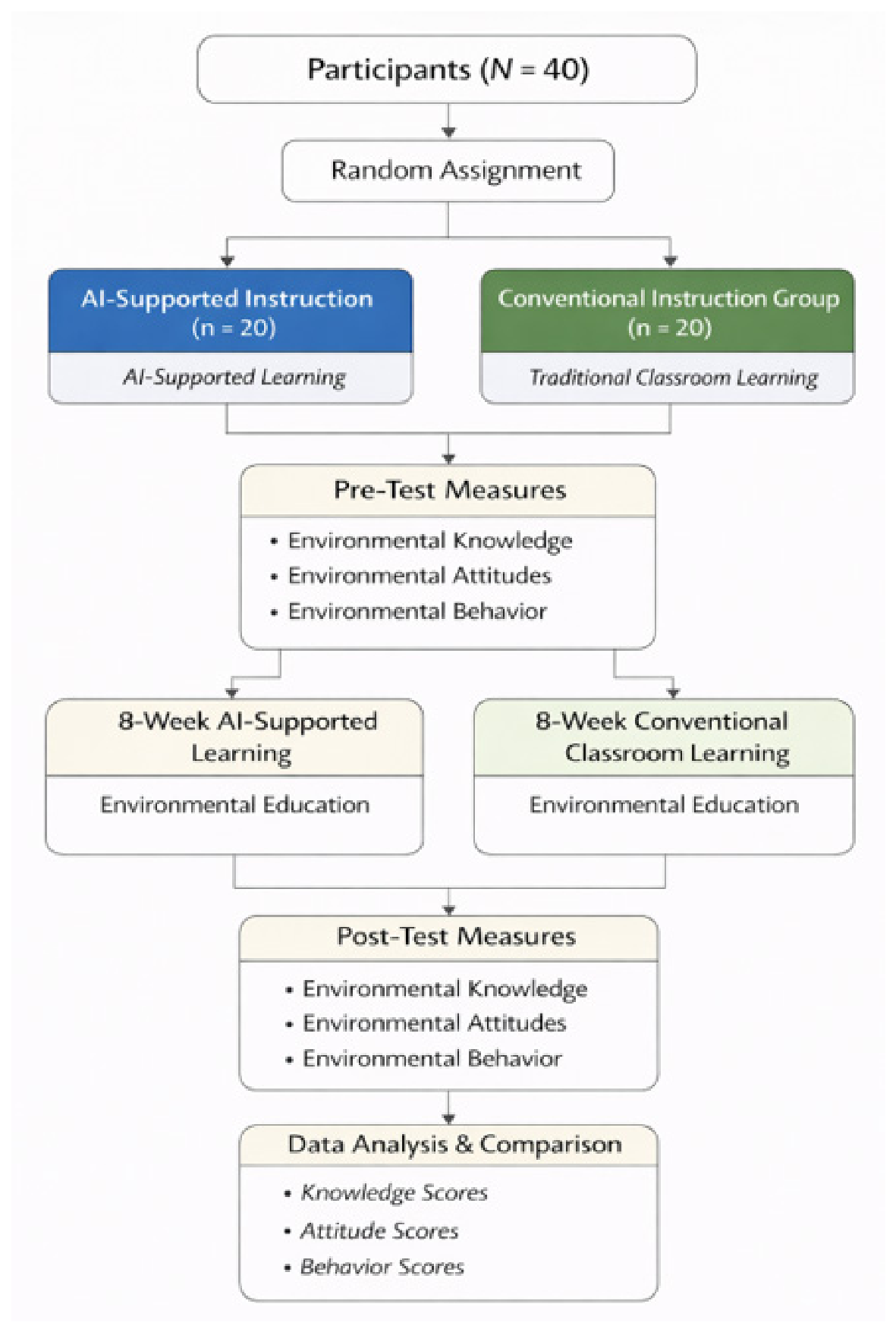
3.1. Study Participants and Grouping
- Control Group: The control group received EE using conventional classroom instructions. This includes instructor-led classroom lectures and discussion.
Sample Limitations
3.2. Course Design and Instructional Procedure
AI-Supported EE Intervention Protocol
- Guided discussion of key environmental concepts (e.g., climate change causes, sustainability practices)
- Clarification of common misconceptions identified during learning activities
- Short application tasks such as scenario-based questions, reflective responses, and concept checks.
3.3. Assessment and Data Collection Tool
Data Collection Instrument
3.4. Statistical Analysis
4. Results
4.1. Environmental Knowledge
4.2. Environmental Attitudes
4.3. Environmental Behavior
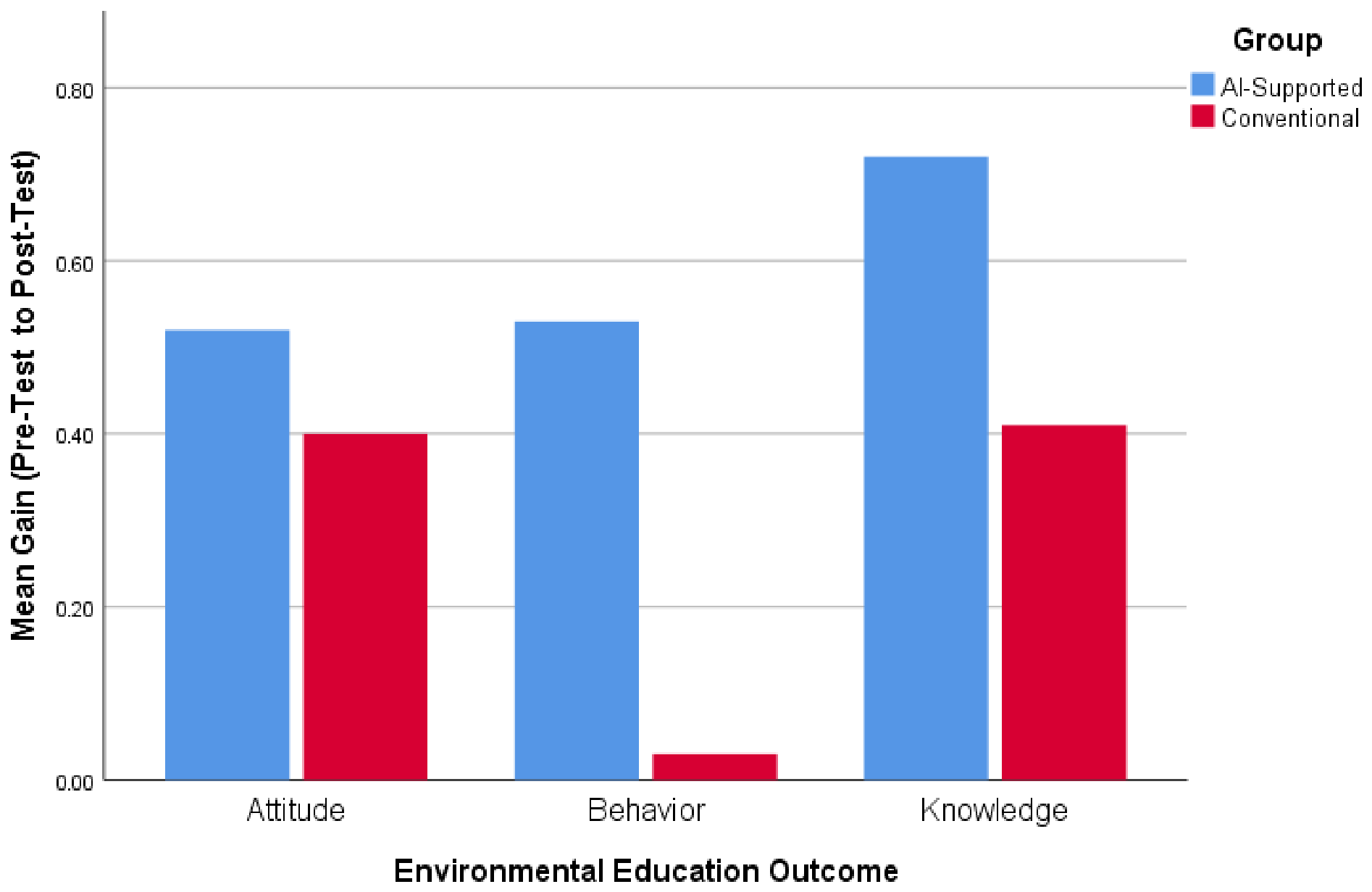
4.4. Between-Group Comparisons of Learning Gains
5. Discussions
5.1. Environmental Knowledge Learning Outcomes
5.2. Environmental Attitudes Learning Outcomes
5.3. Environmental Behavior Learning Outcomes
5.4. Implications of AI-Based EE on Students
5.5. Implications for Learning Organizations
5.6. Limitations and Future Research
6. Conclusions
Author Contributions
Funding
Institutional Review Board Statement
Informed Consent Statement
Data Availability Statement
Conflicts of Interest
References
- Yadav, S.K.; Banerjee, A.; Jhariya, M.K.; Meena, R.S.; Raj, A.; Khan, N.; Kumar, S.; Sheoran, S. Environmental education for sustainable development. In Natural Resources Conservation and Advances for Sustainability; Elsevier: Amsterdam, The Netherlands, 2022; pp. 415–431. [Google Scholar] [CrossRef]
- Romanova, A. Environmental education: Principles, objectives, types and implementing at higher education institutions. In Multilingvism și Interculturalitate în Contextul Globalizării; DuraSpace: Atlanta, GA, USA, 2024; pp. 63–71. [Google Scholar] [CrossRef]
- Hnatyuk, V.; Pshenychna, N.; Kara, S.; Kolodii, V.; Yaroshchuk, L. Education’s role in fostering environmental awareness and advancing sustainable development within a holistic framework. Multidiscip. Rev. 2024, 7, 2024spe012. [Google Scholar] [CrossRef]
- Lord, T.R. A comparison between traditional and constructivist teaching in environmental science. J. Environ. Educ. 1999, 30, 22–27. [Google Scholar] [CrossRef]
- Vasconcelos, C. Teaching environmental education through PBL: Evaluation of a teaching intervention program. Res. Sci. Educ. 2012, 42, 219–232. [Google Scholar] [CrossRef]
- Alqahtani, T.; Badreldin, H.A.; Alrashed, M.; Alshaya, A.I.; Alghamdi, S.S.; Bin Saleh, K.; Alowais, S.A.; Alshaya, O.A.; Rahman, I.; Al Yami, M.S.; et al. The emergent role of artificial intelligence, natural learning processing, and large language models in higher education and research. Res. Soc. Adm. Pharm. 2023, 19, 1236–1242. [Google Scholar] [CrossRef]
- Eysenbach, G. The role of ChatGPT, generative language models, and artificial intelligence in medical education: A conversation with ChatGPT and a call for papers. JMIR Med. Educ. 2023, 9, e46885. [Google Scholar] [CrossRef]
- Navas Bonilla, C.D.R.; Viñan Carrasco, L.M.; Gaibor Pupiales, J.C.; Murillo Noriega, D.E. The future of education: A systematic literature review of self-directed learning with AI. Future Internet 2025, 17, 366. [Google Scholar] [CrossRef]
- Umar, U.; Purwanto, M.B. AI and decision assistance for enhancing self-directed learning. ETERNAL (Engl. Teach. J.) 2025, 16, 457–465. [Google Scholar] [CrossRef]
- Laubscher, D.J. Exploring AI-driven conversations as dynamic OER for self-directed learners. In Proceedings of the 15th Edition of the International Conference: The Future of Education; Filodiritto Editore: Bologna, Italy, 2025. [Google Scholar] [CrossRef]
- Maphalala, M.C.; Mkhasibe, R.G.; Mncube, D.W. Exploring the roles of AI-powered e-tutors in enhancing self-directed learning in open distance e-learning courses. Interdiscip. J. Educ. Res. 2025, 7, a12. [Google Scholar] [CrossRef]
- Bosch, C.; Kruger, D. AI chatbots as open educational resources: Enhancing student agency and self-directed learning. Ital. J. Educ. Technol. 2024, 32, 53–68. [Google Scholar] [CrossRef]
- Milton, S. Higher education, post-conflict democratization and the legacies of authoritarian rule: The Tripoli University Programme for Rebuilding Libya. Educ. Citizsh. Soc. Justice 2022, 17, 18–34. [Google Scholar] [CrossRef]
- Govea, J.; Ocampo Edye, E.; Revelo-Tapia, S.; Villegas-Ch, W. Optimization and scalability of educational platforms: Integration of artificial intelligence and cloud computing. Computers 2023, 12, 223. [Google Scholar] [CrossRef]
- Mahamad, S.; Chin, Y.H.; Zulmuksah, N.I.N.; Haque, M.M.; Shaheen, M.; Nisar, K. Technical review: Architecting an AI-driven decision support system for enhanced online learning and assessment. Future Internet 2025, 17, 383. [Google Scholar] [CrossRef]
- Byrne, L.B. Learner-centered teaching for environmental and sustainability studies. In Learner-Centered Teaching Activities for Environmental and Sustainability Studies; Springer International Publishing: Cham, Switzerland, 2016; pp. 1–28. [Google Scholar] [CrossRef]
- UNESCO. Intergovernmental Conference on Environmental Education; UNESCO: Paris, France, 1978; Available online: https://unesdoc.unesco.org/ark:/48223/pf0000032763 (accessed on 22 December 2025).
- Tilbury, D. Environmental education for sustainability: Defining the new focus of environmental education in the 1990s. Environ. Educ. Res. 1995, 1, 195–212. [Google Scholar] [CrossRef]
- Palmer, J. Environmental Education in the 21st Century: Theory, Practice, Progress and Promise; Routledge: Abingdon, UK, 2002. [Google Scholar] [CrossRef]
- Dale, R.G.; Powell, R.B.; Stern, M.J.; Garst, B.A. Influence of the natural setting on environmental education outcomes. Environ. Educ. Res. 2020, 26, 613–631. [Google Scholar] [CrossRef]
- McGuire, N.M. Environmental education and behavioral change: An identity-based environmental education model. Int. J. Environ. Sci. Educ. 2015, 10, 695–715. [Google Scholar]
- Smith, G.A.; Williams, D.R. Ecological education: Extending the definition of environmental education. Aust. J. Environ. Educ. 1999, 15, 139–146. [Google Scholar] [CrossRef]
- Stern, P.C.; Dietz, T. The value basis of environmental concern. J. Soc. Issues 1994, 50, 65–84. [Google Scholar] [CrossRef]
- Park, J.; Ha, S. Understanding pro-environmental behavior: A comparison of sustainable consumers and apathetic consumers. Int. J. Retail Distrib. Manag. 2012, 40, 388–403. [Google Scholar] [CrossRef]
- Legault, L.; Pelletier, L.G. Impact of an environmental education program on students’ and parents’ attitudes, motivation, and behaviours. Can. J. Behav. Sci. /Rev. Can. Sci. Comport. 2000, 32, 243. [Google Scholar] [CrossRef]
- Geiger, S.M.; Geiger, M.; Wilhelm, O. Environment-specific vs. general knowledge and their role in pro-environmental behavior. Front. Psychol. 2019, 10, 718. [Google Scholar] [CrossRef] [PubMed]
- Littledyke, M. Science education for environmental awareness: Approaches to integrating cognitive and affective domains. Environ. Educ. Res. 2008, 14, 1–17. [Google Scholar] [CrossRef]
- Goldman, D.; Assaraf, O.B.Z.; Shaharabani, D. Influence of a non-formal environmental education programme on junior high-school students’ environmental literacy. Int. J. Sci. Educ. 2013, 35, 515–545. [Google Scholar] [CrossRef]
- Cotton, D.R.; Miller, W.; Winter, J.; Bailey, I.; Sterling, S. Developing students’ energy literacy in higher education. Int. J. Sustain. High. Educ. 2015, 16, 456–473. [Google Scholar] [CrossRef]
- Avelar, A.B.A.; Mitchell, S.F.; Sandes-Guimarães, L.V. Integrating sustainable development goals in management education: Impact on student knowledge, attitudes, and behaviors. Int. J. Manag. Educ. 2025, 23, 101116. [Google Scholar] [CrossRef]
- Serin, H. A comparison of teacher-centered and student-centered approaches in educational settings. Int. J. Soc. Sci. Educ. Stud. 2018, 5, 164–167. [Google Scholar] [CrossRef]
- Sjöblom, P.; Eklund, G.; Fagerlund, P. Student teachers’ views on outdoor education as a teaching method—two cases from Finland and Norway. J. Adventure Educ. Outdoor Learn. 2023, 23, 286–300. [Google Scholar] [CrossRef]
- Zhang, X.; Jung, W.; Asari, M. Systematic review of environmental education teaching practices in schools: Trends and gaps (2015–2024). Sustainability 2025, 17, 8561. [Google Scholar] [CrossRef]
- Zeng, Z.; Zhong, W.; Naz, S. Can environmental knowledge and risk perception make a difference? The role of environmental concern and pro-environmental behavior in fostering sustainable consumption behavior. Sustainability 2023, 15, 4791. [Google Scholar] [CrossRef]
- Van De Wetering, J.; Leijten, P.; Spitzer, J.; Thomaes, S. Does environmental education benefit environmental outcomes in children and adolescents? A meta-analysis. J. Environ. Psychol. 2022, 81, 101782. [Google Scholar] [CrossRef]
- Ardoin, N.M.; Bowers, A.W.; Roth, N.W.; Holthuis, N. Environmental education and K-12 student outcomes: A review and analysis of research. J. Environ. Educ. 2018, 49, 1–17. [Google Scholar] [CrossRef]
- Ardoin, N.M.; Bowers, A.W.; Gaillard, E. Environmental education outcomes for conservation: A systematic review. Biol. Conserv. 2020, 241, 108224. [Google Scholar] [CrossRef]
- Remmen, K.B.; Iversen, E. A scoping review of research on school-based outdoor education in the Nordic countries. J. Adventure Educ. Outdoor Learn. 2023, 23, 433–451. [Google Scholar] [CrossRef]
- Robertson, C.L.; Krugly-Smolska, E. Gaps between advocated practices and teaching realities in environmental education. Environ. Educ. Res. 1997, 3, 311–326. [Google Scholar] [CrossRef]
- Shen, Y.S.; Wu, X.; Li, P.Y. Environmental education and sustainable development: Trends, gaps, and future directions from a bibliometric perspective. Int. Res. Geogr. Environ. Educ. 2025, 1–27. [Google Scholar] [CrossRef]
- Kassab, S.E.; Rathan, R.; Taylor, D.C.; Hamdy, H. The impact of the educational environment on student engagement and academic performance in health professions education. BMC Med. Educ. 2024, 24, 1278. [Google Scholar] [CrossRef]
- Chen, L.; Chen, P.; Lin, Z. Artificial intelligence in education: A review. IEEE Access 2020, 8, 75264–75278. [Google Scholar] [CrossRef]
- Pedro, F.; Subosa, M.; Rivas, A.; Valverde, P. Artificial Intelligence in Education: Challenges and Opportunities for Sustainable Development. 2019. Available online: https://unesdoc.unesco.org/ark:/48223/pf0000366994 (accessed on 21 December 2025).
- Ouyang, F.; Jiao, P. Artificial intelligence in education: The three paradigms. Comput. Educ. Artif. Intell. 2021, 2, 100020. [Google Scholar] [CrossRef]
- Strielkowski, W.; Grebennikova, V.; Lisovskiy, A.; Rakhimova, G.; Vasileva, T. AI-driven adaptive learning for sustainable educational transformation. Sustain. Dev. 2025, 33, 1921–1947. [Google Scholar] [CrossRef]
- Demartini, C.G.; Sciascia, L.; Bosso, A.; Manuri, F. Artificial intelligence bringing improvements to adaptive learning in education: A case study. Sustainability 2024, 16, 1347. [Google Scholar] [CrossRef]
- Tan, L.Y.; Hu, S.; Yeo, D.J.; Cheong, K.H. Artificial intelligence-enabled adaptive learning platforms: A review. Comput. Educ. Artif. Intell. 2025, 9, 100429. [Google Scholar] [CrossRef]
- Baxter, G.; Sommerville, I. Socio-technical systems: From design methods to systems engineering. Interact. Comput. 2011, 23, 4–17. [Google Scholar] [CrossRef]
- Digiacomo, A.; Orsini, A.; Cicchetti, R.; Spadano, L.; De Santis, S.; Di Sessa, L.; Vitale, M.; Di Nicola, M.; Tamborino, F.; Basconi, M.; et al. Chatgpt vs traditional pedagogy: A comparative study in urological learning. World J. Urol. 2025, 43, 286. [Google Scholar] [CrossRef] [PubMed]
- Veluvali, P.; Surisetti, J. Learning management system for greater learner engagement in higher education—A review. High. Educ. Future 2022, 9, 107–121. [Google Scholar] [CrossRef]
- Iku-Silan, A.; Hwang, G.J.; Chen, C.H. Decision-guided chatbots and cognitive styles in interdisciplinary learning. Comput. Educ. 2023, 201, 104812. [Google Scholar] [CrossRef]
- Ezzaim, A.; Dahbi, A.; Aqqal, A.; Haidine, A. AI-based learning style detection in adaptive learning systems: A systematic literature review. J. Comput. Educ. 2025, 12, 731–769. [Google Scholar] [CrossRef]
- Ivy, T.G.C.; Road, K.S.; Lee, C.K.E.; Chuan, G.K. A survey of environmental knowledge, attitudes and behaviour of students in Singapore. Int. Res. Geogr. Environ. Educ. 1998, 7, 181–202. [Google Scholar] [CrossRef]
- Amershi, S.; Weld, D.; Vorvoreanu, M.; Fourney, A.; Nushi, B.; Collisson, P.; Suh, J.; Iqbal, S.; Bennett, P.N.; Inkpen, K.; et al. Guidelines for human-AI interaction. In Proceedings of the 2019 CHI Conference on Human Factors in Computing Systems; Association for Computing Machinery: New York, NY, USA, 2019; pp. 1–13. [Google Scholar] [CrossRef]
- Monroe, M.C.; Plate, R.R.; Oxarart, A.; Bowers, A.; Chaves, W.A. Identifying effective climate change education strategies: A systematic review of the research. Environ. Educ. Res. 2019, 25, 791–812. [Google Scholar] [CrossRef]
- Okonji, N.N.; Igwe, E.A. Prospects and Challenges of Personalized Learning through Artificial IntelligenceDriven Adaptive Learning Systems in N. J. Educ. Dev. Areas 2025, 33, 139–147. Available online: https://journals.journalsplace.org/index.php/JEDA (accessed on 22 December 2025).
- Winkler, R.; Söllner, M. Unleashing the potential of chatbots in education: A state-of-the-art analysis. Acad. Manag. Proc. 2018, 2018, 15903. [Google Scholar] [CrossRef]
- Wu, R.; Yu, Z. Do AI chatbots improve students learning outcomes? Evidence from a meta-analysis. Br. J. Educ. Technol. 2024, 55, 10–33. [Google Scholar] [CrossRef]
- Jonassen, D.H.; Rohrer-Murphy, L. Activity theory as a framework for designing constructivist learning environments. Educ. Technol. Res. Dev. 1999, 47, 61–79. [Google Scholar] [CrossRef]
- Kollmuss, A.; Agyeman, J. Mind the gap: Why do people act environmentally and what are the barriers to pro-environmental behavior? Environ. Educ. Res. 2002, 8, 239–260. [Google Scholar] [CrossRef]
- Schindler, L.A.; Burkholder, G.J.; Morad, O.A.; Marsh, C. Computer-based technology and student engagement: A critical review of the literature. Int. J. Educ. Technol. High. Educ. 2017, 14, 25. [Google Scholar] [CrossRef]
- Cohen, J. Statistical Power Analysis for the Behavioral Sciences; Routledge: Abingdon, UK, 2013. [Google Scholar] [CrossRef]



| Week | Course Topic | Prompt Type | Sample Prompt |
|---|---|---|---|
| 1 | Introduction to Environmental Science | Concept clarification | Explain the concept of environmental sustainability in simple terms and provide two real-world examples. |
| 1 | Introduction to Environmental Science | Concept clarification | What are ecosystems and biodiversity, and why are they important for human survival? |
| 2 | Human Impact on the Environment | Application | Describe how human activities contribute to air and water pollution, using examples relevant to Libya. |
| 2 | Human Impact on the Environment | Concept clarification | What are the main causes of climate change, and how do human actions influence them? |
| 3 | Energy Resources and Environmental Impact | Comparison | Compare renewable and non-renewable energy sources and explain their environmental impacts. |
| 3 | Energy Resources and Environmental Impact | Application | Which renewable energy source would be most suitable for Libya and why? |
| 4 | Waste Management and Pollution Control | Concept clarification | Explain different types of waste and suggest practical ways individuals can reduce waste in daily life. |
| 4 | Waste Management and Pollution Control | Application | How does improper waste management affect human health and ecosystems? |
| 5 | Global Environmental Issues | Critical analysis | Discuss one major global environmental issue and explain its causes and consequences. |
| 5 | Global Environmental Issues | Concept clarification | How does biodiversity loss affect ecosystem stability? |
| 6 | Environmental Policy and Governance | Concept clarification | What is the Paris Agreement, and why is it important for climate change mitigation? |
| 6 | Environmental Policy and Governance | Application | Explain the role of government policies in environmental protection. |
| 7 | Environmental Behavior and Sustainable Living | Reflection | Identify three daily behaviors that contribute to environmental sustainability and explain their impact. |
| 7 | Environmental Behavior and Sustainable Living | Reflection | How can individual lifestyle choices influence environmental conservation? |
| 8 | Technology and Environmental Protection | Application | Explain how artificial intelligence can be used to address environmental challenges. |
| 8 | Technology and Environmental Protection | Critical evaluation | What are the advantages and limitations of using technology, including AI, in environmental protection? |
| All 8 weeks | Cross-cutting reflection | Reflection | How does this topic relate to your own environmental behavior? |
| All 8 weeks | Cross-cutting reflection | Critical thinking | What actions could individuals, communities, and governments take to address this issue? |
| All 8 weeks | Cross-cutting reflection | Evaluation | What limitations or uncertainties exist in the solutions discussed? |
| Scale | Number of Items | Cronbach’s Alpha (α) |
|---|---|---|
| Environmental attitude | 13 | 0.82 |
| Environmental behavior | 11 | 0.79 |
| Environmental knowledge | 23 | Not applicable |
| Characteristic | Category | Frequency (n) | Percentage (%) |
|---|---|---|---|
| Gender | Male | 21 | 52.5 |
| Female | 19 | 47.5 | |
| Department | Environmental Sciences | 20 | 50.0 |
| Faculty of Science (Botany) | 20 | 50.0 | |
| Instructional Group | AI-Supported learning | 20 | 50.0 |
| Conventional learning | 20 | 50.0 |
| Group | N | Pre-Test Mean (SD) | Post-Test Mean (SD) | Mean Gain |
|---|---|---|---|---|
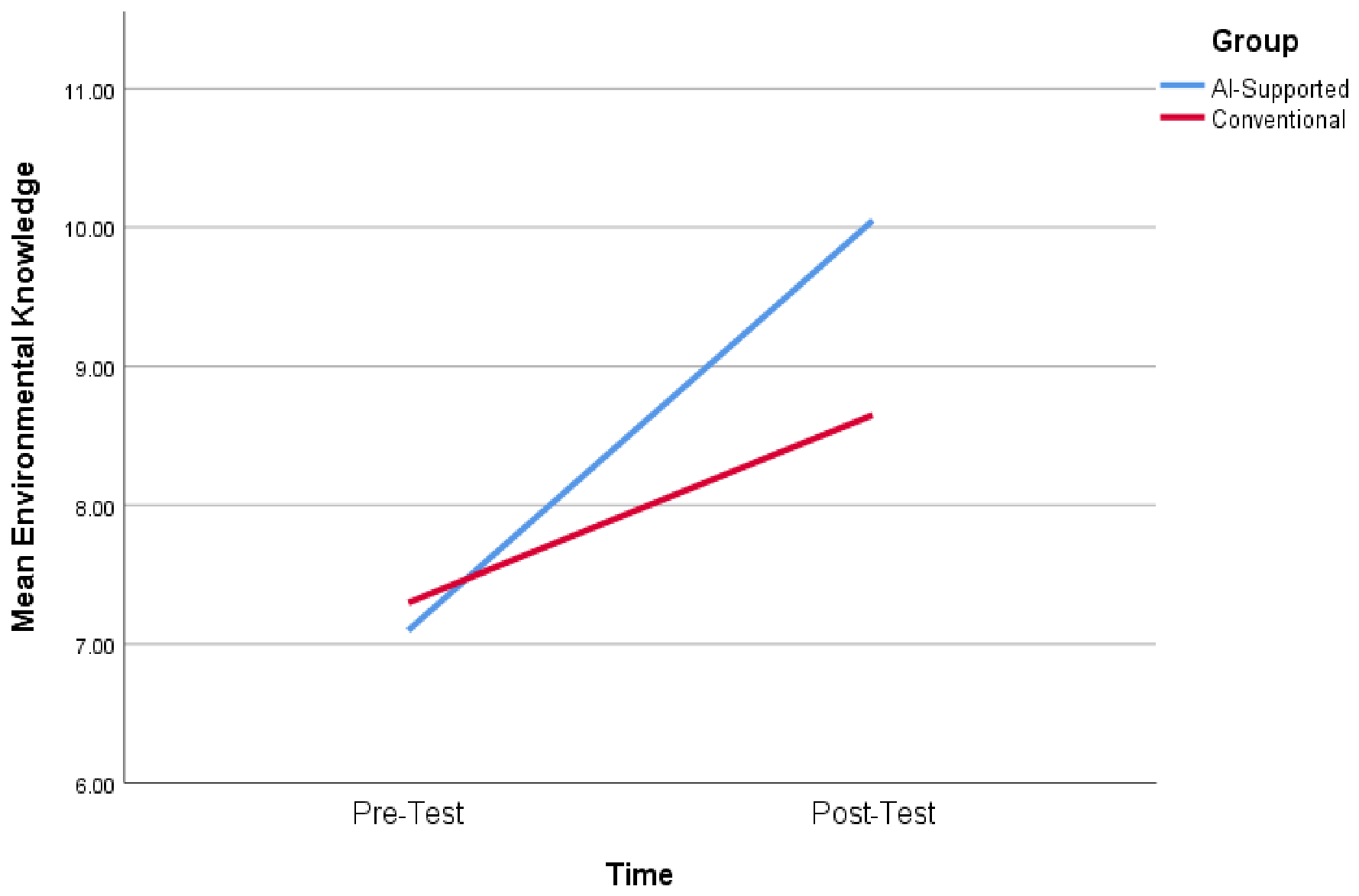
| AI-Supported learning | 20 | 9.90 (4.52) | 14.35 (3.07) | +4.45 |
| Conventional learning | 20 | 9.95 (4.27) | 12.05 (4.20) | +2.10 |
| Group | t | df | p | Cohen’s dz |
|---|---|---|---|---|
| AI-Supported learning | 3.05 | 19 | 0.007 | 0.68 |
| Conventional learning | 1.51 | 19 | 0.148 | 0.34 |
| Source | df | f | p-Value | Partial η2 |
|---|---|---|---|---|
| Pre-test (covariate) | 1 | 2.16 | 0.150 | 0.055 |
| group | 1 | 4.86 | 0.034 * | 0.116 |
| Error | 37 |
| Group | N | Pre-Test Mean (SD) | Post-Test Mean (SD) | Mean Gain |
|---|---|---|---|---|
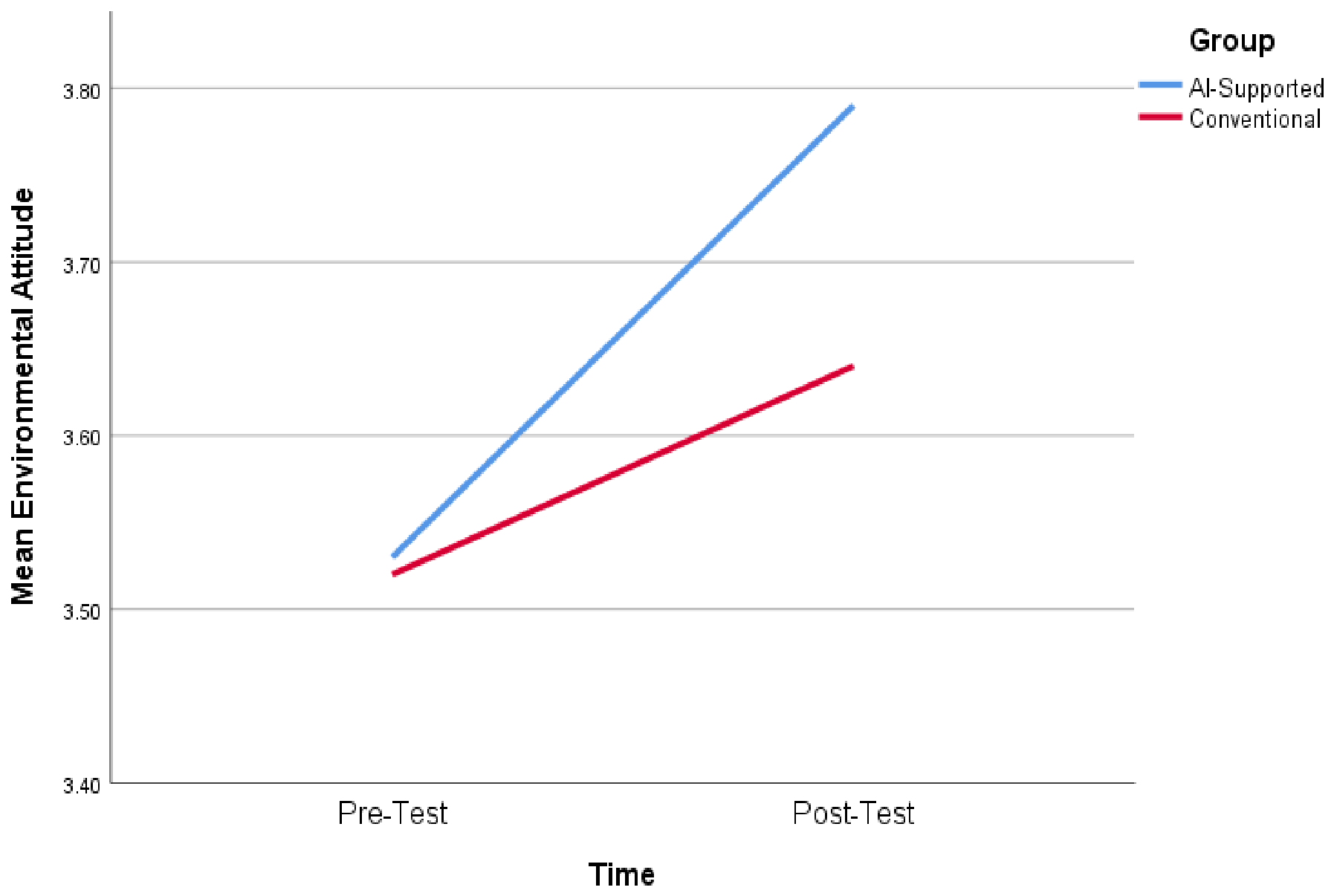
| AI-Supported learning | 20 | 3.67 (0.33) | 3.94 (0.26) | +0.27 |
| Conventional learning | 20 | 3.52 (0.38) | 3.73 (0.32) | +0.21 |
| Group | t | df | p | Cohen’s dz |
|---|---|---|---|---|
| AI-Supported learning | 2.34 | 19 | 0.031 | 0.52 |
| Conventional learning | 1.78 | 19 | 0.090 | 0.40 |
| Source | df | f | p-Value | Partial η2 |
|---|---|---|---|---|
| Pre-test (covariate) | 1 | 3.87 | 0.066 | 0.095 |
| group | 1 | 0.42 | 0.521 | 0.011 |
| Error | 37 |
| Group | N | Pre-Test Mean (SD) | Post-Test Mean (SD) | Mean Gain |
|---|---|---|---|---|
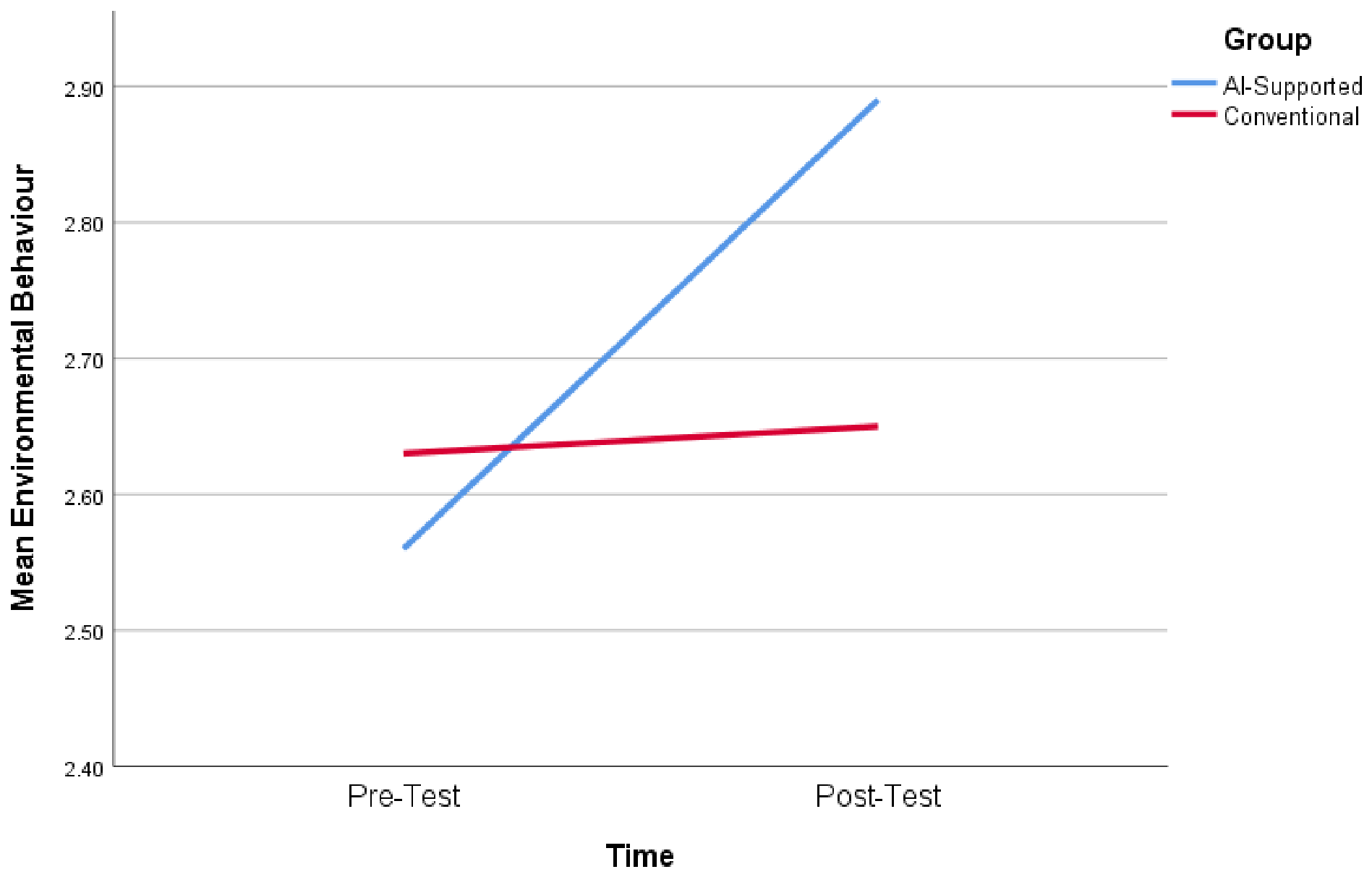
| AI-Supported learning | 20 | 2.72 (0.34) | 3.01 (0.31) | +0.29 |
| Conventional learning | 20 | 2.82 (0.30) | 2.84 (0.29) | +0.01 |
| Group | t | df | p | Cohen’s dz |
|---|---|---|---|---|
| AI-Supported learning | 2.35 | 19 | 0.030 | 0.53 |
| Conventional learning | 0.13 | 19 | 0.896 | 0.03 |
| Source | df | f | p-Value | Partial η2 |
|---|---|---|---|---|
| Pre-test (covariate) | 1 | 4.22 | 0.04 * | 0.102 |
| group | 1 | 2.91 | 0.096 | 0.073 |
| Error | 37 |
| Outcome Variable | Mean Gain (AI) | Mean Gain (Conventional) | t | df | p | Cohen’s d |
|---|---|---|---|---|---|---|
| Environmental Knowledge | 4.45 | 2.10 | 1.16 | 38 | 0.251 | 0.37 |
| Environmental Attitude | 0.27 | 0.21 | 0.38 | 38 | 0.709 | 0.12 |
| Environmental Behavior | 0.29 | 0.01 | 1.73 | 38 | 0.093 | 0.55 |
Disclaimer/Publisher’s Note: The statements, opinions and data contained in all publications are solely those of the individual author(s) and contributor(s) and not of MDPI and/or the editor(s). MDPI and/or the editor(s) disclaim responsibility for any injury to people or property resulting from any ideas, methods, instructions or products referred to in the content. |
© 2026 by the authors. Licensee MDPI, Basel, Switzerland. This article is an open access article distributed under the terms and conditions of the Creative Commons Attribution (CC BY) license.
Share and Cite
Fayid, F.M.B.; Kiraz, A. Human–Machine Cooperation in Environmental Education: Experimental Evidence from AI-Supported Learning in Higher Education. Systems 2026, 14, 504. https://doi.org/10.3390/systems14050504
Fayid FMB, Kiraz A. Human–Machine Cooperation in Environmental Education: Experimental Evidence from AI-Supported Learning in Higher Education. Systems. 2026; 14(5):504. https://doi.org/10.3390/systems14050504
Chicago/Turabian StyleFayid, Faed Mahmoud Buojaylah, and Askin Kiraz. 2026. "Human–Machine Cooperation in Environmental Education: Experimental Evidence from AI-Supported Learning in Higher Education" Systems 14, no. 5: 504. https://doi.org/10.3390/systems14050504
APA StyleFayid, F. M. B., & Kiraz, A. (2026). Human–Machine Cooperation in Environmental Education: Experimental Evidence from AI-Supported Learning in Higher Education. Systems, 14(5), 504. https://doi.org/10.3390/systems14050504