Article

Correlation Analysis of Operational Safety Risks in Inter-Basin Water Transfer Projects Based on ISM-Copula


1
School of Water Conservancy, North China University of Water Resources and Electric Power, Zhengzhou 450046, China
2
School of Management and Economics, North China University of Water Resources and Electric Power, Zhengzhou 450046, China
*
Author to whom correspondence should be addressed.
Systems 2026, 14(5), 477; https://doi.org/10.3390/systems14050477
Submission received: 24 February 2026 / Revised: 8 April 2026 / Accepted: 22 April 2026 / Published: 28 April 2026

Abstract

Inter-basin water transfer projects (IBWTPs) play a pivotal role in alleviating the spatiotemporal imbalances of water resources. However, their operation is exposed to multiple, highly interdependent safety risks that can significantly undermine system stability and water supply reliability. Existing studies predominantly focus on isolated risk factors or rely heavily on subjective data, which limits their ability to capture the complex interrelationships among risks and reveal their underlying propagation mechanisms. To address these limitations, this study proposes a novel risk correlation analysis framework that integrates Interpretive Structural Modeling (ISM) with copula functions. ISM is first employed as a preprocessing tool to structure expert knowledge and develop an initial risk correlation framework. It is then used to hierarchically organize the complex interrelationships among risks. Subsequently, copula functions are utilized to model nonlinear dependencies and tail behaviors among risk variables. This enables a quantitative assessment of correlation strengths and facilitates the construction of a risk topological network. An empirical case study is conducted based on the Middle Route of the South-to-North Water Diversion Project. The results reveal 13 significant correlations among six second-level risk categories. Natural risks (e.g., floods and geological hazards) are identified as the primary driving factors. They exhibit a strong positive correlation (0.6155) with engineering risks and serve as the most critical nodes for proactive risk prevention and control. Engineering risks function as central intermediary hubs in the risk transmission process, whereas water quality and economic risks are characterized as terminal endpoints. Furthermore, three principal risk propagation pathways are identified: (1) natural risks → engineering risks → economic risks; (2) natural risks → operational scheduling risks → social risks; and (3) engineering risks → water quality risks → economic risks. The resulting risk topological network demonstrates significant small-world properties, indicating highly efficient risk transmission within the system. Ultimately, this study provides a robust quantitative approach for analyzing risk interactions in complex engineering systems and enriches the theoretical framework of engineering risk management. It also identifies critical nodes and key transmission pathways for risk prevention and control in IBWTPs, thereby offering significant practical implications for operational safety.

1. Introduction

Inter-basin water transfer projects (IBWTPs) are an essential strategy for alleviating spatiotemporal imbalances in water resources and have been widely implemented worldwide [1]. Notable examples include the Snowy Mountains Scheme in Australia [2], the Central Valley Project in the United States [3], the South-to-North Water Diversion Project (SNWDP) in China [4], and the Yangtze River to Huai River Water Diversion Project in China [5]. These projects, while bringing enormous benefits to the recipient areas, have provided indispensable support for ensuring water supply security in the water-receiving areas. For instance, nearly all drinking water in the central urban area of Tianjin is supplied by the SNWDP, and more than 20% of Beijing’s total water supply comes from such projects [6]. Consequently, ensuring the safe and stable operation of IBWTPs has become increasingly critical.
However, due to their large scale and long transmission distances, IBWTPs are exposed to a complex spectrum of operational risks. These risks encompass engineering-related issues, such as damage to canals and pipeline infrastructure; natural risks, such as floods, geological disasters, and droughts; water quality contamination; and operational scheduling risks, such as failures in dispatch systems. In addition, social risks (e.g., traffic accidents on canal-crossing bridges) and the associated economic risks arising from these factors must also be considered [7,8,9,10,11]. When an incident occurs, it can lead not only to substantial economic losses but also to severe disruptions in daily life.
Complex engineering projects inevitably encounter a wide range of risks during operation. Inadequate risk management during operation and maintenance may trigger adverse events, thereby disrupting normal project operations and causing substantial economic losses. In general, project risk management comprises three fundamental stages: risk identification, risk assessment, and risk response. The interrelationships among risk factors play a crucial role across all three stages of the risk management process [12,13,14,15]. IBWTPs are quintessential complex engineering systems that are inherently open, dynamic, and adaptive, and are characterized by significant uncertainty and strong interactions among system components [16]. Although numerous studies have investigated risks associated with IBWTPs, most have focused on specific risk categories or static assessments [7,8,17], thereby overlooking the interplay among risk factors. In practice, the risks encountered during the operation of IBWTPs are rooted in the intrinsic characteristics of these projects. Given their highly interconnected nature, disturbances in one component can readily propagate throughout the system. Consequently, these risks exhibit pronounced interdependence [18].
For example, in 2016, a traffic accident on a canal-crossing bridge in the Xintun section of the Middle Route of the South-to-North Water Diversion Project (MRSNWDP) caused localized canal damage and water quality contamination (http://sd.dzwww.com/sdnews/201703/t20170329_15694293.htm?pc (accessed on 20 April 2019)). In 2018, a power failure at the No. 21 Gate Pumping Station led to the shutdown of a water treatment plant, resulting in widespread water outages in Zhengzhou (http://henan.sina.com.cn/news/2018-10-11/detail-ihmhafiq8128461.shtml (accessed on 20 April 2022)). Furthermore, a severe rainstorm in Zhengzhou on 20 July 2021 (https://slt.henan.gov.cn/2022/04-07/2427893.html (accessed on 20 April 2022)), destroyed a siphon in the MRSNWDP, interrupting water supply [6]. These incidents demonstrate that social risks can directly trigger engineering and water quality risks. Natural risks can likewise induce engineering failures and water quality deterioration [18]. All such events incur substantial operational costs and give rise to broader economic risks. This interdependence among risk factors significantly increases the complexity of risk management and control. A precise understanding of these interrelationships enables risk managers to develop more effective mitigation strategies and reduce potential losses [13,19]. Therefore, an in-depth investigation of the interconnections among risk factors affecting the safe operation of IBWTPs is essential for effective risk management.
The findings of this study provide a novel methodological framework for analyzing risk correlations in engineering systems. This framework enriches the theoretical foundations of risk management and offers valuable support for risk control practices in the operational management of IBWTPs.
The remainder of this paper is organized as follows: Section 2 reviews studies on risks associated with IBWTPs and risk correlations, thereby establishing the foundation for this research. Section 3 presents the risk indicator system and develops the risk correlation analysis model. Section 4 validates the proposed model through a case study. Finally, Section 5 summarizes the main findings and outlines directions for future research.

2. Literature Review

2.1. Risks of IBWTPs

IBWTPs typically comprise long-distance water conveyance channels, source reservoirs, various hydraulic structures, and dispatch systems. These engineering components are subject to multiple failure risks, including channel damage, slope instability, structural cracking, material aging, and foundation defects [10].
Cracking and seepage in channel linings are the most common failure modes in channel engineering [10]. These failures are primarily caused by uneven foundation settlement, frost heave and thawing settlement, concrete shrinkage, construction defects, and soil expansiveness [10,20,21]. Seepage not only results in water loss but may also induce foundation subsidence, slope instability, and reduced structural bearing capacity [10,21,22]. Channel slopes may undergo sliding or collapse due to hydraulic erosion, freeze–thaw cycles, seismic activity, and improper loading, thereby leading to instability and failure [10]. Cross-structures, such as aqueducts and siphons, are susceptible to cracking, deformation, or even collapse due to uneven settlement, seismic loading, material aging, and overloading [23].
Natural hazards represent a primary source of uncertainty affecting the normal operation of IBWTPs, including rainfall, floods, droughts, and other phenomena [24,25]. Previous studies indicate that climate change is significantly altering regional runoff patterns, leading to increasingly severe drought risks in both the source and receiving areas of IBWTPs [26,27]. In particular, in the Yellow River Basin, Huai River Basin, Hai River Basin, and Yangtze River Basin, the coupled characteristics of future compound drought risks are becoming increasingly significant [26]. For China’s MRSNWDP, Liu et al. [28] conducted projections using global climate models. They found that the probability of concurrent droughts in both the receiving and source areas will continue to increase between 2020 and 2050. In their study of the Hanjiang–Weihe River Water Diversion Project, Wang et al. [29] reported that the probability of drought occurrence gradually increased over the period 1969–2018. Although CMIP6 models predict that increased future precipitation may alleviate drought conditions, high precipitation variability significantly increases the uncertainty associated with concurrent droughts. Similarly, Mu et al. found that changes in runoff processes under climate change scenarios pose significant risks to the operation of the Hanjiang–Weihe River Water Diversion Project [24]. The increased frequency and intensity of extreme drought events directly threaten water supply security and the conveyance capacity of water diversion projects [26,27,30]. Additionally, Fu et al. [31] and Yan et al. [32] investigated the impacts of torrential rainfall and flooding on the safe operation of IBWTPs through targeted risk identification and evaluation.
Water quality directly affects the safety of water supply in receiving areas and is a critical factor determining the success of IBWTPs. As the source of water transfer, source areas are particularly vulnerable to contamination from industrial wastewater, agricultural fertilizer residues, and urban sewage entering reservoirs. These contaminants may subsequently be conveyed to receiving regions during water diversion operations. Existing studies have extensively examined water quality risks in source areas. For example, Chen et al. investigated the spatiotemporal distribution characteristics of eutrophication in the source areas of IBWTPs [33]; Li et al. developed a water pollution risk assessment model for source areas and analyzed the spatial distribution of pollution sources [34]; and Gao et al. explored the potential impacts of human activities on source water quality [11]. During water conveyance, additional pollution risks may arise as new contaminants enter diversion channels or pipelines due to structural defects, adverse geological conditions, or inadequate operational management. Typical pollution pathways include sudden environmental incidents, such as hazardous material transportation accidents on bridges crossing diversion channels [35], as well as non-point source pollution caused by surface runoff along the conveyance route, including sewage intrusion following rainfall events [36]. In addition, Nong et al. conducted a comprehensive evaluation of water quality in IBWTPs from spatiotemporal perspectives [37], while Yang et al. examined the damage caused by biological invasions to channel structures and their subsequent impacts on water quality [7].
The reliability of the dispatch system is a fundamental prerequisite for ensuring the safe operation of water transfer projects and water supply security. Existing studies indicate that the operational dispatch of large-scale water transfer projects faces challenges associated with multi-objective optimization and runoff uncertainty [38]. Computer vision-based water level measurement methods offer advantages such as low installation and maintenance costs and high visualization capability. However, their accuracy under complex environmental conditions still requires further improvement [39]. Traditional scheduling methods may fail to adequately address the mismatch between water supply and demand, thereby increasing the risk of internal scheduling failures [38]. Furthermore, human operational errors—such as the failure to effectively utilize floodwater resources to augment available water supply—may compromise water supply security [38]. The external resilience of scheduling systems is primarily affected by factors such as climate change, water pollution incidents, and other external environmental influences [27].
Social risks primarily manifest in several aspects. First, resettlement issues often involve complex conflicts of interest and limited public participation [40,41]. Second, conflicts over water rights between recipient and donor regions, issues of fairness, and ecological and environmental impacts constitute core concerns [40,42]. Although IBWTPs can effectively alleviate water scarcity and regional inequality, the absence of effective policy and regulatory frameworks may trigger social unrest and undermine public trust [43].
Economic risks manifest as multifaceted challenges. IBWTPs typically require substantial capital investments, and their economic returns and cost structures are inherently complex. Furthermore, water pricing mechanisms may be distorted, leading to inefficient allocation of water resources [40]. Recipient regions may develop path dependence on industrial structures linked to water transfer projects, and the misestimation of the benefits of water transfer may result in inefficient resource allocation [40].
Several studies have also evaluated the overall operational safety risks of IBWTPs from a systems perspective. For instance, Li et al. developed a risk assessment model for the operational safety of inter-basin water diversion channels based on the TODIM-FMEA method [10]. Nie et al. established an indicator system for the overall operational safety risks of IBWTPs using grey relational analysis and sensitivity analysis models [44]. Fan et al. developed a dynamic transmission evolution model and evaluation framework for operational risks in IBWTPs using Bayesian networks and Dempster–Shafer evidence theory [6].
Existing studies have investigated operational risks in IBWTPs from the perspectives of engineering safety, water quality safety, water quantity safety, and overall operational safety. These studies have made important contributions to the sustained and safe operation of these projects. However, these studies have generally overlooked the interrelationships among different risk factors. Existing research indicates that risks are not independent but instead exhibit strong interdependencies and interactions [45,46,47].

2.2. Risk Correlation

Risk factors are the primary drivers of risk occurrence; however, risks do not evolve independently over time. Both the Domino Model [48] and the Swiss Cheese Model [49] posit that accident-causing risk factors are interconnected. An early analytical approach that incorporates risk correlation is fault tree analysis (FTA), which uses directed graph models to represent causal relationships among risks and identify their propagation pathways [50]. In addition, other commonly used approaches include the Master Logic Diagram [51] and Bayesian networks [52]. In recent years, numerous scholars have investigated the interrelationships among risks across a wide range of research domains. Qualitative studies include the empirical work of Teller and Kock. Their study demonstrated that understanding interdependencies between projects and their associated risks is essential for successful project investment [45]. In quantitative research, Marle et al. employed the Design Structure Matrix to examine interrelationships among risks [53]. Xin et al. applied the MACBETH method to model correlation levels among risk factors affecting project schedule, quality, and cost, and subsequently developed an optimal selection model for risk response strategies [54]. Jin et al. used copula functions to quantitatively analyze dependencies among credit, market, and operational risks in commercial banks [55]. Zhang employed a stochastic dominance approach to quantify project risk correlations, analyze their impacts on risk decision-making, and construct an optimization model for project risk response strategies [13]. Other studies have adopted multi-criteria and causal analysis methods. Meng et al. utilized a binary semantic DEMATEL method to quantify correlations among overseas investment country risk indicators [56]. Suo et al. [14,15] analyzed the operational risks of typical urban lifelines under multi-system interconnection scenarios. They evaluated these risks using an extended binary semantic representation model. In further research, they examined the correlation mechanisms of operational risks in urban critical infrastructure and constructed a corresponding risk probability assessment model [57]. Wu et al. analyzed software project risk correlations from the perspectives of probability dependency and loss non-additivity, establishing an optimization model for risk response strategies [58]. Zhang et al. examined complex, multi-faceted correlations in transportation infrastructure construction risks and proposed a stochastic DEMATEL-VIKOR-based risk assessment method [59]. Wang et al. introduced risk chains and risk networks into risk-sharing research, constructing a risk correlation network for rail transit PPP projects and analyzing correlation effects using game theory [60]. Furthermore, Zhang et al. [61] examined the combined effects of direct, indirect, positive, and negative risk associations. Their results revealed that both risk interdependence and managerial risk attitudes significantly influence risk response strategies and expected utility.
Despite these significant contributions to research on risk correlation analysis, from a quantitative perspective, existing approaches still exhibit several notable limitations. First, most studies on risk correlation assessment and correlation degree calculation rely heavily on subjective data. Second, objective data analysis methods, such as copula functions, have been predominantly applied in financial risk analysis, with limited application in engineering risk analysis.
IBWTPs are complex engineering systems characterized by high uncertainty. Their operation involves significant unpredictability and numerous risk factors with complex nonlinear interactions [16]. Traditional quantitative risk analyses often rely on subjective data or assume risk independence for linear weighting, thereby making it difficult to capture the dynamic interdependence of risk occurrence probabilities [62,63]. Although methods such as Bayesian networks and complex network models are commonly used to analyze interrelationships among risks, they exhibit significant limitations when applied to IBWTPs [64]. Specifically, Bayesian networks rely heavily on large volumes of historical data to estimate conditional probability tables [64], rendering them ill-suited to the “small sample size and sparse information” characteristics of operational risk data in such projects. Conversely, complex network models are better suited for analyzing the evolution of macro-scale topological structures. However, they struggle to accurately capture nonlinear characteristics and extreme tail dependencies among risk variables with heterogeneous distributions [65,66].
To address these gaps, this study integrates subjective expert knowledge with objective empirical data. Specifically, the ISM framework is employed to preliminarily identify and screen risk relationships. Building on this foundation, copula functions are utilized to conduct an in-depth analysis of the dependence structure among risks. This establishes a novel risk correlation analysis model, which is subsequently validated through a comprehensive case study.

3. Methodology

3.1. Research Framework

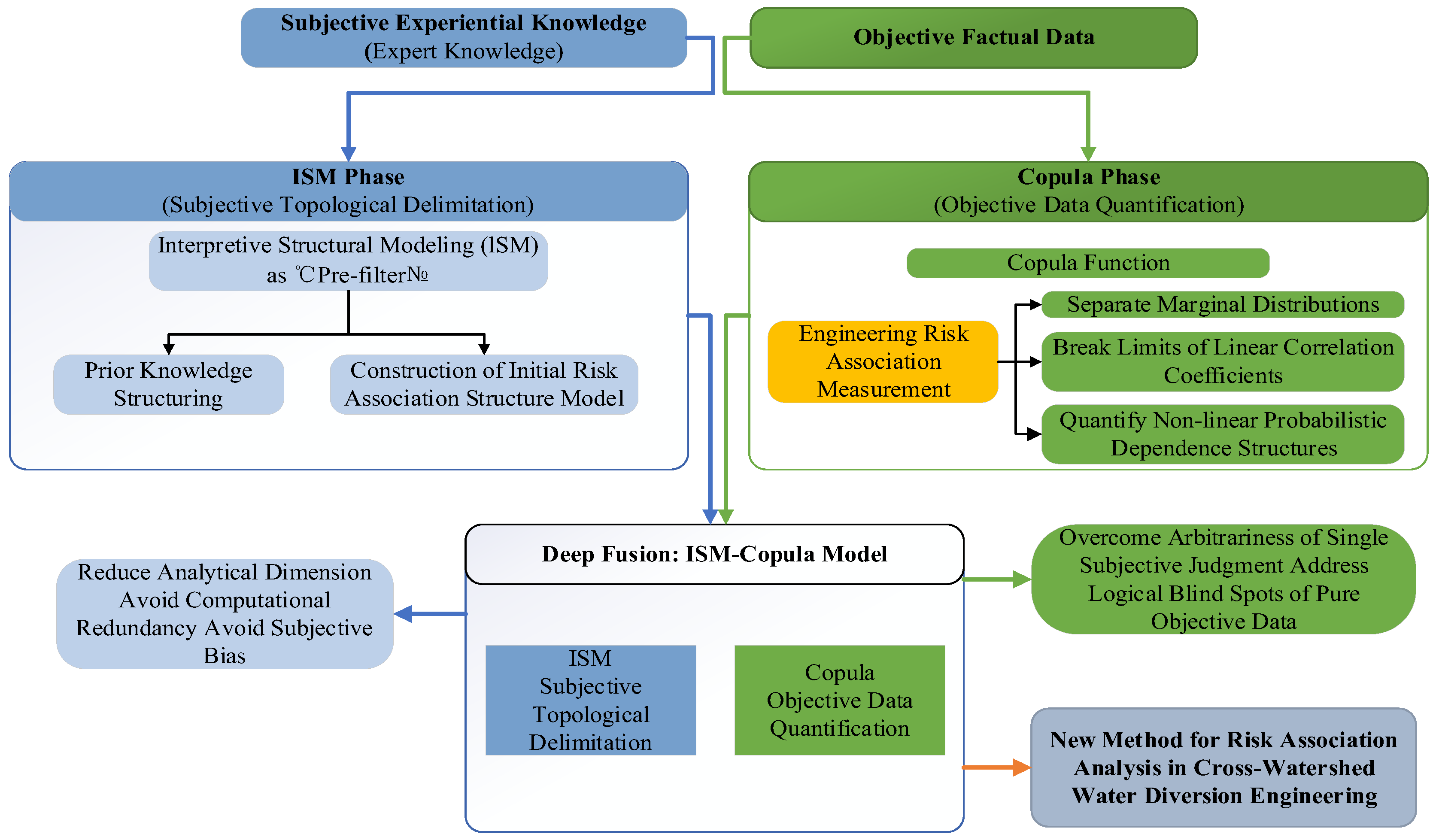
This study proposes a novel ISM-Copula-based risk correlation analysis model that integrates subjective expert knowledge with objective empirical data. First, the ISM method is employed to structure expert knowledge and construct an initial risk correlation framework. In this context, ISM serves as a pre-filter that effectively reduces the dimensionality of the system analysis while avoiding the computational redundancy and excessive subjectivity inherent in exhaustive pairwise correlation calculations.
Building upon this foundation, copula functions—statistical tools widely utilized in financial risk analysis—are innovatively adapted to measure dependencies among engineering risks. By decoupling marginal distributions from joint distributions, copula functions overcome the limitations of traditional linear correlation coefficients, thereby enabling precise quantification of nonlinear probabilistic dependency structures among heterogeneous risks [62,65].
Through the integration of ISM-based subjective topological delimitation and copula-based objective data quantification, the proposed model effectively mitigates the arbitrariness of isolated subjective judgments and the logical blind spots inherent in purely data-driven approaches. Consequently, it provides a robust methodology for risk correlation analysis in IBWTPs. The specific conceptual framework is illustrated in Figure 1.

3.2. Safety Operation Risk Indicators for IBWTPs

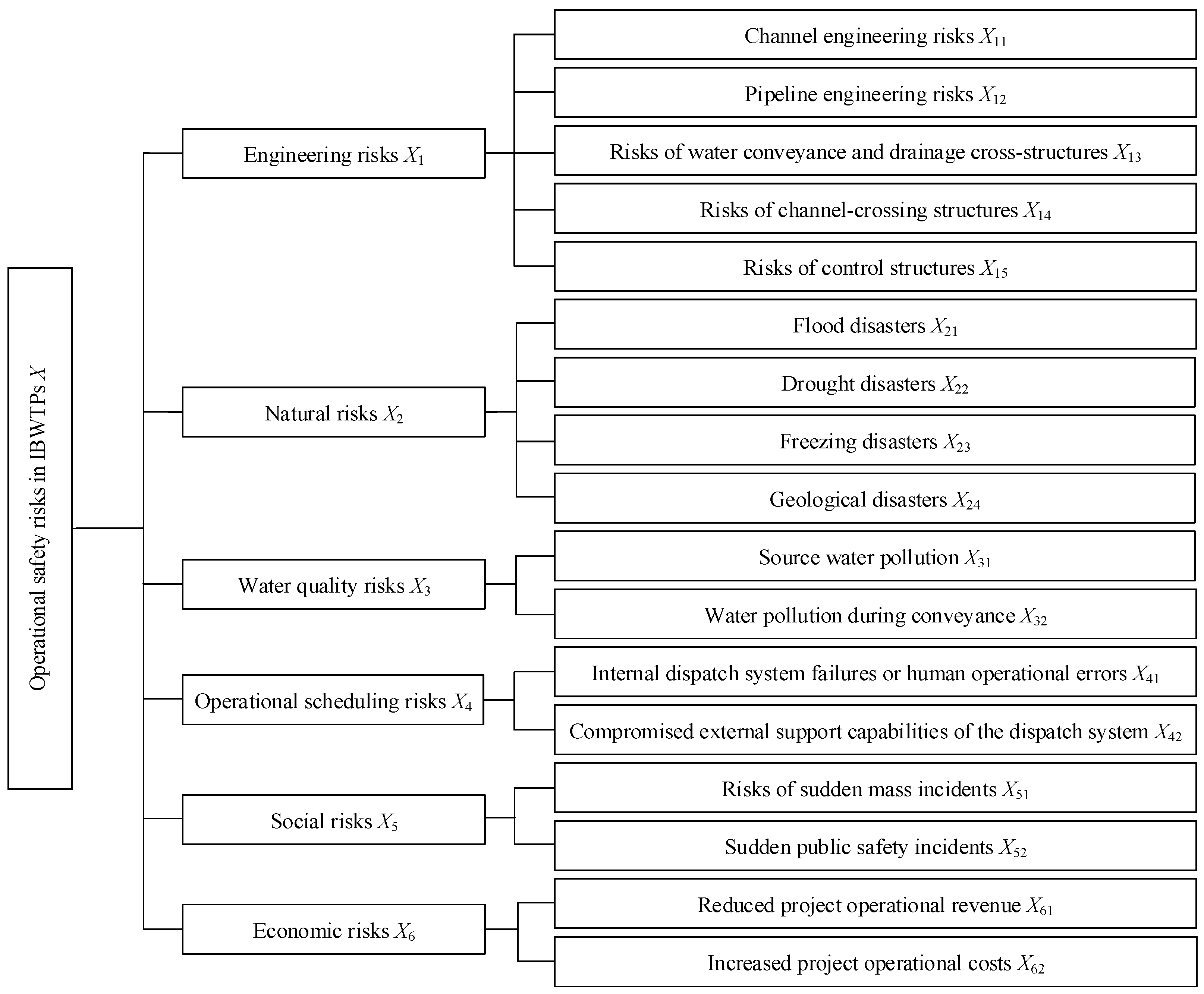
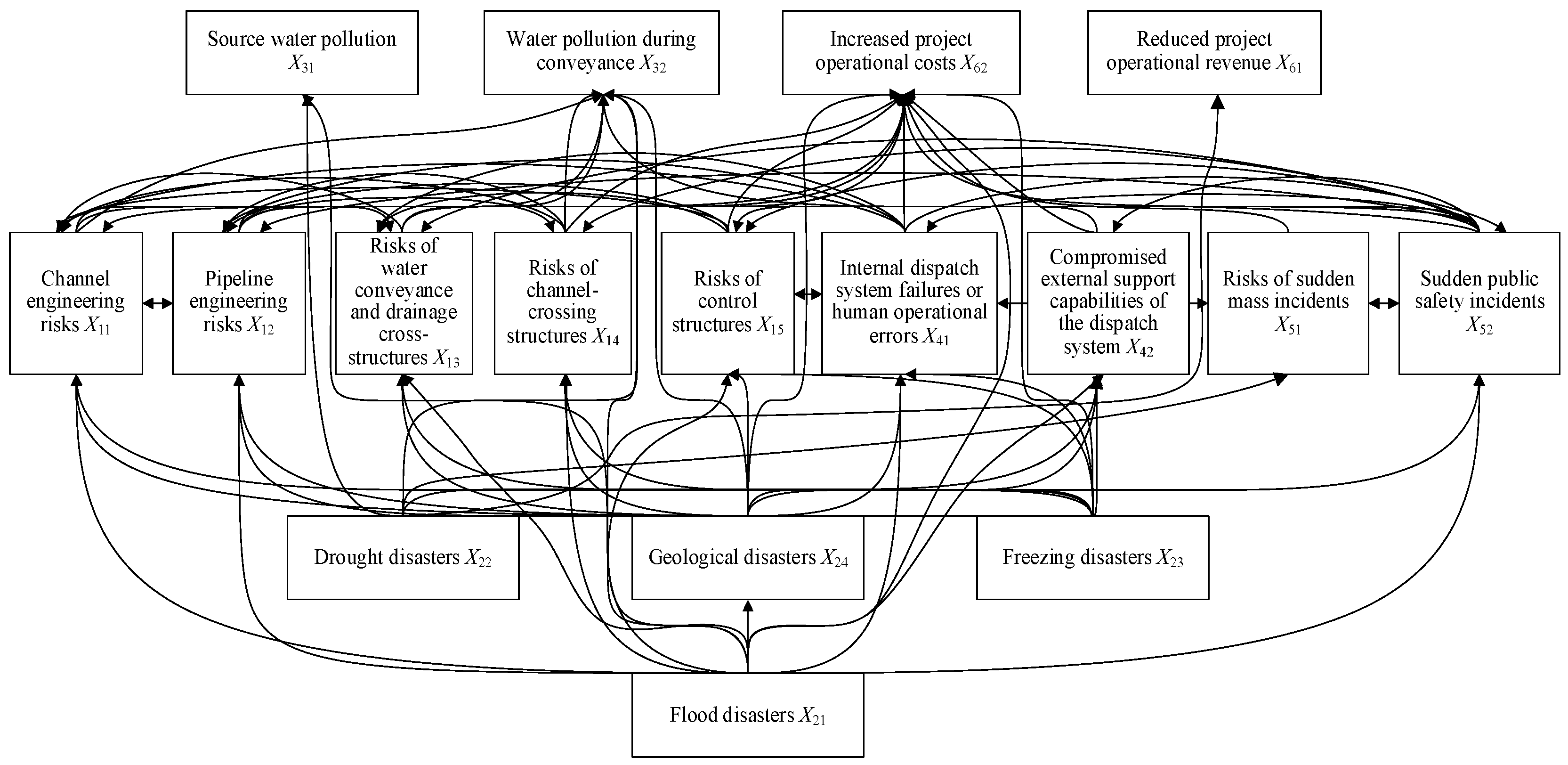
The primary objective of IBWTPs is to transfer water resources from water-abundant regions to water-scarce areas. Factors that impede the realization of this objective are considered operational safety risks for these projects. Through a comprehensive literature review and data analysis, the operational safety risks of IBWTPs are categorized into six dimensions: engineering risks, natural risks, water quality risks, operational scheduling risks, social risks, and economic risks [6], as illustrated in Figure 2.

3.3. Correlation Analysis Model for Safety Operation Risks in IBWTPs

3.3.1. Construction of Initial Risk Correlation Model Based on ISM

  • Risk Factor Adjacency Matrix;
In ISM-based analysis, the third-level risks associated with the safe operation of IBWTPs are treated as an integrated system. Let Si denote the i-th risk factor, where i = 1, 2, …, 17, corresponding sequentially to risks X11, X12, X13, X14, X15, X21, X22, X23, X24, X31, X32, X41, X42, X51, X52, X61, and X62. Based on this definition, an adjacency matrix A = [aij]17×17 can be constructed, where
a i j = 1 ,   S i   directly   affects   S j 0 ,   S i   doesn t   directly   affects   S j ( i , j   =   1 ,   2 ,   ,   17 )
The influence relationships among risks were determined through expert consultation involving professionals from institutions responsible for the construction and operation of IBWTPs. Given variations in experts’ knowledge and experience, the Delphi method was adopted to systematically and objectively integrate expert opinions in assessing risk correlations. The specific procedure was as follows: First, an anonymous questionnaire was distributed to the expert panel to determine whether a direct influence relationship existed between each pair of risk factors. Second, multiple rounds of feedback and iterative consultation were conducted. In each round, statistical results and major points of disagreement were anonymously fed back to all experts for reference. Experts then revised their judgments in subsequent rounds until opinions converged. Finally, an expert consensus threshold α (set to α = 0.8) was defined [67]. When the proportion of experts affirming a direct influence of risk Si on risk Sj is greater than or equal to α, a direct influence relationship is confirmed and aij = 1; otherwise, no direct influence relationship is identified and aij = 0.
2.
Risk Factor Attainment Matrix;
The reachability matrix formally describes whether a specific risk factor can influence another through direct or indirect pathways of a given length, thereby capturing the transitive propagation relationships among risks [68]. Based on the rules of Boolean matrix algebra, the reachability matrix M is derived from the adjacency matrix A through iterative computation, as defined by the following condition:
A + I A + I 2 A + I k = A + I k + 1
where I denotes the identity matrix.
Through successive Boolean exponentiation, the matrix stabilizes at step k. The resulting matrix (A + I)k yields the reachability matrix M, expressed as M = [rij]17×17. If rij = 1, a reachable path exists from risk Si to risk Sj, indicating that Si can influence Sj either directly or indirectly; conversely, if rij = 0, Si has no influence on Sj.
3.
Risk Factor Hierarchy Classification;
Based on the derived reachability matrix, a hierarchical classification of risks can be performed to elucidate the influence relationships among different risk factors. The reachability set, denoted as D(Si), consists of all risks corresponding to columns with matrix elements equal to 1 in the row associated with Si. Similarly, the antecedent set, denoted as H(Si), includes all risk factors corresponding to rows with matrix elements equal to 1 in the column associated with Si. The intersection of the reachability set and the antecedent set is defined as the common set, denoted as O(Si) = D(Si) ∩ H(Si).
The hierarchical structure of the overall risk system is denoted as L = {L1, L2, …, Lm}. During the hierarchical decomposition process, the condition O(Si) = D(Si) is adopted as the extraction criterion. All risk factors satisfying this condition constitute the first hierarchical level, L1. Subsequently, the risk factors identified in L1 are removed from the remaining set of variables, and the same criterion O(Si) = D(Si) is iteratively applied to identify the second hierarchical level, L2, and so forth. This iterative procedure continues until the hierarchical decomposition of all risk factors is complete.
4.
Establishment of Explanatory Structural Model;
Based on the hierarchical classification results derived from the reachability matrix and the adjacency relationships among the risk factors, an initial directed graph of the risk association model can be constructed.

3.3.2. Copula-Based Risk Dependency Structure Measurement

  • Copula Function;
Let F denote the joint distribution function of the random vector (X1, X2, …, Xn), with marginal distribution functions given by F1(x1), F2(x2), …, Fn(xn). According to Sklar’s theorem [66], there exists a copula function C such that
F x 1 , x 2 , , x n = C F 1 x 1 , F 2 x 2 , , F n x n
if F1(x1), F2(x2), …, Fn(xn) are continuous, then C is uniquely determined.
Conversely, if F1(x1), F2(x2), …, Fn(xn) are marginal distribution functions and C(u1, u2, …, un) is an n-dimensional copula function, then F(x1, x2, …, xn) defines a joint distribution function with marginal distributions F1(x1), F2(x2), …, Fn(xn).
From Equation (3), the copula function can be derived by applying the inverse marginal distribution functions to the joint distribution function:
C u 1 , u 2 , , u n = F F 1 1 x 1 , F 2 1 x 2 , , F n 1 x n
Taking the partial derivatives of both sides of Equation (3) yields the joint probability density function:
f ( x 1 , x 2 , x n ) = c ( F 1 ( x 1 ) , F 2 ( x 2 ) , , F n ( x n ) ) i = 1 n f i ( x i )
where c ( u 1 , u 2 , , u n ) = C ( u 1 , u 2 , , u n ) u 1 u 2 u n , u i = F i ( x i ) , f, c, and fi denote the probability density functions corresponding to the distribution functions F, C, and Fi, respectively.
2.
Risk Marginal Distribution Function;
(1)
Data Collection and Virtual Sample Generation
The collection of risk sample data primarily yields time-series observations representing the occurrence probabilities of various risk indicators. Due to the distinctive characteristics of IBWTPs, the volume of available operational safety risk data is typically limited. To address this limitation, virtual sample generation techniques are adopted to expand the effective sample size [69], following the steps outlined below.
Let the occurrence probability sample set of risk Si be denoted as Sit = {Si1, Si2, Si3,…, SiT}, where min(Sit) and max(Sit) represent the minimum and maximum values of the sample set, respectively. The central point CL of the sample set is calculated as:
C L = 1 2 min S i t + max S i t
The left skewness wL and right skewness wR of the sample data are determined by:
w L = N L N L + N R
w R = N R N L + N R
where NL and NR represent the number of samples in the dataset with values less than and greater than the central point CL, respectively. The lower bound LB and upper bound UB of the feasible region are calculated as:
L B = C L w L 2 S ^ S i t 2 / N L ln 10 20 L B min S i t min S i t L B > min S i t
U B = C L + w R 2 S ^ S i t 2 / N R ln 10 20         U B max S i t max S i t         U B < max S i t
where S ^ 2 denotes the variance of the sample set. The membership function value MF for a given is calculated as:
M F = S i t L B / C L L B         S i t C L U B S i t / U B C L     S i t > C L
Based on this, the triangular distribution F(Sit) for the occurrence probability of risk Si is determined as follows:
F S i t = L B , M B , U B
M B = max S i t       U B max S i t         P B                     U B = max S i t
where PB denotes the mode of the SiT sample set.
Virtual samples are then generated via Monte Carlo simulation by sampling from the triangular distribution models corresponding to each risk. These virtual samples are subsequently combined with the empirical samples to fit the marginal probability distributions. Finally, to ensure data validity, consistency checks are conducted on the generated virtual samples.
  • (2)
    Fitting and Selection of Marginal Distribution Models
The specification of marginal distributions directly influences the ability of copula functions to model the joint distribution of risks. Establishing an appropriate fit for the marginal distributions is a fundamental prerequisite for accurate copula estimation and constitutes the initial step in the modeling process. Commonly used marginal distributions in engineering risk analysis include the Generalized Extreme Value (GEV), Normal, Weibull, and Gamma distributions [70,71,72].
IBWTPs involve a diverse array of operational safety risks, each characterized by distinct statistical features and corresponding probability distributions. In this study, four candidate univariate distributions were selected to fit the 17 categories of operational risks associated with these projects. Model parameters were estimated using the maximum likelihood estimation method, followed by a Kolmogorov–Smirnov (K–S) test. In cases where multiple candidate distributions passed the K-S test, the Akaike Information Criterion (AIC), Bayesian Information Criterion (BIC), and the Ordinary Least Squares (OLS) method were further employed to evaluate the goodness-of-fit and determine the optimal marginal distribution [73].
3.
Copula Function Selection;
(1)
Copula Function Classification
Copula functions are broadly categorized into several distinct families. To capture the complex dependency structures among operational safety risks in IBWTPs, this study employs five widely used models from the Elliptical and Archimedean Copula families: the Gaussian, Student’s t, Gumbel, Clayton, and Frank copulas [74,75].
Within the Elliptical family, the Gaussian copula effectively characterizes symmetric dependence structures with asymptotic tail independence. In contrast, Student’s t copula captures symmetric tail dependence, making it highly suitable for modeling concurrent risks under extreme conditions [74]. Among the Archimedean copulas, the Gumbel copula is well-suited for asymmetric dependence structures exhibiting strong upper-tail dependence and lower-tail independence. Conversely, the Clayton copula is particularly effective for asymmetric distributions with strong lower-tail dependence. Finally, the Frank copula is applied to model symmetric dependencies across the entire distribution, particularly when tail dependence is weak or asymptotically independent [70,76].
  • (2)
    Copula Function Parameter Estimation
Let Xit denote the 17-dimensional observation vector of operational safety risks for IBWTPs at observation t, where i = 1, 2, …, 17 and t = 1, 2, …, T. The marginal cumulative distribution function and probability density function for the i-th risk are denoted by Fi(xi,αi) and fi(xi,αi), respectively, where αi represents the parameter vector of the i-th marginal distribution.
The joint distribution function is expressed as F(x1, x2, …, x17; α1, α2, …, α17), and its corresponding density function is f(x1, x2, …, x17; α1, α2, …, α17). The copula function is denoted by C(u1, u2, …, un; θ), with corresponding density function c(u1, u2, …, un; θ), where θ represents the copula parameter.
Based on Equation (5), the joint probability density function for a given observation t can be derived as:
f ( x 1 , x 2 , x 17 ; α 1 , α 2 , , α 17 ) = c ( F 1 ( x 1 , α 1 ) , F 2 ( x 2 , α 2 ) , , F 17 ( x 17 , α 17 ) ) i = 1 17 f i ( x i , α i )
Consequently, the log-likelihood function for the entire sample of T observations is formulated as:
ln L ( x 1 , x 2 , x 17 ; α 1 , α 2 , , α 17 ; θ ) = t = 1 T ( i = 1 17 ln f i ( x i t , α i ) + ln c ( F 1 ( x 1 t , α 1 ) ,   F 2 ( x 2 t , α 2 ) , , F 17 ( x 17 t , α 17 ) ; θ ) )
By maximizing the log-likelihood function in Equation (15)—specifically, by setting its partial derivatives with respect to the parameters αi and θ to zero ( ln L θ = 0 ,   ln L α i = 0 )—the maximum likelihood estimates for all parameters are obtained.
  • (3)
    Goodness-of-Fit Test for Copula Functions
Given the diverse combinations of operational safety risks in IBWTPs, selecting an optimal copula function is essential for accurately capturing their complex dependence structures. To identify the most suitable model from the candidate Copula families, rigorous goodness-of-fit tests must be conducted. In this study, quantitative analytical methods [77,78] are employed to systematically evaluate the goodness-of-fit tests for the selected copula functions.
4.
Risk Correlation Analysis;
Risk correlations are primarily characterized by correlation coefficients, which may exhibit linear, nonlinear, or tail-dependent properties. While linear correlation coefficients are commonly employed to assess relationships between variables in traditional studies, relationships between variables in practical applications often exhibit nonlinear dependencies. In such cases, rank correlation coefficients and tail dependence coefficients derived from copula functions can effectively characterize the underlying nonlinear dependence structure. Accordingly, this study integrates both rank correlation coefficients and tail dependence coefficients to comprehensively analyze the correlations among the occurrence probabilities of operational safety risks in IBWTPs.
  • (1)
    Rank correlation coefficient
Previous studies have demonstrated that applying strictly monotonic transformations to continuous random variables does not alter the correlation measures obtained from Copula functions. These correlation measures serve as measures of concordance, providing greater rigor and reliability compared to linear correlation coefficients [79,80]. Correlation metrics that assess relationships from a concordance perspective are generally referred to as rank correlation coefficients, primarily including Kendall’s τ, Spearman’s ρ, and the Gini correlation coefficient γ.
Kendall’s rank correlation coefficient
Let (X1, Y1) and (X2, Y2) be independent and identically distributed random variable pairs. The Kendall rank correlation coefficient τ is defined as follows [81,82]:
τ = P ( ( X 1 X 2 ) ( Y 1 Y 2 ) > 0 ) P ( ( X 1 X 2 ) ( Y 1 Y 2 ) < 0 )
From Equation (16), it follows that −1 ≤ τ ≤1. When τ = 1, the two random variables are perfectly positively correlated; when τ = −1, they are perfectly negatively correlated; and when τ = 0, the correlation is effectively absent. If the joint copula function of continuous random variables X and Y is denoted by C(u, v), then τ can be expressed in terms of the copula function, where u and v represent the marginal cumulative distribution functions of X and Y, respectively [83].
τ = 4 0 1 0 1 C ( u , v ) d C ( u , v ) 1
Spearman’s rank correlation coefficient
The Spearman rank correlation coefficient ρ is another concordance-based dependence measure [81]. Let (X1, Y1), (X2, Y2), and (X3, Y3) be independent and identically distributed random variable pairs. The Spearman rank correlation coefficient ρ is defined as:
ρ = 3 ( P ( ( X 1 X 2 ) ( Y 1 Y 3 ) > 0 ) P ( ( X 1 X 2 ) ( Y 1 Y 3 ) < 0 ) )
The coefficient ρ can also be represented by a copula function:
ρ = 12 0 1 0 1 u v d C ( u , v ) 3   = 12 0 1 0 1 ( C ( u , v ) u v ) d u d v
Furthermore, the relationship between the Spearman rank correlation ρ and the Kendall rank correlation coefficient τ (under certain copula families) is approximately:
3 τ 1 2 ρ 1 + 2 τ τ 2 2 , τ 0 τ 2 + 2 τ 1 2 ρ 1 + 3 τ 2 , τ < 0
Gini correlation coefficient
The Gini correlation coefficient γ quantifies concordance in both the direction and the magnitude of variation between variables [79]. Let (pi, qi) denote the ranks of the i-th sample (xi, yi) of the random variables X and Y, where I = 1, 2, …, n. The Gini correlation coefficient γ is defined as:
γ = 1 int ( n 2 / 2 ) ( i = 1 n p i + q i n 1 i = 1 n p i q i )
where int(·) denotes the integer function. The Gini coefficient can be expressed using copula functions:
γ = 2 0 1 0 1 ( u + v 1 u v ) d C ( u , v )
  • (2)
    Tail dependence coefficient
The tail dependence coefficient is a metric used to quantify extreme dependence between variables based on copula functions. For instance, the conditional probability P(Y > y | X > x) represents the likelihood that the variable Y exceeds y given that X exceeds x. Similarly, P(Y < y | X < x) represents the probability that Y falls below y given that X falls below x. These scenarios correspond to the upper-tail and lower-tail dependence between X and Y, respectively [84].
Let FX and FY be the marginal distribution functions of continuous random variables X and Y. Tail dependence is formally defined as the limit of quantile conditional probabilities in the tail regions. The lower-tail dependence coefficient λLo is defined as:
λ L o = lim α 0 + P ( Y < F Y 1 ( α ) | X < F X 1 ( α ) )
If λLo ∈ (0, 1], the variables X and Y are asymptotically dependent in the lower tail; conversely, if λLo = 0, they are asymptotically independent in the lower tail. Using the copula function C(u, v), this coefficient can be equivalently expressed as:
λ L o = lim u 0 + C ( u , u ) u
Similarly, the upper tail dependence coefficient λup is defined as:
λ u p = lim u 1 P ( Y > F Y 1 ( u ) | X > F X 1 ( u ) ) = lim u 1 1 2 u + C ( u , u ) 1 u
If λup ∈ (0, 1], X and Y are asymptotically dependent in the upper tail; if λup = 0, they are asymptotically independent.

3.4. Integration and Network Construction of Safety Operation Risk Correlations for IBWTPs

  • Risk Correlation Integration;
Risk correlation aggregation refers to the process of inferring interrelationships among secondary (system-level) risks based on the dependencies among risks within subsystems. The specific pairwise correlations determined in Section 3.3 represent horizontal associations among third-level risks. Associations at the secondary level can be inferred based on the principle that “if probabilistic influence exists between constituent subsystems, a corresponding probabilistic influence exists between their respective parent systems.”
The strength of influence at the secondary level can be quantified based on both the probabilistic influence intensity among third-level risks and their relative importance. Let wij denote the influence degree of the i-th third-level risk factor in secondary risk X1 on the j-th third-level risk factor in secondary risk X2. Let wj1max denote the maximum influence degree of all third-level risk factors in X1 on the j-th risk factor in X2. Let βj denote the relative importance of the j-th risk factor to X2. The overall aggregated influence degree Q12 of X1 on X2 can be expressed as follows:
Q 12 = j w j 1 max β j
where βj can be determined using conditional probability [6].
2.
Topological Network Construction;
The preceding section established horizontal interconnections among risks within the same hierarchical level. Figure 2 illustrates the vertical relationships among risks across different hierarchical levels. By integrating both horizontal and vertical risk associations, the topological network structure of systemic risk interconnections can be derived. The resulting risk association topological network can be visualized and further analyzed using UCINET 6 software.

4. Case Study

4.1. Project Overview

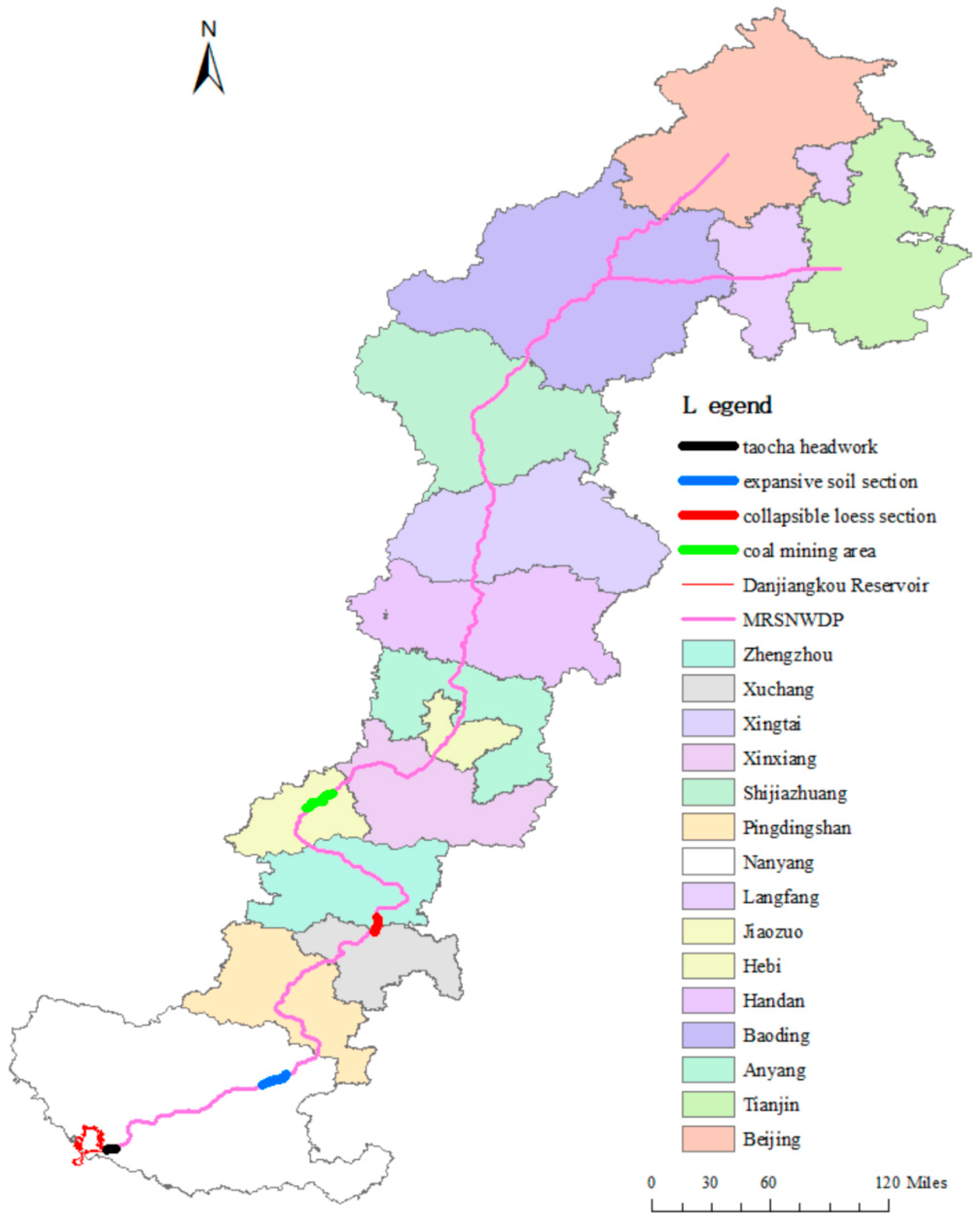
The first phase of the MRSNWDP is a pivotal inter-basin water transfer initiative in China. Originating from the Taocha Headwork of the Danjiangkou Reservoir, the project traverses four major river basins: the Yangtze, Huai, Yellow, and Hai River basins. The main canal spans a total length of 1432 km, passing through Henan and Hebei provinces before terminating in the municipalities of Beijing and Tianjin. Since its commissioning in 2014, the project has cumulatively diverted over 75 billion cubic meters of water.
The conveyance route is characterized by complex geological conditions, traversing regions with expansive soils, collapsible loess, and abandoned coal mine goafs. The engineering infrastructure comprises a diverse array of conveyance and control structures—including open canals, pipelines, regulating gates, siphons, and aqueducts—which are extensively intersected by numerous road and railway bridges.
The project area experiences a warm-temperate monsoon climate, marked by pronounced spatiotemporal variability in precipitation. Notably, the water quality at the Danjiangkou Reservoir source consistently meets or exceeds China’s Class II surface water quality standards (GB 3838-2002) [85]. Operating under a unified dispatching model, the MRSNWDP serves as a critical water supply source for 27 large and medium-sized cities along its route, serving a population of approximately 120 million. Consequently, its operational safety is inextricably linked to regional socioeconomic stability and water resource security. A schematic diagram of the study area is presented in Figure 3.

4.2. Construction and Analysis of the Risk Association ISM Model

  • Risk correlation analysis;
For the 17 third-level risks identified in Figure 2, a panel of 20 experts from the construction and management units of the MRSNWDP was invited to participate. The experts were provided with detailed explanations of each risk indicator, after which they assessed whether a direct probabilistic influence existed between each pair of risks.
Regarding the composition of the expert panel, ten held senior engineer titles and ten held intermediate engineer titles. Seven experts were affiliated with the China South-to-North Water Diversion Group Central Route Co., Ltd (Beijing, China)., nine were affiliated with its Henan Branch (Zhengzhou, China), and four with its Hebei Branch (Shijiazhuang, China). Notably, all experts had more than five years of experience in the operational management of the MRSNWDP.
Following three rounds of consultation and feedback, the level of consensus among the experts consistently exceeded the predefined threshold of 0.8. The integration of evaluations from all 20 experts yielded preliminary risk correlations. Subsequently, the adjacency matrix representing the relationships among the risk factors was derived using Equation (1), and the reachability matrix was computed using Equation (2). Based on the reachability matrix, the relationships among the factors were structured into reachability, antecedent, and common sets, as presented in Appendix A and Table 1.
Based on the risk stratification criterion (O(Si) = D(Si)), the 17 risks can be categorized into four hierarchical levels: Level 1 L1 = {S10, S11, S16, S17}, Level 2 L2 = {S1, S2, S3, S4, S5, S12, S13, S14, S15}, Level 3 L3 = {S7, S8, S9}, and Level 4 L4 = {S6}.
2.
Construction and Analysis of the ISM Model;
Based on the hierarchical classification derived from the reachability matrix and the established risk correlations, an ISM of operational safety risks in the first phase of the MRSNWDP was constructed, as illustrated in Figure 4. This ISM comprises four distinct hierarchical levels:
The first level (top level) includes source water quality risks (X31), water quality contamination during conveyance (X32), reduced project operational benefits (X61), and increased project operational costs (X62).
The second level encompasses channel engineering risks (X11), pipeline engineering risks (X12), risks associated with cross-structures (X13), risks associated with channel-crossing structures (X14), control structure risks (X15), internal dispatch system failures or human operational errors (X41), and compromised external dispatch system support capabilities (X42), risks of sudden mass incidents (X51) and sudden public safety incidents (X52).
The third level consists of drought disasters (X22), freezing disasters (X23), and geological disasters (X24).
The fourth level (bottom level) consists exclusively of flood disasters (X21).
As illustrated in Figure 4, risks within the first level represent surface-level direct factors, while those in the second level correspond to intermediate driving factors. Conversely, risks located in the third and fourth levels constitute deep-seated fundamental drivers. Dynamic interactions occur among these risks across the different hierarchical levels.
Water quality constitutes a critical indicator for the safe operation of IBWTPs. Contamination at the source or during conveyance can cause the delivered water to fail to meet designated usage standards in recipient regions. Furthermore, operational revenue generated by water diversion projects is essential for sustaining effective management. Increases in operating costs or reductions in revenue can reduce the commitment of operating entities, thereby jeopardizing the long-term viability of the project.
Regarding engineering risks, structural failures often trigger cascading effects. For channel engineering, excessively high water levels can propagate upstream. This process elevates water levels within conveyance structures and pipeline systems, thus threatening overall structural integrity. Additionally, damage to slope protection measures facilitates sewage intrusion, resulting in potential water quality degradation during conveyance. Channel leakage may also inundate adjacent areas, leading to public safety incidents such as traffic accidents or personnel falling into the channel. Similarly, pipeline engineering risks exhibit strong propagation characteristics. Pipeline damage that reduces flow capacity can induce upstream backwater effects, while pipeline ruptures or leaks can compromise the structural integrity of crossing structures and lead to contamination via sewage infiltration.
In terms of cross-structures, the blockage of drainage or sewage channels frequently leads to sewage accumulation and subsequent seepage into the main channel, severely degrading water quality. Concurrently, excessive flow can scour and compromise channel slopes. For channel-crossing structures, a ruptured pipeline falling into the waterway not only damages the channel structure but also directly causes contamination. Furthermore, damage to pipelines traversing beneath the channel can compromise the load-bearing capacity of the overlying soil, potentially inducing differential settlement of both the channel and the pipeline.
As for control structures, gate malfunctions frequently result in upstream water backups, directly jeopardizing the safety of the entire conveyance system. Failures of electrical equipment can induce cascading failures in the dispatch system. Moreover, internal failures within the dispatch system can trigger abnormal responses in gates or pump stations, further endangering the infrastructure. Human operational errors trigger public safety incidents, including fires. External anomalies in power or information systems can severely damage the dispatch system and its associated electromechanical equipment.
Social risks are closely intertwined with natural and engineering factors. Insufficient water availability can trigger sudden large-scale incidents, such as water rights disputes. These conflicts can escalate public dissatisfaction, potentially leading to the deliberate sabotage of engineering facilities or intentional contamination. Sudden public safety hazards, including terrorist attacks, can simultaneously compromise structural and dispatch system integrity. They can also cause severe water pollution. Furthermore, accidents such as personnel falls or traffic incidents near channels can trigger public outrage, which may rapidly escalate into broader social crises.
Natural hazards serve as deep-seated driving factors. Drought events at water sources reduce water availability, thereby diminishing the economic and social benefits of the diversion project. When droughts concurrently affect water-receiving regions, the resultant surge in water demand can precipitate severe social conflicts over water allocation. Furthermore, drought conditions promote pollutant stagnation; subsequent rainfall events can flush these accumulated pollutants into reservoirs or channels, exacerbating water quality degradation. Flood events and geological hazards directly compromise engineering structures, leading to facility damage and potential contamination. These hazards also impair external power and communication systems, thereby disrupting project operations. Notably, floods occurring in geologically unstable regions frequently induce secondary disasters, such as debris flows. Finally, freezing events cause frost heave damage to concrete structures, and freeze–thaw cycles near water surfaces severely undermine the integrity of slope linings. Such extreme cold conditions can also cause electromechanical equipment to malfunction, jeopardizing the operational safety of the entire system.
Ultimately, with the exception of drought events, direct water quality contamination, and reduced operational revenue, the manifestation of all other identified risks invariably leads to increased operational costs for the project.

4.3. Risk Interdependence Structure Measurement and Analysis

4.3.1. Risk Sample Data

  • Sample Data Collection;
The primary data collection relied on historical materials, including literature and official reports such as the China SNWDP Construction Yearbook [86], the SNWDP Flying Inspection Report [87], the MRSNWDP Safety Risk Assessment Report [88], and the SNWDP Operational Safety Inspection Technology Research and Demonstration Project Report [89]. The collected risk data underwent rigorous consistency verification prior to analysis [6].
2.
Virtual Sample Generation;
Given the limited operational duration of the project and the correspondingly small volume of observational data, a simulated dataset comprising 992 samples was generated to validate the methodology proposed in this study. The simulation employed information diffusion techniques combined with Monte Carlo methods, using the historical operational data collected from 2020 to 2025 as the baseline.
3.
Virtual Sample Validity Test;
Validating the generated virtual samples is a critical prerequisite for ensuring that subsequent copula-based analyses accurately capture the true dependence structures among the risks. To prevent data distortion during the sample augmentation process, this study evaluates the generated virtual dataset across two dimensions: (i) the consistency of the marginal distributions and (ii) the preservation of correlation structures.
  • (1)
    Marginal Distribution Consistency Check
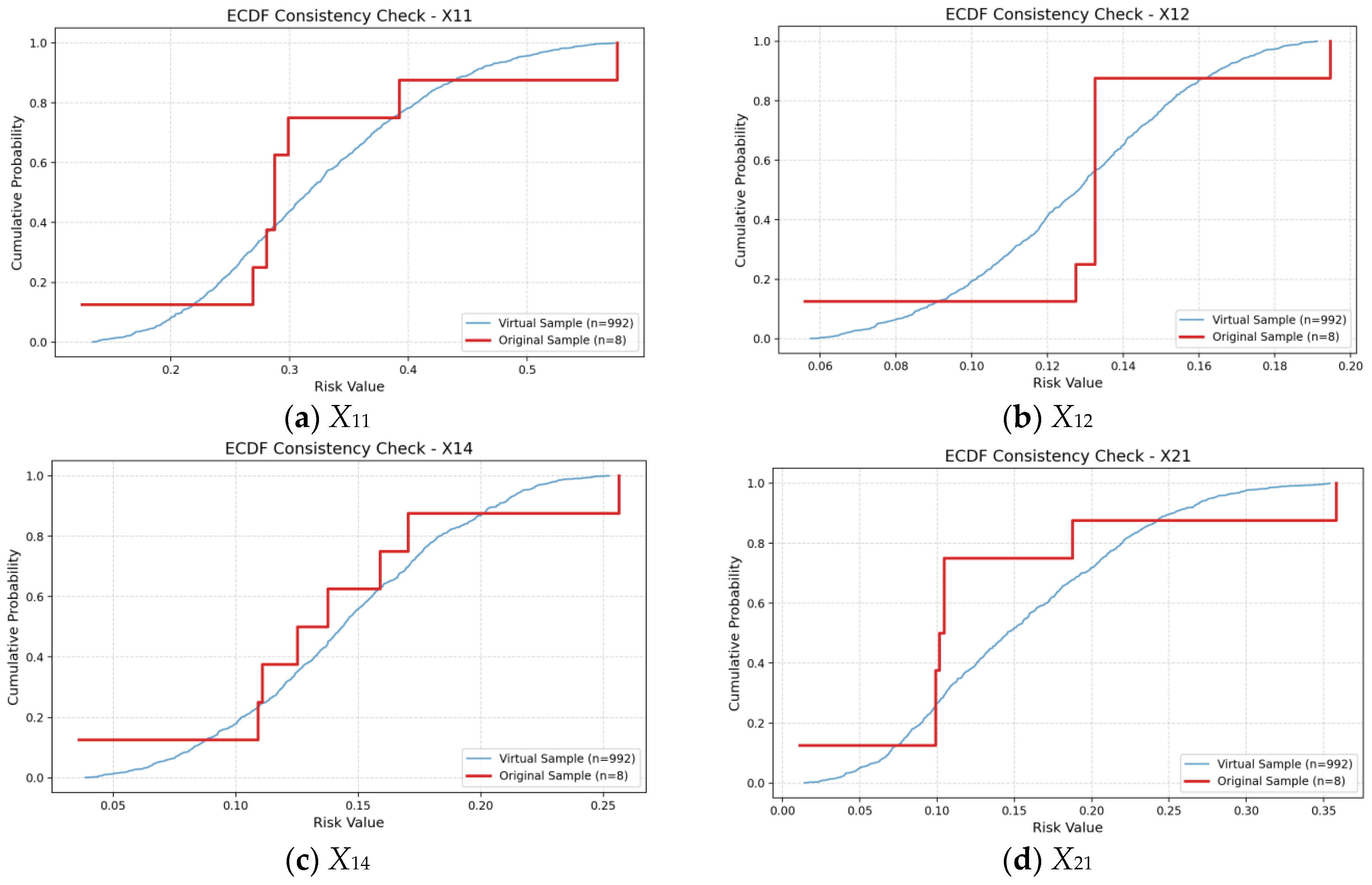
The two-sample K-S test was employed to assess whether the virtual samples preserve the distributional characteristics of the original risk datasets. By comparing the empirical cumulative distribution functions (ECDFs) of the original and virtual samples, the K-S test yielded p-values exceeding the significance level of 0.05 for all risk factors. These results indicate that, at a 95% confidence level, the virtual and original samples can be considered to follow the same distribution. In other words, no statistically significant deviation was observed between the generated virtual samples and the original dataset. The results of these sample consistency tests are summarized in Table 2.
Among these, the sample consistency test results for X11, X12, X14, and X21 are particularly representative. The specific ECDF comparisons are shown in Figure 5.
The K-S test for X21 yielded a p-value of 0.0506. Although this value closely approaches the 0.05 significance threshold, it indicates no statistically significant difference between the empirical distributions of the virtual and original samples. Given the inherent complexity of operational risk data in IBWTPs and the limited sample size, this result confirms the validity and robustness of the augmented dataset. Furthermore, the graphical comparison in Figure 5d shows that the distribution of the virtual samples for X21 closely aligns with that of the original dataset.
  • (2)
    Associative Structure Consistency Test
To verify that the generated virtual samples do not distort the inherent dependence structure of the original system, this study further employs Kendall’s rank correlation coefficient (τ), a robust non-parametric measure of dependence. Core risk pairs exhibiting typical causal transmission relationships were selected for comparative analysis. These include the impacts of flood disasters and geological hazards on channel engineering risks and cross-structure risks.
Kendall’s τ values were computed for these pairs using both the original dataset and the augmented virtual dataset. The results demonstrate that the relative deviations in Kendall’s τ between the two datasets remain below 10% across all cases, with the majority falling under 5%. These findings, detailed in Table 3, confirm that the virtual sample generation process successfully preserves the original risk correlation structures, thereby providing a reliable data foundation for subsequent copula modeling.
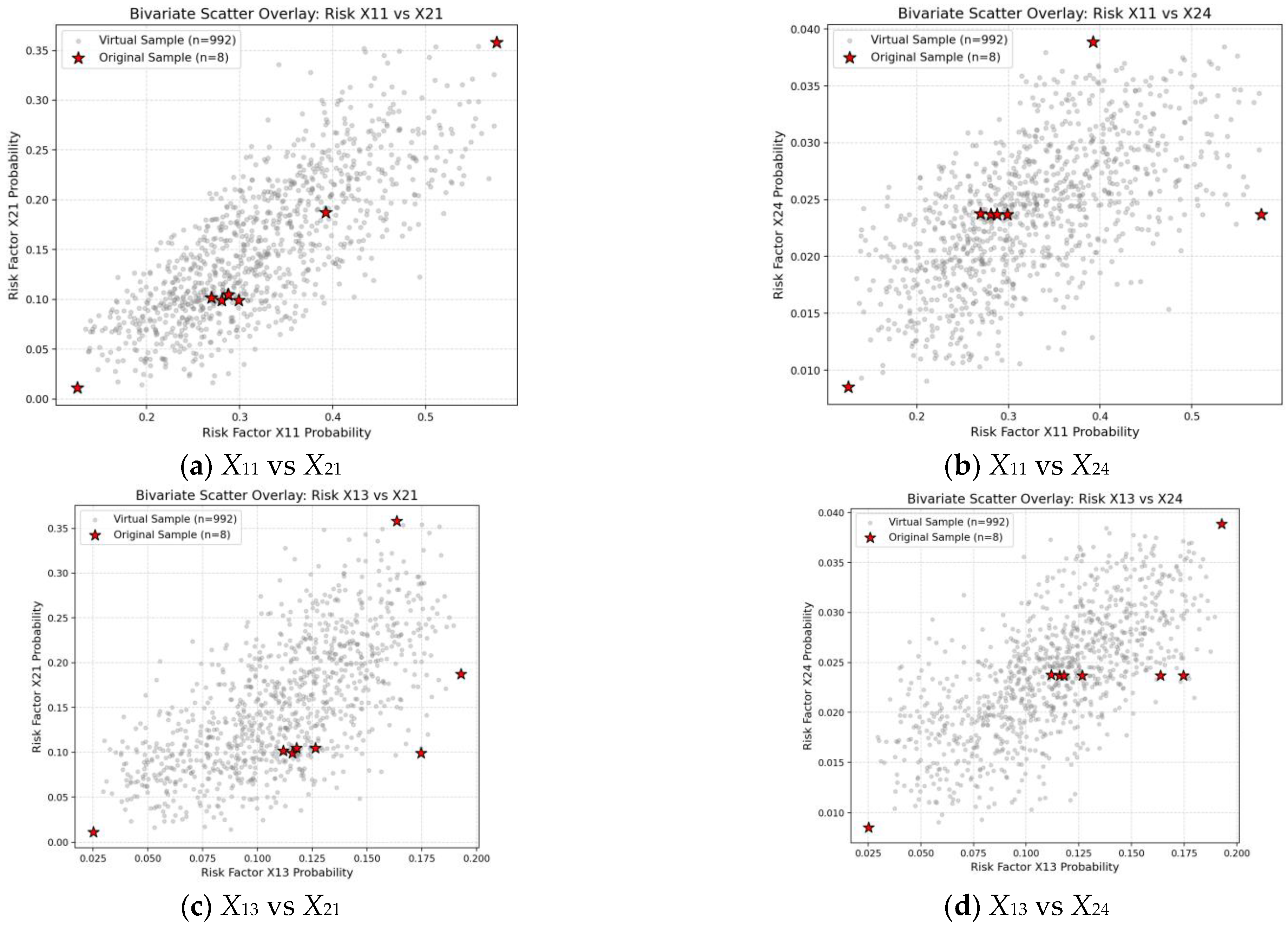
Furthermore, bivariate scatter plots of the selected risk pairs are presented in Figure 6 to provide an intuitive visual comparison. The point cloud generated from the augmented dataset effectively mitigates the spatial sparsity of the original sample, thereby forming a continuous and well-defined joint distribution. More importantly, the principal axis of the distribution and the centroid of the probability density in the augmented dataset remain highly consistent with those of the original data.
In summary, the virtual samples generated through the integration of global trend diffusion techniques and Monte Carlo simulations successfully preserve the complex nonlinear dependence structures inherent in the original engineering risk data. Consequently, this approach establishes a robust empirical foundation for subsequent copula function fitting and comprehensive risk correlation analyses.

4.3.2. Marginal Distribution Fitting

Based on a statistical foundation of 1000 samples—comprising 8 historical observations and 992 simulated virtual samples—four univariate distribution functions were selected as candidate models. The K-S test was applied to assess the goodness-of-fit of these candidate functions for the 17 operational risk factors. The results indicated that for 13 of the risk factors, only a single distribution function passed the K-S test, either the Gamma, Weibull, or Normal distribution.
Specifically, multiple distributions satisfied the K-S test criteria for four risk factors. Both the Weibull and Normal distributions proved suitable for channel engineering risks (X11), while the Normal and Gamma distributions were suitable for flood disasters (X21) and freezing disasters (X23). Furthermore, all four candidate distributions (GEV, Normal, Weibull, and Gamma) passed the K-S test for source water quality risks (X31).
To resolve these ambiguities and identify the most accurate models, further goodness-of-fit evaluations were conducted using the AIC, BIC, and RMSE. Based on these assessments, the optimal marginal distribution for each risk factor was conclusively determined, as presented in Table 4.
As shown in Table 4, the optimal marginal distribution fitting indicates that:
First, among the 17 third-level operational safety risks, the Gamma distribution is the predominant optimal marginal distribution (11 risks), followed by the Weibull (3 risks), and the Normal distribution (3 risks). This finding indicates that the occurrence probabilities of most operational risks in IBWTPs follow a skewed distribution. This pattern is consistent with the inherent characteristics of engineering risks, namely low probability and asymmetry [90,91,92].
Second, engineering risks (X11X15), social risks (X51X52), and economic risks (X61X62) are best described by Gamma or Weibull distributions. These risks are influenced by engineering structural characteristics and human factors, resulting in high variability in occurrence probabilities and pronounced skewness. Therefore, the Gamma and Weibull distributions are more suitable for capturing their asymmetric distributional characteristics.
Third, among natural risks (X21X24), water quality risks (X31X32), and operational risks (X42), flood disasters (X21) and geological disasters (X24) follow the Gamma distribution, while freezing disasters (X23) and source water pollution (X32) follow the Normal distribution. This can be attributed to the influence of natural environmental conditions and water quality control measures, which result in more symmetrical fluctuations in occurrence probabilities for certain risks. Consequently, the Normal distribution provides a better fit for these patterns.
Finally, the parameters of the optimal marginal distributions vary significantly across risks. This reflects substantial differences in the dispersion and central tendency of their occurrence probabilities, and further confirms the necessity of fitting marginal distributions individually for each risk.
These results indicate that the marginal distributions of the risk variables exhibit pronounced non-normality and heterogeneity. Traditional linear correlation methods are insufficient to characterize their dependency structures. This further demonstrates the necessity of employing Copula functions for dependence modeling.

4.3.3. Copula Function Fitting and Selection

Drawing upon the established risk association and the augmented sample data, five candidate copula functions—Gaussian, Student’s t, Gumbel, Clayton, and Frank—were fitted to analyze the bivariate dependency structure among risks. This process aimed to identify the optimal copula model for each specific risk pair. The parameters of each candidate copula function were estimated using maximum likelihood estimation. Subsequently, the goodness-of-fit was evaluated using the AIC, BIC, and RMSE, with smaller values indicating a superior model fit. The final selection of optimal Copula functions includes 52 Gaussian copulas, 1 Clayton copula, and 18 Gumbel copulas.

4.3.4. Risk Correlation Analysis

Based on the optimal Copula functions identified previously, the risk correlation coefficients were calculated in accordance with Equations (16)–(25). These coefficients provide a quantitative basis for analyzing the complex interdependencies among operational risks. The resulting correlation matrix is detailed in Table 5.
As shown in Table 5, the interrelationships among the 17 identified risks are quantified and categorized as follows:
The correlation coefficients for risk pairs X11X41, X13X41, X21X52, X24X41, X24X52, X41X62, and X42X62 are below 0.1, indicating negligible correlation. Risk pairs X11X12, X11X13, X11X15, X11X52, X11X62, X12X14, X12X15, X12X23, X12X32, X12X41, X12X52, X13X15, X13X23, X13X32, X13X52, X14X23, X14X32, X14X52, X14X62, X15X42, X15X52, X21X24, X21X41, X21X42, X21X62, X22X31, X22X51, X22X61, X23X62, X24X62, X41X52, X42X52, and X51X62 exhibit coefficients ranging from 0.1 to 0.2, representing weak correlation. Coefficients between 0.2 and 0.4 denote moderate correlation. This is observed in pairs X11X14, X11X23, X11X32, X12X62, X13X62, X14X21, X15X21, X15X23, X15X41, X15X62, X21X31, X21X32, X22X32, X22X42, X23X41, X23X42, X24X32, X24X42, X32X52, X41X42, X42X51, X51X52, and X52X62. Finally, risk pairs X11X21, X11X24, X12X21, X12X24, X13X21, X13X24, X14X24, and X15X24 exhibit strong correlation, with coefficients exceeding 0.4.
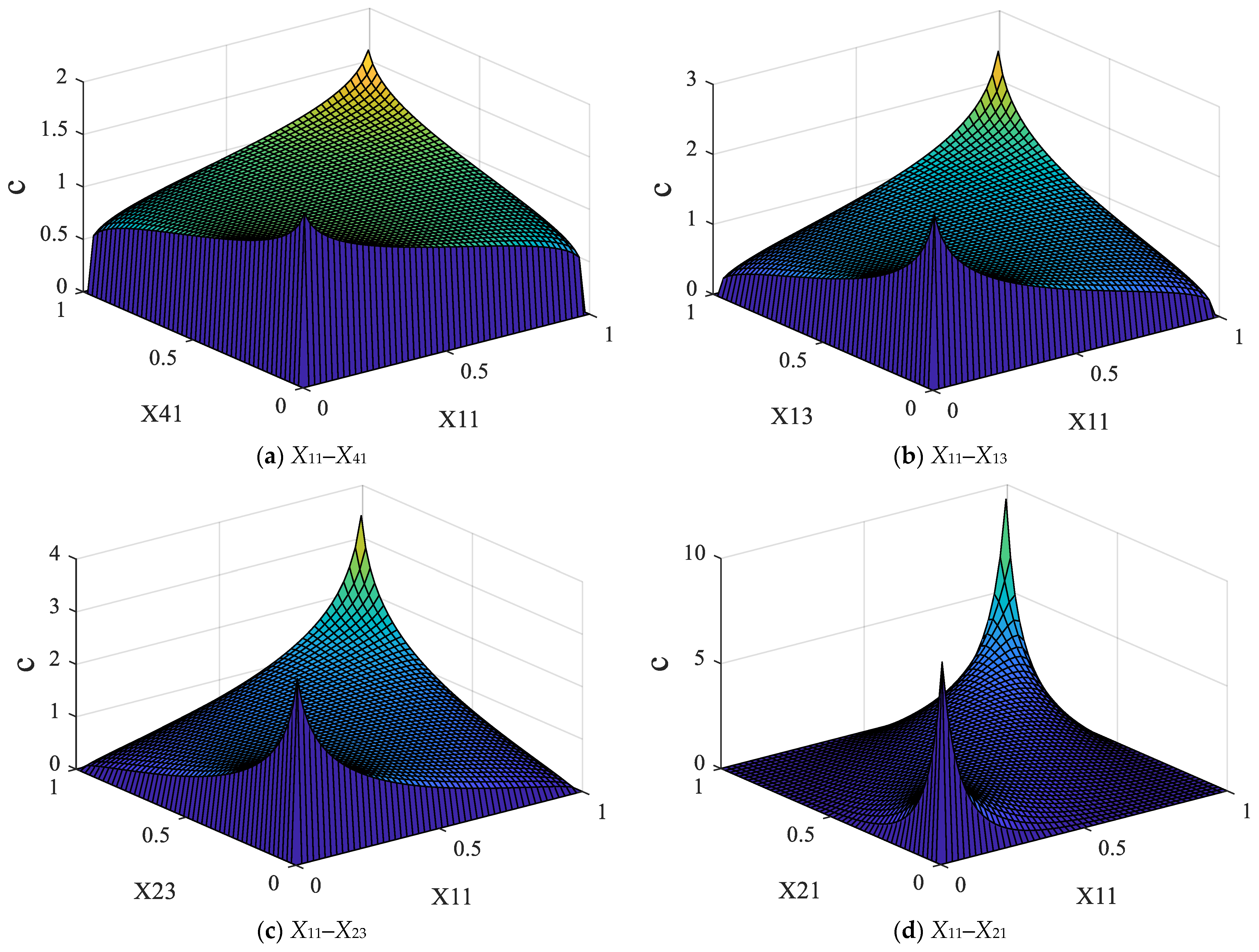
To visualize these dependency structures, the joint copula functions of four representative risk pairs X11X41, X11X13, X11X23, and X11X21 were selected for detailed analysis. The corresponding three-dimensional copula density functions are presented in Figure 7.
As illustrated in Figure 7, the copula probability density surface for the risk pair X11X41 is relatively flat and uniform, indicating negligible correlation. The distribution for X11X13 exhibits slight fluctuations and appears more structured than that of X11X41, which denotes weak correlation. Conversely, the density distribution of X11X23 displays distinct localized peaks, indicating moderate correlation. Finally, the distribution for X11X21 is highly clustered and sharply peaked along the diagonal, confirming a strong dependence between these risks.

4.4. Risk Network Topology

  • Risk Correlation Integration;
Previous sections established the horizontal interrelationships among third-level risks. Based on the risk correlation aggregation criteria defined earlier, the directed interrelationships among the second-level risks were determined, as presented in Table 6.
As shown in Table 6, the directed correlation coefficient for X2X1 is 0.6155, indicating a strong correlation. The coefficients for the directed risk pairs X2X3, X2X4, X1X3, X1X6, and X5X6 range from 0.2 to 0.3, indicating moderate correlations. Furthermore, the correlation coefficients for X1X4, X2X6, X5X1, X5X4, X5X3, X4X5, and X1X5 fall between 0.1 and 0.2, indicating relatively weak correlations. Finally, the influence coefficients for X4X1 and X2X5 are below 0.1, indicating negligible correlation.
2.
Topological Network Structure of Risk Associations;
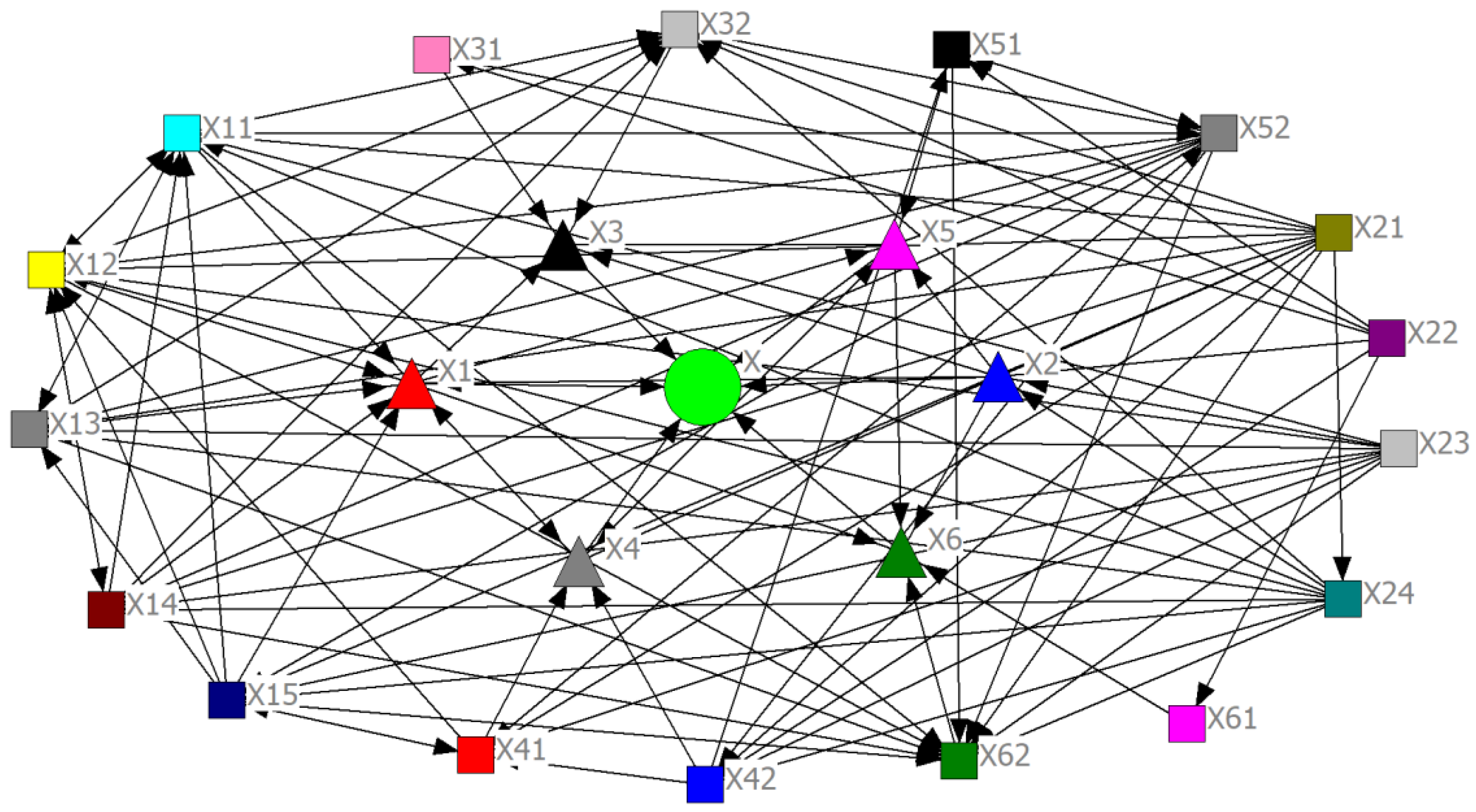
Based on these established correlations, a directed topological network of risk associations was constructed and visualized using UCINET, as illustrated in Figure 8.
The constructed topological network of operational safety risks in IBWTPs is a directed and weighted graph comprising 6 s-level nodes, 17 third-level risk nodes, and 92 directed edges (representing causal interdependencies). The network exhibits an average path length of 1.67, a density of 0.26, and an average clustering coefficient of 0.28. These metrics indicate pronounced small-world characteristics, reflecting an efficient mechanism for risk propagation across the system.
Furthermore, three core risk propagation pathways were identified within the network: (1) Natural risks → Engineering risks → Economic risks (X2X1X6); (2) Natural risks → Dispatch and operational risks → Social risks (X2X4X5); and (3) Engineering risks → Water pollution risks → Economic risks (X1X3X6).
Among these pathways, the first exhibits the highest cumulative correlation weight, making it the primary focus for proactive risk prevention and control. Ultimately, the constructed topological network effectively elucidates the complex propagation patterns of operational risks in IBWTPs. It thus establishes a robust quantitative foundation for targeted risk mitigation strategies.

4.5. Results

4.5.1. Analysis of Results

Based on the comprehensive correlation analysis of operational safety risks in the MRSNWDP, the interaction mechanisms among risks are identified and can be summarized as follows:
A horizontal correlation analysis of the three-level risk framework identified 71 risk pairs exhibiting causal relationships. Floods, droughts, freezing disasters, and geological disasters are classified as natural causal risks. With the exception of geological disasters, which are influenced by floods, these natural risks operate largely independently of other categories and serve as primary driving factors. Specifically, floods influence 11 subsequent risks, droughts affect 5, freezing disasters affect 8, and geological disasters affect 8. Conversely, water quality risks (both source water pollution and contamination during conveyance) and economic risks (reduced operational revenue and increased operational costs) are classified as outcome-oriented risks. Their occurrence probabilities are dictated by antecedent risks. However, they do not exert reciprocal influence on other factors. For instance, source water pollution is driven by two risks (floods and droughts), while contamination during conveyance is affected by eight. Reduced operational revenue is solely influenced by droughts, whereas increased operational costs are impacted by ten distinct risks. Furthermore, engineering risks, dispatch and operational risks, and social risks are categorized as transitional risks. They exhibit bidirectional influence, acting as both receptors and drivers of risk propagation.
Regarding correlation strength at the third level, eight risk pairs exhibit strong correlations (τ > 0.4). Floods strongly influence channel engineering risks, pipeline engineering risks, and the risks of water conveyance/drainage cross-structures, with correlation coefficients of 0.6501, 0.6839, and 0.5479, respectively. Similarly, geological disasters significantly impact five specific engineering risk factors, with correlation coefficients of 0.5055, 0.4791, 0.5596, 0.5204, and 0.5298. Among the remaining pairs, 23 exhibit moderate correlations (0.2–0.4), 33 show weak correlations (0.1–0.2), and 7 exhibit negligible correlations (below 0.1).
Integrated risk correlation analysis further elucidated the interrelationships among second-level risks. Engineering risks are influenced by natural, operational scheduling, and social risks. They also propagate impacts to water quality, operational scheduling, social, and economic risks. Natural risks exert unidirectional influence on the other five risk categories but remain unaffected by them. Water quality and economic risks are influenced by engineering, natural, and social risks, and act solely as endpoints in the risk network. In terms of correlation strength, natural risks exert the most profound influence on engineering risks, manifesting a correlation coefficient of 0.6155. The directed impacts of engineering risks on water quality risks, natural risks on water quality risks, natural risks on operational scheduling risks, engineering risks on economic risks, and social risks on economic risks range from 0.2 to 0.3. These values indicate moderate correlations. The impacts of operational scheduling risks on engineering risks, as well as natural risks on social risks, are below 0.1, indicating negligible correlation. Correlations among other risk pairs range from 0.1 to 0.2, reflecting weak associations.
Overall, the operational safety risks of the MRSNWDP are highly interconnected, forming a complex and dynamic risk network. When upstream risks act as causal drivers and downstream risks as consequences, the manifestation of causal risks significantly amplifies the likelihood of consequential failures. This, in turn, increases the complexity of systemic risk management. These findings offer a novel quantitative perspective for devising mitigation strategies: managing inter-risk correlations or disrupting causal transmission pathways from source risks to consequential risks, thereby fundamentally mitigating the likelihood of cascading failures.

4.5.2. Comparative Analysis with Existing Methods

To further evaluate the applicability of the proposed model to IBWTPs, a comparative analysis was conducted against the standalone ISM model, the standalone copula model, and conventional linear correlation methods.
  • Comparative Analysis with the ISM Model;
A comparative analysis revealed that the standalone ISM model initially identified 71 risk pairs exhibiting causal influence. However, following the integration of Copula functions to enable objective quantitative assessment, it was observed that of the 71 initially identified pairs, only 8 pairs exhibited strong correlations (correlation coefficients > 0.4). Additionally, 23 pairs displayed moderate correlations, and 7 pairs had correlation coefficients below 0.1. These results indicate that reliance on the ISM model alone may produce associations that appear logically coherent but lack statistical support. The proposed ISM–Copula model employs precise quantitative measurement to filter out risk pairs with spurious correlations, thereby improving both the efficiency and accuracy of risk management.
2.
Comparative Analysis with the Copula Model;
Pairwise copula fitting was performed for all 17 third-level risks. Of the 136 risk pairs analyzed, 10 exhibited strong correlations (rank correlation coefficient > 0.4), 32 showed moderate correlations (0.2–0.4), 62 displayed weak correlations (0.1–0.2), and 32 exhibited negligible correlations (0–0.1). These results suggest that a purely data-driven approach may erroneously detect correlations between logically unrelated risks due to sample randomness. For example, the Kendall rank correlation coefficient between drought disaster X22 and internal dispatch system failure or human operational error X41 is 0.416. The proposed ISM-Copula model employs ISM to preemptively filter logically unrelated risk pairs, thereby ensuring that the quantitative outputs of the copula function are consistent with engineering practice.
3.
Comparative Analysis with Traditional Linear Correlation Methods;
A comparison between the traditional Pearson correlation coefficient and the Kendall rank correlation coefficient derived from the copula function reveals substantial differences in the estimated values. Nevertheless, 83% of the risk pairs (59 pairs) maintain consistent classifications. For the remaining 12 pairs, the differences in correlation coefficients are minor and fall within adjacent categories. Consequently, the results obtained from the proposed ISM-Copula model can be considered reliable and robust. Furthermore, by fitting the copula function, the model captures tail correlations arising during concurrent extreme risk events. This enables the quantification of nonlinear intensification in risk associations under extreme conditions, such as heavy rainfall or catastrophic engineering failures.

4.5.3. Discussion

The proposed ISM-Copula risk correlation analysis model not only theoretically quantifies the risk dependence structures in IBWTPs but also provides actionable decision support for project operation and management entities.
  • Risk Correlation Mechanisms and Management Implications;
The risk association network topology illustrated in Figure 8 demonstrates that operational safety risks in IBWTPs are not isolated. Rather, these risks exhibit distinct features of chain-like evolution and cross-level transmission, which are critical mechanisms underlying risk amplification [6,93].
The risk correlation analysis indicates that natural hazards, exemplified by flood disasters X21 and geological disasters X24, function as primary causal risks. They exert a direct influence on engineering risks, including channel engineering risks X11 and pipeline engineering risks X12, via robust correlation pathways. Subsequent damage to engineering structures can propagate further, leading to water quality contamination risks and economic risks [6]. This pronounced transmission pathway underscores the limitations of single-risk management approaches in the context of complex IBWTPs [94,95].
From a management perspective, engineering operation units should adopt a “chain disruption to mitigate hazards” strategy, emphasizing proactive intervention in risk transmission pathways. For critical causal pathways exhibiting correlation coefficients above 0.4—such as the transmission of flood hazards to water conveyance structures—measures including physical spatial isolation and management separation should be implemented [93]. For example, during flood-prone periods or in regions susceptible to extreme geological disasters, structural protective measures must be reinforced, and transmission pathways (e.g., sewage inflow into channels following structural damage) should be preemptively interrupted. This approach effectively mitigates the cascading propagation of risks.
2.
The Value of Tail Risk Prevention in Extreme Scenarios;
As critical components of national strategic infrastructure, IBWTPs must prioritize resilience against extreme hazard events [6]. This study uniquely employs Copula functions to quantitatively capture the tail dependencies among operational risks [55].
Under typical operational conditions, the occurrence probabilities of risks generally display weak correlations. However, during extreme freezing events or torrential rainfall, multiple physical infrastructures may be simultaneously compromised, resulting in a nonlinear amplification of risk correlations, characterized by strong positive tail dependence [94]. This phenomenon explains the system’s susceptibility to cascading failures—such as the simultaneous collapse of dispatch systems, severe water quality contamination, and public mass incidents—during extreme weather events. Therefore, this study recommends that when developing emergency response plans, decision-makers should not base resource allocation solely on historical average correlations. Instead, the extreme tail dependencies identified via Copula models must be integrated to ensure that adequate contingency resources and backup operational plans are available to address concurrent extreme risks.
3.
Risk–Vulnerability Trade-off Analysis and Engineering Application Strategies;
The risk analysis results of this study can be systematically integrated with the vulnerability characteristics of human systems in water-receiving areas. This enables a quantitative trade-off analysis between risk and vulnerability [96], providing practical pathways for operational management and initial condition optimization. Based on the specific characteristics of the water-receiving areas of the MRSNWDP, an analytical framework is developed, encompassing the following three core aspects:
Definition of Human Societal Vulnerability: Focusing on three core sectors—urban life, agricultural irrigation, and industrial production—this study adopts water supply reliability, irrigation area coverage, and industrial water shortage rates as key vulnerability indicators. Vulnerability levels are classified into differentiated categories, identifying high-vulnerability zones in megacities (e.g., Beijing and Tianjin) and medium-to-high vulnerability zones in agricultural areas along the route (e.g., Henan and Hebei provinces).
Risk–Vulnerability Trade-off Methodology [97]: A two-dimensional “risk probability–vulnerability index” matrix is constructed. Strongly correlated risk pairs identified in this study (e.g., flood–channel engineering risk, τ = 0.5536) are integrated with corresponding regional vulnerability indices to determine specific risk acceptance thresholds for different zones. Stricter risk thresholds are systematically applied to high-vulnerability zones to achieve precise risk prevention and control.
Application of Results and Optimization of Initial Conditions: For high-vulnerability urban areas, the initial parameters of water conveyance scheduling should be optimized to enhance system redundancy and minimize the risk of dispatch failures. For medium-to-high vulnerability agricultural areas, the initial design standards for engineering measures (such as channel seepage control and slope protection) should be upgraded to strengthen the integrated prevention of natural and engineering risks. Additionally, the core propagation pathways identified in the risk topology network should be incorporated into emergency response plans. Priority must be given to allocating emergency resources to causal risk nodes, fundamentally mitigating impacts in vulnerable areas by interrupting the risk propagation pathways at their source.

5. Conclusions and Outlook

5.1. Conclusions

This study integrates objective and subjective data to propose a novel coupled ISM-Copula approach for analyzing complex risk correlations in IBWTPs, thereby overcoming the inherent limitations of traditional single-method analyses. The proposed model was analyzed and empirically validated using the first phase of the MRSNWDP as a case study. The main conclusions are summarized as follows:
(1) The developed ISM-Copula coupled model enables both the qualitative identification and quantitative characterization of risk dependencies in IBWTPs. The ISM component structurally classifies the 17 third-level risks into four distinct hierarchical levels, identifying 71 interrelated causal risk pairs. Subsequently, the Copula model quantifies these interactions, revealing that 8 pairs exhibit strong correlations (τ > 0.4), while 23 pairs demonstrate moderate correlations (0.2–0.4).
(2) Within the specific context of the MRSNWDP, natural risks—particularly floods and geological disasters—are identified as the core causal drivers, whereas water quality risks and economic risks act as terminal outcome risks. Notably, the directed correlation coefficient between natural risks and engineering risks reaches 0.6155, highlighting natural hazards as the paramount priority for proactive prevention and control.
(3) The constructed risk association topological network uncovers three core risk propagation pathways. The network exhibits pronounced small-world characteristics, indicating a highly efficient mechanism for risk propagation across the system, with engineering risks serving as critical transitional hubs in this cascading process.
Ultimately, the findings of this study significantly enrich risk management theory for mega-scale water infrastructure projects. Furthermore, they provide a robust quantitative foundation for implementing risk early warning systems, optimizing emergency resource allocation, and facilitating initial condition optimization and operational adjustments in IBWTPs.

5.2. Research Limitations and Future Prospects

The ISM-Copula model proposed herein exhibits notable advantages in analyzing complex risk correlations for IBWTPs; however, certain limitations persist.
First, a primary limitation arises from data scarcity and sample size constraints. Although this study successfully generated virtual samples via global trend diffusion techniques combined with Monte Carlo simulations—which rigorously passed consistency validation—these virtual datasets remain fundamentally mathematical extensions of a finite observed dataset. Future research should leverage developments in digital twin systems and intelligent IoT monitoring to integrate long-term, multi-source, and heterogeneous operational big data, thereby iteratively refining and calibrating the dependency parameters of the copula models.
Second, challenges stem from the inherent discrepancy between static network representations and dynamic risk evolution. The constructed risk correlation topological network captures only the static association structure of the project within a specific assessment period. Nevertheless, the probabilities of risk occurrence and the strengths of inter-risk associations in IBWTPs evolve dynamically due to service life extension, equipment aging, and ongoing environmental changes. Future studies could explore the integration of variable-structure Copulas or dynamic Bayesian networks to construct dynamic risk association models with time-varying characteristics. Such approaches would enable the real-time tracking and precise prediction of risk chain evolution across the entire project lifecycle.

Author Contributions

Conceptualization, T.F., B.W. and X.N.; methodology, T.F. and Z.L.; software, T.F. and Q.L.; validation, B.W. and Z.L.; formal analysis, Z.L.; investigation, T.F. and Q.L.; resources, Z.L. and X.N.; data curation, Q.L. and B.W.; writing—original draft preparation, T.F., Q.L. and B.W.; writing—review and editing, Z.L. and X.N.; supervision, B.W. and X.N.; project administration, B.W. and X.N.; funding acquisition, X.N. All authors have read and agreed to the published version of the manuscript.

Funding

This work was supported by the National Natural Science Foundation of China (Grant No. 51979109), the National Natural Science Foundation of China (Grant No. 72271091), the Natural Science Foundation of Henan (Grant No. 252300420469), the High-level Talent Research Start-up Project of North China University of Water Resources and Electric Power (Grant No. 202310024) and the Training Programme for Young Backbone Teachers of Higher Education Institutions in Henan Province (Grant No. 2024GGJS061).

Informed Consent Statement

Informed consent was obtained from all subjects involved in the study.

Data Availability Statement

The raw data supporting the conclusions of this article will be made available by the authors on request.

Acknowledgments

We are grateful to the anonymous reviewers for their constructive comments.

Conflicts of Interest

The authors declare no conflicts of interest.

Abbreviations

The following abbreviations are used in this manuscript:
ISMInterpretable Structural Model
IBWTPInter-basin water transfer project
MRSNWDPMiddle Route of the South-to-North Water Diversion Project
SNWDPSouth-to-North Water Diversion Project

Appendix A

Based on the evaluations of 20 experts, we have identified preliminary correlations between the risks.
Table A1. Initial influence relationship among third-level risk probabilities.
X11X12X13X14X15X21X22X23X24X31X32X41X42X51X52X61X62
X1101100000001000101
X1210010000001000001
X1310000000001000001
X1411000000001000001
X1511100000000100001
X2111111000111110101
X2200000000011011010
X2311111000000110001
X2411111000001110101
X3100000000000000000
X3200000000000000000
X4111101000000000101
X4200001000000101001
X5100000000000000101
X5211111000001111001
X6100000000000000000
X6200000000000000000
According to Table A1, the adjacency matrix A representing the influence relationships among risk factors can be obtained using Equation (1) as follows:
A = 0 1 1 0 0 0 0 0 0 0 1 0 0 0 1 0 1 1 0 0 1 0 0 0 0 0 0 1 0 0 0 0 0 1 1 0 0 0 0 0 0 0 0 0 1 0 0 0 0 0 1 1 1 0 0 0 0 0 0 0 0 1 0 0 0 0 0 1 1 1 1 0 0 0 0 0 0 0 0 1 0 0 0 0 1 1 1 1 1 1 0 0 0 1 1 1 1 1 0 1 0 1 0 0 0 0 0 0 0 0 0 1 1 0 1 1 0 1 0 1 1 1 1 1 0 0 0 0 0 0 1 1 0 0 0 1 1 1 1 1 1 0 0 0 0 0 1 1 1 0 1 0 1 0 0 0 0 0 0 0 0 0 0 0 0 0 0 0 0 0 0 0 0 0 0 0 0 0 0 0 0 0 0 0 0 0 0 1 1 1 0 1 0 0 0 0 0 0 0 0 0 1 0 1 0 0 0 0 1 0 0 0 0 0 0 1 0 1 0 0 1 0 0 0 0 0 0 0 0 0 0 0 0 0 0 1 0 1 1 1 1 1 1 0 0 0 0 0 1 1 1 1 0 0 1 0 0 0 0 0 0 0 0 0 0 0 0 0 0 0 0 0 0 0 0 0 0 0 0 0 0 0 0 0 0 0 0 0 0
The reachability matrix M can be obtained according to Equation (2).
M = 1 1 1 1 1 0 0 0 0 0 1 1 1 1 1 0 1 1 1 1 1 1 0 0 0 0 0 1 1 1 1 1 0 1 1 1 1 1 1 0 0 0 0 0 1 1 1 1 1 0 1 1 1 1 1 1 0 0 0 0 0 1 1 1 1 1 0 1 1 1 1 1 1 0 0 0 0 0 1 1 1 1 1 0 1 1 1 1 1 1 1 0 0 1 1 1 1 1 1 1 0 1 1 1 1 1 1 0 1 0 0 1 1 1 1 1 1 1 1 1 1 1 1 1 0 0 1 0 0 1 1 1 1 1 0 1 1 1 1 1 1 0 0 0 1 0 1 1 1 1 1 0 1 0 0 0 0 0 0 0 0 0 1 0 0 0 0 0 0 0 0 0 0 0 0 0 0 0 0 0 1 0 0 0 0 0 0 1 1 1 1 1 0 0 0 0 0 1 1 1 1 1 0 1 1 1 1 1 1 0 0 0 0 0 1 1 1 1 1 0 1 1 1 1 1 1 0 0 0 0 0 1 1 1 1 1 0 1 1 1 1 1 1 0 0 0 0 0 1 1 1 1 1 0 1 0 0 0 0 0 0 0 0 0 0 0 0 0 0 0 1 0 0 0 0 0 0 0 0 0 0 0 0 0 0 0 0 0 1

References

  1. Guo, C.; Chen, Y.; Xia, W.; Qu, X.; Yuan, H.; Xie, S.; Lin, L.S. Eutrophication and heavy metal pollution patterns in the water suppling lakes of China’s south-to-north water diversion project. Sci. Total Environ. 2020, 711, 134543. [Google Scholar] [CrossRef]
  2. Normyle, A.; Pittock, J. A review of the impacts of pumped hydro energy storage construction on subalpine and alpine biodiversity: Lessons for the Snowy Mountains pumped hydro expansion project. Aust. Geogr. 2019, 51, 53–68. [Google Scholar] [CrossRef]
  3. Maestro, T.; Barnett, B.J.; Coble, K.H.; Garrido, A.; Bielza, M. Drought index insurance for the Central Valley Project in California. Appl. Econ. Perspect. Policy 2016, 38, 521–545. [Google Scholar] [CrossRef]
  4. Zhuang, W. Eco-environmental impact of inter-basin water transfer projects: A review. Environ. Sci. Pollut. Res. 2016, 23, 12867–12879. [Google Scholar] [CrossRef]
  5. Li, C.; Li, H.; Zhang, Y.; Zha, D.; Zhao, B.; Yang, S.; Zhang, B.; de Boer, W.F. Predicting hydrological impacts of the Yangtze-to-Huaihe Water Diversion Project on habitat availability for wintering waterbirds at Caizi Lake. J. Environ. Manag. 2019, 249, 109251. [Google Scholar] [CrossRef]
  6. Fan, T.; Li, Q.; Wang, B.; Li, Z.; Nie, X. Evolutionary Modeling of Risk Transfer for Safe Operation of Inter-Basin Water Transfer Projects Using Dempster-Shafer and Bayesian Network. Systems 2025, 13, 1064. [Google Scholar] [CrossRef]
  7. Yang, Y.; Xu, M.; Chen, X.; Zhang, J.; Wang, S.; Zhu, J.; Fu, X. Establishment risk of invasive golden mussel in a water diversion project: An assessment framework. Environ. Sci. Ecotech 2024, 17, 100305. [Google Scholar] [CrossRef]
  8. Zhang, X.; Chen, J.; Yu, C.; Wang, Q.; Ding, T. Emergency risk assessment of sudden water pollution in South-to-North Water Diversion Project in China based on driving force-pressure-state-impact-response (DPSIR) model and variable fuzzy set. Environ. Dev. Sustain. 2023, 26, 20233–20253. [Google Scholar] [CrossRef]
  9. Nong, X.; Zeng, J.; Ma, Y.; Chen, L.; Zhang, C.; Behzadian, K.; Campos, L.C. Algal proliferation risk assessment using Vine Copula-based coupling methods in the South-to-North Water Diversion Project of China. Front. Ecol. Evol. 2023, 11, 1193163. [Google Scholar] [CrossRef]
  10. Li, H.; Ji, L.; Li, F.; Li, H.; Sun, Q.; Li, Z.; Yan, H.; Guan, W.; Wang, L.; Ma, Y. Operational Safety Risk Assessment for the Water Channels of the South-to-North Water Diversion Project Based on TODIM-FMEA. Complexity 2020, 2020, 669176. [Google Scholar] [CrossRef]
  11. Gao, W.; Zeng, Y.; Liu, Y.; Wu, B. Human Activity Intensity Assessment by Remote Sensing in the Water Source Area of the Middle Route of the South-to-North Water Diversion Project in China. Sustainability 2019, 11, 5670. [Google Scholar] [CrossRef]
  12. Yang, L.; Lou, J.; Zhao, X. Risk Response of Complex Projects: Risk Association Network Method. J. Manag. Eng. 2021, 37, 5021004. [Google Scholar] [CrossRef]
  13. Zhang, Y. Selecting risk response strategies considering project risk interdependence. Int. J. Proj. Manag. 2016, 34, 819–830. [Google Scholar] [CrossRef]
  14. Suo, W.; Chen, R. Research on Operational Risk Assessment of Urban Typical Lifeline in the Context of Complex Interdependence. Manag. Rev. 2014, 26, 3–12. [Google Scholar]
  15. Suo, W.; Chen, R. Study on Identification Method for Risk Factors of Urban Typical Lifeline Operation Considering a Complex Interdependent Context. Chin. J. Manag. Sci. 2014, 22, 130–140. [Google Scholar]
  16. Yang, L.; Zhou, J. Risk Transmission Mechanism of Complex Engineering Project. Sci. Technol. Manag. Res. 2021, 41, 209–217. [Google Scholar]
  17. Zha, X.; Sun, H.; Jiang, H.; Cao, L.; Xue, J.; Gui, D.; Yan, D.; Tuo, Y. Coupling Bayesian Network and copula theory for water shortage assessment: A case study in source area of the South-to-North Water Division Project (SNWDP). J. Hydrol. 2023, 620, 129434. [Google Scholar] [CrossRef]
  18. Wang, X.; Zhu, J.; Ma, F.; Li, C.; Cai, Y.; Yang, Z. Bayesian network-based risk assessment for hazmat transportation on the Middle Route of the South-to-North Water Transfer Project in China. Stoch. Environ. Res. Risk A 2015, 30, 841–857. [Google Scholar] [CrossRef]
  19. Kwan, T.W.; Leung, H.K.N. A Risk Management Methodology for Project Risk Dependencies. IEEE Trans. Softw. Eng. 2011, 37, 635–648. [Google Scholar] [CrossRef]
  20. Hu, Q.; Kou, Y.; Liu, J.; Liu, W.; Yang, J.; Li, S.; He, P.; Liu, X.; Ma, K.; Li, Y.; et al. TerraSAR-X and GNSS Data for Deformation Detection and Mechanism Analysis of a Deep Excavation Channel Section of the China South-North Water-Diversion Project. Remote Sens. 2023, 15, 3777. [Google Scholar] [CrossRef]
  21. Xu, X.; Xu, W.; Xie, C.; Khan, M.Y.A. Prediction of the long-term performance based on the seepage-stress-damage coupling theory: A case in south-to-north water diversion project in China. Appl. Sci. 2021, 11, 11413. [Google Scholar] [CrossRef]
  22. Bi, K.; Wang, Y.; Li, Z.; Gao, S.; Zou, H.; Li, L. Traceability of gushing water in the Middle Route of the South-to-North Water Diversion (Beijing section) through the river area. J. Environ. Manag. 2024, 364, 121450. [Google Scholar] [CrossRef]
  23. Zhang, Y.; Zeng, X.; Wang, H.; Han, Z.; Deng, K.; Pan, P. Aqueducts under high seismic intensity and complex geological conditions. J. Tsinghua Univ. (Sci. Technol.) 2024, 64, 1264–1277. [Google Scholar]
  24. Mu, L.; Bai, T.; Liu, D.; Li, L. Impact of Climate Change on Water Diversion Risk of Inter-Basin Water Diversion Project. Water Resour. Manag. 2024, 38, 2731–2752. [Google Scholar] [CrossRef]
  25. Bai, T.; Li, L.; Mu, P.; Pan, B.; Liu, J. Impact of Climate Change on Water Transfer Scale of Inter-basin Water Diversion Project. Water Resour. Manag. 2022, 37, 2505–2525. [Google Scholar] [CrossRef]
  26. Wang, L.; He, F.; Zhao, Y.; Wang, J.; Lu, P.; Jia, Y.; Liu, K.; Deng, H.; Cui, H. Inter-basin water transfer will face greater drought risk in the future. J. Environ. Manag. 2025, 385, 125649. [Google Scholar] [CrossRef]
  27. Wu, L.; Su, X.; Zhang, T. Challenges of typical inter-basin water transfer projects in China: Anticipated impacts of climate change on streamflow and hydrological drought under CMIP6. J. Hydrol. 2023, 627, 130437. [Google Scholar] [CrossRef]
  28. Liu, X.; Luo, Y.; Yang, T.; Liang, K.; Zhang, M.; Liu, C. Investigation of the probability of concurrent drought events between the water source and destination regions of China’s water diversion project. Geophys. Res. Lett. 2015, 42, 8424–8431. [Google Scholar] [CrossRef]
  29. Wang, X.; Liu, X.; Sun, G. Increasing probability of concurrent drought between the water intake and receiving regions of the Hanjiang to Weihe River Water Diversion Project, China. J. Geogr. Sci. 2022, 32, 1998–2012. [Google Scholar] [CrossRef]
  30. Nyingi, R.W.; Mwangi, J.K.; Karimi, P.; Kiptala, J.K. Reliability of stream flow in inter-basin water transfer under different climatic conditions using remote sensing in the Upper Tana basin. Phys. Chem. Earth Parts A/B/C 2024, 134, 103527. [Google Scholar] [CrossRef]
  31. Fu, X.; Wang, G.; Ren, M.; Ding, L.; Jiang, X.; He, X.; Zhao, L.; Wu, N. Flood Control Risk Identification and Quantitative Assessment of a Large-Scale Water Transfer Project. Water 2021, 13, 1770. [Google Scholar] [CrossRef]
  32. Long, Y.; Xu, L.; Lei, X.; Zhang, Z.; Yang, Y.; Li, Y. The risk assessment model for water diversion projects based on a fuzzy Bayesian network. J. Hydrol. 2025, 662, 134053. [Google Scholar] [CrossRef]
  33. Chen, L.; Yang, Z.; Liu, H. Assessing the eutrophication risk of the Danjiangkou Reservoir based on the EFDC model. Ecol. Eng. 2016, 96, 117–127. [Google Scholar] [CrossRef]
  34. Li, C.; Sun, L.; Jia, J.; Cai, Y.; Wang, X. Risk assessment of water pollution sources based on an integrated k-means clustering and set pair analysis method in the region of Shiyan, China. Sci. Total Environ. 2016, 557–558, 307–316. [Google Scholar] [CrossRef]
  35. Tang, C.; Yi, Y.; Yang, Z.; Sun, J. Risk forecasting of pollution accidents based on an integrated Bayesian Network and water quality model for the South to North Water Transfer Project. Ecol. Eng. 2016, 96, 109–116. [Google Scholar] [CrossRef]
  36. Feng, T.; Wang, C.; Hou, J.; Wang, P.; Liu, Y.; Dai, Q.; Yang, Y.; You, G. Effect of inter-basin water transfer on water quality in an urban lake: A combined water quality index algorithm and biophysical modelling approach. Ecol. Indic. 2018, 92, 61–71. [Google Scholar] [CrossRef]
  37. Nong, X.; Shao, D.; Zhong, H.; Liang, J. Evaluation of water quality in the South-to-North Water Diversion Project of China using the water quality index (WQI) method. Water Res. 2020, 178, 115781. [Google Scholar] [CrossRef] [PubMed]
  38. Zhang, X.; Yang, H.; Xu, J.; Wang, Y.; Liu, P.; Xu, C. Increasing the available water diversion volume of water source project through flood resource utilization: A case study of the middle route of the South-to-North water diversion project in China. Reliab. Eng. Syst. Safe 2025, 253, 110530. [Google Scholar] [CrossRef]
  39. Faundez, M.; Alcayaga, H.; Walters, J.; Pizarro, A.; Soto-Alvarez, M. Sustainability of water transfer projects: A systematic review. Sci. Total Environ. 2023, 860, 160500. [Google Scholar] [CrossRef]
  40. Amirnejad, H.; Hosseini, S.; Saberi, M. Investigating of the Positive and Negative Consequences of Inter-basin Water Transfer Plans. J. Watershed Manag. Res. 2020, 11, 263–272. [Google Scholar]
  41. Sinha, P.; Rollason, E.; Bracken, L.J.; Wainwright, J.; Reaney, S.M. A new framework for integrated, holistic, and transparent evaluation of inter-basin water transfer schemes. Sci. Total Environ. 2020, 721, 137646. [Google Scholar] [CrossRef]
  42. Fazelpoor, K.; Martínez-Fernández, V.; Yousefi, S.; García De Jalón, D. Increased artificiality trend driven by an inter-basin water transfer on the Zayandeh-rud River floodplain in Iran. Geocarto Int. 2022, 37, 13369–13390. [Google Scholar] [CrossRef]
  43. Priadi, C.R.; Suleeman, E.; Darmajanti, L.; Putri, G.L.; Genter, F.; Foster, T.; Willetts, J. Policy and regulatory context for self-supplied drinking water services in two cities in Indonesia: Priorities for managing risks. Environ. Dev. 2024, 49, 100940. [Google Scholar] [CrossRef]
  44. Nie, X.; Fan, T.; Wang, B.; Wu, H. Optimization of operation safety risk indicator based on grey relational and sensitivity analysis of the south-to-north water diversion project. J. Intell. Fuzzy Syst. 2020, 38, 7787–7793. [Google Scholar] [CrossRef]
  45. Teller, J.; Kock, A. An empirical investigation on how portfolio risk management influences project portfolio success. Int. J. Proj. Manag. 2013, 31, 817–829. [Google Scholar] [CrossRef]
  46. Xie, L.; Han, T.; Skitmore, M. Governance of Relationship Risks in Megaprojects: A Social Network Analysis. Adv. Civ. Eng. 2019, 2019, 1426139. [Google Scholar] [CrossRef]
  47. Yang, M.; Chen, H.; Xu, Y. Stakeholder-Associated Risks and Their Interactions in PPP Projects: Social Network Analysis of a Water Purification and Sewage Treatment Project in China. Adv. Civ. Eng. 2020, 2020, 8897196. [Google Scholar] [CrossRef]
  48. Heinrich, H.W. Relation of accident statistics to industrial accident prevention. Process Causality Actuar. Soc. 1930, 33–34, 170–174. [Google Scholar]
  49. Reason, J. Human error: Models and management. Br. Med. J. 2000, 320, 768–770. [Google Scholar] [CrossRef] [PubMed]
  50. Lee, W.S.; Grosh, D.L.; Tillman, F.A.; Lie, C.H. Fault Tree Analysis, Methods, and Applications ߝ A Review. IEEE Trans. Reliab. 1985, 34, 194–203. [Google Scholar] [CrossRef]
  51. Papazoglou, I.A.; Aneziris, O.N. Master Logic Diagram: Method for hazard and initiating event identification in process plants. J. Hazard. Mater. 2003, 97, 11–30. [Google Scholar] [CrossRef]
  52. Zarei, E.; Azadeh, A.; Khakzad, N.; Aliabadi, M.M.; Mohammadfam, I. Dynamic safety assessment of natural gas stations using Bayesian network. J. Hazard. Mater. 2017, 321, 830–840. [Google Scholar] [CrossRef]
  53. Marle, F.; Vidal, L.; Bocquet, J. Interactions-based risk clustering methodologies and algorithms for complex project management. Int. J. Prod. Econ. 2013, 142, 225–234. [Google Scholar] [CrossRef]
  54. Guan, X.; Zhang, Y.; Jin, X. Method of selecting project risk response strategies considering risk interdependence. Control Decis. 2017, 32, 1465–1474. [Google Scholar]
  55. Jin, C. The dependency measures of commercial bank risks: Using an optimal copula selection method based on non-parametric kernel density. Financ. Res. Lett. 2020, 37, 101706. [Google Scholar] [CrossRef]
  56. Meng, H.; Suo, W. Research on Country Risk Assessment for Overseas Investment Considering Risk Interdependence and Decision Makers’ Preference. Chin. J. Manag. Sci. 2022, 30, 61–70. [Google Scholar]
  57. Suo, W.; Chen, F.; Zhang, L. Research on operational risk probability assessment for urbancritical infrastructures considering multi-interdependency anddynamic stochasticity. J. Ind. Eng./Eng. Manag. 2021, 35, 225–235. [Google Scholar]
  58. Wu, D.; Zhu, X.; Wan, J.; Bao, C.; Li, J. A Multiobjective Optimization Approach for Selecting Risk Response Strategies of Software Project: From the Perspective of Risk Correlations. Int. J. Inf. Tech. Decis. 2019, 18, 339–364. [Google Scholar] [CrossRef]
  59. Zhang, J.; Suo, W. Research on Risk Assessment Method for Transport Infrastructure Construction Considering the Interdependency and Stochasticity of Risks. Manag. Rev. 2020, 32, 45–55. [Google Scholar]
  60. Wang, J.; Yu, X. Evolutionary game model of risk-sharing of rail transit PPP projects considering risk correlation. Syst. Eng. Theory Pract. 2020, 40, 2391–2405. [Google Scholar]
  61. Zhang, Y.; Sun, M.; Guan, X. Method of Selecting Project Risk Response Strategies Considering Total Risk Interdependence. Chin. J. Manag. Sci. 2020, 28, 32–44. [Google Scholar]
  62. Pan, Y.; Ou, S.; Zhang, L.; Zhang, W.; Wu, X.; Li, H. Modeling risks in dependent systems: A Copula-Bayesian approach. Reliab. Eng. Syst. Saf. 2019, 188, 416–431. [Google Scholar] [CrossRef]
  63. Hubbard, D.; Evans, D. Problems with scoring methods and ordinal scales in risk assessment. Ibm J. Res. Dev. 2010, 54, 2:1–2:10. [Google Scholar] [CrossRef]
  64. Ribeiro, R.R.M.; Natal, J.; de Campos, C.P.; Maciel, C.D. Conditional probability table limit-based quantization for Bayesian networks: Model quality, data fidelity and structure score. Appl. Intell. 2024, 54, 4668–4688. [Google Scholar] [CrossRef]
  65. Wang, W.; Wang, R. Measuring the Systemic Risk of Clean Energy Markets Based on the Dynamic Factor Copula Model. Systems 2024, 12, 584. [Google Scholar] [CrossRef]
  66. Lin, Y.; Seligmann, B.J.; Micklethwaite, S.; Lange, D. Causal network topology analysis: Characterizing causal context for risk management. Risk Anal. Off. Publ. Soc. Risk Anal. 2024, 44, 2579–2615. [Google Scholar] [CrossRef] [PubMed]
  67. Hsu, C.; Sandford, B.A. The Delphi technique: Making sense of consensus. Pract. Assess. Res. Eval. 2007, 12, 10. [Google Scholar]
  68. Xiang, P.; Sheng, Y. Research on Social Risk of Overseas Major InfrastructureInvestment Projects Based on ISM. J. Eng. Manag. 2020, 34, 10–15. [Google Scholar]
  69. He, X.; Zhang, L.; Zhou, H.; Wang, X.; Miao, Z. Virtual Sample Generation Method and Its application in Reforming Data Modeling. Pet. Process. Petrochem. 2021, 52, 92–95. [Google Scholar]
  70. Ma, G.; Rezania, M.; Nezhad, M.M.; Phoon, K. Multivariate copula-based framework for stochastic analysis of landslide runout distance. Reliab. Eng. Syst. Saf. 2024, 250, 110270. [Google Scholar] [CrossRef]
  71. Anghel, C.G.; Ianculescu, D. Application of the GEV Distribution in Flood Frequency Analysis in Romania: An In-Depth Analysis. Climate 2025, 13, 152. [Google Scholar] [CrossRef]
  72. Jiang, R.; Murthy, D. A study of Weibull shape parameter: Properties and significance. Reliab. Eng. Syst. Safe 2011, 96, 1619–1626. [Google Scholar] [CrossRef]
  73. Wang, W.; Zhu, J.; Kang, R.; Li, Y. Joint probability distribution model of wind and wave with Vine Copula function. J. Civil. Environ. Eng. 2023, 45, 83–93. [Google Scholar]
  74. Xu, Z.; Zhou, X. Three-dimensional reliability analysis of seismic slopes using the copula-based sampling method. Eng. Geol. 2018, 242, 81–91. [Google Scholar] [CrossRef]
  75. Genest, C.; MacKay, J. The joy of copulas: Bivariate distributions with uniform marginals. Am. Stat. 1986, 40, 280–283. [Google Scholar] [CrossRef]
  76. Terzi, T.B.; Üçüncü, O. Probabilistic Risk Assessment of Meteorological and Hydrological Droughts with Copula Functions: A Multivariate Framework. Water Resour. Manag. 2026, 40, 61. [Google Scholar] [CrossRef]
  77. Haddad, K. An Integrated Goodness-of-Fit and Vine Copula Framework for Windspeed Distribution Selection and Turbine Power-Curve Assessment in New South Wales and Southern East Queensland. Atmosphere 2025, 16, 1068. [Google Scholar] [CrossRef]
  78. Wu, Y.; Haigh, I.D.; Gao, C.; Jenkins, L.J.; Green, J.; Jane, R.; Xu, Y.; Hu, H.; Wu, N. Compound Flooding Potential from the Joint Occurrence of Precipitation and Storm Surge in the Qiantang Estuary, China. J. Hydrometeorol. 2024, 25, 735–753. [Google Scholar] [CrossRef]
  79. Nelsen, R.B. An Introduction to Copulas; Springer Science & Business Media: Berlin, Germany, 2007. [Google Scholar]
  80. Mikosch, T. Copulas: Tales and facts. Extremes 2006, 9, 3–20. [Google Scholar] [CrossRef]
  81. Lehmann, E.L. Some concepts of dependence. Ann. Math. Stat. 1966, 37, 1137–1153. [Google Scholar] [CrossRef]
  82. Hollander, M.; Wolfe, D.A.; Chicken, E. Nonparametric Statistical Methods; John Wiley & Sons: New York, NY, USA, 2013. [Google Scholar]
  83. Schweizer, B.; Wolff, E.F. On nonparametric measures of dependence for random variables. Ann. Stat. 1981, 9, 879–885. [Google Scholar] [CrossRef]
  84. Qian, L.; Wang, H.; Wang, Y.; Zhao, Z. Modelfor Water Shortage Risk Econimic LossesBased on M-Copula and Its Application. J. Basic. Sci. Eng. 2022, 30, 907–917. [Google Scholar]
  85. GB 3838-2002; Environmental Quality Standards for Surface Water. China Environment Publishing House: Beijing, China, 2002.
  86. China South-to-North Water Diversion Yearbook Editorial Board. China South-to-North Water Diversion Yearbook 2025; China Water & Power Press: Beijing, China, 2025. [Google Scholar]
  87. Ministry of Water Resources, South-to-North Water Diversion Project Management Department. South-to-North Water Diversion Project Flying Inspection Report; Ministry of Water Resources, South-to-North Water Diversion Project Management Department: Beijing, China, 2024.
  88. China South-to-North Water Diversion Co., Ltd. The MRSNWDP Safety Risk Assessment Report; Internal Report; China South-to-North Water Diversion Co., Ltd.: Beijing, China, 2024. [Google Scholar]
  89. China South-to-North Water Diversion Group Central Route Co., Ltd. The SNWDP Operational Safety Inspection Technology Research and Demonstration Project Report; Internal Report; China South-to-North Water Diversion Group Central Route Co., Ltd.: Beijing, China, 2024. [Google Scholar]
  90. Cha, E.J.; Ellingwood, B.R. Risk-averse decision-making for civil infrastructure exposed to low-probability, high-consequence events. Reliab. Eng. Syst. Saf. 2012, 104, 27–35. [Google Scholar] [CrossRef]
  91. Korytárová, J.; Hromádka, V. Risk Assessment of Large-Scale Infrastructure Projects—Assumptions and Context. Appl. Sci. 2020, 11, 109. [Google Scholar] [CrossRef]
  92. Li, P.; Dong, F.; Lv, G.; Wang, Y.; Sheng, Y.; Cheng, F.; Wang, B. Multiple Correlation Analysis of Operational Safety of Long-Distance Water Diversion Project Based on Copula Bayesian Network. Water 2025, 17, 2389. [Google Scholar] [CrossRef]
  93. Li, Y.; Zhang, M. Cascading failure analysis of interdependent water-power networks based on functional coupling. Reliab. Eng. Syst. Safe 2025, 259, 110950. [Google Scholar] [CrossRef]
  94. Roozbahani, A.; Ghanian, T. Risk assessment of inter-basin water transfer plans through integration of Fault Tree Analysis and Bayesian Network modelling approaches. J. Environ. Manag. 2024, 356, 120703. [Google Scholar] [CrossRef]
  95. Bozorgi, A.; Roozbahani, A.; Hashemy Shahdany, S.M.; Abbassi, R. Development of multi-hazard risk assessment model for agricultural water supply and distribution systems using bayesian network. Water Resour. Manag. 2021, 35, 3139–3159. [Google Scholar] [CrossRef]
  96. Wei, S.; Lin, K.; Huang, L.; Yao, Z.; Bai, X.; Chen, Z. Assessing the vulnerability of water resources system using VSD-SD coupling model: A case of pearl river delta. Water 2022, 14, 1103. [Google Scholar] [CrossRef]
  97. Joyce, J.; Chang, N.; Harji, R.; Ruppert, T. Coupling infrastructure resilience and flood risk assessment via copulas analyses for a coastal green-grey-blue drainage system under extreme weather events. Environ. Model. Softw. 2018, 100, 82–103. [Google Scholar] [CrossRef]
Figure 1. Research framework diagram.
Systems 14 00477 g001
Figure 2. Risk factors for safe operation of IBWTPs.
Systems 14 00477 g002
Figure 3. Schematic diagram of the first phase of the MRSNWDP.
Systems 14 00477 g003
Figure 4. ISM model for safety operation risks of the MRSNWDP.
Systems 14 00477 g004
Figure 5. Comparison of ECDFs for raw data and virtual data.
Systems 14 00477 g005
Figure 6. Risk in bivariate joint scatter plot.
Systems 14 00477 g006
Figure 7. Copula distribution density functions.
Systems 14 00477 g007
Figure 8. Risk-associated topological network structure.
Systems 14 00477 g008
Table 1. Set of relationships among risks.
RiskD(Si)H(Si)O(Si)
S1S1, S2, S3, S4, S5, S11, S12, S13, S14, S15, S17S1, S2, S3, S4, S5, S6, S7, S8, S9, S12, S13, S14, S15S1, S2, S3, S4, S5, S12, S13, S14, S15
S2S1, S2, S3, S4, S5, S11, S12, S13, S14, S15, S17S1, S2, S3, S4, S5, S6, S7, S8, S9, S12, S13, S14, S15S1, S2, S3, S4, S5, S12, S13, S14, S15
S3S1, S2, S3, S4, S5, S11, S12, S13, S14, S15, S17S1, S2, S3, S4, S5, S6, S7, S8, S9, S12, S13, S14, S15S1, S2, S3, S4, S5, S12, S13, S14, S15
S4S1, S2, S3, S4, S5, S11, S12, S13, S14, S15, S17S1, S2, S3, S4, S5, S6, S7, S8, S9, S12, S13, S14, S15S1, S2, S3, S4, S5, S12, S13, S14, S15
S5S1, S2, S3, S4, S5, S11, S12, S13, S14, S15, S17S1, S2, S3, S4, S5, S6, S7, S8, S9, S12, S13, S14, S15S1, S2, S3, S4, S5, S12, S13, S14, S15
S6S1, S2, S3, S4, S5, S6, S9, S10, S11, S12, S13, S14, S15, S17S6S6
S7S1, S2, S3, S4, S5, S7, S10, S11, S12, S13, S14, S15, S16, S17S7S7
S8S1, S2, S3, S4, S5, S8, S11, S12, S13, S14, S15, S17S8S8
S9S1, S2, S3, S4, S5, S9, S11, S12, S13, S14, S15, S17S6, S9,S9,
S10S10S6, S7, S10S10
S11S11S1, S2, S3, S4, S5, S6, S7, S8, S9, S11, S12, S13, S14, S15S11
S12S1, S2, S3, S4, S5, S11, S12, S13, S14, S15, S17S1, S2, S3, S4, S5, S6, S7, S8, S9, S12, S13, S14, S15S1, S2, S3, S4, S5, S12, S13, S14, S15
S13S1, S2, S3, S4, S5, S11, S12, S13, S14, S15, S17S1, S2, S3, S4, S5, S6, S7, S8, S9, S12, S13, S14, S15S1, S2, S3, S4, S5, S12, S13, S14, S15
S14S1, S2, S3, S4, S5, S11, S12, S13, S14, S15, S17S1, S2, S3, S4, S5, S6, S7, S8, S9, S12, S13, S14, S15S1, S2, S3, S4, S5, S12, S13, S14, S15
S15S1, S2, S3, S4, S5, S11, S12, S13, S14, S15, S17S1, S2, S3, S4, S5, S6, S7, S8, S9, S12, S13, S14, S15S1, S2, S3, S4, S5, S12, S13, S14, S15
S16S16S7, S16S16
S17S17S1, S2, S3, S4, S5, S6, S7, S8, S9, S12, S13, S14, S15, S17S17
Table 2. Sample consistency test results.
RiskOriginal Sample SizeVirtual Sample SizeOriginal Sample MeanVirtual Sample MeanDp
X1189920.3150.3240.31550.3364
X1289920.1300.1270.36790.1811
X1389920.1290.1120.35790.2054
X1489920.1380.1440.17540.9352
X1589920.0210.0220.33970.2557
X2189920.1330.1540.45560.0506
X2289920.0750.0750.36690.1834
X2389920.0070.0070.34170.2497
X2489920.0240.0240.38710.1410
X3189920.0010.0010.39210.1316
X3289920.0130.0130.17740.9297
X4189920.1250.1210.35990.2004
X4289920.0600.0580.34070.2527
X5189920.0120.0120.39420.1280
X5289920.0990.0970.36590.1858
X6189920.0210.0210.37700.1612
X6289920.0670.0660.34780.2323
Table 3. Kendall’s correlation coefficients and their deviations before and after sample expansion.
Risk Causality PairOriginal Sample τExpanded Sample τRelative Deviation
X11, X210.57140.58462.30%
X11, X240.49140.44589.26%
X13, X210.50000.48373.27%
X13, X240.49140.49781.31%
Table 4. Optimal marginal distributions for each risk.
RiskDistributionFitting Parameters
Shape ParametersScale ParameterPosition Parameter
X11Normal/0.09287160.324031
X12Gamma17.72630.00715834/
X13Gamma8.438540.0132609/
X14Gamma8.943650.0160907/
X15Weibull6.778750.023438/
X21Gamma4.131830.0373208/
X22Weibull7.505910.079521/
X23Normal/0.001491660.00731213
X24Gamma14.08630.00169232/
X31Weibull2.073810.00126811/
X32Normal/0.005840980.0129276
X41Gamma7.220980.016756/
X42Gamma6.269450.00930616/
X51Gamma7.657930.00156766/
X52Gamma9.361330.010396/
X61Gamma5.726440.00370362/
X62Gamma7.953420.00827747/
Table 5. Correlation coefficients among risks.
No.RiskKendall’s Rank Correlation CoefficientSpearman’s Rank Correlation CoefficientGini CoefficientUpper Tail Correlation CoefficientLower Tail Correlation Coefficient
1X11, X120.11870.17720.0980//
2X11, X130.16870.25080.1463//
3X11, X140.24740.36400.2874//
4X11, X150.1477/0.11360.1354/
5X11, X210.55360.74870.6481//
6X11, X230.25370.37300.2684//
7X11, X240.41340.58660.5166//
8X11, X320.26270.38550.2780//
9X11, X410.08320.12450.0551//
10X11, X520.14390.21450.1274//
11X11, X620.14780.22020.1447//
12X12, X140.17090.25410.1353//
13X12, X150.13800.20570.1153//
14X12, X210.58860.78430.6788//
15X12, X230.12590.18790.0859//
16X12, X240.39500.56330.4789//
17X12, X320.14180.21140.1259//
18X12, X410.1220/0.0859/0.1621
19X12, X520.13760.20510.1282//
20X12, X620.2509/0.2549/0.3192
21X13, X150.12900.19250.1079//
22X13, X210.45510.63770.5509//
23X13, X230.14420.21490.1479//
24X13, X240.46230.64630.5702//
25X13, X320.13590.20260.1337//
26X13, X410.1133/0.0741/0.1511
27X13, X520.14250.21230.1306//
28X13, X620.24960.36710.2700//
29X14, X210.24590.36190.2857//
30X14, X230.13560.20220.1362//
31X14, X240.42870.60560.5270//
32X14, X320.15670.23320.1320//
33X14, X520.17890.26580.1360//
34X14, X620.16510.24550.1262//
35X15, X210.24140.35560.2644//
36X15, X230.24270.35740.2663//
37X15, X240.43690.61580.5367//
38X15, X410.24900.36630.262//
39X15, X420.1165/0.1123/0.1551
40X15, X520.14400.21450.1252//
41X15, X620.24760.36430.2805//
42X21, X240.16510.24560.1653//
43X21, X310.25420.37370.2828//
44X21, X320.24470.36020.2420//
45X21, X410.1400/0.0992/0.1850
46X21, X420.1819/0.1624/0.2369
47X21, X520.09740.14570.0768//
48X21, X620.14990.22330.1564//
49X22, X310.14840.22110.1250//
50X22, X320.25920.38070.2626//
51X22, X420.2277/0.2658/0.2921
52X22, X510.14600.21760.1317//
53X22, X610.17020.25300.1480//
54X23, X410.26620.39040.2680//
55X23, X420.2685/0.2894/0.3397
56X23, X620.14790.22030.1400//
57X24, X320.25300.37190.2628//
58X24, X410.1038/0.0523/0.1388
59X24, X420.2096/0.1825/0.2705
60X24, X520.0885/0.0571/0.1190
61X24, X620.1379/0.1136/0.1824
62X32, X520.2088/0.2387/0.2695
63X41, X420.2106/0.1652/0.2717
64X41, X520.12940.19310.1176//
65X41, X620.06490.09720.0358//
66X42, X510.2547/0.2598/0.3237
67X42, X520.16500.24540.1524//
68X42, X620.0827/0.0374/0.1115
69X51, X520.23750.35000.2455//
70X51, X620.1396/0.1116/0.1844
71X52, X620.2923/0.2830/0.3668
Table 6. Correlation coefficients between secondary risks.
No.RiskRelevantRelevance LevelNo.RiskRelevantRelevance Level
1X1X2N/16X5X2N/
2X2X1Y0.615517X2X6Y0.1799
3X1X3Y0.272018X6X2N/
4X3X1N/19X3X4N/
5X1X4Y0.196820X4X3N/
6X4X1Y0.021221X3X5N/
7X1X5Y0.143522X5X3Y0.1971
8X5X1Y0.166223X3X6N/
9X1X6Y0.224624X6X3N/
10X6X1N/25X4X5Y0.1593
11X2X3Y0.301226X5X4Y0.1600
12X3X2N/27X4X6N/
13X2X4Y0.298628X6X4N/
14X4X2N/29X5X6Y0.2172
15X2 → X5Y0.018830X6X5N/
Disclaimer/Publisher’s Note: The statements, opinions and data contained in all publications are solely those of the individual author(s) and contributor(s) and not of MDPI and/or the editor(s). MDPI and/or the editor(s) disclaim responsibility for any injury to people or property resulting from any ideas, methods, instructions or products referred to in the content.