
From Probabilistic Pedestrian Intent to Risk-Optimal Trajectories: A Prediction-Driven Planning Framework in Shared Spaces

Abstract
1. Introduction
- Designing a cost function that satisfies vehicle dynamics constraints while also considering ethical principles: This paper innovatively constructs a comprehensive cost function that integrates Bayesian principles and the principle of equality. This cost function generates vehicle trajectories that satisfy vehicle dynamic constraints while balancing safety and efficiency, reflecting fair road rights in shared spaces.
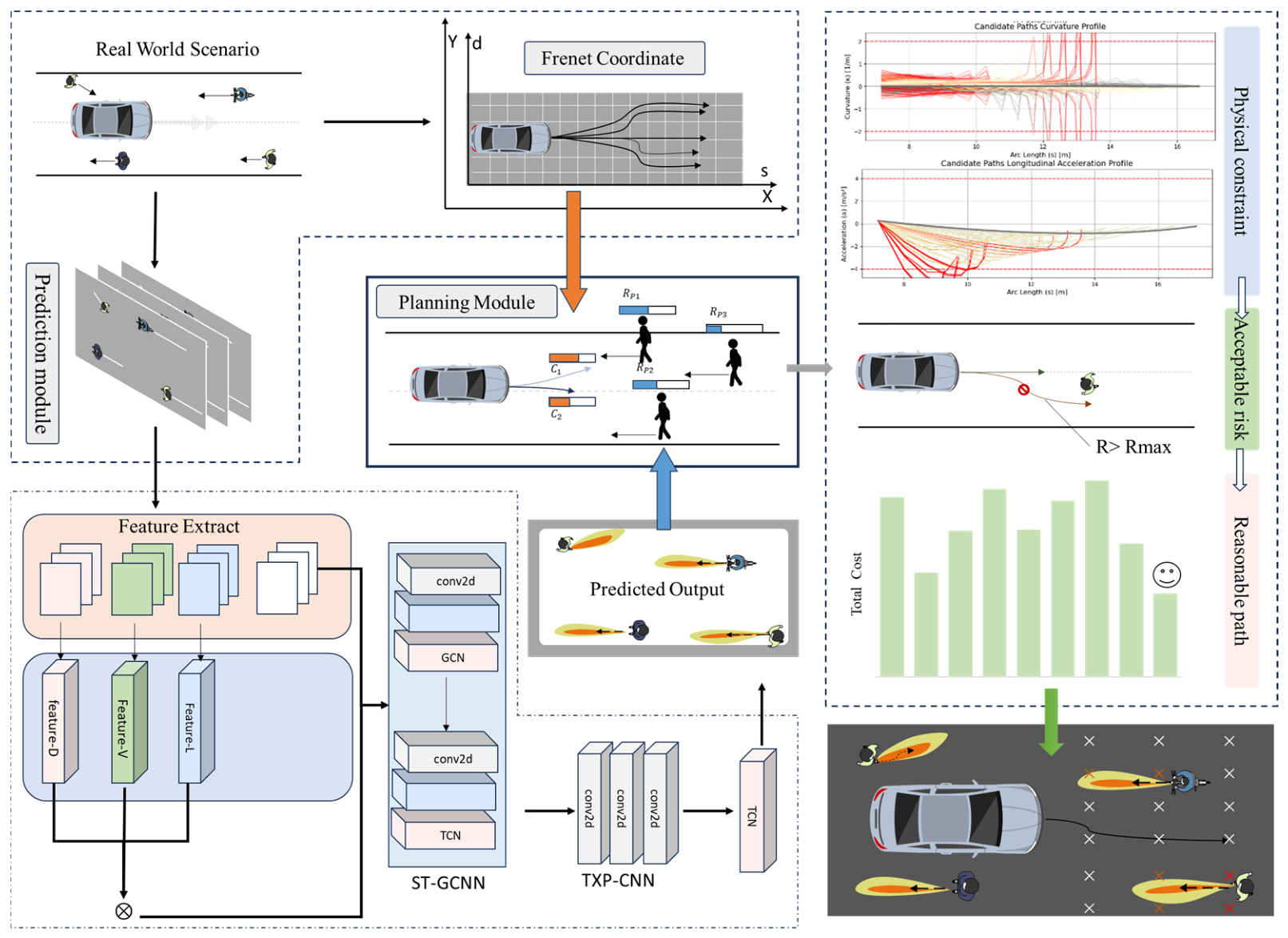
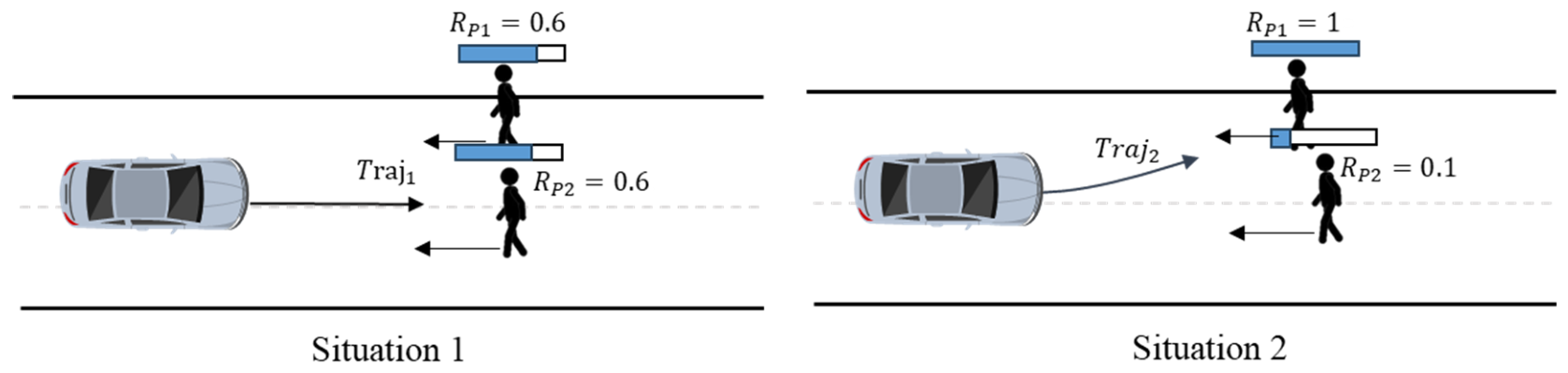
- A trajectory planning framework integrating risk components is proposed: Addressing the complexity of human–vehicle interaction and the principle of equal road rights in shared spaces, this paper introduces a trajectory planning framework incorporating risk division. By considering the variability of pedestrian trajectories and the balanced distribution of risks in shared spaces, an autonomous driving trajectory planning model is generated. This model prioritizes both driver comfort and the safety of surrounding road users.
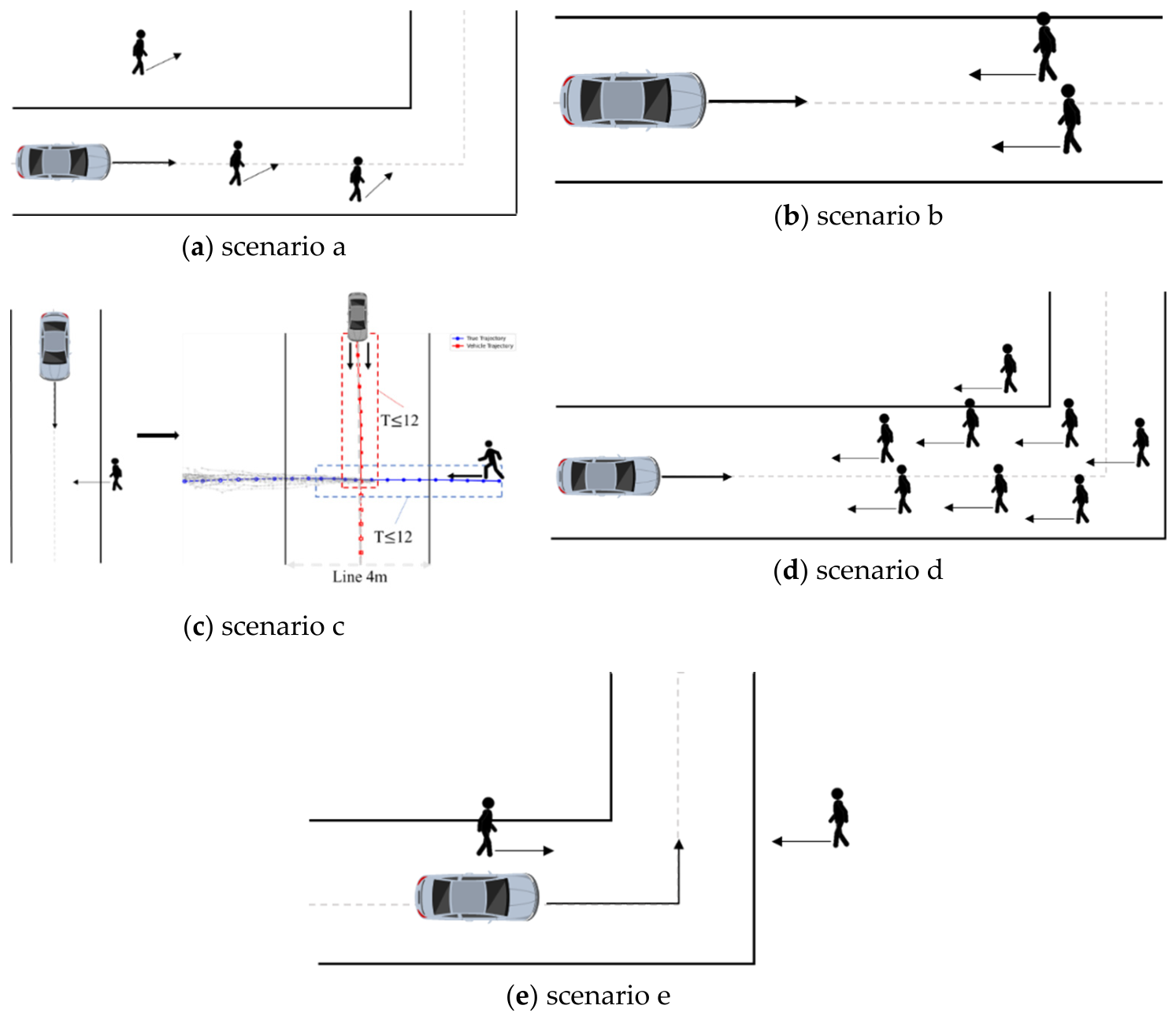
- The safety of the framework is verified by using simulation and real scenarios: This paper is verified in five challenging simulated driving scenarios, showing excellent performance in terms of safety and efficiency. At the same time, the route planned in the real scene is highly similar to the real vehicle path, showing excellent adaptability and robustness.
2. Related Work
3. Methodology
3.1. Prediction Module
3.2. Planning Module
3.2.1. Frenet Coordinate
3.2.2. Longitudinal and Lateral Trajectory Planning
3.2.3. Longitudinal and Lateral Trajectory Assessment
4. Experiment
4.1. Simulation Experiment
4.1.1. Overtaking in the Same Direction
4.1.2. Head-On Collision
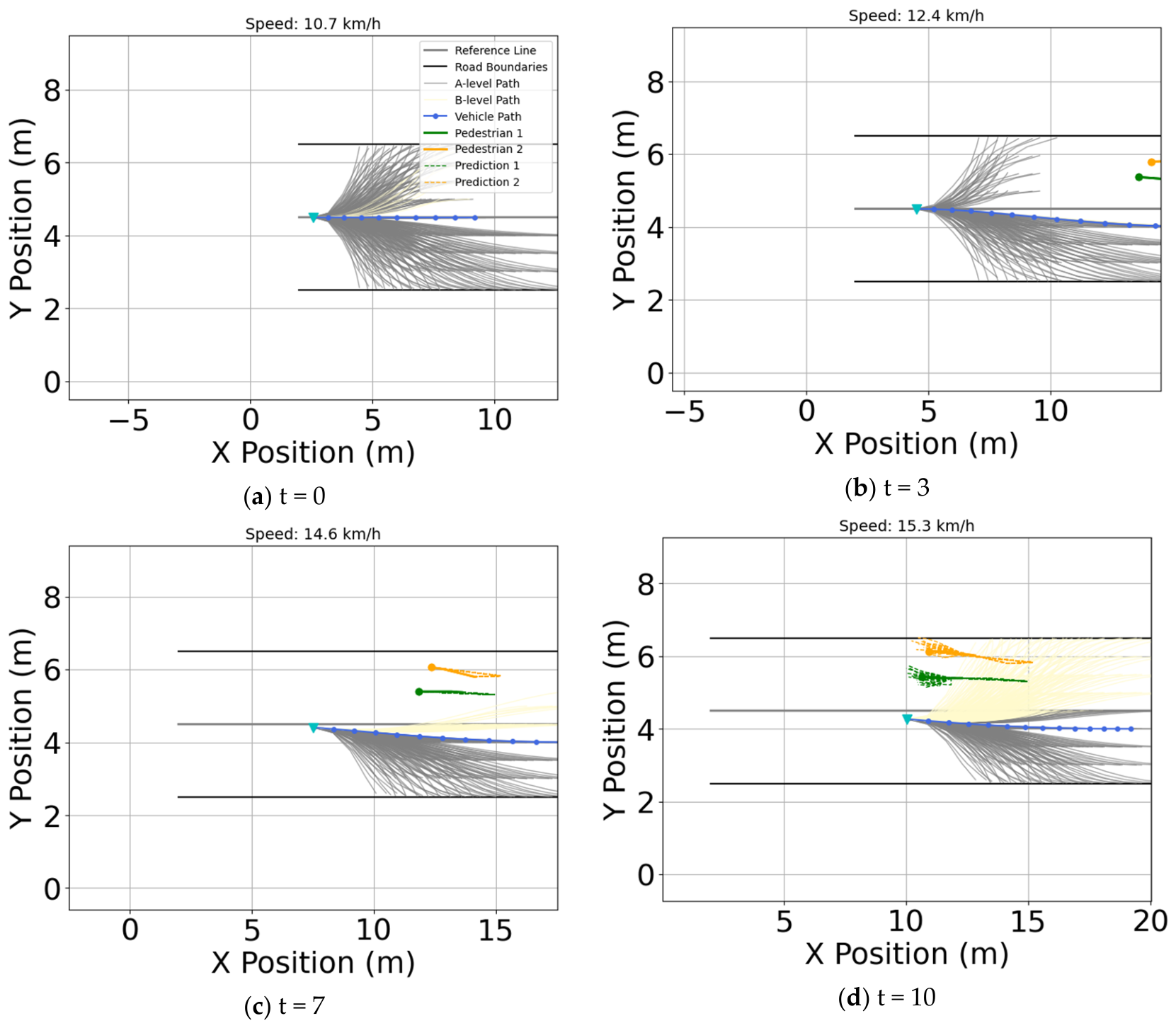
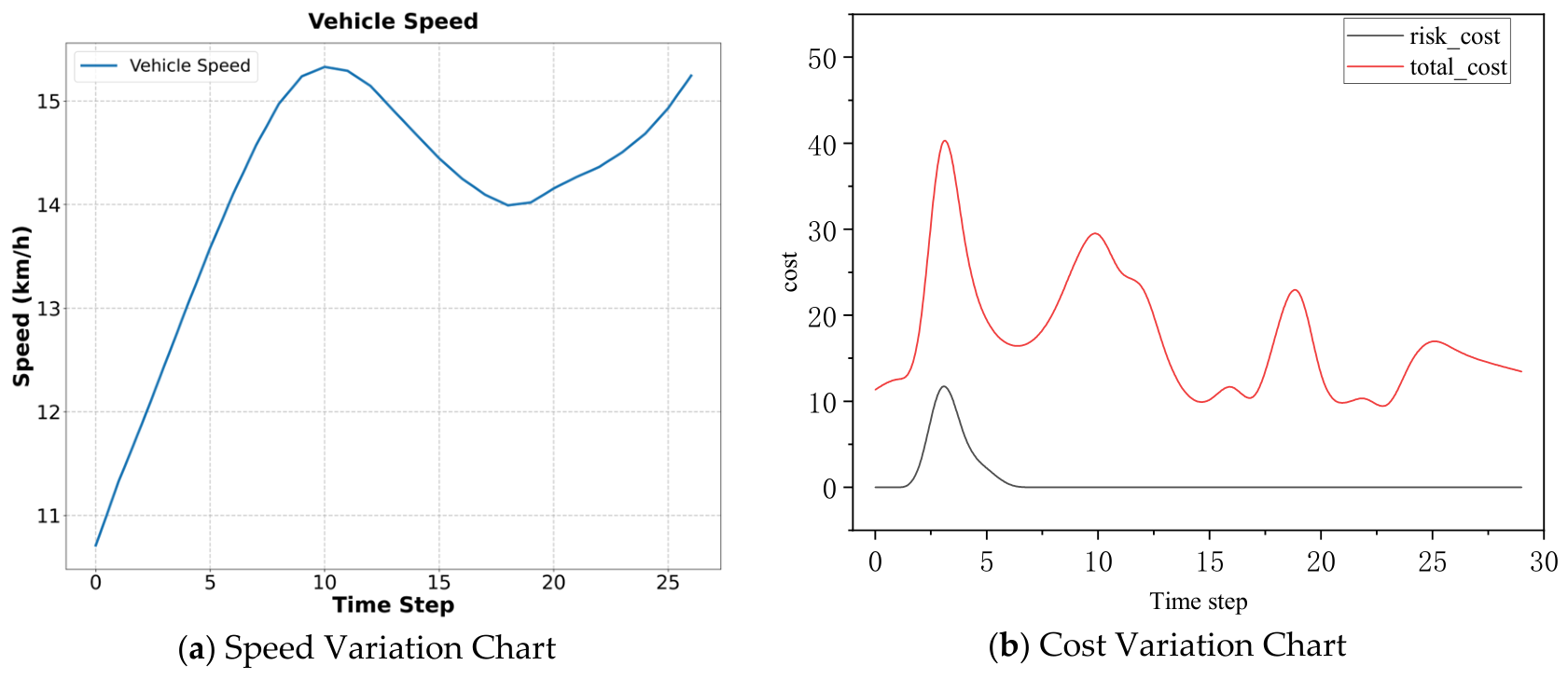
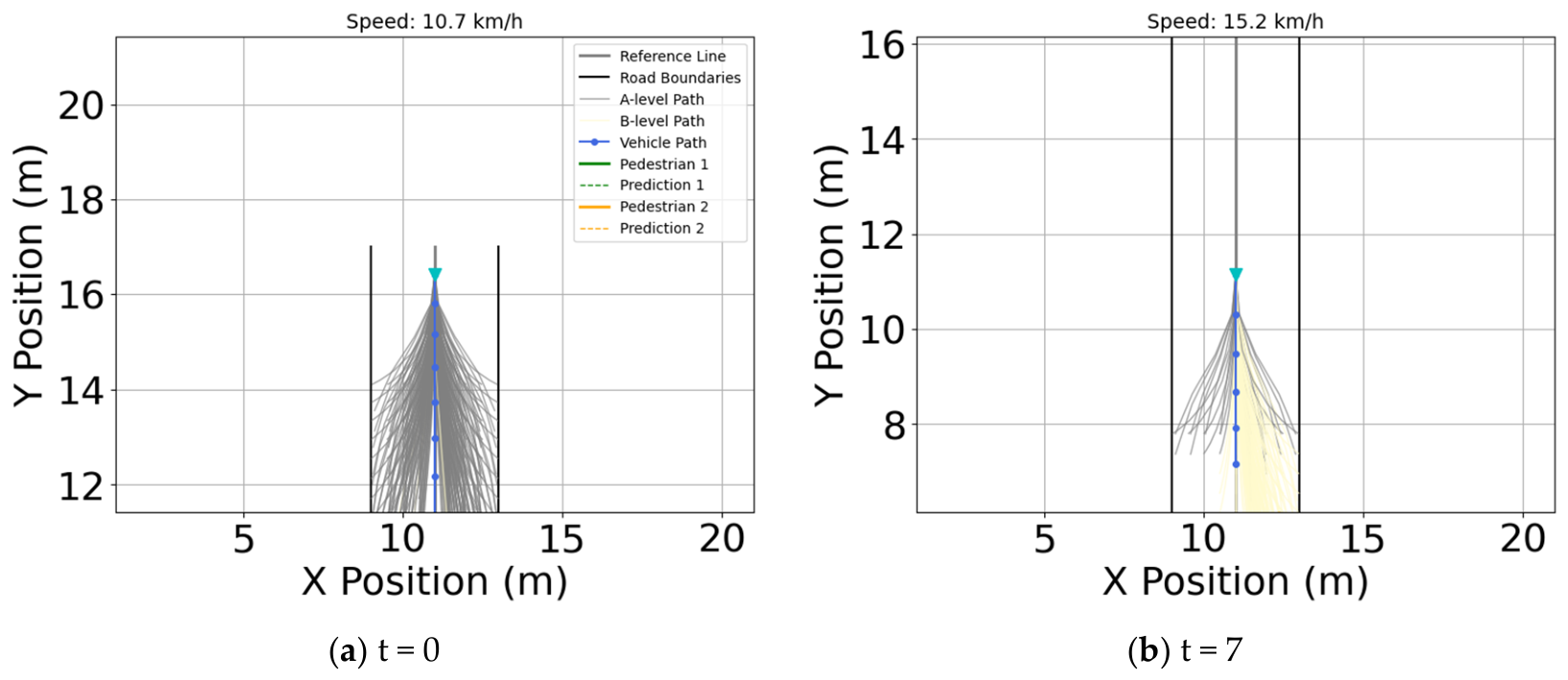
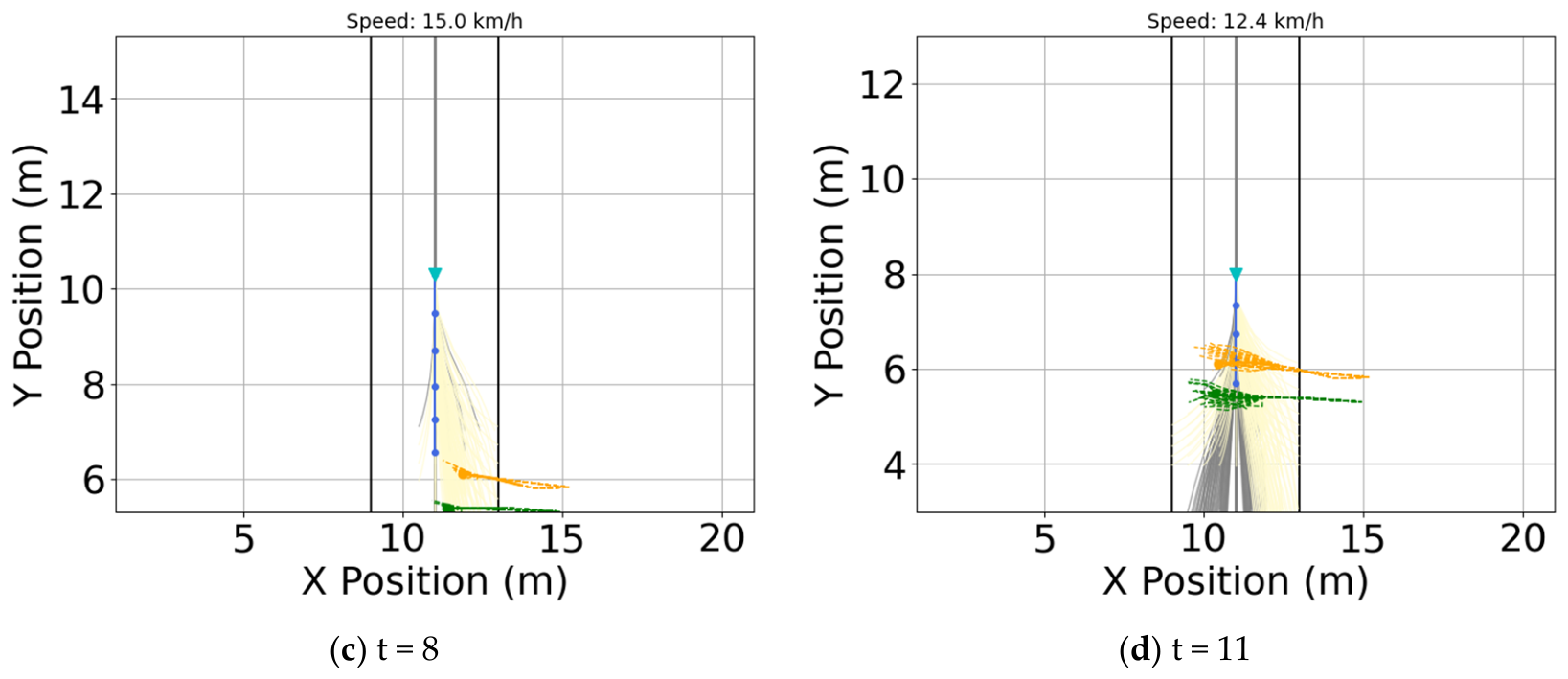
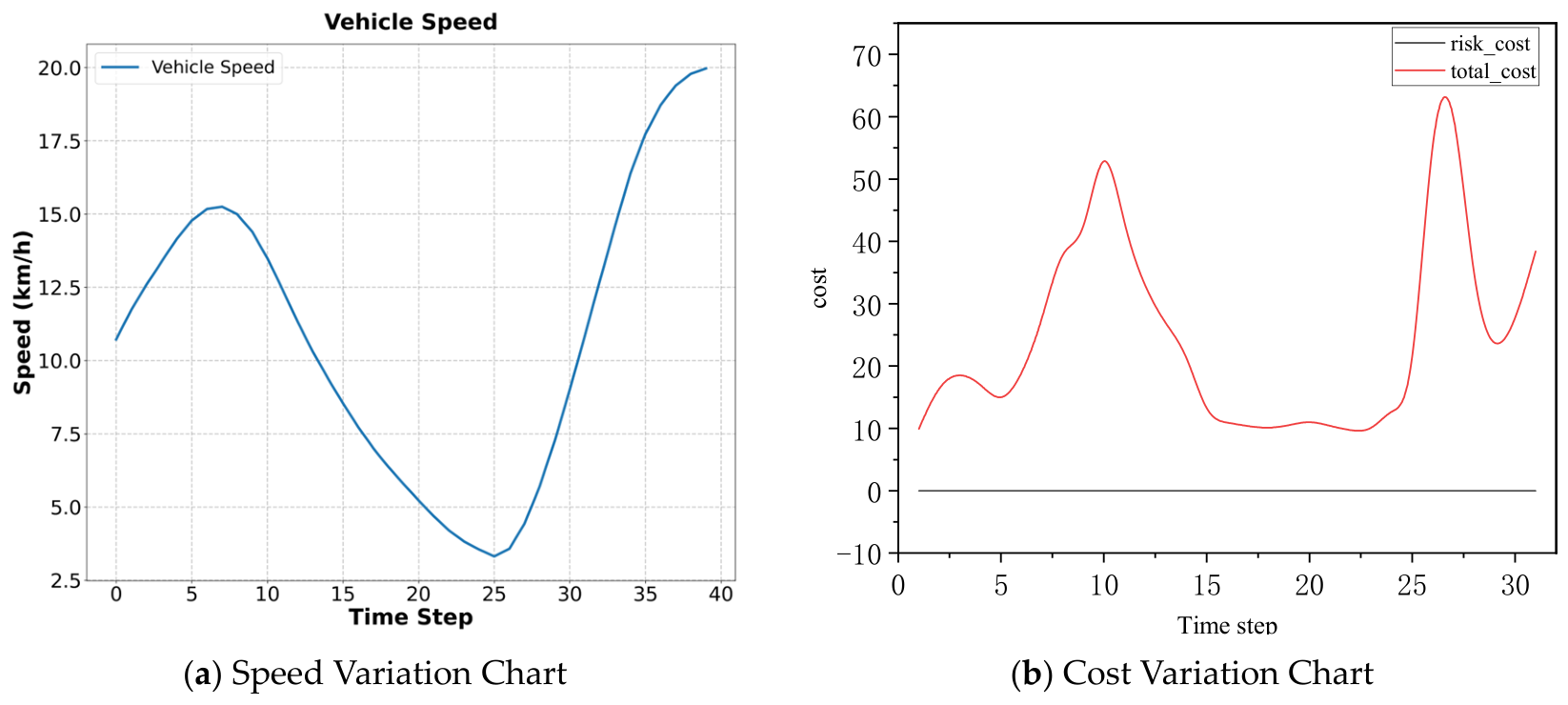
4.1.3. Pedestrian Crossing Collision
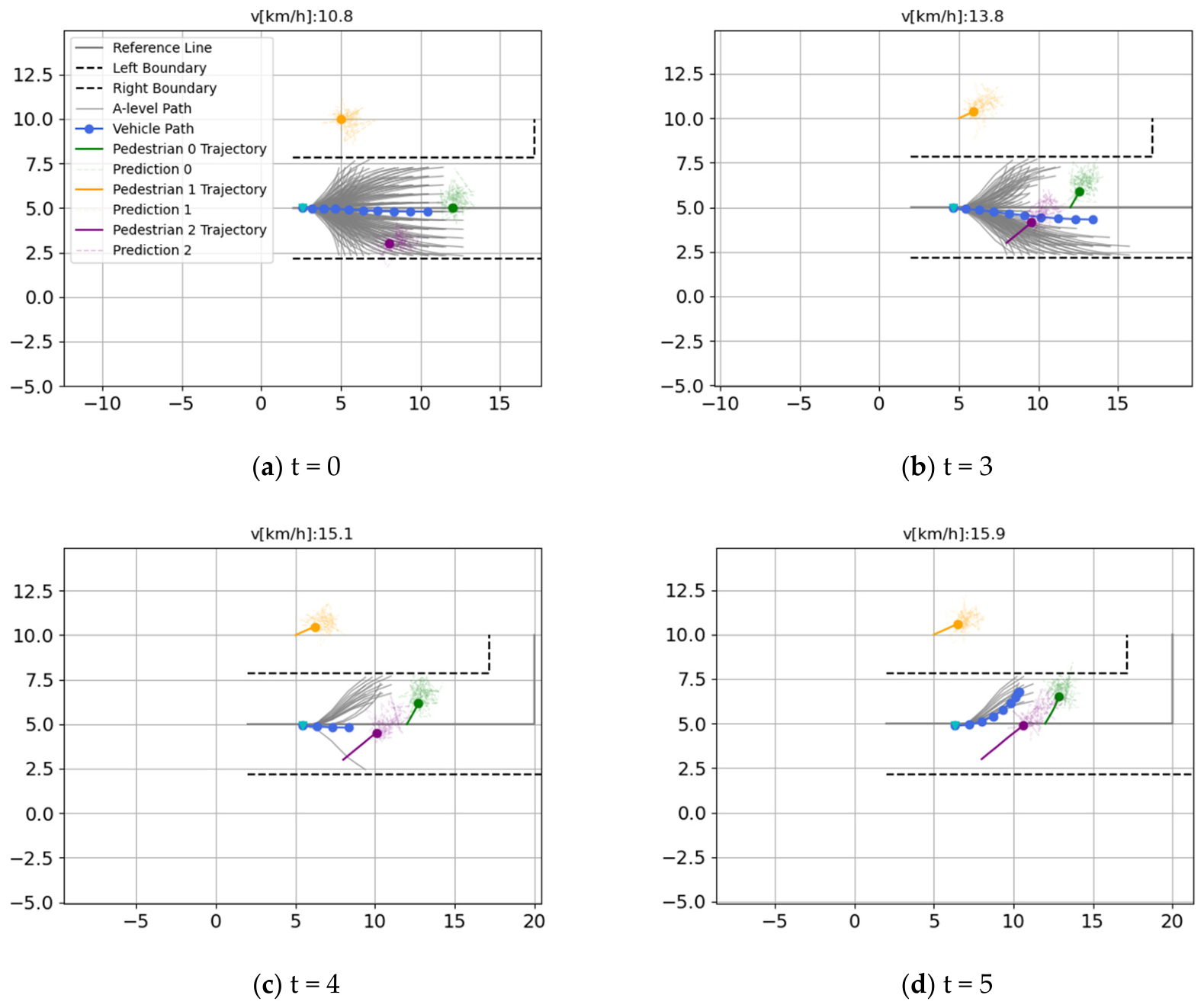
4.1.4. Encountering Pedestrians from Multiple Directions
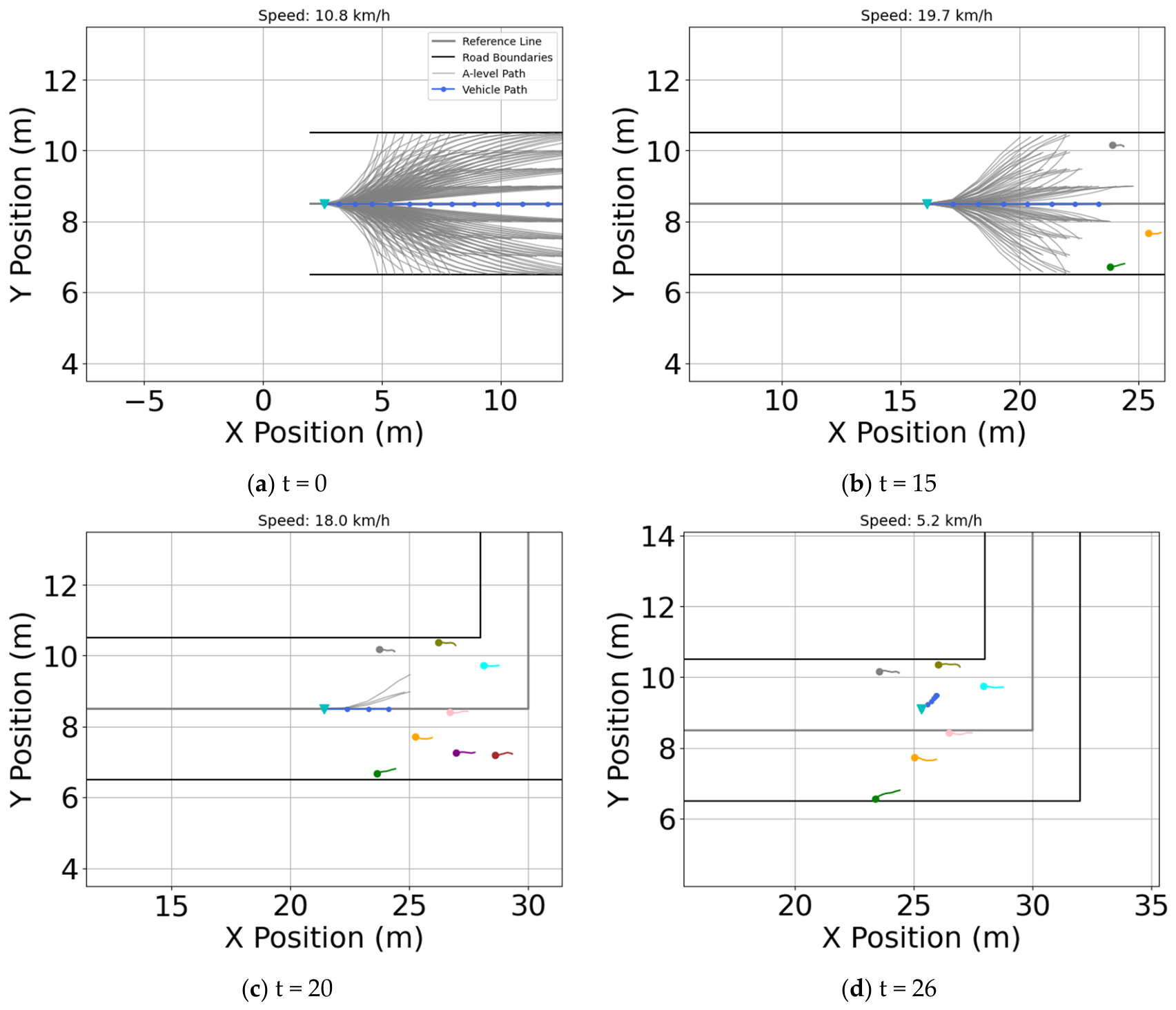
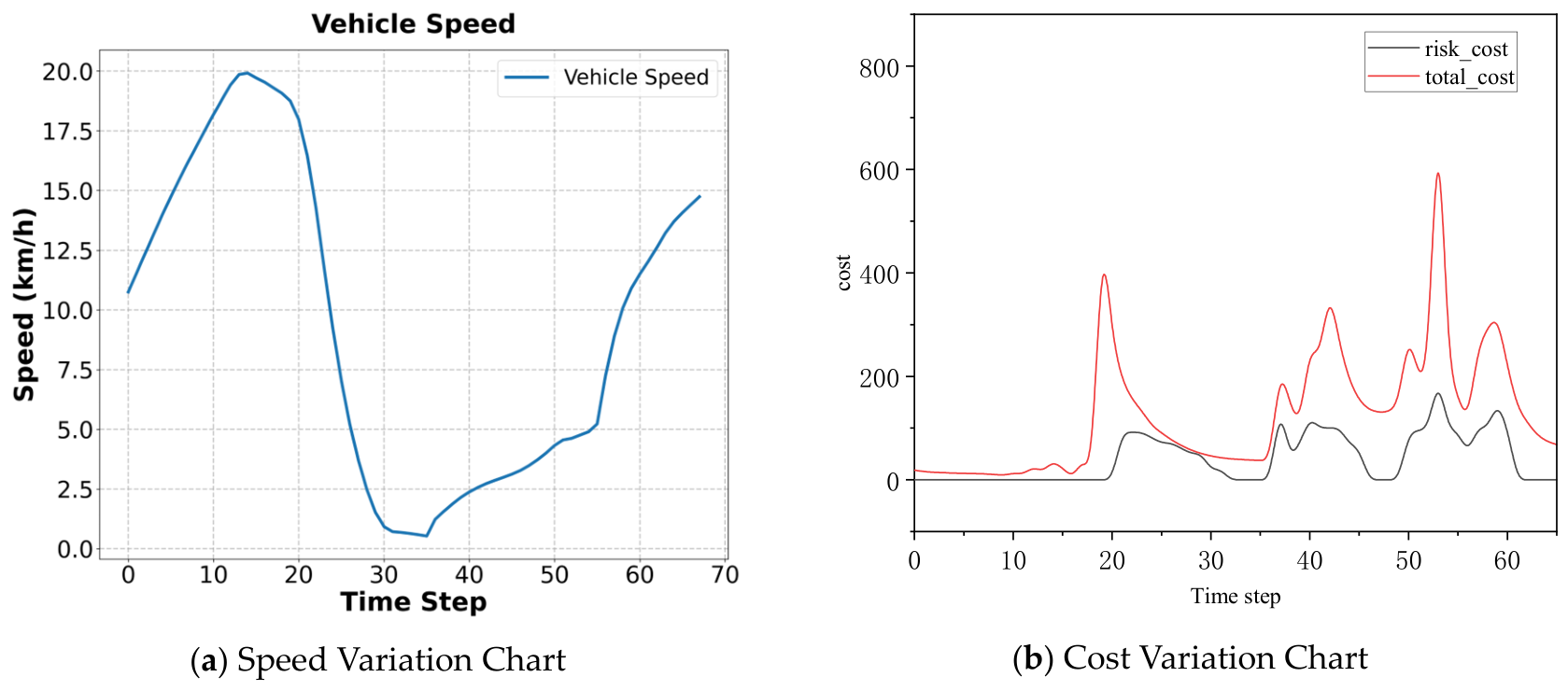
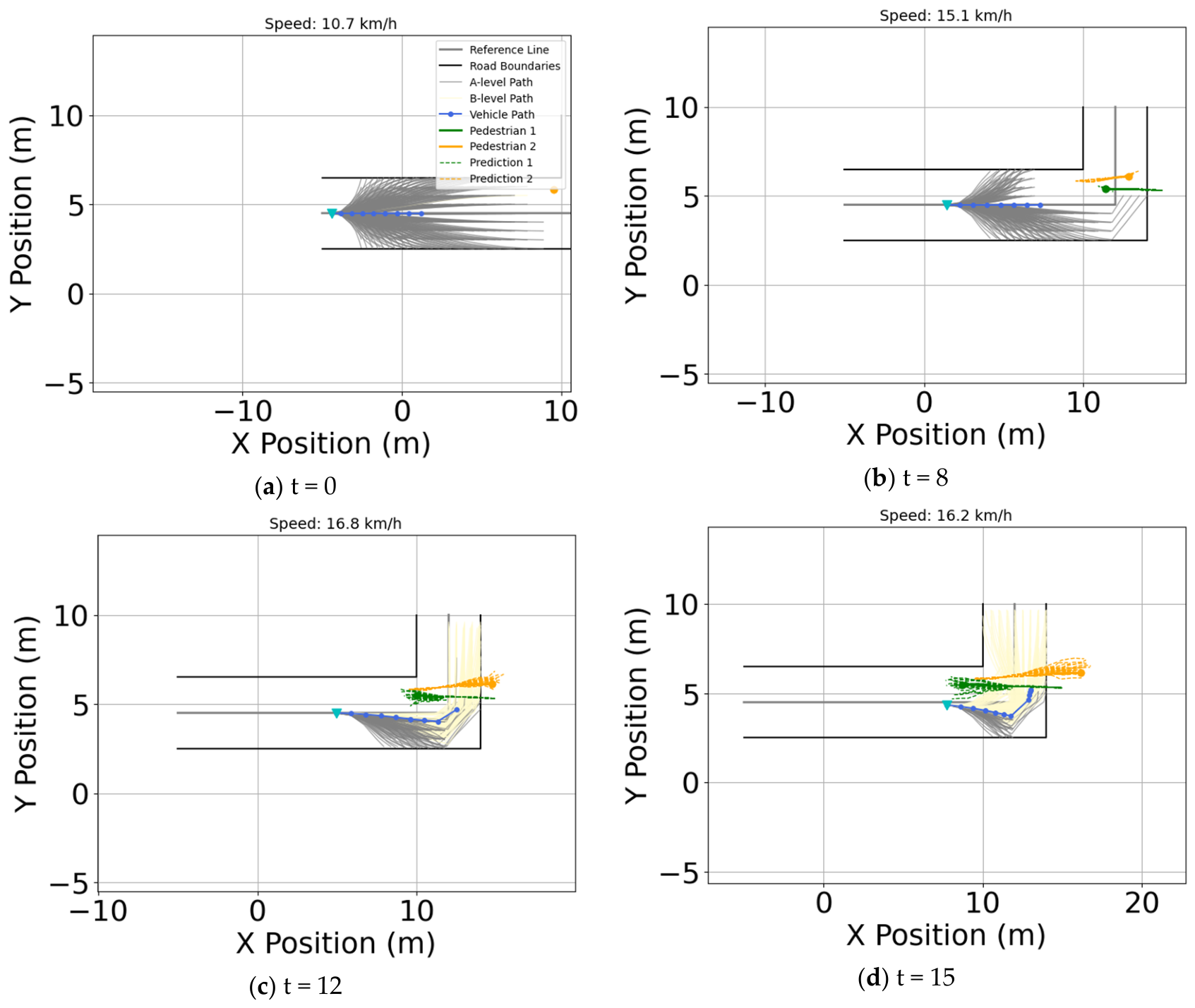
4.1.5. Encountering Pedestrians Crossing While Turning
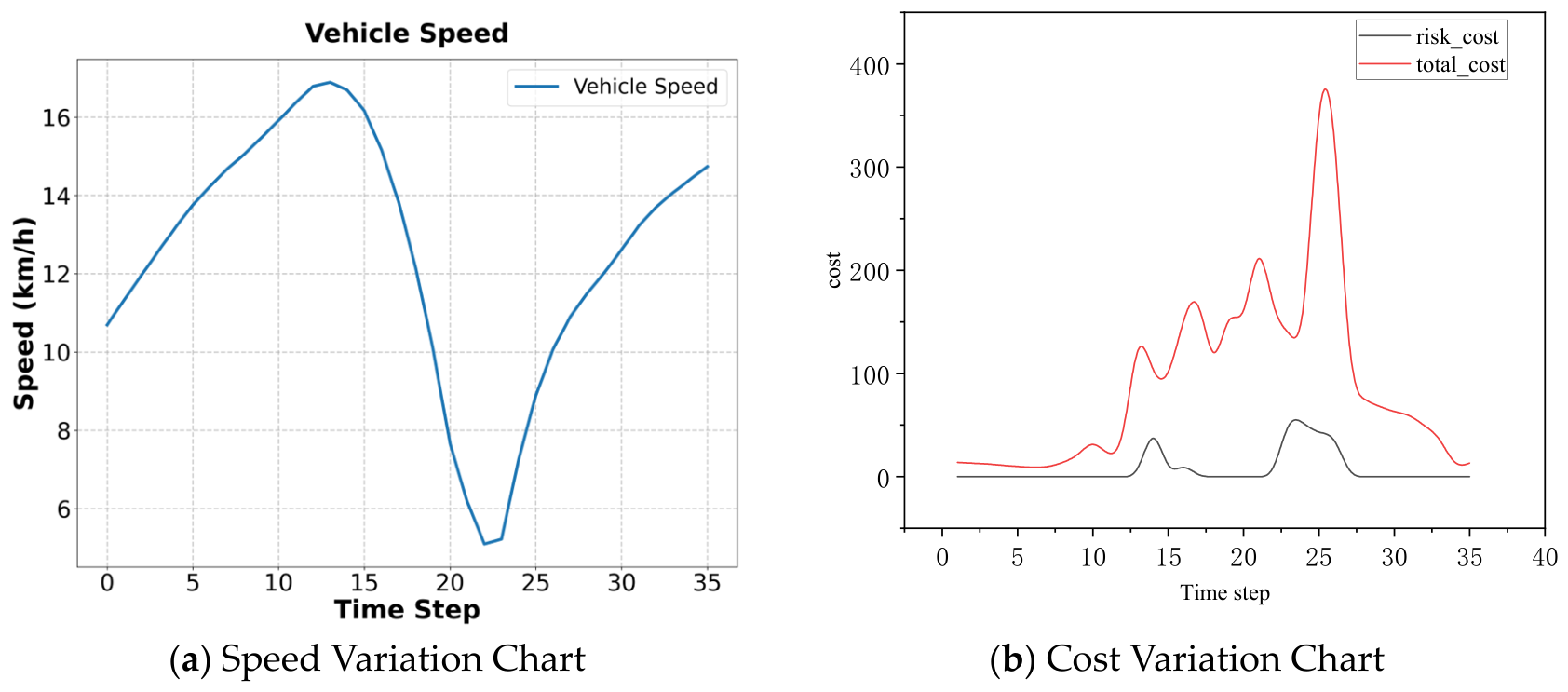
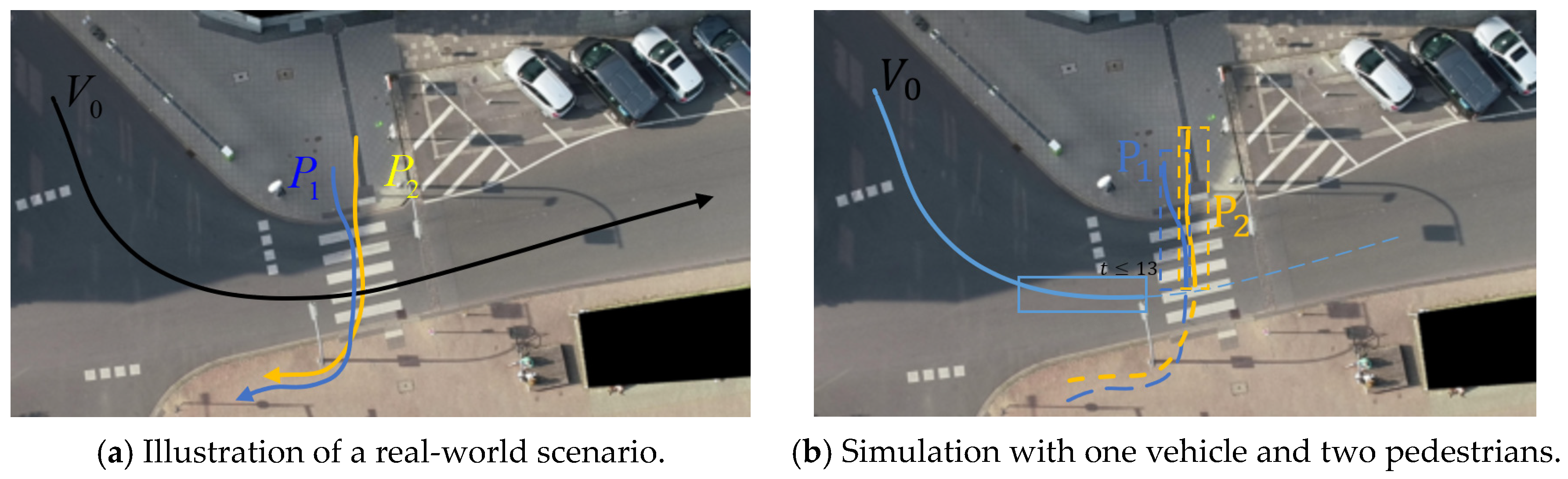
4.2. Real-World Experiment
5. Conclusions
Author Contributions
Funding
Data Availability Statement
Conflicts of Interest
References
- Wang, T.; Ngoduy, D.; Zou, G.; Dantsuji, T.; Liu, Z.; Li, Y. PI-STGnet: Physics-Integrated Spatiotemporal Graph Neural Network with Fundamental Diagram Learner for Highway Traffic Flow Prediction. Expert Syst. Appl. 2024, 258, 125144. [Google Scholar] [CrossRef]
- Wang, T.; Li, Y.; Cheng, R.; Zou, G.; Dantsuji, T.; Ngoduy, D. Knowledge-Data Fusion Oriented Traffic State Estimation: A Stochastic Physics-Informed Deep Learning Approach. Transp. Res. Part C Emerg. Technol. 2026, 182, 105422. [Google Scholar] [CrossRef]
- Li, L.; Lyu, H.; Wang, T.; Cheng, R. STdi4DMPC: Distributed Model Predictive Control for Connected and Automated Truck Platoon with Mixed Traffic Flow Based on Spatiotemporal Trajectory Prediction. IEEE Trans. Veh. Technol. 2024, 73, 14563–14579. [Google Scholar] [CrossRef]
- Xia, T.; Chen, H. A Survey of Autonomous Vehicle Behaviors: Trajectory Planning Algorithms, Sensed Collision Risks, and User Expectations. Sensors 2024, 24, 4808. [Google Scholar] [CrossRef] [PubMed]
- Shared Space: Local Transport Note 1/11—Road Safety Knowledge Centre. 2011. Available online: https://www.roadsafetyknowledgecentre.org.uk/rskc-686/ (accessed on 20 March 2026).
- Werling, M.; Ziegler, J.; Kammel, S.; Thrun, S. Optimal Trajectory Generation for Dynamic Street Scenarios in a Frenét Frame. In Proceedings of the 2010 IEEE International Conference on Robotics and Automation, Anchorage, AK, USA, 3–7 May 2010; pp. 987–993. [Google Scholar]
- Tan, Z.; Wei, J.; Dai, N. Real-Time Dynamic Trajectory Planning for Intelligent Vehicles Based on Quintic Polynomial. In Proceedings of the 2022 IEEE 21st International Conference on Ubiquitous Computing and Communications (IUCC/CIT/DSCI/SmartCNS), Chongqing, China, 19–21 December 2022; pp. 51–56. [Google Scholar]
- Yang, B.; Yan, S.; Wang, Z.; Nakano, K. Prediction Based Trajectory Planning for Safe Interactions Between Autonomous Vehicles and Moving Pedestrians in Shared Spaces. IEEE Trans. Intell. Transp. Syst. 2023, 24, 10513–10524. [Google Scholar] [CrossRef]
- Orsini, F.; Batista, M.; Friedrich, B.; Gastaldi, M.; Rossi, R. Before-after Safety Analysis of a Shared Space Implementation. Case Stud. Transp. Policy 2023, 13, 101021. [Google Scholar] [CrossRef]
- Helbing, D.; Molnár, P. Social Force Model for Pedestrian Dynamics. Phys. Rev. E 1995, 51, 4282–4286. [Google Scholar] [CrossRef]
- Zhang, X.; Cai, J.; Chen, F.; Cheng, R. Multimodal Vehicle Trajectory Prediction and Integrated Threat Assessment Algorithm Based on Adaptive Driving Intention. Chaos Solitons Fractals 2024, 188, 115604. [Google Scholar] [CrossRef]
- Alahi, A.; Goel, K.; Ramanathan, V.; Robicquet, A.; Fei-Fei, L.; Savarese, S. Social LSTM: Human Trajectory Prediction in Crowded Spaces. In Proceedings of the 2016 IEEE Conference on Computer Vision and Pattern Recognition (CVPR), Las Vegas, NV, USA, 27–30 June 2016; pp. 961–971. [Google Scholar]
- Gupta, A.; Johnson, J.; Fei-Fei, L.; Savarese, S.; Alahi, A. Social GAN: Socially Acceptable Trajectories with Generative Adversarial Networks. In Proceedings of the IEEE Conference on Computer Vision and Pattern Recognition (CVPR), Salt Lake City, UT, USA, 18–23 June 2018. [Google Scholar]
- Xu, Y.; Yang, J.; Cheng, R. STG-KNet: A Kernel-Mapping-Based Spatial-Temporal Graph Convolution Network for Pedestrian Trajectory Prediction. Phys. Stat. Mech. Its Appl. 2025, 678, 130985. [Google Scholar] [CrossRef]
- Zhang, Q.; Xing, Y.; Wang, J.; Fang, Z.; Liu, Y.; Yin, G. Interaction-Aware and Driving Style-Aware Trajectory Prediction for Heterogeneous Vehicles in Mixed Traffic Environment. IEEE Trans. Intell. Transp. Syst. 2025, 26, 10710–10724. [Google Scholar] [CrossRef]
- Mohamed, A.; Qian, K.; Elhoseiny, M.; Claudel, C. Social-STGCNN: A Social Spatio-Temporal Graph Convolutional Neural Network for Human Trajectory Prediction. In Proceedings of the 2020 IEEE/CVF Conference on Computer Vision and Pattern Recognition (CVPR), Seattle, WA, USA, 13–19 June 2020; pp. 14412–14420. [Google Scholar]
- Zhu, Z.; Meng, Y.; Cheng, R. Container Truck High-Risk Events Prediction and Its Influencing Factors Analyses Based on Trajectory Data. Systems 2025, 13, 326. [Google Scholar] [CrossRef]
- Dijkstra, E.W. A Note on Two Problems in Connexion with Graphs. Numer. Math. 1959, 1, 269–271. [Google Scholar] [CrossRef]
- Wang, N.; Wang, T.; Zhang, Z.; Shao, S.; Jiang, Y.; Li, Y. Mobile Robot Path Planning Method Based on an Improved A* Algorithm. In Proceedings of the 2022 12th International Conference on CYBER Technology in Automation, Control, and Intelligent Systems (CYBER), Baishan, China, 27–31 July 2022; pp. 140–143. [Google Scholar]
- Yuan, J.; Shao, Q.; Sun, J. Helicopter Trajectory Planning Method Based on Improved IRRT*-D* Algorithm in Forest Fire Rescue Scenarios. Adv. Eng. Inform. 2026, 69, 103947. [Google Scholar] [CrossRef]
- Hu, C.; Ru, Y.; Li, X.; Fang, S.; Zhou, H.; Yan, X.; Liu, M.; Xie, R. Path Tracking Control for Brake-Steering Tracked Vehicles Based on an Improved Pure Pursuit Algorithm. Biosyst. Eng. 2024, 242, 1–15. [Google Scholar] [CrossRef]
- Yang, Y.; Li, Y.; Wen, X.; Zhang, G.; Ma, Q.; Cheng, S.; Qi, J.; Xu, L.; Chen, L. An Optimal Goal Point Determination Algorithm for Automatic Navigation of Agricultural Machinery: Improving the Tracking Accuracy of the Pure Pursuit Algorithm. Comput. Electron. Agric. 2022, 194, 106760. [Google Scholar] [CrossRef]
- Zhang, Y.; Liu, H.; Shen, Y.; He, S.; Wang, H.; Shen, Y. A Systematic Review of Modeling and Control Approaches for Path Tracking in Unmanned Agricultural Ground Vehicles. Agronomy 2025, 15, 2274. [Google Scholar] [CrossRef]
- Kuffner, J.J.; LaValle, S.M. RRT-Connect: An Efficient Approach to Single-Query Path Planning. IEEE Trans. Robot. Autom. 2000, 16, 399–408. [Google Scholar]
- Fan, H.; Huang, J.; Huang, X.; Zhu, H.; Su, H. BI-RRT*: An Improved Path Planning Algorithm for Secure and Trustworthy Mobile Robots Systems. Heliyon 2024, 10, e26403. [Google Scholar] [CrossRef]
- Li, J.; Cheng, R. A Real-Time Adaptive Signal Control Method for Multi-Intersections in Mixed Connected Vehicle Environments. J. Zhejiang Univ.-Sci. A 2025, 26, 801–810. [Google Scholar] [CrossRef]
- Liu, H.; Huang, Z.; Huang, W.; Yang, H.; Mo, X.; Lv, C. Hybrid-Prediction Integrated Planning for Autonomous Driving. IEEE Trans. Pattern Anal. Mach. Intell. 2025, 47, 2597–2614. [Google Scholar] [CrossRef] [PubMed]
- Yan, Y.; Han, D.; Zhang, Q.; Wang, J.; Pi, D.; Chu, D.; Yin, G. Event-Triggered Personalized Driving Based on Passenger’s Subjective Risk Evaluation. IEEE Trans. Intell. Transp. Syst. 2025, 26, 1982–1998. [Google Scholar] [CrossRef]
- Zheng, Y.; Liang, R.; Zheng, K.; Zheng, J.; Mao, L.; Li, J.; Gu, W.; Ai, R.; Li, S.E.; Zhan, X.; et al. Diffusion-Based Planning for Autonomous Driving with Flexible Guidance. arXiv 2025, arXiv:2501.15564. [Google Scholar] [CrossRef]
- Geisslinger, M.; Poszler, F.; Lienkamp, M. An Ethical Trajectory Planning Algorithm for Autonomous Vehicles. Nat. Mach. Intell. 2023, 5, 137–144. [Google Scholar] [CrossRef]
- Huang, Z.; Xie, Y.; Ma, B.; Shen, S.; Ma, J. Fast and Scalable Game-Theoretic Trajectory Planning with Intentional Uncertainties. arXiv 2025, arXiv:2507.12174. [Google Scholar] [CrossRef]
- Guo, Y.; Liu, Y.; Wang, B.; Huang, P.; Xu, H.; Bai, Z. Trajectory Planning Framework for Autonomous Vehicles Based on Collision Injury Prediction for Vulnerable Road Users. Accid. Anal. Prev. 2024, 203, 107610. [Google Scholar] [CrossRef]
- Kirchmair, L.; Paulo, N. Taking Ethics Seriously in AV Trajectory Planning Algorithms. Nat. Mach. Intell. 2023, 5, 814–815. [Google Scholar] [CrossRef]
- Carmona, J.; Guindel, C.; Garcia, F.; de la Escalera, A. eHMI: Review and Guidelines for Deployment on Autonomous Vehicles. Sensors 2021, 21, 2912. [Google Scholar] [CrossRef]
- Li, H.; An, Y.; Li, T.; Li, N.; Zhang, Y.; Yang, P.; Gao, Z. Optimized Method for Dynamic Allocation of Driving Rights and Trajectory Tracking under Human-Machine Co-Driving. In Proceedings of the 2024 8th International Conference on Computer Science and Artificial Intelligence; Association for Computing Machinery: New York, NY, USA, 2025; pp. 127–132. [Google Scholar]
- Wang, X.; Tang, K.; Dai, X.; Xu, J.; Xi, J.; Ai, R.; Wang, Y.; Gu, W.; Sun, C. Safety-Balanced Driving-Style Aware Trajectory Planning in Intersection Scenarios with Uncertain Environment. IEEE Trans. Intell. Veh. 2023, 8, 2888–2898. [Google Scholar] [CrossRef]
- Harsanyi, J.C. Bayesian Decision Theory and Utilitarian Ethics. Am. Econ. Rev. 1978, 68, 223–228. [Google Scholar]
- Shi, L.; Wang, L.; Zhou, S.; Hua, G. Trajectory Unified Transformer for Pedestrian Trajectory Prediction. In Proceedings of the 2023 IEEE/CVF International Conference on Computer Vision (ICCV), Paris, France, 1–6 October 2023; pp. 9641–9650. [Google Scholar]
- Pellegrini, S.; Ess, A.; Schindler, K.; van Gool, L. You’ll Never Walk Alone: Modeling Social Behavior for Multi-Target Tracking. In Proceedings of the 2009 IEEE 12th International Conference on Computer Vision, Kyoto, Japan, 29 September–2 October 2009; pp. 261–268. [Google Scholar]
- Huang, H.; Liu, Y.; Liu, J.; Yang, Q.; Wang, J.; Abbink, D.; Zgonnikov, A. General Optimal Trajectory Planning: Enabling Autonomous Vehicles with the Principle of Least Action. Engineering 2024, 33, 63–76. [Google Scholar] [CrossRef]
- Bonnefon, J.-F.; Černy, D.; Danaher, J.; Devillier, N.; Johansson, V.; Kovacikova, T.; Martens, M.; Mladenovic, M.; Palade, P.; Reed, N.; et al. Ethics of Connected and Automated Vehicles: Recommendations on Road Safety, Privacy, Fairness, Explainability and Responsibility; European Commission: Brussels, Belgium, 2020; ISBN 978-92-76-17868-2. [Google Scholar]
- Wang, X.; Tang, K.; Dai, X.; Xu, J.; Du, Q.; Ai, R.; Wang, Y.; Gu, W. S4TP: Social-Suitable and Safety-Sensitive Trajectory Planning for Autonomous Vehicles. IEEE Trans. Intell. Veh. 2024, 9, 3220–3231. [Google Scholar] [CrossRef]
- Gennarelli, T.A.; Wodzin, E. AIS 2005: A Contemporary Injury Scale. Injury 2006, 37, 1083–1091. [Google Scholar] [CrossRef] [PubMed]
- Najm, W.G.; Smith, J.D.; Yanagisawa, M. Pre-Crash Scenario Typology for Crash Avoidance Research; DOT HS 810 767; The U.S. Department of Transportation, National Highway Traffic Safety Administration: Washington, DC, USA, 2007. Available online: https://rosap.ntl.bts.gov/view/dot/6281 (accessed on 20 March 2026).
- Bock, J.; Krajewski, R.; Moers, T.; Runde, S.; Vater, L.; Eckstein, L. The inD Dataset: A Drone Dataset of Naturalistic Road User Trajectories at German Intersections. In Proceedings of the 2020 IEEE Intelligent Vehicles Symposium (IV), Las Vegas, NV, USA, 19 October–13 November 2019; pp. 1929–1934. [Google Scholar]







| Parameter | |
|---|---|
| Batch size | 128 |
| Epoch | 250 |
| STGCNN | 1 |
| TXPCNN | 5 |
| Learning Rate | 0.01 |
Disclaimer/Publisher’s Note: The statements, opinions and data contained in all publications are solely those of the individual author(s) and contributor(s) and not of MDPI and/or the editor(s). MDPI and/or the editor(s) disclaim responsibility for any injury to people or property resulting from any ideas, methods, instructions or products referred to in the content. |
© 2026 by the authors. Licensee MDPI, Basel, Switzerland. This article is an open access article distributed under the terms and conditions of the Creative Commons Attribution (CC BY) license.
Share and Cite
Luo, Y.; Wang, T.; Wang, Y.; Cheng, R. From Probabilistic Pedestrian Intent to Risk-Optimal Trajectories: A Prediction-Driven Planning Framework in Shared Spaces. Systems 2026, 14, 434. https://doi.org/10.3390/systems14040434
Luo Y, Wang T, Wang Y, Cheng R. From Probabilistic Pedestrian Intent to Risk-Optimal Trajectories: A Prediction-Driven Planning Framework in Shared Spaces. Systems. 2026; 14(4):434. https://doi.org/10.3390/systems14040434
Chicago/Turabian StyleLuo, Yi, Ting Wang, Yunyi Wang, and Rongjun Cheng. 2026. "From Probabilistic Pedestrian Intent to Risk-Optimal Trajectories: A Prediction-Driven Planning Framework in Shared Spaces" Systems 14, no. 4: 434. https://doi.org/10.3390/systems14040434
APA StyleLuo, Y., Wang, T., Wang, Y., & Cheng, R. (2026). From Probabilistic Pedestrian Intent to Risk-Optimal Trajectories: A Prediction-Driven Planning Framework in Shared Spaces. Systems, 14(4), 434. https://doi.org/10.3390/systems14040434